Showing posts with label GM. Show all posts

Tuesday, September 1, 2020

Prelude To Detroit: Ivanka Trump Is Here

Welcome!

https://beverlytran.blogspot.com/search?q=Ivanka+Trump


Ivanka Trump to visit GM’s Warren facilities with CEO Mary Barra

President Donald Trump's daughter, Ivanka Trump, will visit General Motors on Wednesday.

Ivanka Trump will tour the Technical Learning University (TLU) located on GM's Global Technical Center campus in Warren, GM said.

GM CEO Mary Barra will lead Trump on a nearly two-hour tour and highlight GM’s commitment to continued workforce training for hourly skilled trades workers and salaried manufacturing engineers, said GM spokeswoman Jeannine Ginivan.

Ivanka Trump's title is advisor to the president.

Ivanka Trump released her new book, "Women Who Work," on May 2, 2017, seeking to fend off ethics concerns by declining to attend promotional events and promising to donate profits to charity.
This is the first time a Trump administration official has visited GM's facilities, although Barra has been to the White House several times to meet with the president.

Barra's most recent visit to the White House was last fall.

Since then, the president has taken potshots at the automaker over Twitter. In April, the president chided GM for dragging its feet in getting lifesaving ventilators to the front lines in the battle against coronavirus.

Then, 72 hours later, Trump changed course, extolling GM after it announced its plans two days prior to make ventilators with Ventec Life Systems at GM's Kokomo, Indiana, plant.

On Monday, GM delivered the last of 30,000 ventilators it owed the federal government as part of a $489-million contract.

The president was also critical of Barra when GM said it would shut down four U.S. factories. On Twitter, Trump urged Barra to keep Lordstown Assembly in Ohio running. But GM closed it and sold the facility, transferring thousands of workers to plants across the United States.

The issue of manufacturing is in the forefront as the election nears. Michigan is a critical swing state that Trump won in 2016, helping him capture the presidency.

GM has repeatedly said it plans to launch at least 20 all-electric vehicles by 2023. It recently unveiled the Cadillac Lyriq SUV, but GM has not said where it will built. GM is spending $2.2 billion to retool Detroit-Hamtramck Assembly to make all-electric vehicles starting later next year. But a source familiar with Cadillac's plans said the Lyriq would not be one of the vehicles made there.

During Ivanka Trump's visit, Barra will tout GM’s TLU, which is based on an initiative that was started in 2017. It is a technical training center that offers a number of programs.

Last month, TLU completed a $2 million upgrade to its manufacturing laboratory facilities.

Voting is beautiful, be beautiful ~ vote.©

Thursday, August 20, 2020

Michigan Breaks Ground Building The Flint Children's Trust Model - Light Up That Network

The State of Michigan has initiated the first leg in the construction of the children's trusts in the intentional poisoning of Flint's posterity, the children.
preliminary settlement of the

Not the Michigan Children's Trust, but it seems there is a viable option for each child to access their own, individual trust, like a blockchain.

That would be a logical purpose to the contact tracing, considering the fact that Michigan is #1 in the nation when it comes to trafficking tiny humans through its Child Welfare System, which is still under the purview of Nancy Edmunds.

What would be really exciting is to see if the settlement structure continues through the network of those Public Private Partnerships, that were formed as a result of the privatized contracting which falsely advised elected officials.

Just think if, in the continuance of identifying other, private, foreign corporations, there was found suspected violations of law and policy, which were referred to the proper jurisdiction of law enforcement, to provide reparations to the individual trusts of the children?

What about JonesDay and all of those Michigan advisors in Trump's White House Cabinet?

What about #perkinscoiesucks?

Light up that network.

Hey, Mittens, any comments at the Republican National Convention?

I just adore transposable models and I am sure the children will, too.

#maytheheavensfall

Michigan reaches over $500M settlement in Flint water crisis civil suits

The state of Michigan has reached a more than $500 million settlement that would put to rest lawsuits arising out of the Flint water crisis, two sources with knowledge of the agreement confirmed Wednesday.

The sources weren't authorized to speak publicly on the matter, which is a significant development in a years-long legal fight that's garnered national attention.

The state of Michigan has reached a more than $500 million settlement that would put to rest lawsuits arising out of the Flint water crisis, two sources with knowledge of the agreement confirmed Wednesday.
Details about the settlement arising out of the Flint lead-contaminated water crisis are expected to be spelled out Friday. The deal comes after several years of litigation in which Flint residents pursued damages from the state for the lead-contaminated water piped into many households.

The settlement would be one of the largest in the state's history.

Marc Edwards, the Virginia Tech professor and water expert who tested city water at Flint households and helped expose the lead contamination, responded quickly to the news of a settlement.

"If money is how government expresses sorrow for its crimes — this is a big apology," Edwards said.

Flint Mayor Sheldon Neeley was not part of the settlement discussions, but he said Wednesday that he is "anxiously awaiting closure."

"We’re just staying positive and moving our community forward in a positive direction," said Neeley, who was a city councilman during the water source switch to the highly corrosive Flint River in 2014.

Flint Councilman Eric Mays called the settlement a “good start.”

“I always believed we would be somewhat successful in the civil lawsuits,” Mays said Wednesday. “I will hold my breath and wait till Friday.


“I believe a major portion of that (money) will go towards kids 5, 6 years old in that age group,” added the councilman, who is a member of the class-action civil lawsuit. “I will be waiting to see what the attorney fee portion might be out of that.”

Ryan Jarvi, a spokesman for Michigan Attorney General Dana Nessel, declined to provide details or confirm a settlement had been reached Wednesday night.

Flint Councilman Eric Mays
Nessel's office and Gov. Gretchen Whitmer's office have been engaged in ongoing mediation effort in Flint water cases for more than 18 months, Jarvi said.

"We and the other parties are bound by a federal court order to maintain the confidentiality of detailed settlement and mediation communications until we reach a certain point," Jarvi said. "We have not yet reached the point where we can discuss a potential settlement."

Nessel said last year that she was in discussions regarding the negotiations with Whitmer and legislative leaders about the settlement, which will likely require lawmakers to appropriate state funds.

The governor's office isn't at the point where it can discuss a potential settlement in the case, Whitmer's spokeswoman Tiffany Brown said Wednesday.

"Since taking office, the governor's and the attorney general's teams have been working steadily to reach a resolution of the Flint water cases, and they continue to do so," Brown said.

Through June 2019, Michigan was the subject of 79 Flint related lawsuits in state and federal court. Over the years, some suits have been consolidated for case management purposes.

It is not clear whether the settlement expected Friday resolves all of the civil suits filed against the state or a majority of them.

The state also had filed its own civil suit against engineering companies that had been hired by the Flint government as consultants when the city switched its water source. Nessel has said she expected any settlement from the lawsuits against Veolia and LAN would offset what the state would eventually pay in the state and federal civil litigation.

The settlement comes as the state faces what experts say could be up to a $3 billion hole in next year's budget because of decreased tax revenue during the coronavirus pandemic.

The state has a fund that it draws settlement money from, but never one of this proportion. The settlement amount calls for the involvement of the Legislature to appropriate more money toward the agreement.


Between 2015 and 2019, the state has pulled $15.1 million from the Lawsuit Settlement Proceeds Fund — a fund containing settlements in favor of the state — for Flint water investigations and legal defense costs alone, according to a January 2019 report by the House Fiscal Agency.

Between 2008 and 2018, the state paid $441.4 million in settlements across all departments, according to a Senate Fiscal Agency report.

The largest settlement in the past 10 years that comes close to the expected Flint deal appears to be an agreement reached in February requiring the Michigan Department of Corrections to pay $80 million to settle a lawsuit with former juvenile offenders who contended they were sexually abused in Michigan prisons. In 1996, the Corrections Department also reached a $100 million resolution in a separate case in which female prisoners alleged sexual misconduct and harassment by male officers.

Michigan Attorney General Dana Nessel
The Flint lawsuits were prompted after the state had appointed a series of emergency managers to operate the city of Flint after years of financial distress. Under state oversight, the city's water source was switched in April 2014 from water provided by the regional Detroit Water and Sewerage Department system to the Flint River. Flint was switched back to the Detroit system in October 2015.

The more acidic river water was not treated with anti-corrosion chemicals upon the advice of Michigan environmental department experts. A panel formed by former Gov. Rick Snyder found that the series of events led to the acidic river water corroding aging city water lines, resulting in the leaching of lead into the drinking water.


Experts have argued the contamination also resulted in two outbreaks of Legionnaires’ disease that resulted in at least 13 deaths in the Flint area.

The expected settlement comes nearly two months after a divided Michigan Supreme Court ruled a class-action lawsuit against the state — one of many civil suits filed after the water contamination — could proceed on the argument that Flint residents should be able to recover the value of their property alleged to have been improperly taken due to the contamination.

Todd Flood, the former special prosecutor for the criminal cases under then-Attorney General Bill Schuette.
Todd Flood, the former special prosecutor for the criminal cases under then-Attorney General Bill Schuette, praised the civil side attorneys and officials “for their steadfast efforts in making sure the victims are whole in the city of Flint and for Gov. Gretchen Whitmer closing this deal and making sure that victims were taken care of.”

“I worked hard with Noah Hall on the civil side of this case to make sure that we could do everything we could,” Flood added. “And that’s the first step in the process of justice."

In June 2019, Solicitor General Fadwa Hammoud dropped all pending criminal cases in Flint in to reboot the probe that had begun under Schuette. Hammoud replaced Special Assistant Attorney General Noah Hall with assistant attorney generals working to defend the state from civil lawsuits.

Nessel had ceded authority over the criminal cases to Hammoud to build a conflict wall between the civil cases, which Nessel oversaw, and the criminal cases, which fell under Hammoud’s purview.

Trials for former Michigan Department of Health and Human Services Director Nick Lyon and former Chief Medical Executive Eden Wells on manslaughter and other charges were dismissed. Charles also were dropped against six other state and Flint officials.

Hammoud’s investigation is still ongoing.

The state needs to shift its focus to criminal prosecutions next and revive charges, Mays said.


"The second step (of justice) will be coming, I’m sure," former special prosecutor Flood said, "with the criminal side of the case. I’m prayerful that that will come.”

Voting is beautiful, be beautiful ~ vote.©

Tuesday, August 4, 2020

Prelude To Detroit: Where In The World Is Paul Whelan?

And the chaos escalates...

https://beverlytran.blogspot.com/search?q=paul+whelan

US Embassy in Moscow: No info on Paul Whelan’s whereabouts

Paul Whelan, a former U.S. Marine, who was arrested in Moscow at the end of last year, was detained at the end of December for alleged spying.
Paul Whelan
Moscow – The US Embassy in Moscow said Tuesday it had no information on the whereabouts of an American convicted in June of espionage, despite reports that he is being transferred to a prison colony in central Russia.

Paul Whelan’s brother David said Tuesday on Twitter that he “appears to now be in Mordovia, on his way to prison camp IK-17.” The republic of Mordovia, about 350 kilometers (210 miles) east of Moscow, is home to several prison camps.

Paul Whelan, a former U.S. Marine, who was arrested in Moscow at the end of last year, was detained at the end of December for alleged spying.
Paul Whelan, a former U.S. Marine, who was arrested in Moscow at the end of last year, was detained at the end of December for alleged spying. (Photo: Pavel Golovkin, AP)

The Interfax news agency cited David Whelan as saying he received the information from the British Embassy. Paul Whelan holds US, British, Irish and Canadian citizenship.

US Embassy spokeswoman Rebecca Ross said on Twitter: “We have not received official notification from Russian authorities of any such move, despite our repeated recent attempts to gain consular access to Paul.”

Whelan, a former corporate security executive from Michigan, was arrested in Moscow in December 2018; he was convicted in June and sentenced to 16 years in prison. Whelan’s lawyer has said his client was handed a flash drive that had classified information on it that he didn’t know about.

Voting is beautiful, be beautiful ~ vote.©

Thursday, July 16, 2020

Tales Of The New Crown: AG Boo Boo Barr Is In Grand Rapids With Matt Schneider & Andrew Birge On China

Bill "Boo Boo" Barr deserves a standing ovation in his open mike poetry afternoon session in Grand Rapids, Michigan.

The topic was China.

Did Boo Boo talk about the U.S. Patent & Trademark Office in Detroit, or how it even came to be the first satellite PTO outside of DC?

Nope, but he did use lots of alliteration and WWII Disney references when talking about "bowing" to Beijing.

Did Boo Boo talk about China and the DNC?

Nope.

Did Boo Boo talk about how a bunch of folks from other nations, hanging out in China, as I cannot call them Chinese, because I have yet to see any passports or corporate parental filings, running fake ass LLCs, fake ass mortgages, and fake ass quiet titles in Detroit?

Nope.

Did Boo Boo Barr talk about the U.S. auto industry in China?

Nope, well, there are ongoing actions with MIED, so he probably was not allowed to speak upon it.

Not a peep about the Vatican.


Overall, the speech was one of his better ones because Matt Schneider and Andrew Birge were there.

#maytheheavensfall

In Grand Rapids, Barr decries China's 'predatory' trade practices

U.S. Attorney General William Barr decried China's "predatory" trade policies during a 30-minute speech in Grand Rapids on Thursday, accusing the country of manipulating American businesses, stealing trade secrets and attempting to hack U.S. efforts to develop COVID-19 treatments and vaccines. 

China's ultimate goal since the 1980s, "isn't to trade with the United States, it is to raid the United States," Barr said from the podium at the Gerald R. Ford Presidential Museum. 

"No one should underestimate the ingenuity and industry of the Chinese people," he said. "At the same time, no one should doubt the United States made China’s meteoric rise possible.”

Thursday's appearance in Grand Rapids was Barr's first in roughly 30 years when he visited the area while working under former President George H.W. Bush, he said.

"I feel a special bond to the Ford administration, so it's appropriate to be here today," said Barr, who worked in the CIA under Ford appointees in the 1970s.

"I had the privilege to work with many of the superb people he brought into government, many of whom I had the opportunity to work with over the years, several of whom were my mentors," he said.

Barr's appearance at the museum is his first in Michigan since Schneider filed a "state of interest" on behalf of the Department of Justice in a federal lawsuit brought by seven businesses challenging the governor's executive orders to combat COVID-19. 

Federal prosecutors claimed credit for moving the needle on reopening when, four days after the statement was filed, Gov. Gretchen Whitmer moved Michigan out of a stay-home order and into loosened restrictions allowed under her reopening plan. 

The lawsuit filed by the businesses is ongoing.

During his speech Thursday, Barr also alleged China's influence had infiltrated not only manufacturing and production but also film production companies, technology firms, the pharmaceutical market and universities. 

Chinese hackers have targeted American universities and researchers to steal information on the development of COVID-19 treatments and vaccines, Barr said. They're hoping the introduction of a treatment by China would redeem its role in spreading the virus, he said.

"Beijing is desperate for a public relations coup and may hope it could take credit for any medical breakthroughs," he said. 

Voting is beautiful, be beautiful ~ vote.©

Monday, July 13, 2020

Matty Moroun, Owner Of The U.S. Southern Boarder Ambassador Bridge Is Extracted From Humanity

Image may contain: sky, tree and outdoor
Ambassador Bridge
This is deep.

This just about pulls the rug from under all the "Elected Ones" in Detroit and the 2020 Primary Election is August 4th.

This should unravel fast.

The Ambassador Bridge is how everything goes in and out of North America.

Keep that in mind, the busiest international, southern border crossing in North America and port no one wants to talk about.

 I can see Canada from upstairs....not really, but I do see John James and the Detroit Port Authority.

This is John James.

John James 3.png
John James
https://teabagsandcoffeegrinds.blogspot.com/search?q=John+James

https://www.facebook.com/katie.hirzel?sk=wall

Kate Hirzel
'My apartment decided to do something very cool this past summer. Every weekend we invited interns, friends, classmates, etc. to our apartment. This past weekend was the last time all of my roommates were together, so we invited everyone who had ever come over the past couple months. What a wonderful summer spent with amazing people from all over the world. Ironically, I think I met more people from other countries than from the US while in our nations capital. Very fortunate and incredibly lucky. Sad to only have one month left-happy that this will become my home in less than a year 😌'

https://www.vistamaria.org/programs/

https://www.bloomberg.com/profile/company/0371373D:US

https://www.bloomberg.com/profile/person/18951095

http://www.portdetroit.com/lorron-james/

Detroit Riverfront Conservancy
Home
https://detroitriverfront.org/


Detroit/Wayne County Port Authority

No photo description available.
http://www.portdetroit.com/

I also see the Emergency Manager Law, the fake ass Detroit Bankruptcy, and the Detroit Public Schools Emergency Manager Human Asset Forfeiture op.


#maytheheavensfall

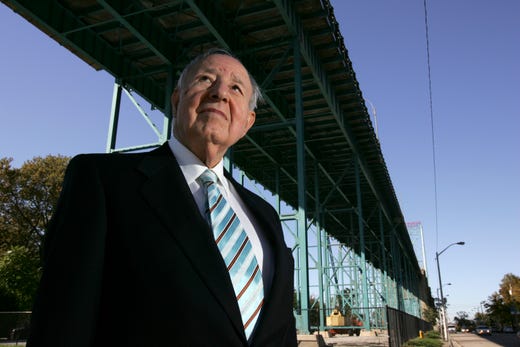
Manuel 'Matty' Moroun, owner of Ambassador Bridge, dead at 93

Detroit businessman and Ambassador Bridge owner Manuel "Matty" Moroun has died at age 93. He is seen standing beneath the Ambassador Bridge in Windsor, Ontario in 2008.
Matty Moroun
Detroit billionaire businessman Manuel "Matty" Moroun died Sunday of congestive heart failure, two sources confirmed to The Detroit News. He was 93.

A letter announcing the trucking magnate's death was sent to employees Monday morning from his only son, Matthew Moroun, who in recent years managed the diversified holdings and worked to improve the company's public image.

The elder Moroun was the owner of the international trucking and logistics company, Central Transport International, and the Ambassador Bridge. Another of his companies also owned Michigan Central Depot, a hulking relic looming over Corktown that came to symbolize Detroit's hard times, before selling the station to Ford Motor Co. in 2018.

Moroun exemplified a mostly bygone era in the low, slow arc of Detroit's reinvention — a secretive mogul who used the levers of politics and contributions to influence policy making that could benefit his private business interests more than the public good. And that gave voice to critics on both sides of the U.S.-Canada border.

A resident of Grosse Pointe Shores, Moroun was a longtime political donor defined in recent years by his frequent clashes over property ownership and use in the Detroit area. Moroun and his son, Matthew, spent millions on a multi-year and unsuccessful legal battle to stop the state of Michigan and Canada from building the Gordie Howe Bridge further downriver.

"The bridge is a living thing," Moroun told The News in 2008, referring to the one he's controlled for decades. "It's become part of me and I think I've done a good job. It's my legacy. They want to steal it from me, but that's not going to happen, I promise."


Moroun was born in June 1927, the grandson of Hanna Moroun, a Maronite Catholic who fled Lebanon before World War I. Matty Moroun was the eldest of four children born to Tufick and Jamal Moroun.

He attended the University of Detroit Jesuit High School, the only Arab in his school and perhaps the first to attend there. He majored in chemistry and biology at the University of Notre Dame. After college, he worked in his father's garage.

Tufick Moroun eventually added to his Detroit garage and gas station with the acquisition of Central Cartage, a trucking company owned by brothers who owed Tufick Moroun $8,300 for tires and gasoline.

By the mid-1950s, Matty Moroun largely was running the trucking company. And, a couple decades later, Moroun acquired a 25% stake in the Ambassador Bridge in order to expand his trucking company more extensively into Canada. He eventually acquired the entire structure for $30 million.

According to Forbes, Moroun and his family are worth $1.7 billion and are among the 1,600 wealthiest people in the world. Moroun ranked as high as No. 342 as recently as 2015.

The Detroit Regional Chamber expressed its condolences over Moroun's passing, calling him a "self-made success story."

"Born of immigrant parents in Detroit, he rose from a young man working at a neighborhood gas station to graduating from the University of Notre Dame and creating a billion dollar company," said chamber CEO Sandy Baruah. "With his passing, we celebrate his life and the family he built in Detroit.”

Voting is beautiful, be beautiful ~ vote.©

Monday, June 15, 2020

Prelude To Detroit: Putin, Pompeo, Whelan, Tony Perkins, Guatanamo & Trafficking Tiny Humans


I bet Mike Pompeo wants Paul Whelan home really, super uber badly, right about now because whelan-russiawhelan-russiait seems Russia is working with the U.S. to take down, and take out that industry of trafficking tiny humans, but, hey, what do I know?

I know we are in Detroit.

According to Wikipedia, here is the Guatanamo List exchange:

The "Guantanamo List" (Russianсписок Гуантанамо) is the list of US politicians and citizens barred from the entrance into Russia for being responsible for human rights abuses, primarily in Guantanamo Bay detention camp, a "symmetric response" to the Magnitsky List.[1]HistoryInitially the list contained 11 US officials responsible to running the Guantanamo prison was compiled in December 2012.[2] The Russian law to match the Magnitsky Act was signed by Vladimir Putin on January 28, 2012.[2] In January 2013 a Russian Parliamentarian Aleksey Pushkov announced that the list was expanded to 60 persons, to include people related to the prosecution of Russian arms dealer Viktor Bout, described as politically motivated, and of a Russian drug dealer Konstantin Yaroshenko, allegedly kidnapped by the USA in Liberia.[1]In April 2013, the finalized list was published to include 18 US officials, four of which were related to Guantanamo and 12 were declared responsible to human rights violations with regard to Russian citizens abroad.[3]In July 2014, the Guantanamo list was expanded with 10 people responsible for Abu Ghraib torture and prisoner abuse and 2 more related to Guantanamo, a symmetric response to the American List of individuals sanctioned during the Ukrainian crisis.[4]List of banned people[edit]The people banned from Russia are listed below: US officials involved in legalizing torture and indefinite detention of prisoners:
  • John Yoo, Assistant US Attorney General in the Office of Legal Counsel, Department of Justice (2001–2003)
The Russian lawmakers also banned several U.S. officials involved in the prosecution and trial of Russian arms smuggler Viktor Bout and drug smuggler Konstantin Yaroshenko, both serving prison time in the United States:
  • Jed Rakoff, Senior US District Judge for the Southern District of New York
  • Preet Bharara, US Attorney for the Southern District of New York
  • Brendan R. McGuire, Assistant US Attorney
  • Anjan S. Sahni, Assistant US Attorney
  • Christian R. Everdell, Assistant US Attorney
  • Jenna Minicucci Dabbs, Assistant US Attorney
  • Christopher L. Lavigne, Assistant US Attorney
  • Michael Max Rosensaft, Assistant US Attorney
  • Louis J. Milione, Special Agent, US Drug Enforcement Administration (DEA)
  • Sam Gaye, Senior Special Agent, US DEA
  • Robert F. Zachariasiewicz, Special Agent, US DEA
  • Derek S. Odney, Special Agent, US DEA
  • Gregory A. Coleman, Special Agent, US Federal Bureau of Investigation

Pompeo rips Russia over spying conviction for former Marine


#maytheheavensfall

Lawyer: Appeal of Whelan's conviction, 16-year sentence likely in next two weeks

A Michigan security executive convicted of spying on the Russian government could appeal his 16-year sentence in a maximum-security prison colony within the next couple of weeks, according to one of his Russian lawyers. 

Olga Karlova and Vladimir Zherebenkov plan to review next with Whelan the details of the appeal, which must be filed within about 10 days of sentencing. 

It is unlikely that Whelan, 50, of Novi will serve his sentence at a maximum-security labor camp because "he is too important," Karlova said. 

Whelan's family has expressed worry over the sentence but noted the verdict also might trigger further involvement from diplomats seeking some kind of deal to secure Whelan's release. 

"The Russian government has been clear, through statements from the Ministry of Foreign Affairs, that it expected to extract concessions but that Paul's inclusion in those discussion would only happen after a conviction," Paul's brother, David Whelan, said in a statement Monday. "That time is here."

Karlova on Monday said she and Zherebenkov have heard rumors of an exchange with the United States for Victor Bout and Konstantin Yaroshenko. Bout is a Russian arms trader convicted in 2011 of conspiring to sell weapons to Colombian rebels, while Yaroshenk is a Russian pilot arrested for conspiring to smuggle cocaine into the U.S., according to the Associated Press.

Secretary of State Mike Pompeo said in a statement Monday that the United States is outraged with the Monday ruling, which occurred after a "secret trial, with secret evidence, and without appropriate allowances for defense witnesses." 

Pompeo demanded Whelan's release. 

"We have serious concerns that Mr. Whelan was deprived of the fair trial guarantees that Russia is required to provide him in accordance with its international human rights obligations," he said.

Whelan, a former U.S. Marine and director of global security for Auburn Hills auto parts supplier BorgWarner, was arrested in Moscow in December 2018 and charged with espionage, which carries an up to 20-year prison sentence.  Russia’s Federal Security Service arrested him at his hotel after agents allegedly found a USB drive with classified information in his room.

His family has said he was visiting the city for a friend's wedding. 

Whelan has told reporters in Moscow that a Russian friend in law enforcement planted the storage drive without his knowledge. He has denied being a spy.

U.S. officials have decried Russia's handling of Whelan's case, noting there has been no credible evidence produced in court to show Whelans' guilt and prison officials at times have delayed Whelan's medical treatments.

“During his detention, Mr. Whelan has endured unimaginable hardships," Michigan's Congressional delegation said Monday. "He was denied necessary medical care until his condition required a life-saving emergency surgery. He was barred from speaking to his family for over a year. He has been threatened by prison guards. 

“Despite months of harsh and cruel treatment, we remain steadfast in our commitment to working with the Whelan family to end this nightmare. Mr. Whelan should not continue to be held as a political prisoner, and he should be allowed to return home to his family in Michigan immediately.”

David Whelan also criticized the sentence Monday and called on President Donald Trump "to bring Paul home."

"The court's decision merely completes the final piece of this broken judicial process," David Whelan said. "We had hoped that the court might show some independence, but, in the end, Russian judges are political, not legal, entities."

Voting is beautiful, be beautiful ~ vote.©

Saturday, April 18, 2020

Paul O'Neill, Progenitor Of TARP Is Extracted From Humanity

Paul O'Neill
Former U.S. Treasury Secretary Paul O'Neill, progenitor of TARP and the Detroit Land Bank Authority, is extracted from humanity.

Gerrymandering was a strong area of his expertise.

I wonder how Steve Mnuchin is doing, right about now?

According to Wikipedia:

In 1989, he was approached by President George H. W. Bush to be Secretary of Defense. O'Neill declined, but recommended Dick Cheney for the position. Bush then pursued O'Neill to chair an advisory group on education that included Lamar Alexander, Bill Brock, and Richard Riley.

#maytheheavensfall

Former Treasury Secretary Paul O'Neill dies at age 84

U.S. Treasury Secretary Paul O'Neill holds a news conference at the U.N. Conference for Financing of Development in Monterrey, Mexico on March 20, 2002. O'Neill died Saturday, April 18, 2020. He was 84.

Paul O'Neill, a former Treasury secretary who broke with George W. Bush over tax policy and then produced a book critical of the administration, died Saturday. He was 84.

O'Neill's son, Paul O'Neill Jr. confirmed that his father died at his home in Pittsburgh after battling lung cancer for the last couple of years. After a few surgeries and chemotherapy, he decided against any further intervention four or five months ago, he said.

"There was some family here and he died peacefully," the son said. "Based on his situation, it was a good exit."

A former head of aluminum giant Alcoa, O'Neill served as Treasury secretary from 2001 to late 2002. He was forced to resign after he objected to a second round of tax cuts because of their impact on deficits.

O'Neill's blunt speaking style more than once got him in trouble as Treasury secretary. He sent the dollar into a tailspin briefly in his early days at Treasury when his comments about foreign exchange rates surprised markets. In the spring of 2001, O'Neill jolted markets again when during Wall Street's worst week in 11 years, he blandly declared "markets go up and markets go down."

He was more focused on the traditional Treasury secretary's job of instilling confidence during times of turbulence later that year when he helped get Wall Street re-opened after the Sept. 11 terror attacks. O'Neill was also instrumental following the attacks in beefing up the government's programs to disrupt financing to terrorist groups.

Treasury Secretary Steven Mnuchin said Saturday on Twitter, "Saddened to hear of the passing of the former 72nd Treasury Secretary, Paul O'Neill. He served @USTreasury and America with distinction during challenging times. My condolences to his family."

Tony Fratto, who served as O'Neill's Treasury spokesman, described O'Neill as a "working class guy" who "cared about how things impacted real people."

Fratto, currently a partner with Hamilton Place Strategies in Washington, said that one of O'Neill's passions was workplace safety, and that he would tour the Treasury building looking for safety issues that needed to be fixed.

After leaving the administration, O'Neill worked with author Ron Suskind on an explosive book covering his two years in the administration. O'Neill contended that the administration began planning the overthrow of Iraqi President Saddam Hussein right after Bush took office, eight months before the Sept. 11 terrorist attacks.

O'Neill depicted Bush as a disengaged president who didn't encourage debate either at Cabinet meetings or in one-on-one discussions with Cabinet members. He said the lack of discussion in Cabinet meetings gave him the feeling that Bush "was like a blind man in a roomful of deaf people."

He said major decisions were often made by Bush's political team and Vice President Dick Cheney. O'Neill had been recruited to join the Cabinet by Cheney, his old friend from the Gerald Ford administration. But it was Cheney who told O'Neill that the president wanted his resignation. It was part of a move by Bush to shake up his economic team and find a better salesman for a new round of tax cuts the president hoped would stimulate a sluggish economy.

When the book, "The Price of Loyalty: George W. Bush, the White House and the Education of Paul O'Neill" came out in early 2004, Bush spokesman Scott McClellan discounted O'Neill's descriptions of White House decision-making and said the president was "someone that leads and acts decisively on our biggest priorities."

After leaving the Cabinet, O'Neill returned to Pittsburgh, where he had headed Alcoa from 1987 to 1999. He resumed working with the Pittsburgh Regional Health Care Initiative, a consortium of hospitals, medical societies and businesses studying ways to improve health care delivery in Western Pennsylvania. The subject had interested him since his days as a budget analyst in Washington with the Office of Management and Budget.

He also devoted time in retirement to projects that would deliver clean drinking water to Africa. As Treasury secretary, O'Neill had focused attention on poverty and combating diseases such as AIDS in Africa, touring the continent with Irish rock star Bono.

While at Alcoa, O'Neill lifted the company out of the doldrums during his 12-year stint as the Pittsburgh company's CEO. Shortly after he took the job in April 1987, he began emphasizing factory safety and employee dignity as a top priority.

His ideas weren't initially well received by profit-driven investors, who cared more about Alcoa's financial performance. After hearing one of O'Neill's first presentations as Alcoa's CEO, one money manager decided the company had put a "crazy hippie in charge" and advised his 20 largest clients to sell its stock, according to the book, "The Power of Habit" by Charles Duhigg.

That investor later called it one of his worst decisions. By the time, O'Neill stepped down as CEO in 1999, Alcoa's accident rate had plunged and its stock had soared more than seven-fold at a time it was part of the Dow Jones Industrial Average.

Before joining Alcoa, O'Neill had been president from 1985 to 1987 of International Paper Co., a firm he had joined in 1977 after leaving OMB.

After graduating with an economics degree from California State University in Fresno in 1961, O'Neill joined the Veterans Administration in Washington, working as a computer systems analyst. He later moved to OMB and rose to become deputy director of the budget agency from 1974 to 1977, providing budget guidance to then-President Gerald Ford.

In June 2019, O'Neill received the Gerald R. Ford Medal for Distinguished Public Service, according to a piece in his hometown paper, the Pittsburgh Post-Gazette. Cheney and Alan Greenspan, who headed the Federal Reserve when O'Neill was Treasury secretary, are among the past recipients of the award.

O'Neill is survived by his wife, four children, 12 grandchildren and 15 great grandchildren.

~~~~~~~~~~~~~~~~~~~~~~~~~~~~~~~~

New TARP Rules: Curb Executive Pay, Bonuses, Parachutes

Former Treasury Secretary Paul O'Neill calls pay limits "a large mistake."

Feb. 4, 2009 — -- Wall Street was bearish today over President Obama's new $500,000 pay limit for executives of financial institutions who he said have come "hat in hand" asking for taxpayers' help.

The new limits, which would affect banks that accept "exceptional assistance" from the public treasury, would also impose stricter rules on golden parachutes, entertainment, holiday parties, conferences and the use of corporate jets.

Scott Talbott, senior vice president of government affairs at the Financial Services Roundtable, expressed concerns about the new executive compensation restrictions.

"The pay scale for Wall Street is different for the pay scale for America," Talbott told ABC News. "So these numbers look large, but the market value for these executives - there's a very small talent pool of individuals that have the education, experience and knowledge to operate a global, international services firm in this day and age."

Executives may quit banks that fall under the new $500,000 pay limits, he warned.

"I don't think the issue is a dollar amount. It's being paid what you're worth… Would you be willing to work for less than what you think you're worth?" Talbott asked.

The compensation limits might also make banks hesitant to ask the federal government for help.

"Companies will have to reevaluate whether the benefits are still worth it under the new rules," he said.

Former Treasury Secretary Paul O'Neill said Obama's move "is going to be a very popular populist move.... even though I think it is a large mistake."

O'Neill, who served under President George W. Bush, told ABC News that the banks would have complied if Obama had asked them to voluntarily follow the new limits. He also pointed out that many of the banks' employees get annual bonuses, not just the top executives. Should the limits apply to them, too, O'Neill asked.

He also said the pay limits could hurt the banks' ability to compete. "To the degree there are competing institutions out there not affected by the new edict, does this give those institutions a significant competitive advantage in attracting talent?"

White House spokesman Robert Gibbs dismissed suggestions that the pay caps could hurt the already ailing banks.

"I think we've struck the right balance," Gibbs said.

Obama's pay limits were endorsed by House Minority Leader John Boehner, a Republican from Ohio.

"I think if anybody is looking to the taxpayer to help bail their company out, these kinds of executive compensation limits are appropriate," he said.

On the $500,000 pay limit, Boehner said, "I think somebody's got to pick a number. The president has picked one. I applaud him for doing it."

ABC News contacted all 30 institutions that received $1 billion or more in bailout money, and most of them ignored the calls or declined to comment.

GMAC, which got $5 billion, said it is already subject to compensation limits imposed by the Bush administration. "We intend to comply with those requirements. We have no further comment," GMAC said.

In scolding language, the president said that the changes are necessary to help stabilize the economy.

"We've got to restore trust," Obama said. "And in order to restore trust, we've got to make certain that taxpayer funds are not subsidizing excessive compensation packages on Wall Street."

The president echoed his inauguration address when he said there would be a "new era of responsibility."

"We all need to take responsibility," he said while announcing the new compensation rules with Treasury Secretary Tim Geithner. "And this includes executives at major financial firms who turned to the American people, hat in hand, when they were in trouble, even as they paid themselves their customary lavish bonuses."

"What gets people upset – and rightfully so – are executives being rewarded for failure. Especially when those rewards are subsidized by U.S. taxpayers," Obama said.

The $500,000 salary limit is still more than Obama makes -- $400,000 -- but is a pittance compared to the $20 million that Kenneth Lewis took home in 2007 as head of Bank of America, a corporation that needed $45 billion of public money to save it from its mountain of bad loans.

The president said the new rules announced today would be accompanied by an effort to determine "how corporate governance and compensation rules can be reformed."

Exceptions to the New Rules
There are exceptions to the new executive pay rules, however.

Banking executives can get extra compensation in restricted stock, but only stock that will not vest until taxpayers are repaid the loans, plus interest.

Companies bailed out by Uncle Sam are permitted to waive the $500,000 rule if they disclose executive compensation and allow investors a nonbinding vote on executive pay.

Banks that have already received several hundred billion dollars from the Troubled Asset Relief Program under the Bush administration won't be subject to the new rules. But several of those banks are expected to come back to the federal till for additional relief.

The new Obama TARP rules will require those companies to demonstrate they have complied with the previously issued restrictions on executive pay and lending requirements, and agree to strict monitoring and oversight going forward.

The new rules also make it harder for corporate titans to live the high life on the public dollar. They include restrictions on how the money can be spent, with a bull's-eye on such items as aviation expenses, office renovations, entertainment and corporate parties.

The new Treasury provisions expand rules established under the Bush administration. Restrictions on golden parachutes originally applied to only the top five executives of an affected bank. That will now be extended to the top 10 officials, and golden parachutes for the next 25 top officials will be limited to one year's pay.

Clawback rules that would require banking officials would have to return bonuses if found to have falsified reports. Those rules originally applied to a bank's top five executives, but under the rules detailed today that would be extended to the top 25 bank officials.

The public has been repeatedly infuriated by examples of federally subsidized bankers still spending lavishly on themselves while laying off tens of thousands of employees and of retirement nest eggs vaporized.

Obama called it "shameful" last week when it was reported that bankers had handed out $18.5 billion in bonuses at the end of 2008, despite the dreadful year of financial losses. The White House had to intervene to persuade Citigroup to abandon plans to buy a $50 million executive jet after getting its $45 billion boost. Merrill Lynch's former CEO John Thain had to be shamed into personally repaying the $1 million he spent on renovating his office while surviving on an additional $45 billion public loan. Bank of America partied hardy at the Super Bowl last weekend. And this week, Wells Fargo reluctantly canceled a corporate outing to Las Vegas.

GOP Emboldened By Obama Stumbles
The new rules should bring a cheer from a frustrated public, a sound that the Obama White House hasn't heard in a while. The withdrawal of two top appointees this week because they hadn't paid all their taxes even prompted the president to repeatedly apologize Tuesday for not adhering to the ethical standard he had publicly set for his administration.

"This was running the possibility of really hurting his reformist image," George Stephanopoulos, ABC News' chief Washington correspondent, told "Good Morning America" today.

The withdrawal of former Senate Majority Leader Tom Daschle was particularly damaging because Daschle was going to be the health and human services secretary and the point man on Obama's efforts to reshape the country's health-care system.

The stumbles could also embolden Republicans who are opposing large parts of the president's economic stimulus package.

"The president's going to have to agree to some changes right now," Stephanopoulos told "GMA."

Obama will meet today with Sen. Bill Nelson, D-Neb., and Maine's two Republican senators, Olympia Snowe and Susan Collins. The trio are spearheading a centrist group of Democrats and Republicans working to reshape the stimulus bill.

"There will still be differences with this group," Stephanopoulos said. "The president doesn't want to bring the package down as far as some of these senators want to go. But they're going to be working intensively on a compromise today."

Voting is beautiful, be beautiful ~ vote.©

Thursday, April 16, 2020

Tales Of The New Crown: What If Emergency Manager Emperor Pence & His Procurement Consortia Task Force Falsely Advised Trump To Inure Themselves Through Public Private Partnerships Like They Did With TARP In Detroit?

What if these were false claims promulgated by Emergency Manager Emperor Pence and his Procurement Consortia Task Force, which falsely advised the president in the public record by and through Predictive Modeling Crap, to personally inure themselves for profit, holding a title of nobility as a foreign corporation, by fraudulently procuring federal contracts to use tiny humans as lab rats by billing Medicaid Fraud in Child Welfare, to profit from mass hysteria that resulted in shutting down the global economy?

I bet that would suck if there already exists a transposable model for prosecution of false claims, like Medicaid Fraud in Child Welfare, but, hey, what do I know?

I know the same privatization Michigan Emergency Manager Law which raped Detroit in a fake ass bankruptcies of the City and Big 3 Detroit Automakers to get all the TARP, was generated by the same exact same people, who are now the Procurement Consortia Task Force.

FUN FACT! LAURA INGRAHAM USED TO WORK WITH SKADDEN, OF DETROIT LAND BANK AUTHORITY FAME

ANOTHER FUN FACT! HER FLATULENT BOVINESS, SHEILA JACKSON LEE IS ON THE CONGRESSIONAL COOTIES COMMITTEE JUST LIKE SHE WAS ON THE TARP CONGRESSIONAL COMMITTEE


Rep. Jackson Lee also showed that she could be bought back in November 2008, when she went on a Citigroup-funded junket to the Caribbean island of St. Maartens along with four other members of the Congressional Black Caucus. The excursion, led by then-Ways and Means Committee Chairman Charles Rangel, whose penchant for IRS tax avoidance was coming to light, by any reasonable standard had violated recently-established ethics rules against House members accepting multi-day corporate trips. The staged event looked like a pat on the back from Citigroup for voting for the Bush administration’s $700 billion financial industry bailout proposal, the Troubled Asset Relief Program, or TARP. The House Ethics Committee, under pressure from the black caucus, did not impose sanctions on any of the congressional participants.

H.R.6319 - To establish a Congressional COVID-19 Aid Oversight Panel, to authorize the Special Inspector General for the Troubled Asset Relief Program to coordinate audits and investigations in connection with the receipt of Federal aid related to COVID-19, and for other purposes.


https://beverlytran.blogspot.com/search?q=fauci


Ford, GE Healthcare sign federal contract to build 50,000 ventilators

This week, the Department of Health and Human Services announced five new contracts for ventilator production rated under the Defense Production Act (DPA), to General Electric, Hill-Rom, Medtronic, ResMed, and Vyaire, as well as two other contracts for ventilator production, to Hamilton and Zoll.

In total, combined with contracts with General Motors and Philips rated under the DPA earlier this week, HHS has finalized contracts to supply 6,190 ventilators for the Strategic National Stockpile by May 8 and 29,510 by June 1. The seven new ventilator contracts announced by HHS this month will provide a total of 137,431 ventilators by the end of 2020.

The rating of the five contracts under the DPA follows President Trump's direction to HHS Secretary Alex Azar to invoke the Act with regard to General Electric, Hill-Rom, ResMed, Medtronic, and Vyaire on April 2.

Secretary Azar issued the following statement:
"President Trump and HHS's use of the DPA is getting private manufacturers what they need to ramp up ventilator production rapidly. We are grateful to the patriotic Americans at companies working around the clock and retooling factories to increase ventilator production. The thousands of ventilators delivered to the Strategic National Stockpile starting this month, continuing through the spring and summer, will mean we have more capacity to respond to the pandemic as it evolves. HHS and FEMA deployment of ventilators from the stockpile have helped ensure that hospitals in states such as New York have not run out of ventilator capacity while working to save lives."

General Electric's contract, at a price of $64.1 million, is for 2,410 ventilators produced by June 29, with 112 by May 4 and 736 by June 1.

Hamilton's contract, at a price of $552 million, is for 14,115 ventilators produced by July 3, with 850 by May 8 and 4,404 by May 22.

Hill-Rom's contract, at a price of $20.1 million, is for 3,400 ventilators produced by July 13, with 400 by June 1.

Medtronic's contract, at a price of $9.1 million, is for 1,056 ventilators to be produced by June 22, with 200 by May 4 and 678 by June 1.

ResMed's contract, at a price of $31.98 million, is for 2,550 ventilators produced by July 13, with 400 by May 4 and 1,150 by June 1.

Vyaire's contract, at a price of $407.9 million, is for 22,000 ventilators produced by June 29, with 1,200 ventilators by May 4 and 9,100 by June 1.

Zoll's contract, at a price of $350.1 million, is for 18,900 ventilators produced by July 3, with 1,010 by May 4 and 4,410 by June 1.

Voting is beautiful, be beautiful ~ vote.©

Friday, April 3, 2020

Tales Of The Crown: Paul Whelan Can Never Get The Cooties Because Moscow Is On Lockdown

Paul Whelan cannot get the cooties because he is already in custody.

DUH.

Moscow is on lockdown.

I bet Detroit, being its sister city in stealin' the children, land & votes, will coincide in its pending lockdown.


#maytheheavensfall

Russian prison denies delivery of protective gear for Paul Whelan amid pandemic

Paul Whelan of Novi has been imprisoned since his arrest for  alleged spying in Moscow on Dec. 28, 2018.
"I'd rather have the cooties."
Amid the coronavirus pandemic, Russian prison authorities denied protective health gear for Michigan's Paul Whelan, who remains in solitary confinement in Moscow as his espionage trial is delayed, his family said.

U.S. Embassy staff were able to deliver food last week for Whelan to Lefortovo prison, but prison officials would not accept the personal protective equipment, said David Whelan, Paul's twin brother.

"They took masks, gloves and wipes, and all were refused," David Whelan said Thursday. "Since then, Moscow has been locked down, and Paul will not have outside visitors for some time."

Whelan, 50, of Novi was arrested 15 months ago in a Moscow hotel room and charged with espionage, which carries up to 20 years in prison in Russia.

Paul Whelan of Novi has been imprisoned since his arrest for  alleged spying in Moscow on Dec. 28, 2018.
Paul Whelan of Novi has been imprisoned since his arrest for alleged spying in Moscow on Dec. 28, 2018. (Photo: Alexander Zemlianichenko, AP)

The former U.S. Marine, who was director of global security for auto parts supplier BorgWarner in Auburn Hills, has denied the charges and has urged President Donald Trump to intervene.

Whelan has told reporters in Moscow that a Russian friend planted a hard drive on him without his knowing.

U.S. lawmakers and diplomats have urged Russia to produce credible evidence against Whelan or release him from custody. He's not been able to speak to his family since his arrest.

BY THE RANGE HOOD STORE
Shop The Range Hood Store
See more →
The trial for Whelan was expected to begin last month but was pushed back. His next hearing has been postponed until April 13, David Whelan said.

"Unless the pandemic precautions in Moscow change, that date is likely to be rescheduled as well," he said.

The Whelan family continues to sound alarms about Paul's health in prison, especially the denial of medical intervention for a preexisting hernia, and about his treatment and isolation by Russian authorities.


"The prison's inability to handle even the most rudimentary medical issues doesn't give us much confidence" amid the coronavirus outbreak, David Whelan said.

"The prison has apparently taken precautions, including changing how Lefortovo is staffed, in order to minimize the risk. But they could go one better by releasing Paul — and the couple of dozen other Americans held in Russia — and give him an opportunity to protect himself from the virus back home in the USA."

David Whelan said he's monitoring Russian media for news of any infections in the Russian prison system, and has not seen any reported so far.

John Sullivan, the U.S. ambassador to Russia, met with Whelan last week when he was in court for a hearing.

"There's no evidence & clearly no crime," Sullivan tweeted Thursday. "We all want to see Paul go home. Now."

He spoke by phone Thursday with Michigan lawmakers on a call set up by U.S. Rep. Haley Stevens, D-Rochester Hills, who represents Paul Whelan in Congress.

“For the last 15 months, we’ve sort of been locked in a pretty bad game with the Russians where they say we’re going to delay his trial, and then he has a trial date, and they delay it again,” Stevens said, noting the most recent delay was attributed to the pandemic.

“They have not produced any evidence and not properly tried this individual for 15 months.”

She said lawmakers asked Sullivan about Whelan's safety amid the pandemic and his potential exposure to the virus in prison.

"The State Department is taking that very seriously," Stevens said.

The Michigan delegation last year introduced a bipartisan resolution led by Stevens and the state's senators, urging Russia to reveal its evidence against Whelan or "immediately" release him from prison. The House adopted the measure, but the GOP-led Senate has not.

Having the Senate take up the resolution "would obviously be very significant," Stevens said.

"The goal and all this activity centers around ensuring his safety and his safe return home," she added.

U.S. Rep. Tim Walberg, a Tipton Republican, said he told U.S. Sen. Debbie Stabenow, D-Lansing, that he would urge Senate Majority Leader Mitch McConnell, a Kentucky Republican, to take up the Whelan resolution and pass it.

Walberg, who participated in Thursday's call with Sullivan, said Whelan’s trial in mid-April before a three-judge panel could last three days or more, and the expectation is he will be automatically convicted under the Russian system, which involves no due process.

A verdict should allow diplomats to begin discussions about potentially trading Whelan for a convicted Russian national held in U.S. prison, Walberg said.

"This is only inference from past performance of the Russians relative to prisoners, but the assumption could be made that at some point in time the Russians are going to try to use Paul as a trading tool," said Walberg, whose district is home to Whelan's parents.

"Probably what ultimately needs to be done is have Paul convicted by the three-judge panel, and then those negotiations can probably start."

Walberg said his colleagues from Michigan also plan to send a letter to House members to stress their continuing concern about Whelan's uncertain trial date, his physical condition going unaddressed and his solitary confinement without any certainty about the charges or evidence against him.

"We need to do everything possible to draw attention to the injustice that is taking place with one of our citizens in a Russian jail right now," Walberg said.

Voting is beautiful, be beautiful ~ vote.©
Wednesday, December 18, 2019

Paul Whelan Lost His Job - Mariia Butina Is Still Free

Well, I bet that sucks.

FUN  FACT!  PAUL WHELAN IS A CONSTITUENT OF MELISSA SLOTKIN

Novi man in prison in Russia loses job at BorgWarner

Paul Whelan
Paul Whelan
Paul Whelan, a Novi man held on spying charges in Russia, has had his job back in Michigan eliminated.

Automotive parts supplier BorgWarner eliminated Whelan's job on Friday, company officials confirmed, as Whelan approaches the one-year anniversary of his arrest and imprisonment in Russia.

BorgWarner spokeswoman Kathy Graham said on Wednesday that Whelan's job as director of global security for the auto parts supplier was eliminated as part of corporate restructuring efforts announced in April.

"His position was eliminated as part of that," Graham said.

Graham said the company worked through the proper channels to notify Whelan's representatives of the termination as he remains in Russian custody.

Whelan worked for Auburn Hills-based BorgWarner since January 2017 and was responsible for overseeing security at facilities around the world.

BorgWarner doesn't have any operations in Russia, although it has customers there, company officials have said. Graham has said previously that she didn't think Whelan had traveled to Russia on the company's behalf since he started working there.

Whelan’s family has said the 49-year-old Novi man was in Russia for a friend’s wedding when he was arrested Dec. 28 in a Moscow hotel room and charged with espionage.

His lawyers have said Whelan was framed and had no knowledge of the classified data on a flash drive he was handed as part of the alleged setup.

Whelan's brother, David, said in an email on Wednesday that Paul's health has declined and his life has "unraveled, collateral damage in the Russian Federation's geopolitical gamesmanship."

David said the firing from BorgWarner "increases the strain on our family's ability to keep some semblance of his former life ready for when he returns home."

David also said his brother will have another detention hearing around Christmas Day.

"Without action in Washington, D.C., to secure his freedom, his life will continue to unravel and Paul will end up spending many more months as a political prisoner of the Russian government," David said in the email.

In October, the U.S. House unanimously approved a resolution urging Russia to produce “credible” evidence against Whelan or “immediately” release him.

A former U.S. Marine, Whelan has been held in Lefortovo Prison for several months without Russian authorities presenting “evidence of supposed wrongdoing,” the resolution said.

Whelan's family and the U.S. Embassy in Moscow have raised concerns about his declining health due to a hernia, as well as his treatment and isolation by authorities in Russia. A trial is not expected until early 2020.

Voting is beautiful, be beautiful ~ vote.©

Detroit News Heralds The Quantum Renaissance In Recording Public Corruption

Thank you, Daniel Howes and Robert Snell, The Detroit News.

This is exactly what I wanted to see as preserving the annals of history in an interactive.

This type of recording of the public record, as opposed to reporting, model can easily be built upon, with videos, case filings, and trusts filled with individual databases.

I am humbled because this is heraldry and this is what it means to be keeper of the record, an office held to protect the children's trust for the posterity of the right to a civil society.

This is the beginning of the Quantum Renaissance.

Driven by Greed: An interactive view of Metro Detroit corruption

Driven by Greed: An interactive view of Metro Detroit corruption
A video primer on corruption: Count the kickbacks, cash and bribes pocketed by Metro Detroit's most corrupt UAW bosses, auto execs and politicians.


Driven by greed: Alliance of FCA, union leaders fueled decade of corruption

Detroit — Dennis Williams requested the meeting with General Motors Co. CEO Mary Barra because the United Auto Workers president wanted to deliver a message: He would support a merger of GM with Fiat Chrysler Automobiles NV.

All GM needed to do in the spring of 2015 was agree to the blockbuster combination to realize ambitions FCA’s then-CEO, Sergio Marchionne, openly touted, even if a prospective deal imperiled plants, products and thousands of union jobs Williams was obliged to protect. The union leader's position defied projections of job losses, reinforcing rank-and-file suspicions their leadership had grown too close to management — and too willing to plunder union resources for their own benefit.

A four-year federal probe has revealed allegations about UAW leaders wasting the auto industry bailout’s historic second chance by embezzling member dues, shaking down union contractors and scheming with auto executives.

"The UAW's done its own research, and we think it's more favorable than you guys do," Williams told GM's leaders of Marchionne's latest proposal, according to two sources familiar with details of the meeting. "I think it's worthy of some study."

The suggestion essentially culminated Marchionne’s evolving strategy to gain control of old Chrysler assets from bankruptcy and to buy union support for his vision to create a global American auto colossus the Italian-born executive would control. Marchionne dismissed skeptics, instead insisting such a tie-up would not result in the plant closings and rank-and-file job losses GM said it would after its own board-level study of a potential combination.

In his second-floor president’s office adorned with football helmets and portraits of Mahatma Gandhi and Martin Luther King Jr., Williams parroted Marchionne's rationale to Barra, President Dan Ammann and CFO Chuck Stevens, according to a civil racketeering lawsuit GM filed against FCA in November. For at least the fourth time in three years, GM said no deal.

The $85 billion government bailout that 10 years ago rescued GM, delivered Chrysler Group to Marchionne's Fiat SpA for no cash down and gave the United Auto Workers large stakes in both automakers also fueled a decade-long corruption conspiracy that has tarnished FCA's revival, undermined the UAW's credibility and exposed the labor union to federal takeover.

Thousands of pages of federal court records, dozens of interviews with auto industry figures, lawyers and federal officials, as well as on-the-ground reporting in three states, help define the origins of the country’s largest union corruption scandal in 40 years and highlight the multimillion-dollar cost of a scheme hatched in the auto industry’s darkest hour.

"This is an ugly story," said Erik Gordon, a professor at the University of Michigan's Ross School of Business. "Pots of money from the government can be irresistible to people. It suggests that there is a culture of corruption and sort of a cozy collusion between the company and union brass" — a culture that an automaker could exploit.

Frank Hammer, 76, of Detroit is a retired UAW international representative and self-described dissident. He traces the roots of corruption to the “extremely hazardous cultural change” that happened after the union and the automakers began jointly operated programs and opened training centers in the 1980s, a move he saw as a threat to the union.

Fiat Chrysler executives, armed with $12.5 billion in taxpayer funds, started funneling bribes and illegal payments to UAW officials within days of the automaker emerging from bankruptcy in June 2009, The Detroit News has learned, partially squandering a second chance financed by American taxpayers. Prosecutors allege the money was part of a broad attempt by Fiat Chrysler executives to secure labor concessions from the UAW by keeping labor leaders “fat, dumb and happy.”

The government’s four-year investigation has revealed how labor leaders misused the bailout’s historic second chance by embezzling money from worker paychecks, shaking down union contractors and scheming with auto executives. The conspiracy stretched from the California desert and a union town on the banks of the Missouri River to the woods of Northern Michigan and the Jersey Shore.

"When the UAW goes on strike and the workers are making — I think it was $275 per week ... And what does the leadership get? Bottles of booze worth $1,300. Lavish steak dinners," U.S. Attorney Matthew Schneider, the Justice Department's top prosecutor in Detroit, told The News.

In all, UAW officials and auto executives are accused of misappropriating nearly $34 million since the bailout 10 years ago, according to an analysis by The News. That money includes embezzled member dues and funds siphoned from facilities that train roughly 150,000 of the union's nearly 400,000 members.

The timing of illegal payments within days of attaining control of Chrysler signals the importance Marchionne appeared to place on buying influence within the UAW, one of the nation's largest and most powerful labor unions. When the remnants of Chrysler emerged from bankruptcy, its UAW retiree health care trust owned a majority stake in the Auburn Hills automaker, and a close relationship with the union could buttress Marchionne's hope of one day acquiring GM, sources familiar with the investigation said.

So far, 13 people tied to the UAW and Fiat Chrysler have been charged in federal court, and prosecutors have implicated at least seven others in the conspiracy. Those include Williams, the union's president emeritus, and recently resigned President Gary Jones, who is accused of stealing as much as $700,000 from workers and trying to cover up crimes. William's attorneys did not respond to requests for comment, and Jones's attorney declined comment.

Thirteen UAW and Fiat Chrysler officials have been charged in auto scandal
Corruption Inc.
Before the UAW scandal erupted two years ago, public officials in Metro Detroit went to prison for receiving bribes that amounted to as little as a used purple Lexus and $10,025 worth of hair plugs.

The auto industry corruption crackdown, centered in America's Motor City, is establishing new benchmarks. Union leaders and auto executives have been accused of receiving an average of $422,000 in illegal benefits — twice as much as regional politicians and municipal employees convicted in the last decade.

"I do think it’s based on greed," Schneider said. "The instant that you decide to put your interests ahead of somebody else’s and serve your greedy or selfish interests, that’s it."

The corruption spanned at least four generations of UAW leaders, a mix of presidents, vice presidents and the union’s junior varsity. According to the government, there was a band of thieves at the UAW’s Solidarity House headquarters along the Detroit River, swindlers in regional offices in the heartland and shakedown artists on the East Coast.

UAW Vice President Joe Ashton headed an Atlantic City crew that strong-armed union contractors into paying kickbacks. The embezzlement squad in St. Louis was led by the late Region 5 Director Jim Wells, a hot-headed gambler who, until now, has not been publicly linked to the scandal, according to sources familiar with the investigation.

Colleagues describe Wells as a Svengali who taught subordinates how to skim member dues, including one bespectacled accountant named Gary Jones who last year took control of the UAW while continuing to skim money, according to prosecutors.

The crews committed crimes on their own and as a team, creating a national network of corruption connected most directly by three letters: UAW. Every December the crews united in Palm Springs, where member dues and Fiat Chrysler cash financed a more than $1 million spending spree. Labor leaders spent freely on poolside villas, five-figure filet dinners and vodka poured from crystal skulls.

From 2014-15, UAW bosses spent member dues on 107 rounds of golf at the nation’s premier courses. With union money, they bought new golf clothes, rainbow-colored golf balls made in South Korea and golf equipment, including a $1,955 set of Titleist golf clubs.

Federal agents seized a matching set of clubs from the suburban Detroit garage of Jones, right next to where they seized more than $32,000 in cash during an August raid. The raid, as well as allegations Jones embezzled member dues, elevated the four-year investigation from a focus on comparatively minor labor law crimes to what legal experts describe as outright thievery.

The pots of money prosecutors say were tapped by UAW officials are dwindling as the investigation approaches its fifth year. GM and the UAW have agreed to shutter a training center financed with money that ended up in labor leaders’ pockets, and bargainers for FCA and Ford Motor Co. are dissolving their joint centers; union officials have mothballed nonprofit charities since investigators started questioning whether the UAW leaders personally benefited from donations; and federal agents are questioning whether union bosses drained accounts that were established to buy flowers for auto worker funerals.

The corruption scandal has proven costly for the UAW. Eight people linked to the union have been convicted so far. The UAW lost its seat on the GM board last year, a seat awarded during the Detroit automaker’s bankruptcy that was occupied by a retired vice president later accused of demanding $550,000 in bribes and kickbacks from a union contractor.

A sitting UAW president implicated in the scandal resigned as the union initiated steps to remove him, and his predecessor has been implicated, too. The scandal also has tarnished the UAW’s historic reputation as a clean union, a legacy of its longest-serving president, Walter Reuther. The UAW lost 35,000 members last year, and the ongoing investigation is expected to all but doom the union’s ability to lure new members in southern plants owned by foreign automakers.

And the four-year corruption investigation has exposed FCA to civil racketeering charges by crosstown rival GM, a target of Marchionne's quest to consolidate the two automakers into a global powerhouse Marchionne planned to lead. GM alleges that the FCA CEO, who died two summers ago, masterminded a scheme to buy UAW influence to raise costs on GM, weaken it and engineer a merger.

In response, FCA pointed to a previous statement labeling GM's lawsuit a "meritless attempt to divert attention from that company’s own challenges." The Italian-American automaker said it "will deal with this extraordinary attempt at distraction through the appropriate channels and will stay focused on continuing to deliver record results." 

The allegations against the UAW and ongoing investigation also have heightened the possibility federal prosecutors will file civil racketeering charges against the union. The move could result in the federal government taking control of one of the nation’s largest and most powerful unions, instituting broad reforms and removing current leaders.

Warning signs in plain sight
"Fat, dumb and happy" was in full flower by spring 2017. That's when an interior decorator dropped off a basket of white birch sticks at a cabin in northern Michigan.

The lakefront, wood-paneled cabin was being renovated by Williams, then UAW president, as part of a $10 million upgrade to the union’s Black Lake Conference Center, a 1,000-acre retreat near Cheboygan. The project was bankrolled after the first hike in membership dues in almost 50 years.

The increased dues, one answer to the union's worsening financial predicament, helped to replenish a depleted UAW strike fund. Besides paying for wages and medical and prescription drug benefits for striking workers, the $750 million fund also finances operations for the conference center dating back to the Reuther era.

Flush with cash for the renovations, Williams outfitted the cabin with a humidor and wine cooler, according to a source. He also commissioned a larger retirement home for himself on an adjacent property that would soon draw the interest of FBI agents. And it eventually would be built with nonunion labor.

Cabin for retired leader rises as feds question UAW spending

But first, Williams needed a few final decorations. He arranged for an interior decorator to bring baubles and decorative pieces, including the basket of white birch sticks that carried a $150 price tag. The expense struck UAW officials familiar with the cabin project as frivolous because a few feet from the cabin's front door stood a forest of white birches, their branches free for the taking.

Such spending ran counter to the mandate Williams inherited from his election in June 2014: repair the UAW's finances and boost membership. That included raising member dues 25%, even as corruption fueled by those same dollars flourished.

By spring 2017, life within the upper echelon of the UAW was far removed from the Great Recession that threatened the union's existence and the U.S. auto industry just eight years earlier. UAW membership was up more than 21%, automakers were booking fat profits, and more membership dues were flowing into UAW coffers.

Williams cut costs and increased revenue. But the way he did it would soon draw attention from a team of federal agents from the FBI, Internal Revenue Service and Labor Department. They were told by a top aide to Williams that he had saved the union money by offloading travel and entertainment expenses to Fiat Chrysler, the No. 3 Detroit automaker run by his old friend, Marchionne.

Ex-UAW boss Dennis Williams OK'd using training center funds, aide says

Fiat Chrysler executives poured more than $100 million into the Detroit joint-training center it operated with senior officers from the UAW, according to court records and tax filings. Fiat Chrysler Vice President Alphons Iacobelli — a Harvard-trained executive with exotic hobbies that included collecting solid-gold fountain pens and Italian-made, cherry red roadsters — handed those labor leaders credit cards paid for by the automaker and encouraged them to swipe liberally.

"If you see something you want," Iacobelli told UAW officer Nancy Adams Johnson in July 2014, according to federal court records that recount the conversation, "feel free to buy it."

How it started
Iacobelli was the automaker's top labor negotiator when what's now called Fiat Chrysler exited Chapter 11 bankruptcy in June 2009 with $12.5 billion in federal aid and a new leader, Marchionne. That's when Iacobelli, his company's point man with the UAW, admitted to opening the financial spigot.

Starting that month, authorities say, Iacobelli and Fiat Chrysler made more than $9 million in illegal payments over eight years to the UAW to cover salaries and benefits of union officials assigned to the training center. Some of those officials worked at the center, but for a large number of UAW officials these were no-show jobs, prosecutors said in a sentencing memo. Iacobelli and Fiat Chrysler viewed the payments as "a political gift" to the UAW..

"It was merely a corrupt mechanism whereby FCA money could be used by the UAW to keep the UAW’s costs down," Assistant U.S. Attorney David Gardey said in court filings. The payments violated a federal law — the Taft-Hartley Act of 1947 — barring company officials from giving money or things of value to labor leaders.

The UAW also collected a 7% fee in addition to the $9 million paid for the no-show jobs, according to prosecutors. Starting in June 2009, that fee pumped an additional $2.9 million into the UAW's bank account, ostensibly to cover administrative costs.

"FCA viewed the 7 (percent fee) as simply another cost of doing business with the UAW in terms of keeping labor peace," Gardey said.

On Sept. 29, three months after Fiat Chrysler left bankruptcy court, Iacobelli met with the automaker's financial analyst, Jerome Durden. At the time, Durden controlled the books of the UAW-Chrysler training center and was a close friend of UAW Vice President General Holiefield, the burly labor leader assigned to the union's Fiat Chrysler department.

During the meeting, Iacobelli talked about restarting an internal Fiat Chrysler plan to funnel money to "high value/high leverage programs," according to a Durden email summarizing the meeting. The email referenced one such program: the nonprofit "Leave the Light On Foundation," a charity for poor children headed by Holiefield. Durden served as the charity's treasurer.

"The overall tone of the meeting," Durden wrote in the emails, "was a desire to deliver some good news to the UAW for a change."

The meeting transformed the foundation from a purported charity into a Trojan horse used by Iacobelli, Durden and others to hide illegal payments. The payments were designed to keep Holiefield happy and to extract favorable labor concessions for Fiat Chrysler, prosecutors said. Durden pleaded guilty in 2017 to making illegal payments to Holiefield and others.

Between 2009 and 2015, Iacobelli and others steered more than $1.2 million in illegal payments to Holiefield, wife Monica Morgan-Holiefield and others. The payments included first-class airfare, clothing, jewelry, furniture; $13,300 to pay for the Holiefields' pool; and $262,219 to pay off the mortgage on their home in suburban Detroit.

Iacobelli was not a rogue auto executive breaking labor laws that bar management from giving labor officials money and things of value, his lawyer David DuMouchel said: "Mr. Iacobelli joined an already ongoing conspiracy. The practices and corruption that are the focus of this case started long before Mr. Iacobelli."

And prosecutors say Iacobelli answered to one person on UAW matters: Fiat Chrysler CEO Sergio Marchionne.

The sweater-clad CEO forged a close relationship with Holiefield, who headed the UAW-FCA Department and led national contract talks with the automaker. Keeping Holiefield happy was a priority for Marchionne and his executive team.

As his team funneled bribes to Holiefield, Marchionne seduced him with gold — a mustard-yellow, limited-edition watch in February 2010, eight months after the Fiat Chrysler bankruptcy concluded.

The Terra Cielo Mare, part of the Italian watchmaker's line of custom-made timepieces, featured the Fiat logo and retailed for $2,245. At that price, the average UAW member would need to work two weeks on the assembly line to afford one.

The watch came with a hand-written note: “Dear General, I declared the goods at less than fifty bucks. That should remove any potential conflict. Best regards, and see you soon,” according to federal court records obtained by The News.

Federal investigators later asked Marchionne whether he had given UAW leaders valuable items when he was questioned during a secret meeting at the U.S. Attorney's Office in downtown Detroit in July 2016, sources told The News.

Nope, Marchionne said. Investigators then confronted the CEO with evidence about the timepiece. The meeting ended with Marchionne exposed to federal charges. But the 66-year-old, accused in GM's civil racketeering lawsuit of masterminding the decade-long bribery conspiracy, was never charged with a crime before he died in July 2018 in a Zurich hospital.

Prosecutors have labeled the auto company a co-conspirator, along with the UAW and the training center, in a conspiracy to violate federal labor laws. Fiat Chrysler is negotiating a settlement that could cost the company less than $50 million.

How the feds got wise
The federal crackdown on auto industry corruption started with a right-hand man and a cherry red roadster.

In September 2013, Holiefield’s top aide, James Hardy, abruptly left the UAW amid allegations he was selling jobs at Chrysler plants. Hardy cooperated with federal investigators and was never criminally charged. But he gave federal investigators a window into the UAW’s internal affairs, as well as a deeper understanding of how the union’s Fiat Chrysler department was plagued by corruption.

A few months later, on May 15, 2014, Iacobelli walked past palm trees and into the exotic car dealership, Naples Motorsports, in southwest Florida. He zoomed out with a red 2013 Ferrari 458 Spider convertible and installed a “IACOBLI” vanity plate on the $365,482 exotic car.

The conspicuous purchase drew attention from federal investigators who analyzed financial records and determined the Ferrari was purchased with money that was supposed to pay for UAW blue-collar worker training.

Feds reveal big-ticket items bought during Fiat Chrysler & UAW conspiracy


Feds reveal big-ticket items bought during Fiat Chrysler & UAW conspiracy
The Ferrari and Hardy led to a sprawling investigation that would push the UAW to the brink of federal oversight, reshuffle the top ranks of the U.S. auto industry and expose Fiat Chrysler executives as schemers bent on warping the collective bargaining process. It also would form the basis for the civil racketeering lawsuit from arch-rival GM alleging that FCA, led by its CEO, systematically bribed union leaders in a conspiracy to raise GM's labor costs to force a merger.

While Marchionne was handing out watches in Italy, a separate scheme was underway 7,614 miles from Turin at a UAW regional office in a suburban St. Louis. And corruption big and small flourished in one of America's most iconic auto towns, Flint, the home of the sit-down strikes, the vast Buick City complex and the stress of GM's decades-long retreat.

The Hotspot Flint
Corruption infiltrates lower levels of UAW leadership, too, said Kathy Otto, former president of UAW Local 326 and 1292. “Each director in Region 1-C-D had their club that you were encouraged to donate to, although it wasn’t required," she said, confirming that she was approached by regional staff about paying into these clubs when she was elected.

She describes a system of political patronage. Members in good standing would get preferential treatment in conflict resolutions, to speed their ascension through the leadership ranks, to burnish their standing among union brothers and sisters.

“I felt that if you're not part of the club you're not going to get the help," Otto said. "My thought was that I was elected just like they were, and I shouldn't have to donate to some slush fund. Some think that they're privileged. They're not. They're servants.”

The groups sported quirky names that rhymed, an apparent union tradition. Norwood Jewell, the former regional director in Flint who abruptly resigned as vice president and director of the FCA department before his conviction on federal charges, had one, too, confirmed Otto and John Gleason, Genesee County clerk and a former member employee at GM Flint Truck Assembly.

“When you try to do the right thing, it’s constant harassment,” said Gleason, who added he found about 50 spikes thrown in his driveway three times in 2016 after supporting a county politician the UAW wasn’t backing. An investigation into the incidents is ongoing.

He has organized rallies calling for the removal of Jewell’s name from all union property, especially the memorial honoring sit-down strikers in front of the UAW Region 1-D office in Flint. Gleason’s grandfather was one of them.

“If the corporation wasn’t abusing its employees, we would never have had a union,” Gleason said. “What they started to end, they have since joined. It’s disgusting. I’m absolutely disgusted.”

Jewell, sentenced in August to 15 months in federal prison for accepting bribes, is not the only product of the Flint culture swept up in the federal crackdown. Mike Grimes, 65, of Fort Myers, Florida, pleaded guilty in September to federal charges of wire fraud conspiracy and money laundering. The government said Grimes received $1.5 million in bribes and kickbacks from union vendors.

People who worked with Grimes, both in the union and at GM, expressed shock that he could be implicated in the federal crackdown. He was administrative assistant to UAW Vice President Cindy Estrada when she headed the union's GM Department, and Estrada says Grimes "would have been the last person I ever thought would do that. I've never been more shocked in my life — and hurt and angry. "

Frank Hammer and Grimes worked in the GM Department as international representatives. Hammer was surprised when Grimes was charged with collecting kickbacks from vendors to the Center for Human Resources, a jointly operated training center between the UAW and GM that is funded by the automaker.

"He was one of the guys I thought that was on the higher end of the spectrum in terms of doing his job and so on," Hammer said. "He has fallen and succumbed to the temptations."

Hammer blames the alleged partnership between union leaders and management, epitomized by joint training centers like the UAW-GM Center for Human Resources on the Detroit River known derisively as "the palace."

"The idea was they were going to build on this cooperative relationship. It would be a whole system from the shop floor to the top leadership where this partnership was fertilized and grown.” And that partnership, Hammer believes, led to corruption.

“UAW officials began to view themselves as co-managers, and they got to the point where they said, ‘we ought to get the perks, too.’ In this new era of managerial partnership, I think some of them convinced themselves they deserved what their managerial co-partners had. I think some of them really began to think that way.”

The scam back east
In the fall of 2012, a bribery and kickback scheme involving different UAW officials was intensifying along the East Coast. Like the St. Louis crew long headed by the late Jim Wells, the East Coast ring involved a UAW power broker poised to reach the union's governing International Executive Board.

His name was Joe Ashton, a regional UAW director in Atlantic City who celebrated his 40th anniversary in the union when GM was in bankruptcy court a decade ago. His job included organizing blackjack dealers and other casino workers — until he moved on to bigger things in Detroit.

Ashton was named a UAW vice president and director of its GM Department in June 2010. His new duties included helping to operate the UAW-GM Center for Human Resources, an impressive training facility financed by GM. The CHR, also known in some UAW-GM circles as the "Center for Hidden Relatives," survived GM's 2009 bankruptcy in part because the automaker received a taxpayer bailout totaling nearly $50 billion.

So had a multimillion-dollar bribery and kickback game involving money from post-bankrupt GM. In 2012, Ashton conspired with top aide Jeff Pietrzyk and Grimes to demand bribes and kickbacks from training center contractors. In return, Ashton and the aides steered more than $15.8 million worth of contracts for UAW-branded clothes and trinkets, including jackets, backpacks and watches.

The contracts were paid with money from GM that was supposed to train blue-collar workers. Grimes pleaded guilty in October after being accused of helping steer contracts to vendors, including a family-operated business that sold American-made custom logo clothes and accessories — and paid more than $1 million in kickbacks and bribes to Grimes.

The criminal case offered insight into a merchandise industry colloquially called "trinkets and trash." The market includes a collection of companies vying for a share of the more than $29 million spent by the UAW and related groups in the last five years on promotion, advertising and union-branded items.

INTERACTIVE: Trinkets and trash, a database of UAW spending on swag

**************************************


Ashton, meanwhile, chose a more intimate target for a shakedown. In 2012, he devised a plan to give every union worker at GM plants a watch, a gift meant to symbolize the quality vehicles and the strong partnership between GM and the UAW.

Ashton contacted his Philadelphia-based chiropractor Marc Cohen and told him to create a company that could win the contract and supply the watches, according to the government. After Cohen won the $3.97 million watch contract, according to court records, Ashton demanded a $250,000 kickback in spring 2013.

The 58,000 watches were delivered Jan. 31, 2014, a date that proved to be unfortunate. Six days later, GM started to recall about 800,000 vehicles due to a faulty ignition switch, the first public indication of a fatal flaw blamed for the deaths of 124 people.

The watches were never distributed. Yet Ashton's career kept rising thanks, in large part, to the GM bankruptcy. In August 2014, Ashton joined GM's board of directors, replacing Vice Chairman Steve Girsky as representative of the UAW Retiree Medical Benefits Trust. The UAW acquired the board seat during the 2009 bankruptcy in part because its health care trust was, at the time, GM's largest shareholder.

Ashton's career fared better than the watches — temporarily, anyway. As recently as August, the timepieces were languishing in boxes on pallets in a Detroit warehouse. And earlier this month, Ashton pleaded guilty in federal court to charges of wire fraud and money laundering in the corruption scandal.

California, here we come
Once a year, the East Coast kickback crew, the union leaders from Flint and the UAW's Detroit power structure converged on the desert oasis of Palm Springs with what prosecutors described in a Sept. 12 criminal complaint as an embezzlement gang from St. Louis.

The Region 5 group included several generations of UAW officers assigned to the union's largest geographic territory. They worked out of an industrial office in suburban St. Louis. Among them was Wells' successor, Gary Jones, the future UAW president who once served as the union's chief accountant back at Solidarity House.

As Region 5 boss, Jones hosted annual regional conventions in the California desert from 2014 to 2018. The events drew the union president, vice presidents, regional directors and local officers with unofficial titles — including, sources say, the bubble wrapper tasked with packing bottles of leftover booze in luggage and shipping the liquor back home.

Palm Springs continues to play a central role in the ongoing investigation targeting Jones and Williams, the union's two most recent presidents. Prosecutors say the two CEOs conspired with others to embezzle more than $1 million in union funds spent in Palm Springs and Missouri on poolside private villas, top-shelf liquor, cigars, golf and more.

Region 5 conferences in Palm Springs lasted as long as five days. Yet UAW leaders stayed for months, prosecutors said, turning the five-story Renaissance Palm Springs Hotel on East Tahquitz Canyon Way into Solidarity House West, far from cold Michigan winters.

“They came out here for years,” said Steve Fitzharris, the club professional at Desert Princess Country Club, where Labor Department filings show the UAW spent $96,806 in 2014 to rent private villas lining the course. “They were a bunch of nice guys. Normally" their golf events "were very well run."

The expenses, hidden from regulatory scrutiny under a master billing scheme devised by senior union leaders, included more than $6,599.87 for a New Year's Eve meal in December 2016 — $1,942 on liquor, $1,440 on wine, a $1,100 tip and the purchase of four bottles of Louis Roederer Cristal Champagne for $1,760.

When it was time to leave, a UAW vendor loaded luggage, new golf clubs and leftover booze into a tractor-trailer and drove back to Detroit. Union leaders left nothing behind, except evidence of fancy goods bought with someone else's money.

"The vendor also transported the luggage back to Detroit as well as any luxury items that were purchased in and around Palm Springs by the UAW officials," Labor Department Special Agent Andrew Donohue wrote in a court filing, describing a "culture of alcohol" within the senior union ranks.

Sergio's endgame
By 2015, Marchionne wouldn't quit.

Three years earlier, in 2012, his proposed merger with GM received scrutiny from the automaker's top three executives — all Wall Street deal-makers before coming to Detroit. Led by then-CEO Dan Akerson, Girsky and President Dan Ammann conducted an extensive review of a potential combination between GM, Fiat SpA and Chrysler.

They evaluated multiple combinations ranging from joint powertrain ventures and brand acquisitions to a complete merger of what were then three entities. Potential impediments included anti-trust concerns, political backlash, the likelihood that promised "synergies" would not be realized.

Most of all, GM's leaders concluded such a combination would require cutting jobs, brands, products and plants. They worried the cuts would be especially damaging for a metro Detroit region just beginning to recover from the Great Recession and the bankruptcies of GM and Chrysler — worries Marchionne routinely dismissed in favor of his industrial logic and repeated pledge to not endanger "the blue collars."

"By 2014, FCA Group had been rejected repeatedly by GM regarding a merger between the two companies," GM alleges in its civil racketeering lawsuit against FCA. "But in early 2015, having successfully consolidated control over Chrysler and positioned FCA NV for merger, FCA believed it was in a much stronger position to force a GM merger."

In a nearly four-page letter dated March 9, 2015, that was reviewed by The News, Marchionne wrote Barra and then-Chairman Theodore Solso to once again propose a merger between the two companies. The FCA boss said the combined company would stake a "formidable position" in North America and would create a "solid platform" in Europe, among other things justifying his take on the deal.

What he didn't say: the combination would be greased by the support of UAW President Dennis Williams, who could invoke Document 13 of the national UAW-FCA contract to block a merger — or let one proceed. Additionally, the union president wielded practical control over the UAW Retiree Medical Benefits Trust, whose stake in GM could be materially affected should a multibillion-dollar GM-FCA transaction raise the value of its holdings.

Under GM's 2009 agreement with the U.S. Treasury Department, the UAW's shares must be voted proportionately with the remaining shareholders. That makes it nearly impossible for the union health care trust to support or block a proposed merger, despite then having a representative on GM's board — namely, Ashton, convicted earlier this month of wire fraud and money laundering.

But the union itself could support a deal.

On April 14, 2015, GM again rejected Marchionne's proposal. Two weeks later, he used FCA's five-year markets presentation in Auburn Hills to unveil "Confessions of a Capital Junkie," Marchionne's manifesto for industry consolidation doubling as a public appeal to GM. The message was clear: he wouldn't quit.

The next gambit came two months later, delivered by Williams on June 18, the same day he told the media the UAW would "not support anything that would hurt our members." Barra, Ammann, Stevens and Cathy Clegg, GM's lead labor negotiator, joined Williams and Estrada, head of the union's GM Department, in Williams' office, according to the GM lawsuit.

The UAW president outlined the inevitability of industry consolidation, according to two sources briefed on the meeting, and warned that GM risked being left behind if the automaker failed to seriously consider Marchionne's latest proposal. But a team of outside lawyers, bankers, financial advisers and crisis communications consultants assembled earlier in the year by GM to fend off Harry Wilson, an activist investor, had studied the proposal — and reached a conclusion similar to the one three years ago.

No deal, in part because doing one with a crosstown rival would lead to plant closures that could devastate the UAW membership. Why Williams would even suggest such a combination mystified GM's leadership, and it would take at least two more years before an explanation began to emerge in the outline of a federal crackdown on union corruption.

"I can't imagine it ever happening," Estrada told The News, adding that she "would have remembered" Williams backing a merger. "It's just insanity. Why would we ever be for a merger that had product overlap and plant closings?"

A potential answer came just a month later when FCA and the UAW held their ceremonial handshake to open 2015 national contract talks. Marchionne and Williams embraced, violating decades of protocol designed to depict the two sides as adversaries, not friends. UAW-FCA members rejected their first tentative agreement, called "transformational" by Marchionne, even as Williams hailed the next and final contract as the UAW's "richest" ever.

In its lawsuit, GM effectively says the 2015 UAW-FCA contract terms served as the culminating payoff in a Marchionne's years-long scheme to buy the support of UAW leadership at the expense of its largest U.S. competitor. It's a charge GM likely will be challenged to prove in its civil racketeering lawsuit against rival FCA.

The corruption exposed by the federal crackdown extends far beyond the UAW-FCA joint-training center in Detroit, or whatever the friendship between Williams and Marchionne may have portended. The continuing investigation is revealing a pervasive culture of self-dealing that also festered outside the orbit FCA began to create a decade ago.

Marchionne carried to the grave his bid to persuade an American partner to build a next-generation industry automotive giant, potentially with the help of the UAW. But the high price for corrupt practices begun soon after the automaker's taxpayer-funded bailout in 2009 continues to be paid — mounting costs for a culture of corruption inside the union Reuther built.


Voting is beautiful, be beautiful ~ vote.©