Showing posts with label Hardest Hit Fund. Show all posts

Saturday, October 17, 2020

Prelude To Detroit: Bill Pulte's Daddy's Home Got Burnt Up

Bill "Punk Ass" Pulte's daddy's home got burnt up.

I hope no one got hurt.

I know Jack Dorsey is by Bill's side as an emotional support, or at least he should be.

Perhaps, Bill and Jack can run another fundraiser on twitter while the insurance company, and others, investigate the origins...of stuff...and get rid of the blight.

#maytheheavensfall

7,000-square ft home destroyed by fire in Bloomfield Twp.


BLOOMFIELD TWP., Mich. (FOX 2) - A massive house fire broke out in a Bloomfield Township home that backed up to the Oakland Hills Golf and Country Club.

The blaze happened Friday night destroying a 7,000 square-foot residence at Lahser and Quarton. By 10 p.m. firefighters were still working on putting out hot spots. The residence is the home of Twitter philanthropist Bill Pulte's father, according to family, though police and fire did not confirm it. Pulte is the grandson of the late founder of home-building giant PulteGroup.

The good news is that nobody was injured but the home is a total loss. The couple got out and they got their puppy out too, but every picture and family memory left insideFOX 2 photographer Todd Brangen shot incredible video of the fast-moving fire. 

This house fire reduced a mansion to a total loss Friday.
It all started when the owners smelled smoke from the fire which started in the garage and they called 911. 

Bloomfield Twp. Fire Chief John LeRoy spoke about how the size of the house worked against those fighting the fire.

"The bigger the house the more wide-open spaces there are," LeRoy said. "They tend to move faster and there is nothing to hold the fire back. Once it gets into the house it is very difficult to stop. 

"We have deployed master streams which are large volume hoses which allows us to deploy massive amounts of water and we are flowing as much water as the system will give us."

Voting is beautiful, be beautiful ~ vote.©

Wednesday, September 25, 2019

SIGTARP, Detroit Land Bank Authority & The Uncloaking Of The Dark Gerrymandering Tale

636391899487340902-camargo.jpg
Becky (said like a 1980s valley girl) Camargo
For everything you ever wanted to know about the Detroit Land Bank Authority, you shall find it here.

The Special Inspector General for the Troubled Asset Relief Program, or SIGTARP, has been conducting a criminal investigation into the program for several years. 
SIGTARP also has secret recordings.

What many may not understand is that these privately contractors may have demolished properties where absentee ballots were issued to these property addresses and tallied for the 2018 election...2016 election...and 2014 election....and 2012 election....and 2010 election.....but hey, what do I know?

#perkinscoiesucks

Contractors named own price for Detroit demolition dirt, emails show

Detroit — Contractors charged the federal government whatever they wanted for more than two years for dirt used to fill holes left behind from thousands of torn-down houses in Detroit's controversial demolition program, emails obtained by The Detroit News show.

It would have been nice if they would have at least dropped more than five inches of dirt on my lot of a demolished home.  I should excavate just to see if there were any antiques left behind before they bulldozed the structure to collapse in its burnt out basement. I really wanted to plant vegetables to compensate for the nasty things Michigan and Detroit continue to do to tiny humans.

The unrestricted charges occurred because no rules were in place to limit dirt costs, eventually prompting state officials to worry about overbilling.

Emails reviewed by The News flagged dirt costs ranging from $3,750 to upward of $7,000 per property that were billed to the state for reimbursement. These charges prompted the state to crack down on contractors, limiting dirt costs to $3,000 for larger houses and $2,000-$2,500 for typical properties.

Considering the average cost for dirt in the most recent quarter — $2,368 per property — it is likely the government spent well above the $18 million it would have on the 7,747 demolitions conducted from the program's inception through July 2017 when cost controls were put into place.

"I cannot say with any kind of authority if something was inappropriate or fraudulent. All I can say is I questioned those costs that were just kind of out of line," said Mary Townley, president of the Michigan Homeowner Assistance Nonprofit Housing Corp., the entity created by the Michigan State Housing Development Authority to administer federal Hardest Hit Funds for the demolition program.

The state's concerns — seen flagged in 2017 correspondence between MSHDA and Detroit Land Bank Authority — first came to light more than a year after the program launched in spring 2014.

The News' request through the Freedom of Information Act included email discussions over dirt charges submitted by contractors that spanned from January 2017 to May 2017. The emails turned up close to a dozen instances in which dirt costs were flagged by state workers hired to review demolition invoices.

State contractors and program leaders expressed skepticism to land bank officials about the prices billed to the taxpayer-funded blight effort as invoices began to come in by late 2015.

But cost reasonableness for dirt wasn't officially added to the state's blight manual until July 2017, requiring contractors to turn in dirt invoices, load tickets and other documents to substantiate costs. This essentially made a paper trail from contractors to prove what "they really paid" for the dirt, according to the emails.

It's unclear to the state what the average dirt cost per house was in the early stages of the program because officials admit they weren't being tracked.

The state also could not provide an estimate on the number of invoices it received that sparked concerns. But officials said once invoices began to ramp up, so did the irregularities, prompting an investigation into the costs and billing practices for the overall program.

'Digging deep' into costs
The emails raise accountability questions for the demolition program, which has been the subject of a federal criminal investigation. The development also comes amid an ongoing audit of whether contaminated soil was used to fill holes for homes torn down through the federally funded program in Michigan cities, including Detroit.

At the outset, the state "did what we could" but operated without formal rules to cap dirt costs, Townley said.

The state got the bulk of the early demolition invoices in late 2015. That's when, Townley said, questions surfaced and state officials began "digging deep" into program costs and whether contractors had documentation to back them up.

The state in 2016 launched a review of the city's demolition program in tandem with a two-month suspension imposed by the U.S. Treasury Department to address improper billing and misallocation of funds.

The state concluded its review of Detroit's billing practices in early 2017 with a $5 million settlement with the land bank to resolve a dispute over invoices the state said were improperly submitted for repayment. In return, the state agreed to make that same amount available to Detroit for tearing down more houses.

On the heels of its review, the state implemented "cost reasonableness" guidelines that Townley said "opened up the process for the state to question costs" as well as a policy requiring contractors to supply load tickets for dirt and copies of other documentation from bid packs. Initially, the state didn't track dirt costs separately.

The dirt cost rules were referenced in a January 2017 email titled "dirt invoices" from Roxanne Eaton, the state's program team leader.

In the correspondence, Eaton identified a range of $2,000 to $2,500 that she deemed acceptable.

Prior to that, emails suggest some were billed at $3,750 or $5,000, regardless of square footage, with at least one billing reaching nearly $7,000, the News found.

On Jan. 24, 2017, Eaton sent an email to MSHDA staff, copying Townley, saying $2,000 to $2,500 or less for dirt for "our usual dinky" houses "we will be fine."

If it's $2,500 to $3,000 and the house is larger, "I am OK with it," she wrote.

"We will only question the ones that falls out of these categories," added Eaton, who notes that costs of $3,750 billed by the prominent demolition firm Homrich "is still high in my mind unless the house is very large."

Anthony Abela, a project manager for Homrich, declined to be interviewed.

Eaton, in a Jan. 19, 2017, email to some land bank and city building authority staff titled "heads up," warned that "very high costs for dirt" would need to be explained.

"I am putting you guys on notice that we are sending the files back with a note asking the contractor to supply a copy of the load ticket and a copy of the invoice showing they really paid for dirt," she wrote.

"We are receiving conflicting stories about where and how dirt is being acquired, so this is (the) way treasury wants us to address it."

On April 24, 2017, an MSHDA worker sent an email to Rebecca Camargo, the land bank's former demolition program director and other land bank staff, asking why the dirt cost for a 2,390-square-foot property at 5759 Lawton was $6,875.

Camargo responded that the property, which records show was demolished by Salenbien Excavating and Trucking, fell under a past directive from the state "to put any dirt amount into that field."

"That directive stated that it didn’t have to be an estimate, just a dollar amount," she wrote, noting the new directive to control costs from the state would be applied for future bids.

In a separate exchange the same month, another MSHDA contractor asked how two properties on Carter — one with 2,208 square feet and another with just 920 square feet — "can both have a charge for dirt = to $5,000 for each?"

"As previously discussed, contractors were operating under a directive to simply place a cost in the dirt column," Camargo wrote in response on April 24, 2017, of the property also under contract with the firm Salenbien. "It is not necessarily reflective of the actual cost."

Camargo, now a private attorney who represents several demolition firms including Salenbien, told The News she doesn't believe any of the contractors were overcharging.

"Quality dirt costs money and is expensive," she said. "The competitive bid process rules out any issue of public waste and/or inflated costs."

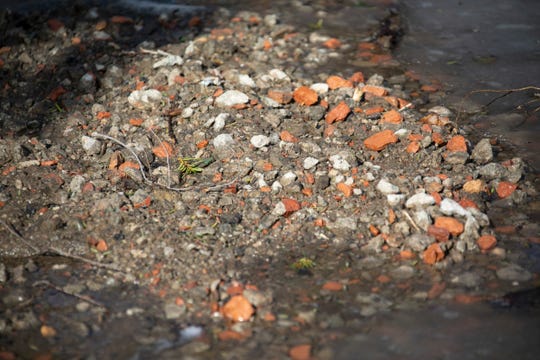
On April 24, 2017, an MSHDA worker sent an email asking why the dirt cost for a 2,390-square-foot property at 5759 Lawton was $6,875.Buy Photo
On April 24, 2017, an MSHDA worker sent an email asking why the dirt cost for a 2,390-square-foot property at 5759 Lawton was $6,875. (Photo: Max Ortiz, The Detroit News)

Camargo said it was clear to her in January 2017, while serving as the demolition director, that there had been an old directive from the state to contractors regarding dirt costs and bids.

"The old directive was to place a cost in the dirt column irrespective of the actual dirt cost," she said. "The new directive came in January 2017, stating that the dirt cost had to be reasonable, essentially based on the size of the structure being demolished."

Camargo said MSHDA reimbursed the land bank for "each and every property they questioned regarding dirt" during her tenure as demolition director. The costs, she said, "were legitimate."

Camargo, a former Wayne County prosecutor, resigned her post with the land bank in August 2017.

In a statement provided to The News, the state said at no time was there a directive to "place any number" in the cost field for dirt.

"But it did ask Detroit to start estimating costs for each category of greening: dirt, grade, seed, sidewalk repair or replacement," MSHDA spokeswoman Katie Bach wrote in an email on behalf of Eaton and Townley. "That estimated cost breakdown reporting started in 2015 and is still required today for all state partners receiving Hardest Hit Funds for demolition, not just Detroit."

Alyssa Strickland, a spokeswoman for the land bank, said Eaton's email is the only directive the land bank has on cost reasonableness and the authority continues to follow it.

The land bank, she said, doesn't see backfill as a factor that drives up costs, and it "wouldn't be making any award decisions based on the dirt price."

The authority, she stressed, looks at the total price of a bid package with the goal of getting the lowest price overall to "maximize every federal dollar."

"We need each bid pack to come in as low as possible to get down as many properties with the finite amount of money that's available to us," she said. "Monitoring the price of dirt isn't really getting us to that end goal. We're looking at what's the overall price for the package."

If the overall price for a property seems too high, she said, it's flagged and the land bank examines it more closely.

Record integrity questioned
Details of the lack of early pricing policies for dirt come after The News reported this spring on a University of Michigan researcher's analysis of record-keeping for the backfill program that turned up errors, gap and oversight concerns.

The findings shed light on the control contractors wielded in the process, said Michael Koscielniak, a doctoral candidate in urban and regional planning who spent more than four years reviewing public records that cast doubt on the integrity of soil records for the $265 million blight elimination program.

The city has said record-keeping for dirt evolved from a paper-based tracking system to digital records, but all of the dirt used to fill holes left behind from housing demolitions was accounted for.

Detroit's demolition program launched with urgency to draw down the first federal dollars earmarked to rid the city of blight. In a state of emergency, Koscielniak said, no regulation is safe.

"When you establish that as the default, it becomes very easy to let stuff get by or to rationalize or accommodate contractors or haulers what have you, taking advantage of the program," he said. "Basically, the contractors were able to set the rules."

The demolition program first came under scrutiny in fall 2015 amid worries over spiraling costs and bidding practices.

The Special Inspector General for the Troubled Asset Relief Program, or SIGTARP, has been conducting a criminal investigation into the program for several years.

This summer, two former employees of a major demolition contractor pleaded guilty to accepting bribes and rigging bids. Both were sentenced to a year in prison.

The federal watchdog agency in January issued subpoenas to certain contractors, seeking two years' worth of backfill records, including cost, where it was obtained and where it ended up.

SIGTARP is also in the midst of an audit of federally funded demolition activities for the risk of contaminated soil in Michigan and Detroit.

Koscielniak said he was contacted by SIGTARP in April to discuss several dozen residential demolitions in 2015 that used backfill from a source site in an industrial area of northwest Detroit.

"The feds are concerned it may have been material generated from the I-96 project," he said, referring to a recent road reconstruction project in western Wayne County.

Demolition program officials have insisted, however, that the use of dirt from the I-96 project was prohibited.

Risks related to the dirt used to fill demolition holes was a core focus of a 2017 audit of Hardest Hit Fund-paid demolitions in Flint. This summer, SIGTARP opened a new audit at the request of Democratic U.S. Reps. Brenda Lawrence of Southfield and Rashida Tlaib of Detroit to determine whether and how its earlier recommendations have been implemented, said Rob Sholars, a spokesman for SIGTARP, in an email.

"Ensuring the integrity of the dirt backfill process is a key area of SIGTARP's continued oversight of the Blight Elimination Program, and we will continue to work to prevent fraud, waste, and abuse throughout the program," Sholars wrote.

Sholars added he can't speak to specific cases but "would strongly agree that decisions related to the broader dirt backfill process should not be left to individual contractors."

"Our audit findings and recommendations make clear that more effective state agency quality assurance and oversight is required," he said.

Eaton, in a Jan. 19, 2017, email that flagged a bill for $3,750 bill for dirt submitted by Homrich, wrote many contractors "received dirt for free or just the trucking charges, and we now have to prove that these are legitimate costs."

"If they are legitimate costs, it should be no issue at all to obtain the documentation," she added.

Koscielniak, in his backfill analysis, identified 70 properties demolished by Homrich from June 4, 2015, through July 11, 2015, in which the firm billed $3,750 for dirt on each, totaling $258,750. All of the material was supplied from a site on Castleton Street.

Townley said in that instance and others, "it appears" Homrich "made a self-determined average and charged the same amount for each lot" prior to the program guideline changes.

"While this is not correct, it is the way DLB accepted the costs back in the beginning of the program," she said. "It wasn’t until later, toward the end of 2016 and 2017, that we took a stronger approach, requiring invoices, load tickets and further justification on costs."

Detroit has knocked down more than 19,000 houses since spring 2014. Of those, more than 12,000 were razed with federal funds.

The last of the Hardest Hit-funded demolitions work has been allocated in Detroit and Mayor Mike Duggan is pitching a bond measure for March that would enable the city to raze the remaining 19,000 blighted houses. This fiscal year also marks a transition from a demolition effort controlled by the land bank to a city-administered effort.

Duggan recently reiterated in an interview with The News that since stronger protocols were implemented in 2016, the federal government has released another $175 million to Detroit for demolition.

"Obviously, things were learned," he said. "But the fact that for more than three years now the money has flowed tells you that the feds and MSHDA have confidence in what we're doing. I'm looking forward, not backwards."

Voting is beautiful, be beautiful ~ vote.©

Sunday, September 8, 2019

Saturday, September 7, 2019

Bill Pulte Sucks TARP & Data With Jack Dorsey

Gather round, my Dearies, for the Celestial Goddess of the Woodshed shall tell the tale of why Bill  Pulte Sucks.

Once upon a time, Bill Pulte sold all his self made mortgages, like right before the housing foreclosure crisis, where Detroit was top of the list of cities to collapse.

The Emergency Manager Kevyn Orr came in and implemented the TARP stealin' system in Detroit.

Bill Pulte got together with Dan Gilbert and set up the Detroit Blight Authority, but forgot to file for incorporation or get an LLC.

Pulte was mean to my Sweetie because he lied but he got lots and lots of money from TARP.


So, Mike Duggan snatched the Detroit Blight Authority from Pulte, who changed the name to The Blight Authority and moved to Pontiac.

The Blight Auhority
https://www.theblightauthority.com/
https://pdf.guidestar.org/PDF_Images/2017/461/898/2017-461898090-10481049-Z.pdf
Mike Duggan took over the Blight Demolition Program through the Detroit Land Bank Authority, which never incorporated, but the LLC was dissolved by Bill *Smooches* Schuette, the Former Michigan Attorney General, and ended up in an ongoing SIGTARP investigation.

Then, Bill Pulte hooked up with Jack Dorsey to run another TARP gerrymandering scam in St. Louis.

And that ends my tale of why Bill Pulte Sucks.

Defango has another tale of why Bill Pulte Sucks.


Who is Bill Pulte? He's the Grandson Of Real Estate Magnate Is Trending On Twitter For Giving Out $100,000 and more. He's connected to one of the biggest housing builders in the United States with a rather unsavory reputation. Deep Diving into the money give away is only part of the puzzle of what is going on here. Did you know you have to pay 10 bucks to become a Teammate to collect if you win the prize? How about the horror stories off all the people talking about getting blocked by him for speaking up.

 Links https://pastebin.com/3jnaiKBZ 

Pulte, Twitter co-founder Dorsey take blight removal effort to St. Louis

Businessmen connect over social media platform
Both men contributed for the roughly $500,000 effort in St. Louis
Pulte also running direct giving campaign on Twitter.

Bill Pulte & Jack Dorsey
Bill Pulte (left) is taking his Blight Authority program to Twitter CEO's hometown of St. Louis. The men connected on the social media platform.

Bill Pulte's blight removal efforts are getting the help of Twitter co-founder and CEO Jack Dorsey in St. Louis.

Pulte, managing partner of Pontiac-based Pulte Capital Partners LLC and grandson of the late homebuilding legend William J. Pulte, is using his Pontiac-based Blight Authority nonprofit to eliminate blight on more than 150 properties in the Wells-Goodfellow neighborhood in St. Louis along with Dorsey, a native of the city.

"I got connected with him and he seems like he really wants to give back and he was very interested in the blight work we have done in Detroit and Pontiac," Pulte said Thursday. "He and I had a conversation, and I said, 'What about St. Louis?' Without hesitation, Jack was like, 'Let's do it.'"

A formal announcement is expected Friday.

Both men contributed to the Blight Authority for the roughly $500,000 effort after being connected over Dorsey's social media platform, Pulte said.

Demolition in St. Louis has begun and Pulte said he believes "a significant amount" should be done by the end of the day Friday.

The efforts in St. Louis model the work Pulte has done in Pontiac and, earlier, Detroit.

In those cities, primarily Pontiac, the cost of blight removal was lowered because the Blight Authority would target heavily blighted areas and clear it all out at once, achieving economies of scale and reducing costs.

Pulte, whose blight removal efforts in Detroit began in 2013, stopped doing demolition work in the city at the request of officials there and in 2014 started working in Pontiac.

In November, Pulte and Pontiac and Oakland County officials said residential blight in the county seat is expected to be eliminated by the end of this year. At that time, there were 99 homes left to be demolished out of the 916 when the effort started. It cost about $12,400 per home to demolish, putting the project at about $10 million currently.

Pulte, 31, has long talked about expanding the blight removal efforts to other cities around the country, including Chicago, Baltimore, Atlanta, Miami and several in Ohio.

The St. Louis Post-Dispatch reported Friday that there are "some 7,000 vacant buildings, most beyond repair, and over 10,000 vacant lots" in the city of about 300,000.

Dorsey co-founded Twitter (NYSE: TWTR) in San Francisco in 2006 and it has a market capitalization of $28.95 billion. Dorsey is worth $5.7 billion, according to Forbes. Dorsey is also a co-founder of Square, a mobile payment company.

Twitter philanthropy
Pulte has also made news recently for his direct giving on Twitter.

Last week, he announced that he would give away $100,000 by the end of the year.

Almost immediately after that, President Donald Trump retweeted Pulte's pledge to give $30,000 to a veteran with a presidential retweet.

On Friday, Pulte honored that pledge by giving a $20,000 Chevrolet Trax and $10,000 in cash to a veteran in need of a vehicle.

He has also made appearances on Fox News and been pledging donations in exchange for retweets by celebrities including Kim Kardashian, Kanye West and others.

"I'm well over $40,000," he said of his giving.

Pulte also said his campaign has spurred other people to donate in amounts small and large on Twitter.

Voting is beautiful, be beautiful ~ vote.©

Saturday, April 13, 2019

Cocktails & Popcorn: Dan Gilbert Forgot About Amrock Defending Quicken Loans Junk Bond Rating

What about Amrock?

You forgot about Amrock, Dan.

Dan Gilbert defends Quicken Loans over 'junk' bond rating


Quicken Loans Technology Center
in Corktown
Detroit-based Quicken Loans is enjoying strong profits and holds the title as the nation's No. 1 direct-to-consumer mortgage lender.

It is one of the city's largest employers and the biggest revenue-generator in the business empire of Dan Gilbert, the central figure in downtown Detroit's recent and dramatic turnaround.

Yet in the eyes of the Wall Street credit rating agencies, Quicken Loans is still viewed as a relatively risky business and its debt is rated as below investment grade, or what is commonly called "junk" in the financial world. It's considered too dangerous for some investors such as some pension funds.

For the rating agencies, a fundamental issue is not how well Quicken is managed, but rather the nature of its business as a non-bank mortgage lender that is reliant on short-term financing — and without any bank deposits to fall back on.

During last decade's mortgage market meltdown and financial crisis, several similar lenders collapsed when their short-term borrowing arrangements dried up.

No one contends that Quicken Loans is facing any immediate danger of a cash crunch, but the rating agencies' cautionary assessment raises questions about the long-term stability of the mortgage lender's business model — as well as downtown Detroit's continued resurgence, which has relied on Gilbert's ability to finance big real estate investments.


Gilbert's real estate firm, Bedrock, owns or controls about 100 properties in greater downtown Detroit and has undertaken expensive renovations of many of them. Among other projects, the firm is building what would be the tallest skyscraper in Detroit, surpassing the Renaissance Center in height.

”If you took Dan Gilbert’s enterprises out of the equation, Detroit's downtown would be basically crawling along in rebuilding itself," said John Mogk, a Wayne State University law professor who specializes in urban development. "So If you begin to let the air out of that balloon, then everything begins to collapse.”

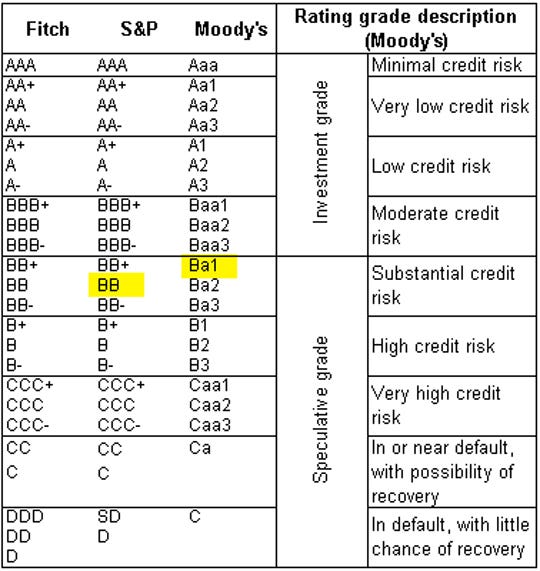
Two of the "Big Three" credit rating agencies have assigned junk ratings to Quicken Loans. The most recent action, in January by agency Moody's Investors Service, scored Quicken as a stable "Ba1," which is a notch below investment grade on Moody's scale.


The other agency, S&P Global Ratings, last affirmed Quicken as "BB" in 2017, or two notches below investment grade on that agency's scale. The third big rating agency, Fitch Ratings, hasn't done any in-depth scores on the company.

Gilbert defends

In a phone interview this week, Gilbert pushed back on any notion that Quicken Loans is a true credit risk.

"Our balance sheet and our liquidity is the most solid and strongest it's been since we started 34 years ago," he said Monday.

Gilbert noted how the junk category has a wide range of gradations and includes companies such as Netflix and Detroit-based Ally Financial, General Motors' former finance arm GMAC. Simply landing in junk territory doesn't mean that a company is in trouble and forced to accept exorbitant borrowing costs, he said.

Quicken had a junk rating when it did a $1 billion, 10-year bond issue in December 2017 with a 5.25% fixed interest rate.

“If you’re familiar with what people people call junk yields, (5.25%) is nowhere near that kind of thing," Gilbert said. "You see companies who are at the worst end of it getting interest rates over 12% and the companies that are at the highest notch of what you're calling junk are getting 4 or 5% interest rates."

Gilbert also emphasized how Moody's scorecard gave 65% weight to Quicken's "operating environment" in the mortgage business and only 35% to the company's balance sheet.
"What brings us down is the industry we're in," he said.

Higher risk

Credit rating agencies are tasked with evaluating the financial health of companies and governments and the riskiness of specific bonds and securities.

Companies with junk ratings typically must pay higher interest rates to borrow money than those with investment-grade ratings. That premium reflects the added risk that investors take when lending to such firms, said Sudip Datta, finance department chair at Wayne State University's Mike Ilitch School of Business.

Some investors like junk bonds because they want the higher yield.

"The rating tells investors that this is a junk-bond category, so be careful, but if you want to have higher returns, take the risk," Datta said.

Many pension funds and money market funds are not allowed to buy junk bonds.

Credit rating agencies appear to be more conservative these day when rating non-bank mortgage lenders than they were before the 2007-09 financial crisis and recession.

For example, Moody's still gave Countrywide Financial an investment-grade rating — albeit a low one — in November 2007, shortly before the mortgage giant's dramatic collapse and acquisition at a fire sale price by Bank of America the following year.

Today, Quicken Loans has a Moody's rating that is one notch below where Countrywide was in those calamitous final months.

A Moody's representative last week declined to comment on whether the agency has adjusted its rating standards for mortgage lenders since the financial crisis.

The government's official Financial Crisis Inquiry Report called the big three credit rating agencies "key enablers of the financial meltdown" for giving top ratings to mortgage-backed securities that were in actuality very risky.

"There's probably a lot of shell-shocked rating firms," Gilbert said. "If you look at the ratings of securitizations from 10, 11 years ago, you'll see a lot of investment-grade stuff that didn't turn out too well for people."

'Strengthen our liquidity'

Quicken's bonds have always been rated in junk territory. The company scored a notch below its current Moody's rating in 2015, when it issued $1.25 billion, 10-year bonds at 5.75%. Most of that money flowed to Quicken's parent company, Rock Holdings.

Gilbert said that both of Quicken's bond issues (2015 and 2017) were done to "strengthen our liquidity".

"One of the reasons was the attractive nature of the terms and the interest rate," he said. "The fact we could lock in debt for 5.25% for 10 years without covenants was something we wanted to take advantage of." (Covenants, in this case, refer to restrictions on a borrower's activities or debt levels.)

Inherent risk

In its Quicken Loans analysis, Moody's praised Quicken's "sound balance sheet" and its "conservative financial management."

It said the company's core profitability has decreased from the exceptionally high levels of 2015-16, during the mortgage refinancing boom, although Quicken is expected to stay highly profitable for the next several years.

But offsetting those positives is the inherent risk in Quicken's business model.

Unlike traditional banks that take deposits, Quicken and other non-bank lenders typically borrow money for their mortgages through so-called "warehouse" lines of credit offered by banks and other financial institutions.

Last decade's financial crisis showed how such funding models can, at times, be precarious. Lenders can pull their credit lines or other short-term financing, leaving dry the companies that depended on the money flow.

That disaster scenario happened to several mortgage lenders during the 2007-08 market collapse that had specialized in risky subprime or "Alt-A" loans, such as now-defunct American Home Mortgage and New Century Financial.

Moody's did credit Quicken for having more than 40% of its credit lines in longer term two-year durations. And it positively noted how Quicken recently began funding a small portion of its mortgages — still less than 10% — with cash on its own balance sheet.

A Free Press review of other large non-bank mortgage lenders that compete with Quicken Loans found their credit ratings to also be in junk territory — typically below Quicken's. Some of those firms had to pay interest rates between 8% and 11% in past bond issues.

Separately, the City of Detroit currently has junk ratings from at least two credit rating agencies. Detroit emerged from the nation's largest Chapter 9 municipal bankruptcy in December 2014. And Moody's downgraded Ford Motor Co. to a notch above junk in August. 

Government-backed loans

Moody's said the vast majority of Quicken's mortgages have explicit government backing through Fannie Mae, Freddie Mac, the Federal Housing Administration or the Department of Veterans Affairs, which insure loans against homeowner defaults.

Quicken pools those mortgages and bundles them into securities, which the company then sells into the secondary market. Quicken uses the money from those sales to pay back the credit line funds.
Moody's said that Quicken holds its mortgages for only a few weeks, which helps to offset risks.

Other risks

The rating agency did mark down Quicken for the long-running Department of Justice lawsuit against the company. That False Claims Act case, first filed in 2015, alleges that Quicken fraudulently approved borrowers for FHA-backed mortgages from 2007 through 2011.

The company has strongly denied the allegations and, unlike other lenders, refused to settle the case with a big payout to the government. Last week, a federal judge in Detroit ordered Quicken and the Justice Department to try one more time to reach a mediated settlement.

Quicken is still the nation's largest FHA lender and, according to Moody's, has among the lowest default rates of all lenders for that type of loan.

Looking ahead, Moody's said that Quicken and other lenders could face challenges in the coming years if interest rates rise and then depress the total volume of mortgage originations.

That scenario might tempt lenders to make dodgier loans to less qualified borrowers. (a.k.a. "The Poors").

"As origination volumes decline, mortgage lenders typically migrate to riskier mortgage origination products to boost origination volumes," Moody's warned in its report.

However, Gilbert told the Free Press that Quicken, which now has a roughly 6 percent market share, would not start giving out dicey mortgages.

"The one company that didn't do those kinds of loans and survived and thrived and became the largest lender in America was Quicken Loans," he said. "So, certainly, we're not going to do that now, after we watched the whole world explode." America' largest lender, Quicken Loans, survived because it was using federal, taxpayer dollars.

Voting is beautiful, be beautiful ~ vote.©

Thursday, March 14, 2019

Detroit Land Bank Authority: Contaminated Soil - Just Another Means To Gerrymandering

"For all the noise out there about investigations," said Duggan, the U.S. Treasury and the state "had confidence in us" and "kept money flowing."

The U.S. Treasury keeps the money flowing while SIGTARP watches.

Contaminated soil is just another way of gerrymandering.

The scheme goes like this:
  • You lose the family home to a City of Detroit - Wayne County tax fraud scheme;
  • No one wants to buy from the Detroit Land Bank Authority because all the deeds are jacked;
  • The house becomes blighted being stripped of its copper and aluminum;
  • Contractors raze the house and bill Hardest Hit Funds;
  • Demolition back fills with contaminated dirt to maximize revenues, and other stuff;
  • Infant mortality, cognitive and developmental disability, child poverty rates spike; 
  • People die;
  • Political campaigns are funded via kickbacks;
  • Detroit is redistricted.
And that ends the tale of gerrymandering by contaminated soil.
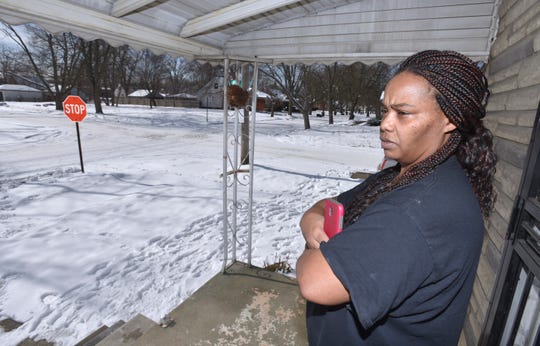
Soil records under scrutiny in Detroit demolitions


Felicia Perry, 42, lives on Rossini at Rex in Detroit,
across the street from at least two vacant lots where
houses were razed and then backfilled.

Detroit — Records detailing what went into the ground at thousands of demolition sites across the city are under scrutiny amid an analysis that's turned up a disjointed process.

University of Michigan doctoral candidate Michael Koscielniak has spent four years conducting an exhaustive review of public records that cast doubt on the integrity of soil records for the city's multi-million-dollar federally funded blight elimination program.

For its part, the city admits the effort got off the ground with a paper-based tracking system before it evolved to online records. But officials contend the dirt used to fill holes left behind from housing demolitions is all accounted for and Koscielniak based his findings on only part of the data.

But Koscielniak asserts the record keeping is a "completely shambolic approach to managing this program — especially one that is transparent."  The demolition effort has paid out close to $177 million in federal funding to take down 11,000 structures since 2014.

"The errors, gaps and inconsistencies in the backfill data — as well as the unclear oversight and monitoring processes — suggest that demolition contractors wield immense authority over the backfill program," said Koscielniak, an Ypsilanti resident and doctoral candidate in urban and regional planning who is working on a dissertation. "They stumbled into a mega project that they had no capacity to manage, and their solution to it was to let contractors figure it out."

The independent researcher's findings heighten growing concern among some city, state and congressional lawmakers over potential environmental contaminants in the dirt following a number of high-profile contractor violations. Officials want to ensure the quality of the dirt going into Detroit's ground isn't harmful to residents.
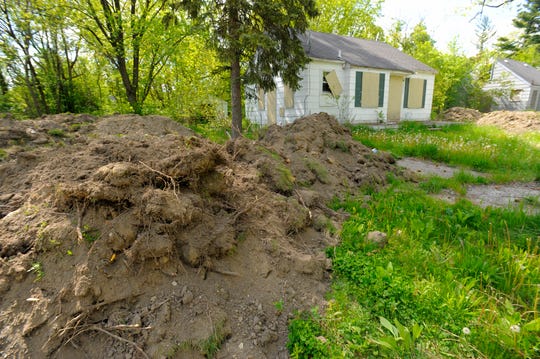
Fresh piled dirt is seen near a vacant home on Faust
 near Constance in Detroit after a demolition on May 18, 2016. 
Under public information requests, Koscielniak obtained copies of an internal contractor portal used to track dirt sources, costs and locations that's maintained by the Detroit Building Authority.


He zeroed in on data for demolitions conducted through July and paid from the federal Hardest Hit Fund, concluding that out of nearly 10,000 listed only about 5,200 had attributed sources through digital record keeping.

Koscielniak's research is the latest cloud over the program at the center of a federal criminal investigation that arose in fall 2015 after concerns were raised over bidding practices and spiraling costs.

Soil worries prompted Detroit City Council's second in command to put out a call for a congressional hearing on demolition in Detroit and comes as one contractor's projects have been halted after it failed to remove potentially hazardous debris at multiple sites before dumping dirt on top.

Officials with the Detroit Building Authority and Detroit Land Bank Authority, which oversee the city's program, argue Koscielniak's research is skewed and maintain their confidence in the records. 
Under Freedom of Information Act requests, they said, he obtained copies of the digital database for soil records. But prior to that, load tickets for dirt were tracked on paper — records Koscielniak did not ask for or obtain, they contend.

"We think the gap is, not that we weren't tracking it, but it wasn't tracked in an online portal that we could send to someone," Brian Farkas, director of special projects for the building authority, told The News. "I'm confident in our records."

Detroit Councilman Andre Spivey said he's concerned to hear of the disconnected record keeping for dirt and wants the city to have tighter reins on the land bank.

"You've got to maintain the integrity of the process," he said. "We're watching, and the federal government is watching as well."

In January, the federal watchdog agency investigating the city's blight elimination effort issued a round of subpoenas to certain contractors, seeking detailed records of where they obtained their dirt, the cost and where it ended up.

In subpoenas dated Jan. 10, the Special Inspector General for the Troubled Asset Relief Program demanded two years' worth of documentation.

Robert Sholars, a spokesman for SIGTARP, declined to say whether Koscielniak's research spurred the investigation, saying "as a general principle, we do not comment on ongoing investigations, including confirming or denying their existence."

Tracking the records

The News last month provided the building authority with 13 addresses from 2014 out of thousands flagged by Koscielniak. Officials produced paper copies for all of them.

According to the load tickets, some of the fill dirt came from an industrial site on Shoemaker on Detroit's east side and a site in Carleton. Other paperwork identifies fill simply as "clay" or has spaces where the source is attributed to a trucking company or left blank, only listing where it was dropped off.

Farkas last week referred to the 13 records pulled at the request of The News as a "spot check" while he faced questioning about contractors and environmental worries during a city council subcommittee session.

Council President Pro Tem Mary Sheffield noted in recent months the tracking system for dirt is more in-depth. The building authority, she said, told council members the independent firm contracted to oversee the process is now verifying the origin of the dirt with aerial checks after documentation is submitted by contractors. Prior to that time, that verification was not taking place, she said.

"You had a period of time where contractors were self-reporting all of these different residential addresses and saying it was residential dirt when it could possibly have not been because there was no oversight," she said. "That's a problem."

Farkas said the city has tracked its soil and dirt on an internal online platform since March 2015. 
A gravel-train semi leaves the Mid Michigan
Crushing & Recycling facility in Highland Park.
Despite that, Koscielniak provided The News with a data set that shows 1,961 Hardest Hit Fund demolitions between March 2015 and June 2018 that weren't accounted for in the backfill portal.


The sites in question, which appear on the city's public demolition database but lack a digital paper trail for the soil, account for $2.9 million in dirt costs among 18 contractors.

Koscielniak also provided The News with more than 100 other records with misspellings and errors, lacking in detail or that list the dirt source and destination as the same site.

The News asked the building authority to reproduce documentation for a dozen of the 2015 demolitions, which based on Farkas' explanation should have been digitized.

In an email, Farkas provided The News with eight of the records located by the department — all paper — out of the 12, citing limited staffing to search. But he stressed confidence the rest would be found.

"This is more a document retrieval issue of records that are four or five years old than it is an issue of whether dirt sources have been verified," Farkas said.

In reference to data suggesting close to 2,000 records submitted after 2015 aren't accounted for in the digital system, Farkas reiterated officials "feel very confident" in protocols in place since 2014 to ensure dirt is safe.

"We see the fact that some records may not be immediately retrievable as a reflection in the record keeping process, not as a reflection of our work in the field to ensure the use of clean dirt," Farkas said in a provided statement.

A handful of contractors have faced penalties between 2017 and 2018 for the use of unapproved backfill at a total of 18 sites, according to the building authority.

Some were issued warnings, others were suspended and another — Detroit-based Glo Wrecking — was issued a stop-work order that remains in effect. The company could not be reached for comment. 
Additionally, in February, another contractor, DMC Consultants, began filling holes with unauthorized dirt. The building authority's online platform flagged officials that the company had exhausted their supply of approved fill.

Farkas declined to specify DMC's dirt source, saying it "doesn't matter."

"All that matters is whether it's been tested and approved, and the DMC dirt used after their approved supply ran out was not," he said.

Farkas said soil sampling is taking place for 37 holes that DMC filled with dirt that had not been approved. Testing will determine whether the soil is unsafe for residential use.

Chicago-based firm McDonagh Demolition was also issued a stop-work order by the building authority in recent weeks after it was discovered that the company had not fully removed demolition debris before adding fill dirt at several sites.

Farkas, during the council's Planning and Economic Development committee session last week, said the company's work is being revoked over the "attempted scheme." It's going to cost McDonagh about $17 million in contracts, he said.

McDonagh called the violation an "isolated issue" that it was taking steps to correct.

Farkas touted the catch as evidence the building authority's controls worked, as intended, saying a field liaison for the building authority discovered the problem.

But Sheffield noted it was later revealed that a former McDonagh employee had acted as a whistle-blower.

The scenario, she said, is a "clear example" that "protocols are not sufficient."

"The pace that they are going, it is hard to have the proper protocols to ensure the health and safety of residents," Sheffield said. "There's too many unknowns for me. Whether it's contaminated or not, it just needs to be clear and verified where the dirt is coming from."

Under the program, the land bank manages the selection and contract awards for demolitions. Oversight is then transferred to the building authority, which has seven field liaisons who monitor all the knockdowns. That's up from two when the program first began, Farkas said. 

What the rules say

The city's Buildings,  Safety Engineering and Environmental Department inspects open holes and final grading.

The state's blight manual outlines requirements for testing and sourcing of fill.

Detroit implemented a new dirt tracking system late last year to better document the dirt being used. The guidelines require the source of dirt, the address it's going to, and size of load by cubic yard or square feet, according to the state.

Previously, contractors were required to provide invoices for dirt, and the land bank maintained load tickets that documented the size of a load and where it was dropped.

"The new protocol requires each contractor to identify source material location and testing evaluation of commercial soil sources in advance of backfilling so as to avoid bad fill material negatively impacting neighborhoods," the U.S. Environmental Protection Agency said in a statement. "The city of Detroit is responsible for identifying dirt sources under its protocol."

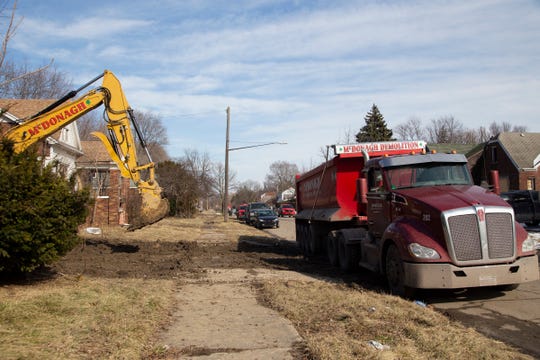
Chicago-based McDonagh Demolition was ordered to
 excavate this site in the 13000 block of Maiden Street in
Detroit after it was discovered that that some demolition
materials there had not been properly removed.
Farkas said there are three acceptable soil sources. A residential site or a virgin source, which could be a clay or gravel pit and requires documentation stating its free of debris, concrete or other unsuitable substances. The third category, non-residential, may consist of commercial, road or construction sites but requires laboratory testing and the results must be approved by the building authority. 


"All city, state and federal guidelines must be followed to ensure environmentally safe back fill is being used," the blight manual notes. "This laboratory testing must be maintained in the blight partner office and copies may be requested at any time."

Matt Polizzotto, a soil chemist and associate professor of earth sciences for the University of Oregon, said urban soils can be contaminated in many ways, including from lead paint or past transportation emissions. The level of risk, he said, depends on how the soil had been used.

"I could come up with doomsday scenarios, but those things are pretty unlikely," said Polizzotto, who has expertise in soil contaminants in the environment. "Not having records doesn't allow for really, truly assessing what any risks might be."

'No legal obligation'

Rebecca Camargo, an attorney for several contractors in the program, said none set out to use bad dirt. 
"I don't believe that any of the demolition contractors violated the terms of the contract knowingly, and they all are very committed to keeping Detroit safe," she said.

Camargo said the deadline for turning over backfill documents requested under the SIGTARP subpoena has been extended.

"It's costing all of them thousands of dollars to provide this documentation for something I believe is going to show nothing," she said.

Multiple contractors did not return messages left by The News. Anthony Abela, a project manager for the firms Homrich and 1 Way Service, said by policy, the company does not issue comments to the media.

Mayor Mike Duggan has defended the program's "vigorous" practices in the wake of concern over whether some dirt might have been contaminated.

The mayor, during his Tuesday State of the City speech, noted the city this month entered into contracts for the last of the $275 million in federal dollars for the program.

"For all the noise out there about investigations," said Duggan, the U.S. Treasury and the state "had confidence in us" and "kept money flowing."

The mayor said the program's environmental team has held demolition contractors accountable. In the last five years, he said, four contractors have been terminated for failing to follow protocols.
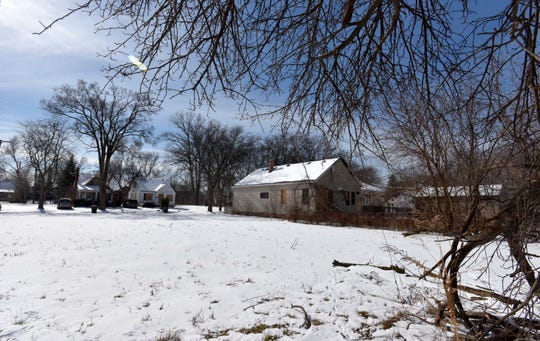
Tens of thousands of houses have been razed in Detroit with
federal funding over the last five years, leaving
vacant lots like this one in the 15600 block of Rossini. 


"In each case, we made each go back in and fix their mistakes. We did not let a single one slide, and we advise the neighbors to help us," Duggan said. "I won't tell you that we're not ever making mistakes. I will tell you, we find out about them."

The mayor, during his Thursday budget presentation to council, said the all federally funded demolition contracts have been awarded and the program is set to wind down by the end of the fiscal year. From here, he said, the city will look to transition to a city-administered effort.

Meanwhile, the state Department of Environmental Quality said it's "working with the federal agencies investigating the city's demolition program."

The DEQ has not issued any violations or fines related to backfill, and it has not done any soil sampling or auditing, said Scott Dean, a DEQ spokesman.

"An entity obtaining soil for backfill has no legal obligation to test those soils or keep records about the sources," Dean said.

"However, there is a risk that contractors may obtain contaminated soils, either knowingly or unknowingly. It seemed reasonable that this risk would increase with the increased demand for soils. Because of this risk, we advised the city to put safeguards in place to make sure they were only using clean dirt. That was a recommendation, not a legal requirement."

Pushing for testing

Council's Sheffield has referenced media reports that raise the possibility of dirt being used to fill holes that may have been contaminated or from unverified sources, including soils from the recent reconstruction of Interstate 96 in western Wayne County. Program officials insist, however, that use of dirt from the I-96 project was banned from the outset.

In a letter to U.S. Reps. Rashida Tlaib, D-Detroit, and Brenda Lawrence, D-Southfield, the councilwoman noted the program has been "mired in controversy since its inception" and it's led to "anxiety, uncertainty, and a lack of transparency for the community."

Lawrence told The News she's leading an effort to ask the delegation to urge the U.S. Treasury Department to assume oversight of soil testing for Detroit's program.

"My focus right now is on whether the dirt is contaminated," she said. "I'm pushing for immediate testing."

In 2014, the city contracted with the Southfield-based consulting firm Atwell to get the program's environmental monitoring off the ground. By September, AKT Peerless in Detroit was retained to "manage and administer" the backfill program.

Reached via email, Julie Barton, program manager for AKT, deferred comment to the building authority. Farkas said the company has designed testing protocols and the online platform, overseeing its use and implementation.

When asked whether the paper record keeping was adequate, Tammy Daniels, a demolition manager for the land bank, agreed it was a process that needed to change, and it did.

"We migrated away from paper because we, too, feel that computer records offer transparency," she said.

Farkas noted when the federally funded demolition work first began, there was $50 million to draw down and a "serious deadline" that "we had to meet."

A 2013 memorandum of understanding between the state, land bank and city, required 70 percent of the $52.3 million allocated for the program be spent by Oct. 7, 2014. If the land bank was unable to draw down the funding within that time, the dollars could have been redirected to another city or program.

"The system we have today is remarkably different than the one we inherited," he said. "So no, records should always be kept in the most high-tech, digital format. The problem is we just don't have that ability when you are staring down a deadline to spend $50 million."

The Michigan State Housing and Development Authority, which allocates funding for the program under the state's Homeowner Assistance Non-Profit Housing Corp., said it does not oversee how the land bank maintains its filing system.

"What we do require is that file documents be uploaded to our system for audit and review prior to funding every demolition," said Katie Bach, a spokeswoman for MSHDA, in an email. 
Bach further said the state has found no evidence of sloppy record-keeping. MHA, she said, has adequate resources to monitor the backfill program and is confident in how it's operating. Under Hardest Hit Fund rules, MHA is required to retain records for three years after the program ends, she added.

"MHA has staff in place to review every file that DLB is uploading to our system," she said. "We expect accurate documentation and full compliance with all program guidelines. If we find that is not the case, we will consult with U.S. Treasury regarding possible corrective action."

East side resident Felicia Perry has been renting a home on Rossini Drive for about a year. Records show numerous demolitions occurred on her block in 2014 when digital records of the soil source were lacking. The city's paper records attribute the source to a city-based industrial site.

The mother of six, who has a young daughter battling chronic health concerns, said the questions and uncertainty are worrisome.

"I have a three-year-old who is battling every day to stay alive with sickle cell disease. I don't even let her outside," said Perry, 42. "If they put something in the ground that's contaminated, it's got growth in it. It brings poison to kids."

Voting is beautiful, be beautiful ~ vote.©

Wednesday, February 27, 2019

The Legal Geniuses Over At The Detroit Land Bank Authority Are At It Again - The Detroit Absentee Ballot Gerrymandering Model & A North Carolina Indictment

We need to do an intervention, like going in, and sitting everyone down, one by one, and let their "Legal Geniuses" (trademark pending) know that they need to stop.

We live in this.

We have been complaining about this.

If only we could get the "Legal Geniuses" (trademark pending) to just admit that they do not know what they are doing, then we could come in and help them understand that you have to first incorporate, register as a company with the state before you can enter into contracts.

On second thought, perhaps the reason they do not want intervention is because they know exactly what they are doing because Detroit was supposed to be the pilot, transposable model for a Public Private Partnership to take over government by manipulating elections.

Look at all those addresses being physically demolished, that can be used as data for other false claims, like absentee ballot votes.

Central figure in North Carolina absentee ballot fraud indicted on multiple counts


Behold, gerrymandering in Detroit.

A company tore down homes in Detroit. Then it hid and buried the debris in the holes.


A Detroit Land Bank Authority contractor is under investigation and could lose more than $15 million in scheduled demolition work because of allegations it tore down several homes and buried the debris under layers of backfill dirt instead of properly disposing of the materials, the Free Press has learned.

The demolitions, which were performed by Chicago-based McDonagh Demolition Inc., have sparked an internal review of every demolition — 90 in total — that the company has performed in Detroit.

The company could also face suspension or expulsion from the program, city officials confirmed.

Concerns regarding proper abatement and backfill practices also have raised questions about unusually high bidding awards for some demolition projects. A Free Press review of McDonagh demolition projects found a half dozen that were well above the $25,000 ceiling for federal dollars.

At least two were more than $40,000, according to city records.

And while the city credited internal quality controls for catching the demo violations, one top city official and a state agency that oversees the city's blight removal program are questioning why the company wasn't caught sooner.

Multiple sources, who requested anonymity because they haven't been authorized to speak publicly, told the Free Press that the city was alerted to the situation by a former company employee who shared photos with the Land Bank of discarded debris buried at demo sites. 

When asked by the city whether that was true, Detroit Building Authority Special Projects Director Brian Farkas said: "I cannot comment on an active investigation."

Instead, Farkas said its on-site DBA field liaison discovered that McDonagh "filled several demolition holes before fully removing all of the demolition debris."

The city did not state how the DBA employee discovered the violations.

"Any sites found in this condition will have all fill removed and replaced with another approved source," Farkas said. At least four sites already have been identified for excavation.

In an emailed statement to the Free Press, the company stated: “During the course of demolishing dozens of abandoned homes, McDonagh has been made aware of four properties that contained small pieces of concrete in the backfill. We have been working with the DBA to remove that material. We are confident that this is an isolated issue.”

Farkas said the city alerted the Michigan Department of Environmental Quality of the situation but an MDEQ spokesperson said in a statement late Monday that it had not been notified. Instead, the MDEQ said it was informed of another issue with McDonagh by the city.

"I checked with our Detroit staff and no one was notified by the city of this issue or received any complaints about illegal disposal by this contractor," spokesperson Scott Dean said. "Our asbestos program did issue a violation notice to this contractor based on violations that the city identified and had the contractor self report, but that was not related to buried asbestos waste."

Dean said it is the city's responsibility, not the DEQ's, to provide oversight of the contractors' waste disposal practices.

"If they find a contractor has illegally disposed of waste on-site, it is the city's responsibility to rectify that problem," Dean said, adding, however, that the city is not required to report the issue. "It is a violation of state law (Part 115, Solid Waste Management) to dispose of the demolition waste on-site."

Contractors are required by local and state regulations to fully remove demolition debris and transport the materials to approved landfill locations after a structure is torn down — in part to prevent any environmental issues. Companies must then use clean and approved backfill materials to fill the open holes.

"These are serious findings concerning a new contractor who started work late last year," Michigan Homeowner Assistance Nonprofit Housing Corp. spokesperson Katie Bach said. "The health and safety of Detroit residents during the demolition process is paramount. We are demanding full disclosure about how this happened and why these violations were not caught during the routine inspection process."

MHA administers the federal Hardest Hit Fund program that funds Land Bank demolitions and has disbursed more than $176 million in federal funds to Detroit, which has the largest demolition program of its kind in the nation.

MHA characterized the situation as a "clear violation" of its blight manual that dictates the rules of the state's blight program.

Meanwhile, City Council President Pro Tem Mary Sheffield told the Free Press she is calling for direct oversight of the demolition program to be returned to the city and removed from the two external authorities currently overseeing it — The Detroit Land Bank and Detroit Building Authority.

"To hear that an unknown, out-of-state company came into our city and thought so little of our residents and communities that they buried multiple houses within demo sites is not only alarming, it's indefensible," Sheffield said in an interview with the Free Press. "I feel the Detroit Land Bank’s decision to award over $15 million of demo contracts in less than a year to a company who had never worked in our city and had no stake in our community is yet another example of policies created to negatively impact Detroiters."

The company has performed at least five demolitions in Sheffield's district. Other council members who also had demolitions performed in their districts by McDonagh did not respond to a request for comment.

Sheffield is also calling for:
  • All of the company's contracts to be immediately pulled.
  • Excavation of all of their demolition sites to determine whether debris has been buried.
  • Revocation of the company's wrecking license.
  • For McDonagh's wrecking license to be revoked and the disbarment of the company and anyone else who may have participated in burying the debris.
"Had it not been for a former McDonagh employee coming forward, our supposedly rigorous dirt processes in place wouldn’t have caught entire homes being buried in the dirt," Sheffield said.

McDonagh, which began performing demolitions in the city in early December, is under contract to tear down 682 properties in neighborhoods across Detroit. The company has been placed on a stop work order while the review is ongoing.

The city, which would respond to questions from the Free Press only via email, said upon making the discovery last week, it "immediately began an internal review."

"McDonagh has been issued a stop work order until we have a chance to review each of its sites and ensure that all work has been completed properly or redone if it has not been," Farkas said via email.

"This is a serious violation of our protocols and will be dealt with severely in our contractor discipline process and likely will result in suspension or expulsion from the program."


The company has already been ordered to excavate a handful of properties, including a site at 13047 Maiden St. on the city's east side that was demolished on Dec. 27.

Prior to the demolition, that home was only partially abated, the Free Press confirmed, raising concerns of whether some asbestos-laden materials may have still been on the site when the company buried the debris.

Farkas said members of his staff said they only observed "hard fill," such as bricks, cement and foundation walls left at the site.

The Chicago-based McDonagh Demolition was ordered to excavate a demolition site in the 13000 block of Maiden St. on Detroit's east side on Friday, Feb. 22, 2019. The order came after it was discovered the company filled several demolition holes across the city before fully removing all of the demolition debris, which is a major violation of the federally-funded program. (Photo: Mandi Wright, Detroit Free Press)

"This means the materials with possible asbestos would have been removed with the debris portion of the structure," Farkas said.

When asked whether further testing would occur, Farkas said testing outside of the asbestos survey prior to the demolition "is not required."

A Free Press reporter and photographer visited the site Friday and watched as the company removed the backfill from the ground, as DBA employees observed the process. The Free Press also identified another site, 13089 Maiden St., just a few houses down on the same block that appeared to have chunks of bricks, concrete and other materials on top of the surface and protruding from the ground.

That property was torn down by the same company on Dec. 27 and is among the properties under review.

Bach said the issue was brought to MHA’s attention last week.

"The Detroit Land Bank Authority and Detroit Building Authority have been instructed to conduct a thorough review of all 90 sites and report the findings to us," Bach said.

High costs

McDonagh was set to be paid about $1.5 million in federal funds for the 90 structures it has demolished. However, the company has not been paid yet and all payments have been frozen pending the outcome of the investigation, city officials said. The Free Press was only able to identify and analyze 82 of the company's public demolition records, through the city's open data portal.
Here are the top amounts McDonagh was set to be paid to demolish single-family residential homes prior to the launch of the internal investigation:
  • $47,703.41 for demolishing 14253 Wilshire on Dec. 13. 
  • $40,127.41 for demolishing 9156 Lakepointe on Dec. 10.
  • $36,617.46 for demolishing 6427 Iroquois on Feb. 14.
  • $29,237.41 for demolishing 9913 Balfour on Dec. 11.
  • $26,785.41 for demolishing 12614 Corbett on Dec. 5. 
  • $26,470.41 for demolishing 12622 Corbett on Dec. 5. 
Each of these demolitions were set to be paid through HHF funds which have a $25,000 cap. Land Bank spokesperson Alyssa Strickland said city dollars would have been used to cover anything over $25,000 and is standard practice for the program. Anything over $25,000 goes through an executive director review process to determine whether the cost "is worth it to eliminate that blight on the neighborhood."

When asked what the justification was for the exorbitant pricing, Strickland said, "There are a significant number of houses that must come down but require significant abatement and/or they are larger houses, so it costs more to demolish them."


Strickland said the overall abatement and demo costs from McDonagh and other contractors were "high and that is reflected in bids from all of the contractors." Strickland said McDonagh's were significantly lower than other companies.

The cost of demolition has risen since  Detroit Mayor Mike Duggan first began his blight remediation effort in 2014 when the average was about $14,000 per home.

Criticism of the costs began in 2015 when the average soared to more than $16,000. In 2015, Duggan defended the rising costs to City Council, which had risen to $16,400 at one point, compared with about $10,000 in 2013.

Duggan attributed the higher costs to a number of reasons for the price increase, including requiring contractors to use clean soil to fill in demolition sites and using "wet" demolition techniques to control dust — hosing down houses before and after demolition.

The Free Press found that McDonagh's average cost of demolition on its properties was $16,533.12.

Bach said any demolitions that are found to be in violation of MHA guidelines will not be funded with Hardest Hit Funds.

With the company at risk of losing 628 properties in contracted HHF-funded work, a Land Bank official denied it was a setback for the program to have to potentially rebid all of the work.

"It is not a setback because we are already months ahead of schedule," Strickland said. "Even with a rebidding process to address these properties, our HHF spend-down will still be complete well before the deadline."

New environmental concerns?

The improper demolitions have raised new environmental questions that come just two weeks after a Free Press investigation reported that contaminated and unverified dirt was potentially used to fill demolition sites across Detroit.

Dirt usage is the focus of a widening federal criminal probe of the city's federally funded demolition program.

The Special Inspector General for the Troubled Asset Relief Program is also probing whether some companies used free dirt obtained from a variety of unverified sources and then passed it off as an approved residential dirt source before billing the demolition program for materials they never actually paid for.

The investigation led Michigan state Rep. LaTanya Garrett to call for state-level hearings to discuss the "alarming" findings and spurred Sheffield to request a congressional hearing be held. Sheffield's request was sent to U.S. Reps. Rashida Tlaib and Brenda Lawrence.

Separately, Sheffield announced during Tuesday's formal session that she will be voting no on all city demolition contracts moving forward. Sheffield, who cited recent news reports and dissatisfaction about the program's procedures and oversight, joins Council President Brenda Jones in voting no on the contracts.

Jones has been voting no on city demolition contracts since the SIGTARP investigation was first announced. The move is significant because now the body's two top leaders are voting no on the lucrative contracts.

Wayne State University professor Shirley Papuga, who specializes in hydrology and urban ecosystems, said the recent environmental concerns raised could be a good opportunity for the city to partner with local researchers, including those at WSU, to tackle "a socio-environmental issue that is impacting so many people and residents of the community."

"Obviously, public health is going to be a main concern," Papuga said, adding that research might need to be done to determine the level of any potential risk. "So thinking about whether or not there are contaminants present, what those contaminants are and potentially, what would their human exposure pathways be?"

The MDEQ said there are potential environmental and public health risks to burying the waste on-site, which is why it's prohibited by state law.

"Soil, air, and water contamination are possible, as well as the physical hazard if waste is close to the surface," Dean said, adding that there are concerns of the lots becoming unusable if they are filled with waste. "Neighbors do not want the lots for gardens if they find waste when they try to dig into the soil. Future redevelopment in these areas may be hampered if the developers find that they have to excavate waste from these lots before they rebuild. This is why it is critical that Detroit provide rigorous contractor oversight."

Voting is beautiful, be beautiful ~ vote.©