Washington, D.C. - House Judiciary Committee Chairman Jerrold Nadler (D-NY) praised the second House passage of H.R. 777, the bipartisan Debbie Smith Reauthorization Act of 2019, which passed by a vote of 402 to 1. The Debbie Smith Reauthorization Act of 2019 reauthorizes the Debbie Smith Act and the Debbie Smith Backlog Grant program for an additional five years, through FY 2024. The bill ensures that grantee states and localities prioritize DNA analysis of crime scene samples from rape kits, other sexual assault evidence, and cases without an identified suspect. The bill also ensures that Debbie Smith grantees prioritize the analysis of samples from homicides and sexual assaults.
House Judiciary Chairman Jerrold Nadler (D-NY) issued the following statement praising its passage and calling on the Senate to do its part:
“The Debbie Smith Act is critical legislation to help fund rape kit processing and end the rape kit backlog across the nation. I helped author the original bill passed in 2004. I applaud my dear friend Rep. Carolyn Maloney who has worked diligently to pass this legislation. Earlier this year, the House passed the Debbie Smith Reauthorization as part of the Violence Against Women Act Reauthorization, but it has languished in the Senate for six months. Once again, the House is doing its part by passing a separate reauthorization of the Debbie Smith Act. It’s past time for Senate Majority Leader Mitch McConnell to put country over party and work with Democrats in the House to get these two bills signed into law as soon as possible.”
BILLNGS—The former chairwoman of the Montana Native Women’s Coalition was arraigned today
on charges in a 10-count indictment accusing her, and the Coalition’s ex-treasurer, of stealing federal
grant funds to make unapproved trips to Las Vegas and to receive other unauthorized benefits, U.S.
Attorney Kurt Alme said.
Meredith McConnell, 50, of Busby, pleaded not guilty to seven counts charging her with theft from a
program receiving federal funding, wire fraud, fraudulent travel claims and misprision of felony.
McConnell was the Coalition’s chairwoman and the executive director of Healing Hearts.
Co-defendant Barbara Mary Daychief, 43, of Browning, the Coalition’s former treasurer, pleaded not
guilty on Aug. 13 to six counts.
U.S. Magistrate Judge Timothy J. Cavan presided and released McConnell pending further
proceedings.
If convicted of the most serious crime, McConnell faces a maximum 20 years in prison, a $250,000
fine and three years of supervised release.
The indictment is merely an accusation and the defendants are presumed innocent until proven
guilty.
The indictment accuses McConnell and Daychief of stealing from Lame Deer-based coalition from
about August 2017 until March 2018. The Coalition’s purpose is to help Native American victims of
domestic and sexual violence. In addition, the Coalition brings together Native American leaders
and state representatives who administer state and federal funds for domestic violence and
programming to improve resources for Native women and tribal programs.
The Coalition receives funding from the U.S. Department of Justice’s Office on Violence Against
Women, which provides grants for victim services. From October 2017 to September 2018, the OVW
awarded the Coalition $318,008 in federal funds.
In March 2017, the Coalition’s previous executive director, Toni Louise Plummer-Alvernaz, pleaded
guilty to fraud for stealing from the Coalition. Plummer-Alvernaz was sentenced to one year and one
day in federal prison and ordered to pay $246,024 restitution.
Two months later, the First Nations Development Institute held a two-day training for the Coalition
in Billings, where it taught board members, including McConnell and Daychief, about conflicts of
interest, whistleblower policies, code of ethics and financial oversight. The Coalition also received a
special condition about reporting fraud in its September 2017 award package.
The indictment alleges McConnell and Daychief committed travel fraud, received travel payments on
non-approved trips, including to Las Vegas, received and authorized double-payment for “days in
service,” authorized unapproved construction projects and took other benefits they were not entitled
to receive.
Assistant U.S. Attorneys Ryan Weldon and Bryan Dake are prosecuting the case, which was
investigated by the Department of Justice Office of the Inspector General.
Pacer case reference. 19-90. The case may be monitored through the U.S. District
Court calendar and the PACER system. To establish a PACER account, please go to,
http://www.pacer.gov/register.html. To access the district court’s calendar, please go to
https://ecf.mtd.uscourts.gov/cgi-bin/PublicCalendar.pl.
Earlier today, at the federal courthouse in Brooklyn, Asia Siddiqui and Noelle Velentzas, both citizens
#MeToo
of the United States and residents of Queens, pleaded guilty to teaching and distributing information pertaining to the making and use of an explosive, destructive device, and weapon of mass destruction, intending that it be used to commit a federal crime of violence. The guilty pleas were entered before United States District Court Judge Sterling Johnson Jr. When sentenced, the defendants face up to 20 years in prison.
“Inspired by radical Islam, Velentzas and Siddiqui researched and taught each other how to construct bombs to be used on American soil against law enforcement and military targets,” said Assistant Attorney General John C. Demers. “They were thwarted by the excellent work of the agents, analysts and prosecutors who are responsible for this investigation and prosecution. For this, we are grateful.”
“In an effort to implement their violent, radical ideology, the defendants studied some of the most deadly terrorist attacks in U.S. history, and used them as a blueprint for their own plans to kill American law enforcement and military personnel,” stated United States Attorney Richard P. Donoghue. “Thanks to the tireless work of law enforcement, they were stopped before they could bring their murderous plans to fruition.”
“Velentzas and Siddiqui were intent on waging violent jihad here in the United States, researching at length historical terrorist attacks on U.S. soil, educating themselves on how to turn propane tanks into explosive devices, and dreaming up plans to kill Americans on our own turf,” stated FBI Assistant Director-in-Charge William F. Sweeney Jr. “Today’s plea is not only a welcome end to this years-long investigation, but a credit to the FBI’s JTTF in New York and our many law enforcement partners who saw this through to the end.”
“This investigation and the subsequent guilty pleas are yet another example of how each day the NYPD and members of the Joint Terrorism Task Force remain vigilant and relentless in their efforts to protect New York City and keep America safe,” stated NYPD Commissioner James P. O’Neill. “I want to commend our law enforcement partners and the U.S. Attorney’s Office for the Eastern District for helping to bring these individuals to justice.”
Between approximately 2013 and 2015, Velentzas and Siddiqui planned to build a bomb for use in a terrorist attack in the United States. In furtherance of their plan, the defendants taught each other chemistry and electrical skills related to creating explosives and building detonating devices; conducted research on how to make plastic explosives and how to build a car bomb; and shopped for and acquired materials to be used in an explosive device. They discussed similar devices used in past terrorist incidents, including the Boston Marathon bombing, Oklahoma City bombing and 1993 World Trade Center attack, and they researched potential targets of attack, focusing on law enforcement and military-related targets.
Siddiqui’s interest in violent terrorist-related activities was reflected in her written submissions to a radical jihadist magazine edited by Samir Khan, a now-deceased prominent figure and member of the designated foreign terrorist organization, al-Qaeda in the Arabian Peninsula (AQAP). Velentzas similarly espoused violent rhetoric, praising the attacks of Sept. 11, 2001, and stating that being a martyr through a suicide attack guaranteed entrance into heaven. Velentzas specifically singled out government targets stating, “you go for the head” when you commit a terrorist attack.
When the defendants were arrested, law enforcement officers seized propane gas tanks, soldering tools, car bomb instructions, jihadist literature, machetes and several knives from their residences.
The government’s case is being handled by the Office’s National Security & Cybercrime Section. Assistant United States Attorneys Craig R. Heeren, Jennifer M. Sasso, Michael T. Keilty, Josh Hafetz and Jonathan E. Algor are in charge of the prosecution, with assistance provided by Trial Attorney Jennifer Burke of the National Security Division’s Counterterrorism Section.
Well, it seems Jolly Jerry over there in House Judiciary gave the green light to launch Operation ERA!
Yes, that is correct, the Equal Rights Amendment has been resurrected and resuscitated with their new spokestoken, Melissa Milano.
Unfortunately, this particular political operation has absolutely nothing to do with equal rights, or women's rights, unless you consider it is a woman's right to defend themselves from prosecution of war crimes.
The reason why the ERA will never go through is because of parental rights.
Yes, that is correct, I am not going through the spiel but you are free to go to my search bar and look it up.
In order to have an equal rights amendment, you have to first address christian law, or rather, Ecclesiastical Law, property law, admirality law, privatization law, maritime law, Vatican law, where it is hierarchial, meaning, children have no rights....
That is how you know this was a "Legal Geniuses" (trademark pending) production because they all know that by addressing the rights of the child, they will have to reference my work because it goes into the residuals of the peculiar institution, which is slavery, which means they would have to reference the work of the individual whose name they do not want to say.
#sayhisname
I wonder if the women in Judiciary will champion equal pay for #MeToo, but I would just be happy with back pay.
Then, Jolly Jerry cut off the mike and walked off during the middle of a Judiciary hearing on why U.S. Attorney Bill Barr would not allow the majority's new staff hires from #perkinscoiesucks to interview him in private session.
So, why would the U.S. Attorney allow a law firm of "interest" to the U.S. Department of Justice and international law enforcement agencies who are investigating why #perkinscoiesucks paid for the Steele Pee-Pee Dossier on Trump to overthrow a U.S. President, just because they got hoisted by their own petards trying to rig the 2016 election but ended up failing miserable, causing Trump to win the Electoral College?
So, after they shut down the committee on the minority, the majority ran out to see how Nancy held up in her press conference of saying something about Barr lying by dropping a lovely tossed salad of political talking points that have absolutely no relevance to Barr not showing up for the House Judiciary Committee hearing.
I closed my eyes and could actually see them all gaggled up, caffeined up, with their power suits starting to dishevel over their stressed out frames, eyes red with busted blood vessels from realizing the errors of their ways, more intuitively known as crimes of war.
It made me feel all warm and fuzzy on the inside.
Then Kevin McCarthy came out to counter Pelosi by letting everyone know that the Freedom Caucus and the Congressional Black Caucus have joined forces.
Boy, oh, boy, I cannot wait to see how that relationship turns out.
I bet there will be political pregnancies.
They all do the nasty together with each other already, anyway.
During this entire #clownfest, not one person will #sayhisname.
And that is your daily update on Cocktails & Popcorn.
Thank you all for attending this incredible Conference on Crimes Against Women.
Many thanks are owed to Jan Langbein, Becky Park, and all the staff of Genesis Women’s Shelter and Support, thank you for your incredible efforts in hosting this annual conference. Your tireless work to strengthen the systemic responses to crimes against women is inspiring.
Thank you also to the Dallas Police Department for co-hosting this year’s conference, and to Dallas City Mayor Mike Rawlings and Dallas Police Chief Reneé Hall for their support of this important event and their welcoming remarks this morning.
It is an honor to be with you all here today. As you know, successfully combatting violence against women requires that we come together with a coordinated community response. Prosecutors, law enforcement, courts, nurses, advocates, service providers, and everyone here today – you play a crucial part in ending violence against women.
Improving the criminal justice response to domestic violence and sexual violence is the backbone of the Violence Against Women Act. Collaborative work is essential to improving the response to crimes against women. I want to highlight one innovative type of collaboration that I have seen recently.
I am pleased to share that US Attorneys’ offices throughout the country are creating collaborative projects through the Department of Justice’s Project Safe Neighborhoods (PSN) initiative. The goal of these projects is to reduce violent crime in our communities and the success of these programs are firmly built on their local partnerships. The U.S. Attorneys’ offices are working hand in hand with local law enforcement, the local District Attorney’s office, and some are even partnering with their local Family Justice Center.
An incredible example of this is happening right here in Dallas. The U.S. Attorney for Northern Texas, Erin Nealy Cox, is fighting domestic violence using federal firearms laws through their PSN initiative. Working in tandem with state and local law enforcement partners, U.S. Attorney Nealy Cox has pledged to prosecute domestic violence offenders discovered with guns. As U.S. Attorney Cox recently said in her announcement of this new initiative: “With so many domestic disputes escalating from bruises to bullets and bloodshed, we can and should play a part in ending this senseless violence. We’re hopeful that highlighting this focus will send a message to convicted abusers: Not only can the Justice Department prosecute you for firearm possession, but in the Northern District of Texas, we will.”
If you are not already working with your local Project Safe Neighborhood site and your U.S. Attorney, I urge you to reach out to them to explore ways you can partner to reduce violent crimes in your community.
I also want to highlight the work being done for Native women at this conference. We know that violence against Native American and Alaskan Native women is an urgent problem in the United States. While crimes against women affect every community, tragically, Native American women face higher rates of domestic violence, sexual assault, and domestic violence homicide than almost any other group. A 2016 National Institute for Justice study concluded that more than half of all Native women have experienced sexual violence and physical violence by an intimate partner, and 84 percent have experienced some form of violence in their lifetimes.
In response to these troubling crimes, President Trump has appropriated historic amounts of funds into tribal country to assist Native women. The Department of Justice has also doubled the amount of grant funding devoted to public-safety and victim services in Native American communities.
Furthermore, the Office of Violence Against Women (OVW) has funded several Tribal Special U.S. Attorneys (Tribal SAUSAs) to address one of the primary challenges to attaining justice for Native women: a lack of prosecutors to hold perpetrators accountable. These tribal prosecutors are able to bring cases in both tribal and federal court to ensure that cases do not fall through the cracks. Tribal SAUSAs will be on the frontline of Attorney General Barr’s strategy to reduce violent crime in all American communities.
In our pilot project, Tribal SAUSAs reported a wide range of successes, including bringing to court cases that otherwise would not have been prosecuted, increasing trust and bettering relationships between tribal law enforcement, victim services, victims, and the participating U.S. Attorney’s Office, and strengthening accountability for violence against women-related crimes in Indian country. Tribal SAUSAs have been able to advocate for their tribe’s views and needs, which helps the tribe have even more input into prosecutions.
I am often asked about my priorities for the Office on Violence Against Women (OVW). My first priority is to support the agenda of Attorney General Barr and President Trump. Their priorities, such as reducing violent crime and combatting human trafficking, perfectly coincide with the priorities of the Office on Violence Against Women (OVW). My other priorities for the office are to include substance abuse professionals in coordinated community responses to VAWA crimes and to increase efforts to combat the crime of stalking.
I am so encouraged to see a specific track at this conference dedicated to the crime of stalking. The seriousness of stalking cases, and the element of stalking in other violent crimes, is often overlooked. Behaviors that might seem harmless are frequently revealed to be part of a pattern of stalking. We all know how tedious yet important it is that we take the time to look for the signs of coercion and control. It is critical that we recognize the often over-looked crime of stalking and bring the stalking case to court to prevent it from becoming a domestic violence, sexual assault, or homicide case.
Lastly, I want to bring your attention to the horrific crime of female genital mutilation and cutting (FGM/C). FGM/C is a horrific crime of violence against women and girls. This crime can cause extreme and long-term physical and psychological effects on its victims. A CDC study from 2012 estimates that at least 513,000 women and girls in the United States have suffered or are at risk of becoming victims of FGM/C.
At OVW, we are working hard to raise awareness about this violent crime and the danger it presents to girls in our local communities. We must work hard to prevent and stop this crime and to support the survivors. OVW funds nonprofit, nongovernmental organizations (NGOs) to do this work in a sensitive, culturally appropriate way as part of their work on domestic violence and sexual assault. I am glad to see a workshop at this conference on FGM/C and I encourage you all to become more informed about this horrific crime.
The work you all are doing on the frontlines in combatting crimes against women every day is making a difference. As I reflect on my 17 years working in the criminal justice system, I see how far our country has come in improving the criminal justice response to violence against women by the work of law enforcement, prosecutors, judges, victim advocates, and other dedicated professionals all represented here today.
Thank you for all you do. You are in our hearts and thoughts always.
U.S. Representative Cedric Richmond is the first elected official to state "Termination of Parental Rights" into the congressional record of Judiciary.
The House Judiciary Subcommittee on Crime, Terrorism and Homeland Security will hold a hearing on the Violence Against Women Act (VAWA) which officially expired on September 30, 2018, but was briefly extended in continuing resolutions before expiring in December 2018. The hearing will examine the broad range of issues related to the harms inflicted upon women, men, and children in America through domestic violence, sexual assault and harassment, dating violence, and stalking, as well as Congress’ role in addressing these issues. The hearing will also explore the potentially devastating effect of not reauthorizing VAWA, and the tremendous impact a prolonged lack of funding could have on millions of survivors across the country.
Ratcliffe spoke in defense of Faith Based organizations being left out of the reauthorization of VAWA. He raised the political partisanship in passing the extension.
No mention of CPS, foster care or adoption, but Julie Beck spoke about the Lesbian Powers of the LBQRSTUV Community in gender identity laws without broaching anything DNA database related.
She spoke about child sexual abuse.
Unfortunately, there was no one to properly expound upon the gender identity laws under chattel law, more intuitively known in the legal world as Ecclesiastical Law, which is being pushed through Public Private Partnerships in the rebranding of parental rights and the children's trust funds.
Fathers have been victims of VAWA in the layers of fraudulent billing in child support and child welfare programs, where there have been instances where a man identified as an aggressor strictly for the purposes of a mother obtaining services.
Yes, you have to check the box in order to access help.
Yes, the VAWA programs are crap, riddled with fraud, which brings a judicial determination to turn on the federal funding spigot for Targeted Case Management, Medicaid fraud.
Ramona Gonzales did speak of children being removed, without saying foster care, if there is a domestic violence situation which is why the national data of child abuse and neglect are corrupt.
Sarah Deer spoke of Native Tribes inability of prosecuting non tribal members or even crimes of child abuse and against women.
Odd how she never mentioned the Indian Child Welfare Act (ICWA) or its history of how the tribal constitutions developed, who was behind it, and the tribal exile based upon the blood quantum rule, as opposed to the one-drop rule.
It is time to address, in formal hearings, ICWA and all the covert "military" operations, including drug, child trafficking and money laundering on the reservations.
Gohmert got raw by asking the LBQRSTUV Lesbian why women must have "women only spaces" by loosely comparing it to "blacks only spaces". She responded by saying, "if women could experience these women only spaces, they will see how wonderful it is." I would suggest she spend time in a women's only prison or go help mothers who have had their children legally kidnapped get them back.
Richmond spoke on Termination of Parental Rights, as one of his first cases out of law school. No one has ever spoken upon this before. He also mentioned CASA. He made history.
Lieu spoke upon lack of resources for domestic violence survivors, homelessness, poverty, etc. On a side note, your children can and will be removed, placed in foster care, under VAWA if you hail from "The Poors" (always said with clinched teeth).
How to stop discrimination and increase to access to domestic violence services for LBQRSTUV individuals: report fraud!
Yes, many Faith Based private contractors will not only turn their noses up at a LBQRSTUV individual seeking help, they will advocate termination of parental rights if there is a child involved. Take for instance any christian child placing agency, perhaps, I shall use Bethany Christian Services, which is notorious for ignoring its foster children who are gay and ask for help from being raped.
Perhaps, we can go as far back as St. Vincent Sarah Fisher Residential Institution who never wanted to do anything when it came to little boys being raped by bigger boys, or men, because, homosexuality is frowned upon in self reporting to DHHS, which is why the typical form of help is to drug the pain away with Medicaid cost reimbursed services and testing second generation antipsychotropic human subject lab rats for corporate sponsorship.
Heck, Faith Based child placing agencies will not even allow LBQRSTUV to adopt.
Grand Rapids does not allow LBQRSTUV youth into its homeless shelters, but I digress.
VAWA has turned into a Social Impact Bond experimental social services program and not a reparative response to the residuals of the peculiar institution, its original intent, a step to end human trafficking of women.
It seems Jolly Jerry of Judiciary forgot the Truth in Testimony, the bios, and legacy of VAWA, but then again, he was probably more focused on his impeachment proceedings because not everyone is allowed due process of the law, right?
The papal admission followed an outcry last week from the Vatican's women's magazine over the sexual abuse of nuns.
Pope Francis has for the first time publicly acknowledged that priests and bishops sexually abused nuns, the latest scandal to hit the Roman Catholic Church.
Speaking to reporters while returning home from the United Arab Emirates on Tuesday, Francis said, "It's not that everyone does this, but there are some priests and also bishops who have done it."
"And I think that it's continuing because it's not like once you realise it that it stops. It continues. And for some time we've been working on it," he said.
The February issue of "Women Church World", a supplement distributed with the Vatican's Osservatore Romano newspaper, warned that nuns have been silent over abuse for decades for fear of retaliation.
It said the Vatican received reports of priests abusing nuns in Africa in the 1990s.
"If the Church continues to close its eyes to the scandal - made even worse by the fact that abuse of women brings about procreation and is therefore at the origin of forced abortions and children who aren't recognised by priests - the oppression of women in the Church will never change," editor Lucetta Scaraffia wrote.
Francis said the mistreatment of women is a problem in society at large, where women are still considered "second-class citizens."
"It's a cultural problem. I dare say that humanity hasn't matured," he said, adding that in some parts of the world, the mistreatment gets to the point of feminicide.
Indian nun accused bishop
The issue hit the headlines last year after an Indian nun accused a bishop of repeatedly raping her in a case that triggered rare dissent within the country's Catholic Church.
Bishop Franco Mulakkal was arrested on September 21 in the southern state of Kerala on suspicion of raping the nun in question 13 times between 2014 and 2016.
Pope Francis suspended him the day before his arrest, appointing another bishop in his place.
Mulakkal, 53, who headed the diocese of Jalandhar in the northern state of Punjab, denied the allegations.
The nun first spoke out in June but police only started formal questioning in September, as fury over the case mounted.
Five nuns - in a rare public show of dissent within the Indian Church - and dozens of supporters staged days of protests.
'Sexual slavery'
Francis said Pope Benedict XVI had taken action against a France-based order after some of its religious sisters were reduced to "sexual slavery" at the hands of the priest who founded the order and other priests.
Francis credited Benedict, pope from 2005-2013, with having had the courage to tackle the problem, saying the popular impression that he was somehow weak was completely wrong.
He said Benedict took action against the French congregation "because a certain slavery of women had crept in, slavery to the point of sexual slavery on the part of clergy or the founder," he said.
"Sometimes the founder takes away, or empties the freedom of the sisters. It can come to this," Francis said.
The pope has summoned the heads of some 110 national Catholic bishops' conferences and dozens of experts and leaders of religious orders to the Vatican on February 21-24 for an extraordinary meeting on the sexual abuse crisis.
Victims of clerical sexual abuse are hoping that the meeting will finally come up with a clear policy to make bishops themselves accountable for the mishandling of abuse cases.
The Celestial Goddess of the Woodshed awaits to be impressed.
Thank you, Tracy, for your kind introduction. I appreciate your devoted service as Director of the Office of Tribal Justice. I first met Tracy more than 20 years ago when we were young attorneys in the Criminal Division. I am grateful to the employees of the Office of Tribal Justice for everything that they do to promote public safety in Indian Country.
I also want to thank everyone throughout the Department who works to improve our relationship with tribes and to further tribal justice, as well as those who worked to create today’s event.
It is my great privilege to join you in celebrating American Indian and Alaska Native Heritage Month.
The theme for this year’s observance is, “Sovereignty, Trust and Resilience.” It encourages us to reflect on the important contributions of Native Americans and Alaska Natives to the Department, and to our nation’s economic, academic, and cultural institutions.
American Indians and Alaska Natives are an indispensable part of our national fabric. They are business owners, teachers, first responders, law enforcement offices, and community leaders. They serve with honor in our Armed Forces. And they work proudly in the Department of Justice.
President Donald Trump said last month, “Native Americans have fortified our country with their traditions and values, making tremendous contributions to every aspect of our national life. We remain committed to preserving and protecting Native American cultures, languages, and history, while ensuring prosperity and opportunity for all Native Americans.”
Consistent with the President’s words, we recognize the many contributions and sacrifices by members of this community. Today, we recommit ourselves to ensuring opportunities for all Americans. Every American enriches the quality and character of our great nation.
The Department of Justice plays a unique role in the government-to-government relationship between the United States and Tribal Nations.
Our U.S. Attorney’s Offices and law enforcement components, such as the FBI and the DEA, are responsible for investigations, prosecutions, and victim services in 51 judicial districts that include Indian country. Federal prosecutors exercise criminal jurisdiction over 250 distinct regions of Indian country, covering more than 55 million acres of land.
Our offices work together with Tribal law enforcement, state and local law enforcement agencies, and the Bureau of Indian Affairs to improve the safety and security of Native American and Alaska Native communities.
The Justice Department also handles a large caseload of civil litigation in Indian country. Our civil cases include matters relating to environmental and natural resources, Tribal treaty rights, and Native Americans’ civil rights.
Our grant making components provided over $259 million to Tribes last year. Those components include the Office of Justice Programs, the Office for Victims of Crime, the Office on Violence Against Women, and the Office of Community Oriented Policing Services. Their grants support police, serve victims, combat domestic violence and sexual abuse, and strengthen tribal justice systems.
We are particularly proud of the Tribal Access Program. That effort is coordinated by the Office of Tribal Justice and the Department’s Chief Information Officer. It provides computer kiosks that allow Tribes to access federal crime databases. The kiosks allow Tribes to protect victims of domestic violence, identify sex offenders, keep guns out of criminals’ hands, and help locate missing people.
There are many success stories involving the kiosks.
Last year, the Gila River Police Department received a report about a sexual assault against a juvenile. Police quickly identified a suspect, and a warrant followed. But the suspect fled.
Using a kiosk, tribal police entered the warrant into the FBI’s National Crime Information Center, which we call NCIC. NCIC is a computerized index of criminal justice information. One of its most important functions is to help police apprehend fugitives.
When police encountered the suspect outside Tribal territory, an NCIC check revealed the tribal warrant. Police took the suspect into custody and transported him to the tribal jail where he was booked using a federal workstation.
Successes likes that would not be possible without the kiosk system. Since the program started in 2015, 47 participating Tribes have entered more than 600 sex offender registrations into the system. Participating Tribes also have entered arrest data that prevents criminals from purchasing firearms. And Tribes have conducted more than 4,500 fingerprint-based record checks for civil purposes, including employment.
The total number of tribes with kiosk access will expand to 114 by the end of 2019.
We are also proud of the Department’s new program to appoint Special Assistant United States Attorneys to work on Tribal issues. The initiative, funded through the Office on Violence Against Women, hires prosecutors to bring cases in both tribal and federal courts. That increases prosecution capacity and helps to prevent criminals from avoiding prosecution because of jurisdiction or sovereignty issues. It will promote the goal of ensuring that every perpetrator of domestic or sexual violence is brought to justice.
These initiatives demonstrate our Department’s steadfast commitment to improving public safety in Indian country by promoting coordination among tribal, state, and federal law enforcement agencies.
As part of our observance today, we are fortunate that John Tahsuda is here as a guest speaker.
Mr. Tahsuda is an enrolled member of the Kiowa Tribe of Oklahoma. He earned a Bachelor of Science degree from Oklahoma State University, and a law degree from Cornell Law School.
Mr. Tahsuda then worked as the acting general counsel of the Oneida Indian Nation of New York. He also taught classes at Cornell Law School about federal Indian law, policy, and history.
Mr. Tahsuda later served as general counsel and legislative director of the National Indian Gaming Association, where he monitored legislation and policy issues affecting the organization’s 180 member tribes and assisted with their lobbying efforts.
In 2002, Mr. Tahsuda joined the staff of the U.S. Senate Committee on Indian Affairs, first as senior counsel and later as staff director. He handled policy and legislation affecting gaming, federal recognition, self-governance, and Indian health care.
From 2007 through 2017, Mr. Tahsuda worked in the private sector, providing clients with advocacy and counsel services about tribal affairs policy issues.
Last year, Mr. Tahsuda was appointed as the Principal Deputy Assistant Secretary for Indian Affairs at the Department of the Interior. Indian Affairs manages Federal trust, treaty, and other responsibilities to 573 federally recognized Indian Tribes. Mr. Tahsuda helps to develop and interpret policies affecting Indian Affairs bureaus, offices, and programs.
He is a strong advocate for Indian country issues, and we are grateful to him for joining us today. Please welcome John Tahsuda.
FUN FACT! The term "Honkey" was given to males who were allowed to purchase and drive automobiles when they were first manufactured and sold abundantly, which was Detroit. These men would drive up to women and little girls of the darker persuasion and honk their horns as a calling card that they were willing to pay for sex, whether the woman or little girl wanted it, or not. It was a tradition for a mother to teach her daughter not to respond to the sound of a honking horn, forcing a man to walk up to the house and knock on the door as a sign of a gentleman. Mothers also taught their daughters no to respond to the term "Hey" because hay was for horses, and the little girl was not a horse, nor a baby, but a lady, and must demand to be treated as such.
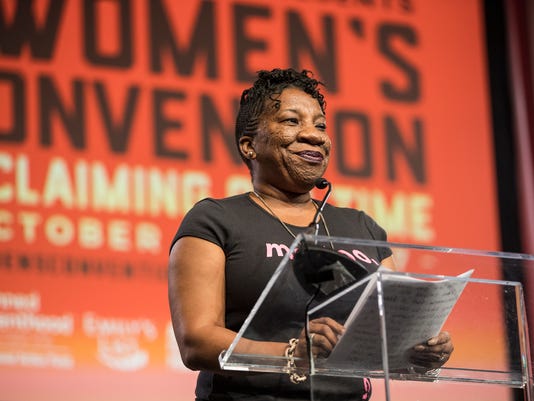
But maybe that’s because Tarana Burke, founder of the #MeToo movement that has led to complaints and indictments against dozens of men — and some women — for sexual harassment and assault, is a big, bold, fierce, powerful, outspoken black woman, who is finally being seen.
And in a keynote address at the Facing Race conference that brought more than 3,500 people to Detroit to discuss social justice, Burke brought down the house, defiantly challenging the movement she started a decade before movie producer Harvey Weinstein was outed for his behavior, saying that it better pay attention to the original survivors.
Those are the young black and brown girls in urban and indigenous communities where she has worked since age 14, women whose poverty and powerlessness made them easy prey.
“The No. 1 thing I hear from folks is that the #MeToo movement has forgotten us,” she said of black, Hispanic and Native American women. “Every day, we hear some version of that. But this is what I’m here to tell you: The #MeToo movement is not defined by what the media has told you. We are the movement, and so I need you to not opt out of the #Metoo movement. ... I need you to reframe your work to include sexual violence That’s how we take back the narrative. Stop giving your power away to white folks.
“You know how many people say, ‘The #Metoo movement — well Hollywood’s got it.’ F--k Hollywood. Every time somebody asks me how I feel about them taking my movement, I say, ‘You can’t take s--t that’s mine. This is not about Tarana Burke owning something. This is about a community that I have lived in, worked in, given my blood sweat and tears to. This is our movement. Stop opting out of it.”
Burke said she will not let her movement that she founded in 2006 and that has resulted in her getting death threats and having to challenge black leaders to support it, be co-opted by pretty girls and Hollywood.
“This is not about awareness. It’s about action,” the 45-year-old activist said at Detroit’s convention center. “…With #Metoo being as big and loud as it is, we don’t need more awareness, This is about what happens after the hashtag, after the hoopla This is about the work.”
Burke’s comments comes a year after her #MeToo movement, which she founded in 2006 became a global sensation when Milano used Burke’s #MeToo hashtag on social media to draw attention to widespread sexual harassment and rape. Some began crediting Milano, an actress and activist, with founding the movement that Burke has worked in since she was 14 and crediting Milano with the hashtag that Burke began using in 2006.
Burke said last Saturday that she wants people to change the way they view sexual assault and harassment, to stop working in silos as if sexual misconduct isn’t a part of every social justice effort.
“If you’re working on mass incarceration, you’re not dealing with health care. If you’re working on economic justice, you’re not dealing with racial justice — well you probably are — but not about sexual violence,” she said. “But we’re not seeing where this (issue of sexual violence) fits in everybody else’s work. What you need to say is the #Metoo movement is in my work. The #Metoo movement is in every single thing I said. It’s in our economic justice work. It’s in our mass incarceration work. It’s in our community health work. It’s everywhere.”
She recalled trying to get community attention focused on helping junior high girls whose stories fueled her work.
“I’m at the junior high school and I have sixth, seventh and eighth grade girls and more than half of these girls’ lives have been touched by sexual violence,” she said. “And what we heard back was they need more guidance counselors.
“… If an issue is affecting any segment of our community, it affects our entire community, and we need a community response,” she said to thunderous applause. “It was very difficult to get folk to rally around this issue.”
She said she faced leaders intent on “not tarnishing the legacy of community heroes and activists.”
“We heard every manner of excuse ‘It’s really about white supremacy because our folks don’t have a history of that kind of thing back in Africa’ or ‘the real issue isn’t sexual violence, it’s false accusations against black men’ or my personal favorite ‘This is not a social justice issue; this is a social work issue.’ ”
The most vulnerable victims of sexual violence and harassment do not deserve the silence they endure in their communities outside the larger movement that is at the top of the news, she said.
She cited statistic after statistic about women who aren’t famous but attacked because of their gender identity or economic powerlessness. But the worst, she said, was the fate of indigenous and Native American women “the group we talk about the least,” she said.
She cited a Justice Department study that found that an estimated one in three Native American women will be assaulted in their lifetimes, that 92 percent of Native American girls reported having been forced to have sex against their will — and that nine of 10 Native American women and girls who survived rape or sexual assault were attacked by assailants of a different color, most of them white.
“That’s definitely a racial justice issue,” she said. “And, at the end of the day, it’s a human rights issue.”
In a powerful moment after her speech, Burke talked about life on the front lines, something else she hopes the #MeToo movement does not ignore and something, in the telling, that moved her to tears before the crowd.
“This is hard,” she said. “… These are mostly women of color, queer women of color who are dealing with layers of s—t. I’ve gotten more death threats from black men than anybody else. After Cosby was indicted and R. Kelly took off, I got tons of threats from black men.”
Some of them were death threats, she said.
“Why do we have to die?” she asked. “And I’m not saying people writing on Facebook ‘You should die!’ I’m talking about coming to your house. I’m talking about having to relocate. … This is not a game. We are in the midst of a crisis around that. I’ve got a child. I had to pull my daughter out of school over some bulls—t. I’m sorry to keep cursing, but it’s just not easy.”
Burke is not going to stop, but she wants the movement to be a movement, one that includes all survivors and enlists the aid of all soldiers fighting for justice because every justice fight can help the fight against sexual violence.
“We come to work because we are the work,” she said. “We work in these different fields because it’s our lived experiences and we have survived sexual violence in addition to other things. We watch folks find the intersection of every other issue except sexual violence. Do you know how painful it is to watch people actively not care about your lived experience? We experience it all the time.”
Burke said the movement, which began as her movement, must care as much about the original victims as it does actresses who wanted careers and producers who got away with career murder.
It was her movement that pulled the covers off what has been a way of life in America.
It was her movement that has now seen countless men felled and countless women empowered.
And her message for that crowded throng in a Detroit convention center ballroom where hundreds of people screamed to her “We got your back!” was clear: The #MeToo movement better not forget the survivors for which it was founded, the original survivors whose faces aren’t known and who don’t have agents.
Now, it is time to go after the fraud in ICWA, money laundering and campaign finance.
Department of Justice Expands Tribal Access Program to Additional 25 Tribes This Year, Department of Interior Funds the Expansion of DOJ Tribal Access Program at 31 BIA Social Services and Law Enforcement Locations by 2020
The Department of Justice and the Department of the Interior announced a dramatic expansion of the federal government’s key program that provides tribes with access to national crime information databases, the Justice Department’s Tribal Access Program for National Crime Information (TAP).
By the end of 2019, the Justice Department will expand the number of TAP participating tribes by more than 50 percent—from 47 tribes to 72. The Department of the Interior (DOI) will fund the instillation of TAP Kiosks at three locations where the BIA-Office of Indian Services (BIA-OIS) deliver direct service social services by the end of 2019 and DOI aims to expand TAP access at all 28 BIA-Office of Justice Services (BIA-OJS) operated law enforcement agencies and detention service centers. These BIA locations will provide some degree of access to TAP for services delivered to more than 50 tribal communities that currently do not have any direct access.
“For far too long, a lack of access to federal criminal databases has hurt tribal law enforcement—preventing them from doing their jobs and keeping their communities safe,” said Deputy Attorney General Rod Rosenstein. “With the Tribal Access Program, participating tribes will be able to protect victims of domestic violence, register sex offenders, keep guns out of dangerous hands, and help locate missing people. This milestone demonstrates our deep commitment to strengthening public safety in Indian country.”
“I am proud to authorize the funding for the expansion of the Tribal Access Program to the Bureau of Indian Affairs to make the future of justice in Indian Country stronger,” said Assistant Secretary for Indian Affairs Tara Sweeney at the 75thNational Congress of American Indians Convention today. “The Bureau of Indian Affairs is proud to grant greater access to these important databases at more locations throughout Indian Country. Performing background checks is a critical step in protecting our precious Native children in foster care, and tribal communities served by the BIA will benefit from access to this extensive public safety tool.”
“Access to information is vital to effective law enforcement,” said Trent Shores, U.S. Attorney for the Northern District of Oklahoma and the Chairman of the Attorney General’s Advisory Subcommittee on Native American Issues. “The Tribal Access Program will enhance and improve the ability of tribal law enforcement officers to serve their communities. The Native American Issues Subcommittee is proud to support the continued expansion of this tool throughout Indian Country.
The Native American Issues Subcommittee (NAIS) is comprised of United States Attorneys with Indian Country in their federal districts. They advise the Attorney General regarding the development and implementation of policies pertaining to justice in Indian Country. The NAIS identified ‘increased law enforcement resources’ as one of four priority areas to improve justice services in Indian Country. Support for and increased dissemination of the TAP was unanimously supported by the US Attorneys at a recent NAIS meeting in Indian Country in Tulsa, Oklahoma.
“We at the BIA-OJS look forward to having direct access to these vital resources,” said Deputy BIA Director for Office of Justice Services Charles Addington. “We have waited years for the opportunity to streamline how we access these critical databases and the funding authorized by AS-IA Sweeney will allow our law enforcement officers the ability to receive the information they need to do their jobs effectively and keep them safe.”
TAP, offered in two versions, TAP-FULL and TAP-LIGHT, allows tribes to more effectively serve and protect their communities by fostering the exchange of critical data through several national databases through the FBI’s Criminal Justice Information Systems (CJIS) network, including the National Crime Information Center (NCIC), Next Generation Identification (NGI), National Data Exchange (N-DEx), National Instant Criminal Background Check System (NICS), Law Enforcement Enterprise Portal (LEEP) as well as other national systems such as the International Justice and Public Safety Network (Nlets). TAP enhances tribal efforts to register sex offenders pursuant to the Sex Offender Registration and Notification Act (SORNA); have orders of protection enforced nationwide; protect children; keep firearms away from persons who are disqualified from receiving them; improve the safety of public housing, and allow tribes to enter their arrests and convictions into national databases.
TAP-FULL consists of a kiosk workstation that provide access to national systems and is capable of processing finger and palm prints, as well as taking mugshots and submitting records to national databases. TAP-LIGHT is software for criminal agencies that include police departments, prosecutors, criminal courts, jails, and probation departments. Both versions provide federally recognized tribes the ability to access and exchange data with national crime information databases for both civil and criminal purpose. TAP is currently available to 47 tribes nationwide with over 220 tribal criminal justice and civil agencies participating.
Well, now, how come the FBI investigated #MeToo accusers before they alleged sexual harassment by Conyers and had him "taken out" of office?
I know why.
So, how come the FBI did not do the same thing and investigate the #MeToo accusers before they alleged sexual harassment by Kavanaugh and have him "taken out" of the nomination for SCOTUS?
Dean of the U.S. House of Representatives John Conyers, Jr.
In Roe v. Wade, the Supreme Court recognized a woman’s constitutional right to make what is perhaps the most profoundly personal of healthcare decisions –when to start a family – free from undue government interference.
Unfortunately, since 1976, Congress has sought to undermine this important constitutional right by attaching the so-called “Hyde Amendment” to annual appropriations measures funding the Department of Health and Human Services.
The Hyde Amendment – named for its original sponsor, former Judiciary Committee Chairman Henry Hyde – prohibits the use of federal Medicaid funds to pay for an abortion except to protect the mother’s life or in cases of rape or incest.
There are many reasons why this restriction should be rescinded.
To begin with, the Hyde Amendment is a blatant example of politicians inappropriately interfering in women’s health care decisions.
For more than 40 years, Roe v. Wade has been the law of the land. Yet, it is clear that the Hyde Amendment’s purpose is to undermine the Roe’s constitutional guarantee of a right to choose to terminate a pregnancy by limiting low-income women’s access to safe, legal medical care.
Politicians, most of whom are not doctors, have no business interfering in a woman’s constitutionally protected private healthcare decisions in order to impose their own moral views about women’s rights and healthcare.
In addition, the Hyde Amendment has a disproportionately detrimental impact on the health of low-income women and the wellbeing of their families.
According to research by the Guttmacher Institute, many low-income women lacking medical coverage are forced to delay paying utility bills, rent, or grocery bills for themselves or their children; to seek out financial assistance from relatives or friends; or to sell personal belongings in order to pay for an abortion.
Moreover, women who cannot afford an abortion procedure may, in desperation, resort to self-inducing an abortion or turn to unsafe, untrained, or unlicensed practitioners – heightening the risk of injury or death from what is supposed to be a safe, legal medical procedure.
Finally, the Hyde Amendment disproportionately affects women of color
Medicaid provides medical coverage to 20% of women of reproductive age.
But, as a result of social and economic inequality tied to the persistence of racism in our society, 30% of African American women and 24% of Hispanic women of reproductive age are enrolled in Medicaid, compared to just 14% of white women of reproductive age.
Clearly, the consequences of the Hyde Amendment disproportionately fall on women of color.
While 15 states permit the use of their own funds to provide abortion coverage for Medicaid enrollees, 60% of women of reproductive age enrolled in Medicare live in states that only cover abortion in limited circumstances.
Rather than undermine the constitutional rights of low-income women and women of color, Congress should look to these states as an example and act to ensure that women -- regardless of their financial situation -- have access to quality, comprehensive reproductive health services.
I thank the witnesses for participating in this hearing and I look forward to hearing their testimony.
Her passion to promote anti-amalgamation policies was beyond reproach.
She did not just embark on the journey to preserve the paleo-conservative concept of the family (pre-Emancipation Proclamation), she modernized the movement to reanimate the residuals of the peculiar institution in Parental Rights and the Religious Freedom Restoration Act by giving it a new face, called privatization.
Without her, the child welfare industry and its product of child poverty would never have made it to national discussions.
Even though I have never agreed with the proposed policies of her work, I highly respect her, and always will.
Phyllis Schlafly, whose grass-roots campaigns against Communism, abortion and the Equal Rights Amendment galvanized conservatives for almost two generations and helped reshape American politics, died on Monday. She was 92.
Her death was confirmed by the Eagle Forum, the conservative organization she founded in 1975.
In her time, Mrs. Schlafly was one of the most polarizing figures in American public life, a self-described housewife who displayed a moral ferocity reminiscent of the ax-wielding prohibitionist Carry Nation. Richard Viguerie, who masterminded the use of direct mail to finance right-wing causes, called her “the first lady of the conservative movement.”
On the left, Betty Friedan, the feminist leader and author, compared her to a religious heretic, telling her in a debate that she should burn at the stake for opposing the Equal Rights Amendment. Ms. Friedan called Mrs. Schlafly an “Aunt Tom.”
Mrs. Schlafly became a forceful conservative voice in the 1950s, when she joined the right-wing crusade against international Communism. In the 1960s, with her popular self-published book “A Choice Not an Echo” (it sold more than three million copies) and a growing legion of followers, she gave critical support to the presidential ambitions of Senator Barry Goldwater, the hard-right Arizonan who went on to lead the Republican Party to electoral disaster in 1964, but who planted the seeds of a conservative revival that would flower with the rise of Ronald Reagan.
And in the 1970s, Mrs. Schlafly’s campaign against the Equal Rights Amendment played a large part in its undoing. The amendment would have expanded women’s rights by barring any gender-based distinctions in federal and state laws, and it was within hailing distance of becoming the law of the land: Both houses of Congress had passed it by a vote of more than 90 percent, and 35 state legislatures — only three shy of the number required for adoption — had approved it.
But the amendment lost steam in the late 1970s under pressure from Mrs. Schlafly’s volunteer brigades — mainly women, most of them churchgoing Christians (Mrs. Schlafly was Roman Catholic) and not a few of them lugging apple pies to cajole legislators. Despite an extension of the deadline, the amendment died, on June 30, 1982.
Spurred by Court Ruling
Many saw her ability to mobilize that citizens’ army as her greatest accomplishment. Angered by the cultural transformations of the 1960s, beginning with the 1962 Supreme Court ruling prohibiting state-sponsored prayer in public schools, her “little old ladies in tennis shoes,” as some called them, went from ringing doorbells for Goldwater to serving as foot soldiers for the “Reagan revolution.”
“Schlafly had discovered a genuine populist sentiment in a large female population that opposed the E.R.A., feminism and modern liberalism with the same intensity of emotion that feminists brought to their cause,” Donald T. Critchlow wrote in “Phyllis Schlafly and Grassroots Conservatism: A Woman’s Crusade” (2005).
Without her and her followers, Mr. Critchlow said, the conservative intellectuals, research organizations and foundations that are often credited with reshaping the contours of American politics might have failed.
The conservative theorist and organizer Paul Weyrich said that Mrs. Schlafly “dressed up the conservative movement for success at a time when absolutely no one thought we could win.”
Even liberals conceded her impact. “If political influence consists in transforming this huge and cantankerous country in one’s preferred direction,” the political scientist Alan Wolfe wrote in The New Republic in 2005, “Schlafly has to be regarded as one of the two or three most important Americans of the last half of the 20th century” — although he hastened to add that “every idea she ever had was scatterbrained, dangerous and hateful.”
For all her political heft, it was Phyllis Schlafly the person who often animated discussion. With her pearls, perfect posture and Daughters of the American Revolution pedigree, she basked in depictions of herself as the perfect wife and mother. She let it drop that she breast-fed all six of her babies and that she had taught all her children to read before they started school.
Feminists said it was her husband’s wealth — he was a lawyer from a rich Illinois family — that had liberated her to politick.
Photo
Mrs. Schlafly endorsed Pat Buchanan for president in 1996.CreditLou Krasky/Associated Press
Her energy was formidable. She wrote or edited more than 20 books, published an influential monthly newsletter beginning in 1967, appeared daily on nearly 500 radio stations and delivered regular commentaries on CBS television in the 1970s and CNN in the ’80s. In 1972, she formed a volunteer organization called Stop ERA, which three years later became the Eagle Forum, to coordinate her campaigns.
In 1975, when she was living in Alton, Ill., Mrs. Schlafly announced to her family at dinner that she was going to enter law school at Washington University in nearby St. Louis. Her husband, by her account, disapproved of the idea at first, and she abandoned it, only to resurrect it when he changed his mind.
She received her law degree in 1978, ranked 27th in a class of 186, and passed the Illinois bar a few months later.
Some opponents called Mrs. Schlafly a hypocrite for pursuing so energetic a career while championing traditional female roles. She replied by calling her political career “a hobby” and saying she would never offer an opinion on whether women should or should not work outside the home.
Other detractors, like Karen DeCrow, a former president of the National Organization for Women, praised Mrs. Schlafly even as they castigated her politics.
Still, Mrs. Schlafly’s pronouncements drove her antagonists to distraction, though they suspected that her biting language was calculated precisely to provoke their outrage. She said that “sexual harassment on the job is not a problem for virtuous women” and that “sex-education classes are like in-home sales parties for abortions.” She called the atom bomb “a marvelous gift that was given to our country by a wise God.”
In 1980, a protester threw an apple pie in her face at a Women’s National Republican Club reception in New York, painfully scratching an eye.
But Mrs. Schlafly was never outwardly ruffled. When Ms. Freidan, during a debate at Indiana University in 1973, recommended that she burn at the stake, Mrs. Schlafly replied in an even voice that she was pleased Ms. Friedan had said that because, she said, the comment had made it plain to the audience just how intolerant “intemperate, agitating proponents of the E.R.A.” were.
Staunch G.O.P. Roots
She was born Phyllis McAlpin Stewart on Aug. 15, 1924, in St. Louis, the oldest of two daughters of the former Odile Dodge, a teacher with two college degrees, and John Bruce Stewart, a machinist and industrial equipment salesman who was 17 years his wife’s senior.
Fired by Westinghouse at the onset of the Depression, Mr. Stewart was never quite able to put the family’s finances back together. In 1944, he won a patent for a rotary car engine, of the type the Japanese automaker Mazda later sold, but it went nowhere.
Despite his hardships, Mr. Stewart remained a staunch Republican, fiercely opposed to the New Deal.
Mrs. Stewart, who was ambitious for her daughters, supported the family with a series of jobs: department store saleswoman, elementary school teacher and librarian at the St. Louis Art Museum. In her spare time, she wrote a book on the history of St. Louis.
Ms. Felsenthal suggested in her book that Mrs. Schlafly’s impatience with women who denigrated homemaking stemmed in part from her mother’s wish that she could have kept house and worked for good causes rather than report for work six days a week.
Phyllis Stewart attended Maryville College of the Sacred Heart in St. Louis (now Maryville University) and transferred to Washington University. She had no time for friends, dates or sororities, she wrote; instead, as a student, she worked nights at a munitions factory test-firing guns.
Photo
The cover of the 1964 edition of “A Choice Not An Echo” by Phyllis Schlafly.
Even so, she managed to graduate Phi Beta Kappa in only three years, at 19. She won a scholarship to study political science at Radcliffe, and earned a master’s degree there in nine months.
Her politics were middle of the road at first. In 1940, she supported the moderate Republican Wendell Willkie in his bid to deny President Franklin D. Roosevelt a third term, and in graduate school she wrote papers supporting an active United Nations. Her ambition was to work for the federal government in Washington.
When no government jobs turned up, she found a spot at a conservative think tank, the American Enterprise Association, the forerunner of the American Enterprise Institute. Educating herself in conservative philosophy, she submitted articles against the New Deal to Redbook and other magazines, but they were rejected.
In 1946, she returned to St. Louis to work on the successful congressional campaign of Claude I. Bakewell, a Republican. After that, she worked as a librarian and researcher at a bank and, at 24, met John Fred Schlafly Jr., a 39-year-old lawyer and politically engaged conservative from an Alton family that had made its money in banking and industry. They were married on Oct. 20, 1949.
At the ceremony, Mrs. Schlafly said, she did not promise to obey, only to cherish. But she delighted in portraying herself as a traditional wife, even as she kept to a hectic pace of travel, writing, speaking and campaigning after her oldest child turned 18 months.
“I want to thank my husband, Fred, for letting me come here” was a favorite opening for speeches. (“I like to say that,” she said, “because I know it irritates women’s libbers more than anything else.”)
But the writer Gail Sheehy suggested that Mrs. Schlafly had used marriage to liberate herself from paying jobs. “Phyllis Schlafly’s formula for the better life, then, is based on marrying a rich professional, climbing the pedestal to lady of leisure and pulling up the rope ladder behind her,” Ms. Sheehy wrote in The New York Times in 1980.
Mrs. Schlafly was introduced to electoral politics in 1952, after Republicans had asked her husband to run for Congress. When he turned them down, Mrs. Schlafly, who was 27, volunteered in his stead. She won the Republican primary but lost the general election.
That experience, she said, helped her overcome her natural shyness, and she went on to make dozens of speeches in Illinois as an officer of the Daughters of the American Revolution and to start building a national network of conservative friends. She was the president of the Illinois Federation of Republican Women from 1956 to 1964.
In 1958, she and her husband started the Cardinal Mindszenty Foundation — named for the Roman Catholic leader who was tortured and imprisoned by Hungarian Communists — to educate Catholics on the dangers of Communism. Beginning in 1962, she hosted a 15-minute radio show on national security called “America Wake Up.” It was carried by 25 Illinois stations.
The Schlaflys’ politics were concentrated on the external threat posed by Communism, not the crusade against domestic Communist infiltration led by Senator Joseph R. McCarthy of Wisconsin. They opposed summit meetings and limits on nuclear testing and favored a constitutional amendment to prevent the president from negotiating international treaties.
Many members of the Mindszenty Foundation were also members of the ultraright John Birch Society, and its founder, Robert Welch, once called Mrs. Schlafly “one of our most loyal members.” The Schlaflys denied they were members.
In 1964, Mrs. Schlafly was an active supporter of Goldwater’s presidential campaign. In her self-published pocket-size book promoting his candidacy, “A Choice Not an Echo,” she contended that Republican presidential nominations were rigged by “secret kingmakers.” By some estimates, the book sold as many as 3.5 million copies.
Writing in The New Yorker in 2005, Elizabeth Kolbert said the book “mixed fact, sensational accusations, commonsensical truths, and elaborate conspiracy theories into a compelling but evidently bogus narrative.”
Photo
Mrs. Schlafly, second from right, demonstrating outside the White House against the Equal Rights Amendment in 1977.CreditBettmann/Corbis
Mrs. Schlafly became closely identified with Goldwater’s landslide defeat in 1964, and in 1967 she lost a bitter campaign for the presidency of the National Federation of Republican Women. Another run for Congress, from another Illinois district, in 1970, also ended in defeat.
Targeting the E.R.A.
During much of the 1960s and ’70s, Mrs. Schlafly wrote books about national defense issues, often working with Chester Ward, a retired Navy admiral. Their “Kissinger on the Couch” (1975) begins with a proposition: “Suppose that Henry Kissinger is, in the common parlance, ‘some kind of nut or something.’” In more than 800 pages, they argued that he was.
Mrs. Schlafly hardly noticed the Equal Rights Amendment when it was first debated in Congress. Her initial inclination was to support it, as “something between innocuous and mildly helpful,” she told Ms. Felsenthal. But when, in December 1971, a friend asked her to debate a feminist on the amendment, she read up on the issue and decided that the E.R.A. was dangerous and needed to be stopped. It had already passed the House.
The next October, Mrs. Schlafly founded and appointed herself chairwoman of Stop ERA, the volunteer organization that became the Eagle Forum. The “stop” was an acronym for “stop taking our privileges,” effectively summarizing the position of the amendment’s opponents. They worried that earlier laws written to protect women — guaranteeing alimony and exempting women from combat, for instance — would be jettisoned.
“I simply didn’t believe we needed a constitutional amendment to protect women’s rights,” Mrs. Schlafly told The Times in 2006. “I knew of only one law that was discriminatory toward women, a law in North Dakota stipulating that a wife had to have her husband’s permission to make wine.”
Proponents of the amendment have said that even though courts and legislatures have set aside statutes that discriminate based on sex, the amendment would still retain symbolic importance.
Unwelcome Revelation
Mrs. Schlafly’s followers only grew in number after the Supreme Court legalized abortion in 1973, an issue that social conservatives saw as a further erosion of the country’s moral values.
After her husband died in 1993, Mrs. Schlafly moved from their limestone house on the bluffs of the Mississippi River in Alton to a brick colonial-style house in the suburbs of St. Louis, where the Eagle Forum has its headquarters.
Mrs. Schlafly is survived by six children, 16 grandchildren and three great-grandchildren.
Her son John gained attention in 1992 when a gay activist revealed that he was homosexual. Mrs. Schlafly said she considered the disclosure a deliberate attempt to embarrass her. The revelation did not alter her disapproval of gay marriage. In 2010, she said of gay couples: “Nobody’s stopping them from shacking up. The problem is that they are trying to make us respect them, and that’s an interference with what we believe.”
(John Schlafly defended his mother and refused to repudiate Republican politicians, like Pat Robertson, who had condemned homosexuality. “Family values people” are “not out to bash gays,” he said.)
Mrs. Schlafly maintained an energetic pace into advanced age. In 2011, she spoke out for “shotgun marriages” as the solution to unwanted pregnancies. Even as supporters of the Equal Rights Amendment tried to revive it, Mrs. Schlafly strove to make sure it stayed dead.
In March of this year, she endorsed Donald J. Trump for president, saying he had “the courage and the energy” to do “what the grass-roots want him to do.”
In her 2006 interview with The Times, she attributed the improvement in women’s lives in the 20th century not to feminism but to labor-saving devices like the indoor clothes dryer and paper diapers.
“Feminism has changed the way women think, and it has changed the way men think,” she said, “but the trouble is, it hasn’t changed the attitudes of babies at all.”