Well, you know what I always say, "What the heck do I know?"
All I know, as a verified factual finding, supported by companion federal and international law, is that Perkins Coie Sucks.
A secret memo marked “URGENT” detailed how the House Democratic Caucus’s server went “missing” soon after it became evidence in a cybersecurity probe. The secret memo also said more than “40 House offices may have been victims of IT security violations.”
In the memo, Congress’s top law enforcement official, Sergeant-at-Arms Paul Irving, along with Chief Administrative Officer Phil Kiko, wrote, “We have concluded that the employees [Democratic systems administrator Imran Awan and his family] are an ongoing and serious risk to the House of Representatives, possibly threatening the integrity of our information systems and thereby members’ capacity to serve constituents.”
The memo, addressed to the Committee on House Administration (CHA) and dated Feb. 3, 2017, was recently reviewed and transcribed by The Daily Caller News Foundation. The letter bolsters TheDCNF’s previous reporting about the missingserver and evidence of fraudon Capitol Hill.
It details how the caucus server, run by then-caucus Chairman Rep. Xavier Becerra, was secretly copied by authorities after the House Inspector General (IG) identified suspicious activity on it, but the Awans’ physical access was not blocked.
But after, the report reads, the server appears to have been secretly replaced with one that looked similar.
The memo called for firing the Pakistani-born aides, revoking all their computer accounts, and changing the locks on any door they had access to.
Rep. Louie Gohmert — a Texas Republican on the House Committee on the Judiciary who has done oversight work on the case — said the missing server contained copies of Congress members’ emails.
“They put 40 members of Congress’s data on one server … That server, with that serial number, has disappeared,” he said.
Multiple sources connected to the investigation told TheDCNF that shortly after an IG report came out identifying the House Democratic Caucus server as key evidence in a criminal probe, the evidence was stolen.
“They [the Awans] deliberately turned over a fake server” to falsify evidence, one official close to the CHA alleged. “It was a breach. The data was completely out of [members’] possession.”
The six-page letter says:
• In September of 2016 … the CHA and [IG] briefed the former Chairman of the Democratic Caucus about suspicious activity related to their server that the [IG] identified. As a result, the former Chairman of the Democratic Caucus directed the CAO to copy the data from their server and two computers.
• The CHA directed the IG to refer the matter to the US Capitol Police. The USCP initiated an investigation that continues to this day.
• In late 2016, the former Chairman of the Democratic Caucus announced his intention to resign from Congress to assume a new position. The CAO and [sergeant-at-arms] worked with the Chairman to account for his inventory, including the one server.
• While reviewing the inventory, the CAO discovered that the serial number of the server did not match that of the one imaged in September. [Investigators] also discovered that the server in question [the replacement server] was still operating under the employee’s control, contrary to the explicit instructions of the former chairman to turn over all equipment and fully cooperate with the inquiry and investigation. [A House source said the “employee” was Abid Awan.]
• The USCP interviewed relevant staff regarding the missing server.
• On January 24, 2017, the CAO acquired the [replacement] server from the control of the employees and transferred that server to the USCP.
President Donald Trump referenced the Democratic Caucus’ missing server in a tweet. But because the letter to the CHA was kept secret, many news outlets have not grasped that the House’s top cop documented a “missing server” connected to the Democratic Caucus.
The timeline laid out in the letter also shows that Becerra — now California’s Democratic attorney general — failed to ensure that the Awans didn’t have access to House computer systems during the 2016 election, which was wrought with cybersecurity scandals.
“The Caucus Chief of Staff requested one of the shared employees to not provide IT services or access their computers,” it read. “This shared employee continued.” It’s unclear why that request was not granted or why it was a request rather than an order.
A House official close to the probe said the employee was Abid, who was not on Becerra or the Caucus’s payroll. The official said Becerra Chief of Staff Sean McCluskie apparently knew Abid was accessing Caucus servers. According to payroll records, Abid’s sister-in-law, Hina Alvi, was the Caucus’ systems administrator.
The Awans’ continued physical access to Becerra’s equipment after red flags emerged enabled the server to disappear after it became evidence, House officials close to the investigation told TheDCNF.
Becerra has refused to comment, citing an ongoing criminal investigation.
The February 2017 memo itemizes “numerous and egregious violations of House IT security” by members of the Awan family, including using Congress members’ usernames and “the unauthorized storage of sensitive House information outside the House.”
“These employees accessed user accounts and computers for offices that did not employ them, without the knowledge and permission of the impacted Member’s office,” it said, adding, “4 of the employees accessed the Democratic Caucus computers 5,735 times.” More than 100 office computers were open to access from people not on the office’s staff, it said.
Chris Gowen — a former aide to Hillary Clinton who is now serving as Imran’s attorney — told TheDCNF, “There is no missing server and never was.”
He didn’t provide any support for his claim, which is contrary to evidence Kiko and Irving presented to Congress.
The memo said the CHA possesses voluminous evidence, including, “Interview notes with House Members’ Chiefs of Staff,” and “Logon activity and computer access logs.” Prosecutors have not brought charges.
The Awans were banned from Congress’s computer network the day the letter was sent, and Kiko held a briefing to convey the message to chiefs of staff for members who employed them.
But Democrats claim they were never told about any of the cybersecurity issues itemized in the urgent memo. Rep. Jackie Speier — a California Democrat on the House Permanent Select Committee on Intelligence who employed Imran and his wife, Hina Alvi — said she never heard of any missing server.
Joaquin Castro of Texas — another Democratic intelligence committee member who employed one of the Awans — told TheDCNF that Kiko never told him of any cybersecurity issues whatsoever and that the Awan probe was instead described as a theft issue.
Indeed, the CHA issued only one public statement on the case and titled it the “House Theft Investigation” — wording that avoids cybersecurity words while political news coverage raged about other cybersecurity issues in the 2016 election.
Yet even the alleged theft has not resulted in criminal charges — even though the letter also says House authorities have “purchase orders and vouchers” that allegedly show procurement fraud, as well as testimony from a Democratic chief of staff to Rep. Yvette Clarke, who warned of procurement fraud.
The FBI arrested Imran at the airport in July 2017 for alleged bank fraud that occurred six months prior, and Democrats have since claimed that the case is about nothing but bank fraud. Bank fraud does not explain why the Awans were kicked off the House network concurrent with the urgent memo, which did not cite bank fraud.
A Democratic IT aide who alleged that Imran solicited a bribe from him told TheDCNF he believes members of Congress are playing dumb and covering the matter up. Wendy Anderson, a former chief of staff to New York Rep. Yvette Clarke, told House investigators that she suspected that her predecessor, Shelley Davis, was working with Abid on a theft scheme, but Clarke refused to fire Abid until outside investigators got involved, TheDCNF reported.
Eighteen months after the evidence was recounted in the urgent memo, prosecution appears to have stalled for reasons not publicly explained. Imran is in court July 3 for a possible plea deal in the bank fraud case. Gohmert said the FBI has refused to accept evidence demonstrating alleged House misconduct, and some witnesses with first-hand knowledge say the bureau has not interviewed them.
Detroit Mayor Mike Duggan. Photo by Steve Neavling.
Mayor Mike Duggan has built a formidable political fundraising machine unlike anything Detroit has ever seen.
The first-term mayor raised a whopping $2.8 million for his re-election bid, courting big banks, suburban developers, corporate executives, political action committees and other deep-pocket movers-and-shakers, many of whom have contracts with the city or bought Detroit-owned property in the past three years. Wow, considering the rate of child poverty in Detroit, I guess he would have to fundraise outside the city limits.
By comparison, his challengers raised a mere $44,300 combined, giving Duggan a significant money advantage going into Tuesday’s primary election. But the mayor’s fundraising prowess raises serious questions about his influence with outsiders who don’t always have Detroit neighborhoods’ best interests at heart or who have contributed heavily to Republican candidates, including Donald Trump, Gov. Rick Snyder and the Michigan Republican Party. Something tells me Coleman knows something about something that is going to happen and will not have to raise a single penny for his campaign to be successful.
A Motor City Muckraker review of Duggan’s latest campaign finance report, which covers $1.6 million in donations from November 2016 to July 23, found:
Just 10% of the mayor’s donations came from inside Detroit. Of those, nearly half came from political action committees.
Twelve of Duggan’s 26 fundraisers were held outside of Detroit, including two in New York City, three in Bloomfield Hills, one in Grand Rapids and one in Lansing.
Duggan’s most successful fundraiser was held at the sprawling home of Yousif and Mara Ghafari, both of whom have histories of donating tens of thousands of dollars to the Michigan Republican Party and conservative candidates, including Donald Trump, Gov. Snyder, George W. Bush and Mitt Romney.
An unusual number of employees from deep-pocket companies contributed to Duggan’s campaign, including more than 150 from Blue Cross Blue Shield, 119 from the law firm of former Detroit Mayor Dennis Archer, 30 from DTE and 43 attorneys from Honigman Miller Schwartz and Cohn. Two Blue Cross employees said they felt pressured to donate.
Miller Canfield Paddock and Stone, the law firm representing the mayor’s controversial demolition program, which is under a federal grand jury investigation, donated $26,600. The firm’s PAC also donated $10,000 in October 2016.
Duggan relied heavily on suburban billionaires and their companies, including Dan Gilbert’s Quicken Loans, Roger Penske and his businesses, the conservative DeVos and Meijer families and Tony Soave, who gave former Mayor Kwame Kilpatrick’s friend, Bobby Ferguson, $30 million in work from 2002 and 2008 and spent an additional $300,000 on Kilpatrick for private flights, hotels, watches and sporting events.
Two high-ranking Snyder employees – senior adviser Richard Baird and former Chief of Staff Dennis Muchmore – both donated to Duggan and were influential in the financial takeovers of primarily black cities.
Since Duggan became mayor in January 2014, he raised an additional $433,000 through his controversial nonprofit, Detroit Progress Fund, which can take unlimited contributions. A vast majority of the donors are corporations, many of which have contracts with the city.
Duggan’s campaign declined to comment on the outside donations but insisted the mayor was running a “grassroots campaign.”
I wonder if Motor City Muckrucker asked the Detroit Land Bank Authority about its participation in the campaign.
“Mayor Duggan has been running a grassroots campaign from the beginning and will continue to do so,” said campaign spokeswoman Sharon Banks, who also served as the press secretary for then-Wayne County Executive Robert Ficano. “He is across the city every day visiting and meeting with residents in the neighborhoods. The more than 10,000 families with a sign in their yard is a good sign that they believe the city is headed in the right direction.”
I believe "grassroots" means what is left of the properties that were stolen from the people by the Detroit Land Bank Authority.
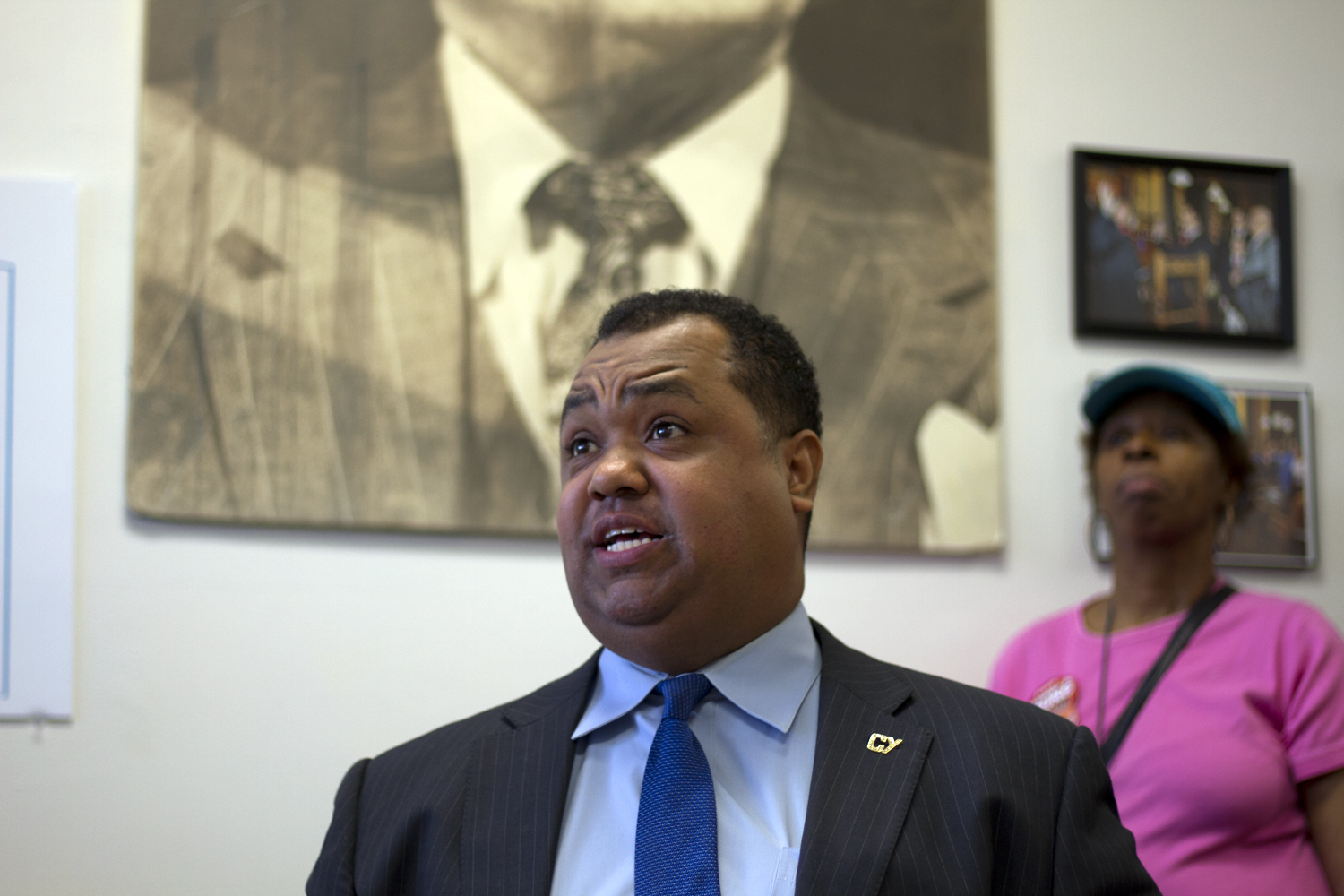
Sen. Coleman Young II. Photo by Steve Neavling.
Duggan’s most competitive challenger, Sen. Coleman Young II, who raised $22,000 so far, criticized the mayor for relying on big banks and corporate outsiders who have preyed on the neighborhoods.
"Always remember, it takes a village...then pillages its treasury."
“Duggan has aligned himself with those who have made millions and millions of dollars off the misery of folks who live in Detroit,” Young’s campaign manager Adolph Mongo told us. “None of these corporations care about the revival of the neighborhoods. The banks, Quicken Loans and people like Dan Gilbert are the direct cause of the problems and foreclosures in the neighborhood.” I believe the proper corporate reference would be Title Source, Incorporated.
Mongo added, “Unlike Duggan, Sen. Young refuses to be bought off and won’t sell the mayor’s office to get donations.”
While Duggan is leading Young in recent polls, serious questions have been raised about the mayor’s loyalty to neighborhoods, where most of the city’s predominately black population lives. Duggan, for example, is demolishing thousands of houses with federal money originally intended to help people save their homes. The mayor also repeatedly lied to the public about the use of $34.5 million in captured taxes to convince billionaire Tom Gores to move the Pistons to downtown Detroit. He also struck deals with the billionaire Illitch family and Dan Gilbert, allowing them to skirt affordable housing requirements for big residential developments in downtown and the rapidly gentrifying Cass Corridor. Guess where the money for these project came from! You, the taxpayer.
Among the biggest contributors to Duggan’s campaign was Blue Cross Blue Shield, which has lucrative contracts with the city. More than 150 employees and executives donated nearly $70,000 in the past several months, and the insurance company’s Lansing-based PAC contributed more than $75,000 to Duggan’s campaign and his Detroit Progress Fund.
I bet if you back track, the Clinton Foundation will be his biggest, dark, dirty money campaign contributor.
Blue Cross CEO Daniel Loepp
Blue Cross CEO Dan Loepp urged more than 1,000 employees to donate to Duggan’s campaign in March, potentially violating the company’s own code of business conduct, Crain’s Detroit Business reported.A day later, members of the company’s PAC received an email from Duggan’s campaign asking for money.
Blue Cross prohibits the use of “company property, facilities or time of any other workforce member for any political activity.”
Two Blue Cross employees, who spoke on condition of anonymity for fear of losing their jobs, told Motor City Muckraker they felt pressured to donate.
“If you want to climb up the ladder, you do what the CEO wants,” one employee said.
Hmmmm, I wonder what Bill Schuette is doing right about now....
Yousif Ghafari
Duggan’s most successful fundraiser – in which $277,000 was donated – was held on June 19 at the sprawling Bloomfield Hills home of Yousif and Mara Ghafari, who are deep-pocket donors to Republican candidates. Yousif Ghafari, the former U.S. ambassador to Slovenia, also sits on the Blue Cross Blue Shield Board of Directors.
The Ghafari family owns Ghafari Associates, which opened an office in downtown Detroit earlier this year. Wayne Count successfully sued the Dearborn-based company for its role in the failed jail project.
Duggan received 56 donations exceeding $1,000 from out-of-state residents, including six executives from JPMorgan Chase, which reached a $55 million settlement with the government in January over allegations that it discriminated against thousands of black and Latino mortgage borrowers.
Many of the out-of-state donations came during two fundraisers in New York City. Duggan raised $31,519 on the 20th floor of 277 Park Avenue, where JP Morgan Chase’s world headquarters are.
Duggan raised an additional $15,150 at a $1,000-a-plate fundraiser at Shinola’s flagship store in the Tribeca neighborhood of Manhattan.
Banks, through the Detroit Land Bank Authority, hand out mortgages through the Hardest Hit Fund.
Another company that profits off of foreclosures, Ohio-based Safeguard Properties, also donated to Duggan’s campaign. Founder and chairman Robert Klein and his wife Ita Klein each contributed the maximum $6,800. The company clears out bank-foreclosed homes.
...and clears out Detroit Land Bank Authority Quiet Title Actions.
Detroit donations
More than two dozen executives with Detroit-based Quicken Loans, which the federal government also accused of predatory lending, contributed nearly $73,000 to Duggan’s re-election campaign. In early July, a federal judge ruled that Quicken Loans officers brokered illegal loans in excess of fair market value by relying on excessive home appraisals.
Title Source, Incorporated was fraudulently collecting non-existent, made up, delinquent taxes for Detroit Land Bank Authority because the Detroit Land Bank Authority is not a registered corporation, which means it has to run its money laundering through another host.
Dennis Archer Jr.
Former Detroit Mayor Dennis Archer and his son Dennis Archer Jr. turned out big for Duggan. Archer Jr., who won at least two competitive land contracts from the Duggan administration, was a guest speaker at the Shinola fundraiser in New York City. He and his company, Ignition Media Group, donated $14,000 to Duggan’s Detroit Progress Fund.
Archer’s father held a fundraiser for Duggan at the former mayor’s home in Palmer Park, where 29 guests donated a combined $49,240. Archer’s law firm, Dickinson Wright, also held a fundraiser at the company’s office in downtown Detroit, raising $10,850. A total of 115 employees of Dickinson Wright donated to Duggan’s campaign.
Oh, DJ...
On Monday, Motor City Muckraker explores how Duggan spent his donations and ran his campaign.
This conundrum wrapped in an enigma has kept me up tossing and turning for nights, pining for you to come to me in my dreams and answer this question:
Why was the Detroit Land Bank Authority a creditor in the Chapter 9 City of Detroit, Michigan, Case No. 13-53846 presided by Judge Steve W. Rhodes?
The Detroit Land Bank Authority claims to be a "quasi-government organization" (QGO), and also claims to be part of the City of Detroit.
A Detroit Land Bank Authority Contractor with the Official Seal of the City of Detroit
So, if this is the case, that the Detroit Land Bank Authority is going around using the Official Seal of the City of Detroit, meaning that its legal paperwork is filed in the great repository of the Seal of the City, then how come it is listed as a creditor in the bankruptcy case against "itself", or rather, the City of Detroit?
If the Detroit Land Bank Authority did not file with the Michigan Eastern District Bankruptcy Court its corporate interest disclosure, then, this begs the question, "Did City of Detroit Corporate Counsel represent, in notice of appearance, for Detroit Land Bank Authority?"
But, wait, I got one even better...
"What is the EIN for the Detroit Land Bank Authority to open a bank account and cash a check?
Perhaps, that is why "settlements" were done in quiet title, MICS 21703.
SHOW Me the Metadata. Seth' Phone, Bodycams, Bar Cams, Hospital Cams, Aaron Rich Lawsuit, Powers of Discovery, Hospital Admit Report, Doctors Report, Autopsy
Set Rich Sent 44,000 Emails to MacFayden, But I Still Say Jones and Ratner Are the Key to Rich and Braverman
Podesta' Playbook -SEIU Janitor With Pillow, Disorderly Orderly, Nurse Anesthetist Whoops I Did It Again, I Am Just Reading the Plays
Reaching Out Wikileaks Francophones, Tout Le Monde, C'est Tres Important
Eric Barnhart, Evan McMullin, McCabe, NSA, and Booz Allen
French Metadata Anyone? Chandelon Open the Door to the French Research Powerhouse
Erik Barnhart, FLDS, NATO, Chandelon, Epstein On the Kosovo to Paris Ratline, Plaime Greatness, Dumheller's Secrets
Most Significant Paragraph, Metadata, Frequency Analysis, Ratlines
Ron Wheeler Interview Was a Real Downer - He Is Not Going To Find Seth Rich's Killer
Pic of Seth at Lou's City Bar, Pic of Mgr. Joe Capone, Badges and Names Of Officers, Name of Ambulance Service, Is Capt Anthony Haythe ex-DynCorp
Any photos of Kelly Mulka, Seth's Girlfriend? Seth's Home Address?
The union that exploited Michigan’s home-based caregivers for the best part of a decade has seen its revenue tumble since the scheme that enabled the exploitation ended. SEIU Healthcare Michigan reported $5,398,383 in dues and fees in 2014. That's just 48 percent of the $11,307,314 it reported for 2012, the last full year during which the union's dues skim was in place.
The information was contained in a financial disclosure report the union submitted to the federal government 57 days after the March 31 deadline it is apparently required to meet. The disclosure finally took place shortly after Michigan Capitol Confidential brought the absence of the report to the attention of the federal Office of Labor-Management Standards.
The roots of the dues skim reach back to the mid-2000s when SEIU moved to grab a share of the benefit checks of Michigan residents enrolled in the Medicaid Home Help program, which lets elderly and disabled individuals receive care in their homes. The operation involved creating a pretext to unionize the caregivers, and on that basis have union dues and fees “skimmed” from the Medicaid checks of the program's homebound beneficiaries. The unseemliness was aggravated by the fact that most of the caregivers were friends and relatives of those receiving care.
In 2005, during the administration of Gov. Jennifer Granholm, SEIU was allowed to carry out the forced unionization scheme by creating a dummy employer and executing a stealth mail-in union certification election. The operation went on from 2006 until its state contract endedon Feb. 28, 2013. Overall, the scheme poured more than $34 million into the union's coffers.
SEIU Healthcare Michigan's required financial disclosure report for 2014 is significant because it covered the first full year in which the union received no money from the dues skim. Its previous (2013) report revealed that more than 80 percent of its members fled when the dues skim ended. However, because the dues skim was still active in early 2013, it wasn’t clear whether that year's report reflected the entire membership loss or a partial, prorated figure.
The recently disclosed 2014 report indicates that the previous report probably indicated the union’s actual membership at the end of 2013, which was mostly real employees of private sector medical facilities. Union rolls did fall by a modest 190 members according to the latest report, from 10,918 in 2013 to 10,728 in 2014.
The headline number in the 2014 report is the impact of terminating the dues skim on the union's revenue and membership. Here are the relevant figures going back as far back as records are available:
2008: Dues and Fees — $10,497,917; Membership 53,533
2009: Dues and Fees — $10,871,481; Membership 57,239
2010: Dues and Fees — $11,508,410, Membership 56,972
2011: Dues and Fees — $11,974,000; Membership 55,359
2012: Dues and Fees — $11,307,314; Membership 55,265
2013: Dues and Fees — $7,119,322; Membership 10,918
2014 Dues and Fees — $5,398,383; Membership 10,728
The dues skim contract officially ended on Feb. 28, 2013, but it allowed the union to collect dues for one more month.
Unions are also required to annually disclose their “Total Receipts,” which in addition to member dues and fees show other money received. The annual disclosures show that after dues and fees, most of SEIU Healthcare Michigan's remaining revenue is listed under “Other Receipts.” The source for most of this is probably SEIU International, the larger union of which SEIU Healthcare Michigan is an affiliate.
In general, those amounts correspond with the size of an affiliate’s membership and the amount of dues and fees it collects. Only a few years ago, SEIU Healthcare Michigan was boasting that it was the fastest growing union in Michigan. Here are the state affiliate's “Total Receipts” as far back as records are available.
2008 — $15,003,971
2009 — $15,372,055
2010 — $16,465,288
2011 — $21,523,734
2012 — $18,929,050
2013 — $12,078,838
2014 — $8,419,245
In 2011, the union’s most lucrative year, it reported receiving $3,372,657 for what it described as funds “On Behalf Of Affiliates Transmittal to Them.” This was in addition to the $6,174,801 that was listed under “Other Receipts.”
According to Vincent Vernuccio, the director of labor policy with the Mackinac Center for Public Policy, the dues skim and its aftermath reveals that the primary motive behind this union’s actions has been and continues to be money, not the best interests of its members.
“The dues skim filled SEIU coffers at the expense of people who were taking care of disabled and elderly friends and relatives while giving them nothing in return,” Vernuccio said. “With schemes like the dues skim and more recently its failed attempt to unionize fast food employees, the SEIU repeatedly proves that it does not consider serving its dues-paying members to be a top priority. No wonder its members are leaving the union in droves.”
SEIU Healthcare Michigan disclosure reports over the years identified several officials receiving six-figure and high five-figure salaries. In 2008, union President Marge Robinson (formerly Marge Faville) collected a base salary of $122,700 and $133,987 overall. The amounts varied in subsequent years but the trend was generally upward.
By 2013, the union president’s base salary was $188,208, and the total amount she was paid was $199,859. In 2014 Robinson's base salary was $183,781, and her total pay was $196,195.
SEIU Healthcare Michigan did not return a phone call giving it the opportunity to comment.