Showing posts with label Eric Sabree. Show all posts

Thursday, October 17, 2019

Rick Sollars & Another Grand Jury Unsealment

There seems to be a trend when it comes to unsealing grand jury material and the requests, thereof.

Funny how that works.

I bet that sucks for Rick Sollars, and his sidekick Slim Shady.

FBI probe of Taylor mayor expands into election activities

The FBI has subpoenaed documents about Taylor Mayor Rick Sollars' re-election fundraising while investigating the Downriver politician for racketeering, bribery, wire fraud and money laundering, according to a grand jury subpoena.
"You can pick up the quiet title deed next week."
The FBI has subpoenaed documents about Taylor Mayor Rick Sollars' re-election fundraising while investigating the Downriver politician for racketeering, bribery, wire fraud and money laundering, according to a grand jury subpoena obtained by The Detroit News.

Investigators are focused on the use of the city-owned Lakes of Taylor golf course from 2016-18 and whether Sollars' re-election committee or a third party paid to use the facilities, according to the subpoena.

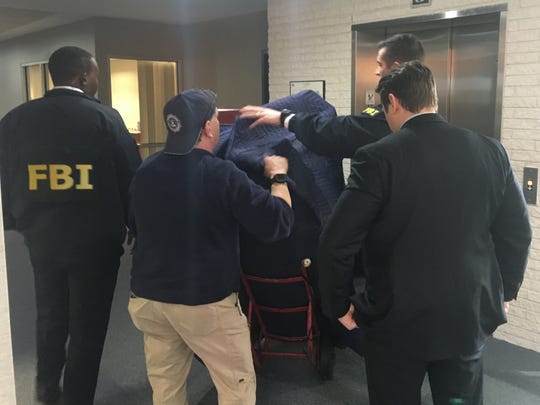
The subpoena provides new insight into an ongoing corruption investigation that emerged publicly in February when FBI agents raided City Hall, the mayor's home and cottage, and the home and office of a city contractor. Investigators seized campaign records and $206,493 from Sollars and later raided the home and business of a second businessman.

The grand jury subpoena was issued in April but revealed Tuesday when attorney Andrew Paterson obtained a copy via a Freedom of Information Act request.

"It is apparent from the newly released federal grand jury subpoenas that Mayor Sollars may be facing multiple federal felonies," Paterson wrote in an email to The News. "The detail contained in the newly released federal grand jury subpoenas seem to indicate that a number of city vendors have been spilling the beans with respect to Mayor Sollars and his campaign fundraisers."

Prosecutors have not filed any criminal charges since searching the locations, and Sollars remains in office.

An FBI spokeswoman declined comment and Sollars' attorney could not be reached immediately for comment Wednesday. Taylor city spokesman Karl Ziomek declined comment.

The golf course and banquet center has been a frequent setting for Sollars, who delivered his State of the City address at the facility two days after the FBI raids and professed his innocence. The grand jury subpoena sought documentation related to golf fundraisers and cigar parties Sollars' re-election committee held at the golf course since 2016.

Specifically, the subpoena requested copies of checks, credit card documents and records of any cash payments to the Lakes of Taylor related to the various events.

Sollars’ election committee has not filed a campaign statement since last year, according to county elections records. In October 2018, the committee reported a $162,382 balance.

Sollars’ campaign hired the Clark Hill law firm to review campaign finance reports and correct irregularities involving contributions and expenses, attorney Michael Pattwell wrote in an email to The News.

“Since this summer, the committee has been working with the Michigan Secretary of State to prepare amended campaign finance reports…,” Pattwell wrote. “Once the committee has amended those historic campaign finance reports it will turn its attention to preparing and filing the more recent reports which had not been filed due to the federal government seizing the underlying records in an unrelated matter.”

During the City Hall search, investigators were hunting for records linking the mayor to property management owner Shady Awad, records involving the mayor's personal and campaign finances, and his casino activity, according to search warrant records obtained by The News.

Sollars, 45, was elected mayor of the Downriver community 17 miles southwest of Detroit in November 2013 following two terms on the City Council and a career in private business as a partner of three Romulus-based manufacturing companies.

Federal prosecutors want to seize his home and vacation chalet in Lenawee County and have filed liens to have the approximately $600,000 worth of real estate forfeited to the government upon conviction.

Voting is beautiful, be beautiful ~ vote.©

Tuesday, September 3, 2019

How Can One Sue The Wayne County Land Bank When It Never Incorporated?

Here is everything you ever wanted to know about Wayne County's property tax situation.

Realty Transitions is currently being scrutinized by federal investigative entities. 

What was not mentioned in another wonder production from Allie Gross, is the stealin'.

Yes, residents of Detroit lost their homes through tax fraud schemes where someone got a kickback, political campaigns were funded and another foreign investor has conspired in the act of gerrymandering.

If you do not live there, you cannot vote there.

Then, there is the situation of the Court, because the Wayne County Land Bank was supposed to have incorporated in 2009, but failed to do so, which means it is not a public body corporate, which means it has been stealin' the homes from the people of Wayne County, with absolutely no legal recourse, because who are you going to sue when there exists no one to sue, just like the Detroit Land Bank Authority.

Lawsuits take aim at Wayne County's controversial Action Before Auction program


 From a distance, the note tacked on the front door looked like your standard mailer — a political advertisement or a 'totally-amazing-act-now!' credit card deal.

But as Mechelle Burrell's car inched closer to the driveway the significance of the paper sank in.

Burrell's presence was requested in 36th District Court two days later on May 17. She was facing eviction.

On its own this would have been troublesome. Realty Transitions, the stated plaintiff and property owner, wanted Burrell and her two daughters out of their northwest Detroit bungalow — the place they'd called home for the past six years.

The summons, however, was underscored by a remarkable peculiarity: Burrell had never heard of Realty Transitions.

"I didn't even know who these people were," the 36-year-old said on an overcast Monday in August, explaining that up until that spring evening she had been under the impression that her house, 11327 Warwick, was owned by a small scale Canadian real estate investor.

And she was in the process of making it her own. Three years earlier, according to Burrell, she signed a five-year, $31,500 land contract with the investor.

Mechelle Burrell, 36 on the front steps of her Detroit home on Tuesday, August, 20, 2019 holding the legal document that was taped to the front door of the home.

Burrell noticed an envelope taped to her front door and it ended up being a legal document for her to appear in court. She was close to being evicted from a company she never dealt with called Realty Transitions.

Mechelle Burrell, 36 on the front steps of her Detroit home on Tuesday, August, 20, 2019 holding the legal document that was taped to the front door of the home.
Burrell noticed an envelope taped to her front door and it ended up being a legal document for her to appear in court. She was close to being evicted from a company she never dealt with called Realty Transitions. 
Burrell is hoping the court figures this out.
Mechelle Burrell
Burrell is hoping the court figures this out.

“I was speechless,” she continued. "Am I going to lose my house because I didn’t know what was going on? I’ve put so much money into this house."

Action Before Auction program was supposed to save homes
Burrell’s home is one of thousands in Wayne County lost to tax foreclosure over the last two years. It's one of 381, however, that was slotted into the Wayne County Land Bank's short-lived Action Before Auction initiative.

The program, which began in 2017, was pegged as a response to the negative consequences of the annual Wayne County Tax Auction — a process that has been heavily criticized for its devastating impact on residential neighborhoods in and around Detroit. But instead of rectifying problems with the auction — blight, vacancy, speculation and displacement — the program exacerbated these issues. Following a Free Press investigation into these failings, this year's program was cancelled.

Yet, despite the county's pivot, occupants, like Burrell, whose homes got caught in the crosshairs in 2017 and 2018, are finding themselves in a unique position: pushing back against evictions and attempting to lay claim to homes that they say they should have never been kicked out of, based on the program's own rules.

While people like Burrell fight for their homes, housing advocates are questioning how the county can allow these evictions under the Action Before Auction program when the program is under re-evalution.

More: Wayne County's auction program is supposed to keep people in homes. It's not.

More: Wayne County's controversial Action Before Auction program canceled for 2019

"Wayne County has tacitly admitted the program's failure to meet its stated objectives by apparently discontinuing it this year," said Joe McGuire an attorney at Michigan Legal Services who has represented five individuals who have been displaced by the Wayne County Land Bank's program.

"Which is why," he continued, "it is so outrageous that Wayne County is still allowing investors who have already purchased properties through the program to evict longtime residents."

The number of people in same situation is ultimately difficult to track, however.

McGuire, who is representing Burrell is currently suing the Wayne County Land Bank and Realty Transition, alleging that the evictions are invalid because the two parties are not honoring their contract — which dictates the rules of the program, and how occupants of selected homes are supposed to be given the opportunity to stay.

"Wayne County claimed it started this program to stop residents from being evicted from their homes by investors who bought their properties out from under them after property tax foreclosure. But in many cases, the program has not only not stopped this from happening but it has facilitated it and made it cheaper for investors, even when doing so violates their own rules in the contracts that they wrote," said McGuire.

Under the Action Before Auction program, which began in 2017, developers chosen by the land bank selected tax foreclosed properties around the county that they were interested in procuring. The Wayne County Land Bank then submitted a list of these properties to the Wayne County Board of Commissioners who pulled the properties using Right of Refusal, a provision that lets government entities snag a foreclosed parcel before the public sale.

These were then sold to the developers. If properties were occupied, developers were supposed to check the "eligibility" of the occupant — a list of criteria created by the Wayne County Land Bank — to see whether the occupant could buy back (at a premium) the property.

The county pulled 141 properties for the program during its first year in 2017 and 240 in 2018.

Investors favored over homeowners <=== because investors contribute to political campaigns.

As the Free Press previously reported, internal documents, emails with the Wayne County Land Bank, and interviews with occupants from both years of the program highlighted four trends: few occupants had a real shot at reclaiming their homes; developers, like Realty Transition, were being sold properties for pennies on the dollar and making significant profits; the Wayne County Land Bank was giving developers remarkable flexibility within the program; there was little-understood financial benefit for the county.

The house Burrell lives in was one of 63 properties Realty Transitions purchased from the Wayne County Land Bank in 2018. The organization is owned by Shady Awad, who was the subject of an FBI investigation this past spring revolving around the City of Taylor's use of the Right of Refusal.

Realty Transition has contracts with several municipalities in the region to purchase homes using RoR.

In the second year of the Action Before Auction program, the Wayne County Land Bank slotted homes into two different tracks. Track A was supposed to be "occupied" homes and Track B was "occupied and unoccupied homes." The stipulations and requirements to prove eligibility were more lax under Track B. What complicates this, however, is homes were placed in tracks without checking first on occupancy.

Burrell's home, where she's lived since 2013, was placed in Track B.

Under Track B, an "eligible occupant" can fit under two categories.

First, they could be an "eligible prior owner," which means the person, or family member, owned the property prior to foreclosure; electric utilities were paid on the property for six-plus months before foreclosure; the property doesn’t carry a mortgage over $5,000 — or if it did the developer could charge the occupant what would have been the remainder of the mortgage debt.

Second, they could be an “eligible renter,” which was defined as any person living on the property who paid rent for 6-plus months prior to foreclosure under a lease agreement.

Under both categories, the Wayne County Land Bank stated that there could be no evidence of intentional fraud tied to the property.

While Burrell's occupancy — rental contract and land contract — should have made this an easy process. She never had the opportunity to prove eligibility.

Burrell contends that the May notice — nine months after Realty Transition got the deed — was the first she heard of the company.

“I was not aware that my home had been foreclosed on for delinquent property taxes until I was brought to court by Realty Transition, LLC on May 17, 2019. I was not aware that my home had been sold to Wayne County Land Bank Corporation, or Realty Transition, LLC,” she wrote in an affidavit a May 22 affidavit.

"To my knowledge, no one from the Wayne County Land Bank Corporation or Realty Transition LLC has ever visited my home," she continued.

The Free Press made several attempts to reach representatives from Realty Transitions and the Wayne County Land Bank, but they did not respond.

In a May 29 email to McGuire, however, Melissa Palepu, the land bank's attorney, stated that the land bank "knocked on the door at the beginning of the program" and an individual answered and gave a phone number but no other information.

"The occupant was provided with a flyer with some contact information and told to please reach out. The occupant did not reach out to the Land Bank and from my understanding did not reach out to the participant," Palepu wrote.

“What happened here," she wrote, "is no occupant reached out to either the Land Bank or the Participant by the deadline or at all and therefore the Participant requested the property be certified as containing no Eligible Occupant."

While McGuire is wary of the fact that all the onus around eligibility was placed on the occupant, he is also skeptical of the entire description of what happened.

"The standardized process that this program was supposed to impose on these purchases was thrown away and really each case has been different," said McGuire who believes the willy-nilly nature in which rules within the Action Before Auction program were followed in fact exacerbated the problems it claimed to be fixing.

"Each investor is different," he continued. "The approach to each occupant seems to be different. The requirements imposed on occupants. The way they’ve been contacted," he said. "So, far from correcting the chaos of the auction, it seems to have really replicated it."

The fight to save her home

The night Burrell got the notice, she remembers sitting with her mother and younger sister on their porch — where they'd spent many evenings chatting and catching up. It was hot and Burrell had just had a long day at work attending to patients at a suburban doctor's office where she's a medical assistant. But despite the distractions and exhaustion, the court notice sent a jolt through her system. She was focused and scared.

"Do you have all your paper work?" she remembers her mom asking. "You have to have your paper work."

She did. But it was also confusing. And who were these people? None of it seemed to make sense.

"People have been doing this to people for years. But why me? I signed a land contract," she said, adding that had she known the house had delinquent taxes — $2,513 was needed to redeem it — she would have made efforts to save it.

"I could have gotten my kids and moved, or I could have bought the house myself," she said. "I put a lot of money into the house."

The Burrell case — one of several that's made its way through the legal system as a result of the Action Before Auction program — highlight the chaos of the program, as well as the auction process it was attempting to rectify.

More so, however, it underscores Detroit's dysfunctional housing market — a market that despite rocket-high prices in certain up-and-coming neighborhoods, never fully recovered from the mortgage crisis. And, in fact, is still grappling with residual effects of the housing meltdown. Specifically the impact of bulk buyers — who have taken advantage of the cheap real estate available via the mortgage crisis and now the tax crisis, and have capitalized on exploitative tools like land contracts when negotiating deals in neighborhoods where mortgage companies won't lend.

What is amply clear: confusion reigns. In many ways, before 11327 Warwick was foreclosed, it was battling the odds.

A look at the chain of title highlights the chaos that transpired — but also how these seemingly different housing problems and solutions are all inter-related.

According to property records, the home was bought in 1999 by a married couple who took out a $67,700 mortgage for the purchase. Over the course of the next 12 years the couple refinanced the home twice, taking on subprime adjustable rate mortgages — the loans at the heart of the mortgage crisis.

In June 2013, the couple sold the home for $7,000 to Rai. A month later the couple was discharged from the Mortgage Electronic Registration System. According to Joshua Akers, an assistant professor of geography and urban and regional studies at the University of Michigan-Dearborn, this sequence of events — coupled with the low sale price — indicates the sale was like a short-sale.

From here, the trajectory of the house gets confusing. And since rental and land contracts don't have to filed anywhere, keeping track of the transactions can be difficult.

According to Burrell in August 2013 she moved into the house paying $500 a month.

A rental contact she provided to the Free Press between her and Rai's LLC — Reasonable Rent — has two dates on it February 2014 and May 2015.

The land contract, which has no signatures on it, is dated April 2016. It details a plan to sell, over time, the house to Burrell for $31,500 — paying $1500 upfront and then $525 a month over five-years.

In terms of tax responsibility the contract is vague. It says the buyer — Burrell — would be responsible. However, if taxes aren't paid the seller can pay them and tack the fees onto the monthly payments, or view non-payment of taxes as breaking the contract.

These fuzzy lines alone could raise some questions about accountability and responsibility, however, before they even come into play there is a bigger issue: While Burrell said she had been paying the land contract fees each month until May — when she got the court summons — the investor, Harvinder Rai, said he has never received any payment.

In a late August phone interview, Rai explained that in 2013 he attempted to purchased 10 homes in Detroit. Since he was in Canada he contacted a realtor, Stacy Williams. In the end, he claims a middle man never paid him back or got any of the rent owed. He was under the impression that man has since died.

Rai contends he never received any of Burrell's money.

The Free Press researched a half dozen phone numbers associated with the man Raj named as his contact, but all were disconnected.

The confusion here can be boiled down, according to Akers, to three trends in a post-mortgage housing market: An out of state bulk buyer, using a finicky tool like a land contract and relying on parasitic middle men to facilitate the transactions.

 All of the incumbent issues and pressures that people like Burrell face are driven in part by the ability of these large scale buyers to buy cheaply. It’s one of the reasons the city haslost population but the eviction rate remains the same.

On Wednesday, online bidding is set to begin for the Wayne County Tax Auction. The initiative Action Before Auction was supposed to fix.

Less than 3,000 properties will be part of the auction — a dramatic decrease from 2015 when 28,000 were up for sale.

Of the properties for sale this year an estimated 521 are occupied, according to Mario Morrow a spokesperson for Wayne County Treasurer Eric Sabree. What will happen to these individual property owners is unknown. Historically, the results have been displacement or finicky land contracts.

For Burrell, whose home was supposed to be saved from such an outcome, this irony is not lost on her. As she awaits the next court date she reflects on what attracted her to Warwick to begin with.

“It was the neighborhood,” she said. “It was the fact that the house was a brick home. It was the fact that you can tell everyone on this block, they own their homes. It’s really quiet, it’s family oriented. My neighbors are great. The house has brand new windows. The house is really, really cute. It’s good enough for me and my two children.”

Voting is beautiful, be beautiful ~ vote.©

Friday, August 16, 2019

Cocktails & Popcorn: How To Solve The Wayne County Property Tax Problem - Federal Receivership

Image result for woman drinking iced tea gif
"Oh, we are all watching you, Eric."
Eric Sabree has disqualified himself from making public comment on the property tax debt of "The Poors" for breaching the duties of his office in the administration of the public trust.

To begin, the Detroit Land Bank Authority, in conjunction with the City of Detroit, has participated in a fraudulent property tax operation which has resulted in gerrymandering and forced migration, resulting in election interference.

Yes, the Detroit Land Bank Authority has been filing quiet titles to even wipe out mortgages.

Have You Paid Your Detroit Property Taxes? Think Again

And, for those who would like to view the actual documents to support my allegations that Eric Sabree breached the public trust, and dare I say crimes of of a bloodless war, for his failure to report these property tax fraud schemes, because the Detroit Land Bank Authority never incorporated.

You may find multiple attestations of the geographic real property fraud schemes in PACER or here:


Eric Sabree does not support the Wayne County Land Bank quiet title action for "The Poors" because he knows what will be found once the proceedings commence, and it will not be pretty.

As stated, the Wayne County Land Bank is a Corporation:
The Wayne County Land Bank Corporation was formed in 2006 through an agreement between the Wayne County Treasurer and the Michigan Land Bank Fast Track Authority. Prior to the formation of the Detroit Land Bank Authority (DLBA) in 2009, the WCLB held in its inventory all Wayne County properties that were neither sold at foreclosure auction nor acquired by the state, city, or county through the right of refusal process. Since the formation of the DLBA, the WCLB holds all of these unclaimed properties with the exception of those located in Detroit. Currently, the WCLB holds title to over 1,000 properties throughout Wayne County.
The mission of the WCLB is to return tax-foreclosed and abandoned properties to productive use, contribute tax revenue to Wayne County, and promote community rehabilitation across its municipalities. Three main objectives drive the WCLB’s operations:
Preserving or increasing property values throughout Wayne County by actively developing vacant, under-utilized, and blighted properties.
Engaging in economic development projects that create or preserve jobs and increase tax revenues.
Preserving real estate for public purposes, e.g. public transportation, public parks, green infrastructure, and to support humanitarian initiatives. Working with state, local, and non-profit partners to dedicate land bank properties for public use.
When I searched for the articles of incorporation, I found none because the Wayne County Land Bank Corporation never incorporated, just like the Detroit Land Bank Authority never incorporated, which leads us right up the Michigan Attorney General of 2003, which just so happens to be Mike Cox, who is definitely a "Legal Genius" (trademark pending), where one only has to look at his record of Medicaid Fraud in Child Welfare, but I digress and apologize for my episode of Post Traumatic Fraud Syndrome.

LAND BANK FAST TRACK ACT (EXCERPT)Act 258 of 2003

124.773 Intergovernmental agreements.
Sec. 23.
  (1) An authority may enter into an intergovernmental agreement with the Michigan economic development corporation for the joint exercise of powers and duties under this act, of the powers and duties of the authority and the Michigan economic development corporation, and for the provision of economic development services related to the activities of the authority.
  (2) An authority may enter into an intergovernmental agreement with the Michigan state housing development authority for the joint exercise of powers and duties under this act, of the powers and duties of the authority and the Michigan state housing development authority, and for the provision of redevelopment services related to the activities of the authority.
  (3) A county, city, qualified city, township, or village may enter into an intergovernmental agreement with the state authority providing for the transfer to the authority of tax reverted property held by the county, city, township, or village, for title clearance, for the disposition of the proceeds from the sale of the property, and for other activities authorized under this act, including the return or transfer of property under the control of the authority to the county, city, township, or village. An intergovernmental agreement under this subsection may not provide for a separate legal or administrative entity to administer or execute the agreement under section 7 of the urban cooperation act of 1967, 1967 (Ex Sess) PA 7, MCL 124.507.
  (4) A county foreclosing governmental unit may, with the approval of the board of commissioners for that county and, if that county has an elected county executive, with the concurrence of the elected county executive, enter into an intergovernmental agreement with the state authority providing for the exercise of the powers, duties, functions, and responsibilities of an authority under this act and for the creation of a county authority to exercise those functions. If a county authority is created under this subsection, the treasurer of the county shall be a member of the authority board.
  (5) A qualified city may enter into an intergovernmental agreement with the state authority providing for the exercise of the powers, duties, functions, and responsibilities of an authority under this act and for the creation of a local authority to exercise those functions.
  (6) An intergovernmental agreement under subsection (4) or (5) shall provide for all of the following:
  (a) The incorporation of a county or local authority as a public body corporate.
  (b) The name of the authority.
  (c) The size of the initial governing body of the county or local authority, which shall be composed of an odd number of members.
  (d) The qualifications, method of selection, and terms of office of the initial board members.
  (e) A method for the adoption of articles of incorporation by the governing body of the county or local authority.
  (f) A method for the distribution of proceeds from the activities of the county or local authority.
  (g) A method for the dissolution of the local or county authority and for the withdrawal from the authority of any governmental agencies involved.
  (h) Any other matters considered advisable by the participating governmental agencies, consistent with this act.
  (7) If under the charter of a qualified city the qualified city collects delinquent city real property taxes and does not return the delinquent taxes to the treasurer of the county in which the qualified city is located under the general property tax act, 1893 PA 206, MCL 211.1 to 211.157, any of the following property held by the qualified city may be transferred to a local authority:
  (a) Tax delinquent real property for which a lien has been deemed sold to a city department director under the charter or ordinances of the qualified city, except for property that was deeded to a department director less than 2 years before the proposed transfer to the local authority.
  (b) Tax delinquent real property held by the city that has been foreclosed by the qualified city and for which title has vested in the city pursuant to procedures established under the charter or ordinances of the qualified city.
  (c) Any tax reverted property owned or under the control of the qualified city.
  (8) A qualified city may authorize the transfer with or without consideration of any real property or interest in real property to a local authority including, but not limited to, tax reverted property or interests in tax reverted property held or acquired after the creation of the local authority by the qualified city, with the consent of the local authority.
  (9) A qualified city and any agency or department of a qualified city, or any other official public body, may do 1 or more of the following:
  (a) Anything necessary or convenient to aid a local authority in fulfilling its purposes under this act.
  (b) Lend, grant, transfer, appropriate, or contribute funds to a local authority in furtherance of its purposes.
  (c) Lend, grant, transfer, or convey funds to a local authority that are received from the federal government or this state or from any nongovernmental entity in aid of the purposes of this act.
  (10) A local authority may reimburse advances made by a qualified city under subsection (9) or by any other person for costs eligible to be incurred by the local authority with any source of revenue available for use of the local authority under this act and enter into agreements related to these reimbursements. A reimbursement agreement under this subsection is not subject to section 305 of the revised municipal finance act, 2001 PA 34, MCL 141.2305.
  (11) A local authority may enter into agreements with the county treasurer of the county in which the qualified city is located for the collection of property taxes or the enforcement and consolidation of tax liens within that qualified city for any property or interest in property transferred to the local authority.
  (12) Unless specifically reserved or conditioned upon the approval of the governing body of a qualified city, all powers granted under this act to a local authority may be exercised by the local authority without the approval of the governing body of the qualified city, notwithstanding any charter, ordinance, or resolution to the contrary.
  (13) Prior to its effectiveness, an intergovernmental agreement under this section shall be filed with the county clerk of each county where a party to the agreement is located and with the secretary of state.
History: 2003, Act 258, Imd. Eff. Jan. 5, 2004
Compiler's Notes: For transfer of powers and duties relative to land bank fast track act, 2003 PA 258, performed by Michigan strategic fund to Michigan state housing development authority, see E.R.O. No. 2013-3, compiled at MCL 125.1393.
Now, that we have established that the Wayne County Land Bank Corporation never incorporated, hence the lack of a D & B number or DLA CAGE number, we have a situation where Eric Sabree seems to understand the process of law, readily understood as my Post Traumatic Fraud Syndrome with the Detroit Land Bank Authority, because I know who he talks to in real life.

See, if Wayne County files in actions in quiet title, in rem, in the court, guess whose name is going to be the Plaintiff?

Go ahead, you can say it.

Eric Sabree.

Yes, Boys & Girls, we shall sit back and wait, with cocktails in hand, to see if Eric will allow Wayne County Corporate Counsel to file these fraudulent actions en masse.

Yes, it is a wonderful idea to apply the quiet title process to "The Poors" because it is done every single day, all the time, but it is mostly done through fake LLCs.

Eric knows about LLCs because he has one, also, which owns Wayne County properties, but I do not know if the LLC has ever executed a quiet title action because I never looked it up...yet.

I wonder if Eric is going to reach out to Butch Hollowell for legal advice.

So, here we sit, with cocktail in hand, waiting to see if Eric is going to fight with Warren Evans and the Board of Commissioners, who are now, put on notice that the world is watching to see if Corporate Counsel is going to commit fraud upon the court because there does not exist a Wayne County Land Bank Corporation and the taxes are fake, anyway.

How can Eric collect on a fraudulent debt through a commission of fraud upon the court?

I bet Eric needs an icy cocktail because DOJ is not just watching, but so is the U.S. Treasury, Department of Homeland Security and FBI.

I bet there are a few other foreign intelligence agencies watching, too.

Of course, I shall not leave everyone is mindnumbing awe of how our county government administers the debt, because it seems we may also be looking at some SEC bond issues and grant issues with SIGTARP.

Here is my solution to address property tax delinquencies and foreclosures in Wayne County:

Federal Receivership


Tah dah!

#perkinscoiesucks

Debate over proposal to forgive poor Detroiters' tax debt

Wayne County is considering forgiving the delinquent tax bills of poor Detroit homeowners under a new program, but the county's chief debt collector said Thursday he's opposed to the idea and it might be illegal.

The Quiet Title Exemption Program would have low-income Detroiters give temporary ownership of their homes to the Wayne County Land Bank, which would then file a court case that would wipe away the debt and return the homes to their owners.

The Quiet Title Exemption Program would have low-income Detroiters give temporary ownership of their homes to the Wayne County Land Bank, which would then file a court case that would wipe away the debt and return the homes to their owners.

The Quiet Title Exemption Program would have low-income Detroiters give temporary ownership of their homes to the Wayne County Land Bank, which would then file a court case that would wipe away the debt and return the homes to their owners. (Photo: Joel Kurth)

But one of the main obstacles appears to be whether it is legal. The land bank's staff members said they have an opinion from county lawyers who blessed the idea, but Wayne County Treasurer Eric Sabree said he doesn't believe judges can erase the debt.

At a land bank board meeting Thursday, Sabree said he's consulted with attorneys, including those who work with land banks and other experts.

"Not one of them have any support for something like this," said Sabree, who chairs the land bank. "The judge cannot extinguish taxes."

The goal is to help struggling owners keep their homes, giving them a "fresh start," said Wayne County Land Bank Executive Director Daniel Rosenbaum.

Foreclosures are down 5% this year, but close to 34,000 properties are on repayment plans, according to the treasurer's office.

Low-income Detroiters who qualify don't have to pay property taxes at all, but critics have argued the yearly application process for the property tax exemption is cumbersome and many don't realize it's available. The ACLU of Michigan sued the city of Detroit over the process in 2016, arguing it was also overtaxing owners with admittedly inflated assessments.

The household income of a family of four needs to be below $26,104 to qualify for the tax break. Detroit would be the only city in the county to qualify currently because it is alone in giving a 100% poverty tax exemption.

Under the proposal, owners who currently have a tax exemption would be forgiven for past years they owe, with the county accepting that they would have qualified in the past. If approved this year, the land bank hopes to start with a group of about 80-90 homes, which officials estimated would mean erasing about $150,000 in debt. It would cost owners $500 to file the court case, called a quiet title.

The land bank board members tabled the proposal Thursday and hope to call a special meeting in the next few weeks for further discussion.

"It makes sense to me," board member Tony Saunders said.

Sabree had other concerns, arguing that other taxing jurisdictions, such as the school district and library, weren't consulted. And he questioned whether the county would have to give refunds to low-income owners who had the exemption but were able to pay their past tax bills.

County Executive Warren Evans is supportive.

"We think it’s a good avenue to help some residents break the poverty cycle and keep them in their homes,” Evans said in a statement.

Rosenbaum said it's a temporary program aimed at helping homeowners until Lansing lawmakers change the law to allow retroactive property tax exemptions. That effort has stalled in recent years. Sabree said he's supportive of the legislation but said Thursday that he believes it has stalled because the city of Detroit hasn't weighed in.

A spokesman for Detroit Mayor Mike Duggan said they were reviewing the Quiet Title Exemption Program and a possible retroactive tax exemption.

"We are committed to reducing the financial burden on these individuals in order to keep them in their homes and are working hard to develop the best solution," John Roach said in a statement.

Jerry Paffendorf Asks Wayne County Treasurer What They Did With All The Property Tax Foreclosue Money


Voting is beautiful, be beautiful ~ vote.©

Tuesday, August 13, 2019

Cocktails & Popcorn: The Wayne Country Treasury Purge Commences - No Mention Of Mike Duggan Or Detroit Land Bank Authority

On this exciting episode of Cocktails & Popcorn, Mike Duggan is no where to be found and there was no mention of the Detroit Land Bank Authority.

Here is a snapshot to the background of this tale.

This is going to get messy.

Two of Wayne County Treasurer Eric Sabree's top staffers were out of their jobs as of Monday. 

A spokesman for Wayne County Treasurer Eric Sabree, shown here in 2017, confirmed the departures but wouldn't give any details.
Eric Sabree
Chief Deputy Melanie Kersey, a former FBI agent, was "no longer an employee" with the office, according to an email Sabree sent to staffers Tuesday morning and obtained by The News. She didn't return calls for comment.

A spokesman for Wayne County Treasurer Eric Sabree, shown here in 2017, confirmed the departures but wouldn't give any details.

Deputy Treasurer and Chief Financial Officer Desiree Kirkland told The News that she was fired Monday. She wouldn't comment further.

Sabree appointed Kersey in 2016 and she made $157,850 a year, according to the county's April salary data. Kirkland, who started with the office as a community outreach coordinator, made $133,250 annually.

Sabree spokesman Bruce Babiarz confirmed the departures but wouldn't give any details.

The office released a statement Tuesday afternoon, saying Sabree accepted Kersey's resignation.
Melanie Kersey
Melanie Kersey

"After a 25-year distinguished career as a special agent with the Federal Bureau of Investigation, Ms Kersey left retirement to help reorganize the Treasurer’s Office with a focus on customer service training and team building. She also brought great integrity to the office. Ms Kersey plans to pursue doctoral studies and spend more time with her husband who recently retired."

The statement did not mention Kirkland.

Prior to coming to Wayne County, Kirkland worked as chief deputy treasurer for Ingham County Treasurer Eric Schertzing, who was critical of the job she did. Kirkland defended her job performance at the time, according to the Lansing State Journal.

The turnover is the latest challenge facing Sabree as his office heads into the controversial fall tax foreclosure auctions. Just under 4,000 properties are headed to the sale this September, a 5% drop from last year. They include about 570 owner-occupied homes, although the numbers could decline further with help from programs designed to keep people in their homes.

Last month, an ethics violation complaint was dismissed 5-1 Wednesday against Sabree in an investigation of his family's tax foreclosure purchases.

And The Detroit News reported in March that the FBI is scrutinizing Sabree family property dealings.

Voting is beautiful, be beautiful ~ vote.©

Friday, May 17, 2019

Cocktails & Popcorn: FBI Raids Taylor Again - Need More 'Jezynówka'

Image result for Leroux 'Jezynówka'
Need more jezy!
There will be more because we are not yet in Detroit.

Remember, the Wayne Country Treasurer for decades was Raymond Wojtowitcz, from Hamtramck, but hey, what do I know?

I know I learned form him about setting up fake ass child welfare NGOs with the state for $25.00 then selling them to a foreign  Corporate Shape Shifter for $250,000.00 to fund their campaigns.

They used to have lots of meetings in the PIAST Institute then go drink jezy.


Federal agents have raided the home and business of a second businessman while investigating Mayor Rick Sollars for racketeering, bribery, wire fraud and money laundering, The Detroit News has learned.

The raids Wednesday at the West Bloomfield Township home of Hadir "Dave" Altoon and his Taylor party store Dominick's Market represent the latest expansion of a public corruption investigation that burst into view in February during a series of daylight raids at Taylor City Hall, the mayor's house and other locations.

It is unclear why FBI agents are interested in Altoon, 47, but the businessman has contributed to Sollars' political campaign and acquired foreclosed homes that were owned by the city and initially purchased by real estate investor Shady Awad, who also is being investigated by the FBI.
Hadir Altoon's store Dominck's Market in Taylor
Small world, another tale..
An FBI spokeswoman confirmed the Altoon searches Wednesday, and another raid at Taylor City Hall two weeks ago, but declined to comment further. Altoon declined to discuss the searches.
"I have no comment right now," Altoon told The News on Monday. "I’m busy working."

His work includes donating to Sollars' re-election campaigns and flipping foreclosed homes once owned by the city of Taylor for profit.

Companies affiliated with Altoon have bought more than a half a dozen Taylor properties from Awad, according to property records. The tax foreclosed homes were originally taken by the city of Taylor through the Wayne County Treasurer’s right of refusal program and sold to Awad to rehab. Typically, Awad and other developers have to pay the city the property’s back taxes.

That includes a home on Harold Street. Awad’s company had to pay a little over $3,000 to the city of Taylor for the 700-square-foot ranch in the summer of 2018, according to its contract with the city.
Awad’s company then sold it to Altoon’s company in late 2018 for $10, according to Wayne County Register of Deeds records.

In February 2019, Altoon sold the home for $54,900.


Since 2016, Altoon and employees of his Taylor party store have contributed at least $4,000 to Sollars' political campaign, according to Wayne County campaign finance statements.

The Altoon raids came more than one month after The News revealed that FBI agents seized more than $206,000 from Sollars' home. Federal prosecutors want to seize the mayor's home and vacation chalet in Lenawee County and have filed liens to have the approximately $600,000 worth of real estate forfeited to the government upon conviction.

No one has been charged during the ongoing investigation. Sollars has professed his innocence and remains in office.

Awad's home and office were searched by federal agents in February.

Rick Sollars and his cute little foreign "Arm".
Awad and his company Realty Transition work with Taylor and other municipalities to rehabilitate hundreds of foreclosed and distressed properties. Realty Transition is active in at least 15 local communities, including Detroit, Canton Township, Dearborn, Ecorse, Melvindale, Romulus, Southgate, Westland and Wyandotte, according to the company's website.


Sollars touted the city's partnership with Realty Transition in 2015 as a way to revitalize 95 tax-foreclosed properties. The city purchases properties and transfers the homes to developers, including Realty Transition, which restores the properties before renting or selling them.

“This is a program to help protect the residents and the neighborhoods of the city of Taylor,” Sollars said in 2015.

Awad's lawyer Mayer Morganroth was unaware of the FBI raids involving Altoon.

“All I can say is Shady Awad didn’t do anything wrong,” Morganroth told The News. “In the final analysis, he lost money doing these jobs.”

City spokesman Karl Ziomek said officials continue to cooperate with the FBI probe.

"Perp-selfies", the new cyber perp walk.
“The FBI was in here last week, and that’s always uncomfortable to a certain extent, but the reality is, this is still an ongoing investigation, and we don’t know when it’s going to end,” Ziomek said. “... We cooperated with them the first time they came, and we cooperated with them last week, and will continue to do so.”


As the federal investigation moves forward, a city councilman is asking why a Taylor police corporal who was suspended days after the City Hall raid in February is getting paid “to sit at home doing nothing.”
City Councilman Butch Ramik last month sent two emails to Sollars and other city officials, questioning why Cpl. Matthew Minard is being paid while serving his suspension.
“It could be assumed that (Minard) … is being investigated by the FBI,” Ramik wrote in an April 9 email to city officials. “We are short police officers and need all we have working.”
Matthew Minard,
in need of a shot of 'Jezy'
On April 30, Ramik sent a follow-up email about Minard: “It is my understanding he is retiring soon and while he is on suspension has been going on vacations on taxpayer money.

Ramik wrote. “His vacation time and other benefits are being paid by the taxpayer. If he is going to stay home then stop paying him and when he is cleared of any wrong doing then pay him his back pay.”

Ramik told The Detroit News: “If the mayor’s position is that Minard should be suspended because he’s under FBI investigation, then why didn’t the mayor suspend himself?”

Ziomek said that’s an apples-to-oranges comparison.

“I respect Councilman Ramik’s position, and he has every right to question what he wants, but the reality is, we have an officer on leave, per our negotiated contract (with the Police Officers Association of Michigan union).

"Any time one of our officers is being investigated by another law enforcement agency, the contract says we must suspend them, because from an ethical standpoint, it makes sense," Ziomek said. "You don’t want to create a conflict if you have an officer who’s working while he’s under investigation, and he deals with that same agency that’s investigating him.

“To compare the officer to an elected official, I don’t think there’s a parallel, when you have union rules you have to follow,” Ziomek said. “It’s a cut-and-dried issue.”

Voting is beautiful, be beautiful ~ vote.©

Sunday, May 5, 2019

Cocktails & Popcorn: Butch Hollowell Is Definitely Going To Have Some Serious Attorney Client Privilege Immunity Issues When It Comes To The Detroit Elections Commission

"I did not interfere in any elections...or money laundering."
Ah, I remember when I first sprinkled magical stinky dust over the Hamtramck Board of Elections and the Wayne County Election Commission......

I bet Butch remembers, too.

Someone should ask him or we could just follow the campaign contributions.

Election commission rules Duggan recall petition can proceed


Detroit — The Wayne County Election Commission on Thursday signed off on a recall petition filed by a west side resident hoping to mount a campaign to oust Mayor Mike Duggan.

The petition, brought by activist Brenda Hill, was filed on April 22 with the Wayne County Clerk's Office. In her petition, Hill cites an investigation into whether the city gave favor to a nonprofit dedicated to preventing premature births and the mayor's alleged ties to the doctor who heads it.

The Election Commission, comprised of Wayne County Probate Court Chief Judge Freddie G. Burton Jr., Wayne County Clerk Cathy M. Garrett and Wayne County Treasurer Eric Sabree, signed off on the clarity of Hill's petition. It is now fit for gathering signatures. The mayor's legal counsel has the option of challenging the ruling.

Hill contends Duggan "has no respect for citizens" and that he should be "very afraid."

"This specifically has brought to the forefront his ability to have relationships and use the city's taxpayer money in relation to an employee ... to get grants for this person and to fundraise as well," Hill said. "We're going to sit down and discuss some strategy. We have 180 days to do what we're going to do."

Gary Gordon, an attorney for the Dykema law firm representing Duggan at the hearing, argued that Hill's language was "sloppy" and "inaccurate" and "demonstrated a lack of due diligence." He also pointed out what he contends are factual inaccuracies in the petitions, saying they are "salacious, unnecessary" and "don't address the conduct of the mayor."

Melvin Hollowell, Detroit's former corporation counsel and an attorney for the Miller Law Firm also representing Duggan, noted the allegations referenced in Hill's petition have to be based on conduct in Duggan's current term. That began Jan. 1, 2018, he said. Ultimately, the commission voted 2-1 on the petition, with Sabree voting no.

"I move that the language is sufficient and clear to warrant distribution of the recall petition," Burton said. "To be very clear, I am not making a determination that anything in this recall petition is true. That's not for this body to decide whether it's true or not."

A second petition with nearly identical wording was rejected by the commission.

Hollowell said that the mayor's legal team is confident the recall ultimately will not appear on a ballot.

"We'll carefully examine the remaining issue and determine whether or not to appeal, but I think it's a pretty safe bet," he said.

The city's Office of Inspector General launched a review on April 5 to determine whether Duggan and city officials potentially "abused their authority" by providing preferential treatment to the Make Your Date program.

The investigation came after the Detroit Free Press reported that the program received $358,000 in city grants and benefited from a fundraising campaign that a city official led at the mayor’s request.
A third petition filed by litigious activist Robert Davis of Highland Park was unanimously rejected by the panel after a debate over his residency.

Davis, who will be assisting Hill in the campaign, said a formal political action committee will be formed in the coming days to raise funds for the recall campaign.

Davis said commitments have been made by “Detroit businessmen” toward the effort. He said the pledged funding is about $50,000 but declined to specify who was planning to kick in funding in advance of the filing.

Political analyst Mario Morrow filed a complaint Thursday with the state Bureau of Elections, accusing Davis of violating the Michigan Campaign Finance Act.

Morrow, in his complaint, said Davis failed to file a statement of organization in the time required as well as a finance statement to reveal how much funding has been allocated toward the effort and who is supplying it.

"It doesn't seem above board to me as a political observer and a political watchdog," he said. "I have no problem with people calling for recalls or filing complaints, but if you are going to hold somebody to a higher standard, you better make sure that you are holding yourself to a high standard as well."
Davis said Thursday evening that “Mr. Morrow has 24 hrs to withdraw the complaint that has been filed with the Secretary of State, otherwise my team of lawyers will be suing Mr. Morrow for filing such a frivolous complaint.”

Shawn Starkey, a spokesman for the Secretary of State's Office, confirmed a complaint against Davis was received and that the state has five days to review it and determine whether it warrants an investigation.

Davis contends that he's complied with the rules, since no donations have been accepted yet, only "verbal commitments."

Davis said that the campaign plans to gather signatures during the summer months.

In response to the prospect of an appeal, Davis said that Duggan is “wasting the taxpayers’ money in the city of Detroit on a useless legal fund.”

Davis argued during the hearing that the statue doesn't require he be a resident for his petition to be valid. A prior recall petition targeting Duggan, he said, was permitted to proceed by a federal judge.
Davis has said that his residency hasn't changed since his last recall petition was filed and it isn't a factor. 
At that time, Davis filed a recall petition against Duggan for his hiring of the city's former corporation counsel. After a legal dispute in Davis' effort, which also sought to recall former Gov. Rick Snyder over his role in the Flint water crisis, U.S. District Court Judge Judith E. Levy ruled Davis could circulate the Duggan recall petition. Ultimately, he did not collect the signatures.
Prior to the commission's vote, Gordon argued that Davis "has no standing to argue Mike Duggan should be recalled,” and that “any petition filed by him in his name is invalid.”

Duggan last week took a shot at Davis over a past criminal conviction and attempt to spearhead a recall against the mayor.

The activist has a federal conviction for embezzling taxpayer funds while he served as a school board member in Highland Park.

Duggan added that he was sure the recall effort would "work itself out" and that "the people in the city will decide; it's in the charter."

Davis has argued Duggan's remarks are an "absurd" attempt to deflect from his own actions.
Davis served 10 months in prison for stealing $200,000 from Highland Park Schools between 2004 and 2010. The former school board member was accused by prosecutors of funneling money from a school contractor to two separate companies he had created.

Duggan's spokesman, John Roach, on Thursday said the mayor has "tremendous support" in the city.

"They need 50,000 recall signatures from a city where only 22,000 people even voted against the mayor in November 2017," said Roach in an email, adding Duggan's legal representation in the matter is being paid for out of his campaign fund.

Duggan this month said he intends to be "100 percent" cooperative in the inspector general investigation.

The mayor has said the city didn't direct any dollars toward the nonprofit. The partnership was with Wayne State University directly, which runs the program.

The News reviewed a 2017 email from Alexis Wiley, Duggan's chief of staff, to the program's leader, Dr. Sonia Hassan, who is affiliated with Wayne State University.

"Dr. Hassan, I’d like to introduce you to Ryan Friedrichs. He is our chief development officer and the Mayor has tasked him with launching a large scale fundraising effort to Make Your Date. He’ll be in touch soon!”

Duggan's relationship to Hassan has been publicly questioned in recent months.

Businessman Robert Carmack, who has been locked in a legal battle with the city and a public feud with Duggan, recently accused the mayor of bribery and infidelity in banners flown over Comerica Park and Hart Plaza in Detroit.

Carmack last year aired private investigator footage of the mayor's comings and goings on a billboard truck outside City Hall.

On Friday, Carmack called Inspector General Ellen Ha's review a "sham" based on statements Ha made to Carmack during a recently secretly recorded meeting.

Ha's office stood by its probe and her credentials. 

Voting is beautiful, be beautiful ~ vote.©
Friday, March 15, 2019

Cocktails & Popcorn: Wayne County Treasurer & Prosecutor - Gerrymandering In Office

"The Elected Ones" do this all the time.

The Wayne County Treasurer's Office has the Wayne County Property Deed Fraud Unit.

Becky (said like a 1980s valley girl) Camargo, used to run the Wayne County Property Deed Fraud Unit, through the Wayne County Prosecutor's Office, but did nothing.

Well, actually, Becky was working with Mike Duggan when he was Wayne County Prosecutor, but she ended up getting the Principal Attorney position at the Detroit Land Bank Authority when Duggan was elected Mayor, but that is just a coincidence.

Becky was still running the show over there with the Wayne County Property Deed Fraud Unit having properties sent over to the Detroit Land Bank Authority.

Becky had to leave Detroit Land Bank Authority, but now she is representing the contractors of her former Ham Sandwich, for I have no other term for DLBA because it never incorporated, so I have no idea how she was even hired, cashed her checks, and legally represented  it.

Kym Worthy is the Wayne County Prosecutor, now.

Kym may have a conflict of interest when it comes to prosecuting "The Elected Ones" who have ended up getting Detroit Land Bank Authority and Wayne County Tax Foreclosure Auction properties, but hey, what do I know?

I know Benny Napoleon is the Wayne County Sherrif.

And I know this is another form of gerrymandering.

And I know Garlin Gilchrist falls into the grouping of "The Elected Ones", too!

I also know alot about Raymond Wojtowicz, former Wayne County Treasurer because he used to hang out at the Piast Institute and Brendan Dunleavy used to have a lot to say, but no one would listen to him but me.

FBI scrutinizes Sabree property dealings; family underpaid taxes


Wayne County Treasurer Eric Sabree speaks from outside
his Detroit residence on Thursday August 31, 2017
The FBI is looking into land deals by the family of Wayne County Treasurer Eric Sabree, including an allegation that interest and penalties were waived on his son's delinquent properties, The Detroit News has learned.

Investigators have contacted a former Sabree staff member who complained to human resources about suspicious activity on the accounts of Sabree family properties, according to two sources familiar with the federal review.

They would only speak on the condition of anonymity.

Sabree's lawyer said he was not aware of an FBI investigation, but he said it was discovered in 2017 that the treasurer's family underpaid taxes on their delinquent property bills by $13,000, which is around the time of events the former staffer describes in her complaint.

Thomas attributed the shortfall to a mistake by Sabree's staff involving about a dozen family properties. The treasurer's wife paid the bills on May 24, 2017 shortly after they were recalculated, he said.

“It is our position that nothing inappropriate was done by Mr. Sabree,” said attorney Philip Thomas. “It was a mistake.”

The disclosures of a federal inquiry and irregularities with his family's properties come amid a Wayne County ethics board review of Sabree's activities. It was sparked by a Detroit News investigation that among other findings,showed a company Sabree founded and his wife participated in the county's tax foreclosure auction in violation of county rules.

Sabree responded to the ethics complaint earlier this week, denying any conflict of interest but expressing regret for his wife's purchases that may appear to run afoul of county policy.

His lawyer said Friday that he didn't know how the miscalculation of $13,000 with properties tied to Sabree happened or who found it. He said he was still gathering information and wasn't sure how far back the debt went back. Some of the properties included vacant lots on Wyoming and houses in Harper Woods, Thomas said, which Sabree's wife purchased from the annual tax auction.

The News asked Friday for a copy of the payment receipt, but Thomas declined to supply it because it contained his notes.

Sabree joined the office in 2011 as a deputy and has been treasurer since 2016. He makes $115,891 a year.

It is unclear if the FBI has launched a full investigation. FBI Special Agent Mara Schneider would neither confirm nor deny the existence of an investigation or discuss the bureau’s interest in the real estate dealings.

The News' investigation found, through multiple Freedom of Information Act requests, other county sales involving his son and nephew, along with family properties purchased at auction that later racked up enough tax debt that they could have been seized but weren't.

The former staffer sent a complaint in February 2018 detailing the allegations to Steve Mahlin, Wayne County's director of the county's personnel and human resources department, which The News obtained through the Freedom of Information Act.

The former clerical employee alleges that Sabree requested she reapply interest and penalties to his son's delinquent properties.

"Once I started to process a few, I noticed it was for his son," the woman wrote in the email. "This made me very uncomfortable."

Sabree later gave her an explanation of "why he waived" the interest and penalties, but "I didn't believe it," she wrote.

"I told him all I wanted was not to be asked to do something like this in the future."

The staffer's complaint was referred to the Wayne County Prosecutor's Office, which determined it had a conflict of interest. The treasurer's office funds the prosecutor's office.

The employee wasn't sent notice of that decision until a year later, the same day The News published the investigation into Sabree's family real estate dealings.

The prosecutor's office sent her a letter detailing their belief of a conflict of interest and recommending she contact the Michigan State Police. The number they suggested she call was a fax number.  
The former staffer sent the complaint to human resources after she put in a request to rejoin the treasurer's office and was denied, in part because she was told she had confrontations with coworkers. She had left the office for another job but it didn't pan out, she wrote.

The former staffer said in the complaint that she believed she was blocked from returning because she expressed concern over Sabree's son's interest and penalties.

Sabree's lawyer, Thomas, said he wasn’t aware of the specific allegation by the female staffer regarding Sabree’s son’s properties.

Taxes are often recalculated at the treasurer’s office to correct mistakes, Thomas said.

"Mistakes happen everywhere, in every office, everyday," said Thomas, who has been retained personally by Sabree and is not being paid through county funds.

Former Chief Deputy David Szymanski said that the correction of "clerical errors are not unusual" in the office, for example if a property mistakenly had a principal residency exemption reserved for owner occupants. 

Jerry Paffendorf, a critic of the annual auction and co-founder of Loveland Technologies which has studied the effects of foreclosure, said the Sabrees' family real estate transactions further erode trust in what he called a flawed process. 

"There has been a loss of trust for a long time," Paffendorf said. "There is not a consistent policy on why properties are foreclosed or not. ... I hope this is a gateway to a wider investigation that (the county isn't) following the law. "

The auction is controversial because the county seizes properties with delinquent tax bills and resells them to the highest bidder, a process that costs homeowners their equity and increases the risks associated with speculation.

Thomas said he doesn't want to comment on specifics about the pending ethics board review but said that Sabree is an “honest man.”

“I don’t think there is a shred of evidence to show he participated in improper conduct as Treasurer,” Thomas said. “Every allegation has turned out to be completely and utterly false. I haven’t seen any allegation that is troubling to me.

“There is an explanation for everything.”

County rules ban family members of Treasurer’s Office employees from participating in the auction, which seizes properties from delinquent taxpayers and resells them to the highest bidder.  Sabree has said the family ban was removed in 2015 and 2016 but is not sure why it was reinstated in 2017 and 2018.

The Detroit News investigation found that a company Sabree formed in 2002, which he says is now run by his wife, bought three Harper Woods homes from the auction in 2011, when he was deputy treasurer coordinating the sale. Sabree’s son Yusuf now lives in one of the homes; the other two are owned by the company Sabree formed. That company, U.S. Development Services LLC, later violated a requirement that tax payments for the homes remain current for at least two years.

Sabree’s son Adam, an attorney, was listed as a successful bidder for a Detroit home in 2017, although he said that it was an error probably caused by him helping a client register to bid. Both Adam and his brother Yusuf were registered bidders in 2016, although county records don’t suggest they were successful in purchasing property that year, The News found.

The investigation also found that 10 properties owned by Sabree, his wife or U.S. Development owed nearly $29,000 in delinquent taxes as of November, debts that were paid off 10 days after The News made inquiries about them. One of those properties by law should have been resold at auction because of the debt, but was not because of an error, Sabree said.

Wayne County Executive Warren Evans filed an ethics complaint against Sabree citing articles by The News and Detroit Free Press on the real estate dealings, which he called "extremely troubling."  County Commission Chairwoman Alisha Bell requested the commission's Auditor General start its regular audit of Sabree's office several months early to look into the real estate deals. 
The Wayne County Ethics Board's next meeting is March 20, but it's not clear if they will publicly review Evans complaint then. Sabree responded to the complaint on Monday.

In the response, Thomas reiterated earlier denials to The News that that there was any conflict of interest in the family real estate dealings and blamed Sabree's political enemies.

"He truly regrets this situation which has allowed his political adversaries to peck through his past for ammunition to use against him in an attempt to belittle the job he has done as Deputy Treasurer and more recently as the Treasurer," the written response reads. "He is genuinely sorrowful for the shadow that the media reports have cast over his distinguished career."

The activist group, Coalition to End Unconstitutional Tax Foreclosures, has called for the ethics board to investigate as well.

"Given that the Wayne County Treasurer’s office has foreclosed on one in four Detroit properties from 2011 to 2015, the problem is systemic," the group's statement reads. "If in fact systemic violations are discovered, this will support the Coalition’s call for a moratorium on selling owner-occupied homes in the tax foreclosure auction."

Voting is beautiful, be beautiful ~ vote.©