Girl, 2, had twice the amount of anti-psychotic drug in her system as adult dosage
Note from CCHR: Though this toddlers death is being investigated as an accidental ingestion of the drug, as hard as it is to comprehend, this is fact—the prescribing of psychiatry’s most powerful drugs, antipsychotics, to infants and toddlers has become commonplace. These drugs are so strong they can cause brain atrophy (shrinkage), tardive dyskinesia (involuntary muscle spasms that can be permanent), diabetes, cardiac events, and death. CCHR’s Drug Database contains the adverse reactions to psychiatric drugs that have been filed with the US FDA by doctors, pharmacists, health care providers and others over a 4 year period. For just this one antipsychotic drug alone (Haldol), the database contains 45 reports of adverse reactions for children 3 years old and under, 41 of which were reported to the FDA by medical doctors. One antipsychotic. There are many others. Keep in mind that by the FDA’s own admission, only 1-10% of side effects are ever reported to them. See the reports here: http://www.cchrint.org/psychdrugdangers/medwatch_psych_drug_adverse_reactions.php
Grand Rapids Press – December 10. 2010
by John Tunisun
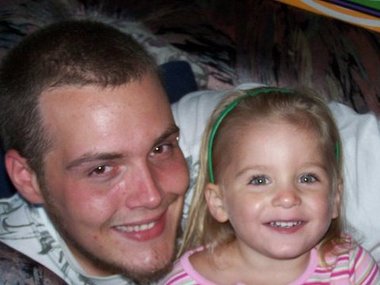
Awtumn Minnema, 2, and her father, Nathan Minnema
WALKER — Awtumn Minnema, the 2-year-old who died Nov 15 from a prescription drug overdose, had twice the amount of an anti-psychotic drug in her system as a single adult dose, a pathologist said today.
Dr. Stephen Cohle, who performed the autopsy on Awtumn, said toxicology reports showed the girl died from too much haloperidol, sold as Haldol, in her system.
Haldol is anti-psychotic drug most often used to treat schizophrenia.
Awtumn was with her mother at a relative’s birthday party on Three Mile Road NW when she apparently ingested the drug.
Her father, Nathan Minnema, was not at the party but was told later that family members tried to make the girl vomit on the belief she had swallowed pills that fell from a broken shelf to the floor. She did not vomit, however, and was put in bed.
She was discovered early the next afternoon in her crib, not breathing.
Walker police say the investigation is open and say they do not know whether anyone will face criminal charges.
Cohle, a forensic pathologist at Spectrum Health Blodgett hospital, said Haldol is generally safe for adults. But it could cause the heart to slow or stop and impaired breathing in a child, he said.
The international community is speaking out on the snake oil marketing phenomenon of ADHD.
"Professor psychotherapy Professor Paul Verhaeghe, author of the book "The End of Psychotherapy ', says that conditions such as ADHD and PDD-NOS does not exist. The symptoms of course: busy or shy children are a fact. The problem arises when a patient as a person with a number of properties, but as these characteristics are filtered to a few well to classify abbreviations.Diagnosis of Sun type of condition is usually using the DSM, a diagnostic manual that does not, as one might expect, compiled by independent scientists, but rather is a mixed bag of opinions.The maker of the American Psychiatric Association, an association that once even one vote decided whether or not homosexuality should be a category. Likewise in and out of season conditions added to the delight of the pharmaceutical industry. Thus, for example, a new pill be put on the market at an abnormally long period of mourning. The DSM method is therefore difficult to name scientifically, and in practice appears not to contribute to a structural solution."
"Hoogleraar psychotherapie prof. dr. Paul Verhaeghe, auteur van het boek "Het einde van de psychotherapie", stelt dat aandoeningen zoals ADHD en PDD-NOS niet bestaan. De symptomen natuurlijk wel: drukke of verlegen kinderen zijn een feit. Het probleem ontstaat wanneer een patient niet als een persoon met een aantal eigenschappen wordt beschouwd, maar als die eigenschappen worden gefilterd tot een paar goed te classificeren afkortingen. Diagnose van zon soort aandoening gebeurt meestal met behulp van de DSM, een diagnostisch handboek dat niet, zoals men zou verwachten, samengesteld werd door onafhankelijke wetenschappers maar eerder een allegaartje van meningen is. De samensteller is de Amerikaanse Psychiatrische Associatie, een belangenvereniging die ooit zelfs met een stemming besloot of homoseksualiteit al dan niet een categorie moest worden. Zo worden ook te pas en te onpas aandoeningen toegevoegd, tot grote vreugde van de farmaceutische industrie. Zo kan er bijvoorbeeld weer een nieuwe pil in de markt worden gezet tegen een abnormaal lange rouwperiode. De DSM methode valt dus moeilijk wetenschappelijk te noemen, en blijkt in de praktijk al helemaal niet bij te dragen aan een structurele oplossing."
Dr. Marcus Bachmann, (left) husband of Michele Bachmann, runs a Christian clinic which uses "therapeutic training programs" to remove homosexuality from children and Barbarians (his word not mine).
FRESNO, Calif. — When Seth Walsh was in the sixth grade, he turned to his mother one day and told her he had something to say.
Enlarge This Image
Seth Walsh
Related
Times Topic: Tyler Clementi
Enlarge This Image
Tyler Clementi
“I was folding clothes, and he said, ‘Mom, I’m gay,’ ” said Wendy Walsh, a hairstylist and single mother of four. “I said, ‘O.K., sweetheart, I love you no matter what.’ ”
Last month, Seth went into the backyard of his home in the desert town of Tehachapi, Calif., and hanged himself, apparently unable to bear a relentless barrage of taunting, bullying and other abuse at the hands of his peers. After a little more than a week on life support, he died last Tuesday. He was 13.
The case of Tyler Clementi, the Rutgers University freshman who jumped off the George Washington Bridge after a sexual encounter with another man was broadcast online, has shocked many. But his death is just one of several suicides in recent weeks by young gay teenagers who had been harassed by classmates, both in person and online.
The list includes Billy Lucas, a 15-year-old from Greensburg, Ind., who hanged himself on Sept. 9 after what classmates reportedly called a constant stream of invective against him at school.
Less than two weeks later, Asher Brown, a 13-year-old from the Houston suburbs, shot himself after coming out. He, too, had reported being taunted at his middle school, according to The Houston Chronicle. His family has blamed school officials as failing to take action after they complained, something the school district has denied.
The deaths have set off an impassioned — and sometimes angry — response from gay activists and caught the attention of federal officials, including Secretary of Education Arne Duncan, who on Friday called the suicides “unnecessary tragedies” brought on by “the trauma of being bullied.”
“This is a moment where every one of us — parents, teachers, students, elected officials and all people of conscience — needs to stand up and speak out against intolerance in all its forms,” Mr. Duncan said.
And while suicide by gay teenagers has long been a troubling trend, experts say the stress can be even worse in rural places, where a lack of gay support services — or even openly gay people — can cause a sense of isolation to become unbearable.
“If you’re in the small community, the pressure is hard enough,” said Eliza Byard, executive director of the Gay, Lesbian, and Straight Education Network, which is based in New York. “And goodness knows people get enough signals about ‘how wrong it is to be gay’ without anyone in those communities actually having to say so.”
According to a recent survey conducted by Ms. Byard’s group, nearly 9 of 10 gay, lesbian, transgender or bisexual middle and high school students suffered physical or verbal harassment in 2009, ranging from taunts to outright beatings.
In Mr. Clementi’s case, prosecutors in New Jersey have charged two fellow Rutgers freshmen with invasion of privacy and are looking at the death as a possible hate crime. Prosecutors in Cypress, Tex., where Asher Brown died, said Friday that they would investigate what led to his suicide.
In a pair of blog postings last week, Dan Savage, a sex columnist based in Seattle, assigns the blame to negligent teachers and school administrators, bullying classmates and “hate groups that warp some young minds and torment others.”
“There are accomplices out there,” he wrote Saturday.
In an interview, Mr. Savage, who is gay, said he was particularly irate at religious leaders who used “antigay rhetoric.”
“The problem is that kids are being exposed to this rhetoric, and then they go to the school and there’s this gay kid,” he said. “And how are they going to treat this gay kid who they’ve been told is trying to destroy their family? They’re going to abuse him.”
In late September, Mr. Savage began a project on YouTube called “It Gets Better,” featuring gay adults talking about their experiences with harassment as adolescents.
In one video, a gay man named Cyrus tells of his life as a closeted teenager in a small town in upstate New York.
“The main thing I wanted to come across from this video is how different my life is, how great my life is, and how happy I am in general,” he says.
Glennda Testone, the executive director of the Lesbian, Gay, Bisexual & Transgender Community Center in New York City, said their youth programs serve about 50 young people a day, often suffering from “bullying, harassment or even violence.”
“The three main groups of pivotal figures are family, friends and their schoolmates,” she said. “And if they’re feeling isolated and like they can’t tell those people, it’s going to be a very rough ride.”
Here in Fresno, in California’s conservative Central Valley, groups like Equality California have been more active in trying to establish outreach offices, particularly after an election defeat in 2008, when California voters approved Proposition 8, which banned same-sex marriage.
In Tehachapi, in Kern County south of here, more than 500 mourners attended a memorial on Friday for Seth Walsh. One of those, Jamie Elaine Phillips, a classmate and friend, said Seth had long known he was gay and had been teased for years.
“But this year it got much worse,” Jamie said. “People would say, ‘You should kill yourself,’ ‘You should go away,’ ‘You’re gay, who cares about you?’ ”
Richard L. Swanson, superintendent of the local school district, said his staff had conducted quarterly assemblies on behavior, taught tolerance in the classroom and had “definite discipline procedures that respond to bullying.”
“But these things didn’t prevent Seth’s tragedy,” he said in an e-mail. “Maybe they couldn’t have.”
For her part, Ms. Walsh said she had complained about Seth’s being picked on but did not want to cast blame, though she hoped his death would teach people “not to discriminate, not be prejudiced.”
“I truly hope,” she said, “that people understand that.”
Ian Lovett contributed reporting from Tehachapi, Calif.
How many children in foster care serve as human guinea pigs in commercial drug trials?
Despite evidence of harm--including the suicide of a 7-year old Gabriel Myers-- the FDA, which is charged
with ensuring the safety of children in drug trials, fails to maintain a record of children enrolled in commercial
drug trials.
By contrast, after the suicide of Gabriel Myers , a seven-year old boy in foster care who had been prescribed
three powerful psychotropic drugs in a dubious clinical trial, George Sheldon, Florida's Secretary of the
Department of Children and Families, examined the records of children in State foster care and found a high percentage being drugged with psychotropic drugs:
"Not only was the percentage high, it was not really known. And, in more than a third of known cases, required approval permission documents were missing."
So he wrote to the FDA--which is responsible for ensuring that children's involvement in drug trials is
approved and understood by parents or guardians who give surrogate consent. The FDA is charged with
overseeing pediatric trials conducted under the FDAMA law--a law that awards drug manufacturers who
test their drugs in children with an extended, highly lucrative, 6-months of market exclusivity.
Sheldon asked the FDA how many Florida foster children were involved in drug studies as they bounce from foster family to foster family?
The answer encapsulates FDA's irresponsible approval for the use of children--who are, after all, NON-CONSENTING human beings--without regard for children's safety.
Drug trials pose known and potential risks of harm, pain, and discomfort. Commercially-driven drug trials
rarely offer children a direct benefit.
The Herald Tribune (Florida) reports (below) the response by Jill Hartzler Warner, an associate FDA
commissioner, to Sheldon's question: "the FDA didn't have an exact number. Or even an estimate. The FDA, in fact, doesn't have the slightest idea how many Florida foster kids are or have been involved in its drug studies."
What's more, Hartzler and the FDA also urged Sheldon "not to bar Florida's foster kids from drug trials, arguing that benefits can outweigh risks."
Richard Wexler of the National Coalition for Child Protection Reform, says the FDA's position is absurd. "I would love to ask Associate Commissioner Hartzler if she'd care to let a total stranger decide if her children should be enrolled in a trial for a potentially dangerous drug."
Does Jill Hartzler Waner's response represent the official position of FDA and its Commissioner,
Dr. Margaret Hamburg?
*Jill Hartzler Warner, J.D., is Acting Associate Commissioner for Special Medical Programs at FDA.
She oversees FDA’s Office of Pediatric Therapeutics, Office of Orphan Products Development, Office of
Good Clinical Practice, Office of Combination Products, and the Advisory Committee Oversight and
Management Staff. In this position, Ms. Warner provides leadership and direction in the coordination of
internal and external review of pediatric science, safety, ethics, and international issues.
The problem comes from the lack of oversight and archaic child human research subject policies, allowing for false claims, suspect data, ghostwriting because the FDA and the DOJ have a drug problem.
The purpose of this post is to enlighten the public of what goes on behind the iron curtain of child welfare.
Even though this particular case does not showcase children, it does provide a working model for child welfare fraud. As the revenue-maximizing scheme is unraveled, we have core elements of child welfare Medicaid fraud. First you have a U.S. Department of Justice Civil Rights for Institutionalized Patients Act investigative finding report in August 2009 citing multiple violations in patient care addressed to the Governor. Then, in June 2010 you have the state put on a dog and pony show and hand out a pretty shiny trophy to the party of the aforementioned federal investigative report.
One patient, restless from forced injections of psychotropic drugs, is said to constantly pace the halls of Ancora Psychiatric Hospital, wearing down the skin on his legs. Another, allegedly uninformed about her right to refuse medication, agreed to take pills despite concerns about side effects only when confronted with forced injections.
Both cases were cited by Disability Rights New Jersey in a lawsuit accusing the state of giving patients almost no opportunity to object to being involuntarily medicated with powerful drugs with potentially severe side effects.
"It’s abysmal," said Emmett Dwyer, litigation director for the federally funded advocacy organization. "New Jersey is running the worst mental health system I have ever encountered."...more
This may be the worst mental health system Emmett Dwyer has ever encountered, but it is not what the New Jersey Department of Health thought of its patient care.
DMHS is extremely proud to announce that the Lean Six Sigma-Birch Hall Restraint Reduction Quality Improvement project at Ancora Psychiatric Hospital is the 2010 winner of the Richard Codey Behavioral Healthcare Quality Improvement Trophy!
The Ancora Quality Improvement project was selected from a field of over sixty competing projects that were submitted as part of the 2010 Behavioral Health Care Quality Improvement Fair sponsored by the University of Medicine and Dentistry-University Behavioral Healthcare (UBHC) in Somerset , New
Jersey on June 2, 2010. UMDNJ Senior Vice President Christopher Kosseff, and New Jersey Senator Richard J. Codey presented the trophy, named in Codey’s honor because of the significant contributions he has made to mental health services in New Jersey...more
And this is what the U.S. Department of Justice thought of Ancora Psychiatric Hospital Patient Care:
What you are about to conceive actually happens everyday in child residential institutions and children placed in foster care homes.
What you are about to receive is relevant evidence to validate my supposition on the generation of child abuse propaganda. Most children who are placed in residential treatment settings and therapeutic traditional foster care homes are done so, not for instances of what is promoted in child abuse literature as abuse and neglect, but are placed in the child welfare system as it is the only way to access mental health treatment.
Once a child is placed in the system, the child is overmedicated and/or unnecessarily medicated causing => a higher rate of cost reimbursement for the state leading to => increased lengths of stay =>stays in the least restrictive setting => reduced cost of care due to the drugging of children (i.e. catotonic and sleeping children require no oversight) => termination of parental rights for the children have exceeded the 15 out of 22 months stay in foster care => increased need in adoption=> Medicaid fraud. All of this is done without parental authorization for medication of their children because children under the auspices of the state are wards, be it temporary or permanent, of the state, and the state, thereby becomes the possessor of parental rights.
This is the reality of foster care. Thank you DRNJ for your dedication and compassion to transparency and accountability.
Here will be one of my textbook examples of a Medicaid Fraud Scheme in Child Welfare.
What is contained within this fraud scheme are key components to validate what I have coined as child abuse propaganda.
Without being said, I will immediately question whether any of the children were temporary/permanent wards of the state, (i.e. foster care, adoption).
It is organizations such as these who present these false data to be compiled to develop public policy. What is most statistically egregious is the national data will never be amended.
For more than 10 years, Madison Center actively sought and enrolled low-income, "problem students" from the local school system and enrolled them in its day treatment program. To boost its Medicaid revenues even more, Madison Center would convince parents that the siblings of those students also should be sent to Madison Center for treatment instead of school, the "qui tam" (whistleblower) lawsuit says.
But the children weren't properly diagnosed, and they were given little or no treatment to help them, according to the whistleblower lawsuit. Since the children's families were poor, Medicaid covered the Madison Center's charges for the treatment the children supposedly received. The state estimates it paid Madison Center more than $10 million in Medicaid payments for fraudulent billing charges.
It seems people are finally listening to me...and I have so much more to say.