And now, you have just one more reason why we are #1 in infant mortality.
Electro-Plating Services Inc. (EPS), located in Madison Heights, Michigan, was sentenced in federal court in Detroit to five years of probation, and was ordered to pay restitution of $1,449,963.94 joint and several with Gary Sayers to the U.S. Environmental Protection Agency (EPA). Sayers, EPS’s owner, was sentenced to one year in prison followed by three years of supervised release. The Honorable Stephen J. Murphy issued the sentence, having accepted each of their pleas of guilty to a federal hazardous waste storage felony on Feb. 14, 2019.
The crime related to Sayers’s operation of EPS, which used chemicals such as cyanide, chromium, nickel, chloride, trichloroethylene, and various acids and bases, as part of the plating process. After these chemicals no longer served their intended purpose, they became hazardous wastes, which required handling in compliance with the Resource Conservation and Recovery Act. Rather than having EPS’s hazardous wastes legally transported to a licensed hazardous waste facility, Sayers stored the hazardous waste in numerous drums and other containers, including a pit dug into the ground in the lower level of the EPS building in Madison Heights. For years, Sayers stonewalled state efforts to get him to legally deal the hazardous wastes. Ultimately, the EPA’s Superfund program spent $1,449,963.94 to clean up and dispose of the hazardous wastes.
“This case shows that anyone who chooses to do business with dangerous materials must obey federal laws that protect our fellow Americans and the environment. These defendants’ knowing, illegal storage of waste cyanide, highly corrosive wastes, toxic chromium waste, and reactive wastes posed a significant danger and threat to nearby communities and the environment,” said Assistant Attorney General Jeffrey Bossert Clark for the Justice Department’s Environment and Natural Resources Division. “They disregarded the law and numerous warnings and requests by state authorities to comply with their legal obligations. The Department of Justice will act to protect public health and safety.”
“The improper storage of hazardous waste presents a significant danger to our communities,” said U.S. Attorney Matthew Schneider of the Eastern District of Michigan. “EPS blatantly disregarded the safety of our community and environment. We hope this case will serve as notice to other businesses that law enforcement will take all necessary action to ensure compliance with our environmental laws and protect the people of Michigan.”
“Hazardous wastes pose serious risks to the health of entire communities, so it’s imperative they be handled and disposed of safely and legally,” said Special Agent in Charge Jennifer Lynn of the EPA’s criminal enforcement program in Michigan. “Today’s sentencing sends a clear signal that EPA and its law enforcement partners are committed to the protection of public health and will continue to pursue those who blatantly undermine those efforts.”
According to court records, Sayers—who owned and was the President of EPS—knew that such storage was illegal and had managed the company’s former Detroit facility where he kept hazardous wastes illegally. Starting in 1996, the Michigan Department of Environmental Quality (MDEQ) repeatedly sent him warnings about his illegal handling of hazardous waste. In 2005, Sayers was charged with and pleaded guilty to illegally transporting hazardous wastes in state court. During the ensuing years, the MDEQ attempted to get Sayers and EPS to properly manage the amounts of hazardous wastes piling up at the Madison Heights location. The MDEQ issued numerous letters of warning and violation notices to the company regarding its hazardous wastes.
In 2016, the MDEQ identified over 5,000 containers of liquid and solid wastes at the Madison Heights location. That same year, the city of Madison Heights revoked the company’s occupancy permit. In January 2017, the EPA initiated a Superfund removal action, after determining that nature and threats posed by the stored hazardous waste required a time-critical response. The cleanup was completed in January 2018.
Assistant Attorney General Clark and U.S. Attorney Matthew J. Schneider thanked EPA’s Criminal Investigation Division and the Michigan Department of Natural Resources-Environmental Investigation Section for their work investigating this case, as well as the Michigan Department of Environment, Great Lakes, and Energy (EGLE, formerly the MDEQ) and the Coast Guard Investigative Service, which provided investigative support. Senior Counsel Kris Dighe of the Environmental Crimes Section of the Justice Department’s Environmental Crimes Section and Assistant U.S. Attorney Sara D. Woodward of the U.S. Attorney’s Office for the Eastern District of Michigan are prosecuting the case.
We need to do an intervention, like going in, and sitting everyone down, one by one, and let their "Legal Geniuses" (trademark pending) know that they need to stop.
We live in this.
We have been complaining about this.
If only we could get the "Legal Geniuses" (trademark pending) to just admit that they do not know what they are doing, then we could come in and help them understand that you have to first incorporate, register as a company with the state before you can enter into contracts.
On second thought, perhaps the reason they do not want intervention is because they know exactly what they are doing because Detroit was supposed to be the pilot, transposable model for a Public Private Partnership to take over government by manipulating elections.
Look at all those addresses being physically demolished, that can be used as data for other false claims, like absentee ballot votes.
A Detroit Land Bank Authority contractor is under investigation and could lose more than $15 million in scheduled demolition work because of allegations it tore down several homes and buried the debris under layers of backfill dirt instead of properly disposing of the materials, the Free Press has learned.
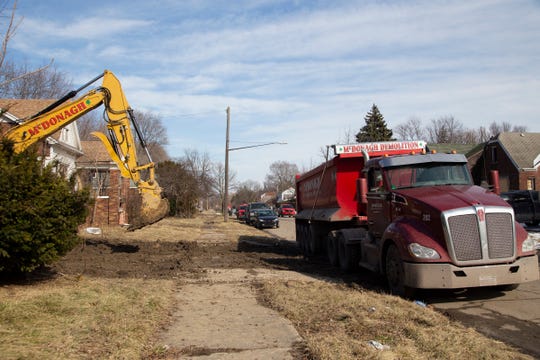
The demolitions, which were performed by Chicago-based McDonagh Demolition Inc., have sparked an internal review of every demolition — 90 in total — that the company has performed in Detroit.
The company could also face suspension or expulsion from the program, city officials confirmed.
Concerns regarding proper abatement and backfill practices also have raised questions about unusually high bidding awards for some demolition projects. A Free Press review of McDonagh demolition projects found a half dozen that were well above the $25,000 ceiling for federal dollars.
At least two were more than $40,000, according to city records.
And while the city credited internal quality controls for catching the demo violations, one top city official and a state agency that oversees the city's blight removal program are questioning why the company wasn't caught sooner.
Multiple sources, who requested anonymity because they haven't been authorized to speak publicly, told the Free Press that the city was alerted to the situation by a former company employee who shared photos with the Land Bank of discarded debris buried at demo sites.
When asked by the city whether that was true, Detroit Building Authority Special Projects Director Brian Farkas said: "I cannot comment on an active investigation."
Instead, Farkas said its on-site DBA field liaison discovered that McDonagh "filled several demolition holes before fully removing all of the demolition debris."
The city did not state how the DBA employee discovered the violations.
"Any sites found in this condition will have all fill removed and replaced with another approved source," Farkas said. At least four sites already have been identified for excavation.
In an emailed statement to the Free Press, the company stated: “During the course of demolishing dozens of abandoned homes, McDonagh has been made aware of four properties that contained small pieces of concrete in the backfill. We have been working with the DBA to remove that material. We are confident that this is an isolated issue.”
Farkas said the city alerted the Michigan Department of Environmental Quality of the situation but an MDEQ spokesperson said in a statement late Monday that it had not been notified. Instead, the MDEQ said it was informed of another issue with McDonagh by the city.
"I checked with our Detroit staff and no one was notified by the city of this issue or received any complaints about illegal disposal by this contractor," spokesperson Scott Dean said. "Our asbestos program did issue a violation notice to this contractor based on violations that the city identified and had the contractor self report, but that was not related to buried asbestos waste."
Dean said it is the city's responsibility, not the DEQ's, to provide oversight of the contractors' waste disposal practices.
"If they find a contractor has illegally disposed of waste on-site, it is the city's responsibility to rectify that problem," Dean said, adding, however, that the city is not required to report the issue. "It is a violation of state law (Part 115, Solid Waste Management) to dispose of the demolition waste on-site."
Contractors are required by local and state regulations to fully remove demolition debris and transport the materials to approved landfill locations after a structure is torn down — in part to prevent any environmental issues. Companies must then use clean and approved backfill materials to fill the open holes.
"These are serious findings concerning a new contractor who started work late last year," Michigan Homeowner Assistance Nonprofit Housing Corp. spokesperson Katie Bach said. "The health and safety of Detroit residents during the demolition process is paramount. We are demanding full disclosure about how this happened and why these violations were not caught during the routine inspection process."
MHA administers the federal Hardest Hit Fund program that funds Land Bank demolitions and has disbursed more than $176 million in federal funds to Detroit, which has the largest demolition program of its kind in the nation.
MHA characterized the situation as a "clear violation" of its blight manual that dictates the rules of the state's blight program.
Meanwhile, City Council President Pro Tem Mary Sheffield told the Free Press she is calling for direct oversight of the demolition program to be returned to the city and removed from the two external authorities currently overseeing it — The Detroit Land Bank and Detroit Building Authority.
"To hear that an unknown, out-of-state company came into our city and thought so little of our residents and communities that they buried multiple houses within demo sites is not only alarming, it's indefensible," Sheffield said in an interview with the Free Press. "I feel the Detroit Land Bank’s decision to award over $15 million of demo contracts in less than a year to a company who had never worked in our city and had no stake in our community is yet another example of policies created to negatively impact Detroiters."
The company has performed at least five demolitions in Sheffield's district. Other council members who also had demolitions performed in their districts by McDonagh did not respond to a request for comment.
Sheffield is also calling for:
All of the company's contracts to be immediately pulled.
Excavation of all of their demolition sites to determine whether debris has been buried.
Revocation of the company's wrecking license.
For McDonagh's wrecking license to be revoked and the disbarment of the company and anyone else who may have participated in burying the debris.
"Had it not been for a former McDonagh employee coming forward, our supposedly rigorous dirt processes in place wouldn’t have caught entire homes being buried in the dirt," Sheffield said.
McDonagh, which began performing demolitions in the city in early December, is under contract to tear down 682 properties in neighborhoods across Detroit. The company has been placed on a stop work order while the review is ongoing.
The city, which would respond to questions from the Free Press only via email, said upon making the discovery last week, it "immediately began an internal review."
"McDonagh has been issued a stop work order until we have a chance to review each of its sites and ensure that all work has been completed properly or redone if it has not been," Farkas said via email.
"This is a serious violation of our protocols and will be dealt with severely in our contractor discipline process and likely will result in suspension or expulsion from the program."
The company has already been ordered to excavate a handful of properties, including a site at 13047 Maiden St. on the city's east side that was demolished on Dec. 27.
Prior to the demolition, that home was only partially abated, the Free Press confirmed, raising concerns of whether some asbestos-laden materials may have still been on the site when the company buried the debris.
Farkas said members of his staff said they only observed "hard fill," such as bricks, cement and foundation walls left at the site.
The Chicago-based McDonagh Demolition was ordered to excavate a demolition site in the 13000 block of Maiden St. on Detroit's east side on Friday, Feb. 22, 2019. The order came after it was discovered the company filled several demolition holes across the city before fully removing all of the demolition debris, which is a major violation of the federally-funded program. (Photo: Mandi Wright, Detroit Free Press)
"This means the materials with possible asbestos would have been removed with the debris portion of the structure," Farkas said.
When asked whether further testing would occur, Farkas said testing outside of the asbestos survey prior to the demolition "is not required."
A Free Press reporter and photographer visited the site Friday and watched as the company removed the backfill from the ground, as DBA employees observed the process. The Free Press also identified another site, 13089 Maiden St., just a few houses down on the same block that appeared to have chunks of bricks, concrete and other materials on top of the surface and protruding from the ground.
That property was torn down by the same company on Dec. 27 and is among the properties under review.
Bach said the issue was brought to MHA’s attention last week.
"The Detroit Land Bank Authority and Detroit Building Authority have been instructed to conduct a thorough review of all 90 sites and report the findings to us," Bach said.
High costs
McDonagh was set to be paid about $1.5 million in federal funds for the 90 structures it has demolished. However, the company has not been paid yet and all payments have been frozen pending the outcome of the investigation, city officials said. The Free Press was only able to identify and analyze 82 of the company's public demolition records, through the city's open data portal.
Here are the top amounts McDonagh was set to be paid to demolish single-family residential homes prior to the launch of the internal investigation:
$47,703.41 for demolishing 14253 Wilshire on Dec. 13.
$40,127.41 for demolishing 9156 Lakepointe on Dec. 10.
$36,617.46 for demolishing 6427 Iroquois on Feb. 14.
$29,237.41 for demolishing 9913 Balfour on Dec. 11.
$26,785.41 for demolishing 12614 Corbett on Dec. 5.
$26,470.41 for demolishing 12622 Corbett on Dec. 5.
Each of these demolitions were set to be paid through HHF funds which have a $25,000 cap. Land Bank spokesperson Alyssa Strickland said city dollars would have been used to cover anything over $25,000 and is standard practice for the program. Anything over $25,000 goes through an executive director review process to determine whether the cost "is worth it to eliminate that blight on the neighborhood."
When asked what the justification was for the exorbitant pricing, Strickland said, "There are a significant number of houses that must come down but require significant abatement and/or they are larger houses, so it costs more to demolish them."
Strickland said the overall abatement and demo costs from McDonagh and other contractors were "high and that is reflected in bids from all of the contractors." Strickland said McDonagh's were significantly lower than other companies.
The cost of demolition has risen since Detroit Mayor Mike Duggan first began his blight remediation effort in 2014 when the average was about $14,000 per home.
Criticism of the costs began in 2015 when the average soared to more than $16,000. In 2015, Duggan defended the rising costs to City Council, which had risen to $16,400 at one point, compared with about $10,000 in 2013.
Duggan attributed the higher costs to a number of reasons for the price increase, including requiring contractors to use clean soil to fill in demolition sites and using "wet" demolition techniques to control dust — hosing down houses before and after demolition.
The Free Press found that McDonagh's average cost of demolition on its properties was $16,533.12.
Bach said any demolitions that are found to be in violation of MHA guidelines will not be funded with Hardest Hit Funds.
With the company at risk of losing 628 properties in contracted HHF-funded work, a Land Bank official denied it was a setback for the program to have to potentially rebid all of the work.
"It is not a setback because we are already months ahead of schedule," Strickland said. "Even with a rebidding process to address these properties, our HHF spend-down will still be complete well before the deadline."
New environmental concerns?
The improper demolitions have raised new environmental questions that come just two weeks after a Free Press investigation reported that contaminated and unverified dirt was potentially used to fill demolition sites across Detroit.
Dirt usage is the focus of a widening federal criminal probe of the city's federally funded demolition program.
The Special Inspector General for the Troubled Asset Relief Program is also probing whether some companies used free dirt obtained from a variety of unverified sources and then passed it off as an approved residential dirt source before billing the demolition program for materials they never actually paid for.
The investigation led Michigan state Rep. LaTanya Garrett to call for state-level hearings to discuss the "alarming" findings and spurred Sheffield to request a congressional hearing be held. Sheffield's request was sent to U.S. Reps. Rashida Tlaib and Brenda Lawrence.
Separately, Sheffield announced during Tuesday's formal session that she will be voting no on all city demolition contracts moving forward. Sheffield, who cited recent news reports and dissatisfaction about the program's procedures and oversight, joins Council President Brenda Jones in voting no on the contracts.
Jones has been voting no on city demolition contracts since the SIGTARP investigation was first announced. The move is significant because now the body's two top leaders are voting no on the lucrative contracts.
Wayne State University professor Shirley Papuga, who specializes in hydrology and urban ecosystems, said the recent environmental concerns raised could be a good opportunity for the city to partner with local researchers, including those at WSU, to tackle "a socio-environmental issue that is impacting so many people and residents of the community."
"Obviously, public health is going to be a main concern," Papuga said, adding that research might need to be done to determine the level of any potential risk. "So thinking about whether or not there are contaminants present, what those contaminants are and potentially, what would their human exposure pathways be?"
The MDEQ said there are potential environmental and public health risks to burying the waste on-site, which is why it's prohibited by state law.
"Soil, air, and water contamination are possible, as well as the physical hazard if waste is close to the surface," Dean said, adding that there are concerns of the lots becoming unusable if they are filled with waste. "Neighbors do not want the lots for gardens if they find waste when they try to dig into the soil. Future redevelopment in these areas may be hampered if the developers find that they have to excavate waste from these lots before they rebuild. This is why it is critical that Detroit provide rigorous contractor oversight."
Mike Duggan, all alone in his vigorous defense, on Valentine's Day in Detroit
Mayor Mike Duggan on Wednesday defended the "vigorous" practices of the city's demolition program in the wake of concerns over whether some of the dirt used to fill holes might have been contaminated.
Duggan's defense comes after a federal watchdog agency issued a new round of subpoenas last month to certain demolition contractors as part of an ongoing criminal investigation into the city's federally funded blight elimination work.
"No city agency has been subpoenaed over the dirt because the city agencies have been vigorous from day one," Duggan told The Detroit News.
"We have cooperated with every single investigation, and we feel very good about where the program stands today."
The City Council's second in command, Mary Sheffield, put out a call Tuesday to have the U.S. House Oversight and Reform Committee convene a congressional hearing, citing a Detroit Free Press report that raised the possibility that dirt being used to fill holes under the program may have been from contaminated or unverified sources, including soils from the recent reconstruction of Interstate 96 in western Wayne County.
Sheffield argues that transparency is lacking in the program that's been the subject of multiple local, state and federal reviews since fall 2015 after concerns were raised over bidding practices and soaring costs.
The Detroit Land Bank Authority oversees the blight elimination effort along with the Detroit Building Authority. Nearly 17,000 blighted homes have been demolished under the program since May 2014.
Sheffield said she worries there are not enough controls in place to properly monitor the soil used in the program. But Duggan said the claim is political and the building authority banned the use of dirt from the I-96 project.
A letter sent to U.S. Reps. Rashida Tlaib, D-Detroit, and Brenda Lawrence, D-Southfield, from Sheffield notes the program has been "mired in controversy since its inception" and it's led to "anxiety, uncertainty, and a lack of transparency for the community."
Tlaib in response said she and her team take the request "very seriously" and "it's critical that we ensure the public's trust."
The Michigan Department of Environmental Quality in a statement late Wednesday said it's "working with the federal agencies investigating the city's demolition program."
The DEQ notes that the state's Environmental Remediation law sets criteria for the relocation of soil. Contaminated soil cannot be relocated to uncontaminated sites.
Brian Farkas, director of special projects for the building authority, has said contractors must perform sampling and analysis of materials that come from sources that may exceed state criteria for residential use.
Sampling results, he said, influenced the building authority's decision to prohibit the use of soils from certain projects, including the I-96 construction project.
The DEQ reviewed that data and noted that it appears "these soils were contaminated with salt from road deicing."
Sheffield on Wednesday noted the DEQ's confirmation that dirt from the I-96 project was contaminated and "there's a possibility that this has been used throughout Detroit."
"If there is contaminated dirt in play, where is it and who is responsible for it?" she said.
Duggan said the building authority had "banned the use of 96 dirt in the first place."
"In cases where we've gotten any evidence of somebody who put in dirt that wasn't tested, we made them pull it out and replace it," he said. "No one has ever suggested on the federal side that the land bank has been anything but diligent on the environmental controls on the dirt."
In subpoenas dated Jan. 10, the Special Inspector General for the Troubled Asset Relief Program is seeking two years' worth of documentation from certain contractors over dirt used to fill holes for homes torn down under the blight removal effort.
Federal investigators have demanded that demolition firms produce receipts and records that reveal where their backfill dirt was coming from, who trucked it to sites in Detroit and where it was dropped off.
Both the land bank and building authority have said they continue to cooperate fully with the SIGTARP investigation. On Wednesday, each reiterated they had not received a subpoena about backfill.
In August 2014, the building authority banned the use of any dirt from the I-96 reconstruction project to fill residential demolition holes, "due to the high level of salt content identified through independent soil testing," Building Authority Director Tyrone Clifton said in a statement posted Tuesday on the city's website.
Later, it made the same decision with a variety of other sources, he said.
Katie Bach, a spokesman for the Michigan State Housing Development Authority, which allocates funds for the program, told The News last month that Detroit implemented a new dirt tracking system late last year.
During the time period referenced in the subpoenas, Detroit required contractors to provide invoices for dirt and the land bank maintained load tickets that documented the quantity and where it was dropped, according to MSHDA.
"The biggest difference is that the source is now being documented," Bach said in January.
Clifton said the building authority also put a system in place to alert is compliance team when authorized dirt had been exhausted. Clifton noted one contractor, DMC Consultants, recently begun filling holes with unauthorized dirt.
A representative with DMC could not be immediately reached Wednesday for comment.
Farkas said soil sampling is taking place for 37 holes that DMC filled with dirt that had not been previously authorized. Testing will determine whether the soil is unsafe for residential use.
"Should results show otherwise for any of the locations, DMC at its own expense will be required to remove and properly dispose of the dirt from those sites, then replace it with approved backfill," he said.
The company is also ineligible from bidding through April due to violations issued in January.
As of Wednesday, there are 365 open holes at demolition sites. Of those, 191 are within the 30-day compliance period. The other 110 open holes are beyond the limit, of which DMC has the most.
The company has been issued a "stop work order," prohibiting them from knocking down more structures without approval until they catch up on the backlog.
Have you ever sat on your front porch, on a warm summer's afternoon, sipping on a jasmine tea, to witness the beauty of asbestos fibers from the wrapped 1920's lead pipes that Fred & Sons stripped the night before the tear down, blowing down the street, like miniture, urban tumble weeds, as the neighborhood kids thrown rocks into to stagnant pool of a demolished basement?
Probably not which is why everyone knows Detroit is the dumping grounds of the region.
It is a well known fact that DEQ does not give a flying rats arse about how demolitions go on in Detroit, including Hamtramck.
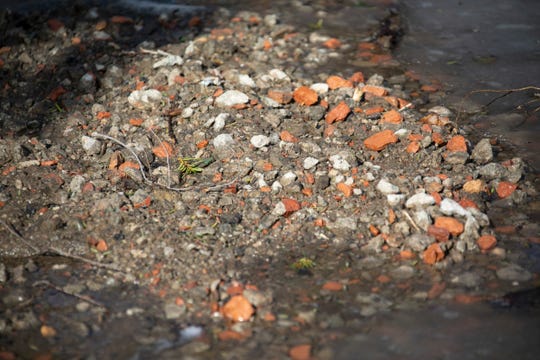
I have pictures, but this one will do because it is much more recent.
Have you ever tried to put your shovel in the ground to grow vegetables on the side lot next to your home only to find out it was backfilled with concrete chucks, and stuff?
Well, if you did, you would know what the Saddy face feels like.
You would think they could have at least put more than 4.5 inches of clean fill dirt over it.
And people wonder why Detroit is #1 in the world for infant mortality, concentration of highest rates of autism, child cognitive and developmental psychological disabilities, child poverty and the trafficking of tiny humans.
Stop stealin' the children, the land and the votes.
The best part about this investigative request is that "The Elected Ones" who are asked to look into the Detroit Land Bank Authority participated in some of the activities of this ham Sandwich, because it never incorporated, because it is the Corporate Shape Shifter that gerrymandered the voting districts and participated in the interference of the 2016 & 2018 Elections.
"Do not drink that Detroit Land Bank Authority cocktail!" ,said Derrick Pratt
Michigan State Rep. LaTanya Garrett is calling for state-level hearings to discuss the "alarming" findings of a Monday Free Press investigation that detailed a widening federal probe of Detroit's demolition program.
The Free Press reported Monday that contaminated dirt was potentially used to fill demolition sites across the city and is the focus of a criminal probe being conducted by the Special Inspector General for the Troubled Asset Relief Program (SIGTARP).
Garrett's request comes one day after Detroit City Council President Pro Tem Mary Sheffield requested a U.S. congressional hearing be held to discuss the city's federally-funded demolition program. Sheffield's request was sent to U.S. Reps. Rashida Tlaiba and Brenda Lawrence.
Garrett, a Democrat, formally submitted a request Wednesday to Republican State Rep. Hank Vaupel, who is the chair of the House's Health Policy Committee, asking for a special hearing to discuss the Free Press' findings.
"On Feb. 11, Detroit Free Press reporter Katrease Stafford wrote an eye-opening article regarding the possibility that contaminated dirt was being used by contractors hired by the Detroit Land Bank Authority to fill holes after vacant structures have been demolished," Garrett wrote in her request to Vaupel and other House members. "The information contained in this article is very alarming considering the health, safety, and well-being of the residents that are in close proximity to said properties may have been compromised."
Garrett, who represents part of northwest Detroit and Highland Park, said she believes the issue should be addressed by the health committee--which she is a member of.
In the letter, Garrett requested that representatives from the Michigan State Housing Development Authority, Michigan Homeowner Assistance Nonprofit Housing Corporation, Detroit Land Bank and Detroit Building Authority be present to provide testimony on "this important public issue."
The city's demolition program is managed by the Land Bank and the Detroit Building Authority under a structure Mayor Mike Duggan put in place after he was elected in 2014.
More than $250 million from the Hardest Hit Fund has been allocated to Detroit for its demolition program since Mayor Mike Duggan began his aggressive effort to tackle blight across the city. MHA, which manages the state's Hardest Hit Fund dollars, said its disbursed more than $176 million in federal funds to demolish 10,755 properties. Detroit has the largest demolition program of its kind in the nation.
"The residents of the City of Detroit deserve to know whether contaminated dirt has been used to fill holes in their respective neighborhoods," Garrett wrote. "Considering the Detroit Land Bank Authority receives its demolition funds from the federal government through the State of Michigan’s nonprofit agency, MHA, which is housed in the Michigan State Housing Development Authority (MHSDA), I believe it is more than appropriate that this very serious matter be addressed on the state level."
Garrett told the Free Press she is also introducing a resolution during next week's session to request either the oversight committee or government operations committee to conduct hearings on "alleged mismanagement of federal funds disbursed by MHA to the Land Bank."
“The state of Michigan has a responsibility to the citizens of the city of Detroit to ensure that the federal demolition funds are being spent appropriately," Garrett said. "To say the least, in light of this most recent information, the Detroit City Council needs to step up and provide more oversight of the use of the Hardest Hit Funds by the Detroit Land Bank Authority.”
SIGTARP is also probing whether some companies used free dirt obtained from a variety of unverified sources— including the I-96 freeway construction project — and then passed it off as an approved residential dirt source before billing the Detroit Land Bank for materials they never actually paid for, sources said.
The Free Press interviewed multiple sources for its Monday story who have been close to the investigation but requested anonymity because they haven’t been authorized to speak publicly.
And in its first public acknowledgement of the probe, the Michigan Department of Environmental Quality confirmed to the Free Press Tuesday that it was aware of the nature of the investigation and the "potential use of I-96 soils as backfill in residential areas" in Detroit.
The federal probe has long been shrouded in mystery since it was reported in the fall of 2015 that demolition prices had risen as much as 60 percent under Duggan's administration.
The Free Press previously reported that suspicions of bid rigging arose in the summer of 2016 during a forensic audit of the demolition program performed by two firms hired by the state — Holland & Knight and Ernst & Young. A state official later said in 2017 that it "didn't see any bid rigging." The suspicions coincided with a three-month suspension of the city's demolition program imposed by the U.S. Treasury.
The investigation into dirt usage and billing is the latest layer of the ongoing SIGTARP and previously reported FBI investigations.
Subpoenas were issued to as many as 10 contractors in late January, commanding them to produce all original documents related to dirt they obtained for numerous contracts awarded between 2016 and 2018. The issuance of subpoenas was first reported by Deadline Detroit in late January.
DBA Director Tyrone Clifton said in a statement published on the city's website Tuesday that "recent questions about the DBA’s efforts to ensure the use of clean fill dirt on its demolitions have no basis in fact."
"At no time has any federal agency ever suggested that the city has been lax in its efforts to ensure that clean dirt is used in all of its demolitions," Clifton said.
Federal agents visited Detroit just months ago to interview multiple companies who have performed work in the program, sources confirmed.
The exact number of potential sites where unverified dirt has been used overall is not yet fully known, sources said, raising questions of whether there's a potential environmental impact.
The MDEQ said in its statement to the Free Press that there is not "a public health risk from this soil" but environmental experts say concerns remain.
Separately, one contractor, city officials confirmed last week to the Free Press, was recently ordered to dig up dozens of sites across the city that were filled with "unverified backfill" dirt.
Asked whether it was concerned about any potential public exposure, the city said public health and safety is a "top priority."
del Tora: "Hey, boss, people of Flint just let me know the children are being poisoned by the water and no one is doing a thing about it."
Hedman: "Really, let me get a legal opinion, first, then put together a legal defense team to come up with a propaganda campaign to cover up why it took so long for us to do anything to stop it."
Lansing — "Management weaknesses" delayed federal intervention in the Flint water crisis after Michigan failed to enforce rules designed to prevent lead contamination and protect public health, according to the Environmental Protection Agency’s Office of Inspector General.
The 69-page report, below, released Thursday highlights known failures by both state and federal regulators that led to the Flint water contamination crisis, but it provides a new level of specificity and includes recommendations to improve oversight.
“While Flint residents were being exposed to lead in drinking water, the federal response was delayed, in part, because the EPA did not establish clear roles and responsibilities, risk assessment procedures, effective communication and proactive oversight tools,” according to the report.
The report cited management problems at the EPA and its Region 5 office in Chicago, which oversees Michigan. Regional managers did not properly address state actions to “disinvest” in safe drinking water requirements dating back to 2010, concluding they were intended to be temporary and not affect public health, inspectors said.
The Region 5 office also lacked an effective risk assessment process, the report said. While initial bacterial violations alone would not have pointed to lead contamination, “the combined information available to Region 5 painted a picture of a system at risk from multiple angles.”
In January 2016, The Detroit News reported that Region 5 water expert Miguel del Toral warned of Flint water problems in a June internal memo, but then-Region 5 Administrator Susan Hedman said she sought a legal opinion on whether the EPA could force action that wasn’t completed until November 2015 — after the state finally recognized the crisis.
Oh, those "Legal Geniuses" (trademark pending), they are everywhere, are they not!?
Hedman soon retired after The News' report, but but no EPA officials were ever fired over the Flint crisis. In a March 2016 congressional hearing, Obama EPA chief Gina McCarthy defended Hedman as "courageous" and blamed the state's misleading and insufficient information for prolonging the crisis.
The state didn’t agree to apply corrosion controls until late July and didn’t publicly concede until October 2015 that it erroneously applied the federal Lead and Copper Rule overseeing water quality. The state decided in October to change Flint’s drinking water source from the corrosive Flint River back to the Detroit water system.
The report, based on two years of research and inquires, dings the federal agency but also repeatedly notes the Michigan Department of Environmental Quality holds primary responsibility for ensuring compliance with safe drinking water requirements.
Communication between the EPA and DEQ “did not convey key information about human health risks from lead,” the report said.
MDEQ did not properly develop and maintain an inventory of lead service lines needed to ensure appropriate test sampling of Flint water, according to the inspector general. The state also failed to ensure Flint continues to use corrosion control chemicals when city began using Flint River water in April 2014 and did not provide the EPA with “accurate information” regarding treatment.
The state “did not issue a notice of violation or take other formal enforcement action regarding either requirement until August 2015.,” the report said. “Instead, the MDEQ advised Flint public water system staff to conduct additional tests and to delay corrosion control treatment installation. The decision to delay corrosion control treatment prolonged residents’ exposure to lead.”
The EPA Office of Inspector General first announced the investigation in January 2016, five days after then-President Barack Obama declared a federal emergency in the city, freeing up $5 million in federal aid. The Obama administration denied Michigan Gov. Rick Snyder's request for a major disaster declaration because the Flint water contamination crisis was a man-made calamity not created by fire, flood or explosion.
Inspectors issued a preliminary report in October 2016, saying the EPA had the authority and enough information about Flint water lead contamination to issue an emergency order to protect public health as early as June 2015, seven months before it's Chicago-based Region 5 office did so.
McCarthy and Gov. Rick Snyder testified before a congressional committee in March 2016 and faced withering criticism for state and federal oversight failures but resisted calls to resign.
Michigan Attorney General Bill Schuette has filed criminal charges against several former and current state employees and officials over the lead contamination and Legionnaires' disease outbreaks that killed at least 12 and sickened 79 others.
Del Toral began raising concerns about Flint water lead content in early 2015 and pressed the DEQ for information about corrosion controls. He confirmed the suspicions in April of that year and two months later summarized the looming problem in an internal memo.
By June 2015, EPA Region 5 knew at least four homes had water with lead concentrations exceeding the federal action level of 15 parts per billion, according to an earlier inspector general report. It was not until Jan. 21, 2016, that EPA finally exerted its authority by issuing an emergency order that laid out steps for Flint and the state to resolve the crisis.
In congressional testimony a month later, the Virginia Tech University professor who helped uncover the Flint water crisis criticized the EPA’s Hedman for discrediting the internal report. But Marc Edwards told Congress the primary blame lies with a few state environmental regulators who “misled” Michigan leaders and residents and tried to “cover up” proof of high lead levels.
A former spokesman for the Michigan Department of Environmental Quality who resigned in the wake of the Flint water crisis provided media training this year for state employees, according to a contract obtained by Bridge Magazine.
Brad Wurfel is listed as “key personnel” in the three-year, $49,000 contract between the state Department of Agriculture and Rural Devleopment and Kandler Reed Khoury & Muchmore, a Lansing consulting firm where Wurfel served as director. KRKM partner Deb Muchmore also is listed as key personnel in the contract.
Wurfel resigned from the MDEQ in December 2015 after a state task force criticized the state’s “dismissive and disrespectful tone” to data from researchers outside of state government who discovered elevated levels of lead in Flint's water and the bloodstreams of the city's children.
Wurfel is no longer with KRKM, but launched his own “communications consultancy” in June, Muchmore said.
The firm secured a contract with the Agriculture department earlier this year for media and communications workshops, Muchmore said. Wurfel participated in in the April and June workshops, the latter of which took place after he had left the firm.
The first training was in Frankenmuth and the second in Grand Rapids.
“Any future workshops we provide will be delivered by KRKM, and without Brad’s role,” Muchmore said.
When contacted for this story, Wurfel said his line was breaking up and he would call back. He has not returned subsequent calls for comment.
A call and email to the state Agriculture Department were not immediately returned.
DETROIT – Today, Rep. John Conyers, Jr. (MI-13) released the following statement in response the Michigan Department of Environment Quality’s (MDEQ) consideration of a proposal from Marathon Petroleum refinery to allow them to expand facility operations in Southwest Detroit:
Dean of the U.S. House of Representatives John Conyers, Jr.
“I am alarmed to hear that the Michigan Department of Environmental Quality (MDEQ) may raise the ceiling on Sulfur Dioxide pollution in the Detroit area. Given the serious health consequences of Sulfur Dioxide pollution, such a measure should receive the highest-level of consideration and discussion.
“Unfortunately, the MDEQ’s recent record demonstrates they are not fully weighing the consequences of their lax approach to regulation. The recent reports out of Flint, that tens of thousands of citizens were exposed to toxic lead levels while MDEQ ignored the threat, should give anyone in public office pause before trusting the word of MDEQ. Their rush to approve the haphazard storage of Petroleum Coke along the Detroit River in 2013 tells us this is a problem that goes back some time.
“It seems that whenever an urban or low-income community’s air or water quality is in question, risks and costs are almost always deemed acceptable. For those of us who live in those communities, it hardly needs to be said that MDEQ’s assurances are not as assuring as they once were.
“As public officials, we are entrusted to provide for the health and welfare of our community, which means overseeing those employed by the state to protect us. As Detroiters and Michiganders, our families and friends have to live with the consequences of damage to our environment. I will be paying careful attention to this evening’s public discussion on raising the allowable Sulfur Dioxide emissions. More importantly, I will be watching for evidence that our state’s regulators have learned some lesson from their recent terrible mistakes.”