Strongsville seems to be the focus, de jour.
I wonder what Lisa Page has to say since Russia banned the U.S. from international adoptions.
I should twat her.
The same thing goes on in the United States, except it is much more gruesome because no one cares about the horrors of Child Protective Services, Foster Care & Adoption, the oldest form of survival.
Three Individuals Charged with Arranging Adoptions from Uganda and Poland Through Bribery and Fraud
Three women were charged in a 13-count indictment filed on Aug. 14 in the Northern District of Ohio for their alleged roles in schemes to corruptly and fraudulently procure adoptions of Ugandan and Polish children through bribing Ugandan officials and defrauding U.S. adoptive parents, U.S. authorities, and a Polish regulatory authority.
Margaret Cole, 73, of Strongsville, Ohio, Debra Parris, 68, of Lake Dallas, Texas, and Dorah Mirembe, 41, of Kampala, Uganda, were charged in the indictment. In relation to the Uganda scheme, Parris and Mirembe were each charged with one count of conspiracy to violate the Foreign Corrupt Practices Act (FCPA) and commit visa fraud, one count of conspiracy to commit mail fraud and wire fraud, one count of conspiracy to commit money laundering, three substantive FCPA counts and three substantive counts of money laundering. Parris was also charged with one count of mail fraud. In relation to the Poland scheme, Parris and Cole were each charged with one count of conspiracy to defraud the United States. Cole was further charged with one count of making a false statement to a U.S. accrediting entity and one count of making a false statement to a Polish authority.
“The defendants allegedly resorted to bribery and fraud to engage in an international criminal adoption scheme that took children from their home countries in Uganda and Poland without properly determining whether they were actually orphaned. The defendants sought to profit from their alleged criminal activity at the expense of families and vulnerable children,” said Acting Assistant Attorney General Brian C. Rabbitt of the Justice Department’s Criminal Division. “These charges clearly show that the Department of Justice is committed to protecting children worldwide, including those involved in the international adoption process.”
“These defendants are accused of orchestrating an alleged scheme that bribed Ugandan officials, defrauded the United States and manipulated parents inside and outside of the country,” said U.S. Attorney Justin Herdman of the Northern District of Ohio. “As a result of this alleged conduct, prospective parents were deceived, hundreds of thousands of dollars were misused and innocent children were displaced from their homes.”
“These three defendants preyed on the emotions of parents, those wanting the best for their child, and those wishing to give what they thought was an orphaned child a family to love,” said Special Agent in Charge Eric B. Smith of the FBI’s Cleveland Field Office. “These defendants allegedly lied to both sides of the adoption process, and bribed Ugandan officials who were responsible for the welfare of children. Parents, prospective parents and children were emotionally vested and were heartbroken when they learned of the selfishness and greed in which these three engaged. The FBI will never cease in its efforts to protect the innocent and unwitting from those who prey on that trust and confidence and we will vigorously pursue and hold those responsible accountable.”
With respect to the Uganda scheme, the indictment alleges that Parris and Mirembe, together with others, engaged in a scheme to pay bribes to Ugandan officials to corruptly procure the adoption of Ugandan children by families in the United States, including the adoption of children who were not properly determined to be orphaned and who had to be ultimately returned to their birth parents.
Specifically, Parris, Mirembe, and their co-conspirators allegedly (1) paid bribes to social welfare officers in exchange for them issuing welfare reports recommending that certain children be placed into orphanages without first ensuring that the children were actually orphaned or that putting them up for adoption was in the children’s best interest; (2) paid bribes to Ugandan magistrate judges to obtain court orders placing those children in an orphanage that was willing to accept the children without inquiring into whether they were actually orphans; (3) paid bribes to court registrars to cause the court registrars to assign the cases of these children to two corrupt “adoption-friendly” judges; and (4) paid bribes to the corrupt Ugandan judges to obtain orders to permit their clients to bring the children to the United States for adoption.
Parris, Mirembe, and others also allegedly lied to, and concealed material information from, adoptive parents, including lying about the bribe payments and whether the children were properly determined to be eligible for adoption, and concealing other material information about the children’s history. The indictment also alleges that Parris, Mirembe, and others agreed to cause false documents to be submitted to the U.S. Department of State to hide the corrupt and fraudulent scheme and to mislead it in its adjudication of visa applications for the Ugandan children being considered for adoption. The co-conspirators and the entities they worked for received more than $900,000 in connection with these adoptions.
With respect to the Poland scheme, the indictment alleges that after clients of their adoption agency determined they could not care for one of the two Polish children they were set to adopt, Cole and Parris took steps to transfer the child to Parris’s relatives, who were not eligible for intercountry adoption and one of whom had a criminal arrest record. After the child was physically abused, Cole and Parris took steps to conceal their improper conduct from the entity responsible for accrediting U.S. intercountry adoption agencies—and from the Polish authority responsible for intercountry adoptions—in an attempt to continue profiting from these adoptions.
An indictment is merely an allegation and all defendants are presumed innocent until proven guilty beyond a reasonable doubt in a court of law.
The FBI’s Cleveland Field Office is investigating the case. Trial Attorneys Jason Manning and Alexander Kramer of the Criminal Division’s Fraud Section and Assistant U.S. Attorney Chelsea Rice of the Northern District of Ohio are prosecuting the case. The Justice Department’s Office of International Affairs assisted in the investigation.
The Criminal Division’s Fraud Section is responsible for investigating and prosecuting all FCPA matters. Additional information about the Justice Department’s FCPA enforcement efforts can be found at www.justice.gov/criminal/fraud/fcpa.
The year 2020 marks the 150th anniversary of the Department of Justice. Learn more about the history of our agency at www.Justice.gov/Celebrating150Years.
FCPA may also be applied to domestic Foster Care & Adoption operations, which extend to the Children's Trust Funds, because these Child Placing Agencies, like Bethany or any other state privatized contract under the U.S. Conference of Catholic Bishops, where the Vatican is a foreign corporation, enforcing its own, privatized laws of chattel, are invading our nation, stealin' the children, the land and the votes.
Behold, the Residuals of the Peculiar Institution because the same thing goes on in the United States, but no one wants to talk about it.
It started in Detroit.
Texas Woman Pleads Guilty to Conspiracy to Facilitate Adoptions From Uganda Through Bribery and Fraud
A Texas woman who managed aspects of an international program at an Ohio-based adoption agency pleaded guilty today for her role in a scheme to corruptly facilitate adoptions of Ugandan children through bribing Ugandan officials and defrauding U.S. adoptive parents and the U.S. Department of State.
Robin Longoria, 58, of Mansfield, Texas, pleaded guilty before U.S. Magistrate Judge William H. Baughman, Jr. of the Northern District of Ohio to one count of conspiracy to violate the Foreign Corrupt Practices Act (FCPA), to commit wire fraud and to commit visa fraud. Sentencing will be before U.S. District Judge Christopher A. Boyko of the Northern District of Ohio.
“The defendant compromised protections for vulnerable Ugandan children and undermined the United States’ visa screening process,” said Assistant Attorney General Brian A. Benczkowski of the Justice Department’s Criminal Division. “Today’s plea ensures that she is held accountable for the far-reaching consequences of her corrupt conduct.”
“This defendant has admitted to playing a part in a conspiracy in which judges and other court officials in Africa were paid bribes to corrupt the adoption process,” said U.S. Attorney Justin Herdman of the Northern District of Ohio. “We are committed to pursuing justice for the adoptive parents and for all parties involved.”
“While adoptive families were financially and emotionally invested in the welfare of their future child, misrepresentations were made by Ms. Longoria and others to disguise bribe payments made to court officials in Uganda,” said Special Agent in Charge Eric B. Smith of the FBI’s Cleveland Field Office. “We are pleased Ms. Longoria has accepted responsibility for her role in facilitating an international adoption scam.”
As part of her guilty plea, Longoria admitted, among other things, that she and her co-conspirators agreed to, and did, cause bribes disquised as fees to be paid to an Uganda Agent. Longoria knew that these fees would and were used by the to pay bribes to court registrars and Ugandan High Court judges to corruptly influence the court registrars to assign particular cases to “adoption-friendly” judges and to corruptly influence the judges to grant the U.S. clients of the adoption agency the authority to bring the Ugandan children to the United States for the purpose of adoption. Longoria also admitted that she and her co-conspirators agreed to, and did, conceal these bribes from the adoption agency’s U.S. clients. Further, Longoria admitted that she and her co-conspirators agreed to, and did, create false documents for submission to the U.S. State Department to mislead it in its adjudication of visa applications for the Ugandan children being considered for adoption.
The FBI’s Cleveland Field Office is investigating the case. Trial Attorney Jason Manning of the Criminal Division’s Fraud Section and Assistant U.S. Attorney Chelsea Rice of the Northern District of Ohio are prosecuting the case.
The Fraud Section is responsible for investigating and prosecuting all FCPA matters. Additional information about the Justice Department’s FCPA enforcement efforts can be found at
Make sure to take out life insurance policies on your newly acquired goods because no one cares when you are doing the work of the tax exempt got, just like they have been doing for centuries.
Renee Bach, 30, is being sued in Ugandan civil court over the deaths of children who were treated at the critical care center she ran in Uganda. She has left Uganda and is now living in Bedford County, Virginia, where she grew up.
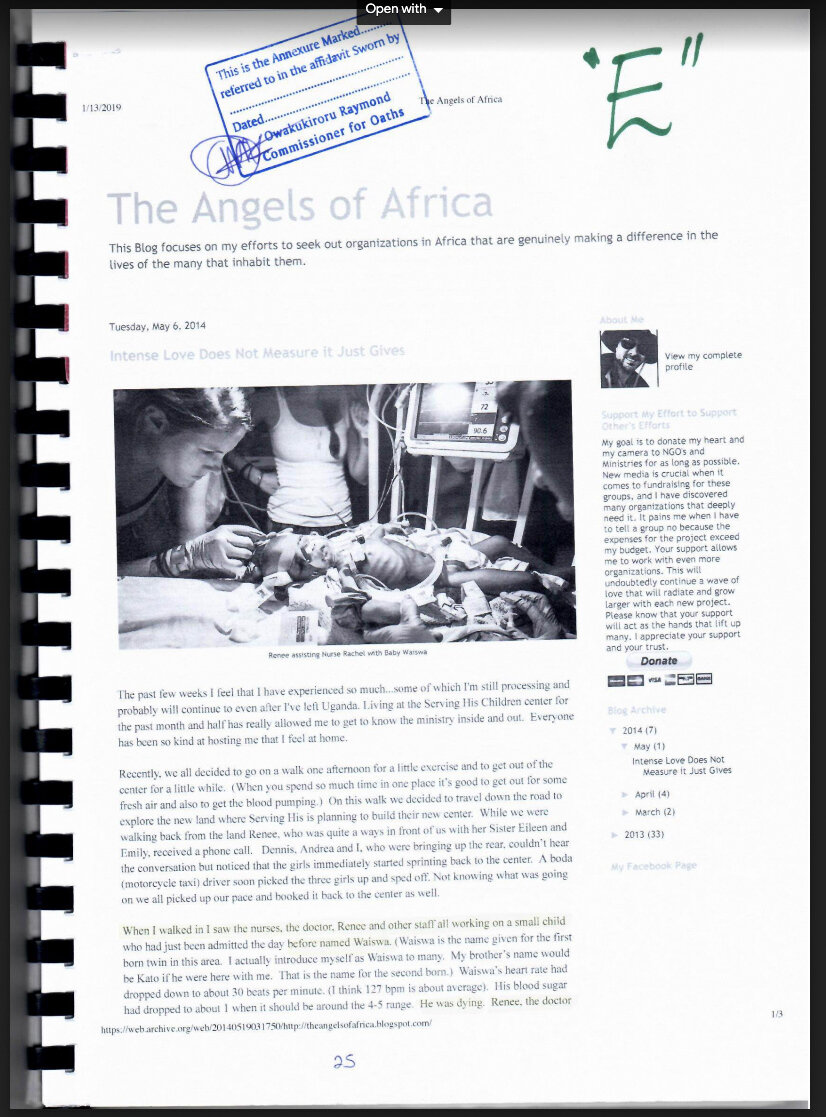
Ten years ago, Renee Bach left her home in Virginia to set up a charity to help children in Uganda. One of her first moves was to start a blog chronicling her experiences.
Among the most momentous: On a Sunday morning in October 2011, a couple from a village some distance away showed up at Bach's center carrying a small bundle.
"When I pulled the covering back my eyes widened," Bach wrote in the blog. "For under the blanket lay a small, but very, very swollen, pale baby girl. Her breaths were frighteningly slow. ... The baby's name is Patricia. She is 9 months old."
Bach went on to write that Patricia had fallen sick three weeks earlier. But her parents had been unable to find anyone closer to home who could cure her.
Then, wrote Bach, "One of their relatives told them about a 'hospital' ... with a 'White Doctor.' "
Except Bach was not a doctor. She was a 20-year-old high school graduate with no medical training. And not only was her center not a hospital — at the time it didn't employ a single doctor.
Yet from 2010 through 2015, Bach says, she took in 940 severely malnourished children. And 105 of them died.
Now Bach is being sued in Ugandan civil court.
"Something that I was supposed to do"
How could a young American with no medical training even contemplate caring for critically ill children in a foreign country? To understand, it helps to know that the place where Bach set up her operation — the city of Jinja — had already become a hub of American volunteerism by the time she arrived.
A sprawling city of tens of thousands of people on the shores of Lake Victoria, Jinja is surrounded by rural villages of considerable poverty. U.S. missionaries had set up a host of charities there. And soon American teens raised in mostly evangelical churches were streaming in to volunteer at them.
Bach was one of these teens. On her first trip, in 2007, she worked at a missionary-run orphanage — staying on for nine months.
Once back home in Virginia, Bach — now 19 years old — came to a life-changing conclusion: She should move to Jinja full time and set up her own charity.
In an interview with NPR, Bach says it felt like a calling from God.
"It was a very, very profound feeling and experience. It's kind of hard to even describe in words," she says. "Like there was something that I was supposed to do."
At first Bach wasn't sure what that was, beyond a sense that it should address some need that wasn't already being met by existing charities.
Funded by money raised through church circles back home, Bach rented a large house in one of Jinja's poorer districts, called Masese, and began testing out options, including starting a program to serve a free hot meal to neighborhood children. Twice a week about 1,000 of them would line up by Bach's house to receive a bowl of food. Bach named her charity "Serving His Children."
According to Bach, word of her feeding program spread through Jinja. In the fall of 2009, she says, she got a call from a staffer at the local children's hospital asking if she could help out with several severely malnourished children.
Bach says the staffer told her that from a medical standpoint, these kids had been stabilized. They just needed to be fed back to health. Could Bach take them in?
Bach says seeing a child in this state — impossibly thin arms, ribs poking out, sunken eyes — "was almost an out-of-body experience. And a sense of, 'Oh my goodness, this isn't right. This needs to stop.' "
She says she agreed to help the children. And before long she came to feel that this was God's plan for her: turn the house into a center where malnourished children and their mothers could live while the youngsters recuperated — complete with free rations of the special foods they would need, the medicines doctors had prescribed and lessons for the mothers on nutrition ... and the Bible.
In early 2010 Bach posted a blog entry titled "Here we go!" Her nutrition center was up and running.
A disillusioned volunteer
Jackie Kramlich was one of many American volunteers drawn to the center.
"I went in with a lot of admiration," Kramlich recalls.
It was the summer of 2011.
By this point Bach had hired three Ugandan nurses to help out during the day and stocked a room she dubbed "the clinic" with medical gear such as oxygen tanks, IV catheters and monitoring equipment.
The center was caring for as many as a dozen children at a time.
But Kramlich — who had just been certified as a registered nurse in North Dakota — was taken aback to realize just how sick these children were. They weren't just malnourished. They had complicated illnesses.
"Pneumonia, intestinal parasites, tuberculosis, many were in stage 4 HIV," Kramlich says.
Almost every week a child would die.
Also, it seemed to Kramlich that Bach, now 22 years old, was handling a lot of the medical care herself.
A court filing by Ugandan attorney Primah Kwagala includes excerpts from Renee Bach's blog as well as from a blog posted by a supporter of her charity who had visited and taken photos. This page above includes a photograph of Bach inserting an IV catheter into the vein of a severely malnourished child.
Jan. 21, 2019, court filing by complainants suing Renee Bach in the High Court of Uganda in Jinja
Which brings us back to that baby Bach wrote about in her blog: 9-month-old Patricia.
In her blog, Bach wrote that she immediately ushered Patricia and her parents into "the clinic."
"I hooked the baby up to oxygen and got to work," she wrote. "Took her temperature, started an IV, checked her blood sugar, tested for malaria, and looked at her HB count." (That's a measure of hemoglobin in the blood.)
"I was attempting to diagnose the many problems that could potentially be at hand. Got it: Malaria: positive. H.B. 3.2. ... a big problem ... most likely fatal. ... She needed a blood transfusion. And fast."
Next, Bach wrote, "we" — it's not specified who is meant by "we" — started a blood transfusion for Patricia.
But about 30 minutes later, Patricia seemed to take a turn.
"Her neck and face started swelling. A lot," she wrote. "[Her] breathing went from bad to worse. Her throat was beginning to close."
That's about the moment Bach called Kramlich on the phone to ask if Kramlich could swing by the center.
"So I walk in," Kramlich recalls, "and there's this child, swollen, wheezing." Kramlich could see the blood still being transfused into Patricia's vein. "And [Bach] goes, 'You know, I think she might be having a reaction. But I don't know. Because, you know, Google says that if they're having a reaction, they'll have a rash. And I don't see a rash."
Kramlich says that as was often the case, it was clear to her that Bach was the one making the medical decisions. And in this instance, she says, none of the staff nurses were even at the center.
"It's just horrifying," says Kramlich. In Uganda, just as in the U.S., only a medical professional is permitted to perform invasive procedures like a blood transfusion. She says her thought at that moment was, "This isn't a game. You have no business running blood — at all."
Bach says it's true she would sometimes perform medical procedures such as running the tubing into a child for a blood transfusion or inserting an IV.
And sometimes, Bach says, "without a medical professional standing right next to me, yes. But it was always under the request and direction of a medical professional."
As for her blog posts, Bach tells NPR, "I was just writing to tell a story to my friends and family.
"And a mistake that I made that I wish I wouldn't have is, I very much wrote in first person — which looking back sounded very prideful as if I wanted to allude to the fact that I was, you know, doing all of those things myself. But the reality was that there were medical professionals present doing those things."
In the case of baby Patricia, Bach's memory is that one of the staff nurses at her nutrition center did the blood transfusion. And she says when Patricia seemed to have a reaction, this nurse called up a private doctor, who — over the phone — recommended that Patricia be rushed to a hospital.
Bach and Kramlich do agree that ultimately, Bach drove Patricia to a hospital. And Patricia lived.
But for Kramlich this was too close a call.
"I was just beside myself. I mean furious."
Soon after, Kramlich quit — four months into what she had originally intended to be a yearlong volunteering stint. Kramlich also sent a letter of concern to the charity's board of directors back in the U.S.
Dangers of treatment
Under both international health guidelines and Ugandan law, if a severely malnourished child has the kind of extra complications Bach's center was taking on — serious respiratory infections, dehydration, swelling — this child must be treated in an advanced medical facility.
Ideally this would be a hospital — but at the least a higher-level health center that has been especially approved by Ugandan health authorities, says Dr. Joel Okullo, chairman of the Uganda Medical and Dental Practitioners Council — the enforcement agency for Uganda's health regulations. Treating a child in this condition at even a lower-level health clinic "would be breaking the law," says Okullo.
And at this point, Bach's nutrition center didn't have any kind of health license or any doctors on staff.
Saul Guerrero specializes in childhood severe acute malnutrition at UNICEF, the world authority to which countries turn for help setting their regulations and treatment programs.
Guerrero says malnourished children with extra complications are so fragile that unless a health provider knows exactly what he or she is doing, it's actually safer to do nothing.
"Their metabolism is not working. Their immune system is not working. So once you initiate any kind of treatment that will very often have knock-on effects," he says.
Just hydrating them by putting them on an IV can trigger a heart attack — if the sodium and potassium content isn't continually adjusted to match the child's fluctuating levels.
And if health workers are not treating the child in a facility that is fully equipped to immediately address such emergencies, says Guerrero, "the chances that that child will die are very, very high."
In 2011, of the 129 children Bach took in, 20% died — nearly a third of them in the first 48 hours. In 2012, the death rate among these in-patient cases was 18%.
By 2013, Bach had hired two doctors and the death rate was 10%.
But Guerrero says even that rate is high by the standards set by international aid groups. He adds that a designated government facility in Africa may have a death rate of 20% or even higher at its in-patient ward if it is serving a very vulnerable population. But facilities with those rates "make it all the way up to New York, to us at HQ, because they are seen as a problem," he says.
An American attitude
Bach says she took in these complicated cases "not because we felt like it was fine." But because there didn't seem to be a better place for them.
"I mean I can tell you time and time again," she says to NPR, "taking kids to hospital after hospital, and them being like, 'meh — we don't really deal with malnutrition. Your best bet is to take them back to your nutrition center.'
"It wasn't ideal. But what do you do in a non-ideal situation?"
Hanifa Bachou, a Ugandan pediatrician who specializes in malnutrition, finds Bach's explanation preposterous.
"No, no, no. I don't accept that," says Bachou. During the period at issue, Bachou, then based at the NGO University Research Co., was working with Uganda's government on a U.S. government-funded project to set up in-patient care for severely malnourished children across the country. And by 2010, Bachou says, Jinja's regional referral hospital had a well-established malnutrition unit to care for complicated cases of severe acute malnutrition.
But even if there was a need for more in-patient care facilities for malnourished children, specialists in medical ethics say it was not appropriate for Bach to try to provide it.
"Just think of the arrogance," says Lawrence Gostin, who heads the Center on National and Global Health Law at Georgetown University. "Who are you to assume that you can do better than they can? It's not your judgment call to make."
Gostin adds that while the circumstances of Bach's case may seem exceptional, he sees her actions as stemming from an attitude many Americans bring to developing countries.
"The American cultural narrative is that these countries are basket cases."
And so, says Gostin, Americans assume that whatever their qualifications, they're sure to be of help.
The result, Gostin says, is that everyone from college kids to credentialed doctors routinely parachute into poor countries for medical missions that completely disregard local laws and conditions.
"People think that they're doing good. And they have no idea how much harm they can cause."
And people back home in the U.S. are often complicit, says Gostin. Because when these volunteers write blogs or post videos to share their exploits, "They're celebrated."
Seeking justice
Kramlich, the volunteer at Bach's center, says this mindset is a big reason that even after quitting, she didn't go straight to the police. That is what she would have done had she encountered a center like Bach's in the United States.
But in this instance, she says, "people are praising [the center]. And [Bach] is receiving funding. And she looks like Mother Teresa. You think, 'It's so out in the open that, well, surely there must be something to this that's OK.' "
But in February 2015, after hearing from an employee at Bach's center that problems there persisted, Kramlich filed a report with Ugandan police.
A month later a district health officer shut the center down.
In his report, the inspector noted that in 2014, Bach had obtained a health license for the center. But it had expired. And in any case, the license had only authorized the center to operate as an outpatient clinic. Instead, on his visit to the charity, he had found "very sick children who need referral to higher centers."
Primah Kwagala, a Ugandan attorney, has filed suit against Bach on behalf of two mothers of children who died after being cared for by Bach's charity.
Majungu Eva/evashots_Photography
"It is what shocked most of us," says Primah Kwagala, a Ugandan civil rights attorney. "We couldn't imagine a human being without skill taking into her care people that were almost on their deathbeds."
Bach notes that a few years later, the government authorized her to reopen her center, this time in direct partnership with a government health center in a different district and with Bach no longer involved in the medical care.
But Kwagala, who runs a legal aid group specializing in public health, says Bach should have been held accountable for the deaths of children in her care. So early this year, she filed a civil lawsuit against her. It's on behalf of the mothers of two of the children who died.
Her court filings include excerpts from Bach's blog as well as a blog posted by a supporter of the charity who visited and took photographs — including one of Bach inserting an IV catheter into the vein of a severely malnourished child.
The next hearing date is scheduled for January 2020.
Bach says the publicity in Uganda over the suit has already made it untenable for her to remain there. "I get death threats all the time." She has moved back to Virginia and has no plans to live in Uganda again.
Kwagala says the suit is deeply necessary. These families deserve justice, she says. And there's a larger principle at stake: Imagine, says Kwagala, if a 20-something Ugandan woman had gone to the U.S. and set up an equivalent arrangement to treat impoverished American children.
"She would have been prosecuted. She would have been behind bars," says Kwagala.
In the U.S., says Kwagala, "I don't think she would have lasted two hours."
Once upon a time, I read a press release from Mastercard announcing the first, meaning there will be much more, $500 million contribution into the Center for Inclusive Growth Fund.
I felt the constriction of repugnance from deep within my bowels and immediately knew the cause.
The Clinton Foundation.
Yes, it only took an initial search to verify that Mastercard was doing what all the other Trust Funds are doing, stealin'.
Instead of getting your corporation seized and indicted by DOJ for participating in the trafficking of tiny humans, you liquidate and dump into the trust funds.
That is correct, the Clinton Global Initiative University never incorporated, just like the Clinton Global Initiative never incorporated and just like the Detroit Land Bank Authority never incorporated.
This means that Mastercard is laundering money through a fake, child welfare NGOs, but who is cashing those checks?
Listen to Reeta Roy pitch the model for human plantations.
Human plantations are grandiose ideas coming out of NGOs, funded through Social Impact Bonds, to force migration of target populations, to a controlled geographic area by taking women of "The Poors" (always said with clinched teeth) and their children to produce more children to "reach their greatest potential" (code for revenue maximization) in international adoptions, and indentured servitude through microfinancing, just like they did in Haiti.
Controlling water resources encourages complicity of the socially invested chattel.
The term slavery is so crass and out-dated.
Remember Haiti?
I do.
Stay tuned.
Pay attention and you will see more major corporations launder money through their trust funds.
New Fund Will Help People, Businesses Prosper in the Digital Economy
PURCHASE, N.Y. – April 10, 2018 – Mastercard today reported its initial $100 million contribution to the Center for Inclusive Growth Fund, part of a $500 million commitment to support initiatives that focus on long-term economic growth for everyone. The company first announced these plans during its fourth-quarter 2017 earnings as an extension of an ongoing commitment to do well and do good.
The fund has been designed to deliver on philanthropic goals shared with the Mastercard Center for Inclusive Growth. Chief among these goals are to reduce income and information inequality, increase financial inclusion and workforce skills development, and make people and businesses more resilient in the face of a rapidly changing economy.
“There are too many people today who are disconnected from the resources and connections they need to survive and thrive,” said Ajay Banga, president and CEO, Mastercard. “In establishing this fund, we hope to increase the agility and ability of people around the world to navigate change and be successful.”
In addition to the new fund, the Center will continue its mission to use Mastercard’s technology, data and partnerships to develop solutions that allow more people to participate in the formal economy.
The Center recently launched a U.S. inclusive growth initiative, following a series of listening sessions in which Mastercard executives met with employers, community leaders and workers in seven U.S. cities. Learnings from those conversations are currently shaping a set of programs to help overcome barriers to economic growth.