That give me Saddy Face.
The Tale Of The Foreign Invasion Of Detroit - Stealin' Children, Land & Votes - Christians, Children's Trusts & The Detroit Land Bank Authority
Where is Rebecca *Becky (said like a 1980s Valley Girl) Camago?
Detroit auditor general report blisters city's demolition program
DETROIT (FOX 2) - The city of Detroit was dealt a scathing report claiming its demolition program hasn't been following the rules on Friday It comes as the mayor is asking for approval of a quarter-billion-dollar bond to expand the same program.The report is being made public just as Mayor Mike Duggan is trying to push a $250 million blight bond proposal. And this report by the auditor general finds that the demolitions over the past four years in the city have been majorly mismanaged.
Detroit demolition program mismanaged, riddled with problems, auditor says
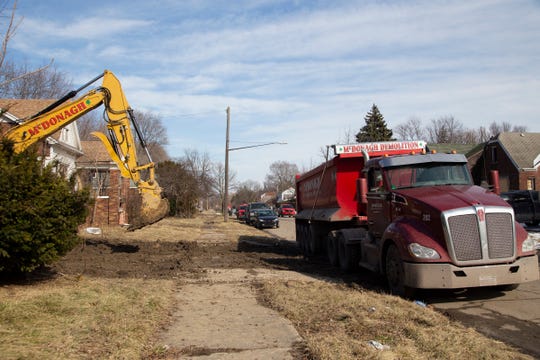 The Chicago-based McDonagh Demolition was ordered to excavate a demolition site in the 13000 block of Maiden St. on Detroit's east side on Friday, Feb. 22, 2019. The order came after it was discovered the company filled several demolition holes across the city before fully removing all of the demolition debris, which is a major violation of the federally-funded program.
On the eve of a City Council vote that may advance Mayor Mike Duggan's $250 million blight bond proposal, a blistering Detroit Auditor General report concluded Friday the city's demolition program has been mismanaged and beset with significant problems for the past four years.
The sweeping audit revealed the Detroit Building Authority— along with one or more city departments in some instances: failed to properly provide oversight and administer contracts; did not fully comply with some local and state laws; didn't monitor to ensure that demolition contractors met requirements.
Auditor General Mark Lockridge also blasted the city for having "inconsistent and unreliable" demolition data, as well as poor record keeping that made it difficult to perform the audit.
"A perception that public officials are using the procurement system to reward themselves, their friends, or supporters, poisons the public’s confidence in government and shakes its faith in the bureaucratic process," he wrote.
But DBA Director Tyrone Clifton countered the findings in a lengthy Friday response that accused the office of producing an audit that represented an "unrepresentative, outdated sample of demolition files (that) severely undermines the report."
Clifton argued that the audit didn't include a sampling from more recent demolitions.
Lockridge said in an interview after receiving the response that his office was "really appalled" by the city's response because he believes it doesn't speak to the issues raised in the audit. He also disagreed with the city's assertion that the data produced a flawed audit.
"They said the population data 'we gave to you is flawed,' " Lockridge said. "...They have not been responsive to us until this bond issue. … It is also disingenuous that they would not address our findings in a more genuine way and take ownership of their flawed data."
More: Was contaminated dirt used to fill Detroit demolition holes? Feds ask
More: Trucking company owner named in demolition of state rep's Detroit home
Lockridge said in the report that his office, which is an independent agency, was forced to subpoena the DBA twice during the course of the more than two-year audit in an attempt to receive pertinent information.
The office encountered significant delays and a "lack of responsiveness," and according to Lockridge, he never fully received everything his office asked for.
"There was almost a one-year delay in receiving information for our first audit sample," Lockridge wrote. "During these periods, we found it necessary to twice subpoena one of the entities for the requested documents. Still, they were unable to provide all of the information, data, documents, reports, etc. that should be available for adequate administration of demolition and demolition-related activities."
The audit raises fresh questions about the effectiveness of the beleaguered program's quality controls which came under renewed scrutiny earlier this year after a series of Free Press investigative reports that led to congressional calls for more oversight.
The report, which specifically looked at city-funded demolitions, determined the city's processes lacked "transparency, accuracy and completeness."
As a result, unnamed contractors were able to skirt regulations and also failed to provide proper documentation, such as landfill and dirt receipts that were required to verify where they took potentially asbestos-laden materials and whether they used clean backfill dirt to fill holes.
Some contractors also did not provide the city with necessary paperwork that was required for payment and in some instances they began demolitions prior to receiving permission.
In auditing the program, the auditor general selected 47 demolished properties as part of a random sample pool to examine the program's efficiency. These are some of the auditor general's findings:
- There was no evidence that asbestos waste was disposed in a required Type II landfill.
- There was no evidence that contractors complied with "wet-wet" requirements, which require that materials be wet down during the demolition process.
- No documentation was found that proved the top soil used was uncontaminated.
- No evidence that the sites were monitored by the city or any representatives during all phases of the demolition and backfill process.
- None of the contractors submitted landfill receipts or waste manifests with invoices, as required within 10 days of the completion of the project in order to be paid.
- Documents were missing from all contracts prior to payment.
- None of the contractors submitted weekly backfill material tracking logs , which would have shown where the dirt materials came from.
But according to the report, the administration has pushed back vehemently on the findings.
Lockridge noted the office presented its initial findings to the affected departments in June 2018 and released a preliminary report to the departments and agencies in February 2019. The office received a coordinated response from all of the departments indicating that the auditor's sample of properties was "old and stale" and did not include new processes that had been put in place to correct documented issues.
The auditor general's office tested a new sample group of 62 properties, according to the report, and reached similar conclusions.
The release of the report comes just days before council is set to consider the bond proposal on Tuesday, which the administration has touted as the city's emergent plan to remove the remainder of the city's residential blight by 2025.
The auditor general's report also sheds light for the first time publicly on the total amount the city has spent since Duggan first began his aggressive blight effort shortly after he took office in January 2014.
The price tag so far? A staggering $532 million that is a mix of city, federal Hardest Hit Funds and other designated monies.
If the bond measure is approved by council, it will go before voters in March 2020. If given the green light by voters, total possible spending on blight removal over the next five years, including funds allocated outside of the bond proposal, could be as much as $500 million, according to a report written by council's legislative policy division.
Total Costs City Funded Res... by Mark J. Rochester on Scribd
So, by 2025, the city may have spent upwards of $1 billion on blight remediation, thanks to the bond and other funding mechanisms the city has planned for the next several years.The audit also raises questions about the true cost of demolitions per structure. Of the $532 million spent thus far, about $330 million can be attributed directly to the hard costs to demolish more than 19,175 structures across Detroit.
Of that, $202 million has been invested in administrative and other "soft" costs which include pre-demolition activities such as property surveys and personnel and other costs.
The auditor general found that the average cost per structure based on the 19,175 homes demolished thus far is $17,198.
But according to the audit, the average total cost per structure is significantly higher at $27,756 when you factor in the administrative and "soft costs."
The audit, which focused on city-funded demolitions, was launched in October 2015, when the Detroit City Council requested the office audit the city’s demolition program.
The office looked at the program’s operation between Jan. 1, 2014 to Dec. 31, 2018
The demolition program is currently jointly overseen by the DBA and the Detroit Land Bank Authority. Duggan announced earlier this year the city would regain full control of its demolition program by January 2020 but, at the time, the DBA was still slated to play a major role in the program's administration.
Lockridge, noted, however, the program should be brought fully under the city's control, noting that its current processes are "convoluted, complex and change often."
"We recommend that the administration consider bringing the program management of demolition under the auspices of the city and under a single organization versus the current matrix organization structure," Lockridge wrote.
 Dave Massaron, the Chief Financial Officer for the City of Detroit talks with the Detroit Free Press editorial board at the newspaper on Thursday, September 26, 2019.
Questions about the city’s management of the demolition program were raised in September when Detroit Chief Financial Officer Dave Massaron met with Free Press reporters and editors to advocate for the demolition bond proposal.
Detroiters recognize the city is running the “largest demolition program in the history of this country,” Massaron said, and the program has evolved over the last five years to address problems that have cropped up.
“We’ve done this 19,000 times and we’ve learned a lot,” Massaron said. “When you do something this repetitive, this massive, there are going to be things you’re going to need to adjust. There are going to be things that don’t go as well as you want on the front end. But I think that what we’ve learned is how to quickly identify those areas and change course to make sure that we’re giving either the best value for the dollar or driving equity and inclusion in this process.”
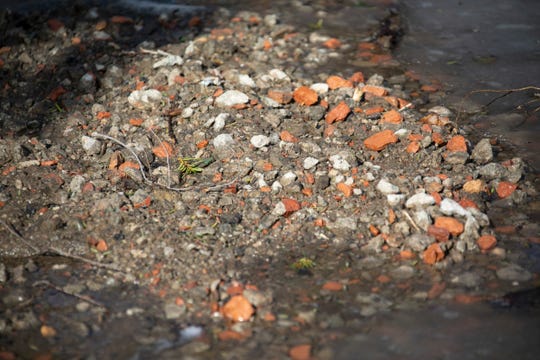 |
| I thought was my backyard, but there is more overgrown vegetation. |
Duggan also downplayed the demolition program’s previous problems during a recent appearance on WDIV-TV (Channel 4) “Flashpoint” program in which he was asked about putting the bond before voters.
Duggan conceded that the city had to clean up the program when the U.S. Department of the Treasury suspended the city’s federally funded demolitions in 2016. But the program has improved since then, the mayor said.
Audit of Demolition Activit... by Mark J. Rochester on Scribd
Amid the federal investigation, which is ongoing, two men were charged and convicted in the probe. The Free Press first reported earlier this year that contaminated dirt was potentially used to fill demolition sites across Detroit. The Special Inspector General for the Troubled Asset Relief Program is also probing whether some companies used free dirt obtained from a variety of unverified sources — including the I-96 freeway construction project — and then passed it off as an approved residential dirt source.SIGTARP is currently auditing the city's federally-funded demolitions at the request of congresswomen Rashida Tlaib and Brenda Lawrence.
But Duggan, in late October, minimized the program's ongoing scrutiny.
“One low-level staff person that we fired two years ago took the guilty plea and the feds have indicated they expect no other charges against any other public official, so let’s not overstate this,” Duggan said.
Voting is beautiful, be beautiful ~ vote.©


