Showing posts with label Japan. Show all posts

Friday, January 10, 2020

DOJ and FTC Announce Draft Vertical Merger Guidelines for Public Comment - Antitrust

You may find the history behind anttitrust, here.


The Department of Justice today withdrew the 1984 DOJ Non-Horizontal Merger Guidelines, and, together with the Federal Trade Commission (FTC), released new draft 2020 Vertical Merger Guidelines (draft guidelines) and seek public comment. The draft guidelines, open to comment for 30 days, describe how the federal antitrust agencies review vertical mergers to evaluate whether the mergers violate antitrust law. Vertical mergers combine two or more companies that operate at different levels in the same supply chainThe draft guidelines outline the agencies’ principal analytical techniques, practices, and enforcement policy for vertical mergers.
The agencies will review and consider the public comments before issuing final Vertical Merger Guidelines. The agencies cooperated closely in preparing the draft guidelines, which reflect the agencies’ significant experience in analyzing vertical mergers. The guidelines are intended to assist the business community and antitrust practitioners by providing transparency about the agencies’ antitrust enforcement policy with respect to vertical mergers.
“I appreciate the Antitrust Division working to update this decades-old statement regarding the practices and policies of the federal enforcement agencies in this critical area, in coordination with the Federal Trade Commission,” said Deputy Attorney General Jeffrey A. Rosen. “As this effort demonstrates, the Department of Justice is committed to principled and transparent antitrust enforcement, which promotes free enterprise, market competition, and ultimately the welfare of American consumers. We look forward to public input and finalizing this important work, along with the FTC.”
“While many vertical mergers are competitively beneficial or neutral, both the Department and the Federal Trade Commission have recognized for over 25 years that some vertical transactions can raise serious concern,” said Assistant Attorney General Makan Delrahim of the Department of Justice’s Antitrust Division. “The revised draft guidelines are based on new economic understandings and the agencies’ experience over the past several decades and better reflect the agencies’ actual practice in evaluating proposed vertical mergers. Once finalized, the Vertical Merger Guidelines will provide more clarity and transparency on how we review vertical transactions. I look forward to receiving comments on these draft guidelines and working with the Federal Trade Commission in finalizing them.”
“Challenging anticompetitive vertical mergers is essential to vigorous enforcement. The agencies’ vertical merger policy has evolved substantially since the issuance of the 1984 Non-Horizontal Merger Guidelines, and our guidelines should reflect the current enforcement approach. Greater transparency about the complex issues surrounding vertical mergers will benefit the business community, practitioners, and the courts,” said FTC Chairman Joseph J. Simons. “We invite comments from all stakeholders to help ensure that the guidelines clearly and accurately convey the agencies’ antitrust enforcement policy with respect to vertical mergers.”
The draft guidelines adopt the principles and analytical frameworks in the agencies’ Horizontal Merger Guidelines, including market definition, the analytic framework for evaluating entry considerations, the treatment of the acquisition of a failing firm or its assets, and the acquisition of a partial ownership interest. The draft guidelines describe the analytical and enforcement considerations that are specific to vertical mergers.
The draft guidelines:
  • describe potential anticompetitive effects resulting from vertical mergers, which may include both unilateral and coordinated effects;
  • identify foreclosure and raising rivals’ costs and access to competitively sensitive information as potential elements of antitrust harm under unilateral effects;
  • describe an analytic framework for analyzing potential anticompetitive effects of foreclosure and raising rivals’ costs;
  • discuss how the elimination of double marginalization may mitigate or completely neutralize the potential anticompetitive effects of vertical mergers;
  • discuss cognizable merger efficiencies that are specific to vertical mergers;
  • provide a number of examples to provide more clarity about the agencies’ analytical methods in evaluating vertical mergers.
Comments on the draft guidelines can be emailed to verticalmergerguidelines@ftc.gov and verticalmergerguidelines@usdoj.gov, and must be received no later than Feb. 11, 2020. 
The year 2020 marks the 150th anniversary of the Department of Justice.  Learn more about the history of our agency at www.Justice.gov/Celebrating150Years.

Voting is beautiful, be beautiful ~ vote.©

Monday, January 6, 2020

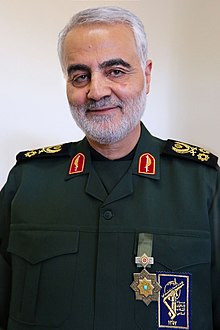
The Tale Of The Death Of Qasem Soleimani

Qasem Soleimani with Zolfaghar Order.jpg
Qasem Soleimani
There seems to be many tales of the death of Soleimani.

First, this happened....

‘Dangerous stalemate’: Attack on U.S. Embassy in Iraq part of Iran’s escalating aggression

Then, this happened....


Then, this happened...

War Stocks Rise Amid U.S. Tensions With Iran, Lockheed And Northrop Shares Jump


Then, this happened....

For non-Arabic speakers, reporting in the main news outlets NYT and Wash Post is so misinformed (either on purpose or because of incompetence) that you might think that the Iraqi State has officially voted for ejecting US forces from Iraq (because of Trump's miscalculated move
— Hussain Abdul-Hussain 🇺🇸 (@hahussain) January 5, 2020

Then, this happened...

A speaker taking part in Qassem Soleimani's funeral procession said anyone who assassinates Trump should get an $80 million bounty

Then, this happened...


Then, this happened...

Japan Navy Keeps Plan for Mideast Deployment Amid Iran Tension

It seems there is much more to the tale of the death of Soleimani.


Then, this happened...

Chief of staff to Secretary of Defense to step down, reports say


Voting is beautiful, be beautiful ~ vote.©

Tuesday, October 15, 2019

Meet Malgosia Fitzmaurice & Her United Nations Trafficking Tiny Humans ASFA Propaganda Crap

fitzmaurice
Malgosia Fitzmaurice
Everyone, meet Malgosia Fitzmaurice.

Malgoise is a trailblazer when it comes to the industry of trafficking tiny humans because she spearheaded the international reengineering the residuals of the peculiar industry by pushing child welfare propaganda to coincide with the launch of ASFA.

I bet she worked on the Convention on the Rights of the Child.


Working Together to Give Children Opportunities and Possibilities
The Nippon Foundation
MS. MALGOSIA FITZMAURICE Professor of Public International Law, Department of Law Queen Mary University of London Professor Malgosia Fitzmaurice holds a chair of public international law at Queen Mary University of London. She specializes in international environmental law, whaling, indigenous rights and the law of treaties, on all of these subjects she publishes extensively. Her monograph on “Whaling and International Law” was published by Cambridge University Press in December 2015. In 2001 she delivered The Hague Academy of International lecture on “The International Protection of the Environment”. Professor Fitzmaurice was invited several times as a Visiting Professor by numerous universities, such as IMO International Maritime Law Institute in Malta (Nippon Foundation Professor); UC Berkeley School of Law, University of Paris 1 PanthéonSorbonne, and University of Kobe, Japan.

Malgoise also has a Japanese Foster Care lab rat operation called the Nippon Foundation.

The Tooth Fairy is my favorite trafficking tiny humans revenue maximization project.


歯の妖精からの贈りもの - TOOTH FAIRY
The Tooth Fairy
What is TOOTH FAIRY project ? The metal used for dental treatment and dentures is made of an alloy containing gold and palladium, and it is an important fund to support children by collecting and recycling a lot. The TOOTH FAIRY project is being promoted by donating metal collected with the cooperation of patients by dentists who sympathize with this activity .

TRANSLATION: THE BODY PARTS INDUSTRY IS NOT JUST FOR ORGANIC MATTER ANYMORE

What is really odd is that I believe The Nippon Foundation may be one of those fake ass child welfare NGO, but, hey, what do I know?

I know nothing because I could not find any instrument of authority.

We must definitely ask Malgosia.
Professor Malgosia Fitzmaurice – Curriculum Vitae 
Professor of Public International Law the Department of Law, School of Law, Queen Mary, University of London with general responsibility for the teaching of public international law in the College at graduate and undergraduate level (at the undergraduate and post-graduate level international environmental law and post-graduate level the law of treaties). (from 1995)
Main teaching interests are: the law of treaties; international environmental law
The Nippon Foundation Part- time Visiting Professor of Marine Environmental Law at the International Maritime Institute in Malta, 2014-present
Main areas of research interest: the law of treaties; international environmental law (protection of marine environment and biodiversity, whales; the environmental protection of the Baltic Sea); indigenous people’s rights.
Other Current  Positions
Editor-in-Chief of a book series ‘Queen Mary Studies in International Law’ published by Martinus Nijhoff Publisher (Brill).
Editor –in –Chief of International Community Law Review
Member of the of the Commission on Environmental Law of the International Union for Conservation of Nature
Member of the International Law Association Working Group on Treaty Interpretation
External Examiner for International Law Subjects undergraduate and LLM: University College London (2012-2015); London School of Economics (2015-present)
Past Employment
1981-1982 Researcher at TMC Asser Institute in the Hague , the Netherlands
1982-1986  Legal Assistant Iran –United States Claims Tribunal
From 1989 to 1995, Senior Lecturer, and from 1994 Reader, in International Law in the Faculty of Law of the University of Amsterdam with responsibility for the advanced course in general international law, international environmental law and law of the sea.
From 1992 to 1995, part time lecturer at King’s College, London taking the LLM Course in the law of treaties (1992/1993 and 1993/1994) and international environmental law (1993/1994 and 1994/1995).
Grants received:
Conference Grant of the Modern Law Review
Commission of the European Union Grant on ecological crimes (a multi-stakeholders grant)
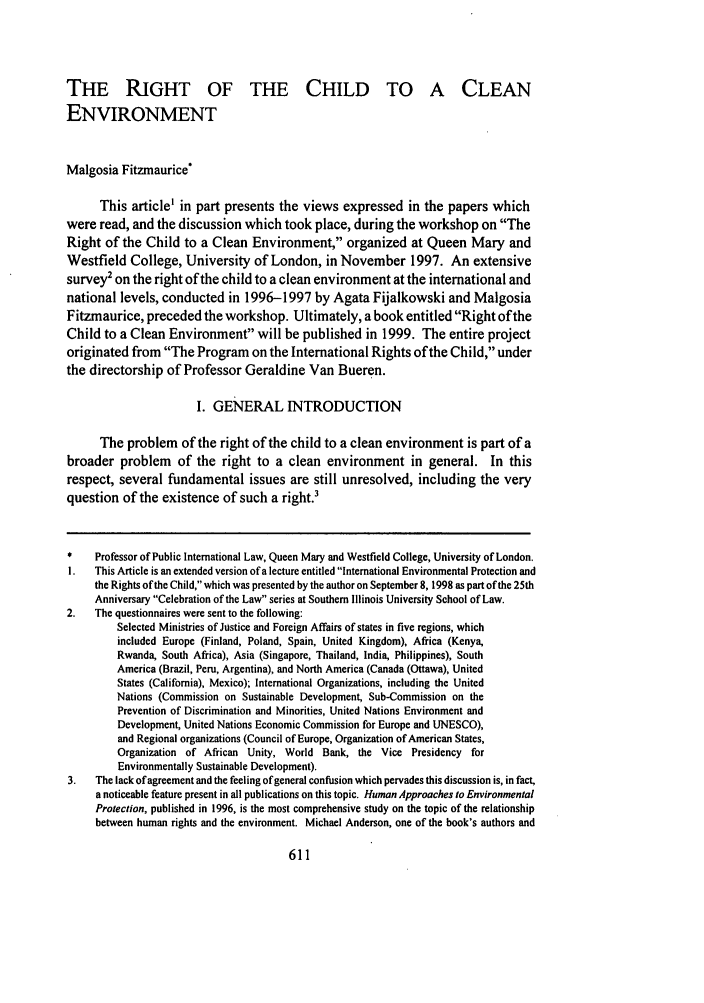
Malgosia wrote this.

handle is hein.journals/siulj23 and id is 643 raw text is: THE RIGHT OF THE CHILD TO A CLEAN
ENVIRONMENT
Malgosia Fitzmaurice
This article' in part presents the views expressed in the papers which
were read, and the discussion which took place, during the workshop on The
Right of the Child to a Clean Environment, organized at Queen Mary and
Westfield College, University of London, in November 1997. An extensive
survey' on the right of the child to a clean environment at the international and
national levels, conducted in 1996-1997 by Agata Fijalkowski and Malgosia
Fitzmaurice, preceded the workshop. Ultimately, a book entitled Right of the
Child to a Clean Environment will be published in 1999. The entire project
originated from The Program on the International Rights of the Child, under
the directorship of Professor Geraldine Van Bueren.
I. GENERAL INTRODUCTION
The problem of the right of the child to a clean environment is part of a
broader problem of the right to a clean environment in general. In this
respect, several fundamental issues are still unresolved, including the very
question of the existence of such a right.'
*    Professor of Public International Law, Queen Mary and Westfield College, University of London.
I.   This Article is an extended version of a lecture entitled International Environmental Protection and
the Rights of the Child, which was presented by the author on September 8, 1998 as part of the 25th
Anniversary Celebration of the Law series at Southern Illinois University School of Law.
2.   The questionnaires were sent to the following:
Selected Ministries of Justice and Foreign Affairs of states in five regions, which
included Europe (Finland, Poland, Spain, United Kingdom), Africa (Kenya,
Rwanda, South Africa), Asia (Singapore, Thailand, India, Philippines), South
America (Brazil, Peru, Argentina), and North America (Canada (Ottawa), United
States (California), Mexico); International Organizations, including the United
Nations (Commission on Sustainable Development, Sub-Commission on the
Prevention of Discrimination and Minorities, United Nations Environment and
Development, United Nations Economic Commission for Europe and UNESCO),
and Regional organizations (Council of Europe, Organization of American States,
Organization of African Unity, World Bank, the Vice Presidency for
Environmentally Sustainable Development).
3.   The lack of agreement and the feeling of general confusion which pervades this discussion is, in fact,
a noticeable feature present in all publications on this topic. Human Approaches to Environmental
Protection, published in 1996, is the most comprehensive study on the topic of the relationship
between human rights and the environment. Michael Anderson, one of the book's authors and
23 S. Ill. U. L. J. 611 (1998-1999)The Right of the Child to a Clean Environment


Voting is beautiful, be beautiful ~ vote.©

Monday, September 16, 2019

DOJ: Assistant Attorney General Makan Delrahim Delivers Remarks at 46th Annual Fordham Competition Law Institute Conference on International Antitrust Law and Policy


New York, NY  ~ Thursday, September 12, 2019
“With a Little Help from My Friends”:  Using Principles of Comity to Protect International Antitrust Achievements
It is an honor to be here again at this great event.  I always enjoy coming to Fordham and seeing so many friends, colleagues, and familiar faces.
Those of you who heard me speak last year may have picked up on the fact that I enjoy history.  As one of my predecessors, former AAG Wendell Berge, commented, “[i]t is valuable to revisit the past . . . because we can acquire some insight into what might happen in the future.”  With that in mind, I’d like to spend my time with you today discussing where we’ve come from in the field of international antitrust.  Then I’d like to focus on how we can protect against losing the progress that we’ve made, and work towards strengthening our bonds in furtherance of our mutual goals of free and competitive markets. 
The Division has long advocated for the market, not the government, to decide winners and losers.  Our role is to protect the conditions under which competition can thrive to the benefit of consumers.  As my friend and then-AAG John Shenefield remarked in the 1970s, “[e]conomic regulation has been a failure in U.S. domestic markets; it is one of the few things we should not try to export.”  We’ve made significant progress at harmonizing international antitrust practices and minimizing conflict over this view.  This progress did not come without sustained international effort, including from many in this room. 
Let’s start by going back to a time when antitrust was the least of the international community’s concerns.  As I was preparing today’s remarks, I read a speech given by former AAG Berge in 1945.  Its opening line was “We are approaching the time when Japan will join Germany in unconditional surrender.  This climax of a war which has absorbed so completely the lives and energies of millions of people will mark the beginning of a new phase in modern history.”
Almost 75 years later, that’s still about as attention-grabbing of an introduction as I’ve seen in an antitrust speech.  It also communicates the optimism of the time that the world had turned a corner and could start building something new.  Unsurprisingly, World War II caused a sea-change in the way that the United States viewed the global community.  Isolationism was not just an increasingly difficult task.  It was dangerous.  As a result, international issues more and more came to the forefront of the Antitrust Division’s thinking.  Antitrust had an important role to play in making sure that we did not replace military conflict with economic conflict. 
Cartels were central in the Division’s crosshairs.  While the goal of eliminating cartels sounds uncontroversial today, it was not widely shared at the time.  Many countries credited industrial cooperation and organization with pulling them out of the depression.  Rather than disbanding cartels in favor of competition, these countries tried to prevent abuse by imposing bureaucratic review of pricing and other practices.  Even when there was abuse, these jurisdictions frequently turned a blind eye if it benefitted firms within their own country.
By making it the stated policy of the Antitrust Division to open up global economic markets, the United States was bound to come into conflict with other countries.  Many countries did not yet have competition laws.  Some prioritized protectionism over competition.  Others objected to the United States’ attempts to apply its laws to conduct occurring outside of the United States’ borders. 
What followed was a period of international antitrust characterized by conflict of laws.  The United States sought active extraterritorial enforcement of its antitrust laws.  In response, other countries adopted so-called “blocking statutes” that prevented access to the evidence necessary for a successful prosecution.  This conflict did not just prevent the Division from achieving its goal of eliminating cartels.  It also required American businesses—which were still subject to U.S. antitrust laws—to compete on an uneven playing field.  Finding that our efforts were creating the very conflict we were trying to avoid, the Division set out to take a different tack.
Following World War II, the United States had become heavily involved in multilateral organizations.  In the 1950s, the Organization for European Economic Cooperation provided one of the first opportunities for the U.S. to exchange its views on competition issues.  It sponsored a group of experts in their work on restrictive business practices, and published a guide on competition laws around the world.
The Organization for European Economic Cooperation eventually became the Organization for Economic Cooperation and Development, or the OECD.  In 1961, the OECD established the first predecessor to the Competition Committee that exists today.  This Committee was a high priority for the United States.  AAG Lee Loevinger attended its first meeting in December 1961, and then-Attorney General Robert Kennedy enthusiastically supported the Division’s participation.    
The commitment to come together and discuss antitrust issues started to bear fruit.  As early as 1967, the OECD’s Competition Committee produced a recommendation on international cooperation in competition enforcement.  A central feature of that recommendation was the requirement that agencies notify each other of investigations that might affect each other’s territory or interests.  This was largely a defensive interest; a way of protecting one’s businesses from the extraterritorial reach of foreign enforcers.  But this recommendation proved to be an important stepping stone.  Over a series of five revisions, the notification provision has continuously shrunk, as cooperation, coordination, and investigative assistance provisions have expanded.
Today, communication and cooperation are a given in the international antitrust community.  In 2001, top antitrust officials from 14 jurisdictions, including the U.S. Department of Justice, established the International Competition Network, or ICN.  ICN now includes more than 140 member agencies.  International cooperation is a top agenda item for each of the ICN’s working groups.  It is also a top priority for the Intergovernmental Group of Experts of the United Nations Conference on Trade and Development.  At its meeting in July this year, that group agreed on a set of guiding policies and procedures for facilitating cooperation among UN member agencies.  These polices are set to be adopted next year at the UN’s Eighth Conference to Review the UN antitrust rules.
This commitment to international engagement reflects our belief that when foreign governments understand what we do and why we do it, their concerns substantially diminish.  These multilateral organizations were not formed to pursue any specific policy goal.  Instead, they were founded on the premise that regular conversations can identify the best answers.  This approach has deep roots in American ideals, particularly in our First Amendment.  As Justice Oliver Wendell Holmes wrote, the “only test of truth is its ability to get itself accepted in the marketplace of ideas.”  Just as the truth will emerge from an open and transparent discussion of ideas, our hope and experience has been that a robust vetting of competition policies will produce the best practices. 
Having opened an international dialogue, the Antitrust Division of the DOJ was able to begin working with the international competition community to converge our substantive competition rules.  This was a longstanding and important goal.  Former AAG Rule noted back in the 1980s that “[i]n a one-world economy, conflicting competition regimes threaten to create a regulatory ‘Tower of Bab[el].’”  These international conflicts were not just inconveniences.  They deprived consumers of efficiency-enhancing mergers.  As then-AAG Rule explained, “[t]he complexity of dealing with so many overlapping but at times inconsistent rules and regulations will surely make some otherwise worthwhile economic transactions prohibitively expensive.”
One of our most important and productive steps forward came during the tenure of AAG Jim Rill.  He initiated our serious substantive engagement with new antitrust enforcers after the fall of the Iron Curtain.  Working with our colleagues at the FTC, he established technical assistance programs in countries that were transitioning to a market-based system.  Under these programs, the United States offered technical advice on the role that antitrust law could play in protecting competition in newly opened markets.  These technical assistance programs continue to this day.  The Antitrust Division regularly sends lawyers and economists to antitrust agencies around the world to share our learnings from decades of experience.  All of this is done to further the goal set by then-AAG Rill in 1991:  “[I]n an increasingly transnational business environment, the rules of the game should be as consistent as possible from place to place.”
Our continued engagement led to progress.  By 2004, then-AAG Hew Pate noted that “[t]he search for objective, non-political principles for competition law has meant that over the last few decades antitrust has become increasingly about economics.”  This statement highlights a few key aspects of effective rules for antitrust enforcement.  If we want to approach international consensus on antitrust issues, the rules must be objective, and they cannot be political.   
This is an important lesson to remember in light of suggestions that we incorporate other areas of law or general issues of social welfare into our antitrust analysis.  With global businesses and near-global antitrust enforcement, consistency is important.  We cannot expect that all countries or political parties will share the same view of a desired social outcome or agree on all substantive areas of law that might interact with the antitrust laws.  We can, however, limit the inconsistency when the touchstone of our antitrust analysis is fundamental principles of economics. 
As we converged on a common substantive approach, we opened new opportunities to work together.  Over the past 25 years, it has become increasingly common for the Antitrust Division to coordinate closely with international enforcers.  This cooperation benefits the enforcement agencies, the business community, and consumers, as we are able to share views of the evidence, expected timelines, and evaluations of potential remedies. 
As just one example, the Antitrust Division recently investigated the Thales/Gemalto merger, which involved components used in complex encryption systems.  After completing its review, the Division decided that a divestiture was necessary to remedy the harms that would otherwise flow from that merger.  Because the Division had worked closely with the EC throughout its investigation, we understood that the EC shared many of our concerns, and would also likely require a divestiture.  Thales and Gemalto both had multinational customers and distributed their products globally.  Splitting the divestiture so that there was one buyer in America and a separate buyer in Europe would have made it more difficult for the divestiture buyers to compete.  Recognizing the importance of finding a single purchaser, we at the Division decided to depart from our normal practice of requiring an up-front buyer.  We were able to use the extra time to work with the parties and the EC to find a single purchaser that was acceptable to everyone.  Our close cooperation made it possible to align on timing, provide more effective antitrust enforcement, and fully protect American consumers. 
Cooperation in our cartel matters also remains of critical importance, particularly on leniency issues.  The modern version of the Division’s leniency policy has been in place for over 25 years.  The idea is simple:  it is easier to uncover and prosecute international cartels if participants have real incentives to self-report.  While the language of the leniency policy has not changed since the 1990s, we have continuously evaluated the program to ensure that incentives remain in place to encourage self-reporting.  To that end, in 2004, the U.S. Congress added incentives to self-report in ACPERA—the Antitrust Criminal Penalty Enhancement and Reform Act—by reducing civil damages exposure for companies that successfully apply for leniency and cooperate with civil claimants. 
In the 25 years of our current leniency policy and 15 years of ACPERA, the Division has learned that leniency programs thrive when they are predictable and transparent.  As the number of countries around the world that investigate and prosecute cartels has increased, the Division has worked to share these lessons with the international enforcement community.  If one country’s leniency program is unpredictable and lacks transparency, it could undermine our collective efforts at prosecuting international cartels.  Similarly, if cooperating with multiple countries becomes too difficult or expensive, we risk unnecessarily deterring self-reporting and cooperation. 
All of this means that our work isn’t done.  We should continue our efforts, with a renewed focus on cartel issues.  We should ensure that leniency applicants can meet the competing demands of all jurisdictions where they have exposure.  For example, we have found that small steps, such as coordinating witness interviews and focusing our investigations on the harms within our respective jurisdictions, can have a large impact on the costs of self-reporting.  We are developing our own internal best practices at the Division, and engaging in a constructive dialogue on this topic with our enforcement counterparts.  An important forum for this dialogue is the ICN Cartel Working Group, which currently is developing ways to enhance coordination on leniency matters.  This project will provide practical guidance on best practices for cross-border leniency coordination, with the goal of making enforcement more effective and efficient.      
Coordination and cooperation, however, is only the first step.  Ensuring a set of due process rights and agreeing on a set of basic procedures can be just as important. 
Agreement within the competition community on antitrust process has been easy on some fronts.  For example, merger notification and review procedures were one of the first subjects discussed among the ICN members.  ICN has also adopted recommended practices for transparency, engagement, and confidentiality during the investigative process.  Similarly, OECD has been a productive forum for discussions.  Then-AAG Varney presided over a series of roundtables just a decade ago when she chaired OECD’s Competition Committee Working Party 3.  These roundtables helped pave the way for our more recent efforts.
When I became AAG, I made it a priority for the Antitrust Division to take these discussions to the next level.  To that end, the Division led an initiative for the first-of-its-kind multilateral agreement on due process that turned into the ICN’s Framework for Competition Agency Procedures, or the “CAP.”  The CAP sets forth a series of fundamental due process norms such as non-discrimination; transparency and predictability; timely notice and resolution; avoidance of conflicts of interest; right of defense; and right to counsel and privilege protections.  As the Head of the International Relations Unit for DG Comp recently described it, the CAP creates a “fundamental counterbalance” for parties appearing before antitrust enforcers. I was very pleased that the CAP opened in Cartagena, Colombia in May with more than 60 original signatures.  As of today, over 70 countries have signed on.  This agreement will make us more efficient and effective competition law enforcers, and will continue to build confidence in our enforcement actions.
The CAP also builds upon our learnings from other areas of international cooperation.  It includes a series of review and consultation mechanisms that will continue and even deepen the dialogue between us.  Our colleagues in Europe recently encouraged companies to raise any violation of the CAP with their domestic enforcement agency, which can then address the issue directly in bilateral conversations.  I join in that encouragement, and hope that companies that experience due process violations abroad will bring those issues to the Antitrust Division, so that we can take appropriate action.
Of course, our hope is that CAP fosters a positive dialogue as well.  Competition agencies around the world operate in different legal and political systems.  The mechanics of antitrust enforcement in a common law or prosecutorial system differ from enforcement in a civil law context where there are specialized tribunals.  The CAP requires that signatories publicize templates summarizing national procedures and practices.  This transparency will allow the Division to understand more readily a specific jurisdiction’s policies, and will help us evaluate our ability to cooperate with that country on an investigation.  My hope is that the CAP will help create a feedback loop where procedural transparency and convergence creates opportunities for additional case cooperation and further substantive convergence as well. 
The CAP is still in its early stage, but I have been greatly encouraged by the international reception of the agreement.  It has the potential to become one of the competition community’s most significant achievements in promoting due process.  Still, we hear complaints that there are agencies that use the competition process to forward blatantly national goals.  These complaints center on issues during the investigative process.  We have more work to do.  It is my hope that every major trading partner with a competition enforcer joins in efforts to improve procedural due process moving forward.
Now that we’ve taken this whirlwind tour of international antitrust history, it’s time to ask what’s next.  Business continues to become more global, and additional countries continue to develop and ramp up their antitrust enforcement.  Each of these factors makes international cooperation in enforcement a matter of increasing importance.  As then-AAG Pate noted 15 years ago, “[a] global antitrust system in which each agency simply lines up to take its whack at the piñata is not a model that is going to serve us, or the market, very well.”  He described the danger of such an approach when he noted that “an international system of seriatim review of controversial matters by different authorities that enables opponents of a transaction to skip across the globe until they get an answer that they like is unacceptable.”  A few years before these comments, then-Acting AAG Doug Melamed similarly highlighted that a failure to work together with our international counterparts “risks not only needless burdens on businesses and suboptimal antitrust enforcement, but also the international politicization of antitrust disputes.”
This is a particular concern with intellectual property, where decisions made in one country can set the norm for global operations.  The most obvious example of this phenomenon may come from outside the antitrust arena.  In May of 2018, the European General Data Protection Regulation went into effect.  This law required, among other things, that companies disclose if they use cookies on their websites.  Despite no such law in the United States, we now constantly see such notifications appearing when we access the web as well.  While this example seems likely to be benign, others are not.  For instance, we have seen countries require global licensing of U.S. patents as a remedy.  Such decisions have the real potential to decrease incentives to invest and to innovate.  When a foreign enforcer imposes such a remedy globally, it takes away the Antitrust Division’s ability to reach a different conclusion and risks harming American consumers.  It also takes away the ability of every other jurisdiction to reach a different conclusion.
So, what is the solution?  I think it is time to return to a topic that then-AAG Rill popularized for the antitrust community in the early 1990s:  comity.  Comity promotes efficiency for international businesses by avoiding unnecessary conflicts.  For example, the Division has been clear that we will not seek world-wide relief where a narrower scope proves adequate.  Our role is to protect competition for American consumers, workers, and entrepreneurs.  It is not to play international antitrust cop where U.S. commerce is not affected.  Consumers and businesses alike are best served when countries avoid using the antitrust laws to expand their sphere of influence.  As our Supreme Court explained in Empagran, principles of comity do not permit “legal imperialism” when a country’s “antitrust policies could not win their own way in the international marketplace for . . . ideas.”
Circuit Judge Douglas H. Ginsburg, a former AAG of the Antitrust Division, recently co-wrote an excellent article on the dangers of overly broad relief, titled “The Enduring Vitality of Comity in a Globalized World.”  I encourage you all to read it, if you haven’t.  As he explains, “comity requires more than avoidance of conflicting outcomes and remedies; it also requires respect for differences in the scope and commercial effect of the laws of foreign sovereigns.”  Judge Ginsburg persuasively argues that comity is necessary if we do not want to create a race to the bottom where antitrust becomes a tool for industrial policy.  In other words, comity is a necessary principle to consider and apply if we do not want to undo all of our hard work over the last 75 years.
It is important to emphasize, however, that employing principles of comity does not mean that we are tying our hands.  As our Supreme Court explained more than a century ago, “‘[c]omity’ . . . is neither a matter of absolute obligation, on the one hand, nor of mere courtesy and good will upon the other.”  Our Supreme Court reiterated that comity is not an all-encompassing obligation in Hartford Fire.  That opinion accepted that comity had a role to play when thinking about the Sherman Act’s application to foreign conduct, but it limited comity’s role to situations where it was truly necessary to resolve a conflict.  Most recently, in the Vitamin C case, the Supreme Court just last year unanimously rejected the view that comity required deference to foreign interpretation, again emphasizing the flexible nature of the comity inquiry.  As the opinion notes, “a federal court is neither bound to adopt the foreign government’s characterization nor required to ignore other relevant materials.  No single formula or rule will fit all cases . . . .”
The Antitrust Guidelines for International Enforcement and Cooperation make clear our ongoing commitment to applying principles of comity to our own decision making.  We need to ensure, however, that comity is a two-way street.  We cannot agree to subject American companies to unfair treatment under foreign laws in the name of comity and avoidance of conflict. 
Any application of comity has to take into account the particular enforcer, including any history of discrimination in favor of its own domestic companies or against foreign companies.  We will not defer our own investigation unless we are certain that our foreign counterparts will conduct a full and fair investigation of their own. 
With these principles in mind, I have directed the Division to undertake a review of our International Guidelines.  We will make sure that these Guidelines:  (1) first, accurately reflect the latest guidance from our Supreme Court and lower courts; (2) second, adequately reflect the importance of comity to our relationships with international competition enforcers; and (3) third, adequately convey the symmetry that we expect from our international counterparts.  In doing so, we hope to further strengthen our invaluable relationships with our international colleagues, as we all pursue the common goal of protecting competition.
I want to again express my appreciation for the invitation to speak today.  International antitrust issues remain vitally important to the work that we do at the Antitrust Division.  I commend this event for drawing attention to these topics and providing the opportunity to engage in a dialogue regarding these issues.  Thank you.   

Voting is beautiful, be beautiful ~ vote.©

Wednesday, May 29, 2019

GO BLUE: Stephen Ross Gets Busted For Stealin' From Our Most Precious Treasures

I was in awe with the legal magnitude of this decision, of the D.C Court of Appeals, of the Tax Court, on stealin'.

I prefer the term Corporate Shape Shifter.

Michelle Obama prefers the term corporate layering.

This is what the Detroit Land Bank Authority did under TARP, except there was a situation of such gross negligence in their racketeering of fake LLCs for the simple fact that University of Michigan actually teaches the virtues of the Michigan land bank model and falsely advises in crafting legislation.

I could go into detail, or I could just send you to my database of their antics.

Get to know Stephen Ross because he was the one who came up with the hustle of scamming the Treasury by claiming to help "The Poors" in housing while generating substantial profits in Corporate Shape Shifting through foreign corporations in tax adverse lands.

It seems he has amassed a $15 billion dollar fortune from the trafficking of tiny humans with investments from the Children's Investment Fund Foundation, EB-5, Brookfield, with Japanese and Israeli financial interests.

The entire philanthropic community has become nothing more than an operation of Social Impact Bonds, a residual of the peculiar institution.

I see another transposable legal model.

I also see another building block in the justice chain.

#maytheheavensfall

Appeals court denies $33M charitable deduction by UM donor Ross, partners


Washington — A federal appeals court has ruled that real estate developer Stephen M. Ross and his partners may not deduct as a charitable contribution $33 million for commercial land donated to the University of Michigan in 2003.

In so ruling, a three-judge panel of the U.S. Court of Appeals for the District of Columbia Circuit upheld a 2017 decision, below, by the U.S. Tax Court and a 40-percent penalty imposed by the Internal Revenue Service.

Ross is UM's largest alumni donor, with hundreds of millions in pledges to the university and with his name on the university's business school.

According to the court, RERI Holdings LLC, of which Ross is a member, had acquired and donated a future interest in a piece of commercial property to UM in 2003.

RERI had argued that the donation was a bona fide deduction valued at $33 million, but the IRS had maintained that RERI artificially inflated the property value to offset the tax liability of its owners.

RERI had paid $2.95 million in 2002 for a remainder interest in the property at issue, later gifting that remainder interest to UM in 2003 as part of Ross' pledge to donate $5 million to the university.
UM later sold the property to HRK Real Estate Holdings LLC — indirectly owned by another RERI member — for $1.94 million, which was credited toward Ross’s pledge to UM, according to the court.

On its 2003 tax return, RERI claimed a charitable contribution deduction of $33 million for the transfer of the property.

After an audit, the IRS rejected $29 million of RERI’s deduction, finding the property was worth only $3.9 million. The IRS also imposed a penalty equal to 20 percent of the tax underpayment.

In the Tax Court, the IRS later asserted that RERI was entitled to no deduction for a charitable contribution on the grounds that the transaction was “a sham for tax purposes or lacks economic substance.” It also revised its penalty to 40 percent of the tax underpayment.

The Tax Court after a four-day trial sided with the IRS, concluding that RERI had failed to substantiate the value of the donated property as required by federal regulations.

The tax court judge also concluded that RERI had "grossly" misstated the property's value, which the judge found was worth just $3.46 million on the date of the donation to UM.

The Tax Court noted a “significant disparity" between the property's claimed fair market value of $33 million and the $3 million that RERI had paid to acquire it just 17 months before gifting it to the university.

"In short, we agree with the Tax Court that RERI fell short of the substantiation requirements by omitting its basis in the donated property," the appeals panel wrote. 

Voting is beautiful, be beautiful ~ vote.©

Monday, May 28, 2018

Why Abortion Kills Jobs: Biomedical Research, Cloning & Patents

While there are groups pitted against each other like the Hatfields and McCoys, in a bitter rival over some generational, archaic, color coded, heirarchial belief system that has been perpetuated as a form of distractionary socioeconomic propaganda to enrich those who came up with this crafty format of politically campaigning to pass law and policy so they can steal from the very same groups who are carrying the pitch forks and torches, taxpayer dollars are funding the colonial expansion of corporate parental rights through the patent.

Below, I have provided a few snippets to introduce plausible explanations as to why the U.S. Patent and Trademark First Satellite Office is in Detroit, why cloning is the new term for human trafficking, which is in biomedical research, cloning & patents.

Always remember, corporations do not adopt, they acquire ownership of the goods through intellectual property, because they own us right down to the genome, which is legal to conduct biomedical research in other countries, because it always starts with the best interests of the child, because no one cares, unless there revenues are maximized to fund more political campaigns to fund more of human R & D.

Open Research Human Cloning


A gene patent is the exclusive rights to a specific sequence of DNA (a gene) given by a government to the individual, organization, or corporation who claims to have first identified the gene. Once granted a gene patent, the holder of the patent dictates how the gene can be used, in both commercial settings, such as clinical genetic testing, and in noncommercial settings, including research, for 20 years from the date of the patent. Gene patents have often resulted in companies having sole ownership of genetic testing for patented genes.

On June 13, 2013, in the case of the Association for Molecular Pathology v. Myriad Genetics, Inc., the Supreme Court of the United States ruled that human genes cannot be patented in the U.S. because DNA is a "product of nature." The Court decided that because nothing new is created when discovering a gene, there is no intellectual property to protect, so patents cannot be granted. Prior to this ruling, more than 4,300 human genes were patented. The Supreme Court's decision invalidated those gene patents, making the genes accessible for research and for commercial genetic testing.

The Supreme Court's ruling did allow that DNA manipulated in a lab is eligible to be patented because DNA sequences altered by humans are not found in nature. The Court specifically mentioned the ability to patent a type of DNA known as complementary DNA (cDNA). This synthetic DNA is produced from the molecule that serves as the instructions for making proteins (called messenger RNA).


STATEMENT AND BACKGROUND ON THE CRISPR PATENT PROCESS

Image result for battle over patentApril 30, 2018: The Federal Circuit heard oral arguments in the appeal on Monday, April 30, 2018. A ruling is expected later this year.

Based on the oral arguments today, we are even more confident the Federal Circuit will affirm the PTAB’s judgment and recognize the contribution of Broad, MIT and Harvard in developing this transformative technology.

As this patent issue is resolved, and as new patents related to important uses of  CRISPR are issued to the many institutions, including UCB, we call on UCB and the companies that control its IP to join our ongoing efforts to simplifyshare, and open the IP landscape.


SCOTUS Cloning Patent Opinion, Scalia Concurrence: ASSOCIATION FOR MOLECULAR PATHOLOGY ET AL. v. MYRIAD GEN... by Beverly Tran on Scribd

Voting is beautiful, be beautiful ~ vote.©

Monday, June 12, 2017

CONYERS: Judiciary Democrats Press Ivanka Trump Brand About Conflicts Of Interest


After Vague Response to Previous Inquiry, Dems Want Real Answers

Washington, D.C. – After receiving a vague response to a previous inquiry, below, House Judiciary Committee Democrats today pressed Ivanka Trump Operations, below, for answers on their business dealings with foreign countries and Ivanka Trump’s involvement with the company. 

On May 3, 2017, every Democratic member of the House Judiciary Committee sent letters to White House Counsel Donald McGahn and to Abigail Klem, president of Ivanka Trump Operations LLC, seeking information about potential conflicts of interest.  The Committee received a response from Mrs. Klem on May 17.  Describing this response as “somewhat incomplete,” today the members wrote again, below, to Mrs. Klem to request additional information.

These letters were prompted by Ms. Trump’s meetings with leaders from China and Japan and the swift, subsequent approval of valuable trademarks for her company by those foreign governments. 

Federal law prohibits the participation of any federal employee in any “decision, approval, disapproval, the rendering of advice, . . . or other particular matter” that will affect his or her own financial interests.  Although Ivanka Trump resigned from her management role with IT Operations LLC before joining the White House as an advisor to her father, she still stands to benefit financially from the expansion of her brand overseas.  Recent reporting suggests that Ms. Trump may have participated in several official meetings with representatives from countries in which her brand seeks to do business.

Today’s letter was signed by every Democratic member of the U.S. House Judiciary Committee, including: Representatives John Conyers, Jr. (D-MI), Jerrold Nadler (D-NY), Zoe Lofgren (D-CA), Sheila Jackson Lee (D-TX), Steve Cohen (D-TN), Hank Johnson (D-GA), Ted Deutch (D-FL), Luis Gutierrez (D-IL), Karen Bass (D-CA), Cedric Richmond (D-LA), Hakeem Jeffries (D-NY), David Cicilline (D-RI), Eric Swalwell (D-CA), Ted Lieu (D-CA), Jamie Raskin (D-MD), Pramila Jayapal (D-WA) and Brad Schneider (D-IL). 

The May 3rd letters to the WH Counsel and IT Operations are available here.

The May 17th letter from IT Operations is, below.

Voting is beautiful, be beautiful ~ vote.©

Wednesday, May 3, 2017

House Judiciary Democrats Demand Answers on Ivanka Trump’s Overseas Business Interests


Washington, DC – Today, every Democratic member of the House Judiciary Committee joined Ranking Member John Conyers, Jr., in sending letters both to White House counsel and the CEO of Ivanka Trump Collection, LLC, expressing concerns that Ivanka Trump may be using her official position for private gain.  The letter focuses on Ms. Trump’s meetings with leaders from China and Japan and the swift, subsequent approval of valuable trademarks for her company by those foreign governments. 

These letters come after the public release of new guidance from the Office of Government Ethics, confirming that Ms. Trump is considered a government employee covered by federal ethics rules, as well as new reports describing how Ms. Trump may have used her official position to promote both her new book and Trump Tower in the Philippines.

Today’s letter was signed by every Democratic member of the U.S. House Judiciary Committee, including: Representatives John Conyers, Jr. (D-MI), Jerrold Nadler (D-NY), Zoe Lofgren (D-CA), Sheila Jackson Lee (D-TX), Steve Cohen (D-TN), Hank Johnson (D-GA), Ted Deutch (D-FL), Luis Gutierrez (D-IL), Karen Bass (D-CA), Cedric Richmond (D-LA), Hakeem Jeffries (D-NY), David Cicilline (D-RI), Eric Swalwell (D-CA), Ted Lieu (D-CA), Jamie Raskin (D-MD), Pramila Jayapal (D-WA) and Brad Schneider (D-IL). 

Voting is beautiful, be beautiful ~ vote.©

Sunday, March 17, 2013

Bicameral Group of Members Raises Alarm on Japan’s Possible Interest in Joining TPP Negotiations


(WASHINGTON) – Today, dozens of House members and Senators are sending a letter to President Obama later today raising the alarm about Japan’s possible interest in joining the Trans-Pacific Partnership negotiations between the Office of the United States Trade Representative (USTR) and several Pacific Rim countries. The letter, still circulating for signatures, will go to President Obama later this afternoon. Current signatories are below. After signing the letter, Congressman John Conyers, Jr. (D-Mich.) issued the following statement:

U.S. Representative
John Conyers, Jr.
“With the auto industry just now regaining its fiscal footing and profitability, it’s a very serious development that USTR is considering opening the domestic auto  industry up to unfair competition from one of the most restrictive markets for automobiles in the world,” said Conyers.

“It is incumbent that USTR carefully scrutinize Japan’s potential entry into the Trans-Pacific Partnership.  American auto workers and manufacturers can’t afford another free trade deal that adds to our country’s $76 billion annual trade deficit with Japan.”

Voting is beautiful, be beautiful ~ vote.©