Showing posts with label redistricting. Show all posts

Sunday, June 14, 2020

The Tale Of Gerrymandering & SCOTUS: How To Cloak The Residuals Of The Peculiar Institution - Stealin' The Children, Land & Vote By Blasphemy

New York Society for the Prevention of Cruelty to Children, 1882 ...
Origins of Gerrymandering - CPS
There is a blog SCOTUS clerks use as reference when it comes to making decisions about gerrymandering cases.

This particular article, below, is about gerrymandering, which just so happens to be false advisement, which is used as obviation in generating court opinions and the law of the land because it omits to tell the tale of Child Protective Services as the Gerry Secret Society, to become so affectionately called in the United States, gerrymandering.

This is fraud because gerrymandering is the act of stealin' the children, land & vote, the residuals of the peculiar institution, whereby, SCOTUS has ruled is constitutional; hence, slavery was never abolished, due to the "Exception Clause" of the Thirteenth Amendment.

SCOTUS Realizes Gerrymandering Is Constitutional Stealin' The Children, Land & Votes Under The Thirteenth Amendment Exception Clause

Section 1. Neither slavery nor involuntary servitude, except as a punishment for crime whereof the party shall have been duly convicted, shall exist within the United States, or any place subject to their jurisdiction.
Section 2. Congress shall have power to enforce this article by appropriate legislation.
Appeal for National Society For The Prevention Of Cruelty To ...
The Allodial Title Holder of the Children's Trust Bonds
The following is the meaning of a bond and its many legal machinations of bondage, for children are immoveable chattels, attached to the allodial title of land, because children cannot be emancipated until the juridic age of 15 years.

15 U.S. Code SUBCHAPTER III—TRUST INDENTURES

The following is the factual, recorded, origins, found in multiple attestation, of Gerrymandering, and the Gerry Secret Society, the response to Emancipation Proclamation: the creation of - 

Society for the Prevention of Cruelty to Children

Company Number
16120
Status
Inactive Merged Out
Incorporation Date
1 December 1920 (over 99 years ago)
Dissolution Date
18 April 2000
Company Type
DOMESTIC NOT-FOR-PROFIT CORPORATION
Jurisdiction
New York (US)
Registered Address
  • 100 EAST OLD COUNTRY RD, BOX 510, MINEOLA, NEW YORK, 11501
  • United States
Previous Names
  • CHILDREN'S HOUSE, INC.
  • NASSAU CHILDREN'S HOUSE, INC.
  • NASSAU CHILDREN'S SHELTER, INC.
  • SOCIETY FOR THE PREVENTION OF CRUELTY TO CHILDREN, NASSAU COUNTY, INC.
The Response 1874-1875

SPCC Founding 1874
Henry Bergh and Elbridge Gerry, aware that the hour for children had finally come, recruited respected philanthropist John D. Wright and formally pledged themselves to the establishment of organized child protection.
Children's Protective Society
The undersigned, desirous of rescuing the unprotected children
of this city and State
from the cruelty and demoralization which
neglect and abandonment engender'
hereby engage to aid, with their sympathy and support,
the organization and working of a Children's Protective Society,
having in view the realization of so important a purpose.
On December 15, 1874, the Society for the Prevention of Cruelty to Children was founded and organized. Gerry annunciated its unique purpose:
"to rescue little children from the cruelty and demoralization which neglect, abandonment and improper treatment engender; to aid by all lawful means in the enforcement of the laws intended for their protection and benefit; to secure by like means the prompt conviction and punishment of all persons violating such laws and especially such persons as cruelly ill treat and shamefully neglect such little children of whom they claim the care, custody or control."
NYSPCC Incorporation 1875
On Tuesday, April 27, 1875, the SPCC was incorporated as The New York Society for the Prevention of Cruelty to Children, the first child protection agency in the world. John D. Wright became its first president, Gerry and Bergh vice-presidents.

But this is what they were really doing:

Humanitarian reformers had expressed concern for children before the 1870s, organizing efforts to end the corporal punishment of school children, creating institutions to care for ORPHANS, and even sending orphans by train to foster families in the West. But reformers were reluctant to interfere in families, which had a recognized right to privacy. By the 1870s, the relative weights of the concern for children and the concern for family privacy had shifted. Mary Ellen's residence with foster parents (her biological parents were dead) may have eased her protectors' willingness to cross that boundary. Differences in class and culture also facilitated the creation of the SPCCs. The organizations were directed by wealthy, conservative, Protestant white men, whereas their clientele were mostly poor, Catholic immigrant families or poor black families. These were powerful distinctions during the late nineteenth century.
Their founders conceived of the SPCCs as law enforcement agencies. Agents were to find abused children–on the street or through tips made by concerned neighbors, relatives, and even the abused children themselves–investigate their families, and prosecute abusers. Many states gave the societies police powers, such as the right to issue warrants, or allowed the police to aid them. Most importantly, "the cruelty" (as SPCC agents were sometimes known in poor neighborhoods) could remove children from their homes.


Learn more: BEVERLY TRAN: SCOTUS Realizes Gerrymandering Is Constitutional Stealin' The Children, Land & Votes Under The Thirteenth Amendment Exception Clause http://beverlytran.blogspot.com/2019/10/scotus-realizes-gerrymandering-is.html#ixzz6PJ8lR5AB
Stop Medicaid Fraud in Child Welfare

The following is false information, intentionally manufactured to manipulate the public record, to control justice, in favor of the publishing blasphemer, because I just demonstrated that Jennifer Davis could have told the truth, if only she knew how to do a internet basic search, but, then again, blame could be attributed to Google, simply for the fact that they lied in testimony to U.S. House Judiciary Committee claiming they do not suppress searches, which obviouly they do, because the world is just finding out about the truth of the history of gerrymandering being the response to the Thirteenth Amendment:

#maytheheavensfall

Elbridge Gerry and the Monstrous Gerrymander

February 10, 2017

"The Gerrymander: a New Species of Monster" Boston Gazette, March 26, 1812, page 2, Newspaper, Serials and Newspaper Division. [//www.loc.gov/exhibits/treasures/trr113.html]
Gerrymander the Blasphemer
The first “gerrymander” was drawn on a map and signed into law on February 11, 1812. Elbridge Gerry, then governor of Massachusetts, signed into law a redistricting plan designed to keep his political party in power in the upcoming election. Upset that the Federalist Party was critical of James Madison’s foreign policy, Gerry signed the reapportioning plan that heavily favored his Republican party. Gerry, a man who staunchly followed his principles even against the popular actions of his colleagues, was hesitant to sign the law. The Republican legislators sponsoring and forcing through the bill redrew voting lines so that the Federalist vote was concentrated in a few districts, while the Republican vote was spread over many. ” The redistricting authorized by Gerry won 29 seats for the his Republican party, whereas the Federalists won a puny 11 seats.* Gerry’s district of Essex was a particularly odd shape, long on one side and curved along the north end.
“The Gerrymander: a New Species of Monster” Boston Gazette, March 26, 1812, page 2, Library of Congress Newspaper, Serials and Government Publications Division. 
When the law passed, reportedly the editor of the Boston Gazette posted the map with the newly drawn districts on his office wall, and in talking to a fellow editor, compared the shape of Gerry’s district to a salamander. The editor said, “Salamander! Call it a Gerrymander” — the portmanteau of Gerry + salamander. Gerry’s name, incidentally, is pronounced with a hard “g” as in “gary,” but over time the word “gerrymander” came to be pronounced with the soft “g” as in “jerry,” the pronunciation we use today. In any case, the picture of the cartoon gerrymander map was published in the Boston Gazette on March 26, 1812, with the caption: “The horrid Monster of which this drawing is a correct representation, appeared in the County of Essex, during the last session of the Legislature.” The word has since entered into national and international political language.
Gerrymandering is a current political topic today; as always, it is usually initiated by the incumbents to retain or increase their power. When gerrymandering is taught in U.S. history classes, it is likely students will be shown a picture of the original political cartoon drawn by Elkanah Tisdale for the Gazette and held here at the Library of Congress. Gerry did not win the 1812 election for his home district despite the reapportionment. He did, however, go on to become James Madison’s second vice president later in 1812. He was a signer of the Declaration of Independence, a member of the House of Representatives, twice governor of Massachusetts, and (full disclosure) he proposed the founding of the Library of Congress; he’d probably be dismayed to find this idea is how his name is remembered. Nevertheless, Gerry is forever tied to an important concept in American legal history.
If you’re interested in learning more about modern gerrymandering and the law, here is a shortlist of some of our recent holdings, and a map of Essex County:
KF4905.B85 2010 Bullock, Charles S., 1942-  Redistricting: the most political activity in America.
KF4891.S74 2004 Stephenson, D. Grier. The right to vote: rights and liberties under the law.
KF4557 .S74 2014 Stevens, John Paul,  1920-  Six amendments: how and why we should change the Constitution.
KF4886 .T65 2013 Tokaji, Daniel P. Election law in a nutshell.
G3763.E7F7 1812 .E8 Essex County; Worcester County.
*source: Selesky, Harold E. Encyclopedia of the American Revolution: Library of Military History2006
The following is the history of gerrymandering by the American Society for the Prevention of Cruelty to Children:


The following is a video on the U.S. history of Gerrymandering.


Voting is beautiful, be beautiful ~ vote.©

Thursday, February 27, 2020

Michigan Private Redistricting Teleconference Featuring Detroit Land Bank Authority Legal Genius Michael Brady - 2-27-2020

Oh, lookie!

Michael Brady is on the redistricting team.

Michael has alot of experience in gerrymandering through fake ass private organizations.

Jocelyn Benson has alot of experience when it comes to making up her own rules, with advice and consent of fake ass private organizations, too.

I would go, but I am not credentialed media, which is a good thing because I would just publish their own words coming from their mouths, including the audience comments, and use it against them.

I bet they are going to produce a fancy video with cute memes and hashtags about all their redistricting efforts, but will forget the history, because they are bleachbitting legacy, which is why I do what I do.

Secretary Benson banner
MEDIA ADVISORY
Note: This event is for credentialed media only
Feb. 26, 2020
Contact: Mike Doyle

Press teleconference with updates on
Michigan's Independent Citizens Redistricting Commission

State officials will announce Michigan has already processed more than
3,000 applications, far more than minimum required by constitution

WHEN:
Thursday, Feb. 27, 2 p.m. [Opening remarks 2-2:15 p.m.; Media Q&A to follow until or before 2:45 p.m. as necessary]

WHO:            
  • Michigan Assistant Secretary of State Heaster Wheeler
  • Sally Marsh, director of special projects for the Michigan Department of State and Secretary of State Jocelyn Benson
  • Michael J. Brady, chief legal director for the Michigan Department of State and Secretary of State Jocelyn Benson
  • Jake Rollowdirector of communications & external affairs for the Michigan Department of State and Secretary of State Jocelyn Benson

LOCATION:
Via conference call – Please RSVP to Mike Doyle of the Michigan Department of State at DoyleM@Michigan.gov or 517-335-3264 to receive the conference call number.

WHAT:
Press teleconference to discuss applicant demographics and selection methodology for Michigan’s Independent Citizens Redistricting Commission.

More than 3,000 applications – nearly half of the more than 6,000 received to date – for the Independent Citizens Redistricting Commission have been processed. This total, as measured through Feb. 26, means Michigan has already received far more applications than the minimum required by the constitution. A profile of Michigan’s pool of applicants whose applications have already been processed will be available at RedistrictingMichigan.org. The data will be updated regularly as more applications are processed.

In addition, the public comment period is open through March 27 for the weighted selection methodology proposed to identify the 200 semifinalists from whom the commission’s 13 members will ultimately be randomly selected – four affiliated with the Republican Party, four affiliated with the Democratic Party and five who do not affiliate with either major party.

During the teleconference, state officials will discuss how the random selection process for the 200 semifinalist applicants will “mirror, as closely as possible, the geographic and demographic makeup of the state” as required by the Michigan Constitution. Officials will emphasize that Michigan voters can continue to apply through the June 1, 2020, deadline.

Michigan voters amended the state constitution in 2018 to give the responsibility for drawing state and congressional electoral districts to a randomly selected, independent commission of citizens. The Michigan Department of State launched the application process for the commission in October 2019. It will conclude on June 1. The constitution designates the secretary of state as administrator of the application and selection process for the commission, as well as “secretary without a vote” providing administrative support to the commission once formed.

More information on the Michigan Independent Citizens Redistricting Commission is available at RedistrictingMichigan.org.

Voting is beautiful, be beautiful ~ vote.©

Sunday, February 2, 2020

Michigan Fails To Explain Foreign Corporate Parental Rights & The Residuals Of The Peculiar Institution Of Gerrymandering In Human Asset Management Private Prisons

How can Michigan construct proposed legislation to end prison gerrymandering when it does not even legally define what gerrymandering is?


SCOTUS Realizes Gerrymandering Is Constitutional Stealin' The Children, Land & Votes Under The Thirteenth Amendment Exception Clause


Now, that I have provided the legal origins of the entire doctrine of gerrymandering, we shall move into the next phase, by identifying the cui bono, or rather the national origins of the financial benefactors in the passage of this Bill.

SENATE BILL NO. 759
January 28, 2020, Introduced by Senator SANTANA and referred to the Committee on Elections.
A bill to require that the pre-incarceration address of incarcerated individuals be reported when providing information for voting district population counts; and to provide for the powers and duties of certain state officers and entities.
THE PEOPLE OF THE STATE OF MICHIGAN ENACT:
Sec. 1. As used in this act:
(a) "Department" means the department of corrections.
(b) "Pre-incarceration address" means the address at which an incarcerated individual resided before the individual's current incarceration.
Sec. 2. For purposes of reporting the residency of an individual who is incarcerated in a correctional institution operated by the department, as that information relates to a population count that is used for the establishment of a voting district, the department shall report the individual's pre-incarceration address.
Found in this Bill, we have a term, that is arbitrarily and capriciously defined as "pre-incarceration address".

'Your Body Being Used': Where Prisoners Who Can't Vote Fill Voting Districts

When an individual is duly order by the court of law to be placed under the auspices of the State, there is a transfer of the grant of parental right of the chattel, meaning, the prison, being a private prison in most cases, becomes the corporate parent.

The corporate parent has the legal right, by proxy, to execute the right to vote, which is done through absentee ballots.

The term which has been traditionally used to describe this prison gerrymandering is called vote packing, which I watched bloom in Detroit.

So, if voting is based upon residency, and not domicile, how come no one has raised this issue of law?

I am going to go out there and just say that we are dealing with the application of private commercial law over the management of human capital assets, such as the right to vote.

The majority of individuals who go to prison, are sentenced under the moral turpitude laws of poverty, meaning, they committed crimes because they were tired of being hungry, or, what I call as being victims of "Whoops" human socioeconomic human lab rat experimental programs gone horribly wrong.

Either way, someone needs to explain to me why gerrymandering is even considered legal, because it is just another fancy way of saying stealin' the children, land and vote.
Gerrymandering was named after Elbridge Gerry, former Vice President and grand father of Eldridge Gerry founded the New York Society for the Prevention of Cruelty to Children, where what we know today as Child Protective Services was known as the Gerry Society.

Michigan bill aims to end 'prison gerrymandering' before 2020 census

A  2020 census sample mail form. Legislation introduced in the Senate this week would change how Michigan's prisoners are counted when providing 2020 census information for voting redistricting.Proposed legislation would change how Michigan's prisoners are counted in legislative and congressional districts, a move that researchers say could shift political power away from rural areas that claim a significant number of incarcerated people as constituents.

Senate Bill 759 aims to end the practice of counting prisoners as residents in the districts where they're currently incarcerated, which critics call "prison gerrymandering."

The bill, introduced by Sen. Sylvia Santana, D-Detroit, would require that prisoners' last-known addresses be used when establishing voting districts. Santana said the change is necessary to draw districts "of equal and fair proportions."

“Prisoners are people, too, and they should be counted in their home communities if we are to build a truly representative democracy," she said.

Like prisoners in all states except Maine and Vermont, the roughly 38,000 people serving time in Michigan Department of Corrections facilities cannot vote.

Advocates argue that counting prisoners in the districts where they're incarcerated, even though they're not part of surrounding community and cannot vote, unfairly boosts the populations of those areas.

"Communities with prisons have their political power inflated because their populations are inflated because of people who are in prison, and other communities see their votes sort of diluted," said Cara Brumfield, senior policy analyst for the Georgetown Center on Poverty and Inequality’s Economic Security and Opportunity Initiative.

More: Analysis: Detroit will be toughest US city to count population for 2020 Census

More: Michigan population increases for 8th straight year, but remains under 10 million

Political districts are redrawn every 10 years after the census.Santana hopes to change the law by April 1, designated as Census Day, when the U.S. Census Bureau says every home should have received an invitation to participate in the census.

Santana's legislation stands to have the greatest effect on state House districts that claim a high percentage of prisoners as constituents, said Aleks Kajstura, legal director of the Prison Policy Initiative, a nonprofit advocating to count incarcerated people as residents of their home addresses.

"There would be less representational power concentrated in these few districts that have these huge incarcerated populations," she said. "There wouldn't be anywhere in the state that would gain the same amount of power that these districts lost."

There were three House districts drawn after the 2010 census that claimed prisoners as more than 5% of their population, Kajstura said.

Just more than 7% of people in District 70 were incarcerated when the mid-Michigan district was drawn after the 2010 census, according to Kajstura. That district is represented by Rep. Jim Lower, R-Greenville, who said Thursday that he didn't have enough information to form an opinion on Santana's bill. He added that voter turnout in his district, which includes three prisons in Montcalm and Gratiot counties, is low compared to surrounding areas.

It's unlikely that the proposal would have a significant effect on congressional districts. It wouldn't affect elections at the municipal or county levels because state law excludes state prisoners from being counted for representation purposes.

Advocates have been fighting for years for the U.S. Census Bureau to change its longstanding practice of counting prisoners as residents of the district where they're incarcerated.

The bureau hasn't altered its policy, but seven states have passed legislation similar to Santana's bill. After the census count, those states will adjust the data to reallocate incarcerated people for redistricting. Similar legislation is pending in eight other states, Kajstura said.

A state-level change to where Michigan's prisoners are counted would have no bearing on the distribution of federal funds for services and infrastructure because funding formulas don't use redistricting data, Kajstura said.


Voting is beautiful, be beautiful ~ vote.©

Monday, April 15, 2019

DOJ: General Electric Agrees to Pay $1.5 Billion Penalty for Alleged Misrepresentations Concerning Subprime Loans Included in Residential Mortgage-Backed Securities - How Gerrymandering & Foreclosures Fund Political Campaigns

This sounds like robo-signing.

The missing documents in the files could also be the deeds, that is if these deeds came from the Detroit Land Bank Authority, but, hey, what do I know?

I know this is gerrymandering because you can always fund political campaigns with fraudulent mortgages.

Always remember, if you no longer live there, you can no longer vote there.


The Department of Justice today announced that General Electric (GE) will pay a civil penalty of $1.5 billion under the Financial Institutions Reform, Recovery, and Enforcement Act of 1989 (FIRREA) to resolve claims involving subprime residential mortgage loans originated by WMC Mortgage (WMC), a GE subsidiary. WMC, GE, and their affiliates allegedly misrepresented the quality of WMC’s loans and the extent of WMC’s internal quality and fraud controls in connection with the marketing and sale of residential mortgage-backed securities (RMBS). FIRREA authorizes the federal government to seek civil penalties for violations of various predicate criminal offenses, including wire and mail fraud where the violation affects a federally insured financial institution.
“The financial system counts on originators, which are in the best position to know the true condition of their mortgage loans, to make accurate and complete representations about their products. The failure to disclose material deficiencies in those loans contributed to the financial crisis,” said Assistant Attorney General Jody Hunt. “As today’s resolution demonstrates, the Department of Justice will continue to employ FIRREA as a powerful tool for protecting our financial markets against fraud.”
General Electric Capital Corporation (GECC), then the financial services unit of GE, acquired WMC, a subprime residential mortgage loan originator, in 2004. WMC originated more than $65 billion dollars in mortgage loans between 2005 and 2007. WMC sold the vast majority of its loans to investment banks, which, in turn, issued and sold RMBS backed by WMC loans to investors. The United States alleged that a majority of the mortgage loans WMC originated and sold for inclusion in RMBS in 2005-2007 did not comply with WMC’s representations about the loans, and that certain of WMC’s representations were reviewed by, approved by, or made with the knowledge of personnel from GE or GECC. Investors, including federally insured financial institutions, suffered billions of dollars in losses as a result of WMC’s fraudulent origination and sale of loans for inclusion in RMBS. 
In particular, the United States alleged that in 2005-2007, WMC attempted to increase its profits and meet profit goals by increasing originations. WMC loan analysts responsible for underwriting mortgage loans were encouraged to approve loans in order to meet volume targets, even where the loan applications did not meet the criteria outlined in WMC’s published underwriting guidelines, and received additional compensation based on the number of mortgages they approved. At the same time, there were significant deficiencies with respect to WMC’s quality control, which was viewed by some as an impediment to volume. In 2005, a WMC quality control manager described his department as a “toothless tiger” with inadequate resources and no authority to prevent the approval or sale of loans his department had determined were fraudulent or otherwise defective. By late third quarter 2006, managers responsible for quality control and risk management at WMC and GECC had expressed concerns that WMC’s quality and fraud controls were so lax that WMC received more mortgage applications containing fraud or other defects than its competitors. As a member of GE’s Corporate Audit Staff (CAS) involved in audits of WMC observed in April 2007, WMC “jacked up volume without controls.”
The United States alleged that the investment banks that purchased WMC’s loans declined to buy certain mortgage loans that WMC attempted to sell due to defects in the loan file or suspected fraud. When it declined, or “kicked out” a loan, the potential purchaser typically notified WMC of its reasons for rejecting the file, including the defects identified. WMC’s general practice was to re-offer certain kicked loans to a second potential purchaser for inclusion in RMBS without disclosing that the mortgage had previously been rejected or the reasons why the first potential purchaser concluded the mortgage had defects. 
The United States alleged that by late 2005 and early 2006, investment banks were kicking out more of WMC’s loans than ever, and investors in RMBS backed by WMC loans raised concerns about the quality of loans originated by WMC because WMC borrowers were failing to repay their loans at unexpectedly high rates. WMC also began receiving increased numbers of requests from investment banks to buy back, or repurchase, loans. In March 2006, WMC reviewed a representative sample of the 1,276 loans it had repurchased in 2005, and concluded that 78 percent of the loan files reviewed contained at least one piece of false information. The results of this review were shared with WMC’s senior executive team and discussed on multiple occasions with personnel from GECC.
The United States alleged that in fall 2006, GECC took control over the strategic direction of WMC. Even in the face of increasing repurchase demands, kick-outs, and concerns about WMC’s underwriting quality, WMC continued selling its loans and making false representations about their qualities and attributes. GECC became closely involved in WMC’s whole loan sales and provided WMC with input and direction on how to sell off WMC’s remaining loans. Beginning in 2007, GECC also assumed control over WMC’s ability to grant repurchase requests. 
The investigation of WMC, GE, and GECC and this settlement were handled by the Civil Division’s Commercial Litigation Branch, with assistance from the San Francisco Field Office of the Federal Bureau of Investigation. The claims resolved by this settlement are allegations only, and there has been no admission of liability. 

Voting is beautiful, be beautiful ~ vote.©

Thursday, March 14, 2019

Woodrow Wilson School of Public & International Affairs, Princeton University Wipes Out More Detroit Civil Rights Legacy By Publishing Michigan Privatization Voting Rights Gerrymandering Crap - Come Smell It


The following report is by a group of students, and a very interesting group of individuals from Michigan.

This is not what happened in the 2010 redistricting of Michigan.

This is not what happened in the 2016 election.

Then, the report furthers some really weird outputs when it comes to previous years voting patterns, particularly the interpretation of voting rights, or rather the method in which they chose to rewrite civil rights history, in Detroit, again.

Obama & Holder: The National Democratic Redistricting Committee


That is when you recognize the stench of a Colored Revolution.

Then, there is this thing called frequencies, or rather how many times you can come big balling with a rolled out production of some top notch predictive modeling crap.

Michigan Ivory Tower Smarty Pants Profess Their Crap On Privatizing Gerrymandering By Failing To Address Election Fraud Or Detroit Land Bank Authority


They did not even properly set up their methodologies.

Who paid for this crap?

There was not one single mention of forced migration resulting from fraudulent property tax and mortgage fraud scam in Detroit.

The report focuses on the Voting Rights Act of 1965 and does not mention the name of the individual who has championed this his entire existence?

Can you smell the crap?

There was not one single mention of the federal investigation of the 13th Congressional District Office, which is public information in House Ethics, referred to the U.S. Office of Inspector General of the Department of Justice, who has been parceling out in referrals to the Districts.

Seriously?

Mark Brewer?

Come on.

You know this is some #perkinscoiesucks operation.

No photo description available.I formally enter this into the record as crap, fraud, propaganda, evidence into the *russian/israeli/ukranian* election interference because you know who pays #perkinscoiesucks.

I wonder if these senior graduate students got into Woodrow Wilson School of Public & International Affairs, Princeton University from the "Mummy & Daddy" college admissions scandal.

DOJ: Arrests Made in Nationwide College Admissions Scam: Alleged Exam Cheating & Athletic Recruitment Scheme

I smell fear.

Do you smell fear?

No?

Maybe because the malodorous stench of this crap is so overpowering.
Voting is beautiful, be beautiful ~ vote.©

Detroit Land Bank Authority: Contaminated Soil - Just Another Means To Gerrymandering

"For all the noise out there about investigations," said Duggan, the U.S. Treasury and the state "had confidence in us" and "kept money flowing."

The U.S. Treasury keeps the money flowing while SIGTARP watches.

Contaminated soil is just another way of gerrymandering.

The scheme goes like this:
  • You lose the family home to a City of Detroit - Wayne County tax fraud scheme;
  • No one wants to buy from the Detroit Land Bank Authority because all the deeds are jacked;
  • The house becomes blighted being stripped of its copper and aluminum;
  • Contractors raze the house and bill Hardest Hit Funds;
  • Demolition back fills with contaminated dirt to maximize revenues, and other stuff;
  • Infant mortality, cognitive and developmental disability, child poverty rates spike; 
  • People die;
  • Political campaigns are funded via kickbacks;
  • Detroit is redistricted.
And that ends the tale of gerrymandering by contaminated soil.
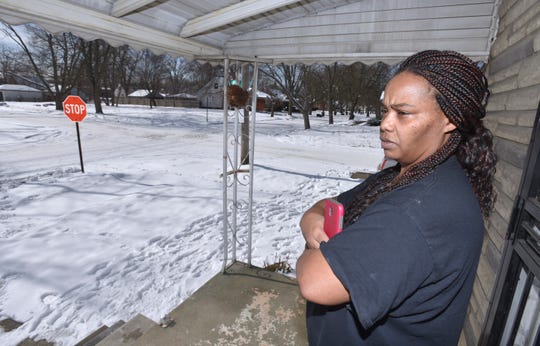
Soil records under scrutiny in Detroit demolitions


Felicia Perry, 42, lives on Rossini at Rex in Detroit,
across the street from at least two vacant lots where
houses were razed and then backfilled.

Detroit — Records detailing what went into the ground at thousands of demolition sites across the city are under scrutiny amid an analysis that's turned up a disjointed process.

University of Michigan doctoral candidate Michael Koscielniak has spent four years conducting an exhaustive review of public records that cast doubt on the integrity of soil records for the city's multi-million-dollar federally funded blight elimination program.

For its part, the city admits the effort got off the ground with a paper-based tracking system before it evolved to online records. But officials contend the dirt used to fill holes left behind from housing demolitions is all accounted for and Koscielniak based his findings on only part of the data.

But Koscielniak asserts the record keeping is a "completely shambolic approach to managing this program — especially one that is transparent."  The demolition effort has paid out close to $177 million in federal funding to take down 11,000 structures since 2014.

"The errors, gaps and inconsistencies in the backfill data — as well as the unclear oversight and monitoring processes — suggest that demolition contractors wield immense authority over the backfill program," said Koscielniak, an Ypsilanti resident and doctoral candidate in urban and regional planning who is working on a dissertation. "They stumbled into a mega project that they had no capacity to manage, and their solution to it was to let contractors figure it out."

The independent researcher's findings heighten growing concern among some city, state and congressional lawmakers over potential environmental contaminants in the dirt following a number of high-profile contractor violations. Officials want to ensure the quality of the dirt going into Detroit's ground isn't harmful to residents.
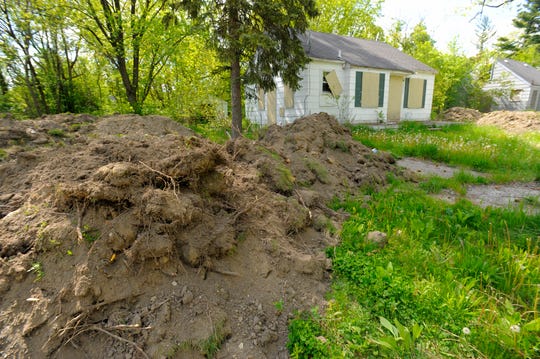
Fresh piled dirt is seen near a vacant home on Faust
 near Constance in Detroit after a demolition on May 18, 2016. 
Under public information requests, Koscielniak obtained copies of an internal contractor portal used to track dirt sources, costs and locations that's maintained by the Detroit Building Authority.


He zeroed in on data for demolitions conducted through July and paid from the federal Hardest Hit Fund, concluding that out of nearly 10,000 listed only about 5,200 had attributed sources through digital record keeping.

Koscielniak's research is the latest cloud over the program at the center of a federal criminal investigation that arose in fall 2015 after concerns were raised over bidding practices and spiraling costs.

Soil worries prompted Detroit City Council's second in command to put out a call for a congressional hearing on demolition in Detroit and comes as one contractor's projects have been halted after it failed to remove potentially hazardous debris at multiple sites before dumping dirt on top.

Officials with the Detroit Building Authority and Detroit Land Bank Authority, which oversee the city's program, argue Koscielniak's research is skewed and maintain their confidence in the records. 
Under Freedom of Information Act requests, they said, he obtained copies of the digital database for soil records. But prior to that, load tickets for dirt were tracked on paper — records Koscielniak did not ask for or obtain, they contend.

"We think the gap is, not that we weren't tracking it, but it wasn't tracked in an online portal that we could send to someone," Brian Farkas, director of special projects for the building authority, told The News. "I'm confident in our records."

Detroit Councilman Andre Spivey said he's concerned to hear of the disconnected record keeping for dirt and wants the city to have tighter reins on the land bank.

"You've got to maintain the integrity of the process," he said. "We're watching, and the federal government is watching as well."

In January, the federal watchdog agency investigating the city's blight elimination effort issued a round of subpoenas to certain contractors, seeking detailed records of where they obtained their dirt, the cost and where it ended up.

In subpoenas dated Jan. 10, the Special Inspector General for the Troubled Asset Relief Program demanded two years' worth of documentation.

Robert Sholars, a spokesman for SIGTARP, declined to say whether Koscielniak's research spurred the investigation, saying "as a general principle, we do not comment on ongoing investigations, including confirming or denying their existence."

Tracking the records

The News last month provided the building authority with 13 addresses from 2014 out of thousands flagged by Koscielniak. Officials produced paper copies for all of them.

According to the load tickets, some of the fill dirt came from an industrial site on Shoemaker on Detroit's east side and a site in Carleton. Other paperwork identifies fill simply as "clay" or has spaces where the source is attributed to a trucking company or left blank, only listing where it was dropped off.

Farkas last week referred to the 13 records pulled at the request of The News as a "spot check" while he faced questioning about contractors and environmental worries during a city council subcommittee session.

Council President Pro Tem Mary Sheffield noted in recent months the tracking system for dirt is more in-depth. The building authority, she said, told council members the independent firm contracted to oversee the process is now verifying the origin of the dirt with aerial checks after documentation is submitted by contractors. Prior to that time, that verification was not taking place, she said.

"You had a period of time where contractors were self-reporting all of these different residential addresses and saying it was residential dirt when it could possibly have not been because there was no oversight," she said. "That's a problem."

Farkas said the city has tracked its soil and dirt on an internal online platform since March 2015. 
A gravel-train semi leaves the Mid Michigan
Crushing & Recycling facility in Highland Park.
Despite that, Koscielniak provided The News with a data set that shows 1,961 Hardest Hit Fund demolitions between March 2015 and June 2018 that weren't accounted for in the backfill portal.


The sites in question, which appear on the city's public demolition database but lack a digital paper trail for the soil, account for $2.9 million in dirt costs among 18 contractors.

Koscielniak also provided The News with more than 100 other records with misspellings and errors, lacking in detail or that list the dirt source and destination as the same site.

The News asked the building authority to reproduce documentation for a dozen of the 2015 demolitions, which based on Farkas' explanation should have been digitized.

In an email, Farkas provided The News with eight of the records located by the department — all paper — out of the 12, citing limited staffing to search. But he stressed confidence the rest would be found.

"This is more a document retrieval issue of records that are four or five years old than it is an issue of whether dirt sources have been verified," Farkas said.

In reference to data suggesting close to 2,000 records submitted after 2015 aren't accounted for in the digital system, Farkas reiterated officials "feel very confident" in protocols in place since 2014 to ensure dirt is safe.

"We see the fact that some records may not be immediately retrievable as a reflection in the record keeping process, not as a reflection of our work in the field to ensure the use of clean dirt," Farkas said in a provided statement.

A handful of contractors have faced penalties between 2017 and 2018 for the use of unapproved backfill at a total of 18 sites, according to the building authority.

Some were issued warnings, others were suspended and another — Detroit-based Glo Wrecking — was issued a stop-work order that remains in effect. The company could not be reached for comment. 
Additionally, in February, another contractor, DMC Consultants, began filling holes with unauthorized dirt. The building authority's online platform flagged officials that the company had exhausted their supply of approved fill.

Farkas declined to specify DMC's dirt source, saying it "doesn't matter."

"All that matters is whether it's been tested and approved, and the DMC dirt used after their approved supply ran out was not," he said.

Farkas said soil sampling is taking place for 37 holes that DMC filled with dirt that had not been approved. Testing will determine whether the soil is unsafe for residential use.

Chicago-based firm McDonagh Demolition was also issued a stop-work order by the building authority in recent weeks after it was discovered that the company had not fully removed demolition debris before adding fill dirt at several sites.

Farkas, during the council's Planning and Economic Development committee session last week, said the company's work is being revoked over the "attempted scheme." It's going to cost McDonagh about $17 million in contracts, he said.

McDonagh called the violation an "isolated issue" that it was taking steps to correct.

Farkas touted the catch as evidence the building authority's controls worked, as intended, saying a field liaison for the building authority discovered the problem.

But Sheffield noted it was later revealed that a former McDonagh employee had acted as a whistle-blower.

The scenario, she said, is a "clear example" that "protocols are not sufficient."

"The pace that they are going, it is hard to have the proper protocols to ensure the health and safety of residents," Sheffield said. "There's too many unknowns for me. Whether it's contaminated or not, it just needs to be clear and verified where the dirt is coming from."

Under the program, the land bank manages the selection and contract awards for demolitions. Oversight is then transferred to the building authority, which has seven field liaisons who monitor all the knockdowns. That's up from two when the program first began, Farkas said. 

What the rules say

The city's Buildings,  Safety Engineering and Environmental Department inspects open holes and final grading.

The state's blight manual outlines requirements for testing and sourcing of fill.

Detroit implemented a new dirt tracking system late last year to better document the dirt being used. The guidelines require the source of dirt, the address it's going to, and size of load by cubic yard or square feet, according to the state.

Previously, contractors were required to provide invoices for dirt, and the land bank maintained load tickets that documented the size of a load and where it was dropped.

"The new protocol requires each contractor to identify source material location and testing evaluation of commercial soil sources in advance of backfilling so as to avoid bad fill material negatively impacting neighborhoods," the U.S. Environmental Protection Agency said in a statement. "The city of Detroit is responsible for identifying dirt sources under its protocol."

Chicago-based McDonagh Demolition was ordered to
 excavate this site in the 13000 block of Maiden Street in
Detroit after it was discovered that that some demolition
materials there had not been properly removed.
Farkas said there are three acceptable soil sources. A residential site or a virgin source, which could be a clay or gravel pit and requires documentation stating its free of debris, concrete or other unsuitable substances. The third category, non-residential, may consist of commercial, road or construction sites but requires laboratory testing and the results must be approved by the building authority. 


"All city, state and federal guidelines must be followed to ensure environmentally safe back fill is being used," the blight manual notes. "This laboratory testing must be maintained in the blight partner office and copies may be requested at any time."

Matt Polizzotto, a soil chemist and associate professor of earth sciences for the University of Oregon, said urban soils can be contaminated in many ways, including from lead paint or past transportation emissions. The level of risk, he said, depends on how the soil had been used.

"I could come up with doomsday scenarios, but those things are pretty unlikely," said Polizzotto, who has expertise in soil contaminants in the environment. "Not having records doesn't allow for really, truly assessing what any risks might be."

'No legal obligation'

Rebecca Camargo, an attorney for several contractors in the program, said none set out to use bad dirt. 
"I don't believe that any of the demolition contractors violated the terms of the contract knowingly, and they all are very committed to keeping Detroit safe," she said.

Camargo said the deadline for turning over backfill documents requested under the SIGTARP subpoena has been extended.

"It's costing all of them thousands of dollars to provide this documentation for something I believe is going to show nothing," she said.

Multiple contractors did not return messages left by The News. Anthony Abela, a project manager for the firms Homrich and 1 Way Service, said by policy, the company does not issue comments to the media.

Mayor Mike Duggan has defended the program's "vigorous" practices in the wake of concern over whether some dirt might have been contaminated.

The mayor, during his Tuesday State of the City speech, noted the city this month entered into contracts for the last of the $275 million in federal dollars for the program.

"For all the noise out there about investigations," said Duggan, the U.S. Treasury and the state "had confidence in us" and "kept money flowing."

The mayor said the program's environmental team has held demolition contractors accountable. In the last five years, he said, four contractors have been terminated for failing to follow protocols.

Tens of thousands of houses have been razed in Detroit with
federal funding over the last five years, leaving
vacant lots like this one in the 15600 block of Rossini. 


"In each case, we made each go back in and fix their mistakes. We did not let a single one slide, and we advise the neighbors to help us," Duggan said. "I won't tell you that we're not ever making mistakes. I will tell you, we find out about them."

The mayor, during his Thursday budget presentation to council, said the all federally funded demolition contracts have been awarded and the program is set to wind down by the end of the fiscal year. From here, he said, the city will look to transition to a city-administered effort.

Meanwhile, the state Department of Environmental Quality said it's "working with the federal agencies investigating the city's demolition program."

The DEQ has not issued any violations or fines related to backfill, and it has not done any soil sampling or auditing, said Scott Dean, a DEQ spokesman.

"An entity obtaining soil for backfill has no legal obligation to test those soils or keep records about the sources," Dean said.

"However, there is a risk that contractors may obtain contaminated soils, either knowingly or unknowingly. It seemed reasonable that this risk would increase with the increased demand for soils. Because of this risk, we advised the city to put safeguards in place to make sure they were only using clean dirt. That was a recommendation, not a legal requirement."

Pushing for testing

Council's Sheffield has referenced media reports that raise the possibility of dirt being used to fill holes that may have been contaminated or from unverified sources, including soils from the recent reconstruction of Interstate 96 in western Wayne County. Program officials insist, however, that use of dirt from the I-96 project was banned from the outset.

In a letter to U.S. Reps. Rashida Tlaib, D-Detroit, and Brenda Lawrence, D-Southfield, the councilwoman noted the program has been "mired in controversy since its inception" and it's led to "anxiety, uncertainty, and a lack of transparency for the community."

Lawrence told The News she's leading an effort to ask the delegation to urge the U.S. Treasury Department to assume oversight of soil testing for Detroit's program.

"My focus right now is on whether the dirt is contaminated," she said. "I'm pushing for immediate testing."

In 2014, the city contracted with the Southfield-based consulting firm Atwell to get the program's environmental monitoring off the ground. By September, AKT Peerless in Detroit was retained to "manage and administer" the backfill program.

Reached via email, Julie Barton, program manager for AKT, deferred comment to the building authority. Farkas said the company has designed testing protocols and the online platform, overseeing its use and implementation.

When asked whether the paper record keeping was adequate, Tammy Daniels, a demolition manager for the land bank, agreed it was a process that needed to change, and it did.

"We migrated away from paper because we, too, feel that computer records offer transparency," she said.

Farkas noted when the federally funded demolition work first began, there was $50 million to draw down and a "serious deadline" that "we had to meet."

A 2013 memorandum of understanding between the state, land bank and city, required 70 percent of the $52.3 million allocated for the program be spent by Oct. 7, 2014. If the land bank was unable to draw down the funding within that time, the dollars could have been redirected to another city or program.

"The system we have today is remarkably different than the one we inherited," he said. "So no, records should always be kept in the most high-tech, digital format. The problem is we just don't have that ability when you are staring down a deadline to spend $50 million."

The Michigan State Housing and Development Authority, which allocates funding for the program under the state's Homeowner Assistance Non-Profit Housing Corp., said it does not oversee how the land bank maintains its filing system.

"What we do require is that file documents be uploaded to our system for audit and review prior to funding every demolition," said Katie Bach, a spokeswoman for MSHDA, in an email. 
Bach further said the state has found no evidence of sloppy record-keeping. MHA, she said, has adequate resources to monitor the backfill program and is confident in how it's operating. Under Hardest Hit Fund rules, MHA is required to retain records for three years after the program ends, she added.

"MHA has staff in place to review every file that DLB is uploading to our system," she said. "We expect accurate documentation and full compliance with all program guidelines. If we find that is not the case, we will consult with U.S. Treasury regarding possible corrective action."

East side resident Felicia Perry has been renting a home on Rossini Drive for about a year. Records show numerous demolitions occurred on her block in 2014 when digital records of the soil source were lacking. The city's paper records attribute the source to a city-based industrial site.

The mother of six, who has a young daughter battling chronic health concerns, said the questions and uncertainty are worrisome.

"I have a three-year-old who is battling every day to stay alive with sickle cell disease. I don't even let her outside," said Perry, 42. "If they put something in the ground that's contaminated, it's got growth in it. It brings poison to kids."

Voting is beautiful, be beautiful ~ vote.©