Showing posts with label Allie Gross. Show all posts

Tuesday, September 3, 2019

How Can One Sue The Wayne County Land Bank When It Never Incorporated?

Here is everything you ever wanted to know about Wayne County's property tax situation.

Realty Transitions is currently being scrutinized by federal investigative entities. 

What was not mentioned in another wonder production from Allie Gross, is the stealin'.

Yes, residents of Detroit lost their homes through tax fraud schemes where someone got a kickback, political campaigns were funded and another foreign investor has conspired in the act of gerrymandering.

If you do not live there, you cannot vote there.

Then, there is the situation of the Court, because the Wayne County Land Bank was supposed to have incorporated in 2009, but failed to do so, which means it is not a public body corporate, which means it has been stealin' the homes from the people of Wayne County, with absolutely no legal recourse, because who are you going to sue when there exists no one to sue, just like the Detroit Land Bank Authority.

Lawsuits take aim at Wayne County's controversial Action Before Auction program


 From a distance, the note tacked on the front door looked like your standard mailer — a political advertisement or a 'totally-amazing-act-now!' credit card deal.

But as Mechelle Burrell's car inched closer to the driveway the significance of the paper sank in.

Burrell's presence was requested in 36th District Court two days later on May 17. She was facing eviction.

On its own this would have been troublesome. Realty Transitions, the stated plaintiff and property owner, wanted Burrell and her two daughters out of their northwest Detroit bungalow — the place they'd called home for the past six years.

The summons, however, was underscored by a remarkable peculiarity: Burrell had never heard of Realty Transitions.

"I didn't even know who these people were," the 36-year-old said on an overcast Monday in August, explaining that up until that spring evening she had been under the impression that her house, 11327 Warwick, was owned by a small scale Canadian real estate investor.

And she was in the process of making it her own. Three years earlier, according to Burrell, she signed a five-year, $31,500 land contract with the investor.

Mechelle Burrell, 36 on the front steps of her Detroit home on Tuesday, August, 20, 2019 holding the legal document that was taped to the front door of the home.

Burrell noticed an envelope taped to her front door and it ended up being a legal document for her to appear in court. She was close to being evicted from a company she never dealt with called Realty Transitions.

Mechelle Burrell, 36 on the front steps of her Detroit home on Tuesday, August, 20, 2019 holding the legal document that was taped to the front door of the home.
Burrell noticed an envelope taped to her front door and it ended up being a legal document for her to appear in court. She was close to being evicted from a company she never dealt with called Realty Transitions. 
Burrell is hoping the court figures this out.
Mechelle Burrell
Burrell is hoping the court figures this out.

“I was speechless,” she continued. "Am I going to lose my house because I didn’t know what was going on? I’ve put so much money into this house."

Action Before Auction program was supposed to save homes
Burrell’s home is one of thousands in Wayne County lost to tax foreclosure over the last two years. It's one of 381, however, that was slotted into the Wayne County Land Bank's short-lived Action Before Auction initiative.

The program, which began in 2017, was pegged as a response to the negative consequences of the annual Wayne County Tax Auction — a process that has been heavily criticized for its devastating impact on residential neighborhoods in and around Detroit. But instead of rectifying problems with the auction — blight, vacancy, speculation and displacement — the program exacerbated these issues. Following a Free Press investigation into these failings, this year's program was cancelled.

Yet, despite the county's pivot, occupants, like Burrell, whose homes got caught in the crosshairs in 2017 and 2018, are finding themselves in a unique position: pushing back against evictions and attempting to lay claim to homes that they say they should have never been kicked out of, based on the program's own rules.

While people like Burrell fight for their homes, housing advocates are questioning how the county can allow these evictions under the Action Before Auction program when the program is under re-evalution.

More: Wayne County's auction program is supposed to keep people in homes. It's not.

More: Wayne County's controversial Action Before Auction program canceled for 2019

"Wayne County has tacitly admitted the program's failure to meet its stated objectives by apparently discontinuing it this year," said Joe McGuire an attorney at Michigan Legal Services who has represented five individuals who have been displaced by the Wayne County Land Bank's program.

"Which is why," he continued, "it is so outrageous that Wayne County is still allowing investors who have already purchased properties through the program to evict longtime residents."

The number of people in same situation is ultimately difficult to track, however.

McGuire, who is representing Burrell is currently suing the Wayne County Land Bank and Realty Transition, alleging that the evictions are invalid because the two parties are not honoring their contract — which dictates the rules of the program, and how occupants of selected homes are supposed to be given the opportunity to stay.

"Wayne County claimed it started this program to stop residents from being evicted from their homes by investors who bought their properties out from under them after property tax foreclosure. But in many cases, the program has not only not stopped this from happening but it has facilitated it and made it cheaper for investors, even when doing so violates their own rules in the contracts that they wrote," said McGuire.

Under the Action Before Auction program, which began in 2017, developers chosen by the land bank selected tax foreclosed properties around the county that they were interested in procuring. The Wayne County Land Bank then submitted a list of these properties to the Wayne County Board of Commissioners who pulled the properties using Right of Refusal, a provision that lets government entities snag a foreclosed parcel before the public sale.

These were then sold to the developers. If properties were occupied, developers were supposed to check the "eligibility" of the occupant — a list of criteria created by the Wayne County Land Bank — to see whether the occupant could buy back (at a premium) the property.

The county pulled 141 properties for the program during its first year in 2017 and 240 in 2018.

Investors favored over homeowners <=== because investors contribute to political campaigns.

As the Free Press previously reported, internal documents, emails with the Wayne County Land Bank, and interviews with occupants from both years of the program highlighted four trends: few occupants had a real shot at reclaiming their homes; developers, like Realty Transition, were being sold properties for pennies on the dollar and making significant profits; the Wayne County Land Bank was giving developers remarkable flexibility within the program; there was little-understood financial benefit for the county.

The house Burrell lives in was one of 63 properties Realty Transitions purchased from the Wayne County Land Bank in 2018. The organization is owned by Shady Awad, who was the subject of an FBI investigation this past spring revolving around the City of Taylor's use of the Right of Refusal.

Realty Transition has contracts with several municipalities in the region to purchase homes using RoR.

In the second year of the Action Before Auction program, the Wayne County Land Bank slotted homes into two different tracks. Track A was supposed to be "occupied" homes and Track B was "occupied and unoccupied homes." The stipulations and requirements to prove eligibility were more lax under Track B. What complicates this, however, is homes were placed in tracks without checking first on occupancy.

Burrell's home, where she's lived since 2013, was placed in Track B.

Under Track B, an "eligible occupant" can fit under two categories.

First, they could be an "eligible prior owner," which means the person, or family member, owned the property prior to foreclosure; electric utilities were paid on the property for six-plus months before foreclosure; the property doesn’t carry a mortgage over $5,000 — or if it did the developer could charge the occupant what would have been the remainder of the mortgage debt.

Second, they could be an “eligible renter,” which was defined as any person living on the property who paid rent for 6-plus months prior to foreclosure under a lease agreement.

Under both categories, the Wayne County Land Bank stated that there could be no evidence of intentional fraud tied to the property.

While Burrell's occupancy — rental contract and land contract — should have made this an easy process. She never had the opportunity to prove eligibility.

Burrell contends that the May notice — nine months after Realty Transition got the deed — was the first she heard of the company.

“I was not aware that my home had been foreclosed on for delinquent property taxes until I was brought to court by Realty Transition, LLC on May 17, 2019. I was not aware that my home had been sold to Wayne County Land Bank Corporation, or Realty Transition, LLC,” she wrote in an affidavit a May 22 affidavit.

"To my knowledge, no one from the Wayne County Land Bank Corporation or Realty Transition LLC has ever visited my home," she continued.

The Free Press made several attempts to reach representatives from Realty Transitions and the Wayne County Land Bank, but they did not respond.

In a May 29 email to McGuire, however, Melissa Palepu, the land bank's attorney, stated that the land bank "knocked on the door at the beginning of the program" and an individual answered and gave a phone number but no other information.

"The occupant was provided with a flyer with some contact information and told to please reach out. The occupant did not reach out to the Land Bank and from my understanding did not reach out to the participant," Palepu wrote.

“What happened here," she wrote, "is no occupant reached out to either the Land Bank or the Participant by the deadline or at all and therefore the Participant requested the property be certified as containing no Eligible Occupant."

While McGuire is wary of the fact that all the onus around eligibility was placed on the occupant, he is also skeptical of the entire description of what happened.

"The standardized process that this program was supposed to impose on these purchases was thrown away and really each case has been different," said McGuire who believes the willy-nilly nature in which rules within the Action Before Auction program were followed in fact exacerbated the problems it claimed to be fixing.

"Each investor is different," he continued. "The approach to each occupant seems to be different. The requirements imposed on occupants. The way they’ve been contacted," he said. "So, far from correcting the chaos of the auction, it seems to have really replicated it."

The fight to save her home

The night Burrell got the notice, she remembers sitting with her mother and younger sister on their porch — where they'd spent many evenings chatting and catching up. It was hot and Burrell had just had a long day at work attending to patients at a suburban doctor's office where she's a medical assistant. But despite the distractions and exhaustion, the court notice sent a jolt through her system. She was focused and scared.

"Do you have all your paper work?" she remembers her mom asking. "You have to have your paper work."

She did. But it was also confusing. And who were these people? None of it seemed to make sense.

"People have been doing this to people for years. But why me? I signed a land contract," she said, adding that had she known the house had delinquent taxes — $2,513 was needed to redeem it — she would have made efforts to save it.

"I could have gotten my kids and moved, or I could have bought the house myself," she said. "I put a lot of money into the house."

The Burrell case — one of several that's made its way through the legal system as a result of the Action Before Auction program — highlight the chaos of the program, as well as the auction process it was attempting to rectify.

More so, however, it underscores Detroit's dysfunctional housing market — a market that despite rocket-high prices in certain up-and-coming neighborhoods, never fully recovered from the mortgage crisis. And, in fact, is still grappling with residual effects of the housing meltdown. Specifically the impact of bulk buyers — who have taken advantage of the cheap real estate available via the mortgage crisis and now the tax crisis, and have capitalized on exploitative tools like land contracts when negotiating deals in neighborhoods where mortgage companies won't lend.

What is amply clear: confusion reigns. In many ways, before 11327 Warwick was foreclosed, it was battling the odds.

A look at the chain of title highlights the chaos that transpired — but also how these seemingly different housing problems and solutions are all inter-related.

According to property records, the home was bought in 1999 by a married couple who took out a $67,700 mortgage for the purchase. Over the course of the next 12 years the couple refinanced the home twice, taking on subprime adjustable rate mortgages — the loans at the heart of the mortgage crisis.

In June 2013, the couple sold the home for $7,000 to Rai. A month later the couple was discharged from the Mortgage Electronic Registration System. According to Joshua Akers, an assistant professor of geography and urban and regional studies at the University of Michigan-Dearborn, this sequence of events — coupled with the low sale price — indicates the sale was like a short-sale.

From here, the trajectory of the house gets confusing. And since rental and land contracts don't have to filed anywhere, keeping track of the transactions can be difficult.

According to Burrell in August 2013 she moved into the house paying $500 a month.

A rental contact she provided to the Free Press between her and Rai's LLC — Reasonable Rent — has two dates on it February 2014 and May 2015.

The land contract, which has no signatures on it, is dated April 2016. It details a plan to sell, over time, the house to Burrell for $31,500 — paying $1500 upfront and then $525 a month over five-years.

In terms of tax responsibility the contract is vague. It says the buyer — Burrell — would be responsible. However, if taxes aren't paid the seller can pay them and tack the fees onto the monthly payments, or view non-payment of taxes as breaking the contract.

These fuzzy lines alone could raise some questions about accountability and responsibility, however, before they even come into play there is a bigger issue: While Burrell said she had been paying the land contract fees each month until May — when she got the court summons — the investor, Harvinder Rai, said he has never received any payment.

In a late August phone interview, Rai explained that in 2013 he attempted to purchased 10 homes in Detroit. Since he was in Canada he contacted a realtor, Stacy Williams. In the end, he claims a middle man never paid him back or got any of the rent owed. He was under the impression that man has since died.

Rai contends he never received any of Burrell's money.

The Free Press researched a half dozen phone numbers associated with the man Raj named as his contact, but all were disconnected.

The confusion here can be boiled down, according to Akers, to three trends in a post-mortgage housing market: An out of state bulk buyer, using a finicky tool like a land contract and relying on parasitic middle men to facilitate the transactions.

 All of the incumbent issues and pressures that people like Burrell face are driven in part by the ability of these large scale buyers to buy cheaply. It’s one of the reasons the city haslost population but the eviction rate remains the same.

On Wednesday, online bidding is set to begin for the Wayne County Tax Auction. The initiative Action Before Auction was supposed to fix.

Less than 3,000 properties will be part of the auction — a dramatic decrease from 2015 when 28,000 were up for sale.

Of the properties for sale this year an estimated 521 are occupied, according to Mario Morrow a spokesperson for Wayne County Treasurer Eric Sabree. What will happen to these individual property owners is unknown. Historically, the results have been displacement or finicky land contracts.

For Burrell, whose home was supposed to be saved from such an outcome, this irony is not lost on her. As she awaits the next court date she reflects on what attracted her to Warwick to begin with.

“It was the neighborhood,” she said. “It was the fact that the house was a brick home. It was the fact that you can tell everyone on this block, they own their homes. It’s really quiet, it’s family oriented. My neighbors are great. The house has brand new windows. The house is really, really cute. It’s good enough for me and my two children.”

Voting is beautiful, be beautiful ~ vote.©

Thursday, November 29, 2018

More Corporate Shape Shifters: Another Set Of LLCs Stealin' Detroit Properties From The Poors

Much love to Allie Gross for another fabulous piece of reporting.

She should interview Bert Johnson when he gets out of prison for the holidays to get more, detailed information on how these fake land contracts and fake LLCs were stealin'.

I believe he is a subject matter expert.

Oh, and so is Adam Hollier.

Detroit land owner Michael G. Kelly sued over 'predatory' contracts

A lawsuit filed in federal court this week takes aim at Michael G. Kelly, one of the top landowners in Detroit, over contracts for housing that the suit calls "predatory."

The suit filed Monday by Mantese Honigman and Michigan Legal Services seeks class-action status and alleges that Kelly and four other defendants lured unassuming and vulnerable Detroiters into a "real estate bait and switch" in violation of the Truth in Lending Act and the Home Ownership Equity Protection Act.

At the crux of the complaint is the use by Kelly — and the various LLCs associated with him such as Detroit Property Exchange — of contracts that seem to operate outside of federal regulations, contracts Joe McGuire, an attorney at Michigan Legal Services who focuses on housing issues in Detroit, says are actually land contracts, which would have some consumer protections.

"The question that this litigation raises," said McGuire, "is can a property like Detroit Property Exchange get around the regulations that were passed by Congress specifically to address predatory lending, like this, simply by renaming the agreement to something other than land contract?" 
The Detroit Free Press reached out to Kelly for comment via the Detroit Property Exchange but did not hear back.

Land contracts are  popular home-buying tools in Detroit where mortgages have historically been hard to come by. They often operate in a nebulous legal space and leave little protections for buyers (called vendees). They also often result in evictions.

But, according to McGuire, a general land contract pales in comparison to the  vague and confusing agreements Kelly uses in his land deals.

"Often, when people hear about land contracts, if all they're used to is your conventional mortgage, they are struck by how much worse a land contract is in the way it's written," McGuire said. "They balk at the idea that you only get your deed when it's paid all off, and that there is no appraisal required, no inspection in the law. But these agreements (used by Kelly) make land contracts look amazing."

According to the complaint filed in U.S. District Court for the Eastern District of Michigan, the deals would work like this: 
  • Kelly (or one of his companies) would purchase homes, often sight unseen, at the Wayne County Tax auction for a low price. The homes are usually dilapidated. 
  • After attracting a potential buyer, Kelly (or one of his companies) would have them sign an "ambiguous, opaque contract" with a high interest rate. 
  • Under the contract, the purchaser would be under the impression that after several years of payments they would own the property, and that in the interim, as the future owner, they would be responsible for fixing up the property.
  • When the buyer "inevitably" got behind on payments "due to their general lack of an ability to pay back the loan," Kelly (or one of his companies) would evict the purchaser as a tenant, rather than a land contract vendee, who would have more time to catch up on payments before being evicted.
  • The tenant's eviction would go unquestioned because of the contract's "intentional use of ambiguous, confusing, cherry-picked language." Adding to the chaos is the fact that purchasers would have typically signed two documents when committing to the property: a "Lease with Option" and "Real Estate Purchase Agreement." One makes the customer a tenant; the other makes them a purchaser — together they created confusion. 
  • Once the "purchaser" had been evicted, the complaint alleged that the scheme would begin again with a new potential buyer.
While the complaint states the deals were predicated on buyers never actually getting the property, a land contract-like agreement was used instead of a rental agreement because it was more lucrative for the defendants.

Michigan law prohibits landlords from collecting a security deposit greater than 1.5 times the monthly rent, but the seller of a land contract can ask for a "nonrefundable down payment" at a cost far greater to the purchaser.

"Defendant sold plaintiffs and the class members home ownership but evicted them as tenants," the complaint said, noting that Detroit Property Exchange, one of Kelly's businesses, has a ratio of 1.49 "evictions" for every property in their portfolio.

Ultimately, according to the complaint, the contracts acted as "high-cost mortgages" and served to originate loans (the monthly bills "buyers" received often had "loan numbers" on them).

Because of this, the complaint states, the Truth in Lending Act — a 1968 federal law aiming to protect consumers in dealings with lenders and creditors — and the Home Ownership Equity Protection Act — a 1994 amendment to the Truth in Lending Act that tackles abusive practices with high-interest rates — should apply.

And because many of the potential buyers could not reasonably make the monthly "rent-to-own" payments — and no consumer financial data was reasonably collected or analyzed — the complaint states the land contracts were ultimately predatory.

The four other defendants are  entities Kelly uses for his land contract business — Detroit Property Exchange, Suena Homes Realty LLC and Homes of Detroit LLC — and Crystian Segura, a licensed real estate agent and property manager for a Kelly real estate company.

The representative plaintiffs are Natalie James, Jerome Day and Carl Austin. All three entered into contracts with the defendants. The complaint seeks class-action certification and the plaintiffs are requesting a jury trial.

A costly route to home ownership

In the United States, land contracts — also known as a contract for deed — were popularized between the 1930s and 1960s as a tool for African-Americans who were prevented from accessing traditional mortgage loans to buy homes.

It is estimated that in Chicago during the 1950s, 85 percent of properties bought by African-Americans were purchased using land contracts.

While land contracts have ebbed in popularity over the decades, especially following the subprime foreclosure crisis that placed constrictions on mortgage lending, they've seen a resurgence as a tool for individuals who cannot obtain conventional home financing.

This is particularly the case in Detroit, but how many have been issued over the years is not known because Michigan law does not require land contracts to be filed with any governmental entity.

"Land contracts can be so pernicious — there is no filing requirement, there is just no regulation on them," Peter Hammer, director of the Damon J. Keith Center for Civil Rights at Wayne State University Law School, said this summer for an article on property speculation in Detroit.

"They can just exist in this completely private space."

Under typical land contracts, the seller holds the deed to the property until the contract — a certain purchase price at an interest rate over a series of years — has been fulfilled. Despite not having a legal title to the house, the buyer, or vendee, is typically obligated to pay property taxes, obtain homeowners insurance and make repairs.

Language within land contracts varies, but it typically includes, as explained in the complaint, vague wording that favors the seller.

"If the buyer defaults during the term of years, the contract usually purports to allow the seller to cancel (or "forfeit") the land contract, keep all payments made by the buyer and evict the buyer through a forfeiture proceeding," the complaint explains.

Land contract forfeiture actions give a vendee 90 days to repay what is owed (180 days if they've already paid 50 percent of the purchase price by the time the case goes to court).

But Kelly has treated the agreements he has made as tenant-evictions, the complaint states, which give tenants only 10 days to pay what is owed.

Ultimately, the complaint states, the agreements — despite their names — are land contracts. 
"The reason that these are land contracts, despite the fact that they slapped a different name on top of it," McGuire said, "is they operate exactly like land contracts."

He said that   following the housing crisis, regulations were passed  targeting land contracts.

As a reaction, those utilizing them began to call them something else.

“It’s pretty common knowledge that this is what drove a lot of these companies that were former land contract sellers to instead start calling these contracts 'lease with option to buy' or 'rent to own' instead of land contracts,” McGuire said.

But, he added, "if you look at the paperwork Detroit Property Exchange gives these customers, they have amortization schedules, they have statements that refer to a loan number, they have (an) interest rate and how it’s being applied to the purchase price; they even in one case ... gave the customer the required IRS form for writing off mortgage interest on income taxes," said McGuire.

"Everything they're giving the customer gives them the impression that they're buying property," McQuire continued. "And ... from what I've heard, when the customer is going in, the agreements are referred to as land contracts. You're told you're buying a property."

They therefore should be subject to federal consumer protection laws that require certain disclosures and evaluations around a customer's ability to repay the loan, the complaint states.

Exploiting buyers

"For buyers, the land contract represents an opportunity to own their homes," Josh Akers, assistant professor of Geography and Urban Regional Studies at the University of Michigan-Dearborn, and Eric Seymour, a postdoctoral research assistant at Brown University, wrote in a 2018 paper on land contracts that the complaint cites. "For unscrupulous agents, it is an opportunity to profit through exploitation and eviction."

In 2017, efforts to regulate land contracts never came to be, according to Lorray Brown, co-director of the Michigan Law Poverty Program, who was working on draft legislation.

"The draft legislation never made it out of the work-group meetings" as there was a lot of opposition "from the industry folks," Brown said this summer, noting that she has seen a number of private investors purchasing uninhabitable and dilapidated foreclosed homes and selling them to consumers under land contracts.

"These land contracts are predatory because they are set up to fail," she said, explaining that the contracts often require consumers to take on all of the obligations of a homeowner with none of the rights.

"The terms of the contract require the consumer to fix up the property within a reasonable time. Then there is usually a provision that says if the consumer fails to comply with any of the provisions, the contract will convert to a month-to-month tenancy and the seller will terminate the contract. The seller then takes back the property through eviction and the consumer loses all of the money invested in repairing the property," Brown wrote.

NameCompanyPipelineProperties
John HantzHantz FarmsTax Foreclosure1,941
Manuel MorounVariousTax Foreclosure1,208
Melvin WashingtonVariousGovernment665
Michael KellyVariousTax Foreclosure534
Dennis ElliottAsset Managers DirectREO391
Matthew TatarianVariousTax Foreclosure344
Bert Dearing Jr.VariousTax Foreclosure304
Stephen HagermanBrick Homes, Unique Homes, OtherREO207
Leslie CoxonHome Source DetroitREO177

Kelly, according to Akers, is one of the more "sophisticated" speculators working in Detroit. 
"He's not just engaged in a single practice like the one called out here in the complaint, but he also purchases vacant land near potential development sites, he finds wrinkles in land records. He's notorious for purchasing parcels within parcels in the land auction," Akers said, pointing to a 2011 Detroit News article that detailed this unusual practice where Kelly has been known to find anomalies in the tax auction — single parcels within a business's larger footprint — and then scooping them up with the intention of selling them back to the buisness at a premium. He notably did this in 2006 with a parcel within a strip club's parking lot. He bought the land for just over $1,000 and sold it back to the club for $19,000.

Today, Akers said Kelly owns roughly 500 properties in Detroit. At the peak of his two-decades of buying properties in the Wayne County Tax Auction, Kelly had more than 1,150 parcels, according to the complaint.

"He's one of the earliest and most recurring characters in the auction showing up in person for days with a team of people going back and forth looking over things and just acquiring lots of properties," said Akers.

Voting is beautiful, be beautiful ~ vote.©

Friday, August 17, 2018

This Is What Means To Be Keeper Of The Record - Detroit Free Press, Wayne County Deeds & The Quantum Renaissance Of Detroit Civil Rights

This is an extremely, very well constructed and written journalism.

This is the quality of reporting that is worthy of the title of keeper of the record.

This is Pulitzer Prize level writing.

This is devoid of poverty shaming.

This demonstrates a mastery of the subject matter.

Proper locations were noted, with, I must direct attention to, Google Maps interactives, visual histograms, timelines, balanced interviews and narratives with principle authorities and original sources, like neighbors, homeowners, victims, elected and authoritative officials representing Wayne County, Wayne State University and University of Michigan-Dearborn, all in District.

[I went to all those schools. (snicker) I wonder what they said about me.]

The use of public resources, the likes of corporate filings and County Register of Deeds recordings, laid out another wonderful visual for one to follow through the chain of command in ownership, whether broken or distorted as a corporate shape shifter.

I found much joy with the use of the Limited Liability Company as a cursory working model of real property schemes.

This is "submission of evidence" worthy.

Now, this is the point where I must interject by throwing my two cents into the mix.

I believe I have previously covered this, but currently, I am so moved by this cogently documented moment of Detroit history, I shall reiterate one of my favorite tales of the Corporate Shape Shifters.

(The names of the LLC's have been changed to protect my future claims.)

Once upon a time, there was a LLC in Idaho named ABC Properties which was listed on a Quit Claim Deed for 123 Elm St. in Wayne County Register of Deeds.

The ABC Properties took out a mortgage on 123 Elm St. and defaulted, where it ended up at the Wayne County Sheriff's sale.

Waiting in the auditorium for the Wayne County auction, 123 Elm St. was never called to auction.

Then, a new Quit Claim Deed magically appears in the Wayne County Register of Deeds as ABC Properties, LLC, registered as a domestic, or perhaps as seen in some instances as a foreign entity, in the State of Michigan, where another mortgage is taken out on 123 Elm St.

Some time later, the Detroit Land Bank Authority swoops in to file a Quiet Title action, wiping out all outstanding liens, mortgages and taxes, only to sell it to another LLC, in the same, exact "switch-o-change-o" out of state/in state Corporate Shape Shifter fraud scheme.

But, since there was no mention the Detroit Land Bank Authority, I am going to giddily assume that it is recognized as never existing, so I am not going there.

Thank you, Allie.  You are a burst of brilliant reality to your profession.  This report is bad ass.

Time to step your games up, keepers of the record.

I want this stuff blockchained.

Detroit real estate game creates chaos in neighborhoods


PROPERTY SPECULATION BRINGS DYSFUNCTION TO DETROIT'S HOUSING MARKET, EXACERBATING BLIGHT AND INSTABILITY IN THE NEIGHBORHOODS.


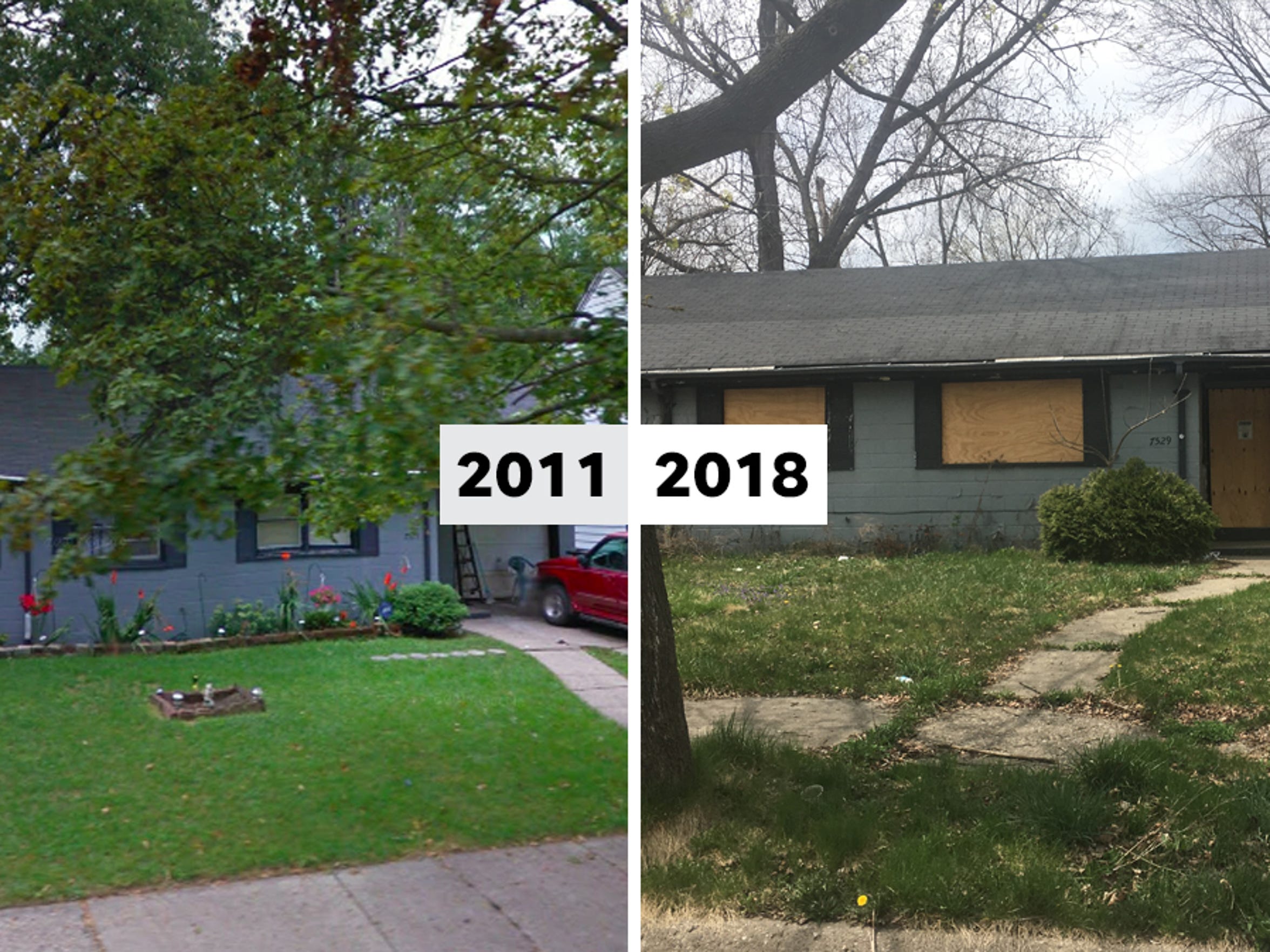
Felicia Anderson shook her head as she looked at an outdated photo of 17529 Kentfield.
The gray, ranch-style bungalow was visible from the 59-year-old’s bedroom window. She saw it every day. But it had been years since she glimpsed at it as it once was: well-kept and thoughtfully trimmed. A home.

“Eli took care of it. Inside and out,” Anderson said as she looked at the Google Street View image from 2013, back when Eli Brown, her sister’s ex, lived in the northwest Detroit house. “He kept it up.” 
This house is at 17529 Kentfield St. in Detroit.


It's easy to write off such conditions as a thing of Detroit's past. A so-called pre-renaissance problem.

The aftermath of Detroit’s economic downturn. A byproduct of middle-class flight from the city, disinvestment and the subprime mortgage crisis.

The chain of title on Kentfield, however, highlights a more recent and concrete undoing. First, cash-poor Detroiters lose their homes in the annual Wayne County tax foreclosure auction. Then, hands-off speculators swoop in and either "rent" the houses back to those who lost them, using predatory schemes that often lead to evictions and cycles of instability, or, as is more common, the speculators just sit on them.

The end result:
  • Blocks of homes rot as investors wait for a fabled payout.
  • Home values for Detroiters in the neighborhoods plummet.
  • A dysfunctional housing market is created where one home can fetch anything from $500 to $51,000 — with no consistency or logic.
There are no clear winners. Just chaos.

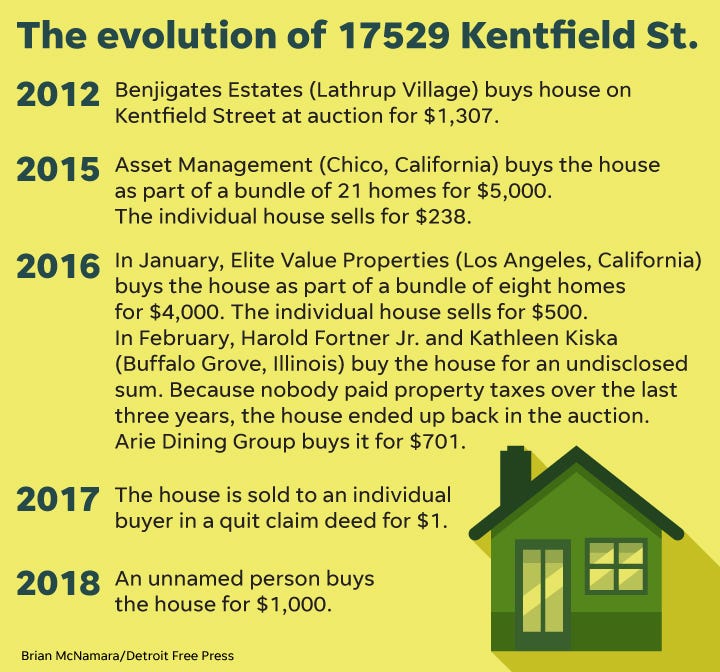
Kentfield exemplifies this trend: From 2012 — when Brown lost the house to tax foreclosure and then signed a rent-to-own land contract before eventually being evicted — to present day, 17529 Kentfield swapped hands eight times. In those six years, it landed in the portfolios of speculators in California and Illinois and even back in the tax auction in 2016.

With each transaction, passing year and repackaging of the property —  the home was often bundled with others — the house deteriorated. Its value declined.

Kentfield is one 23 properties the Detroit Free Press studied this past spring to better understand property speculation and its impact on Detroit neighborhoods. To come up with a sample group, the Free Press focused on one out-of-state speculator — Los Angeles LLC Elite Value Properties — and tracked the properties in its portfolio. The study revealed a complex system in which homes swapped hands in various bundles and newfangled arrangements with the ease and familiarity one normally associates with balancing a checkbook or filling up a tank of gas.


Of the group, 20 were lost to tax foreclosure in 2012 and three in 2013.

While 78 percent of the properties appeared to be occupied in 2011, according to an analysis of Google Map images, 78 percent were either abandoned, demolished or burned down this spring when the Free Press visited the properties.

Additionally, of the 23 homes, 60 percent ended up back in the auction because none of the speculators paid property taxes on the houses they purchased. (Homes are foreclosed and placed in the auction after three years of unpaid property taxes.)

While the auction — which is required by law — is billed as a tool to reactivate abandoned spaces and recoup revenue, the opposite happened to this set of homes.  

See the houses and details of transactions by clicking on the map below:
"The Wayne County Tax Foreclosure Auction is one of the greatest destabilizing forces in Detroit," said Joshua Akers, assistant professor of Geography and Urban and Regional Studies at the University of Michigan-Dearborn, who in 2016 launched the website Property Praxis to document speculation in the city.

"The auction is the perfect way to gamble. If a bet doesn't pay off in three years, all you lost is the initial purchase price," he continued. "At least that's the speculative perspective. There is a much higher cost for the neighborhoods."

According to Akers, the Free Press study and his own research underscore an often-ignored truth: Blight is an active process caused by people, policies and economic interests, rather than the passive phenomenon it’s often made out to be.

“We often think of decline as a slow process," he said. "But what’s actually happening is people and agents engaging in different practices like speculation that contribute to the decay we see."

Back by Kentfield Street, this is hard to ignore. Loved and cared-for homes — tended to as recently as 2013 — are now not only empty but liabilitiesfor neighborhoods.

“I don’t want to live across the street from another abandoned house,” Anderson said with a sigh, pointing to the half-dozen neglected nooks and recently demolished plots that surrounded the home she rents. 

A closer look at speculation

Land speculation is not unique to Detroit.

"It would be difficult to overemphasize the importance of land greed in American history," historian R. Kent Newmyer wrote in 2007, pointing to the fact that for "the better part of two centuries" the idea of "cheap land" attracted millions of immigrants to the country — specifically those traveling west in pursuit of Manifest Destiny.  <=== Oh, no, she did not go there!!!

"It was fought over by the rich and powerful to see who could get the most and the best. It was fought for by the poor, who wanted a little piece of the action and who, unlike the large buyers and sellers, were willing to put their lives on the line to get it."

Detroit today is just a new manifestation of a long American pursuit. What makes the city remarkable, however, is the sheer number of homes available. In 2007, the height of the mortgage meltdown, 5 percent of Detroit's homes were repossessed — the highest rate in the nation. Between 2002 and 2016, 143,958 properties landed in the tax auction.

The elevated numbers, cheap prices and the ease by which homes can be purchased — with the click of a mouse via the online auction — have conspired to create a chaotic reality.

Between 2005 and 2015, speculative investors accounted for 90 percent of all purchases in the Wayne County Tax Auction, according to Akers and Eric Seymour, a postdoctoral research assistant at Brown University who co-authored a 2016 paper on the consequences of speculative bulk buying.


To conduct their study, the duo defined speculator as: A person (or LLC) with three or more parcels in an area in which the owner does not have a taxable address; a person with a large number of parcels in varying conditions and disuse; a person with a single vacant or abandoned property but with an out­-of-­state or international address; a person with a residential property that serves as a taxable address for multiple owners with three or more holdings in the city.

Akers said he has since reassessed the definition and changed the first and last requirement to a person with five or more properties. It has not made a drastic difference, as roughly 40 percent of the properties purchased between 2005 and 2015 were by bulk buyers of 50 or more properties.

While most people, according to Akers, like to focus on the visual consequences of a neighborhood's decline, the instigators — speculative investors engaging in a steady and continuous swapping of capital and titles — often go under the radar.

“What looks to us like a slow decay of vacant and abandoned property that’s static is actually moving quite quickly in financial markets around the world. Capital is changing hands all the time, titles are changing hands all the time,” Akers told Michigan Radio in a 2016 interview. “The friction from that, the outcome of that are the conditions we see in the city.”

And those outcomes, according to Akers, manifest in two forms: vacant properties left to sit fallow, and/or predatory rent-to-own land contracts in which the prospective buyer has a high likelihood of eventual eviction.

While 18 of the 23 homes that the Free Press tracked are currently empty — the first option — many, at some point, fell victim to the latter. 

The trouble with land contracts

Eighteen of the 23  were originally purchased in the foreclosure auction by Benjigates Estates, a local real estate company that has since shuttered but utilized the land-contract model.

Benjigatesbought thousands of properties in the auction and then "sold" them — often to former owners — with rent-to-own land contracts in which  the renter would be responsible for paying both monthly payments (often referred to as rent) and the property taxes.

In a 2013 profile in Crain's, Benjigates' principals explained that because of the "market," they couldn't afford to pay taxes while also offering "prices feasible to low-income buyers."

For this reason, the principals explained, the company set contract periods of a year or a year and a half and once the buyerhad paid in full, gaining possession of a home's title, he or she had two years to pay the current and back taxes owed before the house went into foreclosure.


Nearly half of the homes Benjigates purchased were occupied, Antoine Hayes, Keith Hudson and Eugene Broadway, Benjigates' principals, explained.

The Free Press attempted to reach Benjigates via the company's Facebook page but did not hear back. The organization dissolved in 2016 following a court order, according to the Michigan Department of Licensing and Regulatory Affairs.

While the arrangement could be problematic for many buyers who already had lost their homes because of cash-flow problems, it had another complication.

Land contracts — a popular home buying tool in Detroit where mortgages have historically been hard to come by — have little protections for buyers.

"Land contracts can be so pernicious there is no filing requirement, there is just no regulation on them," explained Peter Hammer, director of the Damon J. Keith Center for Civil Rights at Wayne State University Law School. "They can just exist in this completely private space, and almost no accountability for them."

While in 2017 there were efforts to draft legislation that would regulate land contracts, it never came to be, according to Lorray Brown, co-director of the Michigan Law Poverty Program, who was working on the provision.

"The draft legislation never made it out of the work-group meetings as there were a lot of oppositions from the industry folks," Brown wrote in an email this week, noting that she's seen a number of private investors purchasing uninhabitable and dilapidated foreclosed homes and selling them to consumers under land contracts.

"These land contracts are predatory because they are set up to fail," she wrote, explaining that the contracts often require consumers to take on all of the obligations of a homeowner with none of the rights.

"The terms of the contract require the consumer to fix up the property within a reasonable time. Then there is usually a provision that says if the consumer fails to comply with any of the provisions, the contract will convert to a month-to-month tenancy and the seller will terminate the contract. The seller then takes back the property through eviction and the consumer loses all of the money invested in repairing the property," Brown wrote.

This could be seen in the history of the house on Kentfield.

In 2012, Benjigates purchased the home at the tax auction for $1,350 (that year, the company bought 442 properties at auction, 129 of which they scored for the minimum bid of $500). Benjigates offered to sell Kentfield back to Eli Brown with a rent-to-own land contract. Brown agreed. But in July 2014, before he regained the title, he was evicted over an outstanding debt of $3,100 — a 129-percent increase in what Benjigates paid for the house at auction.

A year later — before the house could go back to auction for a lack of property tax payments — Benjigatessold the house to a company in Chico, California, in a bundle of 21 houses for the price of $5,000, or $238 per house.

At this point, the house's trajectory took a turn and went down the other path Akers describes: vacancy.

According to a 2015 report by Loveland Technologies, a data and mapping service, almost 1 in 6 of the occupied homes in the 2014 tax auction was vacant by fall 2015. Of those empty homes, 180 were considered demolition candidates. In short: Homes that were once occupied by people now not only sit empty but are considered dangerous eyesores.

"You have this auction, which was designed to either buttress the property market or get property taxes to produce revenue, but at the end of the day, it has actually further undermined both the effort to get public revenue and also to re-establish a property market because you have all these speculators and other people coming in just snatching up properties not out of need but on a belief that this market will somehow come back," said Hammer.

He pointed out that sale prices are often dictated by comparable home sale prices, a neighborhood, or schools in an area — but in the case of much of Detroit, they're often determined by arbitrary factors like the taxes owed.

"It hasn’t come back for most of the city," Hammer continued. "And therefore speculators can’t generate revenue. They’re not renting it necessarily. They’re not paying their taxes. And these properties just go through this cycle."

One buyer, 23 houses, little profit

William Joseph Whitaker has never been to 17529 Kentfield, but for one month in 2016, the Los Angeles resident owned it.

Benjigates  may highlight the rental path for a speculator, but Whitaker — the man behind Elite Value Properties — showcases the other trajectory: houses that just sit there.

In the fall of 2015, Whitaker traveled to Indianapolis for a two-day “field training” on property rentals with real estate guru Aaron Adams.

"We feel like US rental properties is the BEST investment you can use to create cash flow for your retirement," Adam’s company, Alpine Management, opined on its website at the time.

Whitaker didn’t need much convincing. He created his LLC at the seminar and purchased two homes from Adams that week. Upon returning to his own apartment in Los Angeles, a friend encouraged the then-50-year-old to scope out Detroit. It was, he remembers the friend saying, "hot."

He linked up with Dennis Elliott, one of the top owners of real estate in Detroit, who is behind Diversified Investment and Asset Management, two Chico, California-based LLCs.

Elliott had purchased several homes from Benjigates in December 2015, and in January 2016, Whitaker threw down just under $15,000 to buy the 22 houses from Elliott’s two LLCs and one from an LLC based in Jackson, Wyoming, according to the Wayne County Register of Deeds.

“I bought the properties for pennies on the dollar. I thought it was a good deal," he said.

In reality, they were mostly, he said, dumps.

"One had a tree growing inside. I bought them sight unseen,” Whitaker said by phone in January.
A month after his purchase, and realizing he was in over his head, Whitaker sold 20 of the 23 properties.

Kentfield was sold to a man and woman in Illinois, who bought 14 of the properties from Whitaker. The rest went to people in California, Tennessee and England.

The three remaining houses were in better shape, so Whitaker held on to them.

The home at 18906 Moross was eventually sold in June 2018 to a woman in Sugarland, Texas, for $14,500. The home at 12569 Glenfield was listed in January for $4,500 — with a memorable Zillow ad that noted a "friendly squatter" may be living inside. It ultimately fetched $2,500 in May — sold to a man in Maricopa, Arizona. The home at 21506 Orchard sold in December 2017 for $14,250. It was the only one of Whitaker's homes that was sold to an actual Detroiter.

“I’d never recommend anyone buying in Detroit, at least not residential investors," Whitaker said in January, noting that while he was able to sell some of the homes for decent prices, he had at one point hired a management company to try and rent out the houses (this was not successful) and had put money into some upkeep like "removing a squatter." Ultimately, there was no profit, he said.

"The only people doing well are the industrial investors who are buying large swaths of land,” Whitaker said, laughing at what felt like an absurd experiment on his part.

While Whitaker was happy to unload the properties, a look at the trajectory of many highlights the riskiness of the process. 

Months after Harold Fortner Jr. and Kathleen Kiska of Buffalo Grove, Illinois, purchased the properties from Whitaker, many were seized by Wayne County. Nobody over the years had been paying the property taxes. In fact, 60 percent of the homes in Whitaker's inventory ended up back at the auction.

The Free Press tried texting and calling multiple phone numbers associated with Fortner and Kiska but did not hear back.

When Kentfield was sold again in the 2016 auction, it was purchased for $701 — a nearly 95-percent decrease from its 2012 sale price.

Trying to track the actual value of the house is an impossible task as no coherent market exists — just hopes and dreams of what is and isn't possible.

"What we often see coming out of tax foreclosure and mortgage foreclosure is that bulk buyers are often preying on one another," said Akers. "I think it’s musical chairs. The last person without a chair is the one who got duped. There is a lot of shuffling. Speculator shuffling, then moving people into properties, out of properties."

Damaging neighborhoods

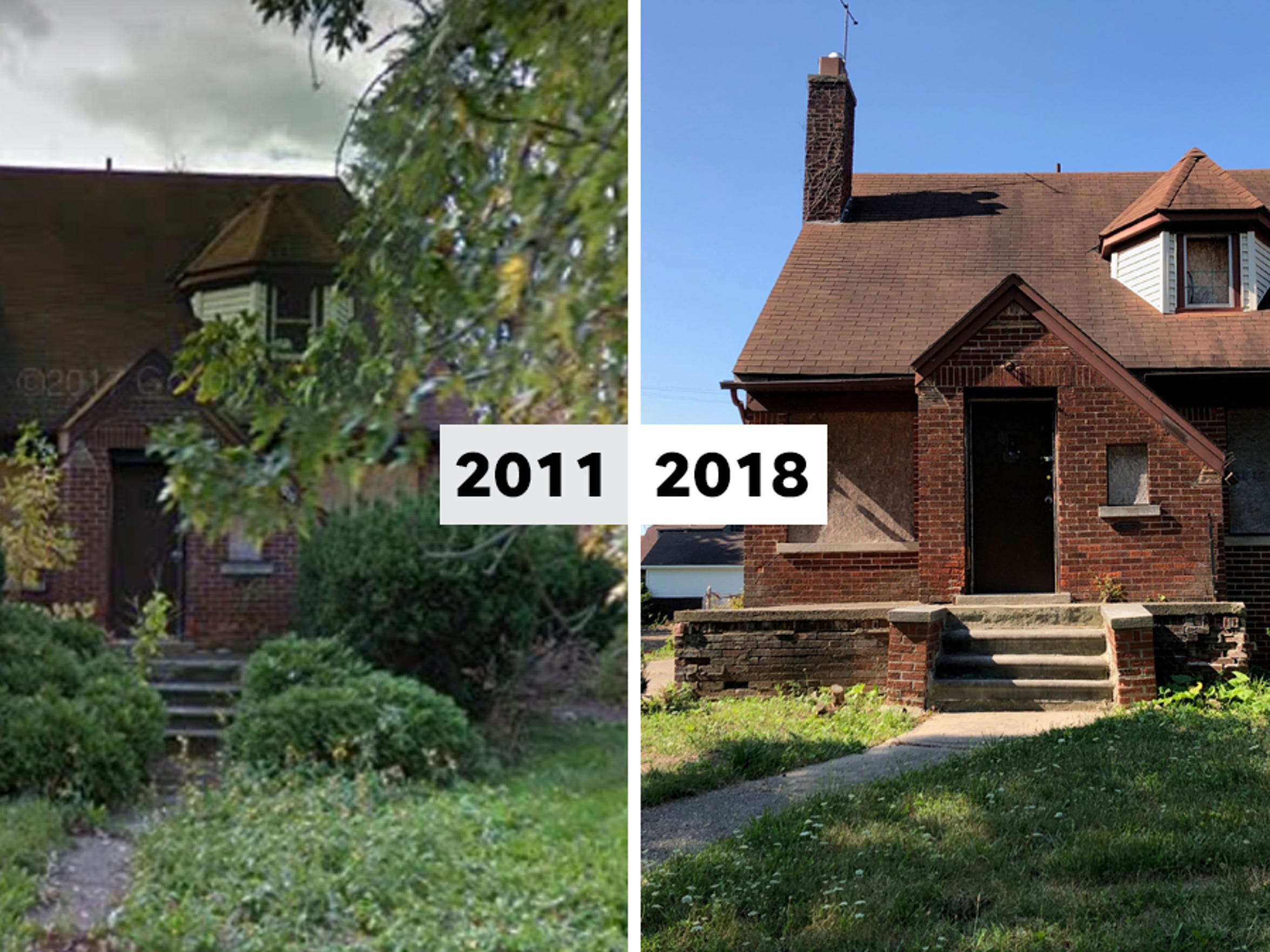
This house is at 9217 Bishop St. in Detroit.
Of course, it's not just speculators who lose. The residents of the neighborhoods — those who lack the most agency, financial capital and say in what occurs around them — have borne the biggest burden: blight and exploitation.

While Kentfield is a good example of how the auction and speculation conspire to breed blight and dysfunction, it is only one of many damaged streets.

Driving around Detroit — east side, west side — the conditions are the same.


Take 9217 Bishop St. 
Bishop Street is only 11 miles east of Campus Martius in downtown Detroit. But it might as well be in another city.

On an airless Wednesday afternoon John Dillon, 80, sat in front of his house talking with Andre Moore, a former neighbor and now friend.

Moore had moved to the neighborhood — on Yorkshire Street, a block over — in 1987. His was, he said, the third black family to move to the block.

“I left in 1997, and when I left, every house had people in it,” Moore said from Dillon’s stoop. Kitty-corner, and just in view, is 9217 Bishop, one of the 23 homes that, at one point, ended up in the hands of Whitaker.

In 2008, the house was lost to mortgage foreclosure over a $98,174 debt and ended up in the hands of Aurora Loan Services.

Aurora Loan Services sold the house to SD Associates by quit claim deed, for an undisclosed sum, and that same year, SD Associates sold the house to a buyer for $3,499.

That buyer lost the home to tax foreclosure in 2012, though Aurora Loan Services was the name on the foreclosure notices. And Benjigates purchased the house at the 2012 Wayne County Tax Auction for $500.

In June 2015, the Detroit Land Bank went before Judge Robert Colombo asking that he declare the house a nuisance. But this did not deter Benjigates, in December 2015, from selling the house to Elliott's Asset Management in a bundle of 21 homes for $5,000 ($238 per house).

In January 2016, Asset Management sold the house to Elite Value Properties in a bundle of eight houses for $4,000 ($500 per house). In February 2016, Elite sold the house to Fortner and Kiska for an undisclosed sum in a quit claim deed. In February 2018, Judge Colombo ordered the property be taken over by the Detroit Land Bank. Last month, the Detroit Land Bank sold the property to an individual buyer for $1,900.

These granular details and transactions are almost irrelevant to Dillon — who goes by "Pops" — and Moore. While there is hope that someone like the new buyer can actually reactivate the space, what they see, right now, is abandonment.

Abandonment that feels like quicksand. It is nearly impossible to stop the trend once it’s started. 
“I can’t leave because I can’t afford to,” said Dillon, who purchased his house 25 years ago when the neighborhood was still bustling.

He pays $700 a month on his mortgage, which he is “just about” done with. Then he will own the house in full. A house that when he bought it — in a then-diverse and densely populated neighborhood — had value.

“I was born and raised in Detroit and I cry when I see this,” said Dillon. “A whole block of lots and every other  one  is mowed. Take it away from the people who are just holding on and sitting on it. The people who are playing. They should have to pay to tear it down.”

Moore, who now lives in Southfield, nodded as “Pops” spoke.

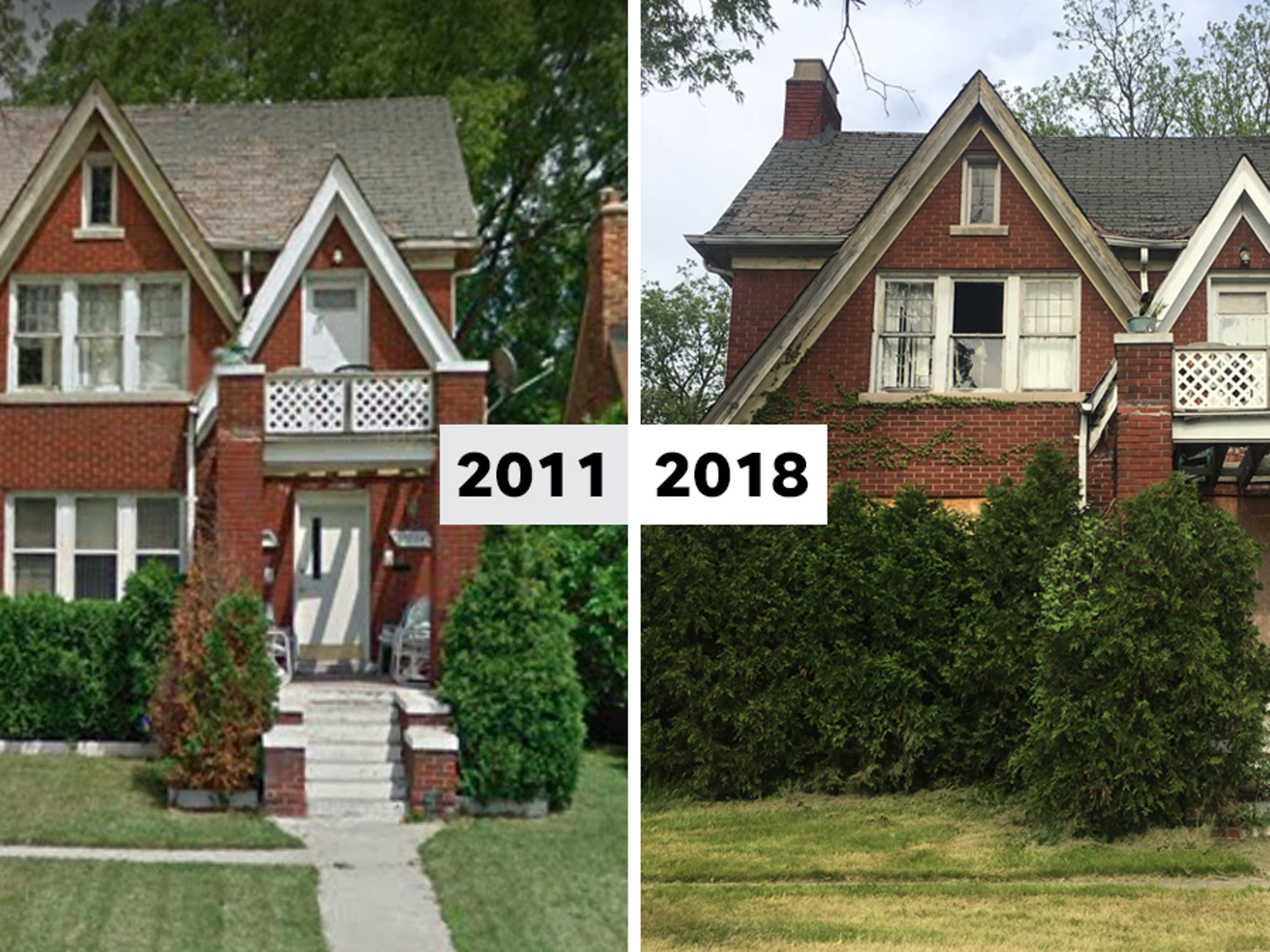
This house is at 13224 Hubbell Ave. in Detroit.
“I feel sad, sad knowing how it was. How it used to work,” the 46-year-old said. “It was beautiful.”

Across town, the people may be different, but blocks, houses and stories sound eerily similar.

If Cynthia Brown and her brother KB craned their heads, they could see 14923 Hubbell,  another property picked up by Benjigates in the 2012 auction for $500. 


Like Kentfield and Bishop, the Hubbell house was passed along in the same bundle of 21 properties from Benjigates to Elliott in Chico and then on to Whitaker in Los Angeles, and then, eventually, to Fortner and Kiska in Illinois. 
Like Kentfield, nobody paid property taxes on the house. In the fall of 2016, it was sold in the auction for $500 to Brian Pepper. In November, Pepper sold the house to Florida-based Lima & Charlie Business Investments for $51,000.

The high sale price — an almost mythical figure — is what attracts so many to the speculator game. But despite the elevated sale price, the house is still an eyesore. It still stands vacant.

"What a market does is it provides some sort of private ordering. It gives value. You are matching, in theory, supply and demand. People who want something and someone willing to sell something," said Hammer, the WSU law professor, synthesizing the situation.

"When you have this absence of a market, it’s an environment for just random and bizarre things to take place with a theme of exploitation and pipe dreams of making money off housing."

Brown and KB didn’t know about the California companies that had owned the house or the Florida investment company that had just bought it.

What they did know was that RD Ware, KB’s best friend, had owned the home. When Ware died, his stepson started to take care of the house. Then it was lost to tax foreclosure.

The home is clearly abandoned today. Plywood serves as a door or a barrier, depending on who you are. The once delicate flowers that grew out front are gone.

But the grass outside is cut.

This, according to Brown, is because the neighbors next door refuse to let it get out of control.
“The couple next door pay to have the grass cut, to make it look lived in,” Brown said. “To keep the neighborhood going.”

Protecting the most vulnerable

Getting a handle on the chaos caused by speculation is difficult.

In January 2015, Gov. Rick Snyder signed into law a bill that prohibits individuals with a foreclosed property or delinquent taxes from bidding in the auction. Land contracts, which put the taxes on the tenant, however, give bulk buyers, speculators, an out.

More notably, many are buying under LLCs and so the issue of being associated with a foreclosed property is harder to come to light. One needs to just register a new LLC and continue to bid, under the radar.

The result of the auction and speculation have drastically altered the makeup of Detroit.
Black homeownership peaked in Detroit in 2000 with 144,571 units, according to Akers and Seymour. By 2015 that share fell by 46 percent to 95,506 units.

“As oversimplifying as it is, there are two Detroits," Akers said of downtown rising and neighborhoods deteriorating. "I don’t really know how you debate that.”

The Wayne County Treasurer's Office points to the declining number of occupied houses in the auction as evidence of a new direction that the office has taken since Eric Sabree was appointed in April 2016.

The county went from 28,000 foreclosures in 2015 to less than 7,000 this year.

"The Wayne County Treasurer is always focused on doing what he can to improve stability in neighborhoods and reducing foreclosures, down to zero if possible," Mario Morrow, spokesperson for Sabree said, noting that Sabree is bound, by law, to hold an auction every year.

In terms of the allowance of speculators partaking in the auction, Morrow says Sabree's  hands are tied. While all auction participants must sign an affidavit, which includes a promise that nobody listed as a grantee on the deed has delinquent property taxes, beyond this, Morrow says, it's hard to monitor.

"The Wayne County Treasurer's Office doesn’t have the resources, financial or human, to police thousands of properties that are sold in the auction. Input from the community is appreciated in that regard. So, yes, the Treasurer and the office care but cannot, on their own, resolve all concerns.

Legally, speculators are allowed to purchase as long as they’ve followed the rules," Morrow said.
As of July, there were 3,959 structures and lots on the county's foreclosure list — a list that if nothing changes over this month, will be indicative of what is up for grabs in the 2018 Wayne County Tax Auction, which starts next month.

The county did not provide occupancy stats in its list, but Loveland Technologies did an analysis and found 1,866 unoccupied structures, 1,405 occupied structures, 419  vacant lots and 269 unknowns. 
Back on Detroit's northwest side, Anderson was happy: 17529 Kentfield had sold for a second time since it landed in the 2016 Wayne County Tax Auction.

The house was still boarded up but there were four cars in the empty lot next to it, and — most notably — signs of life. A motorcycle, two lawnmowers, two BBQs and piles of trash were scattered across the front lawn.

An older couple, Anderson said, had bought it. They were, she said, clearing it out. 
There was hope that after the four years since Eli Brown had been kicked out, a new, stable and permanent neighbor would return.

"They're taking the debris out," Anderson said with a smile. "I'm just glad someone got it."

Contact Allie Gross: AEGross@freepress.com. Follow Allie on Twitter @Allie_Elisabeth.

Voting is beautiful, be beautiful ~ vote.©