These students will be graced with the laurels of expertise, to go forth into society to protect the posterity of the nation, in the best interests of the children.
Think about that.
Just about everyone in Hollywood has a child welfare NGO with a children's trust, and with it, some form of highly sophisticated financial fraud scheme for stealin' the children, land and votes, using taxpayer dollars for personal enrichment, on the backs of "The Poors".
This is why college is not affordable; hence, the dumbing of America, through false claims of a special needs request for testing.
It is my belief Felicity Huffman entered into a pre-trial diversion agreement, a great method when teaching the future of society a lesson in ethics.
In the situation of Felicity Huffman and Lori Loughlin, I believe they are freaking out, on the phone, sending emails, texting, probably trying to dump all their federally funded, economic redevelopment projects and cashing out their foreign children's trust funds, but hey, what do I know?
I know our federal legal community is very aware of this scenario.
Now that Felicity Huffman has been sentenced for her role in the college admissions scandal, all eyes are on Lori Loughlin. What does it mean for the Full House star now that Huffman, who pleaded guilty to one charge of fraud conspiracy, will serve 14 days in prison? Legal experts tell Yahoo Entertainment that if Loughlin is found guilty, it's almost assured she will face prison time — and more of it.
"The fact that Huffman got any jail time after her admission of wrongdoing does not bode well for Loughlin," Los Angeles criminal defense attorney Silva Megerditchian tells Yahoo Entertainment. "In Huffman’s case, she was the first high-profile parent to accept a plea and get sentenced. She immediately took responsibility for her actions, and apologized both privately and publicly in court. Yet despite her accepting full responsibility and for all her apologies, she still got jail time."
While Huffman took a guilty plea in hopes of a more lenient sentence, Loughlin and her husband, fashion designer Mossimo Giannulli, are fighting the federal charges against them. The couple pleaded not guilty to two charges: conspiracy to commit money laundering; and conspiracy to commit mail and wire fraud and honest services mail and wire fraud. (Loughlin and Giannulli were hit with an additional charge when they didn't agree to plead guilty.)
Megerditchian, chief executive officer of SLM Law, continues, "With Loughlin’s seemingly lack of remorse or taking any responsibility, I’m afraid jail time is very likely — unless she has a real and viable defense to the charges."
Criminal defense attorney Matthew Maddox agrees, saying Loughlin should expect to serve time behind bars if convicted, given the severity of her alleged crimes.
"The court will have to at least be perceived as delivering consistent sentences and sentences that are proportional to the defendants’ respective conduct," Maddox, of New Canaan, Conn.'s The Maddox Law Firm, tells Yahoo Entertainment. "Lori Loughlin should expect a jail sentence that is several factors greater than Ms. Huffman’s sentence."
Prosecutors claim Loughlin and her husband paid college admissions consultant William "Rick" Singer $500,000 to get their daughters into the University of Southern California as crew recruits even though neither participated in the sport. Huffman paid Singer $15,000 to have a proctor cheat on her daughter's college entrance exam.
Maddox doesn't believe Huffman's sentence is severe enough to give Loughlin pause on her plea of not guilty.
"This sentence will not divert Ms. Loughlin’s course at all, given what we have observed of her behavior and posture toward this prosecution," he says. "The sentence is not severe enough, and she may inaccurately perceive herself and her circumstances as sufficiently distinguishable in order to warrant a more lenient sentence."
Maddox continues, "If I were on her legal team, I would warn her in the most stark terms that she should change her plea and seek a plea bargain. Her prospects for winning at trial are extremely poor and her sentence will not only be commensurate with her conduct, but by that late post-trial date, she will not be able to avail herself of any of the credits provided by federal sentence guidelines."
But if prison time is what Loughlin fears most, as has been reported, attorney Megerditchian notes the actress might prefer to take the risk and go to trial in hopes she's found not guilty.
"If she’s innocent, it would not change her strategy to fight,” she says. “However, if she were strongly considering a plea to a lesser charge, that could change with Huffman receiving a jail sentence. Loughlin has to figure that accepting a plea would result in a real prison sentence, so she might as well take this all the way to trial."
If Loughlin were to seek a plea deal, Megerditchian points out, "it's never too late to negotiate."
"Trials cost money and a lot of time," she says. "The prosecutors would listen to the defense attorneys’ proposal and counteroffer based on the strength of the government’s case against her."
Still, it would be up to "whether the U.S. attorney's office will have her," adds Maddox.
"It’s not too late to request a negotiated plea, or plea bargain, and she might still receive some federal guidelines sentencing credits, but the longer that she waits, the worse her prospects become," he says.
Huffman's sentencing lit up social media Friday, with some people outraged and some simply surprised. Federal prosecutors had recommended one month in prison with a year of supervised release and a $20,000 fine. Meanwhile, her legal team asked the judge to sentence her to one year of probation, a $20,000 fine and community service — and no prison time.
Maddox explained how a judge considers "several factors in sentencing."
"One factor is specific deterrence," he shares. "Will the sentence deter the defendant from offending again? Yes, for Ms. Huffman, this sentence will, along with the negative media coverage, having a federal conviction and being supervised on probation. Another factor is general deterrence and this is one area where the sentence may be seen as inadequate. A 14-day sentence may not be enough to stop other wealthy parents from engaging in similar fraudulent behavior."
Maddox continues, "The most worrisome factor is whether the sentence offers actual retribution to society at large. Is this enough punishment? This sentence will tend to reinforce many peoples’ impressions that the wealthy are treated more leniently by the criminal justice system than the average citizen."
Loughlin is due in Boston federal court for a status conference on Oct. 2.
Now, think about the other projects these parents are financially securing for their children's future, then think about the children who suffered and died to make this all happen.
Because she and her "Legal Geniuses" (trademark pending) are going to swoop in to save the day when child welfare finally is allowed to be spoken about in the public.
Child Protective Services was based upon the Lebensborn model where I give full credit to Hillary Clinton for its U.S. implementation.
Child Protective Services, known as CPS, is the first leg in the acquisition of goods, more intuitively understood in the legal realms of asset forfeiture of chattel.
CPS is the input of trafficking tiny humans because this is about the Children's Trust Funds that have been pilfered from our most precious treasures - the children.
This is also the first stage of forced migration and gerrymandering.
Would you let a stranger come to your door, with no badge, no court order, and just snatch your kids?
Would you allow your child to enter the foster care system to be drugged, raped, beaten, tortured and used as a lab rat?
If you said yes to any of these aforementioned realities, then you are not human.
If you say that these horrors do not exist, then you are swimming in your own indoctrinated pool of propaganda excrement of cognitive denial.
Of course, there are those who will say, "If we get rid of CPS, then who is going to save the children?"
How about the family.
If you stop making people poor, then there would be no need for CPS because poverty is the crime of abuse and neglect.
This is my favorite CPS motivational video on child trafficking and I hope you enjoy it just as much as I do, each and every time I watch, which is often.
I believe I figured out from whom he received those stolen, congressional, classified documents, from House Judiciary.
Cerno is not in a good place right now and I have all intentions of reminding the cyberverse about his predicament, with a lovely stemmed glass of pinot grigio in hand.
"The Poors" (always said with clinched teeth) cry for help and are told to get a job when all the jobs were sent overseas.
"The Poors" (always said with clinched teeth) scream for health care as the second and third generations are being used for biogenetic experiments.
"The Poors" (always said with clinched teeth) demand education as foreign corporations are pilfering our national treasuries by taking over our public schools.
"The Poors" (always said with clinched teeth) lament when their land is snatched under fraudulent property taxes and nefarious mortgage and legal scams, while "The Elected Ones" ridicule the old, the young, the weak, and the tired.
Selling chattel is just a residual of the peculiar institution.
When The Root publishes, you know the heavens are about to fall.
There is an entire army of journalists who have been lying in wait, surrounding the kingdom, ready to bring down the heavens, upon the call of charge from the Old School Civil Rights Legal Dogs, upon the arrival to Detroit.
... Governmental eavesdropping today is simply out of control, and it is entirely possible that we have seen only the tip of the iceberg....The Nixon clique may just have been the worst offenders, though we can never know this with certainty unless we learn more about what went on during earlier administrations. The [Martin Luther] King episode-which in my view is the single most reprehensible example of unjustified intrusion that we are aware of-is enough to raise serious questions about national security wiretap policies during the Kennedy and Johnson administrations.... That the King tap was authorized by well meaning good guys with beneficent purposes only demonstrates how pervasive the problem of wiretapping has been.
Welp, welcome to the slippery sleazy slope that comes with billionaire Jeffrey Epstein’s recent arrest for child sex trafficking.
Internet sleuths have uncovered a 2015 video of Harvard attorney and Epstein’s friend, Alan Dershowitz, who worked to get Epstein a sweetheart deal in a 2008 plea agreement, admitting to getting a massage at Epstein’s mansion.
During an interview with Miami news station WPLG regarding Britain’s Prince Andrew (another friend of Epstein) and his alleged sexual involvement with an underaged girl who was allegedly kept as a sex slave by Epstein, Dershowitz not only bashed the accuser, calling her an “admitted prostitute and a serial liar” but claimed that the then-teen was not victimized and in fact “made her own decisions in life.”
Dershowitz admitted to being at the billionaire’s home but noted that he’d never seen an underaged girl at Epstein’s place despite sworn testimony from Epstein’s former butler who claimed that Dershowitz was at the residence at the same time that underaged girls were there. Dershowitz has an easy explanation for that: “Were there young women in another part of the house giving massages while I was around? I have no idea of that!”
Oh, and did Dershowitz ever receive a massage at Epstein’s house? Yep. But Dershowitz claimed that it was from an adult woman and he kept his underwear on.
“I kept my underwear on during the massage. I don’t like massages particularly.”
Watch the entire interview below but I warn you, it’s triggering and mad cringey.
It is said that Dershowitz got the sweetheart plea deal for the criminal case of Jeffrey Epstein because he was going to subpoena Child Protective Service files on the Foster Care girls to demonstrate they were, for lack of a better descriptive, "abused and neglected" with mental health issues to challenge the credibility of their accusations.
Then, it seems Dershowitz groomed Cernovich to FOIA the sealed information in the civil case, claiming credit for the arrest, where I am just going to speculate that there were some CPS information that could be used as exculpatory evidence for him, considering one of the defendants had accused of being one of The Nasty Ones on Epstein's Island.
I would be remiss to not include Barb's question to Acosta:
Will someone please ask #Acosta about immunizing co-conspirators?
Mike Dice, Alan Dershowitz (that face you make right after they show you the video) & Mike Cernovich
Lawyer says it’s his moral obligation to help suspected criminals; but his ties to accused sex trafficker go deeper
JTA — Alan Dershowitz represented convicted sex offender Jeffrey Epstein when he was sentenced more than a decade ago to what was generally considered an extremely light term.
Epstein had abused dozens of underage girls, but was given only 13 months in a private wing of a county jail. He was allowed to leave for work six days a week as long as he returned to the facility at night. He and his associates were given immunity from federal prosecution.
That agreement has come under scrutiny following Epstein’s arrest this week and indictment for sex trafficking.
In February, a judge ruled the 2008 deal illegal because the Jewish billionaire’s victims were not notified before it was approved. The case was reopened after a Miami Herald reporter identified some 80 alleged victims who said they were recruited into a sex ring run by Epstein and made to recruit others.
But Dershowitz said he would do it all over again. In fact, he told the Jewish Telegraphic Agency that he would try to get Epstein even less prison time if he had the chance.
“I have no misgivings and I will continue to represent controversial people,” the emeritus professor at Harvard Law School said. “That’s what I do. If I’m in a case, my job is to get the best possible result.”
Was that settlement fair to Epstein’s victims?
Dershowitz says that’s not his responsibility.
“That’s the job of prosecutors and the job of the judge,” he said. “My job is to get the best possible result for my client.”
Dershowitz, who has made a career of unabashedly defending unpopular stances, was happy to point out that he has represented a range of unseemly clients: far-right Jewish Defense League activists (accused of murder), O.J. Simpson (accused of murder), British socialite Claus von Bulow (accused of attempted murder) and, most recently, Harvey Weinstein.
Dershowitz sees it as an obligation, in a society governed by the rule of law, to defend even the most distasteful criminals. It’s not just for the money, he says, pointing out his pro bono work pro for the Aleph Institute, a Jewish group that helps prisoners.
“It’s as moral as a doctor administering to somebody in the emergency ward,” he said. “It’s in the highest tradition of Jewish law and American constitutional law. If you don’t want to live in a system like that, move to Iran.
“The most moral thing you can do is represent the most unpopular defendant.”
Dershowitz’s relationship with Epstein, however, extended beyond legal representation. He used to send Epstein drafts of his books before publication, and would participate in seminars convened by Epstein with other Harvard personalities, like the one-time president Larry Summers. He also attended social gatherings at Epstein’s Upper East Side townhouse.
Dershowitz says that aside from his role as a member of Epstein’s legal team, he has not been in contact with Epstein since the plea deal was finalized.
“My relationship with him was academic and he was a very smart guy,” he said in reference to the book drafts. “He read them and he critiqued them, and he made marginal notes and he was very good at it.”
According to one Epstein accuser, the friendship went deeper.
Virginia Roberts Giuffre, who alleges that Epstein kept her as a “sex slave,” also says she was forced to have sex with Dershowitz at the New York townhouse. Another alleged Epstein victim, Sarah Ransome, also says she was coerced into having sex with Dershowitz.
Dershowitz vehemently denies the allegations and says he was shocked to learn of Epstein’s crimes. He says he has emails proving that Giuffre is lying and that he has never met her or Ransome. Giuffre is suing Dershowitz for defamation.
“I never met any of these people,” he said. “Of course I’m categorically denying it. It’s just a falsehood.”
Dershowitz is one of a string of prominent Jewish men who have become entangled with Epstein over the years, when Epstein was better known as an investor than a sex offender. Epstein once financed a magazine, for example, with New York media mogul Mort Zuckerman.
The most involved by far is Leslie Wexner, the founder of Victoria’s Secret and The Limited, as well as a major philanthropist to Jewish causes. Wexner was the sole known client of Epstein’s secretive money management business, and Epstein was often described as his protege.
Nationwide Children’s Hospital will dedicate the hospital’s Research Institute as the Abigail Wexner Research Institute at Nationwide Children’s Hospital. This renaming recognizes Ms. Wexner, whose ongoing, passionate advocacy has ushered in a period of unprecedented transformation at the hospital. During her more than 25 years on the board of directors, Nationwide Children’s has become one of the leading pediatric health care systems in the United States, and the Abigail Wexner Research Institute has become one of the most preeminent centers of its kind. https://pdf.guidestar.org/PDF_Images/2016/311/036/2016-311036372-0e91679f-9.pdf
Although Wexner has said that the two have not been in touch for over a decade, they once were quite close. Epstein was a trustee of Wexner’s foundation, replacing Wexner’s sick mother on the board, and Wexner told Vanity Fair in 2003 that Epstein is “very smart with a combination of excellent judgment and unusually high standards. Also, he is always a most loyal friend.”
The most intimate and perhaps inexplicable connection between the two men, however, is a piece of shared property. Wexner bought Epstein’s New York City townhouse in 1989 for $13 million, but Epstein was using it as a residence by the mid-1990s. The townhouse would formally change hands between the men, apparently for free. After Epstein was released from prison, according to The New York Times, he graced the house with a photorealistic mural of himself in a jail.
When federal agents busted into that house this week, they found a trove of hundreds of sexually suggestive photos of underage girls — along with CDs bearing labels like “misc nudes 1.”
The house is the same one where Dershowitz is accused of having sex with Giuffre and Ransome. But there’s another link between Dershowitz and the house. Its designer, the architect Horace Trumbauer, also designed Clarendon Court in Rhode Island — the home of Claus von Bulow.
I attempted to find the 990s of the Abigail Wexner Research Institute and its instrument of authority, but was unsuccessful, but I did find the Wexners in Detroit. Perhaps, this is why Acosta immunized the co-conspirators, but hey, what do I know?
Reuben Maxbauer and Ethan Davidson (facing camera) listen intently during a seminar session.
Israel facing the “Who is a Jew” issue, one of several religious dilemmas to confront the state. Clergy “challenged” by intermarriage, assimilation and Hebrew school inattention. American Jewry confronting a nightmare of anti-Semitism and hate. A Supreme Court justice hearing rocked with intense scrutiny. An administration facing scandal dealing with a foreign nation and a country glued to news reports of it and the Congressional testimony around it, day after day. After day.
This was more than three decades ago. It seems like everything — from the flavors of Faygo to the challenges of our demographics to the soup stains on the Maxwell House Haggadah — has stayed the same, with the history and the headlines repeating themselves.
Thirty-one years ago, the initial Detroit cohort of the Wexner Heritage Fellowship, a North American leadership development program designed to provide a toolkit of Jewish knowledge for emerging community leaders, was assembled. Detroit participants were recruited for that initial group when the three youngest members of the current Detroit cohort (including this author) were not yet born. This was the era of Sinai Hospital, still 10 years away from being sold off to DMC.
This was the late 1980s. Boblo and Tally Hall were thriving, so I was told; Google and Uber were not yet envisioned, nor were JSwipe or Twitter or Amazon.
Over the last three decades, it seems like everything except the Amidah has changed. Yet, truth-be-told, that may now depend on your prayer book, which may be digital, colorful, more matriarchal or, for some, non-existent.
One thing is certain: Making sense of a confused, complicated, certainly uncertain world is assisted by education rooted in Torah, by community-building done in real time and with peers who easily become friends. This is Wexner 2017-19 — and Wexner 1986-88.
The program still allows participants the dedicated time with the highest-caliber scholars to discuss and deliberate around the core of who we are as a people, all rooted in the famous Pirkei Avot phrase that inspired the Wexner Heritage Program: “The world stands upon three things: upon Torah, upon Divine service and upon acts of kindness.
The 20 current fellows have discussed pressing issues with noted scholar Deborah Lipstadt just as earlier ones did with Leon Uris, the famous author of bestsellers including Exodus.
Matthew Shiffman of Birmingham, already a passionate philanthropist and dedicated booster of the city and community, has found immediate value in the program.
“Having the opportunity to be part of an incredible group (chavruta), Wexner has provided me a lasting platform to further my Jewish education and prepare me to be an even better lay leader within our community. It’s been many, many years since this program has been in Metro Detroit, and I feel blessed to be part of it.”
The Program’s Roots
When Les Wexner decided to make a significant philanthropic investment in leadership in the North American Jewish community, he approached it entrepreneurially, said Rabbi Jay Henry Moses, vice president at the Wexner Foundation.
“He and his co-founder, the late Rabbi Herb Friedman, piloted the Wexner Heritage Program in Les’ hometown of Columbus, Ohio, in 1985. It was immediately clear they had hit on a winning formula. So, they reached out to neighboring communities, and Detroit, where Les’ dear friends and mentors Max Fisher and Al Taubman were pillars of Jewish life, was one of the first cities to respond to the call and embrace the leadership development opportunity that the Wexner Foundation was offering.
Reuben Maxbauer and Ethan Davidson (facing camera) listen intently during a seminar session.
“So, the Detroit group of 1986-88 were pioneers, helping the foundation test and hone the approach to adult Jewish learning in the service of strengthening leadership.”
“As a native Detroiter myself,” Moses said, “I was especially delighted the trustees of the D. Dan and Betty Kahn Foundation, in partnership with the Jewish Federation of Metropolitan Detroit, had the vision to realize a generation had passed, and it was time to invest in developing volunteer leaders in the Wexner model again.“Since the 1980s, we have watched with great interest as Detroit weathered economic and social challenges and began an inspirational renaissance in the last decade. In the Wexner program, we teach that leaders need to guide their communities to respond to changing circumstances with an adaptive mindset — as Jewish communities have done for three millenia.
“We work with communities all over North America; nowhere are we seeing more vision and energy than in the current Detroit cohort, which represents nearly every corner of Detroit Jewish life, from city to suburbs, secular to Orthodox, schools, community centers, synagogues, startups and more. As Detroit continues to ride the wave of creativity and renewed energy, these leaders will be at the forefront of exciting new initiatives that will strengthen the community and put Jewish values into action.”
To bring the Wexner program back to Detroit, Larry Wolfe, immediate past Federation president, offered local philanthropic support of $350,000 through the D. Dan and Betty Kahn Foundation. The Wexner Foundation matches that amount to fund the two-year program cost of $700,000. No expenses are incurred by the participants.
“Educated leadership is a catalyst for progressive ideas, programs and communal participation,” Wolfe said. “The Wexner program is in the forefront of establishing new leaders and giving them the tools to enhance our communal outreach.”
The Wexner Foundation has expanded to additional fellowships that span leadership development for Jewish communal professionals in graduate programs (Wexner Graduate Fellowship/Davidson Scholars Program) and leadership development for Jewish professionals (Wexner Field Fellowship), to service learning programs for high school students (Wexner Service Corps) and programs to advance the civic sector in Israel (Wexner Israel Fellowship, Wexner Senior Leaders).
2017-19 Detroit Cohort: Adam Blanck, Alicia Chandler, Ethan Davidson and Matthew Shiffman, all of Birmingham; Darren Findling, Gayle Gold, Joshua Levine, Rachel Opperer and Wendy Pittman, all of Huntington Woods; Adam Finkel, Carolyn Bellinson and David Kramer, all of Bloomfield Hills; Kristen Gross, Franklin; Reuben Maxbauer and Sheri Shapiro, both of Farmington Hills; Ruby Robinson, Detroit; Sherrie Singer and Ilana Stern, both of West Bloomfield; Julie Tepperman, Windsor, Ontario; and Yoni Torgow, Oak Park.
Current Cohort
The fellows graduate this July in Jerusalem after having two years of local courses and week-long seminars in Aspen and Utah to learn with participants in other selected cities throughout North America; three new cities begin each year.
During the local courses, a scholar travels to Detroit for a four-hour seminar, usually held every other Wednesday evening. The curriculum span is from liturgy and the Bible and contemporary Israel society to European Jewish history, God and synagogue, and modern leadership topics in 21st-century American Jewry.
“During our first Wexner Heritage retreat in Aspen in the summer of 2017, Les Wexner addressed the group in his beautiful mountainside home,” participant David Kramer of Bloomfield Hills recalled. “He told us he created the program because he came to realize many of the most prominent lay leaders in the Jewish communal world had little to no education in Jewish history, Jewish ritual or Jewishly informed leadership skills.
“I quickly came to realize the principal benefit of the program is not only learning from amazing scholars about all things Jewish, but also understanding how to take that knowledge and apply it to Jewish communal leadership.”
The current participants are already active in a diverse array of leadership endeavors in the community.
For example, Yoni Torgow of Oak Park contributes his time and energy to advance Yeshiva Beth Yehudah; Rachel Opperer of Huntington Woods does the same with Farber Hebrew Day School; Reuben Maxbauer of Farmington Hills has been an active, engaged board member of the Frankel Jewish Academy, as Josh Levine of Huntington Woods has been with the Hillel Day School. Gayle Gold, also of Huntington Woods, has worked to support the Jewish Federation’s endeavors focused on young adult mental health needs. Others of the 20 fellows give of their time by working on Federation, Jewish agency, day school and synagogue boards and committees.
Alicia Chandler of Birmingham, current president of Detroit’s JCRC/AJC, says being a Wexner Fellow has been the most powerful experience of her Jewish communal life.
“It has taught me how to connect my Judaism to my Jewish leadership,” she said. “The experience has helped root my leadership in Torah and tradition and helped me understand the ever-changing entity that is the Jewish community. It has also given me 19 amazing, smart, thoughtful friends. While our community, like all communities, faces challenges, this experience helps empower leaders to embrace the challenges and help our community thrive.”
Levine said, “It also speaks to the resurgence in all areas of the community experienced over the past few years. Wexner recognized all of the wonderful initiatives taking place in Detroit with its Jewish leadership and wanted to cultivate and be part of the great resurgence seen over the past 10 years.”
Gold said, “The Wexner Heritage Program is an incredibly rich resource for the Detroit Jewish community. We are so fortunate that Wexner chose to come back to Detroit. The opportunity to study in a way that develops critical thinking has been truly inspirational for me. It’s been a long time since I’ve been able to stretch my brain in this way. It feels amazing.
“The end result will be a group of leaders with deepened relationships and heightened commitment to our community,” she said. “We will be armed with an enhanced skill set to effectively listen, problem solve and effect change — and, most importantly, the courage to do so.”
Kristen Gross of Franklin said, “Experts have assisted me in honing my personal narrative; succinctly defining why I devote my time to Jewish philanthropic work. Wexner has given me the confidence to be bold and disruptive in certain areas and a thoughtful listener in others.”
Wendy Pittman of Huntington Woods said, “One of my favorite learnings is that pluralism is fundamental in Jewish history and this provides us with a foundation to nurture, support and grow our community from a place of acceptance and unity.”
Rachel Opperer of Huntington Woods summed it up well: “From the community’s standpoint, Wexner has been a successful investment because we have taught a diverse group of Jews to talk with each other, to listen to each other, to respect each other, differences notwithstanding. The more opportunities we have for a community to act like a community, the stronger and more inviting our community will be.”
Scott Kaufman, Federation CEO, hopes to keep the program going in Detroit.
“In Jewish Detroit, we are blessed with a great pipeline of dedicated and talented emerging leaders,” he said. “Among them are a cadre of leaders experiencing the Wexner program, a veritable masterclass in Jewish leadership. Wexner participants are developing expertise in the type of adaptive leadership that is essential in our rapidly changing world. Yet they are also gaining a deeper understanding of the Jewish texts and ethics that inform our enduring mission. Sort of a perfect balance of innovation and tradition that I see as an essential element of the Jewish experience throughout our history.
“Hopefully, our community will be able to bring the Wexner program back on a regular basis as I believe the impact on our community will be profound.”
Wexner Inspired Initial Detroit Alumni
The track record of Wexner Heritage Fellows from 1986-88 is easy to see. Many of the graduates have given decades of leadership and service to the Jewish community, which has included some of the most significant positions of philanthropy, policy-making and community-building within Jewish Detroit, and within the national and international communities.
Peter Alter, as an example, has served as local Federation and Anti-Defamation League president as well as on national Jewish boards. He also studied for more than 15 years with Rabbi Avi Cohen of Partners Detroit, which Alter says has been a very special, worthwhile and privileged experience for him.
Dr. Richard Krugel has chaired the Jewish Fund and been president of the Jewish Community Relations Council; Judge Susan Moiseev has chaired committees at the Jewish Historical Society of Michigan and at Jewish Senior Life; Marcy Feldman co-chaired the Federation’s Family Mission to Israel and was vice president of Federation’s Women’s Division; Phillip Fisher served as chair of the Investment Committees of the Jewish Foundation of North America and the boards of the Jewish Foundation and United Way of Southeast Michigan — and this list is just a tip of the iceberg for their involvement and that of other members of their cohort.
Looking back to their time in Wexner, Cheryl and Dan Guyer, who attended together, said, “We were exposed to different models of leadership, developed a more critical way of problem-solving, and had the opportunity to study with nationally and internationally known Jewish thought leaders — Adin Steinsaltz, Joseph Telushkin, Deborah Lipstadt, Yitz Geenberg, Irwin Kula and others.
“We connected with peers in other Jewish communities across the country,” Dan Guyer said. “We studied with them and learned from them and developed a global picture of leadership through Jewish values that prepared me to take on leadership roles in local agencies and nationally. The return of the Wexner program to Detroit is an opportunity to create a group of educated, thoughtful, dynamic and Jewishly sensitive leaders to take on the challenges of our community.”
Cheryl Guyer is director of development at the Holocaust Memorial Center.
Krugel says his experience in Wexner was one of the most significant events of his early Jewish leadership development and was life-altering. “Those years studying with some of the greatest Jewish scholars in the world, including Rabbis Adin Steinsaltz, David Hartman and Shlomo Riskin, among others, made me realize the importance of Jewish education for the future of the Jewish people and the need for adult Jewish education.”
Alter says it’s impossible to overstate the success and impact of the Wexner programs nationally and in Israel.
“For Detroit, it was a privilege 30 years ago, for each of us participate in the program. It is a fantastic boost for Detroit to have Wexner back here. It, of course, enriches the community and creates a buzz, but, even more importantly, it helps to provide Detroit with a new generation of more informed, more educated, more enthusiastic and, therefore, better Jewish leaders. It allows many of the participants who have leadership potential to be/become much better Jewish leaders. The entire community benefits.”
The propaganda is coming and so are the #pizzacrappers.
This goes far deeper and there are individuals who will do anything to continue to cover it up.
Billionaire pedophile Jeffrey Epstein was arrested for allegedly sex trafficking dozens of minors in New York and Florida between 2002 and 2005, and will appear in court in New York on Monday, according to three law enforcement sources. Epstein, who owns a New York City mansion and an island in the Caribbean, was being held at the federal lockup in Manhattan ahead of his court date.
New York – Wealthy financier and registered sex offender Jeffrey Epstein was arrested Saturday in New York on new sex-trafficking charges involving allegations that date to the early 2000s, according to law enforcement officials.
Epstein, a wealthy hedge fund manager who once counted as friends former President Bill Clinton, Great Britain’s Prince Andrew, and President Donald Trump, was taken into federal custody and is expected to appear Monday in Manhattan federal court, three law enforcement officials told The Associated Press.
One of the officials said Epstein is accused of paying underage girls for massages and molesting them at his homes in Florida and New York.
The officials spoke on the condition of anonymity because they were not authorized to discuss the pending case.
A message was sent to Epstein’s defense attorney seeking comment. Epstein is being held at the Metropolitan Correctional Center in Manhattan, according to the Federal Bureau of Prisons website.
Epstein’s arrest, first reported by The Daily Beast, comes amid renewed scrutiny of a once-secret plea deal that ended a federal investigation against him.
That deal, which is being challenged in Florida federal court, allowed Epstein, who is now 66, to plead guilty to lesser state charges of soliciting and procuring a person under age 18 for prostitution.
Averting a possible life sentence, Epstein was instead sentenced to 13 months in jail. The deal also required he reach financial settlements with dozens of his once-teenage victims and register as a sex offender.
Epstein’s deal was overseen by former Miami U.S. Attorney Alexander Acosta, who is now Trump’s labor secretary. Acosta has defended the plea deal as appropriate under the circumstances, though the White House said in February that it was “looking into” his handling of the deal.
U.S. District Judge Kenneth Marra of Florida ruled earlier this year that Epstein’s victims should have been consulted under federal law about the deal, and he is now weighing whether to invalidate the non-prosecution agreement, or NPA, that protected Epstein from federal charges.
It was not immediately clear whether the cases involved the same victims since nearly all have remained anonymous.
Federal prosecutors recently filed court papers in Florida case contending Epstein’s deal must stand.
“The past cannot be undone; the government committed itself to the NPA, and the parties have not disputed that Epstein complied with its provisions,” prosecutors wrote in the filing.
They acknowledged, however, that the failure to consult victims “fell short of the government’s dedication to serve victims to the best of its ability” and that prosecutors “should have communicated with the victims in a straightforward and transparent way.”
The victims in the Florida case have until Monday to respond to the Justice Department’s filing.
According to court records in Florida, authorities say at least 40 underage girls were brought into Epstein’s Palm Beach mansion for what turned into sexual encounters after female fixers looked for suitable girls locally and in Eastern Europe and other parts of the world.
Some girls were also allegedly brought to Epstein’s homes in New York City, New Mexico and a private Caribbean island, according to court documents.
Saturday’s arrest also came just days after a federal appeals court in New York ordered the unsealing of nearly 2,000 pages of records in a since-settled defamation case involving Epstein.
U.S. Sen. Ben Sasse released a statement Saturday calling for Epstein to be held without bail pending trial.
“This monster received a pathetically soft sentence last time and his victims deserve nothing less than justice,” Sasse, R-Nebraska, said in the statement. “Justice doesn’t depend on the size of your bank account.”
In honor of the legacy of Alan Dershowitz, I have decided to launch the official "Let's Go Whitewatering!" page, where everything you ever wanted to know about what went on behind the scenes during Whitewater in Judiciary and how it turned into the Detroit Land Bank Authority.
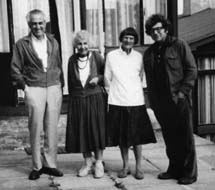
Albert Solnit, Anna Freud, Dorothy Burlingham, and Joseph Goldstein (left to right) in Cork, Ireland after the publication of Beyond the Best Interests of the Child
THE PSYCHOLOGICAL PARENT-CHILD RELATIONSHIP
The child’s psychological tie to a parent figure is not the simple, uncomplicated relationship which it may appear to be at first glance. While it is rooted inevitably in the infant’s inability to ensure his own survival, it varies according to the manner in which protection is given and the physical needs fulfilled. Where this is done impersonally and with routine regularity, as in institutions, the infant may remain involved with his own body and not take an alert interest in his surroundings. Where the adult in charge of the child is personally and emotionally involved, a psychological interplay between adult and child will be superimposed on the events of bodily care. Then the child’s libidinal interest will be drawn for the first time to the human object in the outside world.
Such primitive and tenuous first attachments form the base from which any further relationships develop. What the child brings to them next are no longer only his needs for body comfort and gratification but his emotional demands for affection, companionship, and stimulating intimacy. Where these are answered reliably and regularly, the child-parent relationship becomes firm, with immensely productive effects on the child’s intellectual and social development. Where parental care is inadequate, this may be matched by deficits in the child’s mental growth. Where there are changes of parent figure or other hurtful interruptions, the child’s vulnerability and the fragility of the relationship become evident. The child regresses along the whole line of his affections, skills, achievements, and social adaptation. It is only with the advance toward maturity that the emotional ties of the young will outgrow this vulnerability. The first relief in this respect is the formation of internal mental images of the parents which remain available even if the parents are absent. The next step is due to identification with parental attitudes. Once these have become the child’s own, they ensure stability within his inner structure.
As the prototype of true human relationship, the psychological child-parent relationship is not wholly positive but has its admixture of negative elements. Both partners bring to it the combination of loving and hostile feelings that characterize the emotional life of all human beings, whether mature or immature. The balance between positive and negative feelings fluctuates during the years. For children, this culminates in the inevitable and potentially constructive struggle with their parents during adolescence.
Whether an adult becomes the psychological parent of a child is based thus on day-to-day interaction, companionship, and shared experiences. The role can be fulfilled either by a biological parent or by an adoptive parent or by any other caring adult—but never by an absent, inactive adult, whatever his biological or legal relationship to the child may be.
The best qualities in an adult’s personality give no assurance in themselves for a sound result if, for any reason, the necessary psychological tie is absent. Children may also be deeply attached to parents with impoverished or unstable personalities and may progress emotionally within this relationship on the basis of mutual attachment. Where the tie is to adults who are “unfit” as parents, unbroken closeness to them, and especially identification with them, may cease to be a benefit and become a threat. In extreme cases this necessitates state interference. Nevertheless, so far as the child’s emotions are concerned, interference with the tie, whether to a “fit” or “unfit” psychological parent, is extremely painful. . . .
We propose three component guidelines for decision-makers concerned with determining the placement and the process of placement of a child in a family or alternative setting. These guidelines rest on the belief that children whose placement becomes the subject of controversy should be provided with an opportunity to be placed with adults who are or are likely to become their psychological parents.
PLACEMENT DECISIONS SHOULD SAFEGUARD THE CHILD’S NEED FOR CONTINUITY OF RELATIONSHIPS. . . .
PLACEMENT DECISIONS SHOULD REFLECT THE CHILD’S, NOT THE ADULT’S, SENSE OF TIME. . . .
CHILD PLACEMENT DECISIONS MUST TAKE INTO ACCOUNT THE LAW’S INCAPACITY TO SUPERVISE INTERPERSONAL RELATIONSHIPS AND THE LIMITS OF KNOWLEDGE TO MAKE LONG-RANGE PREDICTIONS. . . .
WHY SHOULD THE CHILD’S INTERESTS BE PARAMOUNT?
Some will assert that the views presented in this volume are so child-oriented as to neglect the needs and rights of the adults. In fact, this is not the case. There is nothing one-sided about our position, that the child’s interests should be the paramount consideration once, but not before, a child’s placement becomes the subject of official controversy. Its other side is that the law, to accord with the continuity guideline, must safeguard the rights of any adults, serving as parents, to raise their children as they see fit, free of intervention by the state, and free of law-aided and law-abetted harassment by disappointed adult claimants. To say that a child’s ongoing relationship with a specific adult, the psychological parent, must not be interrupted, is also to say that this adult’s rights are protected against intrusion by the state on behalf of other adults.
As set out in this volume, then, a child’s placement should rest entirely on consideration for the child’s own inner situation and developmental needs. Simple as this rule sounds, there are circumstances which make it difficult to apply even with ample evidence in support of the child’s interests. The injunction disregards that laws are made by adults for the protection of adult rights. . . .
October 7, 1973, Page 338The New York Times Archives
By now it is axiomatic in the field of child development that healthy emotional and intellectual growth—the ability to relate to others and to learn —depends to a great extent on the establishment very early in life of a mutually gratifying, continuing relationship with a mothering figure who cares for and stimulates the infant. It is in this relationship that the child begins to develop security and trust—a good feeling about himself and a sense that the world is worth moving out into and exploring. Psychologists have come to believe that if you start with these feelings you don't need much of anything else, and that without them, it doesn't much matter what else you have.
The key word here is “continuity.” Where this kind of relationship never gets established (children who grow up in crowded institutions) or when it is interrupted (by the disappearance or replacement of the mothering adult for whatever reason—death, divorce, hospitalization) very young children withdraw, regress, become depressed, sometimes even retarded.
This premise is the starting point for a soon‐to‐be‐published book—“Beyond the Best Interests of the Child”—which applies what psychoanalysts have learned about child development to a new area: the law as it affects children. It is written by the daughter of Sigmund Freud, joined by two other distinguished scholars, and it may well become as controversial among judges, lawyers, legislators, social workers and even psychiatrists as Freud's writings were to the medical and psychological establishment of his day.
Anna Freud, who is based at the Hampstead Child Therapy Clinic in London, is probably the foremost living authority on the emotional lives of children, a subject she explored in depth among children separated from their families during World War II. Her co‐authors are Joseph Goldstein, a professor of law, science and social policy at Yale who specializes in the application of psychoanalysis to law, and Dr. Albert Solnit, director of the Child Study Center at Yale and a professor of pediatrics and psychiatry. This formidable threesome believes that while the law recognizes the need to protect a child's physical well‐being, it has failed to make provisions for safeguarding his psychological wellbeing. Although our present childcustody laws are supposed to protect “the best interests of the child,” the authors argue that they more often serve the emotional needs of parents or the convenience of the courts and the social‐welfare agencies. What Freud‐Goldstein‐Solnit want to do is shift the focus of the laws to the needs of children. To accomplish this, “Beyond the Best Interests” suggests a new set of guidelines for adoption, foster‐care placement and divorce proceedings.
Freud‐Goldstein‐Solnit call the adult who provides day‐to‐day affection and stimulation “the psychological parent,” and they insist that a child's relationship with his psychological parent, whether or not he or she is the child's natural parent, should never be interrupted. What counts in such a relationship is the child's degree of attachment and whether he feels wanted and needed—needed for himself, not for some financial advantage, or to score against a warring spouse in a divorce or to fulfill some fantasy or replace some loss. The book suggests replacing the old thinking in terms of “the best interests of the child,” which promises so much more than it can deliver, with the idea of “the least detrimental alternative,” the placement that provides the child with the best chance of being raised by his “psychological” parents.
Freud‐Goldstein‐Solnit think the law has not only tended to favor biology over psychology, but has failed to understand the child's sense of time: “Unlike adults, who measure the passing of time by clock and calendar, children have their own built‐in time sense, based on the urgency of their instinctual and emotional needs.” What seems like a short wait to a grownup can be an intolerable separation to a young child, to whom a week can seem like a year; a month, forever. A 6‐month‐old who doesn't see the mother he's used to has no clear idea that she still exists. At 2, he still has no certainty that when she goes out she will return. And two years after that he still can't understand exactly how many breakfasts or bedtimes away “six weeks” is.
Putting together the child's need for continuity in his relationship with his psychological parents and the special way in which he experiences time, Freud‐Goldstein‐Solnit draw these conclusions about parents, children and the law:•The adoption decree should be made final and unconditional from the moment a child is placed with a family, as final as a birth certificate and no more subject to review (except, as in the case of the birth certificate, in cases of gross neglect or abuse). Adoption should—with absolute finality—cancel out the legal right of biological parents.
Adoption should take place as early as possible—even before birth where this can be arranged—and with no trial periods, since a succession of temporary placements means the interruption of early attachments that is so destructive for the young child, as well as uncertainty for the adoptive parents, who may hesitate to make a full emotional commitment to the child. Expectant parents who plan to put their child up for adoption should make a firm decision before the birth, and adopting parents should be selected in advance. “If anyone is to be kept waiting, it should not be the child.”
Foster‐care arrangements are usually made with the understanding that the child is placed in a home on a temporary basis and that the placing agency retains the legal right to remove the child at any time. This can lead to a lack of emotional involvement on the part of the foster parents and a feeling of insecurity on the part of the child. Freud‐Goldstein‐Solnit see this as a particularly silly arrangement, one which, since it tends to work against establishment of the psychological ‐ parent/wanted ‐ child relationship, defeats the whole purpose of replacing institutional care with family care. They suggest instead that when foster parents have truly become psychological parents, they should be considered “common‐law adoptive parents,” and that the courts should recognize this new category and the right it gives the foster parents to become adopters. Up to now this right has often been withheld by the courts in the face of objections by social agencies, either on their own behalf (rules and policies) or on behalf of the biological parents (who, while unable to care for their children themselves, may be unwilling to give them up for adoption).
As in the case of adoption, custody decrees in divorce and separation proceedings should be final. One parent should be given custody and that parent—and not the court—should make all decisions about the child's life, including the right of the other parent to visit with the child. Freud‐Goldstein‐Solnit go so far as to suggest that two equally acceptable psychological parents should draw lots as the most rational process for resolving a hard choice. This is the most controversial point made by the authors. They base it on the belief that (1) visiting arrangements may in themselves be sources of discontinuity in the child's experience; (2) children often have difficulty relating to two psychological parents who are not in positive contact with each other, and (3) a visiting or visited parent has little chance of being a psychological parent, since this role depends on his being available on an uninterrupted, day‐to‐day basis.
In order to avoid the psychological injury caused by a sense of loss and uncertainty, all child‐placement decisions should be considered by agencies and treated by the courts as psychological emergencies to be given priority on court calendars, decided—and, where necessary, reviewed—as rapidly as possible. The period for appeal should be no more than a week or two, and final decision should be given within a few days of the close of that hearing. As things stand today, decisions can drag out over weeks and months because of overworked social administrators, understaffed agencies, crowded dockets, overcautious judges and lawyers who demand postponements. On the other hand, when the physical well‐being of a child is endangered by delay — for instance, when parents who are Jehovah's Witnesses have refused on religious grounds to authorize a blood transfusion for a deathly ill child in a hospital—the courts have shown they can move with speed and flexibility, sometimes in a matter of hours.
The longer a child has been in the custody of an adult, the less chance there should be for another party to gain custody. Abandonment and neglect should be redefined in terms of a child's sense of time. The younger the child; the shorter the period in which a psychological tie is broken and a new one fornied.
ONCE a child becomes the subject of a custody dispute, Freud‐Goldstein‐Solnit feel it can no longer be assumed that his parents are best suited to safeguard his interests. Even the social agencies involved may have policies which conflict with the child's needs—and many judges are unaware of those needs or unwilling to consider them seriously because they don't fit their common‐sense view of the matter, or even threaten some personal notion of what is decent or moral. Then who represents the child? Certainly not the lawyers of the disputing parents. Freud‐Goldstein‐Solnit insist that a child is being deprived of his rights in any legal proceedings concerned with his future unless he is represented by a lawyer of his own who has no other goal than to determine what is the least harmful alternative for his child client.
This suggests a whole new legal specialty — lawyers trained in psychoanalytic child development and specializing in child‐custody cases. Judges and lawyers I talked with reacted to this idea in terms ranging from “impractical” (because it would cost so much and require so much additional training) to “ridiculous and unnecessary.” Few of them were aware that a “childadvocacy” bill that would make it a legal requirement for any child involved in a custody case to be represented by counsel has been introduced in the New York State Assembly, where it is now under consideration.
In one chapter of the book Freud‐Goldstein‐Solnit take up an actual placement decision by Justice Bernhard Nadel of the New York Supreme Court and then rewrite the decision according to their guidelines. The case is that of Stacey, an 8‐year‐old foster child whose mother gave her infant daughter to a child‐care agency for temporary care in 1964 when she voluntarily entered a mental hospital. The agency had placed Stacey with a foster family. In 1969 the mother was released, and from then until the time of the decision in 1971 had been living with her parents, holding a job as an executive secretary, taking an active part in community affairs and seeking to regain her child.
Justice Nadel ruled that the agency had failed to demonstrate that the rehabilitated mother was unfit to care for Stacey. He held that the lack of a parent‐child relationship between them was caused by the agency's failure to encourage contact between them, and ordered the return of the child “to her natural mother” after a period of transition. Freud‐Goldstein‐Solnit insist that the fitness of the mother is not the issue. Here are some quotes from their reworking of the decision as they think it might better have been written:
“The real question is: Does Stacey need to have a parent assigned to her by the court? In the absence of such evidence, the law must presume that Stacey is a wanted child, well settled in a reciprocal relationship with her custodians . . . . Stacey has been psychologically abandoned by her biological mother. Seven years have elapsed since their last contact. . . . Painful as it must be for this well‐meaning woman, whatever the cause, whoever may feel responsible, the psychological fact, which the law acknowledges, is that Stacey does not now recognize her as a parent . . . It is the real tie—the reality of an ongoing relationship—that is crucial to this court's decision and that demands the protection bf the state through law. The court must not, despite its sympathetic concern for the petitioner, become party to tearing Stacey away from the only affectionate parents she knows.”
The outcome of the real decision shows what can happen to a child caught in the legal process. Stacey was so antagonistic to her mother that the court modified its earlier judgment and, instead of returning the child to her, gave custody to the agency, which placed her in a residential center. Five psychiatrists chosen by the various parties involved testified that she was depressed and that the mere mention of being returned to her natural mother brought on misery and tears. Even the psychiatrist called by the mother agreed that it would be harmful to return Stacey to her.
A schedule of visits was decided on to develop a gradual rapport, but it was a complete failure. Stacey rejected all offers of affection by her mother. In her frustration, the mother began to yell at her and reproach her, and the child would return upset, tearful, sometimes hysterical. In a second decision a year later, Justice Nadel decided that Stacey was one of the “exceptions to the rule of the primacy of parental custody,” and that under the circumstances it would endanger her mental and emotional wellbeing to return her to her mother. He reversed his original order.
NOT all their colleagues would agree with all the points set forth by Freud‐Goldstein‐Solnit. Experts I talked with, several of them divorced and with children themselves, made their sharpest attacks on the guidelines for settling custody in divorce cases —particularly the notion of allowing the parent awarded custody to make all decisions affecting the child, including the other parent's visitation rights. This could result in the noncustodial parent never being allowed to see the child at all.
One experienced child analyst asks, “Is the anxiety caused by conflict really more damaging than the anxiety caused by permanent loss? We know, from the work of Anna Freud herself, among others, that where there are two involved parents, as there are in most divorces, the loss of one parent is irreparable for the child—and this is true right up into adolescence. We have to ask ourselves what it would mean in an already unsettled society like ours—with separation, divorce, remarriage and even no marriage so common — to encourage further weakening of the ties between children and parents —even part‐time parents. A father who comes once a week and hugs you and takes you for a walk in the park and asks about your report card is better than a father who never comes at all.”
Despite such criticisms, “Beyond the Best Interests of the Child” is an important book, a manifesto on behalf of the rights of children that suggests new ways of looking at family relationships. Just as women until recently were chattel—the property of first their fathers and then their husbands—children have been regarded by the law as the property of their biological parents. But children, unlike any other social group, are unable to fight for their own rights.
The authors insist the law's first obligation should be to protect the child's need for continuity, and they acknowledge the anguishing decisions that are implicit in such a irinciple. As an extreme example, they cite the Dutch Jews who returned from concentration camps after World War II to reclaim the children they had left with nonJewish families; many of the children had by this time become strongly attached to their foster parents. The Dutch Parliament ruled that the children should be returned to their natural parents. Freud‐GoldsteinSolnit disagree. They feel that “the choice in such tragic instances is between causing intolerable hardship to the child who is torn away from his psychological parents, or causing further intolerable hardship to already victimized adults who, after losing freedom, livelihood and worldly possessions may now also lose possession of their child. . . Harsh as it is, and as it must seem to the biological parents, their standing in court is no greater than that of a stranger.”
Grown men and women have feelings too, and needs, and they suffer no less than children. Perhaps the only answer is that as with so many other social problems—like breaking the poverty cycle—a start must be made somewhere. As Freud‐Goldstein‐Solnit conclude: “By and large society must use each child's placement as an occasion for protecting future generations of children by increasing the number of adults‐to‐be who are likely to be adequate parents. Only in the implementation of this policy does there lie a real opportunity for beginning to break the cycle of sickness and hardship bequeathed from one generation to the next by adults who as children were denied the least detrimental alternative.”

 Now that Felicity Huffman has been sentenced for her role in the college admissions scandal, all eyes are on Lori Loughlin. What does it mean for the Full House star now that Huffman, who pleaded guilty to one charge of fraud conspiracy, will serve 14 days in prison? Legal experts tell Yahoo Entertainment that if Loughlin is found guilty, it's almost assured she will face prison time — and more of it.
 Now, think about the other projects these parents are financially securing for their children's future, then think about the children who suffered and died to make this all happen.