Showing posts with label 9b. Show all posts

Sunday, October 13, 2019

Dana Nessel & Her MSU Email FOIA Transposable Model

You would think, as the Michigan Attorney General, Dana would know that in child welfare everything is a secret, protected by law, layered up through Public Private Partnerships, made up of fake ass child welfare NGOs, doing lots of trafficking tiny human stuff.

Geeze!

There is no right to FOIA when dealing with a federally contracted, foreign, sub recipient of federal funding, because there are no rights to a civil society in privatization.

DUH!

Then there are those FOIA Exemptions and Exclusions, particularly when dealing with anything with a cross and a kid.

Praise the lord.

If Dana can find a way of getting those emails, well, gosh golly, I believe we may have ourselves one of those transposable models I so much adore.

Nessel calls for MSU to release 6K emails to help state Nassar probe
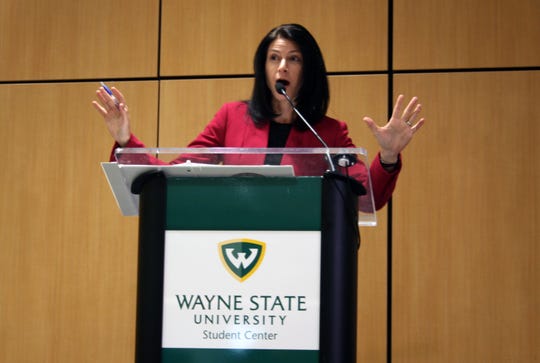

Attorney General Dana Nessel speaks to members of the public and the media at FOIA Fest, an event about the Freedom of Information Act, hosted by the Society for Professional Journalists at Wayne State University on Saturday.Detroit — Michigan Attorney General Dana Nessel told a room of journalists and members of the public that she is "deeply ashamed" that Michigan is the only state that exempts the governor, lieutenant governor and state lawmakers from Freedom of Information Act requests.

"We are not opening the doors to state government," Nessel said Saturday. "In fact, we are locking them with deadbolts, and then we are nailing boards across them, and then there’s a moat … that’s what FOIA feels like with our state government."

Attorney General Dana Nessel speaks to members of the public and the media at FOIA Fest, an event about the Freedom of Information Act, hosted by the Society for Professional Journalists at Wayne State University on Saturday.Buy Photo
Attorney General Dana Nessel speaks to members of the public and the media at FOIA Fest, an event about the Freedom of Information Act, hosted by the Society for Professional Journalists at Wayne State University on Saturday. (Photo: Kevin J Hardy / The Detroit News)

Nessel was the keynote speaker at a day-long festival focused on how to reform FOIA exclusions to the executive and legislative branches of government, developing a state ombudsman or independent commission for FOIA appeals, and reform excessive fees, delays and loopholes in the state's system.

Nessel, who took office in January, has called for more government transparency while noting Michigan's current FOIA restrictions.

"I can’t think of anything more important than to have the public have all the tools available to them and know how to get information," she said.

Kat Stafford, a reporter for the Detroit Free Press, introduced Nessel, saying the attorney general was invited to the FOIA Festival, hosted at Wayne State University by the Society of Professional Journalists, because she's been advocating the importance of government transparency for Michigan residents.
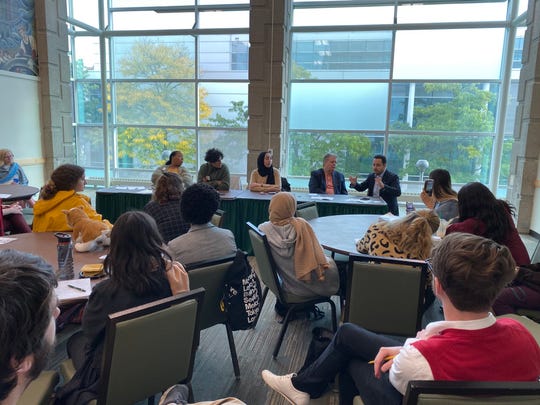
Current and former members of the The South End student newspaper at Wayne State University, which is funded by the university but is editorially independent, share difficulties of filing FOIA requests within their own campus and how they studied student press law after being restricted.Current and former members of the The South End student newspaper at Wayne State University, which is funded by the university but is editorially independent, share difficulties of filing FOIA requests within their own campus and how they studied student press law after being restricted.

Nessel also used the event to take a few shots at the Trump administration, saying the lack of transparency in Michigan is nothing compared to what is going on at the federal level.

"While I am embarrassed on various levels for our lack of transparency in Michigan, but what’s happening in the federal government right now is absolutely unacceptable," Nessel said. "Without these constructs in place, it will be the end of America as we know it."

Nessel also addressed the investigation of John Geddert, a former USA Gymnastics coach who oversaw a Michigan club where multiple victims of sexual predator Larry Nassar trained, Nessel said her office continues to try to get documents Michigan State University has withheld under attorney-client privilege.

MSU initially withheld 7,500 documents under attorney-client privilege and it appears as though her office is not going to see 6,000 of those documents because the university has "fought this office every step of the way."

She called it disingenuous that MSU would ask for the attorney general's office to investigate and then refuse to provide the evidence they need.

"We’ve taken this as far as we can. To fully complete our investigation, we absolutely need to have those emails," she said. "I would ask the board of trustees to reconsider and provide us with those 6,000 plus emails so we can actually complete our investigation."

Beth Konrad, president of the SPJ Detroit chapter and adjunct professor at WSU, said the idea for Saturday's FOIA festival was aimed to build greater awareness and understanding of FOIA and Michigan's Open Meeting Act for better government transparency.

Voting is beautiful, be beautiful ~ vote.©

Thursday, February 9, 2017

Whistleblowers Should Replace Regulators

Image result for joe courtney
U.S. Representative
Joe Courtney
In the spirit of deregulation, there seems to be a shift in the oversight authority back to the people.

U.S. Representative Joe Courtney has introduced the following Bill which has been referred to the U.S. House Committee on House, Education and the Workforce.

All I can do is cross my fingers that the Committee:

  • Does not keep whistleblower powers exclusive to federal employees;
  • Allow pro se standing through administrative remedies via referral coordination with EPA and IRS.  Make a community policing "court appointed" program for indigent whistleblowers to proceed with claims providing advocacy.  It is difficult for the indigent to access justice when your attorney breaks the seal of your case to work with the fraudfeasors and refuses to lift a finger to represent you in hopes the case is dismissed, with or without prejudice, because they know you will never be able to afford representation and you just gave them all the information to cover up these financial crimes. We possess the expertise as the original source, so listen to us; 
  • End all the Rule 9b dilatory volley.  A fraud is a fraud.  Refer it out to an IG, Ethics or DOJ to stop wasting time on litigating legal semantics; and,
  • Stop ignoring the desperately needed clean up with the crap about a state not being classified as an "individual" under the False Claims Act.   All this does is give a free pass to state and locally elected and appointed officials to use their offices for personal inurement with special federal powers of immunities to run taxpayer money-raping schemes through nonprofits into their re-election campaigns.
Come on, people, let us just keep it real and do what needs to be done to stop the dark money being siphoned through the black budget.

Pretty please, Pretty Preet?

If this does not get fast-tracked through Committee and both chambers, I am going to ethically castigate each and every official who is not in concurrence with me because each vote in opposition will be a red flag that they are engaging in fraudulent activities through their offices and campaigns.

If you want to get rid of regulations, then you better replace it with whistleblower empowerment protections. 

Every single federal department and agencies need whistleblower protections, including the States.

Period.

#Time2AuditGod

H.R.914 - To amend the Occupational Safety and Health Act of 1970 to expand coverage under the Act, to increase protections for whistleblowers, to increase penalties for high gravity violations, to adjust penalties for inflation, to provide rights for victims or their family members, and for other purposes.


Voting is beautiful, be beautiful ~ vote.©

Wednesday, March 2, 2011

Another Reason Why Child Welfare Fraud Is A Secret

Here are the latest opinions from the Department of Justice on FOIA.  This particular one is quite relevant as it deals with the publishing of information in violent legal matter of an individual who was under the custody of the state.

Once again, I present to the public one more finding of fact and conclusion of law as to why the standard of fraud is so high in child welfare.  Everything in foster care is a secret, including the murders, torture, drugging, rapes, mutilations, and especially the suicides, all funded by your hard earned taxpayer dollars.

Thanks for keeping the secret.


Courts of Appeal
1.Prison Legal News v. EOUSA, No. 09-1511, 2011 WL 72210 (10th Cir. Jan. 11, 2011) (Murphy, J.)
Re:  Request for videos depicting the aftermath of a brutal prison murder and autopsy photographs of the victim which were introduced into evidence and shown in open court
●  Exemption 7(C):  The Tenth Circuit affirms the finding of the district court that certain portions of video and audio recordings depicting the aftermath of a prison murder along with autopsy photographs of the victim were properly withheld to protect the privacy interests of the victim's survivors pursuant to Exemption 7(C).  Comparing the instant case with the facts presented in Favish, the Tenth Circuit finds that "the privacy interest in [the] images [here] is higher than the privacy interest in the photographs at issue in Favish."  "The photographs in Favish depicted the victim of an apparent suicide, . . . but the images did not involve grotesque and degrading depiction of corpse mutilation as do the images at issue here."  Additionally, the Circuit notes that "the images in Favish were all still photographs, whereas the video at issue here depicts corpse mutilation as it occurs."  Likewise, redacted audio portions contain "the voices of the perpetrators themselves describing the heinous acts in progress." 
The Tenth Circuit rejects plaintiff's argument that because the victim "was a prisoner and the images were taken in a prison cell, [he] himself had no expectation of privacy and his family likewise can have none."  Rather, the Circuit holds that "contrary to [plaintiff's] contention that any privacy interest of [the victim's] family is derivative of [the victim's] own privacy interest, family members' privacy interests under FOIA are independent interests." 
The Circuit rejects plaintiff's contentions that "the government was required to offer evidence of the family's objection and that the district court improperly made findings regarding the particular harm the family would suffer."  Instead, the Circuit finds that the "plain language" of Exemption 7(C) shows that "the test is an objective one and does not depend on the affected individuals' statements of objection or their personal views of the harm they might suffer." 
Although the Tenth Circuit finds the public availability of the records at trial "may impact the family's expectation of privacy in those materials[, it] does not negate it."  The court emphasizes that "[h]ere, the images are no longer available to the public; they were displayed only twice (once at each [defendant's] trial); only those physically present in the courtroom were able to view the images; and the images were never reproduced for public consumption beyond those trials."  As such, the Circuit concludes that the victim's "family retains a strong privacy interest in the images."  
With respect to the public interest in disclosure of the images, the Tenth Circuit determines that "[w]hile BOP's protection of prisoners and the government's discretionary use of taxpayer money may be matters of public interest, there is nothing to suggest the records would add anything new to the public understanding."  Moreover, the Circuit notes that EOUSA has fully released the portions of the video and audio files which depict BOP personnel's response to the incident.  The Circuit also finds that the information about the public interests identified by plaintiff, such as the conditions of confinement, the behavior of the two perpetrators and the nature of the mutilation of the corpse, is publicly available.  Accordingly, "to the extent any additional information can be gained by release of the actual images for replication and public dissemination, the public's interest in that incremental addition of information over what is already known is outweighed by the [victim's] family's strong privacy interests in this case."  Similarly, the Circuit concludes that the "audio recordings add little or nothing to the large amount of public knowledge about the crimes and the government's response to them." 
● Waiver:  The Tenth Circuit finds that the family did not waive their privacy interests by virtue of the fact that prosecutors used the images at trial, finding that "[t]he government cannot waive individuals' privacy interests under FOIA."  Additionally, the family's failure to object to the records being made public at trial has no effect on the Circuit's analysis because the "family members did not take any affirmative actions to place the images in the public domain." 
● Public domain doctrine:  With respect to the video and audio recordings at issue, the Circuit differentiates the instant case with the D.C. Circuit's decision in Cottone v. Reno, in which the D.C. Circuit applied the public domain doctrine to rule that the disclosure of wiretapped conversations covered by an Exemption 3 statute that had been played in open court were no longer exempt.  The Tenth Circuit finds that "[e]ven if this court adopted the public domain doctrine [in response to the government's use of the videos at public trial], it would not defeat Exemption 7(C)'s applicability in this matter because the purposes of Exemption 7(C) [i.e., to protect the privacy interests of the victim's family] can still be served."  Lastly, the Circuit rejects plaintiff's "suggestion that admission of certain records at trial is different from other types of public disclosures under FOIA," finding that "for the purposes of FOIA, the only relevant fact about the trial is the extent of disclosure."
● Agency records:  The Tenth Circuit rules that the district court incorrectly limited the reach of the FOIA "to records that shed light on governmental activity." 

Thursday, April 22, 2010

Why Standard of Fraud is So High in Child Welfare

Ever wanted to know why child welfare information and records are not open to the public?

Ever wanted to know why the circumstances of fraud in child welfare are so hard to prove in a court of law?

Well, here it is:

In the case of Tampico v. EOUSA, No. 04-2285, slip op. at 8 (D.D.C. Apr. 29, 2005), the court clarified the position that is applied to all child protection cases, as it is a federally funded law enforcement action by qualifying certain records containing identifying information pertaining to children involved in criminal proceedings by statute to the Freedom of Information Act under Exemption 3.

Congress exempted nine categories of documents from the broad disclosure requirements of the Freedom of Information Act. Exemption 3 applies to documents that are specifically exempted from disclosure by another statute. 5 U.S.C.S. § 552(b)(3). Exemption 6 protects personnel and medical files and similar files the disclosure of which would constitute a clearly unwarranted invasion of personal privacy. 5 U.S.C.S. § 552(b)(6). Exemption 7(C) excludes records or information compiled for law enforcement purposes, but only to the extent that the production of such materials could reasonably be expected to constitute an unwarranted invasion of personal privacy. 5 U.S.C.S. § 552(b)(7)(C).

Then, under the Federal Victims Protection and Rights Act (3) the term “child abuse” means the physical or mental injury, sexual abuse or exploitation, or negligent treatment of a child. 

As seen in the language of the statute, the terms "child abuse" and "child neglect" are fungible. One in the same.

But this still begs the question, "Why are the state contracted child placing and child welfare agencies, States and U.S. Administration for Children and Families not subject to disclosure of operations for publication in the media?

Here is the case.

UNITED STATES DEPARTMENT OF JUSTICE et al. v. REPORTERS COMMITTEE FOR FREEDOM OF THE PRESS et al.

No. 87-1379

SUPREME COURT OF THE UNITED STATES

489 U.S. 749; 109 S. Ct. 1468; 103 L. Ed. 2d 774; 1989 U.S. LEXIS 1574; 57 U.S.L.W. 4373; 16 Media L. Rep. 1545

December 7, 1988, Argued
March 22, 1989, Decided

The court addressed whether disclosure of the rap sheet constituted an unwarranted invasion of privacy within the meaning of 5 U.S.C.S. § 552(b)(7)(C). The court held that the fact that an event was not wholly "private" did not mean that an individual had no interest in limiting its disclosure. The privacy interest in a rap sheet was substantial. Whether an invasion of privacy was warranted had to turn on the nature of the requested document and its relationship to the basic purpose of the FOIA, which focused on the citizen's right to be informed about the government's actions. The news groups in this case did not intend to discover anything about the conduct of the agency, and response to the request would not shed any light on the agency's conduct. Thus, the public interest in release of a rap sheet was not the type of interest protected by the FOIA. The court held, as a categorical matter under § 552(b)(7)(C), that a third party's request for law enforcement records about a private citizen could reasonably be expected to invade that citizen's privacy, and that when the request sought no official information about the government, the privacy invasion was unwarranted.

This is interpreted to mean that it would be an invasion of a child's privacy, or in more familiar terms, not in the "best interest of the child" to release under FOIA any federally funded law enforcement activities pertaining to child abuse for publication in the media. This was theory was qualified under FOIA Exemption 6.

But of course, there is another reason why child welfare is so secretive. We know there are federal enforcement statutes to provide accountability against child welfare fraud, but the U.S. Department of Health and Human Services Office of Inspector General has what is called in the legal community, "Safe Harbor Provisions". Safe Harbor are exactly what you think; they are a place in the law where an individual or corporation can go to as a safe haven when it has been found that they have been practicing questionable and improper billing cost activities that are punishable by law.
HHS OIG Solicitation for Safe Harbors and Fraud Alerts 2009

Now, we can understand why the MFCUs and the States Attorney General will do nothing, (except for Roy Cooper) as they are too lazy to find the statutory passage to go into the "Exemption 3 and 6 safe harbor" and attack the Child Welfare Medicaid Fraudfeasor with full prosecution and recovery.

We can also understand why Child Abuse Propaganda continues to thrive as there is no public scrutiny of the data that is generated nor the research that is published as we can see "abuse and neglect" are lumped into the same Exemption categories.  With poverty codified as neglect, the propaganda campaigns are in full force.   Nothing more than malafide scienter on the part of these universities to protect federal aberrant billing practices.
Michigan Child Abuse Prevention Month Complete Toolkit 2010


Each state has a Medicaid Fraud Control Unit (MFCU), stationed in with the States Attorney General. These MFCUs has the powers and funding to stop Medicaid fraud. Section 1128B(b) of the Social Security Act (the Act) (42 U.S.C. 1320a–7b(b)) provides criminal penalties for individuals or entities that knowingly and willfully offer, pay, solicit, or receive remuneration in order to induce or reward business reimbursable under the Federal health care programs. The offense is classified as a felony and is punishable by fines of up to $25,000 and imprisonment for up to 5 years. OIG may also impose civil money penalties, in accordance with section 1128A(a)(7) of the Act (42 U.S.C. 1320a–7a(a)(7)), or exclusion from the Federal health care programs, in accordance with section 1128(b)(7) of the Act (42 U.S.C. 1320a–7(b)(7)), yet enforcement is exempted under 3 and 6 of FOIA.

This is why only the bravest warriors enter the battlefield of the court to bring forth qui tams.

The barriers of entry into the "safe harbor"  in alleging fraud or mistake in child welfare claims as a party must state with particularity the circumstances constituting fraud or mistake in a court of law.  It becomes an epic battle of honor for the parties who choose to battle the ugly beast named fraud in child welfare.   Even though malice, intent, knowledge, and other conditions of a person's mind who commits child welfare fraud may be alleged generally in litigation, it is still the burden of the party to educate the court on the facts, the honor of the warrior to tell his story...


Stop Child Welfare Fraud

It must be noted that there is still no mention of any oversight of the pervasive fraud, just focusing on child welfare, with TRICARE the military and military families version of Medicaid. Also, child welfare fraud is not exclusive to Medicaid, as the false claims exist in the areas of Title IV-E, the next largest area of child welfare fraud.