I did not find any other media outlet, except for Buzzfeed, nor did I find any Detroit Black Lives Matter protest groups raise one eyebrow with a shooting which happened down the street, but I did come across this.
Just as pianists must play their instrument’s black and white keys to make great music, so must America draw on her black and white citizens to make a great country. That is why the partnership between the Detroit Branch NAACP and the Michigan Land Use Institute is music to the ears of those who believe in reaching across racial, cultural, and geographic boundaries. And that is why our shared vision must resonate throughout Michigan, from its great southern cities to its splendid northern forests.
Our hopeful partnership aims to replace the unfortunate dearth of urban voices addressing land use issues with a new song that unifies city and countryside in ways that, even very recently, few would have thought possible. Without it, there will be little progress in urban revitalization or land preservation.
Living for the City is a vital first step. Focusing on Detroit, we are addressing three issues crucial to its long-delayed renaissance: Public transit, affordable housing, and race relations.
Public transit’s goals: Accessible, reliable, convenient, and affordable.
Detroit once operated the nation’s largest municipally owned transit system. Fifty years ago, that system annually carried 492 million riders; the Woodward Avenue trolleys rarely required more than a five-minute wait. Today, Detroit’s transit system is an embarrassment and a trial for those who use it. Yet one-third of Detroit residents have no car; for them, getting to work can be a nightmare. They are constantly at risk of losing their jobs because the buses often make them late for work. Dependable public transportation is a basic necessity that Detroit simply must regain.
Detroit — In the latest blow to the Detroit Police Department, already reeling with nearly 500 officers quarantined, Chief James Craig announced Friday he tested positive for COVID-19 after feeling "feverish."
Craig designated Detroit Assistant Chief James White, the longest-tenured assistant chief, in his place while he seeks treatment.
Mayor Mike Duggan announced during his daily COVID-19 update that Craig had contracted the virus. The chief confirmed the news during a brief telephone conversation.
"I feel alright," Craig told The Detroit News. "A little feverish, but I'm hanging in there."
Hollywood James Craig
The chief tested positive Friday morning but was not hospitalized, Duggan said.
"It's something that we knew was a possibility," the mayor said. "He is very fit and mild in symptoms and is very much in charge of running this department. But he's not going to be back on site until he fully recovers."
According to Duggan, Craig chose White to take his place because White had been on quarantine and tested negative. White has a “deep understanding of the risks officers are facing each day,” the mayor said.
White said he is assuming the day-to-day operations, but Craig is still "locked-in," checking in hourly and driving the department.
"The chief is very fit, focused on nutrition and exercise, and we hope that will help his recovery," White said.
Duggan said as the department deals with the latest news, there's still work to be done.
“We’re going to continue to ramp up the care for our police and fire departments,” he said. “This is a major focus of our work right now.”
As of Friday, 39 Detroit police officers tested positive for COVID-19, 468 officers are on quarantine, 35 results are in the process of returning, 119 are awaiting testing, Duggan said.
A strict return-to-work plan is being implemented for the police department and the city’s fire department. With the new process, workers will be tested for fever before starting every shift, no more than two members in an elevator at any time, hugging is prohibited, and officials will distribute masks in an effort to keep members safe.
Many of the quarantined workers are anxious to get back to work, White said.
“We’ve already taken steps to redeploy personnel,” White said. “I, myself, recently returned to work from being quarantined. The process worked for me. After my test results returned, I was able to return to work, and I’m committed to ensuring that every member of this department is safe."
Duggan, meanwhile, said he has not been tested because he doesn’t have symptoms and said he has tried to stay 6 feet from everyone, including Craig.
Duggan said vulnerable police departments are not just happening in Detroit.
"In the New York Police Department, they've got well over 300 officers who have tested positive for COVID-19, and three of their highest police officials have also tested positive," Duggan said.
"This is the world that we live in now. The focus of medical directors with first responders is to protect them from being infected from the citizens they interact with."
Detroit police commissioner Willie Burton said the police department has been hit hard by the virus.
“Right now, I’m asking the community to pray for this department, and pray for Chief Craig’s speedy recovery,” he said.
Burton said the department is in capable hands with White, who has been directing the department’s COVID-19 response strategy.
“DPD has many highly-trained assistant chiefs and deputy chiefs who are capable of getting the job done,” Burton said. “AC White has many years of experience and will be able to step in for the chief in this crisis."
Where Sherry the Sleuth's nonprofit, blighted
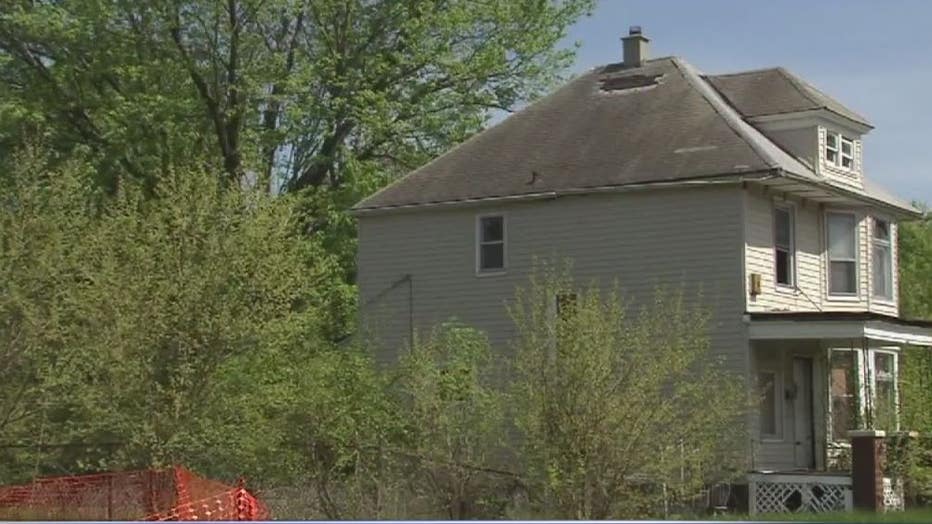
Detroit Land Bank Authority house was demolished
DETROIT (FOX 2) - Detroit police say they've identified the contractor behind the mysterious demolition of State Rep. Sherry Gay-Dagnogo's house, and that they're moving forward with a criminal complaint.
Gay-Dagnogo told the media on Sept. 30 that her house in the 14500 block of Minnock had been demolished without her knowing, and that she herself didn't learn about it until about a week later.
"I was like, 'They had to make a mistake, surely they couldn't ... what do you mean it's not there?'" she told us.
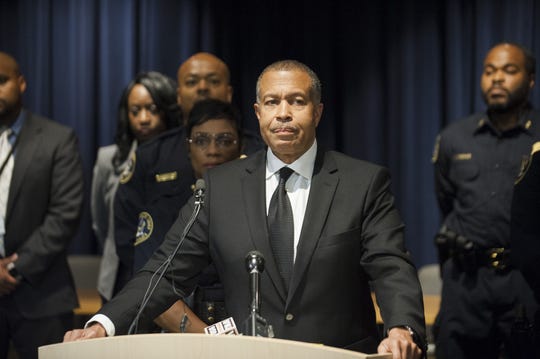
Detroit police chief James Craig said at a news conference Wednesday afternoon that they've submitted a warrant for Sherman Gipson of Gipson Brothers Trucking for malicious destruction of property greater than $20,000.
Craig says they learned of Gipson's alleged involvement in the demolition thanks to a prescription bottle that was left of dropped on the property bearing his name, along with surveillance footage from a nearby Green Light station that showed the vehicle.
However, Craig says the investigation would've gone much quicker had Gay-Dagnogo told police a crucial piece of evidence - that she had previously solicited bids for demolition of this property.
He says that knowledge would've led investigators to the perpetrator much sooner, though Craig insists the house was still taken down without permission and that Gay-Dagnogo didn't know about it.
When asked why she didn't reveal her solicitation for bids earlier in the investigation, Gay-Dagnogo told police she simply didn't think it was relevant to the investigation. She said she had reached out to get quotes for either repairing or demoing the home, which she planned to gift to a needy family.
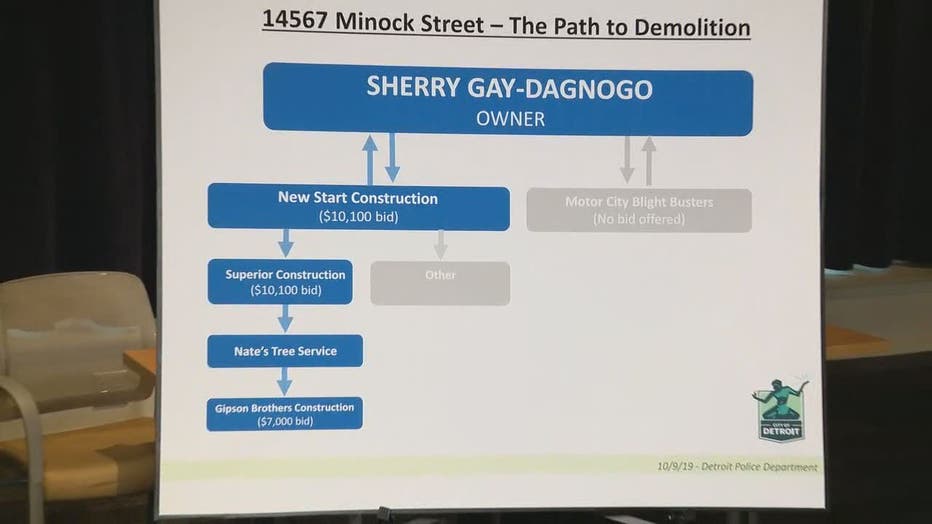
The house demo bids from New Start Construction then trickled down through subcontractors to Gipson Brothers Trucking, who Craig says eventually took down the house without permission.
The why, though, in all of this still isn't clear.
"I can't speculate what was in the contractor's mind when he decided to take it down without permission," Craig said, "but we're clear in that the state representative didn't give the direction and that she didn't know."
Craig said Gipson also didn't pull any permits or consult with the Michigan Department of Environmental Quality before the demolition.
Gipson currently is not facing charges and is not in custody, as the police department works to submit the warrant to the prosecutor's office.
"Will Prince Archie get a reparations check, too?"
FOX 2, or anyone with a camera rolling, should ask Rashida, "What is your measurement used to determine if someone is African-American."
That should be fun.
Will there be any due process to challenge being omitted from this reparations check classed based animus?
Then, there is that pesky issue with identifying individuals who are not formally recognized as U.S. citizens, or have multiple identities, or victims of child trafficking, or are brought as foreign political operatives....oh, the list of legally established measurable variables goes on and on for those privatized local governments known as sanctuary cities.
Which foreign corporation is the administrator of record of the data?
DETROIT (FOX 2) - Congresswoman Rashida Tlaib told Chief James Craig on Monday that analysts who work with the facial recognition software should be African-American only.
It is something Tlaib, a lawyer, later told FOX 2 wouldn't even be legal to hire someone solely on race.
On Monday Tlaib said in a Detroit News online video: "Also, analysts need to be African-Americans, not people that are not. No, it happens all the time, it is true. I think non-African-Americans think African-Americans all look the same."
Craig responded in that video saying, "I trust people who are trained. Regardless of race, regardless of gender."
FOX 2: "Are her comments racist?"
"I think they are racist, I don't know (if) we can call it what we want," Craig said Wednesday.
Chief James Craig is not mincing words after showing how the hotly debated facial recognition technology works to the congresswoman who has been adamantly against it.
Her concerns are regarding the reliability in identifying people of color.
"The facial recognition software is racist in itself," Tlaib said.
The Detroit News was rolling when Tlaib said analysts who work to identify potential criminals with the software should be African American…not, non-African American.
"It's a double standard," Craig said. "Certainly as the police chief of this city, if I had made a similar comment, people would be outraged and they would be calling for my resignation."
FOX 2: "Do you wish you would have said it differently?"
"I'm trying to say it needs to be reflective and if you look at the video I think you can see I'm trying to respectfully disagree," Tlaib said.
Tlaib cited several studies for support on how people of one race identify another.
"The science supports what I'm saying," Tlaib said.
FOX 2: "I'm not asking what the science is saying I'm asking what you're saying?"
"I repeated what the science said," Tlaib said. "I think if you talk, not just to me ... "
FOX 2: "The science says that black analysts should be hired?"
"No," she said. "It says there are mistaken people that cannot identify African-Americans, no, no, no, it's okay, we aren't going to get into an argument about this.
"Please ask African-Americans in my district."
Craig says the software is one tool for investigators and although it isn't 100 percent accurate, trained analysts fill in the gaps.
"I'm not even going to try and understand why the comments were made," Craig said. "Let's just simply say it was improper, it wasn't right and we should be talking about other things."
Tlaib says many of her constituents are against facial recognition - that's why she has been so outspoken. She is actually behind two bills to ban the technology and prevent the cameras from going into public housing.
Top, from left: Arthur Jemison, Dave Massaron. Bottom: Rochelle Riley, Chief James Craig
It's a veritable champagne party inside Detroit city hall's executive suites.
The size of Mayor Mike Duggan's administration and the salaries paid to his 500+ appointees have ballooned to outrageous proportions for a recently bankrupt city.
According to records obtained by Deadline Detroit under the Freedom of Information Act, about 12 dozen people in the Duggan administration earn six-figure salaries that average $142,000 a year.
That comes to $20 million a year – or the equivalent of 1 percent of Detroit's total budget – for just 140 individuals. Good work, if you can get it. Good work if you know the right people.
And this tally does not include benefits, personal service contractors, lawyers on retainer, grants for girlfriend's pet projects, or bloated agencies like the Detroit Land Bank, also controlled by Hizzoner. (Word has it employees there are in line for tasty raises.)
As a comparison, Mayor Dave Bing had just a dozen appointees earning above $100,000 before the city filed for bankruptcy.
Ex-Mayor Dave Bing (Photo: Wikimedia)
If Detroit was really doing as well as the administration would have you believe, who would give a rip? What's a few million bucks? Everyone expects a little graft and a little grease in municipal politics.
But what makes the profligate salaries truly obscene is what Detroit really is outside the silk-stocking corridor of Downtown and Midtown.
Yes, there are two Detroits
A dozen shootings in a 10-hour period on July 4 alone, and 33 shootings over the long holiday weekend, five of them fatal. Cops, medics and firefighters continue to head for the suburbs since pay and benefits are so measly.
Retirees are forced to spend their pensions on colostomy bags, since the bankruptcy settlement. Response times to emergency calls are routinely fudged, and a continual “No Units Available” mantra is broadcast across the city.
Demolitions costs have gotten so high that two federal grand juries have been convened. We had a serial killer running around, who you might remember was not a serial killer, until he was a serial killer. And now the alleged serial killer, strangely enough, has yet to be charged with a serial killing.
Detroit is a city where nearly half the adult population does not have a job. Detroit is a city where the median income for an entire family is $26,000. Detroit, the city where 650,000 people live, is the most violent in the United States.
A matter of priorities
This is a city where the machine pays itself handsomely, pumps out fake statistics to justify it, borrows money at junk-bond rates for sweetheart deals to developers and leaves the tax burden to the poorest urban dwellers in America. And business owners who don't play ball with the machine? They lose out to their competitors who do play.
I know, I know -- shut up, LeDuff.
Detroit is doing great, you say. Look at all the new jobs, you tell me.
Yes, but most of those “new” jobs went to suburbanites whose companies relocated to Detroit from the metro region to dodge taxes there.
In fact, Detroit residents saw 5,000 jobs evaporate over the past five years, according to one study.
In this “other” city, 14,000 families are in danger of losing their homes to tax foreclosure. Water shutoffs continue as temperatures rise.
Downtown, the hogs are getting fat. In the neighborhoods, the wolves are gaunt, and teeth are starting to bare.
Really, the best money can buy?
But we need to pay competitive salaries to attract the best of the best, goes the argument from City Hall.
John Roach, the mayor's $126,863 mouthpiece, issued a statement Wednesday night:
The City of Detroit has balanced every budget since the Mayor took office, gotten out of state financial oversight and run annual budget surpluses. The list you received from your FOIA request shows employees who are defined as appointees because they are not union members or civil servants. Many of them are not appointed by the Mayor.
Roach goes on to note that 14 people identified by the city as mayoral appointees are actually employees of the Department of Homeland Security, and some city positions are grant funded.
Nevertheless, the Mayor has assembled a full-blown propaganda platoon humping his message. They include former reporters, producers and videographers who used to cover the mayor and city hall.
These media types number about a dozen by my count. Rochelle Riley, the former Free Press columnist, is the latest. She will earn $134,441 as the newly created director of arts and culture.
What qualifications does Riley have for her new job? Beats me? But she is a member of the Michigan Journalism Hall of Fame!
Let's look at some of the other appointees with whom Hizzoner has surrounded himself and paid handsomely.
David Manardo, who was intimately involved in the mayor's demolition program, which is now the subject of a long running federal corruption probe, earns $231,531 per year, according to the city records.
David Massaron, the city's chief financial officer, earns $187,305. What is his financial experience? He was a lawyer who put the financing together for the new Flint water system. And you know how that turned out.
Arthur Jemison earns a cool $184,400 as the city's chief of services and infrastructure, who oversaw the Detroit's use of federal funds to help entrepreneurs. That program is frozen and under federal review.
Police Chief James Craig is the highest-paid appointee at $254,447 – about the same as the superintendent of police in Chicago, a city with four times as many residents as Detroit.
That doesn't stop him from stacking the organization at the top. According to city records, Craig has three assistant chiefs and five deputy chiefs, all appointed.
Collectively, Craig's eight top underlings average salary is $137,000 per year. Though Craig continually claims crime to be falling at record levels (a claim that our analysis shows to be suspect), the chief found it necessary to launch a “Check Yourself, Stop The Violence” public relations campaign a few weeks ago after a barrage of shootings began the summer.
The campaign seems to be working, that is, if people take it literally. Within six hours of rolling-out “Check Yourself,” at least five people were checked into the hospital with gunshot wounds; at least two others checked into the county morgue.
Our latest Geointeresting #podcast features NGA’s Director of Research & an NGA scientist discovering the latest in hyperspectral signatures – two women at different stages of their career, but both strong advocates for women in the #STEM field. Listen up! https://t.co/vK7Plnlr7wpic.twitter.com/JyOhUWZaUg
The Detroit Board of Police Commissioners tabled a controversial vote Thursday around the use of facial recognition technology in city neighborhoods.
“It’s still under review, so we cannot move forward at this particular time," Commissioner Willie Bell said, explaining that discussions around that particular surveillance directive were still being hammered out with Police Chief James Craig and Mayor Mike Duggan.
While the facial recognition vote was put off, the board did move forward and approved (6-3, with one abstention) a related directive dealing with rules around cameras mounted onto traffic lights throughout the city's neighborhoods.
"Yes, the traffic light was dealing with face recognition, but we separated it out, they were combined together but they're two separate entities," said Bell.
Community members, who spoke during the public comment period, expressed a different point of view, indicating that they saw the two issues as inextricably tied.
“I understand that you said facial recognition is not on the agenda today, but you moved forward and voted on traffic cameras that will have the capabilities of that technology," said Detroiter Tawana Petty.
“This facial recognition technology has been utilized for a couple of years without transparency and then the minute we get an opportunity to vocalize our concerns on it, it’s rushed through with little accountability," she continued. The city purchased facial recognition software in July 2017 for just over $1 million.
Willie Burton, one of the three commissioners who voted against the traffic directive, agreed with Petty stating that it was impossible to isolate the two directives.
"It was all presented together and now all of a sudden they want to separate it because they knew the community was coming out to speak against it," said Burton.
“This tech has been removed from body cameras in other police depts, it’s banned in SF. The very technologists who created it said it’s harmful and biased. It doesn’t recognize darker skins” - Tawana Petty speaking against facial recognition tech today at police commissioner mtg pic.twitter.com/OKRDYa4jfM
In a rundown of what occurred around the facial recognition directive and why it got pushed back, Gregory Hicks, the board's secretary, explained that the commissioners responded to the original facial recognition directive with 17 recommendations and Assistant Police Chief James White responded with the approval of all but two. The changes were then incorporated in the directive but "at last minute the department requested to pull back" the facial recognition vote.
Hicks said he does not know why the department pulled the directive and that as of now there is no new date for a vote.
“This tech has proven to be inaccurate/misidentifies particularly ppl of color, ppl who look like me, ppl who live/work in my community. I have every right to move thru this city w/o my movements being tracked/watched under the guise that this will make me safer” - Janice Gates pic.twitter.com/Pkg4AwWRCw
Both directives involve the "Neighborhood Real-Time Intelligence Program," a new $9 million initiative that Duggan announced in March at his State of the City address. Using local and federal traffic modernization funds, the city will put high-definition cameras at various intersections in the neighborhoods. They will be monitored by Detroit Public Works staff at the Real Time Crime Center within the Detroit Police Department's Public Safety headquarters downtown.
By the end of 2019, cameras are set to be installed at 11 intersections on the Greenfield and East Seven Mile corridors. Additionally, the Department of Public Works will add cameras to 29 intersections across the city. In 2020, an additional 400 cameras will be added.
“These are the traffic cameras we’re putting up. We will get shots of the perpetrators as they go past and we’ll be able to chase them down,” Duggan said at his State of the City.
Under the traffic-light directive that passed Thursday, Detroit police are prohibited from using the footage or images from the traffic light cameras to enforce traffic misdemeanors or pedestrian laws or to issue civil infractions of any kind. The cameras cannot be used to assess immigration status or engage in immigration enforcement. And DPD cannot use audio from the cameras unless there is a verified court order.
Footage and images obtained from the traffic light-mounted cameras can be used for "legitimate law enforcement purposes," defined as investigations into criminal activity, the pursuit of a criminal suspect, the monitoring of an ongoing situation "in which criminal activity is, or is reasonably expected to occur."
DPD is not prohibited from focusing cameras on handbills, flyers or other materials carried pursuant to the First Amendment, but they will "avoid" doing this.
While some checks are in place, critics remain concerned, especially when considering the yet to be voted on directive that deals with facial recognition.
Worries hit on privacy and the silencing of free speech to the actual efficacy of the technology.
Last year, the American Civil Liberties Union of California tested images of members of Congress on "Rekognition" — Amazon's facial recognition tool. The organization found that of the 535 faces inputted, the software falsely matched 28 with people who had been arrested on criminal charges. Additionally, the software gave false matches for 39% of the minority members, who comprise only 20% of Congress.
Such issues were raised in a May inter-office memo sent to the commissioners. The document cited a January report that found that facial recognition technology showed a lower accuracy rate for African Americans and another that found that artificial intelligence assigned more criminal intent to black men based on difficulties interpreting emotions of black faces.
"That is enough to justify voting against it," said Eric Williams, an attorney working with the ACLU on a committee opposing the city's surveillance tactics. "If it said this for white men and women, this wouldn't even be considered."
Last month, San Francisco — seen by many as the center of the tech-universe — became the first major city to ban police use of the technology, citing several of the concerns Williams and other critics of the software have raised.
"We have an outsize responsibility to regulate the excesses of technology precisely because they are headquartered here," Aaron Peskin, the city supervisor who sponsored the bill, told the New York Times at the time.
This point was raised by Petty during her public comment Thursday.
"I have to push you all to at least understand the technology you’re implementing," she continued. "This will be the largest experiment on black people in the United States — 700,000 black people being submitted to an experiment that has already failed all over the world."
While the directives in question have been discussed in relation to the Neighborhood Real-Time Intelligence Program — the use of such technology and surveillance is not new in Detroit. This is just the latest surveillance project in an ever-expanding network.
The public-facing push to ramp up surveillance began in January 2016 when DPD launched Project Green Light. Starting with eight gas stations, the program has participating businesses pay for and install surveillance cameras on their property that feed directly to DPD's Real Time Crime Center. Additionally, as part of the program, businesses commit to ensuring they have robust lighting and a green light outside of their vicinity to let customers know they are a part of the program.
Today, more than 500 businesses — including churches, schools, and pharmacies — are a part of the program. There are also two "Green Light Corridors" and one public housing property signed on to be part of the program.
Prior to the launch of Project Green Light, however, city officials were thinking about surveillance and specifically facial recognition software.
"FACE Watch Plus tracks face images from live video surveillance, processes the images, then searches your database and alerts you when a match/hit has been made," the proposal explained. "It detects faces within surveillance footage in real-time, then uses cutting-edge facial searching algorithms to rapidly search through your agency's mugshot or watchlist database for positive matches."
The 2017 contract, which expired on Wednesday, explained that the purchase of facial recognition licensing, software and equipment was for "Project Green Light Locations."
Despite this stated use, a May report from Georgetown Law Center on Privacy & Technology noted that nowhere on the Green Light website was the use of face recognition, real-time face surveillance, or any kind of automated face analysis technology mentioned.
This, according to Clare Garvie, a senior associate at the center and co-author of the report, is a problem.
"It should be up to communities to decide whether the benefits of face recognition outweigh the risks and whether these benefits to public safety mean that this technology can and should be used on them," said Garvie.
"What we found in Detroit is the decision to purchase not just face recognition — the ability to do investigations using face recognition — but the ability to do face surveillance was not something that was ever presented to the public," she continued. "It never appears to be presented to the Project Green Light partners, and yes that is absolutely a discussion that should have taken place before the city spends over a million dollars on a system."
For some of the Detroiters in attendance at the vote Thursday, the delay seemed to exacerbate questions of accountability.
"If you can’t even conduct a vote with integrity," asked Janice Gates, "how do you expect us to believe that you will use facial recognition with integrity?"
Detroiter Eric Blount echoed her sentiments.
"It feels like this meeting agenda switch is a sleight of hand switch, so many people came out here thinking they were going to understand and better express themselves on facial recognition and a last-minute switch," Blount said. "I just ask you to stick to the agenda, if there is any possibility that it will be changed, do it far in advance, because these meetings are very inconvenient for most people who have to work."
To begin, I do not believe these Child Protective Services workers should be blamed for the child's death for the following reasons, so let us start with the "Right To Lie" federal case which sets forth the question:
Wayne County CPS Workers Elaine Brown and Kelly Williams
blamed for the death of Aaron Minor
In this report, it is unknown if these workers lied which is really not at issue here.
What is at issue are roles and responsibilities of the players in child welfare.
Let us take a bottom up look at statutory authority in the food chain of child welfare.
CPS operates as the intake under the powers of the State, not local, which means the role of prosecution does not fall upon Wayne County Prosecutor Kym Worthy, but instead, upon the State Attorney General.
Wayne County is the only county of the State where the State Attorney General prosecutes child welfare cases.
Next, upon review of the statements of the anonymous child welfare worker, who, obviously does not possess a legal background, fails to even realize that the one main, and constitutional, reason why the Detroit Police Department will not just bust into a home, based on what CPS calls "exigent circumstances", is because police are supposed to possess a signed warrant, not rubber stamped.
But, as I have always said, there are no civil rights in child welfare.
Continuing on up the CPS food chain, Wayne County Child Protective Services follow the policies set by the State of Michigan, under the leadership of the Department of Health and Human Services, where the latest Director Nick Lyon, who is too busy preparing for his legal defense, with the taxpayers dimes, is a tad bit too busy to address the egregious fraudulent billing, including civil and human rights violations of human trafficking in child welfare.
If one ever took the time to do a time series of expenditures...what a minute, I constructed that model over a decade ago... one will observe, with crystal clarity, that it should appear as odd that each year there is not volatility in caseloads.
Same number of cases opened; same number of cases sustained; same number of foster care placements; same number of termination of parental rights.
But of course, for those who are loyal fans very well know, there were substantial errors in that particular case because HHS lied to the federal court.
Without going into my ad nauseum on that federal oversight case with Children's Rights, there was not a peep on the filing of false cost reimbursements or that magical and secretively omnipotent organization called Michigan Children's Institute, which has never been audited.
This takes us to the upper echelon of Michigan's child welfare administration where many of its leadership, civil servants and contractual arms, are playing the immunity game.
If, in the even the OCO actually does find violations, it is sequestered from the public due to those lovely privacy laws in child welfare, because, as we all know, well, at least the state administrators do, the Attorney General exists in that particular conundrum of contemporaneously "advising and advocating".
How can the State Attorney General prosecute these CPS workers when it is obligated to defend its actors while it prosecutes child abuse and neglect in Wayne County?
Ok, in this particular case, CPS had a referral from a mandatory reporter to check on a mental health patient, who, more than likely, according to the report, was in a situation of "food scarcity".
Food scarcity is the fancy new term which means the state has significantly cut, or even, severed, SNAP food benefits.
Now, let us examine this particular component of the story.
The mother was poor, with mental health needs she was obviously addressing, which means to mean she was receiving Social Supplemental Income, federal welfare, as the national trend is to dissolve the social safety net without any replacement.
If she was receiving $733 a month, that means her SNAP benefits were cut to $18 a month, which includes a child in the home.
This means if she needed food, as the shift is to send the poor to the food pantries, praytell, my gentle readers, how is a mother, with disabilities and an infant, supposed to: (1) get to the food pantry without transportation as some set distribution in vehicle food lines; and, (2) get to and from the food pantry having to pay bus fare from her monthly allotment of $733, and pay her bills?
Let us not even waste our precious time to contemplate if the mentally ill have the ability to even execute this aforementioned food gathering task.
Drive through food line distribution of the week for a
family of 4. (Industrial case of mustard, 2 cabbage, 4 butternut squash,
pre-rotten tomatoes, 2 bags of rice, out-dated milk,
and frozen-thawed-frozen-thawing chicken quarters.)
I do not know about the rest of you, but to me, the unraveling of the social safety net for the most vulnerable, or rather, "The Poors", is a scheme to hustle more federal dollars through privatization, because someone has to make a profit and these poorly trained CPS workers. lacking of resources for proper referrals to prevent situations such as this tragedy, should not be held liable for the unintended death of the child.
The same poor quality of services can be seen in mental health.
They, the CPS workers, were, including the mother and the child she just lost, are part of the food chain in the perverse child welfare system which is only a foreshadowing of its final stage of privatization.
It is my belief that the workers possesses legal claims against the State of Michigan and should be approached by the legal community.
Call me, I will consult.
This is a principal-agent issue where the State should be blamed and federal court oversight should continue.
 First, this happened...