Showing posts with label Grand Bargain. Show all posts

Friday, February 15, 2019

Cocktails & Popcorn: Travis Weber, One Of The Legal Geniuses Behind The Michigan Emergency Manager Law, Flint, Detroit Bankruptcy & Grand Bargain Extracts Himself From Humanity

Image result for billie holiday drinking whiskey
"Who's next?"
Travis Weber has extracted himself from humanity, the method for those of low esteem when it comes to preserving the annals of history.

He failed to tell the world his story, a breach of the children's trust.

Travis became his own, self anointed arbiter of justice by setting precedent in this deontological usurpation of a civil society by and through stealin' the children, the land and the votes.

Who is next?

Mackinac Policy Conference Update: Manufacturing Has a Perception Problem

Day Two: Auto industry expert David Cole and BorgWarner Chairman Tim Manganello

Mackinac Policy ConferenceBy Kurt Brauer, Partner
Automotive industry expert David Cole noted that many Americans simply aren't aware of the import role manufacturing plays in our economy.  How do you accelerate the creativity and innovation in the auto industry and find ways to integrate it into other products and services?

Collaboration is a key element to getting intellectual property from the automotive sector into other sectors.  Cole noted there are more than 350 R&D automotive facilities in Michigan.  We need to significantly increase the "aura" of manufacturing in this state to make it an aspiration, rather than a job of last resort.

Cole said that we need to focus on the choke-points in manufacturing, such as maintaining key suppliers and a developing a properly trained workforce.  He encouraged the crowd to reach out to young women in our society to get them involved in R&D and manufacturing in the automotive sector.

BorgWarner Chairman and CEO Tim Manganello noted that the automotive, aerospace, electronics and chemical industries account for 60 percent of the R&D spending in the United States -- and 60 percent of the R&D spend on automotive is in Michigan. Clearly, he said, this gives Michigan a competitive advantage. 

But we need to focus on education so that we have a well-trained, competent workforce. Manufacturing has a perception problem with potential employees. Instead of choosing manufacturing as a career, people have focused on "chasing the money" and taking jobs in the service economy. This has meant a loss of interest in science and math.

Manganello noted that this is changing, however. If we focus on advanced manufacturing, research and development, we will be globally competitive over the long haul, he said, pointing out that BorgWarner invents technology here and exports it worldwide.

Other 2012 Mackinac Policy Conference Updates:


  • Off to a great start
  • Michigan doesn't need elephant hunters
  • CNN's Zakaria Says Feds Must Invest in the Future
  • Detroit's Tale of Two Cities
  • Corporate Investment in Communities
  • Michigan Origins, Global Destinations
  • Moving Urban Areas Forward
  • New Bridge, New Detroit and New Commitment to Education

  • Ex-Snyder legal counsel Travis Weber remembered for intellect, passion for Detroit


  • Weber recently joined Warner Norcross + Judd's Southfield office
  • He played a key role in crafting legislation for Detroit bankruptcy "grand bargain"
  • Weber was seen as a rising star in the state's legal community

  • During former Gov. Rick Snyder's second term, then-Lt. Gov. Brian Calley knew he could call chief legal counsel Travis Weber for a detailed briefing on the issue of the day that they were navigating.


    Travis Weber
    Any issue.

    "It didn't matter how obscure it was," Calley said Wednesday. "It didn't matter what the issue was. He was always on top of it. He knew about it and he knew how to lay it out to me."

    Snyder's close-knit team was grief-stricken Wednesday in the wake of the Weber's abrupt death, less than a month after the 33-year-old attorney joined Warner Norcross + Judd as senior counsel in the Grand Rapids-based law firm's Southfield office.

    The Saginaw native, who moved to Detroit two years ago, spent four years in the governor's office and two years as an attorney and senior policy adviser in the Michigan House of Representatives, working under former Speakers Jase Bolger and Kevin Cotter.

    "He loved public service and took bettering the state seriously," said Valerie Brader, a former attorney in Snyder's office and co-owner of Rivenoak Law Group PC in Troy. "He loved the city of Detroit and was very excited to get his own place there and live there the last two years."

    Weber earned his juris doctorate degree from Valparaiso University School of Law, graduating cum laude in 2011, according to the obituary.

    During his time in the House, Weber played a key role in crafting the legislation that helped Detroit emerge from bankruptcy in late 2014, Bolger said.

    Weber is credited with drafting the "grand bargain" legislation that became the Michigan Financial Review Commission Act, a state law that put in place long-term state oversight of Detroit's finances after it emerged from its historic Chapter 9 bankruptcy.

    "His contributions on the Detroit bankruptcy settlement were immeasurable," Bolger said Wednesday.

    "His apparent pain is a gut-wrenching reminder that none of us know what it's like in another person's shoes."

    The Saginaw native, who moved to Detroit two years ago, spent four years in the governor's office and two years as an attorney and senior policy adviser in the Michigan House of Representatives, working under former Speakers Jase Bolger and Kevin Cotter.

    "He loved public service and took bettering the state seriously," said Valerie Brader, a former attorney in Snyder's office and co-owner of Rivenoak Law Group PC in Troy. "He loved the city of Detroit and was very excited to get his own place there and live there the last two years."

    Weber earned his juris doctorate degree from Valparaiso University School of Law, graduating cum laude in 2011, according to the obituary.

    During his time in the House, Weber played a key role in crafting the legislation that helped Detroit emerge from bankruptcy in late 2014, Bolger said.

    Weber is credited with drafting the "grand bargain" legislation that became the Michigan Financial Review Commission Act, a state law that put in place long-term state oversight of Detroit's finances after it emerged from its historic Chapter 9 bankruptcy.

    "His contributions on the Detroit bankruptcy settlement were immeasurable," Bolger said Wednesday.

    "His apparent pain is a gut-wrenching reminder that none of us know what it's like in another person's shoes."

    Weber joined Snyder's office as a deputy legal counsel in April 2015, working under then-Chief Legal Counsel Beth Clement until Snyder appointed her to the Michigan Supreme Court. Clement mentored Weber and the two remained close friends since, former governor's office aides said.

    Clement, Brader and Weber were the front-line attorneys for Snyder during the fallout from the Flint water crisis in 2016, when the state was getting hit by a crush of civil lawsuits and document requests from legislators, Congress, the U.S. Justice Department, the attorney general's office and news media.

    "Travis and I pulled an all-nighter together during the heart of the Flint matter," Brader said Wednesday. "He split his dinner leftovers with me when we were too late to order more food in — and was as cheerful and dedicated at 4:30 in the morning as he was at 4:30 in the afternoon."

    For Snyder's final 14 months in office, Weber was the governor's chief legal counsel, navigating a labyrinth of end-of-term legal issues ranging from commutation requests and judicial appointments to reviewing hundreds of bills that crossed Snyder's desk in his final weeks.

    "That's a big job for somebody his age — but we knew he could do it," Calley said. "And he did it really well."

    In October, Snyder appointed Weber to the Northern Michigan University board of trustees for a term that began Jan. 1 and was to expire at the end of 2026. He also was a member of the board of trustees for the Children's Hospital of Michigan Foundation, according to the his NMU biography.

    "Travis was an outstanding individual and attorney who made Michigan a better place," Snyder wrote Wednesday in a LinkedIn message to Crain's. "Our thoughts and prayers are with his family and friends. He will be remembered as a person who made each one of us better. We will miss him."

    Weber is survived by his mother Colleen Weber; brother, Jeffrey Weber; grandparents Bernard and Ruby Cooper; close cousins and a special friend, Amanda Elias. He was preceded in death by his father, William Weber.

    A memorial service is planned for 2 p.m. Monday at Hopevale Church in Saginaw.

    Memorial donations may be made to Children's Hospital of Michigan Foundation.

    On Wednesday, Weber's former colleagues in state government were trying to make sense of his passing.

    "I had planned to spend decades laughing with Travis and celebrating what I was sure would be his many triumphs," Brader told Crain's. "Having those years of future friendship and laughter suddenly disappear is bewildering and horrible."


    The origins of the Flint Water Crisis and the role of the Genessee County Land Bank.
    Voting is beautiful, be beautiful ~ vote.©

    Friday, November 23, 2018

    From Michigan Emergency Manager To Sherpa - Fox Rothschild Busted In Another Grand Bargain Trust Fund Fraud Scheme

    Michael A. Sweet
    Michael Sweet
    Fox Rothschild expert on the
    filing of the Detroit Bankruptcy
    FUN FACT! FOX ROTHSCHILD WAS ALL UP IN THE DETROIT BANKRUPTCY

    Just as Michael Sweet.

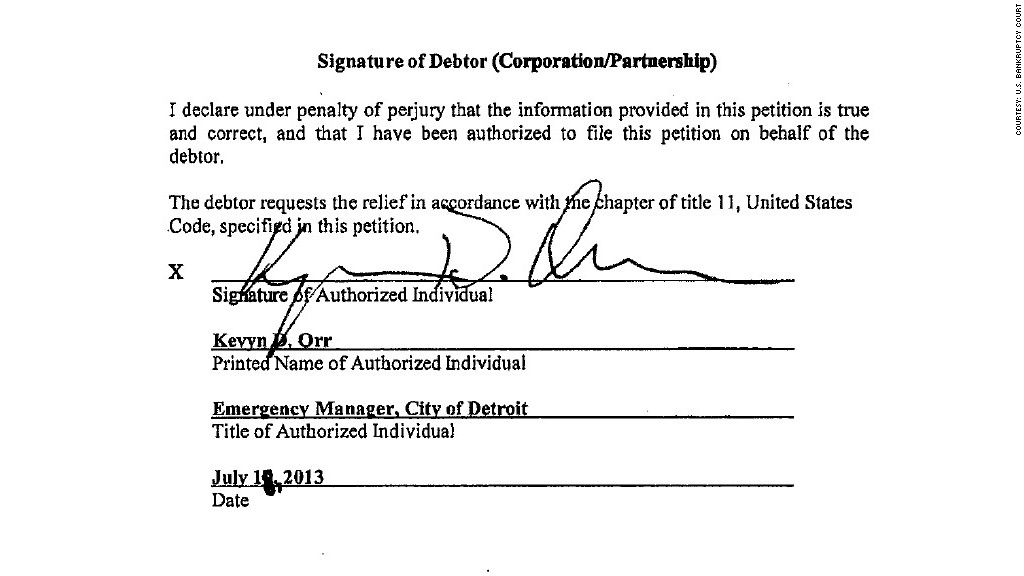
    As seen here, Kevyn Orr was "authorized" to file this bankruptcy petition on behalf of the debtor, when the debtor was in state court arguing against it.

    Witness the miracle of cell phones.

    Detroit bankruptcy filing came with only 5 minutes to spare

    kevin orr signature

    Rule 3004. Filing of Claims by Debtor or Trustee


    If a creditor does not timely file a proof of claim under Rule 3002(c) or 3003(c), the debtor or trustee may file a proof of the claim within 30 days after the expiration of the time for filing claims prescribed by Rule 3002(c) or 3003(c), whichever is applicable. The clerk shall forthwith give notice of the filing to the creditor, the debtor and the trustee.


    Ok, I am just going to ask this only once, because I have been over this a few too many times, but can someone, anyone, tell me how is it that a private individual, who is not elected, represent a State in federal court, when the State Attorney General is representing the State in the State Court of Claims?

    The Michigan Emergency Manager does not have any statute "authorizing" representing the State of Michigan in a court of law because that is the job of the State Attorney General.

    There is nothing where it says an Emergency Manager can just up and make itself the trustee of a city and represent itself as an individual.

    The Act, itself, gives the Emergency Manager, hailing from the executive branch, judicial powers to make judgments.

    LOCAL FINANCIAL STABILITY AND CHOICE ACT (EXCERPT)Act 436 of 2012
    Sec. 18.
    (1) If, in the judgment of the emergency manager, no reasonable alternative to rectifying the financial emergency of the local government which is in receivership exists, then the emergency manager may recommend to the governor and the state treasurer that the local government be authorized to proceed under chapter 9. If the governor approves of the recommendation, the governor shall inform the state treasurer and the emergency manager in writing of the decision, with a copy to the superintendent of public instruction if the local government is a school district. The governor may place contingencies on a local government in order to proceed under chapter 9. Upon receipt of the written approval, the emergency manager is authorized to proceed under chapter 9. This section empowers the local government for which an emergency manager has been appointed to become a debtor under title 11 of the United States Code, 11 USC 101 to 1532, as required by section 109 of title 11 of the United States Code, 11 USC 109, and empowers the emergency manager to act exclusively on the local government's behalf in any such case under chapter 9.
    (2) The recommendation to the governor and the state treasurer under subsection (1) shall include 1 of the following:
    (a) A determination by the emergency manager that no feasible financial plan can be adopted that can satisfactorily rectify the financial emergency of the local government in a timely manner.
    (b) A determination by the emergency manager that a plan, in effect for at least 180 days, cannot be implemented as written or as it might be amended in a manner that can satisfactorily rectify the financial emergency in a timely manner.
    (3) The emergency manager shall provide a copy of the recommendation as provided under subsection (1) to the superintendent of public instruction if the local government is a school district.
    I am sure there are those wondering, "how the heck does she know all this stuff?"
    No automatic alt text available.
    Simple. It is nothing but the Michigan Children's Institute law because the Superintendent is the same as the Emergency Manager, except the Emergency Manager law skipped a few steps in due process because it failed recognize a municipality as a public trust and recognized it as a private corporation to initiate seamless asset forfeiture proceedings.

    The Children's Trust Funds started here in Michigan and is nothing but the original chattel ponzi scheme, just like they did with the real estate of Detroit, because it all ends up in some form of complex financial fraud scheme as a children's NGO trust.


    And to to think, this all started in Detroit.

    Anyway, I am quite sure Fox Rothschild has alot more of these ponzi schemes using trust funds, but hey, what do I know?

    Fox Rothschild Headed to New Jersey Supreme Court in Case Stemming From Ponzi Scheme

    The high court's review follows an appeals court ruling that revived a claim from a U.K. real estate investor alleging Fox Rothschild improperly let $2.4 million flow through an attorney trust account to a fraudster.


    The New Jersey Supreme Court will review a London-based real estate investor’s lawsuit accusing Fox Rothschild of improperly transferring $2.4 million from the firm’s attorney trust account to now-convicted Ponzi schemer Eliyahu Weinstein.

    With a notice handed down Nov. 16 and made public Monday, New Jersey’s high court agreed to consider whether U.K. real estate investor Moshe Meisels can maintain his claims of conversion and breach of fiduciary duty against Fox Rothschild. Meisels alleged that he was bilked by Weinstein—who previously pleaded guilty to running a yearslong, real estate Ponzi scheme that caused $200 million in losses—and that more than $2.4 million he lost moved through Fox Rothschild’s attorney trust account.

    The state high court’s review comes after an intermediate appeals court in June revivedMeisels’ conversion claim against the law firm, while it also kept intact a trial court’s dismissal of the fiduciary breach claims.

    Meisels alleged that he and Weinstein reached an agreement to invest in property in Irvington, New Jersey. In connection with that deal, Weinstein in 2007 directed Meisels to transfer a portion of the investment into Fox Rothschild’s attorney trust account, according to court documents. Weinstein, who was later sentenced to 22 years in prison for his Ponzi scheme, told Meisels at the time that Fox Rothschild was carrying out legal work on the property purchase.

    Meisels transferred the money, and it later went into the coffers of some of Weinstein’s businesses, with $75,000 of it going to Fox Rothschild. The money was never used to purchase any property and, in his suit against the firm, Meisels alleged that Fox Rothschild effectively aided Weinstein as he carried out his fraud.

    Lawyers from Fox Rothschild attacked Meisels’ claims on several fronts, ultimately convincing a trial court to dismiss them in a summary judgment ruling. Among other arguments, Fox Rothschild said Meisels couldn’t pursue his conversion claim because he didn’t do enough to show that he actually owned the money he allegedly lost, and because he never demanded its return.

    Meisels countered that, while the transfers to the attorney trust account technically came from a company called Rightmatch Ltd., the business was serving merely as a conduit for the London-based Meisels to help convert his own personal funds from the British pound to U.S. dollars.

    In June, the Superior Court of New Jersey, Appellate Division found against the law firm on both of those arguments. The appeals court held that Meisels had done enough to prove it was his money that flowed through the firm’s trust account. The court also noted that under the facts of this particular case, Meisels wasn’t required to demand his money back to be able to claim conversion in court.

    The appeals court did, however, come down on Fox Rothschild’s side with respect to Meisels’ breach of fiduciary duty claim. The appellate ruling affirmed the trial court’s conclusion that Fox Rothschild didn’t owe any fiduciary duty to Meisels, leaving that claim dismissed.

    Fox Rothschild’s defense lawyer, Francis Devine III of Pepper Hamilton, did not immediately respond to a request for comment, nor did a lawyer for Meisels, Brian Condon of Condon Catina & Mara in Nanuet, New York.

    Read More:

    Voting is beautiful, be beautiful ~ vote.©