Showing posts with label Brett Kavanaugh. Show all posts

Sunday, September 13, 2020

Prelude To Detroit: Ted Cruz Releases His Religious Freedom Restoration Act Legal Defense Playbook On Parental Rights.

Ted Cruz is releasing his talking points playbook on the Religious Freedom Restoration Act battle to continue stealin' the children, land & vote. 

Ted also ran with the crew, John Roberts and Brett Kavanaugh on the Bush v. Gore case.

That means he was mean to my Sweetie.

Naughty, naughty Ted!


I also know Jeff Sessions may possess mastery on the original intent of the Religious Land Use and Institutional Persons Act.


But, I absolutely know that this is about trafficking tiny humans, or rather, in a nutshell, gerrymandering.

#maytheheavensfall


Voting is beautiful, be beautiful ~ vote.©

Wednesday, January 15, 2020

Ken Starr Predicts Impeachment Witnesses Through His Whitewater Powers Of Refusing To #sayhisname

What if Ken Starr is to be a witness in the Senate impeachment trial?

What if Ken Starr becomes indicted by a grand jury?

What if we just sit back, with cocktails & popcorn in in hand and enjoy the falling of the heavens.


#sayhisname

Voting is beautiful, be beautiful ~ vote.©

Friday, September 6, 2019

Friday, August 9, 2019

The Tale Of Judiciary Jolly Jerry's Quest For Brett Kavanaugh Working Papers

Gather round, my dearies, for the Celestial Goddess of the Woodshed shall tell the tale of Judiciary Jolly Jerry and his quest for Brett Kavanaugh's Working Papers.

Once upon a time, there were these FOX operatives, for it is impossible for me to recognize them as journalists, who peddle their wares by distracting the public with flesh, devoid of sources or intellect, which could have easily have been found with a basic internet search for the Wikipedia entry.


Brett did not just work with Ken Starr, he also was the one who worked on numerous investigations
The Ken Starr Special Counsel Team, featuring Brett Kavanaugh
of Bill Clinton's presidency, and allegedly wrote the Ken Starr Report, which unlocked the constitutional mechanisms for House Judiciary to commence impeachment proceedings.

Now, with this Wikipedia information in hand, executed through a basic Google search of the term "Brett Kavanaugh", this brings us to Monica Lewinsky.

It seems Brett worked with the former Chief of Staff for House Judiciary, Julian *Slimy Slime Slime* Epstein, of which I never queried on how he got the job, but I will just go out there on a limb and say Hillary Clinton more than likely had something to do with Julian getting hired because she worked on the Nixon impeachment proceedings.


She just refuses to #sayhisname


Julian *Slimy Slime Slime* Epstein, known for his "fabulous" New York parties, set up the impeachment hearings by making it into a sex scandal with Monica Lewinsky, then denied her due process of legal representation or the right to testify and tell her story, which was Whitewater.

Whitewater was the progenitor of the Detroit Land Bank Authority and was set up by Perkins Coie, which sucks.


So, now it seems Jolly Jerry Nadler is going after Brett's work product to find out how they switched out Special Counsel Bob Fiske, who supposedly was investigating the original model for stealin', which was transposed and enhanced for Detroit, recognized as the Arkansas Finance Development Authority, and replace it with #MeToo to impeach Trump.

But Doug Collins, the Ranking Member, does not like that idea of digging for a way to launch impeachment proceedings and really does not want to deal with the fact that he will not #sayhisname, nor does he want to be indicted for what happened in House Judiciary, the congressional votes, the GOP, and the children.

Doug has fear in his eyes, but only I can see it, well, maybe not just me....

I know Justin Amish knows why Doug has fear.

I know Bob MAXIMUS GOODLATTECUS Goodlatte knows the origin of this fear.

Jason Chaffetz also knows what this fear is.

Brett used to work on George Bush's campaign with John Roberts in the Florida ballot "chad" issue.

Brett also worked as a staff secretary during 911, so Brett knows stuff because he was recruiting federal judges for appointments.

Senate Judiciary knows all about this, but intentionally neglected to address this in Brett's SCOTUS confirmation hearings, and instead, pulled the old switch-o-change-o model and give the public another sex scandal, to distract the masses in another Pied Piper campaign, just like they are trying to do with the impeachment proceedings.

See, the impeachment proceedings are really not about Trump.

The impeachment proceedings are being constructed as a cover up for not having to #sayhisname, but they have no choice but to #sayhisname because I am going to make them say it.

This is sanguinely entertaining because I know Slimy Slime Slime is advising Jolly Jerry.

This is about Medicaid fraud in child welfare and we are in a Constitutional Crisis.


#sayhisname

Jerry Nadler makes new push for Kavanaugh’s White House records


House Judiciary Committee Chairman Jerry Nadler is moving to bring new scrutiny to Supreme Court Justice Brett Kavanaugh’s past, asking the National Archives on Tuesday to release a large cache of records related to his time in George W. Bush's White House.

In a letter from Nadler and Rep. Hank Johnson (D-Ga.), another senior Judiciary Committee member, the lawmakers said accessing the records are essential to "the public's faith in the integrity of the judiciary."

The effort reopens a debate over Kavanaugh's nomination, which became the subject of fierce partisan rancor during his confirmation hearings last year after Kavanaugh faced allegations of sexual assault.

Democrats also argued they lacked access to records pertaining to Kavanaugh's government work that were important to his qualifications. Ultimately, the Senate supported his nomination along nearly partisan lines, but Democrats vowed to continue seeking records about his background.

Nadler and Johnson emphasized that the Senate only received a sliver of Kavanaugh's records from his White House tenure, which ran from 2001 to 2006, when he served in the White House counsel's office and later as staff secretary.

Then-Senate Judiciary Committee Chairman Chuck Grassley requested records from Kavanaugh's time in the counsel's office but later withdrew his request after the committee received some of the documents it sought.

But Nadler and Johnson say the likelihood that Kavanaugh will rule on matters like abortion rights, executive authority and other topics within the purview of the Judiciary Committee increases the urgency for them to obtain the full slate of records from his White House tenure — information they say is on track to be released in 2021 anyway under the Presidential Records Act.

In the interim, the committee members say the National Archives and Records Administration should begin producing documents that Grassley initially requested and then, on a "rolling basis," Kavanaugh's emails and any "textual records" in his office files from his time as staff secretary.

The top Republican on the House Judiciary Committee ripped Nadler's push as "harassment" of Kavanaugh.

“Chairman Nadler’s request is so far outside the scope of judicial ethics, it’s harassment,” said Rep. Doug Collins (R-Ga.). “Senate Democrats spent months launching false accusations in an attempt to smear Justice Kavanaugh’s reputation and block his confirmation to the U.S. Supreme Court, and now House Democrats want to follow suit with yet another fishing expedition to tarnish his good name.”

Voting is beautiful, be beautiful ~ vote.©

Monday, June 10, 2019

Cocktails & Popcorn: Kavanaugh Is Back And So Is Another Scandal - Chua & The Constitutional Crisis

Have you ever wondered how SCOTUS does its legal research?

The clerks!

Yes, once Mommy and Daddy drops those dollars for the sheep skin, the newly graduated Yale "Legal Genius" (trademark pending) gets her first job with SCOTUS.

But in this case, it looks like a quid pro quo, but hey, what do I know?

I know we are heading for a Constitutional Crisis.

I also know those clerks get emails, with pre-written, private, foreign interest opinions for the Justices to use.

Kavanaugh defender Amy Chua's daughter gets Supreme Court job with Kavanaugh


Amy Chua, Sophia Chua-Rubenfeld and Brett Kavanaugh. (Photo illustration: Yahoo News; photos: Peter Kramer/NBC/NBC NewsWire via Getty Images, via Twitter, Doug Mills/The New York Times via AP, Pool)
Amy Chua and Brett Kavanaugh
Three days after President Trump nominated Brett Kavanaugh as his pick for the Supreme Court, the Wall Street Journal published an op-ed by Amy Chua, a Yale Law professor better known as the author of the 2011 parenting memoir “Battle Hymn of the Tiger Mother,” who praised Kavanaugh as a mentor to young women.

Chua, a member of the school’s clerkships committee, had placed eight women with Kavanaugh, including her daughter Sophia Chua-Rubenfeld, who had been accepted to serve with Kavanaugh, then a circuit court judge.

Some critics called the op-ed self-serving, arguing that Chua was simply setting her daughter up for a Supreme Court clerkship once Kavanaugh was confirmed.

On Monday, the Supreme Court announced that Sophia Chua-Rubenfeld had been hired by Kavanaugh for a clerkship beginning in October.

On Monday, the Supreme Court announced that Sophia Chua-Rubenfeld had been hired by Kavanaugh for a clerkship beginning in October.

Neither Chua nor her daughter responded to requests from Yahoo News for comment.

Kavanaugh was confirmed to the Supreme Court in October following a bitterly divisive nomination fight that included allegations of misbehavior from multiple women, which he denied. During his confirmation hearing, Christine Blasey Ford testified that Kavanaugh had attempted to rape her at a party when they were teenagers.

While the Senate weighed those allegations, the Guardian first reported that Chua and her husband, Jed Rubenfeld, advised female students that it was “not an accident” that Kavanaugh’s female law clerks all “looked like models” and to project a “model-like” femininity if they wanted to clerk for him.

Chau denied the allegations.

"For the more than tec years I've known him, Judge Kavanaugh's first and only litmus test in hiring has been excellence," she said in a subsequent statement.  “As I wrote in the Wall Street Journal, he has also been an exceptional mentor to his female clerks. Among my proudest moments as a parent was the day I learned our daughter would join those ranks.” 

Rubenfeld himself was the subject of an internal investigation at Yale concerning allegations of inappropriate behavior with female students.

Voting is beautiful, be beautiful ~ vote.©

Thursday, January 3, 2019

Tenth Circuit Kicks Back Kavanaugh Ethics Complaints To SCOTUS John Roberts

Well, I bet this is awkward in SCOTUS.

The State of Michigan Attorney Grievance Commission told be to go hire an attorney, like that was going to happen.

Council Reviewing The Kavanaugh Ethics Complaints Punts Back To Chief Justice Roberts

When we last checked in with Brett Kavanaugh back in October, he was performing his judicial duties as a lifetime Justice of the U.S. Supreme Court, even though Chief Justice Roberts had referred 15 ethics complaints against him for review by the Chief Judge of the 10th Circuit in Colorado. No one knew what would happen next.

On December 18, we found out. While much of the country was preoccupied with the government budget shutdown, the 10th Circuit Judicial Council quietly issued its non-verdict , below, in the matter, announcing:
  • that the original roster of 15 complaints had swollen to 83 complaints;
  • that the ethics complaints against Kavanaugh were “serious”; but
  • that the 10th Circuit Judicial Council had no jurisdiction to rule on them; and
  • that the complainants had a brief period to request a review.
In effect, they said, back to you, Chief Justice Roberts: it’s your problem, not ours.

The Elaborate Dance Of Pass-The-Buck

Here is the sequence of moves to date, which resemble a dance routine in a Gilbert & Sullivan musical comedy,
  • Before and after Kavanaugh’s nomination hearings, complaints initially came to Chief Circuit Judge Merrick Garland. Garland recused himself in the matter, since he himself had been nominated for the Supreme Court by President Obama but was denied even consideration by the Senate for purely political reasons.
  • The complaints then passed to Judge Karen LeCraft Henderson of the DC Circuit, who concluded that more than a dozen of the complaints were substantive enough to warrant investigation and she referred them to Chief Justice Roberts.
  • Chief Justice Roberts waited until Kavanaugh had been confirmed by the Senate and then requested the 10th Circuit “to exercise the powers of a judicial council with respect to the identified complaints.
  • The Chief Judge of the 10th Circuit duly formed a Judicial Council which has now declared that it has no such powers. Although the complaints are “serious,” it has decided it has no jurisdiction to rule on them, on the grounds that Kavanaugh is no longer a judge covered by the Judicial Conduct and Disability Act.
  • The 83 complainants were given 42 days to appeal the ruling, i.e. until January 30, 2019.
  • As any appeal will be heard by the same Tenth Circuit that has already declined jurisdiction, there is little prospect of any change in its ruling.
  • The 83 ethics complaints against Kavanaugh will likely soon be back in the lap of Chief Justice Roberts for him to review, act on, or pretend that judicial misconduct never happened and hope that the smell goes away.
The Judicial Ethics Complaints Are “Serious”

The 10th Circuit Judicial Council didn’t totally ignore substance. It stated the obvious with its finding that “the allegations contained in the complaints are serious."


The complaints fell into three main categories. Some relate to complicated matters of fact involving Kavanaugh’s actions many years ago, which might be difficult to verify or resolve.

Other complaints concern Kavanaugh’s behavior as a Judge on the Court of Appeals by favoring certain parties or interests, on which opinions may differ.

The third and most obviously problematic category of the complaints concerns Kavanaugh’s behavior during the nomination proceedings in September 2018. The Judicial Council summarized:
Justice Kavanaugh made inappropriate partisan statements that demonstrate bias and a lack of judicial temperament; and treated members of the Senate Judiciary Committee with disrespect.
Unlike the first two categories of complaints, the third category concerns behavior that was shown on national television. There is thus no question as to whether the behavior in question occurred,
Nor is there any significant question whether the behavior involved extreme breaches of judicial ethics. As one of the complainants, Larry Behrendt, wrote in the Washington Post:
Kavanaugh peppered two hours of Senate testimony with attacks against people and groups he associated with Democrats. Kavanaugh alleged (without factual basis) that he was the victim of a vast, secret, left-wing cabal, masterminded by senators such as Dianne Feinstein (D-Calif.) and motivated by “revenge on behalf of the Clintons.” … [He carried on] like a crazed conspiracy theorist.”
Kavanaugh’s behavior at the hearing prompted several thousand law school faculty to sign a letter opposing his confirmation because "he did not display the impartiality and judicial temperament requisite to sit on the highest court of our land."

In a Wall Street Journal column after the Senate hearings, Kavanaugh acknowledged that his tone was “sharp” and that he “said a few things [he] should not have said” out of frustration at being wrongly accused. He pledged to be “even-keeled, open-minded, independent,” but failed to fully acknowledge what he had done wrong or to formally apologize.

Kavanaugh’s Get-Out-Of-Jail-Free Card

The main elements of the Judicial Council’s decision are:
  • Judicial Councils are created by the Judicial Conduct and Disability Act, 28 U.S.C. which applies to Circuit Judges, not to Supreme Court Justices:
  • Kavanaugh was a D.C. Circuit Court judge at the time of most of the behavior under complaint; but
  • Kavanaugh’s elevation to the Supreme Court means that the Act no longer applies to him; and
  • His elevation to the Supreme Court is “an intervening event” which removes him from any scrutiny by the 10th Circuit Judicial Council.
Following this topsy-turvy reasoning, the Judicial Council would have jurisdiction only if Kavanaugh had not been confirmed by the Senate. In effect, the Act would only apply to ethical missteps if no harm was done. “It’s like saying,” as Behrendt explained in the Washington Post, “we can prosecute a safecracker only if the safe proved to be empty,”—the kind of a tortured legal reasoning that Gilbert & Sullivan would have deeply appreciated.
The Judicial Council also declared that
the Act and Rules provide that a misconduct proceeding can be concluded because of "intervening events," namely, circumstances where an individual is no longer a covered judge.
However, this reasoning seems to be a misreading of the language of the Act. As Behrendt points out:
the Judicial Council truncated the relevant rule, which allows for a complaint to be dismissed if “intervening events render some or all of the allegations moot or make remedial action impossible.” Kavanaugh’s elevation to the Supreme Court did not render moot the questionable behavior that helped him win that seat. Nor is remedial action impossible now that Judge Kavanaugh is Justice Kavanaugh. Brett Kavanaugh can still issue the kind of full apology he has avoided up until now, and he can recuse himself from highly partisan cases (those with Trump as a party, for example.)
In order to avoid ruling against Kavanaugh, the Judicial Council also had to overcome the relevant Commentary on the Act which states that
as long as the subject of a complaint performs judicial duties, a complaint alleging judicial conduct must be addressed.
Even though Kavanaugh can be observed performing judicial duties on a daily basis as a Justice on the Supreme Court, the 10th Circuit Judicial Council found a way to conclude that Kavanaugh is “no longer performing judicial duties.” The Council argued that the Act limits “judicial duties” to those of the Court of Appeals but not those of the Supreme Court. Hence Kavanaugh is no longer performing judicial duties. Here again, the Judicial Council’s reasoning is of the kind that Gilbert & Sullivan greatly savored.

As New York University law professor Stephen Gillers has argued, “Any violation of the Code does not disappear because he is now on another federal court.”

"Ethically," Bloomberg's Noah Feldman writes, "the situation is more than a little bit outrageous."

What Was Chief Justice Roberts Thinking?

Chief Justice Roberts' letter directed the 10th Circuit “to exercise the powers of a judicial council with respect to the identified complaints.” Now the 10th Circuit has concluded it has no such powers. What was Chief Justice Roberts thinking when he issued his directive?

One possibility is that Roberts had given no thought as to whether the Tenth Circuit had jurisdiction, and like the rest of us, didn’t know what to expect. Given his abiding interest in enhancing the standing and stature of the Supreme Court, that seems supremely unlikely.

Another possibility is that he was expecting the 10th Circuit to decline jurisdiction, after which he could say that he had done his best but sadly there was nothing to be done. This also seems unlikely since it would leave the Supreme Court tainted for a generation with a Justice who has multiple “serious” unresolved ethical complaints made against him—hardly an outcome the Chief Justice can have anticipated with relish.

Would we be naïve in thinking that Chief Justice Roberts actually meant what he said and was expecting the 10th Circuit Judicial Council to rule on the substance of the judicial ethics complaints against Kavanaugh? The complaints concerned obvious breaches of judicial ethics. By choosing the Republican-oriented 10th Circuit, Roberts ran no risk of being accused of stacking the deck against Kavanaugh. He was inviting the 10th Circuit to state the obvious. If that was his intent, the Chief Justice was thwarted by the Judicial Council’s decision that although the complaints were “serious,” it had no jurisdiction.

We are thus now in the strange situation that there seem to be no rules of ethical conduct for Supreme Court Justices. Once upon a time it might have been argued that there was no need to any such rules, since Supreme Court Justices were obviously beyond reproach. With the events of 2018, that is no longer the case.
Gabe Roth, executive director of Fix the Court, a nonpartisan group that seeks more accountability on the high court, told the Washington Post that “it is wholly unsatisfactory to anyone looking for moral leadership from our nation’s top jurists.” The decision of the Judicial Council, he said in a statement, underscores the need for the Supreme Court to adopt its own code of conduct or for Congress to write one.”

In 2011, Chief Justice Roberts indicated that he did not believe that Congress has any right to make ethics rules for the Supreme Court. In a 2011 report, Roberts wrote that “the justices consult the code to address specific ethical matters, and comply with financial rules and limitations on the receipt of gifts and outside earned income. But they do so voluntarily, Roberts wrote, hinting that congressional attempts to impose standards may violate the separation of powers.”

Among the questions facing Chief Justice Roberts is this. If it is true that the Supreme Court Justices "voluntarily comply" with normal standards of judicial ethics, when are we going to see this "voluntary compliance" in the case of the 83 "serious" judicial ethics complaints against Justice Kavanaugh? If the Justices can pick and choose when they want to following normal standards of judical ethics or not, hasn't the Supreme Court turned itself into yet another institution that is acting as though it is above the law?

In any event, is the learned Chief Justice correct that Congress is powerless to impose ethical standards on the Supreme Court? Supreme Court Justices are subject to other laws passed by Congress, like the law against bribery. "A ban on bribery is effectively a restriction on how judges do their jobs. If Congress can pass that, why can’t Congress impose other legal restrictions on conduct that potentially perverts the course of justice?"

What Is Justice?

Meanwhile, at least for now, Kavanaugh carries on with his judicial duties with a life-tenured seat on the Supreme Court, despite everything. Since his arrival at the Court , the Justices have been conducting themselves with extreme collegiality and the Chief Justice has been carefully avoiding any political drama. No one is impolite enough to mention the 83 “serious” ethics complaints against one of their members, that remain unaddressed.

Outside the court, Kavanaugh has kept a low profile, although he has been treated as a celebrity by the President and at Republican events. Kavanaugh’s supposed “martyrdom” was a key theme in the Republican successful mid-term election campaign to defend the Senate. Despite Kavanaugh's furious insistence during the hearings that his life had been destroyed and he might never coach again, he has resumed his position as a girls’ basketball coach. He recently received a “hero’s welcome” at his old prep school. Overall, things are going just fine.

Life goes on. But to call this justice is to misunderstand the meaning of the term and construe it in the sense that Gilbert & Sullivan, not James Madison and the Founding Fathers of this country, intended.

Voting is beautiful, be beautiful ~ vote.©
Saturday, December 22, 2018

Cocktails & Popcorn: Her Flatulent Boviness, Sheila Jackson Lee & Her DOJ Treason Investigation Update

Image result for cocktails and cows
"Damn, I need a drink and a good
legal defense team." said
Her Flatulent Boviness
 I wonder what else Sheila Jackson Lee, Her Flatulent Boviness, and her rogue ass crew were doing up there in Judiciary.

Perhaps, we should just wait for DOJ to finish up what they are doing on the complaint and affidavit, below.

I bet they thought they would never get caught being mean to my Sweetie.

That is how you know you are dealing with "Legal Geniuses" (trademark pending).

COURT: EX-SEN. HASSAN IT AIDE WHO ALLEGEDLY DOXXED SENATORS ‘DOWNLOADED MORE INFORMATION THAN WAS ORIGINALLY UNDERSTOOD

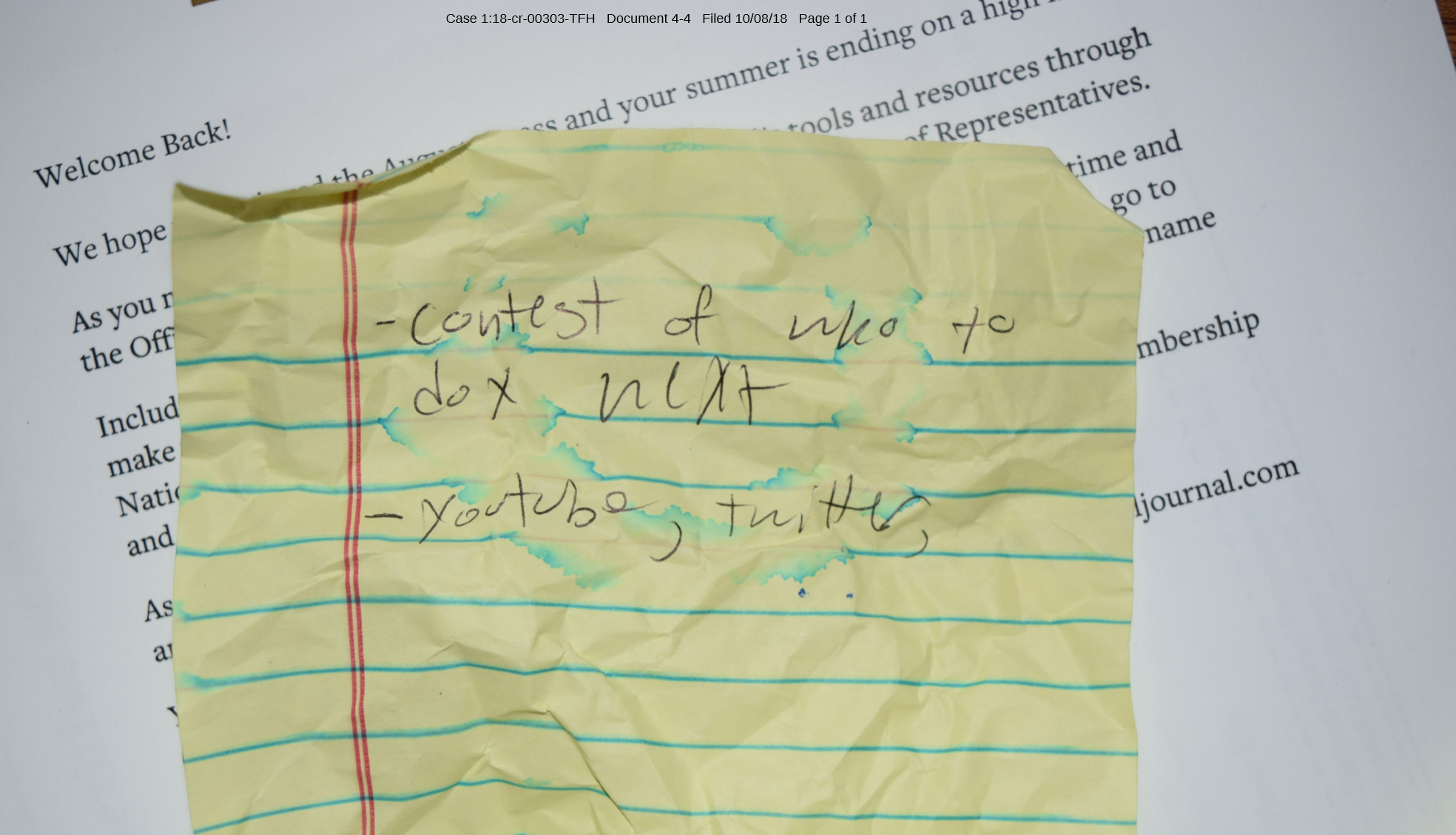
Note found in Jackson Cosko's apartment / Court documents
Pictured is a note found in Jackson Cosko’s apartment. (Photo of evidence filed by prosecutors in D.C. federal court)

  • Former Senate information technology (IT) aide Jackson Cosko was arrested for “doxxing” Republican senators during the Supreme Court confirmation hearings and threatening, “I own EVERYTHING … If you tell anyone I will leak it all.”
  • On Wednesday, a judge said Cosko “downloaded more information than was originally understood,” and that it was so sensitive it could not be discussed in open court.
  • Sen. Maggie Hassan had hired Cosko despite a prior felony conviction, then he “was asked to resign” for undisclosed, unrelated wrongdoing months before the doxxing. Rep. Sheila Jackson Lee then hired him in the House despite the felony and the prior employment trouble.
A former Senate IT aide who allegedly “doxxed” Republican senators by posting their home addresses during the confirmation hearings of Supreme Court Justice Brett Kavanaugh and blackmailed a witness “downloaded more information than was originally understood,” Judge Thomas Hogan said in District of Columbia federal court Wednesday.

Prosecutors said in November they found “terabytes of data” that they were reviewing as evidence in the case. Lawyers indicated Wednesday that what they found was so sensitive the public could not even hear it discussed.

(RELATED: Republican Senators Doxxed By Someone In House Shortly After Questioning Kavanaugh)

The judge took the unusual step of kicking reporters and even Cosko’s own mother out of the courtroom for more than a half hour while prosecutors and the defense discussed what they found with the judge.

“The defense and government have filed a motion to seal the courtroom for certain matters that are not suitable for the public,” Hogan said.

After the public was allowed back in, Hogan expressed alarm.

“His accomplishments in the computer world … allowed him to do the things he was doing … there’s a sense of great risk to the public” if Cosko can access computers, he said. “If he has access to info that only he has the key to, he could cause difficulty.”

“Self-described at the time of doing it and maybe now still, he was malicious and hostile,” Hogan continued. “He downloaded more information that was originally understood. There is no combination of conditions that could ensure the safety of the community.”

Prosecutors said in court filings that even after he was caught bragging about how he used his position as a congressional IT aide to download data, and used it to blackmail an aide, he “expressed intention to commit more similar crimes while charges were pending.”

 (Wasserman Schultz’s Laptop Found In Phone Booth At Midnight)

Through his lawyer, Cosko, a slight 27-year-old with a buzz cut and a baggy orange prison jumpsuit, pleaded with the judge to help move him to a different jail, and said that he wanted to avoid going to trial. Prosecutors said they were discussing a plea deal.

Prosecutors also said that Cosko had a prior felony conviction — a drug charge from college. Sen. Maggie Hassan, a Democrat of New Hampshire, hired him as systems administrator and gave him access to the office’s data despite the felony record. Hassan fired him in May — or rather, he “was asked to resign” for unspecified prior misconduct, according to her spokesman. But it is not clear that she revoked his super-user IT credentials.

Then, Democratic Rep. Sheila Jackson Lee of Texas hired him — she has said in August — despite both a felony record and having just lost his job for misconduct.

After the arrest in October, the congresswoman claimed he was an intern, despite being a 27-year-old who had previously worked in the upper chamber.

A spokesman for Jackson Lee, Robin Chand, refused to tell The Daily Caller News Foundation whether the office did a background check or called Hassan’s office for a reference, and if so, what Hassan’s office said.

During the confirmation hearings of Kavanaugh, Cosko allegedly posted Republicans’ home addresses on Wikipedia, including from his computer in Jackson Lee’s office.

Then, on Oct. 2, he allegedly returned to Hassan’s office and logged into a staffer’s computer.

“The defendant was caught in the act of burglarizing the office of United States Senator Maggie Hassan (his former employer) for the purpose of illegally accessing a computer in the Senator’s office,” according to court papers. “When the defendant recognized that he was caught – by a staffer who knew the defendant well – he fled the office. However, only a few minutes later, the defendant sent a threatening e-mail to that same staffer.”

Cosko wrote, according to the papers: “I own EVERYTHING … If you tell anyone I will leak it all. Emails signal conversations gmails. Senators children’s health information and socials.”

Prosecutors said they searched his home and found “virtually a hackers’ obstruction checklist” and materials to impersonate congressmen such as stationary from Hassan’s office.

(RELATED: Colleagues Fear House IT Aide Imran Awan Blackmailing Members)

Neither prosecutors nor the defense would tell TheDCNF on what legal grounds the court was barring the public from hearing the extent of Cosko’s alleged breach of Congress.

Hassan’s office has declined to answer questions from TheDCNF about what wrongdoing caused it to ask Cosko to resign in May, and why it didn’t take additional measures or even, possibly, deactivate his credentials.

Cosko previously assisted other Democratic senators including Sen. Dianne Feinstein and former Sen. Barbara Boxer, both of California, according to Fox News. Feinstein is on the Senate Select Committee on Intelligence.

Another staffer from Feinstein’s office was fired in 2013 for being a mole for China. Feinstein kept that issue quiet, and later falsely characterized that aide as a driver as opposed to a senior staffer.
One of Cosko’s lawyers claimed in October he was not an intern but a “fellow” paid for by an outside institution, according to Fox News.

But on Wednesday, a Cosko attorney told TheDCNF “there was no fellowship” and said “you’d have to take that up with Sheila Jackson Lee” as to why she called him an intern. A Department of Justice press release in October called him a “volunteer.”

Cosko comes from a wealthy California family, and his lawyer assured the judge that the family could provide him the finest mental health and drug treatment under a renowned doctor there, but the judge ordered him to be held in jail.


District Man Charged in Investigation of Illegal Posting of Restricted Personal Information of U.S. Senators on Website

Arrest Followed Investigation of “Doxxing” Activity

            WASHINGTON – A volunteer on the staff of a member of the U.S. House of Representatives made his first court appearance today on charges stemming from the illegal posting of restricted personal information of five U.S. Senators on the Wikipedia website, as well as related conduct.
            The announcement was made by U.S. Attorney for the District of Columbia Jessie K. Liu and Matthew R. Verderosa, Chief of the U.S. Capitol Police.
            Jackson A. Cosko, 27, of Washington, D.C., was arrested on Oct. 3, 2018 by the U.S. Capitol Police. He is charged in a criminal complaint with five federal offenses: making public restricted personal information; making threats in interstate commerce; unauthorized access of a government computer; identity theft; and witness tampering. The complaint also charges him with second-degree burglary and unlawful entry, both District of Columbia offenses.
            Cosko appeared this afternoon before Magistrate Judge Deborah A. Robinson in the U.S. District Court for the District of Columbia. The judge ordered that Cosko remain detained pending a hearing set for Oct. 9, 2018.
            According to the affidavit in support of the complaint, the U.S. Capitol Police began an investigation on Sept. 27, 2018, after it was determined that the Wikipedia pages of three U.S. Senators had been edited to include restricted personal information without their knowledge or permission. This information included home addresses and personal telephone numbers. These edits took place roughly contemporaneously with public – and highly publicized – Senate proceedings related to a nomination for the U.S. Supreme Court.
            Then, on Oct. 1, 2018, according to the affidavit, similar information was posted on the Wikipedia pages of two additional Senators.
             “Doxxing” is the act of gathering, by licit and illicit means, and posting on the Internet personal identifying information (“PII”) and other sensitive information about an individual.
            On the night of Oct. 2, 2018, according to the affidavit, a witness saw Cosko at a computer in the office of a U.S. Senator who had once employed him. The witness confronted Cosko, who left the office. An investigation led to Cosko’s arrest by the U.S. Capitol Police.
            The charges in criminal complaints are merely allegations and every defendant is presumed innocent unless and until proven guilty beyond a reasonable doubt.
            The statutory maximums for the crimes are as follows:
            Federal Offenses:
            Making public restricted personal information – five years.
            Threats in interstate commerce – two years.
            Unauthorized access of a government computer – one year.
            Identity theft – five years.
            Witness tampering – 20 years.
            District of Columbia Offenses:
            Second-degree burglary – 15 years.
            Unlawful Entry – Six months.
            The maximum statutory federal sentence is prescribed by Congress and is provided here for informational purposes.  If convicted of any federal offense, a sentence will be determined by the court based on the advisory U.S. Sentencing Guidelines and other statutory factors.
            The investigation into this matter is being conducted by the U.S. Capitol Police. The case is being prosecuted by the Cyber Crime and National Security Sections of the U.S. Attorney’s Office for the District of Columbia.

Jackson Cosko - Complaint a... by on Scribd

Voting is beautiful, be beautiful ~ vote.©

Friday, November 23, 2018

Monica Lewinsky To Get Due Process, Ken Starr To Get Karma

Karma, Ken.

I already know that you and your associates are "Legal Genius" (tradmark pending).


Monica Lewinsky reveals for the first time that Bill Clinton urged her to LIE under oath and then called her in for one last tryst before ditching her - which led her to consider suicide

  • Monica Lewinsky revealed that Bill Clinton phoned her at 2.30am to inform her that she was on the witness list for the Paula Jones case 
  • 'Thankfully, Bill helped me lock myself back from that and he said I could probably sign an affidavit to get out of it,' said Lewinsky 
  • She signed the affidavit and soon after got called to the White House for a Christmas tryst
  • Clinton then bailed on Lewinsky, who found herself targeted by the FBI and Kenneth Starr's team 
Monica Lewisnky recounted the moment that the sitting president encouraged her to lie under oath on the final episode of the A&E docuseries The Clinton Affair.

It marked the first time that Lewinsky has actually stated that Bill Clinton advised her to deny their affair if called to testify in the Paula Jones case, pointing out that she could avoid being deposed if she simply denied the charge in an affidavit.

Then, in a shockingly bold move, Clinton called for Lewinsky a few days later and the pair enjoyed an intimate, and private, Christmas party in the White House.

Unbeknownst to Lewinsky that was the end of the pair's relationship, with Clinton quickly bailing on his 24-year-old paramour who was left to do battle with the special prosecutor, the FBI and the American public on her own while he fell back on a multi-million dollar legal fund raised by supporters.

It became too much for Lewinsky at one point she said, and she seriously considered taking her own life.

Wake-up call: Monica Lewinsky revealed that Bill Clinton phoned her at 2.30am to inform her that she was on the witness list for the Paula Jones case.

'Bill called at 2.30 in the morning and there were two pieces of bad news which he was passing along,' recalled Lewinsky.

'One was that Betty Currie's brother had been killed in a car accident and I had grown very close to Betty, I mean, our relationship was complicated, but I cared very much for her she had had another relative who had passed away recently so this was distressing news to me.'

Things then got worse for Lewinsky with the second bit of news, which hit much closer to home.
'And then, he really dropped the bombshell that he had seen the witness list for the Paula Jones case and I was on it,' revealed Lewinsky.

'The information about Betty spun me one way and the information about the witness list spun me completely the other way. He told me that it broke his heart and that he'd thought that I probably wouldn't get called as a witness.'


She continued: 'I was petrified. I was frantic about my family, and this becoming public. Thankfully, Bill helped me lock myself back from that and he said I could probably sign an affidavit to get out of it, and he didn't even know if a 100 percent I would be subpoenaed.'

Tears: 'Thankfully, Bill helped me lock myself back from that and he said I could probably sign an affidavit to get out of it,' said Lewinsky(above in The Clinton Affair)

Lewinsky then pointed out that Clinton never said: 'Now, listen you're gonna have to lie here.'
She followed that up though by stating he also never said: 'Listen, honey, this is gonna be really awful we're gonna have to tell the truth.'

Lewinsky was subpoenaed just a few days later, so she decided to speak with Clinton's close friend and attorney Vernon Jordan.

Up until this point, the docuseries had been remarkably detailed in the chain of events leading up to the impeachment, but here there are some obvious questions that are not even asked, let alone answered.

Lewinsky claims that she called up Jordan on her own and managed to secure a meeting with him in his office.

And from there she claims he introduced her to her attorney.

Apologize: She signed the affidavit and soon after got called to the White House for a Christmas tryst (Clinton above in 1998 denying the affair)

There is no examination of how a 24-year-old working at the Pentagon managed to quickly book a face-to-face with one of the most powerful litigators in the world at the time.

'I didn't know whom to contact and Vernon mentioned a lawyer Frank Carter, and took me to meet him,' said Lewinsky.

'Frank Carter explained to me, if I'd signed an affidavit denying having had an intimate relationship with the president it might mean I wouldn't have to be deposed in the Paula Jones case.

'I did feel uncomfortable about it but I felt it was the right thing to do, ironically, right? So, the right thing to do, to break the law.'

Soon after she did this she was rewarded with a call to meet Clinton at the White House.

'This is the first time I met Buddy, the dog and we kind of all played around with Buddy in the office and then we went into the back study and we had a Christmas kiss,' said Lewinsky.

'Over the summer he had gone to Martha's Vineyard and he brought back a bunch of different things. He had this big canvas bag from the Black Dog. This marble bear, sunglasses.

'It was the most presents he'd given me at one time. He knew the subpoena was gonna ask to produce certain items and yet he was giving me more gifts. He clearly still trusted me.'

She handed those gifts, and all others, to Clinton's secretary for safekeeping and to avoid possible seizure.
Then she was left to fend for herself, a situation that quickly became dire. 
This comes after the premiere of the series on Sunday, when Lewinsky's parents spoke about their daughter's affair for the first time.

Dr Bernard Lewinsky and his ex-wife Marcia said on the second episode of the The Clinton Affair that they were thrilled when their daughter got an internship at the White House.

'I'm an immigrant from El Salvador and it was awesome and unbelievable that she would be working at the White House,' said her father, the son of German Jews who fled to Central America during World War II.

That internship soon spiraled out of control when Lewinsky was discovered to be having an affair with the president, and the FBI forced her to help in the investigation into Clinton.

Lewinsky reveals they did this by threatening to prosecute her mother, breaking down in tears as she recalls how Kenneth Starr's team and federal agents said both women were facing 27 years in prison for lying about the affair.

I kept asking could I call my mom, they kept saying no,' recalled Lewinsky of the 12-hour interrogation inside a hotel room at the Ritz-Carlton.

'You're 24, you don't need to call your mommy, you need to make a decision about what to do.'
Lewinsky was unflappable at that point however, and told the men: 'Well you should learn I am leaning towards not cooperating.'

That is when the men made the decision to threaten not only her, but also her family.

'And then he said, "Well, you should know, we're also thinking about prosecuting your mom for the things you said she did on the tape,"' said Lewinsky, breaking down in tears.

Lewinsky then informed the men that she had to call someone, either her mother or a lawyer, before she would make this decision to wear a wire and have her calls tapped by the FBI.

Tight unit: Lewinsky broke down in tears when recalling the moment that she was told both she and her mother were looking at 27 years in prison for lying (Monoica and Marcia above circa 1996) Monica Lewinsky says Bill sang her 'Try A Little Tenderness'

The men eventually gave in to Lewinsky's demands, and she said she went to a pay phone and called her mother in the local mall.

Lewinsky said her mother attempted to get her to calm down and breathe, before finally coming to realize the situation her daughter was in at the time.

'FBI ... have me ... I'm in a hotel,' recalled Lewinsky of her words to her mother.

Monica's mother recalled her daughter's earlier days in the second episode, while sharing some photos of the girl's childhood.

'Monica was a beautiful and very, very smart little girl,' said her mother Marcia.

'But stubborn. Really stubborn.

Dr Lewinsky added: 'She was very gregarious, friendly, you know when she was in the room.' 
And he said of the moment he learned about her internship: 'I was so proud of her and she was so happy about it.'

Lewinsky also detailed the events that led to her decision to confide in Linda Tripp, the woman who would eventually alert the special prosecutor to the fact that Clinton was having an affair with a former intern.

It all started when members of Clinton's staff decided to move Lewinsky out of her post working for Legislative Affairs at The White House and transfer her to the Pentagon amid growing concerns over how close she had become with the president.

Lewinsky suggested that this was all done with the knowledge of her paramour, who she describes as 'crestfallen.'

The two had been seeing one another daily and enjoying weekly trysts prior to that Lewinsky had revealed, but the move to a new job and building changed all that in an instant.

Lewinsky would instead be forced to wait until the middle of the night for Clinton to call, but she said that he had promised to move her back to a White House position after the election.

At that point the pair had been carrying on their affair for five months, and a number of staff members had begun to take notice of how often Lewinsky was around the president and Oval Office.

It was an optics problem however said staffers, with no one explicitly stating that they believed the intern was having an affair with the president.

The job shift also came while Clinton was in the middle of his reelection campaign, meaning that he was not in touch with Lewinsky for days or even weeks at a time.

'I had this nagging insecurity that maybe he just did all these things these last six months cause he wanted to keep me quiet during the election,' explained Lewinsky.

'How stupid am I that I believed this, that I bought this. I felt so deflated and so desperate. And those were the conditions along with some other things that led to me confiding in Linda Tripp.'

Lewinsky described her mindset at the time by saying she 'had naively invested in his promise,' but that was shattered when the election came and went without the offer of a White House job.

It was too much for Lewinsky, who says that after a few hours she began to think about commiting suicide.

Twenty years later, it still causes her to break down in tears.

'The ground completely crumbled in that moment. I felt so much guilt. And I felt terrified,' she revealed in the interview.

An FBI agent involved in the case acknowledged this, saying that Lewinsky was 'alternating between being hysterical, being angry, being abusive.'

'They imagined that I would have flipped really easily. They had no plan in place for what would happen if i said no,' said Lewinsky.

That then gave way to thoughts of ending her own life.

'There was a point for me somewhere within these first several hours where I would be hysterically crying and then I would just shut down,' she recalled.

'And in the shut down period I just remember looking out the window and thinking the only way to fix this is to kill myself.'

Lewinsky, who up until that point had managed to hold back her tears, then burst out sobbing.
'I just felt terrible ... and I was scared ... and I was mortified,' she said while trying to regain her composure.

This all played out at the Ritz Carlton in January 1998, with the Office of the Independent Counsel getting Linda Tripp to set up a meeting with Lewinsky.

She was then taken to a room and held by prosecutors until that night.

Lewinsky admitted that the thing that made this so difficult for her was the fact that she was still in love with Clinton and she stood her ground, until they threatened her mother. 

Voting is beautiful, be beautiful ~ vote.©