Showing posts with label Saskia Thompson. Show all posts

Thursday, July 16, 2020

North Carolina Approves Corporate Reparations Through Gerrymandering Public Private Partnerships - But Will There Be FARA Registrations?

Finding The Red Card: The Performance Of Three-Card Monte | Jack ...
"See, it is a spade.'
Presenting paperwork as an U.S. black owned
 nonprofit while the foreign corporate mother
intently watches over her human chattel.
Black Lives Matter, because it is how
you maximize revenues.
Yes, you heard me, correctly.

North Carolina has approved reparations.

https://beverlytran.blogspot.com/search?q=reparations

Yippers.

Reparations for foreign corporations, that is!

Well, by golly, I must say, this particular slavific mission is the darnedest human asset forfeiture models I have seen yet.

Nope, I did not see this one coming.

Actually, I probably did because Saskia Thompson, of the Detroit Land Bank Authority, is form North Carolina and probably assisted in the construction of the test pilot model to see if it will fly in Detroit, with the endorsement of all our favorite afrocentristic drum beaters like the NAACP, NAN, and, let me not fail to mention the Congressional Black Caucus and all their financial stakeholders on their servers, to cover up what the did to my Sweetie.

No one wants to say his name.

So, money is going to be doled out to an authority, oh, let us just transpose this working model to Detroit for sake of a few jollies, and say the Detroit Land Bank Authority, who will not just assign a predictive modeling qualitative variable assignment label of one of the four humors, but theses pseudo-scientific determinations will be done, under the powers of a Public Private Partnership through an non-profit, the authority set up all by themselves, like those fake ass LLCs used to file quiet titles and take out fake mortgages.

Slavery was never abolished, just ask North Carolina.

Children are attached to the land as chattel, where, when they grow up, that land is still reconveyance powers of adverse possession.

So, if a foreign entity financially contributes to this 40 acre and a mule concept, must they register under FARA or will they have legally seized the land of the savages, filed a land patent, and leveraged it through a UCC lien as collateral in some other foreign state national treasury?

I find it absolutely fascinating that not one individual has whispered the name of my Sweetie.

I bet they are going to erect a statute to him in support of reparations, in a futile attempt to cover up all the gerrymandering activities to take over the United States, one city, one state at a time, because it all started in Detroit.

https://beverlytran.blogspot.com/search?q=gerrymandering

I wonder how these nonprofits are going to be designated as "black"?

Will the determination process include foreign, corporate parents?

Boy, I will love to see what crafty schemes they will come up with to the doling out of this promotion of homeownership.

I wonder if they will be transposing the Michigan Black Caucus model for homeownership?

#maytheheavensfall

North Carolina City Approves Reparations for Black Residents

The measure passed by the City Council of Asheville, N.C., would provide funding to promote homeownership and business opportunities, but stopped short of stipulating direct payments.

As Americans debate how far the country should go to make amends for slavery and other racial injustices, a conversation reawakened by the killing of George Floyd, a city in North Carolina has taken the first step: It approved reparations for Black residents.

The city, Asheville, N.C., will provide funding to programs geared toward increasing homeownership and business and career opportunities for Black residents as part of a reparations initiative.

The measure was unanimously approved by the Asheville City Council on Tuesday night, but it stopped short of stipulating direct payments, which are usually associated with reparations. City leaders said their goal was to help create generational wealth for Black people, who have been hurt by income, educational and health care disparities.

The city, which is in Western North Carolina and has about 93,000 residents, also apologized for its participation in and sanctioning of slavery, as well as other historical injustices perpetrated against Black people, who make up about 12 percent of the city’s population.

Councilman Keith Young, who is one of two Black members on the Council, was one of the measure’s chief proponents. He said during the group’s meeting that systemic change was long overdue.

“Hundreds of years of Black blood spilled that basically fills the cup that we drink from today,” Mr. Young said.

The momentum for reparations was not limited to Asheville.

In Providence, R.I., the mayor signed an executive order on Wednesday to commence a “truth telling and reparations process,” The Providence Journal reported. In California, a bill creating a task force to develop reparation proposals for African-Americans was passed in the Assembly in June and was being considered by the Senate.

But some said the reparations initiative by city leaders in Asheville did not go far enough. And others panned it outright.

William A. Darity Jr., a professor of public policy at Duke University in Durham, N.C., wrote in an email on Wednesday night that he was “deeply skeptical about local or piecemeal actions to address various forms of racial inequality being labeled ‘reparations.’”

For reparations to be effective, he wrote, they would have to close the pretax racial wealth disparity in the United States, which would cost about $10 to $12 trillion — three to four times more than total state and municipal spending.

“So piecemeal reparations taken singly or collectively at those levels of government cannot meet the debt for American racial injustice,” he wrote.

As part of the resolution passed by the Council, city leaders in Asheville called on the state of North Carolina and the federal government to provide funding for reparations.

Councilwoman Sheneika Smith, who is also Black, said during the Council’s meeting that she had heard from residents who challenged the reparations measure.

“A lot of the feedback that we’ve gotten so far by email is that you know, ‘Why should we pay for what happened during slavery?’” Ms. Smith said. “And my pushback against that is reparations is more than restitution for what happened during the trans-Atlantic slave trade. It is a dark evil sin of chattel slavery that is the root of all injustice and inequity that is at work in American life today.”

The developments in Asheville came after nationwide protests against police brutality and systemic racism, which were catalyzed by Mr. Floyd’s killing in late May. A Minneapolis police officer kept his knee on Mr. Floyd’s neck for more than eight minutes in an episode that was captured on video by bystanders. The officer and three other officers involved were fired and charged in Mr. Floyd’s murder.

Amid the demonstrations, Confederate statues have been toppled by protesters or taken down by local governments, and lawmakers on all levels have introduced police reforms.

There has also been a renewed push by some members of Congress to create a commission to study the impact of slavery and to make recommendations for reparations.

Several times in American history, people have been compensated for historical injustices, from Japanese-Americans who were interned during World War II to victims of police brutality in Chicago.

“It’s simply not enough to remove statutes,” Mr. Young said during the Council’s meeting. “Black people in this country are dealing with issues that are systemic in nature.”

Some said that the action by the Asheville City Council could set a precedent.

“I just hope that we will be, just maybe, a little spark that will really get this conversation not only going in Asheville but in North Carolina and across the country,” Councilwoman Gwen Wisler, who is also the city’s vice mayor, said before the group’s vote.

Voting is beautiful, be beautiful ~ vote.©

Wednesday, May 6, 2020

Dmitry Bosov Extracted Himself From Humanity

Dmitry Bosov extracted himself from humanity.

He just bought a $30 million mansion in Beverly Hills.

He invested $160 million into a legal marijuana company in 2018, too!


Sergei Fedorov Announces Foundation
http://www.angelfire.com/journal/wallpaper/Foundation.html
Dmitrywas on the board of HC Sibir Novosibirsk .

Detroit Red Wings Russian Five played in that Hockey Club.

Sergei Fedorov has a Detroit children's trust fund.

https://cofs.lara.state.mi.us/CorpWeb/CorpSearch/CorpSummary.aspx?ID=800840841&SEARCH_TYPE=3&CanReturn=True

Hey, what do I know?

I know I found Detroit and children's trust funds in pediatric children's hospitals.

I also know his foundation bought a jet.

Image may contain: airplane and skyI wonder who was the pilot.

I wonder if Dmitry had any children's trust funds.

I guess we shall just have to wait.

Wait!

I found it!

Charity Fund "Day One"
https://www.day1fund.ru/about/#partnersAbout

POSITION Director
121108, Moscow city, Minskaya street, 11, floor / room 1/24
TIN 9731062231 PSRN 1207700128954 REGISTRATION DATE March 19, 2020
PRIMARY OCCUPATION 64.99 Provision of other financial services, except insurance and pension funding, nec

Taken from the charity by-laws:
The fund was created with the aim of forming property and funds on the basis of voluntary property contributions, as well as other proceeds not prohibited by law, and using this property and funds to carry out charitable activities aimed at: ¾ social support and protection of citizens, including improving the financial situation of low-income people, social rehabilitation unemployed, disabled and other persons who, by virtue of their physical or intellectual features, other circumstances are not able to independently exercise their rights and legitimate interests; одействие promoting the prestige and role of the family in society; ¾ promoting the protection of motherhood, childhood and fatherhood; одействие promoting activities in the field of education, science, culture, art, enlightenment, spiritual development одействие Promoting activities in the field of prevention and protection of the health of citizens, as well as promoting a healthy lifestyle, improving the moral and psychological state of citizens; 
¾ Promoting voluntary (volunteer) activities; деятельности Promoting activities for the production and (or) distribution of social advertising. Charitable activities of the Fund are understood as voluntary activities of citizens and legal entities on disinterested (gratuitous or on favorable terms) transfer of property to citizens and legal entities, including cash funds, disinterested work, the provision of services, the provision of other support in accordance with the objectives of the Foundation. 3.2. The subject of the Fund's activities is the implementation of the goals provided for in clause 3.1. of this Charter. To achieve its statutory goals, the Fund carries out the following activities: ¾ Attracting donations, investments, credit and other resources, including foreign ones, to implement projects aimed at achieving the statutory goals of the Fund; ¾o "

Dmitry Bosov: from wagons with mustard plasters to a coal empire in the Arctic

Dmitry was in the aluminium business with Oleg "The Ass" Deripaska in Detroit.
I wonder if Dmitry had any Detroit Land Bank Authority properties?

We should ask Saskia.

Russian billionaire Dmitry Bosov found dead in apparent suicide

Dmitry Bosov
Russian billionaire Dmitry Bosov, whose core asset was a major coal company, was found dead Wednesday in an apparent suicide near his home in the Moscow region, local officials say. He was 52 years old.

A spokeswoman for Russia’s Investigative Committee told the Interfax news agency that relatives found Bosov with a gunshot wound to the head near his home in the town of Usovo.

A law enforcement source told the TASS news agency that investigators believe Bosov had committed suicide. A Glock 19 Gen 4 pistol was found near his body, according to Interfax.

Other details were not immediately known.

Bosov’s net worth was estimated to be $1.1 billion at the time of his death, according to Forbes magazine. His core assets were VostokCoal and the Sibanthracite Group, which unites several coal produces in Siberia. He and a partner also co-founded a company called Blackspace in 2015.

Voting is beautiful, be beautiful ~ vote.©

Saturday, April 25, 2020

Tales Of The New Crown: Detroit Cuts Subsidies To Detroit Land Bank Authority

Subsidies? Why is Detroit subsidizing when they never incorporated and is not part of the City of Detroit?

Detroit Land Bank Authority to lay off workers, end contracts due to $5.8M shortfall

Detroit Land Bank CEO Saskia Thompson started her job in September 2017.Detroit — The city's Land Bank Authority, faced with a $5.8 million funding shortfall due to COVID-19, is cutting executive pay, laying off staff and terminating contractors.

The authority said effective Friday about 20% of its full-time workforce will be laid off and half of its contracted personnel will be terminated. In addition, senior executives with annual salaries above $125,000 will see a temporary 5% reduction in pay.

“These cuts are painful. This is not a decision we wanted to make, but we need to protect the viability of the organization to further our mission," Detroit Land Bank Authority Executive Director Saskia Thompson said in a statement. "It’s difficult to have to let anyone go, especially under these circumstances."

The pandemic, the authority noted, has threatened its main revenue sources — a subsidy from the city of Detroit and property sales. The reductions this fiscal quarter and the projections for the new fiscal year beginning July 1 are forcing the sweeping cuts to balance the budget.

The authority first instituted an instant spending freeze on all non-emergency or non-essential purchases. But the projected revenue losses are too great and "make layoffs and contract terminations necessary," the authority said in a Wednesday news release.

The cuts come after Detroit Mayor Mike Duggan this month laid out his own aggressive plan to help offset a more than $348 million hole in the city's budget in the current and next fiscal years.

Under Duggan's plan, the post-bankruptcy city is tapping into its rainy day surplus, doing layoffs of part-time workers and reducing the pay for thousand of others. Executive members of the administration also are taking a voluntary 5% pay reduction.

Duggan, during a virtual town hall this month, said 80% of the deficit can be covered with $151 million in surplus and rainy day funding and $147 million pulled from other sources, including capital improvement funds, blight remediation funds, federal transit funds and cost savings.

The mayor's workforce changes didn't apply to the land bank, Water and Sewerage Department and the city's public lighting and libraries as well as the city council, clerk and auditor and inspector general offices. Those agencies were to determine on their own what cuts may be implemented to curb costs amid revenue losses caused by the virus outbreak.

As part of the city's effort to keep its budget balanced, the land bank expects to see the subsidy from Detroit reduced in the 2020 and 2021 fiscal years, the authority noted.

Salaries and wages of land bank employees are frozen and laid off full-time employees with health insurance coverage through the land bank will retain benefits through April 30.

The authority said Wednesday it will cover the cost of premiums for the continuation of health coverage under COBRA for laid-off full-time employees from May 1 to July 31.

The cuts extend across all levels of the land bank, but are focused most in areas that, while valuable, "do not directly drive revenue or operational support," the authority said.

The land bank further said many Detroiters are losing income due to the hardships caused by the virus. As a result, house sales in the land bank's online Auction and Own It Now programs are down 30% this month. The decline is expected to continue into the next fiscal year.

The authority also projects a 50% decline in sale closings.

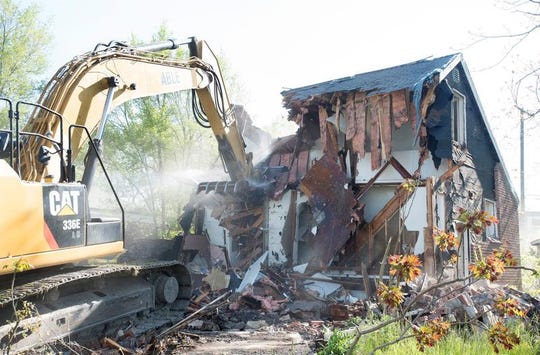
The land bank also expects it will close its federally funded demolition work out on Dec. 31, as scheduled, which will trigger planned staff cuts in the demolition department.

The land bank, the release said, is continuing to evaluate other cost-effective ways to retool its operations and programming.

Since 2014, the land bank has sold more than 24,400 properties including 14,300 side lots and 8,900 structures. It has more than 87,600 parcels in its inventory, 76% of which is vacant land.

“We remain committed to our mission of returning blighted and vacant properties to productive use," Thompson added. "We stand ready to help Detroit recover from the COVID-19 crisis."

Voting is beautiful, be beautiful ~ vote.©

Wednesday, July 3, 2019

The Great Water Shutoff Debacle Continues - Retaliation Is Real & The Detroit Land Bank Authority Is Still Run By Legal Geniuses

When you know everyone and their mother
is listening to your emotionally charged
conversations with the "Legal Geniuses" (trademark pending).
Recently, I suffered a water shutoff where my water was never shutoff, but it is shutoff in the system and I am documented as engaging in utility theft.

I filed complaints with the attorneys of record for my dismissed False Claims Act case, which included the Detroit Land Bank Authority to let them know I would move the court if they did not leave me alone.

Now, how an attorney can represent an entity that never incorporated, per their own so-called instruments of authority, is still an open question for the Grand Jury, but hey, what do I know?

Anyway, my fears have manifested!

Yes, I knew that I would be facing some form of asset forfeiture in coming after my domicile.

See, when you have no water, according to the record, your property is condemned, and subject to the Detroit Land Bank Authority doing one of their sneaky, behind your back, quiet title actions, and you would never be the wiser.

I received a letter from the Detroit Land Bank Authority informing me that my son's house was on the asset forfeiture list, even though it is not in property tax foreclosure and his name is on the property tax rolls.

I called Andrew Sarazin, one of the new attorneys who was kind enough to inform me that Michael Brady is now working with the Michigan Secretary of State.

I shuttered.

Not because Michael Brady has access to identity and voter databases, but for the fact that the Detroit Land Bank Authority has purged its "Legal Geniuses" (trademark pending) and has retained an entirely new set of "Legal Geniuses" (trademark pending).

Andrew's arrogance and lack of legal acumen when it comes to corporate law made me suffer from another episode of Post Traumatic Fraud Syndrome.

He asked if I could explain the problems with their quiet title process, and the property in question, so I sent him links, which contained the history of the Detroit Land Bank Authority filing quiet and supportive documents, of how they can cycle a property multiple times, billing TARP for the entire legal process to take possession of properties in historic districts, where they were not supposed to be.

Since these actions are in rem, meaning, service is not effectuated to the property owner, but to the house, where if the house does not show up in court, there is an automatic default, as the letter was addressed to "occupant".

I shall assume Michael Donovan took over for Michael Brady and I shall also assume he did not tell his successor a peep of what is going on.


Michael Donovan

to meAndrew
This blog does not answer any of my questions regarding this property.  Can you merely send an email stating your position, rather than making me search?
This is a short week, and I will be out of town next week. To give you the time you may need, and time for us to talk, I am going to adjourn the July 12 hearing with respect to 4225 Tyler to a date to be announced.  We will provide you notice of the new date when it is scheduled.
Please also provide me with contact information (phone and email) with Adrian Rivera if it is available.   Thank you.
DLBA logoMichael P. Donovan


DETROIT LAND BANK AUTHORITY
Legal Team
Direct: (313) 261-9914|  Fax: (313) 447-3158
500 Griswold Street, Suite 1200 | Detroit, MI 48226


From: Beverly Tran <tranbeverly@gmail.com>
Sent: Monday, July 1, 2019 5:01 PM
To: Michael Donovan <mdonovan@detroitlandbank.org>
Subject: 4225 Tyler

Thank you for taking the time to address the issues of your quiet title process. I have provided a one-stop link with answers to all your questions pertaining to property at 4225 Tyler.


Leave me alone. I consider this retaliation and have reported it as such.

313-455-8882

Then, a little birdie told me that Duggan is going to move the demolition program to Building and Safety, but that is neither here nor there, considering City Council has yet to vote and there has yet to be identified any funding sources, because he should know he is not getting that new bond.

There are about 150 actions in this one filing.  Talk about saving a few bucks
in filing fees and while charging TARP for each address filing.

But, alas, Donovan failed to even take the time to understand that, in order to bring forth a claim, he must first establish that the jurisdiction is proper, like letting the court know that it incorporated, like what it said it was going to do when it was first formed, but did not, and still has not.

For example, how can you file as a plaintiff when you do not exist?

The last time I checked, I am still the one and only Detroit Land Bank Authority on record with the State of Michigan and the United States to have been recognized as a legal entity to conduct business.

Bill *Smooches* Schuette can vouch for me on this fact, you know.

The last time they just busted up in the house, which was a very unpleasant situation.

As fate would have it, again, Rob Wolchek did a wonderful report on what I like to call Corporate Shape Shifters on just one of the schemes to flip houses, take out mortgages, default, then wipe them out again in another quiet title action.

Here is a link to the lastest bulk quiet title proceedings of the Detroit Land Bank Authority, where you shall find about 150 properties, in one filing.

https://drive.google.com/file/d/1PaSLZKIe9ruY0wlidPyK_TnbetDxzV2A/view?usp=sharing

I am still out on how I am going to address this lunacy of stealin' again.

I could always file a motion to intervene.

That way I can tell the court all about the history of the Detroit Land Bank Authority.

Or, I could move the federal court to address my Post Traumatic Fraud Disorder by telling the story of my civil rights violations, but that would ruin the big party.

So, instead, I shall just send my new friend, Michael Donovan, "Legal Genius" (trademark pending) the link to this post and see how long it takes him to figure it out.

Maybe he will understand better if he listens to Rob Wolchek.

I do not want to spoil the fun, so I shall await for the news to tell Gabe Leland's tale...or maybe not, because there is much more to this ongoing drama.

They just refuse to stop stealin'.

Please, make them stop.

Please.


Man's house put up for sale without him knowing


DEARBORN HEIGHTS, Mich. (FOX 2) - Block after block of run down houses. How did I end up here?  In Detroit with a feeling of doom that
these neighborhoods will never come back.

This was supposed to be a story about a guy and some people he thought were shaking him down. But I may have stumbled upon a much bigger problem - something called ‘bulk portfolio’ real estate.  And it's got everything to do with riches and ruin.

"It didn't make sense,” he said.

Kevin's got a warranty deed to the house.  That means he owns it free and clear, right?  Kevin or someone in his family has lived in the home since 2011.

So imagine Kevin's surprise when a few months ago, strangers started showing up looking
in the windows, taking pictures of the house.

When he confronted them, they told him the house was for sale.

"We went to Google,” he said. “We looked it up. We found out it was listed by Wendy Briggs."

Who's Wendy Briggs? Well, she's a real estate broker and she's also a bulk portfolio home buyer.

What's that mean?  It's like going to one of those warehouse stores and buying a bunch of paper towels and they're cheaper because you're buying in bulk. Except she's buying houses.

How many homes does she have?  According to this map I got from the University of Michigan
Dearborn, a ton.

So how did Kevin's Dearborn Heights house end up in Wendy Briggs’ Detroit portfolio?  He's never even heard of her. So he called her up.

"Wendy I said, what needs to be done to make this go away? How do we fix this?” Kevin said. “She says somebody's got to give Come Back Home Ministries $15,000."

Who's Come Back Home Ministries?  They are another group involved in bulk portfolio home buying.
Kevin's never heard of them either. Kevin's praying for help.  So he calls the Problem Solvers.

We do some digging and discover yes indeed, Kevin has the warranty deed to his house.  But there
are other deeds to his house floating around out there.

Quitclaims deeds - which are basically quickie deeds that make it easy to move a house from one party to another.

It turns out Wendy got the house quitclaim deeded to her company Trading Places in a bulk home
portfolio transaction along with more than 100 other homes in 2013.

“She buys it for $3,000 and never even shows up,” Kevin said. “She takes it and turns around and quitclaim deeds it to Come Back Home Ministries for a dollar. And then Come Back Home Ministry takes it and sells it for $8,500 to this other guy.”

The other guy? Franz John Ivezaj, and you guessed it - he's another bulk portfolio home dude.

Franz then quitclaimed the house for a dollar back to Come Back Home Ministries. What the heck is
going on?

I am going to talk to Franz.

“Listen my friend, I bought a house and they refunded me,” he said.

Wendy: “I bit off more than I could chew.”

The pastor from Come Back Home Ministries: “It’s no scheme.”

And the guy who somehow started this whole mess in a minute.

But first, this is Dr. Joshua Akers from the University of Michigan Dearborn.  He's behind a research project called Urban Praxis. They "out" bulk property owners. He thinks portfolio buying is contributing to the decay of neighborhoods.

Houses that were once owned by families are now commodities. They're not homes. They are things. Things sold in bulk.

Here's how a bulk portfolio business person works.

"I get a bunch of investors together,” Akers said. “I have a portfolio of 150 properties. But the condition of those properties don't really matter. What I'm going to sell to you as an investor is you're going to
get 20 percent in returns. So the emphasis is on me to find a way how to produce those returns."

The buyers take a gamble that some of the properties are salvageable. Some of them aren't but that
doesn't matter, they're dealing in bulk.

So who are these bulk portfolio home traders?  Top notch real estate whizzes?  Upstanding citizens
looking to better the neighborhoods?  Let's examine the bulk portfolio people involved with Kevin's
house.

First off, there's Douglass Diggs. He was appointed as a receiver by the court to clean up a mess
involving homes bought in a giant scheme called the Paramount Case involving the Detroit Police and
Fire Pension Fund.

The problem is, Kevin's house doesn't appear to be a part of that case. But there's Diggs’ signature
quitclaiming Kevin's house to Wendy's company.

I asked Douglass Diggs if he was to blame for Kevin's house to get plucked out of nowhere and into a bulk sale he oversaw.

Rob Wolchek: “Whose fault is it? Is it your fault?"

Douglass Diggs said, "Yeah, I'm sorry. I don't take responsibility for it. It was part of a portfolio."

A portfolio with a whole bunch of houses. Here's what the spokesperson for the pension fund has to say about that:

“Whether this was an error or willful misconduct to convey a title one did not own, is something that the authorities may wish to review."

Diggs told me he'd have his attorney call. We didn't get the call. And unfortunately Mr. Diggs died
shortly after we interviewed him.

Next on the mysterious quitclaim chain is realtor Wendy Briggs.

"I bought many homes from the 3rd Circuit Court appointed Douglas Diggs."

Wolchek: "Right."

"I sold several of those homes to Come Back Home Ministries,” said Briggs. “A church."

Wendy admitted she had never been to the church, but she quit claimed the house to the reverend - a convicted felon by the name of Sylvester "Seal" Murray.

Wolchek: "Why did you give it to Sylvester Murray and Come Back Home Ministries for a dollar?"

"He wanted 32 of the homes - no he paid me," she said.

Wolchek: "So how much did he buy it for?"

"Six thousand,” she said.

Let's see what the reverend has to say.

Wolchek: "Tell me about the ministry.  Is this a ministry or is this just a money making scheme?”

"No, don't talk about a scheme,” Murray said. This is for real."

Yeah, it's real, real shady.  Murray the minister has a past that's sinister.  He was a big shot in a heroin ring called Young Boys Inc.  If anyone's soul needs saving, it's Sylvester Murray's.

And if anyone needs some non-taxable money, it's Sylvester Murray.  According to his 2011 bankruptcy he owes the IRS $14 million.

"I'm spending money, I'm not making money," he said.

Wolchek: “Because you filed for bankruptcy and you've got $14 million …”
"That's personal with me,” Sylvester Murray said. “That's got nothing to do with Come Back Home Ministries."

I hate to doubt a man of the cloth, but I can't even find this place. They're not on the directory in the office they claim to rent. There's no one at either of their addresses.

I caught the Come Back Home minister coming back out of the Mapleview liquor store in West Bloomfield. So where's the congregation meet, rev?

“The church is on 15167 James Couzens.  That's where the church is at, off Puritan," he said.

Wolchek: "You have a church?"

“Yes.”

Nice try.  That address is this vacant lot.

Next I meet up with Franz Ivejah.  A warning - this guy's kind of camera shy.  It might be because he's a registered sex offender.

Wolchek: "I need to know about this quitclaim deed that you did with a house and Come Back Home Ministries.  You bought this house for $8,000 and then you quitclaimed it back to Come Back Home Ministries.  This guy is having a lot of problems with his house. Can you fill me in?"

"I bought a house and it was not good. It was a messed up title and that was it,” he said.

So this guy at least checked the title on the house and realized it belonged to Kevin years ago.

So why is Wendy Briggs listing Kevin's house now? She blames it on Sylvester Murray and Come Back Home Ministries.

Wolchek: “So did Murray contact you earlier this year and say 'Hey sell this house on Monroe?"

"Yes he did," she said.

But he acts like this is news to him.

Wolchek: "Now she put this house up for sale, this Briggs did."

Murray: "When was this?"

Wolchek: "Like this year."

Murray: "Oh, okay."

For Wendy Briggs and Sylvester Murray, Kevin's house wasn’t his home it was just another thing.  A thing to be traded, a thing they wanted to get Kevin to pay $15,000 to them for.

Wendy's now taken the house off her website.  Nobody's contacted Kevin in months.  Maybe they realized this "thing" wasn't going to make them money.

Which leads us back to Professor Akers and why he thinks bulk portfolio sales are so destructive. Remember, many of the houses in Detroit were purchased in bulk.  And he says when the buyers can't make money off of them, they bail.

"When you can't convince someone to take these homes anymore what do they do?  They walk away,” Akers said. “It goes to tax foreclosure auction and it goes all the way through and the goes to the Land Bank and the public is on the hook for paying the bill."

Wolchek: "And ultimately it destroys the city and the neighborhoods."

"Yeah,” he said. “Piece by piece."

Kevin says he has spoken to investigators from the Wayne County Deed Fraud Task Force. He also says he has reported Wendy Briggs to the state board of realtors.

She said over the phone, “This has been a complete nightmare.” She says she has done nothing wrong, and everything legally. She said she is cooperating with investigators and no longer has contact with Come Back Home Ministries.

The ministry’s reverend, Sylvester Murray, never returned my call.

Voting is beautiful, be beautiful ~ vote.©

Monday, April 8, 2019

Cocktails & Popcorn: Detroit Land Bank Authority Criminal Charges Unsealed - The Gerrymandering Cometh

Here we go...

You are watching the 2016 election interference unfold before your eyes in the first layer called gerrymandering.

This shall go deep.

If you do not live there, you cannot vote there.

Feds issue first charges in long-running Detroit demolition probe


"No house, no vote."


Detroit — Federal prosecutors on Monday unsealed criminal charges against two people accused of accepting hundreds of thousands of dollars worth of bribes and rigging bids to demolish homes in Detroit, the first criminal charges filed in a long-running investigation of Mayor Mike Duggan's program to rehabilitate the post-bankrupt city.

The charges against two former employees of prominent contractor Adamo Group allege a pattern of corruption involving contractors and dozens of secret payoffs amidst an unprecedented plan to remove thousands of dangerous, blighted structures in a city decimated by the Great Recession.

The city has received almost $259 million in mostly federal funds in the last six years and removed more than 11,000 structures under the federal program but questions about whether the money was misspent have clouded Duggan's two terms in office.

“When you have that amount of federal money being thrown around, it’s just so tempting to reach your hand into the till and grab a little for yourself,” said Peter Henning, a Wayne State University law professor and former federal prosecutor.

The conspiracy dates to January 2010 — before the start of the federal demolition program and Duggan's first term — and continued until three months ago, in January.

Aradondo Haskins
The charges Monday are the latest corruption scandal to engulf Detroit City Hall in the six years since former Mayor Kwame Kilpatrick was sentenced in a racketeering and bribery scheme. Detroit City Councilman Gabe Leland is awaiting trial in a separate bribery conspiracy.

Those charged Monday were:


Aradondo Haskins, 48, of Detroit, a former employee Adamo Group estimator who later worked for the Detroit Building Authority until 2016. He received $25,500 in payments from an unidentified contractor between 2014 and 2015, according to the government.

Allegations have swirled around Haskins, an ex-building authority field operations manager, since fall 2016.

That's when at least one contractor in the city's demolition program signed an affidavit saying Haskins asked him to "rebalance the bid sheets" for a contract involving 38 houses.

Timothy Drakeford, a senior member of Direct Construction Services LLC, in a Sept. 28, 2016, affidavit wrote he was asked months earlier by Haskins to revise bid sheets.

Drakeford's affidavit surfaced a week after the Detroit Land Bank Authority released an audit that revealed excessive demolition costs were hidden by spreading them over hundreds of properties to appear they didn't exceed limits set by the state.

Anthony Daguanno, 61, of New Baltimore, a former Adamo Group estimator. He received more than $372,000 in bribes from an unidentified contractor in exchange for helping the contractor receive demolition jobs worth hundreds of thousands of dollars, prosecutors said.

Anthony Daguanno
He pocketed bribes from the unidentified contractor on 71 occasions starting in January 2010. The payments were made without the knowledge of Adamo or city officials, according to the court filing.

Both were charged in a criminal information, which indicates a guilty plea is expected and a sign more people could be charged with crimes during the ongoing investigation.

“There will be more,” Henning said. “These guys are just the start.”
Lawyers for both men were not identified in court records.

Daguanno is expected to appear at 10 a.m. Tuesday in Detroit federal court. Haskins is expected to appear later in the day.

The city's program, a centerpiece of the Duggan administration, came under scrutiny in fall 2015 amid concerns over bidding practices and spiraling costs. It's since been under the scrutiny of state and local probes as well as a federal grand jury.

The program was suspended by the U.S. Treasury Department in the summer of 2016 to address concerns involving paperwork, billing and misallocation of funds. It was reinstated two months later. 
Duggan has recently defended the "vigorous" practices of the city's program after concerns were also raised over whether some of the dirt used to fill holes following demolitions might have been contaminated.

Voting is beautiful, be beautiful ~ vote.©

Monday, February 18, 2019

Saskia Thompson Is LeadingThe Detroit Land Bank Authority Through A Federal Investigation

In the spirit of fuchsia....

Detroit Land Bank Authority Executive Director Saskia Thompson on leading through controversy

Saskia Thompson -on a personal note, showcasing the historic
beauty of what was ripped from the people in fraudulent tax
and mortgage schemes may not be the best image to roll with.
Saskia Thompson leads an organization everyone has an opinion about.

I do not have opinions. I have evidence.

She's the executive director of the Detroit Land Bank Authority, which owns about 27,000 Detroit structures — mostly residential properties. The public agency sells properties at auction and on the traditional real estate market and has demolished more than 10,000 structures since Mayor Mike Duggan took office in 2014.

How is the Detroit Land Bank Authority a public agency when you write the checks out to the Corporate Shape Shifter Title Source? Normally, in government, or an incorporated entity, you write the check out to the City of Detroit, and not use a FEIN of a 501c3 Detroit Land Bank Community Development Corporation.

Thompson came to the DLBA in 2017, amid a federal investigation into the agency that had begun a year earlier into its demolition program, which is funded in part by federal dollars. The agency has faced scrutiny for its evaluation of demolition bids, its billing of federal dollars and how its contractors have handled hazardous materials abatement and fill dirt. The investigation is ongoing.

The lead "public agency" is called SIGTARP, of the U.S. Treasury. I still want to know how you contracted for demolition when you are not the City of Detroit.  How were the checks cashed?

Thompson has brought nearly 20 years of experience in municipal government to bear in righting the ship. She worked for Mayor Dennis Archer's administration as an assistant for public policy projects from 2000-2001. After that, Thompson worked for the city of Charlotte, N.C. for about nine years before moving to Philadelphia, Pa. for a position as the city's deputy finance director and executive director of the office of property data. She left Philadelphia to join the DLBA, where she leads the agency's staff of 150.

She should have stayed in North Carolina.

This interview has been edited and condensed.
How did your upbringing influence your career?

My mother is a lawyer and spent her career working in downtown Detroit fighting for pension, Social Security and workers' compensation issues. She later focused on employment discrimination. My father is a professor and does a lot of economic work. He was a union organizer for a long time. It wouldn't fly if I told them that I was going to work for corporate America helping other people make money. The overarching mantra in my family growing up was, whatever you do, you have to give back in some way.

Detroit shaped me as much as my family did. I went to Detroit Public Schools (Thompson graduated from Cass Technical High School) and took Detroit transportation. When people say there's two Detroits and people are left out of this new generation, I don't debunk that. Downtown today doesn't look like how it did when I previously worked here. However, we can still make this a city that everyone can participate in.

We as Detroiters get to pick what we are going to be going forward and I think because I'm from here, I understand that.

Why did you move back to Detroit? How have you seen the city change?

When I worked for Dennis Archer there were a lot of exciting things going on in Detroit in the late '90s and early 2000s. We were building Campus Martius, General Motors was moving into the Renaissance Center and the Super Bowl was going to be held in Detroit. I worked on a lot of exciting projects — including making the Renaissance Center streetscape accessible for pedestrians and many big projects that had the potential to be game-changers. You had hope and felt like a lot of positive things were going on.

When I moved away from Detroit in 2002, Detroit was struggling with a shrinking economy. My frame of reference at the time was so specific to Detroit that it was hard to see how other cities were struggling with problems. I remember doing police ride-alongs when I was working in Charlotte and wondering where all the bad neighborhoods were.

I don't feel like I actively decided to move back to Detroit. I wasn't really ready to leave Philadelphia, because my daughter was about to be a senior in high school and I was not looking to uproot her.

However, the more I looked at this job, I decided it was the right move for me. I came to the conclusion that being at the land bank at this point in time was a unique opportunity and that I was uniquely qualified to be the person who took over. I am a Detroiter and I understand the factors of how we got here and what that actually means to people.

What do you feel are some common misconceptions about the Detroit Land Bank?

People automatically assume that if there's a blighted property in Detroit we own it. That was the image promoted. We own a quarter of the real estate in Detroit, but we don't own everything, so we're not in control of all of the factors in the neighborhoods that would make things better for folks. The city has a tremendous number of challenges, but none of them are new. We own properties that have been in public ownership for decades, or in some cases did not sell for $500 at county auctions. We own property that somebody thought had no value at all, and our job is to create value out of that and to remind people that there is value in this city. We still want to know who owns the land because I found a land patent.

The misconception that frustrates me the most is that we're mismanaging demolition. With all the negative press the land bank received about demolition, there was no focus on all the other positive work the land bank was and still is doing. Even when I was doing my due diligence about coming here, people would say, "You don't want to take over the land bank. Everybody there is terrible and you've got to clean house." When I got here I learned that's clearly not true. This organization is full of smart, talented, dedicated people who are committed to making positive changes.  The DLBA is full of "Legal Geniuses" (trademark pending) and I wonder if this is the reason for this job posting for general counsel. They are going to need really good inhouse counsel considering the fact that they are not part of the City of Detroit, with no access to its Corporate Counsel, unless Larry Garcia is monitoring the contracts with them as a "public agency".
General CounselDetroit Land Bank AuthorityDetroit, MI Full Time
GENERAL JOB SUMMARY
General Counsel is the Detroit Land Bank Authority’s (DLBA) Chief Attorney.  As such, he/she is responsible for overseeing and identifying the legal issues in all departments and their interrelation, as well as business policy.  They will also oversee the entire legal team.
ESSENTIAL DUTIES AND RESPONSIBILITIES:
Provide legal opinions and counsel, and serve as a trusted advisor to the Board, Executive Director and Executive level staff
Keep abreast of DLBA’s legal context and advises and educates the Board, and executive team with regard to changes and trends that could affect their ability to advance their programs. These might be related to FOIA requests, real estate laws, land banking laws, etc.
Oversee the DLBA’s legal team
Provide advice to the Executive Director as to the selection and retention of external counsel; and manage the organization’s relationship with external counsel
Coordinate legal and policy reform efforts, including legislative drafting, analysis, testimony, and advocacy
Develop and maintain the legal and contractual infrastructure required of a Michigan public authority including organizational policy, document retention, filing and registration requirements, labor and immigration law, contracts, leases, and agreements
Develop, implement and maintain systems and processes for the documentation and tracking of legal matters, including, for example, filings and registrations, legal threats, business agreements, and the like
Act as a spokesperson and advocate for DLBA’s legal positions as requested by the Executive Director or the Public Affairs team
Meet regularly with all DLBA staff and program leaders to ensure information shared with partners and residents is accurate and timely
Strategize, renegotiate and conclude contracts with vendors, etc. as they arise; and provide effective support of other managers of the organization in their negotiations
Serve as one of the organization’s key contacts and negotiators with government agencies
Ensure a timely response to all legal claims and legal inquires directed to DLBA
Review and approve all legal documents
Assist in developing the values and unique strengths of the DLBA, which is highly transparent, collaborative and community-centric
Communicate regularly with Executive Director regarding status of special projects
Perform additional duties as assigned in Board resolutions and as directed by the Executive Director
QUALIFICATIONS (Knowledge, Experience, Skills and Abilities)
Juris Doctorate from an American Bar Association-accredited law school
Member in good standing of the State Bar of Michigan
At least six (6) years of related legal experience
Knowledge of land banking, tax foreclosure, municipal, and real estate law
Experience with legal issues for non-profit organizations and employment law is appreciated
Excellent time management skills and ability to multi-task
Ability to work well in a fast paced and demanding environment
Detroit residency, preferred
Management experience, particularly supervising/managing legal work of others
Ability to become a trusted advisor who will be viewed as a strong resource with discretion in keeping sensitive material confidential; a hard worker with a high energy level; a strong manager and administrator with a high sense of personal responsibility and integrity
Ability to think analytically and write clearly
Must have a general orientation towards building appropriate processes and structures
Must be a mission-driven individual with a strong sense of public service to the residents of the City of Detroit
Most people think that demolition is most of our business, but it's not. Community members — those day-to-day people who are living in Detroit's neighborhoods — have every right to be frustrated, but they're not worried about our demolition programs. They're worried about the vacant houses on their block. If anything, they want us to be doing demolitions faster. There's been calls from people telling us that we shouldn't be doing any demolition at all, but I guarantee that the people living in the neighborhoods where we made a real impact by tearing down some of these vacant homes feel differently about that. When we demolish a house we are eliminating a noticeable blight on the neighborhood, as vacant houses attract all sorts of crime.

I wonder what happened with the DLBA solicitors over there at WilmerHale?  Oh, wait, Jeannie Rhee and Bob Mueller are busy, busy, busy with Grampa Corsi and the Ham Sandwiches.  On the other hand, it is much more economical to hire inhouse counsel.  I wonder what Michael Brady is up to. 

How did you work to change that narrative?

When I first got here, I felt strongly that we needed to be in the community more than we were. I changed the name of the public affairs department to the community affairs department. That may seem like a small thing, but I wanted us to be in the neighborhoods talking to people and making our programs accessible to them, not requiring people to come downtown to talk to us. Our community affairs staff now holds office hours in every district in the city. I felt that we couldn't change the negative perception to the media until we are actually talking to the people who are living, breathing and benefiting from our programs every day, and the positive stories will follow. Now, almost 18 months later, I still think that was right decision. We still get a ton of phone calls every month, but not every call is negative. People are asking, "How can I buy this home? How can I tap into this program?"

What's the biggest challenge you've had to overcome in your role?

It is hard to manage an organization that everybody has an opinion about via right or wrong. I'm constantly fighting the notion that the land bank does X, Y and Z, and then I have to cut through that myth and say, "I'm sorry that you had this negative experience, but let me help you in the here and now. Let's do this differently." When you are in the media and the news reports so much about one thing and it detracts from everything else — I think the biggest obstacle is overcoming that.
What do you wish people were focusing on?

I am most proud of the fact that every time we manage to sell a house, the buyer is required to fix the condition of their home. It's a condition of the sale. You can't buy a house from the land bank and sit on it with no investment. We are always working toward moving through our inventory as quickly as we can. The goal is to get those houses out of the land bank's inventory and into the hands of the individuals who are going to renovate them and live in them.

Have you fixed the issues with the titles, yet? Make sure to let MIED know when you do.

The best thing the land bank does is require renovation, which creates a whole host of spin-off activities and investment in the city. Every time we successfully sell a house and somebody renovates it, that's another individual or family of people who are living here, shopping here, working here and bringing back that sense of community that we've lost in a lot of places because so many homes were abandoned for so long. We've had noticeable change in four years and I think that folks that work at land bank should be proud of that.

That noticeable change is called gerrymandering.

Voting is beautiful, be beautiful ~ vote.©