Showing posts with label New Jersey. Show all posts

Wednesday, December 11, 2019

New Jersey Targeted Shooting By Black Hebrew Israelites Hate Group Raises Questions If Black Christian Americans Are Also Hate Groups

If the Black Hebrew Israelites have been labeled a hate group, well, does that mean African American Christian are hate groups, also?

We had better ask CAIR and the NAACP to weigh in on that deep, philosophical question I have just raised.

I can spot a #coloredrevolution and I already know this is going to get nastier because there is much in history to keep cloaked when it comes to trafficking tiny humans.

This is not the first time the Black Hebrew Israelites have been front and center of a #coloredrevolution, but I pray for it to be the last.

Jersey City Shooting: Suspect Linked to Black Hebrew Israelite Group

The Black Hebrew Israelites have been labeled a hate group. The suspect wrote anti-Semitic and anti-police posts, an official said.

Investigators are examining links between the attackers and the Black Hebrew Israelite movement.

Here's what you need to know:Investigating a connection to the Black Hebrew Israelites

  • Surveillance footage shows a kosher market was targeted.
  • Before the gun battle, there was a shooting at a cemetery.
  • Two members of the Hasidic community were killed.
  • Detectives continued to investigate the crime scene.


An assailant involved in a prolonged firefight in Jersey City, N.J., that left six people dead, including one police officer, had published anti-Semitic and anti-police posts online and investigators believe the attack was motivated by those sentiments, a law enforcement official familiar with the case said on Wednesday.

The official said the names of the two suspects were David Anderson and Francine Graham. Mr. Anderson appeared to have a connection to the Black Hebrew Israelite movement, which is designated as a hate group by the Southern Poverty Law Center, a legal advocacy group that tracks such movements.

The extent of Mr. Anderson’s involvement in that group remains unclear, the official said. The Black Hebrew Israelites have no connection with mainstream Judaism.

Investigating a connection to the Black Hebrew Israelites
Investigators also found a manifesto-style note inside the assailants’ van, the law enforcement official and another official familiar with the case said.

The document, which was described as brief and “rambling,” suggested no clear motive for the shooting. Investigators also found a live pipe bomb inside the vehicle, the law enforcement official said.

The law enforcement official could not provide more details about the suspect’s online posts or where they had been published. He said investigators were still reviewing that information.

So far, the authorities have not identified the attackers, who were killed in the firefight. None of the three victims inside the store have been publicly named by officials, but multiple people connected to the Jewish community in Jersey City have identified two of them as Mindel Ferencz, 33, the wife of the market owner, and Moshe Deutch, a 24-year-old rabbinical student who lives in Brooklyn.

The Jersey City police officer who was killed was identified on Tuesday as Detective Joe Seals, a 15-year law enforcement veteran and a father of five.

Surveillance footage shows a kosher market was targeted.

Jersey City’s mayor, Steven Fulop, said that surveillance footage indicated the two attackers had targeted a kosher supermarket where most of the carnage unfolded.

Mr. Fulop said on Wednesday that the footage revealed that after the assailants shot Detective Seals in an earlier encounter, they drove slowly and deliberately to the market, roughly a mile away.


Steven Fulop

@StevenFulop
Last night after extensive review of our CCTV system it has now become clear from the cameras that these two individuals targeted the Kosher grocery location on MLK Dr - the 2 JCPD officers that were on a foot post one block away immediately responded/engaged

801
6:34 AM - Dec 11, 2019
Twitter Ads info and privacy
636 people are talking about this
“The perpetrators stopped in front of there and calmly opened the door with two long rifles,” he said.

Both Mr. Fulop and Jersey City’s public safety director, James Shea, said that after the attackers left the van, they walked past others on the street and aimed at people inside the kosher supermarket.

“We now know this did not begin with gunfire between police officers and perpetrators and then moved to the store,” Mr. Shea said. “It began with an attack on the civilians inside the store.”

Mr. Fulop has not said whether the violence was related to anti-Semitism, though in a related post on Twitter, he said that “hate and anti-Semitism have never had a place” in Jersey City.

Mr. Shea said the attackers’ motives were still being investigated.

Initially, investigators said they believed that the attackers randomly chose the market and that the episode was not a hate crime; Mr. Shea added on Tuesday that there was “no indication” of terrorism.

By Tuesday night, however, Mr. Fulop, said on Twitter that officials had come to believe that the assailants had “targeted the location they attacked.”

Before the gun battle, there was a shooting at a cemetery.

Detective Seals approached the two assailants, a man and a woman, who were inside a U-Haul van at a cemetery near the kosher market because the van had been linked to a homicide over the weekend, according to the law enforcement official. The official did not have any more details on the homicide.

Video surveillance footage shows the assailants shooting the detective and then driving away and ending up in front of the kosher market where they park and enter the store guns firing, the official said.

For much of at least the next hour, residents nearby — and blocks away — could hear rapid bursts of gunfire coming from the area around the market. Investigators later found a live pipe bomb inside the van, the official said.

Two members of the Hasidic community were killed.
Hasidic community leaders on Wednesday morning identified the two members of their community who were killed inside the kosher market.

Ms. Ferencz, the market owner’s wife, was working at the store at the time of the attack.

About five years ago, she and her husband were among the first Hasidic Jews to relocate to Jersey City from Williamsburg, Brooklyn. The couple had three children, said Rabbi Mordechai Feuerwerker, a leader in the Jersey City Hasidic community.

“I’ve cried my eyes out already. I’m feeling pretty broken,” said the victim’s mother-in-law, Victoria Ferencz, 72, who heard the news on Wednesday morning from Jewish media. “I feel sorry for my son. She’s going to heaven, but he and his children will have it hard.”

At the time of the shooting, her son had gone to a nearby synagogue, she said. Shots rang out, and the synagogue was put on lockdown.

Her daughter-in-law had been left tending the market. “I called my son, he says, ‘I’m locked here. I have no idea where she is,’” Ms. Ferencz said.

Another victim was Mr. Deutsch, the 24-year-old rabbinical student.

In Manhattan, at a news conference at City Hall, Rabbi David Niederman, the executive director and president of the United Jewish Organizations of Williamsburg, said that Mr. Deutsch helped lead a food drive this year during the Jewish holidays and helped to feed 2,000 people.

Mr. Deutsch’s father, Abe Deutsch, is a board member of the United Jewish Organizations of Williamsburg, a large community service organization in the Satmar Hasidic community.

Rabbi Niederman said he knew Moshe Deutsch personally, describing him as “extremely kind and generous” and a “go-to person when his peers needed help.”

As he spoke about the young shooting victim, the rabbi choked up.

“Can you imagine a few hundred bullets went into the body of a 24-year-old child?” Rabbi Niederman said. “How can we as a people, a community, bear that?”

Detectives continued to investigate the crime scene.

On Wednesday morning, detectives were at the Jersey City Kosher Supermarket, canvassing the crime scene as a number of uniformed police officers stood watch outside.

The authorities were alerted about a shooting at the market around 12:30 p.m., according to Jersey City’s police chief, Michael Kelly. The officers who responded were met with “high-powered rifle fire,” he said on Tuesday.

On Wednesday, Mr. Fulop, the mayor, said that two police officers who were on a foot patrol near the grocery store were able to immediately respond to the call. Both of them were injured but in stable condition.

For more than an hour, loud bursts of gunfire rang out in the blocks surrounding the market in Jersey City, which is across the Hudson River from Lower Manhattan.

Helicopters circled overhead as police officers swarmed the streets. They aimed handguns and long guns in every direction as they traveled down the street in formations, knocking on doors and rushing residents and business owners to safety.

“This is one of the biggest gunfights I’ve seen in a while,” said Willy McDonald, 67, who lives in the area. “And I’ve been in Vietnam.”

The market was part of a budding Jewish community.

The shootout and police siege overtook the Greenville neighborhood of gentrifying Jersey City — the second most-populous city in New Jersey, with about a quarter of a million residents. As helicopters circled overhead and bursts of gunfire rang out for more than hour, neighbors said their city felt like a war zone.

The center of the chaotic scene, the Jersey City Kosher Supermarket, caters to a small but steadily growing community of about 100 Hasidic families who have moved to Jersey City in recent years from the Williamsburg neighborhood in Brooklyn.

These families, many of whom belong to the ultra-Orthodox Satmar sect, have created a budding community in Greenville, a residential area with a historically African-American population and dense blocks that include a Catholic school, a Pentecostal church and a Dominican restaurant.

The opening of the kosher market three years ago signaled to some that the growing Jewish population was putting down roots in the area.

Rabbi Moshe Schapiro, of the Chabad of Hoboken and Jersey City, said the store was “a grocery that is very popular with the local Jewish community” and had “a deli counter that has nice sandwiches.”

Kosher Market Attack in Jersey City: ‘I Just Hope They’re Safe’Dec. 10, 2019

The detective killed was a longtime police veteran.

Detective Seals had been a police officer for 15 years, said Chief Kelly. He rose through the ranks of the Jersey City Police Department, coming to work in the city’s busy South District.

After being promoted to detective in 2017, he was most recently assigned to a citywide Cease Fire unit, which is tasked with reducing shootings and making gun arrests in Jersey City.

“He was our leading police officer in removing guns from the street,” Chief Kelly said on Tuesday. “Dozens of dozens of handguns he is responsible for removing from the street.”

Detective Seals lived in North Arlington, N.J., a suburb about eight miles northwest of Jersey City, with his wife and five children, the youngest of whom was 2 years old.

Continue reading the main story

His mother, Deborah Ann Perruzza, 65, said that Detective Seals graduated from Bayonne High School in 1997, and set his eyes on a career in law enforcement.

“He always wanted to be a cop,” she said.

On Tuesday, Ms. Perruzza said that when she saw news of the shootings, she had no idea her son was working. It was not long before her phone rang, with one of her sons calling to tell her to come to the hospital.

When she arrived at Jersey City Medical Center, doctors and officials told her that her son had been shot twice, including once in the back of the head.

“He was gone,” she said.

Voting is beautiful, be beautiful ~ vote.©

Thursday, August 15, 2019

TRUMP: New Hampshire Rally - His Public Testimony In His Own Words

If no one has noticed, Trump has no press secretary.

He speaks to the people in the public square.

He bears witness to the world, in his own words, without script or script writer.

But does he have the right to bear arms?


Voting is beautiful, be beautiful ~ vote.©

Friday, December 7, 2018

Which Is Worse In Public Corruption? Atlantic City Or Detroit?

Well, I bet that sucks.

I wonder what Mike Duggan is doing right about now.

F.B.I. Raids Home of Atlantic City Mayor Frank Gilliam

"Always keep a tidy house. You never know when the FBI
will drop by to search, if you are a public official
in Detroit, that is."

The mayor of Atlantic City made headlines last month when he was involved in a fight outside a casino that was captured on video.

The mayor, Frank Gilliam, was not charged. But Mr. Gilliam may be facing more serious trouble.

Early Monday, federal officials raided his home, removing computer equipment and boxes in an operation that represents another setback for this struggling seaside city. “The F.B.I. was at the mayor’s home in Atlantic City in an official capacity executing a search warrant,” said Doreen Holder, a spokeswoman for the F.B.I.’s office in Newark.

Ms. Holder said the I.R.S. was also involved in the search, but she declined to offer any other details.Video posted on social media showed about a dozen agents going in and out of the home on Ohio Avenue.

The mayor’s office declined to comment about what prompted the raid.

“We can tell you that the mayor’s office is open, and we are here to provide services to Atlantic City residents and to serve the administration in any way that we can,” said Christina Bevilacqua, the deputy chief of staff in the mayor’s office.

Shortly after 12:30 p.m. Monday, Mr. Gilliam emerged from his houseand left in a Mercedes-Benz S.U.V. He did not respond to shouted questions from reporters gathered at the end of his driveway.
The F.B.I. operation is the latest chapter in what has been a tumultuous couple of months for Mr. Gilliam, a Democrat. The late-night brawl he was involved in took place outside the Golden Nugget casino in Atlantic City; surveillance video obtained from the casino showed the mayor swinging wildly at an unknown man. Casino security intervened to break up the fight.

The F.B.I. operation is the latest chapter in what has been a
tumultuous couple of months for Mr. Gilliam. He was involved
 in a brawl last month outside a casino in Atlantic City.
The cause of the melee has never been made clear. Prosecutors said they would not pursue criminal charges against Mr. Gilliam.

Mr. Gilliam has also faced complaints about his campaign finances. The mayor and the Atlantic City Democratic Committee quarreled over a $10,000 check that had been made out to the committee, but that Mr. Gilliam deposited into his campaign account.


ImagThe committee filed a criminal complaint in March, but a judge later dismissed the case.
Mr. Gilliam was elected in 2017, defeating the incumbent mayor Don Guardian, a Republican who had clashed frequently with the administration of former Gov. Chris Christie over the state’s decision to take over Atlantic City’s finances. The city was on the brink of bankruptcy as its casino industry struggled.

Mr. Gilliam, a native of Atlantic City who had served as a city councilman since 2009, campaigned on a “new era” message, saying that Atlantic City’s struggles were the result of poor management of city government and the casinos. He faulted Mr. Guardian for allowing the state takeover and said the largely Democratic city needed to return to its Democratic roots.

He promised to court developers and bring in businesses. Since taking office, two casinos have opened where old ones had shuttered.

But he also promised to broaden Atlantic City’s appeal, seeking to establish the resort city as a family-friendly destination.

“We’ve lost our identity because of gaming,” Mr. Gilliam said during the campaign. “If everyone got to the table, Atlantic City would find its way.”

The F.B.I. raid on Mr. Gilliam’s home, however, is a reminder of the long history of criminal behavior among some of Atlantic City’s top public officials.

Robert W. Levy, who was elected mayor in 2006, disappeared in 2007 amid rumors of a pending federal investigation into his military record and benefits. He was found to have checked into an addiction and rehabilitation facility in central New Jersey, and later admitted in courtto falsifying his military records to receive veterans benefits.

In 1991, James L. Usry, who had been mayor for six years and was Atlantic City’s first elected African-American mayor, pleaded guilty to campaign contribution violations after prosecutors accused of him accepting $6,000 in cash and a $500 check in exchange for supporting an ordinance that would have benefited a business owned by the donor. Mr. Usry and four city councilmen were indicted.

And in 1984, Michael J. Matthews, who had been elected mayor in 1982, was charged with extortion, bribery and conspiracy as part of a wide-ranging sting operation against organized crime. Federal authorities said he maintained a close relationship with Nicodemo “Little Nicky” Scarfo, an infamous organized crime leader, that predated Mr. Matthews’s election as mayor. Mr. Matthews pleaded guilty to a single count of extortion.

Atlantic City also played a central role in the Abscam scandal, which resulted in the convictions of several members of Congress on charges of bribery and political corruption, including Senator Harrison A. Williams of New Jersey.

At the center of the scandal were promises for casino partnerships and revenue in Atlantic City.

“I’ll give you Atlantic City — without me, you do nothing,” Angelo J. Errichetti, who was then mayor of Camden, N.J., boasted to an undercover agent about arranging a casino license for a $50,000 kickback.

Voting is beautiful, be beautiful ~ vote.©

Friday, November 23, 2018

From Michigan Emergency Manager To Sherpa - Fox Rothschild Busted In Another Grand Bargain Trust Fund Fraud Scheme

Michael A. Sweet
Michael Sweet
Fox Rothschild expert on the
filing of the Detroit Bankruptcy
FUN FACT! FOX ROTHSCHILD WAS ALL UP IN THE DETROIT BANKRUPTCY

Just as Michael Sweet.

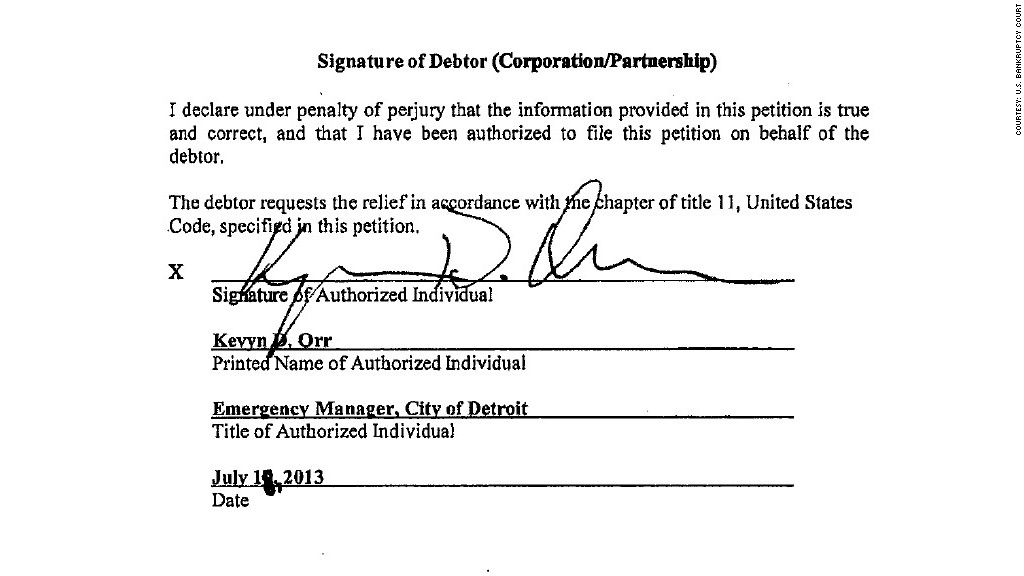
As seen here, Kevyn Orr was "authorized" to file this bankruptcy petition on behalf of the debtor, when the debtor was in state court arguing against it.

Witness the miracle of cell phones.

Detroit bankruptcy filing came with only 5 minutes to spare

kevin orr signature

Rule 3004. Filing of Claims by Debtor or Trustee


If a creditor does not timely file a proof of claim under Rule 3002(c) or 3003(c), the debtor or trustee may file a proof of the claim within 30 days after the expiration of the time for filing claims prescribed by Rule 3002(c) or 3003(c), whichever is applicable. The clerk shall forthwith give notice of the filing to the creditor, the debtor and the trustee.


Ok, I am just going to ask this only once, because I have been over this a few too many times, but can someone, anyone, tell me how is it that a private individual, who is not elected, represent a State in federal court, when the State Attorney General is representing the State in the State Court of Claims?

The Michigan Emergency Manager does not have any statute "authorizing" representing the State of Michigan in a court of law because that is the job of the State Attorney General.

There is nothing where it says an Emergency Manager can just up and make itself the trustee of a city and represent itself as an individual.

The Act, itself, gives the Emergency Manager, hailing from the executive branch, judicial powers to make judgments.

LOCAL FINANCIAL STABILITY AND CHOICE ACT (EXCERPT)Act 436 of 2012
Sec. 18.
(1) If, in the judgment of the emergency manager, no reasonable alternative to rectifying the financial emergency of the local government which is in receivership exists, then the emergency manager may recommend to the governor and the state treasurer that the local government be authorized to proceed under chapter 9. If the governor approves of the recommendation, the governor shall inform the state treasurer and the emergency manager in writing of the decision, with a copy to the superintendent of public instruction if the local government is a school district. The governor may place contingencies on a local government in order to proceed under chapter 9. Upon receipt of the written approval, the emergency manager is authorized to proceed under chapter 9. This section empowers the local government for which an emergency manager has been appointed to become a debtor under title 11 of the United States Code, 11 USC 101 to 1532, as required by section 109 of title 11 of the United States Code, 11 USC 109, and empowers the emergency manager to act exclusively on the local government's behalf in any such case under chapter 9.
(2) The recommendation to the governor and the state treasurer under subsection (1) shall include 1 of the following:
(a) A determination by the emergency manager that no feasible financial plan can be adopted that can satisfactorily rectify the financial emergency of the local government in a timely manner.
(b) A determination by the emergency manager that a plan, in effect for at least 180 days, cannot be implemented as written or as it might be amended in a manner that can satisfactorily rectify the financial emergency in a timely manner.
(3) The emergency manager shall provide a copy of the recommendation as provided under subsection (1) to the superintendent of public instruction if the local government is a school district.
I am sure there are those wondering, "how the heck does she know all this stuff?"
No automatic alt text available.
Simple. It is nothing but the Michigan Children's Institute law because the Superintendent is the same as the Emergency Manager, except the Emergency Manager law skipped a few steps in due process because it failed recognize a municipality as a public trust and recognized it as a private corporation to initiate seamless asset forfeiture proceedings.

The Children's Trust Funds started here in Michigan and is nothing but the original chattel ponzi scheme, just like they did with the real estate of Detroit, because it all ends up in some form of complex financial fraud scheme as a children's NGO trust.


And to to think, this all started in Detroit.

Anyway, I am quite sure Fox Rothschild has alot more of these ponzi schemes using trust funds, but hey, what do I know?

Fox Rothschild Headed to New Jersey Supreme Court in Case Stemming From Ponzi Scheme

The high court's review follows an appeals court ruling that revived a claim from a U.K. real estate investor alleging Fox Rothschild improperly let $2.4 million flow through an attorney trust account to a fraudster.


The New Jersey Supreme Court will review a London-based real estate investor’s lawsuit accusing Fox Rothschild of improperly transferring $2.4 million from the firm’s attorney trust account to now-convicted Ponzi schemer Eliyahu Weinstein.

With a notice handed down Nov. 16 and made public Monday, New Jersey’s high court agreed to consider whether U.K. real estate investor Moshe Meisels can maintain his claims of conversion and breach of fiduciary duty against Fox Rothschild. Meisels alleged that he was bilked by Weinstein—who previously pleaded guilty to running a yearslong, real estate Ponzi scheme that caused $200 million in losses—and that more than $2.4 million he lost moved through Fox Rothschild’s attorney trust account.

The state high court’s review comes after an intermediate appeals court in June revivedMeisels’ conversion claim against the law firm, while it also kept intact a trial court’s dismissal of the fiduciary breach claims.

Meisels alleged that he and Weinstein reached an agreement to invest in property in Irvington, New Jersey. In connection with that deal, Weinstein in 2007 directed Meisels to transfer a portion of the investment into Fox Rothschild’s attorney trust account, according to court documents. Weinstein, who was later sentenced to 22 years in prison for his Ponzi scheme, told Meisels at the time that Fox Rothschild was carrying out legal work on the property purchase.

Meisels transferred the money, and it later went into the coffers of some of Weinstein’s businesses, with $75,000 of it going to Fox Rothschild. The money was never used to purchase any property and, in his suit against the firm, Meisels alleged that Fox Rothschild effectively aided Weinstein as he carried out his fraud.

Lawyers from Fox Rothschild attacked Meisels’ claims on several fronts, ultimately convincing a trial court to dismiss them in a summary judgment ruling. Among other arguments, Fox Rothschild said Meisels couldn’t pursue his conversion claim because he didn’t do enough to show that he actually owned the money he allegedly lost, and because he never demanded its return.

Meisels countered that, while the transfers to the attorney trust account technically came from a company called Rightmatch Ltd., the business was serving merely as a conduit for the London-based Meisels to help convert his own personal funds from the British pound to U.S. dollars.

In June, the Superior Court of New Jersey, Appellate Division found against the law firm on both of those arguments. The appeals court held that Meisels had done enough to prove it was his money that flowed through the firm’s trust account. The court also noted that under the facts of this particular case, Meisels wasn’t required to demand his money back to be able to claim conversion in court.

The appeals court did, however, come down on Fox Rothschild’s side with respect to Meisels’ breach of fiduciary duty claim. The appellate ruling affirmed the trial court’s conclusion that Fox Rothschild didn’t owe any fiduciary duty to Meisels, leaving that claim dismissed.

Fox Rothschild’s defense lawyer, Francis Devine III of Pepper Hamilton, did not immediately respond to a request for comment, nor did a lawyer for Meisels, Brian Condon of Condon Catina & Mara in Nanuet, New York.

Read More:

Voting is beautiful, be beautiful ~ vote.©

Sunday, May 20, 2018

DOJ: $300 Million Real Estate Fraud Assets Seized In Rem Of Chattels

I am enjoying the way the DOJ is giving prominent accolades to the U.S. Assistant Attorneys on the filings but I have to say, this particular asset forfeiture filing has answered the time honored question of how a house can show up for court in a quiet title case.

From Latin, "against a thing."  Concerning the status of a particular piece of property.
For instance, in-rem jurisdiction refers to the power of a court over an item of real or personal property.  The "thing" over which the court has power may be a piece of land or even a marriage.  Thus, a court with only in-rem jurisdiction may terminate a marriage or declare who owns a piece of land.  In-rem jurisdiction is based on the location of the property and enforcement follows property rather than person.

That is correct, the same law of chattels for child welfare is also applied to real estate, because they, or rather, the deeds are treated the same as birth registers.

The Detroit Land Bank Authority filed pseudo...no, let us call it what it is....fake quiet title actions in Columbo's court to steal Detroit properties through Corporate Shape Shifters where it served the addresses as defendants because it is difficult for a residential, or even commerical, building to enter a courtroom.

Logistics, you know.

The only difference is that the Detroit Land Bank Authority, having never incorporated, never verified that the quiet title actions of the properties were in Rem.


Former CEO, CFO and Director of Health Care Services Company Charged in Elaborate $300 Million Investment Fraud Scheme

Defendants Allegedly Inflated Company’s Value and Revenue to Defraud Investors

The former CEO, CFO and an executive director of a publicly traded health care services company were charged today with allegedly orchestrating a widespread scheme to defraud investors and others out of hundreds of millions of dollars in connection with a merger transaction designed to convert the company into a private entity, Acting Assistant Attorney General John P. Cronan of the Justice Department’s Criminal Division and U.S. Attorney Craig Carpenito announced today. 
Parmjit “Paul” Parmar, 48, of Colts Neck, New Jersey; Sotirios “Sam” Zaharis, 51, of Weehawken, New Jersey; and Ravi Chivukula, 44, of Freehold, New Jersey, are charged by complaint with one count of conspiracy to commit securities fraud and one count of securities fraud.  FBI special agents arrested Parmar earlier today near his home.  He is scheduled to appear this afternoon before U.S. Magistrate Judge Leda Dunn Wettre in Newark, New Jersey federal court. Chivukula and Zaharis remain at large.      
According to the complaint unsealed today, from May 2015 through September 2017, the defendants orchestrated an elaborate scheme to defraud a private investment firm and others out of hundreds of millions of dollars in connection with the funding of a transaction to take private a company (Company A) traded publicly on the London Stock Exchange’s Alternative Investment Market.  To fund the transaction, the private investment firm put up approximately $82 million in equity, and a consortium of financial institutions provided another approximately $130 million in debt.  The scheme allegedly utilized fraudulent methods to grossly inflate the value of Company A and trick others into believing that Company A was worth substantially more than its actual value.
The complaint alleges that to present a positive picture of the company’s financial wealth, the defendants allegedly sought to raise tens of millions of dollars in the public markets, purportedly to fund Company A’s acquisitions of various operating subsidiaries.  In reality, a number of those entities either did not exist or had only a fraction of the operating income attributed to them.  The conspirators allegedly funneled the proceeds of these secondary offerings through bank accounts they controlled and used the money for a variety of purposes that had nothing to do with acquiring the purported targets.  The money was instead used to make it appear as if the operating subsidiary had substantial customer revenue when, in fact, the funds were simply transfers of the money that had been raised in the secondary offering.  The defendants allegedly went to great lengths to make it appear that these funds were revenue, concocting phony customers and altering bank statements to make it appear as if the funds were coming from customers.     
The conspirators allegedly:
  • Created fictitious operating companies that Company A purportedly acquired in sham acquisitions;
  • Falsified and fabricated bank records of subsidiary entities in order to generate a phony picture of Company A’s revenue streams;
  • Generated fake income streams and phony customers of Company A and its subsidiaries; and
  • Made material misrepresentations and omissions to the private investment firm and others.
The defendants’ alleged actions caused the private investment firm and others to value Company A at more than $300 million for purposes of financing the transaction to take the company private.     
The alleged scheme was uncovered around September 2017, when the defendants resigned from their positions with Company A or were terminated.  On March 16, 2018, Company A and numerous of its affiliated entities filed for bankruptcy, attributing the company’s financial demise, in large part, to the alleged fraud scheme.
Separately, the United States filed a separate civil complaint today seeking forfeiture of four properties that Parmar owns or controls, including a house on Colt’s Neck and three apartments in New York City.  The U.S. Securities and Exchange Commission filed a civil complaint today against Parmar, Zaharis and Chivukula.
The investigation was conducted by the FBI Newark Field office with the assistance of the U.S. Securities and Exchange Commission’s New York Regional Office.
The government is represented by Trial Attorney Leslie Lehnert of the Criminal Division’s Money Laundering and Asset Recovery Section, Chief Paul A. Murphy of the U.S. Attorney’s Office’s Economic Crimes Unit, Assistant U.S. Attorney Nicholas P. Grippo of the Economic Crimes Unit, and Assistant U.S. Attorney Sarah Devlin of the U.S. Attorney’s Office for the District of New Jersey’s Asset Recovery Money Laundering Unit.
The charges and allegations contained in the complaint are merely accusations, and the defendants are presumed innocent until proven guilty beyond a reasonable doubt in a court of law.

Voting is beautiful, be beautiful ~ vote.©

Wednesday, January 3, 2018

DOJ Needs To Look At The Great Lakes Water Authority


Today’s Dump of Wasted Taxpayer Money in Afghanistan ...
Fraud increases water rates
Well, pun intended, if an executive of a corporation can scheme to substantially steal, which is far beyond any concept of financial profit, taxpayer dollars by rigging bids, kickbacks, bribes, and funding political campaigns, regarding water treatment, then, they probably do the same thing for all other public contracts, like in child welfare.


So, in essence, these were no bid, public contracts which means they are probably looking into the actions of public officials.

This is what increases water rates.

This is privatization.

I wonder if they did this in Detroit and Flint, Michigan, sarcasm intended.

Former Executive Admits Guilt in Antitrust Conspiracy Affecting Water Treatment Chemicals

A former executive pleaded guilty today in the District of New Jersey for his role in a conspiracy to eliminate competition by rigging bids, allocating customers, and fixing the price for liquid aluminum sulfate sold to municipalities and pulp and paper companies in the United States. 
Brian C. Steppig, former director of sales and marketing for a water treatment chemicals manufacturer headquartered in Lafayette, Indiana, admitted to agreeing with competitors, from approximately 2005 until February 2011, not to compete for contracts for liquid aluminum sulfate, a coagulant used by municipalities to treat drinking and waste water, and by pulp and paper companies in their manufacturing processes.  
“Today’s result reflects the Antitrust Division’s ongoing efforts to hold accountable those who seek to corrupt the competitive process and cheat customers,” said Assistant Attorney General Makan Delrahim of the Justice Department’s Antitrust Division.  “This offense was particularly egregious, counting among its victims cities and towns throughout the Southeastern United States that relied on the conspirators’ products to provide clean water to their residents.” 
“The FBI is thorough in ensuring that anyone intent on corrupting our free market system is brought to justice,” said Special Agent in Charge Timothy Gallagher of the FBI's Newark Division.  “Corruption and collusion at any level in our society is unacceptable as it has such a negative impact on the consumer.”
According to court documents, Steppig and his co-conspirators agreed not to pursue each other’s historical customers.  To carry out that agreement, Steppig and his co-conspirators discussed prices to be quoted to customers and submitted intentionally losing bids to favor the intended winner.
A violation of the Sherman Act carries a maximum penalty of 10 years in prison and a $1 million fine for individuals.  The maximum fine for a Sherman Act charge may be increased to twice the gain derived from the crime or twice the loss suffered by the victims if either amount is greater than the statutory maximum fine.   
Including Steppig, two individuals and one company have pleaded guilty to charges arising out of this federal investigation of collusion in the liquid aluminum sulfate industry. 
The investigation was conducted by the Antitrust Division’s New York Office and the FBI’s New Jersey Office.  Anyone with information regarding price fixing, bid rigging or customer allocation in the liquid aluminum sulfate industry should contact the Antitrust Division’s New York Office at 212-335-8000, call the Antitrust Division’s Citizen Complaint Center at 1-888-647-3258 or visit www.justice.gov/atr/contact/newcase.htm

Voting is beautiful, be beautiful ~ vote.©
Friday, December 1, 2017

HHS OIG Busts New Jersey In $600 Million Medicaid Fraud In Child Welfare

Daydreaming images Daydreaming HD wallpaper and background ...
Thinking of how I was going to
end Medicaid fraud in child welfare
back in the day.
As long as I have been filing into my great repository of child welfare fraud, I have never seen anything so repugnant as this level of child welfare fraud.

Wait a minute, yes I have.

I remember when Medicaid fraud in child welfare all began in Michigan.

Back to the present.

This HHS OIG report produced a whopping $600 million in Medicaid fraud in child welfare in the State of New Jersey of it ripping off its IDEA children with special needs.

Now, ponder this for just a moment.

If there are 50 states and a few territories that are engaging in similar transgressions against children through Medicaid fraud in child welfare via special needs education cost-reimbursements, and each state and territory engaged in a comparable about of fraud, $500 million, then, that would mean the U.S. is being ripped off through privatized child welfare fraud, to an estimated tune of $25 billion a year.

This is why Betsy DeVos wants to privatize education in America.

She needs to keep funding political campaigns and international capital ventures.

Think about what I just said, then think about what I have been saying.

Much love to my #Superfans.
Voting is beautiful, be beautiful ~ vote.©

Sunday, June 12, 2016

Another $1.25 Million Draconian Medicaid Fraud In Child Welfare Moment

The Count from Sesame Street - This Draconian Moment was brought to you by Medicaid fraud in child welfare  and privatization
For just one moment, I ask to read the following statement taken from the article, below, very carefully:
Hubert has also placed $298,009 of the settlement in an escrow account to satisfy an automatic lien the Medicaid program places on any settlements or judgments collected by its beneficiaries.

The boy is a Medicaid beneficiary. Hubert said he has filed an appeal to prevent Medicaid from getting his client's money.

Yes, that is correct.

A boy, by the age of 3, who was under the aegis of a state foster care program, being serviced, and received even more services for being raped, beaten, tortured, then drugged to silences his screams, must reimburse Medicaid for the services provided.

I know boys who have survived, much worse, who were given a sentence to a life of poverty because the parents are obligated to reimburse Medicaid for the services provided to silence their screams.

Yes, the practice of legally charging parents to reimburse for the time a child has been in foster care is a well known practice, considered as a child support obligation, yet rarely pursued as reunification becomes a devoted life commitment of taking the children to more Medicaid services to address the hell the children survived.

In short, you cannot get blood from a stone, and most families are forced to live a life of poverty and cannot afford justice.

Not one penny of the Medicaid reimbursement the state is seeking to recover will be sent to reimburse the Social Security Trust program of Medicaid, so the States are double-dipping.

The U.S. HHS OIG will do nothing to stop this horrific treatment of children being constrained federalistically in the States rulemaking.

The White House will not even acknowledge this horrific treatment of children in its #HackFosterCare initiative.

The Medicaid Fraud Control Units of the States will do nothing to stop this practice, lacking authority, guidance and resources.

Congress and state elected officials will do nothing as it is in an election cycle and donors care nothing about stopping their lucrative businesses of "protecting children".

This draconian moment was brought to you by Medicaid fraud in child welfare and Paul Ryan's empowerment of privatization.

N.J. pays $1.25M to settle foster child sex abuse lawsuit

TRENTON — The state has agreed to pay $1.25 million to settle a lawsuit filed by the adoptive parents of a boy who endured physical and sexual abuse in multiple foster homes before his third birthday.

The boy will receive a check for $1,637.59 a month for the next 40 years, deposited into a special needs account, according to the settlement and the family's attorney, Craig J. Hubert of Lawrenceville.

The first check was expected to arrive this month, drawn from a state-created annuity worth $467,014.33, according to the March 11 settlement.

The money will be used "for the boy's treatment over the course of his lifetime as he is left to deal with the aftermath of horrific abuse and torture," Hubert said.

The state child welfare system, known at the time as the Division of Youth and Family Services, or DYFS, took custody of the infant after he was was born in what is today known as Trinitas Regional Medical Center in Elizabeth in May 1999, according to the 2011 lawsuit.

His mother had abandoned him at the hospital — a phenomenon at the time in which mothers, many drug-addicted, created a wave of "boarder babies" in maternity wards across the state.
DYFS enlisted a new nonprofit agency created by First Baptist Church of Lincoln Gardens in Franklin, Harvest of Hope, to recruit foster and adoptive families on the state's behalf for these abandoned newborns.

But neither Harvest of Hope nor DYFS performed any meaningful background checks on the foster families or their "paramours" who assumed care of the child, the first one in 1999, followed by two homes in mid-2002, according to the lawsuit.

Last year, Superior Court Judge Michael Nelson in Essex County agreed to drop Harvest of Hope from the lawsuit, citing its immunity from litigation as a charitable organization. Hubert said he has filed an appeal.

"I thought the decision by the trial judge was correct," said Harvest of Hope's Attorney Kenneth Ho of New Brunswick said.

The lawsuit also alleged that improperly supervised and untrained DYFS employees did not keep required routine visits, and had "failed to locate family members who were willing to care" of the baby.

Identified as S.B.K. in the court records, the baby was removed from the first foster home after DYFS confirmed that he and other children in the home had been abused and neglected. But the abuse continued in two subsequent foster homes.

By October 2002, the 3-1/2-year-old boy came to live with his eventual adoptive parents, the lawsuit said.

In settling the case, the state made no admission of wrongdoing.

The DYFS of 15-plus years ago does not resemble what is today known as the Division of Child Protection and Permanency, said Ernest Landante, spokesman for division's parent entity, the Department of Children and Families.

"Since then, the department has been fundamentally reformed, thoroughly changing its methods and policies," Landante said. "We vastly increased recruitment and retention of (foster) families and the use of kin so children can remain with relatives. We enhanced our screening and licensing standards and improved training for (foster) parents."

In 1999 – the year S.B.K. was born – the national advocacy group Children's Rights sued DYFS on behalf of foster children to force the state to spend more money and to run the dysfunctional agency properly. The lawsuit was settled in 2003 with a commitment the state would undertake a complete overhaul accept federal oversight. The latest monitoring report was released Wednesday.

The family will receive $467,014 of the $1.25 million settlement; the attorneys: $356,061 in fees and $88,414 in reimbursements; a psychiatrist: $22,000.

Hubert has also placed $298,009 of the settlement in an escrow account to satisfy an automatic lien the Medicaid program places on any settlements or judgments collected by its beneficiaries.

The boy is a Medicaid beneficiary. Hubert said he has filed an appeal to prevent Medicaid from getting his client's money.
"Medicaid has a right to the money as a matter of law, but it doesn't seem right my client, who had to bear this misery, should have to pay," he said.

Voting is beautiful, be beautiful ~ vote.©

Wednesday, September 2, 2015

New Jersey Errs by $32 Million in Billing Oversight of Adults and Children

If a state is allowing a pattern of improperly billing Medicaid for vulnerable adults to perpetuate, then it should be seen as a red flag for a similar pattern in child welfare.

Always remember, child welfare is a system closed from scrutiny, due to those "best interests of the child laws".

"Errors" in child welfare result in termination of parental rights, and in some instances, death.

Think about it.

N.J. owes $32M for improperly billing Medicaid for home health care: feds

TRENTON — The state improperly billed $32.2 million for home health services it could not document over a 3-1/2-year-period and should return the money to the federal government, according to a U.S. Office of Inspector General report released Monday.

A random audit of 100 claims submitted from 2008 to 2011 found 17 to be in error because they did not contain proper documentation, according to the report. The deficiencies included nurses not making required visits, companies using untrained home health aides, and failing to maintain patient files.

Based on this "error rate," investigators estimated the state Department of Human Services would have improperly overbilled for $32.2 million, or about 8 percent of the $393 million the U.S. Department of Health and Human Services paid New Jersey to provide home care to elderly and disabled homebound residents, according to the audit Inspector General for the U.S. Department of Health and Human Services.

The state's track record is spotty, according to the report by Regional Inspector General James P. Edert.

"During a prior review of New Jersey's personal care services program, 2004 through 2007, we identified a significant number of services improperly submitted for federal Medicaid reimbursement. On the basis of these results, we decided that another review of this program is warranted."

Valerie Harr, director of the state Division of Medical Assistance and Health Services, challenged five of the 17 claims for "extraordinary circumstances" that included two home health agencies going out of business, one agency losing files in a flood, and some files being older than five years – the length of time state law requires these documents to be kept.

In other instances, Harr's office was waiting more documents from home health care agencies to respond to other questions, according to Harr's written response to the audit.
Harr also questioned whether the claims were truly representative of the 18.2 million others submitted during this study period.

Federal investigators agreed to dismiss one complaint involving the files destroyed in a flood. "We maintain that our remaining findings and recommendations are valid," according to the investigators' response.

The audit was first reported by The Record
.
The state was just cited in June by the Inspector General for lax monitoring of its home health workers.

An audit of 150 randomly selected claims from 2007-08 turned up 38 in which home health aides lacked the proper training or supervision, hadn't had their own health screened for communicable diseases, or hadn't had the proper check of their background and certification.

If that same failure rate occurred in all the claims during the 19-month period, 73,260 claims would have had some kind of error. Taxpayers paid more than $4 million for those problematic claims.

Voting is beautiful, be beautiful ~ vote.©

Tuesday, February 3, 2015

Cursing Is Child Abuse in New Jersey

Yes, using "bad words" in the presence of a child is considered child abuse.

These cases of "child abuse" are then sent up to HHS as aggregate data to justify funding levels for child protection.

Moral turpitude generates f@#%&g revenue and creates jobs.

N.J. ban on “the habitual use by [a parent or guardian] in the hearing of such child, of profane, indecent or obscene language”


Is the ban constitutional? The New Jersey Supreme Court just decided a case, State v. Tate (N.J. Feb. 2, 2015), but declined to decide whether the statute violates the First Amendment or parental rights. Instead, the court concluded that the defendant’s guilty plea should be thrown out, because there wasn’t enough showing in the “plea colloquy” that the defendant was actually guilty; the plea colloquy is the hearing before the trial court at which the defendant admits his guilt and shows that he understands the consequences of the guilty plea:
[W]e now examine whether the factual basis elicited from defendant to support his guilty plea satisfied the elements of child abuse. That is, did defendant admit to or acknowledge uttering profane, indecent, or obscene language in the presence of R.G. on a habitual basis? As we discussed, the words profane, indecent, and obscene are susceptible to various interpretations—and reasonable people may have different understandings of the meaning of those words. Here, defendant was never asked precisely what words he uttered that fit the statutory language. Defendant merely answered, “Yes,” to the question, “did you curse in [R.G.'s] presence to and in a way that would debauch his morals?” and, “Yes,” to the question, “you used off-color language in his presence?”
Curse words and off-color language many times will be synonymous with profane, indecent, or obscene language, but not always. Therefore, it is not possible to determine whether defendant’s use of a curse word or off-color language is the equivalent of the language proscribed by the child-abuse statutes. Conceptions of what constitutes a curse word — even ones that would debauch the morals of a minor — and off-color language may differ among reasonable people. What is profane or indecent may depend on social norms that are fluid.
The flaw in the plea colloquy was the failure to elicit the actual words and language uttered by defendant in the presence of R.G. Only then would the court have been in a position to make an independent determination whether the purportedly offending language constituted child abuse.
Moreover, even if we accept that the use of curse words or off-color language is the equivalent of “profane, indecent or obscene language,” N.J.S.A. 9:6–1(d), the plea colloquy did not elicit whether defendant engaged in the “habitual use” of such language. The “habitual use” of the statutorily proscribed language is an element of child abuse. Defendant’s factual account does not satisfy that element. We cannot infer from defendant’s admission that because R.G. lived with him for three months, defendant therefore must have habitually cursed in the minor’s presence.
Eliciting an adequate factual basis should not be a complex or difficult undertaking if a defendant is willing and able to give a truthful account of the conduct that violates a statute. We are aware of the long procedural history of this case, and that the State attributes delays to defendant and that defendant complains about the one-day-only plea offer. But the sole matter of consequence that we address is whether the factual basis given during the plea colloquy conforms to our court rules and jurisprudence.
We need not decide whether N.J.S.A. 9:6–1(d) is so broadly and vaguely worded that it treads on constitutionally protected free-speech or due-process rights, or the right of a parent to raise a child without undue interference by the State. Here, the factual basis does not comport with the requirements of our court rules or jurisprudence and, therefore, we choose not to reach the constitutional issue raised for the first time on appeal before us.
Because we conclude that the factual basis does not satisfy the elements of N.J.S.A. 9:6–1(d), we are constrained to vacate defendant’s plea of guilty to child abuse.
I think that the statute is both unconstitutionally vague and overbroad (unless it is limited to “obscene language,” and that in turn is limited to extremely pornographic language explicitly describing sexual acts, which is probably not what “obscene language” was likely intended to mean in this context). Still, it’s interesting that the statute is still out there, and still being used.
Note that there’s a backstory to the prosecution:
Defendant was charged in a 2004 Morris County indictment with first-degree aggravated sexual assault; second-degree endangering the welfare of a child; and third-degree aggravated criminal sexual contact. Defendant allegedly committed those criminal acts between September and November 1999, when he served as a foster parent to thirteen-year-old R.G., who had been placed in defendant’s home. The long and tortuous procedural history of this case is not germane to this appeal. Suffice it to say that defendant filed multiple motions and cycled through a number of attorneys from the time of the indictment in 2004 to the plea proceedings in June 2009.
On June 4, 2009, the State tendered to defendant a plea offer that expired that same day. The State and defendant entered into an agreement, which provided that defendant would plead guilty to the downgraded charge of fourth-degree child abuse. In return for the guilty plea, the State agreed to dismiss the remaining charges in the indictment and recommend a sentence of time served [which at that point was more than three years -EV]. The State also agreed that no fine would be imposed….
With respect to the crimes charged in the indictment, the court observed that defendant “sat in jail for a number of years” and “maintained his innocence,” rejecting “favorable plea offers to time served.” Indeed, defendant had been incarcerated for more than three years before he was released on bail on May 20, 2008. According to the court, defendant only accepted “responsibility” when he was “offered an opportunity to provide a factual basis” to cursing in R.G.’s presence. The court found that defendant provided a factual basis for child abuse because he admitted that he was a foster parent in charge of a minor and that “he did curse [and] use foul language” in the child’s presence.
Voting is beautiful, be beautiful ~ vote.©