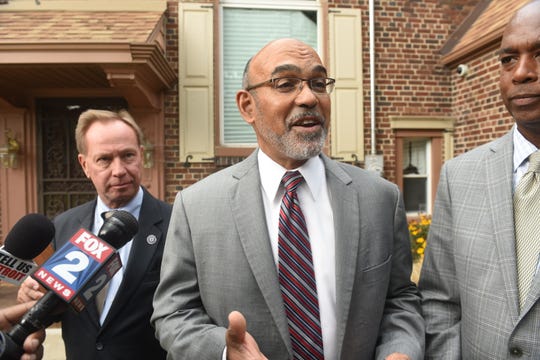
Showing posts sorted by relevance for query camargo. Sort by date Show all posts

Thursday, August 24, 2017

Ring Around The False Claims Act With The Detroit Land Bank Authority


On July 1, 2016, I had about just enough with "Becky" (said like a 1980s Valley Girl) Camargo being a "Meanie" that I lodged a formal grievance with the Michigan Attorney Grievance Commission on her, and her cohorts.


636391899487340902-camargo.jpg
"Becky" Camargo,
former DLBA attorney
The following, in the spirit fuchsia, is an excerpt of that grievance.
I spoke to Ms. Jackson, who refused to give her first name, of the Deed Fraud Unit, whose miserable deportment instructed me that she “works directly with Rebecca Camargo on a daily basis” and informed me that she was going to share my information with her. 
Rebecca Camargo, according to Craig Fahle, a public representative of the DLBCDC, is the Principle Attorney of the DLBCDC, has threatened to file for reconveyance of my property while, in the same breath, telling me that “You have no right to complain. You have no civil rights.” 
Rebecca Camargo is a former Wayne County Prosecutor and it is believed she is the individual who is circumventing the recordkeeping process of the chain of command for properties. Simply put, she is acquiring properties from the Deed Fraud Unit to be sold through the DLBCDC without documenting. 
It is believed that this pattern of practice in fraudulent cost-reimbursements may also be applied to  properties slated for demolition. Once demolished, there is no evidence. 
The State Attorney Grievance Commission responded as such:


Michigan Attorney General's Office busted covering up:

"What are you talking about?  We had nothing to do with this."

TRANSLATION: "What are you talking about?  The State of Michigan Office of Attorney General would never condone any such fraudulent behavior.  We know nothing!  This is an ongoing federal investigation, and you should know that"

I respect that, but I had to find a way around the stupid False Claims Act's arcane financial barrier, (pun intended) of not being able to afford an attorney to engage in reporting federal fraud.

See, the FCA, does not allow an individual to report fraud.

Well, I believe I found the loophole.

If one reports federal fraud through an extensive, exhaustive series of constituency request for referrals, filing of grievances, and a bevy of other administrative means of reporting fraud, where, each and every missive, as I am an elected official, is overtly dismissed, well, that looks like one of those default of duty things.

"You have abused your powers and neglected the duties to protect the national treasury as children are our most precious treasures; ergo,  parens patriea is now conferred upon me, by default."

Call me, the de facto parent.

"Ring around the statute, 
A pocket full of attributes,
Ashes, to ashes,
It all gets shut down".


Oh, by the way, rumor has it last week City of Detroit Corporation Counsel convened a super secret special procurement task force. 

Very interesting results.


Director of demolitions resigns from Detroit 

Land Bank amid federal probe

For your viewing pleasure, I have included, below, a video of Rebecca Camargo's handy work, or at least that is what the name was on the post on my door.  Enjoy!

The director of demolition for the Detroit Land Bank has resigned just a few months after taking the job.

 Rebecca Camargo’s resignation comes amid a federal grand jury investigation targeting demolition contractors and Mayor Duggan’s administration. Camargo, an attorney from Rochester Hills, was promoted to demolition director following the resignation of Pura Bascos in January.

Camargo previously served as principal attorney for the Land Bank. It’s unclear why Camargo resigned.

 “We thank Rebecca Camargo for her more than three years of exceptional service to the Detroit Land Bank, and wish her well in her future endeavors,” Land Bank spokesman Craig Fahle said in a statement.

 Turnover has been high at the Land Bank and Building Authority, both of which oversee Duggan’s beleaguered demolition program. Demolitions have plummeted from more than 200 a week to 35 a week so far this year. In the meantime, the Land Bank’s payroll has nearly doubled.

 Earlier this year, federal prosecutors investigating the city’s demolition program issued grand jury subpoenas for records that contractors have received from Duggan’s office and city and state agencies.

 Three sources close to the investigation said federal authorities are probing allegations of a bid-rigging scheme to steer tens of millions of dollars in taxes to select companies. Investigators also are probing allegations of wire fraud after some contractors received money for work they didn’t perform.

 The grand jury subpoenas, which indicate federal authorities are serious about pursuing criminal charges, were issued by Assistant U.S. Attorney Karen Reynolds of the Eastern District of Michigan. 

Detroit is one of the few cities nationwide using Hardest Hit Funds for demolitions.

The money was originally intended to helping struggling residents save their homes from foreclosure.

http://motorcitymuckraker.com/2017/08/24/director-demolitions-resigns-detroit-land-bank-amid-federal-probe/


Yes, I filed multiple, formal complaints on this woman, who seems to need a bit of personal intervention, with the Detroit Land Bank Authority, and other city and state agencies, but of course, nothing happened.

Voting is beautiful, be beautiful ~ vote.©

Wednesday, September 25, 2019

SIGTARP, Detroit Land Bank Authority & The Uncloaking Of The Dark Gerrymandering Tale

636391899487340902-camargo.jpg
Becky (said like a 1980s valley girl) Camargo
For everything you ever wanted to know about the Detroit Land Bank Authority, you shall find it here.

The Special Inspector General for the Troubled Asset Relief Program, or SIGTARP, has been conducting a criminal investigation into the program for several years. 
SIGTARP also has secret recordings.

What many may not understand is that these privately contractors may have demolished properties where absentee ballots were issued to these property addresses and tallied for the 2018 election...2016 election...and 2014 election....and 2012 election....and 2010 election.....but hey, what do I know?

#perkinscoiesucks

Contractors named own price for Detroit demolition dirt, emails show

Detroit — Contractors charged the federal government whatever they wanted for more than two years for dirt used to fill holes left behind from thousands of torn-down houses in Detroit's controversial demolition program, emails obtained by The Detroit News show.

It would have been nice if they would have at least dropped more than five inches of dirt on my lot of a demolished home.  I should excavate just to see if there were any antiques left behind before they bulldozed the structure to collapse in its burnt out basement. I really wanted to plant vegetables to compensate for the nasty things Michigan and Detroit continue to do to tiny humans.

The unrestricted charges occurred because no rules were in place to limit dirt costs, eventually prompting state officials to worry about overbilling.

Emails reviewed by The News flagged dirt costs ranging from $3,750 to upward of $7,000 per property that were billed to the state for reimbursement. These charges prompted the state to crack down on contractors, limiting dirt costs to $3,000 for larger houses and $2,000-$2,500 for typical properties.

Considering the average cost for dirt in the most recent quarter — $2,368 per property — it is likely the government spent well above the $18 million it would have on the 7,747 demolitions conducted from the program's inception through July 2017 when cost controls were put into place.

"I cannot say with any kind of authority if something was inappropriate or fraudulent. All I can say is I questioned those costs that were just kind of out of line," said Mary Townley, president of the Michigan Homeowner Assistance Nonprofit Housing Corp., the entity created by the Michigan State Housing Development Authority to administer federal Hardest Hit Funds for the demolition program.

The state's concerns — seen flagged in 2017 correspondence between MSHDA and Detroit Land Bank Authority — first came to light more than a year after the program launched in spring 2014.

The News' request through the Freedom of Information Act included email discussions over dirt charges submitted by contractors that spanned from January 2017 to May 2017. The emails turned up close to a dozen instances in which dirt costs were flagged by state workers hired to review demolition invoices.

State contractors and program leaders expressed skepticism to land bank officials about the prices billed to the taxpayer-funded blight effort as invoices began to come in by late 2015.

But cost reasonableness for dirt wasn't officially added to the state's blight manual until July 2017, requiring contractors to turn in dirt invoices, load tickets and other documents to substantiate costs. This essentially made a paper trail from contractors to prove what "they really paid" for the dirt, according to the emails.

It's unclear to the state what the average dirt cost per house was in the early stages of the program because officials admit they weren't being tracked.

The state also could not provide an estimate on the number of invoices it received that sparked concerns. But officials said once invoices began to ramp up, so did the irregularities, prompting an investigation into the costs and billing practices for the overall program.

'Digging deep' into costs
The emails raise accountability questions for the demolition program, which has been the subject of a federal criminal investigation. The development also comes amid an ongoing audit of whether contaminated soil was used to fill holes for homes torn down through the federally funded program in Michigan cities, including Detroit.

At the outset, the state "did what we could" but operated without formal rules to cap dirt costs, Townley said.

The state got the bulk of the early demolition invoices in late 2015. That's when, Townley said, questions surfaced and state officials began "digging deep" into program costs and whether contractors had documentation to back them up.

The state in 2016 launched a review of the city's demolition program in tandem with a two-month suspension imposed by the U.S. Treasury Department to address improper billing and misallocation of funds.

The state concluded its review of Detroit's billing practices in early 2017 with a $5 million settlement with the land bank to resolve a dispute over invoices the state said were improperly submitted for repayment. In return, the state agreed to make that same amount available to Detroit for tearing down more houses.

On the heels of its review, the state implemented "cost reasonableness" guidelines that Townley said "opened up the process for the state to question costs" as well as a policy requiring contractors to supply load tickets for dirt and copies of other documentation from bid packs. Initially, the state didn't track dirt costs separately.

The dirt cost rules were referenced in a January 2017 email titled "dirt invoices" from Roxanne Eaton, the state's program team leader.

In the correspondence, Eaton identified a range of $2,000 to $2,500 that she deemed acceptable.

Prior to that, emails suggest some were billed at $3,750 or $5,000, regardless of square footage, with at least one billing reaching nearly $7,000, the News found.

On Jan. 24, 2017, Eaton sent an email to MSHDA staff, copying Townley, saying $2,000 to $2,500 or less for dirt for "our usual dinky" houses "we will be fine."

If it's $2,500 to $3,000 and the house is larger, "I am OK with it," she wrote.

"We will only question the ones that falls out of these categories," added Eaton, who notes that costs of $3,750 billed by the prominent demolition firm Homrich "is still high in my mind unless the house is very large."

Anthony Abela, a project manager for Homrich, declined to be interviewed.

Eaton, in a Jan. 19, 2017, email to some land bank and city building authority staff titled "heads up," warned that "very high costs for dirt" would need to be explained.

"I am putting you guys on notice that we are sending the files back with a note asking the contractor to supply a copy of the load ticket and a copy of the invoice showing they really paid for dirt," she wrote.

"We are receiving conflicting stories about where and how dirt is being acquired, so this is (the) way treasury wants us to address it."

On April 24, 2017, an MSHDA worker sent an email to Rebecca Camargo, the land bank's former demolition program director and other land bank staff, asking why the dirt cost for a 2,390-square-foot property at 5759 Lawton was $6,875.

Camargo responded that the property, which records show was demolished by Salenbien Excavating and Trucking, fell under a past directive from the state "to put any dirt amount into that field."

"That directive stated that it didn’t have to be an estimate, just a dollar amount," she wrote, noting the new directive to control costs from the state would be applied for future bids.

In a separate exchange the same month, another MSHDA contractor asked how two properties on Carter — one with 2,208 square feet and another with just 920 square feet — "can both have a charge for dirt = to $5,000 for each?"

"As previously discussed, contractors were operating under a directive to simply place a cost in the dirt column," Camargo wrote in response on April 24, 2017, of the property also under contract with the firm Salenbien. "It is not necessarily reflective of the actual cost."

Camargo, now a private attorney who represents several demolition firms including Salenbien, told The News she doesn't believe any of the contractors were overcharging.

"Quality dirt costs money and is expensive," she said. "The competitive bid process rules out any issue of public waste and/or inflated costs."

On April 24, 2017, an MSHDA worker sent an email asking why the dirt cost for a 2,390-square-foot property at 5759 Lawton was $6,875.Buy Photo
On April 24, 2017, an MSHDA worker sent an email asking why the dirt cost for a 2,390-square-foot property at 5759 Lawton was $6,875. (Photo: Max Ortiz, The Detroit News)

Camargo said it was clear to her in January 2017, while serving as the demolition director, that there had been an old directive from the state to contractors regarding dirt costs and bids.

"The old directive was to place a cost in the dirt column irrespective of the actual dirt cost," she said. "The new directive came in January 2017, stating that the dirt cost had to be reasonable, essentially based on the size of the structure being demolished."

Camargo said MSHDA reimbursed the land bank for "each and every property they questioned regarding dirt" during her tenure as demolition director. The costs, she said, "were legitimate."

Camargo, a former Wayne County prosecutor, resigned her post with the land bank in August 2017.

In a statement provided to The News, the state said at no time was there a directive to "place any number" in the cost field for dirt.

"But it did ask Detroit to start estimating costs for each category of greening: dirt, grade, seed, sidewalk repair or replacement," MSHDA spokeswoman Katie Bach wrote in an email on behalf of Eaton and Townley. "That estimated cost breakdown reporting started in 2015 and is still required today for all state partners receiving Hardest Hit Funds for demolition, not just Detroit."

Alyssa Strickland, a spokeswoman for the land bank, said Eaton's email is the only directive the land bank has on cost reasonableness and the authority continues to follow it.

The land bank, she said, doesn't see backfill as a factor that drives up costs, and it "wouldn't be making any award decisions based on the dirt price."

The authority, she stressed, looks at the total price of a bid package with the goal of getting the lowest price overall to "maximize every federal dollar."

"We need each bid pack to come in as low as possible to get down as many properties with the finite amount of money that's available to us," she said. "Monitoring the price of dirt isn't really getting us to that end goal. We're looking at what's the overall price for the package."

If the overall price for a property seems too high, she said, it's flagged and the land bank examines it more closely.

Record integrity questioned
Details of the lack of early pricing policies for dirt come after The News reported this spring on a University of Michigan researcher's analysis of record-keeping for the backfill program that turned up errors, gap and oversight concerns.

The findings shed light on the control contractors wielded in the process, said Michael Koscielniak, a doctoral candidate in urban and regional planning who spent more than four years reviewing public records that cast doubt on the integrity of soil records for the $265 million blight elimination program.

The city has said record-keeping for dirt evolved from a paper-based tracking system to digital records, but all of the dirt used to fill holes left behind from housing demolitions was accounted for.

Detroit's demolition program launched with urgency to draw down the first federal dollars earmarked to rid the city of blight. In a state of emergency, Koscielniak said, no regulation is safe.

"When you establish that as the default, it becomes very easy to let stuff get by or to rationalize or accommodate contractors or haulers what have you, taking advantage of the program," he said. "Basically, the contractors were able to set the rules."

The demolition program first came under scrutiny in fall 2015 amid worries over spiraling costs and bidding practices.

The Special Inspector General for the Troubled Asset Relief Program, or SIGTARP, has been conducting a criminal investigation into the program for several years.

This summer, two former employees of a major demolition contractor pleaded guilty to accepting bribes and rigging bids. Both were sentenced to a year in prison.

The federal watchdog agency in January issued subpoenas to certain contractors, seeking two years' worth of backfill records, including cost, where it was obtained and where it ended up.

SIGTARP is also in the midst of an audit of federally funded demolition activities for the risk of contaminated soil in Michigan and Detroit.

Koscielniak said he was contacted by SIGTARP in April to discuss several dozen residential demolitions in 2015 that used backfill from a source site in an industrial area of northwest Detroit.

"The feds are concerned it may have been material generated from the I-96 project," he said, referring to a recent road reconstruction project in western Wayne County.

Demolition program officials have insisted, however, that the use of dirt from the I-96 project was prohibited.

Risks related to the dirt used to fill demolition holes was a core focus of a 2017 audit of Hardest Hit Fund-paid demolitions in Flint. This summer, SIGTARP opened a new audit at the request of Democratic U.S. Reps. Brenda Lawrence of Southfield and Rashida Tlaib of Detroit to determine whether and how its earlier recommendations have been implemented, said Rob Sholars, a spokesman for SIGTARP, in an email.

"Ensuring the integrity of the dirt backfill process is a key area of SIGTARP's continued oversight of the Blight Elimination Program, and we will continue to work to prevent fraud, waste, and abuse throughout the program," Sholars wrote.

Sholars added he can't speak to specific cases but "would strongly agree that decisions related to the broader dirt backfill process should not be left to individual contractors."

"Our audit findings and recommendations make clear that more effective state agency quality assurance and oversight is required," he said.

Eaton, in a Jan. 19, 2017, email that flagged a bill for $3,750 bill for dirt submitted by Homrich, wrote many contractors "received dirt for free or just the trucking charges, and we now have to prove that these are legitimate costs."

"If they are legitimate costs, it should be no issue at all to obtain the documentation," she added.

Koscielniak, in his backfill analysis, identified 70 properties demolished by Homrich from June 4, 2015, through July 11, 2015, in which the firm billed $3,750 for dirt on each, totaling $258,750. All of the material was supplied from a site on Castleton Street.

Townley said in that instance and others, "it appears" Homrich "made a self-determined average and charged the same amount for each lot" prior to the program guideline changes.

"While this is not correct, it is the way DLB accepted the costs back in the beginning of the program," she said. "It wasn’t until later, toward the end of 2016 and 2017, that we took a stronger approach, requiring invoices, load tickets and further justification on costs."

Detroit has knocked down more than 19,000 houses since spring 2014. Of those, more than 12,000 were razed with federal funds.

The last of the Hardest Hit-funded demolitions work has been allocated in Detroit and Mayor Mike Duggan is pitching a bond measure for March that would enable the city to raze the remaining 19,000 blighted houses. This fiscal year also marks a transition from a demolition effort controlled by the land bank to a city-administered effort.

Duggan recently reiterated in an interview with The News that since stronger protocols were implemented in 2016, the federal government has released another $175 million to Detroit for demolition.

"Obviously, things were learned," he said. "But the fact that for more than three years now the money has flowed tells you that the feds and MSHDA have confidence in what we're doing. I'm looking forward, not backwards."

Voting is beautiful, be beautiful ~ vote.©

Wednesday, January 30, 2019

Former Detroit Land Bank Authority Attorney Becky Camargo Gets Second SIGTARP Subpoena

636391899487340902-camargo.jpg
Becky (said like a 1980s Valley Girl) Camargo
Well...

I bet this is quite the uncomfortable position for Becky (said like a 1980s Valley Girl) Camargo.

See, she was the former Wayne County Property Deed Fraud Unit Prosecutor who was handing over properties to Detroit Land Bank Authority when she became its lead attorney overseeing her continuous property transfer pipeline.

But now, she is representing one of the contractors she contracted with in her former position at the Detroit Land Bank Authority, where she drew up the contracts, and has been subpoenaed to provide certain contracts to SIGTARP, even though the Detroit Land Bank Authority never incorporated.

Messy.

Becky  (said like a 1980s Valley Girl) may be facing one of those pesky "attorney-client  privilege" stripping situations with her second SIGTARAP subpoena.

I bet that sucks.

Then again, SIGTARP may just be going off what Becky  (said like a 1980s Valley Girl) when she was on wiretap, but, hey, what do I know?

I know Becky (said like a 1980s Valley Girl), should ask Perkins Coie to represent her in her  upcoming legal defense.

I wonder what Michael Brady is into, lately?

Subpoenas issued in criminal probe of Detroit demolitions

Detroit — A federal watchdog agency has issued a new round of subpoenas in its ongoing criminal investigation into the city's demolition program.

In subpoenas issued this month, the Special Inspector General for the Troubled Asset Relief Program is seeking two years' worth of documentation from certain contractors over dirt used to fill holes for homes torn down under the blight removal effort.

The feds demand that demolition firms produce receipts and records that reveal where their backfill dirt was coming from, who trucked it to sites in Detroit and where it was dropped off.

The subpoenas are the latest development in the agency's ongoing criminal probe of demolition in Detroit after the federally funded program came under scrutiny in 2015 amid concern over bidding practices and soaring costs.

A copy of a Jan. 10 subpoena obtained by The Detroit News seeks documentation for specific contracts from 2016 through 2018 and notes the information sought is "relevant or material to an ongoing investigation."

Rebecca Camargo, an attorney for one of the contractors targeted, said subpoenas were issued this month to at least seven different demolition companies.

One of her clients, Jackson-based Smalley Construction, received one on Jan. 11 and turned over its documentation to SIGTARP on Monday.

"We've compiled all the information for Smalley that they've asked for and sent it to them," said Camargo, a Troy-based attorney who formerly served eight months as the land bank's director of demolition before stepping down in August 2017. 

"As far as we know, they are reviewing it," she said of SIGTARP. "We have not gotten a response from them yet."

Camargo noted the subpoena asked for information pertaining to several different contracts. For most of the properties, Smalley has not yet completed those jobs. For properties it has knocked down, the company has supplied its backfill tickets. The company, she added, uses dirt from residential projects to fill its open holes.

Rob Sholars, a spokesman for SIGTARP, said Tuesday that it's the office's policy not to comment on any ongoing investigations, including confirming whether they exist.

The newly issued subpoenas were first reported Sunday by Deadline Detroit.

Reached Tuesday, Christian Hauser, an attorney for several demolition and abatement contractors involved in the program, said he was unable to confirm whether his clients received subpoenas.

The Detroit Land Bank Authority oversees the blight elimination effort along with the Detroit Building Authority. More than 16,000 blighted homes have been demolished under the program since May 2014.

The land bank has not received any subpoenas related to backfill used at demolition sites, said spokeswoman Alyssa Strickland, adding "but we do continue to cooperate fully with the SIGTARP investigation."

Brian Farkas, director of special projects for the building authority, said the city and the building authority hadn't received subpoenas either. The city, he said, is cooperating "with all inquiries and investigations into our demolition program."

The Michigan State Housing Development Authority allocates funds for the program under the state's Homeowner Assistance Non-Profit Housing Corp.

The state on Tuesday said it also has not received subpoenas related to backfill from SIGTARP.
Katie Bach, a spokesman for MSHDA, said in a Tuesday email to The News that Detroit implemented a new dirt tracking system late last year to better document dirt that's being used for demolitions.

"The guidelines require source of dirt, the address it's going to, and size of load by cubic yard or square feet," she said.

During the time period referenced in the subpoena, Detroit required contractors to provide invoices for dirt and the land bank maintained load tickets that documented the quantity and where it was dropped, according to MSHDA.

"The biggest difference is that the source is now being documented," Bach said. "MHA supported the guideline changes because they made sense for the continued success of the program."

Strickland said the land bank prioritizes public health and safety and it always had rules that govern backfill for demolitions. It's covered in requests for proposals, she said, "so all contractors know exactly what the requirements are each time they bid and sign a contract."

The building authority then manages those contracts and requirements.

Under program policy, Farkas said demolition contractors are required to identify the source of all backfill materials and maintain records for inspection upon request.

"These requirements have been updated, and contractors are now required to sign an affidavit and provide documentation regarding dirt source and destination," Farkas said.

Contractors must also perform sampling and analysis of materials that come from sources that may exceed state criteria for residential use.

Sampling has informed the building authority's decision to prohibit the use of soils from certain projects, including the I-96 construction project and Little Caesars Arena.

The building authority, Farkas said, has strict penalties for contractors found to have violated the policy, including a 30-day bid disqualification for a first offense, 90 days for a second and nearly a full year for a third offense.

Several contractors were sanctioned for violating the policy between 2016 and 2018, he said. Each had to pay for the cost of removal, replacement and proper disposal of the unauthorized fill.

SIGTARP is a federal law enforcement agency established by the Emergency Economic Stabilization Act of 2008 to conduct, supervise and coordinate audits and investigations of the purchase, management and sale of assets under the Troubled Asset Relief Program.

In 2016, the agency issued subpoenas demanding the land bank and building authority hand over information on federally funded contracts and several demolition contractors.

Detroit's auditor general, who is conducting an ongoing audit on the city's demolition activities, and several contractors involved in the program previously confirmed that they'd received subpoenas from SIGTARP in 2016 as well.

The federally funded effort has also been the subject of state and local audits, reviews and a probe being conduct by the Detroit Office of the FBI.

In 2017, The  News reported that a federal grand jury was focused on whether dollars earmarked for tearing down blighted homes in the city were misappropriated.

As many as 30 contractors and city agencies were believed to have been subpoenaed to testify or provide documents.

A past review of the program's billing practices conducted by the state turned up $7.3 million in what the state argued were "inappropriate" or "inaccurate" costs — the vast majority in connection with a controversial set-price bid pilot in 2014 designed to quickly bring down big bundles of houses.

Detroit's Office of Inspector General issued findings last month from an independent, three-year investigation into the set-price contracts that concluded meetings between city officials and specific contractors to discuss federally funded demolition work before public bidding didn't violate written rules but gave the impression of "preferential treatment."

Voting is beautiful, be beautiful ~ vote.©

Friday, March 15, 2019

Cocktails & Popcorn: Wayne County Treasurer & Prosecutor - Gerrymandering In Office

"The Elected Ones" do this all the time.

The Wayne County Treasurer's Office has the Wayne County Property Deed Fraud Unit.

Becky (said like a 1980s valley girl) Camargo, used to run the Wayne County Property Deed Fraud Unit, through the Wayne County Prosecutor's Office, but did nothing.

Well, actually, Becky was working with Mike Duggan when he was Wayne County Prosecutor, but she ended up getting the Principal Attorney position at the Detroit Land Bank Authority when Duggan was elected Mayor, but that is just a coincidence.

Becky was still running the show over there with the Wayne County Property Deed Fraud Unit having properties sent over to the Detroit Land Bank Authority.

Becky had to leave Detroit Land Bank Authority, but now she is representing the contractors of her former Ham Sandwich, for I have no other term for DLBA because it never incorporated, so I have no idea how she was even hired, cashed her checks, and legally represented  it.

Kym Worthy is the Wayne County Prosecutor, now.

Kym may have a conflict of interest when it comes to prosecuting "The Elected Ones" who have ended up getting Detroit Land Bank Authority and Wayne County Tax Foreclosure Auction properties, but hey, what do I know?

I know Benny Napoleon is the Wayne County Sherrif.

And I know this is another form of gerrymandering.

And I know Garlin Gilchrist falls into the grouping of "The Elected Ones", too!

I also know alot about Raymond Wojtowicz, former Wayne County Treasurer because he used to hang out at the Piast Institute and Brendan Dunleavy used to have a lot to say, but no one would listen to him but me.

FBI scrutinizes Sabree property dealings; family underpaid taxes


Wayne County Treasurer Eric Sabree speaks from outside
his Detroit residence on Thursday August 31, 2017
The FBI is looking into land deals by the family of Wayne County Treasurer Eric Sabree, including an allegation that interest and penalties were waived on his son's delinquent properties, The Detroit News has learned.

Investigators have contacted a former Sabree staff member who complained to human resources about suspicious activity on the accounts of Sabree family properties, according to two sources familiar with the federal review.

They would only speak on the condition of anonymity.

Sabree's lawyer said he was not aware of an FBI investigation, but he said it was discovered in 2017 that the treasurer's family underpaid taxes on their delinquent property bills by $13,000, which is around the time of events the former staffer describes in her complaint.

Thomas attributed the shortfall to a mistake by Sabree's staff involving about a dozen family properties. The treasurer's wife paid the bills on May 24, 2017 shortly after they were recalculated, he said.

“It is our position that nothing inappropriate was done by Mr. Sabree,” said attorney Philip Thomas. “It was a mistake.”

The disclosures of a federal inquiry and irregularities with his family's properties come amid a Wayne County ethics board review of Sabree's activities. It was sparked by a Detroit News investigation that among other findings,showed a company Sabree founded and his wife participated in the county's tax foreclosure auction in violation of county rules.

Sabree responded to the ethics complaint earlier this week, denying any conflict of interest but expressing regret for his wife's purchases that may appear to run afoul of county policy.

His lawyer said Friday that he didn't know how the miscalculation of $13,000 with properties tied to Sabree happened or who found it. He said he was still gathering information and wasn't sure how far back the debt went back. Some of the properties included vacant lots on Wyoming and houses in Harper Woods, Thomas said, which Sabree's wife purchased from the annual tax auction.

The News asked Friday for a copy of the payment receipt, but Thomas declined to supply it because it contained his notes.

Sabree joined the office in 2011 as a deputy and has been treasurer since 2016. He makes $115,891 a year.

It is unclear if the FBI has launched a full investigation. FBI Special Agent Mara Schneider would neither confirm nor deny the existence of an investigation or discuss the bureau’s interest in the real estate dealings.

The News' investigation found, through multiple Freedom of Information Act requests, other county sales involving his son and nephew, along with family properties purchased at auction that later racked up enough tax debt that they could have been seized but weren't.

The former staffer sent a complaint in February 2018 detailing the allegations to Steve Mahlin, Wayne County's director of the county's personnel and human resources department, which The News obtained through the Freedom of Information Act.

The former clerical employee alleges that Sabree requested she reapply interest and penalties to his son's delinquent properties.

"Once I started to process a few, I noticed it was for his son," the woman wrote in the email. "This made me very uncomfortable."

Sabree later gave her an explanation of "why he waived" the interest and penalties, but "I didn't believe it," she wrote.

"I told him all I wanted was not to be asked to do something like this in the future."

The staffer's complaint was referred to the Wayne County Prosecutor's Office, which determined it had a conflict of interest. The treasurer's office funds the prosecutor's office.

The employee wasn't sent notice of that decision until a year later, the same day The News published the investigation into Sabree's family real estate dealings.

The prosecutor's office sent her a letter detailing their belief of a conflict of interest and recommending she contact the Michigan State Police. The number they suggested she call was a fax number.  
The former staffer sent the complaint to human resources after she put in a request to rejoin the treasurer's office and was denied, in part because she was told she had confrontations with coworkers. She had left the office for another job but it didn't pan out, she wrote.

The former staffer said in the complaint that she believed she was blocked from returning because she expressed concern over Sabree's son's interest and penalties.

Sabree's lawyer, Thomas, said he wasn’t aware of the specific allegation by the female staffer regarding Sabree’s son’s properties.

Taxes are often recalculated at the treasurer’s office to correct mistakes, Thomas said.

"Mistakes happen everywhere, in every office, everyday," said Thomas, who has been retained personally by Sabree and is not being paid through county funds.

Former Chief Deputy David Szymanski said that the correction of "clerical errors are not unusual" in the office, for example if a property mistakenly had a principal residency exemption reserved for owner occupants. 

Jerry Paffendorf, a critic of the annual auction and co-founder of Loveland Technologies which has studied the effects of foreclosure, said the Sabrees' family real estate transactions further erode trust in what he called a flawed process. 

"There has been a loss of trust for a long time," Paffendorf said. "There is not a consistent policy on why properties are foreclosed or not. ... I hope this is a gateway to a wider investigation that (the county isn't) following the law. "

The auction is controversial because the county seizes properties with delinquent tax bills and resells them to the highest bidder, a process that costs homeowners their equity and increases the risks associated with speculation.

Thomas said he doesn't want to comment on specifics about the pending ethics board review but said that Sabree is an “honest man.”

“I don’t think there is a shred of evidence to show he participated in improper conduct as Treasurer,” Thomas said. “Every allegation has turned out to be completely and utterly false. I haven’t seen any allegation that is troubling to me.

“There is an explanation for everything.”

County rules ban family members of Treasurer’s Office employees from participating in the auction, which seizes properties from delinquent taxpayers and resells them to the highest bidder.  Sabree has said the family ban was removed in 2015 and 2016 but is not sure why it was reinstated in 2017 and 2018.

The Detroit News investigation found that a company Sabree formed in 2002, which he says is now run by his wife, bought three Harper Woods homes from the auction in 2011, when he was deputy treasurer coordinating the sale. Sabree’s son Yusuf now lives in one of the homes; the other two are owned by the company Sabree formed. That company, U.S. Development Services LLC, later violated a requirement that tax payments for the homes remain current for at least two years.

Sabree’s son Adam, an attorney, was listed as a successful bidder for a Detroit home in 2017, although he said that it was an error probably caused by him helping a client register to bid. Both Adam and his brother Yusuf were registered bidders in 2016, although county records don’t suggest they were successful in purchasing property that year, The News found.

The investigation also found that 10 properties owned by Sabree, his wife or U.S. Development owed nearly $29,000 in delinquent taxes as of November, debts that were paid off 10 days after The News made inquiries about them. One of those properties by law should have been resold at auction because of the debt, but was not because of an error, Sabree said.

Wayne County Executive Warren Evans filed an ethics complaint against Sabree citing articles by The News and Detroit Free Press on the real estate dealings, which he called "extremely troubling."  County Commission Chairwoman Alisha Bell requested the commission's Auditor General start its regular audit of Sabree's office several months early to look into the real estate deals. 
The Wayne County Ethics Board's next meeting is March 20, but it's not clear if they will publicly review Evans complaint then. Sabree responded to the complaint on Monday.

In the response, Thomas reiterated earlier denials to The News that that there was any conflict of interest in the family real estate dealings and blamed Sabree's political enemies.

"He truly regrets this situation which has allowed his political adversaries to peck through his past for ammunition to use against him in an attempt to belittle the job he has done as Deputy Treasurer and more recently as the Treasurer," the written response reads. "He is genuinely sorrowful for the shadow that the media reports have cast over his distinguished career."

The activist group, Coalition to End Unconstitutional Tax Foreclosures, has called for the ethics board to investigate as well.

"Given that the Wayne County Treasurer’s office has foreclosed on one in four Detroit properties from 2011 to 2015, the problem is systemic," the group's statement reads. "If in fact systemic violations are discovered, this will support the Coalition’s call for a moratorium on selling owner-occupied homes in the tax foreclosure auction."

Voting is beautiful, be beautiful ~ vote.©

Thursday, March 14, 2019

Detroit Land Bank Authority: Contaminated Soil - Just Another Means To Gerrymandering

"For all the noise out there about investigations," said Duggan, the U.S. Treasury and the state "had confidence in us" and "kept money flowing."

The U.S. Treasury keeps the money flowing while SIGTARP watches.

Contaminated soil is just another way of gerrymandering.

The scheme goes like this:
  • You lose the family home to a City of Detroit - Wayne County tax fraud scheme;
  • No one wants to buy from the Detroit Land Bank Authority because all the deeds are jacked;
  • The house becomes blighted being stripped of its copper and aluminum;
  • Contractors raze the house and bill Hardest Hit Funds;
  • Demolition back fills with contaminated dirt to maximize revenues, and other stuff;
  • Infant mortality, cognitive and developmental disability, child poverty rates spike; 
  • People die;
  • Political campaigns are funded via kickbacks;
  • Detroit is redistricted.
And that ends the tale of gerrymandering by contaminated soil.
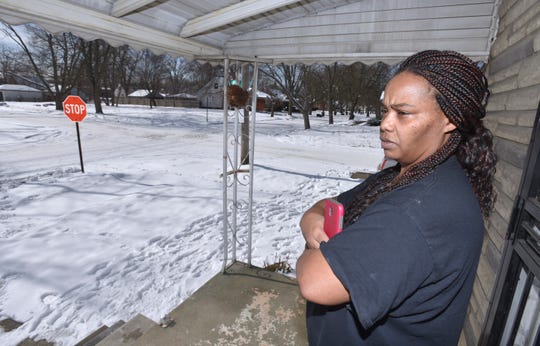
Soil records under scrutiny in Detroit demolitions


Felicia Perry, 42, lives on Rossini at Rex in Detroit,
across the street from at least two vacant lots where
houses were razed and then backfilled.

Detroit — Records detailing what went into the ground at thousands of demolition sites across the city are under scrutiny amid an analysis that's turned up a disjointed process.

University of Michigan doctoral candidate Michael Koscielniak has spent four years conducting an exhaustive review of public records that cast doubt on the integrity of soil records for the city's multi-million-dollar federally funded blight elimination program.

For its part, the city admits the effort got off the ground with a paper-based tracking system before it evolved to online records. But officials contend the dirt used to fill holes left behind from housing demolitions is all accounted for and Koscielniak based his findings on only part of the data.

But Koscielniak asserts the record keeping is a "completely shambolic approach to managing this program — especially one that is transparent."  The demolition effort has paid out close to $177 million in federal funding to take down 11,000 structures since 2014.

"The errors, gaps and inconsistencies in the backfill data — as well as the unclear oversight and monitoring processes — suggest that demolition contractors wield immense authority over the backfill program," said Koscielniak, an Ypsilanti resident and doctoral candidate in urban and regional planning who is working on a dissertation. "They stumbled into a mega project that they had no capacity to manage, and their solution to it was to let contractors figure it out."

The independent researcher's findings heighten growing concern among some city, state and congressional lawmakers over potential environmental contaminants in the dirt following a number of high-profile contractor violations. Officials want to ensure the quality of the dirt going into Detroit's ground isn't harmful to residents.
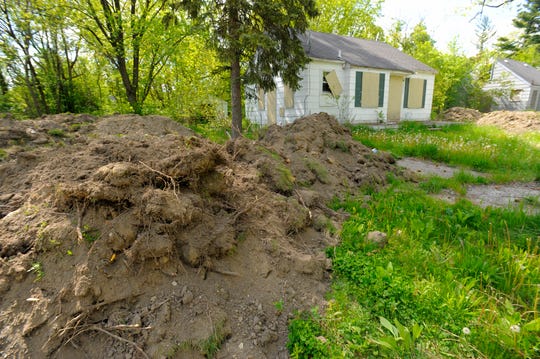
Fresh piled dirt is seen near a vacant home on Faust
 near Constance in Detroit after a demolition on May 18, 2016. 
Under public information requests, Koscielniak obtained copies of an internal contractor portal used to track dirt sources, costs and locations that's maintained by the Detroit Building Authority.


He zeroed in on data for demolitions conducted through July and paid from the federal Hardest Hit Fund, concluding that out of nearly 10,000 listed only about 5,200 had attributed sources through digital record keeping.

Koscielniak's research is the latest cloud over the program at the center of a federal criminal investigation that arose in fall 2015 after concerns were raised over bidding practices and spiraling costs.

Soil worries prompted Detroit City Council's second in command to put out a call for a congressional hearing on demolition in Detroit and comes as one contractor's projects have been halted after it failed to remove potentially hazardous debris at multiple sites before dumping dirt on top.

Officials with the Detroit Building Authority and Detroit Land Bank Authority, which oversee the city's program, argue Koscielniak's research is skewed and maintain their confidence in the records. 
Under Freedom of Information Act requests, they said, he obtained copies of the digital database for soil records. But prior to that, load tickets for dirt were tracked on paper — records Koscielniak did not ask for or obtain, they contend.

"We think the gap is, not that we weren't tracking it, but it wasn't tracked in an online portal that we could send to someone," Brian Farkas, director of special projects for the building authority, told The News. "I'm confident in our records."

Detroit Councilman Andre Spivey said he's concerned to hear of the disconnected record keeping for dirt and wants the city to have tighter reins on the land bank.

"You've got to maintain the integrity of the process," he said. "We're watching, and the federal government is watching as well."

In January, the federal watchdog agency investigating the city's blight elimination effort issued a round of subpoenas to certain contractors, seeking detailed records of where they obtained their dirt, the cost and where it ended up.

In subpoenas dated Jan. 10, the Special Inspector General for the Troubled Asset Relief Program demanded two years' worth of documentation.

Robert Sholars, a spokesman for SIGTARP, declined to say whether Koscielniak's research spurred the investigation, saying "as a general principle, we do not comment on ongoing investigations, including confirming or denying their existence."

Tracking the records

The News last month provided the building authority with 13 addresses from 2014 out of thousands flagged by Koscielniak. Officials produced paper copies for all of them.

According to the load tickets, some of the fill dirt came from an industrial site on Shoemaker on Detroit's east side and a site in Carleton. Other paperwork identifies fill simply as "clay" or has spaces where the source is attributed to a trucking company or left blank, only listing where it was dropped off.

Farkas last week referred to the 13 records pulled at the request of The News as a "spot check" while he faced questioning about contractors and environmental worries during a city council subcommittee session.

Council President Pro Tem Mary Sheffield noted in recent months the tracking system for dirt is more in-depth. The building authority, she said, told council members the independent firm contracted to oversee the process is now verifying the origin of the dirt with aerial checks after documentation is submitted by contractors. Prior to that time, that verification was not taking place, she said.

"You had a period of time where contractors were self-reporting all of these different residential addresses and saying it was residential dirt when it could possibly have not been because there was no oversight," she said. "That's a problem."

Farkas said the city has tracked its soil and dirt on an internal online platform since March 2015. 
A gravel-train semi leaves the Mid Michigan
Crushing & Recycling facility in Highland Park.
Despite that, Koscielniak provided The News with a data set that shows 1,961 Hardest Hit Fund demolitions between March 2015 and June 2018 that weren't accounted for in the backfill portal.


The sites in question, which appear on the city's public demolition database but lack a digital paper trail for the soil, account for $2.9 million in dirt costs among 18 contractors.

Koscielniak also provided The News with more than 100 other records with misspellings and errors, lacking in detail or that list the dirt source and destination as the same site.

The News asked the building authority to reproduce documentation for a dozen of the 2015 demolitions, which based on Farkas' explanation should have been digitized.

In an email, Farkas provided The News with eight of the records located by the department — all paper — out of the 12, citing limited staffing to search. But he stressed confidence the rest would be found.

"This is more a document retrieval issue of records that are four or five years old than it is an issue of whether dirt sources have been verified," Farkas said.

In reference to data suggesting close to 2,000 records submitted after 2015 aren't accounted for in the digital system, Farkas reiterated officials "feel very confident" in protocols in place since 2014 to ensure dirt is safe.

"We see the fact that some records may not be immediately retrievable as a reflection in the record keeping process, not as a reflection of our work in the field to ensure the use of clean dirt," Farkas said in a provided statement.

A handful of contractors have faced penalties between 2017 and 2018 for the use of unapproved backfill at a total of 18 sites, according to the building authority.

Some were issued warnings, others were suspended and another — Detroit-based Glo Wrecking — was issued a stop-work order that remains in effect. The company could not be reached for comment. 
Additionally, in February, another contractor, DMC Consultants, began filling holes with unauthorized dirt. The building authority's online platform flagged officials that the company had exhausted their supply of approved fill.

Farkas declined to specify DMC's dirt source, saying it "doesn't matter."

"All that matters is whether it's been tested and approved, and the DMC dirt used after their approved supply ran out was not," he said.

Farkas said soil sampling is taking place for 37 holes that DMC filled with dirt that had not been approved. Testing will determine whether the soil is unsafe for residential use.

Chicago-based firm McDonagh Demolition was also issued a stop-work order by the building authority in recent weeks after it was discovered that the company had not fully removed demolition debris before adding fill dirt at several sites.

Farkas, during the council's Planning and Economic Development committee session last week, said the company's work is being revoked over the "attempted scheme." It's going to cost McDonagh about $17 million in contracts, he said.

McDonagh called the violation an "isolated issue" that it was taking steps to correct.

Farkas touted the catch as evidence the building authority's controls worked, as intended, saying a field liaison for the building authority discovered the problem.

But Sheffield noted it was later revealed that a former McDonagh employee had acted as a whistle-blower.

The scenario, she said, is a "clear example" that "protocols are not sufficient."

"The pace that they are going, it is hard to have the proper protocols to ensure the health and safety of residents," Sheffield said. "There's too many unknowns for me. Whether it's contaminated or not, it just needs to be clear and verified where the dirt is coming from."

Under the program, the land bank manages the selection and contract awards for demolitions. Oversight is then transferred to the building authority, which has seven field liaisons who monitor all the knockdowns. That's up from two when the program first began, Farkas said. 

What the rules say

The city's Buildings,  Safety Engineering and Environmental Department inspects open holes and final grading.

The state's blight manual outlines requirements for testing and sourcing of fill.

Detroit implemented a new dirt tracking system late last year to better document the dirt being used. The guidelines require the source of dirt, the address it's going to, and size of load by cubic yard or square feet, according to the state.

Previously, contractors were required to provide invoices for dirt, and the land bank maintained load tickets that documented the size of a load and where it was dropped.

"The new protocol requires each contractor to identify source material location and testing evaluation of commercial soil sources in advance of backfilling so as to avoid bad fill material negatively impacting neighborhoods," the U.S. Environmental Protection Agency said in a statement. "The city of Detroit is responsible for identifying dirt sources under its protocol."

Chicago-based McDonagh Demolition was ordered to
 excavate this site in the 13000 block of Maiden Street in
Detroit after it was discovered that that some demolition
materials there had not been properly removed.
Farkas said there are three acceptable soil sources. A residential site or a virgin source, which could be a clay or gravel pit and requires documentation stating its free of debris, concrete or other unsuitable substances. The third category, non-residential, may consist of commercial, road or construction sites but requires laboratory testing and the results must be approved by the building authority. 


"All city, state and federal guidelines must be followed to ensure environmentally safe back fill is being used," the blight manual notes. "This laboratory testing must be maintained in the blight partner office and copies may be requested at any time."

Matt Polizzotto, a soil chemist and associate professor of earth sciences for the University of Oregon, said urban soils can be contaminated in many ways, including from lead paint or past transportation emissions. The level of risk, he said, depends on how the soil had been used.

"I could come up with doomsday scenarios, but those things are pretty unlikely," said Polizzotto, who has expertise in soil contaminants in the environment. "Not having records doesn't allow for really, truly assessing what any risks might be."

'No legal obligation'

Rebecca Camargo, an attorney for several contractors in the program, said none set out to use bad dirt. 
"I don't believe that any of the demolition contractors violated the terms of the contract knowingly, and they all are very committed to keeping Detroit safe," she said.

Camargo said the deadline for turning over backfill documents requested under the SIGTARP subpoena has been extended.

"It's costing all of them thousands of dollars to provide this documentation for something I believe is going to show nothing," she said.

Multiple contractors did not return messages left by The News. Anthony Abela, a project manager for the firms Homrich and 1 Way Service, said by policy, the company does not issue comments to the media.

Mayor Mike Duggan has defended the program's "vigorous" practices in the wake of concern over whether some dirt might have been contaminated.

The mayor, during his Tuesday State of the City speech, noted the city this month entered into contracts for the last of the $275 million in federal dollars for the program.

"For all the noise out there about investigations," said Duggan, the U.S. Treasury and the state "had confidence in us" and "kept money flowing."

The mayor said the program's environmental team has held demolition contractors accountable. In the last five years, he said, four contractors have been terminated for failing to follow protocols.
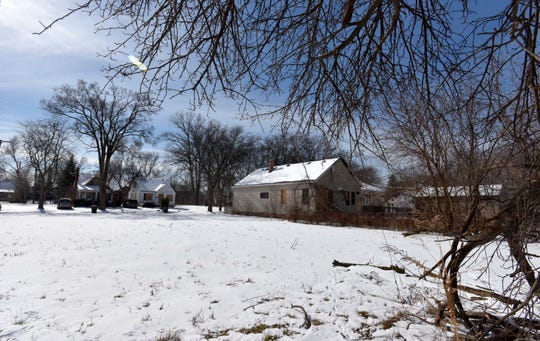
Tens of thousands of houses have been razed in Detroit with
federal funding over the last five years, leaving
vacant lots like this one in the 15600 block of Rossini. 


"In each case, we made each go back in and fix their mistakes. We did not let a single one slide, and we advise the neighbors to help us," Duggan said. "I won't tell you that we're not ever making mistakes. I will tell you, we find out about them."

The mayor, during his Thursday budget presentation to council, said the all federally funded demolition contracts have been awarded and the program is set to wind down by the end of the fiscal year. From here, he said, the city will look to transition to a city-administered effort.

Meanwhile, the state Department of Environmental Quality said it's "working with the federal agencies investigating the city's demolition program."

The DEQ has not issued any violations or fines related to backfill, and it has not done any soil sampling or auditing, said Scott Dean, a DEQ spokesman.

"An entity obtaining soil for backfill has no legal obligation to test those soils or keep records about the sources," Dean said.

"However, there is a risk that contractors may obtain contaminated soils, either knowingly or unknowingly. It seemed reasonable that this risk would increase with the increased demand for soils. Because of this risk, we advised the city to put safeguards in place to make sure they were only using clean dirt. That was a recommendation, not a legal requirement."

Pushing for testing

Council's Sheffield has referenced media reports that raise the possibility of dirt being used to fill holes that may have been contaminated or from unverified sources, including soils from the recent reconstruction of Interstate 96 in western Wayne County. Program officials insist, however, that use of dirt from the I-96 project was banned from the outset.

In a letter to U.S. Reps. Rashida Tlaib, D-Detroit, and Brenda Lawrence, D-Southfield, the councilwoman noted the program has been "mired in controversy since its inception" and it's led to "anxiety, uncertainty, and a lack of transparency for the community."

Lawrence told The News she's leading an effort to ask the delegation to urge the U.S. Treasury Department to assume oversight of soil testing for Detroit's program.

"My focus right now is on whether the dirt is contaminated," she said. "I'm pushing for immediate testing."

In 2014, the city contracted with the Southfield-based consulting firm Atwell to get the program's environmental monitoring off the ground. By September, AKT Peerless in Detroit was retained to "manage and administer" the backfill program.

Reached via email, Julie Barton, program manager for AKT, deferred comment to the building authority. Farkas said the company has designed testing protocols and the online platform, overseeing its use and implementation.

When asked whether the paper record keeping was adequate, Tammy Daniels, a demolition manager for the land bank, agreed it was a process that needed to change, and it did.

"We migrated away from paper because we, too, feel that computer records offer transparency," she said.

Farkas noted when the federally funded demolition work first began, there was $50 million to draw down and a "serious deadline" that "we had to meet."

A 2013 memorandum of understanding between the state, land bank and city, required 70 percent of the $52.3 million allocated for the program be spent by Oct. 7, 2014. If the land bank was unable to draw down the funding within that time, the dollars could have been redirected to another city or program.

"The system we have today is remarkably different than the one we inherited," he said. "So no, records should always be kept in the most high-tech, digital format. The problem is we just don't have that ability when you are staring down a deadline to spend $50 million."

The Michigan State Housing and Development Authority, which allocates funding for the program under the state's Homeowner Assistance Non-Profit Housing Corp., said it does not oversee how the land bank maintains its filing system.

"What we do require is that file documents be uploaded to our system for audit and review prior to funding every demolition," said Katie Bach, a spokeswoman for MSHDA, in an email. 
Bach further said the state has found no evidence of sloppy record-keeping. MHA, she said, has adequate resources to monitor the backfill program and is confident in how it's operating. Under Hardest Hit Fund rules, MHA is required to retain records for three years after the program ends, she added.

"MHA has staff in place to review every file that DLB is uploading to our system," she said. "We expect accurate documentation and full compliance with all program guidelines. If we find that is not the case, we will consult with U.S. Treasury regarding possible corrective action."

East side resident Felicia Perry has been renting a home on Rossini Drive for about a year. Records show numerous demolitions occurred on her block in 2014 when digital records of the soil source were lacking. The city's paper records attribute the source to a city-based industrial site.

The mother of six, who has a young daughter battling chronic health concerns, said the questions and uncertainty are worrisome.

"I have a three-year-old who is battling every day to stay alive with sickle cell disease. I don't even let her outside," said Perry, 42. "If they put something in the ground that's contaminated, it's got growth in it. It brings poison to kids."

Voting is beautiful, be beautiful ~ vote.©

Sunday, August 26, 2018

Cocktails & Popcorn: What Better Way To Launder Money Than Through A Fake NGO - SDNY Subpoenas Michael Cohen

Oh my!
"Real Property Assests, the best tax aversive way to
transfer money overseas so it does not look like
money laundering."

This sounds like the Detroit Land Bank Community Development Corporation.

Actually, Michael Cohen reminds me of Michael Brady, but hey, what do I know.

I know Perkins Coie Sucks and so does Donna Shalala.

What better way to launder money through foreign corporations which are registered in the States than to manage assets (a.k.a. money launder).

There are many "asset management" artifices and schemes, but in this particular instance, Cohen did not use the ole UCC patent box scheme, my favorite one being the Corporate Shape Shifter patent box.

This is when you use a fake corporation, disguised as a campaign committee because the FEC does not know about it, or, in this instance, corporations that are state registered not-for-profits, to transfer everything to another country under the trademark license, so you can 'avert' taxes and any other questionable machinations of money laundering operations.

Traditionally, these fake corporations use child welfare NGOs, but we will have to wait for Juicy Joon.

This fraud scheme is not as sophisticated as the Detroit Land Bank Community Development Corporation, but you have to give them brownie points for creativity!

New York Investigators Subpoena Michael Cohen for Documents Linked to Trump Foundation

Investigators in New York issued a subpoena to Michael D. Cohen, President Trump’s former fixer and lawyer, for documents related to the Donald J. Trump Foundation on Wednesday, an escalation of the Cuomo administration’s investigation into whether the president’s charity violated tax laws.

After receiving the subpoena, Mr. Cohen called the investigators in the state Tax Department to ask when they could talk, according to a person with knowledge of the investigation.

The subpoena was issued less than a day after Mr. Cohen pleaded guilty in Federal District Court in Manhattan to charges including campaign finance violations, in the form of payments to two women who said they had affairs with Mr. Trump, for the “purpose of influencing the election” for president in 2016.

It also came amid a continuing war of words between Gov. Andrew M. Cuomo, a sharp-elbowed Democrat who is said to have presidential aspirations, and Mr. Trump, as both have lobbed personal attacks at each other over Twitter and in speeches. Mr. Cuomo — whose primary opponent, Cynthia Nixon, has accused him of only lukewarm liberalism — has presented himself as a progressive foil to Mr. Trump.

The subpoena to Mr. Cohen on Wednesday, issued by the state’s Department of Taxation and Finance, seemed calculated to strike yet another blow — both legal and political — against the president and his inner circle.

It seeks documents related to both personal and business federal tax filings, as well as state tax filings, connected to the foundation, according to two senior Cuomo administration officials, who spoke on condition of anonymity because they were not authorized to speak about an open investigation. Those documents could include general ledgers, bank statements, invoices and contracts.

The officials said the subpoena stemmed from remarks that Lanny J. Davis, a lawyer for Mr. Cohen, made on Tuesday evening on NBC Newsand CNN. “I do believe that he has information about Mr. Trump that would be of interest both in Washington as well as New York State,” Mr. Davis said of Mr. Cohen on CNN, referring to a two-year investigation the state attorney general’s office conducted into the Trump Foundation. When contacted on Wednesday, Mr. Davis declined to provide further information about Mr. Cohen’s knowledge of the foundation.

James Gazzale, a spokesman for the Tax Department, confirmed the subpoena had been issued “for relevant information in light of the public disclosures made yesterday” but declined to comment further, citing an ongoing investigation.

Representatives of the Trump Organization, an umbrella company for Mr. Trump’s holdings, did not immediately respond to a request for comment about the subpoena on Wednesday.

On its own, the Tax Department’s inquiry may provide political ammunition for Mr. Cuomo more than it presents a legal peril to Mr. Trump. Even if the department found evidence of criminal behavior, it would need to refer the matter to a law enforcement agency, such as the attorney general’s office or a district attorney, for prosecution.

In June, the state attorney general sued the Trump Foundation in civil court, accusing the charity of violating campaign finance laws, self-dealing and illegally coordinating with Mr. Trump’s presidential campaign. The suit said the foundation was co-opted by the campaign during the 2016 race. Campaign staff not only directed foundation fund-raisers but also controlled who received grants, according to the lawsuit. The lawsuit sought to dissolve the foundation, recover $2.8 million in restitution and temporarily bar President Trump and three of his children from serving in leadership positions in New York nonprofits.

Administration officials would not say when the Tax Department’s investigation began, but it became public a month after the attorney general’s lawsuit.

Beyond the civil charges, the attorney general’s office has not announced a criminal investigation into the foundation, saying only that it would seek a criminal referral from a state agency at the appropriate time. But because the office’s review of the Trump Foundation is still active, the office is coordinating with the Tax Department’s inquiry, according to an official familiar with the investigation, who also requested anonymity because the investigation is active.

The Manhattan district attorney’s office is also looking into possible impropriety by the Trump Foundation, according to someone familiar with the matter.

Mr. Trump established the Donald J. Trump Foundation in 1987, when he was a New York City real estate developer, with the stated mission of collecting and maintaining money “exclusively for charitable, religious, scientific, literary or educational purposes,” either directly or by donating to other organizations. It had about $1 million in assets in 2016, according to its last I.R.S. filing. Mr. Trump was the foundation’s president until he stepped down after taking office in January 2017.

The purposes for which the Detroit Land Bank Community Development Corporation (the “Corporation”) is organized are to receive and administer funds exclusively for charitable, education and scientific purposes within the meaning of Section 501(c)(3) of the Internal Revenue Code of 1986, as amended (the “Code”). In particular, the Corporation is organized to serve the people of the City of Detroit, Michigan through the advancement of economic welfare, by making available technical assistance, training, and capital for the establishment of new enterprises and the growth of existing enterprises, through the promotion of community development, and through the provision of affordable housing for persons of low and moderate income (including making distributions to other Code Section 501(C)(3) organizations).

In October 2016, the New York attorney general’s office ordered the foundation to cease soliciting donations in the state, after Mr. Trump admitted he had used the foundation’s money to contribute to political causes. After the election, Mr. Trump announced he would dissolve the foundation to avoid an appearance of a conflict of interest, but the attorney general did not approve the proposal, saying the office needed to finish its investigation.


Voting is beautiful, be beautiful ~ vote.©