Yes, Sidney Powell & Rudy Giuliani are "Legal Geniuses" (trademark pending) as they hold a press conference to utter and publish accusations that "The Elected Ones" of the politically stratified districts under John Conyers, Jr. were rift with public corruption.
I say we investigate!
Or, have we already?
I say Sidney and Rudy should go ask Rashida if there is still political corruption of criminal activities still going on in her congressional district.
Oh, Sidney and Rudy should go ask Rashida to call for an investigation into these alleged treasonous activities of Detroit by filing, first, with the U.S. Committee on Ethics.
Drats!
I forgot, that was already done, quite a few times, if I correctly recall.
Anyway, just watch them do the legal dilatory distraction dance, because we are already in Detroit, just watching the world realize, that the heavens are falling because this is about gerrymandering, or rather, stealin' the children, land & vote.
Watch Sidney and Rudy not say his name as they speak upon Detroit and Voting Rights, while demanding due process, but not for my Sweetie.
Keep in mind, there is no need for subpoena if there is a superseding investigation.
#maytheheavensfall
SAN ANTONIO, Tex. – U.S. Attorney John F. Bash announced today that he will resign from the Department of Justice on Friday, October 9, 2020, at 11:59pm. U.S. Attorney Bash issued the following statement:
This Friday—eight years to the day after I first joined the Department of Justice—I will step down as United States Attorney for the Western District of Texas. Last month I accepted an offer for a position in the private sector and informed the Attorney General of my decision. I tendered formal letters of resignation to both the President and the Attorney General this morning.
I am grateful to the President, Senator John Cornyn, Senator Ted Cruz, and the other members of the United States Senate for the opportunity to serve the people of Texas. I am also grateful to former Counsel to the President Donald F. McGahn II, who gave me steadfast support throughout the nomination and confirmation process, and to former Solicitor General Donald B. Verrilli, Jr., for first bringing me into the Department in 2012. And I am honored that during my tenure as U.S. Attorney, the Attorney General has seen fit to entrust me with significant responsibilities and to appoint me to his Advisory Committee.
I am also deeply indebted to the over 300 attorneys and staff members who work in our office, including the 73 Assistant United States Attorneys hired during my tenure. Through their tireless efforts, we have held accountable child abusers, drug-cartel leaders, gang members, bank robbers, embezzlers, fraudsters, scammers, and corrupt public officials. The exceptional public servants of our office have continued to perform at a high level during the national health crisis.
I owe special gratitude to my executive team—First Assistant U.S. Attorney Ashley Hoff, Executive Assistant U.S. Attorney Kristy Callahan, Counselor Mickey Tapken, Criminal Division Chief Christina Playton, Civil Division Chief Mary Kruger, Administrative Division Chief Gretchen Randall, and Legal Support Division Chief Lora Makowski. They are all women of extraordinary integrity, intelligence, and candor. I am proud to have served alongside them.
Most importantly, I would not have succeeded in this demanding role without the love and support of my wife, Zina, my daughter and son, my parents, my wife’s parents and siblings, and of course the Lord.
The Attorney General has elected to appoint Gregg Sofer to succeed me as U.S. Attorney. Gregg is an inspired choice. He is a veteran Department of Justice attorney, serving first in the National Security Division at Main Justice and then for over a decade as a national-security specialist in our Austin office. In the latter role, he built a reputation as a dogged and tremendously effective prosecutor. In 2018, I selected Gregg to serve as our office’s Criminal Division Chief, where he designed and implemented significant improvements to our operations, oversaw thousands of prosecutions, and provided me with invaluable advice on a range of important issues and cases. Since early this year, he has served in Washington, D.C., as Counselor to the Attorney General. He will make an excellent U.S. Attorney.
Like any job, serving as U.S. Attorney has had its high points and its low points. No day was worse than August 3, 2019, when we lost so many of our fellow Americans and our Mexican brothers and sisters to an almost inconceivable act of hatred. But there was nothing more soul-stirring than the way El Pasoans came together in the wake of that nightmare in a spirit of love and perseverance.
I hope that I have discharged my authority wisely and have improved the safety and security of my fellow Texans. I leave the Department with a profound respect for its people, its traditions, and its importance to our constitutional democracy.
Bash, 39, was appointed by President Trump to the position of United States Attorney in December 2017. He previously served in the Department of Justice as an Assistant to the Solicitor General from 2012 to 2017, and he served as Associate Counsel to the President in 2017.
Attorney General William Barr offered the following statement:
I offer my gratitude to John Bash for his service as United States Attorney for the Western District of Texas. Since 2017, John has successfully led one of the largest U.S. Attorney’s Offices in the country. John has made significant contributions to the Department of Justice, including his service on the Attorney General’s Advisory Committee. I appreciate his service to our nation and to the Justice Department, and I wish him the very best.
The key to crafting and presenting legislation is all about the timing.
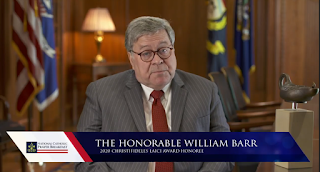
Here, we have the National Catholic Prayer Breakfast, which is to honor my Boo Boo Barr for
Sir Boo Boo Barr Champion of Corporate Parental Rights to take over the U.S.
contemporaneously championing the advice and advocacy Of Corporate Parental Rights, on behalf of those Public Private Partnerships, for he has taken the oath of fealty to the foreign nation called the Vatican.
He who has sworn an oath of fealty to the tax exempt god of a foreign nation, wherefore, loyalty comes with the grant of lots of land and all the attached chattels of tiny humans.
A knight is a title of nobility, you know.
When you help get U.S. contracts, typically in child welfare, as a knight, as an U.S. for-profit or not-for-profit, while we typically call that an emolument, unless you are granted authority to engage in commerce in the U.S. on behalf of a foreign entity, by registering under FARA.
Otherwise, that may be considered under FCPA.
I just thought I would remind everyone when the history of the Knights of Columbus is cloaked in the bastardization of this nation's history.
Praytell, why is Boo Boo Barr praying for mercy, with Aladdin's magic "this means I am a real Smarty Pants" lamp by his side, bearing the arms of the U.S.?
I want to say 911, but will stick with the more universal blanket of "stealin' the children, land & votes."
A nun criticized the National Catholic Prayer Breakfast (NCPB) for its plans to award Attorney General Bill Barr for “Christlike behavior” on Wednesday morning.
Sister Helen Prejean slammed the Catholic organization for announcing the Christifideles Laici Award would be given to Barr, who is Catholic, at the annual breakfast. The award honors the recipient for “Exemplary Selfless and Steadfast Service in the Lord’s Vineyard,” according to the NCPB website.
Prejean, an advocate against the death penalty, argued in a tweet Tuesday night that the attorney general has not demonstrated “Christlike behavior” after the Department of Justice (DOJ) resumed federal executions this year.
“A.G. Barr has ordered the executions of six men with at least one more on the calendar,” she wrote on the social media platform. “What is ‘Christlike’ about using discretionary power to kill?”
Another nun, Sister Simone Campbell, the executive director of the Catholic social justice group Network, told Newsweek she was “horrified” Barr was the recipient of the award.
"I am horrified that they are giving an award to Attorney General Barr who had reinstituted executions of people on death row, which is shocking and counter to Catholic social teaching,” she said. “It is abundantly clear, 'thou shalt not kill', and he is doing that and he is being given an award.”
The NCPB created the award last year “to help highlight these good works and those who serve the Church so well.” The virtual breakfast, which was postponed since March due to the pandemic, started at 11 a.m.
As of Wednesday morning, 22,213 people have signed a Faithful America petition calling on the NCPB
"Stop! You may not legally kidnap this tiny human unless you have a CPS contract under U.S. Conference of Catholic Bishops." said Boo Boo Barr.
to cancel giving Barr the award. Originally, the petition had a 20,000 signature goal, but the group has since raised it to 25,000.
“Attorney General William Barr's work — which includes teargassing peaceful protesters in front of the White House, defending the president's lawless corruption and attacks on American elections, and reinstating federal executions — has nothing to do with service to the Lord, and cannot be described as fidelity to the Church,” the petition reads.
“As fellow Catholics and other Christians, we call on the NCPB to cancel this award for Barr immediately, and avoid any further appearance of endorsing Donald Trump or his Cabinet members so close to an election,” it continues.
The NCPB and the Justice Department did not immediately return requests for comment.
Faithful America, a progressive Christian group, noted in a release that the award will be given the same week the DOJ will conduct two executions.
Pope Francis has come out against the death penalty under all circumstances calling it “inadmissable” in 2018 when he changed the Catholic Church’s teaching.
But the Trump administration resumed federal executions after a 17-year suspension, conducting six executions this year, including William Emmett LeCroy who was executed Tuesday after being convicted of raping and killing a woman in 2004.
Progressive Christians have also denounced the NCPB for identifying as non-partisan but hosting mostly Republican leaders including President Trump this year.
But, alas, there are those who are not happy with Boo Boo Barr.
The timing is not just symbolic, it is symbiotic, I tell you, because we are in Detroit.
Remarks by Attorney General William P. Barr on his Acceptance of the Christifideles Laici Award at the 2020 National Catholic Prayer Breakfast
Good morning. It is a great honor to be recognized by this esteemed organization. The truth is that no one is really worth of an award like this, so I am a little sheepish in accepting it. But I am honored to do so, because I greatly admire the organizers of this breakfast and those who are associated with it. This is a beautiful piece of artwork that I will cherish. Thank you.
For more than 15 years now, inspired by Saint John Paul II’s call for a renewal of Catholic communal and civic spirit, the National Catholic Prayer Breakfast has served as a living testament to the vital role of the Church and its principles in American public life. Thank you for praying with me, and for me, and for the future of our country.
This is a challenging time for many Americans. But times of trial have a way of reminding us how much we have to be grateful for. As people of faith, we take comfort in the knowledge that God has a purpose and a plan. And as citizens, we gain strength from the knowledge that our forebears confronted and overcame even greater tests.
In joining together to pray for the strength and health of our country, we carry on a tradition that goes back to the beginning of the Republic. During the summer of 1783, General George Washington gave his first major address following the Revolutionary War — a war the young nation very nearly lost. He delivered a famous prayer that continues to be read aloud every day at Mount Vernon. He asked God not only to protect the nation from external threats, but to maintain the character of its citizens: as he put it, to “dispose us all to do justice, to love mercy,” and to comport ourselves “with that charity, humility and pacific temper of mind, which were the characteristics of the divine author of our blessed religion,” and without which “we can never hope to be a happy Nation.”
As Washington and his fellow Founders understood, religion is at the heart of the American experiment in self-government. In his Farewell Address, Washington said: “Of all the dispositions and habits which lead to political prosperity, religion and morality are indispensable supports.”
What he meant is that self-government begins with self-restraint. And there is no greater teacher of restraint than religion. That is why John Adams declared that our Constitution — which recently celebrated its 233rd birthday — “was made only for a moral and religious people.” As Father John Courtney Murray later put it, the American idea is notthat “free government is inevitable, only that it is possible, and that its possibility can be realized only when the people as a whole are inwardly governed by the recognized imperatives of the universal moral order.”
That crucial link between religion and liberty, so well understood at the Founding, is all too often forgotten today. In American public discourse, perhaps no concept is more misunderstood than the notion of “separation of church and state.” Militant secularists have long seized on that slogan as a facile justification for attempting to drive religion from the public square and to exclude religious people from bringing a religious perspective to bear on conversations about the common good.
Yet as events like this one remind us, separation of church and state does not mean, and never did mean, separation of religion and civics. As late as 1952, Justice William O. Douglas could write for a majority of the Supreme Court that “we are a religious people whose institutions presuppose a Supreme Being.” Alexis de Tocqueville, the keenest observer of the early American republic, praised America’s separation of church and state while extolling America’s union of the “spirit of religion” and the “spirit of liberty” as the key to its success. And Tocqueville identified religion as perhaps the greatest bulwark against a descent into tyranny.
How does religion preserve liberty? In the first place, as our Founders recognized, religion assists in the formation of virtuous citizens who are prepared to exercise liberty responsibly. Whereas in democratic times, individuals have a tendency to withdraw from public life and pursue private self-gratification, religion builds community, strengthens social cohesion, and turns our attention to the common good. At the same time, religion safeguards individual rights by warding off what Tocqueville called the “impious maxim” that “everything is permitted in the interest of society.” For all of these reasons, Tocqueville referred to Americans’ religion as “the first of their political institutions.”
Unfortunately, in the last half century, that foundation of our free society has increasingly been under siege. Traditional morality has eroded, and secularists have often succeeded not only in eliminating religion from schools and the public square, but in replacing it with new orthodoxies that are actively hostile to religion. The consequences of this hollowing out of religion have been predictably dire. Over the past 50 years, we have seen striking increases in urban violence, drug abuse, and broken families. Problems like these have fed the rise of an ever more powerful central government, one that increasingly saps individual initiative, coopts civil society, crowds out religious institutions, and ultimately reduces citizens to wards of the State.
As patriotic Americans and people of faith, we cannot be complacent about these trends. Yet nor should we give in to despair. More recently, thanks in part to organizations like this one, we have seen some small but significant steps toward the restoration of religion to its rightful place in American public life.
Some notable advances — which admittedly are of particular interest to me — have come in the legal arena. They are the result of decades of hard work advocating for sound jurisprudential philosophies and appointing principled judges to state and federal courts. The most recent term of the Supreme Court, for example, saw three important victories for religious liberty. In each of these cases, the Department of Justice filed briefs supporting the free exercise of religion.
In one case, the Court reaffirmed the principle that the government cannot discriminate against religion in general funding programs, and struck down a provision of the Montana Constitution that had been interpreted to exclude religious schools from a scholarship program for underprivileged students. In another case, the Court held that the First Amendment prohibits courts from intervening in employment disputes involving teachers at religious schools who are entrusted with the responsibility of instructing their students in the faith. In the third case, the Court considered a regulatory mandate requiring employers to provide contraceptive coverage to their employees, and upheld the administration’s rules exempting the nuns of the Little Sisters of the Poor and other employers with moral and religious objections.
In a sense, it is dispiriting that the disputes in these cases ever arose. In each case, the religious litigants were not asking for anything more than the basic freedom to exercise their faith and be treated the same as others. Nevertheless, the recognition of those rights by courts is encouraging. And all involved — from the litigants and lawyers to those who prayed for the wisdom of judges — can take solace in having achieved a just result.
Advocating for religious liberty is just one way that lay Catholics and others can answer the call to serve. In his exhortation Christifideles Laici, for which the award I have the honor of accepting today is named, Saint John Paul II noted that “the lay faithful are never to relinquish their participation in ‘public life’.” At the same time, he emphasized that faith is first and foremost about how we live our daily lives, for “the daily life itself of a truly Christian family makes up the first ‘experience of Church.’”
Wherever we are in life, it is never too late to work in the Lord’s vineyard. Our spiritual renewal, and the renewal of our national character, depend on it. Thank you, and God Bless America.
Quintessentially, I do believe Nancy is targeting that Horowitz IG Report Trump is obstructing justice with by keeping it in his backpocket by threatening, via this package of legislation on whistleblower protections, actions against blasphemy in false claims against an elected official, by forcing Boo Boo Barr to unseal all the Mueller referrals to those two magical grand juries.
We do not need the testimony of Don McGahn to congress because he is already in those grand juries and it is all public information if you just look here.
This is not going to end well, but shall be pearl clutching, for we are in Detroit.
To the liberal media, special counsel Robert Mueller was the sharp, seasoned, no-nonsense prosecutor who would get to the bottom of “collusion.” But when Mueller testified before Congress on July 24, 2019, many were stunned to see a man struggling to answer basic questions.
Had his cognitive abilities declined during the probe?
The 76-year-old Mueller, members of President Trump’s defense team recalled, appeared to be a figurehead investigator, a man who seldom spoke or was even seen. On those rare occasions Trump’s lawyers had a chance to talk to the special counsel, Mueller’s aides appeared to be covering for his lapses in memory. So who was really in charge of the Mueller probe?
There were questions about Mueller’s mental condition even before he was appointed special counsel in May 2017. Chris Swecker spent 24 years in the FBI. He left the agency in 2006 with the highest respect for his old boss, with whom he had extensive daily contact for more than two years. “Mueller was super sharp,” Swecker remembered.
In fall 2016, working in North Carolina, Swecker invited Mueller to speak at a conference. Mueller flew from Washington, and Swecker met him for breakfast to brief him on the event. He noticed something he had never seen in his old boss. “I remember telling my wife after the breakfast that he’s slipping,” Swecker recalled. “You could tell the acuity was not there. . . . He was a little confused about what to do after he got off.” When Mueller was made special counsel the next year, Swecker wondered whether he was up to it.
Communications aide Mark Corallo was a Mueller fan even as he worked for the Trump defense team. After his departure in July 2017, Corallo awaited a call — not from his old colleagues, but from Mueller. Prosecutors wanted to question him about Trump’s role in drafting a statement in response to New York Times reporting on the now-infamous Trump Tower meeting.
The session with Mueller’s lawyers took place on Feb. 15, 2018. “At the end of the interview, Mueller came in and shook my hand and put his hand around my shoulder and said, ‘It’s good to see you,’ ” Corallo recalled. “He said, ‘I’m sorry you got dragged into this.’ When he left the room, I said to Andrew Goldstein, ‘Hey, how’s he doing?’ They said great. I said, ‘Well, he looks a little gaunt. Is he eating? Is he tired?’ They said, ‘No, he’s running circles around us.’ This was the first time I noticed that he was not physically robust.”
Nearly a year and a half later, watching Mueller testify on television, Corallo was taken aback. “When I saw him testifying, it was significantly more apparent,” he recalled. “And trust me, I was not the only one. Those of us who worked with Bob at the Justice Department after 9/11 and watched his testimony — the phone calls were flying. ‘Holy crap, what’s wrong with Bob? Is he sick?’ ”
In another key meeting, according to members of the Trump defense team, the special counsel seemed unfamiliar with a key Justice Department policy having to do with indicting a sitting president. “After that, we never met with Mueller, and we never spoke with him on the phone,” Trump defense lawyer Jane Raskin recalled.
Robert Mueller memo shows why each key figure was targeted in probe
“What’s galling to me in hindsight, knowing what we know, is that they dragged it out as long as they did,” said Corallo, the Trump comms man. “Which says to me that people other than Bob Mueller were running that investigation.”
But who? Speculation focused on Andrew Weissmann, the aggressive prosecutor sometimes known as Mueller’s “pit bull.” But the inner workings of the Mueller investigation were never fully clear to those outside. All the president’s lawyers could see was that Mueller didn’t seem to be in control.
“Bob at the end was AWOL,” Trump lawyer Jay Sekulow recalled. “That was the great con. He showed up for cameo appearances. He was the Wizard of Oz. He was back behind the big curtain, pulling some strings here and there, but when you pulled the curtain away, he wasn’t even really the one pulling the strings.”
When Mueller testified, everyone could see what Team Trump had seen. It wasn’t pretty. And it ended Democratic hopes of turning the Russia probe into a glorious victory.
Jason Leopold has yet to tell us how Cernovich came into possession of his Confidential Congressional Documents, which were published by Buzzfeed, to assassinate a character in the act of blasphemy.
So, who was this FBI Special agent who had to give White House Counsel the FBI director's email address, who then, generated a missive, got Trump to approve and sign, then deliver to a third party, a letter of termination, on the other side of town, in under four minutes?
It is simply magical, like how Michigan Attorney General Bill *Smooches* Schuette was able to get Michigan Emergency Manager Kevyn Orr to file the Detroit Fake Ass Bankruptcy within minutes of him representing the State of Michigan in the Court of Claims.
I just do not know why I want to say JonesDay.
It is almost like filing a fake ass letter of resignation in D.C. when you are in Detroit.
Manafort had lots of Corporate Shape Shifting Rock Financial mortgages, you know, but rumor has it MERS is still under SIGTARP investigation and there is also an internal audit going on of the mysteriously roaming mortgages, but hey, what do I know?
BuzzFeed News filed a public records lawsuit to get the documents Robert Mueller used to write his report. Today, we are publishing the ninth installment of what witnesses in the investigation told Mueller’s team.
A new cache of witness interview summaries from special counsel Robert Mueller’s two-year probe into Russia’s interference in the 2016 presidential election was released Monday in response to Freedom of Information Act lawsuits by BuzzFeed News and CNN.
Key Takeaways:
These documents include five pages of Jared Kushner’s FBI interview summary — but all five are completely redacted. The FBI’s notations indicate that much of the material relates to an ongoing law enforcement investigation. Senior Assistant Special Counsel Andrew Goldstein told Kushner that answering a question with “I don’t recall” if he indeed did recall was considered a lie.
Interview summaries for former deputy national security adviser K.T. McFarland, former White House lawyer and senior Justice Department official James Burnham, and former Stone associate Randy Credico are also almost entirely redacted. McFarland and Credico’s summaries include markings that indicate redacted information relates to ongoing investigations.
A chunk of the 412 pages of interview summaries relates to the special counsel’s investigation of Roger Stone. That material had been withheld during Stone’s prosecution, but now that it has ended — with a 40-month prison sentence that Trump commuted — the documents are being released. They are still heavily redacted.
The documents indicate that in the fall of 2017, the accountant for Michael Cohen, Trump’s longtime lawyer, was under the impression that Cohen was getting a White House job and “needed to liquidate his assets.” Cohen did not get an administration position.
Michael Cohen used to refer to himself as “Trump’s pitbull” — before he flipped on his former boss and cooperated with Mueller — and according to his accountant, even had a statue of himself in his office bearing that title.
An Ohio woman who caught the attention of the special counsel’s office because in 2016 she renamed her Twitter account @Guccifer2 — after the character credited with hacking and leaking Democratic emails — told the FBI she had created the account to see if it would be censored by Twitter.
One witness whose name was redacted told investigators that before the Miss Universe pageant, Trump “would have all of the contestants line up on stage and then he would ask them questions about each other.” Most people would be cleared out of the room for this exchange, which was recorded, the witness said.
These documents, known as FBI 302s, shed light on what Trump administration officials and campaign staffers, as well as other people close to the president, told federal law enforcement agents about events during and after the campaign. In the last set of summaries that were released, one witness said people in Trump’s “orbit” didn’t care whom they hurt, believed their “deep state narrative,” “read books like ‘The Turner Diaries,’” and “downloaded military manuals from the internet.”
A person whose name was withheld on privacy grounds told investigators during an Aug. 11, 2017 interview that after the 2016 election Trump's "hardest" supporters were "shut out" of the new administration by the Republican National Committee, which cut a deal with Reince Priebus, the former White House chief of staff.
"They had many favors to repay the Committee. Trump gave Priebus a chance but Priebus didn't get the healthcare bill passed," the person told Mueller's investigators.
On Nov. 21, 2017, an FBI agent and two lawyers from Mueller’s office interviewed Jeffrey Getzel, who had worked as an accountant for Trump’s former lawyer and fixer Michael Cohen. Getzel was under the impression that Cohen was up for a job in the White House. He told investigators that roughly a month to a month and a half before the interview, someone (whose name is redacted) told Getzel that Cohen “was going to the White House and that COHEN needed to liquidate his assets.”
Getzel said he respected Cohen’s “significant position” in the Trump Organization. He noted to investigators that Cohen had a statue of himself in his office with the phrase, “Trump’s pitbull” written on it, a phrase that Cohen used to describe himself in the past, according to CNN.
A White House job never materialized, though. Cohen would eventually turn on his former boss and cooperate with Mueller’s investigation. He pleaded guilty to financial crimes unrelated to his dealings with Trump as well as campaign finance violations related to his role orchestrating hush-money payments to two women who claimed to have had affairs with Trump.
Getzel told investigators that Cohen was “an extremely sharp individual,” but also a “difficult client” who didn’t pay his bills on time. Cohen “resented paying taxes more than most people” that Getzel did work for, he said, and would pay penalties at the end of the year rather than paying quarterly estimated taxes.
Much of Getzel’s interview summary is redacted, but one section makes clear that he spoke with Mueller’s team about Essential Consultants, the corporate entity that Cohen created to facilitate the hush-money payments. Getzel said that if he’d known more about Essential Consultants, he would have “pushed harder to encourage COHEN to include his interest in the company” in a personal financial statement.
Getzel knew about another corporate entity that Cohen recently created, Michael D. Cohen & Associates P.C. Getzel told investigators that he didn’t think the company had “any real value” because its only client was Trump, ”who had a propensity for firing people.” The Washington Post reported Cohen used that business to pitch himself as a consultant to companies based on his close ties to Trump.
“As such,” the summary reads, “MDCPC was not really a company COHEN could sell to anyone.”
One of the interview summaries is of Cassandra Ford, an Ohio woman who caught the attention of the special counsel's office because in 2016 she renamed her Twitter account @Guccifer2, after the character credited with hacking and leaking Democratic emails. Ford's identity and the interest she attracted from Mueller's investigators were first revealed in October 2018, in an article in BuzzFeed News.
Ford was interviewed by the FBI in April 2018. In the six-page summary of that encounter, much of which is redacted on privacy grounds, she explained why she created @Guccifer2 and chose to give the impression that she was Russian.
"In creating her own twitter account @Guccifer2, Ford wanted to see of the account would be censored by Twitter, because of the notoriety of Guccifer2.0," the interview summary said. She went on to say that she chose the Volgograd time zone for her Twitter account in order to “appear to be Russian.”
Screenshot of the Mueller Memos
Obtained by BuzzFeed News
“Ford used the photo of Felix Dzerzhinsky as her Twitter profile photo. Ford read in the article on Smoking Gun that some of the documents released by Guccifer2.0 persona had the name of Dzerzhinsky on internet and thought he had a ‘creative background,’” the summary said.
In a separate interview, the Republican strategist Jason Miller, who was chief spokesperson of Trump’s 2016 presidential campaign, told the FBI he sought assistance from the Republican National Committee in 2016 poring over the hacked Democratic National Committee emails that WikiLeaks released. Moreover, he said he recalled hearing stories “about there potentially being a tape in which Trump used the ‘N-word."’ When the campaign learned it was the infamous Access Hollywood tape, Miller said he and the campaign went into damage control. He said he was responsible for disseminating the statement that Trump’s “grab em by the pussy” line “amounted to locker room talk.”
Although the Mueller investigation led to 37 indictments and seven convictions, Trump has aggressively sought to discredit it, repeatedly referring to it as a “witch hunt.” His efforts have been supported by Attorney General Bill Barr, who has intervened in several cases related to the investigation, including the prosecutions of former national security adviser Michael Flynn and political consultant Roger Stone. Last year, Barr also tapped a US attorney in Connecticut, John Durham, to investigate the origins of the Russia probe.
Last month — after Trump commuted Stone’s prison sentence and referred to the probe as a “hoax” and “witch hunt” that the “Left and its allies in the media perpetuated for years in an attempt to undermine the Trump Presidency” — Mueller broke his silence by writing an op-ed in the Washington Post defending his investigation. In June, in response to a separate lawsuit filed by BuzzFeed News and the Electronic Privacy Information Center, a previously blacked-out portion of the Mueller report was disclosed; it showed that Mueller’s team suspected Trump had lied to investigators in his written responses to their questions about Stone.
The final 448-page Mueller report, released in April 2019, was the most hotly anticipated prosecutorial document in a generation. But it reflected only a tiny fraction of the primary-source documents that Mueller’s team had amassed over the course of its two-year probe; much of the content of the typewritten interview summaries taken by the special counsel’s office has never before been reviewed publicly. A month after the report was released, BuzzFeed News sued the FBI and the Department of Justice, seeking access to those records. That litigation was subsequently joined by CNN.
In October, a federal judge ordered the release of the documents, and the two agencies began releasing 302s last November. Under the court order, records must be disclosed every month; to date, the government has produced about 3,000 pages of summaries from interviews with more than 500 witnesses who spoke to Mueller’s team during the course of the investigation.
The vast majority of the 302s have been heavily redacted, leaving vast swaths of information about what witnesses told investigators obscured from view. BuzzFeed News has challenged some of those redactions, arguing in court that one category of exemption the government has cited to justify the withholdings was legally unfounded, politically motivated, and implemented solely to protect the president.
You know I know you know there are two other Horowitz IG Reports that have yet to see the light of day.
Actually, there is an entire slew of Horowitz IG Reports that have yet to see the light of day, being referred to DOJ, who then, deferred to the Districts, where, some of them have Grand Juries, but, hey, what do I know?
What about Michael Flynn?
He plead guilty, twice.
You do know Boo Boo Barr knows more than he is doing, right?
Hey, Lindesy,
How come Barb knows more about the Mueller investigation than you?
FBI lawyer charged with altering an email for Page FISA application clearly violated law, but consider what this is and is not. This does not change fact that DOJ IG found Russia investigation was properly opened 11 months BEFORE this conduct occurred. https://t.co/xQwRiu24Ro
Weissmann weighed in following reports Friday that Clinesmith intends to plead guilty to falsifying a document that was part of the FBI's justification for wiretapping former Trump campaign adviser Carter Page as part of the 2016 investigation into Russian election interference.
"Question for [U.S. Attorney General William Barr]: how are [former national security adviser Michael Flynn's] confessed lies to the FBI (repeated to the VP) not a crime, but Clinesmith changing an email (the full version of which he also sent to DOJ) is?" Weissmann tweeted, referencing the Justice Department's controversial move to withdraw its case against Flynn, who had already pleaded guilty to lying to the FBI.
Weissmann later asserted that there were "two systems of justice at play."
"Questions judge should ask before accepting Clinesmith guilty plea: What precisely is the falsity of the statement that Clinesmith made? What investigation was it material to?" he tweeted.
Questions judge should ask before accepting Clinesmith guilty plea:
What precisely is the falsity of the statement that Clinesmith made?
What investigation was it material to?
He gave DOJ accurate information for the Page FISA?
How does the Barr materiality std for Flynn apply?
Question for Barr: how are Flynn’s confessed lies to the FBI (repeated to the VP) not a crime, but Clinesmith changing an email (the full version of which he also sent to DOJ) is?
— Andrew Weissmann (@AWeissmann_) August 14, 2020
The charge against Clinesmith marks the first criminal case arising from the probe led by U.S. Attorney John Durham. The Justice Department alleges that the former FBI attorney altered an email to say that Page was not a source for the CIA, even though Page had had a relationship with the agency.
Georgia state trooper charged with murder after fatally shooting man...
Clinesmith’s lawyers on Friday said this was unintentional.
“Kevin deeply regrets having altered the email. It was never his intent to mislead the court or his colleagues as he believed the information he relayed was accurate. But Kevin understands what he did was wrong and accepts responsibility,” his lawyers told The Washington Post.
The DOJ's probe into Clinesmith came at Barr's behest after a report from Justice Department Inspector General Michael Horowitz found “significant inaccuracies and omissions” in the FBI’s application to a court to obtain permission to monitor Page.
An LLC linked to Cavs owner Dan Gilbert just purchased the 11,000-square-foot Palm Beach mansion featured in the video above for $24.5 million. The listed address of the buyer, "Golden Crate LLC," is that of Quicken Loans, in Detroit.
A Florida real estate blog reported that a document filed with the city of Palm Beach was signed by Matthew Rizik, current CFO of Gilbert's Rock Ventures.
Literally the day before, Palm Beach outlets reported, the same Gilbert-linked LLC purchased an $18.75 million mansion in the same area. That home, however, is only 5,000 square feet. Ho-hum.
Who knows whether Gilbert intends to use these for personal use, as investment properties or something else. The $24.5-million Mediterranean estate in the video above, which reportedly has nine-and-a-half bathrooms, was last sold for $20.38 million, netting the previous owner a cool $4 million.
Gilbert's personal fortune was revealed to have ballooned to $34 billion last week, after the initial public offering of Rocket Cos. corporate stock. He is now the 28th-richest person on planet earth.
Cleveland, Ohio, and Cuyahoga County, meanwhile, on the brink of crippling economic crises spawned by the coronavirus, will be paying off the debt on renovations to the Rocket Mortgage FieldHouse, a venue where fans may not congregate for several years, until 2034.
Facebook got mad and banned me for three days, the day before the 2020 Primary Election, which is highly contentious in legitimacy, considering the fact that Facebook recently testified in U.S. House Judiciary Committee that they do not suppress, shadowbanned, ban, silence, cover up, conservative accounts...yet, will bleachbit the history of my Sweetie and anything dealing with child welfare, voting rights, and anything to do with property (i.e. intellectual, real estate, land, chattel).
According to the Associated Press, Pope Benedict is not healthy.
Of course, I am the only one to be silenced, where I cannot even log in, to document the activities of the August 4th, 2020 Primary Election in Detroit.
Whatever you do, do not tell them that I have all the data to demonstrate that they were lying, bearing false witness in the public record, while engaging in commerce, generating profit, from a foreign nation, which, the last time I checked, interfered in U.S. elections, but, hey, what do I know?
I know I entered all my social media accounts into the formal record, including a court of law, so do not tell them it is all public information, just like the Mueller sealed Grand Jury information, everyone seems to be so desperate to get their hands on.
What a great opportunity for the world to learn the history of Detroit, and not that resegregation crap that is being promulgated through our institutions of learning.
Maybe that is the reason no one can figure out what the Mueller investigation is all about.
I know Bill Clinton is already not very pleased with me.
Chairman Nadler Statement for the Markup of H.R. 2678, the No President is Above the Law Act
Washington, D.C. –Today, House Judiciary Committee Chairman Jerrold Nadler (D-NY) delivered the following opening remarks, as prepared, during the markup of H.R. 2678, the No President is Above the Law Act:
"The two bills we are considering today center around the same basic theme: presidential accountability. When the nation’s founders wrote the Constitution, after having just fought a war against a tyrant, they stood fast to a key principle—that the Executive must not be a king and must, instead, be accountable to Congress, to the people, and ultimately, to the rule of law.
"H.R. 2678, the 'No President is Above the Law Act,' reaffirms that important principle.
"This legislation, which I introduced along with Representatives Swalwell and Deutch, would suspend the statute of limitations for any federal offense committed by a sitting president, whether it was committed before or during the president’s term of office.
"This bill is necessary in order to close a dangerous loophole in the law created by Department of Justice policy—most recently embodied in a legal opinion by the Office of Legal Counsel—which holds that a president may not be criminally prosecuted during his or her term in office.
"Under current law, throughout the entire period that a president is presumed by some to be immune from prosecution, the statute of limitations continues to run on any offenses they may have committed.
"Since most federal criminal offenses carry a five-year statute of limitations, a president who is not prosecuted while in office for a crime they may have committed could end up evading justice altogether if the statute of limitations runs out before their term is over, particularly if they are elected to a second term.
"Allowing complete immunity from criminal prosecution merely because of the office a person holds would make a mockery of the rule of law.
"Statutes of limitations are an important element of criminal law. As a general matter, they provide a necessary balance between protecting defendants from delay and allowing prosecutors adequate time to investigate and charge cases. They ensure that the possibility of a criminal prosecution does not hang over a defendant’s head forever and they encourage prosecutors to bring charges while evidence is fresh.
"But the law has also long recognized that certain limited exceptions to this general rule are necessary, such as when the commission of a crime has been concealed or a defendant has fled or is unavailable. The case of a sitting president, whose prosecution is barred under Justice Department policy—no matter how strong the evidence may be—fits comfortably among such exceptions.
"I would note that even if the OLC opinion is reversed, there may be many practical difficulties in bringing an indictment against a president who is still in office. It is necessary, therefore, to simply pause the statute of limitations so that the president—any president—can be held to account for his or her actions and to ensure that the presidency is not a get-out-of-jail free card.
"I want to thank Mr. Swalwell and Mr. Deutch for their work in helping to craft this legislation. The 'No President Is Above the Law Act' would ensure that every person—no matter his or her title or office—is held accountable under our laws.
"I urge all Members to support this legislation, and I yield back the balance of my time."
~~~~~~~~~~~~~~~~~~~~~~~~~~~~~~~~~~ 116th CONGRESS 1st Session H. R. 2678 To amend title 18, United States Code, to provide for the tolling of the statute of limitations with regard to certain offenses committed by the President of the United States during or prior to tenure in office, and for other purposes. IN THE HOUSE OF REPRESENTATIVES May 10, 2019 Mr. Nadler (for himself, Mr. Swalwell of California, and Mr. Deutch) introduced the following bill; which was referred to the Committee on the Judiciary A BILL To amend title 18, United States Code, to provide for the tolling of the statute of limitations with regard to certain offenses committed by the President of the United States during or prior to tenure in office, and for other purposes. Be it enacted by the Senate and House of Representatives of the United States of America in Congress assembled, SECTION 1. SHORT TITLE. This Act may be cited as the “No President is Above the Law Act”. SEC. 2. TOLLING OF STATUTE OF LIMITATIONS. (a) Offenses Committed By The President During Or Prior To Tenure In Office.—Section 3282 of title 18, United States Code, is amended by adding at the end the following: “(c) Offenses Committed By The President During Or Prior To Tenure In Office.—In the case of any person serving as President of the United States, the duration of that person’s tenure in office shall not be considered for purposes of any statute of limitations applicable to any Federal criminal offense committed by that person (including any offenses committed during any period of time preceding such tenure in office).”. (b) Applicability.—The amendments made by subsection (a) shall apply to any offense committed before the date of the enactment of this section, if the statute of limitations applicable to that offense had not run as of such date.
I shall assume Marion "Motor City Booty Clapper" Brown is quite elated that her daughter, Nailah Elllis has successfully launched her corporate career with the investment of Kevin Hart.
Nailah started to brew her congressional tea in the office some number of years ago.
Superstar comedian Kevin Hart is investing in Detroit beverage maker Nailah Ellis and Ellis Island Tea.
Ellis Island Tea is an all-natural beverage, handcrafted from a recipe inspired by
Ellis’s Jamaican great-grandfather, who came to America through Ellis Island more than 100 years ago. Made with real herbs, including hibiscus, Ellis Island Tea is rich, red, smooth and flavorful.
The story always matters to Hart. An artist and an author, Hart knows an audience looks for truth and a way to connect. So, when Ellis introduced him to her family tea, he was intrigued.
The tea’s history and Ellis’s own backstory of starting with nothing at the age of 20, brewing tea in her mother’s kitchen and selling it from the trunk of her car around Detroit resonated with Hart. Hart’s own story is one of resilience and perseverance – working small clubs and honing his craft for years before becoming a bankable star who commands $10 million-plus a movie.
“There were a lot of people pulling for Nailah,” said Hart, who was impressed by the Detroiter’s determination and hustle. “Her name just kept coming up and coming across my radar. So, I figured there had to be something to it.”
Ellis won BET’s Queen Boss business competition and her company’s growth has been chronicled in national media, including The Wall Street Journal, Forbes, MSNBC, The Financial Times, The Root 100 and Black Enterprise. Accolades and awards have poured in, but Ellis has always focused on building a business that endures.
Today, Ellis has her own Detroit beverage production facility and is the largest Black female beverage manufacturer in the United States. Her tea is an emerging national brand sold by retail giants Sam’s Club and Costco and airport concessioners across the country.
Hart’s investment comes at a critical time – Ellis Island Tea will be rolling out in Walmart this month and will soon debut in Target and CVS. With Hart’s backing, sleek new packaging, competitive pricing, and new e-commerce options, Ellis expects rapid growth.
Ellis has always given a nod to the man who inspired the recipe for Ellis Island Tea – her Jamaican
Great-Grandfather Cyril Byron.”Cyril’s story is one of a true risk taker. He came here with nothing but his dreams,” Ellis said. “He went on to become a head chef on Marcus Garvey’s Black Star Line and then the owner of Byron Caterers, one of the most successful Black-owned catering businesses in the Bronx.”
Cyril was an optimist, an activist, an entrepreneur and a pragmatist, she said. When he passed down his tea recipe for future generations, Cyril said ‘This recipe is to be sold, not told.’
Hart also is a big believer in building for the future. The soon-to-be father of four has said that “You’re supposed to set up for the next generation…if you’re not doing that, you’re not doing your part.”
Ellis takes that seriously as well. She is building upon the dreams of her ancestors, hoping to pass on a legacy to her two young daughters. She’s also proud to be providing jobs for Detroiters like herself.
“We all need opportunity,” she said. “I’ve been given mine and now I’m paying it forward and providing that for others.”