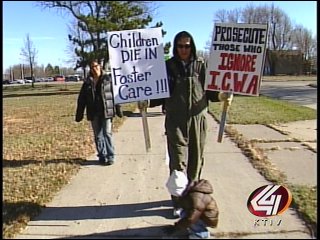
Long after the Trail of Tears Native American children have been removed from families and placed in Christian boarding homes to be "assimilated" under the guise of abuse and neglect.
The practice of "assimilation" (stripping of culture, language, indoctrination of Christianity) only recently ended in the late 1990s but continues in the blatant violations of the
Indian Child Welfare Act.
The funding nomenclature of these activities is simply termed, "Targeting".
Targeting is designed to focus on "vulnerable populations".
Vulnerable populations are just that; people of color.
It is easiest to see the target when the bullseye is based on the pseudo-science of racial profiling and no oversight of due process; hence, the purposes of this DOJ filing.
The time has come to illuminate the egregious practice of civil rights violations in child welfare.
Amicus Brief of U.S. in support of Sioux Tribe on civil rights violations of Native children and culture
The Justice Department has weighed in on a class-action lawsuit in South Dakota pitting Native American tribes against state officials, and come down resoundingly in support of tribes.
It's the first time the department has intervened in a federal district court case involving the Indian Child Welfare Act, a law meant to keep Native American families together. The department filed an amicus brief.
In the suit, tribes claim the state is failing to abide by the 36-year-old federal law, removing hundreds of Indian children from their families in court hearings where parents are rarely allowed to speak, and that often last less than 60 seconds.
The children are then placed in foster care, where they may stay for months or years.
"It's disgraceful," says Stephen Pevar, who is a senior staff attorney at the ACLU, which has brought the suit along with the Oglala Sioux and Rosebud Sioux tribes.
As part of the lawsuit, the state had to turn over rarely seen transcripts of 120 recent court hearings. In every one, the Native American children were taken into state custody.
Not a single parent was allowed to testify at the hearings. Most were not allowed to say anything except their names.
"These were virtually kangaroo courts," Pevar says. "There was nothing, nothing that any of the parents did or could have done. It was a predetermined outcome in every one of these cases."
In one case cited in the lawsuit, children were taken away from a mother who the state said was neglectful. Their father, who was divorcing the mother, appeared at the hearing and said, "I am here. Please give custody of my children to me." The judge placed the kids in foster care.
In another example, a mother returned home from work to find her children had been taken away when her babysitter got drunk. She went to the hearing to explain she was the mother. Her children were also placed in foster care.
"This violates every concept of humanity," Pevar says. "If you have a right to a prompt hearing when [your] automobile is seized, they have a right to a prompt hearing when their children are seized."
State officials declined NPR's request for comment, citing the ongoing lawsuit. Pevar says the suit has been a long time coming.
"There is a crisis in many parts of the United States, and there has been one for decades involving the forceable removal of Indian children from their homes by state judges and social services employees," he says. "This lawsuit seeks to do something about it."
In its brief, the Justice Department wrote that state court and state officials with the Department of Social Services have an obligation to "actively investigate and oversee emergency removals of Indian children to insure that the removal ends as soon as possible, and that Indian children are expeditiously returned to their parents or their tribe" from the beginning of the process with the first court hearing to the end.
The Indian Child Welfare Act mandates that states place children with their tribes, their relatives or Native American foster parents if they have to be removed from their families.
In South Dakota, almost 9 out of 10 Native American children are placed in non-Indian homes or group homes, says Chase Iron Eyes, a staff attorney with the Lakota People's Law Project.
"It's a human rights crisis what's going on," he says.
This year, 7 of the state's 9 tribes applied for federal planning grants, with the help of the law project, in an effort to develop their own foster care programs. State officials have said they support that effort.
"We're trying to turn the whole system around," Iron Eyes says, "and give that power back to where it belongs — the power to raise our own families."
Iron Eyes says the future of Native American tribes depends on it.
Transcript
MELISSA BLOCK, HOST:
The Justice Department has weighed in on a case in South Dakota, where Indian tribes charged that too many of their children are put in foster care improperly. In a rare move, the DOJ is supporting the tribes in a class-action lawsuit. The tribes say, the state is violating the 36-year-old Indian Child Welfare Act by removing hundreds of children after extremely brief court hearings. NPR's Laura Sullivan reports.
LAURA SULLIVAN, BYLINE: Last year, tribes in South Dakota came together with the ACLU to file a class-action lawsuit against South Dakota courts and state officials. The tribes say, the state has removed their children and placed them in foster care without giving them notice or a proper court hearing.
As part of the lawsuit, the state had to turn over rarely seen transcripts of 120 recent court hearings - hearings where Native American children were taken into state custody and typically placed for months into foster care. Most of the hearings lasted just a few minutes. Others lasted less than 60 seconds.
STEPHEN PEVAR: It's disgraceful.
SULLIVAN: Stephen Pevar is a senior staff attorney with the ACLU, which has brought the suit along with the Oglala Sioux and Rosebud Sioux tribes. Not a single parent was allowed to testify at the hearings. Most were not allowed to say anything except their names.
PEVAR: These were virtually kangaroo courts. There was nothing - nothing - that any of the parents did or could have done. It was a predetermined outcome in every one of these cases.
SULLIVAN: In one case cited in the suit, children were taken away from a mother the state said had neglected them. Their father, who was divorcing the mother, appeared at the hearing and said, I am here. Please give custody of my children to me. The judge placed those children in foster care.
In another example, a mother returned home from work to find her children had been taken away when the babysitter got drunk. She went to the hearing to explain she was the mother. Her children were also placed in foster care.
PEVAR: There's a crisis in many parts of the United States - and there has been one for decades - involving the forcible removal of Indian children from their homes by state judges and social services employees. And this lawsuit seeks to do something about it.
SULLIVAN: State officials declined NPR's request for comment, citing the ongoing lawsuit. This month, the Justice Department sided overwhelmingly with tribes. It has never before intervened in a district court case involving the Indian Child Welfare Act.
The act mandates that states do everything they can to keep native families together and that they place native children with their relatives, tribes or Native American foster parents if those children are removed from their families. Chase Iron Eyes is a staff attorney with the Lakota People's Law Project. He says nine out of 10 Native American children who are taken from their families in South Dakota are placed in non-Indian homes or group homes.
IRON EYES: It's a crisis. It's a human rights crisis - what's going on.
SULLIVAN: This year, seven tribes in the state applied for federal planning grants to develop their own foster care programs.
EYES: We're trying to turn the whole system around - turn the whole ship around - and kind of give that power back to where it belongs - the power to raise our own families.
SULLIVAN: Iron Eyes says, the future of Native American tribes depends on it.
Voting is beautiful, be beautiful ~ vote.©