A1: They are all "Legal Geniuses" (trademark pending);
A2: They were all mean to my Sweetie;
A3: Oleg the Ass and his rogue ass Detroit - NABU crew were stealin' the children, the land and the votes.
A4: Whitewater grand jury is ongoing; and,
A5: I am on a mission....
Cocktails & Popcorn: Pence Came To Detroit To Cover Up The War Crimes Of Jeffrey Epstein - Detroit Land Bank Authority, Dan Gilbert, Mike Duggan, Children's Trust Funds & Skadden
Former Manafort deputy Rick Gates testifies against Greg Craig
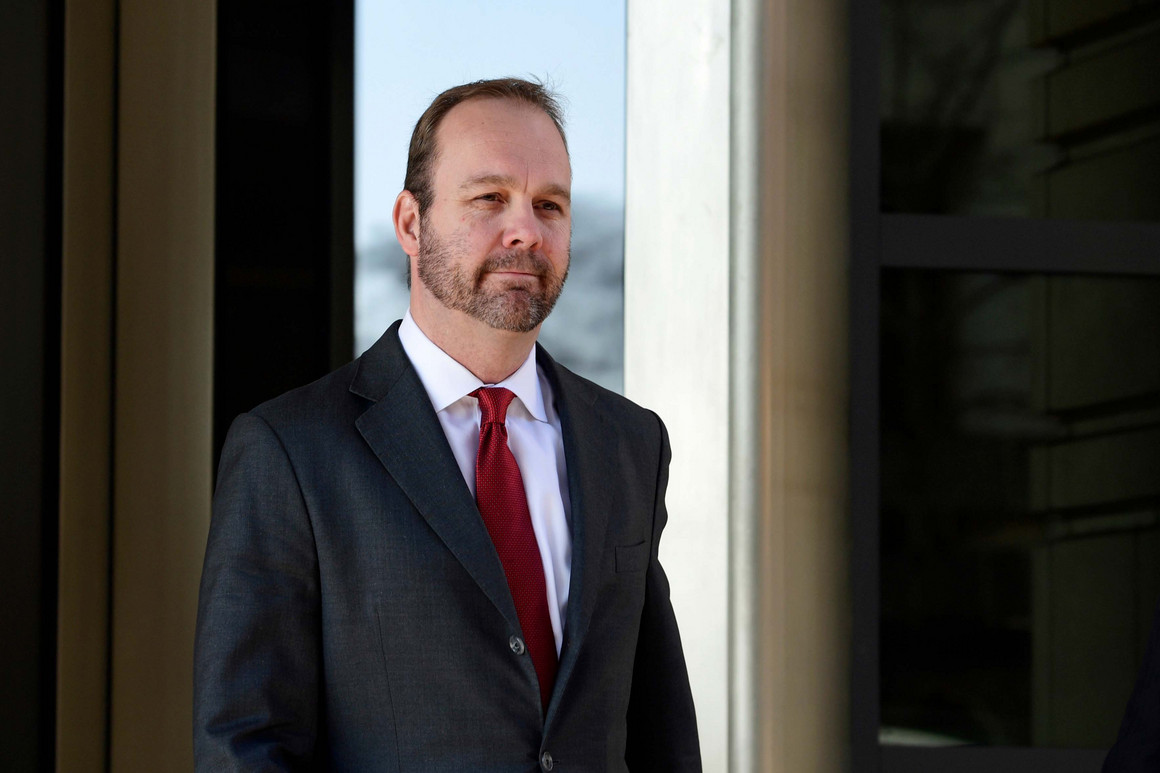 Rick Gates, the former Trump deputy campaign chairman and a central witness in special counsel Robert Mueller’s Russia investigation, appeared in federal court again on Thursday to testify against former Obama White House counsel Greg Craig at his ongoing trial connected to a Ukraine-related legal project that Craig did involving Gates’ former boss Paul Manafort.
Gates’ turn as a prosecution witness on Thursday morning was his first public court appearance since he took the stand a year ago at the trial of Manafort, Trump’s former campaign chairman, on tax and bank fraud charges brought by Mueller.
Gates served as Manafort’s right-hand man for about a decade, including the period in 2012 when Manafort oversaw an in-depth review that Craig conducted of the widely criticized trial of former Prime Minister Yulia Tymoshenko of Ukraine on abuse-of-power charges.
The project — billed as an independent review of the controversial prosecution — was commissioned by Manafort’s main client at the time, President Viktor Yanukovych, and secretly funded by a Ukrainian steel oligarch who backed Yanukovych, Viktor Pinchuk.
Craig served in 2009 as President Barack Obama’s first White House counsel, was a key figure in Obama’s first presidential bid and had previously joined President Bill Clinton’s White House to defend him against impeachment. Craig is charged with scheming to conceal material facts during a Justice Department inquiry into his Ukraine work and whether it required him to file under the Foreign Agents Registration Act.
Prosecutors say Craig was intent on not doing so because he believed that such a filing would harm his chances of a senior post in a future Democratic administration. Detailed disclosures called for under that statute could have undermined the credibility of the review by exposing the secret funding of the $4.6 million project by Pinchuk and by revealing a parallel assignment that Craig’s law firm at the time, Skadden Arps, had to advise Ukraine’s government on a planned second trial of Tymoshenko on other charges, prosecutors contend.
While Craig isn’t charged with failing to register as a foreign agent, a key issue at the trial is whether he was honest with Justice Department officials about his role in release of the report, which included providing an advance, embargoed version of the review to the veteran New York Times national security reporter David Sanger.
The Times’ relatively short story on the topic, co-authored by Sanger and Times reporter David Herszenhorn — who is now with POLITICO Europe — was skeptical in tone, but did note that Craig sided with the Ukrainian government on several important issues related to Tymoshenko.
Gates maintained, however, that the decision to go to The Times through Craig had the desired effect.
“The overall strategy worked. … The article wasn’t the greatest, but at least it was viewed neutrally, so it did have an impact,” Gates said. “From our viewpoint, the success of it was very great.”
Gates conceded that Craig ultimately refused to participate in many of the rollout-related activities that were part of the various plans, but the Manafort aide was emphatic that Craig’s contact with Sanger was a part of the Ukraine team’s broader effort.
“Did Mr. Craig carry out the role that he had promised to carry out in relation to The New York Times?” prosecutor Fernando Campoamor-Sanchez asked.
“He did,” Gates said.
Gates also testified Thursday that, to his knowledge, Craig was the first to raise the possibility of essentially leaking the report to Sanger.
“Mr. Craig had named a reporter from The New York Times as somebody who … he had a specific relationship with that could help with that effort,” Gates said. “He said Mr. Sanger is a tough reporter but a fair reporter, and we wouldn’t necessarily get a good article, but he’s very credible in the space.”
Gates said Craig never said in detail how he knew Sanger. “He just said historically,” Gates said.
Gates also testified that there was some secrecy surrounding the selection of Sanger, at least for a time.
“Mr. Manafort asked me to keep the name [of] Mr. Sanger off of any material going back and forth” with the lobbying firms working on the project in the U.S., Mercury and Podesta Group, Gates said. He did not elaborate on the need for confidentiality, but did say later that some on the Ukraine team had misgivings about trying to go through Sanger to “seed” the report.
“There was a concern raised by one of the other consultants in terms of Sanger and whether he would actually put out a favorable article,” Gates said.
The release of the report was the focus of months of painstaking choreography by Manafort, Gates and a coterie of public relations advisers and lobbyists seeking to improve Yanukovych’s public image and put his country on a path to greater integration with the European Union.
However, Craig’s defense insists that his actions to publicize the Tymoshenko report — including by hand-delivering a copy of the review to Sanger’s Washington home — were not part of the media plan Manafort and Gates labored over.
Craig and his defense lawyers have argued that his contacts with the press were solely aimed at protecting his and Skadden’s reputation in the face of repeated indications that Manafort’s team and others working for Ukraine’s government intended to falsely portray the rather equivocal report as a vindication of the prosecution and imprisonment of Tymoshenko, Yanukovych’s key political rival.
Craig, 74, has pleaded not guilty and denies that he ever sought to lie to or mislead U.S. officials about his role in the project or the core issue in the trial: his involvement in the rollout of the report in the media in December 2012.
Campoamor initially led Gates through his education and work history, with the former Trump campaign deputy chairman saying in passing that he is “unemployed.” Less than 15 minutes into Gates’ testimony, the prosecutor returned to that issue, leading Gates into an explanation of why he’s been out of work for the past two years.
“I was indicted in 2017 in relation to a larger investigation,” Gates said. He did not immediately mention that it was Mueller’s Trump-Russia probe, but jurors saw a document mentioning the “Special Counsel’s Office” and Campoamor later mentioned Mueller by name.
Under prompting by Campoamor, Gates went on to say that he pleaded guilty and agreed to cooperate with prosecutors in order to try to secure a sentence of probation rather than the five or six years called for under federal sentencing guidelines for conspiracy and false-statement charges.
“I agreed to tell the truth,” Gates said. “I agreed to help them with any other cases they were working on.”
Gates told jurors he has met with federal investigators about 40 times on a variety of different matters.
Gates spent less than an hour on the stand for the prosecution, before Craig lawyer Paula Junghans stepped up to try to demolish Gates’ credibility.
For nearly half an hour, Junghans led Gates through questions about the lengthy list of crimes he admitted to as part of the plea deal he struck last year, including tax fraud, failing to report foreign bank accounts and evading the Foreign Agents Registration Act.
“You pled guilty to conspiring to violate all of those federal statutes?” she asked.
“I did,” Gates said.
“You also get under the plea agreement a promise you won’t be prosecuted for other crimes … and you’ve committed quite a few,” Junghans said.
“Yes,” Gates replied.
Junghans got Gates to acknowledge that he hadn’t paid his own taxes in full, lied in a court deposition, lied to banks for loans and even lied to get a credit card. Gates also conceded, as he did at Manafort’s trial last year, that he used access to Manafort’s bank accounts to steal from him.
“In fact, you took money from Mr. Manafort himself?” Junghans asked.
“That’s correct,” Gates said.
“You just helped yourself from time to time without telling him?” the defense lawyer asked.
“Yes,” Gates said.
Gates’ tenure at the Trump campaign came up only briefly, at the tail end of Junghans’ questioning of the Republican operative about his misdeeds.
Asked what he did after working for Manafort’s consulting firm, Gates replied: “The next role I served in was under Mr. Manafort at the Donald J. Trump for President campaign.”
Junghans went on to question Gates about whether he’d ripped off Trump’s presidential bid by submitting false expenses.
“I don’t recall that I did,” Gates said. Asked whether he turned in fake expenses to the Trump inaugural committee, where he worked for a time, or other entities related to Trump’s campaign, Gates said, “No.”
Gates gave a somewhat different answer last year at Manafort’s trial. There, he said it was “possible” that he’d swindled the inaugural committee.
Given his admitted history of lies, Gates seemed to be trying to be meticulous about his statements on Thursday, even raising legal niceties when doing so may have made him seem less contrite.
“I don’t believe it was tax evasion,” Gates, who is not an attorney, said to Junghans at one point. “It was filing a false tax return.”
U.S. District Court Judge Amy Berman Jackson sided with Gates, leading to one of several instances on Thursday where she scolded Junghans in front of the jury.
“There are legal distinctions between the counts,” the judge said. “He’s allowed to answer your question as he understands it. If you’re going to quibble with him about matters of law, I don’t think that he should be testifying about matters of law or you should be testifying about matters of law.”
Gates — no longer sporting the beard he grew after his indictment — seemed earnest and subdued during his more than four hours on the stand Thursday. He smiled on only a few occasions and offered a joke only once. After telling Junghans that he would take her word for what was in a specific document, only to have her say moments later she was mistaken, Gates quipped: “Then, I won’t take your word for it.”
Junghans failed to see the humor. “You’re the one who knows whether you lied to the government of Ukraine or not,” she said gravely.
“Ask your next question rather than making comments,” Jackson interjected.
Gates has a lot riding on his testimony. As he acknowledged on the witness stand, Jackson — the same judge who was on the bench Thursday — will decide what sentence he eventually receives. In theory, he could get up to 10 years, but his plea agreement suggests that probation could be appropriate if his cooperation is deemed extensive.
If the case against Craig amounted to a swearing contest between him and Gates, Gates would almost surely lose. But several other witnesses have testified that having Craig contact Sanger was part of the plans circulated as release of the Ukraine report neared in the fall of 2012.
Manafort is not being called to testify by the prosecution. Prosecutors may have concluded that failing to call Manafort and Gates would leave their case too vulnerable to arguments that Craig lawyers hinted at in pre-trial hearings that key players in the saga were being hidden from the jury.
Craig is one of the most well-respected members of the Washington bar, whose career in public service began with registering African-American voters in the South during the civil rights movement half a century ago.
Craig attended Yale Law School, where he was in the same class as Bill and Hillary Clinton. He later served as general counsel to Sen. Ted Kennedy and in one of the most prestigious posts at the State Department under Secretary of State Madeleine Albright.
Gates got his start as an intern at the Washington political consulting and lobbying firm founded by Manafort and the veteran Republican operative Charlie Black. The firm was known for representing unsavory foreign leaders such as Zaire’s Mobutu Sese Seko and Angola’s Jonas Savimbi. Gates eventually became Manafort’s key deputy at a small spin-off firm, Davis Manafort.
Gates was thrust into public view in August 2017 when he and Manafort were indicted in the first case publicly brought by Mueller’s office. They were accused of conspiring to avoid registering for their Ukraine work, money laundering, making false statements and failing to report offshore bank accounts.
Gates initially vowed to fight the charges, but capitulated in February of last year, agreeing to plead guilty to conspiracy and lying to the FBI. In a bid for leniency, he became a prolific behind-the-scenes cooperator with Mueller’s team.
Gates’ public debut for Mueller came at Manafort’s trial in Virginia last August. He admitted that he and Manafort used millions of dollars in offshore bank accounts in Cyprus and the Caribbean to avoid U.S. taxes.
During the Virginia trial, Gates endured blistering cross-examination from Manafort’s attorneys, who even drew attention to Gates’ personal life, exposing that he’d had extramarital affairs.
At a pretrial hearing last month in Craig’s case, Jackson asked both sides whether they planned to explore this aspect of Gates’ past. Lawyers for the prosecution and defense both said no.
Gates was expected to be a crucial witness at a second trial for Manafort that was to take place in Washington following the Virginia one, but Manafort agreed to plead guilty in that case. He’s currently serving a combined sentence of about seven and a half years in prison stemming from both federal cases.
Both before and after his guilty pleas last year, Gates has been free on bond, living in Richmond, Va., and occasionally traveling with his family on court-approved trips. He is still awaiting sentencing on the two felony charges he admitted to.
Voting is beautiful, be beautiful ~ vote.©

