Since DeWine will be self-quarantining, I have provided an interesting read, below, so that he can get on Zoom broadcasts to discuss with the public on what exactly all this Corporate Shape Shifting is and what is going on when it comes to all this banking drama of Corporate Parental Rights.
Governor DeWine is returning to Columbus where he and First Lady Fran DeWine, who also has no symptoms, will both be tested.
‘That never leaves my mind’: Ohio approaches 100,000 coronavirus cases
Governor DeWine plans to follow protocol for COVID-19 and quarantine at his home in Cedarville for the next 14 days.
Lt. Governor Jon Husted also took the COVID-19 test to greet the president and tested negative.
The Ohio Department of Health reports there are 96,305 coronavirus cases in the state.
Rep. Maxine Waters (D-Calif.) recently confirmed that her sister died after contracting the coronavirus.
In an interview with the website theGrio on Thursday, Waters said that the experience of losing her sister during a pandemic was one of the hardest experiences of her life.
Waters had previously told colleagues in an emotional House floor speech in late April that one of her family members was dying in a hospital in St. Louis.
“It is one of the most painful things that I’ve ever had to experience in my life,” Waters told theGrio. “She had suffered. And so we are going through a very difficult time. It was not easy, but in many ways, I’m so glad she’s out of pain.”
Official tally of April coronavirus deaths in Moscow doubles
Overnight Health Care: Sewage testing gives clues of coronavirus |...
Waters did not say which sibling had died. The congresswoman was born in St. Louis as the fifth of 13 children, according to her congressional bio.
Waters said in the interview that her sister had been living in an assisted living home for elderly St. Louis residents, and warned that such facilities can cause the virus to spread rapidly.
“The nursing home is the only place we have for many of our seniors, many of whom have outlived their families,” she said. “That’s where they go. And now these nursing homes are like a petri dish for the continued development of this virus that is killing us.”
"When the money comes into the cities, the feds will activate a facility that will quickly leverage the money for the cities through corporate bonds to unlock primary and secondary bond markets so they do not crash, and the people will all cherish the Public Private Partnerships we own, which own the bond markets, so they do not collapse and everyone goes homeless, like the black and brown people, so they can borrow."
The Federal Reserve and the Treasury are going to "adapt" and "provide flexibility to the states".
I shall assume that flexibility has to do something with the next round of massive foreclosures, and, as such, another round of stealin' the children, land & vote, because it worked for TARP.
FUN FACT! MANY MUNICIPALITIES USED FAKE MORTGAGE & TAX FORECLOSED PROPERTIES AS LEVERAGE IN MUNICIPAL BONDS FOR PENSIONS IN COMMERCIAL REAL ESTATE INVESTMENTS LIKE STRIP MALLS LIKE DETROIT
The government could never be transparent about TARP being spent because the Detroit Land Bank Authority never incorporated, which means they did not have a bank account, or a tax return, or contracts, which is how they operated behind closed doors.
Will these new facilities be vetted on their state instruments of authority to engage in commerce by ensuring they are incorporated before or after they get the money?
Emergency Manager Emperor Pence & His Procurement Consortia Task Force focused on profit.
My favorite chick seems to be a Predictive Modeling Crapper who was strongly encouraged to put a human spin on the subject of children, where she spoke of her own children.
Well, at least that was a start to get them to focus on the humans, and not revenue maximization for the Public Private Partnerships.
Verily, Google’s sister company, has launched a screening website for those who want to get tested for COVID-19, but it’s limited to people in the Bay Area of California, the Verge reported.
“It’s more of a pilot program than a public health utility,” the website reported.
You have be 18 years of age or older, be able to speak English, and be a U.S. resident, according to the story. It resembles the program a Verily spokesperson described last week, “not the expansive triage system that the Trump administration promised,” the Verge said.
The initial question is “Are you currently experiencing severe cough, shortness of breath, fever, or other concerning symptoms?” the story said.
A “yes” answer prompts a message that the website is “not the right fit” and to seek medical attention.
“This screener was developed in partnership with government health officials,” a Verily spokesperson told the Verge. “The initial question is meant to ensure that anyone who is seriously ill does not come to our sites because they are not prepared to provide medical attention. We are early in this pilot and are going to be learning more that will help us refine this COVID-9 risk screening and testing.”
A “no,” answer prompts the user to sign in with a Google account and sign a consent form allowing data to possibly be shared with public health officials. A series of questions follows including questions about symptoms, travel and work responsibilities. It takes about three minutes to read and respond, the story said.
“Ultimately, our goal is to help local authorities expand testing access in California as the need continues to increase,” the company said. “The program is in its early stages, and we will take the time to assess operations at pilot sites in the Bay Area before rolling out to additional sites. We are working closely with Governor Newsom’s office, federal authorities and local public health authorities to ensure we have the right capabilities in place to help more people over the coming weeks.”
Will the announcement of the Federal Reserve dropping interest rates to zero be enough to halt the pending, global collapse of markets to make up for getting busted for the TARP scheme they actually thought they were going to get away with stealin' the children, land & vote?
Will the major corporations run to get free money, just like they did with TARP, in order to bail themselves out for the pending collapse of the muni bond markets, leveraged with their fake assets of real estate then stole, mortgaged, quit claimed, laundered through land banks thrice, then bundled, flipped, hedged through more fake ass LLCs, run through the children's trusts to their overseas tax aversive havens?
Will a zero interest rate rally main street support to defend their propaganda, predictive modeling crap, which allowed TARP schemes to flourish, like the Detroit Land Bank Authority and gerrymandering from the Detroit Bankruptcy?
Paul Volcker, the former chairman of the Federal Reserve under Presidents Carter and Reagan who later played a role in the Obama administration's response to the financial crisis of 2009, has died at the age of 92.
Multiple media outlets reported Monday that Volcker, who served as Fed chairman from 1979 to 1987, had died. The Volcker Alliance, the former chairman's non-profit group, announced that he died Sunday.
Volcker is known best for using high interest rates to reverse decades of runaway inflation at the cost of a grueling recession. While Volcker was vilified by lawmakers in both parties, as well as farmers, homebuilders and manufacturers hit hardest by higher borrowing costs, he has been credited since for stabilizing the economy after years of rampant price increases.
"His life exemplified the highest ideals–integrity, courage, and a commitment to do what was best for all Americans," Fed Chairman Jerome Powell said in a Monday statement. "His contributions to the nation left a lasting legacy."
Two decades after Volcker left the Fed, he joined the Obama administration to help shape its response to the 2007-8 financial crisis and recession. That response led to the 2010 Dodd-Frank Wall Street reform law.
Volcker chaired former President Obama's economic recovery advisory board and advocated for stricter limits on risky investment practices that led to the 2007 panic.
Volcker advocated for a provision of Dodd-Frank that banned banks from using their own capital to make high-risk bets. That rule, known as the "Volcker Rule," was among the financial industry's chief concerns with Dodd-Frank and was formally loosened earlier this year by Trump-appointed regulators.
Volcker, a Democrat, played crucial roles in economic policy for several presidents in both parties, defining administrations and the trajectory of the U.S. economy for decades to come. He served in the Treasury Department during the Kennedy, Johnson and Nixon administrations, shaping the U.S.'s response to a deteriorating global financial order.
As Treasury undersecretary for international affairs, Volcker was a driving force behind Nixon's decision to abandon the gold standard, which tied the U.S. dollar to a fixed amount of gold. Carter's appointment of Volcker to the Fed and the economic crunch to follow likely played a role in his defeat to Reagan, who nonetheless renominated Volcker in 1983.
Volcker's public standing gradually improved along with the economy, and his Fed tenure led to an era of largely stable growth with mild recessions until the 2007 financial crisis. He faced perhaps more political scrutiny than any other Fed chief until current chairman, Powell, invoked Trump's wrath soon after taking office in 2018.
After leaving the Obama administration, Volcker focused his work on bolster the effectiveness and standing of policymakers and government officials. He founded in 2013 the Volcker Alliance, a non-profit group advocating for non-partisan efforts to improve governance, and released a memoir this year entitled "Keeping At It: The Quest for Sound Money and Good Government."
Volcker warned in August that the U.S. is "developing into a plutocracy," asserting that the country was “in a hell of a mess in every direction.”
"Distrust and ill-will permeate attitudes toward government," Volcker wrote in his memoir.
"Too many of the best in the assailed bureaucracy, both in Congress and in key administrative posts, have left too soon, doubting that their voices could be heard or that their goals could be achieved. That needs to change. And it won’t be easy."
No one wanted to talk about the Corporate Shape Shifters or the fake ass LLCs who take out fake ass mortgages, then get a land bank to do a quiet title to wipe out the debt, then transfer to another fake ass LLC to take out another fake ass mortgage to quiet title, where the previous two, or five, or 10 fake ass mortgages are bundled and sold overseas in fake ass bonds, used to leverage more fake ass loans to launder through foreign fake ass child welfare NGOs children's trust funds, and that does not even include the federal loans or grant programs like TARP, Hardest Hit Funds, and any other Federal Reserve scheme they can run through the backdoors of local, county and state government.
How to address the issues of affordable housing.
Stop stealin'.
Always remember, if you do not live there, you cannot vote there.
Such a shame SIGTARP was not called to testify, but I believe they are rather busy, busy, busy!
Microsoft Super Duper Detroit Election
Victory Transposable Model
On this exciting episode of Cocktails & Popcorn, we are revisiting the DOJ & DHS Conjugal Collaborative Report on Russian interference in the 2018 Elections.
Noah Urban is a Senior Analyst at Data Driven Detroit (D3), a low-profit social enterprise that works to help partners use data to drive informed decision-making in Metro Detroit. At D3, Noah manages execution on D3’s suite of projects and initiatives, including a number of projects with Microsoft. He joins us today to discuss one of those projects — a data collaborative tentatively called the Metro Detroit Data Alliance, or MDDA.
But the report said nothing about public corruption stealin' the vote using the Detroit Land Bank Authority Public Private Partnership with the City of Detroit and Microsoft property tax databases, so I said it for them.
I think it should be claimed as an asset of the City of Detroit, through formal measures, of course, you know, like asset forfeiture.
This about how Detroit improved its election interference strategy for the 2018 Election because they jacked up the 2016 Election Interference Strategy.
See, the "Legal Geniuses" (trademark pending) just knew the had the 2016 Election all wrapped up in their back pockets, having perfected their plan to imprison the Celestial Goddess in the Woodshed.
A year ago, when we started our Civic Tech engagement in Detroit, I wrote (and continue to express my excitement) about all the great business and economic activity in my hometown. Last week, I had the honor to participate as a panelist and in workshops at Detroit Startup Week and the momentum is skyrocketing.
Detroit Startup Week is a 5 day event, which offered over 150 speakers, 10 program tracks, loads of workshops, tours and chats about various topics related to entrepreneurship in Detroit—all for FREE. Because of the wide breadth of activity, the speakers and attendees ranged from Mayor Mike Duggan, Dan Gilbert, and Jamie Dimon to local coffee startups and hackers. Each was as important as the other—because all attendees shared a common vision—a stronger Detroit, based on economic development through small and medium business growth. There were over 2000 attendees and a tremendous amount of sidebar networking. The Goal: To help Grow the Detroit Entrepreneurial Ecosystem. There is no doubt that Detroit is on the mend after becoming the nation’s largest city ever to go bankrupt just two years ago. Mayor Mike Duggan discussed how the city is starting to turn around, betting big on small businesses, education and affordable housing. His measurement of whether the city is on the right track or not is whether the population is growing or declining. Let’s continue to watch closely as I think people are indeed moving back into the city.
Microsoft was delighted to help sponsor Startup Week…and don’t you just LOVE these T-shirts! As you look at the logos, you’ll see big names, small names…everyone pitching in as equals to bring education about how to start a business to as many people as possible.
The diversity of Startup Week was amazing. Ranging from an IoT Avenue to Chase Basecamp to sessions on Lawns, Drones, Kitchens/Café’s, and my personal favorite: Motown, Marketing, Music and More: In the contemporary entertainment industry, it is necessary to conduct yourself with the mindset of an entrepreneurial, self employed businessman. Delivered through the lens of the newly founded Detroit Institute of Music Education, now in its second year, this presentation will dive into the concepts of mentorship, networking, versatility, open-mindedness, and “simple done well.” That’s the key to Detroit—everyone wants to help everyone else be successful, because it’s all good for Detroit.
Microsoft was part of a panel and workshop discussion suite that included January Advisors, Data Driven Detroit, Loveland, and the City of Detroit’s Director of Innovation and Emerging Technology. We discussed best practices from Houston to Chicago to Detroit and how to open up the city’s public data and information for the consumption and benefit of all. Examples like D3’s Motor City Mapping were discussed and Garlin Gilchrist II announced that Detroit will be working with Smart Chicago and Microsoft to bring the Civic User Testing (CUT) Group program to Detroit, in partnership with Data Driven Detroit. We are extremely excited to help with this innovative program.
Congratulations to the volunteers who helped make Detroit Startup Week such a success. We’re looking forward to next year—a bigger crowd, more growth and more success for the new Motor city. NOTHING stops Detroit!
They say that great work stems from a combination of passion and commitment, something that Shelley certainly possesses when it comes to her life and career. She currently serves on the boards of the Women’s Business Development Center, the Chicagoland Chamber of Commerce, Thrive Chicago, Year Up and LISC Chicago. At Microsoft Chicago, she’s the Director of Civic Engagement, working at the intersection of computing and community, promoting STEM programs and using Microsoft technology to spur growth in the community. So no matter if it's work, play, or giving back, Shelley always makes sure her drive and professionalism help her complete her life's goals.
The "Legal Geniuses" (trademark pending) over there at Perkins Coie Sucks, thought they could transpose their super duper campaign victory for Hillary Clinton, having perfected it, and all, but, what had happened was..... the Celestial Goddess of the Woodshed dug her way out because she had access to the internet and thwarted the Smarty Pants, who live in their own reality of an ivory tower, because they were mean to her Sweetie, again.
So, the "Legal Geniuses" (trademark pending) came out and announced that they were just Dandy when it came for using all the Detroit Land Bank Authority property tax data to win the 2018 Election because they now owned Garlin Gilchrist, "GG" (the tech guru).
Dandelion works with cities to help communities achieve access to opportunities and to activate underutilized assets in neighborhoods. Early on, this was the team that helped Detroit Mayor Mike Duggan get elected in a storied campaign (the campaign brought him to a 2013 primary victory as a write-in candidate). It consists of a tactical team of designers, developers, content creators, project managers and others who wrap their talent around civic projects. They establish trust with limited-budget clients such as non-profits, private foundations, and governments, and leverage that trust to “deploy new ideas” in cities. And they have deployed more than 100 of those projects in the last 5 years. Now they are bringing that experience and those skills to Chicago. Watch Matt Wolf from Dandelion talk in my latest Big Shoulders about place-based projects for economic development and those around creative re-use.
You may recognize Adam. He’s a regular on TV, you can hear him on the radio, he’s penned numerous articles and is the co-founder of the Chicago City Data Users Group. But some of Adam’s most important work is done behind the scenes in his role as Microsoft’s Director of Technology and Civic Engagement for Chicago. Tech giants, universities and government leaders turn to Adam for guidance on all matters technology, and he happily obliges, helping Chicago overcome challenges and capitalizing on new, exciting opportunities.
To ensure the 2018 Election Victory for the State of Michigan Democrats, everyone in Detroit and Chicago political leadership came together in an orgy of political partisan unity, because, if they did not take over, there were going to be alot of individuals who would have to "repurpose" their campaign "revenues" for legal defenses because SIGTARP is busy, busy, busy!
Stay tuned.
I believe Rashida Tlaib is about to become really, really famous-er.
The U. S. House Oversight Committee held hearings on the Hardest Hit Fund - TARP, to respond to the findings of SIGTARP, the enforcement mechanism of the U.S. Treasury which audits the program.
Basically, you have a bunch of "The Elected Ones" whose staff failed to properly debrief their members on the background of the Hardest Hit Fund.
All they had to do was google my name, but they probably did, realizing it was best to limit the breadth of their questioning to ethics in the administration of the program.
I like that, just let them speak.
What we have here is an issue within the U.S. Treasury because every time a Member asks about stealin', in an ethical sense, only, because there are no criminal referrals from the Treasury, that we know of, to date, due to the unverified ongoing investigation that may not even exist, here was the mimeographed response of Kipp Kranbuhl. Chairman Gary Palmer smacked down Kipp (a name truly synonymous with poverty and hardship) down by having SIGTARP Christy Goldsmith Romero break it down to the fact that SIGTARP can not speak upon the multiple, ongoing criminal investigations that the office refuses to verify. Gary: "Are gym memberships considered allowable to help homeowners stay in their homes? Kipp: "We follow cost principles for every federal program."
Gary: "Have you made any criminal referrals?" Kipp: "We follow cost principles for every federal program." Gary: "What time is it?" Kipp: "We follow cost principles for every federal program."
Christy was Johnnie on the Spot in her succinct responses to questions of why there was so much stealin', but I seriously wonder how many people in the room actually caught what she said.
For those who do not wish to watch the entire hearing, allow me to provide a quick synopsis.
"They were stealin'." I bet Kipp wore Depends for this hearing.
The Office of Financial Institutions of the U.S. Department of Treasury is the oversight for the administration of TARP, not the money, just the administration, and stuff.
We have ourselves a Special Issue going on with Treasury.
See, SIGTARP, nor any other law enforcement entity, ever verifies the existence, or non-existence, of an investigation, or an ongoing investigation, unless it is verified by an original source, like me.
Chairman Meadows, Chairman Palmer, Ranking Member Connolly, Ranking Member Raskin, and Members of the Subcommittees, thank you for the opportunity to testify today about Treasury’s efforts to mitigate the effects of the financial crisis on American homeowners through the Housing Finance Agency Innovation Fund for Hardest Hit Housing Markets, also known as the Hardest Hit Fund or HHF.
In 2008, Congress passed the Emergency Economic Stabilization Act of 2008, 12 U.S.C. 5201, et seq., (as amended, EESA). This legislation provided Treasury with immediate authorities and resources to restore liquidity and stability to the nation’s financial system in the wake of an historic economic crisis. Using its authorities under EESA, Treasury established the Troubled Asset Relief Program, known as TARP, an initiative that was unprecedented in both its design and scale. Congress initially authorized up to $700 billion for TARP programs, though Congress later reduced that authority to $475 billion.
In the following years, Treasury disbursed nearly $412 billion of TARP funds under a variety of programs designed to help stabilize banks, automobile manufacturers, and other institutions integral to the nation’s economy. Treasury reserved additional funds for programs designed to protect home prices and prevent foreclosure. The first, and largest, of these housing programs was the Making Home Affordable® program, or MHA. Launched in 2009, MHA was a nationwide effort to help struggling homeowners avoid foreclosure by lowering mortgage payments to affordable levels. However, it soon became clear that a one-size-fits-all approach would not be sufficient to address all of the specific needs of homeowners and communities in the states that were hit hardest by the housing crisis.
Treasury established HHF in 2010 as part of TARP in order to help prevent foreclosure and to stabilize housing markets in states hit hardest by the housing crisis. State housing finance agencies, (together with certain designated entities, HFAs) in eighteen states and the District of Columbia were selected to participate, as these areas experienced unemployment rates at or above the national average, and/or home price declines of greater than 20 percent.[1]
Unlike MHA – a national program based on uniform criteria set by the Federal government – HHF was designed to give the participating HFAs the maximum flexibility to design and administer their own programs, each tailored to local conditions in their respective communities. As a part of this flexibility, the states have been able to adapt their programs in order to address the changing needs of their communities over time.
As of December 31, 2017, states had assisted approximately 350,000 homeowners and funded the demolition and greening of nearly 24,000 blighted properties in distressed communities.
However, the flexibility afforded to HFAs by the Hardest Hit Fund has made Treasury’s oversight a critical aspect of the program. Treasury maintains a strong commitment to ensure that the program achieves its goals and that federal taxpayer funds are used for their intended purpose.
Treasury requires each HFA to set specific goals for its HHF program, and to demonstrate steady progress toward meeting these goals. Treasury works with each of the HFAs to identify and address barriers that would keep the HFA from achieving its goals. Subject to Treasury approval, the HFAs may also modify their programs as needed in order to address the changing needs of their communities. Treasury also maintains an ongoing dialogue with the HFAs through in-person meetings and regularly scheduled calls, and it hosts annual summits where the various participating HFAs can meet and share best practices.
Treasury has also conducted more than 100 on-site compliance reviews across the participating HFAs, as well as additional, targeted reviews to address specific programmatic risks. These reviews evaluate a number of critical program functions, such as whether homeowners are evaluated in accordance with the HFA’s guidelines, program disbursements and administrative expenditures are appropriate, the information reported to Treasury is accurate, and the HFA’s internal controls are functioning as intended to minimize the risk of non-compliance.
Treasury takes corrective action when instances of non-compliance arise. This includes, for example, requiring HFAs to re-evaluate homeowners that were improperly denied, to reimburse HHF for improper expenditures, and to strengthen internal controls in order to prevent further non-compliance.
In addition to compliance reviews, Treasury also takes SIGTARP’s role seriously. We share this Committee’s and SIGTARP’s commitment to preventing fraud, waste, and abuse in all TARP programs, and we carefully consider recommendations in that regard.
Treasury responds to SIGTARP recommendations in writing, and our responses are made available to the public. We work hard to address the concerns raised by these recommendations, in a manner that allows the programs to function as intended and in the context of TARP’s wind-down. With respect to HHF in particular, this has included, for example, issuing written guidance to clarify HFA obligations, recovering funds that were improperly spent, and requiring states to strengthen internal controls to prevent non-compliance in the future.
For example, Treasury thoroughly reviewed the $2.2 million of costs questioned in SIGTARP’s August 2017 Audit Report. This involved analyzing thousands of individual transactions incurred by all 19 HFAs, dating back to the program’s inception in 2010. Following this review, Treasury determined that $656,141 of the questioned costs did not comply with the Federal government’s cost principles. The HFAs were required to reimburse HHF. For the reasons set forth in our April 6, 2018, letter to SIGTARP—a copy of which has been provided to the Committee and is available on our website—Treasury determined that the remaining costs questioned by SIGTARP were allowable under Federal cost principles.
As is the case with all TARP programs, HHF is winding down. Although Congress authorized additional funding in 2015, the program remains a temporary one. As of the end of April 2018, Treasury has disbursed $8.8 billion (or 92 percent) of the $9.6 billion obligated under HHF. Although HFAs may continue issuing new approvals through December 31, 2020, most of the states have already begun to close down HHF programs or will do so this year as they exhaust their available funds. This includes California and Florida, the two largest states in the program.
Treasury’s outstanding commitments under TARP represent just one percent of the $475 billion authorized by Congress. As TARP winds down, Treasury remains committed to robust oversight and monitoring of all of its TARP programs, including HHF.
As part of this wind down, the Office of Financial Stability, which oversees HHF and other TARP programs, was recently realigned to report to Treasury’s Assistant Secretary for Financial Institutions. This realignment will enable our office to oversee an orderly and successful wind down of HHF that is in line with the wind down of other programs that are also overseen by this office, such as the State Small Business Credit Initiative and the Small Business Lending Fund.
I thank you again for the opportunity to testify today and welcome your questions.
####
[1] The eighteen participating states consist of Alabama, Arizona, California, Florida, Georgia, Illinois, Indiana, Kentucky, Michigan, Mississippi, Nevada, New Jersey, North Carolina, Ohio, Oregon, Rhode Island, South Carolina, and Tennessee.
Here is where the Treasury came up with the excuse, "the money has not yet been allocated" whenever SIGTARP asked what happened to the money. As soon as Treasury responds, by the wings of Mercury, they officially start stealin' because they know by the time they are asked again, there will be a new allocation cycle, with questions only focused on these new allotted funds, not the funds they were stealin' in the previous grant spend down cycle, because that could be one of those double jeopardy administrative moments they can argue their way out of a criminal proceeding.
"I am serious! These"Legal Geniuses" (trademark pending) have lost their minds trying to interfere in Keith Ellison's election and still have no clue about Detroit."
Well, it seems the attack on Keith Ellison is about to get nastier, but I shall search for plausible propaganda premises as to why these people are going bonkers over him.
Uh... Farrakhan is an individual you just have to scold every so often.
Keith did not mislead or lie, whereupon the suspect timing of this "epic revelation" just now being uncovered by the Daily Caller, which, quite obviously, has no clue about the history of U.S. Civil Rights, gave me every indication that we are dealing with a 'Holy Mary Pass' in squashing his campaign for Attorney General.
That is when you immediately go look to see what the opposition has to say about this:
So, why exactly is there such a coordinated effort being executed in such a tizzy about pushing for a pseudo-impeachment of Keith from holding office without specifically calling for formal process, less than two weeks before the election?
Hmmmmm.....
I decided to do a quick visit over to the meticulously forested metadata, meaning the search algorithms are manipulated on Google, in a basic search of the term "Minnesota", and voila!
Sheeeeeee's baaaaaaaack......
The one, the only, the Queen of Child Welfare Fraud, my muse, Michele Bachmann.
Now, why would such a factitious groupthink of overnight, pig farmers to millionaires, want to rally around Michele Bachmann?
Hmmmmmm........
Ambassador Niki Haley did a great job as U.S Ambassador to the UN. @RealDonaldTrump would do very well to appoint the Bold & Brilliant @MicheleBachmann as Niki’s successor.
But, then I started to think with a bit more of a deductive focus.
If Keith is going for the Office of State Attorney General, then why the distraction with Michele on the international stage?
So, I went back into that meticulously forested metadata and before I could even begin to enter a search term, I remembered there was a recent real estate scheme busted by the FBI and I immediately said to myself, "Self, you know darn well that has to do with TARP!"
Now, I wondered what was going on in the Minnesota Attorney General Office and there I saw the Minnesota Financial Crimes Task Force.
I immediately realized we were dealing with a similar TARP issues that we have with the Detroit Land Bank Authority, which has its own issues in relation to what I shall refer to as voter fraud and the like.
Perhaps, it has something to do with the Federal Reserve and Neel Kashkari's work on TARP.
This may indicate Keith is a potential whistleblower, considering the fact that he does know alot about Detroit, which is why he is being smeared with a hybrid of a #MeToo psychoptic.
These "Economic Gurus" (trademark pending) up in the Federal Reserve, U.S. DHHS and Michigan DHHS suck because they lied to Snyder, once again, using child welfare propaganda, to pitch their form of Medicaid expansion fraud.
This is not the first piece of statistical, predictive modeling crap to come out the Federal Reserve.
The last time they used University of Southern California.
Anything over the price of a 40 ounce brew and a spleef was too much.
Was this study paid with tax dollars and if so, how come I have to pay to access a public document, submitted into state and federal records, used to justify the use of more tax dollars, specifically Medicaid, when there is absolutely no mention of Medicaid fraud, or perhaps there is, if I pay for the study?
Why was an undergraduate student running this study?
This work was supported by the National Institutes of Health [1R01HD081129-01]. The views expressed here do not represent the views of the Federal Reserve Bank of Chicago or the Federal Reserve System. We thank Sharada Dharmasankar for her excellent research assistance. We also thank the editor and four referees for helpful comments.
They used her. They are cranking out their armies through the universities to keep this Public Private Partnership going until they achieve world domination for their glorious leaders who give them pretty shiny sheep skins.
Who was the principal on the study?
"I see Corporate Shape Shifters. Was it Michigan? Was is Sage Foundation? Was it Gates Foundation? Was it the Federal Reserve? Was it the National Bureau of Economic Research? Was it the National Institution of Health? Who is making policies for "The Poors" (always said with clinched teeth). Mommy, who owns our data, I'm scared."
Why was individual data sold to a private organization, who authorized it?
Cui bono?
Second, data from TransUnion on consumer credit histories was matched with the Healthy Michigan administrative data using name, address, and social security number. TransUnion
credit reports were observed twice per year, in January and July, starting with July 2011 and
ending with January 2016, resulting in ten observation periods. Prior to providing the matched
data to the researchers, all personally identifying information was removed. See the Appendix
for additional details on the match process. page 7.
Oh, wait, Michigan Department of Health and Human Services.
Yes, they sold the data.
We are grateful to the Russell Sage Foundation (grant # 94-16-04) for support of this project. Drs
Kaestner, Mazumder, and Miller also benefited from support from the National Institute of Child
Health and Human Development (NICHD) grant #1R01HD081129. We thank Tara Watson, Lara
Shore-Sheppard, seminar participants at the Federal Reserve Banks of Philadelphia and Chicago
and conference participants at ASHEcon for their comments. We also gratefully acknowledge the
Michigan Department of Health and Human Services for making this data available, Sarah Clark
and Lisa Cohn for helping assemble the MDHHS data set, and Dave Fogata for facilitating the
data purchase from TransUnion. The views expressed herein are those of the authors and do not
necessarily reflect the views of the National Bureau of Economic Research.
They now have a viable voting database for manipulation.
Did you know Sharada has her name on another piece of crap Federal Reserve of Chicago study on the financial health of people who lost their homes to fake ass mortgage foreclosures?
Enrollment in Michigan's expanded Medicaid program boosted the finances of many low-income residents as well as their health care status, according to a University of Michigan study released Monday.
It is always wise to keep your chattel alive to maximize revenues my making sure to layer up services, upon administrative fees, to implement studies for more service programs, to service for "The Poors" (always said with clinched teeth.) Can you see the $ocial Impact Bonds? I can.
Among more than 655,000 residents who gained health coverage after the Legislature approved the Healthy Michigan Plan in April 2014, many have experienced fewer debt problems and other financial issues than before enrollment, according to the analysis of thousands of enrollees' financial records.
If you did not know, they used aggregate data. They should know very well the biases with MAUP, duh. This means the entire study sucks.
The study found drops in unpaid debts, such as medical bills and overdrawn credit cards, as well as fewer bankruptcies and evictions after people enrolled in Healthy Michigan. The program provides health insurance for adults with incomes up to 133 percent of the federal poverty level.
The research team was led by economist Sarah Miller of UM’s Ross School of Business. Their finding were published Monday on the website of the National Bureau of Economic Research with colleagues from the Federal Reserve Bank of Chicago, University of Illinois, Chicago and Northwestern University.
Yeah. I truly hope Sarah does not get tenured for this crap.
The greatest financial gains were experienced by people with chronic illnesses or who had a hospital stay or emergency department visit after they enrolled.
“Across the board, we saw a pretty sizable effect, not just on unpaid medical bills, but also unpaid credit card bills, and on public records for evictions, bankruptcies, wage garnishments and other actions,” said Miller, a member of the UM Institute for Healthcare Policy and Innovation.
ASSUMPTION RULEOUT #1: When you are sick and broke, you cross your fingers you get approved in 3 to 5 years for a SSI check. That means you are poor and do not have credit, so there would be no credit card debt.
“Enrollees’ financial well-being seems to improve when they can get the medical care they need without having to put it on a credit card. And the largest effects are among the sickest enrollees.”
ASSUMPTION RULEOUT #2: "The Poors" (always said with clinched teeth), do not have credit. Most of the time, all they have to do is miss one week of work and they will automatically qualify for Medicaid. Have you looked at the rates of poverty, lately? $1.00 over the threshold and you are cut off.
The team worked with the Michigan Department of Health and Human Services to obtain data on more than 322,000 enrollees without the researchers’ having access to any individual’s identifying information. Using a double-blind matching procedure, they matched the data with enrollees’ credit reports, and studied them as a group.
ASSUMPTION RULEOUT #3: They lied. How are you going to obtain metadata then run it in a double-blind with credit reports. Seriously? You already know whatever they crank out is going to be on dirty data. I wonder if they excluded the areas of Flint, Detroit, and the middle swath of the state, you know, the land of "The Poors" (always said with clinched teeth).
The study focused on people who enrolled during the first year of the Healthy Michigan plan, and who had previously been uninsured. Researchers looked at individual-level financial information from several years before each person enrolled, and for at least one year following enrollment.
The average household income for enrollees in the study was $4,400 for an individual and $7,500 for a family of three. Seventy percent had a chronic illness, and on average they had been to an emergency department once in the past year.
Ah, this is where asset forfeiture policies kick in through guardian ad litems and those wonder corporate parents. When someone has an average income between $4K and $7K a year, you are probably correct to assume that these individuals were probably in foster care or living in a boarding home and are dealing with mental health issues.
“A goal of the Healthy Michigan Plan is to address social determinants of health in order to promote positive health outcomes, greater independence and improved quality of life," said Lynn Sutfin, a spokeswoman for the Michigan Department of Health and Human Services.
HOW TO PROMOTE POSITIVE HEALTH OUTCOMES: Stop making "The Poors" (always said with clinched teeth), poorer!
"This study shows that ensuring Michigan residents have access to quality, affordable health care is reaping numerous benefits.”
No, this study shows another fraud scheme to hustle more money through privatization schemes to shore up the Federal Reserve banks that are going insolvent, like Deutsche Bank. This is propaganda and I am repulsed that this is the University of Michigan is promoting more insurgency propaganda for the purposes of the Privateering NGOs to swoop in and commence to stealin' through more crappy predictive modeling social programming for the parent corporations. That is the only place the financial health is focused.
More than 80 percent had credit scores in the subprime or deep subprime range. Their total debt in collections, medical debt in collections and past-due amount was higher than a random sample of credit reports nationally.
Uh...it is called poverty.
According to the study's findings, the Healthy Michigan Plan reduced their medical bills in collections by an average of 57 percent, or about $515. The amount of past due debt not yet sent to a collection agency was reduced by 28 percent or about $233.
How much of this past due debt was based upon bogus water bills or fake mortgages?
Researchers found a 16 percent drop in public records for evictions, bankruptcies, wage garnishments and other financial events. Bankruptcies dropped by 10 percent among the group studied.
Most individuals do not have enough debt to file bankruptcy. You cannot get evicted is you are homeless. There would be no wage garnishments if you already hail from "The Poors" (always said with clinched teeth).
Enrollees’ were 16 percent less likely to overdraw their credit cards, and their credit scores improved as a group. The number with a “deep subprime” rating fell by 18 percent, and the number listed as “subprime” fell by 3 percent.
Do you mean those deep subprime mortgages that stole the houses from the people, allowing for gerrymandering of congressional districts for the purposes of putting in elected spokestokens to approve crappy studies like this to get more Medicaid money for stealin'?
Enrollees experienced a 21 percent rise in automotive loans, an indication of improved financial well-being.
No, no, no. This is Michigan, the land of cars and corner car lots where Mohammad will sell you a hoopty and get you that 7 day insurance to get your plates to get on the road to find a good low-paying job and still qualify SNAP benefits.
According to Miller, other studies have found that Medicaid expansion reduced use of payday loans and reduced interest rates for low-income people.
Did Debbie Wasserman Schultz tell you to throw that "Medicaid expansion reduction in the use of payday loans and reduced interest rates for "The Poors" (always said with clinched teeth). I someone in your targeted population gets a payday loan, it is because they have a SSI check as collateral.
2016
Have Borrowers Recovered from Foreclosures during the Great Recession?
Now, nine years after the onset of the housing bust, we think it is worthwhile to assess the financial health of the individuals whose homes were foreclosed on during this period. Have they regained their financial footing, or are they permanently scarred? How different were their experiences compared with those of borrowers whose homes were lost to foreclosure in the years before the Great Recession? Did their experiences differ by their financial success (as reflected in their credit scores) before the Great Recession? And how likely are they to have undertaken a new mortgage?
In this Chicago Fed Letter, we address these questions by using data on a large sample of individuals who experienced a home foreclosure after 2000, with a focus on those who entered foreclosure between 2007 and 2010. We use credit bureau data through 2016 from the Federal Reserve Bank of New York Consumer Credit Panel/Equifax (CCP) database. We build on prior work by Brevoort and Cooper,2
who also used the CCP database but whose analysis ended with 2010 data. Their study showed that prime borrowers (i.e., borrowers with credit scores 660 and above3) who had experienced a home foreclosure during the Great Recession were especially hard hit and that their rate of recovery was significantly slower relative to such borrowers who had experienced a home foreclosure earlier in the decade. We extend Brevoort and Cooper's analysis through the second quarter of 2016 in order to examine how these patterns evolved over the subsequent years of the economic expansion. Specifically, we examine the entire trajectories of credit scores and credit delinquencies starting from the years before a foreclosure event and also extending many years after foreclosure. We also examine whether borrowers obtained a new mortgage in the years after foreclosure.
Foreclosures surge during the great recession
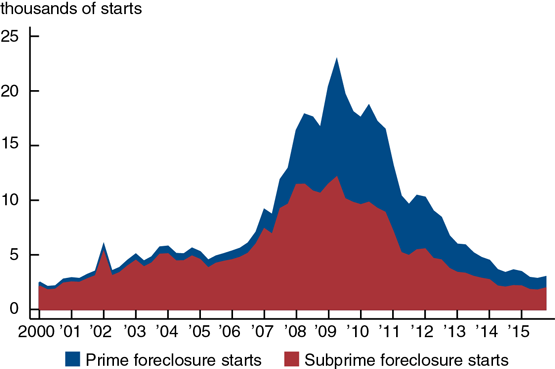
Our data are based on a 5% random sample of the population with credit bureau reports from the CCP database. These data allow us to study patterns in the number of new foreclosures ("foreclosure starts") each quarter beginning with the first quarter of 2000. Figure 1 shows that foreclosure starts were fairly steady until around the end of 2006. They then began to surge in 2007, peaking in 2009. After 2010, foreclosure starts began to rapidly decrease; by the end of 2012, the number of new borrowers entering foreclosure returned to pre-crisis levels.
1. Foreclosure starts, by home mortgage borrower credit status
Note: See note 4 for how prime and subprime home mortgage borrowers are categorized. Source: Authors’ calculations based on data from the Federal Reserve Bank of New York Consumer Credit Panel/Equifax.
Before the Great Recession, the majority of foreclosure starts were among subprime borrowers (i.e., those whose credit scores were below 660 4
Figure 1 shows that the Great Recession led to a striking change in the composition of foreclosures between prime and subprime borrowers. According to our analysis, from 2007 through 2010, foreclosures rose approximately 800% among prime borrowers, but only 115% among subprime borrowers. Over the same period, 40% of all foreclosure starts were among prime borrowers and 26% were among borrowers whose pre-delinquency credit score (see note 4) was over 700. This is one defining characteristic of the Great Recession: A much broader range of individuals, including those who had very high credit scores, were swept up in the collapse of housing markets. Indeed, while the overall level of foreclosure starts has come back down to pre-recessionary levels, the fraction of prime borrowers in foreclosure remains relatively higher than it did before the downturn.
The decline in credit scores at foreclosure
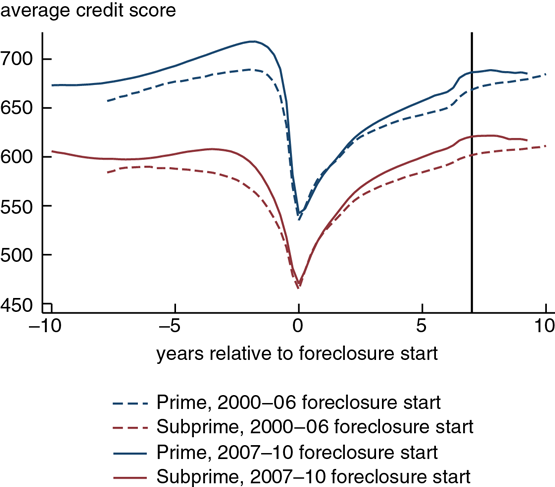
As might be expected, once borrowers enter foreclosure, their credit scores plummet. Figure 2 shows that the declines were very large for both prime and subprime borrowers during the Great Recession (solid lines). The decline in the average score for prime borrowers was about 175 points, and subprime borrowers experienced a decline of about 140 points in their average score.5 Immediately after foreclosure, nearly all borrowers became subprime, with average scores of around 550 for previously prime borrowers and 475 for already subprime borrowers. These declines were a bit larger than those experienced by borrowers who foreclosed between 2000 and 2006 (dashed lines).
2. Credit scores of home mortgage borrowers relative to foreclosure start
Notes: See note 4 for how prime and subprime home mortgage borrowers are categorized. The black vertical line indicates the end of the seventh year after the foreclosure start. Source: Authors’ calculations based on data from the Federal Reserve Bank of New York Consumer Credit Panel/Equifax.
Recovery after foreclosure
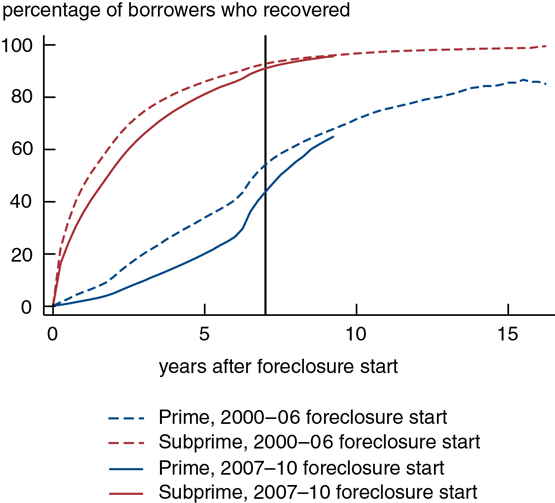
By law, information about any credit payment delinquencies, including mortgage payment delinquencies, must be removed from an individual’s credit record after seven years. Therefore, we would expect that if no other delinquencies occurred, individuals who experienced a foreclosure should see their credit scores recover in seven years. In figure 3, we plot the cumulative fraction of borrowers who reattained their pre-delinquency credit scores (again, see note 4) in the years following a foreclosure and show this separately for previously prime and already subprime borrowers.
3. Share of home mortgage borrowers who recovered pre-delinquency credit score after foreclosure
Notes: See note 4 for how prime and subprime home mortgage borrowers are categorized, as well as for how the pre-delinquency credit score is defined. The black vertical line indicates the end of the seventh year after the foreclosure start. Source: Authors’ calculations based on data from the Federal Reserve Bank of New York Consumer Credit Panel/Equifax.
What is immediately evident is that subprime borrowers tend to recover their pre-delinquency credit scores relatively more quickly than prime borrowers. First, let's examine the patterns of recovery for those who foreclosed on a home before the Great Recession. Among subprime borrowers who experienced a foreclosure between 2000 and 2006, roughly 60% reattained their pre-delinquency credit scores at some point within two years of foreclosure and roughly 85% within five years of foreclosure. In stark contrast, only about 10% of prime borrowers who foreclosed on a home in the same period recovered within two years and only about 33% within five years. After seven years, when delinquency flags are removed from their credit reports (as indicated by the black vertical line), about 90% of these subprime borrowers have reattained their pre-delinquency credit scores, compared with only about 50% of prime borrowers. After 15 years, nearly all subprime borrowers have reattained their pre-delinquency credit scores, whereas about 15% of prime borrowers have still not fully recovered. (Of course, subprime borrowers have a much lower pre-delinquency credit score to return to.)
When we examine the experience of the huge wave of borrowers who lost their homes to foreclosure during the Great Recession, we see a much slower pace of recovery. Specifically, among those who experienced a foreclosure between 2007 and 2010, irrespective of their credit status (prime or subprime), the pace of recovery was slower in the first three to five years after foreclosure relative to the pace of recovery among those who experienced a foreclosure in earlier years. However, after seven years, the subprime borrowers who foreclosed on a home in 2007–10 were virtually on track with their predecessor cohorts in terms of recovering their pre-delinquency credit scores. In contrast, even after seven years, prime borrowers who experienced a foreclosure in 2007–10 continued to lag their predecessor cohorts in reattaining their pre-delinquency credit scores. By 2016, the prime borrowers who entered foreclosure between six and nine years earlier (in 2007–10) appear to have recovery rates that are converging with the historical rates of recovery among their predecessor cohorts. When we further break down the analysis by subgroups of prime borrowers (660 to 700, 700 to 750, 750 and higher), we find that the lack of full recovery is mainly driven by those prime borrowers with the highest credit scores before foreclosure.
Other delinquencies and measures of financial health
A possible explanation for the slower pace of recovery among those who entered foreclosure between 2007 and 2010 relative to predecessor cohorts is that these individuals encountered difficulties paying their credit obligations on time because of the severity of the Great Recession. Since payment history is a critical component of credit scores, this could explain the especially slow rates of recovery. To address this possibility, we examine delinquency rates on any credit obligations for home mortgage borrowers before and after a foreclosure.
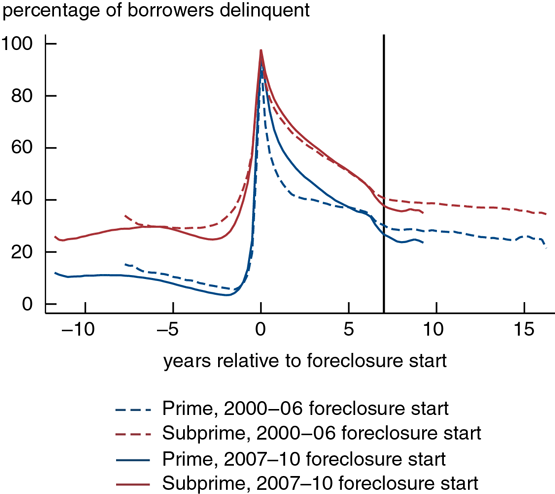
In figure 4, we plot the share of individuals who were 90 days or more past due on one or more sources of credit, including first mortgages, credit cards, and auto loans. Among both prime and subprime home mortgage borrowers, the share with credit delinquencies spikes to roughly 100% at the time of foreclosure and then drops sharply thereafter. Among those who entered foreclosure between 2000 and 2006, the share of prime home mortgage borrowers who are delinquent on their credit obligations tends to decline quite quickly, but never gets back down to the pre-foreclosure levels. Among subprime borrowers, the fraction of those who are delinquent takes much longer to fall, but does eventually get much closer to pre-foreclosure levels.
4. Share of home mortgage borrowers 90 days or more past due on a credit obligation
Notes: See note 4 for how prime and subprime home mortgage borrowers are categorized. The black vertical line indicates the end of the seventh year after the foreclosure start. Source: Authors’ calculations based on data from the Federal Reserve Bank of New York Consumer Credit Panel/Equifax.
We find that for the first seven years following foreclosure, the share of individuals who were delinquent on any credit obligations among those who experienced a home foreclosure in 2007–10 generally remained higher than this share among those who experienced a home foreclosure in 2000–06. This was the case regardless of the credit status (prime or subprime) before foreclosure. However, after seven years, this pattern reversed.
Implications for the housing market
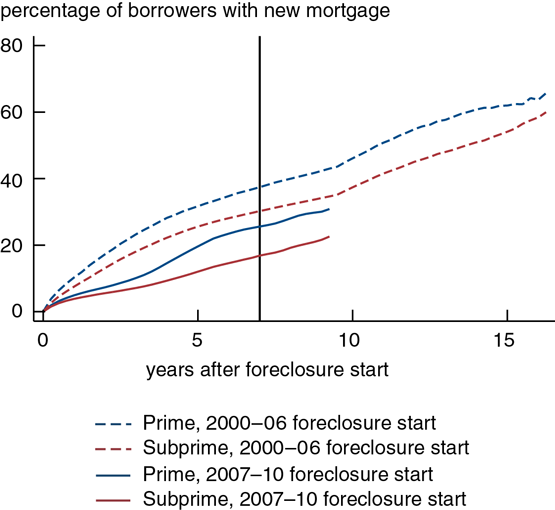
A question of interest is how the experience of foreclosure has affected housing markets. In figure 5, we show the cumulative fraction of individuals who experienced a home foreclosure but who then managed to take out a new mortgage afterward. When looking at the historical experience of prime home mortgage borrowers who entered foreclosure between 2000 and 2006, we find that just shy of 40% took out a new mortgage in the seven years following. The comparable value for subprime borrowers is notably lower, at around 30%. Among those who foreclosed on a home between 2007 and 2010, the shares with new mortgages seven years after foreclosure are dramatically lower at just over 25% for prime borrowers and just under 17% for subprime borrowers.
5. Share of home mortgage borrowers with a new mortgage after foreclosure
Notes: See note 4 for how prime and subprime home mortgage borrowers are categorized. The black vertical line indicates the end of the seventh year after the foreclosure start. Source: Authors’ calculations based on data from the Federal Reserve Bank of New York Consumer Credit Panel/Equifax.
These findings suggest that even though the overall credit scores and shares of delinquent borrowers appear to have returned to levels closer to historical norms for individuals who experienced a foreclosure in 2007–10, their homeownership rates continue to considerably lag the homeownership rates of those who experienced a foreclosure in 2000–06. The slower financial recuperation of those who lost their homes to foreclosure during the Great Recession has been one important factor behind the slow recovery in housing markets during the current economic expansion.
Summary
By tracking a sample of home mortgage borrowers who entered foreclosure in 2000–06 and 2007–10, or before and during the Great Recession, we find that the pace of recovery in credit scores was slower in the first few years after foreclosure for the latter cohorts. We also find that prime borrowers who experienced a foreclosure during the downturn were especially hard hit and had the most difficulty recovering. Overall, at least 15% of all prime borrowers have permanently lower credit scores regardless of when they foreclosed on their homes. A significant factor behind the slow recuperation in credit scores for borrowers who lost their homes to foreclosure in 2007–10 was adverse economic conditions during the recession, which led to delinquencies on other credit obligations. The slow rehabilitation of their financial health helps explain the slow recovery in housing markets post-recession. Indeed, following foreclosure, these borrowers have considerably lagged their predecessor cohorts in terms of homeownership rates.
1 Authors’ calculations based on data from the Federal Reserve Bank of New York Consumer Credit Panel/Equifax (CCP) and statistics from RealtyTrac (as cited in http://blog.credit.com/2015/04/boomerang-buyers-is-there-homeownership-after-foreclosure-114803/). Because of the high incidence of foreclosures in 2010, we include them in our analysis of foreclosures during the “Great Recession.” The recession officially ended in 2009 according to the National Bureau of Economic Research.
2 See Kenneth P. Brevoort and Cheryl R. Cooper, 2013, "Foreclosure's wake: The credit experiences of individuals following foreclosure," Real Estate Economics, Vol. 41, No. 4, Winter, pp. 747–792.
We categorize prime and subprime foreclosures based on the credit score of the borrower (prime, 660 and above; subprime, below 660) in the nearest quarter in which there is no major mortgage delinquency (i.e., less than 30 days past due) before the foreclosure start. In the text, we refer to this particular measure of the credit score as the "pre-delinquency credit score."
We calculated these declines by taking the difference between the peak average credit score before foreclosure and the average credit score at the time of foreclosure.


 Microsoft was delighted to help sponsor Startup Week…and don’t you just LOVE these T-shirts! As you look at the logos, you’ll see big names, small names…everyone pitching in as equals to bring education about how to start a business to as many people as possible.