Showing posts sorted by relevance for query sandy baruah. Sort by date Show all posts

Friday, June 1, 2018

Sandy Baruah Sucks & Deserves A Subpoena For What He Did To Detroit

Image result for Sandy Baruah detroit land bank authority
Sandy Baruah,
Detroit Land Bank Authority
"Financial Genius"
(trademark pending)
Please take note that U.S. Representatives Trey Gowdy and Elijah Cummings,, Chairman and Ranking Member of Oversight Committee, respectively, may take a different approach when it comes to the legacy of Snyder and civil rights.

Snyder may not be called again to testify in Congress.

There may be a referral to the U.S. Department of Justice, but hey, what do I know?

I wonder what Neil Barofsky knows about Sandy?

I do know Sandy Baruah works with the Detroit Land Bank Authority that paid him to do the Global Detroit Annual Report 2017.

I also know Sandy should be given proper credit for the structuring of  the fraudulent TARP scheme because he lauds its benefits to the people, of which there were none, as we know it was a bait and switch scheme generated by Rahm Emanuel and John Podesta.

If he is a member of the Advisory Board at Community Development Financial Institutions Fund, then how did the Detroit Land Bank Authority cash checks if it was never incorporated?

Sandy sits on the Federal Reserve Bank of Chicago, in Detroit.

From Bloomberg profile:

Sandy K. Baruah serves as Director of Detroit at Federal Reserve Bank of Chicago since January 1, 2018. He has been Chief Executive Officer and President of Detroit Regional Chamber since March 15, 2010. Mr. Baruah served as Executive Vice President of Council on Competitiveness. Mr. Baruah leads Council on Competitiveness policy development team and is responsible for strategic planning. From 2008 to 2009, he led the United States Small Business Administration (SBA). In this role he was responsible for SBA's $18 billion small business loan portfolio, helping to shape the federal governance response to the 2008 credit crisis and supporting the government's efforts to provide assistance to the automotive industry. Mr. Baruah also served as the U.S. Assistant Secretary of Commerce with the responsibility of leading the Economic Development Administration. He is credited with helping to transform the agency into one of the top-performing federal agencies. Mr. Baruah serves on the board of directors for Orkestra-Basque Institute of Competitiveness and WavePoint Ventures and an advisor to the Palladium Group, a management consultancy. He is a Member of the Advisory Board at Community Development Financial Institutions Fund. He holds a BS from the University of Oregon and an MBA from Willamette University.

Sandy is framing his own legacy because everyone knows Snyder only does what he is told.

Sandy is throwing Snyder under the bus. 

How do I know this?  Well, let us just say that Emergency Manager Law fell right into my field of expertise when it comes to System Suckology.

Sandy sucks and deserves a subpoena for what he did to Detroit.

Snyder frames legacy with plea for civility

Mackinac Island — The greatest threat to the United States is not North Korea or Iran, Gov. Rick Snyder this week told Michigan business and political leaders.

“Our greatest threat is us.”

The term-limited Republican used the final Mackinac Policy Conference of his eight-year tenure to reinforce his call for civility in politics and public life, bemoaning the harsh rhetoric and polarization that has only grown during his time in office.

“It should never be something you give up on,” Snyder said from a rocking chair on the porch of the Grand Hotel, telling reporters he hopes the proverbial pendulum will swing back soon. “It’s gotten to the point now, you know, how much further can it go?”

In an emotional keynote at the Detroit Regional Chamber's annual policy confab, which also functioned as an exercise in legacy building for Snyder, the former technology executive urged business officials to “vote for leadership” and beware of political candidates who talk about “fighting.”

Snyder told The Detroit News he intends to keep pushing for civility in some role even after he leaves office at the end of the year, suggesting a breakdown in thoughtful dialogue has eroded trust in government and institutions.

So did the Flint water contamination crisis, Snyder told reporters in a subsequent media session, acknowledging a major mark on his legacy he hopes will not completely define it.

The Flint crisis was “a step back in terms of trust — there’s no doubt about that,” he said. “But hopefully … most Michiganders feel better off, more excited about the state’s future, than when I took office.”

'Relentless Positive Action'
Snyder has played an active role in shaping the annual policy agenda at the Mackinac conference, which traditionally functions as a booze-fueled networking event that he said he had grown weary of as a civilian.

During his time in officer, however, the governor has used the island gathering to help broker major deals, including planned construction of the Gordie Howe International Bridge that will connect Detroit and Windsor. His hand-on approach has made him a popular figure at the event.

Sandy Baruah, President and CEO of the Detroit Regional Chamber, renamed the 2018 Mackinac confab the “Relentless Positive Action” conference, an ode to the oft-repeated mantra of a governor he called “transformative” for the state.

“He is a different kind of leader,” Baruah told The News, praising Snyder’s non-confrontational style and the economic gains under the governor. “When you look at Michigan’s business outcomes right now versus where they were eight years ago, it’s almost a completely different state.”

Snyder has maintained a positive attitude “despite some withering criticism, which I thought really showed the true leadership in him,” said John Rakolta, a Republican financier and CEO of the Detroit-based Walbridge construction firm. “When he took over, the future was bleak.”

Business and political leaders say Snyder’s pragmatic approach and general aversion to political bomb-throwing sets him apart from most of the Republican and Democratic candidates now running to replace him, who debated at the conference Thursday night.

"He doesn't like polarization, but we're headed that way, and he doesn't like conflict, but we're headed that way," said Jim Haveman, who worked under Snyder as the director of the Michigan Department of Health and Human Services until suffering a mild heart attack in 2014.

"We're headed towards people stating their positions and finding no middle ground," he said. "I would like to see a candidate who can rise above it."

Divergent views
Snyder and his supporters point to more than 540,000 private-sector jobs created during his tenure and an unemployment rate that is near a 17-year low. But other indicators show Michigan is heading in the wrong direction, said Abdul El-Sayed, a Democratic candidate for governor who pointed to low labor participation rates and stagnant growth in inflation-adjusted wages.

“If you sell a product, the commercial is never going to say that product has flaws, and all of these folks have been in the business of selling the same product for a long time,” said El-Sayed. The former Detroit health director criticized the conference but used the opportunity to mingle with business officials and the press.

“You go into communities like the one my mom grew up in, in Gratiot County, and you tell them the economy is back, and they’ll laugh at you," he said. "That’s exactly what Hillary Clinton tried to do.”
Snyder does not get enough credit for his work in Detroit and shepherding the city through bankruptcy, said Macomb County Public Works Commissioner Candice Miller, a Republican and former congresswoman.

“The former governor never would have done that,” she said about Democrat Jennifer Granholm and the historic Chapter 9 filing authorized by Snyder when he replaced her. “This governor pushed it along, and they were able to restructure and put themselves on a very good foundation.”
In his swan song address, Snyder told business leaders that being governor has been an “incredible opportunity” for him.

But he again acknowledged the Flint water crisis, saying “some terrible things have happened on my watch.” His own task force blamed Snyder's emergency managers and negligence by his environmental regulators for “failure, intransigence, unpreparedness, delay, inaction and environmental injustice” in creating the lead contamination.

Every gubernatorial tenure has “ups and downs, highs and lows,” Miller said. “But I think this governor, overall, gets an excellent rating.”

Voting is beautiful, be beautiful ~ vote.©

Sunday, March 29, 2020

Tales Of The New Crown: Sandy Baruah & Nolan Finley Advocate Profits Over People

No matter how much they hee and haw, the era of profits over people is over, but, do not tell that to Sandy & Nolan!

They want the people to go back to work during the COVID 19 pandemic.

They promulgated the stealin' of the children, land & votes.

They were mean to my Sweetie.


#maytheheavemsfall


Voting is beautiful, be beautiful ~ vote.©

Sunday, March 15, 2020

Tales Of The New Crown: Federal Reserve Announces Free Money To Kick Off TARP 2.0 - Where Is Sandy Baruah?

Will the announcement of the Federal Reserve dropping interest rates to zero be enough to halt the pending, global collapse of markets to make up for getting busted for the TARP scheme they actually thought they were going to get away with stealin' the children, land & vote?

Will the major corporations run to get free money, just like they did with TARP, in order to bail themselves out for the pending collapse of the muni bond markets, leveraged with their fake assets of real estate then stole, mortgaged, quit claimed, laundered through land banks thrice, then bundled, flipped, hedged through more fake ass LLCs, run through the children's trusts to their overseas tax aversive havens?

Will a zero interest rate rally main street support to defend their propaganda, predictive modeling crap, which allowed TARP schemes to flourish, like the Detroit Land Bank Authority and gerrymandering from the Detroit Bankruptcy?

Let us watch and see what SIGTARP does next.

I bet Sandy Baruah does the talk show circuit.

#perkinscoiesucks


Voting is beautiful, be beautiful ~ vote.©

Thursday, June 9, 2016

Detroit's New Home Loan Consumer: "The Poors"

One cannot sell money and make a profit unless historically excluded populations are included. 

I guess that is what you call a "financial diversity" initiative. 

Good luck with that! 

Student debt, lack of access to living wages, poor employment opportunities, illiteracy, developmental disabilities, and a dearth of quality & affordable housing is just going to slow down the chamber's plan of profiting off "the poors".

The poverty rate in Detroit is the highest for a major city in North America.
Child poverty is even higher.

So, the Detroit Regional Chamber of Commerce is going to teach people living in poverty how to save money and budget

Seriously?  Really?

What an insult to humanity!

"Hey, instead of using a whole cup of water to make your cup-o'-noodles daily dinner, how about just cutting the water portion in half.  Think of the savings you can use to pay down your outstanding debt and improve your credit score to eventually qualify for a home loan in 10 years of which you will eventually default upon when you lose that dying wage job!"

Nice pitch, but try again.

Editorial: Detroit needs financial literacy


The world runs on credit. And that’s not good news for Detroit, where on average residents have among the worst credit scores in the nation. That’s a drag on the city’s efforts to repopulate its neighborhoods and build a stronger small business base.
Coming out of last week’s Mackinac Policy Conference, the Detroit Regional Chamber is making improving financial literacy in Detroit one of its top ongoing priorities.
“It’s key to reviving the city,” says Sandy Baruah, chief executive of the chamber. “If we can improve financial literacy and raise credit scores, now we’ve created a different kind of consumer, one who can go from renter to buyer.”
And since so many small business people rely on personal credit cards and loans to get their start, making city residents smarter about personal finance is also key to another priority for the chamber — fostering entrepreneurship.
To get there, the chamber has teamed with John Hope Bryant, a national advocate for financial literacy, with a plan to open five Hope Inside centers in Detroit. One is already operating in the Northwest Activity Center, sponsored by Fifth Third Bank.
Baruah says that simply walking in the doors of the center will improve an individual’s credit score by 50 points by cleaning up reporting errors.
After that, credit counselors help develop debt repayment plans, work with creditors and teach better habits with a goal of eventually improving credit scores by up to 200 points.
Detroiters have the 10th worst credit scores in the nation, according to Moneywatch. (Three other Michigan cities — Benton Harbor, Inkster and Flint — are also in the bottom 10.)
The chamber also intends to work with Junior Achievement of Southeastern Michigan to head-off bad financial habits before they form.
JA is undertaking an ambitious program to make eighth-graders in the city financially literate, hoping to teach them the skills they need before they begin taking part-time jobs.
Its three-year Financial Freedom Project aims to reach 8,000 young teenagers with 25 hours of instruction in personal finance and entrepreneurship. GM Financial is the major sponsor.
“Detroit’s recovery won’t be sustainable if we don’t teach the next generation how to manage money and create wealth,” says Margaret Trimer-Hartley, president of JA.
The combination of helping adults fix their mistakes and teaching students to avoid them should aid Detroit in building the sound financial skills base needed to speed its recovery.
“It’s one way you stabilize neighborhoods,” Baruah says. “A number of people in Detroit aren’t in the banking system at all. They have debts, but they don’t have access to credit.
“This gets them into the system and on their way to better management of their personal finances.”
This may not be as dramatic an effort as tearing down blighted buildings or erecting new apartments and offices downtown, but it is a crucial step to reviving the city and keeping it healthy for the long term.

Voting is beautiful, be beautiful ~ vote.©

Thursday, November 8, 2018

Cocktails & Popcorn: FACT v. CREW - Matt Whitaker, Ethics, Whitewater & Detroit

There seems to be a bit of disdain in the decision for Sessions to resign and Matt Whitaker to take the helm. to steer the DOJ.
Image may contain: 2 people
Liam Tran with 
World Powerlifing Champion 
Ernie Lilliebridge, Sr.


Why Trump could face legal challenges over Whitaker

People are complaining that his position is "unconstitutional" because he is not confirmed by Senate but failed to look at the

Cocktails & Popcorn: Sessions Resigns, Matt Whitaker Is Acting & I Am Ready

But, for a moment, I almost forgot  that this is another one of those transposable models I just so adore.

Then I had a revelation because I remembered about the Acting U.S. Assistant Attorneys of the Districts that were left vacant for quite some time, where many key positions within the DOJ are still, to this very moment, vacant.

There was even an issue under the Federal Vacancies Act, that came out of Whitewater to address any issues with the appointment and firing of a Special Counsel

There are, however, a few key limitations on the scope of the Vacancies Act. Notably, the Vacancies Act governs the ability of a person to perform only those functions and duties of an office that are nondelegable. Unless a statute or regulation expressly specifies that a duty must be performed by the absent officer, that duty may be delegated to another government employee.* In other words, delegable job responsibilities are outside the purview of the Vacancies Act. In addition, if another statute expressly authorizes acting service, that other statute may render the Vacancies Act nonexclusive, or possibly even inapplicable. (That is secret code for "Special Counsel". They made sure they did not that do that Fiske-Starr switcho-chango to happen again.)
But, in this instance, I thought of Sandy Baruah.

New Small-Business Chief Has Critics Already

My most sincerest apologies for the digression with the Sandy, but I was experiencing another Post Traumatic Fraud Syndrome episode.

This is also taken directly from the Federal Vacancies Act.
 As a default rule, the first assistant to a position automatically becomes the acting officer.
First assistant can also mean Chief of Staff.

Then I knew I was on the right tract to deconstructing this transposable model down to its origins, right here in Detroit.

So, let me get this straight, you have a guy, who is a power lifter (had to throw that one in), run for office, then file a bunch of complaints about people in office to Ethics, dealing with personal inurement of office, in a situation of leaking of an ongoing investigation of a former Attorney General, all swirling around the Federal Vacancies Act?

Lemisch's Leaks - Matt Schneider Is Back & So Are Detroit Public Corruption Investigations

I stood aghast for the thought that this could have actually been planned.

Image result for girl eating popcorn
"This is so hot for #MeToo."
I wonder who would plan such a cocktails & popcorn worthy moment, for the model sounds so eerily recognizable.

It would have had to be someone who knows of Said Act and Whitewater, succinctly well.

But hey, what do I know?

I know Perkins Coie Sucks because CREW just filed a letter of recusal to DOJ.


Qui tam pro domino rege quam pro se ipso in hac parte sequitur.

Voting is beautiful, be beautiful ~ vote.©

Tuesday, May 28, 2019

Cocktails & Popcorn: Dan Gilbert Had A Stroke - Detroit Still Has Gerrymandering 2016 Election Issues

I would love to hear the tale of how Dan Jacked Detroit.

I watched him do it, you know.

Where is George Bush?

Gilbert has stroke in hospital; Emerson replaces him at Mackinac business conference

Dan Gilbert, Bedrock founder, left, and Detroit Mayor Mike Duggan at the ground breaking for the skyscraper that will be built on the site of the former Hudson's store in downtown Detroit in December 2017.
Dan Gilbert & Mike Duggan
Quicken Loans Chairman Dan Gilbert had a stroke in the hospital Sunday and had an emergency procedure, company CEO Jay Farner said Monday.

I am claiming it.

Gilbert, the billionaire online mortgage lender and Detroit real estate developer, suffered a stroke" Sunday and had a "catheter-based procedure" at Beaumont Hospital and was put in the Intensive Care Unit, Farner said in a statement.

The statement indicates Gilbert's health condition is more serious than initially indicated.

"Dan is awake, responsive and resting comfortably," Farner said. "Dan and his family are immensely grateful to the doctors and nurses whose early intervention is already paying dividends toward his recovery."

The revelation came as the Detroit Regional Chamber said Quicken Loans Vice Chairman Bill Emerson is replacing Gilbert at this week's Mackinac Policy Conference.

Gilbert's health issue isn't expected to affect the day-to-day operations of the Quicken Loans family of companies, a University of Michigan expert said.

It was a point reinforced by Farner, who said "Thanks to the strong culture and leadership Dan has built and grown, business at the Rock Family of Companies will continue under the normal, everyday direction of their respective CEOs."

But the illness could affect high-profile projects such as the skyscraper scheduled to be built along Woodward Avenue on the old Hudson department store site, said Erik Gordon, an assistant professor in UM's Ross School of Business.

The 912-foot skyscraper is expected to become Michigan's tallest building, taller than the Renaissance Center.

The condition of Gilbert remained unchanged as he recovers from stroke-like symptoms that led over the weekend to his hospitalization at Beaumont Hospital in Royal Oak.

“Dan and his family are in our thoughts, and we are wishing him a speedy recovery," Detroit Regional Chamber Sandy Baruah said in a Monday statement. "The chamber is grateful that Dan’s colleague, Bill Emerson, will be taking his place on stage at the conference.”

Gilbert's medical issue has stoked concerns over the day-to-day operations of his empire of companies — which include the Cleveland Cavaliers, three casinos and Fathead — as well as his real estate investments in Detroit.

But Gordon said Monday that Gilbert's group of companies will be in good shape because the billionaire has done a great job of hiring strong people to keep the businesses going in his absence.
Quicken Loans Vice Chairman Bill Emerson is replacing hospitalized company Chairman Dan Gilbert at this week's Mackinac Policy Conference. (Photo: Max Ortiz, The Detroit News)
"People at the operation level can keep the company going for a while,” said Gordon.

“They understand their role and his vision,” Gordon said. “He’s built a strong team. It’s not a one-man band.”

Gilbert, a 57-year-old Franklin resident, is founder and chairman of Quicken Loans, ranked as the nation's largest mortgage lender. Gilbert's Rock Family of Companies employs more than 30,000 people around the nation, including more than 17,000 in Detroit.

Part of Detroit's turnaround has been credited to Gilbert's investment in the city's central business district. He moved his employees from Livonia and other suburbs to a Detroit headquarters starting in 2010.

As Gilbert bought other companies or provided funding for startups, those firms filled the more than 100 buildings he bought and oftentimes renovated around the city in his bid to help transform Detroit into a "great American city." He also has envisioned turning the city into a magnet for technology companies and has succeeded in luring local offices for Google and Twitter.

Gilbert's Bedrock real estate firm and its affiliate have invested and committed more than $5.6 billion in its efforts to help revitalize Detroit.

The billionaire is not the only person contributing to Detroit's renaissance through his real estate investments and developments, Gordon said. But “he is the symbol of the (city’s) switch from negativity to a turnaround in Detroit’s spirit."

Gilbert's illness also could affect the completion of the Wayne County jail land swap project, Gordon said.

Gilbert's Rock Ventures is receiving 15.5 acres of property where a half-built jail now stands on the edge of Greektown, and the billionaire has vowed to construct an unidentified $1 billion in mixed-use developments. In return, he is helping finance the construction of a new criminal justice complex on other land in the city.

Such a large project could be slowed up by Gilbert's hospitalization, Gordon said.

But the mortgage lender has built a strong team and “avoided the trap of 'It's all me,'” he said.
“He’s not like Elon Musk," Gordon said. "Gilbert is less maniacal."


FUN FACT! DAN GILBERT HAS A TINY HUMANS FOUNDATION

https://www.gilbertfamilyfoundation.org/transform-detroit/

And this is what he is doing with the tiny humans in Detroit where there was $2.5 million directed to Michigan State University.

Dan likes data.

He likes to manipulate data, like what he does with elections.

That is called gerrymandering.


Dan Gilbert suffers stroke: Facts about his family, net worth, real estate empire 


A look at some of the iconic Detroit buildings Dan Gilbert and his companies own. Tanya Wildt, Detroit Free Press

Detroit billionaire Dan Gilbert, founder of Quicken Loans, was hospitalized after suffering stroke symptoms Sunday at Beaumont Hospital in Royal Oak. He was treated for a stroke and is recovering. Here are a few facts about the man who is responsible for much of downtown Detroit's recent growth and who also owns the NBA's Cleveland Cavaliers.

Cleveland Cavaliers owner Dan Gilbert congratulates his son
Nick Gilbert after the team won the NBA basketball draft lottery,
Tuesday, May 21, 2013 in New York. 
Also read:Dan Gilbert's stroke a reminder it can happen at any age

Net worth

 $7.3 billion

Personal

Birthdate and place: Jan. 17, 1962, in Detroit
Age: 57
Spouse: Jennifer Gilbert
Children: Four sons, one daughter. Gilbert's son Nick has a rare genetic disorder called neurofibromatosis, which causes tumors to grow throughout his body. Dan and Jennifer Gilbert founded the Gilbert Family Foundation to help fight for a cure.

Education

High school:  Southfield-Lathrup in Lathrup Village, Michigan
Michigan State University: Bachelor's
Wayne State University Law School: Juris Doctor

Major companies

Gilbert's holdings include dozens of companies and smaller enterprises, including many tech startups. He recently sold his Greektown Casino-Hotel for $1 billion but continues to own other casinos in Maryland and Ohio, according to Quicken's website. Among the companies:


  • Rock VenturesThe holding company that connects Gilbert's portfolio of more than 100 companies.
  • Cleveland Cavaliers: Gilbert bought this NBA team in 2005 for $375 million. Forbes magazine estimated the team was worth more than $1.3 billion in late 2018, but also estimated the team lost $6 million on operations in 2017.
  • Quicken LoansGilbert's online mortgage lender is the mother ship of Gilbert's family of companies. Gilbert founded Quicken in 1985 as Rock Financial and has built it into one of the nation's top mortgage lenders.
  • Bedrock: This company acquires and manages commercial properties in Detroit and Cleveland.
  • Rocket Fiber: This launched in 2014 to provide Detroit's fastest home and business internet service.
  • StockX: Allowing for day trading for consumer goods, this company is billed as the first online consumer "stock market of things" for high-demand products like expensive sneakers
  • Dictionary.com: Gilbert's Rock Holdings purchased the websites Dictionary.com and Thesaurus.com from New York-based media firm IAC in November 2018. The websites date to 1995 and are free for public use. They feature a significant amount of online advertisements.

Real estate 

Gilbert moved Quicken Loans to downtown Detroit in 2010. Today, his companies own or control through master leases somewhere in the range of 100 properties, including many of downtown's iconic skyscrapers — the First National, One Woodward, 1001 Woodward and more. Gilbert's companies also own One Campus Martius, David Stott Building, Detroit Media Partnership Building (former home of the Detroit Free Press and the Detroit News), Chrysler House, Federal Reserve Building (current home of the Free Press and Detroit News), Shinola Hotel, Madison Building, and more. His downtown workforce has swelled to about 17,000 workers who fill up all these properties.

Voting is beautiful, be beautiful ~ vote.©

Friday, October 26, 2018

Cocktails & Popcorn: OVERSIGHT Hearing On SIGTARP & Its Multifaceted Issues With The Administration Of The Hardest Hit Fund

My apologies for missing this precious gem!

The U. S. House Oversight Committee held hearings on the Hardest Hit Fund - TARP, to respond to the findings of SIGTARP, the enforcement mechanism of the U.S. Treasury which audits the program.

Sandy Baruah Sucks & Deserves A Subpoena For What He Did To Detroit


Basically, you have a bunch of "The Elected Ones" whose staff failed to properly debrief their members on the background of the Hardest Hit Fund.

All they had to do was google my name, but they probably did, realizing it was best to limit the breadth of their questioning to ethics in the administration of the program.

I like that, just let them speak.

What we have here is an issue within the U.S. Treasury because every time a Member asks about stealin', in an ethical sense, only, because there are no criminal referrals from the Treasury, that we know of, to date, due to the unverified ongoing investigation that may not even exist, here was the mimeographed response of Kipp Kranbuhl.

Chairman Gary Palmer smacked down Kipp (a name truly synonymous with poverty and hardship) down by having SIGTARP Christy Goldsmith Romero break it down to the fact that SIGTARP can not speak upon the multiple, ongoing criminal investigations that the office refuses to verify.

Gary: "Are gym memberships considered allowable to help homeowners stay in their homes?

Kipp: "We follow cost principles for every federal program."

Gary: "Have you made any criminal referrals?"

Kipp: "We follow cost principles for every federal program."

Gary: "What time is it?"

Kipp: "We follow cost principles for every federal program."

Christy was Johnnie on the Spot in her succinct responses to questions of why there was so much stealin', but I seriously wonder how many people in the room actually caught what she said.

For those who do not wish to watch the entire hearing, allow me to provide a quick synopsis.

"They were stealin'."

I bet Kipp wore Depends for this hearing.

I bet he thinks about me, alot

Neil Barofsky And His History Of SIGTARP


We have ourselves a Special Issue going on with Treasury.

See, SIGTARP, nor any other law enforcement entity, ever verifies the existence, or non-existence, of an investigation, or an ongoing investigation, unless it is verified by an original source, like me.

SIGTARP Is Still Investigating Flint & Detroit Blight Demolition Programs

But, hey, what do I know?

I know I am really happy that I found this hearing video!


Image result for us treasury

Statement of Deputy Assistant Secretary Kipp Kranbuhl Before the House Oversight and Government Reform Subcommittee on Intergovernmental Affairs and Government Operations

Chairman Meadows, Chairman Palmer, Ranking Member Connolly, Ranking Member Raskin, and Members of the Subcommittees, thank you for the opportunity to testify today about Treasury’s efforts to mitigate the effects of the financial crisis on American homeowners through the Housing Finance Agency Innovation Fund for Hardest Hit Housing Markets, also known as the Hardest Hit Fund or HHF.

In 2008, Congress passed the Emergency Economic Stabilization Act of 2008, 12 U.S.C. 5201, et seq., (as amended, EESA).  This legislation provided Treasury with immediate authorities and resources to restore liquidity and stability to the nation’s financial system in the wake of an historic economic crisis.  Using its authorities under EESA, Treasury established the Troubled Asset Relief Program, known as TARP, an initiative that was unprecedented in both its design and scale.  Congress initially authorized up to $700 billion for TARP programs, though Congress later reduced that authority to $475 billion.

In the following years, Treasury disbursed nearly $412 billion of TARP funds under a variety of programs designed to help stabilize banks, automobile manufacturers, and other institutions integral to the nation’s economy.  Treasury reserved additional funds for programs designed to protect home prices and prevent foreclosure.  The first, and largest, of these housing programs was the Making Home Affordable® program, or MHA.  Launched in 2009, MHA was a nationwide effort to help struggling homeowners avoid foreclosure by lowering mortgage payments to affordable levels.  However, it soon became clear that a one-size-fits-all approach would not be sufficient to address all of the specific needs of homeowners and communities in the states that were hit hardest by the housing crisis.

Treasury established HHF in 2010 as part of TARP in order to help prevent foreclosure and to stabilize housing markets in states hit hardest by the housing crisis.  State housing finance agencies, (together with certain designated entities, HFAs) in eighteen states and the District of Columbia were selected to participate, as these areas experienced unemployment rates at or above the national average, and/or home price declines of greater than 20 percent.[1]

Unlike MHA – a national program based on uniform criteria set by the Federal government – HHF was designed to give the participating HFAs the maximum flexibility to design and administer their own programs, each tailored to local conditions in their respective communities.  As a part of this flexibility, the states have been able to adapt their programs in order to address the changing needs of their communities over time.

As of December 31, 2017, states had assisted approximately 350,000 homeowners and funded the demolition and greening of nearly 24,000 blighted properties in distressed communities.
However, the flexibility afforded to HFAs by the Hardest Hit Fund has made Treasury’s oversight a critical aspect of the program.  Treasury maintains a strong commitment to ensure that the program achieves its goals and that federal taxpayer funds are used for their intended purpose.

Treasury requires each HFA to set specific goals for its HHF program, and to demonstrate steady progress toward meeting these goals.  Treasury works with each of the HFAs to identify and address barriers that would keep the HFA from achieving its goals.  Subject to Treasury approval, the HFAs may also modify their programs as needed in order to address the changing needs of their communities.  Treasury also maintains an ongoing dialogue with the HFAs through in-person meetings and regularly scheduled calls, and it hosts annual summits where the various participating HFAs can meet and share best practices.

Treasury has also conducted more than 100 on-site compliance reviews across the participating HFAs, as well as additional, targeted reviews to address specific programmatic risks.  These reviews evaluate a number of critical program functions, such as whether homeowners are evaluated in accordance with the HFA’s guidelines, program disbursements and administrative expenditures are appropriate, the information reported to Treasury is accurate, and the HFA’s internal controls are functioning as intended to minimize the risk of non-compliance.

Treasury takes corrective action when instances of non-compliance arise.  This includes, for example, requiring HFAs to re-evaluate homeowners that were improperly denied, to reimburse HHF for improper expenditures, and to strengthen internal controls in order to prevent further non-compliance.
In addition to compliance reviews, Treasury also takes SIGTARP’s role seriously.  We share this Committee’s and SIGTARP’s commitment to preventing fraud, waste, and abuse in all TARP programs, and we carefully consider recommendations in that regard.

Treasury responds to SIGTARP recommendations in writing, and our responses are made available to the public.  We work hard to address the concerns raised by these recommendations, in a manner that allows the programs to function as intended and in the context of TARP’s wind-down.  With respect to HHF in particular, this has included, for example, issuing written guidance to clarify HFA obligations, recovering funds that were improperly spent, and requiring states to strengthen internal controls to prevent non-compliance in the future.

For example, Treasury thoroughly reviewed the $2.2 million of costs questioned in SIGTARP’s August 2017 Audit Report.  This involved analyzing thousands of individual transactions incurred by all 19 HFAs, dating back to the program’s inception in 2010.  Following this review, Treasury determined that $656,141 of the questioned costs did not comply with the Federal government’s cost principles.  The HFAs were required to reimburse HHF.  For the reasons set forth in our April 6, 2018, letter to SIGTARP—a copy of which has been provided to the Committee and is available on our website—Treasury determined that the remaining costs questioned by SIGTARP were allowable under Federal cost principles.

As is the case with all TARP programs, HHF is winding down.  Although Congress authorized additional funding in 2015, the program remains a temporary one.  As of the end of April 2018, Treasury has disbursed $8.8 billion (or 92 percent) of the $9.6 billion obligated under HHF. Although HFAs may continue issuing new approvals through December 31, 2020, most of the states have already begun to close down HHF programs or will do so this year as they exhaust their available funds.  This includes California and Florida, the two largest states in the program.

Treasury’s outstanding commitments under TARP represent just one percent of the $475 billion authorized by Congress.  As TARP winds down, Treasury remains committed to robust oversight and monitoring of all of its TARP programs, including HHF.

As part of this wind down, the Office of Financial Stability, which oversees HHF and other TARP programs, was recently realigned to report to Treasury’s Assistant Secretary for Financial Institutions.  This realignment will enable our office to oversee an orderly and successful wind down of HHF that is in line with the wind down of other programs that are also overseen by this office, such as the State Small Business Credit Initiative and the Small Business Lending Fund.

I thank you again for the opportunity to testify today and welcome your questions.
####

[1] The eighteen participating states consist of Alabama, Arizona, California, Florida, Georgia, Illinois, Indiana, Kentucky, Michigan, Mississippi, Nevada, New Jersey, North Carolina, Ohio, Oregon, Rhode Island, South Carolina, and Tennessee.

Here is where the Treasury came up with the excuse, "the money has not yet been allocated" whenever SIGTARP asked what happened to the money.

As soon as Treasury responds, by the wings of Mercury, they officially start stealin' because they know by the time they are asked again, there will be a new allocation cycle, with questions only focused on these new allotted funds, not the funds they were stealin' in the previous grant spend down cycle, because that could be one of those double jeopardy administrative moments they can argue their way out of a criminal proceeding.

Voting is beautiful, be beautiful ~ vote.©

Monday, July 13, 2020

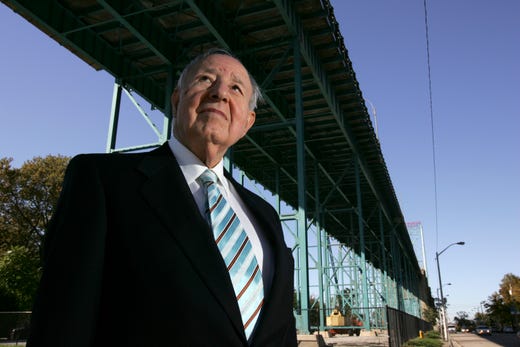
Matty Moroun, Owner Of The U.S. Southern Boarder Ambassador Bridge Is Extracted From Humanity

Image may contain: sky, tree and outdoor
Ambassador Bridge
This is deep.

This just about pulls the rug from under all the "Elected Ones" in Detroit and the 2020 Primary Election is August 4th.

This should unravel fast.

The Ambassador Bridge is how everything goes in and out of North America.

Keep that in mind, the busiest international, southern border crossing in North America and port no one wants to talk about.

 I can see Canada from upstairs....not really, but I do see John James and the Detroit Port Authority.

This is John James.

John James 3.png
John James
https://teabagsandcoffeegrinds.blogspot.com/search?q=John+James

https://www.facebook.com/katie.hirzel?sk=wall

Kate Hirzel
'My apartment decided to do something very cool this past summer. Every weekend we invited interns, friends, classmates, etc. to our apartment. This past weekend was the last time all of my roommates were together, so we invited everyone who had ever come over the past couple months. What a wonderful summer spent with amazing people from all over the world. Ironically, I think I met more people from other countries than from the US while in our nations capital. Very fortunate and incredibly lucky. Sad to only have one month left-happy that this will become my home in less than a year 😌'

https://www.vistamaria.org/programs/

https://www.bloomberg.com/profile/company/0371373D:US

https://www.bloomberg.com/profile/person/18951095

http://www.portdetroit.com/lorron-james/

Detroit Riverfront Conservancy
Home
https://detroitriverfront.org/


Detroit/Wayne County Port Authority

No photo description available.
http://www.portdetroit.com/

I also see the Emergency Manager Law, the fake ass Detroit Bankruptcy, and the Detroit Public Schools Emergency Manager Human Asset Forfeiture op.


#maytheheavensfall

Manuel 'Matty' Moroun, owner of Ambassador Bridge, dead at 93

Detroit businessman and Ambassador Bridge owner Manuel "Matty" Moroun has died at age 93. He is seen standing beneath the Ambassador Bridge in Windsor, Ontario in 2008.
Matty Moroun
Detroit billionaire businessman Manuel "Matty" Moroun died Sunday of congestive heart failure, two sources confirmed to The Detroit News. He was 93.

A letter announcing the trucking magnate's death was sent to employees Monday morning from his only son, Matthew Moroun, who in recent years managed the diversified holdings and worked to improve the company's public image.

The elder Moroun was the owner of the international trucking and logistics company, Central Transport International, and the Ambassador Bridge. Another of his companies also owned Michigan Central Depot, a hulking relic looming over Corktown that came to symbolize Detroit's hard times, before selling the station to Ford Motor Co. in 2018.

Moroun exemplified a mostly bygone era in the low, slow arc of Detroit's reinvention — a secretive mogul who used the levers of politics and contributions to influence policy making that could benefit his private business interests more than the public good. And that gave voice to critics on both sides of the U.S.-Canada border.

A resident of Grosse Pointe Shores, Moroun was a longtime political donor defined in recent years by his frequent clashes over property ownership and use in the Detroit area. Moroun and his son, Matthew, spent millions on a multi-year and unsuccessful legal battle to stop the state of Michigan and Canada from building the Gordie Howe Bridge further downriver.

"The bridge is a living thing," Moroun told The News in 2008, referring to the one he's controlled for decades. "It's become part of me and I think I've done a good job. It's my legacy. They want to steal it from me, but that's not going to happen, I promise."


Moroun was born in June 1927, the grandson of Hanna Moroun, a Maronite Catholic who fled Lebanon before World War I. Matty Moroun was the eldest of four children born to Tufick and Jamal Moroun.

He attended the University of Detroit Jesuit High School, the only Arab in his school and perhaps the first to attend there. He majored in chemistry and biology at the University of Notre Dame. After college, he worked in his father's garage.

Tufick Moroun eventually added to his Detroit garage and gas station with the acquisition of Central Cartage, a trucking company owned by brothers who owed Tufick Moroun $8,300 for tires and gasoline.

By the mid-1950s, Matty Moroun largely was running the trucking company. And, a couple decades later, Moroun acquired a 25% stake in the Ambassador Bridge in order to expand his trucking company more extensively into Canada. He eventually acquired the entire structure for $30 million.

According to Forbes, Moroun and his family are worth $1.7 billion and are among the 1,600 wealthiest people in the world. Moroun ranked as high as No. 342 as recently as 2015.

The Detroit Regional Chamber expressed its condolences over Moroun's passing, calling him a "self-made success story."

"Born of immigrant parents in Detroit, he rose from a young man working at a neighborhood gas station to graduating from the University of Notre Dame and creating a billion dollar company," said chamber CEO Sandy Baruah. "With his passing, we celebrate his life and the family he built in Detroit.”

Voting is beautiful, be beautiful ~ vote.©

Sunday, April 28, 2019

Much Love To Damon Keith - An Original Old School Civil Rights Legal Dog

I used to have pictures of his Soul Food Luncheon in the federal courthouse every year, but I think I lost them along my journeys.

If one of my #Superfans just so happens to stumble across my lost data, would you, please, be so kind to post it up so the world can find them.

I always made sure to take everyone a plate.

To my giggly, little high schooler...

I always keep my vows.

Much love.

On a mission...


Leaders pay respects to late Judge Damon Keith

Federal Judge Damon Keith of Detroit died Sunday morning at 96. Dignitaries from around Michigan weighed in to offer their respects. Some of the statements run full-length, others have been excerpted.
Federal Judge Damon Keith of Detroit
died Sunday morning. He was 96.
Gov. Gretchen Whitmer: “Judge Damon Keith was a civil rights icon. In his decades of public service, he stood up for what was right, even if it meant facing attacks and threats from others. Because of his strength, his determination, and his commitment to ending racism in our country, Michigan is grateful and better for it. We should honor Judge Keith’s legacy by working together to build a Michigan where everybody, no matter who they are or where they come from, can get ahead.”

Detroit Mayor Mike Duggan: "Detroit lost a dear friend this morning with the passing of Judge Damon Keith, and America lost a national treasure.

"Judge Keith left as indelible a mark on this nation and our city as any jurist in history. During his more than 50 years on the federal bench, he handed down rulings that have safeguarded some of our most important and cherished civil liberties, stopping illegal government wiretaps and secret deportation hearings, as well as ending the racial segregation of Pontiac schools. Here in Detroit, he opened the doors for countless young law clerks, many of who have gone on to become judges themselves.

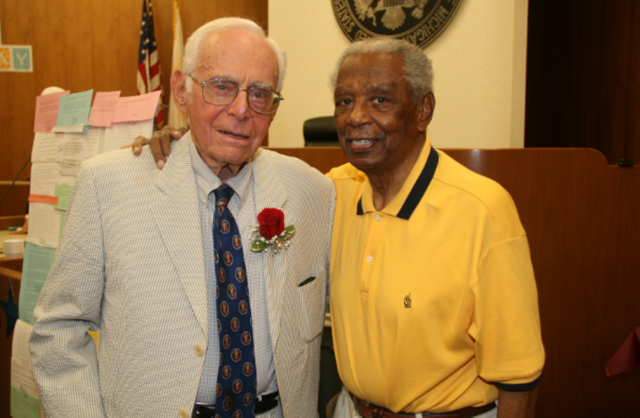
Damon Keith & John Conyers acting like  two high school
 best buddies with the Emancipation Proclamation
"Much love coming, in honor of Detroit legacies"
"I have so many fond memories of Judge Keith. I was humbled and honored the two times he administered the oath of office when I was sworn in as Mayor. I will always treasure the Thanksgiving Day I spent with him in 2016, driving him in the parade as he served as Grand Marshal.

"America is a better place because it had Judge Keith to help safeguard our civil liberties. Our city is a better place because he spent every day of his life as a committed and involved Detroiter. We will miss him dearly."

Former Gov. James Blanchard: “He was such a kind man. Such a positive force in Michigan and the country. He’s a Michigan legend and an American legend. He was always trying to encourage civic engagement. He was always involved.”

Wayne State University President M. Roy Wilson: "It’s a sad day. Judge Damon Jerome Keith passed away earlier today, and we are all mourning the loss of this outstanding civil rights pioneer, federal judge and great friend of Wayne State. I had the honor of being sworn in as the 12th president of Wayne State University by Judge Keith, but it meant even more to me to have met the man. At my swearing in ceremony Judge Keith said, “For Wayne State to be great, it has to be good.” I have used those apt words as my guiding light in the leadership of Wayne State.

Avern Cohn & Damon Keith
"Official Old School Civil Rights Legal Dogs"
WOOF!
"A quick litany of his accomplishments wouldn’t adequately tell the story of this great man, who served 10 U.S. presidents and led from the bench efforts to racially desegregate schools, at a time when there was overwhelming opposition to such a move. His bravery and compassion marked every decision he made in his position as a federal judge, and we are all grateful for the momentous change he affected in the national social conscience.

"Judge Keith received his master of laws from Wayne State in 1956 and remained committed to his alma mater throughout the rest of his life. We opened the Damon J. Keith Center for Civil Rights on our campus in 2011 to promote the educational, economic and political power of underrepresented communities in urban settings. Judge Keith was deeply committed to civil rights for all people, and the Center upholds his values in everything it does.

"Greatness is not randomly conferred on people. It comes from a place in the heart and the soul that defies easy explanation. Damon J. Keith was a great man. The Wayne State community mourns his passing and pledges to honor his legacy through our work in the Damon J. Keith Center for Civil Rights, and by striving to prepare the next generation of leaders to carry his work forward."

Detroit Branch NAACP President Rev. Dr. Wendell Anthony: "The civil rights community has lost a giant among those who have consistently fought to hold fast to the rein of justice and equity for all people. This is particularly true in the cause of Black Freedom and social justice.  Judge Damon Keith for a half century has led in this cause. An icon in the civil rights community, he has rendered uncompromising decisions from punishing illegal government wiretapping, and the racial motivation of building a wall of segregation around the City of Pontiac.

"He would certainly be a thorn in the judicial side of this current administration and its treacherous policies of family separation and deportation. He was an early opponent in the judicial process to expose secret deportations and government abuse of its authority. Judge Keith will long be remembered for his work off the bench with the NAACP. He was an early organizer and supporter of the largest sit-down Dinner in the nation, the Annual Fight For Freedom Fund Dinner of the Detroit Branch.

"He was a great supporter an advocate for the City of Detroit and for African American political empowerment. Judge Keith represents an era of bold, an courageous, judicial principles.  These principles helped guide precedents for those  too cautious to be just and sometimes too afraid to stand alone!"

Michigan Attorney General Dana Nessel: "I only hope that we, as a nation, work feverishly to ensure that Judge Keith’s legacy and body of work does not die with him. If our federal courts do not protect us from tyranny and the undermining of basic rights and liberties, who will?"

U.S. Rep. Debbie Dingell: “We have lost a protector of the people and I just lost another good friend. Judge Keith was an example of the best of Michigan. John and Damon worked closely together for many years in fighting for equality for all. We are losing many giants who stood against enormous odds, lived in historical times and opened doors wider for all of us. Their spirit, courage and wisdom needs to live on.”

Chief U.S. District Judge Denise Page Hood of the Eastern District of Michigan: “It is a great loss to our nation and the Constitution to lose a legal giant like Judge Keith. He dedicated his legal life to protecting the rights guaranteed under our Constitution and decided some of the pressing issues of our time.

“He was a dedicated husband to his late wife and a loving father and grandfather. During an outstanding and demanding legal career, he found time to mentor law clerks and judges. Those of us who knew him appreciate the time he gave us.”

Wayne County Executive Warren C. Evans: "Democracy stands on the shoulders of leaders like Judge Damon Keith. Few have played such an important role in protecting civil liberties and forcing our country to live up to its foundational ideals of equality and justice for all. As we mourn, we also celebrate the life of an icon who left this world far better than he found it. He did so much for so many, it’s hard to adequately put into words."

"On a personal level, Judge Damon Keith was more than a mentor, he was a motivator who challenged us to be the best version of ourselves. He was always there when called upon to help prepare the next generation of civil rights leaders and public servants. We looked to him for guidance and wisdom and always walked away inspired to reach higher. When I was first elected to public office, Judge Keith swore me in, which I consider the honor of a lifetime."

Judge Eric L. Clay, U.S. Court of Appeals for the Sixth Circuit: “Judge Keith was one of the most influential Federal jurists of the 20th and 21st centuries. The grandson of slaves, his rulings in over 52 years on the bench had a profound impact on American life. His decisions ranged from prohibiting the Nixon Administration from warrantless wiretapping in national security cases, to the integration of the Detroit Police Department and the Pontiac Public Schools. President Lyndon Johnson
appointed him to the US District Court in 1967, where he later served as the Court’s first African American Chief Judge. In 1977 he was elevated to the US Court of Appeals for the Sixth Circuit, the nation’s second-highest Court, by President Jimmy Carter. He was a family man possessed of uncommon humility, a leading patron of the arts, a mentor who opened doors to scores of aspiring lawyers and judges, and a proud son of Detroit."

U.S. Sen. Gary Peters: “Detroit, our state and country have lost an extraordinary jurist and legal trailblazer. Judge Damon Keith devoted his life to public service and ensuring equal protection under the law. He will be best remembered for his decisions from the federal bench to protect civil rights and individual liberties."

U.S. Rep. Dan Kildee: “I am saddened to learn of the passing of Judge Keith. Damon Keith was a remarkable man and respected judge. As one of the nation’s longest serving judges, Judge Keith played a role in court decisions that helped to expand civil rights and protect civil liberties for all Americans. Because of Judge Keith’s work on the federal bench, our state and the country have been changed for the better.

Derrick Johnson, president and CEO, NAACP: "We mourn civil rights icon Judge Damon Keith. Guardian of justice since 1967. Landmark rulings in school desegregation, fair housing & voting rights. Still judging at age 96 His commitment will never be matched. Nation forever in his debt."

Richard A. Bierschbach, dean of Wayne State University Law School: "We’ve lost one of the greatest civil rights champions of our time. For more than 50 years, Judge Damon J. Keith has been an unwavering voice for those who have been unjustly silenced. As dean of Wayne State University Law School, proud home to the Damon J. Keith Center for Civil Rights, I know that his legacy will live on in the eyes and hearts of our Damon J. Keith Scholars and every student who learns the law in the center that bears his name.

"Judge Keith was the first member of his family to earn a college degree and went on to earn his master of laws from Wayne Law in 1956. For some of our students, he is the reason they came to law school, and specifically to our law school. Because of Judge Keith, those students are out in the world changing it for the better.

"Words feel inadequate to describe the life of a man who changed the fabric of a nation and how much he meant to the Wayne Law community — he was an extraordinary person and a compass for courage and justice, but that does not even begin to capture the full measure of his character or the impact he had and will continue to have on all of us.

U.S. Sen. Debbie Stabenow: "Judge Damon Keith was a crusader for justice. His life’s work made a lasting impact on civil rights and civil liberties in America. There will never be another Damon Keith."


Michigan Secretary of State Jocelyn Benson: "Our country has lost a legal titan who spent more than half a century as a crusader for civil rights. His decisions from the bench prevented the federal government from infringing on individual liberties and helped to battle systemic racism in corporations, municipalities and schools. I first came to Michigan to clerk for Judge Keith, who became my mentor. I was proud to serve as dean at the law school that houses the Damon J. Keith Center for Civil Rights. His quote, 'Democracies die behind closed doors,' is emblazoned above the center’s entrance at Wayne State University Law School and should serve as a reminder to all of us as we aspire to the legacy he has left our nation."

Congresswoman Brenda Lawrence, D-Southfield: “Heaven has gained another giant. This wonderful man was an inspiration and a friend to me. Your Honor, thank you for giving so much of your life to serve and uplift others.”

Barb McQuade, former U.S. Attorney for the Eastern District of Michigan: “I am grateful to have known Judge Damon Keith, a crusader for justice who served the public as a model of dignity. In his honor, let’s renew our commitment to respect for others, even when we disagree.”

U.S. Attorney Matthew Schneider: "Judge Keith’s impact on our legal system will not be forgotten. He dedicated his life to public service, beginning with the U.S. Army during World War II. He was an incredibly civil and courteous man, and everyone will miss his constant smiles in the courthouse hallways."

Longtime Detroit politico Sam Riddle: "You were always on the legal battlefield to make #America live up to her promises, R.I.P."

Detroit Regional Chamber CEO Sandy K. Baruah: “The terms ‘legend’ and ‘trailblazer’ are sometimes overused, but not when applied to Judge Damon Keith. Judge Keith’s story, that began as the grandchild of slaves, to achieving the pinnacle of American jurisprudence, inspired scores of Americans and his legacy will continue to inspire.”

Judge Greg Mathis:  "Judge Keith was one of the most effective Jurists of our time His work and belief in guaranteeing equal protection under the  law brought forth a country  that is better off now because of the work he's done in the past."


Voting is beautiful, be beautiful ~ vote.©