Today is one of my favorite days of the year – Giving Tuesday.
By now, I’m sure you’re familiar with this global day of giving. Knowing how generous you are, I’m sure you will get a lot of emails from non-profits asking for help.
I hope that you will keep reading to see what your Giving Tuesday gift to the Beau Biden Foundation will do.
Problem: The pandemic continues to rage across the country. As we enter another dark couple of months, millions more children will be learning in online classrooms.
Problem: Teachers and school counselors are the most likely to recognize a child is being abused and get them the help they need. But as we saw in the spring, reports of child abuse plummet when school’s online.
Solution: YOU. By making a special Giving Tuesday gift of just $2, you can protect a child learning online in this dark winter. You’ll do it by making sure her teacher knows how to spot abuse and get that child the help she needs.
And, if you make a gift today – before midnight – your gift will be doubled.
Yes – your gift today will protect twice as many children. A generous friend of Beau (someone who, like you, loves giving back) will match all Giving Tuesday gifts (up to $5,000).
Oh, the antitrust lawsuit against Google is far more protracted that what Boo Boo Barr is presenting.
Statement of the Attorney General on the Announcement Of Civil Antitrust Lawsuit Filed Against Google
Attorney General William P. Barr released the following statement:
“This morning the Department of Justice, along with eleven states, filed a civil lawsuit against Google for unlawfully maintaining a monopoly in general search services and search advertising in violation of the U.S. antitrust laws. This is a monumental case for the Department of Justice and, more importantly, for the American consumer.
Today, millions of Americans rely on the Internet and online platforms for their daily lives. For years, there have been broad, bipartisan concerns about business practices leading to massive concentrations of economic power in our digital economy. Hearing those concerns, I have made it a primary commitment of my tenure as Attorney General for the Department of Justice to examine whether technology markets have been deprived of free, fair, and open competition.
To that end, the Department of Justice formally opened a review of online market-leading platforms in July 2019. One part of this review is the Antitrust Division’s investigation of Google. Over the course of the last 16 months, the Antitrust Division collected convincing evidence that Google no longer competes only on the merits but instead uses its monopoly power – and billions in monopoly profits – to lock up key pathways to search on mobile phones, browsers, and next generation devices, depriving rivals of distribution and scale. The end result is that no one can feasibly challenge Google’s dominance in search and search advertising.
This lack of competition harms users, advertisers, and small businesses in the form of fewer choices, reduced quality (including on metrics like privacy), higher advertising prices, and less innovation.
The complaint filed today against Google is based on violations of the U.S. antitrust laws and is separate and distinct from concerns raised about content moderation and political censorship by online platforms. As part of the Department’s broader review of market-leading online platforms, we listened to myriad public concerns about how online platforms fail their users. While many of the concerns we heard were competition-related, others were not – like online child exploitation, public safety, and censorship. Outside the Antitrust Division, the Department has considered these issues separately, including by advocating for Section 230 legislative reforms. Our antitrust investigation of Google, by contrast, is based solely on traditional antitrust principles and is aimed at promoting consumer welfare through robust competition.
Twenty-five years ago, the Department of Justice sued Microsoft, paving the way for a new wave of innovative tech companies – including Google. The increased competition following the Microsoft case enabled Google to grow from a small start-up to an Internet behemoth. Unfortunately, once Google itself gained dominance, it resorted to the same anticompetitive playbook. If we let Google continue its anticompetitive ways, we will lose the next wave of innovators and Americans may never get to benefit from the “next Google.” The time has come to restore competition to this vital industry.
Today’s challenge against Google – the monopoly gatekeeper of the Internet – shows the tremendous efforts of the Department, in particular the hardworking men and women of the Antitrust Division, and our state partners to restore competition in markets beholden to an unlawful monopolist. This is an important milestone, but not the end of our review of market-leading online platforms. The Department will continue to vigorously investigate and enforce the antitrust laws where appropriate to protect and promote competition in the digital economy for the benefit of the American consumer.”
Not one member of the Senate Judiciary Committee asked Amy how she got those tiny Haitian Humans.
#maytheheavensfall
Some White colonizers "adopted" Black children. They "civilized" these "savage" children in the "superior" ways of White people, while using them as props in their lifelong pictures of denial, while cutting the biological parents of these children out of the picture of humanity. https://t.co/XBE9rRnoqq
$10M to Dr. Ibram Kendi and the Center for Antiracist Research at BU. This research will inform and fuel much needed and overdue policy change. I appreciate you Dr. Kendi, and I’m grateful for your work! https://t.co/M2zvIQYeEO
(CNN)Judge Amy Coney Barrett initially failed to disclose two talks she gave in 2013 hosted by two anti-abortion student groups on paperwork provided to the Senate ahead of her confirmation hearing to become the next Supreme Court justice.
Barrett, President Donald Trump's nominee to succeed Justice Ruth Bader Ginsburg, gave the talks -- a lecture and a seminar -- in 2013 in her capacity as a law professor at the University of Notre Dame. The seminar was co-sponsored by the school's Right to Life club and constitutional studies minor, and the lecture was held by the law school's Jus Vitae club. CNN's KFile found advertisements for two lectures on social media and in a weekly Notre Dame faculty newsletter.
Late on Friday night, hours after this story published, the Senate Judiciary Committee released a supplemental update to Barrett's committee questionnaire that includes the lecture and seminar, as well as a paid advertisement she signed that criticized Roe v. Wade and reaffirmed support for Notre Dame's "commitment to the right to life." The release came after CNN asked the White House about the advertisement earlier on Friday.
It is not known what was said in the two events, though both centered on abortion court cases. In a separate instance, CNN's KFile found a publicized talk that Barrett gave to coincide with the 40th anniversary of Roe v. Wade -- a seminar Barrett disclosed in her Senate paperwork -- was removed by the university from YouTube in 2014. A school spokesman told CNN the video is now lost.
Content by CNN Underscored
Barrett's confirmation to the Supreme Court would strengthen its current conservative majority -- creating a 6-3 bloc of conservative justices -- and could limit abortion access.
Barrett's initial failure to disclose the two events also raises questions about whether the questionnaire is complete or whether there will be any consequences from the Republican-led Senate Judiciary Committee, which oversees her confirmation hearing. Past chairmen of the powerful committee have halted the nomination process after judicial nominees omitted information in their Senate paperwork but under committee Chairman Lindsey Graham that scenario is unlikely.
The committee has slated a hearing for Barrett on October 12 in an effort to confirm her by the full Senate before the election.
Senate Democrats on the Judiciary Committee sent a letter to the Justice Department this week that said Barrett did omit materials concerning Roe v. Wade and asked if Barrett omitted any more materials after the National Review reported that Barrett signed a letter on a "right to life" ad in 2006 that called for the end of the landmark legal decision.
White House spokesperson Judd Deere told CNN in an email, "Judge Barrett submitted her lengthy Senate Judiciary Questionnaire, spoke with an overwhelming majority of the Senate Judiciary Committee, and continues to be transparent throughout her confirmation process. She looks forward to answering questions from the Senators next week."
A spokesperson for the Senate Judiciary Committee told CNN "it is a very normal practice" for Supreme Court nominees to update their questionnaire, noting that several current Supreme Court justices also supplied updated copies.
CNN reached out multiple times to Barrett through her law chambers but did not get a response.
While Barrett's association with anti-abortion groups has come under scrutiny -- including signing a Right to Life ad in 2006 -- little has been examined about her work with anti-abortion groups at Notre Dame. Barrett gave the talks hosted by the anti-abortion student groups while she was also a member of the Notre Dame chapter University Faculty for Life, which staunchly opposes abortion.
In 2016, the group sent a letter asking the university to rescind an award honored to then-Vice President Joe Biden in recognition for his work as an American Catholic. The group called it "a scandalous violation of the University's moral responsibility (as the American bishops wrote in 2004) never to honor those who act in defiance of fundamental moral principles about the sanctity of life" and attacked his views on abortion.
Barrett initially failed to disclose two seminars she gave students on Roe v. Wade
In April 2013, Barrett gave a small hour-long seminar "for students on changes to law and life for women after Roe v. Wade" entitled "Being a Woman After Roe."
According to a copy of the Facebook event advertising the seminar, spots were limited to 15 students. A student publication promoted the event as an informal seminar, small group setting in which students can learn more from faculty members who oppose abortion.
"The Right to Life Seminar Series was begun as an opportunity for students and professors to discuss a variety of issues related to human life and dignity," an advertisement for the event reads.
The conservative judge also did not disclose that in November 2013 she spoke to Jus Vitae, the law school's Right to Life club, on "The Supreme Court's Abortion Jurisprudence." The law school advertised the lecture as focusing on Roe v. Wade and the cases that followed it, including cases that were being litigated on the lower courts at that time.
The lecture Barrett did disclose was entitled "Roe at 40: The Supreme Court, Abortion, and the Culture War that Followed," taking place in January 2013 and open to the university community. It was co-sponsored by the university's Constitutional Studies minor.
However, video for the lecture, which CNN's KFile found on the Internet Archive's Wayback Machine was advertised by the school as being available on YouTube, was removed by the user in 2014, according to a YouTube spokesperson.
Of 11 lectures publicized as available to watch on the school's event, only Barrett's was removed from YouTube.
After CNN inquired to obtain video of the event, a university spokesperson, Dennis K. Brown, told CNN, "We have checked with the organizer of the event [sic] have no information on what has become of the video of that lecture."
Several on-campus publications covered the event and Barrett's remarks at the time.
The Observer, Notre Dame's student newspaper, wrote that Barrett said, ''I think it is very unlikely at this point that the court is going to overturn Roe as curbed by [Planned Parenthood v.] Casey. The fundamental element, that the woman has a right to choose abortion, will probably stand," she said.
The Irish Rover, a student publication covering Catholic identity, quoted Barrett as saying, "whether or not Roe gets overturned is irrelevant," saying the question of abortion would return to the state level and could still be legal in certain states.
Anti-Biden letter
As Barrett gave talks on abortion to groups associated with the on-campus Right to Life groups, Barrett was also a member of the university's chapter of the University Faculty for Life from the group's founding in 2010 until 2016, according to her Senate paperwork.
While she was a member of the group, the group unanimously passed a resolution for a letter calling on the university to rescind an award given to then-Vice President Biden because of his beliefs on abortion.
"Notre Dame claims to award the Laetare Medal 'annually to an American Catholic in recognition of outstanding service to Church and society,'" the letter reads. "But our Faculty for Life Chapter agrees with Bishop Kevin Rhoades that the awarding of the Laetare Medal to Vice-President Biden is a scandalous violation of the University's moral responsibility (as the American bishops wrote in 2004) never to honor those who act in defiance of fundamental moral principles about the sanctity of life."
The faculty letter attacks Biden's position on abortion for not wanting to "impose" the Catholic Church's teachings on abortion upon a woman or a doctor, supporting the death penalty and for rejecting "the truth that human life begins at conception." It also states that public officials like Biden have "an especially grave duty to preserve" life.
Former top officials were aghast at the move by John Ratcliffe, the director of national intelligence.
The assessment claims that Hillary Clinton personally approved an effort during the 2016 election “to stir up a scandal against U.S. Presidential candidate Donald Trump by tying him to Putin and the Russians' hacking of the Democratic National Committee.” | Jeenah Moon/Getty Images
Director of National Intelligence John Ratcliffe on Tuesday declassified a Russian intelligence assessment that was previously rejected by Democrats and Republicans on the Senate Intelligence Committee as having no factual basis, according to two sources familiar with the matter.
The extraordinary disclosure, released to Senate Judiciary Committee Chairman Lindsey Graham (R-S.C.) earlier Tuesday, rankled Democrats, who said the move effectively put Russian disinformation into the public sphere in order to boost President Donald Trump’s unsubstantiated claims about the government’s efforts to investigate Russian interference in the 2016 election.
“It’s very disturbing to me that, 35 days before an election, the director of national intelligence would release unverified Russian rumint,” or rumor intelligence, Senate Intelligence Committee Vice Chairman Mark Warner (D-Va.) told reporters.
And several former senior intelligence officials described Ratcliffe’s move as incendiary and irresponsible, given the manner in which he was publicly releasing unverified information that originated from a foreign adversary.
The assessment claims that Hillary Clinton, then a Democratic candidate for president, personally approved an effort “to stir up a scandal against U.S. Presidential candidate Donald Trump by tying him to Putin and the Russians' hacking of the Democratic National Committee.” But in his letter to Graham, Ratcliffe noted that the U.S. intelligence community “does not know the accuracy of this allegation or the extent to which the Russian intelligence analysis may reflect exaggeration or fabrication.”
The Senate Intelligence Committee issued five reports on Russia’s sweeping effort to meddle in the 2016 election to boost Trump, ranging across thousands of pages. The panel was made aware of that allegation early on in its investigation, and quickly dismissed it, the sources said.
“I’m very, very proud of the bipartisan work of the Intelligence Committee — three and a half years, five volumes — and that work speaks for itself,” Warner said.
According to Ratcliffe, former CIA Director John Brennan briefed former President Barack Obama on the Russian assessment, which included the allegation that Clinton approved the plan to tie Trump to the hack of the DNC after it was proposed by one of her foreign policy advisers.
Asked about Ratcliffe’s claims, Nick Merrill, a spokesperson for Clinton, said in a text message that the allegations were “baseless bullshit.“
Nick Shapiro, Brennan’s former deputy chief of staff at the CIA, said Ratcliffe “should be ashamed of his blatant politicization of his position.”
After receiving pushback against the declassified material, Ratcliffe said in a statement: “To be clear, this is not Russian disinformation and has not been assessed as such by the Intelligence Community. I’ll be briefing Congress on the sensitive sources and methods by which it was obtained in the coming days.”
Graham responded to his critics later Tuesday, saying that the veracity of the Russian intelligence assessment was irrelevant.
“I’m not saying whether it’s true or not,” Graham told reporters. “I’m asking Democrats, do you give a damn whether the FBI investigated it, or do you just care only about investigating Trump?”
When pressed on why he released the information even though it was unverified, Graham called it “the ultimate double standard.”
“They took the whole damn country through hell for two and a half years — and is it far-fetched to believe that the Clinton campaign would do something like this after Christopher Steele?” Graham said referring to the author of an unverified dossier of claims about Trump’s connections to Russia.
A former senior intelligence official said it was “a surprising choice to release this information — that is not new and that seems unconfirmed — now and in an unclassified letter,” adding: “I don’t know what good purpose is served.”
It has long been known that the Russians were trying to stir up false narratives about Clinton through similar avenues.
Another former senior intelligence official said Brennan would frequently brief Obama on Russia’s actions regardless of whether it was about Trump or Clinton, adding that Brennan also wanted to “demonstrate the extent of the U.S. intelligence community’s ability to collect against Russia.”
In recent days, Trump’s allies have been dripping out several disclosures related to the FBI’s investigation into Russian interference in the 2016 election, and other information aimed at denigrating Democratic presidential nominee Joe Biden.
Graham’s committee will hear from former FBI Director James Comey on Wednesday as part of that sweeping GOP-led probe. Graham also announced on Tuesday that former Deputy FBI Director Andrew McCabe will testify before the panel next week. McCabe agreed to appear voluntarily, according to an aide. McCabe’s lawyer said earlier Tuesday that he was being denied access to his old files that he says are necessary for him to prepare for his testimony.
The president’s eldest son, Donald Trump Jr., was among those on the right who spotlighted Tuesday’s disclosure, writing on Twitter: “The Russia hoax was Hillary’s plan, and the Obama-Biden White House was briefed on it.”
Yes, that is correct, race is the great American multi-trillion dollar industry.
Did anyone discuss this?
Nope.
Want to know why?
Because it would mean we would have to address christianity, and no one wants to do that, or do they?
What about islam and its colored stratified history of social standing in the U.S.?
Then, if you are going to talk about judism, which is a subject matter no one dares to broach, including the Ashkenazi, then, you are going to have to talk about the history and Detroit.
If the committee really wanted to address civil rights and civil liberties, do you not think that a good starting point would be to explain the laws and the educational curriculum in our institutions of learning?
Race is taught through what is now called Predictive Modeling Crap.
I got one even better.
How about the committee talk about the foreign operatives who have infiltrated our law enforcement & law making institutions with their #coloredrevolution fairies?
Perhaps, it has something to do with cloaking why a civil rights legacy is not afforded due process, but, hey, what do I know?
I know no one has yet to define race, but like I always say, "Just as a scientist uses science, a racist uses race."
Always remember, Black Lives Matter, because the acquisition of goods, or rather stealin' the children, land & vote, is only done in the name of the tax exempt god to maximize the best interests of the child these foreign corporations own, in pilfering a national treasury, in need of Medicaid cost reimbursement and Faith Based Funding.
What about black supremacy?
Yes, there is black supremacy and it is not very pretty because there seems to be a strong presence in the Child Welfare System, but Rashida made a mockery of this fact in her dismographied, cloaking tale of a "racial attack about two foster kids".
Since Rashida raised foster care, I thought this to be an opportune moment to introduce "Targeted Populations" no one wants to talk about, particularly the U.S. Conference of Catholic Bishops, considering this is her District, and all, ya know.
Gerrymandering: Congress makes the law, where police enforce the law, because those in power create the law, and we all know how political campaigns are funded.
This is about Parental Rights, where the resegregation is the latest financial grifting craze.
The key to crafting and presenting legislation is all about the timing.
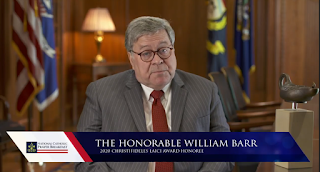
Here, we have the National Catholic Prayer Breakfast, which is to honor my Boo Boo Barr for
Sir Boo Boo Barr Champion of Corporate Parental Rights to take over the U.S.
contemporaneously championing the advice and advocacy Of Corporate Parental Rights, on behalf of those Public Private Partnerships, for he has taken the oath of fealty to the foreign nation called the Vatican.
He who has sworn an oath of fealty to the tax exempt god of a foreign nation, wherefore, loyalty comes with the grant of lots of land and all the attached chattels of tiny humans.
A knight is a title of nobility, you know.
When you help get U.S. contracts, typically in child welfare, as a knight, as an U.S. for-profit or not-for-profit, while we typically call that an emolument, unless you are granted authority to engage in commerce in the U.S. on behalf of a foreign entity, by registering under FARA.
Otherwise, that may be considered under FCPA.
I just thought I would remind everyone when the history of the Knights of Columbus is cloaked in the bastardization of this nation's history.
Praytell, why is Boo Boo Barr praying for mercy, with Aladdin's magic "this means I am a real Smarty Pants" lamp by his side, bearing the arms of the U.S.?
I want to say 911, but will stick with the more universal blanket of "stealin' the children, land & votes."
A nun criticized the National Catholic Prayer Breakfast (NCPB) for its plans to award Attorney General Bill Barr for “Christlike behavior” on Wednesday morning.
Sister Helen Prejean slammed the Catholic organization for announcing the Christifideles Laici Award would be given to Barr, who is Catholic, at the annual breakfast. The award honors the recipient for “Exemplary Selfless and Steadfast Service in the Lord’s Vineyard,” according to the NCPB website.
Prejean, an advocate against the death penalty, argued in a tweet Tuesday night that the attorney general has not demonstrated “Christlike behavior” after the Department of Justice (DOJ) resumed federal executions this year.
“A.G. Barr has ordered the executions of six men with at least one more on the calendar,” she wrote on the social media platform. “What is ‘Christlike’ about using discretionary power to kill?”
Another nun, Sister Simone Campbell, the executive director of the Catholic social justice group Network, told Newsweek she was “horrified” Barr was the recipient of the award.
"I am horrified that they are giving an award to Attorney General Barr who had reinstituted executions of people on death row, which is shocking and counter to Catholic social teaching,” she said. “It is abundantly clear, 'thou shalt not kill', and he is doing that and he is being given an award.”
The NCPB created the award last year “to help highlight these good works and those who serve the Church so well.” The virtual breakfast, which was postponed since March due to the pandemic, started at 11 a.m.
As of Wednesday morning, 22,213 people have signed a Faithful America petition calling on the NCPB
"Stop! You may not legally kidnap this tiny human unless you have a CPS contract under U.S. Conference of Catholic Bishops." said Boo Boo Barr.
to cancel giving Barr the award. Originally, the petition had a 20,000 signature goal, but the group has since raised it to 25,000.
“Attorney General William Barr's work — which includes teargassing peaceful protesters in front of the White House, defending the president's lawless corruption and attacks on American elections, and reinstating federal executions — has nothing to do with service to the Lord, and cannot be described as fidelity to the Church,” the petition reads.
“As fellow Catholics and other Christians, we call on the NCPB to cancel this award for Barr immediately, and avoid any further appearance of endorsing Donald Trump or his Cabinet members so close to an election,” it continues.
The NCPB and the Justice Department did not immediately return requests for comment.
Faithful America, a progressive Christian group, noted in a release that the award will be given the same week the DOJ will conduct two executions.
Pope Francis has come out against the death penalty under all circumstances calling it “inadmissable” in 2018 when he changed the Catholic Church’s teaching.
But the Trump administration resumed federal executions after a 17-year suspension, conducting six executions this year, including William Emmett LeCroy who was executed Tuesday after being convicted of raping and killing a woman in 2004.
Progressive Christians have also denounced the NCPB for identifying as non-partisan but hosting mostly Republican leaders including President Trump this year.
But, alas, there are those who are not happy with Boo Boo Barr.
The timing is not just symbolic, it is symbiotic, I tell you, because we are in Detroit.
Remarks by Attorney General William P. Barr on his Acceptance of the Christifideles Laici Award at the 2020 National Catholic Prayer Breakfast
Good morning. It is a great honor to be recognized by this esteemed organization. The truth is that no one is really worth of an award like this, so I am a little sheepish in accepting it. But I am honored to do so, because I greatly admire the organizers of this breakfast and those who are associated with it. This is a beautiful piece of artwork that I will cherish. Thank you.
For more than 15 years now, inspired by Saint John Paul II’s call for a renewal of Catholic communal and civic spirit, the National Catholic Prayer Breakfast has served as a living testament to the vital role of the Church and its principles in American public life. Thank you for praying with me, and for me, and for the future of our country.
This is a challenging time for many Americans. But times of trial have a way of reminding us how much we have to be grateful for. As people of faith, we take comfort in the knowledge that God has a purpose and a plan. And as citizens, we gain strength from the knowledge that our forebears confronted and overcame even greater tests.
In joining together to pray for the strength and health of our country, we carry on a tradition that goes back to the beginning of the Republic. During the summer of 1783, General George Washington gave his first major address following the Revolutionary War — a war the young nation very nearly lost. He delivered a famous prayer that continues to be read aloud every day at Mount Vernon. He asked God not only to protect the nation from external threats, but to maintain the character of its citizens: as he put it, to “dispose us all to do justice, to love mercy,” and to comport ourselves “with that charity, humility and pacific temper of mind, which were the characteristics of the divine author of our blessed religion,” and without which “we can never hope to be a happy Nation.”
As Washington and his fellow Founders understood, religion is at the heart of the American experiment in self-government. In his Farewell Address, Washington said: “Of all the dispositions and habits which lead to political prosperity, religion and morality are indispensable supports.”
What he meant is that self-government begins with self-restraint. And there is no greater teacher of restraint than religion. That is why John Adams declared that our Constitution — which recently celebrated its 233rd birthday — “was made only for a moral and religious people.” As Father John Courtney Murray later put it, the American idea is notthat “free government is inevitable, only that it is possible, and that its possibility can be realized only when the people as a whole are inwardly governed by the recognized imperatives of the universal moral order.”
That crucial link between religion and liberty, so well understood at the Founding, is all too often forgotten today. In American public discourse, perhaps no concept is more misunderstood than the notion of “separation of church and state.” Militant secularists have long seized on that slogan as a facile justification for attempting to drive religion from the public square and to exclude religious people from bringing a religious perspective to bear on conversations about the common good.
Yet as events like this one remind us, separation of church and state does not mean, and never did mean, separation of religion and civics. As late as 1952, Justice William O. Douglas could write for a majority of the Supreme Court that “we are a religious people whose institutions presuppose a Supreme Being.” Alexis de Tocqueville, the keenest observer of the early American republic, praised America’s separation of church and state while extolling America’s union of the “spirit of religion” and the “spirit of liberty” as the key to its success. And Tocqueville identified religion as perhaps the greatest bulwark against a descent into tyranny.
How does religion preserve liberty? In the first place, as our Founders recognized, religion assists in the formation of virtuous citizens who are prepared to exercise liberty responsibly. Whereas in democratic times, individuals have a tendency to withdraw from public life and pursue private self-gratification, religion builds community, strengthens social cohesion, and turns our attention to the common good. At the same time, religion safeguards individual rights by warding off what Tocqueville called the “impious maxim” that “everything is permitted in the interest of society.” For all of these reasons, Tocqueville referred to Americans’ religion as “the first of their political institutions.”
Unfortunately, in the last half century, that foundation of our free society has increasingly been under siege. Traditional morality has eroded, and secularists have often succeeded not only in eliminating religion from schools and the public square, but in replacing it with new orthodoxies that are actively hostile to religion. The consequences of this hollowing out of religion have been predictably dire. Over the past 50 years, we have seen striking increases in urban violence, drug abuse, and broken families. Problems like these have fed the rise of an ever more powerful central government, one that increasingly saps individual initiative, coopts civil society, crowds out religious institutions, and ultimately reduces citizens to wards of the State.
As patriotic Americans and people of faith, we cannot be complacent about these trends. Yet nor should we give in to despair. More recently, thanks in part to organizations like this one, we have seen some small but significant steps toward the restoration of religion to its rightful place in American public life.
Some notable advances — which admittedly are of particular interest to me — have come in the legal arena. They are the result of decades of hard work advocating for sound jurisprudential philosophies and appointing principled judges to state and federal courts. The most recent term of the Supreme Court, for example, saw three important victories for religious liberty. In each of these cases, the Department of Justice filed briefs supporting the free exercise of religion.
In one case, the Court reaffirmed the principle that the government cannot discriminate against religion in general funding programs, and struck down a provision of the Montana Constitution that had been interpreted to exclude religious schools from a scholarship program for underprivileged students. In another case, the Court held that the First Amendment prohibits courts from intervening in employment disputes involving teachers at religious schools who are entrusted with the responsibility of instructing their students in the faith. In the third case, the Court considered a regulatory mandate requiring employers to provide contraceptive coverage to their employees, and upheld the administration’s rules exempting the nuns of the Little Sisters of the Poor and other employers with moral and religious objections.
In a sense, it is dispiriting that the disputes in these cases ever arose. In each case, the religious litigants were not asking for anything more than the basic freedom to exercise their faith and be treated the same as others. Nevertheless, the recognition of those rights by courts is encouraging. And all involved — from the litigants and lawyers to those who prayed for the wisdom of judges — can take solace in having achieved a just result.
Advocating for religious liberty is just one way that lay Catholics and others can answer the call to serve. In his exhortation Christifideles Laici, for which the award I have the honor of accepting today is named, Saint John Paul II noted that “the lay faithful are never to relinquish their participation in ‘public life’.” At the same time, he emphasized that faith is first and foremost about how we live our daily lives, for “the daily life itself of a truly Christian family makes up the first ‘experience of Church.’”
Wherever we are in life, it is never too late to work in the Lord’s vineyard. Our spiritual renewal, and the renewal of our national character, depend on it. Thank you, and God Bless America.
Quintessentially, I do believe Nancy is targeting that Horowitz IG Report Trump is obstructing justice with by keeping it in his backpocket by threatening, via this package of legislation on whistleblower protections, actions against blasphemy in false claims against an elected official, by forcing Boo Boo Barr to unseal all the Mueller referrals to those two magical grand juries.
We do not need the testimony of Don McGahn to congress because he is already in those grand juries and it is all public information if you just look here.
This is not going to end well, but shall be pearl clutching, for we are in Detroit.
To the liberal media, special counsel Robert Mueller was the sharp, seasoned, no-nonsense prosecutor who would get to the bottom of “collusion.” But when Mueller testified before Congress on July 24, 2019, many were stunned to see a man struggling to answer basic questions.
Had his cognitive abilities declined during the probe?
The 76-year-old Mueller, members of President Trump’s defense team recalled, appeared to be a figurehead investigator, a man who seldom spoke or was even seen. On those rare occasions Trump’s lawyers had a chance to talk to the special counsel, Mueller’s aides appeared to be covering for his lapses in memory. So who was really in charge of the Mueller probe?
There were questions about Mueller’s mental condition even before he was appointed special counsel in May 2017. Chris Swecker spent 24 years in the FBI. He left the agency in 2006 with the highest respect for his old boss, with whom he had extensive daily contact for more than two years. “Mueller was super sharp,” Swecker remembered.
In fall 2016, working in North Carolina, Swecker invited Mueller to speak at a conference. Mueller flew from Washington, and Swecker met him for breakfast to brief him on the event. He noticed something he had never seen in his old boss. “I remember telling my wife after the breakfast that he’s slipping,” Swecker recalled. “You could tell the acuity was not there. . . . He was a little confused about what to do after he got off.” When Mueller was made special counsel the next year, Swecker wondered whether he was up to it.
Communications aide Mark Corallo was a Mueller fan even as he worked for the Trump defense team. After his departure in July 2017, Corallo awaited a call — not from his old colleagues, but from Mueller. Prosecutors wanted to question him about Trump’s role in drafting a statement in response to New York Times reporting on the now-infamous Trump Tower meeting.
The session with Mueller’s lawyers took place on Feb. 15, 2018. “At the end of the interview, Mueller came in and shook my hand and put his hand around my shoulder and said, ‘It’s good to see you,’ ” Corallo recalled. “He said, ‘I’m sorry you got dragged into this.’ When he left the room, I said to Andrew Goldstein, ‘Hey, how’s he doing?’ They said great. I said, ‘Well, he looks a little gaunt. Is he eating? Is he tired?’ They said, ‘No, he’s running circles around us.’ This was the first time I noticed that he was not physically robust.”
Nearly a year and a half later, watching Mueller testify on television, Corallo was taken aback. “When I saw him testifying, it was significantly more apparent,” he recalled. “And trust me, I was not the only one. Those of us who worked with Bob at the Justice Department after 9/11 and watched his testimony — the phone calls were flying. ‘Holy crap, what’s wrong with Bob? Is he sick?’ ”
In another key meeting, according to members of the Trump defense team, the special counsel seemed unfamiliar with a key Justice Department policy having to do with indicting a sitting president. “After that, we never met with Mueller, and we never spoke with him on the phone,” Trump defense lawyer Jane Raskin recalled.
Robert Mueller memo shows why each key figure was targeted in probe
“What’s galling to me in hindsight, knowing what we know, is that they dragged it out as long as they did,” said Corallo, the Trump comms man. “Which says to me that people other than Bob Mueller were running that investigation.”
But who? Speculation focused on Andrew Weissmann, the aggressive prosecutor sometimes known as Mueller’s “pit bull.” But the inner workings of the Mueller investigation were never fully clear to those outside. All the president’s lawyers could see was that Mueller didn’t seem to be in control.
“Bob at the end was AWOL,” Trump lawyer Jay Sekulow recalled. “That was the great con. He showed up for cameo appearances. He was the Wizard of Oz. He was back behind the big curtain, pulling some strings here and there, but when you pulled the curtain away, he wasn’t even really the one pulling the strings.”
When Mueller testified, everyone could see what Team Trump had seen. It wasn’t pretty. And it ended Democratic hopes of turning the Russia probe into a glorious victory.
Defendant G. Gordon Liddy has filed a renewed motion to transfer this case to the District of Columbia. The motion will be granted.
This case arises out of allegedly defamatory remarks that Liddy made about plaintiff Ida Maxwell Wells. Liddy has publicly articulated a theory that the Watergate burglary was prompted by a desire to obtain information about a call-girl ring being operated at the headquarters of the Democratic National Committee. According to the theory espoused by Liddy, Maureen Dean, John Dean's wife, is said to have been one of the call girls. Pictures of Maureen Dean and the other call girls allegedly were kept in Wells' desk. Dean allegedly instigated the break-in to recover the photographs.
The Deans filed an action for defamation against Liddy and others in 1992 based upon Liddy's public statements about the call-girl theory and other alleged libels against John Dean. The case was originally instituted in California but was transferred to the District of Columbia upon a motion to transfer filed by Liddy. Wells instituted the present action in 1997. Liddy moved to transfer it to the District of Columbia as well. Initially, I denied the motion. Two factors figured heavily in my decision. First, the Dean case was then dormant and had been for several years. Second, Wells asserted that she "has a very simple case" and that the "case does not depend upon any testimony from the Deans. . . ."
Circumstances have changed since I denied Liddy's original motion to transfer. Wells has now twice named Maureen Dean as a witness despite her prior representation that her case does not depend upon the testimony of the Deans. Although Wells has withdrawn Mrs. Dean's name from the witness list on both occasions, the interrelatedness between this case and at least a portion of the case instituted by the Deans in the District of Columbia has now become apparent. More importantly, the Dean case is no longer dormant. It has been reassigned to Judge Emmett Sullivan who has set a firm trial date of May 5, 2000.
Wells argues that I cannot transfer this case to the District of Columbia because it could not have been instituted there originally, as required by 28 U.S.C. § 1404(a), since venue and personal jurisdiction over Liddy are lacking in the District of Columbia. This argument is unpersuasive. Liddy has substantial contacts with and engages in a persistent course of conduct in the District of Columbia. Also, the original complaint alleged acts of defamation committed over an Internet website maintained by an organization located in the District and through Liddy's nationwide radio shows. Moreover, prior to Wells bringing suit, Liddy had already purposely availed himself of the jurisdiction of the District of Columbia by initiating the transfer of the Dean litigation. In addition, the federal district judge in California found it was appropriate to transfer the Dean case to the District of Columbia.
I also note that the events underlying the Watergate burglary (in which Liddy was personally involved) occurred in the District of Columbia.
Therefore, this case can be transferred to the District of Columbia. The remaining question is whether it should be transferred. In making this determination I must consider a variety of factors, including the plaintiff's choice of forum, the convenience of counsel and the witnesses, the relative ease of access to sources of proof, and the public interest. See, e.g.,Gulf Oil Corp. v. Gilbert, 330 U.S. 501, 508-09 (1947); Dickens v. United States, 862 F. Supp. 91, 92 (D. Md. 1994). The first of these factors obviously weighs against transfer; plaintiff has chosen to bring her action here in Maryland. The second and third factors weigh slightly in favor of transfer since lead counsel for both parties have their offices in the District of Columbia, many of the witnesses live in the District of Columbia area, and none of the witnesses live in the Baltimore area. However, since the District of Columbia and Baltimore are so close to one another, this factor is negligible.
I find the public interest factor dispositive. There is some overlap between this case and the Dean case, and it may be that they should be consolidated. Liddy vigorously argues that they should be; Wells argues just as strongly to the contrary. These conflicting positions essentially boil down to this: Liddy asserts that he should not be subjected to the cost of litigating (and to the risk of inconsistent results) in two different cases that arise, at least in part, from the same nucleus of facts. Wells acknowledges (as she must) that one aspect of the Deans' claims arises, as do her claims, from Liddy's public statements promoting the call-girl theory of the Watergate burglary. She points out, however, that the Deans' claims involve many other issues as well (apparently arising out of Liddy's broad assertions that John Dean committed "massive perjury.") Wells understandably does not wish her discrete claims to be eclipsed or compromised in the shadow of the larger Dean case.
Wells also expresses a concern that her costs of litigation will be much greater if she becomes embroiled in the trial of the Dean case since it is estimated to last longer than her own trial. While this may be true, a countervailing factor is that Wells' counsel is also local counsel for the Deans and will be participating in the trial of the Dean case in any event.
It would seem to be in the interest of the economic use of judicial resources for the two cases to be consolidated if they can justly be tried together. However, in transferring this action to the District of Columbia, I am expressing no view as to whether consolidation is appropriate. I have no jurisdiction over the Dean case and am not sufficiently knowledgeable about the Deans' claims to know whether Wells would be unfairly prejudiced by a single trial. It is clear to me, however, that it is in the public interest to have the case transferred so that Judge Sullivan, who has been actively presiding over the Dean case and has become fully familiar with it, can be given an opportunity to decide whether consolidation would be appropriate. If Judge Sullivan decides in favor of consolidation, the single trial can go forward in May. If, on the other hand, he decides that consolidation is inappropriate, Wells can file a motion to transfer the case back to Maryland, the forum of her original choice, on the ground that the sole reason for my transfer was to allow Judge Sullivan to rule on the consolidation issue.
Of course, it would be up to Judge Sullivan to decide a motion to re-transfer the case to Maryland. However, lest there be any uncertainty on this score, I affirmatively state that I would be fully amenable to having the case transferred back to Maryland in the event Judge Sullivan decides against consolidation. If it were not for the fact that I believe it to be in the public interest for Judge Sullivan to consider the consolidation issue, I would have respected Wells' choice of forum and ruled against the transfer. Moreover, it is against my own sense of responsibility to ask another judge to try a case that is properly before me. To that end, I will hold on my calendar the September 11, 2000 trial date I have set, so that, in the event Judge Sullivan denies consolidation and decides the case should be transferred back to Maryland, he and the parties can be assured that no unnecessary delay will occur.
A separate order effecting the ruling made in this memorandum is being entered herewith.
ORDER
For the reasons stated in the accompanying memorandum, it is, this ______ day of December 1999
ORDERED
1. Defendant's renewed motion to transfer is granted; and
2. This case is transferred to the United States District Court for the District of Columbia.