Showing posts with label Mother Teresa. Show all posts

Monday, April 8, 2019

Meet Hermann Gemeiner - Founding Father of SOS Children's Villages - Lebensborn - Happy Child Abuse Month

Meet Hermann Gemeiner and the WW II history behind Lebensborn, or Kinderdorf, or rather SOS Children's Villages.

This is the origin of Child Protective Services, Foster Care & Adoption.

In order to properly celebrate Child Abuse Propaganda Month, one must become acquainted to the historical concepts of christian chattel law and its usage.

Yes, that is correct, Child Abuse Propaganda came our of Nazi Germany to cover up their experiments with children, which are in full force today, through the U.S. child welfare system which has dominated the world in the industry of trafficking tiny humans and maximizing revenues.


Logo of the SOS Children's Village eV
https://www.sos-kinderdorf.de/portal
Started in 1949 for orphans, SOS Kinderdorf builds communities around the globe that give foster kids a stable home and long-term parent

Hillary Rodham Clinton isn't the only one who thinks it takes a village to raise a child.

In Austria, where a woman was jailed recently for severely abusing her children, the four young sisters and their brother were sent to a new community and given a new home - complete with a foster mother.

Their destination was an SOS Children's Village, one of 343 such communities around the world set up by SOS Kinderdorf International, based in Innsbruck, Austria. The largest private children's charity in the world, it was originally created to provide homes for orphans. Today, most of its charges in Western Europe are victims of abuse and neglect.
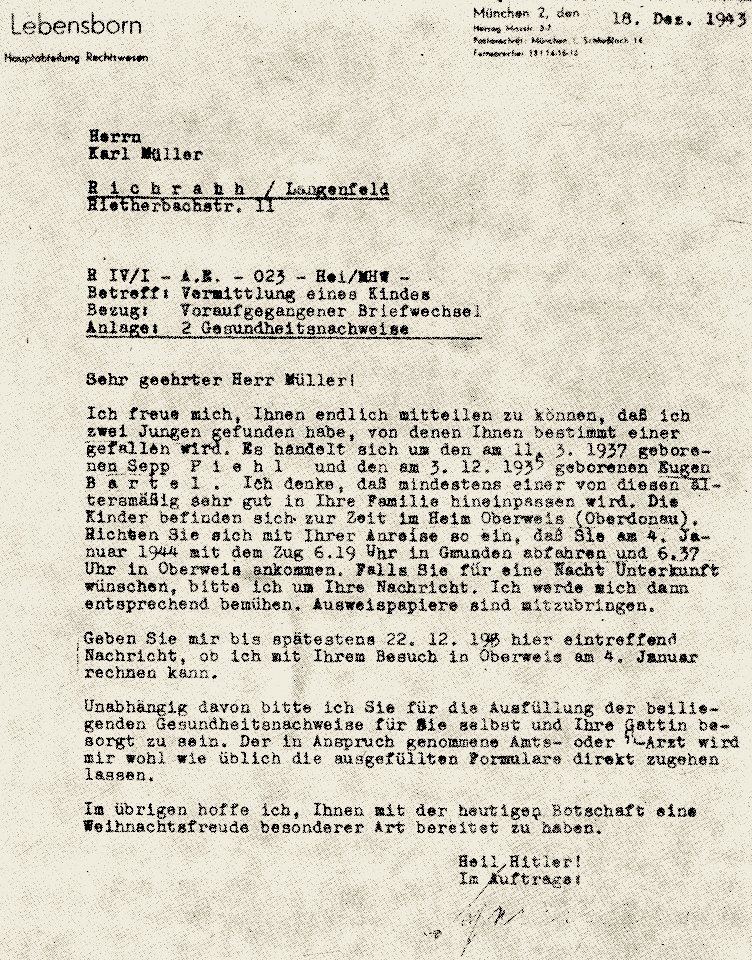
Lebensborn document 1.jpg
The First CPS Foster Care and Adoption Program
The five siblings, like 30,000 other children in 125 countries, joined a small neighborhood of 10 to 20 houses. In Europe, each house is headed by an SOS mother who cares for six to eight children. She performs all the tasks mothers take care of in the normal course of a day: scheduling, cooking, washing, helping with homework, and generally acting as a loving guide. And she does it long term.
The idea behind the villages is to give at-risk children the next-best thing to a natural family. Children get long-term care from well-trained adults in a stable environment. Sixty percent of SOS kids have siblings, and the organization makes every effort to keep them all under one roof.

Virtually all the children still have natural parents and many have some contact with them. And because SOS Kinderdorf puts a premium on community, the villages - which look like a middle-class neighborhood - allow for easy integration into the surrounding area through activities and educational or recreational facilities.

Large families
Ingeborg Neumann cares for two boys and four girls between the ages of 8 and 12. Their home is nestled on a hillside in the Vienna Woods in a community of 27 other SOS homes. Two of the girls are sisters.

During a recent visit, Christmas preparations were well under way in the living room, obviously the center of family life, with a homemade Advent wreath already in place in the center of the table.
 important for the children to have the experience of birthday celebrations and Christmas because many of them haven't had the chance to have celebrations in their previous homes," Ms. Neumann says.

Neumann says she likes what she does. Since becoming a SOS mother 3-1/2 years ago, her conviction has grown that she made the right decision in exchanging her office job for a life of caring for children. And it's quite obvious that her two young sons, who came running in from school for lunch, love her.

While single-mother parenting is often viewed as less than ideal, SOS Kinderdorf International
Image result for lebensborn
"He alone, who owns the youth,gains the future."
generally seeks out only single women to serve as SOS mothers, and has done so since its inception. Single parents are considered less likely to have to leave the family for reasons ranging from a spouse's job relocation to divorce.

But according to Richard Pichler, the organization's secretary general who was raised in an SOS children's village himself, finding candidates is not easy. Even in the early 1950s, when many war widows applied, there was a screening process to make sure that they knew what they were getting into.

"It has never been easy to find good mothers for SOS Children's Villages," Mr. Pichler says "They have to know that it isn't only honey, but that there are rainy days too for an SOS mother."
But, Pichler says, there is a new generation of women, particularly in Europe, who consciously decide to live a single life and want to be SOS mothers. "Single-parent raising of children is very much accepted in society today. Even though the background of SOS mothers has shifted, the desire to be mothers is still the same," he says.

A network of support
One reason SOS villages are often successful, Pichler says, is that they offer the parents a strong network and plenty of support.

The whole community is there to help mothers and their children. SOS mothers are also provided with special training before they establish their new families. There is always an SOS substitute mother who can step in so SOS mothers can have a weekend off or take a vacation. If something in the home needs fixing, an SOS employee is there to take care of it. Children with special needs have access to trained counselors and therapists. Staff members are trained to guide the mothers through particular problems the children may have. And most important, many of the pressures that other single mothers struggle with alone are shared in the villages.

SOS Children's Villages are traditionally headed by male directors who, in addition to running the day-to-day business, also serve as father figures. But times are changing, and a woman director was appointed recently for an Austrian SOS village. Male employees are trained to be positive male role figures for SOS children, helping them with their schoolwork, taking them on excursions, or just being there when the children need a guy to talk to.

The criticism most often directed at SOS Kinderdorf is the perceived weakness of its single-women-only policy. Critics suggest that more male contact is necessary for a child to develop fully.
However, Pichler says, "I had ample male contacts when I was growing up in my SOS family, so it was not a problem for me." In addition to his village director, he had contact with male teachers, male staff members, and his older SOS brothers.

He acknowledges that it is not a perfect arrangement. "We cannot say we are ideally copying the natural family. We have to be realistic and say there are limitations," he concedes. "We know it is not the ideal situation. The ideal situation is adoption or something like that. But in the broad framework, with about 4,500 SOS families worldwide, the most feasible way is with a mother. A single mother."
Helping orphans

Mr. Gmeiner started small. He and a few friends pooled their resources to build five houses for 40 children in the Austrian village of Imst. By 1952, Gmeiner already had 15,000 people contributing one schilling a month (about 4 cents at the time).

Those 15,000 grew to 1 million individuals by 1959, who, through their small donations, built 10 villages caring for 1,000 children. SOS Kinderdorf was on its way.

Other villages were quickly established in Austria, and, beginning in 1956, in Germany. From there, the idea spread throughout Europe. In 1963, the first SOS village in the developing world was established in the Republic of Korea followed by ones in India and the Philippines.

Many countries have used SOS Kinderdorf as a model for their own child-care facilities. India, for example, stated a few years ago that all future work for the placement of children should follow the SOS Kinderdorf village model.

SOS eventually moved beyond just building villages to set up schools. Children from surrounding neighborhoods could also attend, which built stronger ties between SOS kids and their neighbors. SOS has expanded as well into job-training programs, and opened a college in Ghana in 1990. In 1996, 185,000 young people were cared for in a variety of SOS facilities.

Looking back
Theresia Neubauer, who lives in an SOS village with other retired mothers, was one of the first to answer Gmeiner's call for SOS mothers in the early 1950s. She was 25 years old then. In her time, SOS mothers took care of nine to 12 children each.

"Larger families were easier to care for since the older children could help," Ms. Neubauer says. "And children were not so troubled."

The majority of children Neubauer and the other SOS mothers cared for then were orphans. They hadn't been rejected or abused by their natural parents as is more often the case today.

All together, Neubauer raised 32 children and now enjoys ties with 40 grandchildren and eight great-grandchildren. "I never thought of what I did as a job. It was my calling," she says.


Voting is beautiful, be beautiful ~ vote.©

Sunday, September 30, 2018

Why Is India Adopting Failed Western Child Welfare Policies, Finally Answered

Image result for inhale
It only takes a moment to find inner peace before
explaining the financial concept of
trafficking tiny humans, over and over again.
Suranya Aiyar asks a very poignant question: "Why are we [India] adopting failed Western childcare policies?

Allow just a moment for my summation.

Because stealin' children is the first leg of conquering a nation and the Child Protective Service model came out Michigan.

The technical name is imperialism through privateers, by and through chattel law, in the name of the tax exempt god, but in this instance, I am just going to call it, for more intuitive purposes, human trafficking.

Selling Chattel: The Oldest Form Of Survival

Selling chattel is the oldest form of survival, but now-a-days we just call it foster care and adoption.

Poverty is the crime of abuse and neglect, can I get an "Amen"?

Why are we adopting failed Western childcare policies?

The general public’s complicity in passing dangerous child-related policies often leads to dysfunctional societies, as has been seen in the West. It’s high time that we in India learned from that example.


Last week’s article in this series looked at possible reasons why the West has adopted a confiscatory model of child protection, where intervention is in the form of taking children into foster care rather than helping them in their families. The question became relevant as we saw that the number of cases involving sexual or physical abuse was relatively small. Rather than simply targeting abuse, the child protection systems in these countries target the children of the underclass, using the pretext of “emotional abuse”, or labelling poverty-related home conditions as “neglect” or “parental inability to cope”. Those targeted mostly belong to the perceived “dregs of society”, so-called “welfare bums “or poor single mothers as impoverished, poorly educated, isolated and otherwise marginalised parents.

This is where the whole operation starts to look more and more like a eugenics exercise. Short of sterilisation, this is the best way to cull a society—take the children of the perceived “unfit” parents and send them to be raised in foster care or forced adoption with state-approved “fit” parents.
Not only is this unethical and unspeakably cruel, the system has not succeeded in making things better for most of the children it takes away. The child protection and foster care model of our Juvenile Justice Act, 2015 (“JJ Act”) is failing in the advanced Western countries that have it. Even its most vocal advocates will admit that children in foster care do very badly compared with children in the general population. Most of them age-out of the care system as school drop-outs and enter into a life of homelessness, prostitution, substance abuse or crime.

In the USA, surveys show that only 2-9% of foster youth obtain a bachelor’s degree and half of them drop out of school (National Working Group on Foster Care and Education in the USA, 2014). The channel between foster care and being trafficked into sex work is an accepted fact in England and the USA; it is called the “Foster Care to Trafficking Pipeline”. Experts also speak of a “Foster Care to Prison Pipeline” because of the high rates of criminal offenders found among former foster youth.

According to statistics from England, “looked after” children (i.e. those in state care) are five times more likely than all children to commit a crime (Department for Education, Children looked after in England, Additional Tables, SFR 50/2017). The data also shows that 11% of 16 to 17-year-olds and 5% of 13 to 15-year-olds have substance misuse problems.

Educational outcomes for England’s “looked after” children are much lower than for children not looked after (Department for Education, Outcomes for children looked after by local authorities in England, SFR 20/2018).

Data for children in state care/foster care for a year or more continuously (“children looked after continuously for atleast 12 months”) show that only half (49%) are considered to have normal emotional and behavioural health. 12% have “borderline scores” and 38% have scores which were a “cause for concern”.

So the evidence is in that foster care has failed to improve things for children from families assessed negatively by the state.

The breakup of filial ties through foster care has also meant that as adults many of those ageing out of the care system have no one in the world to go to. Children may have no recollection of their parents’ whereabouts, and many have been told from a very young age that their parents were no good. This also generates a stream of now aged parents without any children to care for them in their old age.

The cycle of isolation continues with a high number of teenage pregnancies being observed in girls ageing out of the care system, driven by the very human need to have someone to love. The children of these young women are often targeted by the child protection system as their experience of having been in foster care is seen as retarding their ability to be “fit parents”.

Do we want to set this tragic cycle into motion in India?

The question arises why we are looking at foster care at all. Foster care is described in child protection jargon as “de-institutionalisation”, which the prevailing wisdom holds is better than institutionalisation, i.e., being in orphanages. But, in practice, foster care operates very much like a small-scale institution. The JJ Act has the concept of “group” foster care, which is basically a small institution with a limit on the number of children to 8.

Foster care is said to be preferable to life in an orphanage because it gives children a domestic environment and a sense of belonging. But the relatively closed environment of a foster family leaves children vulnerable to other types of abuse and exploitation. There is any amount of testimony in Western countries from people who have been in foster care saying that they suffered far worse abuse in foster care, like rape and thrashings, than anything they faced in their less-than-perfect biological families.

A large number of children run away from state care. In England, statistics show that 33% of children in foster care went “missing”(Department for Education, Children looked after in England, SFR 50/2017). Of all the children placed in institutions or foster care, an average of 4.2 incidents of being “away from their placement without authorisation” were reported. This is official jargon for a child whose whereabouts away from the place of state care are known. In other words, this refers to runaways. This means many children in foster care are running away more than 4 times a year from their supposedly “wonderful” foster carers. Does this look like a child friendly system?

Many former foster children, even if they were not abused or exploited in foster care, will say that they never felt loved or got the sense of belonging they craved. Many say that they were acutely aware of the fact that the foster parents had taken them in for the fostering “paycheck” that came with them.

In India, the Model Foster Care Guidelines, 2016 say that preference is to be given to fosterers who do not ask for state financial assistance to foster the child, but there is nothing to stop them taking funds from the child rights NGOs that have mushroomed in India since we adopted the Western child protection model. There is also no provision for foster parents to account for monies received towards the care of the foster child. Group foster homes in India are allowed Rs. 2000 per child from the government. This sum is bound to grow and grow, if the experience in Western countries is anything to go by. Once you have this system in place, it keeps asking for more funds and politicians look good allocating monies to child protection. Given economic conditions in India, a payment of Rs 2000 per month is already a hefty amount.

Why are we allowing the Ministry of Women and Child Development to get away with importing failed Western systems for Indian children? Who is lobbying the Ministry with ideas of mass foster care programmes? Are parents even aware of how stubbornly committed child rights groups in India are to the dysfunctional Western model of child protection?

Has the Ministry taken the public into confidence about its agenda for Indian children? Where is the public debate and discussion before allowing state agencies such long arms to reach children who have not been abused or abandoned, but are living in ordinary families—families like yours and mine?

Much is said these days about child abuse awareness. But the most universal form of child abuse in India today is the public apathy about the dangerous child-related policies and laws being quietly passed here.Parents cannot afford to be ignorant any longer. It is high time for us to hold our government and the child rights community to account for what is being planned in the name of child protection. This is our last chance to push back. Once the child rights industry takes root here, once the economy of interests invested in it is breathed to life, it will be too late.

This is the fifth in a five-part series of articles. Part IV of this paper was published on 23 September 2018 with the title “The real agenda behind Western child protection”

Suranya Aiyar is a New Delhi-based lawyer and mother. The Global Child Rights and Wrongs series is run in collaboration with her website www.saveyourchildren.in, critiquing the role of governments and NGOs in childpolicy

Voting is beautiful, be beautiful ~ vote.©

Friday, July 6, 2018

Mother Teresa & The Trafficking Of Tiny Humans

1835 Manifest, alien ages: 13-15 years
Trafficking tiny humans has always been the work of the christian god.

How do you think they got so many slaves on the Good Ship Jesus?

They were children and it was funded by the Holy See.

Besides, good help is so hard to find these days, just ask Michele Bachmann.

Both thy bondmen, and thy bondmaids, which thou shalt have, shall be of the heathen that are round about you; of them shall ye buy bondmen and bondmaids. Moreover of the children of the strangers that do sojourn among you, of them shall ye buy, and of their families that are with you, which they begat in your land: and they shall be your possession. And ye shall take them as an inheritance for your children after you, to inherit them for a possession; they shall be your bondmen for ever.

Leviticus 25:44-46.


"[W]e grant to you full and free power, through the Apostolic authority by this edict, to invade, conquer, fight, subjugate the Saracens and pagans, and other infidels and other enemies of Christ, and wherever established their Kingdoms, Duchies, Royal Palaces, Principalities and other dominions, lands, places, estates, camps and any other possessions, mobile and immobile goods found in all these places and held in whatever name, and held and possessed by the same Saracens, Pagans, infidels, and the enemies of Christ, also realms, duchies, royal palaces, principalities and other dominions, lands, places, estates, camps, possessions of the king or prince or of the kings or princes, and to lead their persons in perpetual servitude..."


Besides, if you sell a few kids, you can take care of even more.

Just never ask about the godly things they do with the children after procurement.

Nun charged with baby trafficking at Mother Teresa home for pregnant women in India

Indian authorities say they have sealed a home run by Mother Teresa's religious order and charged a nun and one other person with baby trafficking.

Key points:

  • Child protection body says home was charging between $785 and $1,964 per baby
  • The home was required to inform authorities of all babies born there
  • Activists claim they were selling more than they were handing over to authorities
The home in eastern India's Jharkhand state is run by Missionaries of Charity, the order set up by Mother Teresa in India, and provides shelter for pregnant unmarried women.
"They have said that at least five to six babies have been sold to childless couples," police officer Aman Kumar told Reuters in a phone interview.
"We are investigating to see how the operation was run and how many more children have been given away in the last few years."
An Indian couple claimed they paid 120,000 rupees ($2,354) to Anima Indwar, who worked at the shelter run by the Missionaries of Charity, said Mr Kumar.
The arrests of the nun and another worker on Tuesday and Wednesday followed the couple's complaint the charity worker had taken back the baby boy and kept their money.
Mr Kumar said the police were investigating three other complaints against Ms Indwar for allegedly selling children from the shelter.

Spokeswoman Sunita Kumar said the Missionaries of Charity was investigating.
"There was no question of selling any child as the Missionaries of Charity had stopped giving children for adoption three years ago," she said.
She said the charity had never taken money from parents while arranging adoptions in the past.
Mr Kumar said 100,000 rupees ($1,964) was recovered from the two who were arrested.
The Missionaries of Charity stopped organising adoptions in India in 2015, saying they disagreed with government rules that made it easier for single, divorced, and separated people to adopt children.
There have been a number of reports of babies and children being trafficked through charity-run homes and hospitals, which campaigners say is driven by a long waiting list for adoption.
The Nirmala Shishu Bhavan home, run by the Missionaries of Charity in Jharkhand state capital Ranchi, was required to inform authorities about all babies born there.
"They were selling more babies than what they were handing over to authorities," said Baidnath Kumar, a Ranchi-based child rights activist who had filed complaints against the home.
Mr Kujur said his organisation had directed that the credentials of every home run in the state should be checked.
Voting is beautiful, be beautiful ~ vote.©