Showing posts with label smithsonian. Show all posts

Friday, October 20, 2017

CONYERS: The Smithsonian Honors VHS Grad John Hasse


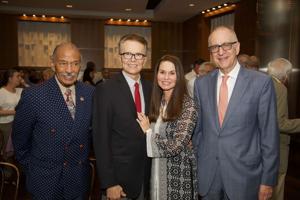
Honored By SmithsonianTop officials of the Smithsonian Institution – and Rep. John Conyers, dean of the House of Representative – saluted music curator John Edward Hasse upon his retirement from the Smithsonian on June 30, bringing to a close 32 years of distinguished accomplishments.

Hasse was hailed by David J. Skorton, secretary of the Smithsonian, John L. Gray, director of the National Museum of American History, and Rep. Conyers, who inserted a tribute into the Congressional Record. Video of the ceremony can be seen at https://goo.gl/aFPpoV.

Hasse, a 1967 graduate of Vermillion High School, was hired as Curator of American Music by the Smithsonian’s National Museum of American History in 1984. In that capacity, he founded national Jazz Appreciation Month and the Smithsonian Jazz Masterworks Orchestra; curated exhibitions on Duke Ellington, Ella Fitzgerald, Ray Charles, Frank Sinatra, and jazz photography; led the museum’s successful drive to acquire the vast Duke Ellington Collection – 100,000 pages of unpublished music and another hundred thousand pages of documents, as well as objects and/or archival materials from Louis Armstrong, Benny Goodman, Jimmie Lunceford, Artie Shaw, Ella Fitzgerald, Woody Herman, Dizzy Gillespie, Miles Davis, Thelonious Monk, Herbie Hancock, Paquito d’Rivera, Randy Weston, Steve Cropper of Booker T & and the MGs, and the 12,000-photo Duncan Schiedt Collection.

A highlight was Hasse’s acquisition of John Coltrane’s Selmer tenor sax and his handwritten manuscript of A Love Supreme, his most celebrated work.

Hasse’s books include Beyond Category: The Life and Genius of Duke Ellington; Jazz: The First Century; and Discover Jazz (with Tad Lathrop). He co-produced/co-authored Jazz: The Smithsonian Anthology. He has been awarded two honorary doctorates, two Grammy Award nominations, two ASCAP-Deems Taylor Awards for excellence in writing, and the Nica’s Dream Achievement Award. He has contributed articles to The Washington Post, The Wall Street Journal, and eight encyclopedias. Often at the request of the US State Department, Hasse has lectured on jazz, the arts, and leadership in 25 countries on five continents.

John Hasse is the brother of long-time Vermillion resident Paul Hasse, and the son of the late USD professors Gladys and Merten Hasse, whose ashes are interred at Bluff View Cemetery. All five of John Hasse’s siblings attended the University of South Dakota: Paul, Trudy, Ann, Ellen, and younger sister Margaret. While attending USD, the three older Hasse sisters were each elected Miss Dakota, breaking records and generating newspaper publicity from coast to coast.

http://www.plaintalk.net/local_news/article_a39662a4-b5cf-11e7-a853-83f7ab40bad0.html 


Voting is beautiful, be beautiful ~ vote.©

Wednesday, April 9, 2014

Smithsonian celebrates April as Jazz Appreciation Month with John Conyers

Smithsonian celebrates April as Jazz Appreciation Month supported by the stalwart leadership of U.S. Representative John Conyers who has introduced a Bill to promote jazz preservation.
Rep. John Conyers, Hugh Masakela, members of the Smithsonian Jazz Masterworks Quintet, and John Haase
Below, is the calendar of events.
Voting is beautiful, be beautiful ~ vote.©

Thursday, May 19, 2011

Smithsonian acquires Parliament-Funkadelic Mothership

It is a shame the Washington Post lost this wonderful opportunity to share with the world the true meaning of the Mothership.

I belive Mr. Clinton should make a movie about the Mothership...

( Cheryl Gerber ASSOCIATED PRESS / ) - George Clinton performs at the New Orleans Jazz and Heritage Festival last April. The frontman for Parliament-Funkadelic gave the 1990s replica of the band’s iconic stage prop, the Mothership, to the Smithsonian.
The funkiest UFO in the galaxy is about to land in Chocolate City.
The Mothership — the iconic stage prop made famous by legendary funk collectiveParliament-Funkadelic — has been acquired by the Smithsonian’s National Museum of African American History and Culture where it will help anchor a permanent music exhibition when the museum opens its doors in 2015.

“I’m about to cry!” Parliament-Funkadelic frontman George Clinton said over the phone from his home in Tallahassee on Wednesday. “They’re taking the Mothership! They’re shipping it out! . . . But I’m glad it’s going to have a nice home there.”
It isn’t the original Mothership. This 1,200-pound aluminum spacecraft was built in the mid-’90s — an indistinguishable replica, Clinton says, of the smoke-spewing stage prop he first introduced to slack-jawed funk fans in 1976.
But by 1982, Parliament-Funkadelic’s towering debts forced the group’s Washington-based management company to trash the Mothership in a Prince George’s County scrap yard. And what happened next has become the stuff of myth. Was it stolen? Did it burn in a fire? Is it still floating around somewhere in the cosmos?
An April 2010 Washington Post story about the Mothership’s disappearance sent the Smithsonian searching for it. Kevin Strait, project historian for the museum, didn’t get very far. “All signs pointed to the fact that we weren’t going to find the original,” Strait said. “So that’s when we essentially put our attentions toward the new one.”
Strait contacted Clinton’s management, and the bandleader eventually decided to donate the piece. The ship has been picked up from Clinton’s Tallahassee recording studio and is scheduled to arrive at a Smithsonian storage facility in suburban Maryland at noon on Thursday.
It’ll be somewhat of a homecoming. The group first formed as the Parliaments in Plainfield, New Jersey in the late 1950’s, but after morphing into a two-group collective — Parliamentand Funkadelic — it would go on to enjoy one of its most loyal followings in Washington. Parliament’s 1975 album “Chocolate City” gave the nation’s capital an unofficial nickname that still sticks today.
When the band lowered the Mothership from the rafters of the Capital Centre in Landover in 1977, the response was rapturous. Not only was it instantly stunning — it felt like a cosmic metaphor for the sense of possibility that followed the civil rights movement.
That symbolism isn’t lost on the Smithsonian.
“With large iconic objects like this, we can tap into . . . themes of movement and liberation that are a constant in African-American culture,” says Dwandalyn R. Reece, curator of music and performing arts for the museum. “The Mothership as this mode of transport really fits into this musical trope in African American culture about travel and transit.”
It will be exhibited alongside other artifacts from American music history — Louis Armstrong’s trumpet, James Brown’s stage costumes, Lena Horne’s evening gowns. But it will be the only spaceship.
“It definitely fits in,” said Reece. “Funk is not just a good groove, it was its own kind of social protest movement.”
And while the original Mothership’s whereabouts remain a mystery, Clinton thinks this one will serve the Smithsonian just fine.
The second ship “went out on the road for a long time,” he says. “Nobody knew the difference!”