
Showing posts with label art. Show all posts

Friday, November 23, 2018

From Michigan Emergency Manager To Sherpa - Fox Rothschild Busted In Another Grand Bargain Trust Fund Fraud Scheme

Michael A. Sweet
Michael Sweet
Fox Rothschild expert on the
filing of the Detroit Bankruptcy
FUN FACT! FOX ROTHSCHILD WAS ALL UP IN THE DETROIT BANKRUPTCY

Just as Michael Sweet.

As seen here, Kevyn Orr was "authorized" to file this bankruptcy petition on behalf of the debtor, when the debtor was in state court arguing against it.

Witness the miracle of cell phones.

Detroit bankruptcy filing came with only 5 minutes to spare
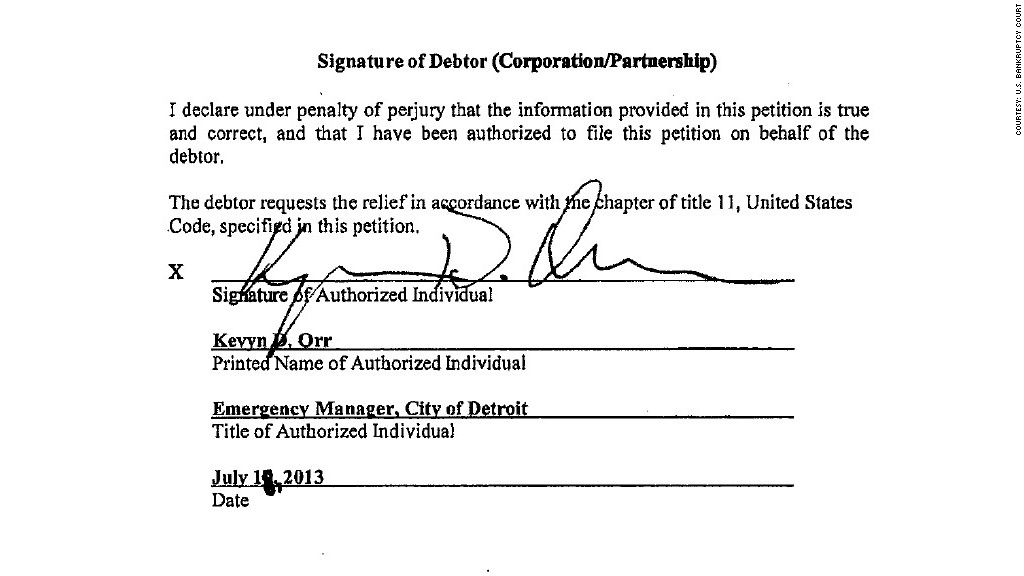
kevin orr signature

Rule 3004. Filing of Claims by Debtor or Trustee


If a creditor does not timely file a proof of claim under Rule 3002(c) or 3003(c), the debtor or trustee may file a proof of the claim within 30 days after the expiration of the time for filing claims prescribed by Rule 3002(c) or 3003(c), whichever is applicable. The clerk shall forthwith give notice of the filing to the creditor, the debtor and the trustee.


Ok, I am just going to ask this only once, because I have been over this a few too many times, but can someone, anyone, tell me how is it that a private individual, who is not elected, represent a State in federal court, when the State Attorney General is representing the State in the State Court of Claims?

The Michigan Emergency Manager does not have any statute "authorizing" representing the State of Michigan in a court of law because that is the job of the State Attorney General.

There is nothing where it says an Emergency Manager can just up and make itself the trustee of a city and represent itself as an individual.

The Act, itself, gives the Emergency Manager, hailing from the executive branch, judicial powers to make judgments.

LOCAL FINANCIAL STABILITY AND CHOICE ACT (EXCERPT)Act 436 of 2012
Sec. 18.
(1) If, in the judgment of the emergency manager, no reasonable alternative to rectifying the financial emergency of the local government which is in receivership exists, then the emergency manager may recommend to the governor and the state treasurer that the local government be authorized to proceed under chapter 9. If the governor approves of the recommendation, the governor shall inform the state treasurer and the emergency manager in writing of the decision, with a copy to the superintendent of public instruction if the local government is a school district. The governor may place contingencies on a local government in order to proceed under chapter 9. Upon receipt of the written approval, the emergency manager is authorized to proceed under chapter 9. This section empowers the local government for which an emergency manager has been appointed to become a debtor under title 11 of the United States Code, 11 USC 101 to 1532, as required by section 109 of title 11 of the United States Code, 11 USC 109, and empowers the emergency manager to act exclusively on the local government's behalf in any such case under chapter 9.
(2) The recommendation to the governor and the state treasurer under subsection (1) shall include 1 of the following:
(a) A determination by the emergency manager that no feasible financial plan can be adopted that can satisfactorily rectify the financial emergency of the local government in a timely manner.
(b) A determination by the emergency manager that a plan, in effect for at least 180 days, cannot be implemented as written or as it might be amended in a manner that can satisfactorily rectify the financial emergency in a timely manner.
(3) The emergency manager shall provide a copy of the recommendation as provided under subsection (1) to the superintendent of public instruction if the local government is a school district.
I am sure there are those wondering, "how the heck does she know all this stuff?"
No automatic alt text available.
Simple. It is nothing but the Michigan Children's Institute law because the Superintendent is the same as the Emergency Manager, except the Emergency Manager law skipped a few steps in due process because it failed recognize a municipality as a public trust and recognized it as a private corporation to initiate seamless asset forfeiture proceedings.

The Children's Trust Funds started here in Michigan and is nothing but the original chattel ponzi scheme, just like they did with the real estate of Detroit, because it all ends up in some form of complex financial fraud scheme as a children's NGO trust.


And to to think, this all started in Detroit.

Anyway, I am quite sure Fox Rothschild has alot more of these ponzi schemes using trust funds, but hey, what do I know?

Fox Rothschild Headed to New Jersey Supreme Court in Case Stemming From Ponzi Scheme

The high court's review follows an appeals court ruling that revived a claim from a U.K. real estate investor alleging Fox Rothschild improperly let $2.4 million flow through an attorney trust account to a fraudster.


The New Jersey Supreme Court will review a London-based real estate investor’s lawsuit accusing Fox Rothschild of improperly transferring $2.4 million from the firm’s attorney trust account to now-convicted Ponzi schemer Eliyahu Weinstein.

With a notice handed down Nov. 16 and made public Monday, New Jersey’s high court agreed to consider whether U.K. real estate investor Moshe Meisels can maintain his claims of conversion and breach of fiduciary duty against Fox Rothschild. Meisels alleged that he was bilked by Weinstein—who previously pleaded guilty to running a yearslong, real estate Ponzi scheme that caused $200 million in losses—and that more than $2.4 million he lost moved through Fox Rothschild’s attorney trust account.

The state high court’s review comes after an intermediate appeals court in June revivedMeisels’ conversion claim against the law firm, while it also kept intact a trial court’s dismissal of the fiduciary breach claims.

Meisels alleged that he and Weinstein reached an agreement to invest in property in Irvington, New Jersey. In connection with that deal, Weinstein in 2007 directed Meisels to transfer a portion of the investment into Fox Rothschild’s attorney trust account, according to court documents. Weinstein, who was later sentenced to 22 years in prison for his Ponzi scheme, told Meisels at the time that Fox Rothschild was carrying out legal work on the property purchase.

Meisels transferred the money, and it later went into the coffers of some of Weinstein’s businesses, with $75,000 of it going to Fox Rothschild. The money was never used to purchase any property and, in his suit against the firm, Meisels alleged that Fox Rothschild effectively aided Weinstein as he carried out his fraud.

Lawyers from Fox Rothschild attacked Meisels’ claims on several fronts, ultimately convincing a trial court to dismiss them in a summary judgment ruling. Among other arguments, Fox Rothschild said Meisels couldn’t pursue his conversion claim because he didn’t do enough to show that he actually owned the money he allegedly lost, and because he never demanded its return.

Meisels countered that, while the transfers to the attorney trust account technically came from a company called Rightmatch Ltd., the business was serving merely as a conduit for the London-based Meisels to help convert his own personal funds from the British pound to U.S. dollars.

In June, the Superior Court of New Jersey, Appellate Division found against the law firm on both of those arguments. The appeals court held that Meisels had done enough to prove it was his money that flowed through the firm’s trust account. The court also noted that under the facts of this particular case, Meisels wasn’t required to demand his money back to be able to claim conversion in court.

The appeals court did, however, come down on Fox Rothschild’s side with respect to Meisels’ breach of fiduciary duty claim. The appellate ruling affirmed the trial court’s conclusion that Fox Rothschild didn’t owe any fiduciary duty to Meisels, leaving that claim dismissed.

Fox Rothschild’s defense lawyer, Francis Devine III of Pepper Hamilton, did not immediately respond to a request for comment, nor did a lawyer for Meisels, Brian Condon of Condon Catina & Mara in Nanuet, New York.

Read More:

Voting is beautiful, be beautiful ~ vote.©

Tuesday, January 30, 2018

Bill Clinton Said Duggan More Powerful Than Putin - My Personal Notes

This a factual statement.

Rip, "The Rip-Off" Rapson concurs.


Detroit bankruptcy DIA http://artvest.com/


Duggan's power now rivals Putin, Bill Clinton jokes

June 12, 2015

Former President Bill Clinton heralded Detroit's turnaround after the Motor City's exit from a record setting Chapter 9 bankruptcy restructuring — and jokingly compared the city's mayor to Russian leader Vladimir Putin.

At a Clinton Global Initiative event Wednesday in Denver, Clinton held a panel discussion with Detroit Mayor Mike Duggan, Kresge Foundation president and CEO Rip Rapson and a Detroit business owner, April Anderson, who owns Good Cakes and Bakes on Livernois.

During the nearly 40-minute discussion on neighborhood revitalization, Clinton said that being mayor of Detroit could be America's "most coveted municipal job" — and noted that with the Detroit land bank, much of the city's 139 square miles is controlled by the city.

Detroit's 2013 bankruptcy restructuring allowed Duggan to "basically become the most powerful municipal official in the country. He controls over half the land mass in the city of Detroit now. He's making old Putin look like a piker — and people actually like (Duggan)," Clinton said to laughter, according to video of the event posted online by the Clinton Foundation.

Rapson said Duggan may not live that image down: "That's a great image. I like to think of Mayor Duggan as our Mayor Putin. That's terrific. I think that's going to stick," Rapson said.

The city owns nearly half the city's property, Duggan said, or about 40,000 vacant parcels. Clinton compared Detroit to the "Homestead Act" in 1862 that convinced Americans to help settle the west by offering them free land. Duggan didn't directly respond to the Putin comparison.

Kresge was one of the nonprofits that helped Detroit exit bankruptcy more quickly by contributing to a fund that saved city-owned art at the Detroit Institute of Arts from being sold and defrayed pension losses for retirees.

Clinton praised the city's revitalization, but noted that the city lost 60 percent of its population since the 1950s — and is down a quarter since 2000.

Duggan, 56, said that he is focused on boosting the population — and has said he wants to be judge when he is up for re-election if the city is growing again. Detroit has lost population for every year that Duggan has been alive.

"You can drop Manhattan, Boston and San Francisco in the city of Detroit boundaries — and still have room left over," Duggan said. The real challenge is revitalizing the neighborhoods after the dramatic turnarounds in downtown and midtown, he said.

Duggan said there are 5,000 new housing units under construction in Detroit. Duggan said he is working to sell the 40,000 vacant houses in the city. The city is auctioning three homes a day. On Tuesday, three homes sold for a total of $100,000, Duggan said.

Duggan noted that the city is offering to allow homeowners to buy next door vacant lots for just $100. The city is now also offering to lease vacant land if the neigbhorhood association signs off on the use — such as a playground or urban farm.

During the event, Duggan said Clinton is the single biggest customer of Detroit watchmaker Shinola. Clinton bought customized watches for the Secret Service agents on his security detail that featured the presidential seal as Christmas presents.

Voting is beautiful, be beautiful ~ vote.©

Wednesday, June 10, 2015

HOUSE JUDICIARY COMMITTEE APPLAUDS HOUSE PASSAGE OF BIPARTISAN CULTURAL EXCHANGE BILL


WASHINGTON – Today, the Foreign Cultural Exchange Jurisdictional Immunity Clarification Act (H.R. 889) passed the House of Representatives with overwhelming bipartisan support:

House Judiciary Committee Chairman Bob Goodlatte (R-Va.), bill sponsor Congressman Steve Chabot (R-Ohio), and co-sponsors House Judiciary Committee Ranking Member John Conyers (D-Mich.) and Congressman Steve Cohen (D-Tenn.) praised the continued bipartisan support for the legislation, and the approval of the bill once again by the whole House:

“We applaud our colleagues for passing an important piece of legislation that will allow millions of Americans the chance to see some of the most important art and artifacts the world has to offer.  Both sides of the aisle have come together again to remove barriers that would deny our country’s museums and galleries the ability to borrow works from foreign governments without the restrictions placed by rulings from the federal courts.

“This legislation will make foreign artwork and artifacts more accessible to the public to study and appreciate in American schools and museums while preserving important protections for Holocaust-related claims.  We are pleased that the House has reaffirmed its longstanding appreciation of the arts and the cultural exchange of ideas.”


Background: Currently, court decisions interpreting the Foreign Sovereign Immunities Act (FSIA) discourage foreign governments from lending government-owned artwork and objects of cultural significance to U.S. museums and schools for temporary exhibit or display. Foreign governments are discouraged by the possibility of litigation in U.S. courts from which they would otherwise be immune. As a result, the ability of U.S. museums and schools to borrow works of art and objects of cultural significance owned by foreign governments has been seriously curtailed in recent years. The Foreign Cultural Exchange Jurisdictional Immunity Clarification Act fixes this problem by making a narrowly-tailored change to FSIA. This change will make it easier for U.S. museums and educational institutions to borrow works of art and other objects from abroad, increasing Americans’ opportunities for cultural and educational development. This bill also contains an exception for cultural property taken during the Nazi era. 
Voting is beautiful, be beautiful ~ vote.©

Wednesday, May 7, 2014

House Passes Bipartisan Bill to Increase Access to Foreign Art in U.S. Museums and Schools


(WASHINGTON) – The House of Representatives passed the strongly bipartisan H.R. 4292, the Foreign Cultural Exchange Jurisdictional Immunity Clarification Act by a vote of 388-4. By making a change to the Foreign Sovereign Immunities Act, this legislation strengthens the ability of U.S. museums and schools to borrow foreign government-owned artwork and cultural artifacts. The bill was approved by the House Judiciary Committee on April 2, 2014.

H.R. 4292 would revive foreign borrowing and encourage foreign governments to loan portions of their collections to museums and galleries in the United States for public viewing. The ability of U.S. institutions consistently to produce first-class exhibitions depends in large part on assuring foreign governments that their loans will not subject them to litigation in U.S. courts.

House Judiciary Committee Chairman Bob Goodlatte (R-Va.), bill sponsor Congressman Steve Chabot (R-Ohio), and co-sponsors House Judiciary Committee Ranking Member John Conyers (D-Mich.) and Congressman Steve Cohen (D-Tenn.) praised the bill’s passage and issued the following joint statement:

“Due to the interpretation of overlapping federal statutes by federal courts, American universities and museums are too often denied the opportunity to borrow foreign government-owned artwork and cultural artifacts for temporary display. Today, much-needed bipartisan legislation passed the House that removes these barriers, increases access to foreign art in the United States and fosters a culture of learning and creativity. This legislation will make foreign artwork and artifacts more accessible to the public to view, study and appreciate in American schools and museums while preserving important protections for Holocaust-related claims. We are pleased that the House has reaffirmed its longstanding appreciation of the arts and the cultural exchange of ideas.”

Background: Currently, court decisions interpreting the Foreign Sovereign Immunities Act (FSIA) discourage foreign governments from lending government-owned artwork and objects of cultural significance to U.S. museums and schools for temporary exhibit or display. Foreign governments are discouraged by the possibility of litigation in U.S. courts from which they would otherwise be immune. As a result, the ability of U.S. museums and schools to borrow works of art and objects of cultural significance owned by foreign governments has been seriously curtailed in recent years. The Foreign Cultural Exchange Jurisdictional Immunity Clarification Act fixes this problem by making a narrowly-tailored change to FSIA. This change will make it easier for U.S. museums and educational institutions to borrow works of art and other objects from abroad, increasing Americans’ opportunities for cultural and educational development. This bill also makes an exception for cultural property taken during the Nazi era.

Voting is beautiful, be beautiful ~ vote.©

Saturday, April 19, 2014

Conyers Applauds $90,000 in Grant Awards to Further Embolden the Detroit Arts


(DETROIT) – Todaythe National Endowment for the Arts (NEA) announced that $50,000 in grant funding has been awarded to The Detroit Symphony Music Hall’s Tchaikovsky Festival for the Detroit Symphony Orchestra’s “Live from Orchestra Hall” webcast series. Additionally, the NEA awarded $40,000 to InsideOut Literary Arts Project, Inc.’s VOICES Amplified program. After the announcement, Congressman John Conyers, Jr. (D-Mich.) issued the following statement:

U.S. Representative
John Conyers, Jr.
"I am pleased to announce that the National Endowment for the Arts (NEA) has awarded $50,000 in grant funding to the Detroit Symphony Orchestra. For over 125 years, the Detroit Symphony Orchestra has brought outstanding music and cultural enrichment to the people of Michigan. This grant will enable the Symphony to impact individuals and communities on a global scale through a series of free webcasts broadcast live to more than 75 countries,” said Conyers.

“In addition, a $40,000 grant awarded to the InsideOut Literary Arts Project’s VOICES Amplified program will allow Detroit’s youth to pursue literacy at a higher level by assisting InsideOut in supplying professional writers to teach in Detroit classrooms. The future of Michigan, and the nation, is held in the hands of our youth. It is our duty to ensure they have the opportunity to succeed in creative endeavors. I applaud NEA for recognizing this valuable organization.

“In a time when arts funding is too often relegated to the backburner, it is encouraging to see national investments in Detroit’s artistic programs. I am grateful to the NEA for their commitment to the arts in Michigan and across the country.”

Voting is beautiful, be beautiful ~ vote.©

Thursday, November 21, 2013

Conyers Announces Grant Awards to Detroit Institute of Arts, Detroit Symphony Orchestra Hall, Michigan Opera Theatre, & Cultural Alliance of Southeastern Michigan

(WASHINGTON) – Today, Congressman John Conyers, Jr. (D-Mich.) announced $185,000 in grant funding from the National Endowment for the Arts (NEA) for prominent artistic and cultural institutions in Detroit. Specifically, the NEA provided $30,000 in grant funding to the Cultural Alliance of Southeastern Michigan to support an arts and culture marketing initiative focusing on music journalism, $75,000 in grant funding for the Detroit Institute of Arts for an exhibition entitled “Art of American Dance,” $50,000 in grant funding to the Detroit Symphony Orchestra Hall to support solo orchestra performances and educational activities, and $30,000 in grant funding to the Michigan Opera Theatre to support performances of “A View from the Bridge.” After the grant recipients were made public, Rep. Conyers issued the following statement:

U.S. Representative
John Conyers, Jr.
"I am so pleased that the National Endowment for the Arts has recognized the robust art scene in metropolitan Detroit, and awarded four of our prominent cultural institutions grant funding to build on our artistic heritage. I can think of no institutions more deserving than the Detroit Institute of Arts, the Detroit Symphony Orchestra Hall, the Michigan Opera Theatre, and the Cultural Alliance of Southeastern Michigan,” said Conyers.

“In particular, these grants will fund an exhibition on the ‘Art of American Dance’ at the Detroit Institute of Arts, orchestra performances at the Detroit Symphony Orchestra Hall, multiple performances of ‘A View from the Bridge’ at the Michigan Opera Theatre, and a program by the Cultural Alliance of Southeastern Michigan to increase artistic awareness in metropolitan Detroit. All of these publicly financed grants are matched with private contributions, and generate - on average - $9 from private sources for every $1 in NEA grant funding. These awards are both a boost to our local economy and a boon to our growing artistic community. I thank the NEA for the important work they conduct and I applaud them for their commitment to preserving and emboldening Detroit’s cultural legacy.”
Voting is beautiful, be beautiful ~ vote.©

Tuesday, April 23, 2013

Conyers Applauds National Endowment for the Arts Grant Recipients


Grant Recipients Include Allied Media Projects, InsideOut Literary Arts Projects, Inc., and the University of Detroit Mercy

(DETROIT) – Today, the National Endowment for the Arts announced its second round of grants for 2013. Three of the grants will go to projects in Michigan’s 13th congressional district. The grants awarded in this funding cycle total over $26 million and will go to over 800 organizations in 46 states. Congressman John Conyers, Jr. (D-Mich.) issued the following statement:

U.S. Representative
John Conyers, Jr.
“The grants awarded today total over $100,000 and will go to support programs for multimedia performance, literacy, and cultural activities in the city.

“These grants will help support projects in the district that involve the creation and presentation of artistically excellent work.

“I am proud that creativity is continuing to be encouraged despite the drastic cuts to arts funding that we are seeing around the country.

“I encourage more of my constituents to seek funding for their art programs through the National Endowment for the Arts.”

The programs that received grants are Allied Media Projects, InsideOut Literary Arts Project, Inc. and the University of Detroit Mercy. Constituents in search of guidelines or information about upcoming grants should visit www.arts.gov.

Voting is beautiful, be beautiful ~ vote.©

Monday, March 19, 2012

House Passes Chabot-Conyers Bill Encouraging Foreign Countries to Lend Cultural Works to American Museums

U.S. Representative
John Conyers, Jr.
(WASHINGTON) – Today, the House of Representatives passed by voice vote H.R. 4086, the “Foreign Cultural Exchange Jurisdictional Immunity Clarification Act.” The bill is a necessary legislative fix in the wake of the decision in Malewicz v. City of Amsterdam, in which U.S. District Court for the District of Columbia broadened the scope of the Foreign Sovereign Immunities Act of 1976 (FSIA) expropriation exception to the point where it undermined exchange between American historical and cultural institutions and their foreign counterparts. H.R. 4086 immunizes foreign states from lawsuits that seek damages for artwork that is already immune from seizure pursuant to a Presidential determination when the work is in the U.S. for temporary exhibition and makes FSIA consistent with the aims of the Immunity From Seizure Act (IFSA). In February, the bill passed the House Judiciary Committee by unanimous voice vote.

Ranking Member John Conyers, Jr. (D-Mich.), an original cosponsor, released this statement following the House’s action:

“One of the most important forms of diplomatic contact occurs not in embassies in Washington, but in museums all across the country,” said Conyers. “Cultural exchanges of artwork and other cultural property creates understanding between Americans and the rest of the world, decreases xenophobia and prejudice, and fosters mutual respect between the United States and other nations. The recent decision in Malewicz v. City of Amsterdam undermined this form of cultural diplomacy by creating so much uncertainty that foreign institutions became afraid to loan their cultural property. For example, in my district, the Russian and Czech governments refused to lend works of art to the Detroit Institute of Arts for fear that their works might be seized or their cultural institutions be held liable under U.S. law.

“But H.R. 4086 is also a narrowly tailored bill that fosters cultural exchange but still preserves important legal prerogatives. The bill does not cover every possible claim concerning the ownership of artwork owned by a foreign government. For instance, the expropriation exception could be available for any claim concerning works that have not received immunity from seizure under IFSA. Similarly, the expropriation exception remains available for a work that is not in the United States on temporary exhibit or display pursuant to an agreement. H.R. 4086 also makes an exception for Nazi-era claims. This carve-out is consonant with another longstanding American policy, which is to seek restitution when possible for victims of the Nazi government, its allied governments, and its affiliated governments.

“H.R. 4086 is an important and necessary bill that reaffirms the original goals of the Foreign Sovereign Immunities Act and Immunity From Seizure Act by clarifying inconsistency in U.S. law created by the Maelwicz decision. We have worked closely with the Obama Administration to make certain the bill incorporates input from the Department of State. This bill will once again make U.S. law inviting to exchanges between American historical and cultural institutions and their foreign counterparts to the educational benefit of our Nation’s public.”

(WASHINGTON) – Today, the House of Representatives passed by voice vote H.R. 4086, the “Foreign Cultural Exchange Jurisdictional Immunity Clarification Act.” The bill is a necessary legislative fix in the wake of the decision in Malewicz v. City of Amsterdam, in which U.S. District Court for the District of Columbia broadened the scope of the Foreign Sovereign Immunities Act of 1976 (FSIA) expropriation exception to the point where it undermined exchange between American historical and cultural institutions and their foreign counterparts. H.R. 4086 immunizes foreign states from lawsuits that seek damages for artwork that is already immune from seizure pursuant to a Presidential determination when the work is in the U.S. for temporary exhibition and makes FSIA consistent with the aims of the Immunity From Seizure Act (IFSA). In February, the bill passed the House Judiciary Committee by unanimous voice vote.

Ranking Member John Conyers, Jr. (D-Mich.), an original cosponsor, released this statement following the House’s action:

“One of the most important forms of diplomatic contact occurs not in embassies in Washington, but in museums all across the country,” said Conyers. “Cultural exchanges of artwork and other cultural property creates understanding between Americans and the rest of the world, decreases xenophobia and prejudice, and fosters mutual respect between the United States and other nations. The recent decision in Malewicz v. City of Amsterdam undermined this form of cultural diplomacy by creating so much uncertainty that foreign institutions became afraid to loan their cultural property. For example, in my district, the Russian and Czech governments refused to lend works of art to the Detroit Institute of Arts for fear that their works might be seized or their cultural institutions be held liable under U.S. law.

“But H.R. 4086 is also a narrowly tailored bill that fosters cultural exchange but still preserves important legal prerogatives. The bill does not cover every possible claim concerning the ownership of artwork owned by a foreign government. For instance, the expropriation exception could be available for any claim concerning works that have not received immunity from seizure under IFSA. Similarly, the expropriation exception remains available for a work that is not in the United States on temporary exhibit or display pursuant to an agreement. H.R. 4086 also makes an exception for Nazi-era claims. This carve-out is consonant with another longstanding American policy, which is to seek restitution when possible for victims of the Nazi government, its allied governments, and its affiliated governments.

“H.R. 4086 is an important and necessary bill that reaffirms the original goals of the Foreign Sovereign Immunities Act and Immunity From Seizure Act by clarifying inconsistency in U.S. law created by the Maelwicz decision. We have worked closely with the Obama Administration to make certain the bill incorporates input from the Department of State. This bill will once again make U.S. law inviting to exchanges between American historical and cultural institutions and their foreign counterparts to the educational benefit of our Nation’s public.”


Tuesday, February 28, 2012

Committee Passes Chabot, Conyers Bill Encouraging Foreign Countries to Lend Cultural Works to American Museums

Committee Passes Chabot, Conyers Bill Encouraging Foreign Countries to Lend Cultural Works to American Museums

U.S. Reepresentative
John Conyers, Jr.
(WASHINGTON) – Today the House Judiciary Committee passed by unanimous voice vote, H.R. 4086, “Foreign Cultural Exchange Jurisdictional Immunity Clarification Act.” The bill immunizes foreign states from lawsuits that seek damages for artwork that is already immune from seizure pursuant to a Presidential determination when the work is in the U.S. for temporary exhibition. H.R. 4086 makes Foreign Sovereign Immunities Act of 1976 (FSIA) consistent with the aims of the Immunity From Seizure Act (IFSA).

Congress passed IFSA in 1965 during the height of the Cold War to encourage the Soviet Union to lend its artwork and other cultural property to American museums and educational institutions for the cultural and educational benefit of the American people without fear that it would be seized. H.R. 4086 is necessary in the wake of the decision in Malewicz v. City of Amsterdam, in which U.S. District Court for the District of Columbia broadened the scope of the FSIA expropriation exception to the point where it undermined exchange between American historical and cultural institutions and their foreign counterparts.

Ranking Member John Conyers, Jr. (D-Mich), an original co-sponsor of the bill, made the following statement upon the bill’s passage:

“This bill will make it easier for American museums and other cultural institutions to arrange exhibits of foreign cultural property to the cultural and educational benefit of the American people,” said Conyers. “According to a letter urging my support for this bill that I received from Graham W.J. Beal, Director of the Detroit Institute of Arts, both the Russian and Czech governments are currently refusing to lend works of art to American museums in the wake of this court decision.

“H.R. 4086 resolves the inconsistency between the IFSA and the FSIA created by the Malewicz decision by ensuring that any work that the President has immunized from seizure pursuant to IFSA will also immunize the foreign government owner of that work from a suit for damages under FSIA.”

“We recognized then, and continue to recognize now, that as a general matter, the benefits of the cultural exchange fostered by temporary exhibits or displays of artwork outweigh the provision of a U.S. forum for disputes about the ownership of cultural property that is held by a foreign government.

“We as a people and a Nation benefit from the cultural exchanges fostered by laws such as H.R. 4086. Cultural exchanges create understanding of and appreciation for foreign cultures, decreases xenophobia and prejudice, and perhaps even creates some diplomatic benefit in fostering mutual respect between our Nation and others.”

###

Saturday, January 9, 2010

Hansen Clarke, A Creative Vision for Michigan

Written and produced by Creative Conquest.

An only child, Hansen Clarke grew up in a working class neighborhood on Detroit's east side. His father passed away when he was eight years old, his mother supported the family as a school crossing guard. Food stamps helped fill in the gaps.

In third grade, an observant teacher recognized his artistic ability and urged his mother Thelma to provide him with lessons. This would change his life and become the catalyst that would open doors that would one day lead him out of a life of hardship.

But, it wasn't easy. Private lessons were out of the question on a crossing guard's salary. However, being a resourceful person, his mother was able to arrange for the Detroit Institute of Arts to pay for the lessons through a grant.

Clarke's hard work and innate artistic ability eventually lead to a scholarship offer from Cornell University. While he would graduate from Cornell with a Bachelors of Fine Arts in Painting, his career would take him in a very different direction.