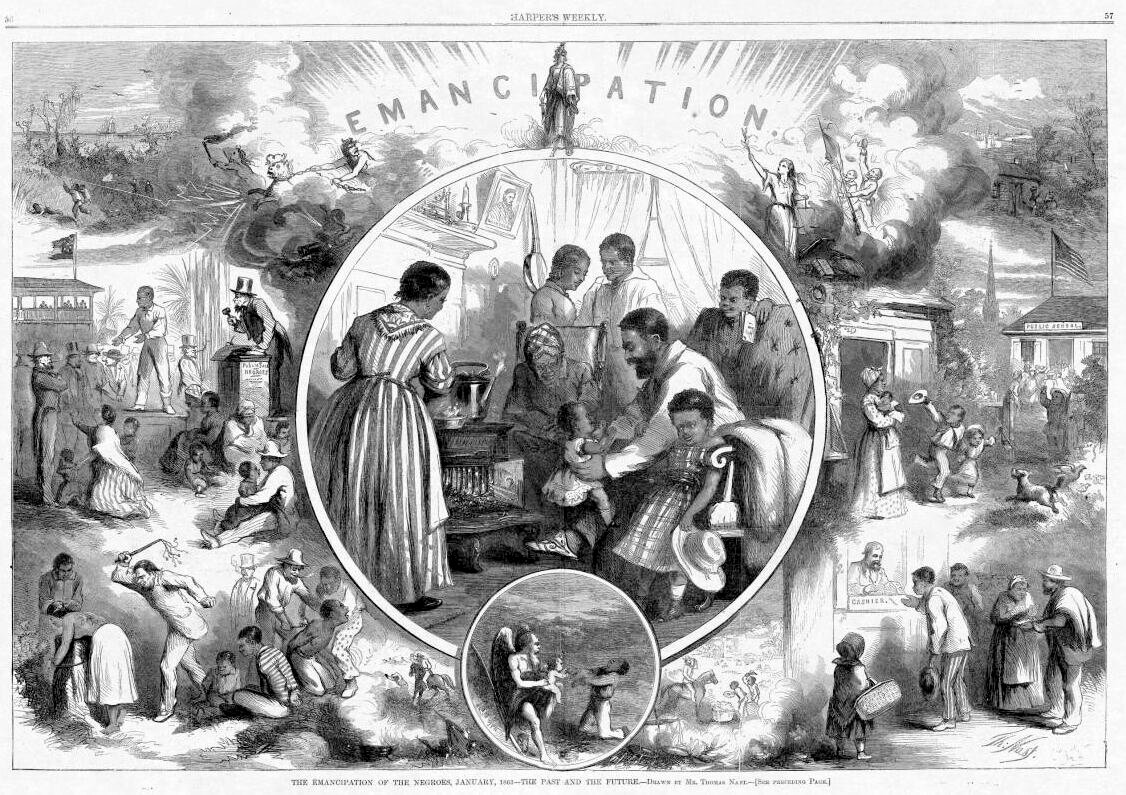
Showing posts with label Emancipation Proclamation. Show all posts

Wednesday, July 8, 2020

What Is Gerrymandering? A Public Educational Lesson For The Legal Geniuses

This is a public educational lesson for the "Legal Geniuses" (trademark pending) on the history of gerrymandering from our friends over at Affairs of the Sheep.


#maytheheavensfall

Voting is beautiful, be beautiful ~ vote.©

Sunday, June 14, 2020

The Tale Of Gerrymandering & SCOTUS: How To Cloak The Residuals Of The Peculiar Institution - Stealin' The Children, Land & Vote By Blasphemy

New York Society for the Prevention of Cruelty to Children, 1882 ...
Origins of Gerrymandering - CPS
There is a blog SCOTUS clerks use as reference when it comes to making decisions about gerrymandering cases.

This particular article, below, is about gerrymandering, which just so happens to be false advisement, which is used as obviation in generating court opinions and the law of the land because it omits to tell the tale of Child Protective Services as the Gerry Secret Society, to become so affectionately called in the United States, gerrymandering.

This is fraud because gerrymandering is the act of stealin' the children, land & vote, the residuals of the peculiar institution, whereby, SCOTUS has ruled is constitutional; hence, slavery was never abolished, due to the "Exception Clause" of the Thirteenth Amendment.

SCOTUS Realizes Gerrymandering Is Constitutional Stealin' The Children, Land & Votes Under The Thirteenth Amendment Exception Clause

Section 1. Neither slavery nor involuntary servitude, except as a punishment for crime whereof the party shall have been duly convicted, shall exist within the United States, or any place subject to their jurisdiction.
Section 2. Congress shall have power to enforce this article by appropriate legislation.
Appeal for National Society For The Prevention Of Cruelty To ...
The Allodial Title Holder of the Children's Trust Bonds
The following is the meaning of a bond and its many legal machinations of bondage, for children are immoveable chattels, attached to the allodial title of land, because children cannot be emancipated until the juridic age of 15 years.

15 U.S. Code SUBCHAPTER III—TRUST INDENTURES

The following is the factual, recorded, origins, found in multiple attestation, of Gerrymandering, and the Gerry Secret Society, the response to Emancipation Proclamation: the creation of - 

Society for the Prevention of Cruelty to Children

Company Number
16120
Status
Inactive Merged Out
Incorporation Date
1 December 1920 (over 99 years ago)
Dissolution Date
18 April 2000
Company Type
DOMESTIC NOT-FOR-PROFIT CORPORATION
Jurisdiction
New York (US)
Registered Address
  • 100 EAST OLD COUNTRY RD, BOX 510, MINEOLA, NEW YORK, 11501
  • United States
Previous Names
  • CHILDREN'S HOUSE, INC.
  • NASSAU CHILDREN'S HOUSE, INC.
  • NASSAU CHILDREN'S SHELTER, INC.
  • SOCIETY FOR THE PREVENTION OF CRUELTY TO CHILDREN, NASSAU COUNTY, INC.
The Response 1874-1875

SPCC Founding 1874
Henry Bergh and Elbridge Gerry, aware that the hour for children had finally come, recruited respected philanthropist John D. Wright and formally pledged themselves to the establishment of organized child protection.
Children's Protective Society
The undersigned, desirous of rescuing the unprotected children
of this city and State
from the cruelty and demoralization which
neglect and abandonment engender'
hereby engage to aid, with their sympathy and support,
the organization and working of a Children's Protective Society,
having in view the realization of so important a purpose.
On December 15, 1874, the Society for the Prevention of Cruelty to Children was founded and organized. Gerry annunciated its unique purpose:
"to rescue little children from the cruelty and demoralization which neglect, abandonment and improper treatment engender; to aid by all lawful means in the enforcement of the laws intended for their protection and benefit; to secure by like means the prompt conviction and punishment of all persons violating such laws and especially such persons as cruelly ill treat and shamefully neglect such little children of whom they claim the care, custody or control."
NYSPCC Incorporation 1875
On Tuesday, April 27, 1875, the SPCC was incorporated as The New York Society for the Prevention of Cruelty to Children, the first child protection agency in the world. John D. Wright became its first president, Gerry and Bergh vice-presidents.

But this is what they were really doing:

Humanitarian reformers had expressed concern for children before the 1870s, organizing efforts to end the corporal punishment of school children, creating institutions to care for ORPHANS, and even sending orphans by train to foster families in the West. But reformers were reluctant to interfere in families, which had a recognized right to privacy. By the 1870s, the relative weights of the concern for children and the concern for family privacy had shifted. Mary Ellen's residence with foster parents (her biological parents were dead) may have eased her protectors' willingness to cross that boundary. Differences in class and culture also facilitated the creation of the SPCCs. The organizations were directed by wealthy, conservative, Protestant white men, whereas their clientele were mostly poor, Catholic immigrant families or poor black families. These were powerful distinctions during the late nineteenth century.
Their founders conceived of the SPCCs as law enforcement agencies. Agents were to find abused children–on the street or through tips made by concerned neighbors, relatives, and even the abused children themselves–investigate their families, and prosecute abusers. Many states gave the societies police powers, such as the right to issue warrants, or allowed the police to aid them. Most importantly, "the cruelty" (as SPCC agents were sometimes known in poor neighborhoods) could remove children from their homes.


Learn more: BEVERLY TRAN: SCOTUS Realizes Gerrymandering Is Constitutional Stealin' The Children, Land & Votes Under The Thirteenth Amendment Exception Clause http://beverlytran.blogspot.com/2019/10/scotus-realizes-gerrymandering-is.html#ixzz6PJ8lR5AB
Stop Medicaid Fraud in Child Welfare

The following is false information, intentionally manufactured to manipulate the public record, to control justice, in favor of the publishing blasphemer, because I just demonstrated that Jennifer Davis could have told the truth, if only she knew how to do a internet basic search, but, then again, blame could be attributed to Google, simply for the fact that they lied in testimony to U.S. House Judiciary Committee claiming they do not suppress searches, which obviouly they do, because the world is just finding out about the truth of the history of gerrymandering being the response to the Thirteenth Amendment:

#maytheheavensfall

Elbridge Gerry and the Monstrous Gerrymander

February 10, 2017

"The Gerrymander: a New Species of Monster" Boston Gazette, March 26, 1812, page 2, Newspaper, Serials and Newspaper Division. [//www.loc.gov/exhibits/treasures/trr113.html]
Gerrymander the Blasphemer
The first “gerrymander” was drawn on a map and signed into law on February 11, 1812. Elbridge Gerry, then governor of Massachusetts, signed into law a redistricting plan designed to keep his political party in power in the upcoming election. Upset that the Federalist Party was critical of James Madison’s foreign policy, Gerry signed the reapportioning plan that heavily favored his Republican party. Gerry, a man who staunchly followed his principles even against the popular actions of his colleagues, was hesitant to sign the law. The Republican legislators sponsoring and forcing through the bill redrew voting lines so that the Federalist vote was concentrated in a few districts, while the Republican vote was spread over many. ” The redistricting authorized by Gerry won 29 seats for the his Republican party, whereas the Federalists won a puny 11 seats.* Gerry’s district of Essex was a particularly odd shape, long on one side and curved along the north end.
“The Gerrymander: a New Species of Monster” Boston Gazette, March 26, 1812, page 2, Library of Congress Newspaper, Serials and Government Publications Division. 
When the law passed, reportedly the editor of the Boston Gazette posted the map with the newly drawn districts on his office wall, and in talking to a fellow editor, compared the shape of Gerry’s district to a salamander. The editor said, “Salamander! Call it a Gerrymander” — the portmanteau of Gerry + salamander. Gerry’s name, incidentally, is pronounced with a hard “g” as in “gary,” but over time the word “gerrymander” came to be pronounced with the soft “g” as in “jerry,” the pronunciation we use today. In any case, the picture of the cartoon gerrymander map was published in the Boston Gazette on March 26, 1812, with the caption: “The horrid Monster of which this drawing is a correct representation, appeared in the County of Essex, during the last session of the Legislature.” The word has since entered into national and international political language.
Gerrymandering is a current political topic today; as always, it is usually initiated by the incumbents to retain or increase their power. When gerrymandering is taught in U.S. history classes, it is likely students will be shown a picture of the original political cartoon drawn by Elkanah Tisdale for the Gazette and held here at the Library of Congress. Gerry did not win the 1812 election for his home district despite the reapportionment. He did, however, go on to become James Madison’s second vice president later in 1812. He was a signer of the Declaration of Independence, a member of the House of Representatives, twice governor of Massachusetts, and (full disclosure) he proposed the founding of the Library of Congress; he’d probably be dismayed to find this idea is how his name is remembered. Nevertheless, Gerry is forever tied to an important concept in American legal history.
If you’re interested in learning more about modern gerrymandering and the law, here is a shortlist of some of our recent holdings, and a map of Essex County:
KF4905.B85 2010 Bullock, Charles S., 1942-  Redistricting: the most political activity in America.
KF4891.S74 2004 Stephenson, D. Grier. The right to vote: rights and liberties under the law.
KF4557 .S74 2014 Stevens, John Paul,  1920-  Six amendments: how and why we should change the Constitution.
KF4886 .T65 2013 Tokaji, Daniel P. Election law in a nutshell.
G3763.E7F7 1812 .E8 Essex County; Worcester County.
*source: Selesky, Harold E. Encyclopedia of the American Revolution: Library of Military History2006
The following is the history of gerrymandering by the American Society for the Prevention of Cruelty to Children:


The following is a video on the U.S. history of Gerrymandering.


Voting is beautiful, be beautiful ~ vote.©

Tuesday, July 30, 2019

TRUMP: Speaks Upon The Residuals Of The Peculiar Institution In Jamestown, Virginia

With each use of the Predictive Modeling Crappy lump and dump, arbitrary and capricious, pseudocientific, fake ass, variable label of "African-American" applied in public discourse, another one-drop baby is born, prematurely, with legal shackles of property ownership in chattel law.

And you wonder why nothing ever changes.

But, now, the "Legal Geniuses" (trademark pending) want to bring back segregation to its glorious splendor through parental rights in privatization, and are prepared to launch #coloredrevolutions to distract the masses with rainbow propaganda, to cloak the trafficking of tiny humans, what has built this great nation.

There is still the 13th Exception, as I like to posit, just to watch people freak out when they actually figure out that slavery was never abolished because they now just call it commerce, I just call it for what it is, highly sophisticated financial fraud schemes of asset forfeiture to foreign operations, because the majority of them are just Corporate Shape Shifters and it is still legal to procure and purvey tiny humans.

Human asset management, modern day human trafficking, is called child welfare and we can start with the history of Foster Care and Adoption.

Virginia Statutes 

Negro Womens Children to Serve According to the Condition of the Mother, 
Virginia Act 12 (1662)164 
Whereas some doubts have arisen whether children got by any Englishman upon a Negro woman should be slave or free, Be it therefore enacted and declared by this present grand assembly, that all children born in this country [sic] shall be held bond or free only according to the condition of the mother, And that if any Christian shall commit fornication with a negro man or woman, he or she so offending shall pay double the fines imposed by the former act.

WILLIAM WALLER HENING, THE STATUTES AT LARGE; BEING A COLLECTION OF ALL THE LAWS OF VIRGINIA, FROM THE FIRST SESSION OF THE LEGISLATURE IN THE YEAR 1619 170, § 12 (1823)


#sayhisname

The First Foster Care Case of Emancipation: Elizabeth Key

Elizabeth Key (fl. 1655–1660) was a principal in one of the important early court cases that shaped the evolving law of slavery in seventeenth-century Virginia. Her mother's name is not preserved in the surviving documents, but it is known that she was of African birth or descent and that an English planter, Thomas Key, claimed ownership of her. Depositions taken when Elizabeth Key sued for her freedom proved that he was her father and had been fined for impregnating her mother. His surname occasionally appeared in the records as Kay or Kaye, suggesting its pronunciation. She was known when young as Elizabeth, Bess, or Black Bess, and was born about 1630 or 1632, probably on the north side of the James River near its mouth. Her father resided there late in the 1620s and in 1630 when he was a burgess for Denby (later a part of Warwick County and still later of the city of Newport News) in the General Assembly.

In the autumn of 1636 when Thomas Key and his wife were preparing to return to England, he transferred Elizabeth to Humphrey Higginson, later a member of the governor's Council, for a period of nine years. Key specified that Higginson treat her well and that if Higginson returned to England before the end of the term of service, he must take the girl with him and allow her to have her freedom, or that if Higginson died before the end of the nine years, the girl would become free. Higginson promised to treat Elizabeth as if she were his own child.

Thomas Key died shortly thereafter, even before he left Virginia. In spite of the terms of the agreement, Elizabeth evidently remained in constant service from then until the winter of 1655–1656, long beyond the specified nine years. By then and through a series of events that are not documented, she passed from Higginson's service (he moved to England) into that of John Mottrom, a prominent and relatively prosperous planter in Northumberland County, near the mouth of the Potomac River. By the summer of 1655 she and William Grinsted, who may have been one of Mottrom's white indentured servants for a time, had a son and another child who died in infancy.

Mottrom died in 1655. The inventory of his estate, taken on July 4 of that year, separately identified six servants and five "Negroes." That the men who compiled the inventory listed the two classes of laborers separately suggests that they regarded the "Negroes" as essentially different in status from the other servants, probably as enslaved for life. How Mottrom regarded them is not known. The estate inventory included "Elizabeth the Negro woman & her sonne."

Elizabeth sued the administrators of Mottrom's estate to obtain her freedom. She had to rely on the assistance of a local planter or perhaps the county clerk to prepare the necessary legal documents, obtain and verify a copy of the 1636 agreement between Thomas Key and Humphrey Higginson, take the depositions that established her parentage and age, and present her case to the county court. One of the court records identified Grinsted as her attorney. What that meant was that he was her attorney in fact, not an attorney at law. It was an important distinction. An attorney in fact was an agent who acted for a person, either with or without a formal power of attorney. Women, minors, and other dependent people often required the assistance of free adult men to represent their legal interests in court. That was what Grinsted did. An attorney in fact need not even be educated, much less trained in the law, and references to Grinsted in the county records suggest that he was then in his early twenties and not literate.

On 20 January 1656, a Northumberland County jury decided that Elizabeth should be free. The administrators of Mottrom's estate appealed the verdict to the governor and members of the Council of State, who comprised the Quarter Court, also called the General Court, which was colony's only court of appeal. The court heard the case on 12 March 1656. The court's records for the period are lost and the reasons for its decision are not known, but it is clear that the court ruled against her.

The legal issues involved were important and in this particular instance somewhat complicated. Under the English common law doctrine of partus sequitur partem, a father's status determined that of a newborn child. Thomas Key was free, so his daughter should have been born free. Under another principle of English common law, Englishmen could not hold Christians in slavery, an important point because Elizabeth had been baptized and was a member of the Church of England.

She appealed the court's decision to the General Assembly that first met on 10 March 1656. At that time and for almost another quarter century thereafter, the General Assembly had authority to hear and rule on appeals from judgments of the General Court. The General Assembly's original records for the period are also lost, but some of its papers relating to her case were subsequently copied into the Northumberland County record books. In the surviving texts, she was for the first time identified as Elizabeth Key.

The assembly referred the evidence to a committee of burgesses, who concluded that the Northumberland County jury had been correct and that "by the Common Law the Child of a Woman slave begott by a free-man ought to bee free." That appeared to confirm the enslaved status of Elizabeth Key's mother and that Elizabeth Key had been held in slavery, not as a servant for a limited specified time. The committee also noted that she had been christened, that Higginson had been her godfather, and that "by report shee is able to give a very good account of her fayth." The committee of burgesses therefore determined that under all the existing rules of law, even without any clear parliamentary or Virginia statutes and in spite of the General Court's verdict, she was entitled to her freedom and to her father's surname. The burgesses also stated that she was entitled to compensation for the time that she had been a servant or slave beyond the nine years specified in the agreement of 1636. Nevertheless, because nobody appeared at the assembly to argue the estate's side of the case, the burgesses recommended that the case be sent back to the county court.

Early in the summer of 1656, one of the administrators of Mottrom's estate asked the governor to order the county court not to act until the General Court could again consider the case, and the governor complied, but the county court acted, anyway, perhaps before it received the governor's directive. On 21 July 1656, the justices of the peace in Northumberland County ruled that Elizabeth Key be free, that she be paid from Mottrom's estate the customary freedom allowance of corn and clothing that an indentured servant received at the end of his or her service, and also that she receive compensation for the additional years of her service as the burgesses had recommended. By those acts, the county court freed her from slavery according to the common law and also from any lesser service according to the law of master and servant as understood and administered in Virginia.

On that very same day William Grinsted (also spelled Greensted and Grimstead in the records) and Elizabeth Key posted their banns and declared their intention to marry, and one of the administrators of Mottrom's estate later signed over to Grinsted all the estate's claim of ownership of Elizabeth Key or her labor. By that act the estate relinquished all claim to her as a slave or to her labor as a servant.

The legal issue of her freedom being settled, few additional occasions occurred for county officials to record information about her. By the summer of 1660 Elizabeth Key Grinsted had another son and a daughter named Elizabeth. Her husband later died, and she may have married a second time. The will of John Parse (or Pearce), recorded in Northumberland County on 20 May 1667, indicates that he had married the widow Elizabeth Key Grinsted and suggests that she was dead by then. Parse bequeathed 300 acres of land as well as livestock and household items to his underage daughter Elizabeth Parse and 500 acres of land and other livestock to John Grimstead and William Grimstead, whom he identified as his sons and also as his sons-in-law. Elizabeth Key's sons who were then living were named John Grimstead and William Grimstead. By the legal usages of the time, the phrase son-in-law embraced many more people than a daughter's husband and often meant a male who occupied the legal relationship of a son, what in the twenty-first century would be called a stepson. It would have been within that meaning of the phrase that Parse described the sons of his wife as his own sons or sons-in-law.

In time, the county's officials forgot or chose to ignore Elizabeth Key Grinsted Parse's origins as the illegitimate daughter of an English man and an enslaved African woman. Early in 1685 the county court ordered that two of her grandsons be bound out to learn a trade, which was commonplace for white children but not for people of African birth or descent. A year later their father—her son—served on a jury, indicating that the county court no longer regarded him as part African but as a white man and a loyal subject of the king.

Elizabeth Key's successful suit to secure her freedom was probably responsible directly or in part for the General Assembly's passage in 1662 of an act to reverse the English Common Law doctrine of partus sequitur partem and replace it with partus sequitur ventrem, making the status of the infant depend on that of the mother. The law also increased the penalties for fornication between men and women of different races. Thereafter, at the time of their birth the children of white male Virginians and enslaved female laborers legally became somebody's slave property for life. In 1667 the assembly also changed the law to specify that conversion of an enslaved person to Christianity did not confer freedom on that person. The new laws were two among several instances in which the needs of Virginia tobacco planters for laborers and the practical consequences of managing enslaved workers led seventeenth-century legislators and judges to modify or reverse ancient rules of English law for the benefit of the planters.

The unforeseen and unfortunate consequences of Elizabeth Key's freedom suit were innovations in Virginia law that influenced legal codes elsewhere in the English North American colonies and that doomed hundreds or thousands of descendants of European men and women to lifetime slavery along with thousands of men and women of African birth or descent and an increasingly large population of mixed-race men, women, and children.


Voting is beautiful, be beautiful ~ vote.©

Sunday, January 27, 2019

Orphan Trains - When The Plantations Beared Christian Arms Of Foster Care & Adoption

The Orphan Trains of Michigan started in Coldwater, which is now know as the Michigan Children's Institute, but it was transformed from a brick and mortar institution into a theoretical one.

I have written extensively on this, but it has been removed due to copyright violations.

Funny, huh?

Look at these orphan trains like this.

The Emancipation Proclamation was signed.

The next day everyone beared a christian arm over their plantation operations and were able to acquire a larger and much more lucrative population of goods, expanding operations into all aspects of society as child welfare.

This continues today, but just in a much more compassionate form called foster care and adoption.


ORPHAN TRAIN IN MICHIGAN


Did you know 12,500 orphans from New York City and the Boston area were placed in Michigan from 1854 to 1927.  The production company spent a year and a half in research and searching for photos of the Orphan Train Riders in Michigan. They have produced a television documentary about this event in Michigan’s history, depicting in great detail the selection process and being an Orphan Train Rider.  Over the past 5 years, the Program Source has been offering lectures on the topic.  On several occasions, we’ve had actual Orphan Train Riders and their relatives in attendance, to tell us their stories.
The first Orphan Train Riders (14 boys), arrived in Dowagiac, Michigan on a Sunday morning in late September 1854, traveling on the Michigan Central Railroad.  By 1927, forty-three Michigan towns would also receive orphans from the “Baby Train”, as it was sometimes called.  Most of the children came from the New York Children’s Aid Society and the New England Home for “Little Wanderers”.  Thirty nine percent were girls, and most children were never adopted.
motivation for producing “The Orphan Train in Michigan” documentary was first discovered at the Oxford Historical Society while working on that town’s history.  The Program Source wants to help relatives of  Michigan Orphan Train Riders with information on dates and placement in Michigan.  In the Fall of 2004, a reenactment of the first Michigan Orphan Train Riders took place in Dowagiac, Michigan.  An entire weekend was planned around the event, with reenacters following in the footsteps of the earlier orphans and walking from the Railroad Depot to the old Methodist Church for placement.  A Michigan Orphan Train Registry is in development to document the names, places and any other information regarding these riders.  If you know of an Orphan Train Riders or have a relative that may have come to Michigan through the placement program, send us an email to:   otim (at) program-source.com  .    Please include as much information as possible.  For more information regarding the Orphan Train, try some of these links:
www.cyndislist.com            www.rootsweb.org          www.obituarieshelp.org

Voting is beautiful, be beautiful ~ vote.©

Tuesday, October 16, 2018

LIBRARY OF CONGRESS: When Congress Taxed Churches: Religion & Politics in the District of Columbia After the Civil War

It is always good to know how the funding systems for the chattel law, or rather the trafficking of tiny humans in the name of the tax exempt god all started.

Obviation is why we preserve the annals of history.

SPEAKER: Sally Barringer Gordon
EVENT DATE: 2018/07/10
RUNNING TIME: 57 minutes
TRANSCRIPT: View Transcript (link will open in a new window)
DESCRIPTION:
Sarah Barringer Gordon presented the annual Cary and Ann Maguire Chair in Ethics and American History Maguire Lecture titled "When Congress Taxed Churches: Religion and Politics in the District of Columbia After the Civil War." In 1874, Congress imposed taxes on all religious property in the District of Columbia. Other jurisdictions also debated taxing churches and some did, including Missouri and California. This lecture explores why imposing taxes on all religious property in the District of Columbia seemed like a good idea to many religious and political thinkers in the 1870s, and how the backlash against them created the extraordinarily deferential system that has only increased exemptions over the past 145 years. Gordon's talk was a culmination of four months of research in Library's collections for her upcoming book tentatively titled "Freedom's Holy Light: Disestablishment in America, 1776-1876."
Speaker Biography: Sarah "Sally" Barringer Gordon held the Maguire Chair at the Library's John W. Kluge Center in 2017 and is Arlin M. Adams professor of Congressional law and professor of history at the University of Pennsylvania. She is well known for her work on religion in American public life and the law of church and state, especially the ways that religious liberty developed over the course of American national history.

Friday, June 17, 2016

On this day in 1865, slaves in Galveston, Texas learned of the end of slavery and the Civil War

It was also on this day the nation was introduced the replacement of slavery with the child welfare model.


#Juneteenth #FreedomDay

Voting is beautiful, be beautiful ~ vote.©

Tuesday, January 1, 2013

Conyers' Letter to Our Ancestors: To Those Who Came Before Us


U.S. Congressman John Conyers, Jr. at Henry Ford Museum
viewing of the Emancipation Proclamation 


To those who came before us:

In the darkest watches of the night, you dared to dream of a day when your descendants could breathe the air of freedom. As we mark the 150th anniversary of the Emancipation Proclamation, we salute the boldness of your dreams and reflect upon the value of your sacrifices. 

In many ways, the lives of your children have evolved beyond imagining; in others their circumstances are shockingly familiar. You would be proud of the progress that our nation has made since the days of the Civil War and Emancipation. Your children have become captains of industry, important contributors in every field of academics, and world leaders in government -- one even occupies the seat of Lincoln in the White House. 

The road to these successes, however, has been neither straight nor smooth. It was 100 hundred years before a rainbow of Americans gathered in Washington to hear your son, Dr. Martin Luther King, give voice to your dreams and inspire us to continue this complex struggle toward racial equality in America. The full promise of Emancipation has not yet been realized and even in the 21st century many sacrifices are required to protect hard-won progress. 

Throughout the protests, marches and sit-ins, your strength in enduring the pain and the bondage of slavery gave us the determination to continue this fight. Our struggle was not one for African Americans alone. We fought for the very soul of this nation, that the American dream could have meaning for every citizen, and for every person who aspired to reach our shores. Your early sacrifices inspired the great diversity of the American people and were held as an example for those struggling for freedom and justice everywhere.
Reflecting on our path, one cannot forget or undervalue your gifts of vigilance and determination. In a test of our resolve, every success was met with a series of setbacks. Without these gifts, we may have lost hope and direction. Even today, after gaining the franchise and electing an African-American president, we must take care to protect these hard-won rights from slipping away as some in this new generation would divert us from the path toward a more just society. We will maintain our vigilance because your example has taught us that we have only traveled a short way on our long journey to freedom. 

The successes of a few of our people may tempt some to believe that the struggle for equality has reached its conclusion and we are a race-blind society. That message ignores our young sons who are disproportionately trapped by a criminal justice system in a prison pipeline, targeted because they have insufficient access to education and employment opportunity, and far too easy access to drugs and guns. Some have labeled them an "underclass" caste, pushed to the margins of society and warehoused in prisons. Our task is not just to celebrate the successes but analyze and repair the problems that cause so many to be mired in hopelessness. Remembering our collective past and the path since emancipation makes us responsible for addressing this 21st century dilemma. Respect for your memory will not allow us to turn away.


Voting is beautiful, be beautiful ~ vote.©

Sunday, July 10, 2011

Bachmann: Black Kids Better Off During Slavery

And she wants to run for president of the Untied States.  Wow.

Bachmann: Black Kids Better Off During Slavery


Minneapolis, MN - Social-conservative GOP presidential candidate Michele Bachmann of Minnesota has again used a slavery analogy that has pundits scratching their heads. While signing a controversial conservative Christian group's pledge to oppose same-sex marriage and uphold its so-called "core values", the Minnesota representative agreed to the following.

"Slavery had a disastrous impact on African-American families, yet sadly a child born into slavery in 1860 was more likely to be raised by his mother and father in a two-parent household than was an African-American baby born after the election of the USA’s first African-American President."

Critics chimed in immediately reminding the GOP candidate that slave families were often broken up as a matter of business. Marriage between men and women slaves was not recognized and was infact illegal. Family members were sold or traded off to other plantations and were viewed as nothing more than beasts of burden. Not to mention these children did not learn to read, write or calculate math while getting daily lessons in humiliation and cruel and unusual punishment.

Bachmann, who previously and erroneously referred to John Quincy Adams as a "founding father" who worked tirelessly to free slaves, was likely making a reference to a study note in the pledge. That note cited a 2005 research paper called "The Consequences of Marriage for African Americans".
According to the study, by 1880, 56.3 percent of Black households were what we now call “nuclear families.” (For Whites, that figure was 66.9 percent.) By 1950, nearly 80 percent of Black families were headed by married couples. By 1996, that figure had dropped to just 34 percent.
But one of the authors of the study, Dr. Lorraine Blackmon, told Forbes.com that Bachmann is "just wrong” and made "a serious error."

While the data regarding the dissolution of the black family over the centuries is considered stark, Bachmann while likely be defending her historical rendition on the Sunday talk show circuit.

Tuesday, June 21, 2011

Emancipation Proclamation On View At Henry Ford Museum

If anyone remembers, there was the reading of the U.S. Constitution on the floor of the House of Representatives.  This was a selective reading of one of the most powerful documents in the world, where the elected majority, touted a denial of history by omitting the sections of slavery.

The Emancipation Proclamation was the beginning of the civil rights movement with civil rights being the rights to a promulgate a civil society.  We have not only forgotten what civility is, but the concept of peace.

The Henry Ford Museum, Dearborn, Michigan, is allowing the opportunity for anyone and everyone to view the original Emancipation Proclamation for free.  The "Discovering the Civil War" event is open to the public for a continuous 36 hours, until 6:00 a.m., June 22, 2011, on loan from the National Archives,

"Only in a democracy can you get this reevaluation of history," U.S. Rep. John Conyers told FOX 2.


For those who may not be able to view the documents up front and personal, here is one of the posters that was sent out throughout the States during the Civil War.


Also on view is the original draft of the 13th Amendment.


Section 1. Neither slavery nor involuntary servitude, except as a punishment for crime whereof the party shall have been duly convicted, shall exist within the United States, or any place subject to their jurisdiction.
Section 2. Congress shall have power to enforce this article by appropriate legislation.


The Emancipation Proclamation exists as a constant reminder of the magnanimous powers of the Constitution and should be read in tangent with the Original Parchment, as a living, breathing reminder of what we should never allow our elected leaders to ever forget that the original intent was to develop a civil society of peace, where all men were created equal.

Article I. Section. 9.

Clause 1: The Migration or Importation of such Persons as any of the States now existing shall think proper to admit, shall not be prohibited by the Congress prior to the Year one thousand eight hundred and eight, but a Tax or duty may be imposed on such Importation, not exceeding ten dollars for each Person. 


Article I. Section 2. Paragraph 3.


Representatives and direct Taxes shall be apportioned among the several States which may be included within this Union, according to their respective Numbers, which shall be determined by adding to the whole Number of free Persons, including those bound to Service for a Term of Years, and excluding Indians not taxed, three fifths of all other Persons.

This is the original parental rights doctrine, the preservation of the family.