Showing posts with label Matthew Schneider. Show all posts

Thursday, October 1, 2020

Prelude To Detroit: The Fools Jacob Wohl & Jack Burkman Interfered With The 2020 Election During The 2020 Election Interference Investigation - Light Up That Network

Well, it is quite obvious they have never read my blog.

It must be one of those google search suppression issues.

Dana is not happy and this is something I am quite secure in stating.

Oh, and neither is Matt, to say the least!

Now, you do know there are going to be sophisticated queries into their financial encouragement, right?

May the gods forbid there exist a russian* origin of the funding source.

That would be quite awkward, legally, I mean.

I shall assume all of the cyber associates of Jacob and Jack will be examined for a possible transposable model, of such actions, but, hey, what do I know?

I know we have just lit up another network.

*intentionally spelled in lower case to bifurcate the difference of a government and some gluttonous individuals of nefarious avarice.

#maaytheheavensfall

Michigan AG charges conservative activists for robocalls trying to dissuade urban voters from voting by mail

DETROIT (FOX 2) - Two notorious conservative activists have been charged with multiple felonies in Michigan for a series of false robocalls that aimed to dissuade urban residents in Detroit and other cities from voting by mail.

Jacob Wohl, 22, and Jack Burkman, 54, each were charged Thursday with four felony counts in Detroit, including intimidating voters in violation of election law, conspiracy, and using a computer to commit crimes.

The calls falsely warned residents in majority-Black Detroit and urban areas in at least four other states that voting by mail in the Nov. 3 election could subject people to arrest, debt collection and forced vaccination. In August, the men denied involvement. Michigan Attorney General Dana Nessel says the pair created and funded them.

According to Nessel, 12,000 calls went out to phone numbers in the 313 area code. Nessel investigated and communicated with attorneys general offices in New York, Pennsylvania, Ohio and Illinois, all of which reported similar calls to urban areas with significant minority populations.

It's believed 85,000 calls were made nationally, Nessel, though an exact breakdown for each city or state is not available.

“Any effort to interfere with, intimidate or intentionally mislead Michigan voters will be met with swift and severe consequences,” Nessel said. “This effort specifically targeted minority voters in an attempt to deter them from voting in the November election. We’re all well aware of the frustrations caused by the millions of nuisance robocalls flooding our cell phones and landlines each day, but this particular message poses grave consequences for our democracy and the principles upon which it was built. Michigan voters are entitled to a full, free and fair election in November and my office will not hesitate to pursue those who jeopardize that.” 

The recorded robocall message warns people about being “finessed into giving your private information to the man” and urges them to “beware of vote by mail.” 

You can listen to the call for yourself here.

The caller, who claimed to be associated with an organization founded by Burkman and Wohl, told people that voting by mail, in particular, will allow personal information to become part of a "special database used by police to track down old warrants and by credit card companies to collect outstanding debts."

Voting is beautiful, be beautiful ~ vote.©

Thursday, July 16, 2020

Tales Of The New Crown: AG Boo Boo Barr Is In Grand Rapids With Matt Schneider & Andrew Birge On China

Bill "Boo Boo" Barr deserves a standing ovation in his open mike poetry afternoon session in Grand Rapids, Michigan.

The topic was China.

Did Boo Boo talk about the U.S. Patent & Trademark Office in Detroit, or how it even came to be the first satellite PTO outside of DC?

Nope, but he did use lots of alliteration and WWII Disney references when talking about "bowing" to Beijing.

Did Boo Boo talk about China and the DNC?

Nope.

Did Boo Boo talk about how a bunch of folks from other nations, hanging out in China, as I cannot call them Chinese, because I have yet to see any passports or corporate parental filings, running fake ass LLCs, fake ass mortgages, and fake ass quiet titles in Detroit?

Nope.

Did Boo Boo Barr talk about the U.S. auto industry in China?

Nope, well, there are ongoing actions with MIED, so he probably was not allowed to speak upon it.

Not a peep about the Vatican.


Overall, the speech was one of his better ones because Matt Schneider and Andrew Birge were there.

#maytheheavensfall

In Grand Rapids, Barr decries China's 'predatory' trade practices

U.S. Attorney General William Barr decried China's "predatory" trade policies during a 30-minute speech in Grand Rapids on Thursday, accusing the country of manipulating American businesses, stealing trade secrets and attempting to hack U.S. efforts to develop COVID-19 treatments and vaccines. 

China's ultimate goal since the 1980s, "isn't to trade with the United States, it is to raid the United States," Barr said from the podium at the Gerald R. Ford Presidential Museum. 

"No one should underestimate the ingenuity and industry of the Chinese people," he said. "At the same time, no one should doubt the United States made China’s meteoric rise possible.”

Thursday's appearance in Grand Rapids was Barr's first in roughly 30 years when he visited the area while working under former President George H.W. Bush, he said.

"I feel a special bond to the Ford administration, so it's appropriate to be here today," said Barr, who worked in the CIA under Ford appointees in the 1970s.

"I had the privilege to work with many of the superb people he brought into government, many of whom I had the opportunity to work with over the years, several of whom were my mentors," he said.

Barr's appearance at the museum is his first in Michigan since Schneider filed a "state of interest" on behalf of the Department of Justice in a federal lawsuit brought by seven businesses challenging the governor's executive orders to combat COVID-19. 

Federal prosecutors claimed credit for moving the needle on reopening when, four days after the statement was filed, Gov. Gretchen Whitmer moved Michigan out of a stay-home order and into loosened restrictions allowed under her reopening plan. 

The lawsuit filed by the businesses is ongoing.

During his speech Thursday, Barr also alleged China's influence had infiltrated not only manufacturing and production but also film production companies, technology firms, the pharmaceutical market and universities. 

Chinese hackers have targeted American universities and researchers to steal information on the development of COVID-19 treatments and vaccines, Barr said. They're hoping the introduction of a treatment by China would redeem its role in spreading the virus, he said.

"Beijing is desperate for a public relations coup and may hope it could take credit for any medical breakthroughs," he said. 

Voting is beautiful, be beautiful ~ vote.©

Sunday, June 14, 2020

DOJ: Nineteen Individuals Indicted In $41 Million Illegal Opioid Distribution Conspiracy


A Clinic Owner, Four Doctors, Two Nurse Practitioners and Three Pharmacists among Those Indicted

An indictment was unsealed today charging nineteen individuals with conspiracy to illegally distribute prescription drugs, U.S. Attorney Matthew Schneider announced today.

U.S. Attorney Schneider was joined in the announcement by Special Agent in Charge Keith Martin, U.S. Drug Enforcement Administration, Detroit Field Division; Special Agent in Charge Steven M. D’Antuono, Federal Bureau of Investigation and Special Agent in Charge Lamont Pugh, the Department of Health and Human Services, Office of Inspector General (HHS-OIG).
The 44-count indictment charges defendants with an alleged drug conspiracy involving prescription drug controlled substances including Oxycodone, Oxymorphone, Oxycodone-Acetaminophen (Percocet), Hydrocodone, Hydrocodone-Acetaminophen, promethazine with codeine cough syrup, and other drugs.
Charged in the indictment are:

John Henry Rankin, III, 46, Detroit,                                  
Dr. Beth Carter, 56, Southfield,
Dr. Robert Kenewell, 52, Auburn Hills,
Dr. Jason Brunt, 50, Clawson,
Dr. John Swan, 30, St. Clair Shores,
Nurse Practitioner, Jean Pinkard, 63, Farmington Hills
Nurse Practitioner Toni Green, 58, St. Clair Shores,
Fitzgerald Hudson, 60, Southfield,
Virendra Gaidhane, 49, Troy
Pharmacist, Maksudali Saiyad, 65, Troy
Pharmacist Adeniyi Adepoju, 61, Warren,
Pharmacist Ali Sabbagh, 36, Dearborn Heights
Robert King, 38, Taylor,
Jermaine Hamblin, 36, Roseville,
Sonya Mitchell, 50, Southfield,
Lavar Carter, 56, Southfield,
Robert Lee Dower, Jr., 49, Eastpointe
Denise Sailes, 51, Detroit, and
Dewayne Bason, 28, Detroit

The indictment alleges that from September 2017 through June 2020, John Henry Rankin, III, owner of New Vision Rehab and Preferred Rehab clinics would provide monetary remuneration and other illegal benefits to Dr. Beth Carter, Dr. Robert Kenewell, Dr. Jason Brunt, Dr. John Swan, Nurse Practitioner Jean Pinkard and Nurse Practitioner Toni Green to induce them to write prescriptions for “fake” patients, who did not have a legitimate medical need for the drugs.  Rankin also allegedly provided monetary remuneration to an unlicensed medical professional, who was not legally authorized to prescribe controlled substances or practice as doctor, who would pose as a doctor and issue pre-signed controlled substance prescriptions in the names of other providers.
It is alleged that the medical professionals named in the indictment prescribed more than 1,951,148 dosage units of Schedule II controlled substances.  The prescribed Oxycodone and Oxymorphone, alone, carried a conservative street value of more than $41 million. Oxycodone and Oxymorphone are two of the most addictive opioids and they have high street value.  Patients were recruited into the conspiracy by patient recruiters or “marketers,” to include Robert King and Jermaine Hamblin.
The indictment further alleges that during this conspiracy, prescriptions were presented to Detroit New Hope Pharmacy (owner Virendra Gaidhane, pharmacist Maksudali Saiyad, pharmacy tech Dewayne Bason), Synergy Pharmacy (pharmacy technician Dewayne  Bason), Nottingham Pharmacy (owner Virendra Gaidhane), Crownz Medical Pharmacy (pharmacist Adeniyi Adepoju), Franklin Healthmart (pharmacist Ali Sabbagh).  Some of the pharmacists would bill insurers, including Medicare, Medicaid, and private insurers, for dispensing the medications, despite the fact that the medications were medically unnecessary. Other times, the pharmacists accepted cash from the recruiters for filling and dispensing medications. 
According to the indictment, the pharmacies dispensed more than 58,725 dosage units of Schedule II controlled substances prescribed by the medical professionals listed in the indictment.
“Prescription drugs are supposed to go to people who truly need them, not to fake patients or people selling drugs on the streets,” United States Attorney Matthew Schneider said. “We are focusing on charging doctors, pharmacists, and the networks that add to the opioid crisis, and this case is unfortunately yet another example of the serious problem facing Michigan.”
Special Agent in Charge Keith Martin, U.S. Drug Enforcement Administration, Detroit Field Division, stated, “These enforcement actions and others like them around the country, demonstrate our commitment to prosecuting licensed professionals who flood communities with addictive legal drugs for their own personal benefit”
“Today’s indictments are the result of healthcare professionals allegedly contributing to the devastating opioid crisis instead of working toward its solution. The public expects and deserves more from them,” said Steven M. D’Antuono, Special Agent in Charge of the FBI in Michigan.
 “The opioid epidemic continues to have a harmful impact on many people across this country”, said Lamont Pugh III, Special Agent in Charge, U.S. Department of Health & Human Services, Office of Inspector General – Chicago Region. “Medical professionals who choose to participate in schemes as alleged in this indictment only exacerbate the problem. The OIG will continue to dedicate and prioritize resources to the investigation of allegations of this nature in an effort to ensure the health and safety of patients and taxpayer dollars.”
This case is being prosecuted by Assistant United States Attorneys Brandy R. McMillion and Mitra Jafary-Hariri.  The Eastern District of Michigan is one of the twelve districts included in the Opioid Fraud Abuse and Detection Unit, a Department of Justice initiative created by Attorney General Sessions, that uses data to target and prosecute individuals that are contributing to the nation’s opioid crisis.
The case was investigated by special agents and task force officers of the Drug Enforcement Administration, the Federal Bureau of Investigation, and the Department of Health and Human Services, Office of Inspector General.
An indictment is only a charge and is not evidence of guilt.  Each defendant is entitled to a fair trial in which it will be the government’s burden to prove guilt beyond a reasonable doubt.

Voting is beautiful, be beautiful ~ vote.©

Thursday, June 4, 2020

Tales Of The New Crown: DOJ Charges Detroit Procurement Consortia Task Force Small Business Wire Fraud Scheme - But Not Sherry The Sleuth - Yet

I wonder when I shall read a MIED presser on all the glorious things Sherry "The Sleuth" Gay Dagnogo has done for the children of Detroit because we already knows what she does for herself.


A Detroit resident was charged in a criminal complaint for his alleged role in a scheme to obtain $590,900 from the Payroll Protection Program for a non-functioning business, announced United States Attorney Matthew Schneider.
Joining in the announcement was Special Agent in Charge Steven M. D’Antuono, Federal Bureau of Investigation.
Charged is Darrell Baker, 51, of Detroit, Michigan.
As alleged in the complaint, Baker applied for and obtained a $590,000 Payroll Protection Program Loan on behalf of a purported business that he owns, called “Motorcity Solar Energy, Inc.” The Paycheck Protection Program is a program managed by the Small Business Administration (SBA) that provides loans to help businesses keep their workforces employed during the Covid-19 crisis. The SBA will forgive the loans if all employees are kept on the payroll for eight weeks and the money is used for payroll, rent, mortgage interest, or utilities. The Payroll Protection Act loans are funded from participating banks, in this case Customers Bank in Pennsylvania.
The complaint further alleges that Baker submitted paperwork with his loan application representing that Motorcity Solar Energy Inc. had 68 employees and, in 2019 paid wages, tips, and other compensation totaling $2.8 million. In fact, the state of Michigan had dissolved Motorcity Solar Energy Inc.’s status as a corporation in July 2019. All of Motorcity’s purported business locations were either empty suites or single-family residences, with no evidence of business activity. And Motorcity never established any account with the State of Michigan’s unemployment insurance program, which is a prerequisite for any valid employer in the state. 
The complaint further alleges that, in the two days after the loan was funded, Baker purchased four cashiers checks and withdraw an additional $60,000 in cash. None of these cashier’s checks went to payroll or other business expenses. Indeed, Baker used the four cashiers checks to purchase two Cadillac Escalades, a Dodge Charger, and a Hummer.  According to the complaint, Baker purchased one of vehicles for his brother-in-law and one for his sister; the remaining two vehicles Baker kept for his own use and enjoyment.
United States Attorney Schneider stated “Defendant Baker is charged with lying to obtain money that was supposed to help small businesses struggling with their payroll and expenses due to the COVID-19 pandemic.  Defrauding banks to obtain loans is never acceptable, and doing so during our current national emergency is unconscionable.  This prosecution is yet another example of our office’s commitment to holding accountable anyone who would exploit the COVID-19 crisis for their own greedy desires.” 
“The Paycheck Protection Program is designed as a lifeline to businesses struggling to survive this current crisis. Instead of using these loans to salvage a legitimate business, the defendant allegedly bought expensive personal items for himself and his family,” said SAC D’Antuono. “These actions harmed hard-working Americans and deserving small businesses. The FBI is committed to investigating anyone who seeks to take advantage of a global pandemic to line their own pockets at the expense of American taxpayers.”
A complaint is only a charge and is not evidence of guilt.  Trial cannot be held on felony charges in a complaint.  When the investigation is completed a determination will be made whether to seek a felony indictment.
The case is being prosecuted by Assistant United States Attorney John K. Neal. The investigation is being conducted by the FBI. 

Voting is beautiful, be beautiful ~ vote.©

Monday, May 18, 2020

All Ratlines Lead To Detroit - Let The Networks Be Elucidated

The feds are going to allow Gabe Leland a plea deal after all that drama Bob Carmack has gone through?

Well, this should be fun because the feds are passing the task of due process off to Macomb County Prosecutor's Office?

I thought there were child welfare issues over there in the Macomb County Prosecutor's Office?

I believe there are election issues over there in the Macomb County Prosecutor's Office.

I bet the referral case will be dropped, triggering another federal action, because you know we are dealing with "Legal Geniuses" (trademark pending).

How come no one will discuss the role of the Detroit Land Bank Authority in this case?

I wanted to see the process of impeaching testimony, but I believe there is more entertainment afoot.

Of course, more than 90% of cases end in plea deals, because 90% of defendants have no money for justice and prosecutors love those notches on their belts, as opposed to the execution of justice.

All ratlines lead to Detroit, let the networks be elucidated because they are dark and very deep.

Bribery case against Detroit councilman could end in plea deal 3 years after he took money

Bob Carmack talks extortion and Gabe Leland Detroit Free Press

Three years after Gabe Leland allegedly shook down a businessman, the Detroit city councilman’s bribery case could end with a plea deal — or a new felony charge in state court.

Leland was indicted on three counts of bribery on Oct. 4, 2018, after a federal grand jury determined he demanded $15,000 in May 2017 from a businessman in a land dispute with the city. Leland, who represents District 7 on the city’s west side, continues to serve on the City Council without any restrictions.

Steve Fishman, Leland’s attorney, had vowed to take the case to trial — where he planned to attack the credibility of the government’s key witness. But recent court records signed by prosecutors and Fishman say “the parties have discussed a resolution of the matter and need additional time to determine whether a resolution is possible.”

The matter could even be resolved in state court, after the federal government asked a Michigan prosecutor to take the case. Monroe County Michael Roehrig is reviewing the feds' evidence and considering whether to charge Leland.

For now, Leland's immediate concern is the federal case. The request made last month to reschedule Leland’s trial in U.S. District Court on public corruption charges was at least the fifth time prosecutors and Fishman asked for more time. It’s not unusual for both sides to seek a delay in the start of a trial, but it wasn't until Feb. 14 that they mentioned a possible resolution. They cited a possible deal again on April 17, the most recent filing in the case.

Fishman declined to comment beyond saying: "That is boiler-plate language that appears in any number of stipulated orders adjourning trials in federal court.”

Leland did not return messages. U.S. Attorney Matthew Schneider declined comment.

Former federal prosecutors, who asked not to be named because they worked with the prosecutors handling the Leland case, say assistant U.S. attorneys in this jurisdiction would not make up a reason to push back a trial date. One reason is concern that a judge could later ask them to provide evidence to support their claim.

Larry Dubin, emeritus professor of law at the University of Detroit-Mercy, said: “It’s very common for plea negotiations to take place the closer you get to trial.”

He added that a defense attorney might not want to acknowledge plea negotiations because he “would not want prospective jurors to know a defendant is contemplating a plea, which could reflect on guilt.”

Dubin estimated that at least 90% of prosecutions in federal court end with a plea. Fishman said the percentage is even higher.

"Most cases over here — 95% — result in a guilty plea," Fishman said outside U.S. District Court after Leland was arraigned on Oct. 15, 2018. "This one won't."

Cash for the councilman
Leland’s troubles date back to May 12, 2017, when prosecutors say Leland spoke to Detroit businessman Bob Carmack about land on Michigan Avenue that Carmack and the city each claimed. Leland, who was chairman of the City Council’s Planning and Economic Development Committee, stopped the city from selling the land.

Bob Carmack in the front office of his body shop on Michigan Avenue in Detroit on Tuesday, October 23, 2018.

Bob Carmack in the front office of his body shop on Michigan Avenue in Detroit on Tuesday, October 23, 2018.  (Photo: Eric Seals, Detroit Free Press)

“I held it up again,” Leland allegedly told Carmack during a phone call. “Yeah, yeah, it stayed, stayed right, right in committee, brother.”

Later in the call, federal prosecutors say Leland told Carmack: “You didn’t show up to my fundraiser.”

Four days later, the feds say, Leland met Carmack and offered to hold up or prevent the city from selling the land in return for $15,000.

“I should ask for 30, but I’m nice to you,” Leland said, according to the indictment.

On June 8, Leland was the only member of the Planning and Economic Development Committee to vote against putting the sale of the property on the City Council’s agenda.


When the sale went before the entire council on June 13, Leland was the only member to vote against selling it.

On Aug. 2, the feds say, Leland and a part-time campaign worker, Elisa Grubbs, met with Carmack at his collision shop on Michigan Avenue.

What Leland and Grubbs didn’t know was that Carmack was recording their encounters.

Carmack later told a reporter he was upset with Leland because the councilman hit him up for cash at the same time Carmack was caring for his dying father.

So Carmack went to the FBI.

“I put a wire on. I wore it, had a meeting with Mr. Leland, and Mr. Leland asked me would I raise some money for his campaign, and he asked me would I give him $15,000 if he didn’t sell that lot,” Carmack told the reporter.

Fishman told the reporter Carmack's allegation was "a blatant lie" with "absolutely no basis for it in fact."

On Aug. 4, prosecutors say, Leland told Carmack to give Grubbs the money. Carmack said he gave Grubbs $7,500 he got from the feds.

“I asked her, I said: ‘This is for Gabe Leland?’ ” Carmack later told a reporter. “She goes, ‘Yes, it’s for Gabe Leland. It definitely ain’t for me.’ ”

The feds say Grubbs gave the money to Leland later that day.

Five days later, according to the indictment, Leland met Carmack downtown at the Caucus Club restaurant and said he got the $7,500, but not the second half of the deal. Carmack said he told Leland he didn’t know Grubbs.

“No, but you can f***in’ trust me,” Leland replied, according to the indictment. “That’s all that matters.”

In June 2018 — nearly a year after Leland allegedly accepted the marked money from Carmack, but months before he would be indicted — Leland was questioned under oath during a deposition stemming from a lawsuit Carmack filed.

From left, Detroit City Councilman Gabe Leland leaves the U.S. District Court with lawyer Steve Fishman after being arraigned on bribery charges, entering a plea of not guilty in Detroit, Mich., Monday, Oct 15, 2018.


From left, Detroit City Councilman Gabe Leland leaves the U.S. District Court with lawyer Steve Fishman after being arraigned on bribery charges, entering a plea of not guilty in Detroit, Mich., Monday, Oct 15, 2018.  (Photo: Kathleen Galligan, Detroit Free Press)

Fishman represented Leland at the deposition, interrupting the questioning to tell Carmack’s attorney: “I’m advising Mr. Leland to assert his Fifth Amendment privilege for any questions having to do with Robert Carmack.”

Nevertheless, Carmack’s attorney asked Leland: “At any time in 2017 did you extort up to $15,000 from Mr. Robert Carmack?”

Leland replied: “I refuse to answer the question based on my Fifth Amendment rights.”


The Fifth Amendment to the U.S. Constitution says a person cannot be compelled to testify against their interest or provide information that may incriminate them.

Leland declined to answer any questions about whether he was being investigated by the feds.

On Oct. 3, 2018, the feds charged Grubbs with conspiracy to help “City Official X” solicit a bribe.

Any question about the identity of “City Official X” was dispelled the next day, when Leland was indicted on bribery and conspiracy charges.

"A sitting member of the Detroit City Council engaging in bribery is an extreme breach of the trust of the people of Detroit that badly undermines their faith in local government," Schneider, the U.S. attorney, said in a statement released that day. "As was starkly demonstrated by the prosecution of former Detroit Mayor Kwame Kilpatrick and several corrupt members of his administration, federal law enforcement is dedicated to rooting out and severely punishing corruption at every level of city governance.”

At the time, Mayor Mike Duggan called the allegations "deeply upsetting and disappointing."

"This is a very unfortunate development for our city at a time when so many things have been going right," Duggan said in a statement. "For now, we just have to let our justice system do its work."

The City Council released a joint statement the day after Leland was indicted, saying it will not affect its work and that the body "will continue to do our jobs, as elected by the citizens of this city."

On Oct. 9, after the first full council meeting since his indictment, Leland met with reporters outside the council chambers on the 13th floor of City Hall.


“I’m innocent until proven guilty and that’s my statement until further comment,” he said.

Six days later, Leland was arraigned in the federal courthouse, one block away from the Caucus Club where the feds say he met with Carmack. As he walked away from the courthouse, Leland said: “I’m innocent, and I’m looking forward to trial.”

Odd twist
While it would not be uncommon for a public corruption case to end with a plea deal, there is one aspect of the Leland case that experts said is highly unusual.

In late January — a few weeks before prosecutors and Fishman submitted the paperwork saying they were exploring a deal and asking for another delay in the start of the trial — Schneider asked Wayne County Prosecutor Kym Worthy to take the case.

Worthy passed. Her spokeswoman, Maria Miller, said Carmack’s role as a “significant witness” for the federal prosecution posed a problem for her office.

“WCPO has a conflict of interest in other cases involving Mr. Carmack and as a result she declined to prosecute this case,” Miller said.

Worthy first claimed a conflict in 2018, when Detroit Police sought fraud charges against Carmack for selling land once owned by the city. At the time, Carmack was suing the county treasurer, which Worthy said created a conflict because the treasurer is involved in funding her office. The Michigan Attorney General's Office assigned the matter to the Genesee County prosecutor, who charged Carmack with fraud. The case is scheduled for trial later this year.

Dubin, Wayne State University Law professor Peter Henning and former federal prosecutors said the U.S. Attorney's Office sometimes refers cases to a state prosecutor, but it’s rare to do so after a defendant has been indicted and a trial date is set.


They speculated that it could be a sign prosecutors are concerned about some aspect of their case.

One of the former prosecutors added, however, that federal prosecutors would be reluctant to unload a weak case on a state prosecutor because it could damage their working relationship in the future.

The Michigan Attorney General’s Office sent the case to Monroe County. Roehrig, the prosecutor, said: “We are reviewing the case and, when we’ve reached a decision, we will issue charges.”

Roehrig said the case landed on his desk in early March and that, because of the coronavirus crisis, it may be awhile before his office makes a ruling. He would not say whether he would prosecute beyond noting that his office would only bring felony charges.

Roehrig says it’s possible his office could decide not to charge Leland. It’s not clear how federal prosecutors would react to that. Their case is scheduled for trial in federal court later this summer, but it is unlikely to go forward if Leland is charged in state court.

The stakes for Leland are high, with his reputation, job and freedom on the line. If convicted of bribery in U.S. District Court, he faces up to 10 years in prison.

Under the Detroit City Charter, an elected official who “engages in official misconduct,” “corrupt conduct in office” or pleads to “or is convicted of a felony while holding office” forfeits their office.

Neither the City Council nor the city’s Board of Ethics has taken any action to remove Leland or limit his authority.

Council relations
On Oct. 9, 2018 — his first council session since his indictment — Leland said he was “innocent until proven guilty” and “it's business as usual for me. I will be out in the community, responding to community concerns.”

Council President Brenda Jones, who did not respond to a request for comment after Leland was indicted, also did not respond to a recent request for comment on the possible resolution of Leland’s case, which has left the councilman operating under a cloud for more than 1½ years.

It’s unclear whether the indictment has affected Leland’s effectiveness on City Council. He is no longer chairman of the Planning and Economic Development Committee. But with nine council members and only four committees, chairmanships change regularly.

One council member, who did not want to be identified to avoid creating friction on council, professed to avoiding Leland because of the indictment.

City Council, unlike the Legislature or Congress, is less likely to move issues forward by coming together to co-sponsor ordinances or other measures. Some members focus mainly on constituent concerns and issues in their districts.

Councilwoman Janeé Ayers, who, along with Jones, represents all Detroiters as one of the council’s two at-large members, praised Leland’s focus.

“Gabe has not allowed this to stop him from doing his job,” she said. “I admire his tenacity to continue to push forward.”

Echoing at least one of her colleagues, Ayers said: “He’s still the same person that I met over seven years ago.”

Duggan declined comment.

The Carmack conundrum
Carmack — and his recordings — are the linchpins in the case against Leland.

Over the last two years, Carmack went from politically connected but little-known collision shop owner to flamboyant gadfly.

He made headlines in November 2018 by renting a mobile billboard and parking it in front of City Hall during rush hour to broadcast video his private investigators shot of Duggan making evening visits to the suburban home of a woman who was not his wife. The woman was a Wayne State University doctor who helped run a nonprofit program created to reduce infant mortality. Duggan supported the program. Duggan declined to comment on the nature of their relationship, and asked Michigan State Police to investigate whether Carmack tried to extort him. Months after Duggan's visits to the doctor's home were revealed, the mayor and his wife divorced. State police declined to charge Carmack with a crime. On several occasions, he paid to have banners questioning Duggan’s relationship flown over sporting events.

In December 2018, as Carmack and the city waged multiple lawsuits against each other over his land deals, prosecutors charged Carmack with fraud. They alleged that he sold city-owned land for $1 million. Carmack countered that the city gave him the land to make up for another failed city land deal. The case is scheduled to go to trial in Wayne County Circuit Court later this year.

In December 2019, Carmack was charged with drunken driving, third offense.

Brownstown Township police said that around 2:30 a.m. on Oct. 27, 2019, they saw Carmack stumbling after leaving Champions Sports Grill. They said he had bloodshot eyes, slurred speech, and told them “I'm drunk" multiple times before walking back into the bar.

About two minutes later, according to a police report, Carmack came back out and started his red Corvette before police stopped him in the parking lot.

Police say Carmack refused a field sobriety test and a blood test. After obtaining a warrant to draw his blood, police said the result came back at .257 — more than three times above the legal limit of .08.

At his arraignment, Carmack pleaded not guilty.

Henning, the Wayne State professor, is also a former federal prosecutor. He said the U.S. Attorney's office may have misgivings about Carmack.

“Do you really want to put Bob Carmack on the witness stand?” Henning said. “He’s not going to be the best witness on earth.”

Fishman said after Leland was arraigned in October 2018 that he would pummel Carmack on the witness stand. Referring to an interview Carmack gave several months earlier, Fishman said: “Let’s go to court and we’ll have a trial with a judge and a jury and the same witness who sat for the softball interview will get cross examined.

“And I guarantee you, there won’t be softball questions on cross-examination.”

Henning said Carmack’s character would not be as important as the recordings he made for the FBI.

“When they have electronic surveillance, they’re going to play those,” he said of prosecutors. “And that’s going to kill Leland.”

Fishman, who has heard the recordings, disagreed.

Speaking after Leland's arraignment, Fishman said: “It doesn’t sound like what they think it sounds like, as far as I’m concerned.”

It’s unclear what role Grubbs will play in the prosecution. Prosecutors initially thought they had worked out a plea deal with Grubbs. But she failed to show up for court, got a new lawyer, and is planning to fight the charges.

Grubbs and Leland — at least for now — are scheduled to go to trial in federal court on Aug. 17.

Voting is beautiful, be beautiful ~ vote.©

Monday, April 27, 2020

Tales Of The New Crown: When Will Matt Schneider Present His Real Time Review Of Gretchen Whitmer's Cooties Orders?

Ok, whatever you do, do not tell anyone the review was done in real time.

Michigan Legislature Going Into Session To Revoke Governor Whitmer’s Emergency Powers

Whitmer plans reopening steps, faces fight over emergency powers


Feds tap Schneider in review of COVID-19 orders amid fight with Whitmer

U.S. Attorney Matthew Schneider
Matt got his hair whipped & laid. I wonder if Trey referred him.
Detroit — Federal prosecutors on Monday started reviewing whether restrictions enacted by state and local officials to curtail the spread of COVID-19 are violating citizens' civil rights and liberties.

U.S. Attorney General Bill Barr announced the sweeping measures that followed criticism from President Donald Trump who has sparred in recent weeks with Gov. Gretchen Whitmer over the government's response to the coronavirus outbreak.

On Monday, Barr tapped the top law enforcement officer in Metro Detroit, U.S. Attorney Matthew Schneider, to oversee a review of state and local orders — a review that could overturn measures that have included broad restrictions on businesses and other economic activity.

Trump nominated Schneider to serve as the region's top federal law enforcement officer in 2018.

"Many policies that would be unthinkable in regular times have become commonplace in recent weeks, and we do not want to unduly interfere with the important efforts of state and local officials to protect the public," Barr wrote in a memorandum Monday.

"But the Constitution is not suspended in times of crisis. We must, therefore, be vigilant to ensure its protections are preserved, at the same time that the public is protected."

Schneider oversees federal prosecutions in a region battered by COVID-19. As of Monday, 73% of Michigan's COVID-19 cases were in Macomb, Oakland and Wayne counties.

“Across the country, many officials are imposing limitations on our rights in order to safely navigate citizens through the pandemic," Schneider said in a statement to The Detroit News on Monday.

"But these restrictions must be both reasonable and temporary.”

In his memo Monday, Barr said the Justice Department review will focus on the constitutionality of state and local laws imposed during the pandemic.

“If a state or local ordinance crosses the line from an appropriate exercise of authority to stop the spread of COVID-19 into an overbearing infringement of constitutional and statutory protections, the Department of Justice may have an obligation to address that overreach in federal court,” Barr wrote.

Kelly Rossman-McKinney, a spokeswoman for Michigan Attorney General Dana Nessel, pushed against the federal moves Monday.

"As a former deputy attorney general for the State of Michigan, we’re confident that U.S. Attorney Matthew Schneider is familiar with the concept of state sovereignty and the state’s power to make autonomous decisions for its citizens, without interference from the federal government," Rossman-McKinney said. "To the extent it becomes necessary though, my department stands ready to make those same arguments to a court."

Whitmer on Monday outlined her next steps for reopening the state's economy, saying construction and other low-risk workplaces will soon see loosened restrictions.

But the Democratic governor also announced she's seeking a 28-day extension of her emergency declaration from the Michigan Legislature, which is scheduled to meet this week.

Her declaration would expire Friday, but there's debate over what that would actually mean for executive powers. On Monday, Whitmer said her emergency powers don't depend on an extension from the Legislature.

Trump during his press briefing Monday was asked whether the federal government would sue states over their orders of restriction. He said it would depend on the circumstances of the state.

"(Barr) wants to see people get back and wants to see people get back to work," Trump said. "He doesn't want people to be held up when there's no reason for doing it. And in some cases, perhaps it's too strict. He wants to make sure people have their rights."

Trump was asked how America should be reopened and whether restrictions could be reimposed. The president said he's relying on the country's governors on those matters.

"From the beginning, the governors — some of them — are doing an extraordinary job — not all of them — but some of them," he said.

An attempt to overturn orders imposed by Whitmer and other state and local officials likely will require a federal lawsuit, said Peter Henning, a Wayne State University law professor and former federal prosecutor.

“I suspect there is a political aspect to this,” Henning told The News. “(Trump) wants the states to open up. But governors have authority over when states are going to open up and when businesses will restart. I’m not sure that’s going to be an easy lawsuit to bring.

“States have police powers and are separate sovereigns,” Henning added. “Typically, the Justice Department doesn’t have that inherent authority, but they can file their lawsuits. How far that’s going to go remains to be seen.”

Last week, Whitmer extended her stay-at-home order through May 15, while lifting certain restrictions on businesses and outdoor activities.

The order allows individuals to travel between two residences in Michigan, including to a new home, though Whitmer strongly discouraged such travel during the coronavirus pandemic. A ban on travel to vacation rentals remains in place.

She is also allowing motorized boating and golfing (without motorized carts) as long as people observe "strict" social distancing protocols to remain six feet apart from one another. Also open now are lawn services, garden shops, landscapers and nurseries.

Michigan now has 38,210 confirmed cases of the virus and 3,407 deaths linked to it, according to data from the Michigan Department of Health and Human Services.

Voting is beautiful, be beautiful ~ vote.©

Wednesday, December 25, 2019

Avern Cohn Retires From MIED - Will He Bear Witness, Next?

Avi bearing arms on the MIED bench (center)
Oh, Avi has lots of tales to tell.

I mean, he has so many tales to tell, he, too, could be summoned to bear witness when the heavens fall, but, hey, what do I know?

I know I like this picture of him, better, because I drew it.

I witnessed him do the "Old School Civil Rights Legal Dog" pimp walk.

It was awesome.

#maytheheavensfall

Judge Avern Cohn leaving federal bench at age 95

Detroit — After four decades behind the bench and at age 95, U.S. District Judge Avern Cohn is calling it a career.

"It is time to pass on my responsibilities to others," Cohn said in a statement released by the court Friday. "Most judicial systems have a mandatory retirement age. While I don't believe in mandatory retirement, there comes a time in the course of one's work that they retire and let their work be borne by younger persons."

U.S. District Judge Avern Cohn
Avern Cohn,
Old School Civil Rights Legal Dog
According to the federal court, nearly two dozen of his criminal cases were reassigned on a blind draw to other judges last week. The remainder of his criminal and civil dockets will be reassigned the same way in coming days.

"Judge Cohn is a valued, valuable and beloved member of our bench, a mentor and friend to me and others," U.S. District Chief Judge Denise Page Hood said in a statement. "I hold him in the highest regard."

Cohn was born in Detroit. His mother, Sadie, was a homemaker, and his dad, Irwin, eventually became the fourth name on the door at Honigman, Miller, Schwartz and Cohn.

Cohn enrolled at the University of Michigan in 1942, just in time to have his academic career waylaid by World War II. The Army sent him to engineering school, abandoned the program and redirected him to pre-med classes.

Discharged in 1946, he gave medicine six more weeks, then enrolled in law school.

Earlier in his career practicing law, Cohn represented looters for free after the 1967 uprising in Detroit. He also served as a Detroit police commissioner when that meant working to integrate the force and had his name taken in vain in an Elmore Leonard novel.

Appointed in 1979 by President Jimmy Carter, Cohn assumed senior status in October 1999. While that typically means part-time duty, nothing changed for Cohn except his title.

 As a judge, he struck down the University of Michigan's anti-hate-speech code as overbroad and presided over the case of former Detroit City Council President Monica Conyers, who drew 37 months for taking bribes.

At a courthouse celebration of his 95th birthday in July, colleagues noted his relentless curiosity and rabid reading habit, which includes six newspapers a day.

Known both for his intellect and his temper, Cohn could still be withering with attorneys earlier this year. He told The Detroit News in July, "I've cooled down. Age. But every so often, I get impatient."

Voting is beautiful, be beautiful ~ vote.©

Wednesday, November 6, 2019

DOJ: Michigan Company and Its Owner Sentenced for Illegally Storing Hazardous Waste

And now, you have just one more reason why we are #1 in infant mortality.


Electro-Plating Services Inc. (EPS), located in Madison Heights, Michigan, was sentenced in federal court in Detroit to­­­­­­­­ five years of probation, and was ordered to pay restitution of $1,449,963.94 joint and several with Gary Sayers to the U.S. Environmental Protection Agency (EPA). Sayers, EPS’s owner, was sentenced to one year in prison followed by three years of supervised release. The Honorable Stephen J. Murphy issued the sentence, having accepted each of their pleas of guilty to a federal hazardous waste storage felony on Feb. 14, 2019.

The crime related to Sayers’s operation of EPS, which used chemicals such as cyanide, chromium, nickel, chloride, trichloroethylene, and various acids and bases, as part of the plating process. After these chemicals no longer served their intended purpose, they became hazardous wastes, which required handling in compliance with the Resource Conservation and Recovery Act. Rather than having EPS’s hazardous wastes legally transported to a licensed hazardous waste facility, Sayers stored the hazardous waste in numerous drums and other containers, including a pit dug into the ground in the lower level of the EPS building in Madison Heights. For years, Sayers stonewalled state efforts to get him to legally deal the hazardous wastes. Ultimately, the EPA’s Superfund program spent $1,449,963.94 to clean up and dispose of the hazardous wastes.
“This case shows that anyone who chooses to do business with dangerous materials must obey federal laws that protect our fellow Americans and the environment.  These defendants’ knowing, illegal storage of waste cyanide, highly corrosive wastes, toxic chromium waste, and reactive wastes posed a significant danger and threat to nearby communities and the environment,” said Assistant Attorney General Jeffrey Bossert Clark for the Justice Department’s Environment and Natural Resources Division. “They disregarded the law and numerous warnings and requests by state authorities to comply with their legal obligations. The Department of Justice will act to protect public health and safety.”  
“The improper storage of hazardous waste presents a significant danger to our communities,” said U.S. Attorney Matthew Schneider of the Eastern District of Michigan.  “EPS blatantly disregarded the safety of our community and environment.  We hope this case will serve as notice to other businesses that law enforcement will take all necessary action to ensure compliance with our environmental laws and protect the people of Michigan.”
“Hazardous wastes pose serious risks to the health of entire communities, so it’s imperative they be handled and disposed of safely and legally,” said Special Agent in Charge Jennifer Lynn of the EPA’s criminal enforcement program in Michigan.  “Today’s sentencing sends a clear signal that EPA and its law enforcement partners are committed to the protection of public health and will continue to pursue those who blatantly undermine those efforts.”
According to court records, Sayers—who owned and was the President of EPS—knew that such storage was illegal and had managed the company’s former Detroit facility where he kept hazardous wastes illegally.  Starting in 1996, the Michigan Department of Environmental Quality (MDEQ) repeatedly sent him warnings about his illegal handling of hazardous waste. In 2005, Sayers was charged with and pleaded guilty to illegally transporting hazardous wastes in state court. During the ensuing years, the MDEQ attempted to get Sayers and EPS to properly manage the amounts of hazardous wastes piling up at the Madison Heights location. The MDEQ issued numerous letters of warning and violation notices to the company regarding its hazardous wastes.
In 2016, the MDEQ identified over 5,000 containers of liquid and solid wastes at the Madison Heights location. That same year, the city of Madison Heights revoked the company’s occupancy permit. In January 2017, the EPA initiated a Superfund removal action, after determining that nature and threats posed by the stored hazardous waste required a time-critical response. The cleanup was completed in January 2018.
Assistant Attorney General Clark and U.S. Attorney Matthew J. Schneider thanked EPA’s Criminal Investigation Division and the Michigan Department of Natural Resources-Environmental Investigation Section for their work investigating this case, as well as the Michigan Department of Environment, Great Lakes, and Energy (EGLE, formerly the MDEQ) and the Coast Guard Investigative Service, which provided investigative support. Senior Counsel Kris Dighe of the Environmental Crimes Section of the Justice Department’s Environmental Crimes Section and Assistant U.S. Attorney Sara D. Woodward of the U.S. Attorney’s Office for the Eastern District of Michigan are prosecuting the case.

Voting is beautiful, be beautiful ~ vote.©

Tuesday, November 5, 2019

DOJ Announces Procurement Collusion Strike Force: a Coordinated National Response to Combat Antitrust Crimes and Related Schemes in Government Procurement, Grant and Program Funding


HAPPY TRAFFICKING TINY HUMANS MONTH

The Justice Department announced today the formation of the new Procurement Collusion Strike Force (PCSF) focusing on deterring, detecting, investigating and prosecuting antitrust crimes, such as bid-rigging conspiracies and related fraudulent schemes, which undermine competition in government procurement, grant and program funding.

At a press conference today at the Department of Justice in Washington, D.C., Assistant Attorney General Makan Delrahim of the Justice Department’s Antitrust Division explained that the PCSF will be an interagency partnership consisting of prosecutors from the Antitrust Division, prosecutors from 13 U.S. Attorneys’ Offices, and investigators from the FBI, the Department of Defense Office of Inspector General, the U.S. Postal Service Office of Inspector General and other partner federal Offices of Inspector General.

Deputy Attorney General Jeffrey A. Rosen expressed the Department’s support for the initiative.  “To protect taxpayer dollars, the Justice Department is doing its part to eliminate anticompetitive collusion, waste and abuse from government procurement,” said Deputy Attorney General Rosen.  “To ensure taxpayers the full benefits of competitive bidding, experienced investigators and prosecutors with the necessary expertise will partner in this Strike Force to deter, detect and prosecute antitrust crimes and related schemes in government procurements.”

“The investigation and prosecution of individuals and organizations that cheat, collude and seek to undermine the integrity of government procurement are priorities for this administration,” said Assistant Attorney General Delrahim.  “The PCSF will train and educate procurement officials nationwide to recognize and report suspicious conduct in procurement, grant and program funding processes. We will aggressively investigate and prosecute those who violate our antitrust laws to cheat the American taxpayer.”

The PCSF will lead a national effort to protect taxpayer-funded projects at the federal, state and local level from antitrust violations and related crimes, starting with a focus on 13 districts throughout the country.  Prosecutors from the Antitrust Division and the participating U.S. Attorneys’ Offices, along with agents from the FBI and partner Offices of Inspector General, will work together to conduct outreach and training for procurement officials and government contractors on antitrust risks in the procurement process.  In addition, the partnered prosecutors and investigators will jointly investigate and prosecute cases that result from their targeted outreach efforts.

“Inspectors General throughout the federal government have a long history of rooting out waste, fraud and abuse in government contracting,” said Michael E. Horowitz, Inspector General of the Department of Justice and Chair of the Council of Inspectors General on Integrity and Efficiency.  “We welcome the opportunity to contribute our expertise to the important work of the Procurement Collusion Strike Force.  We look forward to partnering with the other participating members of the law enforcement community to hold accountable actors who seek to defraud the government and cheat taxpayers.”

“The FBI has a long history of working with our interagency and law enforcement partners to investigate public procurement crimes and ensure justice,” said FBI Criminal Investigative Division Assistant Director Terry Wade.  “We are committed to working closely with our DOJ colleagues and our federal, state and local partners as we continue to successfully combat these crimes.”

“Individuals and companies that participate in procurement collusion cause significant harm and losses to the Department of Defense and to American taxpayers,” said Glenn A. Fine, Principal Deputy Inspector General, Performing the Duties of the Inspector General, of the Department of Defense Office of Inspector General.  “The DoD Office of Inspector General, and our criminal investigative component, the Defense Criminal Investigative Service, are committed to aggressively investigating those individuals and companies who would attempt to compromise government procurement processes.”

The Antitrust Division and its law enforcement partners have a history of prosecuting criminal antitrust conspiracies that take advantage of government contracts.  In late 2018 and early 2019, for instance, five South Korean oil companies agreed to plead guilty for their involvement in a decade-long bid-rigging conspiracy that targeted contracts to supply fuel to U.S. military bases in South Korea.  The Antitrust Division also indicted seven individuals for conspiring to rig bids and to defraud the government, and one executive was also charged with obstruction of justice.  In total, the companies have agreed to pay $156 million in criminal fines and over $205 million in separate civil settlements.  This year, the Justice Department, in partnership with the GSA Office of Inspector General, also indicted individuals for involvement in rigging bids submitted to the GSA.
  • Nicola T. Hanna, Central District of California
  • McGregor Scott, Eastern District of California
  • Jason R. Dunn, District of Colorado
  • Jessie K. Liu, District of Columbia
  • Ariana Fajardo Orshan, Southern District of Florida
  • Byung J. “BJay” Pak, Northern District of Georgia
  • John R. Lausch, Jr., Northern District of Illinois
  • Matthew Schneider, Eastern District of Michigan
  • Geoffrey S. Berman, Southern District of New York
  • David M. DeVillers, Southern District of Ohio
  • William M. McSwain, Eastern District of Pennsylvania
  • Erin Nealy Cox, Northern District of Texas
  • G. Zachary Terwilliger, Eastern District of Virginia
The PCSF’s investigative partners include:
  • Department of Defense Office of Inspector General
  • Federal Bureau of Investigation
  • General Services Administration Office of Inspector General
  • Department of Justice Office of the Inspector General
  • U.S. Postal Service Office of Inspector General
The PCSF has launched a publicly available website at https://www.justice.gov/procurement-collusion-strike-force, where government procurement officials and members of the public can review information about the federal antitrust laws and training programs, and report suspected criminal activity affecting public procurement.
Individuals and companies are encouraged to contact the PCSF if they have information concerning anticompetitive conduct involving federal taxpayer dollars by emailing pcsf@usdoj.gov.

Voting is beautiful, be beautiful ~ vote.©

Wednesday, August 28, 2019

Cocktails & Popcorn: FBI & IRS Raid UAW President Gary Jones' Residence & Domicile

Image result for construction beer
"Ready for another round?" said FBI
to IRS and vested interested friends.
On this exciting episode of Cocktails & Popcorn, UAW President Gary Jones got his domicile raided by the FBI & IRS.

Domicile, a selected legal term I have been doing a comparative legal analysis with residence, for the purposes of breaking it down, for everyone to understand how these people have perfected the art of stealin' through privatization, more intuitively known as ecclesiastic law.

Whenever I see a Conjugal Collaboration of this boldness, it just reinforces my faith in the protectors of the best interests of children's trust for the perpetuity of the public good, not some fake ass foreign child welfare NGO money laundering operation to do nasty stuff to children.

Much love, my Dearies, for the annals of history are being written before our very eyes.

How about some livestreaming?

FBI raids UAW president's home in ongoing investigation

FBI and IRS agents raided the home of UAW President Gary Jones in Canton at 7:30 a.m. Wednesday. Agents also raided the union’s northern Michigan conference center and other UAW locations across the country.

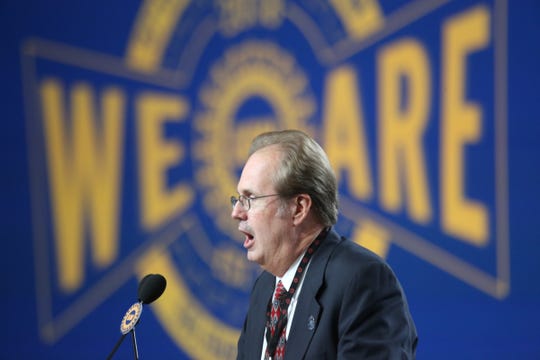
Gary Jones, president of the United Automobile Workers labor union, during the UAW's 37th constitutional convention at Cobo Center in Detroit, on Thursday, June 14, 2018.
Gary Jones, UAW President
The raids were a major step as federal officials ramped up their corruption investigation of the autoworkers union, which is in the midst of contract negotiations with Detroit automakers.

As many as a dozen agents collected evidence from Jones' home on Wildrose Drive in Canton, and they'll remain there "as long as it takes," Special Agent Mara Schneider said from the site at midday.

She declined to confirm whether Jones was home when agents arrived or during the raid. The agents conducted what is called a "knock and announce" protocol.

The raids are linked to an ongoing scandal that's been centered on misspent money intended for use by the union's joint training center with Fiat Chrysler Automobiles, but has expanded in recent weeks to include vendor contracts and to touch officials tied to the union's General Motors training center.

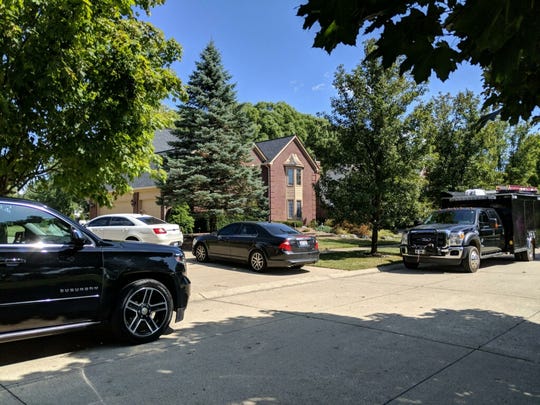
Multiple vehicles are seen parked near UAW president Gary Jones' house in Canton on Wednesday, August 28, 2019. FBI and IRS agents raided the home beginning around 7:30 a.m.
Multiple vehicles are seen parked near UAW president Gary Jones'
house in Canton on Wednesday, August 28, 2019. FBI and IRS agents
raided the home beginning around 7:30 a.m.
The scheme redirected millions of dollars meant for worker training to goodies for former union and company officials. Nine people have been charged in the scandal so far.

Besides Jones' home, agents were at the union's Black Lake Conference Center, a 1,000-acre resort in northern Lower Michigan that includes a golf course, where the UAW is building an opulent cottage for Dennis Williams, its most recent former president.

The center near Onaway, subsidized by interest from the union's strike fund, has bled tens of millions of dollars over the years.

UAW statement
Detroit automakers, whose contract with the UAW expires Sept. 14, declined to comment on the raids. On the broader corruption investigation, GM has said it is cooperating with the investigation. FCA has said it is "a victim of illegal conduct by certain rogue individuals."

The UAW issued a statement Wednesday saying that the union and Jones "have always fully cooperated with the government investigators in this matter. As the leader of the UAW, President Jones is determined to uncover and address any and all wrongdoing, wherever it might lead. There was absolutely no need for search warrants to be used by the government today — the UAW has voluntarily responded to every request the government has made throughout the course of its investigation, produced literally hundreds of thousands of documents and other materials to the government, and most importantly, when wrongdoing has been discovered, we have taken strong action to address it. The UAW will continue to cooperate with the government in its investigation, as we have been doing throughout.

"Trust in UAW leadership is never more important than during the bargaining process, when profit-laden auto companies stand to benefit from media leaks, false assumptions, and political grandstanding," the statement continued. "The sole focus of President Jones and his team will be winning at the bargaining table for our members."

A UAW national leader who asked to not be identified because he was not authorized to speak publicly said the raid on Jones’ house could have a negative impact on talks. Some rank-and-file members already have expressed a lack of trust in union leadership in light of the scandal, he said.

This is likely to create more distrust among those members, the person said.

But, he added that an expected strike authorization vote will indicate that the membership trusts negotiators to green-light a strike if necessary. The results of that vote are expected Thursday or Friday, but it is usually procedural in nature and typically members authorize it.

Plant workers were surprised and dismayed by the news.

UAW member Sean Crawford, who works at GM’s Flint Assembly plant, said the news will have a “really negative impact” on bargaining.

“Call me cynical but I feel the Trump administration willfully timed this to coincide with our negotiations so that the union would lose faith in the leadership,” said Crawford. “We’re getting ready to go into one of the biggest negotiations of our lifetime and we’re possibly going to lose faith in our union.”

Crawford said the union leadership is to blame and should take responsibility for its actions in the corruption scandal.

“All these people should step down and allow a democratic electoral process to take place, an election of leadership that is run by the members,” said Crawford. “The union has to be blamed for this too and it’s disgusting. It makes us all look bad.”

Crawford said the corruption happened because there is no accountability to the membership. The way the international executive board that runs the UAW is elected now is by delegates who represent locals at the UAW convention.

Said a longtime Ford factory worker: “I believe in the UAW. I also believe if there was any corruption, whoever was involved, belongs in jail. If Gary Jones was involved with it, he belongs behind bars. I’m really torn with this. I’m a strong union member. The whole corruption thing, it’s dirty man. How do you preach to new members the UAW cares about you? It doesn’t help the cause.”

Obtaining a search warrant
Using a search warrant rather than getting a subpoena required prosecutors to go to a judge to show probable cause that a crime has taken place and that there is evidence of the crime at the location to be searched, explained Peter Henning, a former federal prosecutor who teaches law at Wayne State University.

"Those UAW bags surely do
come in handy when standing
in the line for rotten food
from Forgotten Harvest."
“It’s a way for prosecutors to ensure they get the materials they want. A search warrant is an escalation of the investigation. It indicates prosecutors are concerned there is evidence out there that they want to get,” he said.

“I would expect they may be looking at electronic documents," Henning added. "You have to have a warrant to search a phone or a computer. If the warrant authorizes electronics, they can seize a computer and create a mirror image of the computer hard drive. They can seize phones. And people put things in text messages that maybe they shouldn’t. They’ll get emails … They are doing a pretty broad sweep.”

The raids Wednesday came on the same day as an arraignment in federal court for Michael Grimes, a former UAW administrative assistant who retired last year from the UAW-GM Center for Human Resources. Grimes was charged earlier this month a federal criminal information alleging he conspired with unnamed union officials to accept hundreds of thousands of dollars in bribes and kickbacks. The schemes were connected to contracts for watches, backpacks and jackets worth millions of dollars.

The filing against Grimes cited unnamed union officials as being linked to the corruption. The Detroit News has reported that those officials are Joe Ashton, a former UAW vice president who resigned from the GM board in 2017 as questions swirled about the federal investigation into training center corruption, and his former aide Jeff Pietrzyk.

Grimes was charged just over a week after former UAW Vice President Norwood Jewell was sentenced to 15 months for his role in the scheme.

Jewell's plea agreement noted that a "culture of corruption" predated his start in the UAW FCA department in June 2014, led by former FCA Vice President Alphons Iacobelli and Jewell's predecessor, the late General Holiefield.

Among others who have pleaded guilty in the case are Monica Morgan, who is Hollifield's widow; Jerome Durden, a financial analyst at FCA who allegedly helped conceal the fraud by cooking the books; Nancy Johnson, the one-time senior official in the UAW Chrysler Department, who spent thousands of dollars meant for autoworker training on personal items; and Virdell King, 65, of Detroit, who was accused of — among other things — buying designer shoes, clothing, jewelry and luggage using credit cards that were issued through the UAW-Chrysler National Training Center.

Voting is beautiful, be beautiful ~ vote.©

Monday, July 22, 2019

Cocktails & Popcorn: Avern Cohn - One Of The Original Old School Civil Rights Legal Dogs Celebrates His Birthday In Detroit

Image result for detroit coney island birthday party
"Happy Birthday, Original Old Dog!
Show the world how we do it in
Detroit."
Happy Birthday, Precious!

I would pop by and grab a few coneys for the boys, but that may be a bit awkward for some.

Instead, from afar, I send my love and shall see you soon.

Yes, there is a complete volume of Civil Rights that is being suppressed by the #coloredrevolution, but fear not, for I am recording the fall of the heavens.

At nearly 95, Judge Avern Cohn 'calls it the way he sees it'

AVERN COHN, ON THE U.S. DISTRICT COURT BENCH SINCE 1979, HAS AN INTELLECT AS KEEN AS GINZU KNIVES, EVEN AS HE TRIES TO GET A HANDLE ON HIS TEMPERAMENT

Detroit — The first time Matthew Schneider met Judge Avern Cohn, Cohn threw him out of the courtroom. But that's not the point of the story.

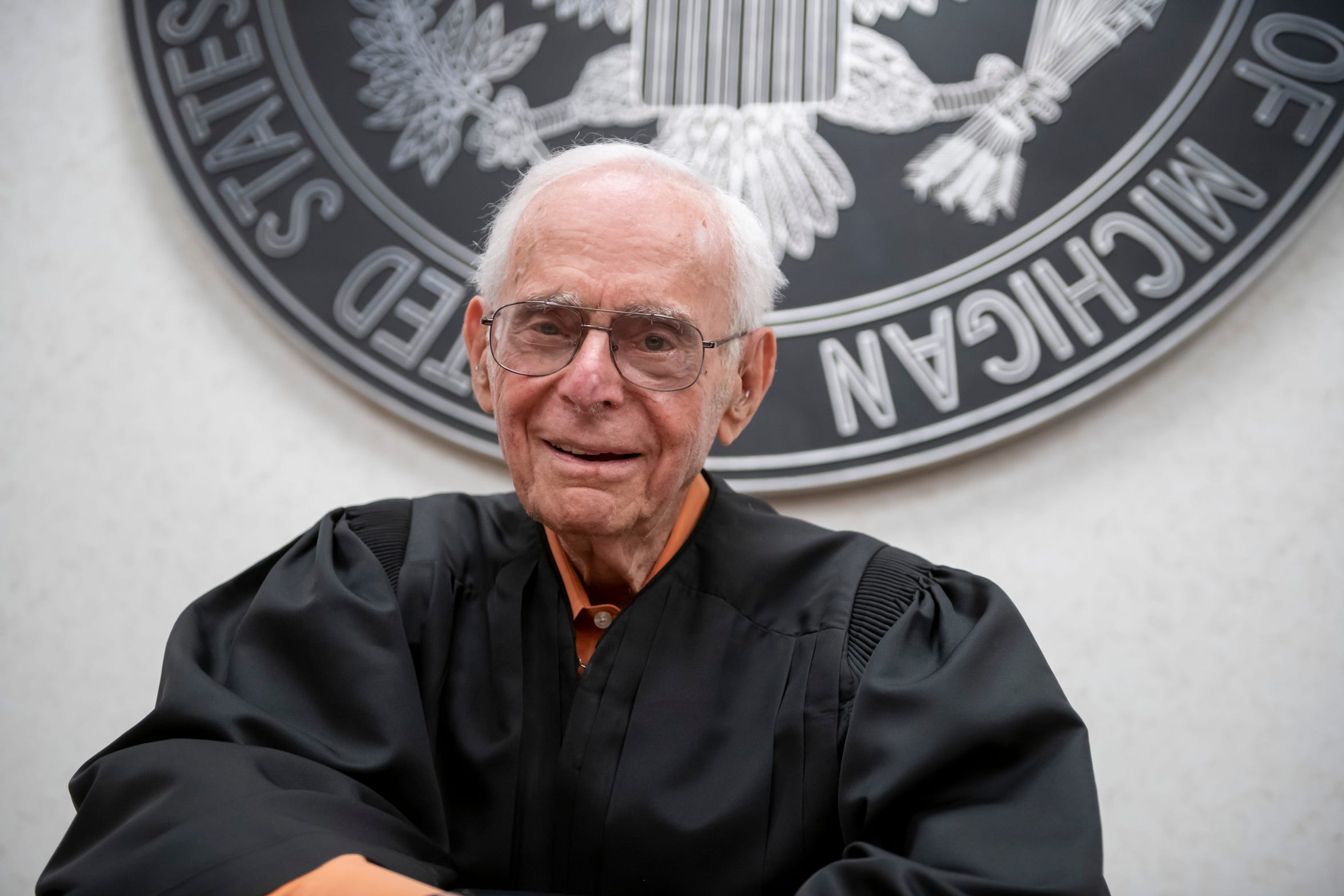
Avern Cohn, Senior United States District Judge of the United States District Court for the Eastern District of Michigan, talks in his courtroom at the Theodore Levin United States Courthouse.
Avern Cohn, One of the Original
Old School Civil Rights Legal Dogs
The point is what happened next — and what happened next helps explain why there will be a throng in that same federal courtroom Tuesday, eating Coneys and raising plastic cups to Cohn's 95th birthday.

They'll be toasting an eventful near-century.

A medical school dropout, as he likes to put it, Cohn is legendary for his blasts of temper, but also renowned for his ability and his intelligence.

He represented looters for free after the 1967 uprising, served as a Detroit police commissioner when that meant working to integrate the force, had his name taken in vain in an Elmore Leonard novel, and keeps quasi-effective hand-written reminders taped to the low ledge that stands between his stern gaze and a parade of nervous attorneys:

"Keep cool!!!"
My first drawing of Avi

"He who angers you controls you."

"No matter how high the throne, there sits but an ass!"

Cohn has been on the U.S. District Court bench since 1979, and you hate to say he's still sharp because that's a low-threshold term you use for someone who can keep track of four bingo cards.

“He calls it the way he sees it, and we need more of that in this world.”

MATTHEW SCHNEIDER, U.S. ATTORNEY FOR THE EASTERN DISTRICT OF MICHIGAN
He carries a full caseload. He reads six newspapers a day and gives three news sites one last check before bed. He has an intellect and a tongue as keen as Ginzu knives, even as he's trying to get a handle on the temperament.

He has "a relentlessly curious mind," as former chief judge Gerald Rosen puts it, and a history of important cases.

And he has Schneider, the U.S. attorney for the Eastern District of Michigan, as a friend.

Schneider is 45, still less than half Cohn's age. At 29, he was four years out of law school and new on the federal prosecutor's staff, at a hearing for a case about human smuggling.

The details aren't vital. What's important, he says, is that he made a mistake and Cohn "invited me in no uncertain terms to leave his courtroom."

Schneider was stricken, he says. He thought his career was over. Then the phone rang.

It was Cohn. They met that day, Schneider says, and had a long, open talk about procedures, judicial philosophy and history.

They're still talking: Schneider an appointee of Donald Trump, Cohn an appointee of Jimmy Carter, both striving for honesty, even if their methods of delivery aren't quite the same.

"My philosophy is about candor," Schneider says. "Judge Cohn's philosophy is about candor.

Judge Cohn keeps notes to himself on the bench inside his courtroom to help keep perspective on the cases before him.
Judge Cohn keeps notes to himself on the bench
inside his courtroom to help keep perspective on the cases before him.
"He calls it the way he sees it, and we need more of that in this world."

Finding satisfaction
The way Cohn sees it, it would be wrong to enjoy his job.

He's devoted to it, and he has no plans to step away from it, even if his steps these days involve a walker. But lives change in room 218, often for the worse, and it would be inappropriate to take pleasure in that.

"I find satisfaction," he says, in a well-reasoned decision, a thoughtful application of the law or a solid instruction to a jury.

He is pleased as well when he is moved to change his mind, as he did earlier this month; having taken a stand in a case about city liability, he kept reading and pondering and invited the opposing side to file another brief.

"Wisdom is in short supply," he likes to say. "The fact that it comes late is no reason to reject it."

A recent morning docket included what appeared to be a routine sentencing for a chronic drug abuser who had assaulted a fellow resident of the federal prison in Milan.

“Wisdom is in short supply. The fact that it comes late is no reason to reject it.”

JUDGE AVERN COHN
Partway through, wisdom once again made an appearance. Wouldn't it be better, Cohn asked, for the judge who would handle sentencing on the defendant's latest drug case to also decide on his punishment for the kicks and punches?

Cohn's sentence, he said, might affect the decision of the other judge. Or it might not. But true justice demanded patience.

The defendant, his legs shackled, shuffled away. Cohn, leaning on a railing, labored down the two steps from the bench to his waiting walker.

Outside the courtroom, the defendant's attorney said, "I love Judge Cohn."

Alvin Sallen, 70, comes from a family of lawyers. His father and uncle both practiced in Cohn's court.

"He has no reluctance to do what he thinks is right," Sallen said. "Part of me would love to go to trial in front of him someday."

The other part probably knows about the taped-up notes, and the reason Cohn posted them.

'Excitable, forceful'
Cohn was born in Detroit. His mother, Sadie, was a homemaker, and his dad, Irwin, eventually became the fourth name on the door at Honigman, Miller, Schwartz and Cohn.

Cohn enrolled at the University of Michigan in 1942, just in time to have his academic career waylaid by World War II. The Army sent him to engineering school, abandoned the program and redirected him to pre-med classes.

Discharged in 1946, he says, he gave medicine six more weeks, then enrolled in law school.

“Always remember that the lawyers have as much right to be in the courtroom as the judge!”

NOTE ON JUDGE COHN'S DESK
Amid three decades of practice, he volunteered as a lawyer with the ACLU, aligned with various other civic and political causes, and came to the attention of the Detroit Police Red Squad, whose dossier on him turned out to be boring — some newspaper clippings, he has said, and maybe a surveillance report.

He'd been angling for a federal judgeship for more than a decade before Carter finally chose him. At one point, he was torpedoed by Sen. Donald Riegle, a fellow Democrat, who questioned his temperament.

"He was right," Cohn later told the federal court's historical society. "I was militant, excitable, forceful, occasionally probably interrupted people, occasionally irritated people."

Today, he says he has changed. At least a little. Or anyway, he has tried. But it's a resoundingly bad idea to come to his courtroom unprepared.

'No limitations'
Another note taped to the bench: "Always remember that the lawyers have as much right to be in the courtroom as the judge!"

He wants to act that way, he says. Honest.

"I've cooled down," he contends. "Age. But every so often, I get impatient."

The years, Cohn says, have done the usual things to his body. He doesn't offer specifics, but he shakes hands like someone with aching fingers. Though he hires a driver for the commute to and from his home in Birmingham, he says that's to give him more time to read; on weekends, he pilots a Cadillac SUV.

Avern Cohn, Senior United States District Judge of the United States District Court for the Eastern District of Michigan, talks in his courtroom at the Theodore Levin United States Courthouse.
(Photo: David Guralnick, The Detroit News)

Doctors have told him to eat or drink more protein, says his judicial assistant of 15 years, Lori Van Hove. They suggested Ensure, but he hated it, so she slipped him some of her Atkins chocolate shakes until he decided he didn't want those, either.

Van Hove will catch him sneaking a Diet Coke, "and I'll look at him and be like, 'Judge?'"

Whatever he's doing, or avoiding, Cohn says he's fine where it counts.

"So far," he says, "as far as I can tell, I have no mental limitations."

Rosen, who's now a principal in a mediation service, concurs.

"He's brilliant," Rosen says. "He's an icon and a legend. And a force of nature."

Within nature, says Detroit Zoo CEO Ron Kagan, Cohn is something else entirely.

In the late 1990s, Kagan led a photo safari to Kenya and Tanzania for civic leaders and zoo donors. Among them was Cohn, his authoritative presence and "probably the most well-read person I know," Kagan says.

At the foot of Mount Kilimanjaro, he says, the spectacle of elephants, zebras and giraffes "brought tears to Avern's eyes."

Travel is one of the pursuits kept in Cohn's past, along with sailing and tennis

“He's brilliant. He's an icon and a legend. And a force of nature.”

GERALD ROSEN, RETIRED CHIEF JUDGE, US DISTRICT COURT FOR THE EASTERN DISTRICT OF MICHIGAN
Now he does what his health will dependably allow, which is hear cases.

Officially, he's been on senior status since 1999. Effectively, he's doing exactly what he did before.

He's technologically adept enough to serve as a visiting judge in California without leaving his chambers in Detroit, but he refuses to send emails. Instead, he mails letters — "some of the most beautiful, thoughtful, kind notes I've gotten from anybody," Rosen says.

Also in contrast, he was malleable enough to pay for an official portrait at the urging of his wife, Lois Pincus Cohn, who owned an art gallery in Birmingham until four years ago.

The painting is a judicial tradition.

But he's either modest or stubborn enough that it moldered in a courthouse closet for 12 years, until Rosen insisted he let it hang on another judge's wall.

In another art form, he had no options.

At a Michigan Opera Theatre benefit, Cohn bid $1,500 to have Leonard attach his name to a character. The Detroit News was given an advance copy of "Mr. Paradise" in late 2003 and called to tell him about his role: a greasy lawyer who served as the agent for a pair of blue-collar hit men.

"Oy," Cohn said. "Oy, oy, oy."

Chili dogs and pizza
The flesh-and-blood Avern Cohn presided over the case of former Detroit City Council President Monica Conyers, who drew 37 months for taking bribes.

Thirty years ago, he struck down UM's anti-hate-speech code, determining that it was too broad. He dismissed criminal charges against a UM student who had published fantasies about violent crimes against women on the Internet, and declined to jail Nada Prouty, a Lebanese immigrant an FBI and CIA operative accused of sharing secrets with her brother-in-law.

Across four decades, he has taken another firm stand a few blocks from the courthouse: Lafayette Coney Island over American.

He's held a lunchtime open house there on his birthday every year since his appointment. Van Hove, ruling that Tuesday's celebration will be too large for the space, instead hired Lafayette to set up a grill and chili pot in Cohn's jury room.

"I could live on chili dogs and pizza," Cohn says. Unfortunately, the women in his life — his wife of 27 years, and assistant of 15 — won't allow it. They're not big on sweets, either, though he keeps a deep bowl of candy on his desk for visitors.

But a fellow only turns 95 once, and his objection has been duly noted. Van Hove cleared his schedule for the afternoon, she says, and he can eat whatever he wants.

Then Wednesday, he'll be back at work, the way he always is.

Voting is beautiful, be beautiful ~ vote.©