Elizabeth “Liz” Darling, president and CEO of the OneStar Foundation in Austin, Texas, was
confirmed by the U.S. Senate yesterday to a senior post in the U.S. Department of Health and Human Services (HHS). Her confirmation had been blocked for months by Sen. Ron Wyden (D-Ore.) but was confirmed by a 57-37 vote.
As commissioner of the Administration on Children, Youth, and Families, Darling will be the administration’s top child welfare official overseeing a budget that includes billions of dollars for foster care. Wyden, the top democrat on the Senate Finance Committee, had placed a hold on her nomination preventing it from going to a floor vote even though the committee narrowly approved her. It is rarely announced when a hold is lifted but Darling would not have been able to get a vote unless it had been.
A call to Wyden’s office was not returned. He was one of the 37 “no” votes yesterday, although he said he believed she was qualified for the job. Sources said he quietly lifted the block in July.
Darling referred calls to the HHS press office.
At the time he blocked it, Wyden said it was because he was upset with the Trump administration’s policy on foster care implemented in South Carolina. It allowed a federally funded, faith-based organization to place children only with Christian families. The policy was being carried out by an office that Darling will oversee.
Wyden said that his opposition to Darling was not personal. “I believe she is qualified for the position,” he said, but he voted against her because of the foster program policy. Wyden was quoted after yesterday’s vote by the Austin American-Statesman as saying: “At a time when there are too many vulnerable kids and too few safe foster homes in America, the Trump administration is allowing states to slam the door on qualified prospective foster parents because of their religious beliefs and sexual orientation. That’s not only unconstitutional, it’s bad for kids.”
It was the second time her nomination, initially made in March 2018, had been put in limbo. While the nomination came out of committee the first time, it did not get to the floor of the Senate. She was re-nominated earlier this year.
Before joining OneStar, Darling was chief operating officer of the Corporation for National and Community Service (CNCS) in Washington D.C., where she provided oversight and management of all CNCS’ national programs, including AmeriCorps, Senior Corps and Learn and Serve America, as well as the offices of Grants Policy and Operations, Leadership Development and Training and Emergency Management. In 2003, Darling was appointed to serve as deputy secretary of the Maryland Department of Human Resources, where she oversaw the Office of Planning and five administrations: Child Support Enforcement, Child Care, Social Services, Family Investment and Community Services.
She assumed the role of founding director of the Center for Faith-Based and Community Initiatives at HHS in 2001. She coordinated the department’s efforts to identify and remove barriers to the participation of faith-based/community groups in accessing federal funds. She was later appointed Advisor on Presidential Initiatives to the Commissioner for the Administration for Children, Youth, and Families (ACYF). In that capacity, she worked across the four Bureaus within ACYF – Head Start, Children’s Bureau, Child Care and Family and Youth Services – where she promoted numerous initiatives, including the President’s Early Childhood Literacy program Good Start, Grow Smart, as well as intergenerational programs and positive youth development.
In 1997, Texas Gov. George W. Bush appointed Darling to the board of the Texas Department of Human Services, where she later became vice chair with policy and program oversight for TANF, Food Stamps and Medicaid eligibility, as well as the regulation of long-term care facilities for the elderly and disabled. Darling chairs the Interagency Coordinating Group (ICG) formed under H.B. 1965 (R82) comprised of 25 state agencies.
A graduate of Baylor University, Darling holds a certificate in Nonprofit Leadership and Management. She was credentialed as a Certified Association Executive (CAE) in June 2014 and received the designation of Certified Fund Raising Executive (CFRE) in March 2015.
Foreign interests can use U.S. DHHS grants, or false claims to Medicaid, to pay for their private investments R&D using kids as human lab rats and not get caught.
And finally, those foreign students who are hired into federal government, turn around and federally contract with fake ass LLCs, to run child welfare money laundering operations, originating in DHHS grants, to fund political campaigns in highly sophisticated financial fraud schemes for the purposes of redistricting.
If you do not live there, you cannot send your children to school there, and neither can you vote there.
I just found it quite odd that one would choose his method of suicide to be beating himself up with a blunt object with the medical examiner concurring.
He was an executive at Pfzier.
But, hey, what do I know?
I know HHS should be in shambles, due to all the Medicaid Fraud in Child Welfare.
WASHINGTON, D.C. - The Nov. 1 death of Daniel Best, a pharmaceutical executive from Bay Village who led U.S. Department of Health and Human Services efforts to lower prescription drug prices, has been ruled a suicide, officials in Washington, D.C., said Thursday.
Police say Best was found "unresponsive" near the garage door exit of an apartment building in Washington, D.C.'s Navy Yard neighborhood at 5:25 a.m. on Nov. 1, and was pronounced dead by medical personnel who responded to the scene.
The city's Office of the Chief Medical Examiner on Thursday said Best died from "multiple blunt force injuries" and it ruled his death a suicide. It would not release further information.
In announcing his death, HHS Secretary Alex Azar said the 49-year-old former CVSHealth and Pfizer Pharmaceuticals executive agreed to work at HHS "out of a desire to serve the American people by making health care more affordable."
"He brought his deep expertise and passion to this task with great humility and collegiality," Azar's statement said. "All of us who served with Dan at HHS and in the administration mourn his passing and extend our thoughts and prayers to his wife Lisa and the entire Best family at this difficult time."
These "Economic Gurus" (trademark pending) up in the Federal Reserve, U.S. DHHS and Michigan DHHS suck because they lied to Snyder, once again, using child welfare propaganda, to pitch their form of Medicaid expansion fraud.
This is not the first piece of statistical, predictive modeling crap to come out the Federal Reserve.
The last time they used University of Southern California.
Anything over the price of a 40 ounce brew and a spleef was too much.
Was this study paid with tax dollars and if so, how come I have to pay to access a public document, submitted into state and federal records, used to justify the use of more tax dollars, specifically Medicaid, when there is absolutely no mention of Medicaid fraud, or perhaps there is, if I pay for the study?
Why was an undergraduate student running this study?
This work was supported by the National Institutes of Health [1R01HD081129-01]. The views expressed here do not represent the views of the Federal Reserve Bank of Chicago or the Federal Reserve System. We thank Sharada Dharmasankar for her excellent research assistance. We also thank the editor and four referees for helpful comments.
They used her. They are cranking out their armies through the universities to keep this Public Private Partnership going until they achieve world domination for their glorious leaders who give them pretty shiny sheep skins.
Who was the principal on the study?
"I see Corporate Shape Shifters. Was it Michigan? Was is Sage Foundation? Was it Gates Foundation? Was it the Federal Reserve? Was it the National Bureau of Economic Research? Was it the National Institution of Health? Who is making policies for "The Poors" (always said with clinched teeth). Mommy, who owns our data, I'm scared."
Why was individual data sold to a private organization, who authorized it?
Cui bono?
Second, data from TransUnion on consumer credit histories was matched with the Healthy Michigan administrative data using name, address, and social security number. TransUnion
credit reports were observed twice per year, in January and July, starting with July 2011 and
ending with January 2016, resulting in ten observation periods. Prior to providing the matched
data to the researchers, all personally identifying information was removed. See the Appendix
for additional details on the match process. page 7.
Oh, wait, Michigan Department of Health and Human Services.
Yes, they sold the data.
We are grateful to the Russell Sage Foundation (grant # 94-16-04) for support of this project. Drs
Kaestner, Mazumder, and Miller also benefited from support from the National Institute of Child
Health and Human Development (NICHD) grant #1R01HD081129. We thank Tara Watson, Lara
Shore-Sheppard, seminar participants at the Federal Reserve Banks of Philadelphia and Chicago
and conference participants at ASHEcon for their comments. We also gratefully acknowledge the
Michigan Department of Health and Human Services for making this data available, Sarah Clark
and Lisa Cohn for helping assemble the MDHHS data set, and Dave Fogata for facilitating the
data purchase from TransUnion. The views expressed herein are those of the authors and do not
necessarily reflect the views of the National Bureau of Economic Research.
They now have a viable voting database for manipulation.
Did you know Sharada has her name on another piece of crap Federal Reserve of Chicago study on the financial health of people who lost their homes to fake ass mortgage foreclosures?
Enrollment in Michigan's expanded Medicaid program boosted the finances of many low-income residents as well as their health care status, according to a University of Michigan study released Monday.
It is always wise to keep your chattel alive to maximize revenues my making sure to layer up services, upon administrative fees, to implement studies for more service programs, to service for "The Poors" (always said with clinched teeth.) Can you see the $ocial Impact Bonds? I can.
Among more than 655,000 residents who gained health coverage after the Legislature approved the Healthy Michigan Plan in April 2014, many have experienced fewer debt problems and other financial issues than before enrollment, according to the analysis of thousands of enrollees' financial records.
If you did not know, they used aggregate data. They should know very well the biases with MAUP, duh. This means the entire study sucks.
The study found drops in unpaid debts, such as medical bills and overdrawn credit cards, as well as fewer bankruptcies and evictions after people enrolled in Healthy Michigan. The program provides health insurance for adults with incomes up to 133 percent of the federal poverty level.
The research team was led by economist Sarah Miller of UM’s Ross School of Business. Their finding were published Monday on the website of the National Bureau of Economic Research with colleagues from the Federal Reserve Bank of Chicago, University of Illinois, Chicago and Northwestern University.
Yeah. I truly hope Sarah does not get tenured for this crap.
The greatest financial gains were experienced by people with chronic illnesses or who had a hospital stay or emergency department visit after they enrolled.
“Across the board, we saw a pretty sizable effect, not just on unpaid medical bills, but also unpaid credit card bills, and on public records for evictions, bankruptcies, wage garnishments and other actions,” said Miller, a member of the UM Institute for Healthcare Policy and Innovation.
ASSUMPTION RULEOUT #1: When you are sick and broke, you cross your fingers you get approved in 3 to 5 years for a SSI check. That means you are poor and do not have credit, so there would be no credit card debt.
“Enrollees’ financial well-being seems to improve when they can get the medical care they need without having to put it on a credit card. And the largest effects are among the sickest enrollees.”
ASSUMPTION RULEOUT #2: "The Poors" (always said with clinched teeth), do not have credit. Most of the time, all they have to do is miss one week of work and they will automatically qualify for Medicaid. Have you looked at the rates of poverty, lately? $1.00 over the threshold and you are cut off.
The team worked with the Michigan Department of Health and Human Services to obtain data on more than 322,000 enrollees without the researchers’ having access to any individual’s identifying information. Using a double-blind matching procedure, they matched the data with enrollees’ credit reports, and studied them as a group.
ASSUMPTION RULEOUT #3: They lied. How are you going to obtain metadata then run it in a double-blind with credit reports. Seriously? You already know whatever they crank out is going to be on dirty data. I wonder if they excluded the areas of Flint, Detroit, and the middle swath of the state, you know, the land of "The Poors" (always said with clinched teeth).
The study focused on people who enrolled during the first year of the Healthy Michigan plan, and who had previously been uninsured. Researchers looked at individual-level financial information from several years before each person enrolled, and for at least one year following enrollment.
The average household income for enrollees in the study was $4,400 for an individual and $7,500 for a family of three. Seventy percent had a chronic illness, and on average they had been to an emergency department once in the past year.
Ah, this is where asset forfeiture policies kick in through guardian ad litems and those wonder corporate parents. When someone has an average income between $4K and $7K a year, you are probably correct to assume that these individuals were probably in foster care or living in a boarding home and are dealing with mental health issues.
“A goal of the Healthy Michigan Plan is to address social determinants of health in order to promote positive health outcomes, greater independence and improved quality of life," said Lynn Sutfin, a spokeswoman for the Michigan Department of Health and Human Services.
HOW TO PROMOTE POSITIVE HEALTH OUTCOMES: Stop making "The Poors" (always said with clinched teeth), poorer!
"This study shows that ensuring Michigan residents have access to quality, affordable health care is reaping numerous benefits.”
No, this study shows another fraud scheme to hustle more money through privatization schemes to shore up the Federal Reserve banks that are going insolvent, like Deutsche Bank. This is propaganda and I am repulsed that this is the University of Michigan is promoting more insurgency propaganda for the purposes of the Privateering NGOs to swoop in and commence to stealin' through more crappy predictive modeling social programming for the parent corporations. That is the only place the financial health is focused.
More than 80 percent had credit scores in the subprime or deep subprime range. Their total debt in collections, medical debt in collections and past-due amount was higher than a random sample of credit reports nationally.
Uh...it is called poverty.
According to the study's findings, the Healthy Michigan Plan reduced their medical bills in collections by an average of 57 percent, or about $515. The amount of past due debt not yet sent to a collection agency was reduced by 28 percent or about $233.
How much of this past due debt was based upon bogus water bills or fake mortgages?
Researchers found a 16 percent drop in public records for evictions, bankruptcies, wage garnishments and other financial events. Bankruptcies dropped by 10 percent among the group studied.
Most individuals do not have enough debt to file bankruptcy. You cannot get evicted is you are homeless. There would be no wage garnishments if you already hail from "The Poors" (always said with clinched teeth).
Enrollees’ were 16 percent less likely to overdraw their credit cards, and their credit scores improved as a group. The number with a “deep subprime” rating fell by 18 percent, and the number listed as “subprime” fell by 3 percent.
Do you mean those deep subprime mortgages that stole the houses from the people, allowing for gerrymandering of congressional districts for the purposes of putting in elected spokestokens to approve crappy studies like this to get more Medicaid money for stealin'?
Enrollees experienced a 21 percent rise in automotive loans, an indication of improved financial well-being.
No, no, no. This is Michigan, the land of cars and corner car lots where Mohammad will sell you a hoopty and get you that 7 day insurance to get your plates to get on the road to find a good low-paying job and still qualify SNAP benefits.
According to Miller, other studies have found that Medicaid expansion reduced use of payday loans and reduced interest rates for low-income people.
Did Debbie Wasserman Schultz tell you to throw that "Medicaid expansion reduction in the use of payday loans and reduced interest rates for "The Poors" (always said with clinched teeth). I someone in your targeted population gets a payday loan, it is because they have a SSI check as collateral.
2016
Have Borrowers Recovered from Foreclosures during the Great Recession?
Now, nine years after the onset of the housing bust, we think it is worthwhile to assess the financial health of the individuals whose homes were foreclosed on during this period. Have they regained their financial footing, or are they permanently scarred? How different were their experiences compared with those of borrowers whose homes were lost to foreclosure in the years before the Great Recession? Did their experiences differ by their financial success (as reflected in their credit scores) before the Great Recession? And how likely are they to have undertaken a new mortgage?
In this Chicago Fed Letter, we address these questions by using data on a large sample of individuals who experienced a home foreclosure after 2000, with a focus on those who entered foreclosure between 2007 and 2010. We use credit bureau data through 2016 from the Federal Reserve Bank of New York Consumer Credit Panel/Equifax (CCP) database. We build on prior work by Brevoort and Cooper,2
who also used the CCP database but whose analysis ended with 2010 data. Their study showed that prime borrowers (i.e., borrowers with credit scores 660 and above3) who had experienced a home foreclosure during the Great Recession were especially hard hit and that their rate of recovery was significantly slower relative to such borrowers who had experienced a home foreclosure earlier in the decade. We extend Brevoort and Cooper's analysis through the second quarter of 2016 in order to examine how these patterns evolved over the subsequent years of the economic expansion. Specifically, we examine the entire trajectories of credit scores and credit delinquencies starting from the years before a foreclosure event and also extending many years after foreclosure. We also examine whether borrowers obtained a new mortgage in the years after foreclosure.
Foreclosures surge during the great recession
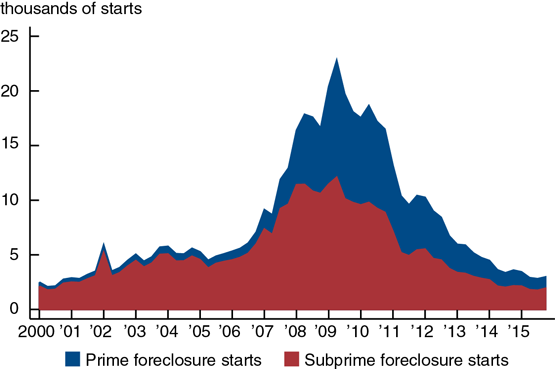
Our data are based on a 5% random sample of the population with credit bureau reports from the CCP database. These data allow us to study patterns in the number of new foreclosures ("foreclosure starts") each quarter beginning with the first quarter of 2000. Figure 1 shows that foreclosure starts were fairly steady until around the end of 2006. They then began to surge in 2007, peaking in 2009. After 2010, foreclosure starts began to rapidly decrease; by the end of 2012, the number of new borrowers entering foreclosure returned to pre-crisis levels.
1. Foreclosure starts, by home mortgage borrower credit status
Note: See note 4 for how prime and subprime home mortgage borrowers are categorized. Source: Authors’ calculations based on data from the Federal Reserve Bank of New York Consumer Credit Panel/Equifax.
Before the Great Recession, the majority of foreclosure starts were among subprime borrowers (i.e., those whose credit scores were below 660 4
Figure 1 shows that the Great Recession led to a striking change in the composition of foreclosures between prime and subprime borrowers. According to our analysis, from 2007 through 2010, foreclosures rose approximately 800% among prime borrowers, but only 115% among subprime borrowers. Over the same period, 40% of all foreclosure starts were among prime borrowers and 26% were among borrowers whose pre-delinquency credit score (see note 4) was over 700. This is one defining characteristic of the Great Recession: A much broader range of individuals, including those who had very high credit scores, were swept up in the collapse of housing markets. Indeed, while the overall level of foreclosure starts has come back down to pre-recessionary levels, the fraction of prime borrowers in foreclosure remains relatively higher than it did before the downturn.
The decline in credit scores at foreclosure
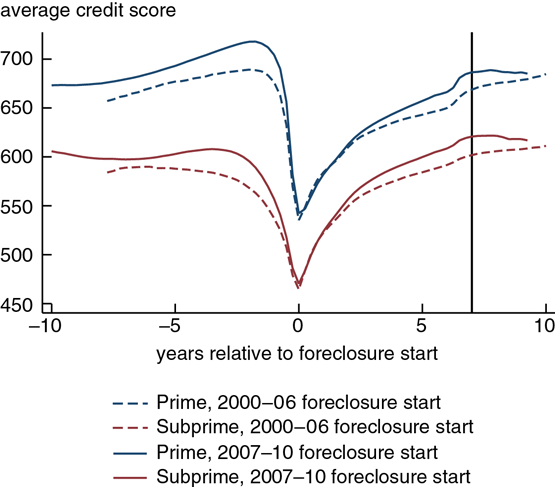
As might be expected, once borrowers enter foreclosure, their credit scores plummet. Figure 2 shows that the declines were very large for both prime and subprime borrowers during the Great Recession (solid lines). The decline in the average score for prime borrowers was about 175 points, and subprime borrowers experienced a decline of about 140 points in their average score.5 Immediately after foreclosure, nearly all borrowers became subprime, with average scores of around 550 for previously prime borrowers and 475 for already subprime borrowers. These declines were a bit larger than those experienced by borrowers who foreclosed between 2000 and 2006 (dashed lines).
2. Credit scores of home mortgage borrowers relative to foreclosure start
Notes: See note 4 for how prime and subprime home mortgage borrowers are categorized. The black vertical line indicates the end of the seventh year after the foreclosure start. Source: Authors’ calculations based on data from the Federal Reserve Bank of New York Consumer Credit Panel/Equifax.
Recovery after foreclosure
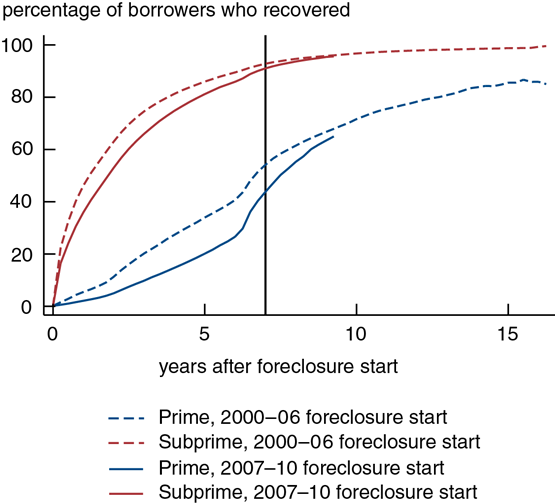
By law, information about any credit payment delinquencies, including mortgage payment delinquencies, must be removed from an individual’s credit record after seven years. Therefore, we would expect that if no other delinquencies occurred, individuals who experienced a foreclosure should see their credit scores recover in seven years. In figure 3, we plot the cumulative fraction of borrowers who reattained their pre-delinquency credit scores (again, see note 4) in the years following a foreclosure and show this separately for previously prime and already subprime borrowers.
3. Share of home mortgage borrowers who recovered pre-delinquency credit score after foreclosure
Notes: See note 4 for how prime and subprime home mortgage borrowers are categorized, as well as for how the pre-delinquency credit score is defined. The black vertical line indicates the end of the seventh year after the foreclosure start. Source: Authors’ calculations based on data from the Federal Reserve Bank of New York Consumer Credit Panel/Equifax.
What is immediately evident is that subprime borrowers tend to recover their pre-delinquency credit scores relatively more quickly than prime borrowers. First, let's examine the patterns of recovery for those who foreclosed on a home before the Great Recession. Among subprime borrowers who experienced a foreclosure between 2000 and 2006, roughly 60% reattained their pre-delinquency credit scores at some point within two years of foreclosure and roughly 85% within five years of foreclosure. In stark contrast, only about 10% of prime borrowers who foreclosed on a home in the same period recovered within two years and only about 33% within five years. After seven years, when delinquency flags are removed from their credit reports (as indicated by the black vertical line), about 90% of these subprime borrowers have reattained their pre-delinquency credit scores, compared with only about 50% of prime borrowers. After 15 years, nearly all subprime borrowers have reattained their pre-delinquency credit scores, whereas about 15% of prime borrowers have still not fully recovered. (Of course, subprime borrowers have a much lower pre-delinquency credit score to return to.)
When we examine the experience of the huge wave of borrowers who lost their homes to foreclosure during the Great Recession, we see a much slower pace of recovery. Specifically, among those who experienced a foreclosure between 2007 and 2010, irrespective of their credit status (prime or subprime), the pace of recovery was slower in the first three to five years after foreclosure relative to the pace of recovery among those who experienced a foreclosure in earlier years. However, after seven years, the subprime borrowers who foreclosed on a home in 2007–10 were virtually on track with their predecessor cohorts in terms of recovering their pre-delinquency credit scores. In contrast, even after seven years, prime borrowers who experienced a foreclosure in 2007–10 continued to lag their predecessor cohorts in reattaining their pre-delinquency credit scores. By 2016, the prime borrowers who entered foreclosure between six and nine years earlier (in 2007–10) appear to have recovery rates that are converging with the historical rates of recovery among their predecessor cohorts. When we further break down the analysis by subgroups of prime borrowers (660 to 700, 700 to 750, 750 and higher), we find that the lack of full recovery is mainly driven by those prime borrowers with the highest credit scores before foreclosure.
Other delinquencies and measures of financial health
A possible explanation for the slower pace of recovery among those who entered foreclosure between 2007 and 2010 relative to predecessor cohorts is that these individuals encountered difficulties paying their credit obligations on time because of the severity of the Great Recession. Since payment history is a critical component of credit scores, this could explain the especially slow rates of recovery. To address this possibility, we examine delinquency rates on any credit obligations for home mortgage borrowers before and after a foreclosure.
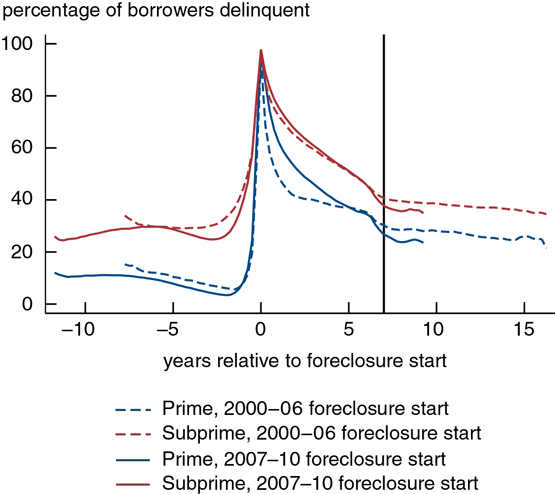
In figure 4, we plot the share of individuals who were 90 days or more past due on one or more sources of credit, including first mortgages, credit cards, and auto loans. Among both prime and subprime home mortgage borrowers, the share with credit delinquencies spikes to roughly 100% at the time of foreclosure and then drops sharply thereafter. Among those who entered foreclosure between 2000 and 2006, the share of prime home mortgage borrowers who are delinquent on their credit obligations tends to decline quite quickly, but never gets back down to the pre-foreclosure levels. Among subprime borrowers, the fraction of those who are delinquent takes much longer to fall, but does eventually get much closer to pre-foreclosure levels.
4. Share of home mortgage borrowers 90 days or more past due on a credit obligation
Notes: See note 4 for how prime and subprime home mortgage borrowers are categorized. The black vertical line indicates the end of the seventh year after the foreclosure start. Source: Authors’ calculations based on data from the Federal Reserve Bank of New York Consumer Credit Panel/Equifax.
We find that for the first seven years following foreclosure, the share of individuals who were delinquent on any credit obligations among those who experienced a home foreclosure in 2007–10 generally remained higher than this share among those who experienced a home foreclosure in 2000–06. This was the case regardless of the credit status (prime or subprime) before foreclosure. However, after seven years, this pattern reversed.
Implications for the housing market
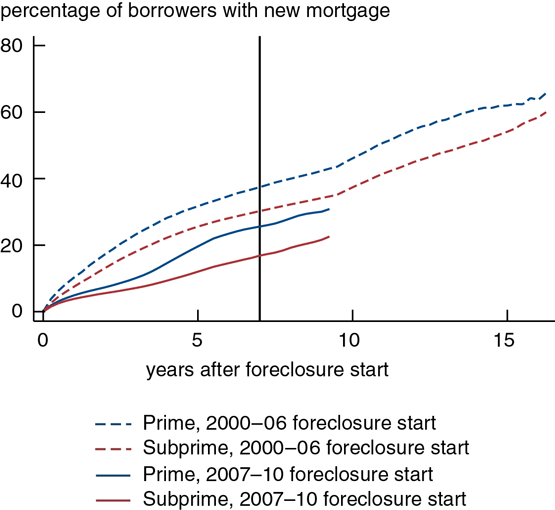
A question of interest is how the experience of foreclosure has affected housing markets. In figure 5, we show the cumulative fraction of individuals who experienced a home foreclosure but who then managed to take out a new mortgage afterward. When looking at the historical experience of prime home mortgage borrowers who entered foreclosure between 2000 and 2006, we find that just shy of 40% took out a new mortgage in the seven years following. The comparable value for subprime borrowers is notably lower, at around 30%. Among those who foreclosed on a home between 2007 and 2010, the shares with new mortgages seven years after foreclosure are dramatically lower at just over 25% for prime borrowers and just under 17% for subprime borrowers.
5. Share of home mortgage borrowers with a new mortgage after foreclosure
Notes: See note 4 for how prime and subprime home mortgage borrowers are categorized. The black vertical line indicates the end of the seventh year after the foreclosure start. Source: Authors’ calculations based on data from the Federal Reserve Bank of New York Consumer Credit Panel/Equifax.
These findings suggest that even though the overall credit scores and shares of delinquent borrowers appear to have returned to levels closer to historical norms for individuals who experienced a foreclosure in 2007–10, their homeownership rates continue to considerably lag the homeownership rates of those who experienced a foreclosure in 2000–06. The slower financial recuperation of those who lost their homes to foreclosure during the Great Recession has been one important factor behind the slow recovery in housing markets during the current economic expansion.
Summary
By tracking a sample of home mortgage borrowers who entered foreclosure in 2000–06 and 2007–10, or before and during the Great Recession, we find that the pace of recovery in credit scores was slower in the first few years after foreclosure for the latter cohorts. We also find that prime borrowers who experienced a foreclosure during the downturn were especially hard hit and had the most difficulty recovering. Overall, at least 15% of all prime borrowers have permanently lower credit scores regardless of when they foreclosed on their homes. A significant factor behind the slow recuperation in credit scores for borrowers who lost their homes to foreclosure in 2007–10 was adverse economic conditions during the recession, which led to delinquencies on other credit obligations. The slow rehabilitation of their financial health helps explain the slow recovery in housing markets post-recession. Indeed, following foreclosure, these borrowers have considerably lagged their predecessor cohorts in terms of homeownership rates.
1 Authors’ calculations based on data from the Federal Reserve Bank of New York Consumer Credit Panel/Equifax (CCP) and statistics from RealtyTrac (as cited in http://blog.credit.com/2015/04/boomerang-buyers-is-there-homeownership-after-foreclosure-114803/). Because of the high incidence of foreclosures in 2010, we include them in our analysis of foreclosures during the “Great Recession.” The recession officially ended in 2009 according to the National Bureau of Economic Research.
2 See Kenneth P. Brevoort and Cheryl R. Cooper, 2013, "Foreclosure's wake: The credit experiences of individuals following foreclosure," Real Estate Economics, Vol. 41, No. 4, Winter, pp. 747–792.
We categorize prime and subprime foreclosures based on the credit score of the borrower (prime, 660 and above; subprime, below 660) in the nearest quarter in which there is no major mortgage delinquency (i.e., less than 30 days past due) before the foreclosure start. In the text, we refer to this particular measure of the credit score as the "pre-delinquency credit score."
We calculated these declines by taking the difference between the peak average credit score before foreclosure and the average credit score at the time of foreclosure.
The dark money laundering rules are in place, where I have provided the Treasury Guidance, below.
The U.S. Child Welfare System is about to get really, really mean because it is about to be exposed for the trafficking of tiny humans residual of the peculiar institution.
Ladies and gentlemen, you are witnessing war crimes.
Enjoy.
Marcia Lowry, representing the corporate parents of
"The Poors" (always said with clinched teeth).
Marcia Lowry, the crusading child welfare attorney, works out of an office on Hardscrabble Road. She didn’t name this leafy suburban New York lane, but it suits her reputation: The slew of big-ticket settlements she’s secured against large foster care systems made her one of the nation’s most respected, winning and – in some quarters – loathed attorneys for vulnerable youth.
Now, thanks to significant new funding from an anonymous Tulsa-based foundation, her small legal aid firm A Better Childhood is hardscrabble no more. Lowry would not disclose the funder, or the amount, but said it will allow her to more than double the organization’s staff and open an office in New York City.
“You still see news stories constantly about problems at child welfare agencies, and there is still a need to more clearly define constitutional rights for children. And that’s what we are going to try to do,” Lowry said. “We plan to bring new cases to try to more fully develop those constitutional principles.”
Lowry rose to prominence in the early 1970s as the lead plaintiff’s attorney in an infamous legal fight over the rights of foster children. Then with the ACLU, she represented a group of New York youth led by Shirley Wilder, a 13-year-old Protestant African-American who had to shuttle between abusive institutions because higher-quality Catholic and Jewish agencies refused to serve her.
The critically acclaimed 2001 book The Lost Children of Wilder cemented the case’s stature even while painting a dispiriting picture of meager system improvements it produced. By then, Lowry had left the ACLU to found the organization Children’s Rights, continuing to pioneer a strategy of high-profile, class-action suits against state and city child welfare systems. It’s hard to say whether those suits — in Milwaukee, Atlanta, New Jersey, Oklahoma, District of Columbia and New York City, among others — earned her more detractors or supporters.
An acclaimed 1999 book chronicled Lowry’s first major case in the early 1970s, when religious and racial discrimination was still “the woof and weave of the city’s foster care system,” as the author once put it.
“If you are the one who points out the emperor is not wearing clothes, you aren’t invited to be the emperor’s wardrobe consultant. Marcia doesn’t shy away from saying the emperor’s naked,” said Dr. Richard Gelles, a sociologist and the former Dean of the School Social Policy and Practice at the University of Pennsylvania. He has served as an expert witness for several of her cases.
While the Wilder suit pushed constitutional boundaries, Lowry’s recent cases have made narrower points about systems’ failures to meet guidelines in federal legislation like the Adoption and Safe Families Act (ASFA) — which Gelles helped write — or under state laws. The resulting settlements, say Lowry’s (and ASFA’s) many staunch critics, put far too much emphasis on fixing foster care and finding permanent homes for foster youth, instead of expanding support for struggling biological parents in low-income minority communities that see a disproportionate number of children placed in foster care.
“I am sad to hear the news of [A Better Childhood’s] expansion. Through litigation Lowry has enabled the destruction of American families,” said Martin Guggenheim, a co-director of New York University School of Law’s Family Defense Clinic, and a former litigation partner with Lowry at the ACLU. “She is oblivious to the reality that most children in foster care shouldn’t be in there in the first place. She ends up braising a state like New York for receiving an ‘F’ grade in permanency — for not destroying families in order to place them with a new family permanently — with the speed she believes children deserve.”
Dilly, dilly!
Lowry acknowledges her thinking has shifted over decades of suing agencies, but rejects that her work subverts a recent movement to expand prevention programs for at-risk parents.
“Prevention is really important, but people forget there is no legal right to prevention services except under some state laws. You need a legal hook, and children in foster care have a legal hook. That’s a fact of life,” she says. “I don’t think anybody knows how to bring a lawsuit simply on behalf of poor people in society. You can work on the particular issues, and that’s what we’re doing.”
Preach. No one cares about "The Poors" (always said with clinched teeth). I know how to bring up a lawsuit on behalf of "The Poors" (always said with clinched teeth) because I have done it a few times.
She plans to file for class action certification in her organization’s case on behalf of 19 foster youth against New York City and State in the fall. The Administration for Children’s Services, the city’s child welfare agency and one of the defendants in the suit, declined to comment.
Judiciary has been pushing the quashing of class action lawsuits but, oddly enough, not one person has raised the issues of "children's rights" as opposed to "Children's Rights", the organization. See, children have no rights. Anything resembling the right of a child, like inheritance, is automatically assigned to the state, who then turns around and grants the right of guardianship to a corporation because the state of being a child, is now being considered to be a condition of disability, which means that they need a guardian, or rather, a corporate parent, who gets child support from the state in the form of grants, Medicaid Targeted Case Management cost reimbursements, Title IV-B and IV-E. The list is endless when you consider the fact that all these federal billables can and will be used to leverage as financial instruments, under intellectual property. So, that means if you run a class action for children in foster care, adoption and juvenile justice, you would have to sue your corporate donors, that you do not have to disclose from which foreign nations they hail.
The debate over using class action litigation to reform child welfare systems has simmered in recent years. The influential Center for the Study of Social Policy released a comprehensive review in 2012, concluding that only certain kinds of suits produce durable change. Jerry Milner, the Trump-appointed head of the federal Children’s Bureau, weighed in on the issue this week on the American Bar Association’s website, describing his experience implementing a class-action settlement in Alabama (Lowry was not involved in that case):
The nature of the litigation and resulting consent decree which was atypical of most state child welfare settlements, brought many positive changes for children and families. This was largely because the plaintiffs sought something more than a mechanical consent decree that might have led to counting widgets rather than achieving real changes.
A Better Childhood plans to file suits against four to six jurisdictions nationwide in the next five years, according to Dawn Post, who will start as the organization’s deputy director next week.
“I’ve seen the need for systemic change that impacts more children than I can through taking individual clients, so having the chance to learn and work with someone like Marcia is an amazing opportunity,” Post said. She was most recently a borough co-director for another New York City legal aid firm, the Children’s Law Center, and a frequent advocate on permanency issues, especially around adoption.
Systematic change: "Stop stealin' children!!!"
Lowry will hire three more attorneys and support staff in the coming months, says a job posting on the Harvard Law School website. “The work will be limited only by our own imaginations and legal skills,” reads the ad.
Harvard Law School has a long and illustrious legacy of churning out "Legal Geniuses" (trademark pending) in the fields of trafficking tiny humans.
According to recent tax filings, A Better Childhood’s revenue for 2016 was just over $640,000, with at least $200,000 going to Lowry as compensation. Local governments the organization has successfully sued have paid for most of the legal work, according to Lowry. Only a single donor is listed on the nonprofit’s tax return, and it is listed as: “Restricted.”
“You can ask but I won’t answer,” said Lowry when asked about her organization’s new funding source. The new benefactor makes most of its donations anonymously, she added, noting that the funder approached her about pitching them.
“Marcia Lowry’s career is evidence of the power of a single visionary to bring about transformational change for some of our nation’s most at-risk children who have been neglected and abused,” reads a statement from the funder, which Lowry passed along to TheChronicle. “We are honored and humbled to be partnering with her and are confident that thousands of our country’s abused and neglected children will have better lives and futures as a result.”
Lowry created A Better Childhood soon after leaving the organization Children’s Rights in 2014, and said her departure was due to a desire to litigate more and manage less. Children’s Rights did not return calls and e-mails for comment.
The chairman of A Better Childhood’s board, a Tulsa-based oil and gas attorney Fred Dorwart, had previously served on Children’s Rights’ board, joining after the organization filed a class-action suit against the State of Oklahoma. He confirmed that A Better Childhood’s new anonymous donor was a private foundation in Tulsa, though not the multibillion-dollar George Kaiser Family Foundation, which he also sits on the board of.
Writing to The Chronicle on behalf of A Better Childhood’s board, Dorwart said:
“We are excited that an anonymous donor has recognized the important work Marcia and A Better Childhood are doing in foster care reform litigation. With this funding, A Better Childhood is now able to expand its efforts and replicate its successes in those additional areas where our less fortunate children so badly need representation.”
This is a legal defense move. You make it seems you are doing the right thing, hoping you can still further the interests of your privatized funders of Social Impact Bonds, but will position yourself when it all comes crashing down on how you are just a propaganda child welfare fraud machine, probably working with Burnsen Marsteller, unless the Clinton Foundation can no longer afford it and is just launching its own intelligence operations through the behemoth of "Legal Geniuses" (trademark pending) over there at Perkins Coie Sucks. But hey, what do I know?
Today, Hillary Clinton will attend a fundraiser at the home of Tulsa businessman and Democrat fundraiser George Kaiser.
Kaiser's private equity firm was the largest shareholder in green energy company Solyndra, whose 2011 bankruptcy cost taxpayers over $500 million and left nearly 2,000 people out of work.
The Department of Energy's Inspector General earlier this year found the company misrepresented key facts about the loan guarantee, as company officials acted at best "reckless" and "irresponsible," orchestrating an "effort to knowingly and intentionally deceive and mislead the department."
On December 11, 2015, Hillary Clinton Will Attend A "Conversation With Hillary" At The Home Of Cookie And George Kaiser In Tulsa, Oklahoma. ("Conversation With Hillary," Hillary For America, Accessed 12/6/15)
George Kaiser Was The Chief Financial Backer Of Solyndra, Which Received A $535 Million Energy Loan Guarantee From Obama's Department Of Energy. "The Obama administration rushed a $535 million energy loan guarantee through to Solyndra Inc. and in doing so skipped steps, potentially putting taxpayers at risk, according to iWatch News and ABC News.In March 2009, the Department of Energy announced the loan guarantee before it received final outside legal reviews. Not only did the rushed process make taxpayers susceptible, but it also gives the perception that the program was influenced by political interests, said Franklin Rusco, an analyst with the Government Accountability Office.Solyndra's main financial backers include George Kaiser, an Oklahoma oil billionaire who raised at least $50,000 for Obama's 2008 campaign." ("DOE: Loan Guarantees Rushed To Companies With White House Ties," Greenwire, 5/25/11)
Kaiser Also Runs Argonaut Private Equity Firm, Which Was The Largest Shareholder Of Solyndra. "Among the key backers of the $198 million raised: Oklahoma oilman Kaiser's Argonaut Private Equity, as well as Madrone Capital Partners, a private investment firm affiliated with S. Robson Walton, chairman of Wal-Mart Stores Inc.Kaiser's Argonaut Private Equity and its affiliates were the largest shareholder of Solyndra as it pushed for the IPO. Kaiser's firm remains a 'significant financial backer of Solyndra,' Solyndra spokesman David Miller confirmed." (Ronnie Greene and Matthew Mosk, "Skipping Safeguards, Officials Rushed Benefit To A Politically-Connected Energy Company," The Center For Public Integrity , 5/24/11)
CLINTON SPOKE IN SUPPORT OF SOLYNDRA IN 2011 AS SECRETARY OF STATE
Clinton Praised Solyndra An Example Of American Entrepreneurship And Innovation In A 2011 Speech In Hong Kong. CLINTON: "And today they are helping power companies like Solyndra, a green energy startup in California that began producing solar panels in 2007 and now installs them in more than 20 countries worldwide." (Secretary Of State Hillary Clinton, Remarks By Secretary Of State Hillary Clinton: Principles Prosperity In The Asia Pacific , Hong Kong, 7/25/11)
Clinton Is Also Linked To Kaiser Through Their Family Foundations
George B. Kaiser Has Donated Between $100,001 And $250,000 To The Clinton Foundation. (Clinton Foundation Donors, Accessed 12/6/15)
In March 2014, Kaiser Appeared With Hillary Clinton At A Clinton Foundation Event To Kickoff A "Too Small To Fail" Initiative, Where The George Kaiser Family Foundation Was A Partner. "Former Secretary of State Hillary Clinton will be in Tulsa with local billionaire philanthropist George Kaiser on Monday to announce the kickoff of the "Talking is Teaching" campaign, a partnership with the Too Small to Fail Initiative aimed at helping parents and caregivers of children ages birth to 5 prepare for success. The partnership is a communitywide effort by the George Kaiser Family Foundation, CAP Tulsa, Tulsa Educare and Too Small to Fail - a joint initiative of Next Generation and the Bill, Hillary and Chelsea Clinton Foundation - to empower parents and caregivers to boost the brain development and vocabularies of young children by increasing the number of words they hear spoken to them each day." (Mike Averill, "Hillary Clinton Coming To Tulsa To Help Announce New Education Campaign," Tulsa World, 3/22/14)
At The Appearance, Clinton Thanked Kaiser And His Foundation For The Commitment To Early Childhood Education, Saying, Of Kaiser, "He Knows It Is Never Too Early To Invest In The Next Generation." "Clinton and billionaire philanthropist George Kaiser spent time with a group of children at the Educare No. 2 site, reading and singing along to 'Take Me Out to the Ball Game.'Clinton later thanked Kaiser and the George Kaiser Family Foundation for their commitment to early childhood education and for creating a model for the rest of the country. 'He knows it is never too early to invest in the next generation,' Clinton said. 'You can't ever give up on any child, and the earlier you start the less likely it will be that you are even facing that difficult situation.'" (Mike Averill, "Hillary Clinton Touts New Child-Development Initiative During Tulsa Visit," Tulsa World, 3/25/14)
SOLYNDRA'S BANKRUPTCY COST TAXPAYERS OVER $500 MILLION DOLLARS AND PUT NEARLY 2,000 PEOPLE OUT OF WORK
Solyndra Received A Major Loan From The Obama Administration But Went Bankrupt In 2011, Leading To An Investigation By The Department Of Energy's Inspector General. Solyndra collapsed two years after it received its first U.S. loan in 2009. Its September 2011 bankruptcy led to an investigation by congressional Republicans and withering criticism of the loan guarantee program, which had been funded by the 2009 economic stimulus program. It's failure became an issue in the 2012 presidential campaign. The Justice Department also investigated the handling of the Solyndra loan, but the inspector general was notified early this year that no criminal charges would be filed, according to the report. (Jim Snyder, "Solyndra May Have Lied To Get Loan Guarantee, Watchdog Says," Bloomberg Politics, 9/26/15)
1,861 Workers Were Laid Off By Solyndra As It Went Bankrupt. "Since September 1, 2010 (impact date), an estimate 1,861 workers have been separated from the firm. This total includes an estimated 649 temporary workers as well as leased workers from West Valley, Aerotek, Oxford Global, GES and Lighthouse Management. Most of these separations occurred at the time of the shut-down of the Fremont, CA facility on August 31, 2011. An additional 85 workers are threatened with separation as the company's operations wind down." (Employment And Training Administration, "Investigative Report TA-W-80,410; Solyndra LLC," Department Of Labor, 9/12/11)
The Government Recovered Only $24 Million Of The $527 Million Loaned To Solyndra. "Last week, Solyndra's final liquidation plan estimated that the government will recover just $24 million of the $527 million that taxpayers lent to the company." (Joe Stephens and Carol D. Leoning, "White House Analyst Warned Saving Solyndra Could Cost More Than Letting It Fail," The Washington Post, 8/1/12)
A Recent Inspector General (IG) Report Found That Solyndra "Misrepresented Facts And Omitted Key Information" In Swindling Taxpayers Out Of $500 Million
The Energy Department IG Has Found That Solyndra "Misrepresented Facts And Omitted Key Information In Their Efforts To Get A $535 Million Loan Guarantee From The Federal Government." "A four-year investigation has concluded that officials of the solar company Solyndra misrepresented facts and omitted key information in their efforts to get a $535 million loan guarantee from the federal government." (Kevin Freking, "Report: Solyndra Misrepresented Fact To Get Loan Guarantee," The Associated Press, 8/26/15)
The Report Showed That The Department Of Energy's Due Diligence Was "Less Than Fully Effective," And That They Felt "Tremendous Pressure" To Approve The Loan Applications. "The report by the Energy Department's inspector general was released Wednesday. It's designed to provide federal officials with lessons learned as it proceeds to grant billions of dollars in additional loan guarantees. The inspector general found fault with the Department of Energy, describing its due diligence work as 'less than fully effective.' The report also said department employees felt tremendous pressure to process loan guarantee applications." (Kevin Freking, "Report: Solyndra Misrepresented Fact To Get Loan Guarantee," The Associated Press, 8/26/15)
Solyndra Officials Acted At Best "Reckless" And "Irresponsible," Orchestrating An "Effort To Knowingly and Intentionally Deceive And Mislead The Department.""In the end, however, the inspector general said the actions of the Solyndra officials 'were at the heart of this matter.' 'In our view, the investigative record suggests that the actions of certain Solyndra officials were, at best, reckless and irresponsible or, at worst, an orchestrated effort to knowingly and intentionally deceive and mislead the department,' the IG's report said." (Kevin Freking, "Report: Solyndra Misrepresented Fact To Get Loan Guarantee," The Associated Press, 8/26/15)
The IG Report Stated That The Solyndra's Failure Will "Cost Taxpayers More Than $500 Million." "The company's collapse soon after getting federal backing provided ammunition to lawmakers and other critics who portrayed it as wasteful government spending. The company's failure likely will cost taxpayers more than $500 million." (Kevin Freking, "Report: Solyndra Misrepresented Fact To Get Loan Guarantee," The Associated Press, 8/26/15)
Emails Released After Solyndra's Bankruptcy "Directly Contradict" Kaiser's Denial Of Talking About Solyndra With The White House
In Response To Criticism, The George Kaiser Family Foundation Denied Participating In Any Discussions With The U.S. Government Regarding Securing A Loan For Solyndra. "A top donor to President Obama did not use political influence or talk to administration officials about a massive government loan to a solar company backed by his investment funds, according to a statement issued by his family foundation.The foundation of Tulsa billionaire George Kaiser said it took a hit like other investors in Solyndra, which this week closed its plant and laid off 1,100 workers. The California-based solar-panel manufacturer won a $535 million government-backed loan to spur innovation in clean energy, but taxpayers may have to repay it.In a statement on Thursday, the George Kaiser Family Foundation said Kaiser, a major fundraising bundler for Obama, is not personally invested in Solyndra and 'did not participate in any discussions with the U.S. Government regarding the loan.'The statement came as House Republicans vowed to more fully investigate the extent of White House involvement in the federal backing for Solyndra. They said they have found evidence that the White House tracked the company's application, and that officials weighing its proposal knew of the White House's interest." (Carol Leonnig and Joe Stephens, "Top Obama Donor George Kaiser Says He Didn't Play Politics To Win Government Loan," The Washington Post, 9/2/11)
But In A February 2010 Email, Kaiser Expressed Concerns Over How His Role Raising Money For Obama Would Look As Long As Solyndra Is "Still The Only Recipient" Of The Loan Guarantee Program. "In a Feb. 7, 2010, email exchange, Kaiser fretted to Levit about how his role raising money for Obama would look to the outside world as the focus stayed on Solyndra. 'S'pose an investigative reporter will ever make an association between an early Obama supporter and majority shareholder (through 'his' charity) in the entity that received one half billion (or two total billion) dollar LOAN guarantee(s)?' he wrote. 'Solyndra is still the only recipient through that program.'Levit replied: 'I've wondered about it, given the WH lists, etc. The truth is that the name of the company has never crossed your lips with the administration (not so with Congress) and we've certainly never lobbied for the company.'" (Darren Samuelsohn, "New Solyndra Emails Fuel Controversy," Politico, 11/9/11)
 I wonder how long before George Bush shall be called to bear witness.