Showing posts with label property rights. Show all posts

Thursday, December 21, 2017

What Do Uranium One, Hillary Clinton, Magnitsky & Child Welfare Fraud Have To Do With A Special DOJ Probe?

What do Uranium One, Hillary Clinton, Magnitsky & Child Welfare have to do with a special DOJ probe?

It is all linked together.

Stay tuned.

Jeff Sessions Reportedly Revives Probe Of Uranium One Deal

An FBI investigation into Hillary Clinton’s ties to the deal has found no wrongdoing.

Congressional investigations into FBI have found wrongdoings, but I guess HuffPo forgot to include this.


The Justice Department is reviving an inquiry into former Secretary of State Hillary Clinton and the government’s controversial approval of the Uranium One deal, NBC News reported on Thursday.

A now-dormant FBI investigation into whether Clinton had ties to the deal has not found evidence of wrongdoing. But NBC, citing “multiple law enforcement officials,” reported that Attorney General Jeff Sessions has in recent weeks directed Justice Department prosecutors to ask FBI agents to explain evidence uncovered in the probe.

Uranium One, a Canadian mining company with major U.S. holdings, was sold in 2010 to a Russian firm.

Before the sale could go through, it needed approval from nine U.S. agencies, including the State Department.

Because some of the people who stood to benefit from the sale were Clinton Foundation donors, conservative media and other critics of the 2016 presidential nominee have alleged a quid pro quo, even though the State Department didn’t have the power to unilaterally approve or reject the deal and Clinton herself was not directly involved in the approval process.

Following pressure from President Donald Trump and congressional Republicans, Sessions last month said he would consider appointing a new special counsel to look into Clinton and Uranium One, as well as other matters involving Democrats.

Sessions pledged during his confirmation hearing last year that he would recuse himself from any possible investigations involving Clinton.

The Uranium One obsession among Trump and his allies has increased in recent months as Special Counsel Robert Mueller’s probe intensifies into the Trump campaign’s ties to Russia.

Four people have been charged, including former National Security Adviser Michael Flynn.

Voting is beautiful, be beautiful ~ vote.©

Tuesday, December 12, 2017

NADLER PRAISES BIPARTISAN BILL TO PROTECT RELIGIOUSLY AFFILIATED INSTITUTIONS


Washington, D.C.—This evening, the House passed H.R. 1730, the “Protecting Religiously Affiliated Institutions Act,”  by a vote of 402-2.  This bill would extend protections under current federal law for “religious real property.”  Currently, Section 247 of the Federal Criminal Code prohibits both the damaging of religious property because of the property’s religious character and the intentional obstruction — by force or threats of force — of anyone’s exercise of religious beliefs. 

H.R. 1730 would clarify that threats of force against religious property are included in this prohibition.  Additionally, the measure would provide that the damaging or obstructing of such property that results in damages exceeding $5,000 constitutes a felony punishable by up to 3 years imprisonment.  Finally, the bill would clarify that real property covered by the statute includes property leased by a non-profit, religiously-affiliated organization.

The importance of this legislation is underscored by the recent upsurge in bomb threats, hate crimes, and vandalism committed against communities of faith.  For instance, more than 150 bomb threats were made against Jewish Community Centers in the first quarter of this year alone.  And, there has been an alarming surge in the number of threats, vandalism, and arson committed against mosques over the past year.

In response to House passage of this bill, Judiciary Committee Ranking Member Jerrold Nadler (D-NY) stated,

“Recently, our country has been experiencing a surge in hate crimes – including those committed against communities of faith. In 2016, the hate crimes statistics released by the FBI indicate that anti-Semitic hate crimes increased 20% from the prior year. 

“Our country was founded on the principles of religious liberty, and while we may disagree with the religious practices of others, it is never acceptable to use physical obstruction, force, or threats of force to deny others the right to worship. 

“I believe it is not only appropriate but necessary for Congress to strengthen our laws against these types of acts so that no American has to choose between their faith and their safety. And I am pleased that this important bill, which was adopted by the Judiciary Committee, has now been passed by the House of Representatives.”
Voting is beautiful, be beautiful ~ vote.©

Wednesday, December 6, 2017

Merry Christmas from Legally Kidnapped

As always, our friends over at Legally Kidnapped would like to wish you and your chattel, a very, merry Christmas.


Voting is beautiful, be beautiful ~ vote.©

Tuesday, September 19, 2017

Foster Care Bonds: Making Child Slavery, Sexy Again

How can one garner the best interests of a child?

Invest in tiny human bonds!

Humans, particularly the products off The Poors, have always been a commodity for sale, oops, because it is illegal to sell people and now-a-days, we charge service fees.

They are already selling children on the Wall Street and there is a strong movement to invest in social impact bonds, so why not let the little guy makes some side money and invest in foster children?

The way the U.S. has set up its financial system, it is very easy for a bank to leverage a loan on the trust of a child only because a child is still considered property pursuant to chattel law.

If the loan goes bad, one can always do a property quiet title, or rather what is compassionately called, termination of parental rights, wiping the debt with a reissuance of a new Social Security Number.

This has been going on for years so the financial institutions conjured the concept of why not make slavery sexy, again?

Always remember, the 13th Amendment has an "exception" to the new human currency.

Foster care bonds is just another privatization hustle to make money speculating in human capital.

Invest in Foster Children: A Radical New Idea

Similar to War Bonds, everyone would be funding the success of a child.


article imageFoster care has reached an impasse. We have found ourselves in a meta-crisis, where the root crisis is how we think. Albert Einstein famously remarked, “The significant problems we face cannot be solved at the same level of thinking we were at when we created them.” In recent writings, I have proposed some truly radical, yet revolutionary ideas. One idea was the creation of an entirely new field and profession: Bachelor of Science in Foster Parenting.

In order to execute these radical ideas, we first need a new source of funding. For this, we can look to the past as everything that is old is new. First, let’s take a look at an old, yet successful approach – War Bonds. We will then discuss how Government Bonds work. Lastly, we will discuss the creation of the Foster Care Bond, where you have the unique opportunity to be fully invested in the success of a foster child.

Buy Your War Bonds!
government bondsDuring World War II, War Bonds were promoted by movie stars who toured the country. They used slogans such as, “If you can’t go across . . .  Come across!” Approximately $185 billion in bonds were sold. Imagine the impact if we were to do this today. Think of Britney Spears or Kid Rock touring the country rallying support to purchase bonds. Additionally, one of the largest advantages of War Bonds was the fact that the money was essentially recycled back into the U.S. economy after World War II.

What are Government Bonds?
So, what are bonds? Essentially, there are three types of bonds: Government, Municipal, and Corporate. They are used to raise funds to issue to whoever wants to buy them. They are similar to stocks, yet bonds are more like a loan in that you are lending money to an organization. In return, the organization promises to pay interest.
Our focus here is Government Bonds. See below for a quick look at Government Bonds.
checkboxes 1
Now let’s take a look at U.S. Savings Bonds.
checkboxes 2
So, how can we use Government Bonds to fund foster care?
Invest in Foster Care
Let me start with a question: Can you name one place in the U.S. that is getting foster care right? Really think about it . . . anything come to mind? People are upset with the failures in the foster care system, and they should be. But what is anyone doing about it? Who is stepping forward to be the voice of the voiceless? Not many, but there could be.

I truly believe my radical ideas can work, but they will need an even more radical idea to fund them. If we created a new type of bond, similar to the approach taken in 1990 with the Education Savings Bond, we could create a way to fund foster care. One that allows everyone to be personally invested in the success of the system.

Similar to War Bonds, everyone would be funding the success of a child. Think of the phenomenal success this would bring to a child and the system by simply purchasing a Foster Care Bond!
Let me emphatically conclude with this: There is no way this will work with the current foster care system. The system is operating so poorly, I can almost guarantee the money invested would be used for the wrong initiatives and would be poorly accounted for. This is why we must scrap the current system and begin with a new model. This is one of the few examples where we would be better off recreating the wheel.

Let’s imagine for a moment that we could hit the reset button and start from scratch. By simply investing in a Foster Care Bond, we would be able to adequately fund this new system. The entire country would have the opportunity to be personally invested in the success of every foster child.
“Every valuable human being must be a radical and a rebel, for what he must aim at is to make things better than they are.” – Niels Bohr

Jamie Schwandt

Dr. Jamie Schwandt (Ed.D.) is an author and former foster child. He is a TV show host, motivational speaker, lean six sigma master black belt, statistics professor, and a major in the U.S. Army. Dr. Schwandt is the author of the books Finding Your Hero (2015) and Succeeding as a Foster Child (2014). He is the host of the inspiring TV show Dreaming Big and is a fitness expert with a unique mindset for positive growth. You can find his published work herehis websiteFacebook, and Twitter.

Saturday, July 29, 2017

The Detroit Land Bank Authority Leaks: The North American Water And Power Alliance

This is the debut of what I am calling the Detroit Land Bank Authority Leaks.

Credit for this discovery is given to State Of The Nation which was written in 2012.

It is now 2017 and I have the answers.

The North American Water and Power Alliance was conceived from the grandiose concept of the U.S. Army Corps of Engineers a Treaty, which failed to take off, but it looks like the Clinton Foundation was behind the establishment of this "grandiose concept" as a privatized corporate entity.

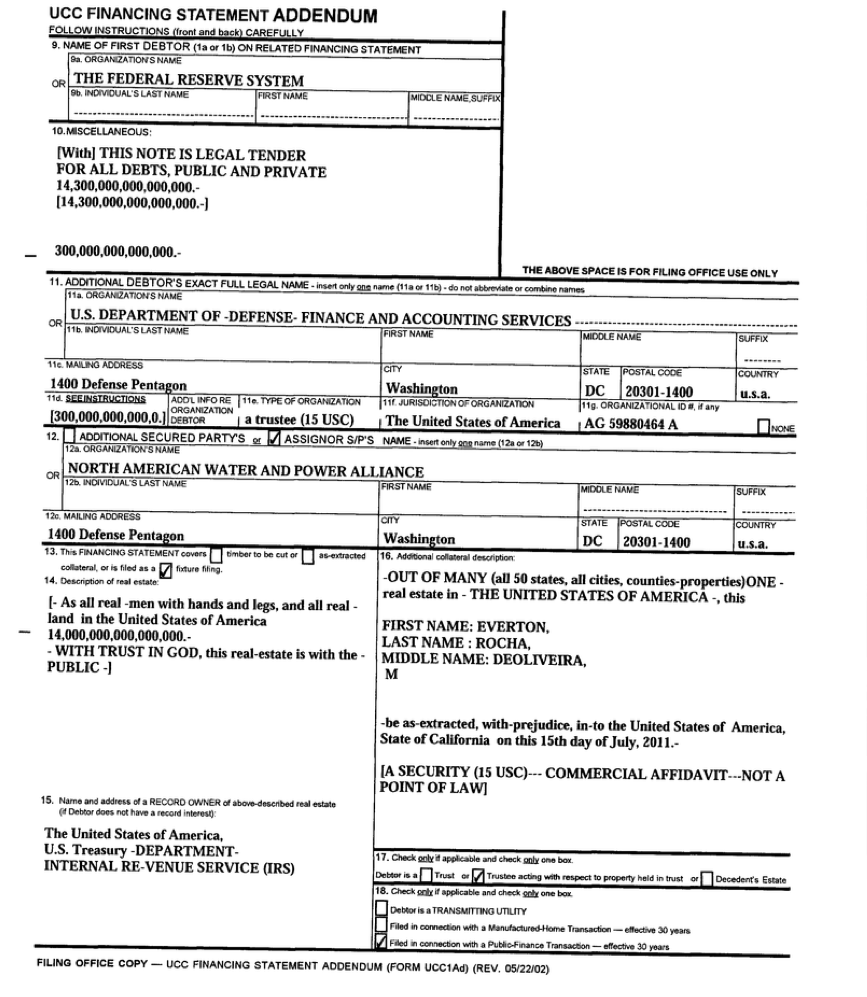
Anyone can file a lien, and, in this case it is by the name of EVERTON DE OLIVEIRA ROCHA, Trustee, where there is no verification of whom actually filed the modified UCC Financing Statement.

In the world of child welfare, Everton De Oliveira Rocha could be a legal trust, under the fiduciary trust of a corporation, just like guardianship or other trust fund structures found exclusively in child welfare.

The listed secured sub-entities are private, Quasi-Governmental Organizations, corporations, with no association nor affiliation with the United States Government, or any other governmental entity, I repeat, none:

These are private entities just like the Detroit Land Bank Authority.

The Detroit Land Bank Authority is the implementation of its pilot administrative model.

The Detroit Land Bank Authority filed what is called Lis Pendens, or rather notice of legal action of Quiet Title for forfeiture of real estate.

There are no verifications of legal standing or corporate affiliation necessary to file these legal real estate actions.

Upon judgment, these privatized so-called Quasi-Governmental Organizations, can, and continue to do so, file for federal mortgages, of which are intentionally defaulted through secondary Lis Pendens Quiet Title actions, which automatically wipe all liens from the records, including mortgages.

The model based on the child welfare and the Russian Prevezon case which was litigated in New York.  The complaint and exhibits can be found in the link, provided.

Always remember,

"It takes a village...then pillages its treasury."

Stay tuned, this is just getting started.

Who established the North American Water and Power Alliance? And why did they do it?

SOTN Editor’s Note:

The following post was sent to the SOTN editor via the website email.  It presents information that has been out there on the Internet for some time but which has never been satisfactorily explained.  The author goes further than anyone else in connecting the dots so that an enormous and unparalleled transaction can be better understood.

However, the real back story to this exceedingly suspicious lien against the USA has yet to be disclosed.  SOTN invites any other IRS investigators and/or FED researchers to provide more facts surrounding this highly unusual case.

Please feel free to forward additional proof of fraud to this email address: SOTNeditor1@gmail.com.
All hard evidence will treated with the utmost security and confidentiality.
Thank you,

State of the Nation

An essential fact is: Americans are indentured servants (slaves); they are owned by international bankers through the BANK OF INTERNATIONAL SETTLEMENTS (BIS).

Below, are the documents proving that the IRS claims ownership of all land, real estate, and ‘all real men with hands and legs”. In law, reference to man includes women and children. (See pdf: 001 A PROOF OF LIEN doc 12, page 3, item 13, under’ Description of real estate’.  The following link contains the official paperwork that documents this extraordinary transaction concerning the North American Water and Power Alliance.

The proof is in the public records which you can access by going to the Maryland Secretary of State website.  Search the business records for the FEDERAL RESERVE SYSTEM and/or entering the filing number, 181425776; scroll for the July 11, 2011 filing event.

This document is a lien against America: all land, all real estate and each and every American.  This lien claims a debt value of $14.3 quadrillion; that’s 14,300 trillion dollars. A lien means that until the debt is paid, the IRS owns America, including the people. Actually, the IRS is just the holder in due course for the BANK OF INTERNATIONAL SETTLEMENTS which is located in Basel, Switzerland.  As the holder in due course, the IRS retains the right to enforce the claim and debt collection.

Please click on the copy of the original document below dated 7/28/2011 (exactly 6 years ago) to view the lien amount of $14.3 quadrillion.  This UCC financing Statement names the “First Debtor” as the The Federal Reserve System.  The U.S Department of Defense is listed as the debtor’s exact legal name.  The North American Water and Power Alliance is shown as the “Assignor”.

How can this possibly be true you may ask?

You need to know that the original Republic of  theUnited States was a compact and alliance of the individual states; each state was recognized as a separate nation under international law. However, when congressional representatives of seven Southern states abandoned their posts in 1861, Congress adjourned and dissolved taking the Constitutional Republic of the United States of America with it. After the Civil War, under the Reconstruction Acts, a new United States corporation, was formed in 1871. This can be confirmed by referring to United States Code, Title 28, Chapter 176 under Federal Debt collection procedures. Section 3002 (15) states that “United States” means:

(A) a Federal corporation;

(B) an agency, department, commission, board, or other entity of the United States; or

(C) an instrumentality of the United States.

Note that this definition does not include any reference to a constitutional republic, country, nation, compact of states, geographic area, or people.

The definition only refers to agencies and instrumentalities of the United States corporation.

It gets worse: the UNITED STATES corporation went bankrupt in 1933; this resulted in establishing a bankruptcy trust.  The FEDERAL RESERVE SYSTEM is the ‘Public Trust’. All the property of the UNITED STATES, which also applies to ‘states’, are held in trust under bankruptcy law.  This property includes all land, all real estate, and even the PEOPLE, and are held as the collateral for the debt owed to international bankers.

Attached below is a pdf document to prove the IRS lien. Also included is information on the NORTH AMERICAN WATER AND POWER ALLIANCE corporation.  Please note that their address is the Pentagon; they are listed as an assignor in the pdf document with assets of $300 billion. An assignor is one who gives something to the assignee, which in this instance is the IRS.

*Quite curiously, the attached article states that NORTH AMERICAN WATER AND POWER ALLIANCE has been trying to control the weather.


Voting is beautiful, be beautiful ~ vote.©

Monday, March 20, 2017

On Detroit Public Schools Closures: "Every Corporation Should Hire A Child"

If anyone would like to hold my 2 cents on why Michigan is on the fast track to shutter its Detroit schools, wait no longer!

The answer is quite simple, well, it will be if I am able to bite my microecnomic tongue for the duration of this post.

It is called privatization, or, in this instance, Life Remodeled and it even has a spokesperson, Chris Lambert, who is politically campaigning with these public dollars and public lands.

\
"It takes a village, then pillages the resources."

Yes, this seems like a great idea, until you look into the complex financial schemes of NGOs capitalizing on tax exempt, public dollars and public land, to maximize revenues for their social impact investors.

In return, the community supports the business center, which trains students through federal cost reimbursements for free, lifetime supply of child labor, who will stay loyal to the product and community model for generations.

There is no transparency as we all know, you cannot audit God, or, in this instance, a 501c3, which will own the land, the businesses, the homes, the food supplies, the workers and all other local opportunities.

This is nothing new, because I have documented the exploits of privatization with such fervor, for many, many years, that I guess I will continue to call it out until someone listens.

Every corporation should hire a child, and that is exactly what the future of public education is.

“The law is clear: Michigan parents and their children do not have to be stuck indefinitely in a failing school,” Schuette said in a news release. “Detroit students and parents deserve accountability and high-performing schools. If a child can’t spell opportunity, they won’t have opportunity.”
Michigan Attorney General Bill Schuette

Please, keep in mind, that I am only calling out the issues of privatization and how individuals are profiting from the ills of the sardonic policies to generate poverty for the purposes of prosperity for profitable returns on corporate social investments with tax dollars to fund political campaigns.

Oh, and I am calling out "The Elected Ones" for doing absolutely nothing in presenting alternative plans to improve the educational and life opportunities for the children in their respective districts, because, audible hallucinations of religous locutions on the floor of the Michigan Legislature or in other political campaign venues do not qualify as a substitution for a policy initiative.

#Time2AuditGod

Detroit schools file suit against Michigan to stop potential closures

The Detroit Public Schools Community District formally filed a lawsuit aimed at preventing the state from forcing the closure of failing schools in the district.

The lawsuit was filed in the Michigan Court of Claims against the state School Reform Office, the State of Michigan and Natasha Baker, the state school reform officer.

"Papers will be served today," Alycia Meriweather, the interim superintendent for the district, said during a meeting Monday morning with parents and community members at Central Collegiate Academy.

"Just know, we're standing with you against closure by the" School Reform Office, Meriweather said. "If any school closures are to happen, it should be at the behest of the elected school board. That's our position."

The state school reform office in January identified 38 schools for potential closure because the schools have ranked in the bottom 5% academically for the three straight years. The list included 16 schools in the Detroit district.

The Detroit board of education voted last week to take legal action, more than a month after giving the district administration the authority to pursue a possible suit. The 147-page lawsuit was formally filed Friday.

The lawsuit comes despite a deal made two weeks ago by the Michigan Department of Education, which operates independently of the reform office. The MDE told districts with schools on the list that they could avoid closure if they enter into a partnership agreement with the state to turn around the schools.

The lawsuit makes a number of arguments against closing schools. One is familiar: That the legislation approved in June that created  the district, and left the Detroit Public Schools district intact solely to pay off debt and collect taxes, gave the district a fresh start.

"Not only do defendants lack authority to do so, their actions are based on flawed data, violations and misinterpretations," of the state school code, the lawsuit argues.

"Because the DPSCD — a brand new school district  — did not operate any of the schools on any bottom 5% list for the three immediately preceding school years, the SRO cannot close them ... before July 1, 2019."

That date would be three years after the Detroit district was created.

If Baker is allowed to close schools in the district during or immediately after the current school year, "the DPSCD will never be given a proper opportunity to fulfill its intended purpose, which is to turn around its lowest achieving schools."

The argument was first made in a memo last summer by the Miller Canfield law firm, which filed the lawsuit on behalf of the district. Gov. Rick Snyder supported the argument.

But in September, Attorney General Bill Schuette issued an opinion that contradicted the idea that lawmakers intended to give the district a fresh start as it relates to school closures.

“The law is clear: Michigan parents and their children do not have to be stuck indefinitely in a failing school,” Schuette said in a news release. “Detroit students and parents deserve accountability and high-performing schools. If a child can’t spell opportunity, they won’t have opportunity.”

Voting is beautiful, be beautiful ~ vote.©

Friday, January 6, 2017

Day 74 - Where is Eric Braverman? Part 1

Gaddafi's Gold, Hillary's FoPo and DoPo 1 2 Punch

FoPo is short for Foreign Policy, DoPo is short for Domestic Policy


No NSA Disruption Version - Censorship Just Makes Things More Popular


Voting is beautiful, be beautiful ~ vote.©

Monday, October 24, 2016

How The U.S. Is Selling Off Child Poverty To Foreign Investors

Some time ago, I was asked to look into what we call the "Million Dollar Green Card".

Blow Out Sale Starts At $500K
In short, if you invest a whole bunch of money which creates alot of jobs, you can become an American citizen.

Yes, of course the EB-5 program is a bit more nuanced than this, but you get the picture that the "rich man immigration program" may have a few flaws which are being addressed.

But, then, I deeply inhaled and realized something was afoul.

The EB-5 is a foreign investment program which "targets", supposedly, economically distressed communities.

It was the word, "target" (a code word for "The Poors") that triggered me to review my issues with social impact bonding.

Private Financing of Social Services


Privatization of Chattel and Services In A Global Economy


For those of you who will not take the time to learn about social impact bonding through the links I have provided, allow me to sum it up with the quickness.

They want the Social Security Trust Fund, really, really badly and plan on doing it by generating targeted populations called "The Poors".

It is called privatization and it was perfected through child welfare programs.

See, in child welfare programs, everything is a secret, protected with privacy laws, arcane recordkeeping systems, and, as everyone should know by now...say it with me..."you cannot audit God."

That is correct, no audits nor oversight, where rampant fraud is but a bit of a monetary civil infraction.

So, now, we have foreign national interests investing in child welfare programs for the purposes of reaping a bountiful return through social impact bonds, while jumping ahead of everyone else to get a green card and grabbing up swaths of land to substantially impact the vote through gerrymandering.

Stay tuned.  I have much more to say.

GAO Immigrant Investor Program: Progress Made to Detect and Prevent Fraud, but Additional Actions Could Fur... by Beverly Tran on Scribd
Voting is beautiful, be beautiful ~ vote.©

Friday, October 21, 2016

JPMorgan Chase Commits $20 Million to Revitalize Neighborhoods in Five U.S. Cities

Collaborative partnerships in Detroit, Atlanta, Chicago, Miami, and New York to develop solutions for distressed neighborhoods

October 19, 2016 (Detroit, MI) – JPMorgan Chase & Co. today announced $20 million for five community development organizations working to create economic opportunity in disadvantaged neighborhoods. As part of the firm’s $125 million, five-year PRO Neighborhoods initiative, these five collaborative partnerships will revitalize neighborhoods in their respective cities that have been left behind by the recovery.

“The 2016 PRO Neighborhoods winners have come to the table with very exciting partnerships that aim to draw the urban renaissance and prosperity they are experiencing in their cities into the deeply distressed neighborhoods where they are working” said Janis Bowdler, Head of Community Development for Global Philanthropy, JPMorgan Chase. “We are proud of the innovative approaches this cohort is taking to delivering capital to entrepreneurs of color, diverse neighborhoods, and urban food deserts.  Each is using a data-driven approach that will create opportunities for more people to share in the prosperity of the local economies of their hometowns of Detroit, Atlanta, Chicago, Miami and New York.”

PRO Neighborhoods provides the necessary capital to local community development financial institutions (CDFIs) to address the drivers of economic opportunity in neighborhoods. These CDFIs work together to pool resources and expand lending activities for building health and education facilities, open retail centers and support community services in area neighborhoods. The first grant recipients of this new initiative include:
  • Detroit Strategic Neighborhoods Initiative Collaborative (Detroit, MI) - $5 Million.
  This alliance will combine new loan capital and unique programs with existing funding capacity to provide economic development in the three targeted neighborhoods in Detroit. The focus on helping distressed neighborhoods is informed by and builds upon JPMorgan Chase’s $100 million, five-year commitment to the city’s economic recovery.

“This announcement from JPMorgan Chase is another example of its deep commitment to Detroit and revitalizing its neighborhoods,” said Mayor Mike Duggan. “Thanks to this funding, we are going to start seeing new small businesses open, existing businesses expand and new residential developments take place in several key areas of the city. This fits in perfectly with our strategy to revitalize our neighborhoods.”

https://www.jpmorganchase.com/corporate/news/pr/20-million-to-revitalize-five-us-cities.htm

Voting is beautiful, be beautiful ~ vote.©

Tuesday, October 11, 2016

Privatization Always Begins In Child Welfare Policies

The genisus of all policy development is found within child welfare.

Privatization began in child welfare, in Michigan, which is more than just dealing with social norms in raising children.

Privatization quickly evolves to expand into the realms of property ownership, criminal & civil justice, voting rights and education as these are funded through the Social Security Trust fund, and these people want to get their hands on it, badly.

This report details just how badly these actors are creating layers, upon layers of administrations and fees through the privatization of governmental services, to generate profit off "The Poors".

I only wish the report addressed the contraints in oversight and the lack of regulation.

If the U.S. House Judiciary Committee is going to continue to advance criminal justice reform, it is going to have to address child welfare and privatization.
Voting is beautiful, be beautiful ~ vote.©

Thursday, June 9, 2016

House Judiciary Committee Approves Bill to Protect Americans’ Property Rights


Civil asset forfeiture reform is part of the House Judiciary Committee’s criminal justice reform initiative

Washington, D.C. – The House Judiciary Committee approved by voice vote H.R. 5283, theDeterring Undue Enforcement by Protecting Rights of Citizens from Excessive Searches and Seizures Act of 2016 (Due Process Act) to strengthen protections for Americans’ property through civil asset forfeiture reform.

The Due Process Act – introduced by Crime, Terrorism, Homeland Security, and Investigations Subcommittee Ranking Member John Conyers (D-Mich.), Chairman Jim Sensenbrenner (R-Wis.), House Judiciary Committee Chairman Bob Goodlatte (R-Va.),, Crime, Terrorism, Homeland Security, and Investigations Subcommittee Ranking Member Sheila Jackson Lee (D-Texas), Representative Tim Walberg (R-Mich.), and Representative Peter Roskam (R-Ill.) – raises the standard of proof law enforcement must show before depriving an individual of his or her property, increases accountability and oversight of seizures and forfeitures, and strengthens protections for Americans whose property has been seized by law enforcement agencies. The legislation is part of the House Judiciary Committee’s bipartisan criminal justice reform initiative.

Crime Subcommittee Ranking Member Conyers, Chairman Sensenbrenner, Chairman Goodlatte, and Crime Subcommittee Ranking Member Jackson Lee praised today’s approval of the Due Process Act in the statements below.


Dean of the U.S. House
of Representatives
John Conyers, Jr.
Ranking Member Conyers: “I am pleased that the Committee adopted the Due Process Act, a bill which will take significant additional steps to prevent unjust seizures and make the procedures concerning federal asset forfeiture less burdensome for innocent property owners.  For instance, the bill elevates the government’s burden of proof in civil forfeiture cases, expands the availability of counsel for those who are indigent, and affords claimants an early opportunity to challenge seizures.  These and other improvements to the law are long overdue and I look forward to House passage of this important bill.” 

Crime Subcommittee Chairman Sensenbrenner: “Civil asset forfeiture is an important piece of the overall effort to reform our criminal justice system, and the Due Process Act makes common sense changes to federal forfeiture laws that help innocent Americans. Its passage out of the House Judiciary Committee is a significant step forward in the process, and I’m confident that it will soon be passed in a full House vote.”

Chairman Goodlatte: “The House Judiciary Committee today approved another important piece of our bipartisan criminal justice reform initiative to protect Americans from having their property wrongfully seized by law enforcement. The Due Process Act reforms civil asset forfeiture to prevent incentives to improperly seize Americans’ property. The bipartisan bill also strengthens protections for Americans who have had their property confiscated by law enforcement and increases the accountability and transparency of this law enforcement tool. I thank the many members who have worked on this bill and look forward to continuing our good work on criminal justice reform.”

Crime Subcommittee Ranking Member Jackson Lee: “I am pleased to support H.R. 5283, the Due Process Act, a bill that is critically needed to update our federal asset forfeiture laws. In 2000, we adopted the Civil Asset Forfeiture Reform Act, a law that made a number of improvements to our civil forfeiture statutes.  That law reversed the burden of proof from being on the property owner to prove that the assets should not be forfeited to the current requirement that the government must prove that seized assets are subject to forfeiture. However, for an unusual process whereby the government may seize and forfeit someone’s money, car, or other assets they need to sustain themselves, the standard should be higher. Therefore, this bill would elevate the burden on the government from ‘preponderance of the evidence’ to ‘clear and convincing evidence.’ We must ensure that the federal laws that allow for the forfeiture of money and other assets include the necessary protections to ensure the innocent do not suffer from wrongful confiscation. That is why I support this bill and urge my colleagues to do the same and look forward to its passage on the House Floor.”

Key Components of the Due Process Act:

Reforms federal civil asset forfeiture programs
·         Enhances procedural protections of forfeiture proceedings in both civil and administrative settings and prevents government overreach
·         Increases the government’s burden of proof in civil asset forfeiture cases to help protect innocent victims

Strengthens protections for claimants
·         Creates a right to counsel for Americans in all civil asset forfeiture proceedings
·         Provides that a claimant may recover attorney’s fees in victorious cases against a government forfeiture
·         Speeds up the process for the government to notify the property owner of a seizure
·         Expands protections to innocent owners by requiring the government to prove the connection between the property and the offense and that the property was used intentionally in order to seize it

Increases accountability and oversight of seizures and forfeitures
·         Requires the Inspector General to conduct a yearly audit on a representative sample of federal civil forfeitures to ensure they are being conducted within the letter and spirit of the law
·         Requires the creation of two federal databases on forfeitures in order to make information more readily available to the public, including a catalog of federal forfeitures to assist those whose property has been seized and to provide broad details on the types of forfeiture, agencies involved, and the conduct that lead to forfeited property


Voting is beautiful, be beautiful ~ vote.©

Monday, May 30, 2016

Puerto Rico To Meet Michigan's Emergency Manager Law 2.0

Looks like Puerto Rico is about to get an Emergency Manager, so the socio-economic experiment of privatization has hit level 2.0.

This is going to be very interesting as there is political discussion of an unelected body taking over the democratic process of a geo-political region already on the table in multiple Bills.

First it was a state, the State of Michigan, to be specific, taking over financially stressed city child welfare programs, including the public schools, then graduated to taking over municipalities, now there is the United States of America taking over a Territory, which, of course, is not fully afforded inclusive participation in the democratic process of national elections.

Makes ya wonder when Privatization 3.0 is going to be launched.

Level 3.0 is already on the books and it is called receivership, but for the federal government to take receivership of an entire state is something which has yet to happen.

Yes, it is true that the feds have taken receivership of a city and even departments within the executive branch of a state government, but never before have the feds taken receivership of an entire state.

What's next?  The U.S. taking over another nation starting by global non-profits setting up shop in child welfare initiatives?

Privatization sounds like the new imperialistic morality parade and is much more peaceful and compassionate alternative to that barbaric thing called war.

Besides, look at the profitable returns these social impact bonds will generate!  (sarcasm intentional)

This is why I am sitting here, eating my popcorn, watching intently, waiting for the next big wave of backdoor political drama, because issues such as privatization, gets swept under rugs of main stream media, and rightfully so, they are stakeholders, to be explained at a later date.

These trends are easy to spot if one follows path to privatization which I have been clearing for the world to see.

Just remember, this all began with child welfare, and this is nothing but chattel law, revisiting the ultra vires over human capital.
.

Hispanic lawmakers face painful decision on Puerto Rico


Hispanic lawmakers are sharply divided over what to do about Puerto Rico's debt crisis.

 PuertoRico's delegate to Congress and several members of the Congressional Hispanic Caucus have begrudgingly endorsed a House bill backed by Speaker Paul Ryan (R-Wis.) and Minority Leader Nancy Pelosi (D-Calif.) It's far from sufficient, they say, but the only viable option to help the island avoid a catastrophic default.

Reps. Luis Gutierrez (D-Ill.) and Sen. Bob Menendez (D-N.J.), though, are opposing the bill and seeking changes that could cost Republican support and blow up months of arduous negotiations.

Each side insists it’s putting the Puerto Rican people above political ambitions in a fight that dwells on the contentious and, for many, painful issue of the island's territorial status.


"This is not about winning or losing. This is about taking a principled position for the people of Puerto Rico,” Gutierrez told reporters Thursday. “People didn't send me here, to the Congress of the United States, to roll over and play dead."

The Puerto Rico Oversight, Management and Economic Stability Act — called PROMESA, from the Spanish word for “promise — cleared the House Natural Resources Committee on Wednesday. It establishes a seven-person oversight board that will decide how to restructure Puerto Rico’s more than $70 billion in debt.

The bill is the result of months of deliberations between House leaders, the White House and Treasury Department. Negotiators had to balance Democratic concerns about the control board’s power and Republican concerns about protecting bondholders and Puerto Rico’s long-term fiscal health.

Despite deep reservations, Hispanic lawmakers who back the bill say there is no other option. Puerto Rico's shrinking economy, crumbling infrastructure and the mass emigration of the island's residents is too dangerous to go unaddressed, they argue.

“When measured against a perfect bill, this legislation is inadequate. When measured against the worsening crisis in Puerto Rico, this legislation is necessary,’ said Rep. Raul Grijalva (D-Ariz.) a caucus member and top Democrat on the House Natural Resources Committee.

Hispanic Caucus Chairwoman Linda Sanchez (D-Calif.) said she expected a majority of the caucus to support it, but said members “have to weigh, does the good in the bill outweigh the bad?”

The bill sailed through the Natural Resources Committee with wide bipartisan support, but the Obama administration is paying close to Hispanic lawmakers ahead of a likely floor vote next month.
Antonio Weiss, a top aide to Treasury Secretary Jack Lew, briefed the caucus on the bill Thursday, and members said they’ve received personal calls from Lew.

“Freshman year members of Congress don’t usually get calls from the Secretary of Treasury,” said first-term Rep. Ruben Gallego (D-Ariz.), who supports the bill.

Gallego said he still has concerns about the makeup of the control board, a worry shared by many Democrats. Even so, conversations with Lew, other administration figures and Puerto Rican officials convinced him to give the bill “a fighting chance.”

“I just couldn’t let my personal political ideology stand in the way of relief for 3.5 million people when there was no other option,” said Gallego. “And I hate that I got put in this position, but this is sometimes things that happen in politics.”

The oversight board is the most contentious issue for many Hispanic lawmakers, including Gutierrez, who is of Puerto Rican descent, and Menendez. They worry about an unelected body armed with the power to override the Puerto Rican government.

Those concerns reflect decades of tension over Puerto Rico’s territorial status. Menendez called the bill “blatant colonialism,” while Gutierrez insisted that reporters identify the island as “a colony of the United States.”

That tension is openly apparent and personal within the caucus.

Puerto Rico’s non-voting delegate to Congress, Resident Commissioner Pedro Pierluisi (D), supports the bill. He says the oversight board is hard to support “personally and politically,” but a necessary evil to get the bill through Congress.

“Puerto Rico has not ceded or lost anything, because we have never had sovereignty,” said Pierluisi, a gubernatorial candidate who supports statehood for Puerto Rico.

Gutierrez, who supports Puerto Rican independence, implied that Pierluisi supports the bill so he can pave a path to statehood.

"You think you're going to have statehood declaring Puerto Rico bankrupt?,” said Gutierrez. "That's always the problem with politicians. They put their own personal ambitions and political ideology ahead of the political framework."

Pierluisi's office hit back at Gutierrez's remarks.

"As Puerto Rico’s only elected representative in Congress, Mr. Pierluisi is focused entirely on what is best for his constituents. He believes that while PROMESA is not perfect, it is indispensable, which is why he is fighting for its passage," said spokeswoman Dennise Perez.

"He has absolutely no time or desire to respond to petty personal comments made by others." 
Hispanic lawmakers also have concerns about a provision in the bill allowing Puerto Rico’s governor to lower the minimum wage.

Natural Resources Committee Chairman Rob Bishop (R-Utah.) blocked an amendment offered by caucus member Rep. Norma Torres (D-Calif.) to remove that language.

“There is no question that Puerto Rico will need to make sacrifices, but it can’t do so on the backs of these hard-working, young American citizens,” said Torres, who voted “present” at the markup. 
Adding to the pressure Hispanic lawmakers feel is the clock, with Puerto Rico facing a massive $2 billion debt payment on July 1. Some are convinced the bill can't be changed in time.

Voting is beautiful, be beautiful ~ vote.©

Saturday, May 21, 2016

CONYERS Sensenbrenner, Goodlatte, Jackson Lee, Walberg, Roskam Unveil Bill to Protect Americans’ Property Rights


Civil asset forfeiture reform is part of the House Judiciary Committee’s criminal justice reform initiative

Washington, D.C. – As part of the House Judiciary Committee’s bipartisan criminal justice reform initiative, Crime, Terrorism, Homeland Security, and Investigations Subcommittee Chairman Jim Sensenbrenner (R-Wis.), House Judiciary Committee Chairman Bob Goodlatte (R-Va.), Ranking Member John Conyers (D-Mich.), Crime Terrorism, Homeland Security, and Investigations Subcommittee Ranking Member Sheila Jackson Lee (D-Texas), Representative Tim Walberg (R-Mich.), and Representative Peter Roskam (R-Ill.) today introduced bipartisan legislation to protect Americans’ property rights through civil asset forfeiture reform. 

In order to strengthen protections for Americans’ property, H.R. 5283, the Deterring Undue Enforcement by Protecting Rights of Citizens from Excessive Searches and Seizures Act of 2016 (Due Process Act),provides much needed reforms to federal civil asset forfeiture programs, increases accountability and oversight of seizures and forfeitures, and strengthens protections for Americans whose property has been seized by law enforcement agencies.

Ranking Member Conyers, Crime Subcommittee Chairman Sensenbrenner, Chairman Goodlatte, and Crime Subcommittee Ranking Member Jackson Lee praised the introduction of the Due Process Act in the statements below.

Dean of the U.S. House
of Representatives
John Conyers, Jr.
Ranking Member Conyers: “It has increasingly become apparent that the procedures in federal law governing civil forfeiture are inadequate and unfair, and therefore I am proud to cosponsor the Due Process Act.  We must change federal law so that the burden is on the government to prove that a property owner is not innocent, to raise the burden of proof, to afford initial hearings to property owners to determine whether a seizure is legal or would pose an undue hardship, and to make other improvements consistent with due process. There will be more to consider in the future, but this bill is a significant step toward rebalancing the scales with regard to a process that is too-often abused.”  

Crime Subcommittee Chairman Sensenbrenner: “Forfeiture is a critical tool in the fight against crime, but it is also vulnerable to abuse. The Due Process Act, among other things, will increase transparency and add protections for innocent property owners, including the opportunity to contest seizures and regain illegally seized property immediately. Reform to the current federal forfeiture laws is necessary to curb abuse, restore confidence in law enforcement, and help citizens protect their property rights.”

Chairman Goodlatte: “In recent years, there have been several incidents in which innocent Americans have had their property or money improperly seized by law enforcement. While asset forfeiture is a useful law enforcement tool, abuses of it clearly show that reform is needed now to better protect Americans from having their property wrongfully seized.

“The Due Process Act rightfully reforms civil asset forfeiture to prevent incentives to wrongly seize Americans’ property. The bipartisan bill also strengthens protections for Americans who have had their property confiscated by law enforcement and increases the accountability and transparency of this law enforcement tool. I look forward to taking this bill up in Committee soon and thank the many members, including Representatives Sensenbrenner and Walberg, who have worked on and championed this important issue.”

Crime Subcommittee Ranking Member Jackson Lee: “I am pleased to join with the Crime Subcommittee Chairman, Jim Sensenbrenner, the Chairman of the Judiciary Committee, Bob Goodlatte, and our Committee’s Ranking Member, John Conyers, Jr., in introducing bipartisan legislation to reform our federal civil forfeiture laws.  We must make important changes to the procedures and standards that determine when the government may take property from those not charged with a crime.  For instance, it is critical that we give greater opportunity to innocent property owners to successfully challenge unwarranted forfeiture and the burden should not be on them to prove their innocence.”

Key Components of the Due Process Act:

Reforms federal civil asset forfeiture programs
·         Enhances procedural protections of forfeiture proceedings in both civil and administrative settings and prevents government overreach
·         Increases the government’s burden of proof in civil asset forfeiture cases to help protect innocent victims

Strengthens protections for claimants
·         Creates a right to counsel for Americans in all civil asset forfeiture proceedings
·         Provides that a claimant may recover attorney’s fees in victorious cases against a government forfeiture
·         Speeds up the process for the government to notify the property owner of a seizure
·         Expands protections to innocent owners by requiring the government to prove the connection between the property and the offense and that the property was used intentionally in order to seize it

Increases accountability and oversight of seizures and forfeitures
·         Requires the Inspector General to conduct a yearly audit on a representative sample of federal civil forfeitures to ensure they are being conducted within the letter and spirit of the law
·         Requires the creation of two federal databases on forfeitures in order to make information more readily available to the public, including a catalog of federal forfeitures to assist those whose property has been seized and to provide broad details on the types of forfeiture, agencies involved, and the conduct that lead to forfeited property

Original cosponsors of the bill are Representatives Steve Chabot (R-Ohio), Doug Collins (R-Ga.), Darrell Issa (R-Calif.), J. Randy Forbes (R-Va.), Trent Franks (R-Ariz.), Steve Cohen (D-Tenn.), Hank Johnson (D-Ga.), Jim Jordan (R-Ohio), Raul Labrador (R-Idaho), David Trott (R-Mich.), Mimi Walters (R-Calif.), and Cedric Richmond (D-La.).
Voting is beautiful, be beautiful ~ vote.©

Thursday, May 19, 2016

Michigan Creates Poverty Segregation Databases


Just when you thought Michigan could not stoop any lower when it comes to making the lives of children in poverty even more dismal.


Michigan Department of Treasury has just implemented an online identity verification system.

Peaches.

Here is the bait and switch, according to the letter, which contains an unique Quiz ID number  (riiiiiiiiiight ` wink.) you must log in as a guest or create an account to access your Earned Income Tax Credit.

What is the purpose of a unique Quiz ID number when, in dealing with the State Treasury or Health and Human Services, one typically uses a Social Security Number?

But wait, there is also a Discovery CID number.  Whether that is Criminal Investigative Demand or Civil Investigative Demand for Discovery, we shall soon find out in the news.

There are only two state departments which participate in the system, the Department of Health and Human Services and the Department of Treasury.

Makes pretty good sense to me, right?  Cost efficient, streamlined, good entitlement fraud detector,

No.  Unique IDs are known in the meth world as no-no's when it comes to internal validity.

Therefore, this is an intentionally constructed database, but for what?

Well, it seems if you fail the quiz, you must hard copy your state identification, and federal income tax information, must also be provided.

But wait, the letter said, [sic] This review may take 3 to 6 months, depending on the volume of responses received.

So, tactfully, Michigan can hustle out of doling out tax refunds to save a few bucks until the next budget by creating a fraudulent ID verification system for the purposes of creating a database to monitor behavior?

I do not have a problem with engaging quantitative methodology into policymaking, but when it is done through an internet farce, that is where I take issue.

The letter for the ID Quiz specifically demands in the alternative:
  • Copy of driver's license(s), picture ID(s) or Government issued picture ID;
  • W-2's
  • SSA-1099s
  • 1099s
  • K1s
What makes me parse out the last of my assumptions of whether this is an intentional farce is the specificity for all financial instruments listed, which are indicative of an individual who is one, classified as "working poor".

Working poor own businesses, put in more than 40 hours a week on a job(s), yet qualify for full SNAP and Medicaid benefits.

In some instances, there are individuals who are disabled or care for the disabled who fall into this category, also.

This means that this population of working poor, EITC beneficiaries, becomes, now, targeted.  But why?

Well, the internet access, skill, itself becomes a toll many cannot afford as they must pay someone to assist as local agencies provide services during traditional working hours.

Then there is the actual recordkeeping.  Many do not keep records and even many more do not know how to keep financial transaction records for home based, cottage industry.

Federal records are not as precise as state, simply for the fact that poor people cost in oversight.  A state may find an incentive through an investment in scrutiny.

I call it privatization as a QGO or even contracted state arm NGO,

I believe there are people who would like to know who is the recordkeeper of these data, and for what purposes.

There is a movement of people who believe they can have a second go-at-it of ending poverty through data, in similar form of our current predictive credit system.

There are those who are afraid of losing everything, including their property, including their children. 

This segment of our newly targeted population will not participate in the filing of identification documents.

Of course, lest we forget the other segment of this newly targeted population who would be identified for possible voting ID laws violations.

In many situations, due to the really bad, and I mean really, really bad history between the State of Michigan and Information Technology, I am even questioning if this is a pilot program to see it it crashes enjoining DHHS and Treasury.

Remember, child support is linked within these two Departments, also.

But to make an assumption that this database action initiative was in the public's best interest would be like giving too much credit to the geniuses  consulting folks of Governor Rick Snyder as he is just as notorious as his fellow Republican Governors, particularly the dude from Kansas,  always slashing resources to children in poverty as the go to budget plug tactic.

Flint will remain a spending priority as Snyder looks for cuts, Roberts said. Reductions will most likely come from areas Snyder had recommended for increases, where spending now will likely go up less than expected, he said. Those areas could include information technology, the Michigan State Police, the Healthy Kids dental program, the K-12 education foundation grant, higher education, and a new statewide infrastructure fund, among others.

Either through fear or a bogus internet fraud scheme, it looks like Snyder found some budget savings to hold out until fiscal year 2017 kicks in and a new method of segregating data.

My alternative hypothesis blends well with the testimony of Maura Corrigan of the American Enterprise Institute. 

(BTW, my null is that this was all just a learning mistake on the part of the Snyder Administration because I poignantly recognize that it will be swiftly disproven.)

Say what you will, but I am calling this Identity Earned Income Tax Confirmation Quiz a BS database until someone proves me wrong.

This is predatory targeting of the poor.


Identity Confirmation Quiz

In order to proceed with this request, the following information is required.

You understand that by clicking on the I AGREE button immediately following this notice, you are providing 'written instructions' to the State of Michigan under the Fair Credit Reporting Act authorizing the State of Michigan to obtain information from your personal credit profile or other information from Experian. You authorize the State of Michigan to obtain such information solely to confirm your identity to avoid fraudulent transactions in your name prior to granting you online access to and use of the State of Michigan web site.

This may be because you have not yet filed your Michigan Income Tax return. Please verify that you have. If you have not filed a MI return, please follow the instructions on the letter.
If you have filed a return, the information you entered is incorrect. Please submit a copy of your driver's license and your spouse's, if applicable, or personal IDs and copies of any of the following that is applicable to your return: W2s, 1099s, SSA-1099, or K1s in the return envelope provided with your letter to the address below.

Michigan Department of Treasury
P.O. Box 30771
Lansing, MI 48909-8271

Voting is beautiful, be beautiful ~ vote.©