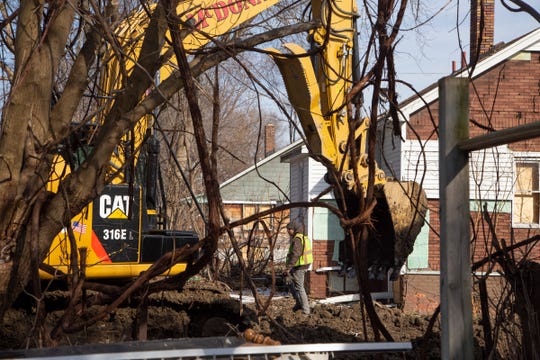
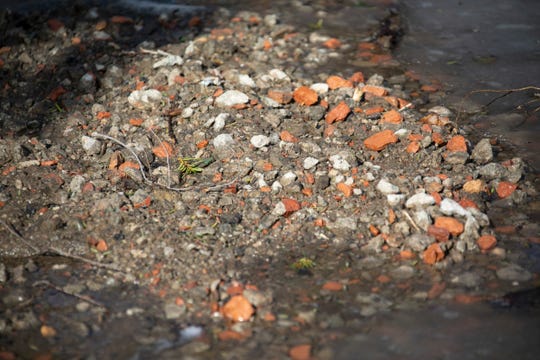
Showing posts sorted by relevance for query sigtarp. Sort by date Show all posts

Monday, January 22, 2018

SIGTARP Is Still Investigating Flint & Detroit Blight Demolition Programs

Did you know the Flint TARP Blight Demolition program is under federal investigation, too?

Did you know the Flint Water Crisis generated lots of blight, too?

MITIGATING THE RISK OF OVERCHARGING AND FRAUD REQUIRES STRONG OVERSIGHT

The question of why costs are rising in Michigan and Ohio is one that SIGTARP will be conducting oversight to answer. Even if there may be explanations for certain rising costs, that does not necessarily mean that federal taxpayers have to pay for it with TARP dollars. In order to understand demolition costs at a more granular level, SIGTARP recently announced an audit of demolition costs in Flint, Michigan, the second largest city in TARP blight demolition funding.

Funny how this works.

Detroit Land Bank Authority and Mike Duggan did not publicly disclose that the Treasury Department had suspended TARP Funded Demolition funding.


Then, the "Legal Geniuses" (trademark pending) came out with the story that everything was honky dory because they had miraculously stopped fraudulently billing TARP for demolitions immediately after SIGTARP told them they were fraudlently billing TARP for demolitions.


via GIPHY

TARP-Funded Demolition Costs Rose 57% in Detroit and Decreased After SIGTARP’s Audit Detroit, Michigan is the city that receives the largest amount of TARP-funding for demolitions in the nation at $130 million. In Detroit, the average cost of demolition per house rose 57%. The average of TARP-funded demolition in Detroit at the time of SIGTARP’s June 2016 audit was $17,622, very close to the peak average for the entire state of Michigan, as shown in figure 3.2. Source: SIGTARP analysis of Michigan HHF Blight Demolition data through 12/31/2016, obtained via Michigan State Housing Development Authority response to SIGTARP data call.

SIGTARP Graph Identifying Detroit Land Bank End of Fraudulent Billing Miracle - June 2016


The data shows a direct correlation to the timing of SIGTARP’s June 2016 audit and the decrease in demolition costs. After SIGTARP issued its June 2016 audit, costs immediately dropped, and since then have dropped significantly. In addition, Treasury temporarily suspended all TARP dollars in Detroit for blight demolition in August 2016. With an additional $67 million in TARP dollars committed to blight demolition in Detroit, cost savings to taxpayers is critical.


Voting is beautiful, be beautiful ~ vote.©

Friday, October 26, 2018

Cocktails & Popcorn: OVERSIGHT Hearing On SIGTARP & Its Multifaceted Issues With The Administration Of The Hardest Hit Fund

My apologies for missing this precious gem!

The U. S. House Oversight Committee held hearings on the Hardest Hit Fund - TARP, to respond to the findings of SIGTARP, the enforcement mechanism of the U.S. Treasury which audits the program.

Sandy Baruah Sucks & Deserves A Subpoena For What He Did To Detroit


Basically, you have a bunch of "The Elected Ones" whose staff failed to properly debrief their members on the background of the Hardest Hit Fund.

All they had to do was google my name, but they probably did, realizing it was best to limit the breadth of their questioning to ethics in the administration of the program.

I like that, just let them speak.

What we have here is an issue within the U.S. Treasury because every time a Member asks about stealin', in an ethical sense, only, because there are no criminal referrals from the Treasury, that we know of, to date, due to the unverified ongoing investigation that may not even exist, here was the mimeographed response of Kipp Kranbuhl.

Chairman Gary Palmer smacked down Kipp (a name truly synonymous with poverty and hardship) down by having SIGTARP Christy Goldsmith Romero break it down to the fact that SIGTARP can not speak upon the multiple, ongoing criminal investigations that the office refuses to verify.

Gary: "Are gym memberships considered allowable to help homeowners stay in their homes?

Kipp: "We follow cost principles for every federal program."

Gary: "Have you made any criminal referrals?"

Kipp: "We follow cost principles for every federal program."

Gary: "What time is it?"

Kipp: "We follow cost principles for every federal program."

Christy was Johnnie on the Spot in her succinct responses to questions of why there was so much stealin', but I seriously wonder how many people in the room actually caught what she said.

For those who do not wish to watch the entire hearing, allow me to provide a quick synopsis.

"They were stealin'."

I bet Kipp wore Depends for this hearing.

I bet he thinks about me, alot

Neil Barofsky And His History Of SIGTARP


We have ourselves a Special Issue going on with Treasury.

See, SIGTARP, nor any other law enforcement entity, ever verifies the existence, or non-existence, of an investigation, or an ongoing investigation, unless it is verified by an original source, like me.

SIGTARP Is Still Investigating Flint & Detroit Blight Demolition Programs

But, hey, what do I know?

I know I am really happy that I found this hearing video!


Image result for us treasury

Statement of Deputy Assistant Secretary Kipp Kranbuhl Before the House Oversight and Government Reform Subcommittee on Intergovernmental Affairs and Government Operations

Chairman Meadows, Chairman Palmer, Ranking Member Connolly, Ranking Member Raskin, and Members of the Subcommittees, thank you for the opportunity to testify today about Treasury’s efforts to mitigate the effects of the financial crisis on American homeowners through the Housing Finance Agency Innovation Fund for Hardest Hit Housing Markets, also known as the Hardest Hit Fund or HHF.

In 2008, Congress passed the Emergency Economic Stabilization Act of 2008, 12 U.S.C. 5201, et seq., (as amended, EESA).  This legislation provided Treasury with immediate authorities and resources to restore liquidity and stability to the nation’s financial system in the wake of an historic economic crisis.  Using its authorities under EESA, Treasury established the Troubled Asset Relief Program, known as TARP, an initiative that was unprecedented in both its design and scale.  Congress initially authorized up to $700 billion for TARP programs, though Congress later reduced that authority to $475 billion.

In the following years, Treasury disbursed nearly $412 billion of TARP funds under a variety of programs designed to help stabilize banks, automobile manufacturers, and other institutions integral to the nation’s economy.  Treasury reserved additional funds for programs designed to protect home prices and prevent foreclosure.  The first, and largest, of these housing programs was the Making Home Affordable® program, or MHA.  Launched in 2009, MHA was a nationwide effort to help struggling homeowners avoid foreclosure by lowering mortgage payments to affordable levels.  However, it soon became clear that a one-size-fits-all approach would not be sufficient to address all of the specific needs of homeowners and communities in the states that were hit hardest by the housing crisis.

Treasury established HHF in 2010 as part of TARP in order to help prevent foreclosure and to stabilize housing markets in states hit hardest by the housing crisis.  State housing finance agencies, (together with certain designated entities, HFAs) in eighteen states and the District of Columbia were selected to participate, as these areas experienced unemployment rates at or above the national average, and/or home price declines of greater than 20 percent.[1]

Unlike MHA – a national program based on uniform criteria set by the Federal government – HHF was designed to give the participating HFAs the maximum flexibility to design and administer their own programs, each tailored to local conditions in their respective communities.  As a part of this flexibility, the states have been able to adapt their programs in order to address the changing needs of their communities over time.

As of December 31, 2017, states had assisted approximately 350,000 homeowners and funded the demolition and greening of nearly 24,000 blighted properties in distressed communities.
However, the flexibility afforded to HFAs by the Hardest Hit Fund has made Treasury’s oversight a critical aspect of the program.  Treasury maintains a strong commitment to ensure that the program achieves its goals and that federal taxpayer funds are used for their intended purpose.

Treasury requires each HFA to set specific goals for its HHF program, and to demonstrate steady progress toward meeting these goals.  Treasury works with each of the HFAs to identify and address barriers that would keep the HFA from achieving its goals.  Subject to Treasury approval, the HFAs may also modify their programs as needed in order to address the changing needs of their communities.  Treasury also maintains an ongoing dialogue with the HFAs through in-person meetings and regularly scheduled calls, and it hosts annual summits where the various participating HFAs can meet and share best practices.

Treasury has also conducted more than 100 on-site compliance reviews across the participating HFAs, as well as additional, targeted reviews to address specific programmatic risks.  These reviews evaluate a number of critical program functions, such as whether homeowners are evaluated in accordance with the HFA’s guidelines, program disbursements and administrative expenditures are appropriate, the information reported to Treasury is accurate, and the HFA’s internal controls are functioning as intended to minimize the risk of non-compliance.

Treasury takes corrective action when instances of non-compliance arise.  This includes, for example, requiring HFAs to re-evaluate homeowners that were improperly denied, to reimburse HHF for improper expenditures, and to strengthen internal controls in order to prevent further non-compliance.
In addition to compliance reviews, Treasury also takes SIGTARP’s role seriously.  We share this Committee’s and SIGTARP’s commitment to preventing fraud, waste, and abuse in all TARP programs, and we carefully consider recommendations in that regard.

Treasury responds to SIGTARP recommendations in writing, and our responses are made available to the public.  We work hard to address the concerns raised by these recommendations, in a manner that allows the programs to function as intended and in the context of TARP’s wind-down.  With respect to HHF in particular, this has included, for example, issuing written guidance to clarify HFA obligations, recovering funds that were improperly spent, and requiring states to strengthen internal controls to prevent non-compliance in the future.

For example, Treasury thoroughly reviewed the $2.2 million of costs questioned in SIGTARP’s August 2017 Audit Report.  This involved analyzing thousands of individual transactions incurred by all 19 HFAs, dating back to the program’s inception in 2010.  Following this review, Treasury determined that $656,141 of the questioned costs did not comply with the Federal government’s cost principles.  The HFAs were required to reimburse HHF.  For the reasons set forth in our April 6, 2018, letter to SIGTARP—a copy of which has been provided to the Committee and is available on our website—Treasury determined that the remaining costs questioned by SIGTARP were allowable under Federal cost principles.

As is the case with all TARP programs, HHF is winding down.  Although Congress authorized additional funding in 2015, the program remains a temporary one.  As of the end of April 2018, Treasury has disbursed $8.8 billion (or 92 percent) of the $9.6 billion obligated under HHF. Although HFAs may continue issuing new approvals through December 31, 2020, most of the states have already begun to close down HHF programs or will do so this year as they exhaust their available funds.  This includes California and Florida, the two largest states in the program.

Treasury’s outstanding commitments under TARP represent just one percent of the $475 billion authorized by Congress.  As TARP winds down, Treasury remains committed to robust oversight and monitoring of all of its TARP programs, including HHF.

As part of this wind down, the Office of Financial Stability, which oversees HHF and other TARP programs, was recently realigned to report to Treasury’s Assistant Secretary for Financial Institutions.  This realignment will enable our office to oversee an orderly and successful wind down of HHF that is in line with the wind down of other programs that are also overseen by this office, such as the State Small Business Credit Initiative and the Small Business Lending Fund.

I thank you again for the opportunity to testify today and welcome your questions.
####

[1] The eighteen participating states consist of Alabama, Arizona, California, Florida, Georgia, Illinois, Indiana, Kentucky, Michigan, Mississippi, Nevada, New Jersey, North Carolina, Ohio, Oregon, Rhode Island, South Carolina, and Tennessee.

Here is where the Treasury came up with the excuse, "the money has not yet been allocated" whenever SIGTARP asked what happened to the money.

As soon as Treasury responds, by the wings of Mercury, they officially start stealin' because they know by the time they are asked again, there will be a new allocation cycle, with questions only focused on these new allotted funds, not the funds they were stealin' in the previous grant spend down cycle, because that could be one of those double jeopardy administrative moments they can argue their way out of a criminal proceeding.

Voting is beautiful, be beautiful ~ vote.©

Wednesday, January 30, 2019

Former Detroit Land Bank Authority Attorney Becky Camargo Gets Second SIGTARP Subpoena

636391899487340902-camargo.jpg
Becky (said like a 1980s Valley Girl) Camargo
Well...

I bet this is quite the uncomfortable position for Becky (said like a 1980s Valley Girl) Camargo.

See, she was the former Wayne County Property Deed Fraud Unit Prosecutor who was handing over properties to Detroit Land Bank Authority when she became its lead attorney overseeing her continuous property transfer pipeline.

But now, she is representing one of the contractors she contracted with in her former position at the Detroit Land Bank Authority, where she drew up the contracts, and has been subpoenaed to provide certain contracts to SIGTARP, even though the Detroit Land Bank Authority never incorporated.

Messy.

Becky  (said like a 1980s Valley Girl) may be facing one of those pesky "attorney-client  privilege" stripping situations with her second SIGTARAP subpoena.

I bet that sucks.

Then again, SIGTARP may just be going off what Becky  (said like a 1980s Valley Girl) when she was on wiretap, but, hey, what do I know?

I know Becky (said like a 1980s Valley Girl), should ask Perkins Coie to represent her in her  upcoming legal defense.

I wonder what Michael Brady is into, lately?

Subpoenas issued in criminal probe of Detroit demolitions

Detroit — A federal watchdog agency has issued a new round of subpoenas in its ongoing criminal investigation into the city's demolition program.

In subpoenas issued this month, the Special Inspector General for the Troubled Asset Relief Program is seeking two years' worth of documentation from certain contractors over dirt used to fill holes for homes torn down under the blight removal effort.

The feds demand that demolition firms produce receipts and records that reveal where their backfill dirt was coming from, who trucked it to sites in Detroit and where it was dropped off.

The subpoenas are the latest development in the agency's ongoing criminal probe of demolition in Detroit after the federally funded program came under scrutiny in 2015 amid concern over bidding practices and soaring costs.

A copy of a Jan. 10 subpoena obtained by The Detroit News seeks documentation for specific contracts from 2016 through 2018 and notes the information sought is "relevant or material to an ongoing investigation."

Rebecca Camargo, an attorney for one of the contractors targeted, said subpoenas were issued this month to at least seven different demolition companies.

One of her clients, Jackson-based Smalley Construction, received one on Jan. 11 and turned over its documentation to SIGTARP on Monday.

"We've compiled all the information for Smalley that they've asked for and sent it to them," said Camargo, a Troy-based attorney who formerly served eight months as the land bank's director of demolition before stepping down in August 2017. 

"As far as we know, they are reviewing it," she said of SIGTARP. "We have not gotten a response from them yet."

Camargo noted the subpoena asked for information pertaining to several different contracts. For most of the properties, Smalley has not yet completed those jobs. For properties it has knocked down, the company has supplied its backfill tickets. The company, she added, uses dirt from residential projects to fill its open holes.

Rob Sholars, a spokesman for SIGTARP, said Tuesday that it's the office's policy not to comment on any ongoing investigations, including confirming whether they exist.

The newly issued subpoenas were first reported Sunday by Deadline Detroit.

Reached Tuesday, Christian Hauser, an attorney for several demolition and abatement contractors involved in the program, said he was unable to confirm whether his clients received subpoenas.

The Detroit Land Bank Authority oversees the blight elimination effort along with the Detroit Building Authority. More than 16,000 blighted homes have been demolished under the program since May 2014.

The land bank has not received any subpoenas related to backfill used at demolition sites, said spokeswoman Alyssa Strickland, adding "but we do continue to cooperate fully with the SIGTARP investigation."

Brian Farkas, director of special projects for the building authority, said the city and the building authority hadn't received subpoenas either. The city, he said, is cooperating "with all inquiries and investigations into our demolition program."

The Michigan State Housing Development Authority allocates funds for the program under the state's Homeowner Assistance Non-Profit Housing Corp.

The state on Tuesday said it also has not received subpoenas related to backfill from SIGTARP.
Katie Bach, a spokesman for MSHDA, said in a Tuesday email to The News that Detroit implemented a new dirt tracking system late last year to better document dirt that's being used for demolitions.

"The guidelines require source of dirt, the address it's going to, and size of load by cubic yard or square feet," she said.

During the time period referenced in the subpoena, Detroit required contractors to provide invoices for dirt and the land bank maintained load tickets that documented the quantity and where it was dropped, according to MSHDA.

"The biggest difference is that the source is now being documented," Bach said. "MHA supported the guideline changes because they made sense for the continued success of the program."

Strickland said the land bank prioritizes public health and safety and it always had rules that govern backfill for demolitions. It's covered in requests for proposals, she said, "so all contractors know exactly what the requirements are each time they bid and sign a contract."

The building authority then manages those contracts and requirements.

Under program policy, Farkas said demolition contractors are required to identify the source of all backfill materials and maintain records for inspection upon request.

"These requirements have been updated, and contractors are now required to sign an affidavit and provide documentation regarding dirt source and destination," Farkas said.

Contractors must also perform sampling and analysis of materials that come from sources that may exceed state criteria for residential use.

Sampling has informed the building authority's decision to prohibit the use of soils from certain projects, including the I-96 construction project and Little Caesars Arena.

The building authority, Farkas said, has strict penalties for contractors found to have violated the policy, including a 30-day bid disqualification for a first offense, 90 days for a second and nearly a full year for a third offense.

Several contractors were sanctioned for violating the policy between 2016 and 2018, he said. Each had to pay for the cost of removal, replacement and proper disposal of the unauthorized fill.

SIGTARP is a federal law enforcement agency established by the Emergency Economic Stabilization Act of 2008 to conduct, supervise and coordinate audits and investigations of the purchase, management and sale of assets under the Troubled Asset Relief Program.

In 2016, the agency issued subpoenas demanding the land bank and building authority hand over information on federally funded contracts and several demolition contractors.

Detroit's auditor general, who is conducting an ongoing audit on the city's demolition activities, and several contractors involved in the program previously confirmed that they'd received subpoenas from SIGTARP in 2016 as well.

The federally funded effort has also been the subject of state and local audits, reviews and a probe being conduct by the Detroit Office of the FBI.

In 2017, The  News reported that a federal grand jury was focused on whether dollars earmarked for tearing down blighted homes in the city were misappropriated.

As many as 30 contractors and city agencies were believed to have been subpoenaed to testify or provide documents.

A past review of the program's billing practices conducted by the state turned up $7.3 million in what the state argued were "inappropriate" or "inaccurate" costs — the vast majority in connection with a controversial set-price bid pilot in 2014 designed to quickly bring down big bundles of houses.

Detroit's Office of Inspector General issued findings last month from an independent, three-year investigation into the set-price contracts that concluded meetings between city officials and specific contractors to discuss federally funded demolition work before public bidding didn't violate written rules but gave the impression of "preferential treatment."

Voting is beautiful, be beautiful ~ vote.©

Wednesday, September 25, 2019

SIGTARP, Detroit Land Bank Authority & The Uncloaking Of The Dark Gerrymandering Tale

636391899487340902-camargo.jpg
Becky (said like a 1980s valley girl) Camargo
For everything you ever wanted to know about the Detroit Land Bank Authority, you shall find it here.

The Special Inspector General for the Troubled Asset Relief Program, or SIGTARP, has been conducting a criminal investigation into the program for several years. 
SIGTARP also has secret recordings.

What many may not understand is that these privately contractors may have demolished properties where absentee ballots were issued to these property addresses and tallied for the 2018 election...2016 election...and 2014 election....and 2012 election....and 2010 election.....but hey, what do I know?

#perkinscoiesucks

Contractors named own price for Detroit demolition dirt, emails show

Detroit — Contractors charged the federal government whatever they wanted for more than two years for dirt used to fill holes left behind from thousands of torn-down houses in Detroit's controversial demolition program, emails obtained by The Detroit News show.

It would have been nice if they would have at least dropped more than five inches of dirt on my lot of a demolished home.  I should excavate just to see if there were any antiques left behind before they bulldozed the structure to collapse in its burnt out basement. I really wanted to plant vegetables to compensate for the nasty things Michigan and Detroit continue to do to tiny humans.

The unrestricted charges occurred because no rules were in place to limit dirt costs, eventually prompting state officials to worry about overbilling.

Emails reviewed by The News flagged dirt costs ranging from $3,750 to upward of $7,000 per property that were billed to the state for reimbursement. These charges prompted the state to crack down on contractors, limiting dirt costs to $3,000 for larger houses and $2,000-$2,500 for typical properties.

Considering the average cost for dirt in the most recent quarter — $2,368 per property — it is likely the government spent well above the $18 million it would have on the 7,747 demolitions conducted from the program's inception through July 2017 when cost controls were put into place.

"I cannot say with any kind of authority if something was inappropriate or fraudulent. All I can say is I questioned those costs that were just kind of out of line," said Mary Townley, president of the Michigan Homeowner Assistance Nonprofit Housing Corp., the entity created by the Michigan State Housing Development Authority to administer federal Hardest Hit Funds for the demolition program.

The state's concerns — seen flagged in 2017 correspondence between MSHDA and Detroit Land Bank Authority — first came to light more than a year after the program launched in spring 2014.

The News' request through the Freedom of Information Act included email discussions over dirt charges submitted by contractors that spanned from January 2017 to May 2017. The emails turned up close to a dozen instances in which dirt costs were flagged by state workers hired to review demolition invoices.

State contractors and program leaders expressed skepticism to land bank officials about the prices billed to the taxpayer-funded blight effort as invoices began to come in by late 2015.

But cost reasonableness for dirt wasn't officially added to the state's blight manual until July 2017, requiring contractors to turn in dirt invoices, load tickets and other documents to substantiate costs. This essentially made a paper trail from contractors to prove what "they really paid" for the dirt, according to the emails.

It's unclear to the state what the average dirt cost per house was in the early stages of the program because officials admit they weren't being tracked.

The state also could not provide an estimate on the number of invoices it received that sparked concerns. But officials said once invoices began to ramp up, so did the irregularities, prompting an investigation into the costs and billing practices for the overall program.

'Digging deep' into costs
The emails raise accountability questions for the demolition program, which has been the subject of a federal criminal investigation. The development also comes amid an ongoing audit of whether contaminated soil was used to fill holes for homes torn down through the federally funded program in Michigan cities, including Detroit.

At the outset, the state "did what we could" but operated without formal rules to cap dirt costs, Townley said.

The state got the bulk of the early demolition invoices in late 2015. That's when, Townley said, questions surfaced and state officials began "digging deep" into program costs and whether contractors had documentation to back them up.

The state in 2016 launched a review of the city's demolition program in tandem with a two-month suspension imposed by the U.S. Treasury Department to address improper billing and misallocation of funds.

The state concluded its review of Detroit's billing practices in early 2017 with a $5 million settlement with the land bank to resolve a dispute over invoices the state said were improperly submitted for repayment. In return, the state agreed to make that same amount available to Detroit for tearing down more houses.

On the heels of its review, the state implemented "cost reasonableness" guidelines that Townley said "opened up the process for the state to question costs" as well as a policy requiring contractors to supply load tickets for dirt and copies of other documentation from bid packs. Initially, the state didn't track dirt costs separately.

The dirt cost rules were referenced in a January 2017 email titled "dirt invoices" from Roxanne Eaton, the state's program team leader.

In the correspondence, Eaton identified a range of $2,000 to $2,500 that she deemed acceptable.

Prior to that, emails suggest some were billed at $3,750 or $5,000, regardless of square footage, with at least one billing reaching nearly $7,000, the News found.

On Jan. 24, 2017, Eaton sent an email to MSHDA staff, copying Townley, saying $2,000 to $2,500 or less for dirt for "our usual dinky" houses "we will be fine."

If it's $2,500 to $3,000 and the house is larger, "I am OK with it," she wrote.

"We will only question the ones that falls out of these categories," added Eaton, who notes that costs of $3,750 billed by the prominent demolition firm Homrich "is still high in my mind unless the house is very large."

Anthony Abela, a project manager for Homrich, declined to be interviewed.

Eaton, in a Jan. 19, 2017, email to some land bank and city building authority staff titled "heads up," warned that "very high costs for dirt" would need to be explained.

"I am putting you guys on notice that we are sending the files back with a note asking the contractor to supply a copy of the load ticket and a copy of the invoice showing they really paid for dirt," she wrote.

"We are receiving conflicting stories about where and how dirt is being acquired, so this is (the) way treasury wants us to address it."

On April 24, 2017, an MSHDA worker sent an email to Rebecca Camargo, the land bank's former demolition program director and other land bank staff, asking why the dirt cost for a 2,390-square-foot property at 5759 Lawton was $6,875.

Camargo responded that the property, which records show was demolished by Salenbien Excavating and Trucking, fell under a past directive from the state "to put any dirt amount into that field."

"That directive stated that it didn’t have to be an estimate, just a dollar amount," she wrote, noting the new directive to control costs from the state would be applied for future bids.

In a separate exchange the same month, another MSHDA contractor asked how two properties on Carter — one with 2,208 square feet and another with just 920 square feet — "can both have a charge for dirt = to $5,000 for each?"

"As previously discussed, contractors were operating under a directive to simply place a cost in the dirt column," Camargo wrote in response on April 24, 2017, of the property also under contract with the firm Salenbien. "It is not necessarily reflective of the actual cost."

Camargo, now a private attorney who represents several demolition firms including Salenbien, told The News she doesn't believe any of the contractors were overcharging.

"Quality dirt costs money and is expensive," she said. "The competitive bid process rules out any issue of public waste and/or inflated costs."

On April 24, 2017, an MSHDA worker sent an email asking why the dirt cost for a 2,390-square-foot property at 5759 Lawton was $6,875.Buy Photo
On April 24, 2017, an MSHDA worker sent an email asking why the dirt cost for a 2,390-square-foot property at 5759 Lawton was $6,875. (Photo: Max Ortiz, The Detroit News)

Camargo said it was clear to her in January 2017, while serving as the demolition director, that there had been an old directive from the state to contractors regarding dirt costs and bids.

"The old directive was to place a cost in the dirt column irrespective of the actual dirt cost," she said. "The new directive came in January 2017, stating that the dirt cost had to be reasonable, essentially based on the size of the structure being demolished."

Camargo said MSHDA reimbursed the land bank for "each and every property they questioned regarding dirt" during her tenure as demolition director. The costs, she said, "were legitimate."

Camargo, a former Wayne County prosecutor, resigned her post with the land bank in August 2017.

In a statement provided to The News, the state said at no time was there a directive to "place any number" in the cost field for dirt.

"But it did ask Detroit to start estimating costs for each category of greening: dirt, grade, seed, sidewalk repair or replacement," MSHDA spokeswoman Katie Bach wrote in an email on behalf of Eaton and Townley. "That estimated cost breakdown reporting started in 2015 and is still required today for all state partners receiving Hardest Hit Funds for demolition, not just Detroit."

Alyssa Strickland, a spokeswoman for the land bank, said Eaton's email is the only directive the land bank has on cost reasonableness and the authority continues to follow it.

The land bank, she said, doesn't see backfill as a factor that drives up costs, and it "wouldn't be making any award decisions based on the dirt price."

The authority, she stressed, looks at the total price of a bid package with the goal of getting the lowest price overall to "maximize every federal dollar."

"We need each bid pack to come in as low as possible to get down as many properties with the finite amount of money that's available to us," she said. "Monitoring the price of dirt isn't really getting us to that end goal. We're looking at what's the overall price for the package."

If the overall price for a property seems too high, she said, it's flagged and the land bank examines it more closely.

Record integrity questioned
Details of the lack of early pricing policies for dirt come after The News reported this spring on a University of Michigan researcher's analysis of record-keeping for the backfill program that turned up errors, gap and oversight concerns.

The findings shed light on the control contractors wielded in the process, said Michael Koscielniak, a doctoral candidate in urban and regional planning who spent more than four years reviewing public records that cast doubt on the integrity of soil records for the $265 million blight elimination program.

The city has said record-keeping for dirt evolved from a paper-based tracking system to digital records, but all of the dirt used to fill holes left behind from housing demolitions was accounted for.

Detroit's demolition program launched with urgency to draw down the first federal dollars earmarked to rid the city of blight. In a state of emergency, Koscielniak said, no regulation is safe.

"When you establish that as the default, it becomes very easy to let stuff get by or to rationalize or accommodate contractors or haulers what have you, taking advantage of the program," he said. "Basically, the contractors were able to set the rules."

The demolition program first came under scrutiny in fall 2015 amid worries over spiraling costs and bidding practices.

The Special Inspector General for the Troubled Asset Relief Program, or SIGTARP, has been conducting a criminal investigation into the program for several years.

This summer, two former employees of a major demolition contractor pleaded guilty to accepting bribes and rigging bids. Both were sentenced to a year in prison.

The federal watchdog agency in January issued subpoenas to certain contractors, seeking two years' worth of backfill records, including cost, where it was obtained and where it ended up.

SIGTARP is also in the midst of an audit of federally funded demolition activities for the risk of contaminated soil in Michigan and Detroit.

Koscielniak said he was contacted by SIGTARP in April to discuss several dozen residential demolitions in 2015 that used backfill from a source site in an industrial area of northwest Detroit.

"The feds are concerned it may have been material generated from the I-96 project," he said, referring to a recent road reconstruction project in western Wayne County.

Demolition program officials have insisted, however, that the use of dirt from the I-96 project was prohibited.

Risks related to the dirt used to fill demolition holes was a core focus of a 2017 audit of Hardest Hit Fund-paid demolitions in Flint. This summer, SIGTARP opened a new audit at the request of Democratic U.S. Reps. Brenda Lawrence of Southfield and Rashida Tlaib of Detroit to determine whether and how its earlier recommendations have been implemented, said Rob Sholars, a spokesman for SIGTARP, in an email.

"Ensuring the integrity of the dirt backfill process is a key area of SIGTARP's continued oversight of the Blight Elimination Program, and we will continue to work to prevent fraud, waste, and abuse throughout the program," Sholars wrote.

Sholars added he can't speak to specific cases but "would strongly agree that decisions related to the broader dirt backfill process should not be left to individual contractors."

"Our audit findings and recommendations make clear that more effective state agency quality assurance and oversight is required," he said.

Eaton, in a Jan. 19, 2017, email that flagged a bill for $3,750 bill for dirt submitted by Homrich, wrote many contractors "received dirt for free or just the trucking charges, and we now have to prove that these are legitimate costs."

"If they are legitimate costs, it should be no issue at all to obtain the documentation," she added.

Koscielniak, in his backfill analysis, identified 70 properties demolished by Homrich from June 4, 2015, through July 11, 2015, in which the firm billed $3,750 for dirt on each, totaling $258,750. All of the material was supplied from a site on Castleton Street.

Townley said in that instance and others, "it appears" Homrich "made a self-determined average and charged the same amount for each lot" prior to the program guideline changes.

"While this is not correct, it is the way DLB accepted the costs back in the beginning of the program," she said. "It wasn’t until later, toward the end of 2016 and 2017, that we took a stronger approach, requiring invoices, load tickets and further justification on costs."

Detroit has knocked down more than 19,000 houses since spring 2014. Of those, more than 12,000 were razed with federal funds.

The last of the Hardest Hit-funded demolitions work has been allocated in Detroit and Mayor Mike Duggan is pitching a bond measure for March that would enable the city to raze the remaining 19,000 blighted houses. This fiscal year also marks a transition from a demolition effort controlled by the land bank to a city-administered effort.

Duggan recently reiterated in an interview with The News that since stronger protocols were implemented in 2016, the federal government has released another $175 million to Detroit for demolition.

"Obviously, things were learned," he said. "But the fact that for more than three years now the money has flowed tells you that the feds and MSHDA have confidence in what we're doing. I'm looking forward, not backwards."

Voting is beautiful, be beautiful ~ vote.©

Thursday, December 12, 2019

The Tale Of SIGTARP, Hans von Spalovsky, Janice Winfrey & Gerrymandering In The Detroit Russian 2016 Election Interference

https://publicinterestlegal.org/
Gather round, my Dearies for the Celestial Goddess of the Woodshed shall tell the tale of Janice Winfrey, Hans von Spakowsky, & stealin' the children, land & votes.

I smell Mittens Romney and his Carlyle Cabal.

This is not about dead people voting, this is a legal psyoptic to cover up using Detroit Land Bank Authority properties in some jacked up voter packing scam through absentee ballots.

Have you ever wondered to the identities of foster care upon termination of parental right?

What about all those absentee voters, who are under the legal custodialship and guardianship, whose voting rights are transferred by state grant to a private, foreign corporation?

Praise the lord.

What about adoptee former voting rights?

Is this chattel even considered?

Nope.

You know why?

SIGTARP.

Hans von Spalovsky
Yup, this lawsuit is the fault of SIGTARP because no one will say anything about the Detroit Land Bank Authority.

Naughty, SIGTARP!

SIGTARP should go ask Janice Winfrey to tell her tale.

I bet it will be just riveting.

SIGTARP must definitely ask Hans von Spakowsky to tell his tale.

I bet Hans has lovely tales of to tell about his heritage, according to Wikipedia:
Hans Anatol von Spakovsky (born March 11, 1959) is an American attorney and a former member of the Federal Election Commission (FEC). He is the manager of the Heritage Foundation's Election Law Reform Initiative and a senior legal fellow in Heritage's Meese Center for Legal and Judicial Studies.[1] He is an advocate for more restrictive voting laws.[2][3] He has been described as playing an influential role in making alarmism about voter fraud mainstream in the Republican Party, despite no evidence of widespread voter fraud.[4][5]
He was nominated to the FEC by President George W. Bush on December 15, 2005, and was appointed by recess appointment on January 4, 2006.[6] However, von Spakovsky's nomination was opposed by Senate Democrats, who argued that his oversight of voter laws was unacceptably partisan and that he had consistently acted to disenfranchise poor and minority voters.[7][8] Opposition to the nomination was bolstered by objections from career Justice Department staff, who accused von Spakovsky of politicizing his nominally non-partisan office to an unprecedented degree.[9] While von Spakovsky and the Bush Administration denied the accusations of partisanship, the nomination was withdrawn on May 15, 2008.[10] Von Spakovsky subsequently joined the staff of the Heritage Foundation, a politically conservative think tank. On June 29, 2017, President Donald J. Trump named him to be a member of the Presidential Advisory Commission on Election Integrity.[11]
Von Spakovsky was born in Huntsville, Alabama, where his parents had eventually settled after immigrating to the United States in 1951. His German mother met his Russian father Anatoly von Spakovsky, who had settled in Yugoslavia after WWI and then fled to Germany after WWII, in a German refugee camp for displaced persons.[5] Von Spakovsky received a B.S. from the Massachusetts Institute of Technology in 1981 and a J.D. from the Vanderbilt University Law School in 1984. Von Spakovsky is a member of the Georgia and Tennessee bars. Before entering politics, he worked as a government affairs consultant, in a corporate legal department, and in private practice.
Von Spakovsky served as Republican Party chairman in Fulton County, Georgia, and as a Republican appointee to the Fulton County Registration and Election Board, where he championed strict voter-identification laws.[12][13] Von Spakovsky became a member of Voting Integrity Project, which investigated alleged voter fraud across the United States,[14] as well as a member of the politically conservative Federalist Society. He worked as a lawyer for George W. Bush's team during the 2000 Florida Presidential election recount.[12] After Bush's election victory, von Spakovsky was appointed to the Civil Rights division of the U.S. Department of Justice.[14] 
I like Hans better than John Christian Adams, even though they are both co-conspirators.

FUN FACT! Michael Brady, former legal counsel for the fake ass Detroit Land Bank Authority is now with the Michigan Secretary of State.

Michigan has some serious errors going on in the administration of their meshed databases with local and county governments because the data are corrupt, where they run double books.

There may not be as many registered voters in this area, where I am including Hamtramck and Highland Park, which also makes Han's case suck because he probably failed to identify those geopolitical areas, intentionally, of course.

There may be even less of population due to the issues with the double books.

It always starts in child welfare because no one cares, not even Hans or Janice.

Hans von Spakovsky Lies about Voter Fraud. Now He’s Testifying Before Congress

For all the reasons, cited, above, I am calling this another one of those Crafty Creations by the "Legal Geniuses" (trademark pending) because it is a distractionary, dilatory action, to divert everyone's attention from the gerrymander for the simple fact that the reporting on the case, since I have yet to see the original complaint, fails to mention the Detroit Land Bank Authority.

So, why is it #perkinscoiesucks is pulling out all the big guns to distract from gerrymandering as Russian interference in the 2016 election?

I believe SIGTARP is really going to have to spend quality time with Hans, but I am pretty sure this is was, notice I reference to the outcome of the case, to be their Hail Mary Pass, GO BLUE!, to save the day from the unsealing of the Detroit Grand Juries.

And that ends another tale of stealin' the children, land and votes.


#maytheheavensfall

Suit alleges Detroit has thousands of dead residents on voting rolls

An advocacy group is suing Detroit election officials, claiming they violated the National Voter Registration Act by failing to properly maintain city voting rolls, including listing long-dead residents and keeping multiple registrations for the same people.

The "failure" to comply with federal voter registration laws "undermined the confidence of Detroit’s properly registered voters in the integrity of the voter registration rolls and, accordingly, has undermined the integrity of elections held both within the city of Detroit and across the state of Michigan," the complaint contends.

The Public Interest Legal Foundation filed the suit Tuesday in U.S. District Court, targeting Detroit City Clerk Janice Winfrey and elections director George Azzouz.

The nonpartisan, Indiana-based nonprofit filed the lawsuit after spending more than two years seeking to resolve Detroit's voting record issues. The foundation said it attempted “to cure problems” with the voter roll maintenance practices when it first requested records on Oct. 3, 2017.

Ultimately, it purchased the state’s entire voter roll on April 1 and analyzed Detroit's voter registration list. Multiple efforts have since been made to have Detroit's discrepancies corrected, but the alleged errors were "brushed aside," said Logan Churchwell, communications and research director for the group.

"Someone dropped the ball, and they keep dropping it," Churchwell said. "All you need is a little bit of chaos to spread distrust."


Duggan administration spokesman John Roach in an email Wednesday referred questions to Winfrey. The city's Law Department, he added, has not seen the lawsuit, nor has it been asked by the clerk to represent her office on the complaint.

Reached Wednesday, Winfrey did not immediately comment on the filing. Azzouz did not return a message left by The News.

The city had 511,786 registered voters as of the 2016 general election, according to Detroit election data, while the U.S. Census Bureau’s American Community Survey that year estimated Detroit only had 479,267 voting-age residents, the lawsuit said.

This year, analyzing the city’s official voter registration list from the state roll, Public Interest members “identified records listing years of birth indicating registrants of 105 years of age and older, with some records listing dates of birth in the nineteenth century. According to the foundation’s research, the oldest, active registrant in the city of Detroit was purportedly born in 1823, 14 years before Michigan was admitted to the Union as the 26th state,” according to the suit.

Through more research and further checking of Social Security and other records, the foundation also found “a significant number of deceased registrants whose registrations should have been canceled, but remain registered to vote in Detroit,” the suit reads.

For example, in a sample of 2,503 voter registrants flagged as likely dead, “(65) percent, or 1,629 registrants, have been deceased for more than 10 years. Of those, 898 registrants have been deceased for more than 15 years, 324 registrants have been deceased for more than 20 years, and 13 have been deceased for more than 25 years,” according to the court document.

When poring over city voters rolls to find identical or closely matching names, addresses and birth dates, “the foundation’s comparison yielded a list of 2,384 entries that are likely duplicates or triplicates," the filing said. “... The defendants have many tools available to conduct list maintenance and, yet, they are failing to reasonably maintain the city of Detroit’s voter rolls."

The Public Interest Legal Foundation launched in 2014 and acts as a law firm that focuses on election administration issues. It's headed by J. Christian Adams, who formerly worked for the U.S. Justice Department's legal section and served on President Donald Trump's advisory commission on election integrity.

Churchwell said there's a private right of action built into the Voting Rights Act that permits the foundation, or others to bring such court action.

The group has filed lawsuits in Florida, Texas and Mississippi over similar alleged voting roll errors as it found in Detroit. Most have been settled or remain on appeal, he said.

"This type of lawsuit is very rare," he said. "There's just not a whole lot of case law on it."

Churchwell told The News on Wednesday that the group identified and reported similar voting roll errors to clerk's offices in Flint and Grand Rapids.

Flint City Clerk Inez Brown said the group requested information this year, but her office hasn't had the resources to complete it, nor the time, due to its focus on elections.

The city just completed an election in November and has another that's upcoming Jan. 7 as well as the March presidential primary.

The foundation, she said, is seeking a vast amount of information and for large urban cities, such as Flint and Detroit, "it's not as easy as people may think."

"We all do the best we can do to ensure everything is kept properly, in an orderly way and in accordance with state law," she said. "We're not going to do anything that's going to put the voters' rights in jeopardy."

The foundation, in its Tuesday filing, said it alerted Detroit elections staff of the concerns, corresponded with the office via email and drove out to meet with officials there.

The foundation sent a letter to Winfrey in the spring, notifying her the city allegedly was in violation of Voting Rights Act, warning of a potential lawsuit to ensure compliance.

The issues with the city's rolls, Churchwell said, have "lived on for years," and there "doesn't seem to be any effort to address them."

The suit is asking Detroit to implement effective registration list maintenance programs and ensure that ineligible voters are not on the city rolls.

But the foundation has faced some criticism over a flawed analysis several years ago involving non-citizens listed on voting rolls in Virginia that landed them in litigation.

Churchwell said public records provided by the state elections office in Virginia for the analysis was "mislabled" and "communicated wrong." A lawsuit filed by certain individuals purported to be non-citizens was settled, and the foundation apologized, he said.

Bill Ballenger, a long-time political pundit, said "people want clean voter rolls.”

“They don’t want dead wood, they don’t want people with suspicious addresses and suspicious backgrounds on the voter rolls,” he said. “The Republicans are generally more focused on enforcing that kind of regimen than Democrats are, but both sides really don’t want fraudulent people on the voter rolls who might be able to vote.”

The Detroit Clerk’s Office has faced voting-related controversies in recent years.

After the 2016 presidential election, a Wayne County canvass revealed "significant discrepancies" in the number of voters and ballots in 392 Detroit precincts.

The Michigan Bureau of Election "found no evidence of pervasive voter fraud," according to a 24-page audit, but noted that more than half of 136 Detroit precincts had nearly 600 questionable votes, which was reduced to 216 after extensive review.

Poll worker errors in the 2017 general election prevented 20% of reviewed precincts from being recounted.

Winfrey has said the city bought new voting machines and beefed up poll worker training to address the issues.

Voting is beautiful, be beautiful ~ vote.©

Friday, August 14, 2020

SIGTARP Is Not Finished With The Detroit Land Bank Authority & Its Legal Geniuses - Gerrymandering


#maytheheavensfall

Detroit Land Bank Authority tears down last house with federal grant money

DETROIT (FOX 2) - The Detroit Land Bank Authority hit a milestone on Friday, August 14, 2020. The grant program that was launched six years ago funded its final demolition.

"We're very excited that we were able to accomplish over 15,000 demos," said Deputy Executive Director Tammy Daniels. A blighted home on Waveney where squatters used to live was the final demo.

Federal grant ends for Detroit Land Bank Authority
The Detroit Land Bank Authority demolished its final home Friday under a federal grant program that has been funding the demolitions for the past six years.

At the height of the program, the Land Bank Authority would demolish sometimes nearly 100 blighted homes a week. But, despite successes, the program faced a federal probe that resulted in criminal charges of two former employees of a demolition firm.

"In a program operating at this scale, there's going to be some problems. This was something that was never done before. We did not have a roadmap so, yes, there were mistakes. And there will continue to be issues," Daniels said.

As the Land Bank demolishes its last house, what happens to the future of demolitions in the city?

"We still have 8,000 properties that need that level of attention and so Proposal N is critically important to finishing the work that we started," she said.

When Detroit residents vote in November, they can support Proposal N (for neighborhoods), a plan to address vacant houses in Detroit through rehabilitation or demolition.

"I think we need it because there's a lot of abandoned houses here in the city because we've got squatters, little kids that could go inside the houses and get hurt," said Stephenie Lee, who lives near the final demolition site.

And if the proposal is not approved?

"Right now we're only budgeted for $9.5 million, and that's really restricting us to emergencies only. And for us, it's even restricting the emergencies," said LaJuan Counts, City of Detroit Demolition Director.

You can read more about Proposal N here.

Voting is beautiful, be beautiful ~ vote.©

Wednesday, September 18, 2019

Walbridge, John Rakolta, Detroit Land Bank Authority & Life Remodeled - How To Get An UAE Ambassadorship By Stealin' The Child, Land & Votes Of Detroit

UPDATE: http://www.walbridge.com is in error status.

John Rakolta, Jr. is going to be UAE ambassador.

John has Walbridge.

Walbridge partners with Life Remodeled rehabbing blighted buildings.

Life Remodeled got properties from the Detroit Bankruptcy.

During the SIGTARP investigation, the questions of Walbridge contracts with the Detroit Land Bank Authority have been called into question because the Detroit Land Bank Authority never incorporated, which makes it difficult to enter into a contractual relationship.

This is called gerrymandering.

CPS snatched the kids, closed the schools stole the school buildings and kept all the money. 
Project Name: Skillman Good Neighborhoods Description: The Skillman Foundation began a neighborhood-based children’s change effort in 2006 called Good Neighborhoods. The neighborhoods – Brightmoor (NRSA 5), Chadsey Condon(NRSA 3), Cody Rouge, Northend Central Woodward (NRSA 4), Osborn (NRSA2) and Southwest Detroit (NRSA 3) -- were selected because of the large numbers of children living there. The purpose is to ensure that children have clear pathways to graduating from high school and leading successful lives as adults. The imitative focuses on four areas: high-quality education, youth development, safety, and community leadership. Focus areas are identified on the Philanthropic Boundaries Map in Attachment D. Resources Involved $100 million from Skillman Foundation Timeline 2006-2016 
Source: http://www.skillman.org/.../Investment-Areas/Neighborhoods

Yes, it is correct the link takes you to a 404.

This is their Public Private Partnership redistricting map creating conditions like fake property tax foreclosures, fake water shutoffs, to steal the homes.

Then, people like Walbridge make fake ass contracts through Mayor Mike Duggan with the fake ass Detroit Land Bank Authority that SIGTARP ran up in the Building and Planning Department with a team of 8 auditors to look at the contracts, like Walbridge, got based on this fake ass report because they stole all the money.

https://detroitmi.gov/sites/detroitmi.localhost/files/2018-06/City%20of%20Detroit%20NRSA%20Application%202015%2001%2005_1_0.pdf?fbclid=IwAR2dVnnGKhvMMPBriIbbn5-SON1g5HvFBwuDlz8ciTQHxXG61TLIWjjrqnE

Effects of jail project dog Walbridge; civil lawsuit filed against joint venture

Study finds half-built Wayne County jail structurally sound

So, how do you get out of a SIGTARP investigation?

Donate to a political campaign and get an ambassadorship.

Senate approves Rakolta to become UAE ambassador

John Rakolta Jr.
John Rakolta Jr
Washington — The U.S. Senate on Tuesday approved the nomination of Michigan businessman John Rakolta Jr. to be U.S. ambassador to the United Arab Emirates.

With the 63-30 vote, Rakolta is set to become the first political appointee to serve in the post, which has traditionally been filled by career foreign-service officers.

Michigan U.S. Sens. Debbie Stabenow and Gary Peters voted in favor of Rakolta's selection, along with nine other Democratic senators plus Sen. Angus King, an independent from Maine.

Rakolta is CEO and chairman of the Detroit-based Walbridge, an international construction and engineering company that has done major projects in the UAE.

At his confirmation hearing this summer, he pledged not to do any more business in the Middle East going forward. "We will not be going back to doing business there," he said.

Utah Sen. Mitt Romney, a Michigan native, on Tuesday praised Rakolta's business success but also his service to the Detroit community, which includes co-chairing a coalition of business, civic, education and faith leaders addressed the city's public school system ills.

Rakolta served as finance chairman of Romney’s two presidential campaigns in 2008 and 2012.

"Of course, my friends on the other side of the aisle are dutiful in their examination of any possible flaw," said Romney, who has known Rakolta personally for 30 years.

"I'm convinced that the concerns they may have raised are not well-founded, and he is in fact entirely qualified and appropriately nominated to this important position."

BY SUB ZERO WOLF
Relish every fresh, delicious bite.
See more →

President Donald Trump nominated Rakolta in March 2018 for the position, which has been vacant for 18 months.

Rakolta was a top donor to Trump's 2017 inauguration, giving $250,000. His family members contributed over $275,000‬ to Trump's 2016 campaign funds.

Rakolta is also related by marriage to Ronna Romney McDaniel, who chairs the Republican National Committee and who chaired the Michigan GOP when Trump was elected. Rakolta’s wife and McDaniel's mother are sisters.

The UAE is a major trading partner with the United States and hosts three American military bases including Al Dhafra Air Base from which the American military conducts surveillance flights.

The Senate has not taken up two other Michigan nominees to serve as ambassadors, including the pick of Suburban Collection Chairman and CEO David T. Fischer for Morocco — whose selection has been pending since December 2017.

The Senate Foreign Relations Committee in April approved the nomination of Joe Cella to serve as ambassador to Fiji and four other Pacific island nations, but Cella's nomination has not been taken up by the full Senate.

Voting is beautiful, be beautiful ~ vote.©

Monday, November 18, 2019

No Water, No Vote - The Legal Geniuses Of The Great Detroit Water Shutoff Debacle Prepares For Their 2020 Election Victory

Well, it looks like our favorite "Legal Geniuses" (trademark pending) over there at the City of Detroit are gearing up for the 2020 election because they are getting ready to launch their next, latest and greatest election victory operation, since all the legal cases against them have gone bye bye.

Yes, that is correct, it seems the rogue ass crew is at it again, but I believe this matter may be resolved by the time that I post this, considering that the Michigan Attorney General Dana Nessel has just raided the IT Department that handles all this stuff I have filed multiple complaints about.

No photo description available.
This is not a legal notice which
makes it a fraud scheme lie.
I have brought this complaint to the attention of SIGTARP, FBI and any other relevant law enforcement agencies that have jurisdiction and have no fucking qualms of reanimating all my legal actions.

I know how to do that, you know.

If you are reading this, please, be so kind and to share this with your friend, family, and any one else who is offended by the actions of these individuals.

I attempted to send an online form complaint to SIGTARP, but the system would not let me, so I found another way.

When you have no water, you have no vote.

A water shutoff automatically disqualifies your vote because you property is condemned.

Just ask Janice Winfrey.

Cocktails & Popcorn: Detroit & Wayne County Figure Out That Fees Are Not Taxes

On November 15, 2019, I received a door hang notifying me that my water service is scheduled to be interrurpted in approximately 7 days due to nonpayment with a shut off date of November 18, 2019.

According to DWSD system, my water has been shut off where I experienced a previous situation of having a worker come to my home to shut off my water for illegal usage, of which I was never notified. I physically went to the main office where I was told I had to pay a reconnection fee, for services that were never terminated. I was told that I listed as water theft. I filed a police report as this was an internal issue with the system, suspect to either hacking or other egregious activities, as I dismiss the possibility of human error, due to my litigation with the City.

I sent grievance to my City Councilman, Gabe Leland, requesting referral for investigation, to no avail.

In this situation, I take a water shutoff as another act of retaliation for the simple fact that, I am listed as engaging in a criminal act of public service theft, which not only triggers the process to disqualify my votes, but also initiates foreclosure on my property and prosecution.


On June 21, 2019, I received a letter from the Chief Financial Officer Office of the Assessor Operations and Administrative Services regarding unpaid property taxes, even though I have been approved for the poverty exemption property tax program.

On September 10, 2019, I received a letter from the Office of the Chief Financial Officer of the Office of the Treasury, Revenue Collections Unit, identifying me as a "customer" and not a resident.

The letter of collection goes on to state that the Revenue Collections Branch has been notified that my vusiness license will expire on September 30, 2019 and that I have to notify the office in 30 in writing to dispute the debt.

This unidentified "debt" was then converted into a property tax which was placed upon my property, for the tax years that I have previously been approved for the poverty property tax exemption, which is not listed in any public database.

The point person is identified as Michael Jones, Tax Examiner II, but herein lies the issue:

My business, the Detroit Land Bank Authority, LLC, was dissolved in the Michigan Court of Claims by former Attorney General Bill Schuette, November 27, 2017, so , riddle me this: How is it the City of Detroit converted an unidentified debt of my dissolved legal business entity, Detroit Land Bank Authority, LLC, when the end result will be a transfer, through a court of law, to the Detroit Land Bank Authority, which is not, nor has it ever been a legal entity, with no chance in the future to be a legal entity?

I have two disabled children and continue to survive the barrage of these unprecedented acts of fraud.

I am forwarding this to complaint to SIGTARP, DHS, DOJ, FBI, Office of the Mayor, including Corporate Counsel, and Michigan Attorney General.

I am also documenting the resolution of this matter on my blog, because this is not an act of incompetence, this is retaliation in the most nefarious means.

Do not let my water be shutoff.

I pay each and every month, where I have never had my services terminated.

I thank you in advance for immediate attention to this matter.


Voting is beautiful, be beautiful ~ vote.©
Tuesday, March 26, 2019

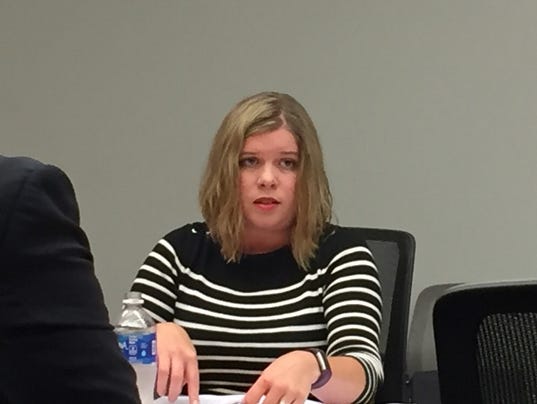
Rashida Tlaib Reaches Out To Detroit Land Bank Authority Stakeholders But Forgets About Me

According to this article, Rashida Tlaib is going to reach out to Detroit Land Bank Authority "stakeholders".

Of course, she will not reach out to me.

I am not just a primary stakeholder of the Detroit Land Bank Authority, I am also the former Principal Agent!

Just ask Bill Schuette.

*Smooches*

Feds probe Detroit Land Bank contractor that tore down homes, hid debris in holes

The Chicago-based McDonagh Demolition was ordered to
excavate a demolition site in the 13000 block of Maiden St. on
Detroit's east side on Friday, Feb. 22, 2019. The order came after it was
discovered the company filled several demolition holes across the city
before fully removing all of the demolition debris, which is a
major violation of the federally-funded program.


Federal agents are now investigating who was involved in an alleged scheme where a Chicago-based company tore down homes in Detroit and hid the debris under layers of dirt, sources familiar with the probe told the Free Press.

Agents questioned some McDonagh Demolition Inc. workers about whether they'd ever seen "payoffs" or shoddy work happening under the Detroit demolition program, during visits earlier this month at their homes, sources told the newspaper.

One former employee told the Free Press he never witnessed any sort of bribery but that he was directed by a McDonagh supervisor to place demolition debris in multiple holes.

When asked about the federal probe and allegations raised by a former employee, McDonagh Demolition said late Friday when it became aware of "alleged issues related to a limited number of McDonagh work sites within the Detroit program," it launched an internal investigation with the help of outside legal counsel.

"The findings uncovered evidence that individuals acted on their own, without the knowledge, authorization or consent of McDonagh ownership or management," the company said in a prepared statement. "The evidence uncovered in no way reflects the integrity, values and operating practices of our company."

Agents also visited City Hall to interview at least one city employee about the ongoing federal probe of the demolition program, which has taken several turns within the past few years.

Officials earlier this month said the alleged scheme would cost McDonagh Demolition more than $15 million in awarded Detroit Land Bank Authority work and that it was the "most egregious" incident to ever occur in the federally-funded program.

Officials confirmed the City Hall visit but declined to discuss the nature of it. Sources spoke with the newspaper on the condition of anonymity because they aren't authorized to speak publicly.

Separately, a series of recent highly publicized incidents have sparked new questions about the city's demolition procedures. Congresswoman Rashida Tlaib told the Free Press last week  she plans to inquire about "standards of environmental quality" used in the federal Hardest Hit Fund program, not just in Detroit, but across the nation, in other states that have received such federal funding.

Detroit's demolition program has been fueled by more than $250 million in Hardest Hit Fund dollars from the U.S. Department of the Treasury since 2014.

Tlaib also said that she met with officials in mid-March from the Office of the Special Inspector General for the Troubled Asset Relief Program.

“We focused on the need for more oversight and protections regarding environmental issues with demolition that could have a detrimental impact on our public health," Tlaib said in a statement.

The move comes after the Free Press published investigations this year outlining concerns raised about the city's quality controls in place within the program, which is currently overseen by the Detroit Land Bank Authority and Detroit Building Authority.

A former McDonagh employee told the Free Press two federal agents with SIGTARP visited his home unexpectedly late on March 7.

The employee said he was "startled" by the hour-long visit, which touched on a variety of topics related to the McDonagh incident, including whether he witnessed "any monies being exchanged between people" or any "payoffs being done to officials."

The employee also said he conducted an interview detailing the initial incident with the city's ombudsman, which is an independent position appointed by the council to investigate complaints against city government departments and agencies.

Ombudsman Bruce Simspon declined comment, citing the ongoing investigation.

Agents visited City Hall the next day.

City officials said federal agents were in City Hall on March 8 but characterized it as a "scheduled agent visit" with a Buildings, Safety, Engineering and Environmental employee.

"As is our practice, the employee cooperated fully and voluntarily," BSEED Director Dave Bell said in a statement.

When asked whether the agents specifically inquired about the McDonagh incident, mayoral spokesperson John Roach declined to answer the question, saying "we don't comment on ongoing investigations" and any further information would have to come from SIGTARP.

A SIGTARP spokesperson declined comment.

The Free Press first reported in late February that McDonagh Demolition was set to lose more than $15 million in contracted work with the Detroit Land Bank. Officials alleged the company "cut corners" in an attempt to save $1,000 in costs per house by burying the debris, instead of removing it properly. The incident surfaced after a whistleblower ex-employee directed city employees to the sites where the materials were buried.

The company previously said it was confident that the incident was an "isolated issue.”

McDonagh, which began performing demolitions in the city in early December, was under contract to tear down 682 properties in neighborhoods across Detroit. The company was placed on a stop work order while the city reviewed all of its completed demolition sites.

Officials told the Free Press and the Detroit City Council that they were in the process of moving to permanently ban the out-of-state demolition company from any future work in Detroit.

When asked whether the process had been started to revoke and rebid the company's work, as officials alluded to earlier, Land Bank spokesperson Alyssa Strickland declined comment.

Strickland also wouldn't answer whether the revocation was still occurring, saying both questions were "related to ongoing negotiations, therefore I cannot comment further."

Strickland later added that negotiations are ongoing between the Land Bank and McDonagh.

The city did not respond to questions Friday regarding the status of the company's wrecking license and whether a review had yet been completed of the work performed by McDonagh. Detroit Building Authority Special Projects Director Brian Farkas previously said the company's license would be revoked.

"This attempted scheme will cost McDonagh $17 million in awarded work," Farkas said at a Feb. 28 Detroit City Council committee meeting. "McDonagh is not going to do work in the city of Detroit.

This attempted scheme is the most egregious I've seen in the city."

The city, including Mayor Mike Duggan, has defended its demolition process in recent weeks, in response to concerns raised regarding proper abatement and backfill practices within the program.

Duggan announced two weeks ago that the Land Bank will no longer oversee the city's demolition program by the end of this year. Demolitions are expected to be fully administered by the city.

A timeline of the transition period wasn't immediately clear.

"The Land Bank will be out of the demolition business," Duggan said, while addressing the City Council on March 7. "At this point ... we're done."

A separate Free Press investigation revealed last month that federal authorities were probing whether contaminated and unverified dirt was potentially used to fill demolition sites across Detroit.

SIGTARP is also investigating whether some companies used free dirt obtained from a variety of unverified sources and then passed it off as an approved residential dirt source before billing the demolition program for materials they never actually paid for.

In response, City Council President Pro Tem Mary Sheffield called for congressional hearings to be held on the city's federally funded demolition program. State Rep. LaTanya Garrett also called for state-level hearings.

Tlaib said she plans to reach out to "stakeholders," including the Michigan State Housing Development Authority, to inquire about "standards of environmental quality." MSHDA's Michigan Homeowner Assistance Nonprofit Housing Corporation manages the state's HHF dollars.

"My hope is that we do our due diligence to protect the public from any irreparable harm especially when it comes to exposure to harmful material," Tlaib said.

Kat Stafford writes enterprise and investigative stories about Detroit. Contact her: kstafford@freepress.com or 313-223-4759. 

To read previous stories regarding the federal probe and other demolition issues go to www.freep.com/news/investigations.

Voting is beautiful, be beautiful ~ vote.©