Showing posts sorted by relevance for query database. Sort by date Show all posts

Tuesday, April 6, 2010

Medicaid fraud should be tracked just the way sex offenders are

Sen. Schumer: We should track child beaters like we do sex offenders

Child beaters should be tracked just the way sex offenders are, Sen. Chuck Schumer (D-N.Y.) said Sunday.

Child welfare fraudfeasors should be tracked the way other federal false claims are prosecuted.

"We have no comprehensive system to make sure that after they strike once, they never strike again," Schumer said, speaking outside state court buildings on Centre St. in downtown Manhattan.

That is absolutely correct.  We have no comprehensive system to make sure that after they commit Medicaid fraud, they never file false claims again.

Schumer called on the U.S. Department of Health and Human Services to implement a national tracking database of child beaters, similar to those that exist for sexual predators.

I call on the U.S. Department of Health and Human Services to implement a national exclusionary database of those who file child welfare false claims in Medicaid fraud.

"It doesn't make any sense at all that while we try to watch sex offenders like hawks, we let child batterers, who physically batter children, slip through the cracks," he said.

It doesn't make any sense at all that while we try to stop Medicaid fraud like hawks, we let child placing agencies file false claims allowing children to be improperly and unnecessarily placed in foster care and put up for adoption by considering poverty as the crime of abuse and neglect.

A 2006 congressional act authorized the government to create such a database, but it has yet to be implemented.

The reason the database was never implemented is because a person is placed on the registry without being being able to confront the accusers, without being in a court of law, without notification, without witnesses, and before ever being charged, plead, and found guilty by a jury of peers.

Read more: http://www.nydailynews.com/news/politics/2010/03/28/2010-03-28_sen_schumer_we_should_track_child_abusers_like_we_do_sex_offenders.html#ixzz0kMdt5tZM

If the Senator wants to put "child beaters" on a central database, then I say we put those who commit Medicaid fraud on a central database!

The Central Registry of Child Welfare Fraud!

For many years the Congress of the United States has worked diligently to protect the health and welfare of the nation's elderly and poor by implementing legislation to prevent certain individuals and businesses from participating in Federally-funded health care programs. Legally Kidnapped has mandated that the health and welfare of the nation's children and families must  be protected by including Child Welfare Agencies in this exclusion database.  Foster Care and Adoption Agencies should be banned from entering contracts using federal funds if the bases for exclusion have been met.


Bases for exclusion include for child welfare program-related fraud, child abuse, child deaths, licensing board actions, improper and questionable claims, false reports.

The effect of not being able to participate in federally funded contracts is:
  • No payment will be made by any Federal child welfare program for any items or services furnished, ordered, or prescribed by an excluded individual or entity. Federal foster care and adoption programs include Medicaid Targeted Case Management, and Social Security Title IV A, B, D, and E, Maternal and Child Health Services Block Grant (Title V), Block Grants to States for Social Services (Title XX), State Children's Health Insurance (Title XXI) and all other plans and programs that provide health benefits for foster care and adoption funded directly or indirectly by the United States.

Wednesday, June 17, 2020

JUDICIARY: Hearing On Jobs, Justice & Peace - Without Once Saying His Name

The Committee addressed qualified immunity by resurrecting the Second Amendment of the right to keep and bear the arms of the United States and the respective States which issues the licenses.

With great discernment, the Committee amazingly addressed the legacy of Conyers, without once saying his name, or the fact that he, as Chairman Emeritus of Judiciary, was denied due process, assassinated by blasphemy.

Absolutely amazing to witness the soulless execute such a bipartisan task.


Nessel calls for public database of Michigan's problem police officers

Detroit Police Chief James Craig speaks after officer Waldis Johnson's funeral Detroit Free Press

LANSING – The public could access a statewide database of problem police officers under a set of reforms put forward Tuesday by Michigan Attorney General Dana Nessel.

Nessel said in a news release she wants the Michigan Commission on Law Enforcement Standards to create a police misconduct registry of verified claims of abuse or other misconduct made against police officers in Michigan.


The proposed registry is part of a seven-point plan Nessel released amid nationwide discussions about police reform in the wake of the Memorial Day death of George Floyd, a Black man who died during an arrest by Minneapolis police.

Frank Guido, general counsel for the Police Officers Association of Michigan — a union representing more than 12,000 officers in more than 300 local police and sheriff departments — said he is OK with some of Nessel's proposals, two of which he said are already in place, but he has concerns with others.


As for the public database, how would misconduct be defined? Guido asked. Also, "is this a requirement that is appropriate for all government employees?" or would only police officers be singled out, he asked.

The Michigan Commission on Law Enforcement Standards sets professional standards in education, selection, employment, licensing and funding in law enforcement and criminal justice in Michigan. Last week, Gov. Gretchen Whitmer announced she was adding four seats to the commission — which has been dominated by law enforcement representatives — to give it a greater community voice.


Nessel said that in 2016 the commission began requiring that law enforcement officers be licensed. But she said the commission "lacks sufficient authority to oversee law enforcement professionals and to revoke the licenses of police officers who demonstrate poor moral character or violate the public trust."

More: Michigan State Police graduates another school of troopers — with only 4 Black recruits

More: Whitmer: Require police to intervene if they see officers use excessive force

The measures she announced Tuesday are "the first step toward implementing positive change in our criminal justice system," Nessel said.

In addition to the database, Nessel called for:

Amending the Public Employee Benefits Forfeiture Act so that officers forfeit their retirement benefits upon conviction of a felony related to misconduct while on duty. 
Authorizing the commission to suspend or revoke a license when an officer engages in certain misconduct.
Requiring police agencies to maintain all disciplinary records of a police officers in their personnel files.
Requiring police agencies to report use of force data, with information about the civilians' race, gender, disability, sexual orientation, gender identity, national origin, religion and age.
Creating an independent investigative and prosecutorial process for deaths resulting from police actions.
Requiring continuing education for officers as a condition of licensing and improving and standardizing policies and training related to conflict de-escalation, cultural awareness, and implicit bias.
The public registry of problem officers would be a departure for Michigan. Until 2018, when Public Act 128 of 2017 took effect, even Michigan police agencies often could not review the circumstances under which police officers seeking employment left their previous departments. That had led to an issue with problem officers moving from one police agency to another, without their records following them.

“We must do more than just condemn bigotry and acts of excessive force committed by law enforcement officers. We must act,” Nessel said.

"Making meaningful and concrete changes doesn’t end here, but it’s crucial that we move first with measures which create better accountability and more transparency to the actions of law enforcement here in Michigan."

Guido said no officer should forfeit pension money they have contributed or earned for past service.

He also expressed concern about the proposed license suspensions. Guido wondered who would make such determinations and what due process protections would be in place.

"The concepts are far too broad," he said. "Not much job security for a law enforcement officer if every move is subject to someone claiming, after the fact, it was detrimental to the department — and now you lose your job because of knee-jerk reactions."

Maintenance of disciplinary records already occurs, as do independent investigations, and additional training is always welcome as long as the government funds it, Guido said.

"Reporting data is not objectionable as long as sufficient funds are provided out of the AG budget for personnel to do record-keeping," Guido said. "Also, the data should include information concerning the individuals that attack law enforcement."

In an executive order Tuesday, President Donald Trump called for creation of a national database of problem officers to track potential police hires with records of abuse. But unlike the registry proposed by Nessel, Trump's database would not be accessible to the public. Instead, data from the national database would be made anonymous and periodically made public, according to the order.


Until Whitmer's recent executive order, the Commission on Law Enforcement Standards had 19 members. The AG, the director of the Michigan State Police and the chief of police in Detroit are all members. The other 16 members are appointed by the governor, based on recommendations from various law enforcement groups, such as the Michigan Association of Chiefs of Police.

Whitmer's order adds as members the director of the Michigan Department of Civil Rights and three community representatives.


Voting is beautiful, be beautiful ~ vote.©

Friday, September 6, 2019

TCS: The Federal CPS - Databases & Due Process

A federal judge said the FBI can no longer maintain a terrorist watch list, mostly on the fact that no one knows the process of getting on that list, let alone getting off the list.


But no one wants to talk about those tiny human asset management databases, but hey, what do I know?


I also know I expect to find out about Michigan's Child Welfare Databases, quite soon.


https://en.wikipedia.org/wiki/Terrorist_Screening_Database

https://cdn.ca9.uscourts.gov/datastore/opinions/2018/09/20/16-36072.pdf

Federal judge rules FBI terrorism watchlist violates constitutional rights

Almost two dozen Muslim American citizens who were placed on a watchlist, known as the Terrorist Screening Database, filed suit.

The FBI maintained a list of one million people identified as “known or suspected terrorists."

Terrorist Screening Center
TSC the federal CPS
A federal judge ruled Wednesday that a government database of more than one million people identified as “known or suspected terrorists,” violates the constitutional rights of U.S. citizens who were added to the list by denying them due process.

Almost two dozen Muslim American citizens who were placed on a watchlist, known as the Terrorist Screening Database, filed suit along with the Council on American-Islamic Relations against the government saying they were wrongly included in the database and that the process for adding names is overbroad and riddled with errors.

Many on the list, which is maintained by the FBI and shared with a variety of federal agencies, said they were subjected to frequent and sometimes invasive screenings while traveling which have led to “adverse experiences and consequences,” including being handcuffed at border crossings.

U.S. District Judge Anthony Trenga ruled that the travel difficulties faced by plaintiffs who were on the list are significant and that they have a right to due process when their constitutional rights are infringed.

"The general right of free movement is a long-recognized, fundamental liberty," he wrote. "Inclusion in the TSDB accordingly imposes a substantial burden on Plaintiff's exercise of their rights to international travel and domestic air travel" which he adds is a "deprivation of liberty interests."

He also said the concerns about erroneous placement on the list are legitimate.

“There is no evidence, or contention, that any of these plaintiffs satisfy the definition of a ’known terrorist,” Trenga wrote. And the alternate standard for placement — that of a “suspected terrorist” — can easily be triggered by innocent conduct that is misconstrued, he said.

A Producer's Notebook: The story behind 'Justice For All'
Trenga added that “an individual’s placement into the [watch list] does not require any evidence that the person engaged in criminal activity, committed a crime, or will commit a crime in the future,” and “individuals who have been acquitted of a terrorism-related crime may still be listed.”

The database was put together in the aftermath of the 9/11 attacks and in many cases added American citizens with little oversight and secretive criteria.

As of 2017, 1.2 million people are listed in the database, of which 4,600 are American citizens or lawful permanent residents, according to the ruling.

The FBI declined to comment on the ruling Wednesday, but in court government lawyers argued that the difficulties suffered by the plaintiffs pale in comparison to the government’s interests in combating terrorism.

Gadeir Abbas, a lawyer for the plaintiffs, called the ruling a victory. He said he will be asking the judge to severely curtail how the government compiles and uses its list.

Voting is beautiful, be beautiful ~ vote.©

Tuesday, January 12, 2016

Statement of the Honorable John Conyers, Jr. Full Committee Markup of H.R. 4240, the "No Fly for Foreign Fighters Act”


Dean of the U.S. House
of Representatives
John Conyers, Jr.
 “H.R. 4240, the ‘No Fly for Foreign Fighters Act,’ is a common sense measure that supports the Terrorist Screening Database maintained by the Federal Bureau of Investigation and, in doing so, will aid in our efforts to combat terrorism and keep our Nation safe.

“Since 2003, the FBI's Terrorist Screening Center helps to identify those individuals known or reasonably suspected of being involved in terrorist activity by integrating information collected from law enforcement, homeland security, and intelligence communities.

“This information is then entered into the Database in order to populate various screening systems used by the U.S. government.  The result is a sophisticated watchlist and screening system that has undoubtedly saved lives.

“Despite the diligent work of the Screening Center and the many dedicated individuals who make the screening database possible, this system is not flawless.  Past incidents, such as the 2009 Christmas Day attempt attack by the ‘underwear bomber’ on a Northwest Airlines flight, put a spotlight on potential gaps in the system.
      
“In response, significant improvements have been made to the Database and audits by the Department of Justice Office of Inspector General have revealed movement in the right direction.

“Despite these regular audits, no independent review has been conducted of the changes to the watchlist and screening progress.

“To the extent additional improvements are necessary, or new weaknesses have emerged, such an independent review could serve to make us all safer.

“H.R. 4240 addresses this precise issue by directing the U.S. Government Accountability Office to conduct an independent review of the operation and administration of the Terrorist Screening Database and subsets of the Database.

“This review will assess whether past weaknesses have been eliminated, and the extent to which existing vulnerabilities may be addressed or mitigated through additional changes.

“H.R. 4240 requires the GAO to complete and submit the results of the study to this Committee and our counterpart in the Senate not later than 18 months after the bill's enactment.

“In closing, I commend Subcommittee on Crime, Homeland Security, Terrorism, and Investigations Ranking Member Sheila Jackson Lee for her leadership on this important issue and I am proud to join her and many of my Committee colleagues in co-sponsoring this bipartisan legislation.

“I thank the Chairman for bringing H.R. 4240 before the Committee today and I urge my colleagues to join me in supporting it.”

Voting is beautiful, be beautiful ~ vote.©

Tuesday, November 27, 2018

Michigan Central Registry For Abuse & Neglect Is The Children's Trust Fund Database Of Trafficking Tiny Humans

FUN FACT! PRIVATIZED CONTRACTED CHILD PLACING AGENCIES AND CORPORATE PARENTS ARE EXCLUDED FROM THE CENTRAL REGISTRY

In the spirit of fuchsia...

What is Central Registry and why you should care?

The Central Registry is a database of human chattel for asset forfeiture for the Michigan Children's Trust Fund.  You should care because you are probably on it if you hail for the population of "The Poors" (always said with clinched teeth).

Where can you see the registry?
The First Data Collection Repository of asset forfeiture
Michigan Central Registry
There are 300,000 people on Michigan's Central Registry for abuse and neglect. The database gives select entities - Child Protective Services, schools, police, courts, and employers and volunteer agencies working with children - access to a subject's background information, including alleged harm to children that does not rise to the criminal level. Those convicted of harming children go on the registry.

The Central Registry is also a database of Medicaid fraud in child welfare because it contains evidence of false claims, double billing, phantom billing, human trafficking, asset forfeiture, and a bunch of other made up crap to cover up the state's operations of trafficking tiny humans through foster care and adoption.

How do you get on the registry?

The wind blows in a different direction; you ask for help for your child; lack of health care, someone does not like the way you look, the chicken crossed the road, you are disabled, your child is disabled, lack of education, or, you could just be part of the targeted population of "The Poors" (always said with clinched teeth). There are no civil rights in child welfare.

Commit a crime against a child. Or, have your parental rights to a child terminated for abuse or neglect. In other cases, a CPS worker, in consultation with a supervisor, can place someone on the registry after finding evidence of abuse or neglect. The subject can seek a review by an administrative law judge, whose ruling can be appealed to circuit court.

Wrong. You have to hail from "The Poors" (always said with clinched teeth) Title IV-A criteria for funding. If, in fact, someone does commit a crime, other than being poor because poverty is considered the crime of abuse and neglect for "failure to provide for the necessary needs of the child", that individual is tried, in a court of law as being innocent until proven guilty.  In child welfare proceedings, you are guilty until proven innocent.

As for seeking a review by an administrative law judge, there are no constitutionalities in administrative law. For example, you can be denied expunction from the Central Registry for the simple fact that you were placed on the Central Registry.  Seriously, and I can prove it.  Just ask Steve Yager.

Image result for you know you lie"There's a checks-and-balances system in place," Rachael Wineland, Child Protective Services policy analyst, told MLive/The Grand Rapids Press at her Lansing office.

Rachael Wineland is a damn lie, either that or she is just stupid and needs to be removed from her position for interfering in federal and state investigations.

Why does Michigan have the Central Registry?

Consider it as the ship's property manifest of the UCC Children's Trust Fund.

It's mandated by the state and federal government, though registries differ by state. It's intended to protect children from those whose neglect or abuse of a child did not rise to the criminal level.

There goes that legal assertion of the 13th Amendment Exception Clause. If someone committed a crime that rose to the level of an adult, there would be due process and conviction, removing the need for the database.

Assistant Attorney General Kristin Heyse said the state "has a strong interest in ensuring the safety of children and protecting children. In fact, it is well established that both the safety and the protecting of children are compelling state interests."

NOTE TO SELF: FILE AN ATTORNEY GRIEVANCE ON KRISTIN HEYSE FOR LYING AND COVERING UP KIDS IN FOSTER CARE WHO HAVE BEEN DRUGGED AS LAB RATS, RAPED, TORTURED, MURDERED, ATTEMPTED SUICIDE AND WHO HAVE SUCCESSFULLY COMMITTED SUICIDE.

The compelling state interest is to maximize revenue because these actions of Child Protective Services are carried out through private contracts and the parties on the Central Registry cannot afford an attorney nor will the Attorney General intervene as there is that inherent conflict of interest in having to contemporaneously prosecute and represent the privatized agency.

Besides, "The Poors" (always said with clinched teeth) cannot afford an attorney, let alone find one competent or gutsy enough to jeopardize their legal career taking on cases as this.

Kristin probably has no clue about the functions of the Foster Care Review Board.

What do critics say?

The Central Registry is a human trafficking database.

It is also a foreign operation.

Where can you see the registry?

It is not public. Only certain organizations and employers can gain access to results by submitting a name to the state.

It is called privatization of trafficking tiny humans for the purposes of covering up a multi-billion dollar fraud scheme.

Voting is beautiful, be beautiful ~ vote.©

Thursday, October 20, 2016

DOJ and HHS Finally Team Up To Address Civil Rights Violations In Child Welfare

Well, it is about damn time!

The U.S. Department of Justice has teamed up with the U.S. Department of Health and Human Services to offer joint guidance into civil rights violations in child welfare.
Child Welfare:  The Residuals of the Peculiar Institution

Why, you may inquire?


"So, why are there no civil rights in child welfare?", is the next logical query.
  
The answer is quite simple because the child welfare system is a residual of the peculiar institution, devoid of any feasibly constructed oversight.

Of course, there are those who will quickly defend the entire child welfare industry, but steadfast as they are, they fail to disclose their financial and political conflicts of interest for personal inurement, which is currently another scope of investigation of the U.S. Department of Justice.

An action, or inaction, of a civil rights violation, is even more egregious when it is perpetrated through the use of federal funds, in order to maximize revenues, in the name of God.

As these child welfare organizations are classified as nonprofits, many Christian, everyone knows that...say it with me..."you cannot audit God."

This means that the iron curtain of child welfare has been impenetrable since its Emancipation Proclamation inception.

This now begs the question, "How are the DOJ and HHS to investigate alleged civil rights violations in child welfare when the databases do not have mandated reported variables?"

The University of Michigan Law School has a civil rights database.

The Department of Education has a civil rights database.

The U.S. Department of Health and Human Services Administration for Children & Families has a National Youth in Transition Database.

But there is no database on civil rights violations of children and families involved in the child welfare system.

There is not even an exclusionary database of child welfare organizations which have been found to engage in questionable billing practices in dealing with Medicaid, Title IV-B or IV-E.

Here we have U.S. Representative John Conyers speaking upon H.R. 40, a Bill to establish a commission to study the "residuals of the peculiar institution", affectionately misunderstood, as the Reparations Bill.

The study is to address the history of the means and ways of why and how the U.S. has ignored the civil rights (including human rights) violations of the poor but it must be inclusive of all targeted populations.

Only the poor are eligible for the programs in which this joint federal partnership is investigating; therefore, the only way to payback for the social assistance, where being impoverished is statutorily considered moral turpitude, is to lose one's children through termination of parental rights, the edifice of the 13th Amendment.

Canada issued a formal apology on how it has treated aboriginal children and families and did not even have slavery, but not the U.S.


This letter of guidance should be considered more along the lines of a notice of intent.

There are other areas of awakening within the DOJ and HHS, but the work will be slow and arduous as there are many, many, powerful players who do not want a single thing to change.

To my #Superfans ... you know where to find me.


Here is the guidance for the DOJ and HHS.

Who knows, perhaps one day when the U.S. admits child welfare has no civil rights, it will finally agree to sign on.

If you believe you or a child's civil rights have been violated, file up with your stories.

Information about filing a Title VI complaint with DOJ can be found at www.justice.gov/crt/howfile-complaint.

Individuals who believe they have been aggrieved under Title VI should file complaints at the earliest opportunity. You can also file a Title VI complaint with OCR at www.hhs.gov/ocr/civilrights/complaints/index.html.

Voting is beautiful, be beautiful ~ vote.©

Thursday, November 5, 2009

National False Claims Database

The Interim Report to the Congress on the Feasibility of a National Child Abuse Registry published by the U.S. Department of Health and Human Services, Office of the Assistant Secretary for Planning and Evaluation, May 2009, should be called by another name if it ever makes it through Congress.

I would like to propose to call it the "National False Claims Database", a lawyers wet dream.

In order for an individual to be placed on the states central registry, one need only have a finger pointed in one's general direction, and, voila, you are on the central registry for abuse and neglect.

Now, the Adam Walsh Child Protection and Safety Reauthorization Act of 2009 seems to have resurfaced in the wake of discussions to reauthorize CAPTA (Child Abuse Prevention and Treatment Act).

Well, a national database for child sex offenders is a popular and utilitarian endeavor but not for a child abuse national registry.

Using my favorite state as a working example, let's look at Michigan:

MCL 28.724 is an excerpt of the Sex Offenders Registration Act. The key word in said act is convicted. A person who is convicted in a court of law of an offense pursuant to the act is required to register with this central registry.

MCL 722.628d(4) states in relevant part: "If following a field investigation the department determines that there is a preponderance of evidence that an individual listed in subsection (3) was the perpetrator of child abuse or neglect, the department shall list the perpetrator of the child abuse or neglect on the central registry."

Simply put, a person is placed on the Central Registry of Abuse and Neglect of a child without due process of the courts. What may not be publicly known is that there are many individuals who were never notified that they are on the Central Registry and, even moreso, there are individuals who remain on this Central Registry when the case was dismissed.

As Michigan slowly departs from the institutionalized philosophy that poverty is abuse and neglect, the probability that many, many individuals have been listed on this eternal registry for being poor will be significant.

So, what happens is that the only way the state can provide services to needy children and parents is to create a "new and improved" federal funding-maximizing scheme. Removing a person from the central registry puts Michigan is a compromising situation: If the state removes a person from the central registry when there were no charges filed or evidence presented and the child had to remain in the foster care system, that would be a billboard announcement for ineligibility of funding (fraud) and due process violations, to name a few.

This is what is called the origin of child welfare federal false claims, or the National False Claims Database, a law firm's wet dream.

National Child Abuse Registry Feasibility Report 2009

Wednesday, January 6, 2010

Checks and Balances Database in Child Welfare

Michigan has introduced a series of House Bills to address the lack of accountability and transparency in child welfare.

House Bill 5702 (Revise child death reports and procedures )
Introduced by Rep. Jennifer Haase (D) on December 16, 2009, to authorize the establishment of a legislative child fatality investigator appointed by the legislative council, who would identify specific causes and systemic problems that contribute to the mortality of children in foster care.

House Bill 5703 (Revise child death reports and procedures )
Introduced by Rep. Dian Slavens (D) on December 16, 2009, to require the state to establish a central database with statistical information on the number of children who died while in foster care, while under court jurisdiction for child abuse or neglect, or after having involvement with child protective service. See Senate Bill 258.

House Bill 5704 (Revise child death reports and procedures )
Introduced by Rep. Mary Valentine (D) on December 16, 2009, to revise procedures for releasing an annual report on child fatalities that a state multiagency, multidisciplinary advisory on child fatalities is supposed to prepare. The bill would also revise the membership of a state child fatalities advisory committee.


House Bill 5705 (Revise child death reports and procedures )
Introduced by Rep. Dan Scripps (D) on December 16, 2009, to require the Department of Human Services to give access to all information it has pertaining to a child who dies after becoming a ward of the state to a probate court that has jurisdiction over the child.

Once these databases are implemented, further oversight objectives may be initiated. Some of the identified objectives will be to:

(1)Reduce fraud, waste and abuse in billing;
(2)Ameliorate unnecessary removals;
(3)Increase quality of care;
(4)Improve quality of services;
(5)Establish best practices;
(6)Create recipient rights for consumers (i.e. parents, grandparents, extended family members, children, other people of affinity, consanguinity);
(7)Empower the Attorney General to prosecute and recover Medicaid Fraud;
(8)Empower the Department of Human Services and Department of Community Health to institute contractual debarment, fines, license revocation, sanctions;
(9)Prevent racketeering;
(10)Reduce the State percentage of Medicaid to 30%;
(11)Dismantles the Michigan Children's Institute as decisions are computerized.


First, Section 7(b)1 must be revised to strike "may" and replace with SHALL.  A basic review of county activities, particularly Wayne County, will demonstrate the lack of federal compliance, OMB Circular A-87.  So, if a county is not mandated to establish and maintain a database of child fatalities, then how is the state to meet the objectives of a statistical database as the data are and will be skewed, and even suspect.

Next, Section 5  must include (g) ONE COMMUNITY REPRESENTATIVE.  The operations of the state's child welfare system are shielded behind the iron curtain of secrecy.  There needs to be established in this advisory committee a system of checks and balances to steer policy; otherwise, the status quo will continue to admiral failed policies.

Finally, add Section 10 (G) The number and type of child abuse or neglect complaints against A CHILD PLACING AGENCY OR RESIDENTIAL INSTITUTION before the child's death and, if there was more than
1 child abuse or neglect complaint in the 2 years preceding the
child's death, the child protective services
category as described
in section 8d given to each investigated complaint.


Currently, there is very little opportunity to report child abuse and neglect within the confines of the foster care system.  The Office of Children's Ombudsman "may entertain" which complaints will be investigated and most of the investigative reports are limited to selective issues of investigation due to a lack of office resources or a failure of a party to comply with the investigation.  The Bureau of Children and Adult Licensing has no enforcement authority and this is why:

A licensed entity my operate under 2nd and 3rd provisional licensing without any recourse.  Conversely, if an organization "voluntarily" stops its operations, it may reorganize under a different name, continuing its same aberrant operations, which include abuse and neglect.

Lastly, Counties Community Mental Health may be the only opportunity for children under the auspices of the state to self-report complaints of abuse and neglect.  Unfortunately, these reports are either kept internally and never reported to the state, or, the reports are filed for refuse recycling.

I understand these legislative initiatives are to bring the state in line with the UNESCO Intercountry Adoptions Treaty, the same that was done with licensing standards of social workers, but this is a window of opportunity, opened to include an integral part of transparency and accountability, and that is to create a universal complaint registry for child welfare to include, not just child fatalities in foster care, but abuse and neglect in foster care, as well as fraud, waste and abuse.

For more background information on these bills...

Beverly Tran

An Original Source

Thursday, May 19, 2016

Michigan Creates Poverty Segregation Databases


Just when you thought Michigan could not stoop any lower when it comes to making the lives of children in poverty even more dismal.


Michigan Department of Treasury has just implemented an online identity verification system.

Peaches.

Here is the bait and switch, according to the letter, which contains an unique Quiz ID number  (riiiiiiiiiight ` wink.) you must log in as a guest or create an account to access your Earned Income Tax Credit.

What is the purpose of a unique Quiz ID number when, in dealing with the State Treasury or Health and Human Services, one typically uses a Social Security Number?

But wait, there is also a Discovery CID number.  Whether that is Criminal Investigative Demand or Civil Investigative Demand for Discovery, we shall soon find out in the news.

There are only two state departments which participate in the system, the Department of Health and Human Services and the Department of Treasury.

Makes pretty good sense to me, right?  Cost efficient, streamlined, good entitlement fraud detector,

No.  Unique IDs are known in the meth world as no-no's when it comes to internal validity.

Therefore, this is an intentionally constructed database, but for what?

Well, it seems if you fail the quiz, you must hard copy your state identification, and federal income tax information, must also be provided.

But wait, the letter said, [sic] This review may take 3 to 6 months, depending on the volume of responses received.

So, tactfully, Michigan can hustle out of doling out tax refunds to save a few bucks until the next budget by creating a fraudulent ID verification system for the purposes of creating a database to monitor behavior?

I do not have a problem with engaging quantitative methodology into policymaking, but when it is done through an internet farce, that is where I take issue.

The letter for the ID Quiz specifically demands in the alternative:
  • Copy of driver's license(s), picture ID(s) or Government issued picture ID;
  • W-2's
  • SSA-1099s
  • 1099s
  • K1s
What makes me parse out the last of my assumptions of whether this is an intentional farce is the specificity for all financial instruments listed, which are indicative of an individual who is one, classified as "working poor".

Working poor own businesses, put in more than 40 hours a week on a job(s), yet qualify for full SNAP and Medicaid benefits.

In some instances, there are individuals who are disabled or care for the disabled who fall into this category, also.

This means that this population of working poor, EITC beneficiaries, becomes, now, targeted.  But why?

Well, the internet access, skill, itself becomes a toll many cannot afford as they must pay someone to assist as local agencies provide services during traditional working hours.

Then there is the actual recordkeeping.  Many do not keep records and even many more do not know how to keep financial transaction records for home based, cottage industry.

Federal records are not as precise as state, simply for the fact that poor people cost in oversight.  A state may find an incentive through an investment in scrutiny.

I call it privatization as a QGO or even contracted state arm NGO,

I believe there are people who would like to know who is the recordkeeper of these data, and for what purposes.

There is a movement of people who believe they can have a second go-at-it of ending poverty through data, in similar form of our current predictive credit system.

There are those who are afraid of losing everything, including their property, including their children. 

This segment of our newly targeted population will not participate in the filing of identification documents.

Of course, lest we forget the other segment of this newly targeted population who would be identified for possible voting ID laws violations.

In many situations, due to the really bad, and I mean really, really bad history between the State of Michigan and Information Technology, I am even questioning if this is a pilot program to see it it crashes enjoining DHHS and Treasury.

Remember, child support is linked within these two Departments, also.

But to make an assumption that this database action initiative was in the public's best interest would be like giving too much credit to the geniuses  consulting folks of Governor Rick Snyder as he is just as notorious as his fellow Republican Governors, particularly the dude from Kansas,  always slashing resources to children in poverty as the go to budget plug tactic.

Flint will remain a spending priority as Snyder looks for cuts, Roberts said. Reductions will most likely come from areas Snyder had recommended for increases, where spending now will likely go up less than expected, he said. Those areas could include information technology, the Michigan State Police, the Healthy Kids dental program, the K-12 education foundation grant, higher education, and a new statewide infrastructure fund, among others.

Either through fear or a bogus internet fraud scheme, it looks like Snyder found some budget savings to hold out until fiscal year 2017 kicks in and a new method of segregating data.

My alternative hypothesis blends well with the testimony of Maura Corrigan of the American Enterprise Institute. 

(BTW, my null is that this was all just a learning mistake on the part of the Snyder Administration because I poignantly recognize that it will be swiftly disproven.)

Say what you will, but I am calling this Identity Earned Income Tax Confirmation Quiz a BS database until someone proves me wrong.

This is predatory targeting of the poor.


Identity Confirmation Quiz

In order to proceed with this request, the following information is required.

You understand that by clicking on the I AGREE button immediately following this notice, you are providing 'written instructions' to the State of Michigan under the Fair Credit Reporting Act authorizing the State of Michigan to obtain information from your personal credit profile or other information from Experian. You authorize the State of Michigan to obtain such information solely to confirm your identity to avoid fraudulent transactions in your name prior to granting you online access to and use of the State of Michigan web site.

This may be because you have not yet filed your Michigan Income Tax return. Please verify that you have. If you have not filed a MI return, please follow the instructions on the letter.
If you have filed a return, the information you entered is incorrect. Please submit a copy of your driver's license and your spouse's, if applicable, or personal IDs and copies of any of the following that is applicable to your return: W2s, 1099s, SSA-1099, or K1s in the return envelope provided with your letter to the address below.

Michigan Department of Treasury
P.O. Box 30771
Lansing, MI 48909-8271

Voting is beautiful, be beautiful ~ vote.©

Friday, April 26, 2019

Build The Wall: Trafficking Of Souls Has Gone AI - Schengen Information System, European Union, Vatican, Bitcoin & Children's Trust Funds

Walls are no longer brick and mortar.

Walls are AI.

The U.S. has no AI border wall.

The U.S. likes to traffic tiny human and their souls over the border for lots and lots of money.

But do not just ask Chuck & Nancy because it is personal inurement of office and how politicians fund their campaigns, which would be an issue of self incrimination.

We would not want Chuck & Nancy to incriminate themselves but we could ask Betsy DeVos, a subject matter expert on trafficking the souls of tiny humans.

And that is why we are going to have a Constitutional Crisis because we would like to know who is in our country and the purveyors of tiny humans do not want to stop salvaging all the souls, which includes our intellectual property.


Trump is championing the end of stealin' the children, the land and the votes.


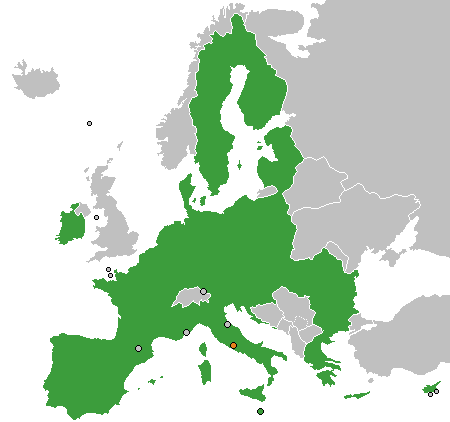
European–Vatican relations
QUESTION*: What does the Vatican and European Union have in common?

ANSWER: A Bitcoin Wall

According to Wikipedia:
Holy See–European Union relations is the relationship between the European Union (EU) and the Holy See (or Vatican City).   This is framed by the Holy See's geography (within an EU state capital) while being unable to join.

According to Wikipedia:

The Schengen Information System (SIS) is a governmental database maintained by the European Commission. The SIS is used by 31 European countries to find information about individuals and entities for the purposes of national security, border control and law enforcement. A second technical version of this system, SIS II, went live on 9 April 2013.Schengen Information System

What is the Schengen Information System (SIS)?

The Schengen Information System (SIS) is the most widely used and largest information sharing system for security and border management in Europe. SIS enables competent national authorities, such as the police and border guards, to enter and consult alerts on persons or objects. An SIS alert does not only contain information about a particular person or object but also instructions for the authorities on what to do when the person or object has been found. Specialised national SIRENE Bureaux located in each Member State serve as single points of contact for the exchange of supplementary information and coordination of activities related to SIS alerts. At the end of 2017, SIS contained approximately 76.5 million records, it was accessed 5.2 billion times and secured 243 818 hits (when a search leads to an alert and the authorities confirm it).

What is the purpose of the SIS?

The main purpose of SIS is to make Europe safer. The system assists the competent authorities in Europe to preserve internal security in the absence of internal border checks. The scope of SIS is defined in three legal instruments:
  1. Regulation (EC) No 1987/2006 (Border control cooperation):
    SIS enables border guards and visa issuing and migration authorities to enter and consult alerts on third-country nationals for the purpose of refusing their entry into or stay in the Schengen area.
  2. Council Decision 2007/533/JHA (Law enforcement cooperation):
    SIS supports police and judicial cooperation by allowing competent authorities to create and consult alerts on missing persons and on persons or objects related to criminal offences.
  3. Regulation (EC) No 1986/2006 (Cooperation on vehicle registration)
    Vehicle registration services may consult SIS in order to check the legal status of the vehicles presented to them for registration. They only have access to SIS alerts on vehicles, registration certificates and number plates.

How will SIS be in the future?

The changes proposed in 2016 by the European Commission will strengthen significantly the system.
In June 2018, the co-legislators reached political agreement on the new SIS package. The new functionalities in SIS will be implemented in different stages, with a requirement for the work to be completed by 2021.
The changes will entail enhancements in the following areas:
  • Biometrics: SIS will contain palm prints, fingerprints, facial images and DNA concerning, for example, missing persons to confirm their identity.
  • Counter-terrorism: More information will be shared on persons and objects involved in terrorism-related activities, allowing the authorities of the Member States to better pursue and prevent serious crimes and terrorism.
  • Vulnerable persons: Competent authorities will have the possibility of entering preventive alerts in the system to protect certain categories of vulnerable persons (missing persons, children at risk of abduction or potential victims of trafficking in human beings or gender-based violence).
  • Irregular migration: Return decisions and entry bans will be part of the information shared in the system to enhance their effective enforcement.
  • Enhanced access for EU Agencies: Europol will now have access to all alert categories in the SIS while the European Border and Coast Guard Agency operational teams will be able to access SIS for the purpose of carrying out their tasks in the hotspots.
Moreover, the introduction since March 2018 of an AFIS (Automated Fingerprint Identification System) in SIS, and the resulting possibility of making searches using fingerprints, makes it even more difficult for criminals to move unnoticed across Europe.

In which countries is SIS in operation?

SIS is in operation in 30 European countries, including 26 EU Member States (only Ireland and Cyprus are not yet connected to SIS) and 4 Schengen Associated Countries (Switzerland, Norway, Liechtenstein and Iceland).

EU Member States with special arrangements:

  • Bulgaria, Romania and Croatia are not yet part of the area without internal border checks (the 'Schengen area'). However, since August 2018, Bulgaria and Romania started using fully SIS. A Council Decision is still required for the lifting of checks at the internal borders of these two Member States. In the case of Croatia, there are still some restrictions regarding its use of Schengen-wide SIS alerts for the purposes of refusing entry into or stay in the Schengen area. Those restrictions will be lifted as soon as Croatia has become a part of the area without internal border checks.
  • The United Kingdom operates SIS but, as it has chosen not to join the Schengen area, it cannot issue or access Schengen-wide alerts for refusing entry and stay into the Schengen area.
  • Ireland and Cyprus are not yet connected to SIS. Ireland is carrying out preparatory activities to connect to SIS, but, as is the case for the UK, it will not be able to issue or access Schengen-wide alerts for refusing entry or stay. Cyprus has a temporary derogation from joining the Schengen area and is not yet connected to SIS.

EU Votes to Create a Gigantic Biometrics Database

EU Biometrics DatabaseThe European Union has moved forward with its plans to create a gigantic biometrics database, despite facing criticism for putting privacy rights at stake through it.
Last week, the European Parliament has adopted a legislation that will enable EU information systems to exchange records through the Common Identity Repository (CIR), which is set to gather data for over 150 million individuals. The move has been taken as a further attempt to simplify the jobs of EU border and law enforcement officers.
According to a press release by the European Parliament, the new system will facilitate the tasks of border guards, migration officers, police officers and judicial authorities by providing them with more systematic and faster access to various EU security and border-control information systems.
“The systems covered by the new rules would include the Schengen Information System, Eurodac,the Visa Information System (VIS) and three new systems: the European Criminal Records System for Third Country Nationals (ECRIS-TCN), the Entry/Exit System (EES) and the European Travel Information and Authorization System (ETIAS),” the press release reads.
The EU Commissioner for Migration, Home Affairs and Citizenship Dimitris Avramopoulos asserted that the Security Union is steadily taking shape with a whole range of tools, actions and rules being put in place to protect all EU citizens.
Whereas, the Commissioner for the Security Union Julian King said that the new adoptions mark another important milestone in the work of the EU towards an effective and genuine Security Union.
“Interoperability will help those working in the frontline to keep EU citizens safe – ensuring police and border guards have efficient access to the information they need, including to fight identity fraud, enables them to do their jobs properly,” he said a day after the Parliament had adopted the legislation.

EU Criticized for Putting Privacy Rights at Stake

Watchdog and non-profit organizations have long criticized the move for establishing such a system.
Non-profit organization Statewatch published a report last year titled “Interoperability morphs into the creation of a Big Brother centralized EU state database including all existing and future Justice and Home Affairs databases.”
According to the report the notion that these plans are simply bringing together existing data and biometrics, and so there is nothing to be afraid of, is untrue.
“If there has been one clear lesson since 11 September 2001 it is that function creep is the name of the game. From the late 1970s onwards each new stage of the technological revolution has been justified on the grounds that there is nothing new, it is just making life easier for law enforcement and border control agencies to get access to the information they need to do their job more efficiently. Whereas the reality is that at each stage databases become ever more intrusive as security demands cumulatively diminish freedoms and rights,” the report concludes among others.


*I had to spell out "QUESTION" because there are humans who like to worship a random letter of the alphabet.

Voting is beautiful, be beautiful ~ vote.©