Showing posts sorted by relevance for query Equifax. Sort by date Show all posts

Saturday, September 23, 2017

CONYERS: Top Democrats Ask Equifax, TransUnion, & Experian: Will Restore Consumers Rights In The Wake Of The Equifax Data Breach?


September 21, 2017 (Washington, DC) – Following the Equifax data breach of 143 million Americans’ personal information, House Judiciary Committee Ranking Member John Conyers, Jr. (D-MI), Ranking Member of the House Judiciary Committee’s Subcommittee on Regulatory Reform, Commercial and Antitrust Law Rep. David N. Cicilline (D-RI), and Representatives Don Beyer (D-VA) and Henry C. “Hank” Johnson, Jr. (D-GA), wrote to the three main credit rating agencies—Equifax,TransUnion, and Experian—to hear whether these companies will continue to include forced arbitration clauses in their terms of service or end their campaign against the Consumer Financial Protection Bureau’s rule to restore consumers’ day in court.

They wrote:

“The economic security of nearly half of all Americans has been jeopardized because Equifax’s failure to safeguard our most sensitive information, which is now in the hands of criminals. Making matters worse, many of those affected by this massive security breach are unsure whether they even have legal recourse because of your company’s use of forced arbitration clauses. Although Equifax has revised its policy in response to public outcry, this limited change is simply not enough given the systemic nature of this problem and the scope of the lives affected. We therefore request information concerning your plans to revise your terms of service and stance on the Consumer Financial Protection Bureau’s (CFPB) arbitration rule to restore consumers’ day in court.”

The CFPB arbitration rule includes important safeguards for consumers against forced arbitration, a practice that routinely allows corporate entities to avoid class-action lawsuits by burying legal language in the fine print of contracts that require consumers to waive their right to court.

A Republican measure to repeal that rule, supported by all three credit rating agencies, passed in the House of Representatives in July on a nearly-straight party-line vote. It is currently pending in the Senate.

The House Democrats denounced the three credit agencies for their opposition to the forced arbitration rule, writing, “Rather than support this commonsense protection, your company and others like it have reportedly campaigned against it, spending millions in campaign contributions and other efforts to undermine both the rule and the CFPB. Now is the time to demonstrate your respect for the rights of your customers, not undermine them.”


Voting is beautiful, be beautiful ~ vote.©

Wednesday, October 4, 2017

CONYERS: Another lesson from Equifax - We must end the predatory consumer practice of forced arbitration

By John Conyres, Jr., Hank Johnson, David Cicilline, & Don Beyer

Dean of the U.S. House
of Representatives
John Conyers, Jr.
The recent Equifax data breach jeopardized the economic security of nearly half of all Americans because of the credit rating company’s failure to safeguard our most sensitive information, which could now be in the hands of criminals. To make matters worse, many of those affected by this massive security breach are unsure whether they even have legal recourse because of the company’s use of forced arbitration clauses.

Americans are right to be outraged and frustrated and should be especially concerned about the use of forced arbitration by credit rating agencies like Equifax. Forced arbitration clauses are a predatory consumer practice written into the fine print of contracts. Signers unknowingly waive their right to sue and are forced into arbitration if a dispute arises. Americans should have a right to choose whether to sue or to seek arbitration. Preemptively eliminating our access to the justice system is a violation of every American’s right as a consumer. The justice system is one of the few tools that average citizens have to fight deceitful and harmful business practices, vindicate their rights, and pursue justice.

Equifax partially revised its forced arbitration policy in response to public outcry, but a limited change is not sufficient given the systemic nature of this problem and the scope of the lives affected. In recognition of the importance of Americans’ access to justice, the Consumer Financial Protection Bureau (CFPB) finalized a rule to eliminate forced arbitration from consumer financial product contracts.

This protection restores the rights of Americans to seek their day in court, and the transparency that comes with it, if their rights are violated by unscrupulous financial services and products. This protection is vital for the economic security of the American people and our country’s commitment to the rule of law. But rather than support this commonsense protection, credit rating agencies, like Equifax, reportedly campaigned against it and spent millions in political contributions to undermine both the CFPB rule and the CFPB itself.

The Equifax data breach shook public confidence in the entire credit rating industry. Companies such as Equifax, TransUnion, and Experian should take this moment to demonstrate their respect for the rights of customers, not undermine them. This is why we wrote to ask the three credit rating agencies to revise their terms of service and eliminate their use of forced arbitration and class action waivers on all the products they offer. Furthermore, we asked that they end their opposition to the CFPB arbitration rule to restore consumers’ day in court.

Forced arbitration clauses are a bald and predatory attempt to shield corporations from liability for their misconduct through the fine print of contracts. The credit rating agencies who we trust with our most sensitive data should not be actively working to undermine consumer rights. They should support the CFPB and the rule against forced arbitration.

Congress must also step forward to protect consumer’s rights. We have led the push in the House to pass the Arbitration Fairness Act, which would eliminate forced arbitration. It deserves a vote. Unfortunately House and Senate Republicans sought a different path. A Republican measure to repeal the CFPB rule, supported by all three credit rating agencies, passed the House of Representatives in July on a nearly-straight party-line vote. It is currently pending in the Senate. We cannot afford to let it pass. The right of your and every other American’s access to the justice system is at stake.

Voting is beautiful, be beautiful ~ vote.©

Monday, September 17, 2018

Federal Reserve & DHHS Lied To Snyder Using Privatization Predictive Modeling Crap To Push Medicaid Fraud In Child Welfare

These "Economic Gurus" (trademark pending) up in the Federal Reserve, U.S. DHHS and Michigan DHHS suck because they lied to Snyder, once again, using child welfare propaganda, to pitch their form of Medicaid expansion fraud.

This is not the first piece of statistical, predictive modeling crap to come out the Federal Reserve.

The last time they used University of Southern California.


Stop Medicaid Fraud in Child Welfare 


Portrait of Sharada Dharmasankar
Sharada Dharmasankar
 The most valuable thing I’ve acquired in my time as an 
AE at the Chicago Fed is a deep understanding of how 
academic research is conducted. Working with my team, 
taking classes, and attending seminar 
presentations have given me a broad perspective on the 
research process: formulating research ideas, learning about new 
and interesting sources of data, 
and how to review and question existing work. 
Doing this on a daily basis with researchers who are 
leaders in their fields has only furthered my interest in 
pursuing graduate studies in economics. 
This time, they are using the University of Michigan.

As much as I respect my alma mater, this has got to be one of the dumbest studies I have seen since that other Federal Reserve hit study on whether or not the banks benefited from TARP.

It is not even peer reviewed because it is a working paper.

Who paid for this study?

Russell Sage Foundation (grant # 94-16-04)

National Institute of ChildHealth and Human Development (NICHD) grant #1R01HD081129

Did you know the NICHD is really called the Eunice Kennedy Shriver National Institute of Child Health and Human Development and they are the ones who make the policies to traffic tiny humans?

This looks like a Public Private Partnership, or rather, I smell the work of Jerry Milner.

How much was this study?

Anything over the price of a 40 ounce brew and a spleef was too much.

Was this study paid with tax dollars and if so, how come I have to pay to access a public document, submitted into state and federal records, used to justify the use of more tax dollars, specifically Medicaid, when there is absolutely no mention of Medicaid fraud, or perhaps there is, if I pay for the study?

https://www.sciencedirect.com/science/article/abs/pii/S0047272718300707

Guess what, I got the document.
How come a public document which has been generated with public dollars, prescribing social and economic policy recommendations, has a copyright?
© 2018 by Sarah Miller, Luojia Hu, Robert Kaestner, Bhashkar Mazumder, and Ashley Wong. All rights reserved. Short sections of text, not to exceed two paragraphs, may be quoted without explicit permission provided that full credit, including © notice, is given to the source.
I am taking this moment to call out Fair Use on the BS copyright because my site is not monetized, I am preserving the annals of history, and I have just formally enter this into my case as evidence, so if anyone has a problem, then you are going to have to motion up.

Why was an undergraduate student running this study?

This work was supported by the National Institutes of Health [1R01HD081129-01]. The views expressed here do not represent the views of the Federal Reserve Bank of Chicago or the Federal Reserve System. We thank Sharada Dharmasankar for her excellent research assistance. We also thank the editor and four referees for helpful comments.

They used her. They are cranking out their armies through the universities to keep this Public Private Partnership going until they achieve world domination for their glorious leaders who give them pretty shiny sheep skins.

Who was the principal on the study?

"I see Corporate Shape Shifters. Was it Michigan? Was is Sage Foundation? Was it Gates Foundation? Was it the Federal Reserve? Was it the National Bureau of Economic Research? Was it the National Institution of Health? Who is making policies for "The Poors" (always said with clinched teeth). Mommy, who owns our data, I'm scared."

Why was individual data sold to a private organization, who authorized it?

Cui bono?

Second, data from TransUnion on consumer credit histories was matched with the Healthy Michigan administrative data using name, address, and social security number. TransUnion credit reports were observed twice per year, in January and July, starting with July 2011 and ending with January 2016, resulting in ten observation periods. Prior to providing the matched data to the researchers, all personally identifying information was removed. See the Appendix for additional details on the match process. page 7.

Oh, wait, Michigan Department of Health and Human Services.

Yes, they sold the data.

We are grateful to the Russell Sage Foundation (grant # 94-16-04) for support of this project. Drs Kaestner, Mazumder, and Miller also benefited from support from the National Institute of Child Health and Human Development (NICHD) grant #1R01HD081129. We thank Tara Watson, Lara Shore-Sheppard, seminar participants at the Federal Reserve Banks of Philadelphia and Chicago and conference participants at ASHEcon for their comments. We also gratefully acknowledge the Michigan Department of Health and Human Services for making this data available, Sarah Clark and Lisa Cohn for helping assemble the MDHHS data set, and Dave Fogata for facilitating the data purchase from TransUnion. The views expressed herein are those of the authors and do not necessarily reflect the views of the National Bureau of Economic Research.
They now have a viable voting database for manipulation.

Did you know Sharada has her name on another piece of crap Federal Reserve of Chicago study on the financial health of people who lost their homes to fake ass mortgage foreclosures?

Now, you do.

Her other crappy Federal Reserve study, below, failed to identify the fake ass mortgage fraud in Detroit.

In the spirit of fuchsia...

Study: Expanded Medicaid boosted finances of Michigan's poor

Enrollment in Michigan's expanded Medicaid program boosted the finances of many low-income residents as well as their health care status, according to a University of Michigan study released Monday.

It is always wise to keep your chattel alive to maximize revenues my making sure to layer up services, upon administrative fees, to implement studies for more service programs, to service for "The Poors" (always said with clinched teeth.)

Can you see the $ocial Impact Bonds?  I can.

Among more than 655,000 residents who gained health coverage after the Legislature approved the Healthy Michigan Plan in April 2014, many have experienced fewer debt problems and other financial issues than before enrollment, according to the analysis of thousands of enrollees' financial records.

If you did not know, they used aggregate data.  They should know very well the biases with MAUP, duh. This means the entire study sucks.

The study found drops in unpaid debts, such as medical bills and overdrawn credit cards, as well as fewer bankruptcies and evictions after people enrolled in Healthy Michigan. The program provides health insurance for adults with incomes up to 133 percent of the federal poverty level.

You can already tell that they did not use Detroit data. Do you know how many homes were foreclosed upon based on fake property taxes and mortgages in 2012 in Wayne County?

The research team was led by economist Sarah Miller of UM’s Ross School of Business. Their finding were published Monday on the website of the National Bureau of Economic Research with colleagues from the Federal Reserve Bank of Chicago, University of Illinois, Chicago and Northwestern University.

Yeah.  I truly hope Sarah does not get tenured for this crap.

The greatest financial gains were experienced by people with chronic illnesses or who had a hospital stay or emergency department visit after they enrolled.

“Across the board, we saw a pretty sizable effect, not just on unpaid medical bills, but also unpaid credit card bills, and on public records for evictions, bankruptcies, wage garnishments and other actions,” said Miller, a member of the UM Institute for Healthcare Policy and Innovation.

ASSUMPTION RULEOUT #1: When you are sick and broke, you cross your fingers you get approved in 3 to 5 years for a SSI check.  That means you are poor and do not have credit, so there would be no credit card debt.

“Enrollees’ financial well-being seems to improve when they can get the medical care they need without having to put it on a credit card. And the largest effects are among the sickest enrollees.”

ASSUMPTION RULEOUT #2: "The Poors" (always said with clinched teeth), do not have credit. Most of the time, all they have to do is miss one week of work and they will automatically qualify for Medicaid.  Have you looked at the rates of poverty, lately?  $1.00 over the threshold and you are cut off.

The team worked with the Michigan Department of Health and Human Services to obtain data on more than 322,000 enrollees without the researchers’ having access to any individual’s identifying information. Using a double-blind matching procedure, they matched the data with enrollees’ credit reports, and studied them as a group.

ASSUMPTION RULEOUT #3: They lied.  How are you going to obtain metadata then run it in a double-blind with credit reports.  Seriously?  You already know whatever they crank out is going to be on dirty data.  I wonder if they excluded the areas of Flint, Detroit, and the middle swath of the state, you know, the land of "The Poors" (always said with clinched teeth).

The study focused on people who enrolled during the first year of the Healthy Michigan plan, and who had previously been uninsured.  Researchers looked at individual-level financial information from several years before each person enrolled, and for at least one year following enrollment.

The average household income for enrollees in the study was $4,400 for an individual and $7,500 for a family of three. Seventy percent had a chronic illness, and on average they had been to an emergency department once in the past year.

Ah, this is where asset forfeiture policies kick in through guardian ad litems and those wonder corporate parents.  When someone has an average income between $4K and $7K a year, you are probably correct to assume that these individuals were probably in foster care or living in a boarding home and are dealing with mental health issues.

“A goal of the Healthy Michigan Plan is to address social determinants of health in order to promote positive health outcomes, greater independence and improved quality of life," said Lynn Sutfin, a spokeswoman for the Michigan Department of Health and Human Services.

HOW TO PROMOTE POSITIVE HEALTH OUTCOMES: Stop making "The Poors" (always said with clinched teeth), poorer!

"This study shows that ensuring Michigan residents have access to quality, affordable health care is reaping numerous benefits.”

No, this study shows another fraud scheme to hustle more money through privatization schemes to shore up the Federal Reserve banks that are going insolvent, like Deutsche Bank.  This is propaganda and I am repulsed that this is the University of Michigan is promoting more insurgency propaganda for the purposes of the Privateering NGOs to swoop in and commence to stealin' through more crappy predictive modeling social programming for the parent corporations.  That is the only place the financial health is focused.

More than 80 percent had credit scores in the subprime or deep subprime range. Their total debt in collections, medical debt in collections and past-due amount was higher than a random sample of credit reports nationally.

Uh...it is called poverty.

According to the study's findings, the Healthy Michigan Plan reduced their medical bills in collections by an average of 57 percent, or about $515. The amount of past due debt not yet sent to a collection agency was reduced by 28 percent or about $233.

How much of this past due debt was based upon bogus water bills or fake mortgages?

Researchers found a 16 percent drop in public records for evictions, bankruptcies, wage garnishments and other financial events.  Bankruptcies dropped by 10 percent among the group studied.

Most individuals do not have enough debt to file bankruptcy.  You cannot get evicted is you are homeless.  There would be no wage garnishments if you already hail from "The Poors" (always said with clinched teeth).

Enrollees’ were 16 percent less likely to overdraw their credit cards, and their credit scores improved as a group. The number with a “deep subprime” rating fell by 18 percent, and the number listed as “subprime” fell by 3 percent.

Do you mean those deep subprime mortgages that stole the houses from the people, allowing for gerrymandering of congressional districts for the purposes of putting in elected spokestokens to approve crappy studies like this to get more Medicaid money for stealin'?

Enrollees experienced a 21 percent rise in automotive loans, an indication of improved financial well-being.

No, no, no.  This is Michigan, the land of cars and corner car lots where Mohammad will sell you a hoopty and get you that 7 day insurance to get your plates to get on the road to find a good low-paying job and still qualify SNAP benefits.

According to Miller, other studies have found that Medicaid expansion reduced use of payday loans and reduced interest rates for low-income people.

Did Debbie Wasserman Schultz tell you to throw that "Medicaid expansion reduction in the use of payday loans and reduced interest rates for "The Poors" (always said with clinched teeth).  I someone in your targeted population gets a payday loan, it is because they have a SSI check as collateral.

2016
Have Borrowers Recovered from Foreclosures during the Great Recession?
 Now, nine years after the onset of the housing bust, we think it is worthwhile to assess the financial health of the individuals whose homes were foreclosed on during this period. Have they regained their financial footing, or are they permanently scarred? How different were their experiences compared with those of borrowers whose homes were lost to foreclosure in the years before the Great Recession? Did their experiences differ by their financial success (as reflected in their credit scores) before the Great Recession? And how likely are they to have undertaken a new mortgage?
In this Chicago Fed Letter, we address these questions by using data on a large sample of individuals who experienced a home foreclosure after 2000, with a focus on those who entered foreclosure between 2007 and 2010. We use credit bureau data through 2016 from the Federal Reserve Bank of New York Consumer Credit Panel/Equifax (CCP) database. We build on prior work by Brevoort and Cooper,2

 who also used the CCP database but whose analysis ended with 2010 data. Their study showed that prime borrowers (i.e., borrowers with credit scores 660 and above3) who had experienced a home foreclosure during the Great Recession were especially hard hit and that their rate of recovery was significantly slower relative to such borrowers who had experienced a home foreclosure earlier in the decade. We extend Brevoort and Cooper's analysis through the second quarter of 2016 in order to examine how these patterns evolved over the subsequent years of the economic expansion. Specifically, we examine the entire trajectories of credit scores and credit delinquencies starting from the years before a foreclosure event and also extending many years after foreclosure. We also examine whether borrowers obtained a new mortgage in the years after foreclosure.

Foreclosures surge during the great recession

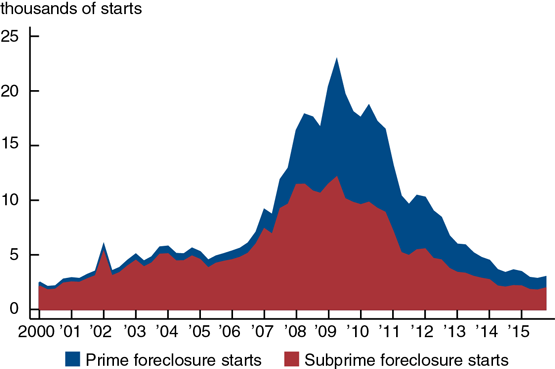
Our data are based on a 5% random sample of the population with credit bureau reports from the CCP database. These data allow us to study patterns in the number of new foreclosures ("foreclosure starts") each quarter beginning with the first quarter of 2000. Figure 1 shows that foreclosure starts were fairly steady until around the end of 2006. They then began to surge in 2007, peaking in 2009. After 2010, foreclosure starts began to rapidly decrease; by the end of 2012, the number of new borrowers entering foreclosure returned to pre-crisis levels.

1. Foreclosure starts, by home mortgage borrower credit status


figure 1 image
Note: See note 4 for how prime and subprime home mortgage borrowers are categorized.
Source: Authors’ calculations based on data from the Federal Reserve Bank of New York Consumer Credit Panel/Equifax.

Before the Great Recession, the majority of foreclosure starts were among subprime borrowers (i.e., those whose credit scores were below 660 4

 Figure 1 shows that the Great Recession led to a striking change in the composition of foreclosures between prime and subprime borrowers. According to our analysis, from 2007 through 2010, foreclosures rose approximately 800% among prime borrowers, but only 115% among subprime borrowers. Over the same period, 40% of all foreclosure starts were among prime borrowers and 26% were among borrowers whose pre-delinquency credit score (see note 4) was over 700. This is one defining characteristic of the Great Recession: A much broader range of individuals, including those who had very high credit scores, were swept up in the collapse of housing markets. Indeed, while the overall level of foreclosure starts has come back down to pre-recessionary levels, the fraction of prime borrowers in foreclosure remains relatively higher than it did before the downturn.

The decline in credit scores at foreclosure

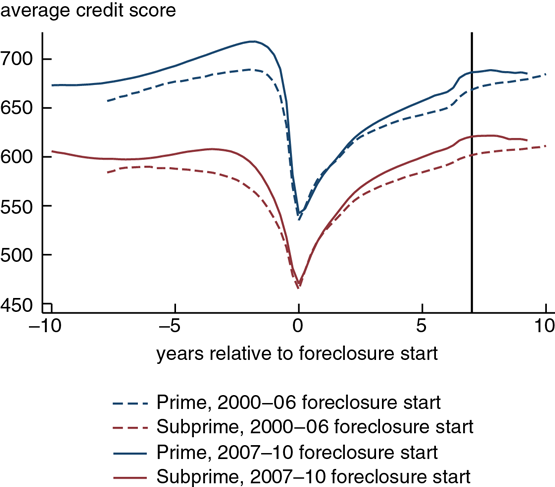
As might be expected, once borrowers enter foreclosure, their credit scores plummet. Figure 2 shows that the declines were very large for both prime and subprime borrowers during the Great Recession (solid lines). The decline in the average score for prime borrowers was about 175 points, and subprime borrowers experienced a decline of about 140 points in their average score.5 Immediately after foreclosure, nearly all borrowers became subprime, with average scores of around 550 for previously prime borrowers and 475 for already subprime borrowers. These declines were a bit larger than those experienced by borrowers who foreclosed between 2000 and 2006 (dashed lines).

2. Credit scores of home mortgage borrowers relative to foreclosure start


figure 2 image
Notes: See note 4 for how prime and subprime home mortgage borrowers are categorized. The black vertical line indicates the end of the seventh year after the foreclosure start.
Source: Authors’ calculations based on data from the Federal Reserve Bank of New York Consumer Credit Panel/Equifax.

Recovery after foreclosure

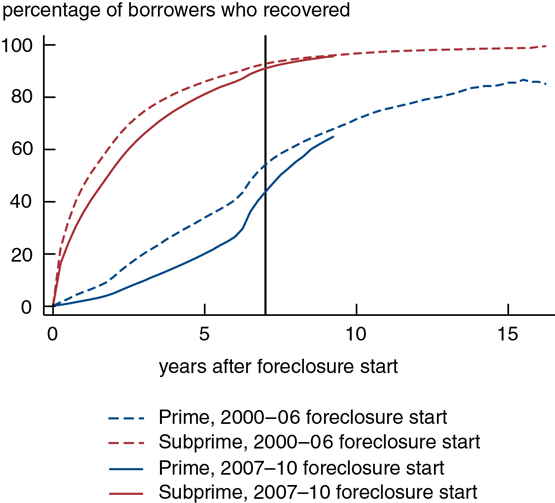
By law, information about any credit payment delinquencies, including mortgage payment delinquencies, must be removed from an individual’s credit record after seven years. Therefore, we would expect that if no other delinquencies occurred, individuals who experienced a foreclosure should see their credit scores recover in seven years. In figure 3, we plot the cumulative fraction of borrowers who reattained their pre-delinquency credit scores (again, see note 4) in the years following a foreclosure and show this separately for previously prime and already subprime borrowers.

3. Share of home mortgage borrowers who recovered pre-delinquency credit score after foreclosure


figure 3 image
Notes: See note 4 for how prime and subprime home mortgage borrowers are categorized, as well as for how the pre-delinquency credit score is defined. The black vertical line indicates the end of the seventh year after the foreclosure start.
Source: Authors’ calculations based on data from the Federal Reserve Bank of New York Consumer Credit Panel/Equifax.

What is immediately evident is that subprime borrowers tend to recover their pre-delinquency credit scores relatively more quickly than prime borrowers. First, let's examine the patterns of recovery for those who foreclosed on a home before the Great Recession. Among subprime borrowers who experienced a foreclosure between 2000 and 2006, roughly 60% reattained their pre-delinquency credit scores at some point within two years of foreclosure and roughly 85% within five years of foreclosure. In stark contrast, only about 10% of prime borrowers who foreclosed on a home in the same period recovered within two years and only about 33% within five years. After seven years, when delinquency flags are removed from their credit reports (as indicated by the black vertical line), about 90% of these subprime borrowers have reattained their pre-delinquency credit scores, compared with only about 50% of prime borrowers. After 15 years, nearly all subprime borrowers have reattained their pre-delinquency credit scores, whereas about 15% of prime borrowers have still not fully recovered. (Of course, subprime borrowers have a much lower pre-delinquency credit score to return to.)
When we examine the experience of the huge wave of borrowers who lost their homes to foreclosure during the Great Recession, we see a much slower pace of recovery. Specifically, among those who experienced a foreclosure between 2007 and 2010, irrespective of their credit status (prime or subprime), the pace of recovery was slower in the first three to five years after foreclosure relative to the pace of recovery among those who experienced a foreclosure in earlier years. However, after seven years, the subprime borrowers who foreclosed on a home in 2007–10 were virtually on track with their predecessor cohorts in terms of recovering their pre-delinquency credit scores. In contrast, even after seven years, prime borrowers who experienced a foreclosure in 2007–10 continued to lag their predecessor cohorts in reattaining their pre-delinquency credit scores. By 2016, the prime borrowers who entered foreclosure between six and nine years earlier (in 2007–10) appear to have recovery rates that are converging with the historical rates of recovery among their predecessor cohorts. When we further break down the analysis by subgroups of prime borrowers (660 to 700, 700 to 750, 750 and higher), we find that the lack of full recovery is mainly driven by those prime borrowers with the highest credit scores before foreclosure.

Other delinquencies and measures of financial health

A possible explanation for the slower pace of recovery among those who entered foreclosure between 2007 and 2010 relative to predecessor cohorts is that these individuals encountered difficulties paying their credit obligations on time because of the severity of the Great Recession. Since payment history is a critical component of credit scores, this could explain the especially slow rates of recovery. To address this possibility, we examine delinquency rates on any credit obligations for home mortgage borrowers before and after a foreclosure.
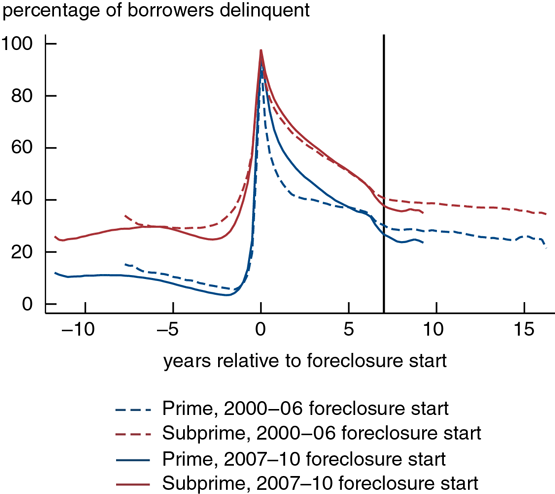
In figure 4, we plot the share of individuals who were 90 days or more past due on one or more sources of credit, including first mortgages, credit cards, and auto loans. Among both prime and subprime home mortgage borrowers, the share with credit delinquencies spikes to roughly 100% at the time of foreclosure and then drops sharply thereafter. Among those who entered foreclosure between 2000 and 2006, the share of prime home mortgage borrowers who are delinquent on their credit obligations tends to decline quite quickly, but never gets back down to the pre-foreclosure levels. Among subprime borrowers, the fraction of those who are delinquent takes much longer to fall, but does eventually get much closer to pre-foreclosure levels.

4. Share of home mortgage borrowers 90 days or more past due on a credit obligation


figure 4 image
Notes: See note 4 for how prime and subprime home mortgage borrowers are categorized. The black vertical line indicates the end of the seventh year after the foreclosure start.
Source: Authors’ calculations based on data from the Federal Reserve Bank of New York Consumer Credit Panel/Equifax.

We find that for the first seven years following foreclosure, the share of individuals who were delinquent on any credit obligations among those who experienced a home foreclosure in 2007–10 generally remained higher than this share among those who experienced a home foreclosure in 2000–06. This was the case regardless of the credit status (prime or subprime) before foreclosure. However, after seven years, this pattern reversed.

Implications for the housing market

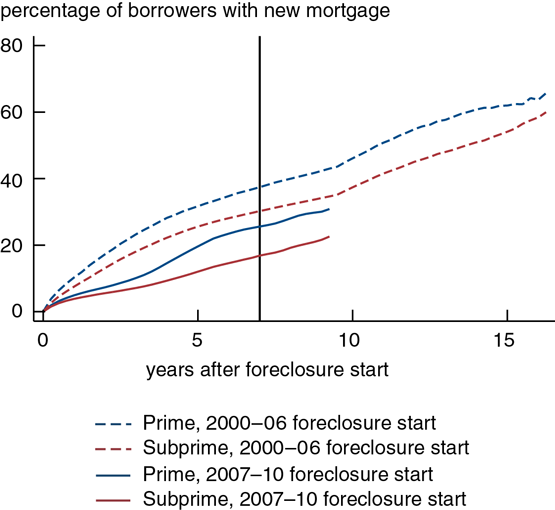
A question of interest is how the experience of foreclosure has affected housing markets. In figure 5, we show the cumulative fraction of individuals who experienced a home foreclosure but who then managed to take out a new mortgage afterward. When looking at the historical experience of prime home mortgage borrowers who entered foreclosure between 2000 and 2006, we find that just shy of 40% took out a new mortgage in the seven years following. The comparable value for subprime borrowers is notably lower, at around 30%. Among those who foreclosed on a home between 2007 and 2010, the shares with new mortgages seven years after foreclosure are dramatically lower at just over 25% for prime borrowers and just under 17% for subprime borrowers.

5. Share of home mortgage borrowers with a new mortgage after foreclosure


figure 5 image
Notes: See note 4 for how prime and subprime home mortgage borrowers are categorized. The black vertical line indicates the end of the seventh year after the foreclosure start.
Source: Authors’ calculations based on data from the Federal Reserve Bank of New York Consumer Credit Panel/Equifax.

These findings suggest that even though the overall credit scores and shares of delinquent borrowers appear to have returned to levels closer to historical norms for individuals who experienced a foreclosure in 2007–10, their homeownership rates continue to considerably lag the homeownership rates of those who experienced a foreclosure in 2000–06. The slower financial recuperation of those who lost their homes to foreclosure during the Great Recession has been one important factor behind the slow recovery in housing markets during the current economic expansion.

Summary

By tracking a sample of home mortgage borrowers who entered foreclosure in 2000–06 and 2007–10, or before and during the Great Recession, we find that the pace of recovery in credit scores was slower in the first few years after foreclosure for the latter cohorts. We also find that prime borrowers who experienced a foreclosure during the downturn were especially hard hit and had the most difficulty recovering. Overall, at least 15% of all prime borrowers have permanently lower credit scores regardless of when they foreclosed on their homes. A significant factor behind the slow recuperation in credit scores for borrowers who lost their homes to foreclosure in 2007–10 was adverse economic conditions during the recession, which led to delinquencies on other credit obligations. The slow rehabilitation of their financial health helps explain the slow recovery in housing markets post-recession. Indeed, following foreclosure, these borrowers have considerably lagged their predecessor cohorts in terms of homeownership rates.


1 Authors’ calculations based on data from the Federal Reserve Bank of New York Consumer Credit Panel/Equifax (CCP) and statistics from RealtyTrac (as cited in http://blog.credit.com/2015/04/boomerang-buyers-is-there-homeownership-after-foreclosure-114803/). Because of the high incidence of foreclosures in 2010, we include them in our analysis of foreclosures during the “Great Recession.” The recession officially ended in 2009 according to the National Bureau of Economic Research.
2 See Kenneth P. Brevoort and Cheryl R. Cooper, 2013, "Foreclosure's wake: The credit experiences of individuals following foreclosure," Real Estate Economics, Vol. 41, No. 4, Winter, pp. 747–792.
3 Credit scores (FICO scores) have a range of 300–850; for more details, see http://www.myfico.com/credit-education/credit-scores/.
4
 We categorize prime and subprime foreclosures based on the credit score of the borrower (prime, 660 and above; subprime, below 660) in the nearest quarter in which there is no major mortgage delinquency (i.e., less than 30 days past due) before the foreclosure start. In the text, we refer to this particular measure of the credit score as the "pre-delinquency credit score."
5
 We calculated these declines by taking the difference between the peak average credit score before foreclosure and the average credit score at the time of foreclosure.

I have a copyright, too, you know. 

Voting is beautiful, be beautiful ~ vote.©

Friday, April 5, 2019

#HackFosterCare: How To Steal Your Child's Legacy By Medicaid Fraud In Child Welfare

Just think....

If there are hackers stealing your children's credit data, then what are the possibilities of Medicaid fraud in child welfare?

Endless.

Yes, that is correct, there are already systems in place to #HackFosterCare and it is completely legal.

See, there is the "Bill Smith, Will Smith" copy and paste syndrome of double jackets scam of billing foster care the same time you bill in juvenile justice with fake cases.

Just ask Judy Hartsfield.

Then you have the Termination of Parental Rights scams where the State continues to process through privatized contracts the old Social Security Number of the child while granting a new Social Security Number to the state owned child.

But, have no fear, there is a major re-engineering and re-branding of child welfare to streamline stealin' of children's  identities of "The Poors", and that is through asset forfeiture of a the civil debt, like asking for help from the continuous operations of stealin'  the children, the land and the votes, and it is called Corporate Parental Rights, and their predictive modeling crap covers it all up.


Happy Child Abuse Propaganda Month!

Thanks, Roop, Roop!

How to protect your child's credit from data hackers


(FOX 2) - When you hear of identity theft you think of adults, but cyber risk experts say toddlers and teens are equally good targets.

But there are three things you can do to make sure their credit is protected.

Chris Sherban, a photographer here at FOX 2, says he received a letter address to his daughter saying her data had been compromised. The thing is -- she's 3 years old.

"I didn't think anything could be done with a 3 year old's (social security number), what are you going to do with it? She's only three," Sherban said.It turns out there's a danger, too. Kids' social security numbers are being sold as used. The bad guys simply edit the other information keep the social security number, and skate by, opening up credit using children's identities and ultimately putting them at risk down the road. "Worrying about her being in debt at 17-18 years old, somebody stealing her (social security number) and ringing up thousands of dollars on her credit before she had a chance to build it herself," Sherban said.

David Derigiotis is a cyber-security with Burns and Wilcox.

"For someone like Chris, you have to understand that as soon as you have a child, as soon as you enter them into the medical their information, their social security number, their data is going to be publically accessible somewhere," he said.

Child or not, if a social security number gets into the wrong hands, the danger is real.

"It's telling them that the health information was accessed. We don't know if it was extracted, but ransomware is something that's happening to so many organizations all over the world and that's exactly what we saw with that letter. This medical billing services company experienced a ransomware attack, so the data was touched," Derigiotis said.

He says the only way to know if the data has been touched is to call the three major credit reporting agencies: Equifax, Experian or TransUnion.

"Then you have to conduct a credit freeze for that minor. So they're a protected individual -- anyone under the age of 16 is considered a protected consumer. You have to go through the process and each website has its own set of instructions, but it's all done by mail. You can't do this stuff online. You have to prove that you're the guardian or the father, mother of that child," Derigiotis said.

There's a PIN that can be used down the road to unlock the credit, so one day Evelyn can use a credit card, buy a car or rent an apartment.

Voting is beautiful, be beautiful ~ vote.©

Thursday, September 24, 2020

Tales Of The New Crown: FBI & White House Take Action On Cyber Intrusions Of The Absolutely Brilliant Online Investigative Journalists

Thou shalt not bear false witness online, and thou better not be found generating revenue while doing it.

With that said, I strongly encourage the cyberblasphemers to put a disclaimer on your work as a fiction or you shall be called to bear witness, under oath, with your body as your bond, in a court of law, but hey, what do I know?

I know lots and lots of Absolutely  Brilliant Online Investigative Journalists who know all about the 2016 Election.

Yippers.

I most certainly do!


#maytheheavensfall


Statement Before the Senate Homeland Security and Governmental Affairs Committee
Washington, D.C.
September 24, 2020
Worldwide Threats to the Homeland
Statement for the Record

Good afternoon, Chairman Johnson, Ranking Member Peters, and members of the committee. Thank you for the opportunity to appear before you today to discuss the current threats to the United States homeland. I am pleased to be here representing the nearly 37,000 dedicated men and women of the FBI.

While the COVID-19 pandemic has presented unique and unprecedented challenges to the FBI workforce, I am proud of their dedication to our mission of protecting the American people and upholding the Constitution. Hostile foreign actors, violent extremists, and opportunistic criminal elements have seized upon this environment. As a result, we are facing aggressive and sophisticated threats on many fronts. Whether it is terrorism now moving at the speed of social media, or the increasingly blended threat of cyber intrusions and state-sponsored economic espionage, or malign foreign influence and interference or active shooters and other violent criminals threatening our communities, or the scourge of opioid trafficking and abuse, or hate crimes, human trafficking, crimes against children—the list of threats we are worried about is not getting any shorter, and none of the threats on that list are getting any easier.

Counterterrorism
Preventing terrorist attacks remains the FBI’s top priority. However, the threat posed by terrorism—both international terrorism (IT) and domestic violent extremism—has evolved significantly since 9/11.

The greatest threat we face in the homeland is that posed by lone actors radicalized online who look to attack soft targets with easily accessible weapons. We see this lone actor threat manifested both within domestic violent extremists (DVEs) and homegrown violent extremists (HVEs), two distinct sets of individuals that generally self-radicalize and mobilize to violence on their own. DVEs are individuals who commit violent criminal acts in furtherance of ideological goals stemming from domestic influences, such as racial bias and anti-government sentiment. HVEs are individuals who have been radicalized primarily in the United States, and who are inspired by, but not receiving individualized direction from, foreign terrorist organizations (FTOs).

Many of these violent extremists, both domestic and international, are motivated and inspired by a mix of ideological, sociopolitical, and personal grievances against their targets, which recently have more and more included large public gatherings, houses of worship, and retail locations. Lone actors, who by definition are not likely to conspire with others regarding their plans, are increasingly choosing these soft, familiar targets for their attacks, limiting law enforcement opportunities for detection and disruption ahead of their action.

DVEs pose a steady and evolving threat of violence and economic harm to the United States. Trends may shift, but the underlying drivers for domestic violent extremism—such as perceptions of government or law enforcement overreach, sociopolitical conditions, racism, anti-Semitism, Islamophobia, misogyny, and reactions to legislative actions—remain constant. As stated above, the FBI is most concerned about lone offender attacks, primarily shootings, as they have served as the dominant lethal mode for domestic violent extremist attacks. More deaths were caused by DVEs than international terrorists in recent years. In fact, 2019 was the deadliest year for domestic extremist violence since the Oklahoma City bombing in 1995.

The top threat we face from domestic violent extremists stems from those we identify as racially/ethnically motivated violent extremists (RMVE). RMVEs were the primary source of ideologically motivated lethal incidents and violence in 2018 and 2019 and have been considered the most lethal of all domestic extremists since 2001. Of note, the last three DVE attacks, however, were perpetrated by anti-government violent extremists.

The spate of attacks we saw in 2019 underscore the continued threat posed by DVEs and perpetrators of hate crimes. The FBI works proactively to prevent acts of domestic terrorism and hate crimes. For example, in November 2019, the Denver Joint Terrorism Task Force arrested Richard Holzer on federal charges of attempting to obstruct religious exercise by force using explosives. This disruption is just one example of the strength of our Domestic Terrorism-Hate Crimes (DT-HC) Fusion Cell. Our Counterterrorism Division (CTD) and Criminal Division (CID), working together, were able to prevent a potential terrorist attack before it occurred and, for the first time in recent history, make a proactive arrest on a hate crimes charge. Through the DT-HC Fusion Cell, subject-matter experts from both CTD and CID work in tandem to innovatively use investigative tools and bring multiple perspectives to bear in combating the intersecting threats of domestic terrorism and hate crimes, preventing attacks and providing justice to victims.

We recognize that the FBI must be aware not just of the domestic violent extremism threat, but also of threats emanating from those responding violently to First Amendment-protected activities. In the past, we have seen some violent extremists respond to peaceful movements through violence rather than non-violent actions and ideas. The FBI is involved only when responses cross from ideas and constitutionally protected protests to violence. Regardless of the specific ideology involved, the FBI requires that all domestic terrorism investigations be predicated based on activity intended to further a political or social goal, wholly or in part involving force, coercion, or violence, in violation of federal law.

HVEs and FTOs have posed a persistent threat to the nation and to U.S. interests abroad, while their tradecraft, tactics, and target sets have evolved. The international terrorism threat to the U.S. has expanded from sophisticated, externally directed FTO plots to include individual attacks carried out by HVEs who are inspired by designated terrorist organizations. As stated above, the FBI assesses HVEs are the greatest, most immediate international terrorism threat to the homeland. These individuals are FTO-inspired individuals who are in the U.S., have been radicalized primarily in the U.S., and are not receiving individualized direction from FTOs. We, along with our law enforcement partners, face significant challenges in identifying and disrupting HVEs. This is due, in part, to their lack of a direct connection with an FTO, an ability to rapidly mobilize without law enforcement detection, and their frequent use of encrypted communications.

Many FTOs use various digital communication platforms to reach individuals they believe may be susceptible and sympathetic to violent terrorist messages. However, no group has been as successful at drawing people into its perverse ideology as ISIS, which has proven dangerously competent at employing such tools. ISIS uses traditional media platforms as well as widespread social media campaigns to propagate its ideology. Terrorists in ungoverned spaces—both physical and virtual—readily disseminate propaganda and training materials to attract easily influenced individuals around the world to their cause. With the broad distribution of social media, terrorists can spot, assess, recruit, and radicalize vulnerable persons of all ages in the U.S. either to travel to foreign lands or to conduct an attack on the homeland. Through the internet, terrorists anywhere overseas now have direct access to our local communities to target and recruit our citizens and spread their message faster than was imagined just a few years ago.

We remain concerned that groups such as the Islamic State of Iraq and ash-Sham (ISIS) and al Qaeda intend to carry out large-scale attacks in the U.S. Despite their territorial defeat in Iraq and Syria, ISIS remains relentless and ruthless in its campaign of violence against the West and has aggressively promoted its hateful message, attracting like-minded violent extremists. The message is not tailored solely to those who overtly express signs of radicalization. It is seen by many who use messaging apps and participate in social networks. Ultimately, many of the individuals drawn to ISIS seek a sense of belonging.

Echoing other terrorist groups, ISIS has advocated lone offender attacks in Western countries. Recent ISIS videos and propaganda have specifically advocated attacks against soldiers, law enforcement, and intelligence community personnel.

As noted above, ISIS is not the only terrorist group of concern. Al Qaeda maintains its desire for large-scale, spectacular attacks. While continued counterterrorism pressure has degraded the group’s Afghanistan-Pakistan senior leadership, in the near term, al Qaeda is more likely to focus on building its international affiliates and supporting small-scale, readily achievable attacks in key regions such as East and West Africa. Simultaneously, over the last year, propaganda from al Qaeda leaders seeks to inspire individuals to conduct their own attacks in the U.S. and the West. For example, the December 2019 attack at Naval Air Station Pensacola demonstrates that groups such as al Qaeda continue to be interested in encouraging attacks on U.S. soil.

The FBI regularly reviews intelligence to ensure that we are appropriately mitigating threats from any place by any actor, and the possible violent responses and actions. We are sensitive to First Amendment-protected activities during investigative and intelligence efforts so as to ensure that our investigative actions remain aligned with our authorities and are conducted with the appropriate protections in place for privacy and civil liberties.

As the threat to the United States and U.S. interests evolves, we must adapt and confront these challenges, relying heavily on the strength of our federal, state, local, tribal, and international partnerships. The FBI uses all lawful investigative techniques and methods to combat these terrorist threats to the United States. Along with our domestic and foreign partners, we are collecting and analyzing intelligence concerning the ongoing threat posed by violent extremists motivated by any ideology and desire to harm Americans and U.S. interests. We continue to encourage information sharing, which is evidenced through our partnerships with many federal, state, local, and tribal agencies assigned to Joint Terrorism Task Forces around the country. Be assured, the FBI continues to strive to work and share information more efficiently, and to pursue a variety of lawful methods to help stay ahead of these threats.

Election Security
In less than two months, Americans will exercise one of their most important and cherished freedoms: the right to vote in a democratic election. Our nation is confronting multi-faceted foreign threats seeking to both influence our national policies and public opinion and cause harm to our national dialogue. The FBI and our interagency partners remain concerned about, and focused on, the covert and overt influence measures used by certain adversaries in their attempts to sway U.S. voters’ preferences and perspectives, shift U.S. policies, increase discord in the United States, and undermine the American people’s confidence in our democratic processes.

Foreign influence operations—which include covert, coercive, or corrupt actions by foreign governments to influence U.S. political sentiment or public discourse or interfere in our processes themselves—are not a new problem. But the interconnectedness of the modern world, combined with the anonymity of the internet, have changed the nature of the threat and how the FBI and its partners must address it. This year’s election cycle, amid the COVID-19 pandemic, provides ample opportunity for hostile foreign actors to conduct disinformation campaigns and foreign influence operations in an effort to mislead, sow discord, and, ultimately, undermine confidence in our democratic institutions and values and in our government’s response to our current health crisis.

Foreign influence operations have taken many forms and used many tactics over the years. Most widely reported these days are attempts by adversaries—hoping to reach a wide swath of Americans covertly from outside the United States—to use false personas and fabricated stories on social media platforms to discredit U.S. individuals and institutions.

The FBI is the lead federal agency responsible for investigating foreign influence operations. In the fall of 2017, the Foreign Influence Task Force (FITF) was established to identify and counteract malign foreign influence operations targeting the United States. The FITF is led by the Counterintelligence Division and is composed of agents, analysts, and professional staff from the Counterintelligence, Cyber, Counterterrorism, and Criminal Investigative Divisions. It is specifically charged with identifying and combating foreign influence operations targeting democratic institutions and values inside the United States. In all instances, the FITF strives to protect democratic institutions and public confidence, develop a common operating picture, raise adversaries’ costs, and reduce their overall asymmetric advantage.

The task force brings the FBI’s national security and traditional criminal investigative expertise under one umbrella to prevent foreign influence in our elections. This better enables us to frame the threat, to identify connections across programs, to aggressively investigate as appropriate, and—importantly—to be more agile. Coordinating closely with our partners and leveraging relationships we have developed in the technology sector, we had a number of instances where we were able to quickly relay threat indicators that those companies used to take swift action, blocking budding abuse of their platforms.

Following the 2018 midterm elections, we reviewed the threat and the effectiveness of our coordination and outreach. As a result of this review, we further expanded the scope of the FITF. Previously, our efforts to combat malign foreign influence focused solely on the threat posed by Russia. Utilizing lessons learned over the last year and half, the FITF is widening its aperture to confront malign foreign operations of China, Iran, and other global adversaries. To address this expanding focus and wider set of adversaries and influence efforts, we have also added resources to maintain permanent “surge” capability on election and foreign influence threats.

We have also further refined our approach. All efforts are based on a three-pronged approach, which includes investigations and operations, information and intelligence sharing, and a strong partnership with the private sector. Through the efforts of the FITF  and lessons learned from both the 2016 and 2018 elections, the FBI is actively engaged in identifying, detecting, and disrupting threats to our elections and ensuring both the integrity of our democracy is preserved and the will of the American people is fulfilled.

Protecting policymakers is an important part of our efforts to combat malign foreign influence and protect our elections. As you are aware, the FBI and our interagency partners have been providing ongoing election security threat briefings to Congress. We will continue to do so throughout the fall and into the future, where there is actionable intelligence.

Lawful Access
I want to turn now to an issue continuing to limit law enforcement’s ability to disrupt these increasingly insular actors. We are all familiar with the inability of law enforcement agencies to access data, even with a lawful warrant or court order, due to “end-to-end” encryption. Increasingly, device manufacturers and communications service providers have employed encryption in such a manner that only the users or parties to the communications can access the content of the communications or devices. This is known as end-to-end encryption.

This development has meant that, in recent years, the FBI has observed a decline in its ability to gain access to the content of both domestic and international terrorist communications due to the widespread adoption of encryption for internet traffic and the prevalence of mobile messaging apps using end-to-end encryption as default.

The FBI certainly recognizes how encryption increases the overall safety and security of the internet for users. But in fulfilling the FBI’s duty to the American people to prevent acts of terrorism, this kind of end-to-end encryption creates serious challenges. Accessing content of communications by, or data held by, known or suspected terrorists pursuant to judicially authorized, warranted legal process is getting more and more difficult.

The online, encrypted nature of radicalization, along with the insular nature of most of today’s attack plotters, leaves investigators with fewer dots to connect. As was evident in the December 9, 2019, shooting at Naval Air Station Pensacola that killed three U.S. sailors and severely wounded eight other Americans, deceased terrorist Mohammed Saeed Alshamrani was able to communicate using warrant-proof, end-to-end encrypted apps deliberately to evade detection by law enforcement. It took the FBI several months to access information in his phones, during which time we did not know whether he was a lone wolf actor or whether his associates may have been plotting additional terrorist attacks.

If law enforcement loses the ability to detect criminal activity because communication between subjects—data in motion—or data held by subjects— data at rest—is encrypted in such a way making content inaccessible, even with a lawful order, our ability to protect the American people will be degraded. Providers and law enforcement must continue to collaborate to explore possible technical solutions that would provide security and privacy to those using the internet while also contributing to the FBI’s ability to complete its mission.

Despite the successes that result from the hard work of the men and women of the FBI, our Joint Terrorism Task Forces, and our partners across the government, terrorism continues to pose a persistent threat to the homeland and our interests overseas.

China Threat
The greatest long-term threat to our nation’s information and intellectual property and to our economic vitality is the counterintelligence and economic espionage threat from China. It is a threat to our economic security and by extension, to our national security.

As you have seen from the recent closure of the Chinese Consulate in Houston, this issue is not just an intelligence issue, or a government problem, or a nuisance largely just for big corporations who can take care of themselves. Our adversaries’ targets are our nation’s core economic assets—our information and ideas, our innovation, our research and development, our technology. No country poses a broader, more severe threat to those assets than China. It is the people of the United States who are the victims of what amounts to Chinese theft on a scale so massive that it represents one of the largest transfers of wealth in human history. If you are an American adult, it is more likely than not that China has stolen your personal data.

In 2017, the Chinese military conspired to hack Equifax and made off with the sensitive personal information of 150 million Americans—we are talking nearly half of the American population and most American adults. Our data is not the only thing at stake here—so is our health, livelihood, and security.

The FBI is opening a new China-related counterintelligence case approximately every 10 hours. Of the nearly 5,000 active FBI counterintelligence cases currently underway across the country, almost half are related to China. And at this very moment, China is working to compromise American health care organizations, pharmaceutical companies, and academic institutions conducting essential COVID-19 research. They are going after cost and pricing information, internal strategy documents, personally identifiable information—anything that can give them a competitive advantage.

It is important to be clear: This is not about the Chinese people as a whole, and certainly not about Chinese Americans as a group, but it is about the Chinese government and the Chinese Communist Party. Every year, the United States welcomes more than 100,000 Chinese students and researchers into this country. For generations, people have journeyed from China to the United States to secure the blessings of liberty for themselves and their families—and our society is better for their contributions. So, when the FBI’s refers to the threat from China, we mean the government of China and the Chinese Communist Party.

Confronting this threat effectively does not mean that we should not do business with the Chinese. It does not mean that we should not host Chinese visitors. It does not mean that we should not welcome Chinese students or coexist with China on the world stage. But it does mean that when China violates our criminal laws and international norms, we are not going to tolerate it, much less enable it. The FBI and our partners throughout the U.S. government will hold China accountable and protect our nation’s innovation, ideas, and way of life—with the help and vigilance of the American people.

Cyber
With the advent of the COVID-19 pandemic, the nature of the cyber threat has become increasingly concerning. As more individuals telework and increasingly use the cloud, we encounter less secure networks. As a result, the scope of our cyber threats has changed, the impact has deepened, and many of the players have become more dangerous as we have become increasingly vulnerable. We are still seeing hack after hack and breach after breach. We hear about it daily in the news. The more we shift to the internet as the conduit and the repository for everything we use and share and manage, the more danger we are in.

Today we are worried about a wider-than-ever range of threat actors, from multinational cyber syndicates to nation-state adversaries. And we are concerned about a wider-than-ever gamut of methods continually employed in new ways, like the targeting of managed service providers—MSPs—as a way to access scores of victims by hacking just one provider.

China’s Ministry of State Security (MSS) pioneered that technique and, as you saw in July, we indicted two Chinese hackers who worked with the Guangdong State Security Department of the MSS. These individuals conducted a hacking campaign lasting more than 10 years, targeting countries with high technology industries, to include the United States. The industries targeted included, among others, solar energy, pharmaceuticals, and defense.

Cyber crimes like these, directed by the Chinese government’s intelligence services, threaten not only the United States but also every other country that supports fair play, international norms, and the rule of law, and they also seriously undermine China’s desire to become a respected leader in world affairs.

Theft of intellectual property is not the only cyber threat presented by the People’s Republic of China (PRC) government. They are also working to obtain controlled defense technology and developing the ability to use cyber means to complement any future real-world conflict. All of them, and others, are working to simultaneously strengthen themselves and weaken the United States. And we are taking all these nation-state threats very seriously.

But as dangerous as nation-states are, we do not have the luxury of focusing on them alone. We also are battling the increasing sophistication of criminal groups that place many hackers on a level we used to see only among hackers working for governments. The proliferation of malware as a service, where darkweb vendors sell sophistication in exchange for cryptocurrency, increases the difficulty of stopping what would once have been less-dangerous offenders. It can give a ring of unsophisticated criminals the tools to paralyze entire hospitals, police departments, and businesses with ransomware. Often the hackers themselves have not become much more sophisticated—but they are renting sophisticated capabilities, requiring us to up our game as we work to defeat them, too.

Hackers have not relented under the COVID-19 pandemic. On the contrary, they have attempted to compromise the computer systems of hospitals and medical centers to obtain patient financial data, medical records, and other information. In addition, such attacks on medical centers may lead to the interruption of computer networks and systems putting patients’ lives at an increased risk when America faces its most dire health crisis in generations.

Conclusion
Chairman Johnson, Ranking Member Peters and members of the committee, thank you for the opportunity to testify today. I am now happy to answer any questions you might have.

Voting is beautiful, be beautiful ~ vote.©