Showing posts sorted by date for query camargo. Sort by relevance Show all posts

Wednesday, September 25, 2019

SIGTARP, Detroit Land Bank Authority & The Uncloaking Of The Dark Gerrymandering Tale

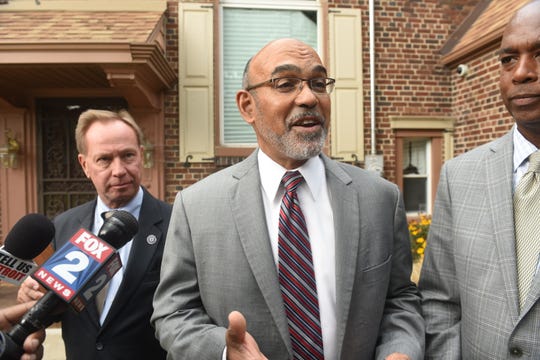
636391899487340902-camargo.jpg
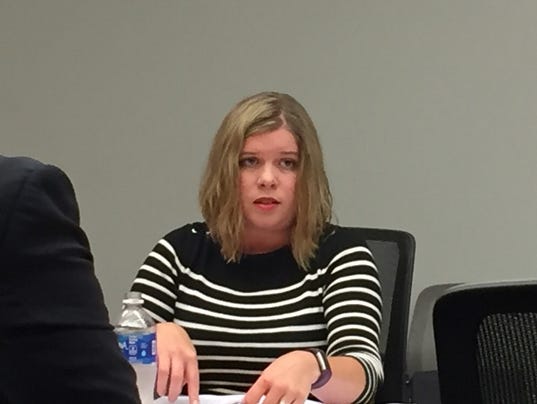
Becky (said like a 1980s valley girl) Camargo
For everything you ever wanted to know about the Detroit Land Bank Authority, you shall find it here.

The Special Inspector General for the Troubled Asset Relief Program, or SIGTARP, has been conducting a criminal investigation into the program for several years. 
SIGTARP also has secret recordings.

What many may not understand is that these privately contractors may have demolished properties where absentee ballots were issued to these property addresses and tallied for the 2018 election...2016 election...and 2014 election....and 2012 election....and 2010 election.....but hey, what do I know?

#perkinscoiesucks

Contractors named own price for Detroit demolition dirt, emails show

Detroit — Contractors charged the federal government whatever they wanted for more than two years for dirt used to fill holes left behind from thousands of torn-down houses in Detroit's controversial demolition program, emails obtained by The Detroit News show.

It would have been nice if they would have at least dropped more than five inches of dirt on my lot of a demolished home.  I should excavate just to see if there were any antiques left behind before they bulldozed the structure to collapse in its burnt out basement. I really wanted to plant vegetables to compensate for the nasty things Michigan and Detroit continue to do to tiny humans.

The unrestricted charges occurred because no rules were in place to limit dirt costs, eventually prompting state officials to worry about overbilling.

Emails reviewed by The News flagged dirt costs ranging from $3,750 to upward of $7,000 per property that were billed to the state for reimbursement. These charges prompted the state to crack down on contractors, limiting dirt costs to $3,000 for larger houses and $2,000-$2,500 for typical properties.

Considering the average cost for dirt in the most recent quarter — $2,368 per property — it is likely the government spent well above the $18 million it would have on the 7,747 demolitions conducted from the program's inception through July 2017 when cost controls were put into place.

"I cannot say with any kind of authority if something was inappropriate or fraudulent. All I can say is I questioned those costs that were just kind of out of line," said Mary Townley, president of the Michigan Homeowner Assistance Nonprofit Housing Corp., the entity created by the Michigan State Housing Development Authority to administer federal Hardest Hit Funds for the demolition program.

The state's concerns — seen flagged in 2017 correspondence between MSHDA and Detroit Land Bank Authority — first came to light more than a year after the program launched in spring 2014.

The News' request through the Freedom of Information Act included email discussions over dirt charges submitted by contractors that spanned from January 2017 to May 2017. The emails turned up close to a dozen instances in which dirt costs were flagged by state workers hired to review demolition invoices.

State contractors and program leaders expressed skepticism to land bank officials about the prices billed to the taxpayer-funded blight effort as invoices began to come in by late 2015.

But cost reasonableness for dirt wasn't officially added to the state's blight manual until July 2017, requiring contractors to turn in dirt invoices, load tickets and other documents to substantiate costs. This essentially made a paper trail from contractors to prove what "they really paid" for the dirt, according to the emails.

It's unclear to the state what the average dirt cost per house was in the early stages of the program because officials admit they weren't being tracked.

The state also could not provide an estimate on the number of invoices it received that sparked concerns. But officials said once invoices began to ramp up, so did the irregularities, prompting an investigation into the costs and billing practices for the overall program.

'Digging deep' into costs
The emails raise accountability questions for the demolition program, which has been the subject of a federal criminal investigation. The development also comes amid an ongoing audit of whether contaminated soil was used to fill holes for homes torn down through the federally funded program in Michigan cities, including Detroit.

At the outset, the state "did what we could" but operated without formal rules to cap dirt costs, Townley said.

The state got the bulk of the early demolition invoices in late 2015. That's when, Townley said, questions surfaced and state officials began "digging deep" into program costs and whether contractors had documentation to back them up.

The state in 2016 launched a review of the city's demolition program in tandem with a two-month suspension imposed by the U.S. Treasury Department to address improper billing and misallocation of funds.

The state concluded its review of Detroit's billing practices in early 2017 with a $5 million settlement with the land bank to resolve a dispute over invoices the state said were improperly submitted for repayment. In return, the state agreed to make that same amount available to Detroit for tearing down more houses.

On the heels of its review, the state implemented "cost reasonableness" guidelines that Townley said "opened up the process for the state to question costs" as well as a policy requiring contractors to supply load tickets for dirt and copies of other documentation from bid packs. Initially, the state didn't track dirt costs separately.

The dirt cost rules were referenced in a January 2017 email titled "dirt invoices" from Roxanne Eaton, the state's program team leader.

In the correspondence, Eaton identified a range of $2,000 to $2,500 that she deemed acceptable.

Prior to that, emails suggest some were billed at $3,750 or $5,000, regardless of square footage, with at least one billing reaching nearly $7,000, the News found.

On Jan. 24, 2017, Eaton sent an email to MSHDA staff, copying Townley, saying $2,000 to $2,500 or less for dirt for "our usual dinky" houses "we will be fine."

If it's $2,500 to $3,000 and the house is larger, "I am OK with it," she wrote.

"We will only question the ones that falls out of these categories," added Eaton, who notes that costs of $3,750 billed by the prominent demolition firm Homrich "is still high in my mind unless the house is very large."

Anthony Abela, a project manager for Homrich, declined to be interviewed.

Eaton, in a Jan. 19, 2017, email to some land bank and city building authority staff titled "heads up," warned that "very high costs for dirt" would need to be explained.

"I am putting you guys on notice that we are sending the files back with a note asking the contractor to supply a copy of the load ticket and a copy of the invoice showing they really paid for dirt," she wrote.

"We are receiving conflicting stories about where and how dirt is being acquired, so this is (the) way treasury wants us to address it."

On April 24, 2017, an MSHDA worker sent an email to Rebecca Camargo, the land bank's former demolition program director and other land bank staff, asking why the dirt cost for a 2,390-square-foot property at 5759 Lawton was $6,875.

Camargo responded that the property, which records show was demolished by Salenbien Excavating and Trucking, fell under a past directive from the state "to put any dirt amount into that field."

"That directive stated that it didn’t have to be an estimate, just a dollar amount," she wrote, noting the new directive to control costs from the state would be applied for future bids.

In a separate exchange the same month, another MSHDA contractor asked how two properties on Carter — one with 2,208 square feet and another with just 920 square feet — "can both have a charge for dirt = to $5,000 for each?"

"As previously discussed, contractors were operating under a directive to simply place a cost in the dirt column," Camargo wrote in response on April 24, 2017, of the property also under contract with the firm Salenbien. "It is not necessarily reflective of the actual cost."

Camargo, now a private attorney who represents several demolition firms including Salenbien, told The News she doesn't believe any of the contractors were overcharging.

"Quality dirt costs money and is expensive," she said. "The competitive bid process rules out any issue of public waste and/or inflated costs."

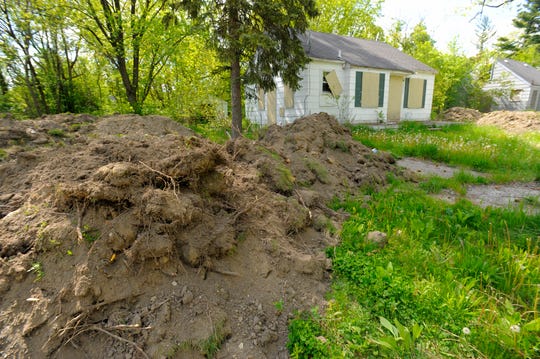
On April 24, 2017, an MSHDA worker sent an email asking why the dirt cost for a 2,390-square-foot property at 5759 Lawton was $6,875.Buy Photo
On April 24, 2017, an MSHDA worker sent an email asking why the dirt cost for a 2,390-square-foot property at 5759 Lawton was $6,875. (Photo: Max Ortiz, The Detroit News)

Camargo said it was clear to her in January 2017, while serving as the demolition director, that there had been an old directive from the state to contractors regarding dirt costs and bids.

"The old directive was to place a cost in the dirt column irrespective of the actual dirt cost," she said. "The new directive came in January 2017, stating that the dirt cost had to be reasonable, essentially based on the size of the structure being demolished."

Camargo said MSHDA reimbursed the land bank for "each and every property they questioned regarding dirt" during her tenure as demolition director. The costs, she said, "were legitimate."

Camargo, a former Wayne County prosecutor, resigned her post with the land bank in August 2017.

In a statement provided to The News, the state said at no time was there a directive to "place any number" in the cost field for dirt.

"But it did ask Detroit to start estimating costs for each category of greening: dirt, grade, seed, sidewalk repair or replacement," MSHDA spokeswoman Katie Bach wrote in an email on behalf of Eaton and Townley. "That estimated cost breakdown reporting started in 2015 and is still required today for all state partners receiving Hardest Hit Funds for demolition, not just Detroit."

Alyssa Strickland, a spokeswoman for the land bank, said Eaton's email is the only directive the land bank has on cost reasonableness and the authority continues to follow it.

The land bank, she said, doesn't see backfill as a factor that drives up costs, and it "wouldn't be making any award decisions based on the dirt price."

The authority, she stressed, looks at the total price of a bid package with the goal of getting the lowest price overall to "maximize every federal dollar."

"We need each bid pack to come in as low as possible to get down as many properties with the finite amount of money that's available to us," she said. "Monitoring the price of dirt isn't really getting us to that end goal. We're looking at what's the overall price for the package."

If the overall price for a property seems too high, she said, it's flagged and the land bank examines it more closely.

Record integrity questioned
Details of the lack of early pricing policies for dirt come after The News reported this spring on a University of Michigan researcher's analysis of record-keeping for the backfill program that turned up errors, gap and oversight concerns.

The findings shed light on the control contractors wielded in the process, said Michael Koscielniak, a doctoral candidate in urban and regional planning who spent more than four years reviewing public records that cast doubt on the integrity of soil records for the $265 million blight elimination program.

The city has said record-keeping for dirt evolved from a paper-based tracking system to digital records, but all of the dirt used to fill holes left behind from housing demolitions was accounted for.

Detroit's demolition program launched with urgency to draw down the first federal dollars earmarked to rid the city of blight. In a state of emergency, Koscielniak said, no regulation is safe.

"When you establish that as the default, it becomes very easy to let stuff get by or to rationalize or accommodate contractors or haulers what have you, taking advantage of the program," he said. "Basically, the contractors were able to set the rules."

The demolition program first came under scrutiny in fall 2015 amid worries over spiraling costs and bidding practices.

The Special Inspector General for the Troubled Asset Relief Program, or SIGTARP, has been conducting a criminal investigation into the program for several years.

This summer, two former employees of a major demolition contractor pleaded guilty to accepting bribes and rigging bids. Both were sentenced to a year in prison.

The federal watchdog agency in January issued subpoenas to certain contractors, seeking two years' worth of backfill records, including cost, where it was obtained and where it ended up.

SIGTARP is also in the midst of an audit of federally funded demolition activities for the risk of contaminated soil in Michigan and Detroit.

Koscielniak said he was contacted by SIGTARP in April to discuss several dozen residential demolitions in 2015 that used backfill from a source site in an industrial area of northwest Detroit.

"The feds are concerned it may have been material generated from the I-96 project," he said, referring to a recent road reconstruction project in western Wayne County.

Demolition program officials have insisted, however, that the use of dirt from the I-96 project was prohibited.

Risks related to the dirt used to fill demolition holes was a core focus of a 2017 audit of Hardest Hit Fund-paid demolitions in Flint. This summer, SIGTARP opened a new audit at the request of Democratic U.S. Reps. Brenda Lawrence of Southfield and Rashida Tlaib of Detroit to determine whether and how its earlier recommendations have been implemented, said Rob Sholars, a spokesman for SIGTARP, in an email.

"Ensuring the integrity of the dirt backfill process is a key area of SIGTARP's continued oversight of the Blight Elimination Program, and we will continue to work to prevent fraud, waste, and abuse throughout the program," Sholars wrote.

Sholars added he can't speak to specific cases but "would strongly agree that decisions related to the broader dirt backfill process should not be left to individual contractors."

"Our audit findings and recommendations make clear that more effective state agency quality assurance and oversight is required," he said.

Eaton, in a Jan. 19, 2017, email that flagged a bill for $3,750 bill for dirt submitted by Homrich, wrote many contractors "received dirt for free or just the trucking charges, and we now have to prove that these are legitimate costs."

"If they are legitimate costs, it should be no issue at all to obtain the documentation," she added.

Koscielniak, in his backfill analysis, identified 70 properties demolished by Homrich from June 4, 2015, through July 11, 2015, in which the firm billed $3,750 for dirt on each, totaling $258,750. All of the material was supplied from a site on Castleton Street.

Townley said in that instance and others, "it appears" Homrich "made a self-determined average and charged the same amount for each lot" prior to the program guideline changes.

"While this is not correct, it is the way DLB accepted the costs back in the beginning of the program," she said. "It wasn’t until later, toward the end of 2016 and 2017, that we took a stronger approach, requiring invoices, load tickets and further justification on costs."

Detroit has knocked down more than 19,000 houses since spring 2014. Of those, more than 12,000 were razed with federal funds.

The last of the Hardest Hit-funded demolitions work has been allocated in Detroit and Mayor Mike Duggan is pitching a bond measure for March that would enable the city to raze the remaining 19,000 blighted houses. This fiscal year also marks a transition from a demolition effort controlled by the land bank to a city-administered effort.

Duggan recently reiterated in an interview with The News that since stronger protocols were implemented in 2016, the federal government has released another $175 million to Detroit for demolition.

"Obviously, things were learned," he said. "But the fact that for more than three years now the money has flowed tells you that the feds and MSHDA have confidence in what we're doing. I'm looking forward, not backwards."

Voting is beautiful, be beautiful ~ vote.©

Friday, March 15, 2019

Cocktails & Popcorn: Wayne County Treasurer & Prosecutor - Gerrymandering In Office

"The Elected Ones" do this all the time.

The Wayne County Treasurer's Office has the Wayne County Property Deed Fraud Unit.

Becky (said like a 1980s valley girl) Camargo, used to run the Wayne County Property Deed Fraud Unit, through the Wayne County Prosecutor's Office, but did nothing.

Well, actually, Becky was working with Mike Duggan when he was Wayne County Prosecutor, but she ended up getting the Principal Attorney position at the Detroit Land Bank Authority when Duggan was elected Mayor, but that is just a coincidence.

Becky was still running the show over there with the Wayne County Property Deed Fraud Unit having properties sent over to the Detroit Land Bank Authority.

Becky had to leave Detroit Land Bank Authority, but now she is representing the contractors of her former Ham Sandwich, for I have no other term for DLBA because it never incorporated, so I have no idea how she was even hired, cashed her checks, and legally represented  it.

Kym Worthy is the Wayne County Prosecutor, now.

Kym may have a conflict of interest when it comes to prosecuting "The Elected Ones" who have ended up getting Detroit Land Bank Authority and Wayne County Tax Foreclosure Auction properties, but hey, what do I know?

I know Benny Napoleon is the Wayne County Sherrif.

And I know this is another form of gerrymandering.

And I know Garlin Gilchrist falls into the grouping of "The Elected Ones", too!

I also know alot about Raymond Wojtowicz, former Wayne County Treasurer because he used to hang out at the Piast Institute and Brendan Dunleavy used to have a lot to say, but no one would listen to him but me.

FBI scrutinizes Sabree property dealings; family underpaid taxes


Wayne County Treasurer Eric Sabree speaks from outside
his Detroit residence on Thursday August 31, 2017
The FBI is looking into land deals by the family of Wayne County Treasurer Eric Sabree, including an allegation that interest and penalties were waived on his son's delinquent properties, The Detroit News has learned.

Investigators have contacted a former Sabree staff member who complained to human resources about suspicious activity on the accounts of Sabree family properties, according to two sources familiar with the federal review.

They would only speak on the condition of anonymity.

Sabree's lawyer said he was not aware of an FBI investigation, but he said it was discovered in 2017 that the treasurer's family underpaid taxes on their delinquent property bills by $13,000, which is around the time of events the former staffer describes in her complaint.

Thomas attributed the shortfall to a mistake by Sabree's staff involving about a dozen family properties. The treasurer's wife paid the bills on May 24, 2017 shortly after they were recalculated, he said.

“It is our position that nothing inappropriate was done by Mr. Sabree,” said attorney Philip Thomas. “It was a mistake.”

The disclosures of a federal inquiry and irregularities with his family's properties come amid a Wayne County ethics board review of Sabree's activities. It was sparked by a Detroit News investigation that among other findings,showed a company Sabree founded and his wife participated in the county's tax foreclosure auction in violation of county rules.

Sabree responded to the ethics complaint earlier this week, denying any conflict of interest but expressing regret for his wife's purchases that may appear to run afoul of county policy.

His lawyer said Friday that he didn't know how the miscalculation of $13,000 with properties tied to Sabree happened or who found it. He said he was still gathering information and wasn't sure how far back the debt went back. Some of the properties included vacant lots on Wyoming and houses in Harper Woods, Thomas said, which Sabree's wife purchased from the annual tax auction.

The News asked Friday for a copy of the payment receipt, but Thomas declined to supply it because it contained his notes.

Sabree joined the office in 2011 as a deputy and has been treasurer since 2016. He makes $115,891 a year.

It is unclear if the FBI has launched a full investigation. FBI Special Agent Mara Schneider would neither confirm nor deny the existence of an investigation or discuss the bureau’s interest in the real estate dealings.

The News' investigation found, through multiple Freedom of Information Act requests, other county sales involving his son and nephew, along with family properties purchased at auction that later racked up enough tax debt that they could have been seized but weren't.

The former staffer sent a complaint in February 2018 detailing the allegations to Steve Mahlin, Wayne County's director of the county's personnel and human resources department, which The News obtained through the Freedom of Information Act.

The former clerical employee alleges that Sabree requested she reapply interest and penalties to his son's delinquent properties.

"Once I started to process a few, I noticed it was for his son," the woman wrote in the email. "This made me very uncomfortable."

Sabree later gave her an explanation of "why he waived" the interest and penalties, but "I didn't believe it," she wrote.

"I told him all I wanted was not to be asked to do something like this in the future."

The staffer's complaint was referred to the Wayne County Prosecutor's Office, which determined it had a conflict of interest. The treasurer's office funds the prosecutor's office.

The employee wasn't sent notice of that decision until a year later, the same day The News published the investigation into Sabree's family real estate dealings.

The prosecutor's office sent her a letter detailing their belief of a conflict of interest and recommending she contact the Michigan State Police. The number they suggested she call was a fax number.  
The former staffer sent the complaint to human resources after she put in a request to rejoin the treasurer's office and was denied, in part because she was told she had confrontations with coworkers. She had left the office for another job but it didn't pan out, she wrote.

The former staffer said in the complaint that she believed she was blocked from returning because she expressed concern over Sabree's son's interest and penalties.

Sabree's lawyer, Thomas, said he wasn’t aware of the specific allegation by the female staffer regarding Sabree’s son’s properties.

Taxes are often recalculated at the treasurer’s office to correct mistakes, Thomas said.

"Mistakes happen everywhere, in every office, everyday," said Thomas, who has been retained personally by Sabree and is not being paid through county funds.

Former Chief Deputy David Szymanski said that the correction of "clerical errors are not unusual" in the office, for example if a property mistakenly had a principal residency exemption reserved for owner occupants. 

Jerry Paffendorf, a critic of the annual auction and co-founder of Loveland Technologies which has studied the effects of foreclosure, said the Sabrees' family real estate transactions further erode trust in what he called a flawed process. 

"There has been a loss of trust for a long time," Paffendorf said. "There is not a consistent policy on why properties are foreclosed or not. ... I hope this is a gateway to a wider investigation that (the county isn't) following the law. "

The auction is controversial because the county seizes properties with delinquent tax bills and resells them to the highest bidder, a process that costs homeowners their equity and increases the risks associated with speculation.

Thomas said he doesn't want to comment on specifics about the pending ethics board review but said that Sabree is an “honest man.”

“I don’t think there is a shred of evidence to show he participated in improper conduct as Treasurer,” Thomas said. “Every allegation has turned out to be completely and utterly false. I haven’t seen any allegation that is troubling to me.

“There is an explanation for everything.”

County rules ban family members of Treasurer’s Office employees from participating in the auction, which seizes properties from delinquent taxpayers and resells them to the highest bidder.  Sabree has said the family ban was removed in 2015 and 2016 but is not sure why it was reinstated in 2017 and 2018.

The Detroit News investigation found that a company Sabree formed in 2002, which he says is now run by his wife, bought three Harper Woods homes from the auction in 2011, when he was deputy treasurer coordinating the sale. Sabree’s son Yusuf now lives in one of the homes; the other two are owned by the company Sabree formed. That company, U.S. Development Services LLC, later violated a requirement that tax payments for the homes remain current for at least two years.

Sabree’s son Adam, an attorney, was listed as a successful bidder for a Detroit home in 2017, although he said that it was an error probably caused by him helping a client register to bid. Both Adam and his brother Yusuf were registered bidders in 2016, although county records don’t suggest they were successful in purchasing property that year, The News found.

The investigation also found that 10 properties owned by Sabree, his wife or U.S. Development owed nearly $29,000 in delinquent taxes as of November, debts that were paid off 10 days after The News made inquiries about them. One of those properties by law should have been resold at auction because of the debt, but was not because of an error, Sabree said.

Wayne County Executive Warren Evans filed an ethics complaint against Sabree citing articles by The News and Detroit Free Press on the real estate dealings, which he called "extremely troubling."  County Commission Chairwoman Alisha Bell requested the commission's Auditor General start its regular audit of Sabree's office several months early to look into the real estate deals. 
The Wayne County Ethics Board's next meeting is March 20, but it's not clear if they will publicly review Evans complaint then. Sabree responded to the complaint on Monday.

In the response, Thomas reiterated earlier denials to The News that that there was any conflict of interest in the family real estate dealings and blamed Sabree's political enemies.

"He truly regrets this situation which has allowed his political adversaries to peck through his past for ammunition to use against him in an attempt to belittle the job he has done as Deputy Treasurer and more recently as the Treasurer," the written response reads. "He is genuinely sorrowful for the shadow that the media reports have cast over his distinguished career."

The activist group, Coalition to End Unconstitutional Tax Foreclosures, has called for the ethics board to investigate as well.

"Given that the Wayne County Treasurer’s office has foreclosed on one in four Detroit properties from 2011 to 2015, the problem is systemic," the group's statement reads. "If in fact systemic violations are discovered, this will support the Coalition’s call for a moratorium on selling owner-occupied homes in the tax foreclosure auction."

Voting is beautiful, be beautiful ~ vote.©

Thursday, March 14, 2019

Detroit Land Bank Authority: Contaminated Soil - Just Another Means To Gerrymandering

"For all the noise out there about investigations," said Duggan, the U.S. Treasury and the state "had confidence in us" and "kept money flowing."

The U.S. Treasury keeps the money flowing while SIGTARP watches.

Contaminated soil is just another way of gerrymandering.

The scheme goes like this:
  • You lose the family home to a City of Detroit - Wayne County tax fraud scheme;
  • No one wants to buy from the Detroit Land Bank Authority because all the deeds are jacked;
  • The house becomes blighted being stripped of its copper and aluminum;
  • Contractors raze the house and bill Hardest Hit Funds;
  • Demolition back fills with contaminated dirt to maximize revenues, and other stuff;
  • Infant mortality, cognitive and developmental disability, child poverty rates spike; 
  • People die;
  • Political campaigns are funded via kickbacks;
  • Detroit is redistricted.
And that ends the tale of gerrymandering by contaminated soil.

Soil records under scrutiny in Detroit demolitions


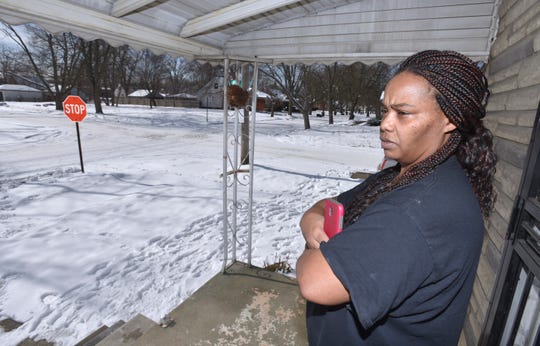
Felicia Perry, 42, lives on Rossini at Rex in Detroit,
across the street from at least two vacant lots where
houses were razed and then backfilled.

Detroit — Records detailing what went into the ground at thousands of demolition sites across the city are under scrutiny amid an analysis that's turned up a disjointed process.

University of Michigan doctoral candidate Michael Koscielniak has spent four years conducting an exhaustive review of public records that cast doubt on the integrity of soil records for the city's multi-million-dollar federally funded blight elimination program.

For its part, the city admits the effort got off the ground with a paper-based tracking system before it evolved to online records. But officials contend the dirt used to fill holes left behind from housing demolitions is all accounted for and Koscielniak based his findings on only part of the data.

But Koscielniak asserts the record keeping is a "completely shambolic approach to managing this program — especially one that is transparent."  The demolition effort has paid out close to $177 million in federal funding to take down 11,000 structures since 2014.

"The errors, gaps and inconsistencies in the backfill data — as well as the unclear oversight and monitoring processes — suggest that demolition contractors wield immense authority over the backfill program," said Koscielniak, an Ypsilanti resident and doctoral candidate in urban and regional planning who is working on a dissertation. "They stumbled into a mega project that they had no capacity to manage, and their solution to it was to let contractors figure it out."

The independent researcher's findings heighten growing concern among some city, state and congressional lawmakers over potential environmental contaminants in the dirt following a number of high-profile contractor violations. Officials want to ensure the quality of the dirt going into Detroit's ground isn't harmful to residents.

Fresh piled dirt is seen near a vacant home on Faust
 near Constance in Detroit after a demolition on May 18, 2016. 
Under public information requests, Koscielniak obtained copies of an internal contractor portal used to track dirt sources, costs and locations that's maintained by the Detroit Building Authority.


He zeroed in on data for demolitions conducted through July and paid from the federal Hardest Hit Fund, concluding that out of nearly 10,000 listed only about 5,200 had attributed sources through digital record keeping.

Koscielniak's research is the latest cloud over the program at the center of a federal criminal investigation that arose in fall 2015 after concerns were raised over bidding practices and spiraling costs.

Soil worries prompted Detroit City Council's second in command to put out a call for a congressional hearing on demolition in Detroit and comes as one contractor's projects have been halted after it failed to remove potentially hazardous debris at multiple sites before dumping dirt on top.

Officials with the Detroit Building Authority and Detroit Land Bank Authority, which oversee the city's program, argue Koscielniak's research is skewed and maintain their confidence in the records. 
Under Freedom of Information Act requests, they said, he obtained copies of the digital database for soil records. But prior to that, load tickets for dirt were tracked on paper — records Koscielniak did not ask for or obtain, they contend.

"We think the gap is, not that we weren't tracking it, but it wasn't tracked in an online portal that we could send to someone," Brian Farkas, director of special projects for the building authority, told The News. "I'm confident in our records."

Detroit Councilman Andre Spivey said he's concerned to hear of the disconnected record keeping for dirt and wants the city to have tighter reins on the land bank.

"You've got to maintain the integrity of the process," he said. "We're watching, and the federal government is watching as well."

In January, the federal watchdog agency investigating the city's blight elimination effort issued a round of subpoenas to certain contractors, seeking detailed records of where they obtained their dirt, the cost and where it ended up.

In subpoenas dated Jan. 10, the Special Inspector General for the Troubled Asset Relief Program demanded two years' worth of documentation.

Robert Sholars, a spokesman for SIGTARP, declined to say whether Koscielniak's research spurred the investigation, saying "as a general principle, we do not comment on ongoing investigations, including confirming or denying their existence."

Tracking the records

The News last month provided the building authority with 13 addresses from 2014 out of thousands flagged by Koscielniak. Officials produced paper copies for all of them.

According to the load tickets, some of the fill dirt came from an industrial site on Shoemaker on Detroit's east side and a site in Carleton. Other paperwork identifies fill simply as "clay" or has spaces where the source is attributed to a trucking company or left blank, only listing where it was dropped off.

Farkas last week referred to the 13 records pulled at the request of The News as a "spot check" while he faced questioning about contractors and environmental worries during a city council subcommittee session.

Council President Pro Tem Mary Sheffield noted in recent months the tracking system for dirt is more in-depth. The building authority, she said, told council members the independent firm contracted to oversee the process is now verifying the origin of the dirt with aerial checks after documentation is submitted by contractors. Prior to that time, that verification was not taking place, she said.

"You had a period of time where contractors were self-reporting all of these different residential addresses and saying it was residential dirt when it could possibly have not been because there was no oversight," she said. "That's a problem."

Farkas said the city has tracked its soil and dirt on an internal online platform since March 2015. 
A gravel-train semi leaves the Mid Michigan
Crushing & Recycling facility in Highland Park.
Despite that, Koscielniak provided The News with a data set that shows 1,961 Hardest Hit Fund demolitions between March 2015 and June 2018 that weren't accounted for in the backfill portal.


The sites in question, which appear on the city's public demolition database but lack a digital paper trail for the soil, account for $2.9 million in dirt costs among 18 contractors.

Koscielniak also provided The News with more than 100 other records with misspellings and errors, lacking in detail or that list the dirt source and destination as the same site.

The News asked the building authority to reproduce documentation for a dozen of the 2015 demolitions, which based on Farkas' explanation should have been digitized.

In an email, Farkas provided The News with eight of the records located by the department — all paper — out of the 12, citing limited staffing to search. But he stressed confidence the rest would be found.

"This is more a document retrieval issue of records that are four or five years old than it is an issue of whether dirt sources have been verified," Farkas said.

In reference to data suggesting close to 2,000 records submitted after 2015 aren't accounted for in the digital system, Farkas reiterated officials "feel very confident" in protocols in place since 2014 to ensure dirt is safe.

"We see the fact that some records may not be immediately retrievable as a reflection in the record keeping process, not as a reflection of our work in the field to ensure the use of clean dirt," Farkas said in a provided statement.

A handful of contractors have faced penalties between 2017 and 2018 for the use of unapproved backfill at a total of 18 sites, according to the building authority.

Some were issued warnings, others were suspended and another — Detroit-based Glo Wrecking — was issued a stop-work order that remains in effect. The company could not be reached for comment. 
Additionally, in February, another contractor, DMC Consultants, began filling holes with unauthorized dirt. The building authority's online platform flagged officials that the company had exhausted their supply of approved fill.

Farkas declined to specify DMC's dirt source, saying it "doesn't matter."

"All that matters is whether it's been tested and approved, and the DMC dirt used after their approved supply ran out was not," he said.

Farkas said soil sampling is taking place for 37 holes that DMC filled with dirt that had not been approved. Testing will determine whether the soil is unsafe for residential use.

Chicago-based firm McDonagh Demolition was also issued a stop-work order by the building authority in recent weeks after it was discovered that the company had not fully removed demolition debris before adding fill dirt at several sites.

Farkas, during the council's Planning and Economic Development committee session last week, said the company's work is being revoked over the "attempted scheme." It's going to cost McDonagh about $17 million in contracts, he said.

McDonagh called the violation an "isolated issue" that it was taking steps to correct.

Farkas touted the catch as evidence the building authority's controls worked, as intended, saying a field liaison for the building authority discovered the problem.

But Sheffield noted it was later revealed that a former McDonagh employee had acted as a whistle-blower.

The scenario, she said, is a "clear example" that "protocols are not sufficient."

"The pace that they are going, it is hard to have the proper protocols to ensure the health and safety of residents," Sheffield said. "There's too many unknowns for me. Whether it's contaminated or not, it just needs to be clear and verified where the dirt is coming from."

Under the program, the land bank manages the selection and contract awards for demolitions. Oversight is then transferred to the building authority, which has seven field liaisons who monitor all the knockdowns. That's up from two when the program first began, Farkas said. 

What the rules say

The city's Buildings,  Safety Engineering and Environmental Department inspects open holes and final grading.

The state's blight manual outlines requirements for testing and sourcing of fill.

Detroit implemented a new dirt tracking system late last year to better document the dirt being used. The guidelines require the source of dirt, the address it's going to, and size of load by cubic yard or square feet, according to the state.

Previously, contractors were required to provide invoices for dirt, and the land bank maintained load tickets that documented the size of a load and where it was dropped.

"The new protocol requires each contractor to identify source material location and testing evaluation of commercial soil sources in advance of backfilling so as to avoid bad fill material negatively impacting neighborhoods," the U.S. Environmental Protection Agency said in a statement. "The city of Detroit is responsible for identifying dirt sources under its protocol."

Chicago-based McDonagh Demolition was ordered to
 excavate this site in the 13000 block of Maiden Street in
Detroit after it was discovered that that some demolition
materials there had not been properly removed.
Farkas said there are three acceptable soil sources. A residential site or a virgin source, which could be a clay or gravel pit and requires documentation stating its free of debris, concrete or other unsuitable substances. The third category, non-residential, may consist of commercial, road or construction sites but requires laboratory testing and the results must be approved by the building authority. 


"All city, state and federal guidelines must be followed to ensure environmentally safe back fill is being used," the blight manual notes. "This laboratory testing must be maintained in the blight partner office and copies may be requested at any time."

Matt Polizzotto, a soil chemist and associate professor of earth sciences for the University of Oregon, said urban soils can be contaminated in many ways, including from lead paint or past transportation emissions. The level of risk, he said, depends on how the soil had been used.

"I could come up with doomsday scenarios, but those things are pretty unlikely," said Polizzotto, who has expertise in soil contaminants in the environment. "Not having records doesn't allow for really, truly assessing what any risks might be."

'No legal obligation'

Rebecca Camargo, an attorney for several contractors in the program, said none set out to use bad dirt. 
"I don't believe that any of the demolition contractors violated the terms of the contract knowingly, and they all are very committed to keeping Detroit safe," she said.

Camargo said the deadline for turning over backfill documents requested under the SIGTARP subpoena has been extended.

"It's costing all of them thousands of dollars to provide this documentation for something I believe is going to show nothing," she said.

Multiple contractors did not return messages left by The News. Anthony Abela, a project manager for the firms Homrich and 1 Way Service, said by policy, the company does not issue comments to the media.

Mayor Mike Duggan has defended the program's "vigorous" practices in the wake of concern over whether some dirt might have been contaminated.

The mayor, during his Tuesday State of the City speech, noted the city this month entered into contracts for the last of the $275 million in federal dollars for the program.

"For all the noise out there about investigations," said Duggan, the U.S. Treasury and the state "had confidence in us" and "kept money flowing."

The mayor said the program's environmental team has held demolition contractors accountable. In the last five years, he said, four contractors have been terminated for failing to follow protocols.

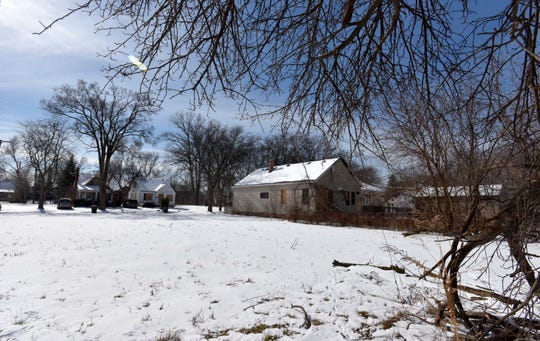
Tens of thousands of houses have been razed in Detroit with
federal funding over the last five years, leaving
vacant lots like this one in the 15600 block of Rossini. 


"In each case, we made each go back in and fix their mistakes. We did not let a single one slide, and we advise the neighbors to help us," Duggan said. "I won't tell you that we're not ever making mistakes. I will tell you, we find out about them."

The mayor, during his Thursday budget presentation to council, said the all federally funded demolition contracts have been awarded and the program is set to wind down by the end of the fiscal year. From here, he said, the city will look to transition to a city-administered effort.

Meanwhile, the state Department of Environmental Quality said it's "working with the federal agencies investigating the city's demolition program."

The DEQ has not issued any violations or fines related to backfill, and it has not done any soil sampling or auditing, said Scott Dean, a DEQ spokesman.

"An entity obtaining soil for backfill has no legal obligation to test those soils or keep records about the sources," Dean said.

"However, there is a risk that contractors may obtain contaminated soils, either knowingly or unknowingly. It seemed reasonable that this risk would increase with the increased demand for soils. Because of this risk, we advised the city to put safeguards in place to make sure they were only using clean dirt. That was a recommendation, not a legal requirement."

Pushing for testing

Council's Sheffield has referenced media reports that raise the possibility of dirt being used to fill holes that may have been contaminated or from unverified sources, including soils from the recent reconstruction of Interstate 96 in western Wayne County. Program officials insist, however, that use of dirt from the I-96 project was banned from the outset.

In a letter to U.S. Reps. Rashida Tlaib, D-Detroit, and Brenda Lawrence, D-Southfield, the councilwoman noted the program has been "mired in controversy since its inception" and it's led to "anxiety, uncertainty, and a lack of transparency for the community."

Lawrence told The News she's leading an effort to ask the delegation to urge the U.S. Treasury Department to assume oversight of soil testing for Detroit's program.

"My focus right now is on whether the dirt is contaminated," she said. "I'm pushing for immediate testing."

In 2014, the city contracted with the Southfield-based consulting firm Atwell to get the program's environmental monitoring off the ground. By September, AKT Peerless in Detroit was retained to "manage and administer" the backfill program.

Reached via email, Julie Barton, program manager for AKT, deferred comment to the building authority. Farkas said the company has designed testing protocols and the online platform, overseeing its use and implementation.

When asked whether the paper record keeping was adequate, Tammy Daniels, a demolition manager for the land bank, agreed it was a process that needed to change, and it did.

"We migrated away from paper because we, too, feel that computer records offer transparency," she said.

Farkas noted when the federally funded demolition work first began, there was $50 million to draw down and a "serious deadline" that "we had to meet."

A 2013 memorandum of understanding between the state, land bank and city, required 70 percent of the $52.3 million allocated for the program be spent by Oct. 7, 2014. If the land bank was unable to draw down the funding within that time, the dollars could have been redirected to another city or program.

"The system we have today is remarkably different than the one we inherited," he said. "So no, records should always be kept in the most high-tech, digital format. The problem is we just don't have that ability when you are staring down a deadline to spend $50 million."

The Michigan State Housing and Development Authority, which allocates funding for the program under the state's Homeowner Assistance Non-Profit Housing Corp., said it does not oversee how the land bank maintains its filing system.

"What we do require is that file documents be uploaded to our system for audit and review prior to funding every demolition," said Katie Bach, a spokeswoman for MSHDA, in an email. 
Bach further said the state has found no evidence of sloppy record-keeping. MHA, she said, has adequate resources to monitor the backfill program and is confident in how it's operating. Under Hardest Hit Fund rules, MHA is required to retain records for three years after the program ends, she added.

"MHA has staff in place to review every file that DLB is uploading to our system," she said. "We expect accurate documentation and full compliance with all program guidelines. If we find that is not the case, we will consult with U.S. Treasury regarding possible corrective action."

East side resident Felicia Perry has been renting a home on Rossini Drive for about a year. Records show numerous demolitions occurred on her block in 2014 when digital records of the soil source were lacking. The city's paper records attribute the source to a city-based industrial site.

The mother of six, who has a young daughter battling chronic health concerns, said the questions and uncertainty are worrisome.

"I have a three-year-old who is battling every day to stay alive with sickle cell disease. I don't even let her outside," said Perry, 42. "If they put something in the ground that's contaminated, it's got growth in it. It brings poison to kids."

Voting is beautiful, be beautiful ~ vote.©
Wednesday, January 30, 2019

DOJ: Fraud On The Taxpayer - Deputy Associate Attorney General Stephen Cox Delivers Remarks at the 2019 Advanced Forum on False Claims and Qui Tam Enforcement


New YorkNY
 ~
Monday, January 28, 2019
Thank you for that introduction, and thank you to the American Conference Institute and all of its sponsors for hosting me here today. 
I serve in the Office of the Associate Attorney General at the Department of Justice.  Our office oversees five litigating divisions, including the Civil Division, and I spend most of my time working with the Consumer Protection Branch and the Commercial Litigation Branch on enforcement.  Relevant to this audience, I’ve had the privilege of working closely with the Civil Fraud Section within the Commercial Litigation Branch that is responsible for investigating and litigating violations of the False Claims Act. 
The new Administration is two years old this month.  My plan today is to offer some thoughts about this Administration’s commitment to enforcing the False Claims Act and then describe some of the Department’s enforcement principles, policies, and perspectives that guide us.
Fraud on the Taxpayer
(I prefer to just call it stealin')
Let me begin by describing the Department’s commitment to fighting fraud on the taxpayer—and specifically our duty to responsibly enforce the False Claims Act to recover loss to the taxpayer and deter misconduct. 
The Act was passed during the Civil War to fight fraud on the Union Army, and it is sometimes called “Lincoln’s Law.”  As Assistant Attorney General Jody Hunt recently noted, there were crooked contractors defrauding the Union Army by selling sick mules, lame horses, sawdust instead of gunpowder, and rotted ships with fresh paint.  Lincoln’s Law was an answer to those problems one hundred and fifty years ago.
The Act fell into relative disuse over the years, but was revitalized in 1986 through amendments spearheaded by Senator Grassley.  For example, the 1986 amendments increased the incentives for whistleblowers to file lawsuits alleging false claims on behalf of the government.  Since the 1986 amendments, the False Claims Act has returned over $59 billion to the U.S. Treasury—over $42 billion of which came through qui tam actions filed by whistleblowers.
Today, we use the False Claims Act to fight not only contracting fraud, but also healthcare fraud, grant fraud, financial fraud, and many other types of fraud. 
Enforcing the False Claims Act is a top priority for the Department—not just for our office. 
Last month, we announced that the Department recovered approximately $2.8 billion this past fiscal year.  $2.5 billion involved the health care industry, including drug and medical device manufacturers, managed care providers, hospitals, pharmacies, hospice organizations, laboratories, and physicians.  This is the ninth consecutive year that the Department’s civil health care fraud settlements and judgments have exceeded $2 billion.
This year we settled a number of large and important cases.  We settled a case with Amerisource Bergen for $645 million involving improper repackaging and distribution of cancer drugs.  The Department’s position was that the company circumvented important safeguards designed to preserve the integrity of the nation’s drug supply.
We also settled a case with United Therapeutics Corporation for $210 million.  This case involved the use of a foundation as an illegal conduit to pay the co-pays of thousands of Medicare patients taking the company’s drugs.  We settled a similar case with Pfizer for $23.85 million to settle allegations that it was also improperly using a foundation to pay Medicare patient co-pays.  Co-pay requirements can serve as an important check on healthcare costs, including the cost of drugs, but these cases show how drug manufacturers can make an end-run around these requirements to facilitate increases in drug prices.
We settled a case with Toyobo for $66 million in a case involving the sale of defective Zylon fiber used in bullet proof vests that the United States purchased for federal, state, local, and tribal law enforcement agencies.  Defective Zylon can render bullet proof vests unfit for use and put our men and women in blue at unnecessary risk.
Another important case was the Deloitte & Touche settlement for $149.5 million.  Deloitte served as independent outside auditor for an originator engaged in a long-running mortgage fraud scheme involving loans insured by the Federal Housing Authority.  The allegations against Deloitte were that they knowing deviated from auditing standards and therefore failed to detect the fraud.
It is also worth highlighting cases where we pursued individuals because individual accountability remains a top priority for the Department.  The Department obtained $114 million in judgments against three individuals found to have paid kickbacks to doctors disguised as “handling fees” resulting in medically unnecessary tests that were billed to Medicare.
We also settled our case against Lance Armstrong for $5 million.  The allegations in that case were that his cycling team used performance enhancing drugs while making numerous false statements denying it and concealing the drug use during the U.S. Postal Service’s sponsorship of the team for the Tour de France.
I could tell you about many more cases, and you might hear about more throughout this conference.  But the point is that we just finished another big year demonstrating our commitment to False Claims Act enforcement.
Before I turn to certain principles we apply and reforms that we have brought about, I want to note that our work in the False Claims Act space not only protects the taxpayer, but it serves other important goals.  The taxpayer is not the only victim of fraud on the government.
When a company falsely certifies the quality of military equipment, it sends our brave men and women into harm’s way with less protection.  When medical providers submit false claims to Medicare, they often fail to provide adequate medical care to their patients.  Kick-back schemes not only defraud the government, they also drive up consumer costs, undermine competition, and may distort independent medical decision-making.   
By effectively enforcing the False Claims Act, we protect the taxpayer, we deter bad actors, we protect victims, and we level the playing field in the markets.
Now let me turn to some of the principles that guide the Department in False Claims Act enforcement.
Qui Tam Dismissals
Let me first start with an internal memo that has become known as the Granston Memo.  Last January, the Director of our Civil Fraud Section issued internal guidelines for our litigators in determining when it is appropriate in a qui tam case to exercise our dismissal authority under the False Claims Act. 
As I mentioned earlier, the success of the False Claims Act is due in large part to the qui tam provisions and the partnership between the federal government and whistleblowers.  Of the recoveries last year, more than $2 billion was recovered in qui tam cases.  
One of the reasons for this partnership is that whistleblowers are often uniquely situated to bring fraudulent practices to light—particularly in suits filed by corporate insiders, who have frequently disclosed complex corporate wrongdoing that the government would have been hard-pressed to understand and unearth without their assistance.  
Qui tam filings have been on the rise for many years.  The Department intervenes in only about 1 in 5 cases that are filed.  But even the other 4 in 5 cases consume Department time and resources – not only in investigating them initially, but also in terms of monitoring and participating in any ensuing litigation if the relator elects to proceed.
When relators litigate cases in which the Department declines to intervene, the relators essentially stand in the shoes of the Attorney General.  Because relators may not always have the same interests as the United States, we take very seriously our responsibility to monitor False Claims Act cases when we decline to intervene.  Indeed, the Department serves an important role as a gatekeeper. 
The Granston Memo is about our gatekeeping role.  Part of the reasoning behind the memo is that when qui tam cases are non-meritorious, abusive, or contrary to the interests of justice, they impose unnecessary costs on the Department, on the judiciary, and on the defendants.  Bad cases that result in bad case law inhibit our ability to enforce the False Claims Act in good and meritorious cases.  And from a resource perspective, when the Department’s resources are consumed for other things, we have less time to fulfill our priorities.  This is why we have instructed our lawyers to consider dismissing qui tamcases when they are not in our best interests.  This authority is an important tool to protect the integrity of the False Claims Act and the interests of the United States.


The Granston Memo is not really a change in the Department’s historical position.  In fact, it reflects the factors that the Department has historically considered in deciding to dismiss a case.  But we did think it was important that all of our False Claims Act litigators had the benefit of understanding the Department’s practice so that the authority could be used more consistently.
It is true that this authority has been used sparingly.  In the past, in a given year, the Department might have dismissed a few cases—if it dismissed any at all—but since 2017, the Department has moved to dismiss about two dozen cases.  Our exercise of this authority will remain judicious, but we will use this tool more consistently to preserve our resources for cases that are in the United States’ interests.
Subregulatory Guidance
Second, I’ll address the Department’s reforms concerning the issue of rulemaking by guidance.  As you know, when an agency has statutory authority to issue regulations, it normally goes through the notice-and-comment process of rulemaking, which can be cumbersome and slow.  Sometimes agencies have instead taken a shortcut by issuing “guidance” in lieu of regulations, knowing that it will achieve a similar effect of changing behavior.
To be fair, subregulatory guidance documents can be helpful in educating the public about statutes, regulations, and legal developments.  But it is improper to try to use guidance to bind the public by imposing legal obligations beyond those already enshrined in existing statutes or properly promulgated regulatory provisions.  Put simply, agency guidance should educate, not regulate.  


That is why, in November 2017, former Attorney General Sessions announced that the Department will no longer issue any kind of binding sub-regulatory guidance.  In other words, the Department will no longer issue guidance documents that effectively bind the public without undergoing the notice-and-comment rulemaking process.
We hoped to serve as an example for other agencies to follow, and shortly after the policy was announced, then-Chairman of the Senate Judiciary Committee, Senator Grassley, sent a letter to the President praising the Attorney General’s policy and suggesting that other agencies follow its commonsense principles.

SENATE JUDICIARY: Confirmation Hearing Of Bill Barr - Honoring Grassley & His Legacy On Medicaid Fraud In Child Welfare - The False Claims Act - My Color Commentary

Last January, in the affirmative civil litigation context (which includes the False Claims Act), then-Associate Attorney General Rachel Brand instructed Department attorneys not to use our affirmative civil enforcement authority to convert other agencies’ sub-regulatory guidance into rules that have the force or effect of law.  In other words, noncompliance with a nonbinding guidance document cannot be used to establish a violation of law.  This policy has been called the “Brand Memo.”  Its principles have been codified in the Justice Manual, and they apply not only in False Claims Act and civil enforcement cases, but also in criminal actions now.
Let me make a few points about how these principles might apply in False Claims Act cases.  As we have noted before, there are, of course, circumstances where it may be appropriate to rely on agency guidance, including to show the defendant’s awareness of an agency’s interpretation of a particular requirement or the agency’s views on the materiality of that requirement.  This is not to say that the guidance will carry the day—just because a company knows an agency’s nonbinding interpretation of the law does not mean it’s correct or that the company’s interpretation is unreasonable.
Some guidance documents may be relevant to professional standards that are incorporated into statutes.  For example, there are statutory and regulatory requirements that procedures billed to Medicare and Medicaid be medically “reasonable and necessary,” and there may be guidance documents discussing an agency’s non-binding views on what is medically reasonable and necessary.  The guidance document might be probative, even if it isn’t binding.  Of course, we must be careful not to run afoul of first principles.  Agency guidance cannot be dispositive on what a statute or regulation means—it is not a thumb on the scale—and it cannot create binding requirements.  But just like other statements of medical standards—such as professional standards from the medical industry or expert testimony—the guidance may have some probative value.  It’s not necessarily more probative than guidance from the industry, but it can have probative weight.
A particular guidance document may also be relevant if it is expressly incorporated into a contract or a certification.  For example, if a party and the government agree in a contract that compliance with some specified guidance document is required, the guidance document will be contractually binding on the party and noncompliance will be relevant under principles of contract law. 
Of course, all of these examples need to line up with the general principle that we’re not going to use “violations” of nonbinding guidance documents to establish a violation of law.  Guidance is not law.  It’s not binding.  And it shouldn’t be given the force or effect of law.
As I mentioned earlier, we hope that the Department’s policies on subregulatory guidance have been informative to other agencies, and we see evidence of that.  Last September, six of the banking regulators followed the Department’s lead and announced limits on the issuance and enforcement of sub-regulatory guidance.  In December, with similar principles in mind, the Department of Transportation issued an important memo clarifying and updating its procedures for guidance documents.   We hope other agencies follow suit.  These policies keep government restrained and promote the rule of law, fair notice, and due process. 
Piling On
Third, let me turn to a Department policy discouraging what we think of as “piling on.”  This policy was announced by the Deputy Attorney General last summer, and it applies across the board, including in False Claims Act cases. 
As you know, often the same conduct can violate multiple statutes.
When multiple law enforcement and regulatory agencies pursue a single entity for the same or substantially similar conduct, and then impose unwarranted and disproportionate penalties for that conduct, this is what we mean by “piling on.”  This can be seen as inconsistent with the concepts of fair play and the need for certainty and finality.
To avoid piling on, we are promoting coordination within the Department and with other agencies to apportion penalties and fines where appropriate. Under the same policy, we are also reminding our attorneys not to use our criminal enforcement authority for purposes unrelated to the investigation and prosecution of a possible crime. For example, we are not going to invoke the threat of criminal prosecution just to persuade a company to pay a larger settlement in a False Claims Act case or any other civil case.

That is why we have this thing called referrals to other law enforcement divisions outside DOJ, like SIGTARP and FinCEN.  Or, there is that special circumstances provision of the Act which allows the Attorney General to intervene if there are other ongoing investigations, not that I know anything, but just saying, considering the Detroit Land Bank Authority just got a bunch of new subpoenas sent to its contractors, that ended up going to its former attorney Rebecca Camargo, who just so happens to be the attorney for the contractors.
The most prominent example of this policy in action was a $680 million Foreign Corrupt Practices Act settlement in June with Société Générale, a global financial services institution based in Paris, for FCPA violations in Libya and for LIBOR manipulation.  This was handled by the Department’s Criminal Division, which is not supervised by our office, but the Department’s press release made clear that it credited $292 million that the firm paid to the French Authorities, an amount equal to 50% of the total criminal penalty otherwise payable to the United States.
But let me give you one example in the False Claims Act context:   In November, the Department announced a global resolution with three South Korea-based fuel companies for their involvement in a decade-long bid-rigging conspiracy that targeted contracts to supply fuel to U.S. military bases in South Korea.  This was a global resolution of criminal Sherman Act violations, civil claims under the Clayton Act, and civil claims under the False Claims Act.  I can tell you that the Antitrust Division’s criminal and civil sections and the Civil Division’s Fraud Section worked together effectively with the policy in mind so that they could reach coordinated global settlements that were equitable and proportionate to the defendants’ conduct, and they were careful not to impose fines, penalties, or damages that are unnecessarily duplicative of each other.
Cooperation Credit
Finally, let me turn to the issue of cooperation and policy initiatives of relevance to the False Claims Act. 
As the Deputy Attorney General has made clear in other contexts, and as senior officials from our office and the Civil Fraud Section have echoed in the False Claims Act context, the Department is committed to rewarding companies that invest in strong compliance programs and who cooperate with our investigations into wrongdoing. 
In November of 2017, the Department announced a corporate enforcement policy that takes voluntary disclosure, cooperation, and compliance into account in criminal cases.   This policy was, in a sense, a culmination of the FCPA Pilot that was announced in early 2016, but the corporate enforcement policy has been applied in criminal cases outside the FCPA space. 
In November of 2018, the Deputy Attorney General announced changes to Department’s policies on awarding cooperation credit based on, for example, whether a company identifies the individual wrongdoers.  Much ink has been spilled about the changes, and I won’t go into each and every one of them.  But for this audience I would like to focus on one change in particular relating to civil cases.
There is no longer an “all or nothing” approach to awarding credit for cooperation in civil cases.  You don’t have to boil the ocean in an effort to identify every employee who played any role in the conduct in order to receive any credit for cooperating.  If a corporation wants to earn maximum credit, it must identify every individual person who was substantially involved in or responsible for the misconduct. But when a company honestly does meaningfully assist the government’s investigation, our civil attorneys now have discretion to offer some credit even if the company does not qualify for maximum credit.
In announcing these changes, the Deputy Attorney General gave a False Claims Act example:  “A company might make a voluntary disclosure and provide valuable assistance that justifies some credit even if the company is either unwilling to stipulate about which non-managerial employees are culpable, or eager to resolve the case without conducting a costly investigation to identify every individual who might face civil liability in theory, but in reality would not be sued personally.”
In short, the policy changes return discretion to our civil lawyers to resolve each case consistent with relevant facts and circumstances.

That is if there is intervention.
Last June, then-Acting Associate Attorney General Jesse Panuccio made clear that False Claims Act investigations are no exception to the Department’s policy of incentivizing cooperation.  Corporate defendants can receive a more favorable resolution for cooperating with our False Claims Act investigations – from voluntary disclosure, which is the most valuable form of cooperation, to other efforts such as sharing information gleaned from an internal investigation and making witnesses available.    He also made clear that we will reward companies that invest in strong compliance measures.
As you know, strong compliance programs are good for business and fair competition, they raise awareness of legal obligations, they mitigate risk of legal jeopardy, and they promote reporting up.  When there’s been a case of overbilling Medicare or Medicaid, for example, we want you to know that having an effective and robust compliance program in place is something we will consider at the outset in determining whether it was a mistake or an anomaly or whether there was a knowing violation.  And that in turn will inform whether a False Claims Act case is merited, or whether pursuing another remedy is appropriate to make the government whole.   
We also want you to know that, if there’s a problem, the Department welcomes and will reward companies that make voluntary disclosures and provide meaningful, candid assistance in False Claims Act investigations.
The Department has significant discretion under the False Claims Act to resolve cases in a way that provides a material discount based on cooperation while still making the government whole.  Stay tuned on this front.

Oh, I shall be watching.
*        *        *
It is a privilege working at the Department of Justice on False Claims Act enforcement, and you should know that our lawyers are committed to exercising the Department’s enforcement discretion consistent with the rule of law. 
I hope that my remarks today have given you a better understanding of how we do our work, so that you can feel more confident that you know the rules of the road and the priorities of the Justice Department.
Thank you.

Voting is beautiful, be beautiful ~ vote.©