This is not about race, this is about fraud as there exists the question if these overseas territories U.S. voters are actually real people.
There have been questions raised as to the validity of existence of some of our troops.
The delegates are advocating resegregation of bringing back the Plessy ruling of "Separate, yet equal", which overturns Brown v. Board of Education, which brings back segregation into human asset management databases of corporate parental rights in ownership of their chattel.
I simply do not understand why congress holds all these chuckin' & jivin' congressional hearings and call for task forces to simply avoid discussing anything remotely relevant to the issues surrounding voting rights, like gerrymandering, or, more readily understood as stealin' the children, land & vote.
How about we start talking about those land patents.
I seem to recall lots of fake ass LLCs registered in the Virgin Islands which ended up putting their sticky hands on Detroit Land Bank Authority properties, but, hey, what do I know?
To expand Americans' access to the ballot box, reduce the influence of big money in politics, and strengthen ethics rules for public servants, and for other purposes.
Trafficking Tiny Humans christian sleeper cells - Level 2
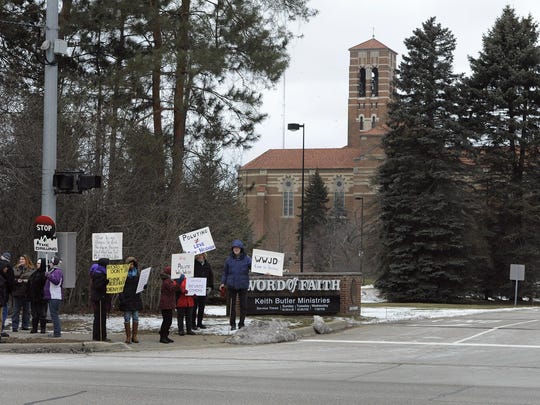
Three Michigan church leaders, including the state House speaker’s father, filed suit Wednesday against Gov. Gretchen Whitmer’s stay home order in federal court, arguing it violated their First Amendment rights to free exercise and to assemble.
Stanley “Rusty” Chatfield III, pastor for Northern Michigan Baptist Bible Church in Burt Lake, filed suit in Grand Rapids federal court the same day his son, House Speaker Lee Chatfield, filed suit in state court to challenge the governor’s emergency powers.
Joining Rusty Chatfield in the suit are Southfield-based Word of Faith Christian Center Church Bishop Keith Butler, Sturgis-based Whole Life Church Pastor Chuck Vizthum, and Tim Schmig, executive director at Michigan Association of Christian Schools. Butler is a former Detroit City Council member who unsuccessfully sought the Republican U.S. Senate nomination in 2006.
The churches are being represented by the conservative Great Lakes Justice Center.
Chatfield, R-Levering, said in a Thursday statement that he doesn't know "too much about it."
"My dad mentioned a few days ago that he was working with a group of pastors, and the next I heard about it was from the media yesterday," Chatfield said. "I told him I wish him luck."
Whitmer’s office said the Democratic governor does not comment on pending litigation.
Various lawsuits have been filed against Whitmer's executive orders in recent weeks, but no injunctions, preliminary or otherwise, have been granted that would stop the order.
Early in the emergency, Whitmer exempted churches from penalties related to bans on assemblies but that exemption doesn’t extend to individuals attending services, the lawsuit said.
The exemption “merely adorns the Constitution with a fig leaf and does not protect individuals or change the clear language of the order prohibiting any religious services,” the lawsuit said.
In addition to violations of their First Amendment rights, the churches also argue the governor’s executive orders are unconstitutionally vague, lack due process and ignore the role of the Legislature.
Both the 1945 Emergency Powers Act and 1976 Emergency Management Act violate the Separation of Powers clause in the state constitution, the lawsuit argued.
“Allowing one person to wield absolute power is not a republican form of government, it is tyranny,” the lawsuit said.
The lawsuit asks a judge to rule as unconstitutional the governor’s executive orders, the Emergency Powers Act and the Emergency Management Act. The lawsuit also asks the judge to ban law enforcement from enforcing the executive orders unless they receive legislative approval.
The Word of Faith Christian Center in Southfield can hold up to 4,000 people, according to the lawsuit, which would allow the church to hold multiple services while observing social distancing. The church also plans to deep-clean between services, increase ventilation and require attendees to wear masks and gloves.
Whole Life Church and Northern Michigan Baptist Bible Church also plan to put in place similar precautions, according to the lawsuit.
The executive orders “are not generally applicable because they grant local authorities unbridled discretion, enforced via an individualized subjective assessment, to prohibit plaintiff’s religious exercise while permitting other individuals or entities to engage in non-religious practices,” the lawsuit said.
Part of the lawsuit’s arguments parallel those from the GOP-led Legislature, which has argued the governor does not have the authority to extend her state of emergency past April 30 without legislative approval.
Whitmer has argued she has that authority under a 1945 law allows the governor to declare a state of emergency and have emergency powers without the 28-day time limit.
Then, this happened...
Boston Edison Detroit Land Bank Authority Territory
Level Three
The Michigan Foster Care Services Program wanted me to take a survey, so you know what I did, do you not?
Please Take Our Online Survey
Just a few minutes of your time can make a big difference as we work to support the more than 13,000 Michigan children in foster care.
We want to hear what we can do different or better to help Michiganders take the leap to become a foster parent. Whether you are already a foster parent or thinking about becoming a foster parent, your insights are valuable to us.
The first thing I did upon landing on the home page was to ask myself, "What the hell is a Foster Care Navigator?"
So, I clicked the drop down menu link and found this:
What is a Foster Care Navigator? A Foster Care Navigator (FCN) is someone who serves as a liaison between current and prospective foster parents and their agency. Each FCN will mentor, through their own experience, parents navigating through the world of foster care. Modeled after the Michigan Adoption Resource Exchange (MARE) Adoption Navigator program, Foster Care Navigators are trained and experienced current and former foster parents who have navigated through their own foster care experiences.
It was at that point that I realized that we are priming for the blue pinwheel month in the launch of a full scale admirality defense of the work of the lord, in Public Private Partner-ships, to finally take over the residuals of the peculiar institution, by invading our shores with Micro-Privateers, or rather Foster Care Navigators.
What is a Micro Tiny Human Privateer? A Micro Privateer is an individual who has been anointed in the acquisition of goods through the process of child welfare law and policy to ensure an unimpeded transfer of parental rights in the entire tiny human asset management system, for the purposes of maximizing revenues, to fund political campaigns in the promulgation of child welfare propaganda
So, who eactly were geniuses behind this trafficking tiny humans program, because I could see the paretal optimalization, not just in the operations of data scrapping human intelligence for Predictive Modeling Crappers to pitch more of their latest and greatest Social Impact Bond Programs, I saw private research being funded through Medicaid?
So, I ended up here:
Foster Care Navigator ProgramThe Foster Care Navigator Program is a support service program dedicated to prospective and current foster parents as well as agencies with the goal of recruiting, retaining and empowering great people to become super foster parents.
Which took me here, where I said, "I told you, so."
Child welfare propaganda.
How are these people pitching programs to increase graduation rates for kids in foster care when Michigan has a human trafficking issue, otherwise known as Foster Care and Adoption?
These university students, yes, I said students, pitch their quick and dirty data survey crap, where they are robed sheepskin, to go forth and carry on the will of their cloaked, foreign funded, masters.
WARNING: THE FOLLOWING VIDEO MAY CONTAIN MATERIAL NOT SUITABLE TO INDIVIDUALS IN THE FIELD OF RESEARCH METHODOLOGIES
After suffering through the entire pitch for more private grant funding from her Google searches........yes, the State of Michigan uses Google to develop web-based resources for policymaking through their child welfare propaganda websites.
I like to call this portion of tiny human asset management, Googthink, a modern day version to the concept of Groupthink.
See, instead of getting a bunch of Predictive Modeling Crappers into one room to come up with more revenue maximization trafficking tiny humans programs, you do it online, in surveys, and you can do it in bots, because this chick presented how great her concepts are because they got lots of clicks, as seen in Google Analytics.
Yup.
Online clicking for policy bot programming is another great field to go into as a Micro Tiny Human Navigator.
And that ends the tale of Micro Tiny Human Privateers Ratlines and the propaganda they are going to be using to defend their financial practices of trafficking tiny humans.
Oh, instead of taking the survey, I generated this post, because I know they will read it.
Oh, and if you did not know, we are talking about Covenant House, where they are busy, busy, busy, crunching those data to base their fake ass programs on evidence they generate in pretty pictures in their Public Private Partnership white papers.
Yup.
They even found some weird Social Worker, hot out of Wayne State University, doing corporal punishment in making these homeless students respect her authority, in the name of the tax exempt god.
Yup.
See, you need a Social Worker onsite to make sure you can qualify for those fake ass cost reimbursement programs to help homeless students, because they are working on an app.
Yup.
So, instead of ending stealin' the children, land & vote, because this is nothing but another act of gerrymandering, no one is going to talk about the lack of housing stock for these students to be able to live with their families, and not be processed as a datapoint, randomly assigned to maximize revenues.
These students are going to end up enrolled, by database, only.
There are no services in the schools.
They are even trying to get rid of human resources.
At least these charter schools can compete for enrollment, but I am pretty sure this is going to be a Bethany Christian operation.
If we are undercounting students, then we are undercounting the parents, too.
How come the Census cannot be meshed with all the other databases?
How come no one will speak upon why we have homeless families in the first place?
Because there is too much money to be made by the Privateers.
Will this new system address human trafficking?
Will these students be placed under the aegis of these schools, in some shape or fashion, like a transfer of parental rights to the new corporate parent?
Thousands of homeless students aren't being identified as such by their schools, one researcher says. And that means they're not getting the services that could help them stay in school when they need it the most.
A new referral system sends Detroit schools an automatic alert when one of its students enters a homeless shelter. Advocates say it’s a simple but critical step, because they believe Detroit is drastically undercounting the number of students who are homeless.
Unless they’re identified, those students won’t receive the services they’re legally entitled to under federal law, including transportation and immediate enrollment, even if they don’t have the typically required paperwork, like proof of residency. That’s according to Jennifer Erb-Downward, a senior research associate with the University of Michigan’s Poverty Solutions Initiative.
"When we don't identify a child as experiencing homelessness and housing instability, we are denying them a right to education,” she says. “And we are all but guaranteeing they're going to be chronically absent from school.”
How it works
Whenever a family with school-aged children goes through the intake process for a homeless shelter in Detroit, the staff will alert the Wayne Community Metropolitan Community Action Agency, which is already overseeing a county-wide homeless assistance program. The agency will then alert the school’s homeless liaison, a position all school districts are required to fill. They’re currently about three months into the pilot program in Detroit, Erb-Downward says.
“The reason we set it up that way was because the person who administers the countywide homelessness program also has access to the HMIS system, because she's completed training in that. So she can get this automatic referral and then follow up with families to connect them to their schools, to connect them to the supports that they are eligible for," Erb-Downward said.
Why it’s needed
According to Erb-Downward’s research, roughly 1 in 6 kids in Michigan’s public school system is chronically absent (missing 10% or more of school days) and 40% of homeless students were chronically absent in the 2016-2017 school year. Chronically absent students are significantly more likely to drop out of school and less likely to meet grade-level standards, Erb-Downward says.
She says living in unstable conditions, or buildings that lack heat or water can contribute to poor health.
“One of the largest factors driving chronic absenteeism for kids is asthma. And if you're experiencing housing instability and homelessness, being able to control your asthma and not have it be something that prevents you from going to school can be very, very challenging," she said.
Thousands of homeless students not being identified
Because families or students may not feel comfortable telling schools they’re experiencing homelessness, getting those students the help they’re afforded by the federal law (known as the McKinney–Vento Homeless Assistance Act) can be a challenge.
Erb-Downward believes public schools in Detroit are undercounting the number of homeless students they have by thousands.
“There is this sort of unofficial threshold, which is that if less than 10% of low income students in a school district are being identified as experiencing housing instability or homelessness, that there's a possible undercount taking place,” she says.
But in Detroit, 96% of all schools identified less than 10% of low-income students at homeless, according to Erb-Downward. The city’s schools (including both charter the traditional public schools) identified 1,862 students as homeless, she says. But if the 10% threshold holds true, you’d expect to see at least 7,589 students identified as homeless.
“So there really is a very dramatic undercount that's going on,” Erb-Downward says.
But that’s not just a problem in Detroit. In fact, because the city actually has homeless shelters (unlike some parts of the state) this new system is really about capturing the “low hanging fruit,” Erb-Downward says: children who are at least part of the shelter system are far easier to count than those who may never enter a shelter, and instead live their family’s car or crash with a rotation of friends and relatives.
Still, any part of the state that does have a shelter system, could adapt this model.
“This is something that could be replicated across the state, basically in any county,” she says.
They got their Medicaid expansion plan implemented.
They increased their Special Needs population, which is an automatic default to the corporate parent who provides aid and shelter to the savages who must forfeit assets of their souls in foreign corporate legal guardianship.
Operation Reanimation of the Peculiar Institution is a roaring success.
Someone should interview Maura Corrigan to find out how proud she is of her passionate work to reanimate the Peculiar Institution of the Michigan Department of Human Services.
Years after reports surfaced of alarmingly high lead levels in the water system, the toll of the crisis is becoming clear: At least 1 in 5 students in Flint's public schools are eligible for special education—and the school system is buckling under the weight of federal requirements and costs for providing programs and services.
The percentage of special education students has increased by 56 percent, rising from 13.1 percent in 2012-13, the school year before the water crisis began, to 20.5 percent last school year.
Schools are understaffed. Teachers are overwhelmed. Parents are frustrated.
"It's been a fight," said Maxine Onstott, a leader of a citywide special education parent-advocate group. Her autistic 6-year-old son, Maximilliano, began kindergarten this month. "There [are] a lot of children right now that are not getting the services they need and that are not getting the support they deserve to get from the schools."
The fallout in Flint could foreshadow problems in other districts. Schools across the country have found elevated lead levels in drinking water.
In a suit brought by the American Civil Liberties Union of Michigan, the Education Law Center, and the New York-based firm of White & Case, lawyers representing Flint families have sued the school system, the Michigan education department, and the Genesee County Intermediate school district, alleging systematic failure to meet the needs of special education students. The Genesee district helps oversee special education services in Flint and other county districts.
While the lawsuit does not pin the increased need for special education services solely on the prolonged lead exposure, research has linked lead toxicity to learning disabilities, poor classroom performance, and increased aggression.
"Any amount of lead is damaging to a child's brain development, and clearly a number of children in Flint were overexposed," said epidemiologist and pediatrician Philip Landrigan, whose research in the 1970s in El Paso, Texas, was among the first to show that lead can cause brain damage to children at levels too low to cause clinically evident signs and symptoms.
In Flint, families drank, bathed, and cooked in their homes with lead-laced water from the Flint River for 17 months before the problem was discovered and the water supply was shut off. The contamination occurred when the city switched its water supply from Lake Huron as a cost-cutting measure.
Still more children have suffered lead exposure because of lead-based paint in the city's older, deteriorated housing stock, said Landrigan, a professor of biology and the director of the Global Public Health Program and the Global Observatory on Pollution and Health at the Schiller Institute for Integrated Science and Society at Boston College.
"The combination of lead in paint and lead in water is a double whammy," Landrigan said.
City officials say the water is safe to drink now, but the water fountains and faucets in the schools remain off-limits for students. Even so, the percentage of special education students in Flint could continue to rise as children born during the water crisis begin to enroll in the city's schools.
A System in Stress
In an interview with television station WJRT, Flint schools Superintendent Derrick Lopez said that 28 percent of the district's students have individualized education programs this school year. That's more than double the national average of 13 percent.
Lopez did not respond to interview requests from Education Week. But, in a prepared statement from the district's public relations firm, he responds by saying: "The Flint Community schools district is deeply committed to the well-being and success of all students."
For Onstott, though, trying to secure educational support for her son has been one big waiting game: waiting months for an updated individualized education program or IEP, waiting weeks for special education staff to return her calls, waiting hours in district offices to plead her case for help.
"I should be able to walk into my child's school and know and trust that everybody that has interaction with him is doing the best things for him," Onstott said. "You're supposed to be able to trust your child's school, and I don't."
The water crisis has further eroded trust in a city and school system already decimated by deindustrialization and urban decay.
Flint was a city once fueled by General Motors jobs. Many of those jobs are gone, poverty is pervasive, and few cities report more violence per capita.
At the peak of the city's manufacturing boom in the 1960s, Flint had 54 school buildings and close to 50,000 students. Four decades later, enrollment has dropped to less than 4,500, declining 35 percent since the water crisis began.
Many families with the resources to do so have left town. Those left behind are disproportionately poor and in need of extra support.
The lead poisoning has made "an absolutely terrible situation significantly worse," said Gregory Little, the chief trial counsel at the Education Law Center, a Newark, N.J.-based nonprofit that advocates for at-risk students.
The Flint schools "simply do not have the resources to provide these programs and services," Little said.
Ebony Dixon, a mother of two children identified for special education services—a son, 7-year-old Torea, diagnosed with autism, and a daughter, 6-year-old Alexus, deemed to be cognitively impaired—has struggled with that reality for years.
Dissatisfied with the services in Flint schools, Dixon faces a constant dilemma: Should she leave her home in the city behind and head to a more affluent school district?
Tracking the Growth of Special Education in Flint
The percentage of students who qualify for special education services in Flint has grown from 13.1 percent in the school year before the water became contaminated to 20.5 percent last school year.
2012-13: 13.1%
2013-14: 15.1%
2014-15: 15%
2015-16: 16.7%
2016-17: 17.4%
2017-18: 19.8%
2018-19: 20.5%
Source: Michigan Department of Education
Dixon has moved to neighboring school districts more than once, only to return because she was unable to make ends meet.
"It's been a struggle at times," she said.
Dixon said that she doesn't want to leave now that her children have started school, but even if she did, "I'm still stuck here."
Overwhelmed Teachers
Unable to recruit and retain qualified special education teachers, the school district has resorted to filling vacancies with long-term substitutes and hires from temp agencies. As many as 25 percent of special education teaching and support jobs in the Flint schools have been filled that way, the lawsuit against the district alleges.
William Therrien, a special education professor at the University of Virginia Curry School of Education and Human Development, has visited Flint twice since 2017 to interview parents and current and former teachers to evaluate the special education services in place after the water crisis. He provided a declaration of his findings in support of the lawsuit against the Flint schools.
Therrien documented a number of problems, including a glaring shortage of teachers qualified to work with special education students.
"If we don't have effective educators and enough of them, we're identifying [children in need of special education] for no reason," said Therrien, a former K-12 special education teacher.
Part of the challenge for Flint is that teaching candidates can earn tens of thousands of dollars more in neighboring school systems.
But the issues for teachers extend beyond the struggles to find and retain qualified staff members, teachers said.
Classroom sizes and caseloads for support-staff members, such as speech therapists, have swelled as a consequence of the staffing shortages.
And training to help teachers address student anxiety and aggression has missed the mark, making it more difficult to connect with students who are exhibiting problems in class, according to the local teachers' union affiliate.
The lawsuit also seeks to address the Flint schools' increased reliance on suspensions and related discipline measures to deal with student behavior. The district's suspension and expulsion rate for special education students is four times higher than the state average.
One family in the suit had a child suspended from school more than a dozen times in one school year—and even placed in restraints in an attempt to control him. The child, now a 4th grader diagnosed with ADHD, has since left the district and is enrolled in online classes.
Joanna Coselman, a special education teacher at Flint's Durant-Tuuri-Mott Elementary School, said: Learning has "to come later. You have to feel safe, you have to feel secure."
Union members have reported more student-on-teacher attacks and increased aggression from parents as well. In response, the district has added security in every building to help manage relationships with frustrated parents and to limit in-school confrontations.
"I've had parents come at me," Coselman said."[I say] 'We're not going to do this in front of the kids. Let's go the office. You can yell and scream at me all you want.' "
'Long-Sustaining Disaster'
Flint is not the only school district dealing with lead concerns.
From coast to coast, lead-contaminated water has emerged as a problem aggravated by aging school buildings and plumbing and tight repair budgets.
Hundreds of schools in dozens of districts have identified similar problems. School leaders in big-city districts such as Detroit; Newark, N.J.; and Portland, Ore., have shut off water in buildings for months or years at a time.
A study released earlier this year from the Harvard School of Public Health and the Robert Wood Johnson Foundation suggests the problem may be even more widespread. It found that half of students in the United States attend schools in states that do not have programs for testing drinking water for lead.
Among the schools that do test, about 40 percent have yielded samples with elevated lead levels.
The U.S. Environmental Protection Agency estimates that 98,000 public schools and a half-million child-care facilities are not regulated under the Safe Drinking Water Act, the federal law designed to ensure safe drinking water.
In fact, there is no federal policy that mandates lead testing in schools.
The Genesee Healthy System's Neurodevelopmental Center of Excellence, which provides universal health screening and neurological assessments for families, opened as a result of a $4 million settlement agreement by the lawyers representing Flint children in the ongoing lawsuit against the Flint schools and the state education department.
The current phase of the lawsuit is focused on ensuring that the lead-exposed children receive the special services and resources they are entitled to under federal and state law.
Months after the school district shut off its own water fountains in 2015, the district sent a letter to parents about the water crisis warning that: "It is impossible, at this point, to forecast how it will impact us, our schools, and our children."
Almost four years have passed, and the school district, the state, and the families they serve still don't know the full impact of the lead contamination on the children bearing the brunt of it.
"It's a long-sustaining disaster that society has turned their head away from," said Therrien, the special education professor. "Time really is of the essence here. Years and years are going to go by, and the children that need help the most are going to suffer."
Instead of addressing the public corruption, the fraud, waste, abuse and trafficking tiny humans in the States and Counties Child Welfare Programs, there is a push to continue dumping more money into the expansion of more Public Private Partnership, by making these foreign operations more governmental like so they can take control of more of the money so they can come up with more Social Impact Bond programs in the schools and Foster Care.
Betsy already pitched the model by reanimating 1960s segregation operations.
Lots of issues with unfunded mandates because Michigan has been pushing, or rather Betsy DeVos has, for these Public Private Partnerships to become eligible to transfer control of the entire Child Welfare System funding so they can put in the U.S. Conference of Catholic Bishops to maximize revenues to be able to cover these unfunded mandates.
TRANSLATION: GIVE US THE MONEY SO WE CAN STEAL IT, LAUNDER IT OVERSEAS THROUGH FAKE ASS CHILD WELFARE NGOs, INVEST IN FAKE ASS CHILDREN'S TRUSTS, TO FUND POLITICAL CAMPAIGNS SO WE CAN COME UP WITH MORE LAWS TO GET US MORE CRAPPY CHILD WELFARE PROGRAMS TO KEEP STEALIN' THE CHILDREN, THE LAND, AND THE VOTES.
Carbone came up about municipal bonds, waste treatment facilities, water rights, etc. because everything is being privatized, but SCOTUS did not consider public corruption and fraud or its ills upon the people.
They want to push private technological partnerships to reduce administrative costs, but failed to mention there are no civil rights in the private sector.
You cannot FOIA a private corporation.
You have not Right to Grievance or Due Process when under the legal auspices of a corporate parent when it comes to asset forfeiture for a civil debt, or rather, being a member of "The Poors" (always said with clinched teeth.)
Did you ever wonder how Betsy DeVos personally inures herself through a public office of appointment, with confirmation and consent from the Senate?
Well, wonder no more!
Yes, it is absolutely profitable to own the program for our nation's charter schools, and make up whatever educational policies you want, just as long as it generates a profit for your foreign held corporations.
You can do the same thing for U.S. DHHS child welfare policies, too.
See, if the Committee, or anyone else, for that matter, speaks upon these aforementioned legal doctrines, codified, in law and policies of the land, universally embraced in maritme laws, standing fast holding up the heavens in divine law, then, well...that would just strip away their grant of the right to bear the arms of being "Legal Geniuses" (trademark pending).
Until someone admits that chattel law hoodwinked when it comes to the residuals of the peculiar institution, the only thing that shall be done to address what build this great nation is more stealin'.
Once again, I regret that I must share this hearing of more bleachbitting the history of my Sweetie.
Her Flatulent Boviness (HFB), Sheila Jackson Lee is co-optimizing her reparations fraud scheme, once again, by bastardizing the legacy of the Judiciary Committee, of justice, itself.
Since they ran out of TARP money and did not get caught, HFB & Co. is championing transposing the U.S. German Marshall Fund for their reparations stealin', the children, the land and the votes.
Think of all that biometric data that would be collected by private, foreign corporations to administer the "One-Drop Rule" to see who qualifies for the reparations Social Impact Bond programs through Public Private Partnerships.
I wonder if they are going to establish citizenship based upon DNA.
You can do that, you know.
Oh, the possibilities.
Happy Residuals of the Peculiar Institution Month - Celebrating the day after Juneteenth
A new bill would calculate potential costs of reparations — and by Yahoo Finance estimates, these could reach as high as $17.1 trillion.
Last week, the House Judiciary Subcommittee on the Constitution, Civil Rights and Civil Liberties held the first hearing in a decade on H.R. 40, the Commission to Study and Develop Reparation Proposals for African-Americans Act. The bill was first introduced in 1989 by former Congressman John Conyers (D-MI). Conyers reintroduced the bill each year until his retirement in 2017 — and each year, the bill languished in Congress.
The bill’s focus was not to pass reparations, but to research the impact slavery had on black Americans and develop proposals for redress.
If Colored Person A procreates w/ Colored Person B, producing Offspring X; and, Colored Person C procreates w/ Colored Person D, producing Offspring Y; where Offspring X and Offspring Y births to their own Offspring XY, does the fetus qualify for #reparations? @HouseJudiciary
The subject of reparations has remained a political hot potato, with presidential candidates Sen. Kamala Harris (D-CA), Sen. Cory Booker (D-NJ), Sen. Elizabeth Warren (D-MA), Beto O’Rourke and Julian Castro supporting some form of reparations. But while the Democratic-controlled House is willing to hear the bill, it seems likely that a bill on reparations will die in the Senate where Republicans have a majority. When asked about the hearing, Senate Majority Leader Mitch McConnell (R-KY) said he opposed the measure, given that “not one of us currently living are responsible” for slavery.
Rep. Sheila Jackson Lee (D-TX), a sponsor of H.R. 40 — named after the 40 acres and a mule promised to freed slaves — responded to McConnell’s comments in a statement to Yahoo Finance.
The case for reparations
Activists have been calling for reparations for years, and in 2016, a UN panel declared that the U.S. owed black Americans reparations because of slavery and its link to injustices today in America.
“In particular, the legacy of colonial history, enslavement, racial subordination and segregation, racial terrorism and racial inequality in the United States remains a serious challenge, as there has been no real commitment to reparations and to truth and reconciliation for people of African descent,” the report states.
African-Americans are disproportionately targeted by the criminal justice system, accounting for 33% of the prison population, but only 12% of the adult population in the country. According to Pew Research, this is in comparison to their white counterparts who make up a third of the prison population, but over 60% of the adult population in the U.S.
But there are other disparities between the black community and their counterparts. Unemployment rates for African-Americans are twice as high as that of white workers, while black poverty rates are more than twice as high as that of their white counterparts. According to the Economic Policy Institute (EPI), the black poverty rate was 22% in 2016 — the same year, it was 8.8% for white Americans. The national poverty rate, by contrast, was 12.7%.
Wealth inequality between the races has only increased throughout the years. In 2016, according to the Inequality Project at the Institute for Policy Studies, the U.S. median wealth — or the total of all assets — for white families was just under $150,000, compared to the national median wealth of $82,000. In 2016, the median figure for African-Americans stood at roughly $3,500. That’s less than half the median black wealth 35 years ago.
And though Brown v. Board of Education integrated the nation’s schools, today, they are more segregated than ever. According to a recent study by the education research group EdBuild, there is a $23 billion gap in funding between white and non-white school districts of equal size. Roughly, this means that non-white school districts receive $2,226 less on average for each enrolled student than predominately white districts.
William Darity, a public policy professor at Duke University, has researched reparations for decades. With Professor Dania Francis at UMass Amherst, their paper, “The Economics of Reparations,” notes that the United States has paid reparations to wronged communities before, including Japanese families kept in internment camps, and Native-American tribes. But, they write, “almost 250 years of domestic enslavement of African people and their descendants have not elicited a similar response from the U.S. government.”
The cost of reparations
If reparations were to be paid to descendants of slaves, it would be costly. Many researchers have tried to place a dollar figure on the economic cost associated with hundreds of years of free labor, and accumulated wealth Southerners gained from enslaving blacks. Darity and Francis argue that any reparations paid should also be tax-free, given the nearly 100 years that black people paid taxes “while being disenfranchised in the U.S. South, a paradigmatic case of ‘taxation without representation.’”
FUN FACT! Employment law falls under the principal agent doctrine of the 13th Amendment. Does that mean a gal can get #reparations by getting her back paychecks for the last 10 years? https://t.co/6e9NTQ9JZF
In the essay collection “Wealth of Races,” several researchers tried to calculate the cost or “present value of benefits from past injustices.” Roger Ransom and Richard Sutch calculated that cost to be $3.4 billion between 1810 and 1860. In 2019, that would come to roughly $8.5 billion.
Economist Larry Neal tried to tabulate the price tag of unpaid wages to slaves from 1620 to 1840. In 1983 when he calculated the number, he estimated that slaves were owed $1.4 trillion in unpaid wages, or $3.6 trillion today. Economist James Marketti estimated that unpaid wages totaled somewhere between $3 trillion and $5 trillion dollars — again in 1983. Today, when accounting for inflation that number leaps to $7.7 trillion to $12.9 trillion.
But these costs do not include the lingering economic impact of Jim Crow and current discrimination that black people face in the labor market, health care system, or education and criminal justice systems. According to “The Economics of Reparations,” that figure stands at an additional $1.3 trillion to $4.2 trillion today. When totaling Marketti’s estimates along with restitution costs for racial injustice since the end of slavery, reparations could range from $9 to $17.1 trillion.
“Suffice it to say,” Darity and Francis write, “the damages to the collective well-being of black people have been enormous and, correspondingly, so is the appropriate bill.”
But are reparations possible? H.R. 40 aims to determine just that. First, the U.S. government would have to determine who is eligible for reparations, and then figure out how to pay for it.
There have been different reparation proposals made through the years, and historically the U.S. has paid restitution to groups that have suffered injustices at the hands of the government. Reparations proposals have run the gamut from lump-sum payouts to a “trust fund” that could be used to finance black Americans’ pursuit of higher education or home purchases. Other options include reparations modeled after Germany’s postwar restitution plan, which combined both individual payments with financing institutions and resettlement of Jewish people in Israel.
It’s unclear how a sum as potentially as large as $17.1 trillion would be financed. Darity’s research posits that it could be financed through additional taxes, or by issuing bonds. But Darity and Francis make clear that “African-Americans should not bear the tax burden of financing their own reparations payments.”
Though H.R. 40 is seeing the light of the debate floor, the measure is still deeply unpopular. According to a 2016 Marist poll, only 26% of Americans support reparations. More than 80% of white Americans disapprove of restitution to African-Americans, while nearly 60% of black Americans support the proposal.