For those of you just now joining us, in
this celebration of gerrymandering that SCOTUS just said was constitutional, allow me to bring everyone up to speed on when it comes to
stealin' the children, land and votes.
Here we have
Mike Duggan, his lover,
Sonia Hassan, his Chief of Staff,
Alexis Wiley, his IG,
Ellen Ha, and
Hillary Clinton, all of whom really, really do not want to say
Detroit Land Bank Authority, so I will.
If you do not live there, you cannot vote there, and if you cannot vote there, you cannot complain when your generations die in your womb or are snatched under that salvific mission of saving the tiny savages from child abuse and neglect.
That is what I call a Constitutional Crisis because we are now dealing with the mortality of history, or rather the wiping out of the next generation of voters in Detroit through infant mortality, and they are profiting from it.
Duggan administration admonished for preferential treatment of Make Your Date program
Detroit Office of the Inspector General finds Make Your Date program received preferential treatment from Mayor Duggan, but no abuse of power.
Detroit Mayor Mike Duggan provided preferential treatment to a prenatal health program run by a woman with close ties to him, and his chief of staff later ordered emails related to the program deleted, an explosive Detroit Inspector General report released Monday morning found.
Alexis Wiley, Duggan’s chief of staff, abused her authority by twice ordering city staff to delete their emails related to the program, known as Make Your Date, as the mayor’s ties came under scrutiny by the Free Press and others late last year. The revelation that Wiley was behind more than 200 pages of mysteriously deleted emails was one of multiple instances of misconduct cited in the report.
After reviewing more than 400,000 pages of documents and interviewing several city officials, Detroit Inspector General Ellen Ha concluded Make Your Date received preferential treatment from Duggan because he picked the program to lead the city’s fight against infant mortality without a competitive selection process.
“Based on the evidence gathered, the OIG concludes that the selection of MYD lacked fairness, openness and transparency,” Ha wrote.
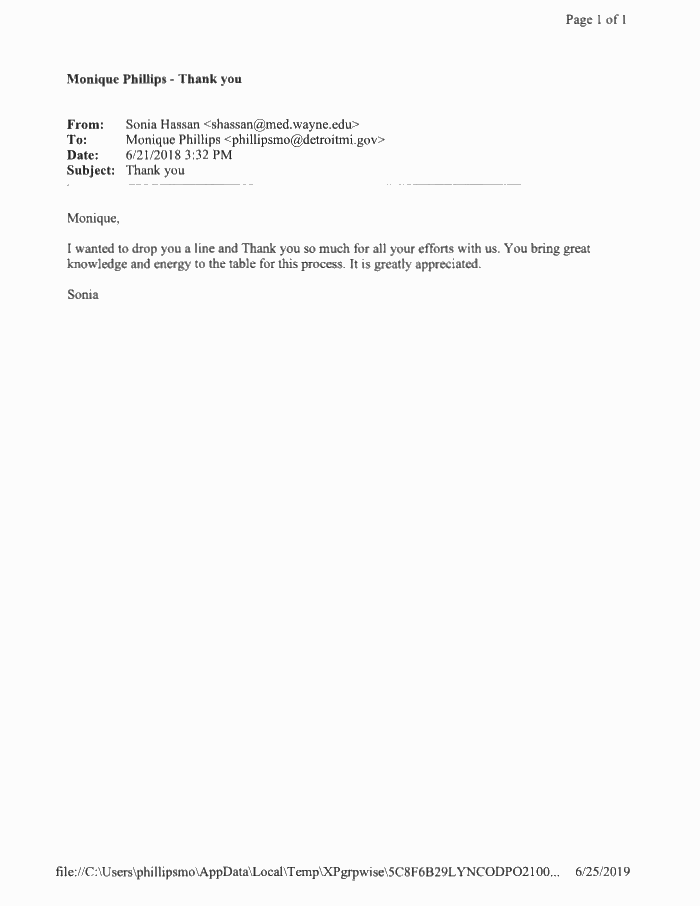
The inspector general launched its investigation into Make Your Date in April following a Free Press report about Duggan’s relationship with Make Your Date and its director, Dr. Sonia Hassan. Duggan worked with Wayne State University officials to create the program, handpicked Hassan to lead the initiative and ordered city staff to raise money for Make Your Date. The city also directed more than $358,000 in federal grants to the program.
Ha’s report confirmed details in numerous Free Press’ investigative reports and included new information about additional city resources provided to Make Your Date. General fund money was earmarked for Lyft rides for Make Your Date participants and the city’s health department was expected to perform an inordinate amount of work for the program. Workers in the department felt pressured by the mayor’s office to recruit women to Make Your Date, the OIG found.
If there was ever a problem with the health department, Make Your Date “would go directly to the mayor’s office and the mayor would call the DHD Director who would, in turn, scold the DHD staff regardless of fault,” one health department worker told the inspector general.
Eli Savit, who serves as Duggan’s chief legal counsel in the law department, disputed the inspector general’s findings, indicating they are not supported by facts or applicable legal standards.
“The draft findings, moreover, threaten to impose severe, unwarranted damage to the reputation of several public servants — and further threaten to stymie effective governance in the City of Detroit,” Savit wrote in his 32-page response.
Savit’s response was also on behalf of Wiley and two others involved in deleting emails. Savit requested that the inspector general reverse her findings, but Ha maintained her position and said she hopes the mayor reconsiders.
While generally dismissive of the inspector general's report, the mayor will be consulting with the city's human resources director, Denise Starr, about the discipline suggested in the report.
The inspector general interviewed Duggan but did not investigate the nature of his relationship with Hassan. The city's ordinance prohibiting officials from making decisions for financial gain only requires them to disclose personal relationships such as those with a spouse or domestic partner. The inspector general determined Duggan's relationship with Hassan was irrelevant to the investigation.
Abuse of authority
In assessing her findings, Ha determined that Wiley’s orders to delete city emails about Make Your Date were “more egregious” than the preferential treatment shown to Make Your Date.
“The deletion of emails only serves to undermine the public’s trust in an open and transparent government,” Ha’s report reads. “The very fact they were ordered to be deleted alone casts a shadow over transparency.”
Wiley’s actions were an abuse of authority and she should be disciplined, the inspector general concluded.
"When a public official, especially somebody from very high up, when that person orders his or her subordinates to delete certain emails, we believe that's contrary to open government," Ha said in an interview with the Free Press.
"She (Wiley) did have an intention to make those emails disappear, which we find egregious because the whole point of open government is so that people see what went on. And to have those records disappear is just not only a violation of spirit of openness but quite frankly it really puts a shadow over the government that's supposed to be transparent."
The report paints a troubling portrait of Wiley, the former Fox 2 reporter who became Duggan’s chief of staff shortly after he took office in 2014.
Known as a fierce Duggan loyalist, Wiley acted swiftly to conceal information about the city’s ties to Make Your Date just as Duggan’s relationship with Hassan was coming into public view late last year.
City employees who carried out Wiley’s orders – Chief Development Officer Ryan Friedrichs and his deputy, Sirene Abou-Chakra – also abused their authority and should be disciplined, the inspector general wrote.
It is illegal in Michigan to destroy public records, but the inspector general’s report did not determine whether Wiley or any other staffers involved in deleting the emails broke any laws. That could be determined by Michigan Attorney General Dana Nessel’s public integrity unit, which also is investigating the matter.
Savit, the mayor’s attorney, defended Wiley’s actions as an “error in judgement” that doesn’t rise to the severity of an abuse of authority. The order was only given “to protect junior staffers from unsavory media attention” and it would be unfair to suggest it was a cover-up, Savit wrote in his response to the report.
Preferential treatment
Duggan told the inspector general in an August 20 interview that his support of Make Your Date wasn’t atypical and that he's had the same level of involvement with other city initiatives.
But unlike other initiatives, Make Your Date was created at Duggan's direction, the inspector general noted, “whereas most, if not all, of the city’s other partners were already established with a proven track record.”
“The OIG investigation revealed that MYD received an inordinate amount of city time and resources, considering the fundraising goals and scope of work when compared against other projects of similar size and scope,” Ha's report noted.
Questions about Hassan’s relationship with Duggan were first raised after she was spotted last year arriving after hours at the same suburban residence as Duggan in an edited surveillance video captured by a private investigator hired by Detroit businessman Robert Carmack.
The inspector general's report summarizes the very beginnings of the Make Your Date program.
Duggan’s professional relationship with Hassan goes back at least to the beginning of his administration, when Make Your Date was born out of the mayor’s 2013 transition team shortly after he was elected.
He asked Hassan to co-chair his health care transition committee and she presented a plan to address the city’s infant mortality, which led to the creation of her program.
Months later, Make Your Date became the city’s official partner to fight preterm birth and infant mortality on Feb. 27, 2014 when the mayor announced the program during his first State of the City address.
Duggan was a key speaker at Make Your Date’s initial news conference, touting the organization’s role in his ambitious mission to fight preterm birth.
The program began enrolling pregnant women on May 15, 2014.
In 2015, the City of Detroit began sending to Make Your Date a portion of its state allocation of money for maternal and child health programs. The state, Wayne State and the city’s grant administrator — the Southeastern Michigan Health Association — all approved the city’s grant contributions to Make Your Date.
Make Your Date used the city grants for many purposes — nurses’ labor costs, office supplies, computer equipment and advertising were among the expenses, records show.
Ha said there is also no evidence Make Your Date misused funds or that it is not the best partner to combat infant mortality.
The city’s third and final grant to Make Your Date, for $100,000, was finalized in May 2017 and expired on Sept. 30, 2017.
The inspector general found it problematic that no other previously established nonprofits and programs were considered by the mayor to lead the fight against infant mortality.
Duggan told the OIG that his experience as CEO of the Detroit Medical Center helped him become familiar with preterm birth rates as well as the National Institutes of Health Perinatology Research Branch, where Hassan served as the project site manager.
So he unilaterally selected Make Your Date to partner with the city.
But because city time, resources and funding were used for Hassan’s program, “other nonprofits should have been considered to effectuate the mayor’s initiative,” Ha wrote, adding that a formal and competitive process should have taken place.
“While the mayor was able to articulate his position in selecting MYD, because it appears no other agencies were considered to ensure that the best possible selection was made in his initiative to combat infant mortality, in the eyes of the public, MYD had unfair advantage over other organizations,” the OIG determined.
Although the city lacks a defined procedure or policy that directly addresses the selection of nonprofit partners for mayoral priorities or other city initiatives, it does have established procedures for when City of Detroit general funds and grant funds are being used to pay for services under the Office of Contracting and Procurement.
The inspector general states that those policies and procedures should be made applicable to Make Your Date and other organizations or nonprofits that receive grants from the city.
“The City of Detroit must competitively bid all new contracts to the greatest extent possible,” the report stated.
But despite the findings the OIG said it recognizes and applauds Duggan and the city's efforts to reduce infant mortality, as well as the "significant contributions made by MYD."
"It is entirely appropriate that city time and resources be allocated to this goal," Ha wrote. "However, there must be a process by which any agency, nonprofit, or other organization is selected to receive these resources.
Make Your Date was launched with help from major health organizations in the area, including St. John Providence Health System, Henry Ford Health System and the Detroit Medical Center, which Duggan ran as CEO until he resigned in 2012 to run for mayor.
Some of those health groups also gave Make Your Date significant financial help early on.
Many contributions were made through its celebration galas, where Duggan served as honorary chairman for three straight years, from 2015 to 2017.
Photos from one gala posted on its website show Hassan and Duggan sitting at a table together and posing for a photo with comedian Louie Anderson, the headlining entertainment act.
All references to the Make Your Date galas and events, including photos of Duggan, have since been removed from its website.
Problems arise
Duggan announced a partnership between Make Your Date and SisterFriends in August 2017, with the goal of the two programs being separate but complementary. SisterFriends is a city program to reduce infant mortality by connecting pregnant women with a social support network.
The partnership was expected to be seamless but problems quickly arose, according to interviews with former and current employees and emails obtained during the course of the inspector general investigation.
Yolanda Hill-Ashford, a former SisterFriends manager, said Make Your Date was unusual because of Duggan’s level of involvement. She said the partnership felt forced because it was “what the mayor wanted.”
Hill-Ashford said she believed Make Your Date “absolutely, absolutely, absolutely” received preferential treatment in terms of mayoral support and “it was highlighted, it was the preferred program.”
But problems began even prior to the partnership, according to the report, when the health department attempted to award Make Your Date its first round of funding in 2015 and continued through subsequent rounds of funding.
Contract negotiations took several months and an excess amount of time and effort from several health department employees who had trouble getting information about the program’s outcomes, according to an email written in May 2015 by Chelsea Harmell, former SEMHA/Detroit Health Department Maternal Child Health Program Manager.
“Negotiations have stalled over several budget line items (initially nearly half of the budget was dedicated to advertising), changing program staff, Dr. Hassan’s lack of availability to meet over the phone or in person for months on end and continued confusion … about whether the MYD program activities are serving the population at large or acting as clinical research,” Harmell wrote.
Health department staffers had difficulties obtaining Make Your Date’s budget and justification for its disbursement of funds.
Meeting minutes from a March 2017 SisterFriend’s strategic planning meeting revealed that the health department had a “tumultuous relationship” with Make Your Date.
Hill-Ashford said in an Aug. 7 interview with the inspector general that getting information from Make Your Date leadership and staff was like “pulling teeth.”
“They don’t do things really in the spirit of partnership,” Hill-Ashford said.
Hill-Ashford initially expressed her frustrations soon after Duggan directed the partnership and she told the inspector general’s office that after the third or fourth meeting with the mayor’s office, “it started to feel more like a takeover” instead of just a partnership.
She said that instead of a collaboration, SisterFriends was tasked with recruiting women for Make Your Date and it became the focus of their meetings.
The inspector general said Hill-Ashford’s assertion was supported by an email sent by Hassan in Sept. 2017. Hassan wanted to temporarily hold off on sending Make Your Date patients to SisterFriends and instead focus on SisterFriends recruiting patients jointly to both organizations.
“This statement is troubling because the stated goal of both programs is to reduce infant mortality,” the inspector general wrote. “The focus should be on making sure expectant mothers are receiving all assistance available to them as opposed to bolstering MYD’s enrollment numbers.”
David Yeh, the Detroit health department’s director of special projects, also noted tensions between SisterFriends and Make Your Date. Yeh questioned why the program was so closely integrated with the city and that he believed it received preferential treatment.
“(MYD) became, in my view, more active and wanting to be closely involved after DHD got the $2 million grant from the Ralph Wilson Foundation in early 2017,” Yeh said. Make Your Date "thought that they should be getting the funds rather than DHD because they were the high-profile, evidence based, going-to-change-infant-mortality-for-the-city program.”
The inspector general found that the city also allocated general fund dollars to help pay for Lyft rides for both Make Your Date and SisterFriends participants in early 2017. The allocation came after the mayor made transportation funding a priority for pregnant women enrolled in either program. The funds, totaling more than $127,000 between August 2017 and April 2019, were paid directly through the health department.
'Let the circus settle'
Wiley’s initial order to delete emails came in December, not long after surveillance footage of Duggan and Hassan was shown outside city hall during rush hour on a giant video monitor affixed to a truck.
The public spectacle, commissioned by Carmack, triggered widespread speculation about the mayor’s relationship with Hassan and prompted the Free Press to launch an investigation into the city’s support of Hassan’s program, Make Your Date.
In late November, the Free Press sent a public records request to the city for contracts and other documents regarding Make Your Date and Hassan.
Wiley gave her first directive to delete city emails concerning Make Your Date sometime in December, according to the inspector general’s report.
Friedrichs, who oversees the city’s Office of Grants and Development, said in an interview with the inspector general’s office that Wiley called and told him to have two of his staffers delete their emails pertaining the city’s outreach for Make Your Date. Wiley also wanted the staffers to stop contacting Make Your Date.
“Ms. Wiley justified her direction to Mr. Friedrichs by stating that she did not want to ‘pull the grants department into all of this,’” according to the report.
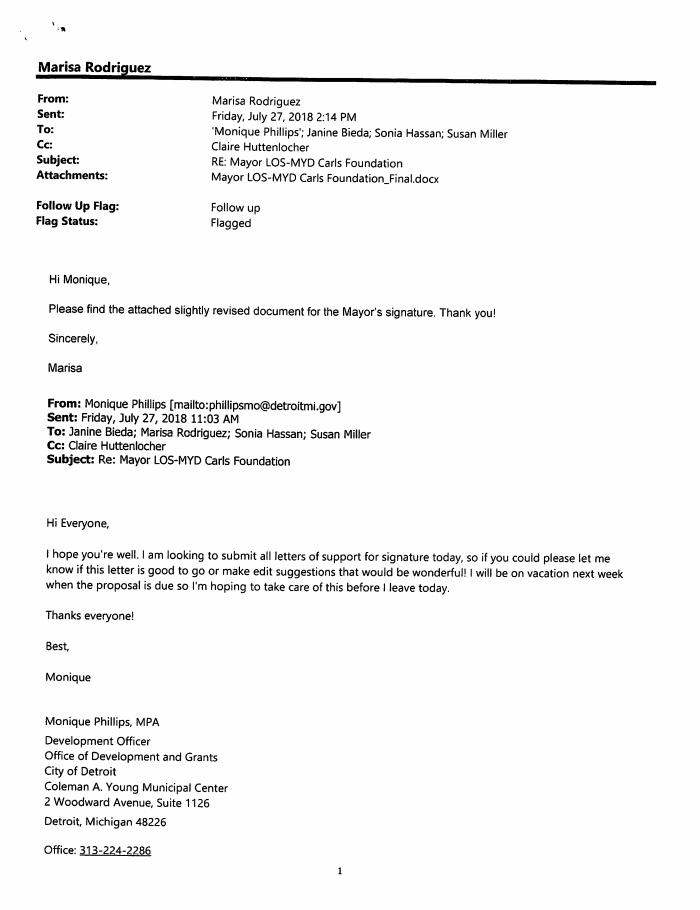
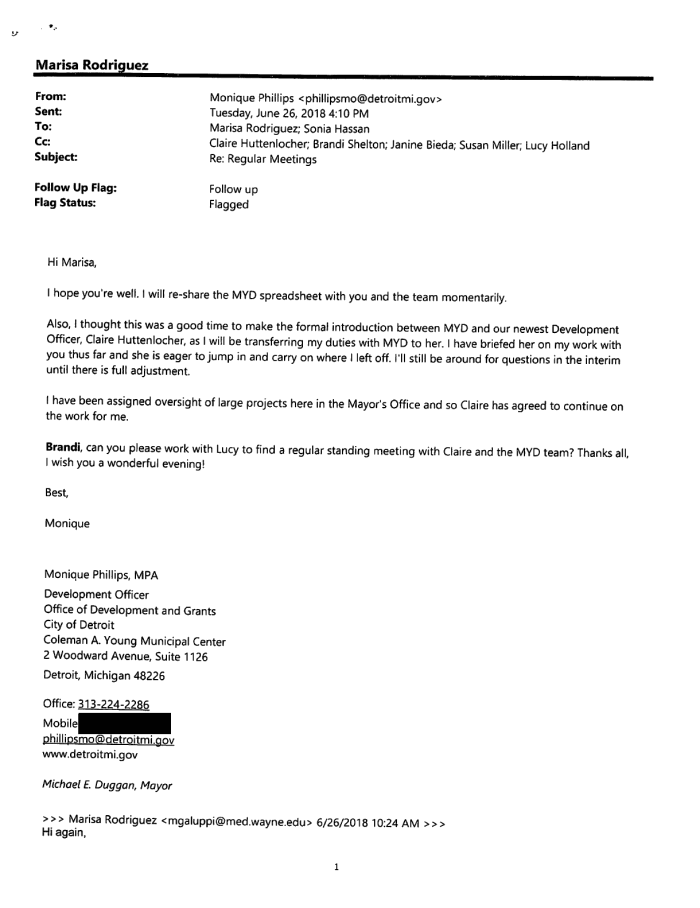
Wiley’s order went down the chain of command. Friedrichs told About-Chakra to pass along the message to the two staffers involved in raising money for Make Your Date, Monique Phillips and Claire Huttenlocher.
Phillips got the message and deleted her emails. But first she made sure to forward some of them to her personal email to maintain a record, Phillips told the inspector general’s office.
The message, however, didn’t reach Huttenlocher and she continued interacting with Make Your Date about fundraising.
Wiley eventually found out her order wasn’t completely followed when a Make Your Date representative told her about Huttenlocher’s ongoing emails. Wiley again called Friedrichs.
“Staff were given a second directive to stop contacting MYD and to delete all MYD related emails,” according to the report. Friedrichs “also noted that, at that time, a ‘full stop’ occurred to ‘let the circus settle.’”
Wiley never admitted to giving the orders during her interview with the inspector general’s office in August. She claimed she didn’t recall giving the instructions. But the inspector general’s office was not convinced. Statements from Friedrichs, Abou-Chakra, Phillips and Huttenlocher “are consistent in that the order to delete the emails came from Ms. Wiley,” according to the report.
The inspector general found no evidence that Duggan was involved in or knew about the orders to delete emails.
City officials took steps to recover the deleted emails in May after an employee being dismissed from her job spoke out. The city’s Chief Financial Officer, Dave Massaron, was involved in recovering the emails and provided 59 messages to the inspector general’s office, which later recovered another 26 additional emails. Due to the city’s retention period for deleted emails, “it is impossible to definitively say that all deleted MYD emails have been recovered,” the report concluded.
The report also criticized the use of personal email accounts by Duggan and Wiley. Messages from their personal accounts were handed over to the inspector general in response to a document request.
“Mayor Duggan told the OIG that he performs city business on his personal email…Ms. Wiley told the OIG that she uses her personal emails account to conduct city business and is under the impression that is not an issue,” the report reads.
The inspector general called the practice “extremely problematic.” If emails from a personal account are requested under public records laws, for example, Duggan or Wiley would be responsible for producing the messages, rather than the city’s IT department.
The inspector general recommended that the city establish a policy preventing public servants from conducting city business on personal email accounts.
Voting is beautiful, be beautiful ~ vote.©