The New York Times possesses absolutely no legal authority to investigate a #MeToo allegation, silly!
Since you want to be the Vice Presidential Candidate for Joe Biden, because someone knows you will swiftly be elevated to be POTUS, yoy should really go ask Perkins Coie Sucks, or some of your other "Legal Geniuese" (trademark pending) over there at the DNC, to properly advise you before you open your mouth.
Do you seriously believe everything printed in the newspapers or are you and your staff so daft that you do not know how to engage current credible and reliable law enforcement authorities to lodge a formal request to exhaustively investigate the matter of Tara Reade, as a right of due process.
You should know that you cannot go around accusing someone of lying in the public record without allowing for her civil right to due process.
Just because you were, whether knowingly or willingly, part of the denial of due process for Member of Congress, does not mean you can tear up the #MeToo agenda just because it does not fit your political career aspirations.
Now, I know, I know, you are going to dismiss me just because this Act is only for the House, and does not apply to a former Senator who is running to be the leader of the free world, and all, but, you may want to take a few moments to put down your bucket of fried chicken your campaign purchased for you and read this.
Funny.
You believe Biden but not my Sweetie.
You suck, Stacey and you probably suck your PAC purchased fried chicken bones, too.
Hey Stacey!
Why not ask for Conyers' Ethics referrals to the DOJ.
You know Trump keeps obstructing justice by keeping those IG Reports in his backpocket.
That would definitely get you that coveted VP spot.
Former Georgia gubernatorial candidate Stacey Abrams (D) on Tuesday night defended presumptive Democratic presidential nominee Joe Biden when asked about sexual assault allegations from Tara Reade, a former Biden aide who has alleged that the then-senator sexually assaulted her in a secluded part of Capitol Hill in 1993.
"I believe that women deserve to be heard and I believe they need to be listened to, but I also believe that those allegations have to be investigated by credible sources," Abrams, who is said to be on the shortlist to be Biden's running mate, told CNN's Don Lemon.
"The New York Times did a deep investigation and they found that the accusation was not credible," she added. "I believe Joe Biden."
The Times, in the report that Abrams referenced, said that the newspaper found "no pattern of sexual misconduct by Mr. Biden" but didn't come to a conclusion on the credibility of Reade's allegations.
In 2019, Reade was one of several women who came forward and said that Biden’s public touching had made them uncomfortable.
Last month, she alleged for the first time that Biden had assaulted her. Lynda LaCasse, a former neighbor of Reade's, said earlier this week that she recalled Reade recounting the story of the alleged assault to her at the time. Reade’s brother, Collin Moulton, has previously said that she told him that Biden “had his hand under her clothes at some point.”
Reade said that she confronted other Biden aides about the alleged incident at the time, but the aides that she named have gone on the record saying that Reade never confronted them about the allegation. Reade also said she filed a complaint with the human resources office in the Senate about the allegations of inappropriate touching, though reporters to this point have failed to find the complaint. Reade said she believes that the complaint is in Biden's Senate archives at the University of Delaware, which has stated that it won't release the former vice president’s records until he has stepped away from public life.
Biden's campaign has vigorously denied Reade's allegations, but the former vice president has not addressed them.
“Vice President Biden has dedicated his public life to changing the culture and the laws around violence against women,” deputy campaign manager Kate Bedingfield previously said to The Hill. “He authored and fought for the passage and reauthorization of the landmark Violence Against Women Act. He firmly believes that women have a right to be heard — and heard respectfully. Such claims should also be diligently reviewed by an independent press. What is clear about this claim: It is untrue. This absolutely did not happen.”
Sen. Kirsten Gillibrand (D-N.Y.) on Tuesday also defended Biden, saying "when we say believe women, it’s for this explicit intention of making sure there’s space for all women to come forward to speak their truth, to be heard."
“And in this allegation, that is what Tara Reade has done. She has come forward, she has spoken, and they have done an investigation in several outlets," Gillibrand, a former presidential candidate who also called for then-Sen. Al Franken(D-Minn.) to resign in 2017 in the wake of a sexual harassment allegation, said.
"Those investigations, Vice President Biden has called for himself," she added. "Vice President Biden has vehemently denied these allegations, and I support Vice President Biden.”
So, she was set up with what I love to call a trafficking tiny humans trust fund, which is co-mingled with lots of foreign trafficking tiny human trust funds.
Now, what that has to do with "The Poors" (always said with clinched teeth), I have no idea, but I thought it wise to review her glorious work in voting rights, which, of course, she has bastardized my Sweetie's legacy.
This is how they campaign, but win elections through fake absentee ballots, through land banks and its fake foreclosed properties, funded through TARP.
But, alas, they stole all the TARP, and are now implementing their latest and greatest TARP 5.0 stealin' the children, land & vote operation, called reparations, or, as I so fondly call it, the #coloredrevolution.
They want that money because they need to stay in power, for the heavens are falling.
Deep in my heart, I truly hope the Biden campaign selects the stealin' the children, land & vote spokestoken, Stacey Abrams, to be his Vice Presidential Candidate, just because it will spotlight her life of selling her soul for a bottomless bucket of fried chicken to bleachbit my Sweetie's legacy.
Their civil rights agenda was already set by the legacy of Martin Luther King, Jr. and no one has ever "journaled" upon it in the media....which is why I do what I do.
I believe they are setting up the biggest Cocktail & Popcorn party the world has ever seen!
Detroit —The advances and lingering conflicts since civil rights icon Dr. Martin Luther King Jr. was slain 50 years ago anchored a panel discussion Friday presented by the National Association of Black Journalists.
Held on the third day of the group’s convention in the Motor City, the plenary drew more than 400 people to a ballroom at the Detroit Marriott in the Renaissance Center to hear insight from activists and public figures on challenges facing minorities across the United States in 2018.
Among them was Georgia resident Stacey Abrams, whose effort to become the nation’s first black woman elected governor has made her a national political celebrity. In May, the Yale-educated attorney and romance novelist who served a decade in the Georgia Legislature easily won the Democratic nomination to seek the top spot in a state where Republicans have held every statewide office from U.S. senator to insurance commissioner.
During an interview with CNN national correspondent Suzanne Malveaux, Abrams acknowledged “the transformative moment” but insisted it was not solely a spotlight on her campaign.
“I am privileged to stand in the space of history,” she said. “But for me, it’s only history if I’m doing it to make sure there’s space for everyone else."
Abrams, who won 76 percent of the Democratic vote and earned an endorsement former U.S. President Barack Obama, also described how her campaign is gaining support by reaching out to a wide swath — including majority-white counties.
“This is not the Georgia of 1998, and it’s not the Georgia of 1968," she said. "It is a very different state that has a much more diverse and rich nature.”
Diversity and the importance of minority representation also was the focus of discussion Friday.
Benjamin Crump, a civil rights attorney who represented the families of Trayvon Martin and Michael Brown, mentioned how the slayings of those teens and other African-Americans tragically underscored how law enforcement treats minorities. But the issue permeates other segments of society, as well, he said — citing unequal treatment in the legal system.
“As bad as it is … it is far worse how they kill our children in courtrooms everyday in America, in every city, in every state, with these trumped up felony convictions,” Crump said to applause. “..
Once you have that felony conviction and you’re a young person of color, it’s almost impossible for you to get a decent living wage job, to put a roof overhead, to put food on the table, to keep lights on.”
Other speakers urged journalists to reframe the narrative on King’s legacy and the civil rights movement.
“Every cycle we put a movement in a box,” said Dominique Alexander, president/founder of the Next Generation Action Network. “We talk about the civil rights movement — they were fighting for human decency, human rights.”
Coupled with fighting for social justice is heading to the polls to elect candidates and change policies, said Michael Eric Dyson, a Georgetown University professor and author. “Voting is critical, not just for the president. … Voting still makes a difference.”
The message was enlightening for Shyra Duncan, a freelance broadcaster from Atlanta who attended.
“We need to make our voices heard,” she said. “Voting is important for our future.”
Abrams became the nation's first African-American female to earn a major party's nomination for governor.
Good evening, Georgia. I stand here tonight grateful to the thousands of you who have joined me on this drive to history. We are writing the next chapter of Georgia’s future. Where no one is unseen, unheard or uninspired. A Georgia where we prosper – together!
I offer my congratulations to Stacey Evans and her campaign and all of her supporters tonight for a hard-fought race. And I know… for the journey that lies ahead, we need every voice in our party – and every independent thinker in the state of Georgia – energized, and by our side to succeed, so I hope you will join our fight for the future.
But our mission is about more than success at the ballot box in November. Our mission is to see beyond the challenges that face us, to create a Georgia where our dreams and aspirations become real and lasting legacies. A state of excellent schools, with jobs that create wealth and opportunity, and good leaders who stand up for all of us. Because that is why we are here. To ensure that all Georgians… from farmers in Montezuma… to mill workers in Dalton know we value them. That educators in Sparta and airport workers in College Park know we see their efforts. That former prisoners across our state working towards more know we believe in their redemption. We are here to ensure that everyone who calls Georgia home has the freedom and opportunity to thrive -- to live their very best lives!
I am a product of the power of that mission. I am the child of a shipyard worker and a college librarian, who were called to become United Methodist ministers. A proud daughter of the Deep South. I grew up the second of six children in a family where we struggled to stay above the poverty line, but we never struggled to know what was right or to believe in our possibilities. My parents instilled in us the core values of faith, family, service and responsibility. Hard work is in my bones.
So is a deep respect for those who wake up early and come home tired but ready to read to their kids - or change clothes for a second job. And all those who are just getting by or are doing well but worry for the next generation. A respect for those who care for their loved ones – or who have earned their rest and retirement. A respect for our service members, their families and veterans that call our state home. Our campaign, and our work, is for them and their security - as we shape the future of this state we love.
In this tough race to come, we can find it easy to forget about the solid ground beneath our feet. But we must remember we’re in the state where the red clay gives life to generations of dreamers. The state where Martin marched on ballot boxes and challenged a nation’s conscience. The Georgia that gave us the Godfather of Soul and the queen of the Met - and that sent a peanut farmer to the Oval Office.
Our state’s rich, complicated history courses through our memories on nights like tonight. When the unexpected becomes truth, it reminds us of who we are – how we’ve stumbled and how we’ve flourished– and it commands that we embrace our obligation to live up to Georgia’s tradition of pride and of promise, to remember our complex roots…
Together, we will shape a future with boundless belief and historic investment in our children at the core of every decision we make. That means affordable childcare for families and real pathways of opportunity from cradle to career. Because when all of Georgia’s children have a chance to reach their potential, regardless of their zip code or their family’s salary, we can reach our potential as a state – and unleash the full power of our people.
That’s why public schools must remain the beating heart of Georgia – to propel our young people toward lives of security, happiness and achievement. But even as I speak here tonight, public education is under assault in our state, with our kids and our educators being told to do more and more with less and less.
As the state’s ‘Public Education Governor,’ I will use every tool we have to ensure that we stop shortchanging our children – and sabotaging our futures. Our children deserve better than a basic education. They deserve excellence no matter where they learn; and, together, we will deliver.
We deserve an economy that works in all 159 counties, and gives Georgians the freedom to do more than just survive. We deserve a diverse and inclusive economy, one where everyone can succeed. That gap – between struggle and success – has too often been overlooked by our leaders.
Together, we will renew the respect for the dignity of work in every field, sector and region of Georgia. Including the staff right here in this hotel, who made tonight possible. Everybody wins when we choose to honor hard work with wages you can raise a family on. We can invite corporations to our communities, and at the same time, invest in the thousands of small businesses that keep our neighborhoods alive.
I will be a governor who brings more than jobs to Georgia – together, we can build career pipelines in renewable energy, spur creativity through a growing entertainment industry, and increase the strength of our trade unions to grow an economy that lifts every Georgian. We can build an economy as strong and diverse as our citizens. A state where we can give our people license to dream and the opportunity they deserve to achieve.
Across Georgia, we are ready for more. I was down in Macon a few months ago, where I met Pam, a proud mother about to send both of her daughters off to college. One wants to teach, the other wants to study criminology. The one who wanted to be a teacher was a few months away from giving birth to her own child. Pam understood that for her daughter to have a brighter future, she would spend the next four years raising her grandchild. A choice she made readily, because she dreamed of more for her girls. She is determined that both her girls pursue degrees she never received.
Then I asked Pam about her dreams – beyond her daughters, beyond her grandchild, what did she dream for herself. And, honestly, she looked at me like I was crazy. Finally, Pam told me she’d been a cashier at the Piggly Wiggly for twenty years, and that’s what she’d be doing for the rest of her life. So I asked again, what did she want for herself. She hesitated… and then told me that no one had ever asked her that. And finally she told me: ‘There’s a building down the road from my house in South Macon, and one day, I’d love to turn it into a daycare facility. To help young women like my daughter not have to give up on their dreams. Maybe even give them a new skill. And help kids get a head start.’
But, she told me, no one would ever loan her the money – because who was she to want so much? I’m running for governor because Georgia must invest in Pam, Inc. To see her dreams as vital and real and necessary and true. Because as excited as we may become when a Fortune 500 offers to come to Georgia, we can grow the Georgia 5000 by investing in our people and their solutions for our state. When they hire 10 more neighbors and serve a generation, we all rise.
With a governor who cares as much about Main Street, not only can Georgians like Pam succeed, but if we give them a chance… they can lift up their entire communities. When Pam and her daughters and her grandchild prosper – we are on our way to a future in Georgia that can inspire us all.
Together, we stand prepared to stand up for Georgians who believe they are in this alone. Single mothers sifting through mounting bills on the kitchen table… college grads battling against crushing loan payments that stand in the way of their ambition… Over the last decade, I’ve traveled to rural towns full of anxiety as the ground shifts beneath them… We all know families battling crippling debt - and the very fear that an illness or accident may wipe them out financially – as they try to keep their loved ones safe and cared for…
To these families, and all Georgians I say: I’m with you. I’ve been there. I’m still there. And I’ll never stop fighting for you. For Pam. For Georgia. I am running for you. Because your dreams matter to me – and we can do this better - together.
But we have work to do … in too many ways, Republican leaders have failed these folks. By being too mean and too cheap to expand Medicaid, by jeopardizing our rural hospitals for political gain, they’ve put millions of Georgia families at risk. We can do better than that. I want to lead Georgia because I know we can do more: we can protect our healthcare - and safeguard our kids’ education and their lives… Together, we can continue to fix our criminal justice system and begin to defend our Dreamers… Build the infrastructure that connects us to one another. Repeal campus carry and expand HOPE.
We can lead a stronger Georgia, a more compassionate Georgia, a bold and ambitious Georgia. We can show the old-guard something new – and fight together for the good of all. I want every Georgia family to have the freedom and opportunity to thrive. You deserve nothing less, and I know our Georgia can deliver.
But to claim our victory – to write that next chapter and live those best lives - we have a lot of work to do. We have to reach out to those who do not believe their voices matter. Who have been disappointed again and again by promises made and never kept. Who live in counties crushed by poverty and neglect. In suburbs isolated from jobs and opportunity and sometimes, each other. In cities where lack of affordability makes it harder and harder to stay. In the next six months, we will work together to remake our Georgia.
With your help, we will register every last person we know – and we will talk to Georgians from all walks of life to engage them too. Because our campaign will be a coalition that reaches across backgrounds, sharing our constant belief in our capacity to win. And with your hands knocking and your feet walking and your voices speaking out, every Georgian we touch will understand the value and immense power of the vote.
Inaction can be contagious… but so can a passion for change. From our campuses to our neighborhood blocks to our senior centers, a wave is coming – and I know Georgians won’t stand on the sidelines.
In the Book of Esther, there’s a verse that reminds us we are born for such a time as this. A time to defend our values and protect the vulnerable – stand in the gap and lead the way. A time to know that this democracy only works – when we work for it. That is what we have done tonight and that is what we will continue to do – all the way to victory in November.
Because we know the power of the possible in Georgia. A Georgia that elected Shirley Clarke Franklin and Brenda Lopez and Jason Esteves and Keisha Lance Bottoms and Melanie Hammett and Sam Park. A Georgia that sees diversity as our strength and acceptance as our birthright.
That’s why when I ask for your vote—I’m really asking you to vote for yourself. For the people you know and love, the ones you work beside and worship with. For the Georgians you may never know, but whose fate is undeniably tied to your own. These are the people on my mind tonight. And that’s who will be on my mind every day as I go to work for you as your next Governor.
So tonight, we celebrate… we rejoice and say thank you to all who got us this far… and tomorrow we hit the phones, the doors, and the streets to reach every Georgian with our message. This - is our time to build a Georgia where everyone has the freedom and opportunity to thrive… because our best lives are within reach. This is our moment, and this is our chance to lift up Georgia! And if we fight, if we push, if we work, we will win!
The GBI has opened an investigation of Fulton County District Attorney Paul Howard and his use of a nonprofit to funnel at least $140,000 in city of Atlanta funds to supplement his salary, The Atlanta Journal-Constitution and Channel 2 Action News have learned.
The criminal investigation comes at a time when Howard, Fulton’s DA since 1997, is being challenged in the Democratic primary for reelection and is facing allegations of sexual harassment, which he strongly denies.
In a statement issued Monday, Howard predicted he will be cleared of any wrongdoing.
“This is not the first time what would be considered as an administrative matter for other Georgia elected officials is turned over to the GBI for investigation when it involves the Fulton County district attorney,” he said.
This was in reference to the agency’s 2014 investigation of Howard’s use of money forfeited by criminals to pay for galas and dinners for his staff and their families.In that GBI probe, prompted by media reports, “I was totally exonerated,” Howard said.
As for the ongoing investigation, he said, “(I)f the facts are followed, it is my expectation that the result will be exactly the same.”
Howard said the timing of this investigation, weeks away from the June 9 primary, “is not lost on me.”
Howard is also facing a state ethics complaint for not disclosing he was a chief executive of the nonprofit, People Partnering for Progress, in personal financial statements.
On April 15, the Georgia Transparency and Campaign Finance Commission charged Howard with a dozen disclosure violations, most of them involving PPP.The GBI probe and the ethics complaint followed a report by The Atlanta Journal-Constitution and Channel 2 Action News about discrepancies between financial disclosures Howard filed with the state and tax filings submitted to the IRS by the nonprofit he heads as CEO.
This week, GBI agents were scheduled to visit Atlanta tax attorney Raymond Carpenter to review PPP’s records, Carpenter said.
For years, Carpenter, a longtime friend of Howard’s, has served as the nonprofit’s chief financial officer.The GBI was asked by the state Attorney General’s Office to conduct the investigation of Howard, agency spokeswoman Nelly Miles said.
“At this point, that’s all we can say.”Katie Byrd, a spokeswoman for Attorney General Chris Carr, confirmed that was the case but declined further comment.Former DeKalb District Attorney Bob Wilson said he finds the investigation troubling.
“When you become the controversy, there’s a problem,” said Wilson, now a private attorney in Decatur. “I think a criminal investigation of a district attorney — that is a very sad state of affairs.”
A criminal probe of the prosecutor who heads Georgia’s largest and busiest district attorney’s office is highly unusual.
But so was Howard’s decision to use PPP as a conduit to pad his salary by at least $170,000 from 2014 through 2017, according to tax records and the nonprofit’s own documents. (Howard’s annual salary, paid by the state and supplemented by the county, is roughly $175,000.)
Howard initially sought an $81,259 salary supplement from the city of Atlanta in a May 2014 letter he sent to then-Mayor Kasim Reed.
At that time, Howard wrote, nine other DAs around the state were earning more than he was.
Howard did not get that annual supplement, but the city did present him with $125,000 checks in each of the next two years.
In a previous statement, Howard said Reed tied the money to Howard’s efforts to address repeat criminal offenders and expand his community prosecutors’ program.
When contacted Monday, Reed said he had no comment.It’s unclear whether the city knew how much of the $250,000 would go to Howard because he paid himself differing amounts from year to year.
In 2015, he took in $50,000, then $20,000 in 2016 and $70,000 in 2017, the nonprofit’s tax filings show.PPP’s most recent tax filing in 2018 did not disclose whether Howard received additional funds.
Nonprofits do not have to provide detailed financial information for a year in which they collect less than $50,000 in contributions, which was the case for PPP that year.
On April 13, the AJC and Channel 2 filed an Open Records Act request with the city to determine how the funds were transferred to Howard and for documents relating to it.
But City Hall, shut down because of the pandemic, has yet to produce the records.In a statement issued last month, Howard said he deposited the city’s checks into the nonprofit’s account and then received checks to supplement his salary.
The arrangement is open to question because state law says only counties can supplement a district attorney’s state pay.
In his statement, Howard said he tasked one of his former appellate attorneys to determine whether he could receive supplements from the city.
He also provided a memo in which the attorney said there was no law prohibiting it.
But the July 2014 memo did not address the legality of Howard using a nonprofit to funnel city funds as a way to supplement his salary. PPP’s records say the nonprofit’s mission has been to reduce youth violence.In his prior statement, Howard said the money he received from the city through PPP “represents reasonable compensation.”
He also said that PPP’s involvement, through his supervision, in his office’s community prosecution program has been meaningful and had a positive impact.
Howard has been named in two sexual harassment complaints filed by county employees and another alleging gender discrimination.
During a recent virtual pre-election forum, his two opponents, former Fulton chief deputy DA Fani Willis and Atlanta lawyer Christian Wise Smith, criticized Howard for the harassment allegations.
Wilson, DeKalb’s DA from 1981 to 1992, said he chaired and worked with child advocacy and rape crisis center nonprofits while he was in office.
If a nonprofit can help victims of crime, it’s appropriate for a district attorney to be involved, he said.
At the same time, he added, “You would not undertake that with any idea of ever being paid.”Wilson said he never asked for a raise while he was district attorney.
“You know what the job is,” he said. “You know what it pays, and if that’s not good enough for you and your family then seek other employment.”
Biden picks Sen. Kamala Harris as running mate
The pick fulfills the Democratic presidential contender’s promise to select a woman as his running mate, and puts to rest the sometimes bristly rivalry the pair shared during the early phase of the Democratic primary.
WASHINGTON - Joe Biden has finally announced his selection for his 2020 election running mate – Kamala Harris.
The pick fulfills the Democratic presidential contender’s promise to select a woman as his running mate, and puts to rest the sometimes bristly rivalry the pair shared during the early phase of the Democratic primary.
The rivalry provided one of the nomination race’s most memorable moments when Harris sharply criticized Biden for his record on racial justice, calling his positive description of a past working relationship with segregationist statesmen as “hurtful.”
Harris has since dialed back the attack, reportedly telling a colleague that the exchange was “just politics.”
Harris dropped out of the race for president in December 2019 and endorsed Biden in March 2020.
RELATED: Arizona, long considered a GOP stronghold, could be swing state in 2020 presidential election, experts say
Harris, who is also Indian American, joins Biden in the 2020 race at a moment of unprecedented national crisis. The coronavirus pandemic has claimed the lives of more than 150,000 people in the U.S., far more than the toll experienced in other countries. Business closures and disruptions resulting from the pandemic have caused an economic collapse. Unrest, meanwhile, has emerged across the country as Americans protest racism and police brutality.
She is the Democrats’ first female running mate since Walter Mondale selected Geraldine Ferraro in the 1984 presidential election. The last time a woman was picked as a vice-presidential candidate was 2008 when Republican John McCain tapped Alaska Gov. Sarah Palin as his running mate.
Should Biden win the 2020 election, Harris would be the first woman to serve as vice president.
Biden taps Kamala Harris as his running mate
The former vice president made his announcement on Aug. 11.
Harris beat out a short list that reportedly included Stacey Abrams, Tammy Baldwin, Karen Bass, Keisha Lance Bottoms, Val Demings, Tammy Duckworth, Michelle Lujan Grisham, Susan Rice, Elizabeth Warren and Gretchen Whitmer.
With the country still in the throes of the coronavirus pandemic, Biden holds a significant lead over President Donald Trump in most major polls, including an eight-point lead in the most recent FOX News poll.
RELATED: Why choice of running mate matters more than usual this year
Biden also leads in battleground states like Michigan, Minnesota and Pennsylvania.
Harris, an Oakland native who graduated from Howard University and received her law degree from the University of California, cut her teeth in politics as California’s attorney general before being elected to the Senate in 2016.
Harris’ record as California attorney general and district attorney in San Francisco was heavily scrutinized during the Democratic primary and turned off some liberals and younger Black voters who saw her as out of step on issues of systemic racism in the legal system and police brutality. She tried to strike a balance on these issues, declaring herself a “progressive prosecutor” who backs law enforcement reforms.
As her national profile grew, Harris built a reputation around her work as a prosecutor. After being elected to the Senate in 2016, she quickly gained attention for her assertive questioning of Trump administration officials during congressional hearings. In one memorable moment last year, Harris tripped up Attorney General William Barr when she repeatedly pressed him on whether Trump or other White House officials pressured him to investigate certain people.
Harris has taken a tougher stand on policing since the killing of George Floyd. She co-sponsored legislation in June that would ban police from using chokeholds and no-knock warrants, set a national use-of-force standard and create a national police misconduct registry, among other things. It would also reform the qualified immunity system that shields officers from liability.
“We made progress, but clearly we are not at the place yet as a country where we need to be and California is no exception,” she told The Associated Press recently. But the national focus on racial injustice now shows “there’s no reason that we have to continue to wait.”
House Minority Leader Nancy Pelosi (D-Calif.) on Friday outlined an ambitious overhaul to the way government operates — including legislation to strengthen voting rights protections.
Pelosi, widely expected to be elected the next House Speaker, vowed to make it the first order of business when Democrats realize their newly won majority next year.
The goal, Pelosi said, is “to reduce the role of money [and] advance fair elections, and one part of that is having the Voting Rights Act early on the agenda.”
The effort would come following a midterm election that included a number of closely fought elections, including a tight race for governor in Georgia that was shadowed by accusations that black voters were being disenfranchised.
Rep. Terri Sewell (D-Ala.), who has sponsored legislation to restore voting protections lost when the Supreme Court gutted the Voting Rights Act in 2013, said the issue will be “our first order of business” in the next Congress.
“That means starting work, on Day One, to restore the Voting Rights Act of 1965,” said Sewell.
“We believe that no matter what state you live in — whether you’re a Democrat or a Republican — you should have a fair voice in our elections,” she said. “Your vote is your voice.”
The issue of voting rights protections has been on the Democrats’ radar for years, particularly among members of the Congressional Black Caucus (CBC). And it’s only gained steam this cycle, following reports of voting irregularities — and in some cases, allegations of outright suppression — in states like Georgia and Florida, where black Democrats vying for governor fell by razor-thin margins.
In Georgia, a group backing Democratic candidate Stacey Abrams sued the state this week, alleging the elections were rigged to disenfranchise black and other minority voters. In North Carolina, officials are investigating allegations of a fraud scheme targeting Democratic voters. Several of the complaints, in that ongoing probe, came from African American seniors.
At issue is a section of the Voting Rights Act that had required a number of states with a history of racial discrimination at the polls — most of them in the south — to get federal approval before changing their voting rules.
In a 5-4 decision in June 2013, the Supreme Court eliminated that requirement. Behind Chief Justice John Roberts, the Court's conservative majority found that the formula dictating which states are subject to the extra hurdles — defined by Section 4 of the law — is outdated and therefore unconstitutional.
The Court did not invalidate Section 5 of the law, which empowers the federal government to require pre-clearance for certain states and localities. But without a formula to determine which regions are subject to the extra scrutiny, Section 5 was effectively neutered.
Roberts invited Congress to “draft another formula based on current conditions” — which is what Sewell has done in her proposal.
Outgoing Speaker Paul Ryan (R-Wis.) has said he supports strengthening the Voting Rights Act. But he’s deferred the decision to move legislation to Rep. Bob Goodlatte (R-Va.), chairman of the Judiciary Committee, who’s adamantly opposed to restoring the protections.
The issue resurfaced in September, when the U.S. Commission on Civil Rights, a bipartisan panel, issued a damning report finding that minority voter protections in certain parts of the country were severely weakened by the Supreme Court’s decision. The group urged Congress to intervene.
Goodlatte responded by issuing a five-year-old statement explaining why Congress has no role to play. He has said congressional action is unnecessary because other parts of the Voting Rights Act, which were left intact by the Supreme Court, provide sufficient protections against race-based discrimination.
Asked about the appropriateness of releasing a five-year-old statement in response to a new report, a spokeswoman said, “The Chairman’s position has remained the same since the 2013 statement.”
Democrats, and a number of Republicans, have a decidedly different view, pointing to a long list of states that have adopted higher hurdles to voting since the 2013 ruling took effect, including photo-ID requirements, shorter windows of early voting and the elimination of same-day registration.
“It’s ridiculous that it’s an obstacle course to get to the ballot box, still, 240 years into this Republic,” said Rep. John Sarbanes (D-Md.). “So we have to make it easier — not harder — to register, to vote and people have to have confidence that when they exercise their franchise, that vote will be tabulated and it will be protected.”
Sewell proposed a March 3 deadline for passing their reform package — a date marking the 54th anniversary of the “Bloody Sunday” civil rights march that nearly ended the life of Rep. John Lewis (D-Ga.) and led directly to adoption of the Voting Rights Act.
The issue has emerged amid the ongoing saga over Pelosi's future on Capitol Hill. Pelosi, facing a group of insurgents fighting to block her rise to Speaker, has been huddling with her detractors in an effort to win them over. She won an early victory last week when she enticed Rep. Marcia Fudge (D-Ohio), former chairwoman of the CBC, to her side by offering to revive a defunct voting rights committee and give Fudge the gavel.
"Our party should reflect the diversity of our changing nation and guarantee all our citizens the unfettered right to vote and to have every vote count," Fudge said at the announcement.
The push for stronger voting rights protections is just one part of a larger package Democrats are promising to tackle immediately when they take control of the House next year. That bill — to be introduced as H.R. 1 — will also feature provisions promoting tougher ethics rules for lawmakers, as well as efforts to limit the role of money in politics.
Democrats think adopting those reforms will send the message to voters that they have the public’s interest in mind, thereby easing passage of the other items on their legislative wish list.
“If we are going to accomplish the bold, aspirational things that everybody wants in America, … we have to have a government that they can trust. And this is the first step to building a government that they can trust,” said Rep.-elect Veronica Escobar (Texas).
“Once we pass this, we can then get on to tackling all of the big-picture issues that the American public expects us to tackle,” she said.
Democrats will likely face strong resistance to all of those reforms in the Senate, where Majority Leader Mitch McConnell (R-Ky.) has shown no appetite for moving such legislation.
Pelosi suggested the power of public sentiment would eventually force the hand of Republicans.
“Our best friend in this debate is the public,” she said. “We believe that it will have great support and that message won’t be lost on the Senate or on the president of the United States.”
Rep.-elect Tom Malinowski (N.J.) said Democrats will have no trouble winning over voters in his district, regardless of their political leanings.
“A lot of us who supported this ran in districts where we have to get Republican support to be here,” Malinowski said. “And I can tell you, I did not meet a singe Republican voter who thought its was a good to allow, say, a foreign government to channel money through nonprofit organizations to a Super PAC in the United States to influence the outcome of our elections.
“This is bipartisan when it comes to the American people.”
I have to determine if she is just really dumb or brilliantly nefarious.
I am going with the former until evidence proves, otherwise.
All I can say is that this will be better than any kind of deposition one can creatively conjure.
Since I have an international audience in hand, I thought it would be optimal for me to request assistance:
On November 22, 2019, DTE came to an elderly woman's home, in her 70's with her sister in her 80's, to install a new gas line. They have lived there for 35 years. The workers busted the brick and foundation with sledgehammers, destroying the ventilation system for the water heater. The home is almost 100 years old. The workers even left their tools. We all called to request immediate, emergency assistance to repair the damage, but DTE refused to respond. State Senator Stephanie Chang just referred to constituency request for emergency help back to DTE, who never returned calls. Gretch's office was just rude and referred the matter to DTE, who never returned the call. As of this posting, there is still no hot water and they are sick. I was considering this an act of retaliation, just because it is a predictable pattern of practice when dealing with Michigan social welfare issues, but, hey, what do I know? I know nothing because no one will call back and help them. So much for that MLK humanitarian award....
Considering the fact that Gretch is not duly elected, she probably does not respond to humanitarian emergency requests for assistance because she is an illegitimate governor.
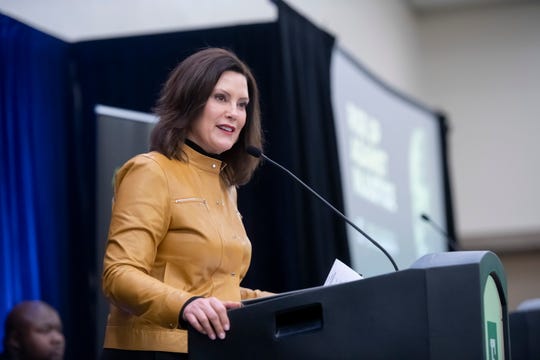
Michigan Governor Gretchen Whitmer gives a speech after receiving the Martin Luther King Jr. Humanitarian Award Capturing that look of complete indifference to due process
Michigan Gov. Gretchen Whitmer will give the Democratic response to President Donald Trump’s State of the Union address Feb. 4, six days after delivering her own State of the State speech in Lansing.
Whitmer will deliver the response beside U.S. Rep. Veronica Escobar of Texas, who will give a separate response in Spanish.
The response is usually given by an elected official whom opposition party officials tag as a rising star. Trump's speech will come one day after the Iowa caucuses and likely in the midst of the Senate impeachment trial.
Whitmer said the response would serve as an “exciting opportunity” to show Democrats “getting things done.”
“Across the country, Democrats are staying focused on building a stronger, more sustainable country for future generations,” Whitmer said. “As leaders, it’s our responsibility to ensure a safe, healthy future for our children and families, and that’s exactly what we’re working toward in Michigan."
But Republicans hit Whitmer's record as lackluster.
"She’s had ample time to make a difference for our state, but her past year in office has been nothing more than photo-op's and sound bites," said Michigan Republican Party Chairwoman Laura Cox. "Ultimately, Gretchen Whitmer's decision to side with Chuck Schumer and Nancy Pelosi makes it that much easier to give our state a new governor in 2022."
Whitmer rode to a 2018 victory in Michigan on a promise to “fix the damn roads,” but making good on the vow has proven difficult with divided government.
The first-term governor's proposal last year to increase the 26.3-cents-a-gallon gas tax by 45 cents was opposed by GOP leaders and effectively died in late August when House Minority Leader Christine Greig, D-Farmington Hills, declared Whitmer's tax plan an “extreme” that likely wouldn't happen.
The debate over road funding options eventually led to a breakdown in negotiations with GOP legislative leaders.
When the Republican-controlled Legislature sent the governor a budget that shifted existing funds from other departments for a one-time $375 million payment toward roads, the governor made 147 line item vetoes, slashing $947 million from the state budget and transferring another $625 million within departments.
"Caught in the middle of Whitmer's political budget retribution were at-risk students, people with autism, public safety, and healthcare services," said Tori Sachs, executive director of the Michigan Rising Action political action committee. "Our state and nation deserve better."
The Democratic governor did slash funding for charter schools, an autism alliance, rural health care and county road patrols, but most of it was restored after negotiations with Republican lawmakers.
Whitmer made Michigan the first state in the nation to declare a ban on flavored vaping products out of concern for youth usage and an uptick in lung injuries, but the ban was halted by the courts amid a challenge from vape shop owners.
But her first year in office included victories, including the signing of bipartisan legislation that reformed Michigan's no-fault auto insurance, changes that had eluded consensus for about 40 years. Some Democrats criticized her for signing the Republican-inspired legislation.
Whitmer has “rolled up her sleeves” during her more time in public service, House Speaker Nancy Pelosi wrote in a Friday statement with Senate Democratic Leader Chuck Schumer announcing Whitmer’s selection.
“Her decades of hard work on behalf of the people should serve as a model for our nation,” Pelosi said. “She’s a forward-looking leader who is laser-focused on solving problems for everyday Michiganders and is uniquely qualified to deliver Democrats’ message of progress for all Americans.”
Whitmer’s efforts in Michigan are a “model for public servants everywhere,” Schumer said.
"Whether it's pledging to 'Fix the Damn Roads' or investing in climate solutions, Governor Whitmer's vision for the future is exactly what this country needs, and I'm thrilled she is giving the Democratic response,” he said.
As a "fierce leader" for Michigan's families, Whitmer will highlight how Trump's "broken promises have devastated our state," said Lavora Barnes, chairwoman for the Michigan Democratic Party.
"Gov. Whitmer was critical to our party’s success up and down the ballot in 2018, and I look forward to working with her this year as we fight to beat Donald Trump, re-elect Gary Peters to the Senate and turn every corner of Michigan blue," Barnes said.
Democratic former U.S. Sen. Carl Levin of Detroit appears to be the last Michigan politician to have given a State of the Union response, according to U.S. Senate records. In 1984, Levin was one of several members of Congress on a panel who responded to then-President Ronald Reagan's address in a partly taped and partly live program.
Then-House Minority Leader Gerald Ford of Grand Rapids, a Michigan native, gave the first televised response to a State of the Union address in a 30-minute rebuttal alongside Senate Minority Leader Everett Dirksen to President Lyndon Johnson's 1966 and 1967 addresses, according to U.S. Senate records.
"Today, thanks to the efforts of Dirksen and Ford, the opposition response is anticipated and discussed almost as much as the president’s speech," according to the Senate Historical Office.
The last sitting governor to give an official response to a State of the Union speech was then-South Carolina Gov. Nikki Haley, a Republican who responded to then-President Barack Obama’s speech in 2016. Haley was Trump's United Nations ambassador until deciding to step down at the end of 2018.
Democrat Stacey Abrams, a former minority leader in the Georgia House of Representatives, gave the response to Trump’s speech in 2019.