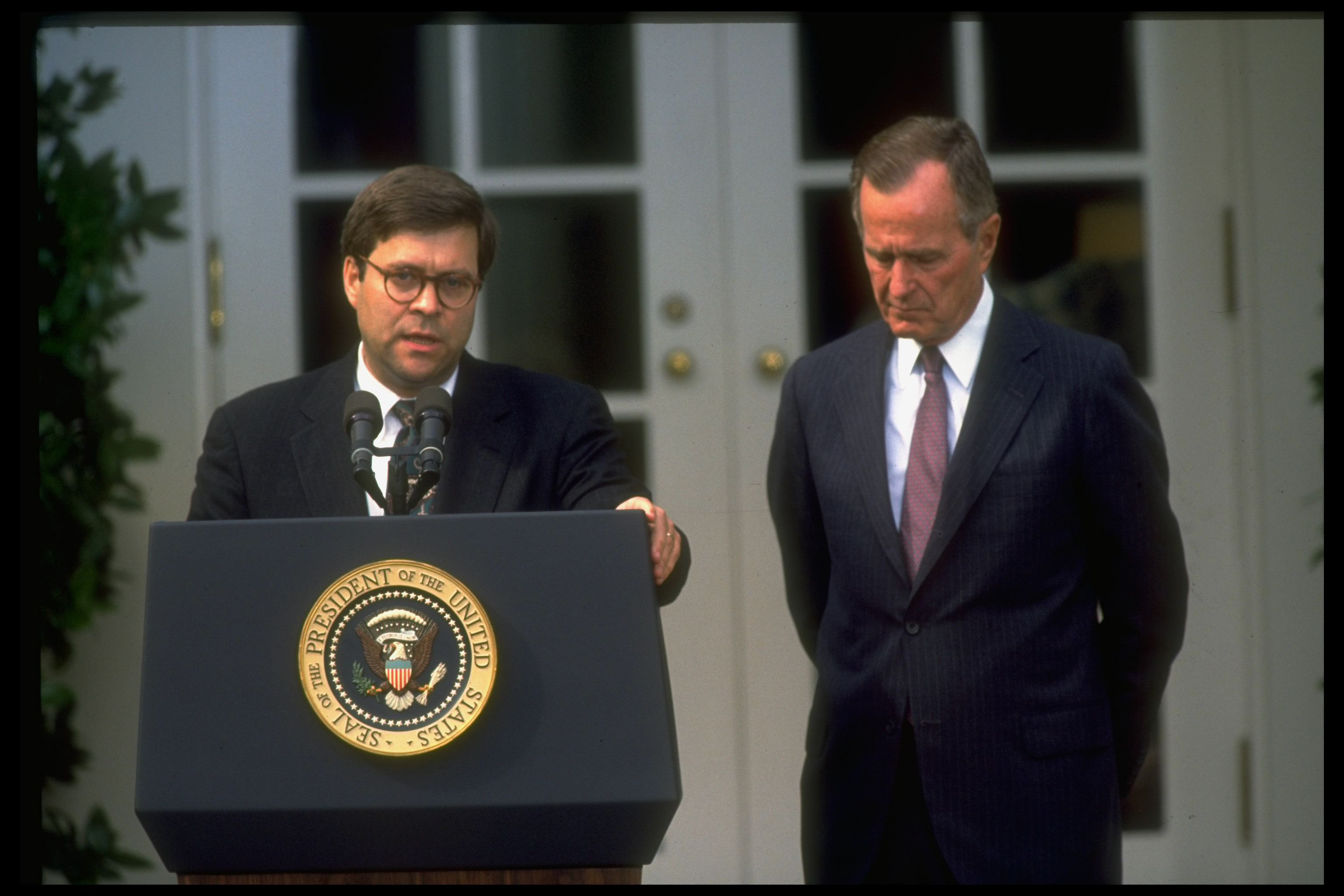
George H.W. Bush dies and Trump's advisors recommend nomination of Bill Barr.
Then there is a flurry of positions coming out pro, against, and even neutral on Bill Barr.
All I can say is that I think he is going to fall under that pesky "attorney-client privilege" thing no one is talking about.
Bill knows stuff.
Let us find out just what he knows, or what he is willing, or unwilling, to share.
He only issued one Advisory Opinion of his tenure, that has been published, but I am sure there are more, unless he did not issue any, relying upon other individuals in the Office of Legal Counsel, but hey, what do I know?
I only know that he was the Attorney General who oversaw the implementation of privatization, and it started with the children and the only thing he opined was on abortion which laid the foundation for ASFA.
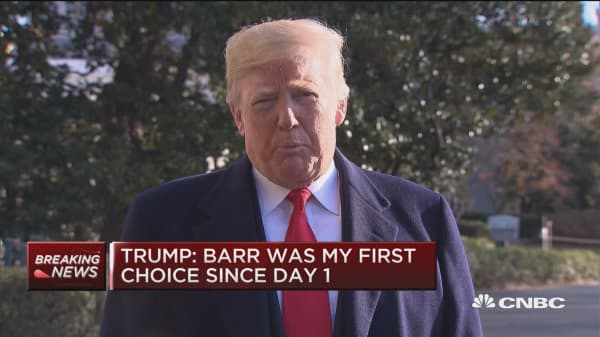
President Donald Trump announced Friday that he will nominate William Barr as attorney general.
Barr previously was attorney general during the administration of President George H.W. Bush.
Barr, who would succeed acting Attorney General Matt Whitaker, is "a terrific man, a terrific person, a brilliant man," Trump told reporters. The president fired AG Jeff Sessions in November.
President Donald Trump said Friday that he will nominate William Barr as attorney general — a position that Barr previously held during the administration of President George H.W. Bush.
Trump called Barr "one of the most respected jurists in the country, [a] highly respected lawyer ... a terrific man, a brilliant man."
"I think he will serve with great distinction," the president told reporters at the White House.
If confirmed by the Senate, Barr would take over leadership of the Justice Department from acting Attorney General Matt Whitaker.
Whitaker has been in that temporary role since last month when Trump effectively fired Attorney General Jeff Sessions.
President Donald Trump says he will nominate William Barr, former President George H.W. Bush's attorney general, to serve in the same role.
Trump has faced criticism ever since putting Whitaker in charge without getting Senate approval for him.
The temporary appointment also sparked worries that Whitaker would hamstring or even kill the ongoing investigation by special counsel Robert Muller into Russian interference in the 2016 presidential election and possible collusion by Trump's campaign.
Trump has repeatedly railed against that probe — most recently in a storm of angry tweets Friday morning. Trump had long been angry at Sessions for the appointment of Mueller as special counsel, which was set in motion when Sessions recused himself from the Russia investigation because of his own contacts with Russians during the presidential campaign.
Trump told reporters that he "did not know" Barr until recently, "when I went through the process of looking at people."
"He was my first choice, from day one, respected by Republicans, and respected by Democrats," Trump said. "He will be nominated for the United States attorney general, and hopefully that process will go very quickly and I think it will go very quickly."
"I've seen very good things about him, even over the last day or so when people thought [Trump's AG nominee] would be Bill Barr."
I am pleased to announce that I will be nominating The Honorable William P. Barr for the position of Attorney General of the United States. As the former AG for George H.W. Bush....
Barr, who was last attorney general from 1991 to 1993, currently is of counsel in the Washington office of the high-powered Kirkland & Ellis law firm.
A year ago, when The New York Times reported on Trump's call for the Justice Department to investigate supposed wrongdoing by 2016 Democratic presidential nominee Hillary Clinton, Barr said, "There is nothing inherently wrong about a president calling for an investigation."
"Although an investigation shouldn't be launched just because a president wants it, the ultimate question is whether the matter warrants investigation," Barr told the newspaper.
The Times reported at the time that Barr saw more reason to investigate Clinton's purported role in signing off on the purchase by Russia's atomic energy agency of a Canadian firm which holds a significant chunk of U.S. uranium production capacity than there was to probe possible coordination between the Trump campaign and Russia.
Barr also told told The Washington Post in November 2018 that, "I don't think all this stuff about throwing [Clinton] in jail or jumping to the conclusion that she should be prosecuted is appropriate."
"But I do think that there are things that should be investigated that haven't been investigated," he said.
In 2017, Barr was asked by the Post about Trump's claims that Mueller's team of prosecutors is biased because some of them had contributed to political campaigns of Democrats.
"In my view, prosecutors who make political contributions are identifying fairly strongly with a political party," he told the Post. "I would have liked to see him have more balance on this group."
Barr served in the CIA from 1973 through 1977. He later was on the White House domestic policy staff during the Reagan administration. He became an assistant attorney general in 1989.
After leaving the attorney general's post in 1993, Barr spent more than 14 years in top corporate legal positions, including as general counsel and executive vice president of Verizon Communications. He retired from Verizon in 2008.
I tried to tell Boo Boo Barr that is was not cool to promulgate the purveying and procuring of tiny humans, particularly by foreign corporations, but he did not want to listen to me.
It really does not matter because Trump was never duly elected, which means his appointment and confirmation was illegitimate, but, hey, what do I know?
The New York City Bar Association is calling on congressional leaders to launch an investigation into Attorney General William Barr, saying his public remarks threaten "public confidence in the fair and impartial administration of justice."
“These public statements by Mr. Barr also contravene the norms applicable to his office and warrant further investigation by Congress as part of an inquiry into Mr. Barr’s conduct as Attorney General more generally,” the group wrote in a six-page letter sent Wednesday to the top Democrat and Republican in each chamber.
Among the examples cited by the bar association was an October speech at the University of Notre Dame, posted on the Justice Department website, in which the attorney general said “the founding generation … believed that the Judeo-Christian moral system corresponds to the true nature of man” and that “Judeo-Christian moral standards are the ultimate utilitarian rules for human conduct.”
Other examples cited in the letter include a speech Barr gave at the Federalist Society’s National Lawyers Convention in November, when he allegedly “vilified progressives,” and an interview last month where he “rejected the inspector general’s findings, asserting instead that a separate ongoing investigation into the FBI’s actions that he personally had directed would likely reach a different conclusion.”
The Justice Department's inspector general released a report in December that found FBI agents were not motivated by political bias in opening investigations into associates of the Trump campaign in 2016. Barr later disputed some aspects of the report.
This is not the first time that the group has criticized Barr. In October, they called for Barr to recuse himself from a Justice Department review of the Trump administration's dealings with Ukraine.
Attorney General William Barr asked Speaker Nancy Pelosi (D., Calif.) if she brought "handcuffs" for him Wednesday at the Capitol, following her accusing him of lying to Congress earlier this month.
According to multiple reporters, Barr approached Pelosi following the National Peace Officers Memorial Service in Washington, shook her hand, and asked, "Madam Speaker, did you bring your handcuffs?" Pelosi smiled and said the House Sergeant at Arms was present if an arrest was necessary, to which Barr laughed and walked away.
Some congressional Democrats have called for Barr to be jailed after the House Judiciary Committee voted to hold him in contempt when he ignored a subpoena for the unredacted Russia report by Special Counsel Robert Mueller.
Attorney General Bill Barr spoke to House Speaker Nancy Pelosi in person today, after the National Peace Officers Memorial Service at the Capitol. A source close to Barr says he asked Pelosi if she had brought her handcuffs. There was laughter but no word on Pelosi's response.
Source confirms AG Barr approached @SpeakerPelosi at National Peace Officers Memorial Service, shook her hand + said loudly “Madam Speaker, did you bring your handcuffs?” Pelosi smiled and indicated to Barr the House Sergeant at Arms was present should an arrest be necessary.
Pelosi joked about the Capitol jail last week when asked whether Treasury Secretary Steven Mnuchin should be arrested for failing to hand over President Donald Trump's tax returns.
"Let me just say that we do have a jail down in the basement of the Capitol," Pelosi said. "But if we were arresting all of the people in the administration, we would have an overcrowded jail situation, and I’m not for that."
She stopped short of calling for Barr's jailing when she accused him of a crime, saying "there's a process involved here."
Barr, a proponent of executive power, has become the Democrats' top enemy in the Trump administration in the months following the conclusion of the Mueller investigation, with accusations that he whitewashed its conclusions to Trump's benefit. Barr also skipped a House Judiciary Committee hearing on the Mueller report a day after testifying in front of the Senate.
Once again, respecting the economy of your time, I have brought to you,in the spirit of fuchsia, my color commentary on the Senate Judiciary Confirmation Hearing of Bill Barr.
Please take notice that Chuck Grassley was looking quite dapper because he was letting the world know about his legacy as an old school civil rights dog, in his work on the False Claims Act, addressing Medicaid fraud in child welfare, in this hearing.
Grassley started slamming Bill Barr on the False Claims Act because it is his legacy, he introduced.
He grilled Barr on supporting the whistleblower cases, with specific reference to this case. It made me all warm and fuzzy because, basically, if Barr is confirmed as the U.S. Attorney General and dismisses the case, well, that would mean he lied to congress breaching the trust of this sworn office, which means I would just have to file up a quo warranto.
You can catch the historic FCA love starting @1:11:00
Lee is asking about the Ashcroft-Sessions policy of "most readily provable offense" policy of DOJ.
Barr is talking about sentencing guidelines, going back to what Grassley was talking about his previous position of support of the Crime Bill. Barr said he would defer to the Districts on prosecution decisions.
PART 2
Barr was asked about voting identification laws. He was good in his responses because this stuff is pending in lower courts, so he could not interject with specificity.
Sass is asking about child sex trafficking and the Jeffery Epstein no prosecution agreement without addressing his foundation research.
They asked him about 2016 election fraud investigation and releasing the documents after the committee reviews, redacts everything.
That sounds like they want to see if their name is in it so they can do a white out and not be prosecuted.
Immigration and undocumented individuals were raised but not one peep on SCOTUS DACA DAPA, well, because it is in the court and this is a congressional senate hearing
Not one word on foster care and adoption in the child trafficking on the southern border.
Detroit has a southern border, too.
Barr had to clarify that only congress makes law not policy.
Not one word on child welfare fraud but they did bring up Enron.
BB said he got 900 convictions on the Enron case, but nothing on the bigger scandals that went down. From there they went into the mortgage fraud and the creation of the toxic asset program without saying TARP, but asked if there was going to be prosecution on SEC fraud on the fake mortgages, bundling, you know, the stuff the Detroit Land Bank Authority did, but Barr did well in not commenting on pending grand jury actions in Detroit and Arkansas, and I mind as well throw in the Grand Rapids, Kent County Land Bank, and the Michigan Land Bank Fast Track Authority.
Barr said he would resign is he found out someone in stopped an investigation based on fraud which is honorable, or not, because he could function as a whistleblower.
Then there was border wall political blah, blah, blah that had no place to be put forth in this hearing.
They covered VAWA and it falling under jurisdiction of DOJ.
Then they went after Trump of what he knows and does based on media reports asking Barr to speculate on what Trump actually knows without seeing the documents.
He did say people who are accused, based upon public information like what Trump knows or is covering up, deserves due process.
He talked alot about due process.
Cory Booker asked about gay hate based on judicial morality but said nothing about chattel law because that is what all the labeling is about. I do not like Booker. He is a clown. He partnered with Betsy DeVos in privatized education enterprises. He kept talking about civil rights but has no idea that he was behind taking out the civil rights leader from congress. Yes, I said that. All that gay protection stuff is about pumping through more child welfare fraud programs layered with layers of administrations to steal more money and nothing about equal justice in holding these NGOs who push through divisive speech through law to keep people under their classification schemes for that crappy predictive modeling just to make money off the people they claim to help. Not impressed.
Watching parts of this hearing reminds me of each senator being assigned a specific area they will champion to keep their crap under cover in case Barr is appointed and decides to prosecute them.
Where is the substantive questioning?
Harris threw out the race card talking about voting rights but conveniently failed to mention anything about the DOJ election integrity investigations on the 2016 and 2018 elections because she is going to have some issues when it comes to her participation in violating the voting rights act.
Barr had to explain again that only congress makes law.
Hirono brought up election fraud and argued that there is no voter fraud going on, even in the absentee ballots, and asked if he would waste resources going after voter fraud that does not exist. Too bad she does not know about thee voter fraud in the absentee ballots like what they did in Detroit.
Blumenthal brought up Uranium One.
Barr called it pay for play and that it was put in
Huber's file to review. Interesting. He did say it was not handled properly.
Then Blumenthal brought up the Clinton Foundation.
Barr said he did not think he said the foundation should be criminally investigated and said it should be civilly investigated for tax fraud.
Blumenthal pulled up the emoluments case again, after Feinstein did earlier on anti-corruption.
Barr said, again, he has not looked into emoluments, which is Blumenthal's filing.
No one asked him about 911.
To honor the work of Grassley on his elimination of the government knowledge bar in the False Claims Act work in 1986, just in case the history is wiped because that seems to be a trend right now, I would like to introduce to you his advocacy for whistleblowers in Medicaid fraud.
Have no fear!
I found a way around that "government knowledge bar" by uncloaking the Meanies were mean to my Sweetie.
I also found out that Justice Clarence Thomas has a few issues that have never been addressed when it comes to Medicaid fraud in child welfare.
Have no fear, he will soon come to love me, just like John Roberts.
Can you say "constitutional crisis"?
I can.
Prepared Senate Floor Statement by Senator Chuck Grassley of Iowa
Chairman,
Senate Judiciary Committee
Interpreting the False Claims Act
February 13, 2018
Today I want to talk about some troubling developments in the courts’ interpretation of the False Claims Act. To understand these developments, we need to review a little history.
In 1943, Congress gutted the Lincoln-era law known as the False Claims Act. At the time, the Department of Justice said that it needed no help from whistleblowers to fight fraud. The Department said that if the government already knows about the fraud, no court should even hear a whistleblower’s case. So, Congress amended the False Claims Act to bar any whistleblower from bringing a claim if the government knows about the fraud.
That was a mistake.
The bar led to absurd results that only hurt the taxpayer. It basically meant that all whistleblower cases were blocked, even cases where the government only knew about the fraud because of the whistleblower.
In 1984 the Seventh Circuit barred the State of Wisconsin from a whistleblower action against Medicaid fraud. Wisconsin had already told the federal government about the fraud—because it was required to under federal law. So, because of the so-called “government knowledge bar,” whistleblower cases went nowhere and neither did prosecution of wrongdoers.
In 1986 I worked with my colleagues to make it possible for whistleblowers to be heard again. That included eliminating this so-called “government knowledge” bar. Since then, what the government knows about a fraud has still been used by defendants in False Claims Act cases, as a defense against their own state of mind.
Courts have found that what the government knows about fraud can undercut allegations that defendants knowingly submitted false claims.
The theory goes something like this: If the government knows about the defendant’s bad behavior, and the defendant knows the government knows, then the defendant did not knowingly commit fraud. Once you wrap your head around that logic puzzle, I’ve got another one for you.
In 2016, the question of what the government knows about fraud in False Claims Act cases began to take center stage once again. In Escobar, the Supreme Court rightly affirmed that a contractor can be liable under the “implied false certification” theory. That just means a contractor can be in trouble when it doesn’t make good on its bargain. And it doesn’t matter whether the contractor outright lies. A misleading omission of its failures is enough.
Unfortunately parts of the Court’s ruling are getting some defendants, and judges, tied in knots.
Justice Thomas wrote that the false or misleading aspect of the claim has to be material to the government’s decision whether to pay it. Thomas said that one of several ways you can tell whether something misleading is also material is if the government knows what the contractor is up to and pays the claim anyway.
At first glance, I suppose that makes sense. If someone gives you something substantially different in value or quality than what you asked for, why would you pay for it? But if the difference really isn’t that important, you might still accept it.
Even if that is true, the problem here is that courts are reacting the way they always have. They are trying to outdo each other in applying Thomas’ analysis inappropriately or as strictly as possible – to the point of absurdity. In doing so, they are starting to resurrect elements of that old “government knowledge” bar I worked so hard to get rid of.
This is what the Justice actually wrote:
“[I]f the Government pays a particular claim in full despite its actual knowledge that certain requirements were violated, that is very strong evidence that those requirements are not material. Or, if the Government regularly pays a particular type of claim in full despite actual knowledge that certain requirements were violated, and has signaled no change in position, that is strong evidence that the requirements are not material.”
He did not say that in every case, if the government pays a claim despite the fact that someone, somewhere in the bowels of the bureaucracy might have heard about allegations that the contractor may have done something wrong, the contractor is automatically off the hook.
Think about it. Why should the taxpayer pay the price for bureaucrats who fail to expose fraud against the government?
That’s why the False Claims Act exists, to protect taxpayers by rewarding whistleblowers for exposing fraud.
Justice Thomas said that the government’s actions when it has actual knowledge that certain requirements were violated are evidence of whether those requirements are material—or not.
What does it mean for the government to have actual knowledge? Would it include one bureaucrat who suspected a violation but looked the other way? Would that prove the requirement was material?
Courts need to be careful here.
First, this statement about government knowledge is not the standard for materiality. The standard for materiality is actually the same as it has always been. The Court did not change it in Escobar.
Materiality means “having a natural tendency to influence, or being capable of influencing, the payment or receipt of money or property.”
The question of the government’s behavior in response to fraud is one of multiple factors for courts to weigh in applying the standard.
Second, courts and defendants should be mindful that Justice Thomas limited the relevance here to actual knowledge of things that actually happened. There are all sorts of situations where the government could have doubts—but no actual knowledge of fraud.
Maybe the government has only heard vague allegations, but has no facts. Maybe the rumors are about something that may be happening in an industry, but nothing about particular false claims by a particular defendant. Maybe an agency has started an inquiry, but still has a long way to go before it’s finished. Maybe someone with real agency authority or responsibility hasn’t learned of it yet.
There are a lot of situations where the government might not have actual knowledge of the fraud.
Third, even if the government does pay a false claim, that is not the end of the matter. Courts have long recognized there are a lot of reasons why the government might not intervene in a whistleblower case.
And, there are a lot of reasons why the government might still pay a false claim. Maybe declining to pay the claim would leave patients without prescriptions or life-saving medical care.
Paying the claims in that case does not mean the fraud is unimportant. It means that, in that moment, the government wants to ensure access to critical care. That payment cannot, and does not, deprive the government of the right to recover the payment obtained through fraud.
Can you imagine if that were the rule, though? Can you imagine if providers could avoid all accountability because the government decided not to let someone suffer? Then fraudsters could hold the government hostage.
They could submit bogus claims all the time with no consequences because they know the government is not going to deny treatment to the sick and vulnerable.
That is just not what the False Claims Act says. Courts should not read such a ridiculous rule into the statute.
Fourth, courts should take care in reading into the Act a requirement for the government to immediately stop paying claims or first pursue some other remedy. There could be many important reasons to pay a claim that have nothing to do with whether the fraud is material.
Further, there is no exhaustion requirement. The False Claims Act does not require the government to jump through administrative hoops or give up its rights. And that would be an unreasonable burden on the government in any event.
We have decades of data showing that the government cannot stop fraud by itself. I also know from many years of oversight that purely administrative remedies are very time consuming and often toothless.
The government should be able to decide how best to protect the taxpayers from fraud. The FCA is the most effective tool the government has. The government should be able to use it, without the courts piling on bogus restrictions that are just not in the law.