
Meet Hermann Gemeiner and the WW II history behind Lebensborn, or Kinderdorf, or rather SOS Children's Villages.
This is the origin of Child Protective Services, Foster Care & Adoption.
In order to properly celebrate Child Abuse Propaganda Month, one must become acquainted to the historical concepts of christian chattel law and its usage.
Yes, that is correct, Child Abuse Propaganda came our of Nazi Germany to cover up their experiments with children, which are in full force today, through the U.S. child welfare system which has dominated the world in the industry of trafficking tiny humans and maximizing revenues.
 |
| https://www.sos-kinderdorf.de/portal |
Hillary Rodham Clinton isn't the only one who thinks it takes a village to raise a child.
In Austria, where a woman was jailed recently for severely abusing her children, the four young sisters and their brother were sent to a new community and given a new home - complete with a foster mother.
Their destination was an SOS Children's Village, one of 343 such communities around the world set up by SOS Kinderdorf International, based in Innsbruck, Austria. The largest private children's charity in the world, it was originally created to provide homes for orphans. Today, most of its charges in Western Europe are victims of abuse and neglect.
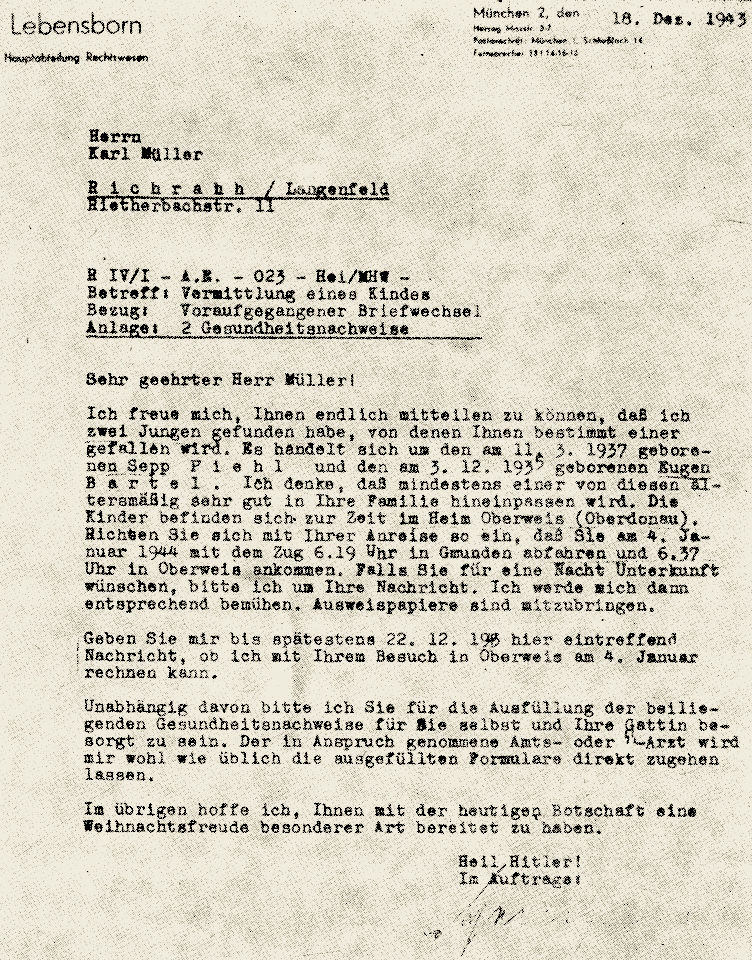 |
| The First CPS Foster Care and Adoption Program |
The idea behind the villages is to give at-risk children the next-best thing to a natural family. Children get long-term care from well-trained adults in a stable environment. Sixty percent of SOS kids have siblings, and the organization makes every effort to keep them all under one roof.
Virtually all the children still have natural parents and many have some contact with them. And because SOS Kinderdorf puts a premium on community, the villages - which look like a middle-class neighborhood - allow for easy integration into the surrounding area through activities and educational or recreational facilities.
Large families
Ingeborg Neumann cares for two boys and four girls between the ages of 8 and 12. Their home is nestled on a hillside in the Vienna Woods in a community of 27 other SOS homes. Two of the girls are sisters.
During a recent visit, Christmas preparations were well under way in the living room, obviously the center of family life, with a homemade Advent wreath already in place in the center of the table.
important for the children to have the experience of birthday celebrations and Christmas because many of them haven't had the chance to have celebrations in their previous homes," Ms. Neumann says.
Neumann says she likes what she does. Since becoming a SOS mother 3-1/2 years ago, her conviction has grown that she made the right decision in exchanging her office job for a life of caring for children. And it's quite obvious that her two young sons, who came running in from school for lunch, love her.
While single-mother parenting is often viewed as less than ideal, SOS Kinderdorf International
generally seeks out only single women to serve as SOS mothers, and has done so since its inception. Single parents are considered less likely to have to leave the family for reasons ranging from a spouse's job relocation to divorce.
| "He alone, who owns the youth,gains the future." |
But according to Richard Pichler, the organization's secretary general who was raised in an SOS children's village himself, finding candidates is not easy. Even in the early 1950s, when many war widows applied, there was a screening process to make sure that they knew what they were getting into.
"It has never been easy to find good mothers for SOS Children's Villages," Mr. Pichler says "They have to know that it isn't only honey, but that there are rainy days too for an SOS mother."
But, Pichler says, there is a new generation of women, particularly in Europe, who consciously decide to live a single life and want to be SOS mothers. "Single-parent raising of children is very much accepted in society today. Even though the background of SOS mothers has shifted, the desire to be mothers is still the same," he says.
A network of support
One reason SOS villages are often successful, Pichler says, is that they offer the parents a strong network and plenty of support.
The whole community is there to help mothers and their children. SOS mothers are also provided with special training before they establish their new families. There is always an SOS substitute mother who can step in so SOS mothers can have a weekend off or take a vacation. If something in the home needs fixing, an SOS employee is there to take care of it. Children with special needs have access to trained counselors and therapists. Staff members are trained to guide the mothers through particular problems the children may have. And most important, many of the pressures that other single mothers struggle with alone are shared in the villages.
SOS Children's Villages are traditionally headed by male directors who, in addition to running the day-to-day business, also serve as father figures. But times are changing, and a woman director was appointed recently for an Austrian SOS village. Male employees are trained to be positive male role figures for SOS children, helping them with their schoolwork, taking them on excursions, or just being there when the children need a guy to talk to.
The criticism most often directed at SOS Kinderdorf is the perceived weakness of its single-women-only policy. Critics suggest that more male contact is necessary for a child to develop fully.
However, Pichler says, "I had ample male contacts when I was growing up in my SOS family, so it was not a problem for me." In addition to his village director, he had contact with male teachers, male staff members, and his older SOS brothers.
He acknowledges that it is not a perfect arrangement. "We cannot say we are ideally copying the natural family. We have to be realistic and say there are limitations," he concedes. "We know it is not the ideal situation. The ideal situation is adoption or something like that. But in the broad framework, with about 4,500 SOS families worldwide, the most feasible way is with a mother. A single mother."
Helping orphans
Mr. Gmeiner started small. He and a few friends pooled their resources to build five houses for 40 children in the Austrian village of Imst. By 1952, Gmeiner already had 15,000 people contributing one schilling a month (about 4 cents at the time).
Those 15,000 grew to 1 million individuals by 1959, who, through their small donations, built 10 villages caring for 1,000 children. SOS Kinderdorf was on its way.
Other villages were quickly established in Austria, and, beginning in 1956, in Germany. From there, the idea spread throughout Europe. In 1963, the first SOS village in the developing world was established in the Republic of Korea followed by ones in India and the Philippines.
Many countries have used SOS Kinderdorf as a model for their own child-care facilities. India, for example, stated a few years ago that all future work for the placement of children should follow the SOS Kinderdorf village model.
SOS eventually moved beyond just building villages to set up schools. Children from surrounding neighborhoods could also attend, which built stronger ties between SOS kids and their neighbors. SOS has expanded as well into job-training programs, and opened a college in Ghana in 1990. In 1996, 185,000 young people were cared for in a variety of SOS facilities.
Looking back
Theresia Neubauer, who lives in an SOS village with other retired mothers, was one of the first to answer Gmeiner's call for SOS mothers in the early 1950s. She was 25 years old then. In her time, SOS mothers took care of nine to 12 children each.
"Larger families were easier to care for since the older children could help," Ms. Neubauer says. "And children were not so troubled."
The majority of children Neubauer and the other SOS mothers cared for then were orphans. They hadn't been rejected or abused by their natural parents as is more often the case today.
All together, Neubauer raised 32 children and now enjoys ties with 40 grandchildren and eight great-grandchildren. "I never thought of what I did as a job. It was my calling," she says.
Borgwarner Becomes Global P... by on Scribd
Voting is beautiful, be beautiful ~ vote.©


