Showing posts sorted by relevance for query SOS Children's Villages. Sort by date Show all posts

Monday, April 8, 2019

Meet Hermann Gemeiner - Founding Father of SOS Children's Villages - Lebensborn - Happy Child Abuse Month

Meet Hermann Gemeiner and the WW II history behind Lebensborn, or Kinderdorf, or rather SOS Children's Villages.

This is the origin of Child Protective Services, Foster Care & Adoption.

In order to properly celebrate Child Abuse Propaganda Month, one must become acquainted to the historical concepts of christian chattel law and its usage.

Yes, that is correct, Child Abuse Propaganda came our of Nazi Germany to cover up their experiments with children, which are in full force today, through the U.S. child welfare system which has dominated the world in the industry of trafficking tiny humans and maximizing revenues.


Logo of the SOS Children's Village eV
https://www.sos-kinderdorf.de/portal
Started in 1949 for orphans, SOS Kinderdorf builds communities around the globe that give foster kids a stable home and long-term parent

Hillary Rodham Clinton isn't the only one who thinks it takes a village to raise a child.

In Austria, where a woman was jailed recently for severely abusing her children, the four young sisters and their brother were sent to a new community and given a new home - complete with a foster mother.

Their destination was an SOS Children's Village, one of 343 such communities around the world set up by SOS Kinderdorf International, based in Innsbruck, Austria. The largest private children's charity in the world, it was originally created to provide homes for orphans. Today, most of its charges in Western Europe are victims of abuse and neglect.
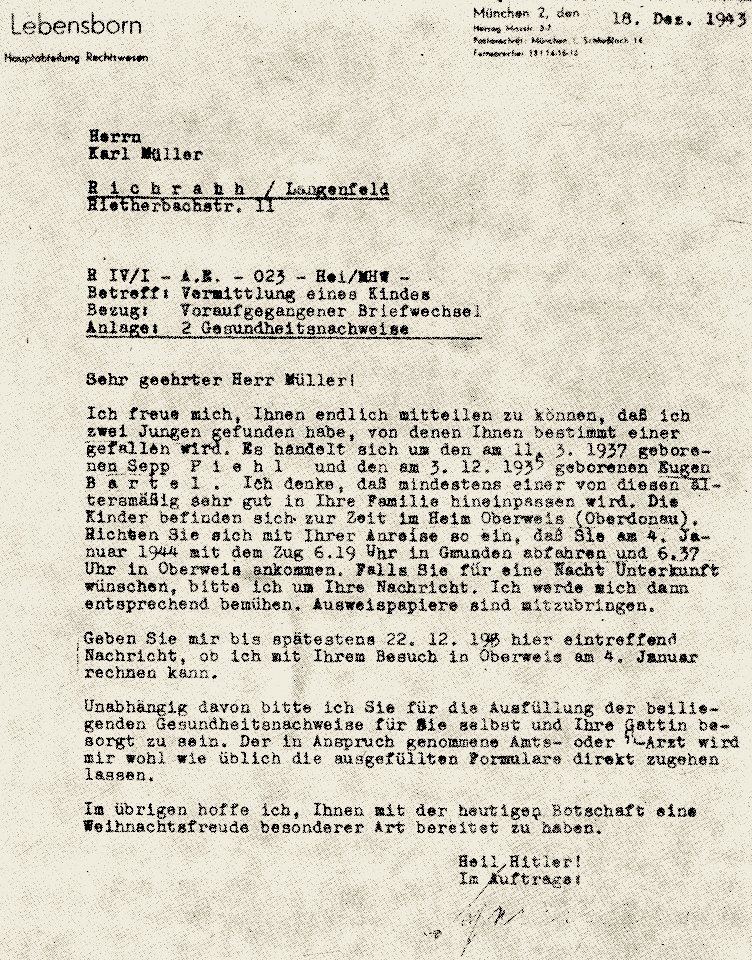
Lebensborn document 1.jpg
The First CPS Foster Care and Adoption Program
The five siblings, like 30,000 other children in 125 countries, joined a small neighborhood of 10 to 20 houses. In Europe, each house is headed by an SOS mother who cares for six to eight children. She performs all the tasks mothers take care of in the normal course of a day: scheduling, cooking, washing, helping with homework, and generally acting as a loving guide. And she does it long term.
The idea behind the villages is to give at-risk children the next-best thing to a natural family. Children get long-term care from well-trained adults in a stable environment. Sixty percent of SOS kids have siblings, and the organization makes every effort to keep them all under one roof.

Virtually all the children still have natural parents and many have some contact with them. And because SOS Kinderdorf puts a premium on community, the villages - which look like a middle-class neighborhood - allow for easy integration into the surrounding area through activities and educational or recreational facilities.

Large families
Ingeborg Neumann cares for two boys and four girls between the ages of 8 and 12. Their home is nestled on a hillside in the Vienna Woods in a community of 27 other SOS homes. Two of the girls are sisters.

During a recent visit, Christmas preparations were well under way in the living room, obviously the center of family life, with a homemade Advent wreath already in place in the center of the table.
 important for the children to have the experience of birthday celebrations and Christmas because many of them haven't had the chance to have celebrations in their previous homes," Ms. Neumann says.

Neumann says she likes what she does. Since becoming a SOS mother 3-1/2 years ago, her conviction has grown that she made the right decision in exchanging her office job for a life of caring for children. And it's quite obvious that her two young sons, who came running in from school for lunch, love her.

While single-mother parenting is often viewed as less than ideal, SOS Kinderdorf International
Image result for lebensborn
"He alone, who owns the youth,gains the future."
generally seeks out only single women to serve as SOS mothers, and has done so since its inception. Single parents are considered less likely to have to leave the family for reasons ranging from a spouse's job relocation to divorce.

But according to Richard Pichler, the organization's secretary general who was raised in an SOS children's village himself, finding candidates is not easy. Even in the early 1950s, when many war widows applied, there was a screening process to make sure that they knew what they were getting into.

"It has never been easy to find good mothers for SOS Children's Villages," Mr. Pichler says "They have to know that it isn't only honey, but that there are rainy days too for an SOS mother."
But, Pichler says, there is a new generation of women, particularly in Europe, who consciously decide to live a single life and want to be SOS mothers. "Single-parent raising of children is very much accepted in society today. Even though the background of SOS mothers has shifted, the desire to be mothers is still the same," he says.

A network of support
One reason SOS villages are often successful, Pichler says, is that they offer the parents a strong network and plenty of support.

The whole community is there to help mothers and their children. SOS mothers are also provided with special training before they establish their new families. There is always an SOS substitute mother who can step in so SOS mothers can have a weekend off or take a vacation. If something in the home needs fixing, an SOS employee is there to take care of it. Children with special needs have access to trained counselors and therapists. Staff members are trained to guide the mothers through particular problems the children may have. And most important, many of the pressures that other single mothers struggle with alone are shared in the villages.

SOS Children's Villages are traditionally headed by male directors who, in addition to running the day-to-day business, also serve as father figures. But times are changing, and a woman director was appointed recently for an Austrian SOS village. Male employees are trained to be positive male role figures for SOS children, helping them with their schoolwork, taking them on excursions, or just being there when the children need a guy to talk to.

The criticism most often directed at SOS Kinderdorf is the perceived weakness of its single-women-only policy. Critics suggest that more male contact is necessary for a child to develop fully.
However, Pichler says, "I had ample male contacts when I was growing up in my SOS family, so it was not a problem for me." In addition to his village director, he had contact with male teachers, male staff members, and his older SOS brothers.

He acknowledges that it is not a perfect arrangement. "We cannot say we are ideally copying the natural family. We have to be realistic and say there are limitations," he concedes. "We know it is not the ideal situation. The ideal situation is adoption or something like that. But in the broad framework, with about 4,500 SOS families worldwide, the most feasible way is with a mother. A single mother."
Helping orphans

Mr. Gmeiner started small. He and a few friends pooled their resources to build five houses for 40 children in the Austrian village of Imst. By 1952, Gmeiner already had 15,000 people contributing one schilling a month (about 4 cents at the time).

Those 15,000 grew to 1 million individuals by 1959, who, through their small donations, built 10 villages caring for 1,000 children. SOS Kinderdorf was on its way.

Other villages were quickly established in Austria, and, beginning in 1956, in Germany. From there, the idea spread throughout Europe. In 1963, the first SOS village in the developing world was established in the Republic of Korea followed by ones in India and the Philippines.

Many countries have used SOS Kinderdorf as a model for their own child-care facilities. India, for example, stated a few years ago that all future work for the placement of children should follow the SOS Kinderdorf village model.

SOS eventually moved beyond just building villages to set up schools. Children from surrounding neighborhoods could also attend, which built stronger ties between SOS kids and their neighbors. SOS has expanded as well into job-training programs, and opened a college in Ghana in 1990. In 1996, 185,000 young people were cared for in a variety of SOS facilities.

Looking back
Theresia Neubauer, who lives in an SOS village with other retired mothers, was one of the first to answer Gmeiner's call for SOS mothers in the early 1950s. She was 25 years old then. In her time, SOS mothers took care of nine to 12 children each.

"Larger families were easier to care for since the older children could help," Ms. Neubauer says. "And children were not so troubled."

The majority of children Neubauer and the other SOS mothers cared for then were orphans. They hadn't been rejected or abused by their natural parents as is more often the case today.

All together, Neubauer raised 32 children and now enjoys ties with 40 grandchildren and eight great-grandchildren. "I never thought of what I did as a job. It was my calling," she says.


Voting is beautiful, be beautiful ~ vote.©

Saturday, January 5, 2019

Cocktails & Popcorn: Day 93.1 Paul Whelan's Sniper Kids - Related To His Iraq Days? - 4 Passports - SOS Children's Villages Trafficking Tiny Humans Of BorgWarner

I wonder if Michelle Obama is going to speak out.

Probably not, there is no money involved.

FAMILY FUN DAY IN POLAND

Family Fun Day in Poland
SOS Children's Village RZESZÓW, POLAND
Over 50 grade school kids from the local SOS Children’s Village had the time of their lives during BorgWarner’s Family Fun Day in Poland. A total of 1,800 employees, family members and guests enjoyed food, games, slides, shows, horse riding and dancing. It was a wonderful opportunity to get to know the kids on a personal level. The event was another example of Turbo Systems’ partnership with SOS Children’s Villages around the world.


http://www.freepatentsonline.com/y2015/0240834.html?fbclid=IwAR02TwMlipQH6zOW_7igesI9x1nU2CyvYtZ3hqkZb4SkbKODxS_nFzJ1Yu4

https://caselaw.findlaw.com/ak-supreme-court/1109237.html?fbclid=IwAR2xXk1_k-0eAkDrnMhwkm0K3WX7GpWg8O6ugsm8FBk3ckV1TV7MeHJg1bg

Accused American ‘spy’ in Russia has 4 passports

American Paul Whelan, arrested in Moscow and accused of espionage, has in addition to his American passport one from Britain, Canada and Ireland, Whelan’s brother said Friday.

“As for his international connections, our family spans continents, and Paul’s four passports reflect his birth (Canada), parents (Britain), grandparents (Ireland) and choice (United States),” David Whelan wrote in an Op-Ed in The Washington Post.

In the Op-Ed Whelan called on President Donald Trump and lawmakers to “pressure Russia for [Paul Whelan’s] immediate release.”

“Paul is a kind and considerate brother, son and uncle, and a generous and loyal friend. He travels as often as he can, both for work and pleasure. He is many things to many people, but he is not a spy,” David Whelan wrote.

The revelation of Whelan’s passports issued by multiple Western nations further complicates an already complex situation for the 48-year-old. Whelan was arrested by Russian security services on Dec. 28, according to a Dec. 31 statement from the FSB, successor to the KGB. The FSB said Whelan was caught engaging in espionage activity, and unverified Russian news reports further alleged he had for years been involved in spying and was arrested in his hotel room in Moscow with a secret list of Russian government personnel.

Whelan’s family maintains his innocence and said he was only in Moscow for a wedding. A Russian attorney currently representing him also denied the allegations.

Former intelligence officials told ABC News they view the Russian claims with deep skepticism and said Russia might have detained Whelan in an act of “reciprocity” for the arrest of Russian agent Maria Butina in the U.S. One former senior CIA official, Steven Hall, said the fact that Whelan may hold multiple passports doesn’t suggest anything nefarious and said many people have multiple passports for perfectly legitimate reasons.

Whelan is employed as head of security at the international auto parts firm BorgWarner based in Michigan, a spokesperson for the company said. Military records show he served as a Marine from 1994 to 2008 when he received a bad conduct discharge for attempted larceny and other charges. 

Whelan was found guilty of stealing more than $10,000 while deployed to Al Asad Base in Iraq and, around the same time, bounced nearly $6,000 worth of checks, according to military records.

British Foreign Secretary Jeremy Hunt told Sky News Friday that Britain is “giving [Whelan] every support we can, but we don’t agree with individuals being used in diplomatic chess games.”


“Because it is desperately worrying, not just for the individual but their families, and we are extremely worried about him and his family as we hear this news,” he said.

A British official told ABC News the U.S. Embassy in Moscow alerted the British Embassy Thursday that Whelan had a British passport.

The Canadian foreign ministry said today that consular assistance is being provided by their nation as well, “and we are in contact with local authorities to gather further information.”

Whelan was visited in detention in Moscow Wednesday by U.S. Ambassador Jon Huntsman. Thursday, Secretary of State Mike Pompeo told Newsmax the Trump administration is "doing everything we can to make sure [Whelan is] treated appropriately and that we get the information we need."

The CIA and the White House have declined to comment on the case.

“We urge President Trump to intercede on Paul’s behalf,” David Whelan wrote. “U.S. government action will reinforce that Americans traveling abroad should not do so in fear, and ensure other American families are less likely to have their loved ones go missing.”

UPDATE: The page became a 404 just minutes after this post. That means they love me!

https://cdn.borgwarner.com/docs/default-source/press-release-downloads/borgwarner-becomes-global-partner-of-sos-childrens-villages.pdf?sfvrsn=2973c23c_2

The acronym 'GmbH', which is written after the name of a German company, designates it as a private entity. The letters stand for Gesellschaft mit beschränkter Haftung which, translated literally, means a 'company with limited liability'.  (a.k.a.  Corporate Shape Shifter).

Voting is beautiful, be beautiful ~ vote.©

Saturday, June 13, 2020

Prelude To Detroit: Will Paul Whelan Do Hard Labor Or Will Pompeo Continue To Cloak CIA Trafficking Tiny Humans Operations?

SOS Children's Villages: A Family For Every Child - The Holy ...
SOS Children's Villages
Paul Whelan is about to do hard labor in a Russian prison camp.

I bet that sucks.

Mike Pompeo wants Paul to come home.

I bet that will suck for Pompeo when Paul comes home due to the fact that we are dealing with stealin' the children, land & vote because the CIA is the one who crafted the U.S. Child Welfare System.

I just do not understand how people so readily forget that Pompeo was running in the aeronautics industry before he got a law license, long before he was appointed by Trump to be CIA Director, which means he already knows what is going on with Whelan.

According to Wikipedia:
In 1998, Pompeo moved to Wichita, Kansas, where he and three other West Point friends, Brian Bulatao, Ulrich Brechbuhl, and Michael Stradinger, acquired three aircraft-part manufacturers there (Aero Machine, Precision Profiling, B&B Machine) and in St. Louis (Advance Tool & Die), renaming the entity Thayer Aerospace after West Point superintendent Sylvanus Thayer.[23][24][25] Venture funding for the private organization included a nearly 20% investment from Koch Industries [26] as well as Dallas-based Cardinal Investment, and Bain & Company (Brechbuhl worked for Bain at the time).[27][23] Brechbuhl and Stradinger left the company shortly after it was founded, but Pompeo and Bulatao continued.

In 2006, he sold his interest in the company, which by then had been renamed Nex-Tech Aerospace, to Highland Capital Management, which had clients including Lockheed Martin, Gulfstream Aerospace, Cessna Aircraft, Boeing, Spirit AeroSystems and Raytheon Aircraft.[28] Pompeo then became president of Sentry International, an oilfield equipment manufacturer that was also a partner of Koch Industries.[29]

In 2017, when Pompeo became head of the CIA, he named his former business partner, Brian Bulatao, the agency's chief operating officer.[24]
Then, this happened....

Pompeo denies impropriety in firing of State Dept. watchdog


Mike Pompeo is from Kansas, the very same state which hosts the fake ass foreign money laundering National Alliance of Children's Trust & Prevention Funds for all the States, which started in Detroit, where Sam Brownback is running the international ops for Faith Base Funding through USAID.

But, hey, what do I know?

I know this happened....

Prelude To Detroit: The Unholy Alliance Of Bill Barr, Mark Esper & Mike Pompeo Falsely Advise Trump To Block ICC War Crimes Prosecutions Of Afghanistan Trafficking Tiny Humans

I know we are in Detroit because it all started in Detroit.

Michigan man to be sentenced in Moscow, faces 18 years in labor camp

After nearly 18 months in prison, Michigan's Paul Whelan is expected to be sentenced Monday in Moscow as his espionage trial there concludes.

Prosecutors are seeking up to 18 years in a labor camp, which Whelan's family and attorneys consider particularly harsh, Whelan's twin brother David said.

Whelan, 50, of Novi has maintained his innocence. His attorneys pressed for acquittal.

His family doesn't really know what’s going to happen Monday, but they expect Whelan will be automatically convicted under Russia's justice system, which involves no due process. A conviction in Russia, David said, means the defendant didn't confess.

"I’m concerned and anxious for Paul. No one wants to be sentenced to 18 years, even if it’s for show. He is the one who will face going to a labor camp in 30 days," David said. "But I really am very hopeful that finally that’s out of the way."

The family is eager for the verdict because that means Whelan can finally move to the next step, where diplomats become heavily involved.

The Russian foreign ministry has indicated during the last year its interest in trading the American for certain Russian prisoners or for access to diplomatic properties the they've been denied access to in New York and Maryland, David said.

"Conviction is a necessary occurrence, so that Paul can then be considered in that potential for whatever concession the Russian government is looking for," David said.

"The sentence is almost immaterial because we don’t want him to have any of the sentence over there. It’s much more about getting past this procedural milestone, so on the government-to-government side they can have discussions about some sort of future exchange."

Paul Whelan, who grew up in Ann Arbor, was arrested in December 2018 in a Moscow hotel room and charged with espionage, which carries up to 20 years in prison in Russia.

The former U.S. Marine was director of global security for auto parts supplier BorgWarner in Auburn Hills and was visiting Moscow for a friend's wedding, according to his family.

He has denied being a spy and urged President Donald Trump to intervene, telling reporters in Moscow that a Russian friend in law enforcement planted a hard drive on him without his knowing.

Russian media reported during the trial that Paul believes Ilya Yatsenko, an FSB agent, set him up to avoid repaying a $1,400 loan to Paul, David said. The FSB is the successor agency to the communist KGB secret police.

In prison, Paul was denied treatment for a painful hernia that worsened and led to emergency surgery two weeks ago. He was transferred back to Lefortovo prison the next day, David said.

U.S. lawmakers and diplomats have repeatedly urged Russia to send Paul home, criticizing the fairness of the judicial process, the lack of evidence against him and the conditions in which he's been held.

“We ... call on Russia to do the same for Paul Whelan, who needs to be released now," Secretary of State Mike Pompeo told reporters Wednesday in Washington.

Ryan Fayhee, the Whelan family's attorney, has said Paul doesn't fit the profile of a spy, as the U.S. government wouldn't send someone to engage in intelligence gathering without diplomatic cover.

It's unclear why Paul was arrested — whether it was carefully orchestrated or was the product of negligence, said Fayhee, who worked in the Justice Department's counter-espionage section.

"What is clear is that Paul is not a spy and that he has subsequently been held, isolated from his family and subjected to a secret 'trial' that will lead to its forgone conclusion," Fayhee said Friday.

"This has all been done to seek some advantage or to extract some benefit from the U.S. government, as has been made quite clear time and again openly by Russian officials."

As a matter of policy, U.S. officials have necessarily been deferential to the Russian judicial process, Fayhee said, but once there is a conviction that deference will cease on both sides.

"And so, optimistically, Paul’s family very much hopes that with Paul’s conviction, a more intensive political process can begin after 18 long months," Fayhee said.

"We hope and expect, come Monday, the full court press will begin. ... We look forward to the coming engagement, whatever it brings."

Voting is beautiful, be beautiful ~ vote.©

Saturday, January 30, 2016

Marie Cohen Is A Classic Example Of A Chattel Hustler

I came across this particular piece, under child welfare, of by this former child welfare worker,

Marie K. Cohen
— Marie K. Cohen
This is the comment I left because I am quite sure she will not approve my comment:
This has to be one of the most convoluted, contrite proposals I have seen in a long time. I would prefer applying the term "ass-backwards" but that would be redundant, considering the fact that this comes from the mouth of a former child welfare worker who is poorly attempting to find her way back into the industry with a made up authority.
Seriously, you wish to promote legislation to pay someone else a substantial living wage to raise kids whose original parents have had their kids removed for living in poverty, and suffering the ills of such.
In short, this is nothing but a roadmap to selling chattle. 
The reason the Families First Act disregards foster care shortage is because it is designed to help families, you know, not use foster care because it does not work and is too expensive.

This is why the act is focused on home based, community based services, not, institutional.

It is a bill to keep families together.

This is the mentality which keeps poverty codified as a crime.

I guess she did not read my congressional testimony on this.

This woman is nothing more than a chattel hustler.

Families First Act Disregards Foster Care Shortage, Need for Some Group Homes

Congress appears to be on the right track with child welfare reform, as evidenced by a summary of the new Families First Act, which may soon be marked up by the Senate Finance Committee. The centerpiece of the legislation is the expansion of Title IV-E to provide preventive services to assist children in danger of being placed in foster care.
With the passage of this legislation, federal funding will support keeping children at home as much as it does foster care. It is a change that almost everyone seems to support.
The other major part of the legislation, however, is not without controversy. That is the part that seeks to eliminate most federal support for foster care group homes.
The legislation eliminates funding for placements that are not foster family homes after two weeks, with three exceptions: Qualified Residential Treatment Programs (QRTP’s), facilities for pregnant and parenting teens, and independent living arrangements.
The definition of QRTP has not been released, but it appears that Congress has in mind the types of arrangements that are currently known as residential treatment programs, which are large institutions where clients attend school and receive mental health treatment.
I have several concerns with this provision.
First, the bill fails to recognize the need for a continuum of care depending on the child’s needs. Such a continuum should include family foster care, therapeutic foster care, therapeutic community group homes and residential treatment centers. A child who leaves residential treatment is not necessarily ready for a foster family, and a child who can’t function in a family may not need a residential treatment program. What’s missing from the options provided by the new bill are therapeutic group homes, such as those operated by Boys Town, using the evidence-based Teaching Family model.
Secondly, the bill contains no provisions to increase the supply of high-quality foster care to meet the needs of all the children who will need to be accommodated when group homes close down. Today, there is a critical foster care shortage around the country, with children staying in offices, hotels and emergency shelters because foster homes are not available to them.
To make matters worse, many existing foster homes provide care that is neglectful or even abusive. As a former social worker with District of Columbia foster children, I have writtenabout neglectful foster parents. There was the foster parent who hadn’t been to her foster child’s school in more than a year, and refused to pick her up even when she was vomiting. There was the foster parent who refused to go to a meeting at her foster child’s school, saying, “If I cared I would go, but I don’t care.”
I asked my agency to close these homes, but the request was not granted. With the shortage of foster homes, agencies are reluctant to close homes that are anything short of abusive. And even in the case of abusive homes, we have all heard the stories of children who have been killed or injured in foster care.
Sometimes, as in the case of two-year-old Laila Marie Daniel in Georgia, it turns out that agency staff disregarded multiple reports of trouble in the home. I’m sure that the critical shortage of foster parents is part of the explanation.
Abusive and neglectful foster homes need to be closed, but they must be replaced and added to with a new source of high quality foster homes. How can this be done? The only way is to pay foster parents enough so that one foster parent in each home can stay home with the children, thus attracting a completely new source of foster parents.
In an earlier column, I wrote about the SOS Children’s Villages in Illinois and Florida. They not only pay foster parents a salary but provide houses large enough for six children. The provision of housing is particularly important in order to attract foster parents to cities with high housing costs, where many foster kids live.
Paying foster parents a full-time salary is an expensive proposition. But this expense can be offset by recruiting foster couples (either married couples or two single people living together as house parents) to care for five or six children. By locating them in communities like those provided by SOS Children’s Villages or the Mockingbird Society, foster parents can be empowered to help each other, and services to the children can be provided on site.
It would be irresponsible for Congress to pass the Families First Act without provisions for a therapeutic option between foster homes and residential treatment and for increasing the supply of quality foster care. The Senate Finance Committee should modify its bill by adding a provision for short-term therapeutic group homes and by providing new funding and incentives to encourage states to improve the quantity and quality of their foster homes.

Voting is beautiful, be beautiful ~ vote.©

Friday, November 4, 2016

Wikileaks Uncovers Child Trafficking In Haiti


Snatching children from the poor who traditionally hail from the nations of "darker persuasions" in the name of God is just the oldest form of survival.

The proper term of snatching kids from parents is called "termination of parental rights" for "abuse and neglect" which are in the "best interests of the child", just because they are poor.

This is foster care.

Welcome to the unraveling of child welfare fraud, not just in Haiti, not just in the U.S., but the entire world.

This is the Clinton Global Initiative.

This is the Adoption and Families Safe Act.

This is privatization.


https://wikileaks.org/gifiles/docs/32/323249_-os-haiti-us-legal-adviser-to-u-s-haiti-missionaries.html


Four women suspected of being involved in an illegal adoption scheme are being held at behind bars at Port-au-Prince
Four women suspected of being involved in an illegal adoption scheme
are being held at behind bars at Port-au-Prince

We found Benatide's mother high up a mountain in a tiny house with half the roof ripped off by the earthquake and scrawny chickens pecking in the dust under a fierce Haitian sun.

For longer than she cares to remember, it has been a struggle to keep her three children on the few pounds a week she makes from selling vegetables which grow on the scrap of land surrounding her home.

But now Adrienne Poulime has one less mouth to feed.


Ten days ago she gave away her youngest daughter, 12-year-old Benatide, to a group of American Baptists who promised to give her a better life abroad by finding a Christian family to adopt her.

'There was nothing left for the girl here after the earthquake last month,' says Adrienne simply as she sits on a pile of rubble, overlooking the country's devastated capital, Port-au-Prince, below in the valley. 'Benatide's school has shut down.

'We didn't have enough food to put on the table for everyone. It was bad in Haiti before the earthquake - now it's far worse. I let her go because I hoped that one day she would do well and come back and help the family.'

She clasps the hands of her other children, Alain, 18, and daughter, Carline, 21, as we talk of Benatide, who is now living at the international SOS children's refuge 20 miles away from her family's village of Calebasse.

She was taken there by Haitian police the Friday before last, just after she and 32 other children - including 19 from her village - were discovered being spirited out of the country by the Baptists from churches in Idaho, Utah and Texas.

On Thursday, the five men and five women Baptists, led by a 40-year-old Idaho businesswoman called Laura Silsby, were charged with child abduction and criminal conspiracy. If convicted, they face lengthy terms in a Haitian prison.

Benatide Poulime, 12, is one of the Haiti 'orphans' taken by a group of American Baptists
Benatide Poulime, 12, is one of the
Haiti 'orphans' taken by a group of baptists
Meanwhile, the children remain at the refuge - and have not been returned to their homes while an investigation goes on into their parents' decision to give them up.

The authorities, growing increasingly alarmed at the numbers of Haitian children disappearing overseas, want to find out if they were coerced into handing them over or did so willingly.

Since the earthquake on January 12, 300 children have been given to new families in the U.S., Canada and the Netherlands. More adoptions are in the pipeline, many arranged by orphanages in Haiti. It is estimated that 7,000 children could leave the country over the next year. 

In many of the cases, the adoptive parents have not met the children before choosing them - they have simply picked them from photographs.

To speed up the adoptions, the White House has approved a fast-tracking system to relieve Haiti's orphanages, which are overflowing with parentless and lost children since the earthquake.

Arrests
Laura Silsby, left, and Charisa Coulter, pictured \
after they were arrested trying to cross into the
Dominican Republic with a busload of 33 children
Once children arrive in America and are introduced to their family at the airport, they are taken to special centres where lawyers are on hand to complete adoption papers in a process that can take just half an hour.

And, of course, there is no shortage of youngsters available. It is estimated that 300,000 children in Haiti lost one parent, or both, in the earthquake.

A large number of Haiti orphanages were also destroyed, leaving a shortage of beds for orphans who now wander the streets in the devastated city, adding pressure to ramp up the foreign adoptions. To increase the problem, plenty of parents like Adrienne believe sending their children abroad from one of poorest countries in the world is the best gift they can give.

Meanwhile, child traffickers have begun to operate in Port-au-Prince. They are plucking children from the streets or smuggling them out of orphanages, before offering them to foreigners for as little as £65.

Haitian social workers and international aid organisations fear that many will be sold into paedophile rings in Europe and America, or be traded into domestic slavery in the third world.
The result of all this is that Haiti is haemorrhaging its young. It is a sad postscript to the tragedy, in which 200,000 people were killed as houses, supermarkets and entire shopping streets crumbled to the ground.

Thousands upon thousands of those made homeless are still living in tented towns in the city, including one in the garden of the presidential palace.

Yet despite the new vulnerability of these children, Heather Paul, the international head of the charity SOS Children's Villages, which runs the refuge now caring for Benatide, says foreign adoptions should be only a last resort when 'every effort has been made to reunite a child with relatives or provide suitable care in Haiti'.

She added: 'Sometimes Americans think that children are better off in a middle-class environment than being with their own family because they are impoverished. I don't believe that. Children love their own families.'

That is certainly the case with Benatide. When I met her at the refuge, she whispered to me: 'I want to go home. Please tell them to come and get me.' After all, this family has been through a lot together.
When the earthquake struck, they ran in horror from their house and scrambled up the steep path to the main road that leads to Port-au-Prince. There, they watched as buildings all over Calebasse began to crumble.

Seven of the 33 children taken by the missionaries. Authorities believe none of the children were in fact orphans
Seven of the 33 children taken by the missionaries. Authorities
believe none of the children were in fact orphans
Only later, when it had got dark, did the Poulime family dare walk back down to see the damage. The kitchen and the bedrooms had all disappeared. A crack six inches wide snaked down the wall at the front. The tin roof had lifted off and only one room was left intact.

However, Benatide's family got on with their lives. That was until ten days later when the U.S. Baptists arrived at Calebasse and began knocking on doors. They handed out flyers saying they wanted to 'help children who have lost their mother and father in the earthquake or have no one to love and care for them'.

The flyers said, inaccurately, that the group had the Haitian government's permission to take 100 children abroad to the Dominican Republic, which shares a border with Haiti.

They said they had an orphanage in a former seaside hotel where the children would have a school, football pitch and even a swimming pool.

Laura Silsby, who set up a U.S. charity called New Life Children's Refuge to help Haitian children the instant the disaster struck, has said from her prison cell in Haiti that adoption was not in her mind when she trawled the earthquake zone for children.

She says she intended to help 'only those children that needed us most, that had lost either both their mother and father, or had lost one of their parents and the other had abandoned them'.

But, revealingly, the mission statement of her New Life organisation specifically says its purpose was to get Haitian children for adoption in the U.S.. Some parents of the 33 children were told that living in the Dominican Republic would be a first step towards their offspring going to new families in America.

Furthermore, far from being orphans, the Mail has been told that none of the 33 children are parentless or abandoned. All of them have a mother or father - often both, including Benatide, whose farmer father is working elsewhere in Haiti, but returns home to visit the family.

Whatever the Baptist group's exact motives, one of their persuasive flyers ended up with Adrienne Poulime.

'It made me want the best for the children. Alain and Carline were too old to go - that meant it had to be Benatide. We talked about it in the family for about a week. Then I told the Baptists I wanted her name put on their list. I explained it to Benatide and she was very excited.'

So on the Thursday before last, she walked to the waiting bus with her daughter. Benatide had only the clothes she was wearing. Her seven-year-old cousin Alantina was also on the bus. With her hand in her pocket, Benatide held on to a piece of paper on which her brother Alain had written his mobile phone number.

In front of Benatide on the bus were the daughters of Lely Laurentus - Soraya, four, and Leila, five, who had grown up in Calebasse, too.

The earthquake had left the family homeless, and Lely thought this was a chance to give them a new start. He admits the two girls were too young to understand what was happening.

But, he says, solemnly: 'I didn't want them to suffer anymore. I didn't pack any of their things, not even their teddy bears. The American woman said she had enough clothes, toys and snacks for the children. I trusted her because she said they were going to a better place. My last words to my children were: "Please remember me."'

As the bus moved away, one little girl, ten-year-old Loundiny Jovan, was near to tears. She called out to her mother Melanie through the window: 'Bye-bye and please pray for me.' Then they were gone.
It was 24 hours later, the Friday before last, that the Poulime family heard on the radio that a busload of Haitian children had been stopped at the border. It turned out the Baptists had no documentation for the children and had breached an order that children going overseas for adoption must receive written permission from the prime minister.

Next morning, Benatide rang her brother Alain. She said three police vans had picked the children up from the border and driven them back to Port-au-Prince, where she had spent the night at the SOS village.

This week Georg Willeit, an SOS worker who welcomed the children there, said they are emotionally traumatised from their experience.

One boy has told staff he will never go back to his mother because she gave him away. Another girl talks repeatedly about the bus journey, before bursting into tears. As for Benatide, a lot of the time she stays silent and deep in thought. Every day, she begs to make a call to her brother.

How long it will take her and the others to recover, no one knows. As Mr Willeit says: 'The children must be made to feel safe again. They need a routine with care and attention given to them. They know they were given away by their mothers or fathers.

'They will not forget that for a long time, if ever. They should grow up in Haiti knowing their own roots and customs with family members around. They ought not be sent to live in another country.'
Of course, not everyone would agree with him. The arrested Baptists refuse to admit they did anything wrong.

Laura Silsby, who runs a personal shopping company and has a chequered financial history, is scheduled to appear in front of a U.S. judge in an unfair dismissal case involving one of her former employees this week. But she will not make that date, as she remains locked up in a squalid, mosquito-ridden jail on the island until the case against her, and her fellow Baptists, is heard.
The situation is viewed so seriously by the Americans that former President Bill Clinton, now a United Nations special envoy, has arrived in Haiti to negotiate a solution.

Most of the Baptists charged worship at the Central Valley Church in Meridian, Idaho, where the pastor Clint Henry says their motives were 'upright and pure'.

Many religious organisations are at work in Haiti, including many fundamental Christian ministries such as the Church of Jesus Christ of Latterday Saints, run by the Mormons, who have paid for flights to airlift children from Port-au-Prince to America.

Roman Catholic churches have also taken Haitian children - some toddlers in nappies - to the U.S..
Up to 300,000 children are believed to have been orphaned by the Haiti quake


They are feeding an insatiable demand for children from white American families with a conservative Christian outlook. The U.S. churches operate hand-in-hand with hundreds of Haiti orphanages, many of which are run by like-minded pastors. The deal is simple: the orphanages provide the children, and the churches provide the parents.

The result is that the vast majority of Haitian children are going to families in Bible-belt states. The phenomenon has led to extraordinary scenes at Miami airport, which is where many first meet the children.

The adoptive parents start screaming, then hugging, kissing and crying over their new children, who often look bewildered as they are handed Mickey Mouse dolls and bags of popcorn as welcome presents.

With so many children involved, things go wrong. After one airlift to Miami, five children were traumatised when no parents turned up to meet them. And in another case, a threeyearold boy was left in tears after his adoptive parents changed their mind at the last minute about having him. He is now in the care of American social services.

Many think the real purpose of the fundamentalists' involvement in the huge-scale adoptions is religious conversion. Some families have taken four or five children.

Certainly, the literature of His House, a large Christian orphanage in Miami which is coordinating adoptions, says it aims to turn children into 'Christ-like beings'.

Others question whether black children from a Caribbean island should be adopted at all by white parents who know little about the children's culture and cannot speak their languages, French and Creole.

Many predict there will be enormous difficulties within the 'ready-made' families as time goes on, even though many Haitian children have the same religious background.

But Iris Marrero, the director of His House in Miami, which at 600 miles away is the closest point in America to Haiti, insists there is nothing sinister about the adoptions.

Staff at His House have matched 150 Haitian children to American families in the past two weeks. One night, a plane arrived from Port-au-Prince at midnight in Miami and all 90 children on board had been formally adopted by 5.30am. 'I pray that their families will love them for ever,' Mrs Marrero told the Mail earnestly.

As for Benatide, her future is yet to be decided. With the other 32 children, she is now in limbo at the SOS refuge.

SOS Children's Village www.soschildren.org

Adrienne is unrepentant about giving her daughter away. When I ask her if she would do it again, she answers quickly in a quiet voice: 'Yes, of course, and so would you if your child lived in Haiti.'


Voting is beautiful, be beautiful ~ vote.©