Showing posts sorted by relevance for query duggan. Sort by date Show all posts

Wednesday, March 18, 2020

Will The Ghost Of Patrick Duggan Haunt Mike Duggan For What He Did To Detroit?

Legacies are important and should never be bleachbitted.

Mike Duggan's father's decisions may set case precedent to hold those accountable for what was done to Detroit.

Retired senior judge Patrick J. Duggan, father of Detroit mayor, dies

Patrick J. Duggan
Patrick Duggan
Retired senior U.S. District Judge Patrick J. Duggan, the father of Detroit's mayor, has died, the city announced Wednesday.

Duggan, 86, passed away at 4:30 a.m. Wednesday at Angela Hospice in Livonia following a lengthy illness. He was surrounded in his final days by his wife, four sons, daughter-in-law and 13 grandchildren, the family said.

Duggan, who was nominated in 1986 by President Ronald Reagan, retired as a federal judge in 2015 after three decades on the bench. His son, Mike Duggan, is serving his second term as Detroit's mayor.

The judge was known for his relentless pursuit of dispensing justice equally regardless of status and his strong value for family, son Tim Duggan told The Detroit News.

"I couldn't feel more blessed that I had him as an example as a dad," said Duggan, 53, of Ohio, Duggan's youngest son and his father's "stated favorite."

"Honestly, I don't know how he did it. He managed to be at home at dinner every night and coach Little League team when doing all the other things he was doing," he added. "As important as his legal career was, nothing ever came before the family."

Mike Duggan, the city said Wednesday, had spent the last few weeks splitting his time between work and Livonia, spending time with his father and other relatives, in some cases multiple times per day.

Patrick Duggan was a Wayne County judge for 10 years prior to moving to U.S. District Court beginning in 1977, following an appointment to the position in 1976 by Gov. William Milliken.

He was officially appointed to the U.S. District Court in October 1986 and assumed judicial service in January 1987, according to the court's website.

Prior to his federal appointment and time on the bench in Wayne County, he'd been a senior partner at Brashear, Brashear, Mies and Duggan, a private law firm in Livonia.

Duggan was born Sept. 28, 1933. His father, Patrick J. Duggan Sr., left the family farm in Kilkenny, Ireland, at the age of 18 to come to Detroit.  His mother, Mabel Kelly, was the daughter of Irish and German immigrants who also made Detroit their home, according to an obituary prepared by the family.

Duggan grew up on Detroit's east side and attended St. Clare de Montefalco Elementary School, then De LaSalle High School.


In 1951, he left to earn an undergraduate degree at Xavier University in Cincinnati, Ohio. He worked his way through school, first as a loader at a nearby dairy and then for the U.S. Postal Service, his family said. He graduated in 1955 with a bachelor's degree in economics.

He then returned to Detroit and completed his juris doctorate at the University of Detroit School of Law.

Among his federal cases, Duggan sent former Detroit Red Wings player Bob Probert and ex-Detroit Tiger pitching great Denny McClain to prison.

The judge in 1997 handed down a sentence of more than eight years to McLain for raiding raiding the pension fund of his former company and putting it out of business.

In deciding the sentence, Duggan had agreed with prosecutors that McLain should be held to a higher "public trust" standard.

As an owner of Peet Packing Co., McLain misused pension funds, driving the company into bankruptcy. He spent the pension money to pay personal debts and luxuries for himself that included a motorcycle and condominium in Puerto Rico."It was this abuse of trust that significantly facilitated the crime," Duggan said during McLain's sentencing.

Other cases he's known for, family noted, include a ruling against the Oakland University after a student with intellectual disabilities was denied the right to live in a student dorm there. The decision "allowed Mikah Fialka-Feldman his rightful place – in school and in society," the family said.

A 2000 ruling in favor of the University of Michigan’s use of affirmative action in its admissions process made its way to the United States Supreme Court.  Duggan ruled that diversity could be considered a compelling government interest — a principle that the Supreme Court eventually affirmed.

Senior U.S. District Judge Avern Cohn first met Patrick Duggan while he was city attorney for Livonia and Cohn was practicing law.

“We developed a friendship that continued through his service on the Wayne County Circuit Court and his appointment as a judge of this court," Cohn said in a statement provided by the court. "He was always calm, thoughtful and fair minded. Absent from his makeup was any prejudice or bias. We will all miss him.”

Chief U.S. District Judge Denise Page Hood added Duggan was "fair minded and respected the law."

"He had a good sense of judges as a group and I valued his opinion on issues facing our court and judges," she said. "He saw many changes in the law and society during his judicial tenure."

Hewas a past president of the Livonia Bar Association, a trustee of the board for Madonna University in Livonia and a teacher in its paralegal program. Earlier on, he held roles as a past president of the Michigan Jaycees and a chairman of the Livonia Family YMCA.

In retirement, Duggan enjoyed more time with family, as well as Joan, his wife of 63 years, whom he called "my best friend, my supporter through all things, and the most important person in my life.”

Duggan will be buried at Parkview Memorial Cemetery in Livonia in a private family service. A public memorial celebration of his life will be held later this year when the health risks associated with the coronavirus have eased, the city added in a statement.

He was preceded in death by parents Patrick and Mabel Duggan; sisters Margaret Duggan, Mary Cassabon and Kay Murray; and son Robert Duggan. He is survived by his wife Joan; son Michael; son Daniel and his spouse Sharlene; son James and his spouse Stephanie; and son Timothy and his spouse Albina; thirteen grandchildren; three great grandchildren.

Voting is beautiful, be beautiful ~ vote.©

Sunday, August 6, 2017

Part 1: Duggan’s formidable political machine relies on deep-pocket outsiders

This is a quote taken from the Motor City Muckrucker article, below:

" many of whom have contracts with the city or bought Detroit-owned property in the past three years."

I believe it should read:


"have contracts with or bought Detroit Land Bank Authority owned property" because the Detroit Land Bank Authority is not part of the City of Detroit as they are creditors in the Detroit Chapter 9 bankruptcy, have no corporation filings with the State of Michigan, and filed no corporate interest disclosures with the Courts.


Detroit Mayor Mike Duggan. Photo by Steve Neavling.

Mayor Mike Duggan has built a formidable political fundraising machine unlike anything Detroit has ever seen. 

The first-term mayor raised a whopping $2.8 million for his re-election bid, courting big banks, suburban developers, corporate executives, political action committees and other deep-pocket movers-and-shakers, many of whom have contracts with the city or bought Detroit-owned property in the past three years.

Wow, considering the rate of child poverty in Detroit, I guess he would have to fundraise outside the city limits.

By comparison, his challengers raised a mere $44,300 combined, giving Duggan a significant money advantage going into Tuesday’s primary election. But the mayor’s fundraising prowess raises serious questions about his influence with outsiders who don’t always have Detroit neighborhoods’ best interests at heart or who have contributed heavily to Republican candidates, including Donald Trump, Gov. Rick Snyder and the Michigan Republican Party.

Something tells me Coleman knows something about something that is going to happen and will not have to raise a single penny for his campaign to be successful.

Motor City Muckraker review of Duggan’s latest campaign finance report, which covers $1.6 million in donations from November 2016 to July 23, found: 
  • Just 10% of the mayor’s donations came from inside Detroit. Of those, nearly half came from political action committees.
  • Twelve of Duggan’s 26 fundraisers were held outside of Detroit, including two in New York City, three in Bloomfield Hills, one in Grand Rapids and one in Lansing.
  • Duggan’s most successful fundraiser was held at the sprawling home of Yousif and Mara Ghafari, both of whom have histories of donating tens of thousands of dollars to the Michigan Republican Party and conservative candidates, including Donald Trump, Gov. Snyder, George W. Bush and Mitt Romney.
  • An unusual number of employees from deep-pocket companies contributed to Duggan’s campaign, including more than 150 from Blue Cross Blue Shield, 119 from the law firm of former Detroit Mayor Dennis Archer, 30 from DTE and 43 attorneys from Honigman Miller Schwartz and Cohn. Two Blue Cross employees said they felt pressured to donate.
  • Miller Canfield Paddock and Stone, the law firm representing the mayor’s controversial demolition program, which is under a federal grand jury investigation, donated $26,600. The firm’s PAC also donated $10,000 in October 2016.
  • Duggan relied heavily on suburban billionaires and their companies, including Dan Gilbert’s Quicken Loans, Roger Penske and his businesses, the conservative DeVos and Meijer families and Tony Soave, who gave former Mayor Kwame Kilpatrick’s friend, Bobby Ferguson, $30 million in work from 2002 and 2008 and spent an additional $300,000 on Kilpatrick for private flights, hotels, watches and sporting events.
  • Two high-ranking Snyder employees – senior adviser Richard Baird and former Chief of Staff Dennis Muchmore – both donated to Duggan and were influential in the financial takeovers of primarily black cities.
  • Since Duggan became mayor in January 2014, he raised an additional $433,000 through his controversial nonprofit, Detroit Progress Fund, which can take unlimited contributions. A vast majority of the donors are corporations, many of which have contracts with the city.
Duggan’s campaign declined to comment on the outside donations but insisted the mayor was running a “grassroots campaign.”

I wonder if Motor City Muckrucker asked the Detroit Land Bank Authority about its participation in the campaign.

“Mayor Duggan has been running a grassroots campaign from the beginning and will continue to do so,” said campaign spokeswoman Sharon Banks, who also served as the press secretary for then-Wayne County Executive Robert Ficano. “He is across the city every day visiting and meeting with residents in the neighborhoods. The more than 10,000 families with a sign in their yard is a good sign that they believe the city is headed in the right direction.”

I believe "grassroots" means what is left of the properties that were stolen from the people by the Detroit Land Bank Authority.


Sen. Coleman Young II. Photo by Steve Neavling.

Duggan’s most competitive challenger, Sen. Coleman Young II, who raised $22,000 so far, criticized the mayor for relying on big banks and corporate outsiders who have preyed on the neighborhoods.

"Always remember, it takes a village...then pillages its treasury."

Duggan has aligned himself with those who have made millions and millions of dollars off the misery of folks who live in Detroit,” Young’s campaign manager Adolph Mongo told us. “None of these corporations care about the revival of the neighborhoods. The banks, Quicken Loans and people like Dan Gilbert are the direct cause of the problems and foreclosures in the neighborhood.”

I believe the proper corporate reference would be Title Source, Incorporated.

Mongo added, “Unlike Duggan, Sen. Young refuses to be bought off and won’t sell the mayor’s office to get donations.”

While Duggan is leading Young in recent polls, serious questions have been raised about the mayor’s loyalty to neighborhoods, where most of the city’s predominately black population lives. Duggan, for example, is demolishing thousands of houses with federal money originally intended to help people save their homes. The mayor also repeatedly lied to the public about the use of $34.5 million in captured taxes to convince billionaire Tom Gores to move the Pistons to downtown Detroit. He also struck deals with the billionaire Illitch family and Dan Gilbert, allowing them to skirt affordable housing requirements for big residential developments in downtown and the rapidly gentrifying Cass Corridor.

Guess where the money for these project came from!  You, the taxpayer.

Among the biggest contributors to Duggan’s campaign was Blue Cross Blue Shield, which has lucrative contracts with the city. More than 150 employees and executives donated nearly $70,000 in the past several months, and the insurance company’s Lansing-based PAC contributed more than $75,000 to Duggan’s campaign and his Detroit Progress Fund.

I bet if you back track, the Clinton Foundation will be his biggest, dark, dirty money campaign contributor.


Blue Cross CEO Daniel Loepp

Blue Cross CEO Dan Loepp urged more than 1,000 employees to donate to Duggan’s campaign in March, potentially violating the company’s own code of business conduct, Crain’s Detroit Business reported. A day later, members of the company’s PAC received an email from Duggan’s campaign asking for money.

Blue Cross prohibits the use of “company property, facilities or time of any other workforce member for any political activity.”

Two Blue Cross employees, who spoke on condition of anonymity for fear of losing their jobs, told Motor City Muckraker they felt pressured to donate.

“If you want to climb up the ladder, you do what the CEO wants,” one employee said.

Hmmmm, I wonder what Bill Schuette is doing right about now....


Yousif Ghafari

Duggan’s most successful fundraiser – in which $277,000 was donated – was held on June 19 at the sprawling Bloomfield Hills home of Yousif and Mara Ghafari, who are deep-pocket donors to Republican candidates. Yousif Ghafari, the former U.S. ambassador to Slovenia, also sits on the Blue Cross Blue Shield Board of Directors.

The Ghafari family owns Ghafari Associates, which opened an office in downtown Detroit earlier this year. Wayne Count successfully sued the Dearborn-based company for its role in the failed jail project.

I wonder what his federal contracts were for.

Out-of-state donations
Duggan received 56 donations exceeding $1,000 from out-of-state residents, including six executives from JPMorgan Chase, which reached a $55 million settlement with the government in January over allegations that it discriminated against thousands of black and Latino mortgage borrowers.

Many of the out-of-state donations came during two fundraisers in New York City. Duggan raised $31,519 on the 20th floor of 277 Park Avenue, where JP Morgan Chase’s world headquarters are.
Duggan raised an additional $15,150 at a $1,000-a-plate fundraiser at Shinola’s flagship store in the Tribeca neighborhood of Manhattan.

Banks, through the Detroit Land Bank Authority, hand out mortgages through the Hardest Hit Fund.

Another company that profits off of foreclosures, Ohio-based Safeguard Properties, also donated to Duggan’s campaign. Founder and chairman Robert Klein and his wife Ita Klein each contributed the maximum $6,800. The company clears out bank-foreclosed homes.

...and clears out Detroit Land Bank Authority Quiet Title Actions.

Detroit donations
More than two dozen executives with Detroit-based Quicken Loans, which the federal government also accused of predatory lending, contributed nearly $73,000 to Duggan’s re-election campaign. In early July, a federal judge ruled that Quicken Loans officers brokered illegal loans in excess of fair market value by relying on excessive home appraisals.

Title Source, Incorporated was fraudulently collecting non-existent, made up, delinquent taxes for Detroit Land Bank Authority because the Detroit Land Bank Authority is not a registered corporation, which means it has to run its money laundering through another host.


Dennis Archer Jr.

Former Detroit Mayor Dennis Archer and his son Dennis Archer Jr. turned out big for Duggan. Archer Jr., who won at least two competitive land contracts from the Duggan administration, was a guest speaker at the Shinola fundraiser in New York City. He and his company, Ignition Media Group, donated $14,000 to Duggan’s Detroit Progress Fund.
Archer’s father held a fundraiser for Duggan at the former mayor’s home in Palmer Park, where 29 guests donated a combined $49,240. Archer’s law firm, Dickinson Wright, also held a fundraiser at the company’s office in downtown Detroit, raising $10,850. A total of 115 employees of Dickinson Wright donated to Duggan’s campaign.

Oh, DJ...

On Monday, Motor City Muckraker explores how Duggan spent his donations and ran his campaign.
Motor City Muckraker is an independent watchdog funded by donations. To help us cover more stories like this, please consider a small contribution.

Sitting on the edge of my seat!

http://motorcitymuckraker.com/2017/08/06/part-1-duggans-formidable-political-machine-relies-deep-pocket-outsiders/

Voting is beautiful, be beautiful ~ vote.©

Friday, August 30, 2019

Cocktails & Popcorn: WXYZ Found The Detroit Development Fund But Forgot To Ask Who Owns The Patent

Much love to WXYZ, except Carolyn Clifford, because she does not remember Father Michael Winkowski from the Archdiocese of Detroit.

Elizabeth Warren said really dumb things about Detroit and his Detroit legacy, but it was for the purposes of stealin' more from the people of Detroit under the reparations banner of a #coloredrevolution because they stole all the TARP money and want to steal more children, land and votes.

But, I digress.

Someone should ask Mike Duggan about those child welfare NGOs that like to do stuff with tiny humans like preterm births and infant mortality.

Someone should ask him who owns the patent because it looks like it is possibly the land patent to the City of Detroit, courtesy of the Detroit Land Bank Authority, but, hey, what do I know?

Duggan once ripped ‘secret funds.’ Today, he ducks questions about his own.

'Progress Fund' has spent $750,000 in secret since '14


DETROIT (WXYZ) — Detroit Mayor Mike Duggan refuses to disclose how a non-profit set up “to promote the City of Detroit’s turnaround” has spent $750,000 since 2014.

His decision, allowable by the IRS, stands in stark contrast to a 2013 promise Duggan made while running for mayor, vowing that he would have “no part in a secret fund when I’m elected.”

But in 2014, shortly after Duggan took office, the Detroit Progress Fund was created to “assist the Office of the Mayor on expenditures necessary to conduct the business for the City but for which there are no funds available in the City budget.”

The fund summarizes its expenses in broad categories, like spending more than $16,000 last year on “meals,” nearly $34,000 on “community outreach” and more than $41,000 on “travel.”

Fund administrator Abbey Dinsmore, who is also a fundraiser for Duggan's mayoral campaign, says the Progress Fund has been used for things like flying in job candidates from out of state and helping put on an annual dinner during Ramadan.

“We are following the law, we are disclosing everything the IRS requires that we disclose to the IRS,” Duggan said when questioned by 7 Investigator Ross Jones earlier this month.

Unlike many similar non-profits, the Detroit Progress Fund discloses its donors quarterly or bi-annually. But expenses have remained a secret and, as Duggan points out, the IRS doesn't require funds to disclose them publicly.

History of controversy

Duggan is hardly the first Michigan politician to be associated with a non-profit 501(c)(4) like the Progress Fund. Over the years, a number of elected leaders have come under fire over how their non-profits spent money.

Former Detroit Mayor Kwame Kilpatrick insisted his Kilpatrick Civic Fund was in complete compliance, saying in 2001: “We’ve done all the paperwork, followed every rule, every regulation from the IRS.”

But reporters and eventually federal prosecutors would reveal that the Civic Fund was used to pay for things like Kilpatrick’s lavish family vacations, golf clubs and even yoga lessons.

Ex-Governor Rick Snyder said his NERD Fund was acting above board, saying in 2012 that “there’s nothing that exciting about it. We’re just following the rules and moving ahead.”

But the fund was ultimately closed after reporters learned it was paying Snyder’s top aide, Rich Baird, a salary of $100,000 from donors who were unknown.

Former Wayne County Executive Robert Ficano ran into trouble with his non-profit, the Wayne County Business Development Corporation, when it was revealed by 7 Action News to have paid his economic development czar a secret $75,000 annual bonus, paid in part by county contractors.

“Government doesn’t always run best on ‘trust me,'” said Peter Henning, a former federal prosecutor who today is a law professor at Wayne State University.

“That’s the key to government is transparency,” he said. “That we know this much is coming in and here’s what it’s being spent on.”

'Erodes confidence in government'

Henning isn’t alone in cautioning public officials from using secret funds as an extension of government. Duggan himself spoke out against them in 2013 when he was a candidate for mayor.

In an interview on Channel 7, Duggan was asked specifically about non-profit funds that got Kilpatrick, Snyder and Ficano into trouble.

“You’ll notice in this campaign, I did not create one of those funds,” Duggan said. “I had advisers telling me, let’s create secret funds where you don’t know the donors. I said absolutely not, I’m not going to participate in that. I think it erodes confidence in government, and I’m going to have no part in a secret fund when I’m elected.”

Earlier this month, Duggan was asked by 7 Action News about his change in heart.

“I didn’t change my mind,” Duggan said. “The issues were raised about people not disclosing their donors. We have disclosed our donors from the beginning,” he said.

“As you know, these funds have been abused, from Kilpatrick to Ficano to Snyder for how they've been spending money,” said Channel 7’s Ross Jones. “And the question is, if you have nothing to hide, why not show us exactly how it’s being spent?”

“There has been no suggestion of anything wrong,” Duggan said.


Close ties to Mayor

The Detroit Progress Fund is overseen by a board of five, but neither Duggan nor the fund's spokesman will say who selected the board members. All of them have ties to Duggan or his campaign.

Jonathan Quarles is the chairman of the Progress Fund’s Board. In 2014, he was appointed by Duggan to the city's Economic Development Corporation board.

Trunetta Roach, the Progress Fund’s treasurer, is the wife of Duggan’s spokesman John Roach. Campaign records show that she's donated $1,000 to Duggan’s campaign.

Attorney Thomas Bruetsch also sits on the board. In 2013, he represented Duggan in his fight to stay on the mayoral ballot. He's also donated nearly $2,500 to Duggan’s campaign.

Board member David Katz is one of Duggan’s longtime friends, having worked with him since his days in Wayne County government. Katz donated more than $10,000 to Duggan’s campaign.

In addition to serving on the Progress Fund’s board, Tatiana Grant also worked to help get the mayor elected. Records show that her company, Infused PR, has been paid more than $43,000 by Duggan’s campaign.

Fund spokesman Mario Morrow called the board “very competent people” and said their past history with Duggan doesn’t influence their judgment.

“They all seem to be pretty close to the mayor,” said Channel 7’s Ross Jones.

“This is a small town,” Morrow said.

#sayhisname


Voting is beautiful, be beautiful ~ vote.©

Tuesday, January 30, 2018

Bill Clinton Said Duggan More Powerful Than Putin - My Personal Notes

This a factual statement.

Rip, "The Rip-Off" Rapson concurs.


Detroit bankruptcy DIA http://artvest.com/


Duggan's power now rivals Putin, Bill Clinton jokes

June 12, 2015

Former President Bill Clinton heralded Detroit's turnaround after the Motor City's exit from a record setting Chapter 9 bankruptcy restructuring — and jokingly compared the city's mayor to Russian leader Vladimir Putin.

At a Clinton Global Initiative event Wednesday in Denver, Clinton held a panel discussion with Detroit Mayor Mike Duggan, Kresge Foundation president and CEO Rip Rapson and a Detroit business owner, April Anderson, who owns Good Cakes and Bakes on Livernois.

During the nearly 40-minute discussion on neighborhood revitalization, Clinton said that being mayor of Detroit could be America's "most coveted municipal job" — and noted that with the Detroit land bank, much of the city's 139 square miles is controlled by the city.

Detroit's 2013 bankruptcy restructuring allowed Duggan to "basically become the most powerful municipal official in the country. He controls over half the land mass in the city of Detroit now. He's making old Putin look like a piker — and people actually like (Duggan)," Clinton said to laughter, according to video of the event posted online by the Clinton Foundation.

Rapson said Duggan may not live that image down: "That's a great image. I like to think of Mayor Duggan as our Mayor Putin. That's terrific. I think that's going to stick," Rapson said.

The city owns nearly half the city's property, Duggan said, or about 40,000 vacant parcels. Clinton compared Detroit to the "Homestead Act" in 1862 that convinced Americans to help settle the west by offering them free land. Duggan didn't directly respond to the Putin comparison.

Kresge was one of the nonprofits that helped Detroit exit bankruptcy more quickly by contributing to a fund that saved city-owned art at the Detroit Institute of Arts from being sold and defrayed pension losses for retirees.

Clinton praised the city's revitalization, but noted that the city lost 60 percent of its population since the 1950s — and is down a quarter since 2000.

Duggan, 56, said that he is focused on boosting the population — and has said he wants to be judge when he is up for re-election if the city is growing again. Detroit has lost population for every year that Duggan has been alive.

"You can drop Manhattan, Boston and San Francisco in the city of Detroit boundaries — and still have room left over," Duggan said. The real challenge is revitalizing the neighborhoods after the dramatic turnarounds in downtown and midtown, he said.

Duggan said there are 5,000 new housing units under construction in Detroit. Duggan said he is working to sell the 40,000 vacant houses in the city. The city is auctioning three homes a day. On Tuesday, three homes sold for a total of $100,000, Duggan said.

Duggan noted that the city is offering to allow homeowners to buy next door vacant lots for just $100. The city is now also offering to lease vacant land if the neigbhorhood association signs off on the use — such as a playground or urban farm.

During the event, Duggan said Clinton is the single biggest customer of Detroit watchmaker Shinola. Clinton bought customized watches for the Secret Service agents on his security detail that featured the presidential seal as Christmas presents.

Voting is beautiful, be beautiful ~ vote.©

Sunday, May 5, 2019

Cocktails & Popcorn: Butch Hollowell Is Definitely Going To Have Some Serious Attorney Client Privilege Immunity Issues When It Comes To The Detroit Elections Commission

"I did not interfere in any elections...or money laundering."
Ah, I remember when I first sprinkled magical stinky dust over the Hamtramck Board of Elections and the Wayne County Election Commission......

I bet Butch remembers, too.

Someone should ask him or we could just follow the campaign contributions.

Election commission rules Duggan recall petition can proceed


Detroit — The Wayne County Election Commission on Thursday signed off on a recall petition filed by a west side resident hoping to mount a campaign to oust Mayor Mike Duggan.

The petition, brought by activist Brenda Hill, was filed on April 22 with the Wayne County Clerk's Office. In her petition, Hill cites an investigation into whether the city gave favor to a nonprofit dedicated to preventing premature births and the mayor's alleged ties to the doctor who heads it.

The Election Commission, comprised of Wayne County Probate Court Chief Judge Freddie G. Burton Jr., Wayne County Clerk Cathy M. Garrett and Wayne County Treasurer Eric Sabree, signed off on the clarity of Hill's petition. It is now fit for gathering signatures. The mayor's legal counsel has the option of challenging the ruling.

Hill contends Duggan "has no respect for citizens" and that he should be "very afraid."

"This specifically has brought to the forefront his ability to have relationships and use the city's taxpayer money in relation to an employee ... to get grants for this person and to fundraise as well," Hill said. "We're going to sit down and discuss some strategy. We have 180 days to do what we're going to do."

Gary Gordon, an attorney for the Dykema law firm representing Duggan at the hearing, argued that Hill's language was "sloppy" and "inaccurate" and "demonstrated a lack of due diligence." He also pointed out what he contends are factual inaccuracies in the petitions, saying they are "salacious, unnecessary" and "don't address the conduct of the mayor."

Melvin Hollowell, Detroit's former corporation counsel and an attorney for the Miller Law Firm also representing Duggan, noted the allegations referenced in Hill's petition have to be based on conduct in Duggan's current term. That began Jan. 1, 2018, he said. Ultimately, the commission voted 2-1 on the petition, with Sabree voting no.

"I move that the language is sufficient and clear to warrant distribution of the recall petition," Burton said. "To be very clear, I am not making a determination that anything in this recall petition is true. That's not for this body to decide whether it's true or not."

A second petition with nearly identical wording was rejected by the commission.

Hollowell said that the mayor's legal team is confident the recall ultimately will not appear on a ballot.

"We'll carefully examine the remaining issue and determine whether or not to appeal, but I think it's a pretty safe bet," he said.

The city's Office of Inspector General launched a review on April 5 to determine whether Duggan and city officials potentially "abused their authority" by providing preferential treatment to the Make Your Date program.

The investigation came after the Detroit Free Press reported that the program received $358,000 in city grants and benefited from a fundraising campaign that a city official led at the mayor’s request.
A third petition filed by litigious activist Robert Davis of Highland Park was unanimously rejected by the panel after a debate over his residency.

Davis, who will be assisting Hill in the campaign, said a formal political action committee will be formed in the coming days to raise funds for the recall campaign.

Davis said commitments have been made by “Detroit businessmen” toward the effort. He said the pledged funding is about $50,000 but declined to specify who was planning to kick in funding in advance of the filing.

Political analyst Mario Morrow filed a complaint Thursday with the state Bureau of Elections, accusing Davis of violating the Michigan Campaign Finance Act.

Morrow, in his complaint, said Davis failed to file a statement of organization in the time required as well as a finance statement to reveal how much funding has been allocated toward the effort and who is supplying it.

"It doesn't seem above board to me as a political observer and a political watchdog," he said. "I have no problem with people calling for recalls or filing complaints, but if you are going to hold somebody to a higher standard, you better make sure that you are holding yourself to a high standard as well."
Davis said Thursday evening that “Mr. Morrow has 24 hrs to withdraw the complaint that has been filed with the Secretary of State, otherwise my team of lawyers will be suing Mr. Morrow for filing such a frivolous complaint.”

Shawn Starkey, a spokesman for the Secretary of State's Office, confirmed a complaint against Davis was received and that the state has five days to review it and determine whether it warrants an investigation.

Davis contends that he's complied with the rules, since no donations have been accepted yet, only "verbal commitments."

Davis said that the campaign plans to gather signatures during the summer months.

In response to the prospect of an appeal, Davis said that Duggan is “wasting the taxpayers’ money in the city of Detroit on a useless legal fund.”

Davis argued during the hearing that the statue doesn't require he be a resident for his petition to be valid. A prior recall petition targeting Duggan, he said, was permitted to proceed by a federal judge.
Davis has said that his residency hasn't changed since his last recall petition was filed and it isn't a factor. 
At that time, Davis filed a recall petition against Duggan for his hiring of the city's former corporation counsel. After a legal dispute in Davis' effort, which also sought to recall former Gov. Rick Snyder over his role in the Flint water crisis, U.S. District Court Judge Judith E. Levy ruled Davis could circulate the Duggan recall petition. Ultimately, he did not collect the signatures.
Prior to the commission's vote, Gordon argued that Davis "has no standing to argue Mike Duggan should be recalled,” and that “any petition filed by him in his name is invalid.”

Duggan last week took a shot at Davis over a past criminal conviction and attempt to spearhead a recall against the mayor.

The activist has a federal conviction for embezzling taxpayer funds while he served as a school board member in Highland Park.

Duggan added that he was sure the recall effort would "work itself out" and that "the people in the city will decide; it's in the charter."

Davis has argued Duggan's remarks are an "absurd" attempt to deflect from his own actions.
Davis served 10 months in prison for stealing $200,000 from Highland Park Schools between 2004 and 2010. The former school board member was accused by prosecutors of funneling money from a school contractor to two separate companies he had created.

Duggan's spokesman, John Roach, on Thursday said the mayor has "tremendous support" in the city.

"They need 50,000 recall signatures from a city where only 22,000 people even voted against the mayor in November 2017," said Roach in an email, adding Duggan's legal representation in the matter is being paid for out of his campaign fund.

Duggan this month said he intends to be "100 percent" cooperative in the inspector general investigation.

The mayor has said the city didn't direct any dollars toward the nonprofit. The partnership was with Wayne State University directly, which runs the program.

The News reviewed a 2017 email from Alexis Wiley, Duggan's chief of staff, to the program's leader, Dr. Sonia Hassan, who is affiliated with Wayne State University.

"Dr. Hassan, I’d like to introduce you to Ryan Friedrichs. He is our chief development officer and the Mayor has tasked him with launching a large scale fundraising effort to Make Your Date. He’ll be in touch soon!”

Duggan's relationship to Hassan has been publicly questioned in recent months.

Businessman Robert Carmack, who has been locked in a legal battle with the city and a public feud with Duggan, recently accused the mayor of bribery and infidelity in banners flown over Comerica Park and Hart Plaza in Detroit.

Carmack last year aired private investigator footage of the mayor's comings and goings on a billboard truck outside City Hall.

On Friday, Carmack called Inspector General Ellen Ha's review a "sham" based on statements Ha made to Carmack during a recently secretly recorded meeting.

Ha's office stood by its probe and her credentials. 

Voting is beautiful, be beautiful ~ vote.©
Saturday, October 14, 2017

It Is Not Nice To Lie To The Court, Detroit Land Bank Authority

Image result for cheers
Na zdrowie, Kevin, Dziękuję Ci.
Sometimes, in the still of the night, one can realize just how small the world is.

Yes, I had forgotten all about those "Legal Geniuses" (trademark pending) over at the Detroit Land Bank Authority.

It is absolutely amazing just how small the world is.

Ousted Detroit Land Bank director was drunk on job, stalked employee

Kevin Simowski, the recently ousted head of the Detroit Land Bank and a longtime friend and political ally of Mayor Mike Duggan, was fired after coming to work drunk and threatening and stalking an upper-management employee for six months, Motor City Muckraker has learned.


Carrie Lewand-Monroe

Carrie Lewand-Monroe, who was then the principal director of the Land Bank, filed a personal protection order against her boss on Oct. 8, the same day he was fired as the director.

“He told me on one instance he owned a weapon and would kill himself because I stopped being his friend and would not have lunch with him,” Lewand, 38, wrote in the PPO. “Based on his actions, I am fearful and feel threatened.”

She now runs the Land Bank, which has razed about 7,000 vacant houses under Duggan. But the agency has come under fire for increased demolitions costs, which the mayor has defended.


Kevin Simowski
Kevin Simowski

For months, Land Bank employees were complaining that Simowski, 58, of Plymouth, was showing up to work drunk and was belligerent and disruptive.

Yet Simowski, who previously worked for Duggan at the Wayne County Prosecutor’s Office and then the Detroit Medical Center (DMC), was allowed to stay on the job.

“On September 1st, 2015, the Board of the Detroit Land Bank placed Kevin Simowski on medical leave,” Erica Ward Gerson, board chairwoman for the Detroit Land Bank Authority, said in a statement to Motor City Muckraker. “He has not been on the premises since that date and was instructed by me to not to contact any Land Bank employees during that leave.”

But according to Lewand-Monroe, Simowski continued to harass her by phone and by showing up to her Ann Arbor home.

“Since April of 2015, Kevin has constantly harassed and displayed aggressive behavior. After six months, he showed up at my home uninvited,” Lewand-Monroe wrote in the PPO.

Land Bank officials insist they had no idea that Simowski was harassing her until shortly before she filed the PPO.

“Based on information provided me by an employee of the Land Bank relative to an incident on October 7th, the Land Bank terminated Simowski on October 8th,” Gerson said. “Simowski was terminated for cause, and no severance was paid.”

It’s not the first time Simowski has been accused of wrongdoing in Duggan’s administration. In January 2003, he and then-Wayne County Prosecutor Duggan were sued in a whistleblower lawsuit by an intern who alleged retaliation at her job for reporting that Duggan’s staff was using county resources for political work. She also claimed that Duggan’s staff was coaching her on misleading the FBI regarding the political work.

At the time, Simowski was serving as Duggan’s chief of operations and blasted the intern for fabricating the story. But the intern, who was being interviewed by the FBI, provided strong evidence that she was ordered to do political work at her county job, prompting Duggan to fire one of his top staff members.


Mayor Duggan
Mayor Duggan

Duggan’s office declined to comment on Simowski or explain how he was qualified to oversee one of the largest municipal demolition projects in U.S. history. He had no experience in real estate or demolitions.

Simowski, a graduate of Wayne State University Law School, served in top positions for Duggan when the mayor was head of DMC. He also served as chief of the criminal justice bureau in the Michigan Attorney General’s department under Mike Cox.

Wiener also had no experience with Land Bank issues.

Lewand-Monroe, whose brother is Tom Lewand Jr., president of the Detroit Lions, previously served as the director of policy of Detroit Future City and executive director of the Michigan Land Bank Fast Track Authority. She also was a project manager and attorney for Wayne County.
According to the PPO:

Week of Sept. 21: “Kevin called me on my direct office phone. He told me about his current employment status and I advised him not to contact me as he was told by the employer. Over a period of months prior to the call, there were numerous unwanted verbal contact.”

Oct. 2: “Kevin called my direct office phone. I saw his number on my caller ID and did not answer. This call was after he was told not to contact me at all. I notified my employer.”

Oct. 7: Simowski “parked outside my home and waited for me to come home from work. My husband went up to his vehicle and asked why he was there. He mumbled something and then drove.”
Lewand-Monroe added: “Kevin has continued his behavior after he was threatened by his employer to lose his job and severance pay. The unwanted contact and phone calls originated at my place of employment in the city of Detroit. It came to a head when he showed up at my home.”

UPDATE: 10-14-2017

Due to the unprecedented ability of the "Legal Geniuses" (trademark pending) over at the Detroit Land Bank Authority, to wipe bios of Richard Wiener from Michigan State University and other sites, I have taken the opportunity, once again, to preserve the annals of history.

SPOLIATION NOTICE: If, in fact, the Detroit Land Bank Authority claims to be a public entity, then it needs to stop destroying public records...and stop generating false recordings of public documents.

Richard Wiener resigns from Detroit Land Bank; Kevin Simowski takes over as director

Rick Wiener
Richare Wiener
Richard Wiener has resigned as executive director of the Detroit Land Bank Authority. Wiener resigned Oct. 31 and was replaced by Kevin Simowski, according to Craig Fahle, director of public affairs for the land bank, which auctions and demolishes vacant, abandoned and foreclosed properties.

Wiener started as the land bank’s executive director in January. Simowski was most recently the land bank’s general counsel, a position he took in February, according to his LinkedIn profile.

Prior to that, he was attorney and COO of Flood Law PLLC in Royal Oak and vice president of operations for the Cardiovascular Institute at the Detroit Medical Center between 2012 and 2013.e is also the former vice president of customer service and programs for the DMC, a position he held 2005-12.

He was also chief of the criminal justice bureau in the Michigan Attorney General’s department during former Gov. Jennifer Granholm’s administration, and worked for 22 years in the Wayne County Prosecutor’s Office. Simowski is a graduate of the University of Michigan and Wayne State University Law School. Wiener, a graduate of Wayne State University and the Michigan State University College of Law, is the founder of Wiener Associates, a governmental affairs law firm in Lansing, and served as Granholm’s chief of staff for three years 2003-05, according to his LinkedIn profile.

He has also worked in the and for U.S. Sen. Carl Levin, former Gov. James Blanchard and former U.S. Rep. William Brodhead, according to his biography on the Wiener Associates website.

Voting is beautiful, be beautiful ~ vote.©
Sunday, May 5, 2019

Cocktails & Popcorn: Will Mike Duggan Renew His Wedding Vows During The Divorce?

Image result for bride and cocktails
"Renewing wedding vows are really fun psyoptics!"
Oh my!

Mike and his wife, Mary, have filed for divorce.

I wonder if they are going to file protective orders on all electronic devices.

This could be open new chapters to be written in domestic law when it comes to being a public office holder.

Have no fear!

They could always renew their wedding vows during the divorce case.

Married spouses cannot testify against each other, you know.

Too bad Vonda is no longer on the bench, she would be able to officiate the renewal of vows.

Charlie LeDuff is back in action, though.

Detroit Mayor Mike Duggan's wife Mary Loretto Maher files for divorce


Detroit Mayor Mike Duggan, whose personal life has been the subject of media reports in recent months, is now facing divorce.

His wife of more than three decades, Mary Loretto Maher, filed for divorce Friday in Wayne County Circuit Court.

The divorce filing comes a month after a Free Press investigation raised questions about Duggan's ties to Dr. Sonia Hassan, a Wayne State University physician who heads a maternal health program the mayor supported.

Online court records show Maher, who commonly goes by Lori, filed the divorce complaint Friday. Novi-based attorney Julia Perkins, a partner in the Varnum law firm, is listed as having been retained. Perkins could not be immediately reached for comment.

Information available through the court online contains limited information about the divorce case. The record shows the complaint was filed Friday and that a settlement conference is scheduled for Aug. 2.

Mayor Mike Duggan and his wife, Lori Maher, arrive at
Greater Grace Temple to pay their final respects to
Aretha Franklin in Detroit, on Friday, Aug. 31, 2018. 
Neither Duggan's spokesman, John Roach, nor his chief of staff Alexis Wiley, could be reached for comment by the Free Press. The couple released a statement to several media outlets confirming they had made the painful decision to divorce. Numerous attempts to obtain the statement from city officials were unsuccessful.

Six months ago, Duggan and Maher defended their marriage after Detroit businessman Robert Carmack aired surveillance video showing Duggan and Hassan arriving at the same suburban residence last year.

"We decided to write this statement together because we are proud of the marriage we’ve built over 32 years, proud that our bond today remains strong, and proud of our goal to spend the rest of our lives together," the statement read.

Duggan and Hassan both have repeatedly refused to address the nature of their relationship in recent months.

The City of Detroit and Duggan supported Hassan's organization, Make Your Date, with $358,000 in federal grants from 2015 to 2017 and a fundraising effort in 2017. The Detroit inspector general has opened an investigation into the city's support of Make Your Date.

"I'm never going to talk about my personal life, as you well know," Duggan said at a news conference last month.

Voting is beautiful, be beautiful ~ vote.©
Monday, October 21, 2019

Mike Duggan & His Women Do Not Want To Say Detroit Land Bank Authority Constitutionally Gerrymanders Michigan

For those of you just now joining us, in this celebration of gerrymandering that SCOTUS just said was constitutional, allow me to bring everyone up to speed on when it comes to stealin' the children, land and votes.

Here we have Mike Duggan, his lover, Sonia Hassan, his Chief of Staff, Alexis Wiley, his IG, Ellen Ha, and Hillary Clinton, all of whom really, really do not want to say Detroit Land Bank Authority, so I will.

If you do not live there, you cannot vote there, and if you cannot vote there, you cannot complain when your generations die in your womb or are snatched under that salvific mission of saving the tiny savages from child abuse and neglect.

That is what I call a Constitutional Crisis because we are now dealing with the mortality of history, or rather the wiping out of the next generation of voters in Detroit through infant mortality, and they are profiting from it.


Duggan administration admonished for preferential treatment of Make Your Date program

Detroit Office of the Inspector General finds Make Your Date program received preferential treatment from Mayor Duggan, but no abuse of power.
Detroit Mayor Mike Duggan provided preferential treatment to a prenatal health program run by a woman with close ties to him, and his chief of staff later ordered emails related to the program deleted, an explosive Detroit Inspector General report released Monday morning found.

Alexis Wiley, Duggan’s chief of staff, abused her authority by twice ordering city staff to delete their emails related to the program, known as Make Your Date, as the mayor’s ties came under scrutiny by the Free Press and others late last year. The revelation that Wiley was behind more than 200 pages of mysteriously deleted emails was one of multiple instances of misconduct cited in the report.

After reviewing more than 400,000 pages of documents and interviewing several city officials, Detroit Inspector General Ellen Ha concluded Make Your Date received preferential treatment from Duggan because he picked the program to lead the city’s fight against infant mortality without a competitive selection process.

“Based on the evidence gathered, the OIG concludes that the selection of MYD lacked fairness, openness and transparency,” Ha wrote.

The inspector general launched its investigation into Make Your Date in April following a Free Press report about Duggan’s relationship with Make Your Date and its director, Dr. Sonia Hassan. Duggan worked with Wayne State University officials to create the program, handpicked Hassan to lead the initiative and ordered city staff to raise money for Make Your Date. The city also directed more than $358,000 in federal grants to the program.

Ha’s report confirmed details in numerous Free Press’ investigative reports and included new information about additional city resources provided to Make Your Date. General fund money was earmarked for Lyft rides for Make Your Date participants and the city’s health department was expected to perform an inordinate amount of work for the program. Workers in the department felt pressured by the mayor’s office to recruit women to Make Your Date, the OIG found.

If there was ever a problem with the health department, Make Your Date “would go directly to the mayor’s office and the mayor would call the DHD Director who would, in turn, scold the DHD staff regardless of fault,” one health department worker told the inspector general.

Eli Savit, who serves as Duggan’s chief legal counsel in the law department, disputed the inspector general’s findings, indicating they are not supported by facts or applicable legal standards.

“The draft findings, moreover, threaten to impose severe, unwarranted damage to the reputation of several public servants — and further threaten to stymie effective governance in the City of Detroit,” Savit wrote in his 32-page response.

Savit’s response was also on behalf of Wiley and two others involved in deleting emails. Savit requested that the inspector general reverse her findings, but Ha maintained her position and said she hopes the mayor reconsiders.

While generally dismissive of the inspector general's report, the mayor will be consulting with the city's human resources director, Denise Starr, about the discipline suggested in the report.

The inspector general interviewed Duggan but did not investigate the nature of his relationship with Hassan. The city's ordinance prohibiting officials from making decisions for financial gain only requires them to disclose personal relationships such as those with a spouse or domestic partner. The inspector general determined Duggan's relationship with Hassan was irrelevant to the investigation.

Abuse of authority

In assessing her findings, Ha determined that Wiley’s orders to delete city emails about Make Your Date were “more egregious” than the preferential treatment shown to Make Your Date.

“The deletion of emails only serves to undermine the public’s trust in an open and transparent government,” Ha’s report reads. “The very fact they were ordered to be deleted alone casts a shadow over transparency.”

Wiley’s actions were an abuse of authority and she should be disciplined, the inspector general concluded.

"When a public official, especially somebody from very high up, when that person orders his or her subordinates to delete certain emails, we believe that's contrary to open government," Ha said in an interview with the Free Press.

"She (Wiley) did have an intention to make those emails disappear, which we find egregious because the whole point of open government is so that people see what went on. And to have those records disappear is just not only a violation of spirit of openness but quite frankly it really puts a shadow over the government that's supposed to be transparent."

The report paints a troubling portrait of Wiley, the former Fox 2 reporter who became Duggan’s chief of staff shortly after he took office in 2014.

Known as a fierce Duggan loyalist, Wiley acted swiftly to conceal information about the city’s ties to Make Your Date just as Duggan’s relationship with Hassan was coming into public view late last year.

City employees who carried out Wiley’s orders – Chief Development Officer Ryan Friedrichs and his deputy, Sirene Abou-Chakra – also abused their authority and should be disciplined, the inspector general wrote.

It is illegal in Michigan to destroy public records, but the inspector general’s report did not determine whether Wiley or any other staffers involved in deleting the emails broke any laws. That could be determined by Michigan Attorney General Dana Nessel’s public integrity unit, which also is investigating the matter.

Savit, the mayor’s attorney, defended Wiley’s actions as an “error in judgement” that doesn’t rise to the severity of an abuse of authority. The order was only given “to protect junior staffers from unsavory media attention” and it would be unfair to suggest it was a cover-up, Savit wrote in his response to the report.

Preferential treatment

Duggan told the inspector general in an August 20 interview that his support of Make Your Date wasn’t atypical and that he's had the same level of involvement with other city initiatives.
But unlike other initiatives, Make Your Date was created at Duggan's direction, the inspector general noted, “whereas most, if not all, of the city’s other partners were already established with a proven track record.”

“The OIG investigation revealed that MYD received an inordinate amount of city time and resources, considering the fundraising goals and scope of work when compared against other projects of similar size and scope,” Ha's report noted.

Questions about Hassan’s relationship with Duggan were first raised after she was spotted last year arriving after hours at the same suburban residence as Duggan in an edited surveillance video captured by a private investigator hired by Detroit businessman Robert Carmack.

The inspector general's report summarizes the very beginnings of the Make Your Date program.
Duggan’s professional relationship with Hassan goes back at least to the beginning of his administration, when Make Your Date was born out of the mayor’s 2013 transition team shortly after he was elected.

He asked Hassan to co-chair his health care transition committee and she presented a plan to address the city’s infant mortality, which led to the creation of her program.


Months later, Make Your Date became the city’s official partner to fight preterm birth and infant mortality on Feb. 27, 2014 when the mayor announced the program during his first State of the City address.

Duggan was a key speaker at Make Your Date’s initial news conference, touting the organization’s role in his ambitious mission to fight preterm birth.

The program began enrolling pregnant women on May 15, 2014.

In 2015, the City of Detroit began sending to Make Your Date a portion of its state allocation of money for maternal and child health programs. The state, Wayne State and the city’s grant administrator — the Southeastern Michigan Health Association — all approved the city’s grant contributions to Make Your Date.

Make Your Date used the city grants for many purposes — nurses’ labor costs, office supplies, computer equipment and advertising were among the expenses, records show.

Ha said there is also no evidence Make Your Date misused funds or that it is not the best partner to combat infant mortality.

The city’s third and final grant to Make Your Date, for $100,000, was finalized in May 2017 and expired on Sept. 30, 2017.

The inspector general found it problematic that no other previously established nonprofits and programs were considered by the mayor to lead the fight against infant mortality.

Duggan told the OIG that his experience as CEO of the Detroit Medical Center helped him become familiar with preterm birth rates as well as the National Institutes of Health Perinatology Research Branch, where Hassan served as the project site manager.

So he unilaterally selected Make Your Date to partner with the city.

But because city time, resources and funding were used for Hassan’s program, “other nonprofits should have been considered to effectuate the mayor’s initiative,” Ha wrote, adding that a formal and competitive process should have taken place.

“While the mayor was able to articulate his position in selecting MYD, because it appears no other agencies were considered to ensure that the best possible selection was made in his initiative to combat infant mortality, in the eyes of the public, MYD had unfair advantage over other organizations,” the OIG determined.

Although the city lacks a defined procedure or policy that directly addresses the selection of nonprofit partners for mayoral priorities or other city initiatives, it does have established procedures for when City of Detroit general funds and grant funds are being used to pay for services under the Office of Contracting and Procurement.

The inspector general states that those policies and procedures should be made applicable to Make Your Date and other organizations or nonprofits that receive grants from the city.

“The City of Detroit must competitively bid all new contracts to the greatest extent possible,” the report stated.

But despite the findings the OIG said it recognizes and applauds Duggan and the city's efforts to reduce infant mortality, as well as the "significant contributions made by MYD."

"It is entirely appropriate that city time and resources be allocated to this goal," Ha wrote. "However, there must be a process by which any agency, nonprofit, or other organization is selected to receive these resources.

Make Your Date was launched with help from major health organizations in the area, including St. John Providence Health System, Henry Ford Health System and the Detroit Medical Center, which Duggan ran as CEO until he resigned in 2012 to run for mayor.

Some of those health groups also gave Make Your Date significant financial help early on.


Many contributions were made through its celebration galas, where Duggan served as honorary chairman for three straight years, from 2015 to 2017.

Photos from one gala posted on its website show Hassan and Duggan sitting at a table together and posing for a photo with comedian Louie Anderson, the headlining entertainment act.

All references to the Make Your Date galas and events, including photos of Duggan, have since been removed from its website.

Problems arise

Duggan announced a partnership between Make Your Date and SisterFriends in August 2017, with the goal of the two programs being separate but complementary. SisterFriends is a city program to reduce infant mortality by connecting pregnant women with a social support network.

The partnership was expected to be seamless but problems quickly arose, according to interviews with former and current employees and emails obtained during the course of the inspector general investigation.

Yolanda Hill-Ashford, a former SisterFriends manager, said Make Your Date was unusual because of Duggan’s level of involvement.  She said the partnership felt forced because it was “what the mayor wanted.”

Hill-Ashford said she believed Make Your Date “absolutely, absolutely, absolutely” received preferential treatment in terms of mayoral support and “it was highlighted, it was the preferred program.”

But problems began even prior to the partnership, according to the report, when the health department attempted to award Make Your Date its first round of funding in 2015 and continued through subsequent rounds of funding.

Contract negotiations took several months and an excess amount of time and effort from several health department employees who had trouble getting information about the program’s outcomes, according to an email written in May 2015 by Chelsea Harmell, former SEMHA/Detroit Health Department Maternal Child Health Program Manager.

“Negotiations have stalled over several budget line items (initially nearly half of the budget was dedicated to advertising), changing program staff, Dr. Hassan’s lack of availability to meet over the phone or in person for months on end and continued confusion … about whether the MYD program activities are serving the population at large or acting as clinical research,” Harmell wrote.

Health department staffers had difficulties obtaining Make Your Date’s budget and justification for its disbursement of funds.

Meeting minutes from a March 2017 SisterFriend’s strategic planning meeting revealed that the health department had a “tumultuous relationship” with Make Your Date.

Hill-Ashford said in an Aug. 7 interview with the inspector general that getting information from Make Your Date leadership and staff was like “pulling teeth.”

“They don’t do things really in the spirit of partnership,” Hill-Ashford said.

Hill-Ashford initially expressed her frustrations soon after Duggan directed the partnership and she told the inspector general’s office that after the third or fourth meeting with the mayor’s office, “it started to feel more like a takeover” instead of just a partnership.

She said that instead of a collaboration, SisterFriends was tasked with recruiting women for Make Your Date and it became the focus of their meetings.

The inspector general said Hill-Ashford’s assertion was supported by an email sent by Hassan in Sept. 2017. Hassan wanted to temporarily hold off on sending Make Your Date patients to SisterFriends and instead focus on SisterFriends recruiting patients jointly to both organizations.
“This statement is troubling because the stated goal of both programs is to reduce infant mortality,” the inspector general wrote. “The focus should be on making sure expectant mothers are receiving all assistance available to them as opposed to bolstering MYD’s enrollment numbers.”

David Yeh, the Detroit health department’s director of special projects, also noted tensions between SisterFriends and Make Your Date. Yeh questioned why the program was so closely integrated with the city and that he believed it received preferential treatment.

“(MYD) became, in my view, more active and wanting to be closely involved after DHD got the $2 million grant from the Ralph Wilson Foundation in early 2017,” Yeh said. Make Your Date "thought that they should be getting the funds rather than DHD because they were the high-profile, evidence based, going-to-change-infant-mortality-for-the-city program.”

The inspector general found that the city also allocated general fund dollars to help pay for Lyft rides for both Make Your Date and SisterFriends participants in early 2017. The allocation came after the mayor made transportation funding a priority for pregnant women enrolled in either program. The funds, totaling more than $127,000 between August 2017 and April 2019, were paid directly through the health department.

'Let the circus settle'

Wiley’s initial order to delete emails came in December, not long after surveillance footage of Duggan and Hassan was shown outside city hall during rush hour on a giant video monitor affixed to a truck.

The public spectacle, commissioned by Carmack, triggered widespread speculation about the mayor’s relationship with Hassan and prompted the Free Press to launch an investigation into the city’s support of Hassan’s program, Make Your Date.

In late November, the Free Press sent a public records request to the city for contracts and other documents regarding Make Your Date and Hassan.

Wiley gave her first directive to delete city emails concerning Make Your Date sometime in December, according to the inspector general’s report.

Friedrichs, who oversees the city’s Office of Grants and Development, said in an interview with the inspector general’s office that Wiley called and told him to have two of his staffers delete their emails pertaining the city’s outreach for Make Your Date. Wiley also wanted the staffers to stop contacting Make Your Date.

“Ms. Wiley justified her direction to Mr. Friedrichs by stating that she did not want to ‘pull the grants department into all of this,’” according to the report.

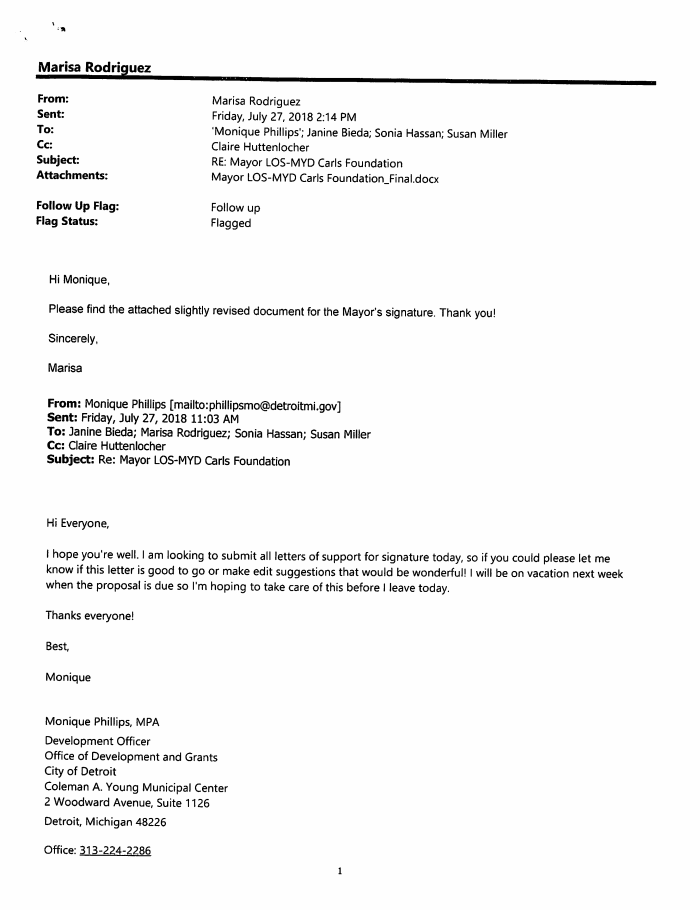
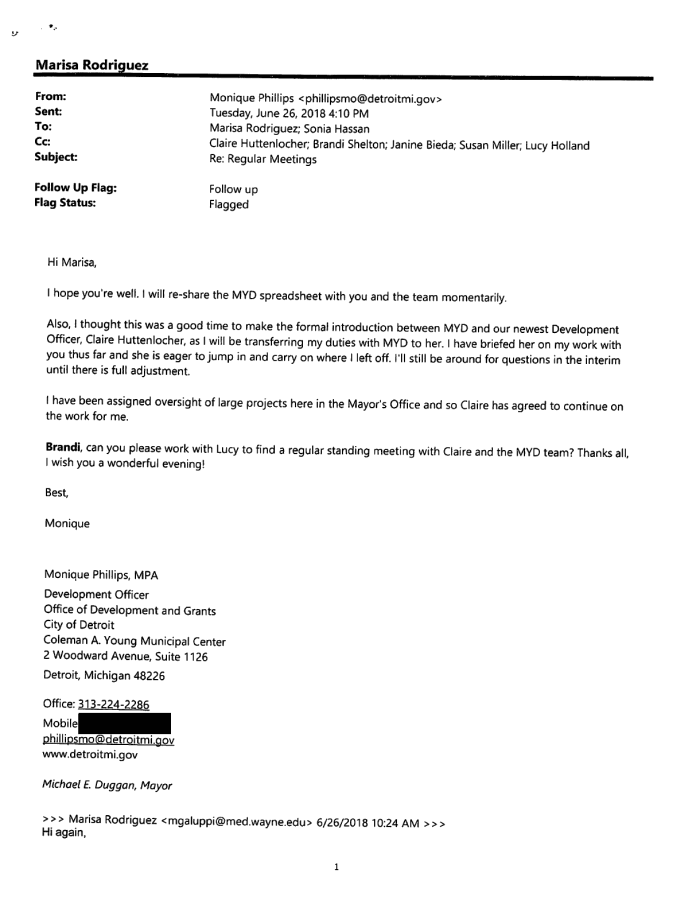
Wiley’s order went down the chain of command. Friedrichs told About-Chakra to pass along the message to the two staffers involved in raising money for Make Your Date, Monique Phillips and Claire Huttenlocher.

Phillips got the message and deleted her emails. But first she made sure to forward some of them to her personal email to maintain a record, Phillips told the inspector general’s office.

DOCUMENT
PAGES
Zoom

The message, however, didn’t reach Huttenlocher and she continued interacting with Make Your Date about fundraising.

Wiley eventually found out her order wasn’t completely followed when a Make Your Date representative told her about Huttenlocher’s ongoing emails. Wiley again called Friedrichs.

“Staff were given a second directive to stop contacting MYD and to delete all MYD related emails,” according to the report. Friedrichs “also noted that, at that time, a ‘full stop’ occurred to ‘let the circus settle.’”

Wiley never admitted to giving the orders during her interview with the inspector general’s office in August. She claimed she didn’t recall giving the instructions. But the inspector general’s office was not convinced. Statements from Friedrichs, Abou-Chakra, Phillips and Huttenlocher “are consistent in that the order to delete the emails came from Ms. Wiley,” according to the report.


The inspector general found no evidence that Duggan was involved in or knew about the orders to delete emails.

City officials took steps to recover the deleted emails in May after an employee being dismissed from her job spoke out. The city’s Chief Financial Officer, Dave Massaron, was involved in recovering the emails and provided 59 messages to the inspector general’s office, which later recovered another 26 additional emails. Due to the city’s retention period for deleted emails, “it is impossible to definitively say that all deleted MYD emails have been recovered,” the report concluded.

The report also criticized the use of personal email accounts by Duggan and Wiley. Messages from their personal accounts were handed over to the inspector general in response to a document request.
“Mayor Duggan told the OIG that he performs city business on his personal email…Ms. Wiley told the OIG that she uses her personal emails account to conduct city business and is under the impression that is not an issue,” the report reads.

The inspector general called the practice “extremely problematic.” If emails from a personal account are requested under public records laws, for example, Duggan or Wiley would be responsible for producing the messages, rather than the city’s IT department.


The inspector general recommended that the city establish a policy preventing public servants from conducting city business on personal email accounts.


Voting is beautiful, be beautiful ~ vote.©