I learned how they were flipping charities and properties from Ray Wojtowicz when he was hanging tough at the PIAST Institute because he lived right around the corner in the Hamtramck Historic District.
They all treated me like I was a worthless, ignorant, savage pagan, who was too vague to hate, yet a blast to celebrate.
It costs $25 to start a nonprofit in Michigan.
Then, when you run for office, sell the nonprofit for $250,000 for your campaign by donating to yourself as a personal contribution.
Then, after you win, or lose, you donate the leftovers of your campaign finance, in accordance to Michigan Campaign Finance Law, to your other nonprofit, that you can either use to sell for your next cycle of perpetual campaigning, like Taras used to do, or, you could invest in real estate, and start doing the early stages of the corporate shape shifting grift.
TAH DAH!
Ray was pimping big stupid money from the Wayne County Property Taxes.
He got a percentage on the money collected, and, if you were really, really nice to him, you could even get some free properties.
My sincerest apologies for missing this most auspicious moment in history.
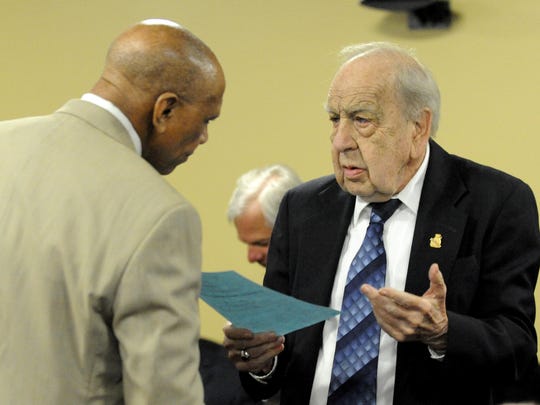
Detroit — Former Wayne County treasurer Raymond Wojtowicz has died, officials said Wednesday. He was 90.
"Today, I was saddened to hear of the passing of former Wayne County Treasurer Raymond J. Wojtowicz," said Eric Sabree, the county's current treasurer, in a statement. "In 2011, (he) gave me the opportunity to work under his leadership in the Treasurer’s Office. My condolences and prayers go out to (his entire) family during this difficult time."
I am saddened to hear of the passing of former Wayne County Treasurer Raymond Wojtowicz who admirably served our 43 communities for nearly 40 years, including his beloved hometown of Hamtramck. Our thoughts and prayers are with the Wojtowicz family at this difficult time.” pic.twitter.com/GybX1NvZtI
During his lengthy tenure, the Hamtramck native earned praise for working with distressed homeowners facing tax foreclosure, but also faced criticism because his office oversaw the foreclosure of more than 100,000 properties in a decade, The Detroit News reported.
Alisha Bell, chair of the Wayne County Commission, described Wojtowicz as "dedicated" to his job.
"He was a dedicated fiscal steward, overseeing billions of county tax dollars during his long run as Wayne County Treasurer," Bell said in an emailed statement. "He was a steady and stabilizing hand, helping guide Wayne County through some very tough financial times during his tenure."
Wayne County Executive Warren Evans also commented on the retired official's passing.
"I am saddened to hear of the passing of former Wayne County Treasurer Raymond Wojtowicz who admirably served our 43 communities for nearly 40 years, including his beloved hometown of Hamtramck," Evans tweeted. "Our thoughts and prayers are with the Wojtowicz family at this difficult time.”
When seeking re-election in 2008, Wojtowicz touted his experience in The News, including working with 20 nonprofits to give assistance to people unable to pay their property taxes.
"Every day, there are issues that come up where people need assistance," he told the publication at the time. "I enjoy doing (the job) for the benefit for all of the people in Wayne County."
Wojtowicz retired as county treasurer Dec. 1, 2015, after nearly 40 years in office. He was 86 at the time. A Democrat, he was last elected county treasurer in 2012.
He previously served as mayor of Hamtramck.
A graduate of St. Ladislaus High School and Great Lakes College, Wojtowicz also served as a Wayne County Community College trustee. He was a married father of five children and a grandfather, according to Detroit News archives.
Detroit — A former Detroit Metropolitan Airport official faces the longest corruption crime sentence in U.S. history after being convicted Wednesday of receiving more than $5 million worth of bribes.
James Warner, 52, of Commerce Township, gasped and arched his eyebrows as the jury forewoman said "guilty" 10 times for charges that included bribery, theft and money laundering conspiracies, and obstruction of justice, a charge that carries a possible 20-year prison sentence.
Warner could be sentenced to more than 30 years in federal prison. The sentence would eclipse the current record, a 28-year federal prison sentence being served by former Detroit Mayor Kwame Kilpatrick.
Warner will be sentenced Oct. 8 by U.S. District Judge Victoria Roberts.
"The government is going to come at him guns blazing and seek the maximum sentence," said Peter Henning, a Wayne State University law professor and former federal prosecutor. "Whether Judge Roberts gives that to him is an open question."
Advisory sentencing guidelines call for 24-30 years in federal prison.
U.S. Attorney Matthew Schneider, who was in the courtroom Wednesday, said his office will pursue a sentence within the guideline range, "at least."
U.S. Attorney Matthew Schneider said, "at least".
Roberts has broad discretion and can ignore the guideline range.
Henning does not expect a record-setting sentence even though Warner was accused of receiving five times as much money as Kilpatrick.
"Being an elected mayor versus an airport official, I’m not sure they’re exactly comparable even though (Warner) took much more money," Henning said.
Prosecutors wanted Warner taken into custody Wednesday, calling him a flight risk and a danger to himself, citing what they believe was a suicide attempt in 2017.
More than $1 million remains unaccounted for and the money could bankroll a flight from justice, Assistant U.S. Attorney Eaton Brown told the judge.
Warner’s lawyer Robert Harrison disagreed. All of Warner’s assets have been frozen or seized, Harrison said, adding that Warner is not suicidal.
The judge read letters from Warner’s doctor before deciding to let Warner remain free until October. The letters convinced the judge Warner was not suicidal and she was satisfied he does not have money to fund an escape.
Warner and his lawyer declined comment.
Jurors deliberated for about four hours before reaching the verdict following a trial that lasted parts of three weeks. In a rare move, Warner testified in his own defense.
Warner, an airport manager and field inspector who also worked for West Bloomfield Township, is the rare indicted public official to stand trial on corruption charges and risk a decades-long federal prison sentence.
Kwame Kilpatrick and Dean Reynolds
Two of the most recent politicians to stand trial in federal court —Kilpatrick and Clinton Township Trustee Dean Reynolds — were convicted and sentenced to double-digit prison sentences.
Kwame Kilpatrick, left, and Dean Reynolds.
Warner's alleged appetites distinguish him from the dozens of public officials who have been accused or convicted of corruption-related crimes in the last decade in Metro Detroit. He fabricated invoices, overcharged the airport for work performed by contractors and received more than $5 million worth of kickbacks during a four-year period, prosecutors said.
The alleged bribery conspiracy outlined by prosecutors started in May 2010 when Warner was working as a field inspector at the airport approving maintenance and repair contracts. He headed three related schemes involving Metro Detroit contractors, including Romulus businessman William Pritula, 70, whose company William Pritula & Sons held facilities and maintenance contracts at the airport, prosecutors said.
Warner drafted and submitted inflated invoices for work Pritula was hired to perform at the airport, according to the government. The payments totaled more than $18 million.
In return, Warner received approximately half of the profits from the contracts, or more than $5 million, according to the indictment.
Pritula pleaded guilty to bribery last year and could be sentenced up to 10 years in prison in September. He agreed to forfeit $5.4 million to the government.
Federal court records describe Warner as a greedy, potty-mouthed felon.
"If it weren't for me, your ass would be out," Warner told one airport contractor, according to the indictment.
That contractor, authorities allege, was Gary Tenaglia, 65, of Rochester, who was charged last year and accused of defrauding the Wayne County Airport Authority of $1.5 million.
Warner allegedly gave Tenaglia inside information so the contractor's company, Envision Electric, could win contracts. In return, Warner received 10 percent of each invoice, prosecutors said.
During one dinner, Warner and Tenaglia discussed contracts and kickbacks, prosecutors said.
"During the meal, James Warner wrote '5k,' a proposed kickback amount, on a napkin," prosecutors wrote in the indictment. "He folded it and slid it across the table to Gary Tenaglia. After Gary Tenaglia acknowledged the meaning of the writing on the napkin, James Warner retrieved the napkin and ate it."
Before I begin, I must state that I believe that I have endured an irrevocable emotional harm from the fact that the Detroit Free Press editorial staff besmirched its history being the institution of journalism for the City of Detroit, the keeper of the record, by allowing the publication of propaganda.
Either that, or the paper is announcing the pending demise of its circulation.
Since the article failed to define the legal term of a squatter, and instead, resorted to poverty shaming, I felt the obligation as being the scribe of this entire tale, that I must preserve the record.
To begin, before you can call someone a squatter, there must be a judicial determination, like that stuff called due process.
1. HB 5069/PA 223 amends the revised judicature act
to allow a landlord to use force (but not including assault) and
self-help when recovering possession of premises from a person who came
into possession by trespass (squatting).
2. HB 5070/PA 224
makes squatting in a single family house or a duplex a misdemeanor for
the first offense, with a $5,000 maximum fine and 180 day maximum
sentence; and a felony for second and subsequent offenses, with a
$10,000 maximum fine and a 2 year maximum sentence.
3. HB 5071/PA 225 identifies the felony for second and subsequent squatting offenses as a class G felony with a 2 year maximum sentence.
In essence, the Detroit Free Press, obviously, set this article up to become a hit piece (on a certain Celestial Goddess of the Woodshed) to go along with all the throwing of money to the people in hopes they and divert attention to bide time to generate another narrative to counter the stuff that is about to come out of D.C.
As I am a strong advocate in the practice of illuminating all iterations of a predictive model, just because I am the one who came up with it in constructing spline models that can be used to sniff out stealin' , I would like to share some of the horrific experiences I have suffered by being called on of "Those Squatters" (said with disdain) since May 26, 2016.
Just say no to drugs.
I reported to those people over there at that work group going by the name of Detroit Land Bank Authority, the City of Detroit Inspector General, Detroit Police Department, Office of the Mayor, Wayne County Prosecutor's Office, and multiple federal authorities, and have yet to hear anything, well, actually, the matter is pending before the court.
I patiently await the opinion of the U.S. Attorney General.
I do not believe the legal mechanism of the U.S. Attorney General having to answer for its failure to intervene in stealin' has ever been done before, since the False Claims Act was updated a few years ago.
A politically connected charity that was
supposed to help people living in properties owned by the Detroit Land Bank Authority wrongly evicted some of them and flipped houses to
developers with markups of thousands of dollars.
So, why would the Detroit Land Bank Authority use the Black Caucus Foundation of Michigan to "turn squatters into homeowners"? What better way of shifting the blame...theCorporate Shape Shifter Way!
In
early 2016, the Black Caucus Foundation of Michigan promised it would
convert squatters into homeowners if the Detroit City Council allowed it
to buy up to 200 occupied houses from the land bank.
By what powers does the Detroit City Council have "to allow"....what the heck is "allow"....to purchase 200 occupied houses from the Detroit Land Bank Authority, which is not part of the City of Detroit because it is fake and is using Hardest Hit Funds for something other than what the TARP funds were supposed to be used?
Hold up, I want to know how the Black Caucus Foundation of Michigan purchased these houses because the Detroit Land Bank Authority is not incorporated, which means they have no bank account, which means they used another corporate entity to cash the checks.
To whom were these checks written out to and where is the contract...or was it just one of those Detroit City Council Resolutions where folks got political "guidance" in their political careers, being advised by all those "Legal Geniuses" (trademark pending) from New York, and stuff. I know a few State of Michigan elected officials who bought right into this Detroit Land Bank Authority fraud scheme, just to get elected or to keep a job.
There are a lot of questions here, so I am going to just leave them here for the moment and thank the Detroit Free Press by making a public notice that I request this article to be entered into the formal record, just like what is going on in D.C. with its issues of media propaganda.
Instead, the plan is sputtering along, with finger-pointing all around.
Squatters,
people who live illegally in houses they don't own, are a most vexing
problem in Detroit. There are more than 3,600 houses owned by the land
bank and occupied by such people, many of whom lost their homes to
foreclosure. Evict them and the land bank could add to the city's
homeless population and its enormous stock of vacant and blighted
buildings. Land bank officials have said an occupied property is better
for a neighborhood than an empty building.
Squatters are people who have been determined by a court of law to have violated state laws, after a case is adjudicated.
Remember, the Detroit Land Bank Authority never incorporated which means it has no legal standing in a court of law, unless it is specially created court of law, like Columbo's court of running fake quiet title cases on property addresses, and not the owners, or even the occupants, oops, I meant squatters.
The Black Caucus told council it would, at its
expense, "rehabilitate and affordably sell the fully renovated homes by
land contract to the properties' qualified occupants." To run the
operation, the caucus formed a subsidiary, Bridges to Homeownership.
They were too busy running to the casino.
The
plan included providing "wraparound" services to squatters, such as
educating them on the responsibilities of home ownership, financial
literacy and job advancement.
If things didn't
work out for the squatters, the foundation would try to find buyers
among first responders and skilled craftsmen.
"The Squatters" (said with disdain), as I have now officially adopted this term, had no legal chance in hell of following through with the plan of ownership because the titles were all jacked up, and still are jacked up. Heck, those titles are so jacked up many do not even have the proper address on them. Those titles are so jacked up... How jacked up are they?
They are so jacked up, that they have been bundled through intellectual property and complex fraud schemes that reconveyance will go to some foreign corporation like, perhaps...just pulling a corporate name out the blue...in example only....not making any inference of being a Meanie...like Bill Clinton, inc.
But after council gave its blessing to the Black Caucus, that's not exactly what happened.
Bridges,
the subsidiary, evicted some squatters before it had the deeds to
the houses. Land bank officials say the evictions were improper. Nice covering of thyne arse!
Bridges
or the Black Caucus paid $1,000 each for 29 houses, as of mid-February,
then flipped eight of them to investors for thousands of dollars
more. It sold a two-story brick colonial on Detroit's east side to a
Miami company for $30,000 while it was still occupied. A Southfield man
paid $12,500 for a Bridges house and resold it within days for $19,000. Did someone say Adam Hollier?
Of
those 29 houses, only three have been sold to the squatters, far below
the group's stated goal of buying and selling up to 1,800 houses a year.
Another three have been rented to the squatters. The plan was to go to the casino. Duh.
“It has been a complete nightmare,” said Rachel
Yancey, who was evicted from a house she lost to tax foreclosure after
she decided against buying the property from Bridges to Homeownership.
She said Bridges didn't fix a mice infestation and sewage backups in the
basement. She's now living with her childrenin a friend’s basement.
Wanna bet there were no taxes on that property? See, it seems this is the part where the "Legal Geniuses" (trademark pending) did not get their fake quiet title judgment certifications from the court, but you know darn well they billed the Hardest Hit Fund for it. Not getting the judgments of quiet title means the property taxes were never legally wiped from the books because there was no property tax foreclosure hearing, which means Detroit wiped its books but Wayne County did not, because that certificate of judgment was never filed, which is what we here in the community of whom are not "Legal Geniuses" (trademark pending), like to call stealin' property taxes.
Even
as these issues unfolded, the Detroit Land Bank asked City Council in
June 2017 for permission to sell Bridges up to 200 additional houses, in
batches. The land bank said the foundation had "demonstrated its
ability ... to successfully renovate occupied residential structures in
the City of Detroit." Council agreed, unanimously.
I wonder how many City Council members got houses, or their property taxes wiped, or campaigns funded?
Erica Ward Gerson, chair of the land bank's board, defended Bridges.
"I
believe that they’re succeeding in our goal, which is to allow these
people to stay in their homes or at least to put the homes back into
productive use," she said in an interview.
You know girlfriend was out there front and center defending Bridges, because they were the ones who set it up, because, you know, the board was too busy at the casino, oh, and there is a well documented trail of corporate shape shifting which leads right back to the Detroit Land Bank Authority.
Squatter problem to rival them all
In 2013, Mike Duggan campaigned for mayor on a promise to demolish thousands of blighted buildings across Detroit.
Whatever.
After
he took office, he turned to the land bank to help make that happen.
The city transferred thousands of properties in its inventory to the
land bank to clear title issues, sell the houses or demolish them.
"Granpa, what's a city transfer?"
"Why it's special privatization language used by Legal Geniuses (trademark pending) who set up fake authorities, when executing the final stages of a highly sophisticated complex fraud scheme called Public Private Partnerships that has been in the years making to take over the children, the land and the vote, like they did with those Type III transfers under Engler.
Think of a city transfer like a termination of parental rights, same concept...kids, land, votes...it is all fungible because we have were the ones who transferred governmental authority over to ourselves by buying out these cheap ass, washed up politicians who would do anything to get back down to the casino...or who would stab one of their relatives in the back just for the opportunity to help us do more pilfering of the national treasury.
Any other questions, my Grandson?"
The Wayne County treasurer also began transferring tax-foreclosed properties to the land bank.
Detroit Home showing up for court
Some
of those houses had people living in them. Many of the occupants
had lost their homes to tax foreclosure or their landlords did. Others
simply moved in and took over properties.
As of late March, the land
bank estimated it owned more than 3,600 structures with people living
inside. Overall, including vacant houses, the land bank owns more than
31,000 structures across the city.
You know why there are still people residing in these homes? "The Squatters" (said with disdain) probably grew up in these homes and had no idea their homes were being "city transferred" to the Wayne County Treasurer because there is a strong probability the Detroit Land Bank Authority in that special Columbo court, just rubber stamped defaults to quiet title actions because the house, I mean the actual brick and mortar building, itself, was served and never showed up for court because the occupants were never notified.
I have always wanted to see a house walk into a court room!
Officials
who work with land banks say Detroit's squatter problem could be
the biggest in the country. The land bank's inventory of occupied
properties is likely the largest, in part because many land banks do not
take occupied structures.
That is a blatant lie. ^^^^ documented!
So Gerson said the land
bank drew up its plan for occupied structures "out of whole cloth" and
"shopped it to a bunch of different nonprofits."
Who they hell gave them blanket authority to come up with some crap like this that is sponsored by a few of "The Elected Ones" of Detroit, to transfer authority to levy taxes without a damn vote to a fake, unincorporated, authority, that is private, with no oversight and no civil rights?
You know darn well the Board of the Black Caucus Foundation of Michigan Members were too busy at the casinos to even come up with this stuff.
Girl, you really need to get an attorney when it comes to making public statements like this.
"They
all said, 'this is too hard. This is too heavy a lift. We don’t see
that this is something we can take on,' " Gerson said.
They all saw the massive fraud scheme. Keep it real, girl.
Not the Black Caucus. In 2015, the foundation and land
bank signed the first of several agreements that allowed its
subsidiary, Bridges to Homeownership, to buy occupied properties for
$1,000 each (and later, $1,500).
Because you knew they did not have a freaking clue of what was going on. I should know. One of them asked me for advice. Guess who.
A for-profit
company, Realty Services, has a contract to run day-to-day operations
for the program. It pays the Black Caucus Foundation a fee "per sale
transaction," according to documents Bridges filed in an eviction case
in 36th District Court.
"We are not aware of the
details of any business arrangements between the Black Caucus Foundation
and RSC, nor do we need to be," Gerson said in an e-mail. "Our
agreement is with the Black Caucus Foundation/Bridges to Homeownership."
^^^^^ Statement duly noted into the record that you just contradicted yourself in this article. Thank you, again, Editorial Staff of the Detroit Free Press.
Black caucus makes a pitch
I am going to intentionally skip over this entire section, detailing one property ratline of the fraud scheme for the simple fact that former Michigan Senator Bert Johnson more than likely sang like a canary, with Adam Hollier following close behind.
FUN FACT! TWO BLOCKS OF MCCLEAN IN HIGHLAND PARK HAVE BEEN REMOVED FROM THE WAYNE COUNTY REGISTER OF DEEDS.
Andrew
Munro, a lawyer from Birmingham and chairman of Realty Services, helped
create Bridges to Homeownership, which was incorporated with the
managing director of the Black Caucus after the nonprofit signed its
first deal with the land bank.
After
spending a couple of years handling mortgage foreclosures in the
private sector, Munro said he designed the program to help
Detroiters struggling with affordable housing. Bridges spends about
$48,000 to $55,000 per house when it does the renovations, a figure that
does not include administrative costs, he said.
The
land bank has more than 200 "community partners" who can buy up to nine
houses a year without City Council approval. But none has access to 400
houses like the politically connected foundation.
Former
state Rep. Alma Stallworth founded the group. One of her two sons, K.B.
Stallworth, was managing director but recently retired after inquiries
from the Free Press for this article. His wife, Nicole Stallworth, is
executive director.
K.B. Stallworth also served in the Legislature — but
at that time went by Keith Stallworth. K.B. is also the Keith Stallworth
who pleaded guilty to a felony in federal court in 2003. He was accused
of helping a gang launder money through a Detroit strip club he owned,
according to Free Press reports at the time.
The
Black Caucus website lists state Sen. Virgil Smith and state Reps. Brian
Banks and Bert Johnson as board members. None is still in the
Legislature and all have felony convictions.
The
Black Caucus told City Council it is a nonprofit dedicated to public
policy analysis and direct service that "focuses on life quality
advances for urban, disadvantaged, poor and minority constituencies."
According
to its 2015 federal tax return, the most recent available, the
foundation's mission is to "decrease usage of drugs and alcohol among
youth." That year, Alma Stallworth earned $18,000, Nicole Stallworth,
$47,294.
The Black Caucus did not mention any
experience in real estate or development in its letter seeking council
approval to buy occupied houses from the land bank. But that wasn't a
deal breaker.
"We were less worried about that
because this is a different deal," Gerson said. "There are people around
here who are very successful in real estate who could never handle an
occupied property. So what we did was we ran a test. We gave them four
properties and said you have to prove to us that the renovation is going
to be quality, that you don’t fall down on the finances, that you
provide the housing counseling we required. ... And that was the way we
due-diligenced them."
And the result of that small
experiment? The occupants of two of the houses moved out. The occupants
of the other two are buying the properties on land contracts. One is
paying $57,000; the other $72,000.
"I know that we do everything we possibly can to keep people in" the houses, Munro said. "Our success rate is fairly high."
Land
contracts may be used to sell property to buyers with less than good
credit who wouldn't qualify for a conventional mortgage and when the
seller does not need the entire purchase price up front.
Under
a land contract, the buyer can occupy the property as long as the
required payments are made.
After the last payment, the buyer gets the
deed and holds legal title to the property. If the buyer fails to pay,
the seller can take back the house.
In five cases,
the Free Press found, Bridges began evictions against the occupants
before it had the deed to the houses, according to records from 36th
District Court and the Wayne County Register of Deeds.
The
occupants of all five are gone, land bank records show. Bridges sold
two of those houses to developers and a third to a man in New York.
Who is this mysterious New York man? Did he, perhaps, go through the New York Bank of Mellon?
The land bank's Gerson said the evictions should not have happened that way.
They should not have happened at all; they were fraudulent.
"Our
view is that legally, you are not permitted to evict from property that
we own. They didn’t have the property. ... Our view is that we don’t
allow anyone to evict anyone until after they have legal title and by
the way, we made that explicitly clear" in a December 2017 agreement
with Bridges, Gerson said. Bridges has not filed to evict since signing
the agreement.
You do not own anything. The Detroit Land Bank Authority, which was dissolved in the Michigan Court of Claims as an LLC, was the only legal authority that could enter into any agreement be it financial or legal, and I got the certificate of judgment to prove it.
Thanks Bill Schuette. Smooches...
Monologue, no questions
The
Free Press spoke with Black Caucus and Realty Services officials in
February at a Realty Services building on West 7 Mile in Detroit. Alma
Stallworth opened the meeting by reading a prepared statement that
touched on her 21 years in the Legislature, and various programs that
serve children and the community.
As she finished, K.B. Stallworth addressed her.
"Permission
to speak, Queen Mother?" he asked. He then launched into a
20-minute monologue about the foundation's many contributions to the
world, including teaching life skills to children.
Child welfare fraud schemes.
"I wish the rowing was not so difficult," Stallworth said. Then, he left the building, without taking questions.
Foundation President Michael Aaron did not respond to later requests for comment.
Munro,
in a separate interview, defended the actions, pointing to Bridges'
agreement with the land bank that allowed it to use "any and all legal
methods" to evict occupants. But Bridges was not supposed to remove
occupants without first giving the land bank five days advance notice in
writing.
The land bank said written notice was not provided in those five evictions and two others.
Munro said the evictions were discussed in meetings and noted in spreadsheets shared by Bridges and the land bank.
"Oral
notification is OK because they knew about all of these and they've
never objected until you got involved," Munro told the Free Press. "My
understanding is that there were spreadsheets that went back and forth
that indicated the status of all of the addresses."
TRANSLATION: THEY DID NOT HAVE A CLUE ON WHAT WAS GOING ON...Blackjack...we have a winner!
Some houses flipped
Bridges
also flipped eight properties for thousands of dollars more than it
paid for the houses, according to records from the Wayne County Register
of Deeds.
Take a house on Bishop on Detroit's east
side. Bridges bought the two-story colonial with a sagging gutter and
damage to the brick exterior in August 2017 for $1,000. It sold the
property last November for $30,000 to IDG Holdings of Miami.
Who financed this and have they filed for quiet title to wipe the mortgage, yet?
IDG began evicting the occupant in January.On
a recent day, she told the Free Press no repairs had been done to the
house, and that she has agreed to move. She declined additional
comment.
Then
there's a house on Murray Hill. Bridges bought it for $1,000 in March
2017. Two months later, Realty Services Company, on behalf of the Black
Caucus and Bridges, sold the house to Talfred Waire of Southfield for
$12,500. Within days, Waire sold the house for $19,000.
Tasha
Hervey, who lived nearby, said she had asked the land bank whether she
could buy the house for herself and her two children, but was told it
wasn't for sale.
The Detroit Land Bank Authority does this all the time. They always give first pick of the best to their friends and investors, just ask Adam Hollier and those other individuals on the Board of the Boston-Edson-Arden Park Association.
"I
saved it from getting broken into," she said. "They promised me they
would give me a chance to buy it but they never gave me the chance."
This week, the house sat vacant.
In another case, Bridges bought a house on St Marys
from the land bank in March 2017 for $1,000, then sold it to a company
called Invest Detroit in July for $26,000. Five months later, Invest
Detroit sold the house for $53,596 to a company called Investuru.
Both
companies that bought that house share the same suite with IDG Holdings
on Biscayne Boulevard in Miami. An official reached by phone declined
comment.
I believe you might want to talk to Debbie Wasserman Schultz & Donna Shalala about this one.
Gerson said Bridges described its buyers as “partners that are providing services like contractors."
A house that Bridges sold to a developer for $33,000 was resold earlier this year to a California couple for $110,000.
You may want to talk to Nancy Pelosi about this issue.
Munro
did not answer questions about how much money Bridges put into specific
homes the Free Press inquired about, but said: "As a company, we have
lost money every year of operation."
In December,
the land bank began prohibiting Bridges from selling houses to third
parties until the houses had been rehabilitated. Regarding the houses
that already had been flipped, Gerson said the buyers are
successfully completing the required repairs.
But safely? Not always, the Free Press found.
On a warm February afternoon, the Free Press found a
crew working on a two-story house on St Marys that IDG purchased from
Bridges for $25,500. Two men were on the roof, prying off the shingles.
They had no fall protection.
The workers had no fall protections which means they were not licensed contractors and did not pull permits.
You know Pookie and Ray Ray needed some side work and it was a good cover up to submit some fraudulent billing so they could scrape a few bucks to go to the casino.
(Pookie and Ray Ray are based on your local handyman lovable characters who are just trying to keep a roof over their head because they are probably hit with child support and lots of legal fines that stop them from getting a job, of which there are no jobs in Detroit for them.)
"That's an injury or
fatality waiting to happen," said Dr. Kenneth Rosenman, a professor of
medicine at Michigan State University who studies occupational and
environmental injuries. Falls are a leading cause of death among
construction workers and can be prevented with safety equipment.
The workers declined to speak to the Free Press.
No one was bonded and everyone had Medicaid.
On
Fairmount, a house that IDG Holdings bought from Bridges in December
for $14,500 has a broken front window, a little lion statue in the front
yard and an occupant — Reginal Murphy.
Murphy was sitting on his front porch when the Free Press stopped by.
"What seems to be the problem?" he asked.
A Free Press reporter told him the house had changed hands several times.
"That's way out of my jurisdiction," he said.
Murphy
said he thought his sister owned the house. He said he is on Social
Security and suffered a head injury in a car accident. He asked whether
he could pose for a Free Press photographer.
Standing on the front lawn, he declared: "Olympics. Korea. Karate." Then he did a little dance.
What was the purpose of these two sentences? Are we engaging in more squatter-shaming behaviors Editorial Staff of the Detroit Free Press? When one is a victim of fraud, where everything thing, including a legacy, has been snatched from a dream, life becomes much more precious by just living in the moment, right before they treat you like one of "Those Squatters" (said with disdain) right before they start calling you homeless.
Land Bank catches criticism
The land bank shares the blame for its squatters' troubles.
Because the Detroit Land Bank Authority is a fake corporation that stole these properties.
Under
a second program known as Buyback, certain squatters can purchase their
properties, as is, for $1,000. The land bank admits it failed to inform
some of them, including the occupants of the first houses sold to
Bridges, that Bridges wasn't their only option.
The
land bank said it has no record of successfully contacting the
occupants of 13 houses sold to Bridges. The land bank changed its
procedures in May 2017 to require that squatters be contacted about the
buyback option before their houses are sold to Bridges.
I told you, they contact the property, not the occupants. Duh.
Carl Payne and Rachel Yancey were among those who missed out.
No, they were crossed off.
The
couple bought their house on Ilene in 2010 at the Wayne County
treasurer's tax-foreclosure auction for $3,005. But they were unable to
pay the taxes and lost the home in 2014. They remained in the house.
Oh, "Those Squatters" (said with disdain)!
In
late 2015, Payne said he noticed someone taking photos of the house.
K.B. Stallworth introduced himself and "said he worked for some
organization that helps people in the community save their homes."
Payne
said Stallworth's pitch sounded good. The house needed repairs,
including a new roof. Yancey said Bridges gave them two options:
leave and they would get $900 toward their moving expenses
— cash-for-keys — or stay and let Bridges do the repairs and sell them
the house.
These cash-for-keys signs are all over the off ramps of freeways, Livernois, Seven Mile, Gratiot, etc.
In January 2016, they signed a lease and
began paying $850 a month in rent as Bridges began renovations. That
June, a lawyer working with Realty Services sought to close the sale to
Payne and Yancey.
Oooooo....casino money!
According to the purchase
agreement, Bridges would sell the house for $57,000 on a land contract
with an 8.5% interest rate and monthly payments of about $830. Munro
said Bridges had put $63,000 into the house.
On paper, that is (giggles).
Yancey
said she and her husband didn't go through with the purchase because
the house had a mice infestation and plumbing problems that caused raw
sewage to bubble up in the basement. They stopped paying rent and were
evicted that September.
Their marriage, they said, crumbled under the stress.
"We separated," Payne said. "I was living with a friend, homeless for a while. It was crazy."
"Having to vacate the home, we eventually just had to go our separate ways because we had nowhere to go together," Yancey said.
Since
the eviction, Yancey said, she and her children, who now attend a new
school, are living in the basement of a family friend's home.
"Those Squatters" (said with disdain) get what they deserve, right, U.S. Department of Justice?
Yancey and Payne said no one from the land bank told them about the buyback option.
Gerson,
the land bank's chair, said the program was developed in late 2015 and
was initially offered only to "people ... who called us up."
Ssssshhhh....it never existed......
Land bank records show that Yancey did
contact the land bank in 2015 asking how she could stay in the house.
She was told there were no guarantees but "it will be taken into
consideration that she's been living there."
But in May 2016, the land bank sold the house to Bridges.
Someone must have hit that night at the casino because the Detroit Land Bank Authority does not have a bank account to cash any checks. I wonder if they take casino chips for homes. (Bookmark that for a new program to pitch.)
"I definitely feel betrayed," Payne said.
Yancey
recalled Stallworth's visit to the home, when Stallworth talked about
helping to revitalize the tree-lined neighborhood of brick houses.
"I
kind of feel like they sent the African-American guy because we’re like
an urban community so I felt like they sent him out to communicate with
us first just because we would take to him easier and really not ask a
lot of questions because, you know, the way he talked and presented
himself, we thought it was a reputable organization. So because we
couldn’t contact the land bank, or we tried to and weren’t getting any
feedback, you know, we’re like OK, the Black Caucus organization, we’re
assuming he’s trying to help, so that’s what we went with."
The proper terminology for this particular planned event is called "throwing the casino token under the bus" by keeping them "Fat, Dumb. and Happy" while the fraud scheme evolved.
Relationships strained
Bridges,
in turn, has accused the land bank of undercutting its efforts by not
selling it enough houses, according to e-mails obtained by the Free
Press between Munro, Gerson, Stallworth and a land bank lawyer.
Hey Free Press, how did you "obtain" these emails? Care to share with the DOJ?
In
an August 2016 court filing in the Payne-Yancey eviction, Bridges
predicted it would acquire 200 houses in its first year and at "full
scale, the program will seek to acquire and sell up to 1,800 homes
annually."
But privately, three months earlier,
Munro had complained in a series of e-mails to the land bank that it was
not living up to the terms of their deal.
He
requested a meeting and wrote that the land bank had not transferred any
homes to Bridges in more than seven months, according to e-mail
exchanges with Gerson and the land bank lawyer.
"The viability of BTHO is being jeopardized by our inability to get homes," he wrote.
In
another e-mail that day, he added: "The financial consequences of the
DLBA's nonfeasance are not yet irreparable, but are on the verge of
becoming so. If consequences become irreparable, our conversation
becomes very different."
Hey, wait a minute, I had Michigan LARA certification to operate under the name DLBA, not them. Oooooo, I'm telling.....oh, wait, I already did.
Gerson replied: Munro's "hostile demand" was endangering the land bank's relationship with K.B. Stallworth.
"I
would be personally very distressed to see your attempted intimidation
tactics destroy what he and I have worked so hard to build."
In
a follow-up e-mail, Munro said he had raised capital from investors to
buy and renovate houses based on his agreement with the land bank, but
the land bank hadn't even given him a list of available properties.
"Today, I began laying off employees and am faced with the decision to return investors' money," he told Gerson.
K.B.
Stallworth also weighed in, writing to the land bank that Bridges was
having trouble getting a "good list" of occupied properties it could
purchase. The land bank's lists had properties it didn't even own, that
were not occupied, or didn't have a structure on them.
Stallworth said the land bank needed to make his program "a high enough priority to get us properties to work on."
Stallworth added that he had asked Munro to "stand down" from additional communication.
He's happy, others aren't
Since
signing its first agreement with the land bank in 2015, Bridges has
reached additional deals that have allowed it to purchase vacant
properties and rehab them. In all, Bridges has purchased 46 vacant and
occupied houses from the land bank and one side lot.
Of
that total, it sold seven houses to couples and individuals at prices
ranging from $69,000 to $92,500. It sold another house to a man living
in New York for $15,000 who handled the repairs and said he plans to
live there when his family comes from Yemen.
According to Bridges, renovations have been completed at 15 houses and work is under way at two others.
Word on the streets are that the renovations done by cousin Pookie and Ray Ray are quite shoddy, and probably not even up to code.
For Muhtasib Dirul-Islam, Bridges was a lifesaver. He
and his wife lost their home on Ohio Street to tax foreclosure in 2014.
At the time, they were divorcing and money was tight after he lost his
job cooking for an Oakland County country club. He couldn't keep up with
the repairs, including a leaky roof.
After the divorce, she moved out and he stayed, becoming a squatter.
Oh, "Those Squatters, (said with disdain), such pesky creatures.
Things
were so dire then that Chef Taz, as he's known, was catering out of his
house and delivering food from the trunk of his car. His credit was
shot.
"It was a rough time in my life," he said on a
recent afternoon in the building on Fenkell where he runs his
restaurant, SumThingGood, alongside a mobile phone shop, a check-cashing
business and an insurance agency.
Bridges gave his two-story brick house a new roof, windows, kitchen, central heating — a complete makeover.
"My house looks amazing," he said. "It's one of the nicest houses on the block now."
Dirul-Islam is buying the house on a land contract for $72,000. He's paying 8.5% interest and has monthly payments of $1,000.
"For
me, it lined up perfectly," said Chef Taz, who bills his restaurant
as the King of the Turkey Chop. "I was looking to earn something off the
sweat of my brow."
But two other families who bought vacant houses from Bridges had a very different experience.
Lori and Levan Adams said they decided to buy their house from Bridges
partly because it was affiliated with the Black Caucus Foundation.
"When I saw it on the website, I’m like, 'it’s gotta be reputable,' " Lori said.
They bought it, hook, line and sinker. Nowadays, all you need is a website, an email, a cute poor kid and you are off an running a fraud scheme, and I bet there are some deeper, more nefarious fraud schemes dealing with political campaign finance and other stuff like that.
She's
buying the two-story house for $92,500 on a land contract. She said
that for that price, she was supposed to get a vinyl privacy fence so
they could let their dog, Chance (as in Chance the Rapper), run around
unleashed. Bridges offered the couple $3,500 toward the fence, but Levan
Adams said it could cost twice that.
"I'm very
pissed off," said Levan Adams, standing next to his Silverado pickup,
wearing a Detroit Bad Boys cap and smoking a cigar.
"I got a big ol' Rottweiler in the basement," he said. "I'm pissed. My wife is pissed. You feel like you got shafted."
Another
issue: Bridges built a railing around a second-story balcony and
encased the railing with flimsy wooden lattice panels more often seen
around deck foundations, they said. One of the panels has fallen.
Lori Adams said she won't allow their daughters on the balcony because she doesn't think it's safe.
The
couple moved to Detroit from Roseville because they wanted to be a part
of the city's comeback.
She works at MotorCity Casino; he is a
detective with the Detroit Police Department.
Someone was hustling at the casino, must have been a bad night at the blackjack table. They used their elected offices for personal inurement,
"We could have stayed in the suburbs," Levan said. "But I'm a firm believer that you should police where you live."
Lori said her family could have helped promote Bridges. But not now.
"If
this program ran smoothly it would be a good program ... for people
like me and my husband, who are working people, who are trying to
rebuild credit and live in a home in the city."
They hustled a Detroit Police Officer. That is just out cold.
Ricky and Denise Sailes are also buying their house on
Robson from Bridges on a land contract. Bridges got it for $1,000.
County records indicate the couple is paying $70,000 but they say their
cost is actually $72,000.
The newlyweds (they were
married in June 2017) say they can't use their master bedroom because
there's no heat on the second floor. The garage has a new door, but
the walls are rotted and when he touches the garage, Ricky said, "it
actually moves."
"I ain’t going to say a strong gust of wind is going to bring it down but I could push it down," Ricky said.
The
couple said they moved into the house in March 2017 and, at first,
it looked great. But it wasn't long before doors started coming off
the hinges and the basement flooded with sewage.
They said Bridges told them it would put a bathroom in the basement but ran out of money to build it.
Ricky
and Denise share the home with three dogs named after high-fashion
houses — Prada, Fendi and Chanel. Denise said she worries she and Ricky
made a bad decision. She's not sure how much money Bridges put into the
house.
"But to sell it to us for $72,000 with one
bathroom, no heat upstairs. It’s a lot," Denise said. "They keep
spinning me. I’ve called Mr. Stallworth; he hasn’t returned my calls. I
just want to know, 'is this legit, is we going to be in this house until
we pay it off or is this some scam going on where in five years we
going to be homeless, lose all our money?' That’s all we want to know.
Is it legit?"
To my most dearest #Superfans, please make it stop. Please.
DETROIT—
Today, Congressman John Conyers, Jr. (MI-13) released the following statement urging a moratorium on property tax foreclosures and improved access to services for Detroiters facing today’s deadline:
Today is the final day for anyone facing property tax foreclosure to get assistance. I urge any Detroiter who thinks they might be facing foreclosure by Wayne County to visit the Wayne County Treasurer’s office at 400 Monroe Street in Detroit, call 313-224-5990 or email at taxinfo@waynecounty.com. For more complex issues with property tax foreclosures, call the United Community Housing Coalition at 313-963-3310, or their emergency number at 313-405-7726. Today may be your last chance.”
Dean of the U.S. House
of Representatives
John Conyers, Jr.
“I remain gravely concerned over the fate of the tens of thousands of Wayne County residents that could lose their homes to property tax foreclosure. While I greatly appreciate the hard work done by the Wayne County Treasurer’s office to keep people in their homes, including providing an extension, additional time is needed to protect our residents from being kicked out of their homes. Detroiters already suffered through a foreclosure crisis caused by the discriminatory lending policies and incompetence of our nation’s biggest lending institutions. We cannot tolerate another round of foreclosures and evictions – much less one carried out by our local government that has a duty to serve our citizens.”
“Despite the economic hardship faced by many Detroit families, too many Detroit homeowners are being obligated to pay taxes when they are eligible for a statutorily-mandated poverty exemption. Furthermore, the City of Detroit has not carried out its duty under Michigan’s Constitution (Art. IX, § 3.) to assess the actual value of properties on an annual basis. The failure of local authorities to fulfill these two legal requirements means that many homeowners owe inaccurate and unreasonable amounts in property taxes—in some cases, the owed taxes exceed the actual value of the home.”
“Finally, foreclosing on occupied homes actually hinders the goal of raising revenue. Selling these homes at auction only gathers a tiny fraction of the revenues owed in taxes, while the eviction of families from their homes increases blight, depresses surrounding property values, and destabilizes neighborhoods. For these reasons, I strongly urge Wayne County Treasurer Raymond Wojtowicz to immediately implement a moratorium on property tax foreclosures until there is an appropriate remedy for these families and our community.”
As of last month, 31,000 properties were facing property tax foreclosure in Wayne County, and about 9,000 of those properties are occupied, according to Wayne County Chief Deputy Treasurer David Szymanski. Detroit’s Loveland Technologies estimated that, of the 58,000 blighted properties in Detroit, 50,000 of them were impacted by tax foreclosure. An investigation by The Detroit News into area home sales and property value assessments found homes that were sold for under $100 were valued by local authorities at nearly $46,000.
On May 27, Congressman Conyers hosted a tele-town hall on the property tax foreclosure crisis featuring representatives of the County Treasurer’s office and other legal assistance organizations, in which over 8,600 Wayne County residents participated.
Those facing property tax foreclosure are urged to immediately seek help by visiting the County Treasurer’s Office at 400 Monroe Street in Detroit, calling 313-224-5990 or emailingtaxinfo@waynecounty.com. For more complex issues with property tax foreclosures, residents can call the United Community Housing Coalition at 313-963-3310, or their emergency number at 313-405-7726.
Well, actually, Becky was working with Mike Duggan when he was Wayne County Prosecutor, but she ended up getting the Principal Attorney position at the Detroit Land Bank Authority when Duggan was elected Mayor, but that is just a coincidence.
Becky was still running the show over there with the Wayne County Property Deed Fraud Unit having properties sent over to the Detroit Land Bank Authority.
Becky had to leave Detroit Land Bank Authority, but now she is representing the contractors of her former Ham Sandwich, for I have no other term for DLBA because it never incorporated, so I have no idea how she was even hired, cashed her checks, and legally represented it.
Kym Worthy is the Wayne County Prosecutor, now.
Kym may have a conflict of interest when it comes to prosecuting "The Elected Ones" who have ended up getting Detroit Land Bank Authority and Wayne County Tax Foreclosure Auction properties, but hey, what do I know?
I know Benny Napoleon is the Wayne County Sherrif.
And I know this is another form of gerrymandering.
And I know Garlin Gilchrist falls into the grouping of "The Elected Ones", too!
I also know alot about Raymond Wojtowicz, former Wayne County Treasurer because he used to hang out at the Piast Institute and Brendan Dunleavy used to have a lot to say, but no one would listen to him but me.
Wayne County Treasurer Eric Sabree speaks from outside his Detroit residence on Thursday August 31, 2017
The FBI is looking into land deals by the family of Wayne County Treasurer Eric Sabree, including an allegation that interest and penalties were waived on his son's delinquent properties, The Detroit News has learned.
Investigators have contacted a former Sabree staff member who complained to human resources about suspicious activity on the accounts of Sabree family properties, according to two sources familiar with the federal review.
They would only speak on the condition of anonymity.
Sabree's lawyer said he was not aware of an FBI investigation, but he said it was discovered in 2017 that the treasurer's family underpaid taxes on their delinquent property billsby $13,000, which is around the time of events the former staffer describes in her complaint.
Thomas attributed the shortfall to a mistake by Sabree's staff involving about a dozen family properties. The treasurer's wife paid the bills on May 24, 2017 shortly after they were recalculated, he said.
“It is our position that nothing inappropriate was done by Mr. Sabree,” said attorney Philip Thomas. “It was a mistake.”
The disclosures of a federal inquiry and irregularities with his family's properties come amid a Wayne County ethics board review of Sabree's activities. It was sparked by a Detroit News investigation that among other findings,showed a company Sabree founded and his wife participated in the county's tax foreclosure auction in violation of county rules.
Sabree responded to the ethics complaint earlier this week, denying any conflict of interest but expressing regret for his wife's purchases that may appear to run afoul of county policy.
His lawyer said Friday that he didn't know how the miscalculation of $13,000 with properties tied to Sabree happened or who found it. He said he was still gathering information and wasn't sure how far back the debt went back. Some of the properties included vacant lots on Wyoming and houses in Harper Woods, Thomas said, which Sabree's wife purchased from the annual tax auction.
The News asked Friday for a copy of the payment receipt, but Thomas declined to supply it because it contained his notes.
Sabree joined the office in 2011 as a deputy and has been treasurer since 2016. He makes $115,891 a year.
It is unclear if the FBI has launched a full investigation. FBI Special Agent Mara Schneider would neither confirm nor deny the existence of an investigation or discuss the bureau’s interest in the real estate dealings.
The News' investigation found, through multiple Freedom of Information Act requests, other county sales involving his son and nephew, along with family properties purchased at auction that later racked up enough tax debt that they could have been seized but weren't.
The former staffer sent a complaint in February 2018 detailing the allegations to Steve Mahlin, Wayne County's director of the county's personnel and human resources department, which The News obtained through the Freedom of Information Act.
The former clerical employee alleges that Sabree requested she reapply interest and penalties to his son's delinquent properties.
"Once I started to process a few, I noticed it was for his son," the woman wrote in the email. "This made me very uncomfortable."
Sabree later gave her an explanation of "why he waived" the interest and penalties, but "I didn't believe it," she wrote.
"I told him all I wanted was not to be asked to do something like this in the future."
The staffer's complaint was referred to the Wayne County Prosecutor's Office, which determined it had a conflict of interest. The treasurer's office funds the prosecutor's office.
The employee wasn't sent notice of that decision until a year later, the same day The News published the investigation into Sabree's family real estate dealings.
The prosecutor's office sent her a letter detailing their belief of a conflict of interest and recommending she contact the Michigan State Police. The number they suggested she call was a fax number.
The former staffer sent the complaint to human resources after she put in a request to rejoin the treasurer's office and was denied, in part because she was told she had confrontations with coworkers. She had left the office for another job but it didn't pan out, she wrote.
The former staffer said in the complaint that she believed she was blocked from returning because she expressed concern over Sabree's son's interest and penalties.
Sabree's lawyer, Thomas, said he wasn’t aware of the specific allegation by the female staffer regarding Sabree’s son’s properties.
Taxes are often recalculated at the treasurer’s office to correct mistakes, Thomas said.
"Mistakes happen everywhere, in every office, everyday," said Thomas, who has been retained personally by Sabree and is not being paid through county funds.
Former Chief Deputy David Szymanski said that the correction of "clerical errors are not unusual" in the office, for example if a property mistakenly had a principal residency exemption reserved for owner occupants.
Jerry Paffendorf, a critic of the annual auction and co-founder of Loveland Technologies which has studied the effects of foreclosure, said the Sabrees' family real estate transactions further erode trust in what he called a flawed process.
"There has been a loss of trust for a long time," Paffendorf said. "There is not a consistent policy on why properties are foreclosed or not. ... I hope this is a gateway to a wider investigation that (the county isn't) following the law. "
The auction is controversial because the county seizes properties with delinquent tax bills and resells them to the highest bidder, a process that costs homeowners their equity and increases the risks associated with speculation.
Thomas said he doesn't want to comment on specifics about the pending ethics board review but said that Sabree is an “honest man.”
“I don’t think there is a shred of evidence to show he participated in improper conduct as Treasurer,” Thomas said. “Every allegation has turned out to be completely and utterly false. I haven’t seen any allegation that is troubling to me.
“There is an explanation for everything.”
County rules ban family members of Treasurer’s Office employees from participating in the auction, which seizes properties from delinquent taxpayers and resells them to the highest bidder. Sabree has said the family ban was removed in 2015 and 2016 but is not sure why it was reinstated in 2017 and 2018.
The Detroit News investigation found that a company Sabree formed in 2002, which he says is now run by his wife, bought three Harper Woods homes from the auction in 2011, when he was deputy treasurer coordinating the sale. Sabree’s son Yusuf now lives in one of the homes; the other two are owned by the company Sabree formed. That company, U.S. Development Services LLC, later violated a requirement that tax payments for the homes remain current for at least two years.
Sabree’s son Adam, an attorney, was listed as a successful bidder for a Detroit home in 2017, although he said that it was an error probably caused by him helping a client register to bid. Both Adam and his brother Yusuf were registered bidders in 2016, although county records don’t suggest they were successful in purchasing property that year, The News found.
The investigation also found that 10 properties owned by Sabree, his wife or U.S. Development owed nearly $29,000 in delinquent taxes as of November, debts that were paid off 10 days after The News made inquiries about them. One of those properties by law should have been resold at auction because of the debt, but was not because of an error, Sabree said.
Wayne County Executive Warren Evans filed an ethics complaint against Sabree citing articles by The News and Detroit Free Press on the real estate dealings, which he called "extremely troubling." County Commission Chairwoman Alisha Bell requested the commission's Auditor General start its regular audit of Sabree's office several months early to look into the real estate deals.
The Wayne County Ethics Board's next meeting is March 20, but it's not clear if they will publicly review Evans complaint then. Sabree responded to the complaint on Monday.
In the response, Thomas reiterated earlier denials to The News that that there was any conflict of interest in the family real estate dealings and blamed Sabree's political enemies.
"He truly regrets this situation which has allowed his political adversaries to peck through his past for ammunition to use against him in an attempt to belittle the job he has done as Deputy Treasurer and more recently as the Treasurer," the written response reads. "He is genuinely sorrowful for the shadow that the media reports have cast over his distinguished career."
The activist group, Coalition to End Unconstitutional Tax Foreclosures, has called for the ethics board to investigate as well.
"Given that the Wayne County Treasurer’s office has foreclosed on one in four Detroit properties from 2011 to 2015, the problem is systemic," the group's statement reads. "If in fact systemic violations are discovered, this will support the Coalition’s call for a moratorium on selling owner-occupied homes in the tax foreclosure auction."