Showing posts sorted by relevance for query brown v. board of education. Sort by date Show all posts

Friday, November 9, 2018

Happy National Adoption Month: SCOTUS - DHS v. States Children's Trust Funds On Trafficking Tiny Humans - DACA, DAPA Privatization Policies Of Fraud

Children's Trust Funds is the reason why we are in SCOTUS.

The link, below, is the first Petition for Certiorari, and a bit of history, in dealing with the chattel law in the trafficking of tiny humans under DACA and DAPA for National Adoption Month.


Happy National Adoption Month: TRUMP v. NAACP Petition For Certiorari To SCOTUS On Trafficking Tiny Humans - DACA, DAPA


In short, DACA and DAPA are policies, not laws, because the Congress refuses to make law in dealing with child immigration.

The reason why the Congress will not touch the fraud in child welfare is because it is what keeps them in a job.


That is why you have the States jumping to defend DACA because it is their money maker through the Public Private Partnerships o Children's Trust Funds:

QUESTIONS PRESENTED 
This dispute concerns the policy of immigration enforcement discretion known as Deferred Action for Childhood Arrivals (DACA). In 2016, this Court affirmed, by an equally divided Court, a decision of the Fifth Circuit holding that two related Department of Homeland Security (DHS) discretionary enforcement policies, including an expansion of the DACA policy, were likely unlawful and should be enjoined. See United States v. Texas, 136 S. Ct. 2271 (per curiam). In September 2017, DHS determined that the original DACA policy was unlawful and would likely be struck down by the courts on the same grounds as the related policies. DHS thus instituted an orderly wind-down of the DACA policy. The questions presented are as follows: 1. Whether DHS’s decision to wind down the DACA policy is judicially reviewable. 2. Whether DHS’s decision to wind down the DACA policy is lawful.

PARTIES TO THE PROCEEDING 
Petitioners are the Donald J. Trump, President of the United States; Jefferson B. Sessions III, Attorney General of the United States; Kirstjen M. Nielsen, Secretary of Homeland Security; U.S. Department of Homeland Security; and the United States.
Respondents are the Regents of the University of California; Janet Napolitano, President of the University of California; the State of California; the State of Maine; the State of Maryland; the State of Minnesota; the City of San Jose; Dulce Garcia; Miriam Gonzalez Avila; Saul Jimenez Suarez; Viridiana Chabolla Mendoza; Norma Ramirez; Jirayut Latthivongskorn; the County of Santa Clara; and Service Employees International Union Local 521.
And, in the Vidal, et. al. case, you have:
Respondents are Martin Jonathan Batalla Vidal, Antonio Alarcon, Eliana Fernandez, Carlos Vargas, Mariano Mondragon, and Carolina Fung Feng, on behalf of themselves and all other similarly situated individuals; Make the Road New York, on behalf of itself, its members, its clients, and all similarly situated individuals; the State of New York; the State of Massachusetts; the State of Washington; the State of Connecticut; the State of Delaware; the District of Columbia; the State of Hawaii; the State of Illinois; the State of Iowa; the State of New Mexico; the State of North Carolina; the State of Oregon; the State of Pennsylvania; the State of Rhode Island; the State of Vermont; the State of Virginia; and the State of Colorado. 
I have included the petition for cert of the individual DREAMer defendants, below.

If you pay close attention to what I am saying, here, you will start to see a civil rights model.

No? You can not see the civil rights model?

Image result for brown v board of education
https://beverlytran.blogspot.com/2017/10
/a-letter-to-kansas-foster-care-task.html
Brown v. Board of Education.

In a nutshell, Brown v. Board of Education is child welfare legal precedent because it was the very first case that was based in what they called "science" back then.

The SCOTUS case was fast tracked by enjoining all parties into on case for orals and opinion.

I ran across a study that was actually used in one of the many enjoined cases in this action that came out of Kansas called Brown v. Board of Education.

Yes, I was intentionally redundant in my cadence, of saying Brown v. Board of Education came out of Kansas.

Do you know why?

Because, the chattel model was created, right here, in Michigan called the Michigan Children's Trust Fund and the model transposed to Kansas to set up the parent trust fund.

The National Alliance of Children’s Trust and Prevention Funds (Alliance) is the only national membership organization representing state children’s trust and prevention funds (CTFs).

Dr. Ray E. Helfer, M.D., began using his influence to create a protected source of funding for prevention by persuading the state legislature in Michigan to increase funding to add 50 full-time “prevention workers” to the protective services budget. After the “prevention worker” positions had been created and filled, all 50 had full-time protective service caseload and none of them was doing any prevention work. The needs and demands of children in crisis had compelled the decision makers to divert the money to treatment. This event helped shape the law that created Michigan’s Children’s Trust Fund and served as a model for all states.


In summation, DACA is nothing but a product of judicial lobbying of legislating from the bench through privatization under UCC laws as foreign corporations to fund political campaigns, to ensure more trafficking of tiny human policies go through so there is more appropriation of federal funding to secure more foreign contracts designed to traffic more tiny humans for the continuance of stealin' children, land and votes.

This is the reason why Medicaid Fraud in Child Welfare is going to SCOTUS.


It all started in Detroit.

It all started with the children because no one cares and there are too many trillions of dollars involved.

Voting is beautiful, be beautiful ~ vote.©

Friday, May 16, 2014

Reps. Miller, Conyers, and Scott Honor Brown v. Board Anniversary, Call for Examination of Education Equity Today


UNITED STATES CONGRESS

WASHINGTON—At the 60th anniversary of the Brown v. Board of Education Supreme Court decision, much more must be done to reduce segregation and increase equity in our school system, say Representatives George Miller, John Conyers, and Bobby Scott.

Today the three members sent a joint letter to the U.S. Government Accountability Office (GAO) to request an examination of current policies in school districts and the impact of such policies on racial and socioeconomic integration and student education outcomes, as well as an analysis of the changes in student racial isolation or integration over time.

In addition, Miller, Conyers, and Scott issued the following statement:  

“Brown v. Board was a historic turning point for our nation, one that reverberated throughout the civil rights movement, our nation’s schools, and our children’s lives. But as we mark this momentous decision sixty years later, we must recognize that there is still more work to be done. Every child in every neighborhood deserves access to a high-quality public education. We know that all children—regardless of their background, their race, or their zip code—can succeed. By continuing to fight for all students to have equal access to excellent teachers, schools, and resources, we can continue to ensure that all students receive the ultimate civil right—a quality education.”

Read the full letter to GAO below.

May 16, 2014

The Honorable Gene L. Dodaro
Comptroller General
U.S. Government Accountability Office
441 G Street, N.W.
Washington, D.C. 20548

Dear Mr. Dorado:

This week marks the 60th anniversary of the landmark ruling in Brown v. Board of Education in which the United States Supreme Court concluded that “segregation is inherently unequal” and that the prevailing doctrine of separate but equal in the field of education violated the dictates of our Constitution.  Although our nation has made progress toward realizing the promise of Brown; we write out of concern that inequality persists in public education and more must be done to fully realize the promise of Brown.

The population of our nation’s public schools is dramatically different than it was in 1954.  While there has been a steady decrease in the percentage of white students, the presence of Latino students has increased nearly five-fold.  National statistics show that segregation in public schools typically occurs by both race and poverty, with African American and Latino students more likely to be educated in schools with a substantial majority of low-income students. 

Nearly a half-century of research shows that segregation negatively impacts student outcomes and exacerbates unequal opportunity later in life.  Schools that are racially and socioeconomically isolated are related to factors including quality of instruction, teacher turnover, lower-achieving peer groups, facilities disrepair, and outdated learning materials.  High school dropout rates are significantly higher in poor, segregated schools, with most of the roughly 2,000 “dropout factories” doubly segregated by both race and income.  A 2010 research study concluded that a school’s concentration of poverty more strongly influences student academic achievement than the poverty status of the individual student.

Despite 60 years having passed since Brown, African American and Latino students are more likely to be poor, far less likely than their white and Asian peers to perform on grade level, and more than twice as likely to drop out of high school before earning a diploma. As dramatic achievement gaps persist and demographics within communities are changing, there is growing concern that much of the initial progress made toward school integration in the decades immediately following Brown is dissipating and that policy changes are being made within public education  without deliberate consideration for the impact on and effects of racial and socioeconomic isolation.  

Specifically, we respectfully request that the U.S. Government Accountability Office (GAO) carefully examine:

(1)   changes in student racial isolation or integration over time, as measured by concentration (the proportion of students of different races who attend schools that are majority white) and exposure to overall racial composition, experienced by major metropolitan areas due to variables including regional structure (county-wide versus municipal and multi-municipal school districts) and shifts in boundary lines from year to year, including shifts caused by school closures or consolidations, with particular attention to changes over time experienced in suburban school districts;

(2)   implementation of state and local educational agency (LEA) policies that affect attendance areas or admissions, including open enrollment in public charter schools, non-charter schools and magnet schools, within and inter-district enrollment policies, and any impact on socioeconomic and racial concentration (the proportion of students of different races who attend schools that are majority white) and exposure to overall racial composition and income level over time;

(3)   voluntary actions designed to further integration, such as student assignment policies and transfer priorities and policies within or across districts, undertaken by school districts and states, including those in post-unitary status, and any resulting failures or successes that may have policy implications for achieving integration in public schools more broadly;

(4)   impact of racial and socioeconomic isolation in public education, including GAO findings in responses to this inquiry, on student academic achievement, including reading and math proficiency rates, high school graduation rates, high school dropout rates, rates of college enrollment and completion, and postsecondary or postgraduate earnings.

We appreciate your assistance on this issue.  If you have any questions concerning this request, please contact Jacque Chevalier with Committee on Education and the Workforce Democratic staff at (202)225-3725.  Thank you for your consideration.

Sincerely,

GEORGE MILLER
Ranking Member, Committee on Education and the Workforce      

JOHN CONYERS               
Ranking Member, Committee on the Judiciary

ROBERT C. “BOBBY” SCOTT
Member, Committee on Education and the Workforce
Member, Committee on the Judiciary


Voting is beautiful, be beautiful ~ vote.©

Saturday, May 21, 2016

New report is 'huge warning sign' that desegregation has failed in US schools

Report illuminates extent to which US schools are becoming more segregated, with more than 60% of schools with high levels of poor students racially divided

When Terrance Green was a student at public schools starting in the 1980s, he celebrated his experience in the overwhelmingly black district.
John Conyers and Bobby Scott are pushing legislation that would amend Title VI of the 1964 Civil Rights Act and restore the rights of parents to file lawsuits against segregated school districts under claims of disparate impacts.
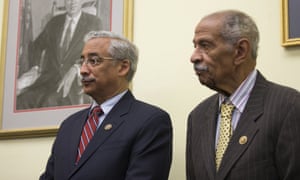
U.S. Representatives Bobby Scott and John Conyers, Jr.
“The teachers were outstanding … there was a very strong ethos around racial identity, around civil rights, around celebrating who we were,” he said.

It wasn’t lost on Green, however, that just north of 8 Mile Road – the demarcation line of Detroit and its suburbs – students had access to a significantly higher amount of resources.

“I do remember … 8 Mile being like the psychological barrier, even in the early 80s it was,” said Green, 33. “I knew there were these suburbs [that] had more amenities, but I don’t think I could articulate that as an elementary school child.”

A fourth-generation Detroiter, Green’s entry into the city’s public school system was only several years removed from a seminal 1974 US supreme court ruling on school desegregation, Milliken v Bradley, which ended a plan to integrate mostly white suburban schools into Detroit’s public school system. The city’s population continued to swiftly decline in the years that followed, eroding the school system’s resources in tandem until the state declared a financial emergency.

Green, a professor of educational policy and planning at the University of Texas at Austin, pointed to the Milliken decision as a “death knell” to implementing the supreme court’s 1954 decision in Brown v Board of Education to desegregate school systems.

“How do you have meaningful desegregation when you have white flight occurring at rapid rates, but we can’t involve suburban school districts where this was occurring?” Green said. “It stopped mandatory desegregation efforts metropolitan-wide.”

A report released this week by the Government Accountability Office illuminated the extent to which school systems across the US are, once again, becoming more segregated. The report found that more than 60% of schools with high levels of poor students were racially segregated, which the report defined as being at least 75% black or Latino.

The study reviewed federal data from 2001 to 2014 and found 16% of all US schools were both racially segregated and poor, increasing from about 7,000 schools in 2001 to 15,089 by 2013 to 2014. Observers and advocates for school desegregation said the report should be a “huge warning sign” that needs to be addressed.

“There are many who believe in this country that we are operating on an even playing field,” said Jadine Johnson, staff attorney at Advancement Project.

“I think what this report revealed … is that the legacies of slavery in this country, the legacies of Jim Crow, are alive and active,” she said. “That did not go away with Brown v Board of Education.”
Compared to other schools, the GAO report found, segregated schools offered fewer college prep, science, and math classes to take, and a disproportionate number of students were either held back in ninth grade, suspended, or expelled.

Michigan congressman John Conyers was among several lawmakers who requested the report, which was released on the 62nd anniversary of Brown v Board of Education. Conyers and Virginia congressman Bobby Scott are pushing legislation that would amend Title VI of the 1964 Civil Rights Act and restore the rights of parents to file lawsuits against segregated school districts under claims of disparate impacts, which are based on ascertaining the discriminatory effect of a policy rather than ascertaining a discriminatory intent.

"This GAO report confirms what has long been feared and proves that current barriers against educational equality are eerily similar to those fought during the civil rights movement,” Conyers said in a statement. “There simply can be no excuse for allowing educational apartheid in the 21st century.”

Johnson said the loss of parents’ ability to file disparate impact cases was a “huge blow to the civil rights community”. Johnson has assisted in filing several Title VI complaints in recent years with the federal department of education – complaints that could have been filed in federal court under Conyers’ proposal.

“Us having that right could have potentially … slowed down the school closures crisis that’s happening today,” she said.

In Conyers’ home state, the largest public school system – Detroit – is currently embroiled in a struggle for survival amid bloated class sizes, paltry resources, and large-scale protests waged by teachers who have faced the prospect of working without pay. Michigan’s governor, Rick Snyder, is pushing a controversial $715m plan to overhaul the district, which needs a significant influx of cash to move forward with much-needed repairs for dozens of dilapidated facilities.

Only one-third of high school students in Detroit public schools are proficient in reading, according to Snyder’s office.

Green said the Milliken decision is one of the “main culprits” in what has happened to his alma mater.

Despite the supreme court’s 1954 landmark decision that US schools must be desegregated, Detroit’s school system remained effectively segregated, stemming in part from an accelerated white flight. When the NAACP legally challenged the state of Michigan in 1970 to end the district’s segregation, at first, the federal courts agreed something needed to be done: A plan was crafted to bus students in from suburban districts and was upheld by an appellate court.

But the plan was quickly stamped out. In 1974, the US supreme court in a 5-4 ruling shot down the efforts in Detroit, saying desegregation measures had to remain inside district boundaries.

In a column he co-wrote for the Detroit Free Press, Green argued that “we need advocacy and policies for all schools to be equitable, and racially and socioeconomically diverse across metro Detroit so that all children can learn to grow up in a diverse nation.”

Compared to suburban districts, he said, citing the GAO report, segregated schools have less access to courses needed to exceed in college – and, in some cases, a lower level of teacher experience. Indeed, a plan approved by the Michigan house to overhaul Detroit schools would allow uncertified teachers to be hired by the district.

“So I think there’s also a resource argument that has to be made [for integration],” he said.
The GAO recommended that the US department of education “more routinely analyze” civil rights data to identify disparities and said the federal justice department could “systematically track key information on open federal school desegregation cases to which it is a party to better inform its monitoring”.

Eve Hill, US deputy assistant attorney general, wrote in a response letter to the report: “The Department carefully monitors each open desegregation case to which the United States is a party on a case-by-case basis, recognizing that each case is unique.” The justice department is involved in 178 open desegregation cases, stemming from court orders that originated in the 1970s and 1980s.

Green said the GAO report underscores the spirit of the Brown v Board of Education decision.
“It’s not just about putting white bodies and black bodies together,” he said. “It’s about understanding what they said in 54, that racially segregated and separate schools are inherently unequal.”

Voting is beautiful, be beautiful ~ vote.©
Tuesday, May 17, 2016

CONYERS, Scott Unveil New GAO Report on Segregation in Public Schools

Washington, D.C. – Committee on the Judiciary Ranking Member John Conyers, Jr. (MI-13) and  Committee on Education and the Workforce Ranking Member Bobby Scott (VA-03) unveiled the findings of a new report by the Government Accountability Office (GAO) on actions needed to reduce racial and socioeconomic segregation, and address disparities in K-12 public schools. Ranking Members Conyers and Scott, along with retired Congressman and former Ranking Member George Miller, first requested this report in May 2014.

Sixty-two years ago, the Supreme Court struck down lawful school segregation in the Brown v. Board of Education decision, stating that “it is doubtful that any child may reasonable be expected to succeed in life if he is denied the opportunity of an education” The decision also affirmed that education was a right that “must be made available to all on equal terms.” GAO gathered data for this report from the Department of Education and confirmed that increasing segregation along the lines of race and poverty continue to be a driver for inequities in education. Despite Brown’s affirmation that “separate educational facilities are inherently unequal,” our system of public education remains largely separate and largely unequal.

Dean of the U.S. House
of Represetatives
John Conyers, Jr.
“This GAO report confirms what has long been feared and proves that current barriers against educational equality are eerily similar to those fought during the civil rights movement,” said Rep. John Conyers.“There simply can be no excuse for allowing educational apartheid in the 21st century. Congress and the federal government, as well as state and local agencies, must ensure all children receive access to equal education at all publicly funded schools.”

“Sixty-two years later, here we are in 2016 facing an overwhelming failure to fulfil the promise of Brown in realizing equality in educational opportunity for all students,” said Rep. Bobby Scott. “In May of 2014, I, along with Ranking Member Conyers and former Education and the Workforce Committee Ranking Member George Miller, requested that the GAO examine racial and socioeconomic isolation in K-12 public schools, and the resulting impact on educational equity. The report resulting from this inquiry confirms a growing and persistent body of research. The GAO report confirms that our nation’s schools are, in fact, largely segregated by race and class. What’s more troubling, is that segregation in public K12 schools isn’t getting better; it's getting worse, and getting worse quickly, with more than 20 million students of color now attending racially and socioeconomically isolated public schools. This report is a national call to action, and I intend to ensure Congress is part of the solution.”

“Equal educational opportunity is too critical to our nation’s future to allow persistent disparities adversely affecting minority groups to continue,” stated Thomas A. Saenz, President and General Counsel of MALDEF (Mexican American Legal Defense and Educational Fund).  “Unjustified and significant educational disparities must be challengeable by private individuals; the Department of Education simply cannot provide the consistent and broad enforcement necessary for such a pivotal concern.”

Nearly a half-century of research shows that segregation negatively impacts student outcomes and exacerbates unequal opportunity experienced later in life. GAO data from the Department of Education confirmed that race and poverty continue to be driver for inequities in education and that housing segregation patterns contribute to school segregation.

“This report shines a light on worsening educational inequities that cannot be divorced from our nation's legacy of racial discrimination that has perpetuated racial and socioeconomic isolation,” said NAACP President and Director Counsel Sherrilyn Ifill. “It is our imperative on the 62nd anniversary of the U.S. Supreme Court’s ruling in Brown v. Board of Education to ask, ‘How will we act to address current disparities like resource inequities and discriminatory discipline practices?’ We must ensure that interventions address the intersectional nature of racial discrimination in areas like housing and economics that impact educational opportunities and outcomes.”

“The findings of GAO confirm what we know to be true: that the promise of Brown remains a promise that has gone largely unfulfilled,” said National Urban League President and CEO Marc H. Morial. “In too many communities, students of color are now more segregated with less access to equitable educational opportunities than in decades prior. Collectively, we can and must do better. This is why the National Urban League and our network of local leaders remains dedicated to partnering with state and school district leaders to seize on the opportunity presented by the Every Student Succeeds Act (ESSA); to turn the ship and reverse the trend of racial and socioeconomic isolation in public K-12 education. I look forward to continued collaboration with Congress to ensure that government at all levels is acting to right this egregious wrong and bring us closer to fulfilling Brown’s promise.”

Reps. Conyers and Scott introduced the Equity and Inclusion Enforcement Act, legislation to empower parents and communities to address – through robust enforcement – racial inequities in public education.

Voting is beautiful, be beautiful ~ vote.©

Friday, May 25, 2018

JUDICIARY: Opening Statement of Ranking Member Jerrold Nadler for the Forum on Enforcement of the Civil Rights Act in U.S. Schools


Washington, D.C. – Today, on the anniversary of Brown v. Board of Education, House Judiciary Committee Ranking Member Jerrold Nadler (D-NY) joined his colleagues in Democratic leadership to unveil a resolution to affirm support for disparate impact analysis as an enforcement tool of Title VI under the Civil Rights Act of 1964. The resolution also calls on the Trump administration to fully enforce federal civil rights law to advance equal opportunity in education. Ranking Member Nadler announced this resolution at a forum he co-hosted with Congressman Bobby Scott (VA-03), Ranking Member of the Committee on Education and the Workforce.

Below are Ranking Member Nadler’s remarks at the forum, as prepared for delivery:

“Good afternoon. I am pleased to join my friend, the Ranking Member of the Education and the Workforce Committee, Representative Bobby Scott of Virginia, as we delve into educational equity issues in the wake of No Child Left Behind.  Those of you who are Hill veterans will recall the many years that Representative Scott and I sat beside one another on the Judiciary Committee dais to debate and defend issues on the Constitution, civil rights and civil liberties. 

“Earlier today, we introduced a resolution to affirm Congress’s intent for the Trump Administration to fully enforce federal civil rights laws that advance equal opportunity in education. I hope this is the first of many efforts together in our roles as Ranking Members on the Education and the Workforce and Judiciary Committees.

“As we meet today, on the 64th anniversary of the Brown v. Board of Education decision, we are reminded of both, historically, the progress in addressing racial inequality in our education system and, more contemporaneously, just how much work still needs to be done.  By one reckoning, the Brown decision was an epic victory in the fight for equality.  By another, it signaled a school-by-school effort to advance educational achievement for minority students, culminating with the enactment of the Civil Rights Act of 1964.

“More than 50 years after the passage of the Civil Rights Act, education issues still generate partisan controversy and have the power to divide communities.  Under the Trump administration, Education Secretary Betsy DeVos has begun dismissing hundreds of civil rights complaints under a new protocol that allows investigators to disregard cases that are part of serial filings or that they consider burdensome to the office.  She has also rescinded Obama-era guidelines that have prodded colleges and universities to more aggressively investigate campus sexual assaults.  She has further threatened to rescind other important Obama-era guidelines that have proved critical to protecting students, like the 2014 School Discipline Guidance, that we will discuss later.

“We are joined today by the Government Accountability Office and other experts to highlight important research around resegregation and school discipline. In 2016, the GAO found that schools were resegregating at alarming rates and, just last month, the GAO found that students of color suffer harsher punishment in school than their peers.  In the face of mounting challenges faced by students of color as the Trump Administration attempts to roll back critical civil rights protections, Congress must remain vigilant to address these problems and to check the Trump Administration’s abuses. Our students deserve no less.”

BACKGROUND:

The original co-sponsors for the resolution include Ranking Member Bobby Scott (VA-03), Ranking Member Jerrold Nadler (NY-10), House Democratic Leader Nancy Pelosi (CA-12), House Minority Whip Steny Hoyer (MD-05), Assistant Democratic Leader James Clyburn (SC-06), Chair of the Congressional Asian Pacific American Caucus Judy Chu (CA-27), Chair of the Congressional Black Caucus Cedric Richmond (LA-02), Chair of the Congressional Hispanic Caucus Michelle Lujan Grisham (NM-01), and additional Democratic Members of Congress.

On April 4, 2018, Ranking Members Scott and Nadler released a GAO report entitled, “Discipline Disparities for Black Students, Boys, and Students with Disabilities.” This report found that Black students, boys, and students with disabilities are disproportionately disciplined in K-12 public schools. This pattern of disproportionate discipline persists regardless of the type of disciplinary action, level of school poverty, or type of public school students attend. To read more about this report, click here.

On May 17, 2016, Committees on the Judiciary and Education and the Workforce Democrats unveiled a GAO report entitled, “K-12 EDUCATION: Better Use of Information Could Help Agencies Identify Disparities and Address Racial Discrimination.” This report confirmed that increasing segregation along the lines of race and poverty continue to be a driver for inequities in education. The report identified actions needed to reduce racial and socioeconomic segregation, and addressed disparities in K-12 public schools. To read more about this report, click here.

Voting is beautiful, be beautiful ~ vote.©

Monday, May 6, 2019

EDUCATION: School Re-Segregation - Brown v. Board Of Education - A Residual Of Predictive Modeling Crap Databases Of Property Ownership & Gerrymandering

Before you watch this very painful hearing of educators who are poorly educated on the history of Brown v. Board of Education, here is the condensed congressional history that they are attempting to bleach and "re-segregate".

This was basically a #clownfest of individuals who are trying to pitch their new and improved versions of history, while trying to increase their foreign corporate profits by reanimating the residuals of the peculiar institution by telling really creative tales of how they are best to steward all the public education funding for students without saying that they are going to self embolden themselves with corporate parental rights in their school model for "The Poors".

Yes, this was a privatization pitch and there was not one mention of Detroit, where it all started.


Pierre is talking about black families being dissipated? 

Linda Darling-Hammond
Linda Darling-Hammond,
Predictive Modeling Crapper
"She is creepy."
WTF?  Dude needs some serious therapy.

what the hell 

schrier is talking real estate and financial investment.

The respondents are talking about investing.

this is gerrymandering

Scott stated that submissions into the record was open until May 14th, 2019 by 5:00 p.m. 

I see nothing on the committee site but I did find this if anyone is interested in commenting you can go to the following links: 


Charter schools suck, badly.  I know.  I am in Detroit. They started here.

This is geopolitical.


Then the Emergency Manager Law came in and privatized education.


These foreign corporations own our schools and I speculate there are land patents involved.

This is about forced migration.

There studies are crappy data collection methodology are like harvesting wheat shafts with scythes in the hot summer sun.

John C. Brittain
John Brittain, Attorney
who has no clue about the dirty
deeds of the NAACP
Brown v. Board of Education was based on a science study, "Tanks v. Talent".

Basically, the study was a parody to the study that said, "kids who grew up reading the newspaper in the home got more scholarships for universities and performed better on tests."

The study was done in the 1950s where only "certain people" could own property.

For example, sharecroppers had no toilets.

They had outhouses, not tanks in the home.

Indoor plumbing was for the rich, who owned houses, not shacks.

People in shacks could not afford to purchase a newspaper, which means, according to the original study, would be not able to get scholarships, would not perform well on tests, and as such, would never succeed to be property owners.

Ergo, the more the toilets in the home, the smarter and more successful in life the kids.

Kim Schrier, official portrait, 116th Congress.jpg
Kim Schrier
I used to have the study found in the African American History Journal, but Jstor is privatized, and got copyright on a case used in the Brown v. Board education, so I do not know why it is not in the public domain.

These DeVos witnesses, yes, conflict of interest, are talking about privatizing to help the state with their growing foster care and homeless students populations.

This is TARP.

They stole the children, the land and the votes, creating this population of foster care and homeless students, but I did learn something new!

These witnesses have redefined race by lumping English as a Second Language population as students of color.

They are skewing dirty data.....I love it because everyone up there on the diaz in committee, including their staff, are absolutely unqualified to catch that these people are pumping some some hard core, raw, predictive modeling crap.

This Darling-Hammond just said that kids tear up the schools and get more detention but did she say anything about the schools not having heat or books?

Nope, because she comes from a wealthy school district.

I bet she hangs out with Blasey-ford over there at Stanford but I did find their charter schools think tank which is probably run by some of those trust fund babies mommy and daddy dropped millions to get them into these graduate positions.

These are the people who are doing that generational gerrymandering.

Lessons for Developing School and District Capacity to Transform Literacy Instruction: The Canterbury Learning Collaborative

I knew I would find Social Impact Bonds.

https://edpolicy.stanford.edu/


They are mapping out voting districts through paramilitary instructor, not educator, networks.


Photo: Dan Losen
Daniel Losen,
He who does not know
Gracie Lee Boggs
or anything about the history
of Civil Rights
These people are talking about lumping racial disparities and psychological disabilities into quotas as their newly made up term of "re-segregation?

I just got chills of terror for these people, of whom command our educational institutions are a caustic affront, besmirching the profession of higher learning, by transmogrifying schools into institutions of predictive modeling  for civil asset forfeiture.

How can they even mention the "School-to-Prison" pipeline without mentioning Gracie Lee Boggs?

Seriously?


There they go talking that race crap as a reason to get more money for community development.

Jahana Hayes, official portrait, 116th Congress.jpg
Jahana Hayes,
the only one with common sense
I can smell the carve out from their entire second round of another TARP hustle to get more money through their reparations propaganda.

No parents wakes up and says, "oh, we cannot let little Johnny go to that school because there are too many (fill in the blank)."

Please, someone, make the stupid stop.

These people speak as if they have never set afoot in Detroit, where this entire privatized, charter school model was set up and failed miserably.


Defiance?

These people are talking about defiance in children.

Did you know there is a disorder called Oppositional Defiance Disorder and they have psychotropics to prescribe for it.
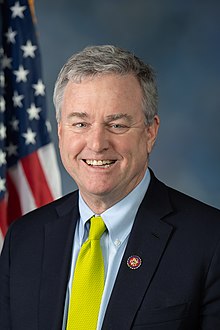
David Trone official photo.jpg
David Trone
should not be around
any children's issues

They used foster kids for the lab rat researach.

Here is an example of the growing foster care and homeless population of kids they want to service, as opposed to ending child poverty, but I digress.

You snatch a kid from his fmaily for being poor.

You put the kid in a foster care placement, that the Secretary of Education just so happens to have a familiar financial interest in the child placing agency privatized contracts.

The kid wants to go home.

You dope the kid up because the kid opposes foster care or being homeless.

Voting is beautiful, be beautiful ~ vote.©
Thursday, May 18, 2017

CONYERS & SCOTT Introduce Bill to Address Racial Inequities in Public Education

WASHINGTON – TODAY, Committee on Education and the Workforce Ranking Member Bobby Scott (VA-03) and Committee on the Judiciary Ranking Member John Conyers, Jr. (MI-13) introduced the Equity and Inclusion Enforcement Act (EIEA). This legislation would empower parents and communities to address – through robust enforcement – racial inequities, including inequities in access to educational resources, in public education.

Today marks the 63rd anniversary of the landmark Supreme Court decision in the Brown v. Board of Education case, which struck down lawful school segregation and affirmed that education was a right that “must be made available to all on equal terms.” Last year on the anniversary of Brown, Ranking Members Scott and Conyers unveiled the findings of a Government Accountability Office (GAO) report which found that our nation’s schools are, in fact, re-segregating by race and class.

Dean of the U.S. House
of Representatives
John Conyers, Jr.
“Though the Nation can celebrate the progress made over the course of the last 63 years after the Brown v. Board decision, we should acknowledge the long path ahead of us in the battle toward equal education,” said Ranking Member Conyers. “Last year’s GAO report confirmed our fears -- that many of our schools are re-segregating at alarming rates. On this landmark occasion, I’m proud to join Rep. Scott in introducing the Equity and Inclusion Enforcement Act, legislation that will help us on our path to providing equal educational opportunities for all students.”

On this anniversary of Brown, we are reminded that we have a long way to go to achieve educational equity for all students,” said Ranking Member Scott. “Last year’s GAO report confirmed that increasing segregation along the lines of race and poverty continue to be a driver for inequities in education. The Equity and Inclusion Enforcement Act provides parents and communities with the tools necessary to ensure all children have a chance to succeed, and moves us one step closer to fulfilling the promise of Brown.”

In 1964, Congress passed the Civil Rights Act, a decade after the Brown decision. Title VI of the Act mandates that federal dollars cannot subsidize or support programs or activities that discriminate on the basis of race, color, or national origin. The EIEA would:
  • restore a private right of action to file disparate impact claims under Title VI;
  • create Title VI monitors to ensure that every school has at least one employee to specifically carry out the responsibilities of the law; and
  • create an Assistant Secretary in the Department of Education to coordinate and promote Title VI enforcement of equity and inclusion in education.

Earlier today, a companion bill - the Rebuild America’s Schools Act of 2017 - was introduced to support new investments in school infrastructure to help level the playing field for students in under-resourced communities. 

Organizations supporting the EIEA: NAACP Legal Defense and Education Fund (LDF), Southeast Asia Resource Action Center (SEARAC), the Leadership Conference on Civil and Human Rights, the Advancement Project, NAACP, and Teach Plus.

The Equity and Inclusion Enforcement Act (EIEA): Restoring Private Right of Action to Disparate Impact Clai... by Beverly Tran on Scribd


Voting is beautiful, be beautiful ~ vote.©