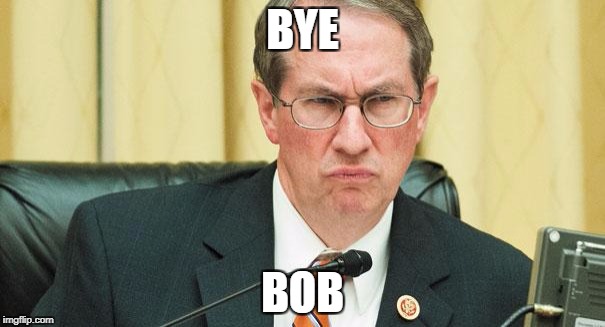
Rep. Bob Goodlatte, the longtime Virginia Republican who chairs the House Judiciary Committee, announced on Wednesday that he will not run for re-election in 2018, adding to the growing list of retiring House Republicans.
The 65-year-old Goodlatte, who announced his decision on Twitter, did not offer much insight into why he is leaving Congress now, other than saying he and his wife,
Maryellen, decided now is the "right time for me to step aside and let someone else serve the Sixth District." Goodlatte's tenure as chairman ends in December 2018, so this is a "natural stepping-off point," he said.
"Every two years, Maryellen and I sat down to discuss whether to run again or not,"
Goodlatte said in a statement posted on his congressional page Thursday.
"When we discussed the 2018 election, the conversation ended a little differently than in past years. After much contemplation and prayer, we decided it was the right time for me to step aside and let someone else serve the Sixth District.
I will not seek re-election. With my time as chairman of the judiciary committee ending in December 2018, this is a natural stepping-off point and an opportunity to begin a new chapter of my career and spend more time with my family, particularly my granddaughters."
It's my honor to represent #VA06. I cannot begin to express how blessed I am to have had the opportunity to serve. Now is the right time to step aside - I will not seek re-election. My statement: https://t.co/tByoe5vFmO
I extend my deepest thanks to the people of Virginia’s Sixth District who have placed their trust in me. Congressman Bob Goodlatte (R-Va.) released the following letter today announcing that he will not seek re-election in 2018:
Dear Friend,
When I first decided to run for Congress there were several things I wanted to achieve for the Commonwealth of Virginia and our nation.
I had a strong passion for public service, a love of the law and the judicial system, and a deep appreciation for the people who call western and central Virginia home.
These passions led me to serve on the Judiciary and Agriculture Committees throughout my time in the House, and have shaped my work on policies impacting the American people.
I’ve had the privilege to serve as Chairman of both of these committees, and I’ve been proud to work on policies that have become law and advance fiscal conservatism, personal liberty, economic growth, and limited government.
For the past 25 years, it has been my honor to represent the Sixth Congressional District of Virginia. I cannot begin to express how blessed I am to have had the opportunity to serve and take part in the great experiment of self-government envisioned by our Founders.
It has been a labor of love to work countless hours and travel endless miles on the roads of our District for a quarter of a century.
Every two years, Maryellen and I sat down to discuss whether to run again or not.
When we discussed the 2018 election, the conversation ended a little differently than in past years. After much contemplation and prayer, we decided it was the right time for me to step aside and let someone else serve the Sixth District. I will not seek re-election.
With my time as Chairman of the Judiciary Committee ending in December 2018, this is a natural stepping-off point and an opportunity to begin a new chapter of my career and spend more time with my family, particularly my granddaughters.
While I’m not running for re-election, my work in the 115th Congress is far from done.
There is much that I hope we can accomplish in the next year, including: bolstering enforcement of our immigration laws and reforming the legal immigration system, simplifying the tax code in order to stimulate job growth and benefit families in the Sixth District, enacting criminal justice reform, repealing Obamacare, advancing protections of the freedoms and liberties enshrined in our Constitution, and, of course, continuing first-class constituent service for the citizens of the Sixth District.
I look forward to working with the House Leadership, the Senate, and President Trump in bringing real conservative change to our country.
I extend my deepest thanks to the people of Virginia’s Sixth District who have placed their trust in me.
It is truly you who are the highlight of my time in elected office. I’ve had the good fortune of having an amazing staff team during my time in Congress – both in my Sixth District offices as well as in the Judiciary and Agriculture Committees.
They’ve done excellent work, and I greatly value their commitment to serving the Sixth District and the American people. I’d also like to thank my colleagues on both sides of the aisle in Congress with whom I’ve had the opportunity to work over the years.
I genuinely appreciate your friendship and support. And finally, none of this would have been possible without the love and support of my wife, Maryellen, and our children, Bobby, Jen, and Jen’s husband, Matt.
They have my enduring love and gratitude.
I look forward to what the next chapter brings.
Sincerely,
Bob
And the moral of the story is: "Do not be mean to my Sweetie, period."
What is quite odd about Bobby Goodlatte, son of the Chairman of the U.S. House Judiciary, is not the fact that he is supporting a Democrat for his father's soon to be vacant seat, but the fact that Peter Strzok was fired for violating national security protocol, in the same exact manner that former Secretary Hillary Clinton did, which is how special access intelligence got onto her unsecured servers and in her emails.
Strzok wasn't fired just for his anti-Trump text messages. I discovered that he had the regular practice of taking his cell phone into the @FBI's Sensitive Compartmented Information Facility. I gave the proof to the @FBIWFO. @DeepStateExposepic.twitter.com/SJem9cN5Ek
The son of a powerful Republican congressman lambasted his father on Twitter on Monday for "ruining" the career of a recently fired FBI agent who had sent anti-Trump text messages during the Russia investigation.
The son of U.S. Rep. Bob Goodlatte also began soliciting campaign donations on Sunday for the Democrat who is running to replace his father, who is retiring.
The Democratic campaign said more than $25,000 had flowed in from across the country in less than 24 hours.
The elder Goodlatte, who chairs the House Judiciary Committee, is leaving his seat in western Virginia after 13 terms.
His son Bobby Goodlatte was an early designer at Facebook and is based in the San Francisco area.
"I'm deeply embarrassed that Peter Strzok's career was ruined by my father's political grandstanding," the younger Goodlatte wrote on Twitter on Monday.
"That committee hearing was a low point for Congress.
Thank you for your service sir. You are a patriot."
Strzok's lawyer said Monday that he had been fired by the FBI.
Bobby Goodlatte was referring to his father's role in an extraordinarily combative congressional hearing last month in which Strzok was questioned about the anti-Trump texts he had sent.
The hearing lasted 10 hours. Strzok said the texts, including ones in which he called Trump a "disaster" and said "We'll stop" a Trump candidacy, did not reflect political bias and had not infected his work.
Congressman Goodlatte asked colleagues to imagine being investigated by someone who "hated you" and "disparaged you in all manner of ways."
"Would anyone sitting here today believe that this was an acceptable state of affairs, particularly at an agency whose motto is 'Fidelity, Bravery and Integrity'? I think not," Goodlatte said.
When Strzok declined to answer some questions on the Russia probe, Goodlatte suggested Republicans might recess the hearing and hold him in contempt.
Democrats objected and Goodlatte eventually let the hearing proceed.
A day before he tweeted about his father's treatment of Strzok, the younger Goodlatte had requested donations in support of the Democrat who is running for the open seat in Virginia's 6th District.
"I just gave the maximum allowed donation to Jennifer Lewis, a democrat running for my father's congressional seat," he wrote. "I've also gotten 5 other folks to commit to donate the max. 2018 is the year to flip districts — let's do this!"
Political observers have described the House district in Virginia, which includes Roanoke, as safely Republican.
Lewis has received about $73,000, according to the latest Federal Elections Commission data.
Her Republican opponent, Ben Cline, has pulled in nearly $400,000.
Following Goodlatte's tweet on Sunday, more than $25,000 had flowed in from across the country by Monday afternoon, according to Lewis' campaign manager, Josh Stanfield.
He said mostly smaller donations, such as $100, came first from northern California and then from places like Iowa and Alaska.
"(Bobby Goodlatte) never expected this to go viral," Stanfield said. "Everyone is sort of caught off guard. But obviously it's compelling for some reason. We'd be delighted if he'd come back to the 6th and canvass with us."
State of Mississippi Attorney General
Jim Hood, Pimp Master of a MFCU
This is the most beautifully crafted complaint for an extraordinary writ; it goes after Medicaid fraud in child welfare; and, it is a State, the State of Mississippi, Attorney General, Jim Hood,
Nor, will there be comment on the State of Ohio's lawsuit against these pharmaceutical corporations that fraudulently bill Medicaid to fund political campaigns and launder money.
My problem is not just with the unethical practices warped up in the industry of human trafficking of child welfare, but the fact that these fraud schemes actually fund political campaigns and, if you look really closely, it will direct the way a Member votes, or the way the Chairman of the U.S. House Judiciary Committee will direct the way the agenda is set for Committee hearings and the Congress.
I have been watching the Committee for quite some time, so, without further adieu, in the spirit of fuchsia, I will only highlight my expletives.
I decided to reach out in a compassionate capacity, rather than going the hell off on reading some really bloody shyte like this.
Take another read at the qui tam, above which is about Medicaid fraud in child welfare, specifically foster care and adoption.
Can you say "Foster Care and Adoption", Bob?
Do you know how many children are raped each year in foster care, which is billed to Medicaid?
Do you know how many foster children are used as lab rats for pharmaceutical testing of second generation anti-psychotropics or any other form of biomedical profiteering that may come about through the maximization of revenue from these child welfare Medicaid fraud schemes. Do you even know how many children were trafficked through foster care and adoption?
Do you know how much in Medicaid false claims are submitted, through judicial determination, in child welfare?
Are you that out of touch with the current situation of child protection in the U.S. that you actually believe "remarkable progress has been made in preventing, investigating, and prosecuting crimes against children"?
Bob, you do know that TEVA made several financial contributions to your re-election campaign, but of course you do, and you know what the Foreign Corrupt Practices Act is.
Bob, even the SEC got in on this. Come on, and you actually believe these monetary legal asset hits are going to stop child trafficking?
Bob!!! Wake up!!!!
Crimes against children are condoned in legislation, funded extremely well through appropriations, where the funding spigot is only turned on through a judicial determination on a case where one is guilty until proven innocent, charged without plea or notification of the charge, with not right to face one's accuser, with no right of reinstatement of parental rights, all blessed by the privatized, tax exempt God.
Human trafficking in child welfare is privatization, the modernized residuals of the peculiar institution.
Your campaign has a pattern of practice of accepting campaign contributions from PACs which are funded by dark money, gained through the filing of false claims of Medicaid in child welfare.
Bob, you are part of the problem of child poverty, or rather, financial crimes of trafficking children & profiting through privatized, federally cost-reimbursed, tax exempt child welfare operations which have funded much of your campaigns.
Bob, I can go through your FEC filings and cross reference with DOJ, FEC, SEC, and HHS OIG settlements and other forms of agreements in dealing with these corporations, which set up & fund their PACs with money they made from filing false claims to Medicaid through child welfare.
That is not progress in preventing, investigating and prosecuting crimes against children, this is propaganda to distract from the reality of privatization to fund political campaign through Medicaid fraud in child welfare.
And, propaganda is exactly what these Domestic & Foreign Corporate PACs fund when they make political campaign contributions.
This is child welfare propaganda, Bob because, not once is there mention of child poverty, foster care, adoption, drugging kids, rape, torture, suicide or attempted suicide, nor human trafficking of children or what has happened to the parents in this lovely production, which even has the Committee co-opting the pinwheel symbol at the end of the video.
But I must say, dropping the "Nelson Mandela" effect by the witness was a nice try at a political propaganda crossover technique.
Bob, you impugn my veracity while deprecating my acumen of this subject matter, but you need to come clean because right now, in my eyes, you suck.
Badly.
But, hey, what do I know about Medicaid fraud in child welfare, campaign finance fraud, the House Judiciary Committee, or the Clinton Foundation?
Companies Agree to Pay Nearly $520 Million to U.S. Criminal and Regulatory Authorities, Representing the Largest Criminal Fine Imposed Against a Pharmaceutical Company for Violations of the FCPA
Teva Pharmaceutical Industries Ltd. (Teva), the world’s largest manufacturer of generic pharmaceutical products, and its wholly-owned Russian subsidiary, Teva LLC (Teva Russia), agreed to resolve criminal charges and to pay a criminal penalty of more than $283 million in connection with schemes involving the bribery of government officials in Russia, Ukraine and Mexico in violation of the Foreign Corrupt Practices Act (FCPA).
Assistant Attorney General Leslie R. Caldwell of the Justice Department’s Criminal Division, Assistant Director Stephen Richardson of the FBI’s Criminal Investigative Division, and Assistant Special Agent in Charge William J. Maddalena of the FBI’s Miami Field Office made the announcement.
“Teva and its subsidiaries paid millions of dollars in bribes to government officials in various countries, and intentionally failed to implement a system of internal controls that would prevent bribery,” said Assistant Attorney General Caldwell. “Companies that compete fairly, ethically and honestly deserve a level playing field, and we will continue to prosecute those who undermine that goal.”
“No matter where corruption occurs, the FBI and our global partners are committed to diligently rooting out the corruption that betrays the public trust and threatens a fair economy for all,” said FBI Assistant Director Stephen Richardson.
“As demonstrated by this case, the Foreign Corrupt Practices Act has a long reach,” said William J. Maddalena, Assistant Special Agent in Charge, FBI Miami. “Teva’s egregious attempt to enrich themselves failed and they will now pay a tough penalty.”
According to the companies’ admissions, Teva executives and Teva Russia employees paid bribes to a high-ranking Russian government official intending to influence the official to use his authority to increase sales of Teva’s multiple sclerosis drug, Copaxone, in annual drug purchase auctions held by the Russian Ministry of Health. The corrupt arrangement occurred at the same time that the Russian government was seeking to reduce the amount spent on costly foreign pharmaceutical products, such as Copaxone. Between 2010 and at least 2012, pursuant to an agreement with a repackaging and distribution company owned by the Russian government official, Teva earned more than $200 million in profits on Copaxone sales to the Russian government. Moreover, the Russian official earned approximately $65 million in corrupt profits through inflated profit margins granted to the official’s company.
Teva also admitted to paying bribes to a senior government official within the Ukrainian Ministry of Health to influence the Ukrainian government’s approval of Teva drug registrations, which were necessary for the company to market and sell its products in the country. Between 2001 and 2011, Teva engaged the official as the company’s “registration consultant,” paid him a monthly fee and provided him with travel and other things of value totaling approximately $200,000. In exchange, the official used his official position and influence within the Ukrainian government to influence the registration in Ukraine of Teva pharmaceutical products, including Copaxone and insulins.
In addition, Teva admitted that it failed to implement an adequate system of internal accounting controls and failed to enforce the controls it had in place at its Mexican subsidiary, which allowed bribes to be paid by the subsidiary to doctors employed by the Mexican government. Teva admitted that its Mexican subsidiary had been bribing these doctors to prescribe Copaxone since at least 2005. Teva executives in Israel responsible for the development of the company’s anti-corruption compliance program in 2009 had been aware of the bribes paid to government doctors in Mexico.
Nevertheless, Teva executives approved policies and procedures that they knew were not sufficient to meet the risks posed by Teva’s business and were not adequate to prevent or detect payments to foreign officials. Teva also admitted that its executives put in place managers to oversee the compliance function who were unable or unwilling to enforce the anti-corruption policies that had been put in place.
Teva entered into a deferred prosecution agreement (DPA) in connection with a criminal information, filed today in the Southern District of Florida, charging the company with one count of conspiracy to violate the anti-bribery provisions of the FCPA and one count of failing to implement adequate internal controls. Pursuant to its agreement with the department, Teva will pay a total criminal penalty of $283,177,348. Teva also agreed to continue to cooperate with the department’s investigation, enhance its compliance program, implement rigorous internal controls and retain an independent corporate compliance monitor for a term of three years.
Teva Russia has signed a plea agreement in which it has agreed to plead guilty to a one-count criminal information, also filed today in the Southern District of Florida, charging the company with conspiring to violate the anti-bribery provisions of the FCPA. The plea agreement is subject to court approval. The case was assigned to U.S. District Judge Kathleen M. Williams of the Southern District of Florida and Teva Russia's initial court appearance has been scheduled for January 12, 2017.
In related proceedings, the U.S. Securities and Exchange Commission (SEC) filed a cease and desist order against Teva, whereby the company agreed to pay approximately $236 million in disgorgement to the SEC, including prejudgment interest. Thus, the combined total amount of U.S. criminal and regulatory penalties to be paid by Teva is nearly $520 million.
The Criminal Division’s Fraud Section reached this resolution based on a number of factors, including the fact that Teva did not timely voluntarily self-disclose the conduct, but did cooperate with the department’s investigation after the SEC served it with a subpoena. Teva received a 20 percent discount off the low end of the U.S. Sentencing Guidelines fine range because of its substantial cooperation and remediation. The company, however, did not receive full cooperation credit because of issues that resulted in delays to the early stages of the Fraud Section’s investigation, including vastly overbroad assertions of attorney-client privilege and not producing documents on a timely basis in response to certain Fraud Section document requests. Because many of the company’s compliance enhancements were more recent, and therefore have not been tested, the DPA imposes an independent compliance monitor for a term of three years.
The FBI’s International Corruption Unit and Miami Field Office investigated the case. Fraud Section Trial Attorneys Rohan A. Virginkar and John-Alex Romano prosecuted the case. The Fraud Section appreciates the significant cooperation and assistance provided by the SEC in this matter. The Criminal Division’s Office of International Affairs and the Mexican Attorney General’s Office (Procuradura General de la República or PGR) also provided assistance in this matter.
Someone should really have Bob call Ethics to see if there are any, ya know, congressional staff advisers giving him bad information which would manipulate his votes in Committee and on the House Floor.
Hatch-Goodlatte Music Modernization Act to be Signed into Law
Washington, D.C.(H.R. 1551), bipartisan legislation that updates several key provisions of U.S. copyright law regarding music licensing. This consensus legislation is a product of the House Judiciary Committee’s comprehensive copyright review and was introduced by House Judiciary Committee Chairman Bob Goodlatte (R-Va.), Ranking Member Jerrold Nadler (D-N.Y.), Courts, Intellectual Property, and the Internet Subcommittee Vice Chairman Doug Collins (R-Ga.), Representative Hakeem Jeffries (D-N.Y.), Courts, Intellectual Property, and the Internet Subcommittee Chairman Darrell Issa (R-Calif.), Courts, Intellectual Property, and the Internet Subcommittee Ranking Member Hank Johnson (D-Ga.), former House Judiciary Committee Chairman and current Science, Space, and Technology Committee Chairman Lamar Smith (R-Texas), and Representative Ted Deutch (D-Fla.).
Chairman Goodlatte and Ranking Member Nadler applauded today’s vote in the statements below.
Chairman Goodlatte: “Today’s House passage of the bipartisan Hatch-Goodlatte Music Modernization Act is a major victory for American music creators, music distributors, and the music listening public. This legislation, which modernizes our music copyright laws so music creators are fairly compensated for their works, finally brings our music laws into the digital age.
“I appreciate the hard work of the many House and Senate Judiciary Committee Members who came together on this legislative package. Music has such an immense impact on all of our daily lives and with this important legislation headed to the President’s desk, we will help ensure the sustainability of the evolving American music industry for decades to come.”
Ranking Member Nadler: “I am proud that the Music Modernization Act will now head to the President’s desk. This bill will update the law to better serve both creators and digital music providers. Virtually all of the major industry stakeholders came together to support this bill. I am particularly pleased that this bill includes several measures included in the Fair Play Fair Pay Act, which I introduced the last two Congresses. Under the leadership of Chairman Goodlatte, we have joined together on a bipartisan basis to modernize the music licensing system. We have seized this historic opportunity to resolve some longstanding inequities in the music marketplace by helping digital services more efficiently license and distribute musical works, while ensuring artists, songwriters, and other music creators receive fair market value for their work.”
Key Provisions of the Hatch-Goodlatte Music Modernization Act include:
Title I – Music Modernization Act
Reflects how modern digital music services operate by creating a blanket licensing system to quickly license and pay for musical work copyrights
Discourages music litigation that generates legal settlements in favor of simply ensuring that artists and copyright owners are paid in the first place without such litigation
Ends the flawed U.S. Copyright Office bulk notice of intent system that allows royalties to not be paid
Implements uniform rate setting standards to be used by the Copyright Royalty Board for all music services
Shifts the costs of the new licensing collective created by the bill to those who benefit from the collective – the licensees
Updates how certain rate court cases are assigned in the Southern District of New York
Title II — Compensating Legacy Artists for their Songs, Service, and Important Contributions to Society (CLASSICS) Act
Provides that performers who recorded songs before 1972 can finally be paid for their works (currently, only performers who recorded songs after 1972 are paid for their works)
Title III — Allocation for Music Producers (AMP) Act
Ensures that record producers, sound engineers, and other creative professionals receive compensation for their work
Nothing about Corporate Shape Shifiting on the Royalties but that it is a matter for a different jurisdiction.
The Music Modernization Act was signed into law on Thursday by a clearly exuberant President Trump. "I've been reading about this for many years and never thought I'd be involved in it, but I got involved in it," he said of the historic legislation, which passed with unanimous support in both chambers of Congress after years of efforts by the music industry and lawmakers.
At the signing ceremony, Trump was surrounded by a smattering of supportive artists including Kid Rock, John Rich and Mike Love, along with the two Republican lawmakers whose names are officially attached to the law, Sen. Orrin Hatch of Utah and Rep. Bob Goodlatte of Virginia.
While Trump did thank members of the industry in attendance, he only mentioned one executive: Recording Academy Neil Portnow, whom he referred to as "big stuff." Short speeches were delivered by several of the artists, including Rock, Rich, Love and soul legend Sam Moore.
Here are the official reactions to the new law from key execs and organizations:
Mitch Glazier, RIAA president: "The Music Modernization Act is now the law of the land, and thousands of songwriters and artists are better for it. The result is a music market better founded on fair competition and fair pay. The enactment of this law demonstrates what music creators and digital services can do when we work together collaboratively to advance a mutually beneficial agenda. It's a great day for music. We hope fans across the country will join with us in celebration and PLAY IT LOUD."
David Israelite, NMPA president & CEO: "The Music Modernization Act is finally the law of the land. We are incredibly grateful for the Members of Congress who passed the MMA and the President for signing it. Songwriters have for too long labored without seeing fair rates and receiving all that they deserve, and for the first time in history, the music industry has partnered with the tech industry to fix these systemic problems. As we embark on supporting and helping build the critical structures within the MMA, we are humbled by the extraordinary progress propelled by compromise and the unprecedented political involvement of music creators. Today is about their future and this bill stands as a great statement on what can be done when we work together."
Neil Portnow, Recording Academy president and CEO: "As we celebrate the harmony and unity that got us here, we applaud the efforts of the thousands of performers, songwriters, and studio professionals who rallied for historic change to ensure all music creators are compensated fairly when their work is used by digital and satellite music services," he said in a statement. "We thank the members of Congress who championed this issue throughout the past several years to bring music law into the 21st century."
Elizabeth Matthews, ASCAP CEO: "Thanks to the unrelenting efforts of our ASCAP music creator and publisher members, industry partners and champions in Congress, a more sustainable future for songwriters is finally within reach. The MMA's unanimous passage in the House and Senate proves that the power of music is a great unifier. ASCAP is proud to have stood alongside creators, music publishers, and many more to make this dream a reality."
Paul Williams, ASCAP chairman of the board and president: "A young songwriter once wrote, ‘You give a little love and it all comes back to you; You’re gonna be remembered for the things that you say and do.’ Decades later, this could not be more true. Songwriters across this country now and in the future will remember those who fought so hard for the Music Modernization Act—both in Congress and across the music industry. On behalf of the music community, we are so thankful for the love and will return the favor with music for generations to come."
Mike O'Neill, BMI president and CEO: "This is truly a historic moment for the music industry, especially for the American songwriters and composers at its core, who will see significant and deserved benefit from this legislation. Passage of the Orrin G. Hatch-Bob Goodlatte Music Modernization Act was a hard-fought process that hinged on tremendous collaboration and unprecedented support among diverse stakeholders who ultimately united to safeguard the future of music. We are gratified by this extraordinary outcome that recognizes the essential contributions of creators and streamlines the use of their music across businesses. While BMI will keep advocating to protect the livelihood of music creators in the digital age, we thank Congress and the President for taking this important step in implementing the most meaningful music licensing reform in decades."
John Josephson, chairman/CEO of SESAC: "Today, President Trump signed the bi-partisan Hatch-Goodlatte Music Modernization Act (The MMA), which will finally bring music copyright laws into the digital age. We applaud everyone's hard work and tireless efforts on this legislation, especially the Senators who worked diligently to get the bill passed then adopted by the House. We're grateful for our committed songwriting and publishing community whose focus and passion have strengthened our industry for generations to come."
Michael Huppe, SoundExchange president and CEO: "With today's signing of the Music Modernization Act, we mark a historic accomplishment. But more importantly, we mark what it means. For creators, it means getting paid more fairly. For those who recorded music before 1972, it means assurance you'll get paid for your work. For songwriters, publishers and producers it means making the digital economy work for you. SoundExchange's 170,000-member community was a driving force in getting the bill from the halls of Congress to the White House. When the music industry speaks with one voice, Congress listens. I urge you to stay active because there is much more work to be done before we can truly say all music creators are treated fairly."
Michelle Lewis and Kay Hanley, Songwriters of North America (SONA) executive directors: "SONA and its membership of working songwriters would like to express heartfelt thanks to Congress and to our fellow music business stakeholders for accomplishing what everyone thought was impossible: Compromise, consensus, and passage of the Orrin G Hatch - Bob Goodlatte Music Modernization Act. As President Trump signs our bill into law, today marks another momentous event in the rich history of music and the people who create it."
Dina LaPolt, founder/owner, LaPolt Law: "Music’s unifying power helped opposing communities reach across party lines to pass the Music Modernization Act with unanimous congressional support. The President’s final signature now enshrines the MMA in U.S. law, protecting music creators for generations to come. I couldn’t be more proud of SONA and all the songwriters who engaged the entire music creator community to help get this over the line! Now the real work begins!"
Horacio Gutierrez, Spotify general counsel: "One of our core missions at Spotify is to enable a million artists to make a good living from what they love: creating and performing music. The Music Modernization Act is a huge step towards making that a reality, modernizing the outdated licensing system to suit the digital world we live in. The MMA will benefit the music community and create a more transparent and streamlined approach to music licensing and payment for artists."
Keith Kupferschmid, Copyright Alliance CEO: "The Copyright Alliance appreciates the President signing the MMA into law today, and commends and thanks members of Congress, numerous Copyright Alliance members, and friends of the music community for their support of this critical legislation. It's truly remarkable for any cause or bill to bring everyone together in a bipartisan fashion, especially a bill as complex and lengthy as this one. But that's just what happened with the Music Modernization Act. The willingness to compromise, and work with others who may have competing or different interests, in the singular effort to get this important copyright legislation passed was laudable and inspiring."
Michael Eames, Association of Independent Music Publishers (AIMP) president; Alisa Coleman, AIMP New York Executive Director; and John Ozier, AIMP Nashville Executive Director: "Today marks a historic step forward for independent music publishers, songwriters, and the entire music industry, as President Trump has signed the Hatch Goodlatte Music Modernization Act (MMA) into law. This marks the first significant federal legislation since 1998’s Digital Millennium Copyright Act (DMCA) to address the needs of rights-holders in today’s online age. We can look forward to a variety of long-overdue reforms that will make it easier to negotiate for and collect fair royalty rates while also establishing once and for all that digital services must pay for the use of pre-1972 recordings. In addition, it ensures independent publishers and songwriters a seat at the table for the new mechanical licensing collective. The AIMP is committed to ensuring that the independent publishing community and songwriters are represented fairly in the implementation and enforcement of the MMA, and we look forward to working with our partners across the music and technology industries as we move ahead in this new era. We offer our sincere gratitude to David Israelite and his team at NMPA, to the NSAI and SONA, to Senator Orrin Hatch and Congressmen Bob Goodlatte and Doug Collins, and to all parties from all sides who fought to provide a balanced outcome for all involved."
James Donio, Music Business Association president: "The Music Business Association applauds and congratulates its members and valued partners across the industry on their extraordinary and unprecedented efforts to bring the groundbreaking Music Modernization Act to fruition. What an amazing achievement for creators and their commercial partners to have come together in solidarity, and joined with Congress, to make long overdue copyright reform a reality. This is the start of an exciting new era for the entire business of music. Bravo!"
How about a hearing on child welfare policies that have obviously been demonstrated to be ineffective and riddled with fraud?
Washington, D.C. - Today, the House Judiciary Subcommittee on Crime, Terrorism, Homeland, Security, and Investigations conducted a hearing examining school safety issues and the Federal Bureau of Investigation’s (FBI) inadequate response to tips concerning the man who shot and killed 17 students and staff at Marjory Stoneman Douglas High School in Parkland, Florida on February 14. Among the issues examined in the hearing, Republicans focused on the reform of school disciplinary policies by Broward County, Florida in 2013 and guidance on school discipline issued by the Obama Administration in 2014, emphasizing the duty of schools to comply with civil rights laws.
Ranking Member Jerrold Nadler (D-NY) and Subcommittee Ranking Member Sheila Jackson Lee (D-TX) released the following statement after the hearing:
“On a day when our country has suffered yet another horrific school shooting, Judiciary Committee Republicans held a hearing that did not consider how to address dangerous flaws in our gun laws, but instead sought to blame commendable efforts to reform school disciplinary policies for the Parkland, Florida school shooting. School disciplinary policies and practices should be unbiased, but many have not been and reforms to address discrimination based on race, color, and national origin are long overdue. If statistics show that the imposition of certain forms of discipline have dropped in some districts, we would only hope that those who called for this hearing would at least consider that the reforms are achieving their intended, constructive purpose of making these policies more fair, while not reducing student safety. To suggest otherwise and, furthermore, to claim that reducing bias in school discipline has led to the terrible tragedy in Florida last month, is offensive.”
On March 7, 2018, during aHouse Judiciary Committee markup, Ranking Member Nadler called for the House Judiciary Committee to address gun violence in America.
On February 21, 2018, all House Judiciary Committee Democrats, led by Ranking Member Nadler, urged Chairman Bob Goodlatte (R-VA) to bring gun violence prevention legislation before the House Judiciary Committee for a vote.
On November 7, 2017, Judiciary Democrats sent a letter to House Judiciary Committee Chairman Bob Goodlatte to request that the Committee’s ATF briefing be conducted as a public hearing, and that the FBI be included to discuss background check issues.
On November 1,2017, all House Judiciary Democrats sent a letter to Chairman Bob Goodlatte, urging him to hold hearings on gun violence in America.
On October 2, 2017, immediately following the Las Vegas shooting, Judiciary Democrats sent a letter to House Judiciary Committee Chairman Bob Goodlatte to renew their call for hearings on these issues.
Washington D.C. - Ahead of Attorney General Jeff Sessions’ appearance before the Senate Select Committee on Intelligence this week, House Judiciary Committee Democrats, led by Ranking Member John Conyers, Jr. (D-MI), today sent a letter, below, to Attorney General Jeff Sessions requesting information on the charges made by former FBI Director James Comey last week. This is the ninth letter sent to the Department of Justice by House Judiciary Democrats related to these matters. To date, there has been no response.
In their letter, the Members wrote, “As Members of the House Judiciary Committee, we write to ask that you provide us with information relating to your knowledge concerning recent charges by Mr. Comey regarding improper conduct by the President; the veracity of your disclosure regarding meetings with Russian officials; and your compliance with the terms of your recusal. We ask these questions to fulfill our responsibility to protect the integrity of the Department of Justice and the Office of the Attorney General, whether or not you are recused from an ongoing investigation. If necessary, we are willing to receive any portion of your response in a classified setting.”
Today’s letter was signed by every Democratic member of the U.S. House Judiciary Committee, including: Representatives John Conyers, Jr. (D-MI), Jerrold Nadler (D-NY), Zoe Lofgren (D-CA), Sheila Jackson Lee (D-TX), Steve Cohen (D-TN), Hank Johnson (D-GA), Ted Deutch (D-FL), Luis Gutierrez (D-IL), Karen Bass (D-CA), Cedric Richmond (D-LA), Hakeem Jeffries (D-NY), David Cicilline (D-RI), Eric Swalwell (D-CA), Ted Lieu (D-CA), Jamie Raskin (D-MD), Pramila Jayapal (D-WA) and Brad Schneider (D-IL).
Background:
The House Judiciary Committee has jurisdiction over the Department of Justice and the Federal Bureau of Investigation. It also has jurisdiction over the Foreign Agents Registration Act and the Foreign Intelligence Surveillance Act. Democrats on the House Judiciary Committee have long called on Chairman Bob Goodlatte (R-VA) to join them in their oversight efforts.
On March 2nd, all House Judiciary Committee Democrats sent a letter to former Federal Bureau of Investigations Director James Comey and former U.S. Attorney for Washington, D.C., Channing D. Phillips, calling for an immediate criminal investigation into U.S. Attorney General Jeff Sessions’ statements before Congress in regards to his communications with Russian officials.
On March 10th, every Democrat on the Committee called on Chairman Goodlatte to “get moving on Trump oversight” by holding formal committee hearings on Russia’s interference with the election and related matters.
On May 11th, all seventeen Democrats on the House Committee on the Judiciary sent a letter to Chairman Bob Goodlatte, urging him to conduct immediate hearings into the firing of James Comey.
On May 12th, Rep. John Conyers, Jr., and Rep. Elijah E. Cummings, sent a letter to Deputy Attorney General Rod Rosenstein raising “grave concerns” about Attorney General Jeff Sessions’ direct participation in President Trump’s decision to fire FBI Director James Comey despite the fact that he previously recused himself from any actions involving the investigations of the Trump and Clinton presidential campaigns.
On May 16th, all 33 Democratic Members of the House Committee on Oversight and Government Reform and the House Committee on the Judiciary, sent a detailed letter to their respective Republican Chairmen outlining their demand for an immediate investigation into the actions of President Donald Trump, Attorney General Jeff Sessions, and top White House aides.
On May 24th, Conyers called on House Judiciary Committee Chairman Bob Goodlatte to investigate Sessions.
Washington, D.C. – Several members of the bipartisan Policing Strategies Working Group will be traveling to Atlanta, Georgia to meet with local community leaders and law enforcement to discuss police accountability, aggression towards law enforcement, and public safety concerns related to these issues. Members of the working group plan to hold a press conference following their private roundtable with community leaders on Friday, November 18 at 2:00 p.m. ET. Details can be found below.
WHO: Members of Congress
·House Judiciary Committee Chairman Bob Goodlatte (R-Va.)
·Ranking Member John Conyers, Jr. (D-Mich.)
·Representative Doug Collins (R-Ga.)
·Representative Sheila Jackson Lee (D-Texas)
·Representative David Reichert (R-Wa.)
·Representative Hank Johnson (D-Ga.)
Roundtable Participants
·George Turner, Chief of Police, Atlanta Police Department
·John Horn, United States Attorney, Northern District of Georgia
·Joseph P. Spillane, Chief of Police, Georgia State University
·Roderick Hughey, Sr., Pastor, Voices of Faith North
·Nirej Sekhon, Associate Professor of Law, Georgia State University – College of Law
·Johnathan Hill, Student Body President, Morehouse University
WHAT: Press conference following the conclusion of the bipartisan Policing Strategies Working Group roundtable with community leaders.
WHEN:Friday, November 18, 2016 at 2:00 p.m. Media with video equipment can begin setup at 1:30 p.m. The press conference will also be streamed live on the House Judiciary CommitteeMajority’s Facebook page.
Background on the Working Group: In July 2016, Chairman Bob Goodlatte and Ranking Member John Conyers announced the establishment of a working group to examine police accountability, aggression towards law enforcement, and public safety concerns related to these issues. The bipartisan working group is in the process of holding a series of roundtables to candidly discuss the issues fueling excessive force used by law enforcement and attacks against police officers. Read Chairman Goodlatte and Ranking Member Conyers’ op-ed on the working group, below:
Examining police-community issues with bipartisan working group
By John Conyers, Jr. and Bob Goodlatte
One does not need a public opinion poll to know that fear and frustration is rampant in many communities across our Nation. Our newsfeeds and TV screens are filled with reports of deadly attacks on police officers and excessive use of force by law enforcement officers. These tragic events have strained race relations and heightened tensions as well as further added to feelings of mistrust between communities and law enforcement. When African-American men and women are pulled over for routine traffic stops, many fear that officers will cause undue harm. And as the men and women in blue head out on their daily patrols, many worry that it may be their last.
It seems as though there are two factions forming: one pro-police and one pro-racial justice. As Members of Congress, we strongly reject this notion of division. The senseless deaths that have occurred over the last several weeks are unconscionable. These incidents must not become the new normal for our communities.
Just days before his murder, Montrell Jackson, an African-American police officer, summed up these issues in a Facebook post: “In uniform I get nasty hateful looks and out of uniform some consider me a threat…These are trying times.” He further called on his fellow citizens: “Please don’t let hate infect your heart.”
As a Nation, we must heed Officer Jackson’s call and come together to address these tensions so that we can overcome all unjustified acts of violence. Every layer of civil society – neighbors, community leaders, churches, and state and local governments – must confront this matter of vital national importance.
As Chairman and Ranking Member of the House Judiciary Committee, we recently established a bipartisan working group to examine the use of force by law enforcement, aggression towards law enforcement, and public safety concerns related to these issues. We are not naïve enough to believe that we can fix this problem by ourselves. However, we can and must devote urgent Congressional attention to these serious problems that must be addressed, and determine what can be done at the federal level to set an appropriate tone. In addition, we need to work with state and local communities to help find the tools they need to do the hard work of improving the relationships between their law enforcement agencies and residents.
Before Congress adjourned, we and the 10 other members of the working group met for the first time to candidly discuss the issues fueling the current state of distrust between some of the public and law enforcement. Each of us comes from different walks of life and different parts of the country and can learn from one another and our constituents. We plan to hold more meetings when we return to Washington, D.C. in September, but in the meantime, we intend to take action to learn more about the problem and potential solutions from the individuals, law enforcement agencies, and community leaders in our state and local communities.
We plan to listen and talk with a variety of people in our districts who are impacted by this problem: law enforcement, religious and other community leaders, area youth, and mothers and fathers who have lost children to violent crime. We want to hear about people’s own experiences so that we can understand the fears and frustrations of those impacted most by the ongoing tension.
The issues driving the wedge between law enforcement and the public will not be solved overnight and they won’t be solved by the federal government alone. Much of the hard work needs to happen in local communities, but we in Congress acknowledge the gravity of this problem and are committed to finding solutions. There is room for compassion for all the victims of violence on our streets. We must work together as fellow Americans on this issue so that we live up to our nation’s values of liberty and justice for all.