Showing posts sorted by date for query brian banks. Sort by relevance Show all posts

Friday, October 23, 2020

The Pastoral Plays Of Jorge: DOJ Pops Goldman Sachs In $2.9 Billion Bribery FCPA Case - More To Come


Where is Melanie?

Happy Fratelli Tuttii!


#maytheheavensfall

Goldman Sachs Charged in Foreign Bribery Case and Agrees to Pay Over $2.9 Billion

The Goldman Sachs Group Inc. (Goldman Sachs or the Company), a global financial institution headquartered in New York, New York, and Goldman Sachs (Malaysia) Sdn. Bhd. (GS Malaysia), its Malaysian subsidiary, have admitted to conspiring to violate the Foreign Corrupt Practices Act (FCPA) in connection with a scheme to pay over $1 billion in bribes to Malaysian and Abu Dhabi officials to obtain lucrative business for Goldman Sachs, including its role in underwriting approximately $6.5 billion in three bond deals for 1Malaysia Development Bhd. (1MDB), for which the bank earned hundreds of millions in fees.  Goldman Sachs will pay more than $2.9 billion as part of a coordinated resolution with criminal and civil authorities in the United States, the United Kingdom, Singapore, and elsewhere. 

Goldman Sachs entered into a deferred prosecution agreement with the department in connection with a criminal information filed today in the Eastern District of New York charging the Company with conspiracy to violate the anti-bribery provisions of the FCPA.  GS Malaysia pleaded guilty in the U.S. District Court for the Eastern District of New York to a one-count criminal information charging it with conspiracy to violate the anti-bribery provisions of the FCPA. 

Previously, Tim Leissner, the former Southeast Asia Chairman and participating managing director of Goldman Sachs, pleaded guilty to conspiring to launder money and to violate the FCPA.  Ng Chong Hwa, also known as “Roger Ng,” former managing director of Goldman and head of investment banking for GS Malaysia, has been charged with conspiring to launder money and to violate the FCPA.  Ng was extradited from Malaysia to face these charges and is scheduled to stand trial in March 2021.  The cases are assigned to U.S. District Judge Margo K. Brodie of the Eastern District of New York.

In addition to these criminal charges, the department has recovered, or assisted in the recovery of, in excess of $1 billion in assets for Malaysia associated with and traceable to the 1MDB money laundering and bribery scheme.   

“Goldman Sachs today accepted responsibility for its role in a conspiracy to bribe high-ranking foreign officials to obtain lucrative underwriting and other business relating to 1MDB,” said Acting Assistant Attorney General Brian C. Rabbitt of the Justice Department’s Criminal Division.  “Today’s resolution, which requires Goldman Sachs to admit wrongdoing and pay nearly three billion dollars in penalties, fines, and disgorgement, holds the bank accountable for this criminal scheme and demonstrates the department’s continuing commitment to combatting corruption and protecting the U.S. financial system.”

“Over a period of five years, Goldman Sachs participated in a sweeping international corruption scheme, conspiring to avail itself of more than $1.6 billion in bribes to multiple high-level government officials across several countries so that the company could reap hundreds of millions of dollars in fees, all to the detriment of the people of Malaysia and the reputation of American financial institutions operating abroad,” said Acting U.S. Attorney Seth D. DuCharme of the Eastern District of New York.  “Today’s resolution, which includes a criminal guilty plea by Goldman Sachs’ subsidiary in Malaysia, demonstrates that the department will hold accountable any institution that violates U.S. law anywhere in the world by unfairly tilting the scales through corrupt practices.”

“When government officials and business executives secretly work together behind the scenes for their own illegal benefit, and not that of their citizens and shareholders, their behavior lends credibility to the narrative that businesses don’t succeed based on the quality of their products, but rather their willingness to play dirty,” said Assistant Director in Charge William F. Sweeney Jr. of the FBI’s New York Field Office.  “Greed eventually exacts an immense cost on society, and unchecked corrupt behavior erodes trust in public institutions and government entities alike.  This case represents the largest ever penalty paid to U.S. authorities in an FCPA case.  Our investigation into the looting of funds from 1MDB remains ongoing. If anyone has information that could assist the case, call us at 1-800-CALLFBI.”

“1MDB was established to drive strategic initiatives for the long-term economic development of Malaysia. Goldman Sachs admitted today that one billion dollars of the money earmarked to help the people of Malaysia was actually diverted and used to pay bribes to Malaysian and Abu Dhabi officials to obtain their business,” said Special Agent in Charge Ryan L. Korner of IRS Criminal Investigation’s (IRS-CI) Los Angeles Field Office.  “Today’s guilty pleas demonstrate that the law applies to everyone, including large investment banks like Goldman Sachs.  IRS Criminal Investigation will work tirelessly alongside our law enforcement partners to identify and bring to justice those who engage in fraud and deceit around the globe.  When the American financial system is misused for corruption, the IRS will take notice and we will take action.”

According to Goldman’s admissions and court documents, between approximately 2009 and 2014, Goldman conspired with others to violate the FCPA by engaging in a scheme to pay more than $1.6 billion in bribes, directly and indirectly, to foreign officials in Malaysia and Abu Dhabi in order to obtain and retain business for Goldman from 1MDB, a Malaysian state-owned and state-controlled fund created to pursue investment and development projects for the economic benefit of Malaysia and its people.  Specifically, the Company admitted to engaging in the bribery scheme through certain of its employees and agents, including Leissner, Ng, and a former executive who was a participating managing director and held leadership positions in Asia (Employee 1), in exchange for lucrative business and other advantages and opportunities.  These included, among other things, securing Goldman’s role as an advisor on energy acquisitions, as underwriter on three lucrative bond deals with a total value of $6.5 billion, and a potential role in a highly anticipated and even more lucrative initial public offering for 1MDB’s energy assets.  As Goldman admitted — and as alleged in the indictment pending in the Eastern District of New York against Ng and Low — in furtherance of the scheme, Leissner, Ng, Employee 1, and others conspired to pay bribes to numerous foreign officials, including high-ranking officials in the Malaysian government, 1MDB, Abu Dhabi’s state-owned and state-controlled sovereign wealth fund, International Petroleum Investment Company (IPIC), and Abu Dhabi’s state-owned and state-controlled joint stock company, Aabar Investments PJS (Aabar). 

Goldman admitted today that, in order to effectuate the scheme, Leissner, Ng, Employee 1, and others conspired with Low Taek Jho, aka Jho Low, to promise and pay over $1.6 billion in bribes to Malaysian, 1MDB, IPIC, and Aabar officials.  The co-conspirators allegedly paid these bribes using more than $2.7 billion in funds that Low, Leissner, and other members of the conspiracy diverted and misappropriated from the bond offerings underwritten by Goldman.  Leissner, Ng and Low also retained a portion of the misappropriated funds for themselves and other co-conspirators.  Goldman admitted that, through Leissner, Ng, Employee 1 and others, the bank used Low’s connections to advance and further the bribery scheme, ultimately ensuring that 1MDB awarded Goldman a role on three bond transactions between 2012 and 2013, known internally at Goldman as “Project Magnolia,” “Project Maximus,” and “Project Catalyze.” 

Goldman also admitted that, although employees serving as part of Goldman’s control functions knew that any transaction involving Low posed a significant risk, and although they were on notice that Low was involved in the transactions, they did not take reasonable steps to ensure that Low was not involved.  Goldman further admitted that there were significant red flags raised during the due diligence process and afterward — including but not limited to Low’s involvement — that either were ignored or only nominally addressed so that the transactions would be approved and Goldman could continue to do business with 1MDB. As a result of the scheme, Goldman received approximately $606 million in fees and revenue, and increased its stature and presence in Southeast Asia.

Under the terms of the agreements, Goldman will pay a criminal penalty and disgorgement of over $2.9 billion.  Goldman also has reached separate parallel resolutions with foreign authorities in the United Kingdom, Singapore, Malaysia, and elsewhere, along with domestic authorities in the United States.  The department will credit over $1.6 billion in payments with respect to those resolutions.

The department reached this resolution with Goldman based on a number of factors, including the Company’s failure to voluntarily disclose the conduct to the department; the nature and seriousness of the offense, which included the involvement of high-level employees within the Company’s investment bank and others who ignored significant red flags; the involvement of various Goldman subsidiaries across the world; the amount of the bribes, which totaled over $1.6 billion; the number and high-level nature of the bribe recipients, which included at least 11 foreign officials, including high-ranking officials of the Malaysian government; and the significant amount of actual loss incurred by 1MDB as a result of the co-conspirators’ conduct.  Goldman received partial credit for its cooperation with the department’s investigation, but did not receive full credit for cooperation because it significantly delayed producing relevant evidence, including recorded phone calls in which the Company’s bankers, executives, and control function personnel discussed allegations of bribery and misconduct relating to the conduct in the statement of facts.  Accordingly, the total criminal penalty reflects a 10 percent reduction off the bottom of the applicable U.S. sentencing guidelines fine range. 

Low has also been indicted for conspiracy to commit money laundering and violate the FCPA, along with Ng, E.D.N.Y. Docket No. 18-CR-538 (MKB).  Low remains a fugitive.  The charges in the indictment as to Low and Ng are merely allegations, and those defendants are presumed innocent until proven guilty beyond a reasonable doubt in a court of law.

The investigation was conducted by the FBI’s International Corruption Unit and IRS-CI.  The prosecution is being handled by the Criminal Division’s Fraud Section and the Money Laundering and Asset Recovery Section (MLARS), and the Business and Securities Fraud Section of the U.S. Attorney’s Office for the Eastern District of New York.  Trial Attorneys Katherine Nielsen, Nikhila Raj, Jennifer E. Ambuehl, Woo S. Lee, Mary Ann McCarthy, Leo Tsao, and David Last of the Criminal Division, and Assistant U.S. Attorneys Jacquelyn M. Kasulis, Alixandra Smith and Drew Rolle of the Eastern District of New York are prosecuting the case.  Additional Criminal Division Trial Attorneys and Assistant U.S. Attorneys within U.S. Attorney’s Offices for the Eastern District of New York and Central District of California have provided valuable assistance with various aspects of this investigation, including with civil and criminal forfeitures.  The Justice Department’s Office of International Affairs of the Criminal Division provided critical assistance in this case. 

The department also appreciates the significant assistance provided by the U.S. Securities and Exchange Commission; the Board of Governors of the Federal Reserve System, including the Federal Reserve Bank of New York; the New York State Department of Financial Services, the United Kingdom Financial Conduct Authority; the United Kingdom Prudential Regulation Authority; the Attorney General’s Chambers of Singapore; the Singapore Police Force-Commercial Affairs Division; the Monetary Authority of Singapore; the Office of the Attorney General and the Federal Office of Justice of Switzerland; the judicial investigating authority of the Grand Duchy of Luxembourg and the Criminal Investigation Department of the Grand-Ducal Police of Luxembourg; the Attorney General’s Chambers of Malaysia; the Royal Malaysian Police; and the Malaysian Anti-Corruption Commission.  The department also expresses its appreciation for the assistance provided by the Ministry of Justice of France; the Attorney General’s Office of the Bailiwick of Guernsey and the Guernsey Economic Crime Division.

The Fraud Section is responsible for investigating and prosecuting all FCPA matters. Additional information about the Justice Department’s FCPA enforcement efforts can be found at www.justice.gov/criminal-fraud/foreign-corrupt-practices-act.

MLARS’s Bank Integrity Unit investigates and prosecutes banks and other financial institutions, including their officers, managers, and employees, whose actions threaten the integrity of the individual institution or the wider financial system.

MLARS’s Kleptocracy Asset Recovery Initiative, in partnership with federal law enforcement agencies, and often with U.S. Attorney’s Offices, seeks to forfeit the proceeds of foreign official corruption and, where appropriate, to use those recovered assets to benefit the people harmed by these acts of corruption and abuse of office.

Relevant court documents will be uploaded throughout the day and available at the following links: The Goldman Sachs Group Inc. and Goldman Sachs Sdn. Bhd.


Voting is beautiful, be beautiful ~ vote.©

Monday, October 21, 2019

Can Brian Banks Help Sherry The Sleuth To Find Out Who Demolished Her Nonprofit's Home?

Brian Banks & Sherry "The Sleuth"
This is Brian Banks.

Sherry "The Sleuth" is his friend. 

M.L. Elrich is on fire.

We should ask Brian Banks if he can help Sherry "The Sleuth" Gay Dagnogo find out who demolished her blighted nonprofit's home she got from the Detroit Land Bank Authority.
Voting is beautiful, be beautiful ~ vote.©

Saturday, September 7, 2019

Jennifer Dixon Of The Detroit Free Press & Her Transposable Ethical Model For Investigative Reporting - Bearing False Witness Into The Public Record For The Purposes Of Promulgating The Trafficking Tiny Human Networks

Image
Jennifer Dixon
This is the work of Jennifer Dixon of the Detroit Free Press.

Jennifer Dixon is an award-winning reporter whose stories have prompted criminal investigations and changes in state and federal law. She has been with the Free Press since 1996 and has been a member of the investigative team since 2003.  Before joining the Free Press, she spent 12 years with the Associated Press, including eight years in AP’s Washington, D.C. bureau. 


Contact her at 313-223-4410 or jbdixon@freepress.com 

I thought it was more important to honor her investigative work since it has prompted federal indictments.

Please keep in mind that I am not a journalist nor a self-proclaimed investigative reporter, the latest craze for the online propagandists, who just fail so miserably to understand that they shall be called forth, to bear witness to what they spew, while engaging in commerce, falsely bearing the arms of the U.S., and be held accountable for fraudulently advising "The Elected Ones" in the public record".

Michigan Attorney General Letter of Dissolution of the
Detroit Free Press Charities, Inc.
June 5, 2019


Simply put, if you promulgate false claims in the public record, which lead to any form of civil or criminal action against another, well, that is just not an ethical model for maintaining a civil society.

That is an act of antitrust, a breach of the public trust, which is the children's trust, in the posterity of a civil society.

I felt my spirit transported to LARA to check and see if there were any trafficking tiny human trust funds, just because I have yet to be disproven in my assumptions when it comes to seeing licensed commercial business take the ethical high road, where, in this instance, The Detroit Free Press is honoring their investigative teams, which will result in criminal indictments.


https://pdf.guidestar.org/PDF_Images/2005/204/431/2005-204431012-02e8fa41-9.pdf

"Oups j'ai dit une betise!"

Neal Shine Award for Media Commitment to Philanthropy

Debora Scola
Debora Scola has been a key partner in managing relationships with nonprofits for the Detroit Media Partnership.

As the community affairs director for partnership, which does business as Michigan.com, Scola directs and manages community initiatives and programs for the website, the Detroit Free Press and The Detroit News.

In that role, Scola plans monthly volunteer events for staff members and places Michigan.com executives on many nonprofit boards — including Forgotten Harvest, Habitat for Humanity Detroit and Haven.

"The people I work with are very generous and giving, and that makes it so much easier to do my job," said Scola, 52.

Scola has served as vice president and secretary for the Detroit Free Press charities since 2007. Last year, she raised over $20,000 for the Free Press' Gift of Reading Program and provided 25,000 books to underprivileged children. Books and Backpacks are the most popular tells of child welfare fraud.

As director and manager of Detroit Newspapers in Education, Scola helps provide educational materials to Michigan classrooms, including Yak's Corner, a printed monthly magazine aimed at elementary school students. Targeted  propaganda and data collection are more dead give-a-ways to a child welfare fraud scheme.

Scola also manages the Detroit Free Press/Talmer Bank Marathon charity partner program, which supports local charity organizations that focus on health and wellness. Last year, the program raised more than $2.2 million.

And she directs the Detroit region's Gannett Foundation fund, which provides support to nonprofits, and co-manages the Shining Light Regional Cooperation Awards. The event honors four individuals for improving and uplifting Southeast Michigan. Fancy dinners and award ceremonies are pretty good indicators of self-anointing in successful money laundering operations through children's trusts.

Also, Scola is a founding member and director of Reading Works, a nonprofit focused on improving adult literacy in metro Detroit. Obviously, not very successful.

"Deb really sets herself apart as being personally engaged and involved," said Paula Brown, executive director for Reading Works. "Everyone really likes to work with her because it's not just a job to her — she really comes across as caring and part of the team."

Brown had worked with Scola at the Detroit Free Press Summer Dreams program to fund camps for underprivileged and sick children, which Scola directed for six years.

"Every day we publish sad stories in the paper about the challenges and difficulties people have to overcome," Scola said. "To be able to provide a way to help is the most meaningful part of my job."

My sincerest apologies for my digression, but I continue to experience unexpected bouts of Post Traumatic Fraud Disorder whenever I find another trafficking tiny humans stealin' network, promulgated in the public record, in this instance, the media, under the cloak of the Detroit Free Press.

Here is a bit of background, and always remember, I am the original source.

https://beverlytran.blogspot.com/2019/05/go-blue-stephen-ross-gets-busted-for.html

https://beverlytran.blogspot.com/search?q=MEDC

https://beverlytran.blogspot.com/search?q=dan+gilbert

https://beverlytran.blogspot.com/search?q=MIKE+DUGGAN

https://beverlytran.blogspot.com/p/detroit-land-bank-authority-leaks.html

#sayhisname

Thank you, Jennifer and thank you, Detroit Free Press.
Bedrock got nearly free land, millions in incentives — based on Dan Gilbert promises

"Look, the heavens are about to fall."
"No, that is just Hillary Clinton flying in to save my ass."
Experts say the state and city should have demanded evidence of secured financing for downtown developments before granting incentives

Businessman Dan Gilbert’s organization persuaded Detroit and state officials to give his development companies free land and hundreds of millions of dollars in tax incentives by promising to turn downtown into a walkable urban center with public plazas and a skyscraper that would be a “landmark destination.”

But the city’s Downtown Development Authority and the Michigan Economic Development Corp. didn’t demand that Gilbert’s real estate and development company, Bedrock Detroit, document how it intended to finance construction of the skyscraper at the site of the former J.L. Hudson flagship store, and a 35-story office tower and four other buildings on the Monroe block.

Good governance experts say requiring a developer to disclose financing plans is basic due diligence for a project using public money to build millions of square feet of office, residential, retail, hotel and event space.

Accepting the word of an ambitious billionaire was a gamble by officials who should have insisted on the kind of proof usually required for a typical real estate deal, a Free Press analysis concludes.

Experts interviewed by the Free Press agreed.

The board of the Michigan Strategic Fund was assured that the Hudson and Monroe projects were financially and economically sound and approved $618 million in tax credits for the projects last year.

But in an interview Wednesday, Jared Fleisher, an executive of the development group, conceded that the projects needed to be "smarter and more cost-effective. ... To be successful, to be sustainable, to get the financing, we have to be smart, cost-effective. We're working day in and day out on that."

Fleisher, vice president of government affairs for Gilbert's Quicken Loans and Family of Companies, also confirmed that Gilbert has been in conversations about the Detroit market with another billionaire developer, Stephen Ross and his Related Companies.

"I'm sure Stephen gave Dan advice," Fleisher said. But, "Dan Gilbert keeps his own counsel, has his own vision."

Two real estate experts said Ross gave Gilbert advice about the Monroe Block, Hudson's and a third site.

Jared Fleisher, vice president of government affairs for Quicken Loans Family of Companies
Dan (Gilbert) has a certain vision, somewhat atypical. He sees the longer term, the bigger picture. Dan is willing to accept less return … with more risk, to do something transformative for the community.
Fleisher said that while Ross has a perspective from doing development around the country, "Dan has a certain vision, somewhat atypical. He sees the longer term, the bigger picture. That's kind of been our lodestar ...

"Dan is willing to accept less return, later in the future, with more risk, to do something transformative for the community."

Economy softens, work slows
The softening of the Detroit economy in recent months, illustrated by a slowdown in construction and commercial leasing, as well as Gilbert’s health issues (a stroke over the Memorial Day weekend followed by ongoing rehab) raises the question of whether state and city officials backed his vision for downtown without doing their homework.

The significantly slower-than-expected pace of development has some observers watching closely, with some concerned that officials might have put too much trust in Gilbert's ambitions for a revitalized Detroit.

Today, the Monroe block sits empty, with the exception of the derelict former National Theater. The Hudson’s site is a hole in the ground where the general contractor, Southfield-based Barton Malow, is building a foundation. Cranes are parked in the hole and workers in hard hats can be seen on duty.

Hudson’s and the Monroe block have stalled and Bedrock conceded as much Aug. 7, when it announced that it is dropping plans for a sky deck at the Hudson's site and looking for a hotel to occupy some of the space that had been designated as residential. The project is now scheduled for completion in 2023, a year later than planned.

Bedrock also announced that it was extending the design phase of the Monroe block and talking with real estate brokers about pre-leasing office and retail space. Developers typically need to show lenders that they’ve pre-leased a portion of the space in that kind of project to obtain financing.

Plans for the Monroe block in downtown Detroit included construction of a public plaza, the 35-story office tower fronting Campus Martius, a 27-story residential tower, and three mid-rise buildings with ground-floor retail. The Hudson’s site was to include a skyscraper that rose to 912 feet, the tallest building in the city, and a mid-rise podium separated by landscaped public space.

Too expensive? Too grand?
Real estate experts told the Free Press the two developments, as promised to the state and city, were too expensive, speculative and grandiose, and that Bedrock has been unable to pre-lease significant amounts of space in either.

Without signed lease agreements with credit-worthy retailers and office tenants for a portion of the space, experts say lenders will not bankroll such projects. Records obtained by the Free Press show one of Gilbert’s companies, Bedrock Management, intended to finance construction in part with conventional debt, which Fleisher confirmed.

“Without an anchor tenant, what bank is going to finance a project like that? If you build it and they will come, it doesn’t work that way anymore,” said Cindy Ciura, principal of CC Consulting, a real estate and retail consulting company in Bloomfield Hills.

“When it comes to large developments, one of the most key elements to a project’s success is finding companies that are going to commit” to move in, she said. “In today’s world with the high cost of development, there has to be … guaranteed significant partners in the project that have committed financially,” she said. “Banks seem particularly stringent on their funding.”

Lenders, she said, want to be sure “these are projects that are moving forward; they want guarantees that potential tenants are in place.”

While Bedrock has a track record of renovating existing buildings, new construction is more expensive, and persuading tenants to lease property that hasn’t been built can be a challenge, Ciura said.

“It’s easier to sell an existing building to a tenant, they can walk in, see it,” said William Watch, president and CEO of First Commercial Realty & Development in Southfield. “For new construction, it’s a lot harder to get tenants. It could be two years, four years, before the building is completed, and that’s the anxiety with tenants.”

Steve Morris, managing principal of Axis Advisors, a Farmington Hills real estate firm and an adjunct professor of finance at the University of Michigan’s Ross School of Business, said developing new offices and high-rise residential space takes time, is complicated and risky.

“The first and foremost quality of a developer is a vision,” said Morris, who teaches real estate finance. “Clearly Dan Gilbert and the Bedrock team are visionaries and will continue to improve the City of Detroit’s architectural and business environment.”

Bringing back downtown Detroit
Gilbert is credited with leading the revival of downtown since moving Quicken Loans to Detroit from Livonia in 2010, and investing more $3 billion to acquire, renovate and develop a hundred properties. His companies employ 17,000 people in the city, making those companies the largest private employer in Detroit, and he has another $2.6 billion in development in the works.

Before Bedrock’s recent announcement that it was considering scaling back the height of the Hudson building and redesigning the Monroe block, Wayne State University law professor John Mogk, who specializes in urban development issues, said it’s possible there wasn’t sufficient market demand to support those developments.

“If there were, there would be leases that had been signed, financing available to proceed, and the developer would want to complete the project as soon as possible to begin to receive a return on investment and to avoid carrying costs associated with a delay in finishing the project,” Mogk said.

Several experts said nothing kills a development more than time.

“When you announce a project, you should be ready to hit the ground running or that momentum wanes,” Ciura said.

Bedrock follows its own path on development projects.

Fleisher said Bedrock typically puts its own money into its projects at the start. Once a building is well under construction, "it's easier to attract tenants who can touch it, see it, believe it" and to "get financing at much better terms."

Fleisher said Bedrock, which has already spent $91 million on the Hudson's site, will continue to float the project "until the capital markets are willing to come on board."

"We are going to continue to support that project with our equity, to continue to make the case to lenders to come on board with an iconic project ...  that's how we've had to do business. It's unique to this market," which lenders still consider to be risky. 

"In this market, for these projects, you have to get the ball down the road through our courage and conviction, before the lenders are going to come on board," he said, calling it a "hardscrabble way to make progress."

He said financing for the Monroe block will be sorted out once the design is done.

Land for cheap, tax breaks, too
At various times over the last decade or so, the City of Detroit, the state Legislature and the Michigan Economic Development Corp. blessed Gilbert’s ambitions for the Hudson’s site and the Monroe block. And to make the deals happen, the city’s Downtown Development Authority sold Bedrock a key parcel for $1, while the board of the Michigan Strategic Fund approved millions in incentives.

But experts said the DDA and the MEDC, which is supposed to conduct due diligence for the board of the strategic fund, fell short when they vetted the projects for two of downtown’s most desirable sites for development.

Gilbert has had dibs on the Hudson site since 2007, when he first approached the city about moving Quicken Loans downtown. In 2010, another Gilbert company named Rosko Development signed its first development agreement with the Downtown Development Authority for the property.

The DDA said in that 2010 agreement that it wanted to see a “commitment for financing issued by a qualified financial institution of recognized responsibility …”  But the DDA never got those records, the DDA’s general counsel, Rebecca Navin, told the Free Press in an email.

The DDA did not include similar language in its January 2019 deal with Rosko for the Monroe block.

The DDA provided the Free Press with a one-page financial summary for the Hudson site that listed various costs and potential sources of financing.

The agency then declined to answer additional questions from the Free Press, including whether the DDA asked Rosko about pre-leases and construction financing, and whether it had requested an update from Rosko about the status of the projects.

“The DDA staff was satisfied to proceed to closing on the financing plan that was provided. We have no further information to provide at this point,” Charlotte Fisher, vice president of marketing and communications for the Detroit Economic Growth Corp., said in an email. The DEGC provides administrative services to a variety of public authorities, like the DDA, that have a role in economic development in Detroit.

The Free Press sent an open records request for documents  that Bedrock submitted to support any pitches for economic incentives, such as an application form or financial records. In response, the DDA produced a November 2016 presentation and renderings for the Monroe block, along with a timeline for development.

The DDA’s contributions to the projects include the sale of a surface parking lot for the Monroe block for $1 and the sale of the air rights — the right to develop or build in the air space above a property — above Hudson’s for $1.

The state is contributing to the projects with transformational brownfield credits. The credits required legislation — the bill was passed by the Michigan Legislature in 2017, and the board of the Michigan Strategic Fund approved the deal in 2018.

The tax breaks come largely from capturing property taxes, state income taxes and withholding taxes from the businesses, workers and residents who would occupy the new buildings. In other words, the developer doesn’t get those captured taxes until the project is built. Bedrock can also seek reimbursement from the state for sales taxes paid on construction supplies.

Defending the process
MEDC spokesman Otie McKinley defended the agency’s due diligence, saying it hired outside consultants to study the economic and fiscal impact of the project, and to do a financial analysis.

That financial analysis relied in part on the developer’s assumptions about the project’s income and expenses, and a letter from its CEO “indicating they have the financial capacity to undertake the project as proposed using a combination of conventional financing and equity.”

“This project would not have received approval of the MSF board if it had not been effectively vetted and verified by these entities,” McKinley said in an email.

While most of the tax breaks will go toward Hudson’s and the Monroe block, two other Bedrock projects will also benefit: the renovation of the 38-story Book tower and 13-story Book building, and expansion of the Quicken Loans’ headquarters building, One Campus Martius.

In seeking those tax breaks, Bedrock told the Michigan Economic Development Corp. that the Quicken Loans family of companies would be the "primary" office tenant in the projects, according to state records. But the MEDC never obtained copies of any signed leases “as there were no active leases,” McKinley said.

McKinley said MEDC staff and its outside consultants were provided information from Bedrock regarding the growth of its staff downtown as well as information “on future anticipated staff growth based on the growth of its group of companies.”

A consultant hired by the MEDC to review the finances of the Hudson's, Monroe block and the two other construction projects said the Quicken family would occupy about half the office space created.

That consultant also found that while the developer identified preliminary financing sources for each component of the project, “no documentation from potential lenders has been provided.”

The May 2018 report by SB Friedman Development Advisors of Chicago said the developer planned to finance the projects in part with conventional debt and equity.

According to that report, SB Friedman asked Bedrock to provide at least three references related to financial relationships and public-private partnerships. It got a single letter, from JP Morgan Chase, indicating it had provided banking services to Bedrock and the Quicken Loans family of companies since 2005 and that Bedrock had a track record of undertaking a range of high-quality projects downtown.

The obligations of government
Bernard Weinstein, an economist in the Cox School of Business at Southern Methodist University in Dallas, said the city and state agencies had an obligation to ask Bedrock to show evidence of financing and future tenants.

“It’s absolutely good government to ask for this information,” he said. “Absolutely.”

Bernard Weinstein, an economist at Southern Methodist University
The information should have been provided by a date certain. It’s absolutely good government to ask for this information. Absolutely.
“The information should have been provided by a date certain,” Weinstein said. Absent that information, he said, the deals should have been tossed out.

Greg LeRoy, executive director of Good Jobs First, a nonprofit, nonpartisan research organization in Washington, D.C., that is focused on economic development and incentives, said government agencies have the same obligation to vet a deal as any lender.

“The lender is trying to protect the bank … in the same way a public official wants to not put taxpayer dollars at unnecessary risk,” LeRoy said.

He said the city and state should have asked Bedrock “to show how it intended to finance these projects. It’s standard operating procedure for a big project asking for a lot of money.”

One example of municipal due diligence is Dayton, Ohio.

Brian Heitkamp, president of CityWide Development (the economic development agency for Dayton and the surrounding area), insists that developers disclose evidence of their financing.

He said CityWide discusses the terms and conditions of each financial contribution to a project with the bankers or government agencies providing loans, tax credits or other incentives to ensure all of the pieces work together.

“There has to be communication on the financial structure, and everyone has to be on the same page, that everyone is aware of the rights of the other parties,” Heitkamp said.

He likened CityWide’s due diligence to that of a bank lender and said the goal is to make sure a project is viable. The reputation and track record of the developer are part of that, but CityWide also wants to be certain the project is “sustainable and makes sense.”

Earlier this year, CityWide closed on a complicated $90 million deal that used a variety of tax credits and other financing to redevelop seven buildings on a city block in Dayton, a city of about 140,000 in southwest Ohio.

Ellen Harpel, founder of Smart Incentives, an organization that helps economic developers use incentives effectively and responsibly, said it is important that economic development agencies vet requests for incentives so they have “some confidence the project will proceed as planned and can accomplish the objectives everyone has agreed to.”

Harpel, also president of Business Development Advisors, a consulting company in Arlington, Virginia, said Smart Incentives grew out of that practice. She said proper due diligence includes making sure the applicant has “the experience and resources to follow through … and is likely to keep their commitments.”

In her experience, she said, economic development agencies routinely ask about the financing, “sources of financing, sources and uses of funds.”

Despite the lack of documentation on the sources of financing for the Bedrock projects, the staff of the Michigan Economic Development Corp. assured the board of the Michigan Strategic Fund in a May 2018 memo that “the project has been thoroughly analyzed and is believed to be financially and economically sound.”

The four projects receiving the incentives were expected to cost $2.15 billion, according to that 2018 memo.

The tax incentives were necessary, the memo said, because “market rents in the city are insufficient to support the cost of complex, high-quality, large-scale, high-rise construction.

“Construction costs in Detroit have increased substantially in recent years as demand for construction labor and materials has increased at a faster rate than supply. In addition to this market value gap, the dedication of extensive space to public and civic uses and architectural excellence (while critical to local economic development and overall community quality of life) furthers the financial challenge and in turn, the need for the transformational brownfield incentives to make the project possible.”

What was promised, what will be delivered
The four projects covered by the incentives were expected to create 900 new housing units, and more than 3 million square feet of residential, office, retail and hotel space.

According to the 2018 memo from the MEDC staff to the board of the Michigan Strategic Fund, the Hudson’s site “will be a landmark destination and visitor attraction and is anticipated to include the tallest tower in the city, that will rise to an estimated 800 feet next to a mid-rise podium which will be separated by landscaped public space. The project will also include a public marketplace, a public sky deck and flexible space for exhibitions and events.”

“The Hudson’s site is widely regarded as one of the most important redevelopment priorities in the City of Detroit and the proposed development is intended to create a landmark economic and cultural asset for the city, region and state,” according to the 2018 memo. “It is intended to be a destination that will attract visitors and drive ancillary economic impact further enhancing Detroit’s comeback story.”

The price tag, as of 2018: $909 million.

Plans for the site shifted after that memo was written as new renderings, released in late 2018, showed the tower rising to 912 feet. Plans for Hudson’s shifted again in August 2019, when a Bedrock executive told reporters at a media briefing that the height of the tower may change depending on the needs of the hotel operator to be chosen. According to real estate experts, it is easier to get financing for a hotel than a speculative residential or office tower.

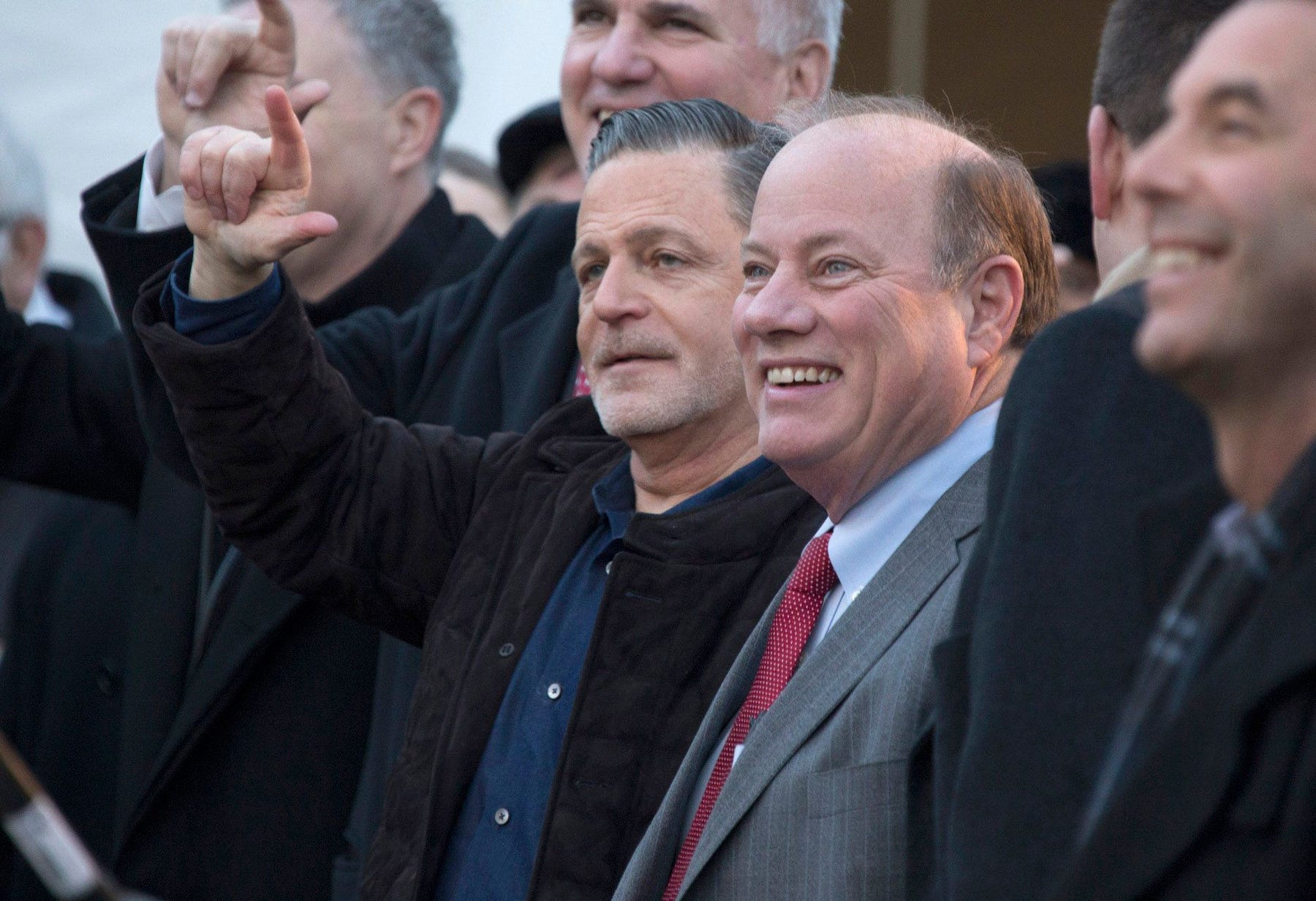
Gilbert and Mayor Mike Duggan broke ground on the Hudson’s site in December 2017.

The beloved flagship Hudson’s department store on the site closed in 1982 and the building was imploded in 1998. The store was a destination for shoppers, as many as 100,000 a day at its height, and was known for its Christmas displays and its fleet of green trucks that would deliver anything, down to a spool of thread.

“We’re standing on a site that has been a source of heartache for Detroiters for 35 years,” Duggan said at the groundbreaking, referring to the years since the department store closed.

The original plans for the nearby Monroe Block included construction of a 35-story office tower, a 10-story development containing residential and retail space, a 27-story residential tower with retail on the first two floors and a public plaza. The price tag for that project as of 2018 was $830 million.

Gilbert said at the groundbreaking last December that the project was needed because many of downtown’s office buildings were full or nearly full, and market demand for housing was strong.

“We have to build to continue to grow,” Gilbert said, according to an article in the Free Press. “There’s no other way to grow, but to build.”

But the project didn’t materialize in the months that followed and New York developer Stephen Ross advised Gilbert to scale it back, according to a person familiar with the situation who insisted on anonymity because of the sensitivity of the discussions. This person said the redesigned project would still be “incredible,” but not “Disneyland.”

In its Aug. 7 announcement, Bedrock promised a “landmark mixed-use development designed to attract the world’s top businesses and talent to Detroit.”

Ross also advised Gilbert to scale back the Hudson’s site as well, the source said.  A second real estate expert said Gilbert had consulted with Ross about the Hudson's site, the Monroe block and a site on Gratiot Avenue.

Ross and Gilbert, longtime friends, have talked about the Detroit market, Fleisher said.

"We're excited to be in conversations with them about this market. It's great to have one of the biggest real estate developers interested in this market."

Ross is the chairman and founder of Related Companies, one of the most prolific developers in the United States with more than $60 billion in real estate assets owned or under development, according to its website. Ross is also owner of the Miami Dolphins and graduated from the University of Michigan and Wayne State. He is the largest single donor to the University of Michigan, which in 2004 named its business school after him.

Dennis Bernard, president of the Bernard Financial Group of Southfield and Detroit, said that even if Hudson’s and the Monroe block are smaller than originally planned, they still can’t be done without tax credits.

“This couldn’t have happened without the state,” said Bernard, whose company has arranged more than $22 billion in commercial real estate financing. “Construction costs are so high and our rents are not there yet.”

Voting is beautiful, be beautiful ~ vote.©

Saturday, August 24, 2019

DOJ: Former Bank Executive Found Guilty in $15 Million Construction Loan Fraud Scheme - No, This Is Not Detroit, Yet


A former Kansas bank executive was found guilty by a federal jury yesterday for his participation in a bank fraud scheme to obtain a $15 million construction loan for certain bank customers based upon false and fraudulent representations.  The loan was shared among 26 Kansas banks.
Assistant Attorney General Brian A. Benczkowski of the Justice Department’s Criminal Division, Special Agent in Charge Justin R. Bundy of the Federal Deposit Insurance Corporation Office of Inspector General’s (FDIC-OIG) Kansas City Regional Office, Special Agent in Charge Timothy R. Langan of the FBI’s Kansas City Field Office and Special Agent in Charge Catherine Huber of the Federal Housing Finance Agency Office of Inspector General’s (FHFA-OIG) Central Region Office made the announcement.                                                                                                                           
Troy A. Gregory, 52, of Lawrence, Kansas, was found guilty of four counts of bank fraud and two counts of false statements, as charged in a November 2017 indictment.  The jury failed to reach a verdict as to one count of conspiracy.  Sentencing is scheduled for Jan. 28, 2020, before U.S. District Judge Carlos Murguia of the District of Kansas, who presided over the trial.
According to the evidence submitted at trial, Gregory was a bank executive and loan officer who had made millions of dollars in loans to a group of borrowers who were struggling to make payments on the loans.  Beginning in approximately late 2007, Gregory began the process of making a $15.2 million construction loan to build an apartment complex to that same group of borrowers.  Gregory’s bank shared this loan with 25 other Kansas banks.  Gregory made and caused others to make false statements to the banks about the strength of the borrowers, the debt status of the apartment property and the existence of approximately $1.7 million in certificates of deposit for collateral on the loan, all to get the loan approved.  Instead of using the loan funds promised for building the apartments, Gregory immediately diverted over $1 million of the loan to pay for part of the certificates of deposit pledged as collateral, pay off debt on the apartment property, and make payments on unrelated loans, the evidence showed.  Other Kansas banks that shared in this loan would not have participated in the loan without the false representations and promises. The banks ultimately wrote off millions of dollars on the $15.2 million construction loan, the evidence showed.
The FDIC-OIG, IRS-CI, FBI and FHFA-OIG are investigating this matter.  Trial Attorney Andrew R. Tyler and Senior Litigation Counsel David A. Bybee of the Criminal Division’s Fraud Section are prosecuting the case.

Voting is beautiful, be beautiful ~ vote.©

Wednesday, July 3, 2019

DOJ: South Florida Resident Sentenced to 30 Years for $100 Million International Fraud Scheme that Led to the Collapse of One of Puerto Rico’s Largest Banks

I wonder how many trafficking tiny humans trust funds were found.


Western Bank
https://westernbank.com/
A Key Biscayne, Florida, resident and the former CEO and Chairman of a now-bankrupt multinational pharmaceutical company was sentenced to 30 years in prison followed by five years of supervised release yesterday for his role his role in a $100 million scheme to defraud Westernbank of Puerto Rico (Westernbank). The losses triggered a series of events leading to Westernbank’s insolvency and ultimate collapse.
Assistant Attorney General Brian A. Benczkowski of the Justice Department’s Criminal Division, U.S. Attorney Ariana Fajardo Orshan of the Southern District of Florida, Inspector General Jay N. Lerner of the Federal Deposit Insurance Corporation Office of Inspector General (FDIC-OIG), Special Agent in Charge Michael J. DePalma of IRS Criminal Investigation (IRS-CI) for Miami and Puerto Rico, Special Agent in Charge Iván J. Arvelo of U.S. Immigration and Customs Enforcement’s Homeland Security Investigations (HSI) in San Juan and Special Agent in Charge Douglas A. Leff of the FBI’s San Juan, Puerto Rico Field Office made the announcement.
Jack Kachkar, 56, was sentenced by U.S. District Judge Donald L. Graham of the Southern District of Florida, who also presided over the trial in this case.  Judge Graham also ordered the defendant to pay $103,490,005 in restitution to the FDIC, as receiver for Westernbank.  Kachkar was convicted on Feb. 4, 2019, after a three-week trial, of eight counts of wire fraud affecting a financial institution. 
According to evidence presented at trial, from 2005 to 2007, Kachkar served as chairman and CEO of Inyx Inc., a publicly traded multinational pharmaceutical manufacturing company.  Beginning in early 2005, Kachkar caused Westernbank to enter into a series of loan agreements in exchange for a security interest in the assets of Inyx and its subsidiaries.  Under the loan agreements, Westernbank agreed to advance money based on Inyx’s customer invoices from “actual and bona fide” sales to Inyx customers, the evidence showed.
The trial evidence showed that Kachkar orchestrated a scheme to defraud Westernbank by causing numerous Inyx employees to make tens of millions of dollars worth of fake customer invoices purportedly payable by customers in the United Kingdom, Sweden and elsewhere.  Kachkar caused these invoices to be presented to Westernbank as valid invoices.  Kachkar made false and fraudulent representations to Westernbank executives about purported and imminent repayments from lenders in the United Kingdom, Norway, Libya and elsewhere in order to lull Westernbank into continuing to lend money to Inyx, the evidence showed.  In fact, these lenders had not agreed to repay Westernbank’s loan.  Kachkar made false and fraudulent representations to Westernbank executives that he had additional collateral, including purported mines in Mexico and Canada worth hundreds of millions of dollars, to induce Westernbank to lend additional funds, the evidence showed.  In fact, this additional collateral was worth barely a fraction of that represented by Kachkar.
During the course of the scheme, Kachkar caused Westernbank to lend approximately $142 million, primarily based on false and fraudulent customer invoices.  The evidence showed that the defendant diverted tens of millions of dollars for his own personal benefit, including for the purchase of, among other things, a private jet, luxury homes in Key Biscayne and Brickell, Miami, luxury cars, luxury hotel stays, and extravagant jewelry and clothing expenditures.
In or around June 2007, Westernbank declared the loan in default and ultimately suffered losses exceeding $100 million on the Inyx loans.  According to trial evidence, these losses later triggered a series of events leading to Westernbank’s insolvency and ultimate collapse.  At the time of its collapse, Westernbank had approximately 1,500 employees and was one of the largest banks in Puerto Rico.
This case was investigated by the FDIC-OIG, IRS-CI, HSI and FBI.  The Department of Justice’s Office of International Affairs provided significant support in the investigation.  The case is being prosecuted by Assistant U.S. Attorney Michael N. Berger of the Southern District of Florida and Trial Attorney Michael O’Neill of the Criminal Division’s Fraud Section.  The Department acknowledges and appreciates the substantial assistance of the Royal Canadian Mounted Police and the U.K. Metropolitan Police.
Inyx, Inc. Chairman & CEO Approved as Debtor-In-Possession Lender for Inyx Subsidiaries
Published: Jul 12, 2007

NEW YORK, July 12 /PRNewswire-FirstCall/ -- Inyx, Inc. , reported that the company's Chairman & CEO, Jack Kachkar, M.D., yesterday was approved as the debtor-in-possession lender for Inyx USA, Ltd. and Exaeris, Inc., its two wholly-owned North American operating subsidiaries, by the U.S. Bankruptcy Court in the District of Delaware, over the objections of Westernbank Puerto Rico, a wholly owned subsidiary of W Holding Company, Inc. .

On July 2, 2007, as a measure to protect Inyx against further potential damaging actions by Westernbank, the company placed its two U.S. operating subsidiaries in Chapter 11 protection.

As a result of yesterday's court approval of Dr. Kachkar providing the financing for the U.S. operating subsidiaries, Inyx's North American businesses will continue to operate on a normal basis.

Dr. Kachkar also continues to provide the financing for the operations of Inyx, Inc., which is not itself a party to the Chapter 11 filings.

In addition to the Chapter 11 protection, on June 29, 2007, Inyx, Inc. and Inyx USA, together with Dr. Kachkar and his wife, filed suit against Westernbank in New York State Supreme Court, asserting various causes of action seeking no less that $500 million in compensatory damages as well as punitive damages. The complaint charges, among other things, that Westernbank acted in bad faith and in a commercially unreasonable manner by blocking the flow of funds from Inyx's customers to the company, and preventing the Inyx companies from paying their debts. The complaint asserts causes of action for breach of contract and breach of the implied covenant of good faith and fair dealing, promissory estoppel, wrongful dishonor of checks, wrongful impairment of collateral, tortious interference or impairment with prospective business relations, and third-party beneficiary of contract and tortious interference with contracts and prospective business relations.

About Inyx

Inyx, Inc. is a specialty pharmaceutical company with niche drug-delivery technologies and products for the treatment of respiratory, allergy, dermatological, topical and cardiovascular conditions. Inyx USA, Ltd., located in Manati, Puerto Rico, is the company's North American-based production center. Exaeris, Inc., based in Exton, Pennsylvania, is Inyx's North American marketing arm. For more information, please visit: www.inyxgroup.com.

Safe Harbor

Statements about the Inyx's future expectations, including future revenues and earnings, and all other statements in this press release other than historical facts, are "forward-looking statements" within the meaning of Section 27A of the Securities Act of 1933, Section 21E of the Securities Exchange Act of 1934, and as that term is defined in the Private Securities Litigation Reform Act of 1995. Inyx intends that such forward-looking statements be subject to the safe harbors created thereby. Since these

statements involve risks and uncertainties and are subject to change at any time, Inyx's actual results could differ materially from expected results.

For more information, please contact: Jay M. Green, Executive VP jgreen@inyxgroup.com

Inyx, Inc.
CONTACT: Jay M. Green, Executive VP of Inyx, Inc., jgreen@inyxgroup.com


Web site: http://www.inyxgroup.com/ Voting is beautiful, be beautiful ~ vote.©

Saturday, December 8, 2018

DOJ: Four Defendants Charged in Panama Papers Investigation for Their Roles in Panamanian-Based Global Law Firm’s Decades-Long Scheme to Defraud the United States

Oh, I am so going to enjoy this when we get to Detroit.

I wonder if Janet Olszewski is related to the family.

Panama Papers US Charges - The Clients
What the Panama Papers tell us about the
 clients in the latest bombshell charges
Four individuals have been charged in an indictment unsealed today in the Southern District of New York with wire fraud, tax fraud, money laundering and other offenses in connection with their alleged roles in a decades-long criminal scheme perpetrated by Mossack Fonseca & Co. (“Mossack Fonseca”), a Panamanian-based global law firm, and related entities.

Assistant Attorney General Brian A. Benczkowski of the Justice Department’s Criminal Division, U.S. Attorney Geoffrey S. Berman for the Southern District of New York, Chief Don Fort of IRS Criminal Investigation (IRS-CI), and Special Agent in Charge Angel M. Melendez of U.S. Immigrations and Customs Enforcement’s Homeland Security Investigations (HSI) New York made the announcement today.
Ramses Owens, 50, a Panamanian citizen; Dirk Brauer, 54, a German citizen; Richard Gaffey, 74, a U.S. citizen, of Medfield, Massachusetts; and Harald Joachim Von Der Goltz, 81, a German citizen, have been charged in an 11-count indictment.  Owens, Gaffey and Von Der Goltz are charged with one count of conspiracy to commit tax evasion, one count of wire fraud, and one count of money laundering conspiracy.  Owens and Brauer have been charged with one count of conspiracy to defraud the United States and one count of conspiracy to commit wire fraud.  Gaffey and Von Der Goltz are additionally charged with four counts of willful failure to file an FBAR.  Von Der Goltz has been additionally charged with two counts of making false statements.
Three of the four defendants named in the indictment have been arrested.  Brauer, who worked as an investment manager for Mossfon Asset Management, S.A. (“Mossfon Asset Management”), an asset management company closely affiliated with Mossack Fonseca, was arrested in Paris, France, on Nov. 15.  Von Der Goltz, a former U.S. resident and taxpayer, was arrested in London, United Kingdom, on Dec. 3.  Gaffey, a U.S.-based accountant, was arrested in Boston, Massachusetts earlier today.  Owens, a Panamanian attorney who worked for Mossack Fonseca, remains at large.   
“Law firms, asset managers, and accountants play key roles enabling entry into the global financial system,” said Assistant Attorney General Benczkowski.  “The charges announced today demonstrate our commitment to prosecute professionals who facilitate financial crime across international borders and the tax cheats who utilize their services.” 
"As alleged, these defendants went to extraordinary lengths to circumvent U.S. tax laws in order to maintain their wealth and the wealth of their clients,” said Manhattan U.S. Attorney Berman.  “For decades, the defendants, employees and a client of global law firm Mossack Fonseca allegedly shuffled millions of dollars through offshore accounts and created shell companies to hide fortunes.  In fact, as alleged, they had a playbook to repatriate un-taxed money into the U.S. banking system.  Now, their international tax scheme is over, and these defendants face years in prison for their crimes.”
“The unsealing of this indictment sends a clear message that IRS-CI is actively engaged in international tax enforcement, and more investigations are on the way,” said IRS-CI Chief Don Fort.  “IRS-CI specializes in unraveling these intricate offshore tax schemes and following the money around the globe wherever it may lead.  Cases like this help maintain the public’s confidence in our tax system by letting them know that we investigate and prosecute those who evade their tax obligation.”
“Today we announce the indictment of four individuals who allegedly defrauded the U.S. government through a large scale, intercontinental money laundering and wire fraud scheme, associated with Mossack Fonseca and its affiliates,” said HSI Special Agent-in-Charge Angel M. Melendez.  “HSI’s El Dorado Task Force, together with the IRS, built a case that uncovered an alleged complex trail of offshore shell corporations and bogus foundations used to disguise the beneficial ownership of huge amounts of money.  These efforts reflect the commitment of U.S. law enforcement to follow that trail and apprehend these criminals regardless of where they are in the world.”
According to the indictment, from at least in or about 2000 through in or about 2017, Owens and Brauer conspired with others to help U.S. taxpayer clients of Mossack Fonseca conceal assets and investments, and the income generated by those assets and investments, from the IRS through fraudulent, deceitful, and dishonest means.  To conceal their clients’ assets and income from the IRS, Owens and Brauer allegedly worked to establish and manage opaque offshore trusts and undeclared bank accounts on behalf of U.S. taxpayers who were clients of Mossack Fonseca.  Owens and Brauer allegedly marketed, created, and serviced sham foundations and shell companies formed under the laws of countries such as Panama, Hong Kong, and the British Virgin Islands, to conceal from the IRS and others the ownership by U.S. taxpayers of accounts established at overseas banks, as well as the income generated in those accounts.  As structured by Mossack Fonseca, the sham foundations typically “owned” the shell companies that nominally held the undeclared assets on behalf of the U.S. taxpayer clients of Mossack Fonseca.  The names of Mossack Fonseca’s clients generally did not appear anywhere on the incorporation paperwork for the sham foundations or related shell companies, although the clients in fact beneficially owned, and had complete access to, the assets of those sham entities and accounts.
In furtherance of the scheme, and in exchange for additional fees, Owens and Brauer allegedly provided support to clients who had purchased the sham foundations and related shell companies by providing corporate meeting minutes, resolutions, mail forwarding, and signature services.  Moreover, Owens and Brauer are alleged to have purposefully established the bank accounts in locations with strict bank secrecy laws, which impeded the ability of the United States to obtain bank records for the accounts.  Owens and Brauer also allegedly instructed U.S. taxpayer clients of Mossack Fonseca about how to repatriate funds to the United States from their offshore bank accounts in a manner designed to keep the undeclared bank accounts concealed.  Among other things, Owens and Brauer instructed clients to use debit cards and fictitious sales to repatriate their funds covertly, the indictment alleges.
Von Der Goltz was allegedly one of Mossack Fonseca’s U.S. taxpayer clients.  At all relevant times, Von Der Goltz was a U.S. resident and was subject to U.S. tax laws, which required him to report and pay income tax on worldwide income, including income and capital gains generated in domestic and foreign bank accounts.  U.S. citizens, resident aliens, and permanent legal residents with a foreign financial interest in or signatory authority over a foreign financial account worth more than $10,000 are required to file a Report of Foreign Bank and Financial Accounts, commonly known as an FBAR, disclosing the account.  Von Der Goltz is alleged to have evaded his tax reporting obligations by setting up a series of shell companies and bank accounts, and hiding his beneficial ownership of the shell companies and bank accounts from the IRS.  These shell companies and bank accounts allegedly made investments totaling tens of millions of dollars.  According to the indictment, Von Der Goltz was assisted in this scheme by Owens and by Gaffey, a partner at a U.S.-based accounting firm.  In furtherance of Von Der Goltz’s fraudulent scheme, Von Der Goltz, Gaffey, and Owens are alleged to have falsely claimed that Von Der Goltz’s elderly mother was the sole beneficial owner of the shell companies and bank accounts at issue because, at all relevant times, she was a Guatemalan citizen and resident, and — unlike Von Der Goltz — was not a U.S. taxpayer. 
As alleged in the indictment, Gaffey, in addition to assisting Von Der Goltz evade U.S. income taxes and reporting requirements, also worked closely with Owens to help another U.S. taxpayer client (“Client-1”) of Mossack Fonseca defraud the IRS.  Client-1 allegedly maintained a series of offshore bank accounts, which Mossack Fonseca helped Client-1 conceal from the IRS for years.    The indictment further alleges that, upon the advice of Owens and Gaffey, Client-1 covertly repatriated approximately $3 million of Client-1’s offshore money to the United States by falsely stating on Client-1’s federal tax return that the money represented proceeds from the sale of a company.  After Client-1 repatriated approximately $3 million in this manner, approximately $1 million still remained in Client-1’s offshore account, the existence of which remained hidden from the IRS.  
The charges in the indictment are merely allegations, and the defendants are presumed innocent until proven guilty beyond a reasonable doubt in a court of law. 
The investigation was conducted by IRS-CI and HSI with significant assistance by the Justice Department’s Tax Division and the FBI.  The Justice Department’s Office of International Affairs and law enforcement partners in France and the United Kingdom secured the arrests of the defendants located overseas.                                                                                                                                                                                                                                                                                                                                                                                                                                                    
This case is being prosecuted by Trial Attorneys Michael Parker and Parker Tobin of the Criminal Division’s Money Laundering and Asset Recovery Section of the Justice Department and Assistant U.S. Attorneys Sarah E. Paul, Nathan Rehn, Kristy Greenberg and Andrew Adams of the Manhattan U.S. Attorney’s Office’s Complex Frauds and Cybercrime Unit and Money Laundering and Transnational Criminal Enterprises Unit, with substantial support from previous co-counsel, Assistant U.S. Attorney Ann Marie Blaylock of the Western District of Kentucky.

Voting is beautiful, be beautiful ~ vote.©

Thursday, May 10, 2018

Cocktails & Popcorn: Calley v. Schuette And Those Pesky Trust Funds

Related imageRecently on Cocktails & Popcorn, we took a look at Those Pesky Trust Funds and land banks with John Engler, Brian Calley and campaign finance.

Well, it seems Calley is going for the jugular, hitting Schuette on his blind trust.

We have a sitting State Attorney General who took an oath on, basically, not to use his office for personal inurement, what some may find a bit more clarification in the understanding of emoluments.

The thing that got me was not the registration of Bill's corporation, Vircom, L.L.C. where he was the Grantor, but Ditleff Point Lots, a Group S, L.L.C., registered in Delaware, with the exact same addresses.

From Wikipedia:

An S corporation, for United States federal income tax purposes, is a closely held corporation (or, in some cases, a limited liability company (LLC) or a partnership) that makes a valid election to be taxed under Subchapter S of Chapter 1 of the Internal Revenue Code. In general, S corporations do not pay any income taxes. Instead, the corporation's income or losses are divided among and passed through to its shareholders. The shareholders must then report the income or loss on their own individual income tax returns.

Why does Bill have a Delaware corporation?

What, is Michigan LARA not good enough for you?

Is Bill a Corporate Shape Shifter?

Did I just find out why Bill called me a "Public Nuisance"?

Oh, those pesky trust funds.  They seem to becoming a bit of an interest as of lately.

Brian Calley alleges AG Bill Schuette violated 'blind trust' pledge

EAST LANSING — Attorney General Bill Schuette continued to have a hands-on role in business dealings, despite his claims he put his assets in a blind trust when he took office in 2011, Lt. Gov. Brian Calley charged Thursday.

Schuette, confronted by Calley with the accusations at a candidate forum on Thursday, said the allegations are false and accused Calley of desperation in his campaign for governor.

The Calley campaign released documents showing Schuette signed deeds in 2014 transferring real estate between Schuette businesses.

The deed records transfer real estate in the U.S. Virgin Islands from Vircom LLC, where Schuette signed as the company manager, to Ditleff Points, Group S, LLC, which lists its corporate address as Schuette's home address in Midland.

Later on Thursday, Calley campaign consultant John Yob retweeted images of another Vircom deed transfer record, from 2017, also signed by Schuette.

The Calley campaign released additional records they say show Schuette similarly directed offshore sales in 2012 and 2013.

"He's been directing the purchase, transfer of millions of dollars in offshore assets while attorney general," Calley alleged at the candidate forum hosted by the Michigan Press Association.
Schuette denied the allegation.

"Brian, you go around the state ... making false allegations," Schuette shot back.
"All my assets are in a blind trust."

Schuette wouldn't comment on the companies or transactions when approached after the candidate forum. He later issued a statement that said the transactions related to property holdings in the U.S. Virgin Islands and Colorado that he and his two sisters inherited from their parents. The transactions represent the sale of some parcels in the Virgin Islands, which were never included in the blind trust because it was family property, Schuette said.

More stories:
The Calley campaign issued a news release saying the transactions show "a stunning level of hypocrisy" by Schuette.

"What else is Bill Schuette hiding?"

When Bridge Magazine earlier this year asked all candidates to make certain financial disclosures, Schuette released his federal tax return, as he has each year. But he declined to make an asset disclosure, citing his blind trust.

Calley made an asset disclosure similar to the ones federal officeholders file.
Schuette said at the forum that "we need to have openness and transparency." He said he releases his tax return each year, and also made asset disclosures when he was a member of Congress.

"When we pass the law on financial disclosure (in Michigan), I'll do it," Schuette said.

After the forum, Schuette declined to answer questions about the companies involved, or whether he had ties to him. He said Calley has gone negative, but he will continue a positive campaign.

Several hours after the forum, his campaign strategist John Sellek said Calley is "continuing to make negative and false attacks," and thereby "diminishing the office he holds and more importantly, the one he seeks to occupy."

Calley campaign spokesman Michael Schrimpf said Schuette "lied multiple times about his financial holdings, and now he wants voters to believe that selling millions of dollars in real estate for his own benefit poses no potential for conflicts of interest."


Voting is beautiful, be beautiful ~ vote.©