Showing posts sorted by relevance for query treasury. Sort by date Show all posts

Friday, October 26, 2018

Cocktails & Popcorn: OVERSIGHT Hearing On SIGTARP & Its Multifaceted Issues With The Administration Of The Hardest Hit Fund

My apologies for missing this precious gem!

The U. S. House Oversight Committee held hearings on the Hardest Hit Fund - TARP, to respond to the findings of SIGTARP, the enforcement mechanism of the U.S. Treasury which audits the program.

Sandy Baruah Sucks & Deserves A Subpoena For What He Did To Detroit


Basically, you have a bunch of "The Elected Ones" whose staff failed to properly debrief their members on the background of the Hardest Hit Fund.

All they had to do was google my name, but they probably did, realizing it was best to limit the breadth of their questioning to ethics in the administration of the program.

I like that, just let them speak.

What we have here is an issue within the U.S. Treasury because every time a Member asks about stealin', in an ethical sense, only, because there are no criminal referrals from the Treasury, that we know of, to date, due to the unverified ongoing investigation that may not even exist, here was the mimeographed response of Kipp Kranbuhl.

Chairman Gary Palmer smacked down Kipp (a name truly synonymous with poverty and hardship) down by having SIGTARP Christy Goldsmith Romero break it down to the fact that SIGTARP can not speak upon the multiple, ongoing criminal investigations that the office refuses to verify.

Gary: "Are gym memberships considered allowable to help homeowners stay in their homes?

Kipp: "We follow cost principles for every federal program."

Gary: "Have you made any criminal referrals?"

Kipp: "We follow cost principles for every federal program."

Gary: "What time is it?"

Kipp: "We follow cost principles for every federal program."

Christy was Johnnie on the Spot in her succinct responses to questions of why there was so much stealin', but I seriously wonder how many people in the room actually caught what she said.

For those who do not wish to watch the entire hearing, allow me to provide a quick synopsis.

"They were stealin'."

I bet Kipp wore Depends for this hearing.

I bet he thinks about me, alot

Neil Barofsky And His History Of SIGTARP


We have ourselves a Special Issue going on with Treasury.

See, SIGTARP, nor any other law enforcement entity, ever verifies the existence, or non-existence, of an investigation, or an ongoing investigation, unless it is verified by an original source, like me.

SIGTARP Is Still Investigating Flint & Detroit Blight Demolition Programs

But, hey, what do I know?

I know I am really happy that I found this hearing video!


Image result for us treasury

Statement of Deputy Assistant Secretary Kipp Kranbuhl Before the House Oversight and Government Reform Subcommittee on Intergovernmental Affairs and Government Operations

Chairman Meadows, Chairman Palmer, Ranking Member Connolly, Ranking Member Raskin, and Members of the Subcommittees, thank you for the opportunity to testify today about Treasury’s efforts to mitigate the effects of the financial crisis on American homeowners through the Housing Finance Agency Innovation Fund for Hardest Hit Housing Markets, also known as the Hardest Hit Fund or HHF.

In 2008, Congress passed the Emergency Economic Stabilization Act of 2008, 12 U.S.C. 5201, et seq., (as amended, EESA).  This legislation provided Treasury with immediate authorities and resources to restore liquidity and stability to the nation’s financial system in the wake of an historic economic crisis.  Using its authorities under EESA, Treasury established the Troubled Asset Relief Program, known as TARP, an initiative that was unprecedented in both its design and scale.  Congress initially authorized up to $700 billion for TARP programs, though Congress later reduced that authority to $475 billion.

In the following years, Treasury disbursed nearly $412 billion of TARP funds under a variety of programs designed to help stabilize banks, automobile manufacturers, and other institutions integral to the nation’s economy.  Treasury reserved additional funds for programs designed to protect home prices and prevent foreclosure.  The first, and largest, of these housing programs was the Making Home Affordable® program, or MHA.  Launched in 2009, MHA was a nationwide effort to help struggling homeowners avoid foreclosure by lowering mortgage payments to affordable levels.  However, it soon became clear that a one-size-fits-all approach would not be sufficient to address all of the specific needs of homeowners and communities in the states that were hit hardest by the housing crisis.

Treasury established HHF in 2010 as part of TARP in order to help prevent foreclosure and to stabilize housing markets in states hit hardest by the housing crisis.  State housing finance agencies, (together with certain designated entities, HFAs) in eighteen states and the District of Columbia were selected to participate, as these areas experienced unemployment rates at or above the national average, and/or home price declines of greater than 20 percent.[1]

Unlike MHA – a national program based on uniform criteria set by the Federal government – HHF was designed to give the participating HFAs the maximum flexibility to design and administer their own programs, each tailored to local conditions in their respective communities.  As a part of this flexibility, the states have been able to adapt their programs in order to address the changing needs of their communities over time.

As of December 31, 2017, states had assisted approximately 350,000 homeowners and funded the demolition and greening of nearly 24,000 blighted properties in distressed communities.
However, the flexibility afforded to HFAs by the Hardest Hit Fund has made Treasury’s oversight a critical aspect of the program.  Treasury maintains a strong commitment to ensure that the program achieves its goals and that federal taxpayer funds are used for their intended purpose.

Treasury requires each HFA to set specific goals for its HHF program, and to demonstrate steady progress toward meeting these goals.  Treasury works with each of the HFAs to identify and address barriers that would keep the HFA from achieving its goals.  Subject to Treasury approval, the HFAs may also modify their programs as needed in order to address the changing needs of their communities.  Treasury also maintains an ongoing dialogue with the HFAs through in-person meetings and regularly scheduled calls, and it hosts annual summits where the various participating HFAs can meet and share best practices.

Treasury has also conducted more than 100 on-site compliance reviews across the participating HFAs, as well as additional, targeted reviews to address specific programmatic risks.  These reviews evaluate a number of critical program functions, such as whether homeowners are evaluated in accordance with the HFA’s guidelines, program disbursements and administrative expenditures are appropriate, the information reported to Treasury is accurate, and the HFA’s internal controls are functioning as intended to minimize the risk of non-compliance.

Treasury takes corrective action when instances of non-compliance arise.  This includes, for example, requiring HFAs to re-evaluate homeowners that were improperly denied, to reimburse HHF for improper expenditures, and to strengthen internal controls in order to prevent further non-compliance.
In addition to compliance reviews, Treasury also takes SIGTARP’s role seriously.  We share this Committee’s and SIGTARP’s commitment to preventing fraud, waste, and abuse in all TARP programs, and we carefully consider recommendations in that regard.

Treasury responds to SIGTARP recommendations in writing, and our responses are made available to the public.  We work hard to address the concerns raised by these recommendations, in a manner that allows the programs to function as intended and in the context of TARP’s wind-down.  With respect to HHF in particular, this has included, for example, issuing written guidance to clarify HFA obligations, recovering funds that were improperly spent, and requiring states to strengthen internal controls to prevent non-compliance in the future.

For example, Treasury thoroughly reviewed the $2.2 million of costs questioned in SIGTARP’s August 2017 Audit Report.  This involved analyzing thousands of individual transactions incurred by all 19 HFAs, dating back to the program’s inception in 2010.  Following this review, Treasury determined that $656,141 of the questioned costs did not comply with the Federal government’s cost principles.  The HFAs were required to reimburse HHF.  For the reasons set forth in our April 6, 2018, letter to SIGTARP—a copy of which has been provided to the Committee and is available on our website—Treasury determined that the remaining costs questioned by SIGTARP were allowable under Federal cost principles.

As is the case with all TARP programs, HHF is winding down.  Although Congress authorized additional funding in 2015, the program remains a temporary one.  As of the end of April 2018, Treasury has disbursed $8.8 billion (or 92 percent) of the $9.6 billion obligated under HHF. Although HFAs may continue issuing new approvals through December 31, 2020, most of the states have already begun to close down HHF programs or will do so this year as they exhaust their available funds.  This includes California and Florida, the two largest states in the program.

Treasury’s outstanding commitments under TARP represent just one percent of the $475 billion authorized by Congress.  As TARP winds down, Treasury remains committed to robust oversight and monitoring of all of its TARP programs, including HHF.

As part of this wind down, the Office of Financial Stability, which oversees HHF and other TARP programs, was recently realigned to report to Treasury’s Assistant Secretary for Financial Institutions.  This realignment will enable our office to oversee an orderly and successful wind down of HHF that is in line with the wind down of other programs that are also overseen by this office, such as the State Small Business Credit Initiative and the Small Business Lending Fund.

I thank you again for the opportunity to testify today and welcome your questions.
####

[1] The eighteen participating states consist of Alabama, Arizona, California, Florida, Georgia, Illinois, Indiana, Kentucky, Michigan, Mississippi, Nevada, New Jersey, North Carolina, Ohio, Oregon, Rhode Island, South Carolina, and Tennessee.

Here is where the Treasury came up with the excuse, "the money has not yet been allocated" whenever SIGTARP asked what happened to the money.

As soon as Treasury responds, by the wings of Mercury, they officially start stealin' because they know by the time they are asked again, there will be a new allocation cycle, with questions only focused on these new allotted funds, not the funds they were stealin' in the previous grant spend down cycle, because that could be one of those double jeopardy administrative moments they can argue their way out of a criminal proceeding.

Voting is beautiful, be beautiful ~ vote.©

Saturday, April 18, 2020

Paul O'Neill, Progenitor Of TARP Is Extracted From Humanity

Paul O'Neill
Former U.S. Treasury Secretary Paul O'Neill, progenitor of TARP and the Detroit Land Bank Authority, is extracted from humanity.

Gerrymandering was a strong area of his expertise.

I wonder how Steve Mnuchin is doing, right about now?

According to Wikipedia:

In 1989, he was approached by President George H. W. Bush to be Secretary of Defense. O'Neill declined, but recommended Dick Cheney for the position. Bush then pursued O'Neill to chair an advisory group on education that included Lamar Alexander, Bill Brock, and Richard Riley.

#maytheheavensfall

Former Treasury Secretary Paul O'Neill dies at age 84

U.S. Treasury Secretary Paul O'Neill holds a news conference at the U.N. Conference for Financing of Development in Monterrey, Mexico on March 20, 2002. O'Neill died Saturday, April 18, 2020. He was 84.

Paul O'Neill, a former Treasury secretary who broke with George W. Bush over tax policy and then produced a book critical of the administration, died Saturday. He was 84.

O'Neill's son, Paul O'Neill Jr. confirmed that his father died at his home in Pittsburgh after battling lung cancer for the last couple of years. After a few surgeries and chemotherapy, he decided against any further intervention four or five months ago, he said.

"There was some family here and he died peacefully," the son said. "Based on his situation, it was a good exit."

A former head of aluminum giant Alcoa, O'Neill served as Treasury secretary from 2001 to late 2002. He was forced to resign after he objected to a second round of tax cuts because of their impact on deficits.

O'Neill's blunt speaking style more than once got him in trouble as Treasury secretary. He sent the dollar into a tailspin briefly in his early days at Treasury when his comments about foreign exchange rates surprised markets. In the spring of 2001, O'Neill jolted markets again when during Wall Street's worst week in 11 years, he blandly declared "markets go up and markets go down."

He was more focused on the traditional Treasury secretary's job of instilling confidence during times of turbulence later that year when he helped get Wall Street re-opened after the Sept. 11 terror attacks. O'Neill was also instrumental following the attacks in beefing up the government's programs to disrupt financing to terrorist groups.

Treasury Secretary Steven Mnuchin said Saturday on Twitter, "Saddened to hear of the passing of the former 72nd Treasury Secretary, Paul O'Neill. He served @USTreasury and America with distinction during challenging times. My condolences to his family."

Tony Fratto, who served as O'Neill's Treasury spokesman, described O'Neill as a "working class guy" who "cared about how things impacted real people."

Fratto, currently a partner with Hamilton Place Strategies in Washington, said that one of O'Neill's passions was workplace safety, and that he would tour the Treasury building looking for safety issues that needed to be fixed.

After leaving the administration, O'Neill worked with author Ron Suskind on an explosive book covering his two years in the administration. O'Neill contended that the administration began planning the overthrow of Iraqi President Saddam Hussein right after Bush took office, eight months before the Sept. 11 terrorist attacks.

O'Neill depicted Bush as a disengaged president who didn't encourage debate either at Cabinet meetings or in one-on-one discussions with Cabinet members. He said the lack of discussion in Cabinet meetings gave him the feeling that Bush "was like a blind man in a roomful of deaf people."

He said major decisions were often made by Bush's political team and Vice President Dick Cheney. O'Neill had been recruited to join the Cabinet by Cheney, his old friend from the Gerald Ford administration. But it was Cheney who told O'Neill that the president wanted his resignation. It was part of a move by Bush to shake up his economic team and find a better salesman for a new round of tax cuts the president hoped would stimulate a sluggish economy.

When the book, "The Price of Loyalty: George W. Bush, the White House and the Education of Paul O'Neill" came out in early 2004, Bush spokesman Scott McClellan discounted O'Neill's descriptions of White House decision-making and said the president was "someone that leads and acts decisively on our biggest priorities."

After leaving the Cabinet, O'Neill returned to Pittsburgh, where he had headed Alcoa from 1987 to 1999. He resumed working with the Pittsburgh Regional Health Care Initiative, a consortium of hospitals, medical societies and businesses studying ways to improve health care delivery in Western Pennsylvania. The subject had interested him since his days as a budget analyst in Washington with the Office of Management and Budget.

He also devoted time in retirement to projects that would deliver clean drinking water to Africa. As Treasury secretary, O'Neill had focused attention on poverty and combating diseases such as AIDS in Africa, touring the continent with Irish rock star Bono.

While at Alcoa, O'Neill lifted the company out of the doldrums during his 12-year stint as the Pittsburgh company's CEO. Shortly after he took the job in April 1987, he began emphasizing factory safety and employee dignity as a top priority.

His ideas weren't initially well received by profit-driven investors, who cared more about Alcoa's financial performance. After hearing one of O'Neill's first presentations as Alcoa's CEO, one money manager decided the company had put a "crazy hippie in charge" and advised his 20 largest clients to sell its stock, according to the book, "The Power of Habit" by Charles Duhigg.

That investor later called it one of his worst decisions. By the time, O'Neill stepped down as CEO in 1999, Alcoa's accident rate had plunged and its stock had soared more than seven-fold at a time it was part of the Dow Jones Industrial Average.

Before joining Alcoa, O'Neill had been president from 1985 to 1987 of International Paper Co., a firm he had joined in 1977 after leaving OMB.

After graduating with an economics degree from California State University in Fresno in 1961, O'Neill joined the Veterans Administration in Washington, working as a computer systems analyst. He later moved to OMB and rose to become deputy director of the budget agency from 1974 to 1977, providing budget guidance to then-President Gerald Ford.

In June 2019, O'Neill received the Gerald R. Ford Medal for Distinguished Public Service, according to a piece in his hometown paper, the Pittsburgh Post-Gazette. Cheney and Alan Greenspan, who headed the Federal Reserve when O'Neill was Treasury secretary, are among the past recipients of the award.

O'Neill is survived by his wife, four children, 12 grandchildren and 15 great grandchildren.

~~~~~~~~~~~~~~~~~~~~~~~~~~~~~~~~

New TARP Rules: Curb Executive Pay, Bonuses, Parachutes

Former Treasury Secretary Paul O'Neill calls pay limits "a large mistake."

Feb. 4, 2009 — -- Wall Street was bearish today over President Obama's new $500,000 pay limit for executives of financial institutions who he said have come "hat in hand" asking for taxpayers' help.

The new limits, which would affect banks that accept "exceptional assistance" from the public treasury, would also impose stricter rules on golden parachutes, entertainment, holiday parties, conferences and the use of corporate jets.

Scott Talbott, senior vice president of government affairs at the Financial Services Roundtable, expressed concerns about the new executive compensation restrictions.

"The pay scale for Wall Street is different for the pay scale for America," Talbott told ABC News. "So these numbers look large, but the market value for these executives - there's a very small talent pool of individuals that have the education, experience and knowledge to operate a global, international services firm in this day and age."

Executives may quit banks that fall under the new $500,000 pay limits, he warned.

"I don't think the issue is a dollar amount. It's being paid what you're worth… Would you be willing to work for less than what you think you're worth?" Talbott asked.

The compensation limits might also make banks hesitant to ask the federal government for help.

"Companies will have to reevaluate whether the benefits are still worth it under the new rules," he said.

Former Treasury Secretary Paul O'Neill said Obama's move "is going to be a very popular populist move.... even though I think it is a large mistake."

O'Neill, who served under President George W. Bush, told ABC News that the banks would have complied if Obama had asked them to voluntarily follow the new limits. He also pointed out that many of the banks' employees get annual bonuses, not just the top executives. Should the limits apply to them, too, O'Neill asked.

He also said the pay limits could hurt the banks' ability to compete. "To the degree there are competing institutions out there not affected by the new edict, does this give those institutions a significant competitive advantage in attracting talent?"

White House spokesman Robert Gibbs dismissed suggestions that the pay caps could hurt the already ailing banks.

"I think we've struck the right balance," Gibbs said.

Obama's pay limits were endorsed by House Minority Leader John Boehner, a Republican from Ohio.

"I think if anybody is looking to the taxpayer to help bail their company out, these kinds of executive compensation limits are appropriate," he said.

On the $500,000 pay limit, Boehner said, "I think somebody's got to pick a number. The president has picked one. I applaud him for doing it."

ABC News contacted all 30 institutions that received $1 billion or more in bailout money, and most of them ignored the calls or declined to comment.

GMAC, which got $5 billion, said it is already subject to compensation limits imposed by the Bush administration. "We intend to comply with those requirements. We have no further comment," GMAC said.

In scolding language, the president said that the changes are necessary to help stabilize the economy.

"We've got to restore trust," Obama said. "And in order to restore trust, we've got to make certain that taxpayer funds are not subsidizing excessive compensation packages on Wall Street."

The president echoed his inauguration address when he said there would be a "new era of responsibility."

"We all need to take responsibility," he said while announcing the new compensation rules with Treasury Secretary Tim Geithner. "And this includes executives at major financial firms who turned to the American people, hat in hand, when they were in trouble, even as they paid themselves their customary lavish bonuses."

"What gets people upset – and rightfully so – are executives being rewarded for failure. Especially when those rewards are subsidized by U.S. taxpayers," Obama said.

The $500,000 salary limit is still more than Obama makes -- $400,000 -- but is a pittance compared to the $20 million that Kenneth Lewis took home in 2007 as head of Bank of America, a corporation that needed $45 billion of public money to save it from its mountain of bad loans.

The president said the new rules announced today would be accompanied by an effort to determine "how corporate governance and compensation rules can be reformed."

Exceptions to the New Rules
There are exceptions to the new executive pay rules, however.

Banking executives can get extra compensation in restricted stock, but only stock that will not vest until taxpayers are repaid the loans, plus interest.

Companies bailed out by Uncle Sam are permitted to waive the $500,000 rule if they disclose executive compensation and allow investors a nonbinding vote on executive pay.

Banks that have already received several hundred billion dollars from the Troubled Asset Relief Program under the Bush administration won't be subject to the new rules. But several of those banks are expected to come back to the federal till for additional relief.

The new Obama TARP rules will require those companies to demonstrate they have complied with the previously issued restrictions on executive pay and lending requirements, and agree to strict monitoring and oversight going forward.

The new rules also make it harder for corporate titans to live the high life on the public dollar. They include restrictions on how the money can be spent, with a bull's-eye on such items as aviation expenses, office renovations, entertainment and corporate parties.

The new Treasury provisions expand rules established under the Bush administration. Restrictions on golden parachutes originally applied to only the top five executives of an affected bank. That will now be extended to the top 10 officials, and golden parachutes for the next 25 top officials will be limited to one year's pay.

Clawback rules that would require banking officials would have to return bonuses if found to have falsified reports. Those rules originally applied to a bank's top five executives, but under the rules detailed today that would be extended to the top 25 bank officials.

The public has been repeatedly infuriated by examples of federally subsidized bankers still spending lavishly on themselves while laying off tens of thousands of employees and of retirement nest eggs vaporized.

Obama called it "shameful" last week when it was reported that bankers had handed out $18.5 billion in bonuses at the end of 2008, despite the dreadful year of financial losses. The White House had to intervene to persuade Citigroup to abandon plans to buy a $50 million executive jet after getting its $45 billion boost. Merrill Lynch's former CEO John Thain had to be shamed into personally repaying the $1 million he spent on renovating his office while surviving on an additional $45 billion public loan. Bank of America partied hardy at the Super Bowl last weekend. And this week, Wells Fargo reluctantly canceled a corporate outing to Las Vegas.

GOP Emboldened By Obama Stumbles
The new rules should bring a cheer from a frustrated public, a sound that the Obama White House hasn't heard in a while. The withdrawal of two top appointees this week because they hadn't paid all their taxes even prompted the president to repeatedly apologize Tuesday for not adhering to the ethical standard he had publicly set for his administration.

"This was running the possibility of really hurting his reformist image," George Stephanopoulos, ABC News' chief Washington correspondent, told "Good Morning America" today.

The withdrawal of former Senate Majority Leader Tom Daschle was particularly damaging because Daschle was going to be the health and human services secretary and the point man on Obama's efforts to reshape the country's health-care system.

The stumbles could also embolden Republicans who are opposing large parts of the president's economic stimulus package.

"The president's going to have to agree to some changes right now," Stephanopoulos told "GMA."

Obama will meet today with Sen. Bill Nelson, D-Neb., and Maine's two Republican senators, Olympia Snowe and Susan Collins. The trio are spearheading a centrist group of Democrats and Republicans working to reshape the stimulus bill.

"There will still be differences with this group," Stephanopoulos said. "The president doesn't want to bring the package down as far as some of these senators want to go. But they're going to be working intensively on a compromise today."

Voting is beautiful, be beautiful ~ vote.©

Tuesday, July 2, 2019

Cocktails & Popcorn: House Democrats Sue Treasury During A Treasury Investigation Of House Democrats - Welcome To Detroit

happy david alan grier GIF
"Whatever you suggest for cocktails
is fine with me."
This is not going to end well for House Democrats.

We still have the outstanding issues with the DNC and DCCC servers, including all those referred Ethics investigations.

Heck, we have not even broached the Michigan Democratic Party, let alone the NAACP & co.

Oups... J'ai encore dit une bêtise!

House Democrats sue Treasury to turn over Trump tax returns

The House Ways and Means Committee on Tuesday filed its long-expected lawsuit over the Trump administration's refusal to turn over the president's tax returns, kicking off what could be a lengthy legal battle.

The committee, chaired by Rep. Richard Neal (D-Mass.), filed a complaint against the Treasury Department and the Internal Revenue Service in federal court in Washington, asking the court to order the defendants to comply with Neal's subpoenas and a section of the federal tax code.

While the president has sued to prevent lawmakers from getting their hands on documents detailing his personal finances, this is the first time House Democrats have gone to court themselves to obtain such records.

Democrats have viewed obtaining President Trump’s tax returns as one of their top oversight priorities. Trump is the first president in decades who hasn’t made any of his tax returns public, citing a years-long audit. However, the IRS has said that nothing prevents people from releasing their own tax information.

In April, Neal sent a request to the IRS seeking Trump’s personal and business tax returns from 2013 to 2018, saying that the Ways and Means Committee is conducting oversight and is interested in legislative proposals relating to how the IRS audits presidents. Neal made the request under section 6103(f) of the federal tax code, which states that the Treasury secretary “shall furnish” tax returns requested by the chairmen of Congress’s tax committees.

Treasury Secretary Steven Mnuchin rejected Neal’s request in May, saying that it lacked a legitimate legislative purpose. Neal then issued subpoenas to Treasury and the IRS for Trump’s tax returns, which Mnuchin also rejected.

“Due to that noncompliance, the Committee is now pursuing this matter in the federal courts,” Neal said in a statement.

The complaint asks the court to declare that Treasury and the IRS are legally obligated to produce the documents subpoenaed. It also asks the court to declare that the administration’s failure to comply with section 6103(f) violates the Administrative Procedure Act.

The lawmakers argue in the lawsuit that the administration, “for what the committee believes is the first time ever” is denying their request “in order to shield President Trump’s tax return information from congressional scrutiny.”

“In refusing to comply with the statute, Defendants have mounted an extraordinary attack on the authority of Congress to obtain information needed to conduct oversight of Treasury, the IRS, and the tax laws on behalf of the American people who participate in the nation’s voluntary tax system,” the lawsuit states.

And they point to the administration’s refusal to comply with congressional subpoenas issued for the tax returns as effectively forcing the committee to go to court.

The House Democrats further argue that they need the returns to determine whether Trump has been compliant with federal tax law, and whether “the IRS’s self-imposed policy of annually auditing the returns of sitting presidents is working properly, even though it has not been updated in decades.”

“The Committee has been unable to evaluate President Trump’s claims about the audit program or investigate its other concerns because the President has declined to follow the practice of every elected President since Richard Nixon of voluntarily disclosing their tax returns,” the court filing reads.

“Without reviewing the requested return materials, the committee cannot ensure that the IRS’s audit process is functioning fairly and effectively, understand how provisions of the tax code are implicated by President Trump’s returns, or exercise its legislative judgment to determine whether changes to the code may be warranted.”

The Trump administration is expected to fight the lawsuit.

The Department of Justice’s (DOJ) Office of Legal Counsel last month issued a memo backing up Treasury’s decision to reject Neal’s request for Trump’s tax returns. In the memo, DOJ said that Neal’s stated purpose for wanting Trump’s tax returns is pretextual and that his real reason for seeking the documents is to make them public.

Democrats’ lawsuit said that DOJ, Treasury and the IRS “gravely misunderstand the operative law.”

“The Committee’s power to conduct oversight and investigations is firmly rooted in Congress’s Article I legislative authority,” the complaint stated. “And courts have long recognized that Congress’s ‘power of inquiry — with process to enforce it — is an essential and appropriate auxiliary to the legislative function.’”

The top Republican on the Ways and Means Committee, Rep. Kevin Brady (Texas), criticized the fact that the lawsuit was authorized by the Bipartisan Legal Advisory Group, a majority-Democratic group of senior House leaders, rather than by a vote of the House.

“This is a dangerous course of action,” Brady said. “For this reason, I am introducing a resolution to preserve the integrity of the People’s House from the attacks of the elite few and restore the voice of every American.”

Neal had long expected that the tax-return matter would end up in court, which prompted him to take a careful approach in issuing his request and filing the complaint.

The lawsuit details actions that the Ways and Means Committee took after Treasury and the IRS rejected Neal’s subpoenas and before the complaint was filed, which had not previously been reported. These included that a bipartisan group of committee staff members met with Treasury and IRS officials to discuss the presidential audit program, and that committee staff then sent Treasury and the IRS a list of nearly 300 follow-up questions.

Last Friday, Neal sent Mnuchin and IRS Commissioner Charles Rettig a letter notifying them that the briefing reinforced the Ways and Means Committee’s need to see Trump’s tax returns as part of its oversight responsibilities.

Some progressive groups have been frustrated at times with the pace at which Neal was moving, and many praised the filing of the complaint on Tuesday.

“We commend Chairman Neal for taking this necessary action to finally get answers on behalf of the American people about what Donald Trump is hiding—and who he may be beholden to,” Stand Up America spokesman Ryan Thomas said in a statement.

Rep. Lloyd Doggett (D-Texas) called the lawsuit “long overdue.”

“It should not take a court order to affirm that ‘shall’ means ‘shall,’” he said. “But Trump will do what it takes to delay the inevitable, hiding his tax returns as long as he can.”

The lawsuit cites other instances where the committee has invoked the statute on obtaining tax return information in the course of their investigations, including that of non-profits who were allegedly facing higher levels of scrutiny in their pursuit of a tax-exempt status allegedly due to their political affiliations.

And it points to past statements made by Trump, first as a candidate and then as president, in which he claimed he was being “unfairly” audited, as further reason to see the tax returns and review the audit process.

It also alleges that by not handing over the documents, the administration is committing a “grave” injury on the committee and “undermines the House’s unique role in the separation of powers structure that is fundamental to our system of constitutional governance.”

“Courts have recognized that the House’s power to obtain the production of papers and testimony from witnesses through compulsory process is integral to its constitutional mandate to legislate and to oversee the Executive,” the lawsuit reads.

“Permitting Defendants to impede the House’s subpoena power would imperil the separation of powers essential to the Constitution’s structure of lawful governance.”

Democrats have repeatedly pointed their court-backed right to conduct oversight in other lawsuits involving the president, including Trump’s attempts to block banks and other financial institutions to comply with congressional subpoenas for his records.

That argument has held up so far, with judges in D.C. and New York both siding with lawmakers in those lawsuits. Both of those cases are now working their way through the appeals process.

The subpoenas for Trump’s records have been issued as part of House Democrats’ exhaustive investigations into the president, his family, private businesses and administration.

Trump has promised to fight “all” the subpoenas, ensuring this attempt to get his tax returns will result in a lengthy court battle.
Voting is beautiful, be beautiful ~ vote.©

Thursday, April 21, 2016

Conyers Praises $188 Million Hardest Hit Fund Allocation for Michigan Homeowners


WASHINGTON – The U.S. Treasury Department announced today that it will allocate an additional $188 million in Troubled Asset Relief Program (TARP) funds to the Hardest Hit Fund (HHF) program in the second phase of funding.  The additional funding into the HHF program, which is the result of recent bipartisan cooperation in Congress, will assist homeowners who are struggling to keep a roof over their heads and help stabilize impoverished neighborhoods.

Dean of the U.S. House
of Representatives
John Conyers, Jr.
After the funding was approved by Congress, Rep. John Conyers sent a letter to Treasury Secretary Jack Lew, advocating on behalf of Michigan as the Obama administration designed a process for distributing the funds between states. He urged the Administration to take into consideration Michigan’s “disproportionate economic challenges resulting from the Great Recession,” including continued high unemployment and underemployment, and the ongoing impact on Michigan families of the drop of housing prices caused by the economic collapse.  Rep. Conyers also highlighted the “expeditious manner that Hardest Hit Fund resources have been disbursed in our state,” as the funds enabled Michigan to conduct more blight removal than any other state, in addition to providing important assistance with those at risk of losing their homes due to property tax foreclosure.

After the second phase of funding was announced, Rep. Conyers made the following statement:
“The people of Michigan and I are deeply grateful for the work of the Treasury Department and our Michigan Congressional delegation for this significant infusion of funding to the Hardest Hit Fund and to Step Forward Michigan.  As the aftermath of the Great Recession continues to cause severe hardship for many Michigan families, I am thankful that Secretary Lew and the Obama Administration shared my perspective that the additional funds should provide special assistance for our state. Due to this fair formula devised by the Department of the Treasury, the first phase of new funding provided Michigan with one of the largest portions of funds, per capita, of any state receiving assistance. In the second phase, which was announced today, Michigan will receive the largest allocation of any state. I look forward to witnessing the impact of this funding as our communities continue to heal and rebuild.”

The process announced by the Department of Treasury allocated $1 billion using a formula based on state population and the state’s use of their HHF allocation to date. In the second phase that was announced today, Treasury focused additional resources on those states “with significant ongoing foreclosure prevention and neighborhood stabilization needs, a proven track record in utilizing funds, and successful program models to address those needs,” mirroring the criteria Rep. Conyers urged Treasury to consider in his February 2016 letter.

The Hardest Hit Fund was created in 2010 to provide $7.6 billion in targeted aid to 18 states and the District of Columbia, deemed hardest hit by the economic and housing market downturn.  The program has funded numerous initiatives in Michigan that have made significant progress for the people of Michigan. As of January 17, Michigan’s Blight Elimination Program had successfully demolished 8,022 blighted properties, the most of any state in the country. And aside from California (which has a population four times greater than that of Michigan), Michigan has used the Hardest Hit Funds to assist the greatest number of homeowners of any state, surpassing 30,000 in January 2015. 
Visit the Treasury Department’s website for more information on how the Hardest Hit Fund is helping communities and homeowners across the country.


Voting is beautiful, be beautiful ~ vote.©

Sunday, December 23, 2018

DOJ: FinCEN, Buzzfeed, Mike Cernovich & Voting Rights

This is about Buzzfeed, Mike Cernovich and the propaganda they spew.

Senior FinCen Employee Arrested And Charged With Unlawfully Disclosing SARs

Natalie Mayflower Sours Edwards Illegally Photographed SARs and Other Sensitive Government Information and Transmitted Them To Reporter In Connection With Approximately 12 News Articles Over 1-Year Period

Geoffrey S. Berman, the United States Attorney for the Southern District of New York, William F. Sweeney Jr., Assistant Director-in-Charge of the New York Division of the Federal Bureau of Investigation (“FBI”), and Eric M. Thorson, Inspector General for the Department of Treasury, announced today the filing of a criminal complaint charging NATALIE MAYFLOWER SOURS EDWARDS, a/k/a “Natalie Sours,” a/k/a “Natalie May Edwards,” a/k/a “May Edwards,” who is a Senior Advisor at the Treasury Department’s Financial Crimes Enforcement Network (“FinCEN”), with unlawfully disclosing Suspicious Activity Reports (“SARs”) and conspiracy to do the same.  EDWARDS was arrested yesterday and will be presented this afternoon in the United States District Court for the Eastern District of Virginia.
U.S. Attorney Geoffrey S. Berman said:  “Natalie Mayflower Sours Edwards, a senior-level FinCEN employee, allegedly betrayed her position of trust by repeatedly disclosing highly sensitive information contained in Suspicious Activity Reports (SARs) to an individual not authorized to receive them.  SARs, which are filed confidentially by banks and other financial institutions to alert law enforcement to potentially illegal transactions, are not public documents, and it is an independent federal crime to disclose them outside of one’s official duties.  We hope today’s charges remind those in positions of trust within government agencies that the unlawful sharing of sensitive documents will not be tolerated and will be met with swift justice by this Office.”
FBI Assistant Director-in-Charge William F. Sweeney Jr. said:  “In her position, Edwards was entrusted with sensitive government information.  As we allege here today, Edwards violated that trust when she made several unauthorized disclosures to the media.  Today's action demonstrates that those who fail to protect the integrity of government information will be rightfully held accountable for their behavior.”
Treasury Department Inspector General Eric Thorson said:  “Our criminal investigators have been at the center of this investigation as a core part of our responsibility to detect and prevent threats to the integrity and efficiency of Treasury programs and operations.  We are committed to working with our law enforcement partners and with FinCEN and other Treasury officials, and appreciate their cooperation and support.”
Treasury Under Secretary for Terrorism and Financial Intelligence Sigal Mandelker said:  “Protecting sensitive information is one of our most critical responsibilities, and it is a role that we take very seriously.  We have fully and proactively supported Treasury’s Office of Inspector General’s investigation of leaks of protected information, and thank them for their hard work with the U.S. Attorney’s Office to hold accountable those responsible.”
According to the Complaint filed today in Manhattan federal court:
The mission of FinCEN is to “safeguard the financial system from illicit use and combat money laundering and promote national security through the collection, analysis, and dissemination of financial intelligence and strategic use of financial authorities.”[2]  Among other things, FinCEN manages the collection and maintenance of SARs regarding potentially suspicious financial transactions, which, under the Bank Secrecy Act, U.S. financial institutions and other parties are required by law to generate and deliver to FinCEN.  Under the BSA and its implementing regulations, willful disclosure of a SAR or its contents by government employees or agents except as necessary to fulfill official duties is a felony.
Beginning in approximately October 2017, and lasting until the present, EDWARDS unlawfully disclosed numerous SARs to a reporter (“Reporter-1”), the substance of which were published over the course of approximately 12 articles by a news organization for which Reporter-1 wrote (“News Organization-1”).  The illegally disclosed SARs pertained to, among other things, Paul Manafort, Richard Gates, the Russian Embassy, Mariia Butina, and Prevezon Alexander.  EDWARDS had access to each of the pertinent SARs and saved them – along with thousands of other files containing sensitive government information – to a flash drive provided to her by FinCEN.  She transmitted the SARs to Reporter-1 by means that included taking photographs of them and texting the photographs to Reporter-1 over an encrypted application.  In addition to disseminating SARs to Reporter-1, EDWARDS sent Reporter-1 internal FinCEN emails appearing to relate to SARs or other information protected by the BSA, and FinCEN non-public memoranda, including Investigative Memos and Intelligence Assessments published by the FinCEN Intelligence Division, which contained confidential personal, business, and/or security threat assessments. 
At the time of EDWARDS’s arrest, she was in possession of a flash drive appearing to be the flash drive on which she saved the unlawfully disclosed SARs, and a cellphone containing numerous communications over an encrypted application in which she transmitted SARs and other sensitive government information to Reporter-1.
*                      *                      *
EDWARDS, 40, of Quinton, Virginia, is charged with one count of unauthorized disclosures of suspicious activity reports and one count of conspiracy to make unauthorized disclosures of suspicious activity reports, both of which carry a maximum sentence of five years in prison.  The statutory maximum penalties are prescribed by Congress and are provided here for informational purposes only, as any sentencings of the defendants would be determined by the judge.
Mr. Berman praised the investigative work of the Federal Bureau of Investigation, the Treasury Department, and the Treasury Department’s Office of Inspector General.  He also thanked the United States Attorney’s Office for the Eastern District of Virginia for its assistance with the investigation.
This case is being handled by the Office’s Public Corruption Unit.  Assistant U.S. Attorneys Kimberly J. Ravener and Daniel C. Richenthal are in charge of the prosecution.

Voting is beautiful, be beautiful ~ vote.©

Tuesday, February 23, 2016

CONYERS Applauds Additional $2 Billion Dollar Investment into the Hardest Hit Fund


DETROIT – Last week the U.S. Treasury Department announced that it will be adding an additional $2 billion Troubled Asset Relief Program (TARP) funds to the Hardest Hit Fund (HHF) program due to bipartisan procurement of additional funding in Congress.  The additional funding into the HHF will assist homeowners who are struggling to keep a roof over their heads and help stabilize impoverished neighborhoods.

Dean of the U.S. House
of Representative
John Conyers, Jr.john 
After the funds were approved by Congress, Rep. John Conyers sent a letter to Treasury Secretary Jacob Lew earlier this month, advocating on behalf of Michigan as the Obama administration designed a process for distributing the funds between states. He urged the Administration to take into consideration Michigan’s “disproportionate economic challenges resulting from the Great Recession,” including continued high unemployment and underemployment, and the ongoing impact on Michigan families of the drop of housing prices caused by the economic collapse.  Rep. Conyers also highlighted the “expeditious manner that Hardest Hit Fund resources have been disbursed in our state,” as the funds enabled Michigan to conduct more blight removal than any other state, in addition to providing important assistance with those at risk of losing their homes due to property tax foreclosure.

“The people of Michigan and I are deeply grateful for the work of the Treasury Department and allies in Congress for this important infusion of funding to the Hardest Hit Fund.  As the impact of the Great Recession continues to be particularly harsh for Michigan families, I am thankful that Secretary Lew and the Obama Administration supported my request to design a process that will provide special assistance for our state. The result of their process is that, in this first round of funding, Michigan will receive one of the largest portions of funds, per capita, of any state receiving assistance. The formula for the second round of funding considers states' housing market realities and capacity to put additional funds to use, again positioning Michigan to also receive a substantial portion of the funds in the second round."

The process announced by the Department of Treasury will allocate $1 billion using a formula based on state population and the state’s use of their HHF allocation to date. In the second phase, Treasury will focus additional resources on those states “with significant ongoing foreclosure prevention and neighborhood stabilization needs, a proven track record in utilizing funds, and successful program models to address those needs,” mirroring the criteria Rep. Conyers urged Treasury to consider in his February 2016 letter.

The Hardest Hit Fund was created in 2010 to provide $7.6 billion in targeted aid to 18 states and the District of Columbia deemed hardest hit by the economic and housing market downturn.  The program has funded numerous initiatives in Michigan that have made significant progress for the people of Michigan. As of January 17, Michigan’s Blight Elimination Program had successfully demolished 8,022 blighted properties, the most of any state in the country. And aside from California (which has a population four times greater than that of Michigan), Michigan has used the Hardest Hit Funds to assist the greatest number of homeowners of any state, surpassing 30,000 in January 2015. 

Visit the Treasury Department’s website for more information on how the Hardest Hit Fund is helping communities and homeowners across the country.
Voting is beautiful, be beautiful ~ vote.©

Friday, February 9, 2018

2018 CR Budget Allows Child Welfare Whistleblowers To Report Privatized Fraud

If you steal, we are snitching.

#DOJ
#FBI

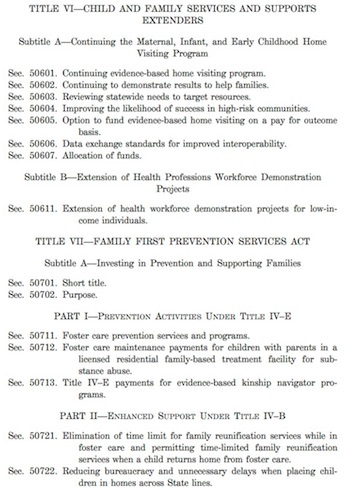
This is historic because there are no civil rights in privatization nor can one execute FOIA, but now we can blow the whistle on fraud in child welfare.

There are a few areas of the Continuing Resolution 2018 for the Budget to extend governmental operations until March 23, 2018 I would like to highlight.

Social Impact Bonds: From its language, I believe that this is going to be a bait and switch for private funding of social programs and this is why:

$100 million is dedicated to the U.S. Treasury, and not Department of Health and Human Services.

U.S. Treasury has some really super duper special enforcement powers of financial accountability, like SIGTARP.

This means if these NGO "Pay For Success" privatized programs do not demonstrate success, they do not get a penny!

Why is this so funny to me?

Well, it is going to be virtually impossible for these NGOs to meet any of the benchmarks set as criteria for success because all one has to do is look out their front window or in their refridgerator to see if these PFS have met the federal benchmarks.

Now, allow us to move on the Families First Act.

I always had issues with it as it just established more and more layers of privatized contractual billing opportunities for fraud, but, considering there are now benchmarks and law enforcement oversight through the U.S. Treasury, I think we finally have a neotin form of oversight from the people.

Did you know the U.S. Treasury has a whistleblower program?

Well, now you do.

Office of the Inspector General
U.S. Treasury Office of Inspector General Whistleblower Fraud Program

You may use the following form to submit your complaint or you may phone, fax, or mail your complaint. Prior to submitting your complaint to the Treasury OIG Hotline, we recommend you review the information located on the main Treasury OIG Hotline page.

Per Treasury Employee Rules of Conduct, 31 C.F.R. §0.207, and Treasury Order 114-01, all Treasury employees and officials are under the affirmative duty to report to the Inspector General any complaints or information concerning the possible existence of any activity constituting a violation of law, rules or regulations relating to the Department. Please be aware that if you intentionally report false information to the Treasury OIG, in some instances, you may be subject to possible criminal or civil penalties. We may make disclosures of information you submit to other parties, including other Federal and State law enforcement agencies, as necessary to complete our investigation, or as required under Federal law. We may also refer your allegation to the appropriate law enforcement agency if we believe you have alleged a criminal or civil violation within their jurisdiction.

You are not required to complete all of the presented information fields. Completion of the fields that are strongly recommended are marked by a * red asterisk. If you wish to elect anonymity or confidentiality, select the appropriate options within Part I of the form and follow the corresponding instructions. Please keep in mind that your decision to elect anonymity may limit our ability to conduct a complete investigation, if one is warranted.

There are other public fraud reporting programs, but I shall save those for another time.

Quintessentially, the public will be conducting the oversight of these privatized child welfare programs through whistleblowers.

Image result for HA HA
"HA-HA!  You will lose your funding if you
sell and/or kill tiny humans."
Fatality Prevention Plans: The States can no longer cover up kids dying in foster care and adoption programs and must come up with a plan to properly report data to the feds, which in this instance, I shall assume, no, I am claiming oversight will be with the U.S. Treasury.

If they lie, the States get their federal grants snatched and face serious reprisal, and I do not limit the reprisals to be only through civil penalties.  These state administrators should be looking at federal criminal investigation referrals and criminal prosecutions.

This concept I am attributing to Senators Hatch-Wyden and their report findings of privatization in of child welfare, I shall leave below.

Michigan sold and killed Ricky Holland for profit, using federal taxpayer dollars, and nothing, nothing, absolutely nothing happened to the perpetrators, and none of "The Elected Ones" did a damn thing about it, which is why I am on a mission.

This is strictly personal.

DACA:  The is nothing but a cover for the international trafficking of tiny humans.  Period.

Home-based, Community-based Visitation Program:  We, the people can now snitch on the States and privatized programs is they violate our civil rights. (See U.S. Treasury Fraud Reporting Program). 


Stay tuned.  More to come and it will not be pretty, trust me.  I am the original source and I am going to be very, very busy for years to come.

One Month of Spending, Years of Child Welfare Reform

The continuing resolution (CR) signed by President Donald Trump this morning funds the government until March 23. But it changed the landscape of federal child welfare funding for the foreseeable future.

Here is Youth Services Insider’s breakdown of the many long-term implications for youth and family services in the spending bill.

Family First Act Is Law of the Land


H.R.1892 - Bipartisan Budget Act of 2018
A few years back, Sens. Orrin Hatch (R-Utah) and Ron Wyden (D-Ore.) – the chair and ranking member on the Senate Finance Committee – merged their child welfare priorities into one bill. Hatch wanted to pressure states to cut down on the use of congregate care and group home placements; Wyden wanted to give child welfare systems more ability to fund services that prevented the use of foster care in more cases.

These were the seeds from which the Family First Prevention Services Act grew, a bill that now has significantly altered the child welfare financing landscape. The Title IV-E entitlement, currently reserved for foster care and adoption assistance expenses, can now be used for 12 months of services aimed at helping families without the use of foster care (well, sort of: many will surely require the assistance of relative caregivers).


The spending bill signed by President Trump includes funding through March 23, and provisions that permanently change the federal entitlement for foster care.

As opioids and meth continue to wreak havoc on American families, the act will enable child welfare systems to tap into IV-E to get addiction treatment for parents that they determine, with the right amount of support, are not a danger to their children. So too for parents suffering from mental illness or basic parenting deficits.

On the other end of the spectrum, proponents of Family First hope that its restrictions on federal funds for congregate care settings is enough to pressure states into relying more on foster homes. There is no current limit to how long IV-E can be used for such placements. Under the new law, states will have only two weeks of federal support guaranteed.

“I cried for about 10 minutes this morning,” said Amy Harfeld, national policy director for the Children’s Advocacy Institute, speaking in celebration of the bill. “There are not a lot of things that shock the hell out of me, but seeing this long fight culminate in victory did. It’s revolutionary. This presents a really exciting challenge to folks in our field to think about the way we do finance child welfare and where we should be making investments.”

“Challenge” is an appropriate word. On the front end, the Family First’s prospects to keep more families together is contingent on states’ willingness to put in their own funds for substance abuse, mental health and parenting services. And success will further be contingent on greater knowledge and proliferation of evidence-based interventions that work to help these parents.

On the back end, use of congregate care has declined over the years as states have come to rely more on relatives and some have built their roster of foster homes. But as The Chronicle of Social Change reported this fall, in more than half of the states, foster home recruitment and retention has not kept pace with the rise in youth placed in foster care.

The Family First Act injects into that situation fiscal pressure to keep youth out of congregate care, where the feds won’t help pay for it, and into foster homes, where the feds will. The Family First Act does include a slate of exceptions to the congregate care limits, chief among them a pass for settings that can be deemed “qualified resident treatment placements.”

Ten years ago, such restrictions on congregate care would have occurred as foster care numbers were ticking down across the country. Today, states will have to find more foster home capacity while some accommodate rapidly rising numbers of kids.

John Sciamanna, vice president of public policy for the Child Welfare League of America (CWLA), summed up the challenges nicely in an e-mail to Youth Services Insider:

Like all child welfare legislation, this is a work in progress. There is great potential to add in new post-reunification and adoption services as well as up-front intervention services. The challenge will be to make sure as many states as possible take the option to draw down the new IV-E services fund. 
In addition, we need to make sure that HHS [the Department of Health and Human Services] is flexible in the programs that can be funded. As part of this we also have to work to make sure that youth in particular are not pushed into another system (juvenile justice, for example) as oversight on institutional care is increased.
YSI will certainly dive deeper into the implications of and details in the Family First Act in the coming weeks.

Home Visiting’s Last-Minute Save

The Maternal, Infant and Early Childhood Home Visiting (MIECHV) program, which pairs professionals with new and expecting mothers to help prepare them for parenthood, faced a shortfall that likely would have prompted program eliminations and staff layoffs across the country.

On Tuesday, the House did not include reauthorization of MIECHV in its spending plans. That is sort of incredible when you consider that the House did include Family First, a new law with massive implications for a federal entitlement, and MIECHV has had bipartisan support for more than a decade.

By Wednesday, when the Senate introduced the CR that actually became law, MIECHV had received a five-year extension at its current rate of $400 million per year. Last year, advocates for the program might have been glum that the authorization wasn’t doubled or at least increased; today, they are surely relieved to just get out with a win.

“Today is a great day for children and families,” said Diedra Spires, CEO of the Dalton Daley Group, which helped coordinate the Home Visiting Coalition, in an e-mail to YSI.  “A five-year reauthorization of MIECHV is tremendous. We are also gladdened by the increased impact that the passage of multiple programs that serve and protect children and families will have over the next five years and beyond.”

The level extension of MIECHV sidesteps House Republicans’ desire to turn it into a match program, requiring equal fiscal participation by states by 2022. That plan had potential in theory to increase the overall investment in home visiting, but MIECHV proponents argued that the opposite would be the reality. Many states, they argued, would not be in a position to meet the federal allocations, leaving millions in MIECHV funds on the table.

Fatality Prevention Plans

Slipped into the original construct of the Family First Act is a provision from a separate law introduced in October by Hatch and Wyden following the Senate Finance Committee’s investigation of privatization in foster care.

Each state would be required under Title IV-B of the Social Security Act to conduct an annual review of child fatalities, collecting data on both the circumstances of the death and facts about the child’s history (siblings, presence of mental health or substance abuse issues, etc.).

The provision embeds the idea of a regular assessment of child fatalities envisioned in the recommendations last year by the Commission to Eliminate Child Abuse and Neglect Fatalities.

The language in the CR is a little looser than the October version, but requires two things from states on this issue: A description of the steps the state is taking to compile complete and accurate information on maltreatment-related deaths, and a description of steps that state is taking to implement a “plan to prevent the fatalities.”

$100 Million for Social Impact Projects

Pay for Success (PFS) projects, also known as social impact bonds, offer governments a sneak peak at the impact of evidence-based interventions and services before they (hopefully) commit to embedding them in policy. Private money is put up to fund the services with agreed-upon benchmarks for success; if the marks are met or exceeded, funders get their money back with potential bonuses. If the benchmarks are not met, the government doesn’t pay a dime.

The CR includes legislation providing $100 million to the Treasury Department to issue for PFS projects around the country. The department has a year to launch the competition for these funds, and another six months to select winners.

The legislation includes a laundry list of acceptable issues and populations for the projects to focus on. Among them:
  • Improving birth outcomes and early childhood health
  • Increasing the number of children living in two-parent households
  • Reducing the number of children living in foster care and returning to foster care
  • Increasing graduation rates
  • Increasing employment rates among youth and young adults
  • Reducing reliance among low-income families on the social safety net
The U.S. accounts for fewer than 20 percent of the 108 projects that have launched worldwide, but it accounts for about half of the total funding committed to PFS ventures, according to new numbers released by Social Finance.

Click here to read our recent interview with Tracy Palandjian, co-founder of Social Finance, on the state of the social impact financing

CHIP Extension Extended, Community Health Centers Get Boost

The Child Health Insurance Program (CHIP) was built as a protective wall to prevent health care costs from making families poor. It helps insure children whose parents make too much to qualify for Medicaid, but not enough money to afford the premiums for quality care for the whole family.
Like MIECHV, CHIP expired in September, and states were making noise about halting enrollment before last month’s CR extended the program for six years.

This deal added an additional four years, giving CHIP a full decade extension, which the Congressional Budget Office estimates will actually save the federal government $6 billion over the decade.

Community health centers serve about 27 million people a year in America, many of them low-income families. Federal funding expired in September, and is renewed in this bill with an increase from last year’s $3.6 billion. The centers will receive $3.8 billion this year, and $4 billion next year.

No DACA

Noticeably absent from the spending agreement is a fix for Deferred Action on Childhood Arrivals (DACA), the program through which people who arrived illegally in America as young children can move toward lawful residency. DACA was rolled out by executive order under President Obama after Congress failed to pass the DREAM Act, a legislative attempt to help this population.
President Trump has set the DACA program to expire in early March, weeks before the next funding deadline for the government. He wants DACA tied to a broader immigration reform.

Voting is beautiful, be beautiful ~ vote.©