Showing posts sorted by relevance for query barbara mcquade. Sort by date Show all posts

Monday, June 10, 2019

WATERGATE 2.0: John Dean Of Watergate Fame & Detroit's Barbara McQuade Testifie To House Judiciary On Mueller Report

Recently, on Cocktailis & Popcorn:


Then, this happened.

Comes now, John Dean, of Watergate fame.

John Dean is testifying as an original source, expert witness, on using congressional resources for a political campaign, through a process of ethics investigations.

Then, Detroit's own Barbara McQuade testifies but the some of the members took issues with this tweet.


Oh....this is absolutely delicious.......mmmmmmmm........... everyone signed a Truth in Testimony affidavit.

Her Flatulent Boviness, Sheila Jackson Lee, rambled something about the Saturday Night Massacre, so I am providing a link to it.

Louie brought up G. Gordon Liddy.


Louie is asking about the Watergate break in with John Dean.


Gaetz is desperately trying to knock down the veracity of the historic expertise.

Unfortunately, Gaetz is demonstrating how poorly his staff prepared him on the history of Watergate.

Ratcliffe rightfully complained that the Majority only delivered the testimony of the witnesses two hours before the hearing.

The Committee definitely needs to #sayhisname, or just subpoena.

Then, this happened.

Justice Department, Judiciary Democrats Reach Deal for Mueller Documents

Bass is asking about that "attorney client privilege" in the Clinton Impeachment, otherwise known as Whitewater Cover up about notes.

Witnesses

Mr. John Dean 
Former White House Counsel
Mr. John Malcolm 
Vice President, Institute for Constitutional Government, Director of the Meese Center for Legal & Judicial Studies and Senior Legal Fellow, The Heritage Foundation
Ms. Barbara McQuade 
Former U.S. Attorney for the Eastern District of Michigan
Ms. Joyce White Vance 
Former U.S. Attorney for the Northern District of Alabama

Documents

116th Congress

Then this happened.

Former U.S. Attorney Tells Congress Trump Committed ‘Multiple Crimes’


Sunday, November 18, 2018

Cocktails & Popcorn: Wikileaks Meets Detroit - Barbara McQuade, Julian Assange & Election Interference

Image may contain: one or more people, people standing and suit
Barbara McQuade
Welcome to Detroit, Julian!

FUN FACT! Barbara McQuade is on the Michigan Governor's transition team for Gretchen Whitmer.

ANOTHER FUN FACT! The Michigan 2018 Primary was never certified by the Michigan Board of Canvassers nor was it recorded by the Secretary of State, which means the 2018 General Election can not be certified nor recorded.

ONE LAST FUN FACT! Barbara McQuade was the U.S. Michigan Eastern District Attorney for the 2016 election interference investigations, which are ongoing.

Surprise disclosure puts Assange in US spotlight

Time may be up for Julian Assange.

The WikiLeaks founder, who played a central role in leaking hacked emails during the 2016 election, has spent the past six years avoiding prosecution in the Ecuadorian Embassy in London. But a recently revealed court filing points to U.S. prosecutors having already pressed sealed charges against him, even as he's avoided arrest.

And with Ecuadorian leaders publicly growing frustrated over their longtime tenant, it could be just a matter of time until Assange faces extradition to the United States.

Assange’s prosecution would be a win for the U.S. federal government, including special counsel Robert Mueller, who has eyed WikiLeaks over the distribution of Democratic emails ahead of the 2016 election that he alleges were hacked by Russian military officers.

The court document, filed in August of this year, was first flagged Thursday on Twitter by Seamus Hughes, a researcher at the George Washington University’s Program on Extremism, hours after The Wall Street Journal first reported that the U.S. was preparing to bring charges against Assange.

Legal experts told The Hill that the mistaken filing is a clear sign that an indictment against Assange is at least in the works, if not already filed against him.

This filing, written by Assistant U.S. Attorney Kellen Dwyer — who is also working on the WikiLeaks case — argues in the unrelated case that it’s necessary to seal the charges in the case in order “to protect this investigation.”

“Another procedure short of sealing will not adequately protect the needs of law enforcement at this time because, due to the sophistication of the defendant and the publicity surrounding the case, no other procedure is likely to keep confidential the fact that Assange has been charged,” the filing reads.

Assange is mentioned again later in the document, in a statement asserting that all documents related to the charges in the unrelated case “would need to remain sealed until Assange is arrested in connection with the charges in the criminal complaint and can therefore no longer evade or avoid arrest and extradition in this matter.”

“So it seems likely that Assange has been charged and the sealing motion was filed in that case, and then somebody made this cut and paste error in this new case,” said former U.S. Attorney Barbara McQuade.

It’s unclear what charges Assange may be facing.

But the U.S. has sought to prosecute him since WikiLeaks distributed classified U.S. cables obtained from former U.S. Army intelligence analyst Chelsea Manning in 2010.

Assange is also facing an arrest warrant in Sweden over an accusation of rape, which he has denied.

Assange’s attorney Jennifer Robinson said Friday that the report is “confirmation of what we’ve been concerned about and been talking about since 2010.”

“There is a very real risk that the United States is going to seek to prosecute him for his publishing activities and potentially seek to extradite him, and that if there was to be an indictment, it would be sealed, it would be secret, and we wouldn’t know that it existed until such time as he was in custody,” she told the progressive show "Democracy Now!"

Prosecutors generally keep charges sealed to prevent from showing their hand as they come closer to apprehending a suspect, over fears that an individual at the center of a case may attempt to escape law enforcement’s jurisdiction or cause harm to others.

Former federal prosecutor Bob Mintz said that while the U.S. will likely still have to follow the standard procedure for extraditing and charging Assange, the inadvertent disclosure of the possible indictment “does inject some additional urgency into the process.”

“I think there will be some desire on the part of the DOJ to expedite this process if they intend to go forward with it,” Mintz said.

McQuade, currently a professor at Michigan Law School, said the filing to seal charges in an indictment is one of the last steps in a case. And considering that this document was filed in August, she predicted that the Assange charges may have been handled before then.

The U.S. has been wary of bringing charges against WikiLeaks in the past, as free speech and First Amendment groups claim that it would be an attack on freedom of speech. WikiLeaks has argued that it is a media outlet and has a right to share the classified documents that it obtains, just as traditional press outlets often do.

Free speech groups have quickly spoken out in defense of Assange since news of the possible indictment broke. The American Civil Liberties Union said in a statement Friday that any prosecution of Assange over WikiLeaks’s actions “would be unprecedented and unconstitutional, and would open the door to criminal investigations of other news organizations.”

McQuade said that in the course of Mueller’s investigation, the special counsel's team may have uncovered evidence that shows WikiLeaks working in coordination with Russian intelligence that causes federal prosecutors to view the group “in a different light.”

She also noted that Assange likely has information that could be valuable to the special counsel's probe, referring to Mueller’s focus on former informal Trump campaign adviser Roger Stone and his interactions with WikiLeaks, as well as the release of the Democratic National Committee emails.
Mueller has been questioning associates of Stone’s for months to determine whether the president’s longtime confidant had prior knowledge of the WikiLeaks email dump. Stone has denied knowing that the group would release the emails, instead claiming that a source gave him an inside tip that WikiLeaks would soon release damaging information that would “roil” the 2016 presidential election.

McQuade added that Assange might want to strike a plea deal with the U.S. if only to get out of the Ecuadorian embassy.

Ecuador has allowed Assange to stay in its embassy in London since 2012. But the country has shown signs that it is growing fed up with Assange’s presence, warning him that he will be evicted from the premises if he doesn’t start cleaning up after himself and his cat.

The nation also said earlier this year that it had granted Assange citizenship, thinking that he may then be able to leave the facility without facing arrest. However, those hopes were dashed when authorities in the United Kingdom said they couldn’t guarantee that Assange wouldn’t be arrested as soon as he left the premises.

Elie Honig, a former federal prosecutor, said the U.S. and Ecuador do have an extradition treaty in place, but that it allows exemptions in cases of political charges. He said that while he’s not sure that Assange’s indictment would be considered a political one — the charges remain unknown — his lawyers could make the argument in court that it does.

Still, he said an indictment against Assange would be significant, considering the bevy of potential charges that the U.S. could be weighing. But just charging Assange would only be the start of the battle.

“I think they would have a hotly contested case in court and likely a trial,” Honig said. “I think that would be the real test.”

Voting is beautiful, be beautiful ~ vote.©

Wednesday, March 6, 2019

Cocktails & Popcorn: Barbara McQuade, Judiciary, Amrock, DACA With Gibson Dunn & Crutcher Featuring Michael, Jolly Jerry's Son

Image result for timing cocktails
"Old fashioneds, it is all about the timing."
The timing is just impeccable.

Here you have Barbara McQuade saying the same thing I just said the other day.

Now, why would Jolly Jerry of Judiciary call for hearings about "obstruction of justice, public corruption, and other abuses of power" when Mueller is about to release his investigative report, and other things, on "obstruction of justice, public corruption, and other abuses of power"?

That sounds so redundant to me, a waste of taxpayer dollars, dilatory distractions, shucking & jiving, you know, your standard clowning right before everyone realizes that all heaven is about to break loose, but hey, what do I know?

I know it looks a bit awkward now that we know that Jolly Jerry's son, Michael Nadler got a job with Gibson Dunn & Crutcher LLP in 2018, which just so happens to be the main law firm suing Trump about protecting their trafficking tiny humans operations, oh, I mean, DACA, but that is not what has me questioning impeccable timing.

In March 2018, Gibson Dunn & Crutcher just so happened to have been representing Amrock in the Canary House Corporate Shape Shifter $706 million dollar fraud judgment, that was just struck down in appeal, as Amrock started crying about blowing the whistle.

I wonder where they got that idea.

We should definitely ask Michael Nadler.

Anyway, I hope everyone enjoys this riveting piece of civil art, created by Barbara McQuade, encouraging Jolly Jerry to embrace the fact that Mueller is very attentive to the proceedings of House Judiciary, and probably the former proceedings of House Judiciary, but hey, what do I know?

I know Barbara McQuade is a Detroit Super Star because she had an entire smear campaign launched against her...that never filed any 990s nor annual reports.

The House’s Sweeping New Probe May Be the Biggest Threat to Trump Yet

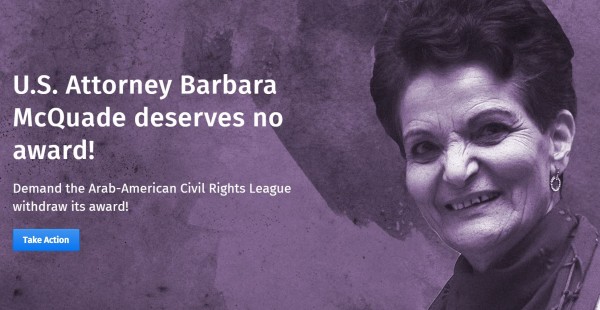
Barbara McQuade Rasmea Defense Committee
Barbara McQuade & her cyber-smear
(When you know you are a Detroit Super Star)

Members of the House Judiciary Committee have an opportunity to provide an important service to the American public – as long as they don’t blow it.

On Monday, the committee opened a sweeping investigation into “obstruction of justice, public corruption, and other abuses of power” relating to President Donald Trump by requesting documents from 81 sources. The committee’s probe could potentially uncover more misconduct than Special Counsel Robert Mueller ever will. Committee Chairman Jerrold Nadler vowed to “hold hearings for the public to have all the facts.” The challenge will be to conduct the investigation effectively without compromising Mueller’s work.

In many ways, the congressional investigation offers advantages that Mueller’s probe lacks.
According to the mandate issued by Deputy Attorney General Rod Rosenstein, Mueller has been investigating links between Russia and the Trump campaign relating to interference with the 2016 presidential election, matters arising in that investigation, and any obstruction of justice that might occur along the way. The House Judiciary Committee, on the other hand, has the power to investigate a much broader scope of possible misconduct. Congress can investigate anything over which it has power to legislate, and committees may explore matters that do not amount to crimes. As Nadler pointed out, his committee is charged with a number of responsibilities, including the duty to investigate “abuses of executive power.”

In addition to the broader scope of its powers, the congressional inquiry also differs from Mueller’s probe in its transparency. While Mueller is bound by grand jury secrecy rules and Department of Justice policies to prevent public disclosure of matters under investigation, congressional committees operate largely in the public. In fact, one purpose of the Judiciary Committee’s probe may be to avoid a scenario in which Mueller ends his investigation without any further public disclosure of his findings, as the special counsel regulations seem to permit. The Committee’s document requests stated that the recipient could limit his initial production to documents already disclosed to the special counsel, the U.S. Attorney’s Office for the Southern District of New York, law enforcement, other congressional committees, or in civil or other litigation. By collecting the same material that Mueller has already gathered, Nadler’s committee may be seeking to replicate Mueller’s investigation, but with materials that can be shared with the public.


With this opportunity before them, the Judiciary Committee needs to avoid missteps that could interfere with Mueller’s work or harm the effectiveness of its own investigation. To that end, here are three pieces of advice for Nadler.

First, hire professional help to conduct questioning. How many more hearings must we endure in which members of Congress take turns grandstanding to make political points, only to be parodied on Saturday Night Live? Asking questions in five-minute bursts provides no opportunity for effective follow-up and allows the witness to filibuster away the allotted time. House Democrats should hire counsel with the training and experience to conduct effective questioning. They should also pool their time so that the questioner can proceed as a prosecutor would at a grand jury session by methodically asking the essential who, what, when, where, and why of important matters, demanding explanations and details along the way, and pinning down witnesses to establish facts from which they cannot later walk away.

Second, be careful whom you immunize. Congress has the power to grant immunity to witnesses who invoke their Fifth Amendment rights not to incriminate themselves. By granting immunity, the Committee can then legally compel the witness to testify because their statements may not be used against them. As we saw in the case of Oliver North, however, immunity granted by Congress can prevent prosecutors from using the witness’s statements, or any leads derived from their statements, against them in criminal proceedings. After the former Marine Corps. lieutenant colonel was convicted for his role in obstructing the investigation of the Iran-Contra affair, North’s conviction was vacated because it was tainted by the use of information derived from his immunized congressional testimony.

If the House Judiciary Committee wants to question witnesses, it should avoid immunizing anyone who might be a target of Mueller’s investigation. Donald Trump Jr., for example, has reportedly not met with Mueller, a sign that he may be a target of the special counsel’s investigation. Offering him immunity to testify before Congress could make it much more difficult for Mueller to charge him criminally. Instead, the Judiciary Committee might focus on witnesses who have already been convicted by Mueller, such as Michael Flynn, George Papadopoulos, and even Paul Manafort.

Congress could also call as witnesses people who were in positions to have committed less egregious misconduct, yet possess valuable information, such as Trump’s former communications director Hope Hicks or his longtime assistant Rhona Graff. These witnesses are unlikely to be high priorities for criminal charges. Or, better yet, the committee should clear with Mueller any witness that the committee might want to immunize.

Third, don’t just copy Mueller’s work, create your own roadmap. The evidence that Watergate Independent Counsel Leon Jaworski turned over to Congress is sometimes referred to as a roadmap for impeachment. While Nadler appears interested in obtaining and memorializing Mueller’s work, he should not end there. Mueller is limited to looking for federal crimes. But just because conduct does not amount to a violation of the criminal code does not mean that Congress should permit it to occur unchecked. For example, while lying to the public is not a crime, if the lie is egregious enough, it might be sufficient to disqualify a president from office. Additional lines of inquiry outside of Mueller’s mandate would be well within the scope of proper congressional inquiry, such as foreign influence on the president’s businesses, profits from his businesses that may constitute prohibited emoluments or use of the presidency to enrich family members and associates. Were Jared Kushner or Erik Prince attempting to form back channels of communication with Russia and the UAE? And if so, why? The House Judiciary Committee can find out the answers to all of these questions, even if they are outside the realm of potential criminal misconduct.

Nadler has a job to do, but he must do it well. The stakes of this investigation are high because the House Judiciary Committee has one power that all other entities lack – the power to initiate impeachment proceedings.

EXCLUSIVE: Jerry Nadler’s Son Works For Firm Suing Trump, Which Presents Conflict of Interest

Image result for Gibson Dunn & Crutcher LLP
https://www.gibsondunn.com/
Democrat congressman Jerry Nadler, leading the investigative charge against President Donald Trump, has a son whose firm is trying to get access to Trump documents for their clients in numerous lawsuits against President Trump.

“Congressman Jerry Nadler has a big conflict,” our source tells Big League Politics in Washington, D.C.

“His son (Michael Nadler) got a job with Gibson Dunn & Crutcher LLP in 2018.  That’s convenient because Jerry Nadler and the Democrats just won control of the House in 2018.  Gibson Dunn & Crutcher hire Jerry’s son and Gibson Dunn & Crutcher are the main Nemesis against Trump and the Trump Administration on numerous lawsuits.  Now the Nadler family will gain access to thousands of Trump documents via Jerry’s subpoenas!,” our insider stated.

Profile Picture
https://www.gibsondunn.com/lawyer/nadler-michael-l/

Gibson Dunn represented CNN’s Jim Acosta in his lawsuit against the Trump White House after President Trump revoked Jim Acosta’s press credentials for creating a disturbance in a press briefing and making physical contact with a female White House intern. In December Gibson Dunn announced that it was representing the Center for Reproductive Rights in its lawsuit against the Trump State Department concerning abortion language in Trump administration human rights reports.

Gibson Dunn’s global co-chairman Ted Boutros sued President Trump in a bid to protect the DACA Dreamer program.

Such an arrangement — Jerry Nadler investigating Trump with his son’s firm trying to get access to documents in other cases — violates ethics rules for federal investigators.

Voting is beautiful, be beautiful ~ vote.©

Thursday, June 30, 2011

DOJ Busts Detroit Public Schools Kiddy Kickback Racket

Shout out to Barbara McQuade:
Image may contain: one or more people, people standing and suit
Barbara McQuade

You go, girl!!!!!!

Detroit Businesswoman Convicted of Defrauding the Detroit Public Schools 
A federal jury in Detroit returned guilty verdicts yesterday against a Detroit businesswoman for conspiracy to defraud the Detroit Public Schools (DPS) of $3.3 million and money laundering conspiracy, announced United States Attorney Barbara McQuade.
Ms. McQuade was joined in the announcement by Special Agent in Charge Andrew G. Arena, Federal Bureau of Investigation, and Special Agent in Charge Erick Martinez, Internal Revenue Service, Criminal Investigation.
Found guilty was Sherry Washington, 54, a partner in an entity doing business as “Associates For Learning.” The jury deliberated for about one hour and 20 minutes before returning the guilty verdicts after a two-week jury trial conducted before United States District Judge Paul D. Borman.
“These defendants exploited the Detroit Public Schools system and essentially stole $3 million that could have been spent on school children,” McQuade said. “We hope that this prosecution will discourage others from taking money that is intended to benefit students.”
According to the superseding indictment, Associates for Learning contracted with Stephen Hill, the former Executive Director of the Risk Management Department at DPS, to facilitate a wellness program for DPS employees, despite the lack of any bidding process or a written contract, in violation of DPS policies. The original proposal was for $150,000 for a six month pilot program. However, in 2005 and 2006 Associates for Learning submitted three inflated, fraudulent invoices to DPS, each for approximately $1 million, which DPS paid by electronic wire transfers. As part of the conspiracy, Hill was paid five percent cash kickbacks by members of Associates For Learning. Washington was also convicted of money laundering in an attempt to conceal the kickbacks.
Seven others charged in this case have all pleaded guilty for their roles in the conspiracy to commit program fraud by submitting fraudulent invoices to DPS for services and thereafter participating in making kickbacks to Hill. Those include Gwendolyn Washington, Marilyn White, and Sally Jo Bond, who were business partners of Sherry Washington’s; Duane Polk, Valerie Polk, Thomas Ray Taylor, and Stephen Hill The original indictment, returned on April 18, 2010, had also named former DPS Risk Management executive Christina Polk-Osumah, who died of natural causes on September 2, 2010.
Sentencings for the defendants are set for July and August.
The case was investigated by special agents of the FBI and IRS with the cooperation of Detroit Public Schools, Office of Inspector General. The case is being investigated and prosecuted by Assistant United States Attorney J. Michael Buckley of the Public Corruption Unit.

Tuesday, December 22, 2015

Officials, interfaith and civil rights activists condemn bigotry

Officials, interfaith and civil rights activists condemn bigotry
Congress members Brenda Lawrence (L), John Conyers and Debbie Dingell stand at the podium in front 
of a group of activists and officials at Charles Wright Museum of African American History, Dec. 21


DETROIT — Heads of civil rights organizations, interfaith activists, government officials and religious leaders gathered at the Charles H. Wright Museum of African American history to condemn the rising tides of Islamophobia, which are manifesting as hate crimes across the nation.

Speakers from the group dubbed "One Nation, One Voice Against Bigotry and Hate Coalition" took turns denouncing xenophobia and promoting unity at a press conference on Monday morning. 

Nabih Ayad, chairman of the Arab American Civil Rights League (ACRL), said those on the path of hate are on the wrong side of history.

"We know very well that diversity inherently is very strong for this nation and for this community," he said. 

Democratic U.S. Reps speak out
U.S. Reps. John Conyers (D-Detroit), Debbie Dingell (D-Dearborn) and Brenda Lawrence (D-Southfield) took part in the event and voiced support for the local Muslim community.

"How wonderful it is to see in this important hall a group of men and women, leaders of many different organizations, coming together to speak out and encourage the diversity that marks us a great area," Conyers, the dean of the House of Representatives, said.

Congresswoman Lawrence urged Americans to speak up against discrimination.

"History has taught us that the biggest threat to our democracy is silence," she said.

She said allowing bigotry to go on against one group puts the entire society at risk.

"Collectively, if we raise our voices and not be silent, we can make a difference," Lawrence added. "We can show those who are misinformed that hatred will not be tolerated; not in this country, not in southeast Michigan."

Rep. Dingell stressed that metro Detroit residents are united. She described Arab and Muslim Americans as friends and colleagues.

"They are our neighbors; they are our small business owners; they are our doctors," she said. "Steve Jobs’ father was a Syrian and he [Jobs] was one of the greatest inventors of this country."

She said anti-Muslim sentiments violate the fundamental founding principles of the United States.
"Stop," Dingell said, addressing those who promote anti-Muslim bigotry. "Enough is enough. It's not who we are as Americans."

The congresswoman said she will scream if she is asked about Muslims' denouncing terrorism again.
"They're speaking out every day, but the media is not covering it," she added.

Barbara McQuade
"False narrative"
Barbara McQuade, the U.S. attorney for the Eastern District of Michigan, said the backlash against Arab and Muslim Americans harms national security.

"We know that terrorist organizations like ISIS use this rhetoric as propaganda," she said. "They love to use that false narrative that America is at war with Islam."

McQuade said "misguided stereotypes" about Arabs and Muslims are spreading because people are afraid to interact with others who are different."Why is it when Timothy McVeigh commits a terrorist attack in Oklahoma City, no one blames all Catholics?" she asked. "When a White supremacist shoots up a Black church, no one blames all Whites. Yet, when there is a terrorist attack committed by a Muslim, we paint with a broad brush. Why is that? Because we demonize that which is different."

McQuade said during World War II German Americans were not put in internment camps, but Japanese Americans were— "because they look different."

To suggest that Muslim Americans are less American than the rest of us is insulting to all of us,"

McQuade said. "When it comes to national security, united we stand; and divided we fall."

Wayne County Executive Warren Evans acknowledged the contributions of local Arabs and Muslims to the county.

"Diversity is important to being successful," he said.

Evans said bigotry and lack of respect are a problem for the development of the county, state and nation.

Steve Spreitzer, president of the Michigan Roundtable for Diversity and Inclusion, said people should come to know the larger human family around them.

"Dr. King marched to Selma for voting rights and to Washington for human rights," he said. "What we need in southeast Michigan is to march across these artificial barriers for human relations and for people to come to know people who are different."

Nabby Yono, vice president of community relations at the Arab American and Chaldean Council (ACC), said prejudice is the same whether against Arabs, Chaldeans, Christians or Muslims and should be condemned.

"We're in it together," he said. 

"Did you get it?"
The Arab American News Publisher Osama Siblani, who emceed the conference, reiterated Arab Americans' stance on terrorism.

"Just in case you did not hear it before, here it is again — we, the Arab and Muslim communities in the United States, condemn terrorist acts, whether they are acted by individuals, groups or governments," Siblani said.

"Did you get it?" he asked reporters. "Did everybody hear it? Should I repeat it again. Stop asking us to apologize for the terrorists, because we are their first victims."

Dearborn Mayor Jack O'Reilly paid tribute to the Charles H. Wright Museum, which chronicles African Americans' historic struggles with slavery and segregation.

The mayor said it was fitting to hold the press conference at the museum because it details some of the greatest mistakes the United States has committed.

"We can't go back and we can't slide back," O'Reilly said. "What I'm most concerned about particularly is our citizens who feel threatened and are afraid."

The mayor added that politicians with supposed credibility are promoting xenophobia at the national level, adding that Muslim citizens fear for their constitutional rights.

"We just can't let that happen," O'Reilly said. "We have to protect everyone."

Dearborn Police Chief Ron Haddad stressed public safety, reaffirming his department's commitment to protecting the civil rights and liberties of all residents.

"I'm proud to stand here with our group," Haddad said. "We're going to make sure that — from a public safety perspective — we do all we can."

Brenda Rosenberg, the founder of Pathways to Peace Foundation in Action, emphasized the importance of dialogue between ethnic and religious groups.

Rosenberg said she sent an email last week with a list of 12 Jewish civil rights, religious and political organizations that stood with the Muslim community.

"We have to come together and stand together like we're doing today," she said.

The message against Islamophobia was also reiterated by Rev. Dr. Wendell Anthony, president of Detroit Chapter of the NAACP; Fatina Abdrabboh, executive director of ADC-Michigan; Shirley Stancato, president of New Detroit; Najah Bazzy, of Zaman International; and former State Rep. Rashida Tlaib, campaign manager of Take on Hate.

Voting is beautiful, be beautiful ~ vote.©

Tuesday, May 7, 2019

McQuade Announces The League Of Old School Civil Rights Legal Dogs

Image result for mephistopheles faust
"How did I win the 2016 election? What if there
is election interference in 2018 or 2020?"
"Worry ye not, for we are here to whisper in your ears."

Trump being advised by his top advisor, Mephistopheles.
 2016 to present 
Former Federal Prosecutors can be whistleblowers, too, you know.

This is about false advisement by the nefarious ones by whispering into the ears of the king.

That is how attorney-client privilege immunities are stripped.

Trump is not an attorney but Barb and her League of Old School Civil Rights Legal Dogs are.

#sayhisname

McQuade: Trump committed obstruction of justice

Former Detroit U.S. Attorney Barb McQuade signed onto a statement Monday with hundreds of other former federal prosecutors saying President Donald Trump would be charged with crimes for obstruction of justice were he not in the White House.

"I see Watergate 'Legal Geniuses' (trademark pending)"
Barbara McQuade - MIED
McQuade said on Twitter that she endorsed the document "to make clear what (Special Counsel Robert) Mueller’s nuance may have obscured: Trump’s conduct violated the obstruction of justice statute, and he would be charged with crimes if he were not president."

McQuade, who was appointed by President Barack Obama, served as the top federal prosecutor for the Eastern District of Michigan from 2010 to March 2017, stepping down after Trump took office.

She co-chaired the Terrorism and National Security Subcommittee of the Attorney General’s Advisory Committee from 2010-17.

Now a professor at the University of Michigan School of Law, McQuade has opined extensively on the Mueller investigation and report. 


The letter, published on the website Medium, had been signed by more than 390 former federal prosecutors from both Republican and Democratic administrations, as of Monday afternoon. They described themselves as former "line attorneys, supervisors, special prosecutors, United States Attorneys and senior officials at the Department of Justice."

Trump has incorrectly said the Mueller report "exonerated" him. The group of former prosecutors painted a different picture.

"Despite the tremendous success that I have had as President, including perhaps the greatest ECONOMY and most successful first two years of any President in history, they have stolen two years of my (our) Presidency (Collusion Delusion) that we will never be able to get back," Trump tweeted Sunday.

"Also, there are 'No High Crimes & Misdemeanors,' No Collusion, No Conspiracy, No Obstruction. ALL THE CRIMES ARE ON THE OTHER SIDE, and that’s what the Dems should be looking at, but they won’t. Nevertheless, the tables are turning!"

In the statement, the prosecutors said the details included in Mueller’s report would, "in the case of any other person not covered by the Office of Legal Counsel policy against indicting a sitting president, result in multiple felony charges for obstruction of justice."

They specifically cite Trump's alleged efforts to fire Mueller via former White House counsel Donald McGahn and then to "falsify evidence about that effort."

"Firing Mueller would have seriously impeded the investigation of the President and his associates  —  obstruction in its most literal sense," they wrote.

"Directing the creation of false government records in order to prevent or discredit truthful testimony is similarly unlawful."

The prosecutors also point to Trump's efforts to limit the scope of Mueller’s investigation to exclude his conduct and to prevent witnesses from cooperating with investigators probing him and his campaign.

"All of this conduct  —  trying to control and impede the investigation against the President by leveraging his authority over others  —  is similar to conduct we have seen charged against other public officials and people in powerful positions," the prosecutors wrote.

McQuade, who oversaw public corruption cases while in office, has also questioned Attorney General Bill Barr's decision to conclude that Trump hadn't violated any laws after Mueller found it inappropriate to say whether Trump committed obstruction of justice.

"Barr has said that were no instances in which he overruled the special counsel. In fact, he overruled Mueller’s finding of obstruction," she tweeted last week.

"He should just say so instead of using letters, press conference and testimony to mislead the public." 
McQuade has also criticized Trump for downplaying Russian interference in the 2016 election, saying "Trump’s failure to protect our country from future attacks is his biggest betrayal."

STATEMENT BY FORMER FEDERAL PROSECUTORS

We are former federal prosecutors. We served under both Republican and Democratic administrations at different levels of the federal system: as line attorneys, supervisors, special prosecutors, United States Attorneys, and senior officials at the Department of Justice. The offices in which we served were small, medium, and large; urban, suburban, and rural; and located in all parts of our country.

Each of us believes that the conduct of President Trump described in Special Counsel Robert Mueller’s report would, in the case of any other person not covered by the Office of Legal Counsel policy against indicting a sitting President, result in multiple felony charges for obstruction of justice.
The Mueller report describes several acts that satisfy all of the elements for an obstruction charge: conduct that obstructed or attempted to obstruct the truth-finding process, as to which the evidence of corrupt intent and connection to pending proceedings is overwhelming. These include:

· The President’s efforts to fire Mueller and to falsify evidence about that effort;
· The President’s efforts to limit the scope of Mueller’s investigation to exclude his conduct; and
· The President’s efforts to prevent witnesses from cooperating with investigators probing him and his campaign.

Attempts to fire Mueller and then create false evidence

Despite being advised by then-White House Counsel Don McGahn that he could face legal jeopardy for doing so, Trump directed McGahn on multiple occasions to fire Mueller or to gin up false conflicts of interest as a pretext for getting rid of the Special Counsel. When these acts began to come into public view, Trump made “repeated efforts to have McGahn deny the story” — going so far as to tell McGahn to write a letter “for our files” falsely denying that Trump had directed Mueller’s termination.

Firing Mueller would have seriously impeded the investigation of the President and his associates — obstruction in its most literal sense. Directing the creation of false government records in order to prevent or discredit truthful testimony is similarly unlawful. The Special Counsel’s report states: “Substantial evidence indicates that in repeatedly urging McGahn to dispute that he was ordered to have the Special Counsel terminated, the President acted for the purpose of influencing McGahn’s account in order to deflect or prevent scrutiny of the President’s conduct toward the investigation.”

Attempts to limit the Mueller investigation

The report describes multiple efforts by the president to curtail the scope of the Special Counsel’s investigation.

Second, after McGahn told the President that he could not contact Sessions himself to discuss the investigation, Trump went outside the White House, instructing his former campaign manager, Corey Lewandowski, to carry a demand to Sessions to direct Mueller to confine his investigation to future elections. Lewandowski tried and failed to contact Sessions in private. After a second meeting with Trump, Lewandowski passed Trump’s message to senior White House official Rick Dearborn, who Lewandowski thought would be a better messenger because of his prior relationship with Sessions. Dearborn did not pass along Trump’s message.

As the report explains, “[s]ubstantial evidence indicates that the President’s effort to have Sessions limit the scope of the Special Counsel’s investigation to future election interference was intended to prevent further investigative scrutiny of the President’s and his campaign’s conduct” — in other words, the President employed a private citizen to try to get the Attorney General to limit the scope of an ongoing investigation into the President and his associates.

All of this conduct — trying to control and impede the investigation against the President by leveraging his authority over others — is similar to conduct we have seen charged against other public officials and people in powerful positions.

Witness tampering and intimidation

The Special Counsel’s report establishes that the President tried to influence the decisions of both Michael Cohen and Paul Manafort with regard to cooperating with investigators. Some of this tampering and intimidation, including the dangling of pardons, was done in plain sight via tweets and public statements; other such behavior was done via private messages through private attorneys, such as Trump counsel Rudy Giuliani’s message to Cohen’s lawyer that Cohen should “[s]leep well tonight[], you have friends in high places.”

Of course, these aren’t the only acts of potential obstruction detailed by the Special Counsel. It would be well within the purview of normal prosecutorial judgment also to charge other acts detailed in the report.

We emphasize that these are not matters of close professional judgment. Of course, there are potential defenses or arguments that could be raised in response to an indictment of the nature we describe here. In our system, every accused person is presumed innocent and it is always the government’s burden to prove its case beyond a reasonable doubt. But, to look at these facts and say that a prosecutor could not probably sustain a conviction for obstruction of justice — the standard set out in Principles of Federal Prosecution — runs counter to logic and our experience.

Image result for protect democracy
https://protectdemocracy.org/
As former federal prosecutors, we recognize that prosecuting obstruction of justice cases is critical because unchecked obstruction — which allows intentional interference with criminal investigations to go unpunished — puts our whole system of justice at risk. We believe strongly that, but for the OLC memo, the overwhelming weight of professional judgment would come down in favor of prosecution for the conduct outlined in the Mueller Report.

If you are a former federal prosecutor and would like to add your name below, click here.

Protect Democracy will update this list daily with new signatories.

Signatories have been vetted to the best of our ability.

Here is another list of "well-armed" militia with institutional brigades.

Voting is beautiful, be beautiful ~ vote.©

Monday, September 16, 2019

MCQUADE: Democrats should think like criminal prosecutors as they investigate Trump impeachment

Will impeaching Donald Trump protect the public, deter criminal behavior and promote respect for the rule of law? If so, Democrats have a duty to act.
Image may contain: one or more people, people standing and suit
Barbara McQuade

The House Judiciary Committee has adopted procedures for impeachment proceedings and, according to Chairman Jerrold Nadler, the vote signals the start of “an aggressive series of hearings” starting Tuesday. Others, like House Majority Leader Nancy Pelosi, seem concerned that an impeachment that results in an acquittal in the Senate would create a backlash that will boost President Donald Trump’s reelection effort in 2020. But perhaps political victory should not be the sole motivation for impeachment.

Congress can find some lessons about impeachment from the way prosecutors make investigative and charging decisions.

In a criminal case, an investigation begins when there is a serious allegation of criminal conduct. Investigators must decide whether the allegations are seriousness enough to expend investigative resources. At that stage, the investigators do not know what the outcome of their work will be. Investigators take the evidence where it leads, seeking an indictment from a grand jury only if the evidence merits charges.

Are allegations against Trump serious enough?

Similarly, in the case of impeachment, an investigation should begin only if serious allegations merit the distraction from other business that it will require. Here, Nadler has said that he plans to focus on obstruction, corruption and abuse of power. The House is reviewing obstructive acts described in the Mueller report, payments of hush money to silence adult film actor Stormy Daniels about alleged marital infidelity on the eve of the election, Trump’s alleged use of the presidency to enrich himself, and his administration’s refusal to comply with congressional subpoenas. These are serious allegations that merit further inquiry, even if the outcome of an investigation is unknown.

Once prosecutors have learned the relevant facts, they consider two questions. First, they decide whether a crime has been committed. In the case of impeachment, the question would be whether Trump has committed a high crime or misdemeanor. But prosecutors do not automatically file charges just because a crime has been committed, and neither should the House vote to impeach without further consideration. The second part of the equation is whether a substantial interest requires filing charges. That is, not only do prosecutors decide whether they can file charges, they also decide whether they should file charges. In the case of Trump, members of Congress must consider the seriousness of any wrongdoing they find.

Once prosecutors decide that a crime has been committed, and that a crime should be charged, they must decide what charges to file. Although investigations often get broader before they get narrower, filing every charge possible is rarely the best way to proceed because weak charges can dilute stronger ones. The House would be wise to pare down potential charges from its list to those that are the most egregious and are based on the strongest evidence. The investigation will inform its decision as to whether to file charges, and if so, which charges to file.

Extraordinary step could end presidency
In making charging decisions, prosecutors must also consider why charges are appropriate. They must be able to articulate why an offender should be punished for a particular offense. The criminal justice system exists to punish offenders in hopes of protecting the public, deterring criminal behavior and promoting respect for the rule of law, among other reasons.

In the realm of impeachment, House members should think of these interests as well as they decide whether to take the extraordinary step that could end a presidency. If we simply shrug and allow Trump’s behavior to go unaddressed, is the public harmed? If we tolerate Trump’s behavior now, does that give license to future presidents to abuse the power of their office? If we give Trump a pass, do other citizens tend to believe that the duty to comply with law is not to be taken seriously?

Nadler has stated his reason for the impeachment investigation: “The conduct under investigation poses a threat to our democracy. We have an obligation to respond to this threat.”

Even if an acquittal of Trump in the Republican-controlled Senate seems likely, maybe impeachment is still important to the long-term health of our republic. Members of the House should ask themselves whether they want to be able to say that at this moment in history, they cared more about protecting the public, deterring criminal behavior and promoting respect for the rule of law than about winning the next election. At some point, we must put country before party, and duty before politics.

Barbara McQuade, a former U.S. attorney for the Eastern District of Michigan, is a professor at the University of Michigan Law School and a member of USA TODAY's Board of Contributors. Follow her on Twitter: @barbmcquade

Voting is beautiful, be beautiful ~ vote.©